Herodotus, Histories 3.39-49: Polycrates and his ring
Introduction
Herodotus of Halicarnassus wrote the Histories in the third quarter of the 5th century BCE, an inquiry into the deeds of Greeks and barbarians and the causes of the wars between them, later divided into nine books. Book 3 tells of Cambyses' conquest of Egypt and his madness, Polycrates of Samos, the rising of the Magi and the seven Persians who overthrew them, the accession of Darius and his provinces, and the revolt and recapture of Babylon.
The photographs are of Florence, Biblioteca Medicea Laurenziana, Plut. 70.3 (parchment, 10th century, 374 folios, 31 lines a page), Herodotus, Histories (codex A of the editors), the oldest surviving manuscript of the complete Histories, from the Teca Digitale of the Biblioteca Medicea Laurenziana. Each section below is the text of one page, or of the part of a page that falls within these chapters. The first and last words of every page were read on the photograph and located in the Greek, and every page break was checked against the next page; the notes quote these words. Readers' notes in the margins are not part of the text and are mentioned where they occur.
The Greek is the text printed in A. D. Godley's Loeb edition (1920-1925), from Perseus; it is the edited text, not a transcription of the manuscript, whose wording differs in places. The English is Godley's translation as printed, from Wikisource. Godley's English carries only chapter numbers; the section numbers shown in it were placed by comparison with the Perseus version of his translation. Each page's English is cut at the end of one of Godley's sentences, so it can begin or end a few lines away from the Greek of the page; each note gives the exact ranges.
This entry covers chapters 3.39-49, on fol. 113v to 116r.
How was this verified? (Provenance)
Where on the image
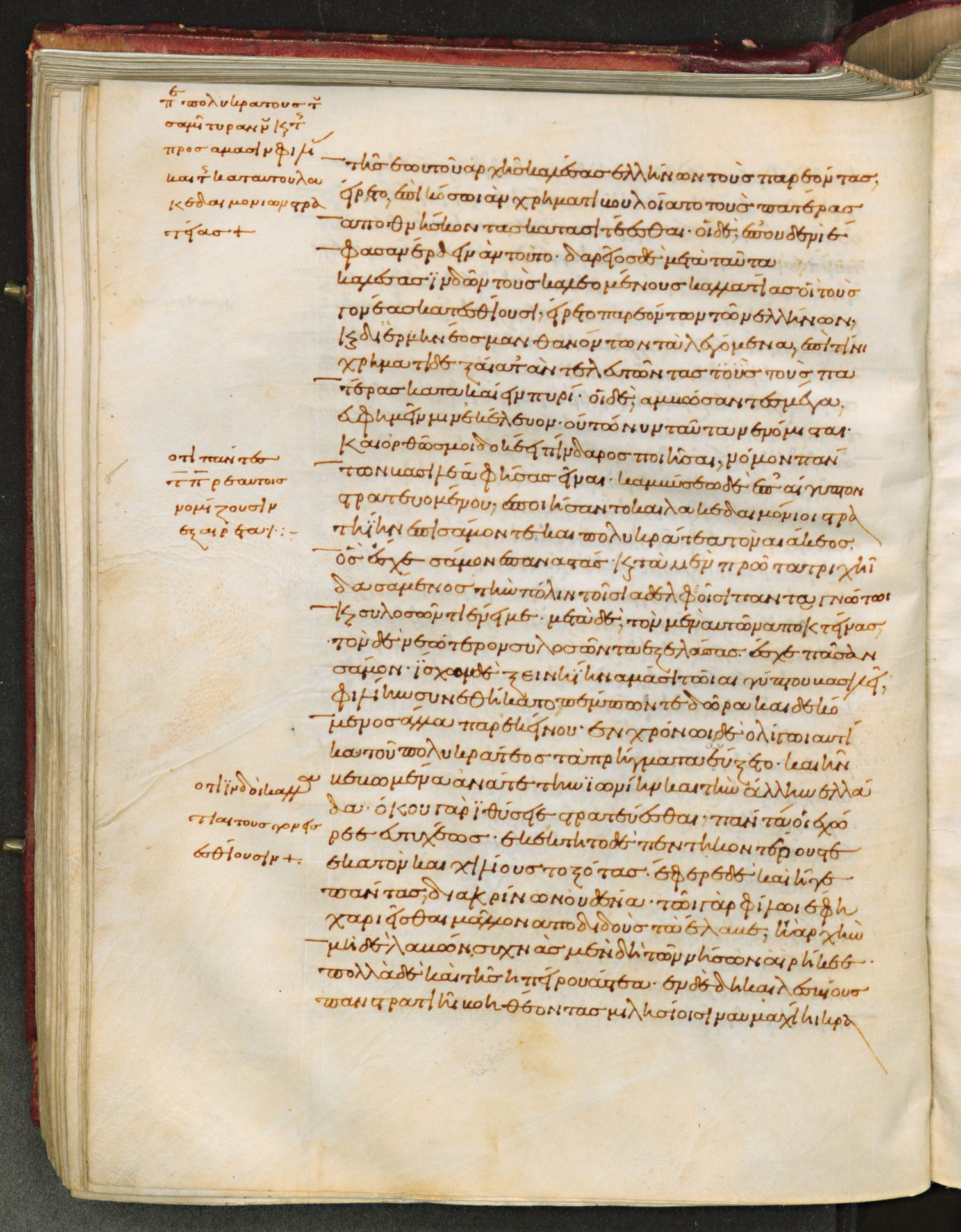
Laur. Plut. 70.3, fol. 113v: Greek here 3.39.1 to 3.39.4. Checked on the image (first and last words read and located in the Greek; each break checked against the neighbouring page): fol. 113v begins ‹τῆς ἑωυτοῦ ἀρχῆς καλέσας› (3.38.3), ends ‹βοηθέοντας Μιλησίοισι ναυμαχίῃ κρα-› (3.39.4). English here: 3.39.1 to 3.39.4 (Godley's sentences for the sections whose Greek lies mostly on this page).
3.39.1Καμβύσεω δὲ ἐπʼ Αἴγυπτον στρατευομένου ἐποιήσαντο καὶ Λακεδαιμόνιοι στρατηίην ἐπὶ Σάμον τε καὶ Πολυκράτεα τὸν Αἰάκεος· ὃς ἔσχε Σάμον ἐπαναστάς, 3.39.2καὶ τὰ μὲν πρῶτα τριχῇ δασάμενος τὴν πόλιν […] τοῖσι ἀδελφεοῖσι Πανταγνώτῳ καὶ Συλοσῶντι ἔνειμε, μετὰ δὲ τὸν μὲν αὐτῶν ἀποκτείνας τὸν δὲ νεώτερον Συλοσῶντα ἐξελάσας ἔσχε πᾶσαν Σάμον, σχὼν δὲ ξεινίην Ἀμάσι τῷ Αἰγύπτου βασιλέι συνεθήκατο, πέμπων τε δῶρα καὶ δεκόμενος ἄλλα παρʼ ἐκείνου. 3.39.3ἐν χρόνῳ δὲ ὀλίγῳ αὐτίκα τοῦ Πολυκράτεος τὰ πρήγματα ηὔξετο καὶ ἦν βεβωμένα ἀνά τε τὴν Ἰωνίην καὶ τὴν ἄλλην Ἑλλάδα· ὅκου γὰρ ἰθύσειε στρατεύεσθαι, πάντα οἱ ἐχώρεε εὐτυχέως. ἔκτητο δὲ πεντηκοντέρους τε ἑκατὸν καὶ χιλίους τοξότας, ἔφερε δὲ καὶ ἦγε πάντας διακρίνων οὐδένα· 3.39.4τῷ γὰρ φίλῳ ἔφη χαριεῖσθαι μᾶλλον ἀποδιδοὺς τὰ ἔλαβε ἢ ἀρχὴν μηδὲ λαβών. συχνὰς μὲν δὴ τῶν νήσων ἀραιρήκεε, πολλὰ δὲ καὶ τῆς ἠπείρου ἄστεα· ἐν δὲ δὴ καὶ Λεσβίους πανστρατιῇ βοηθέοντας Μιλησίοισι ναυμαχίῃ κρατήσας
3.39.1While Cambyses was attacking Egypt, the Lacedaemonians too made war upon Samos and Aeaces’ son Polycrates. 3.39.2He had revolted and won Samos, and first, dividing the city into three parts, gave a share in the government to his brothers Pantagnotus and Syloson; but presently he put one of them to death, banished the younger, Syloson, and so made himself lord of all Samos; which done, he made a treaty with Amasis king of Egypt, sending and receiving from him gifts. 3.39.3Very soon after this Polycrates grew to such power that he was famous in Ionia and all other Greek lands; for all his warlike enterprises prospered. An hundred fifty-oared ships he had, and a thousand archers, 3.39.4and he harried all men alike, making no difference; for, he said, he would get more thanks if he gave a friend back what he had taken than if he never took it at all. He had taken many of the islands, and many of the mainland cities. Among others, he conquered the Lesbians; they had brought all their force to aid the Milesians, and Polycrates worsted them in a sea-fight; it was they who, being his captives, dug all the fosse round the citadel of Samos.
Where on the image
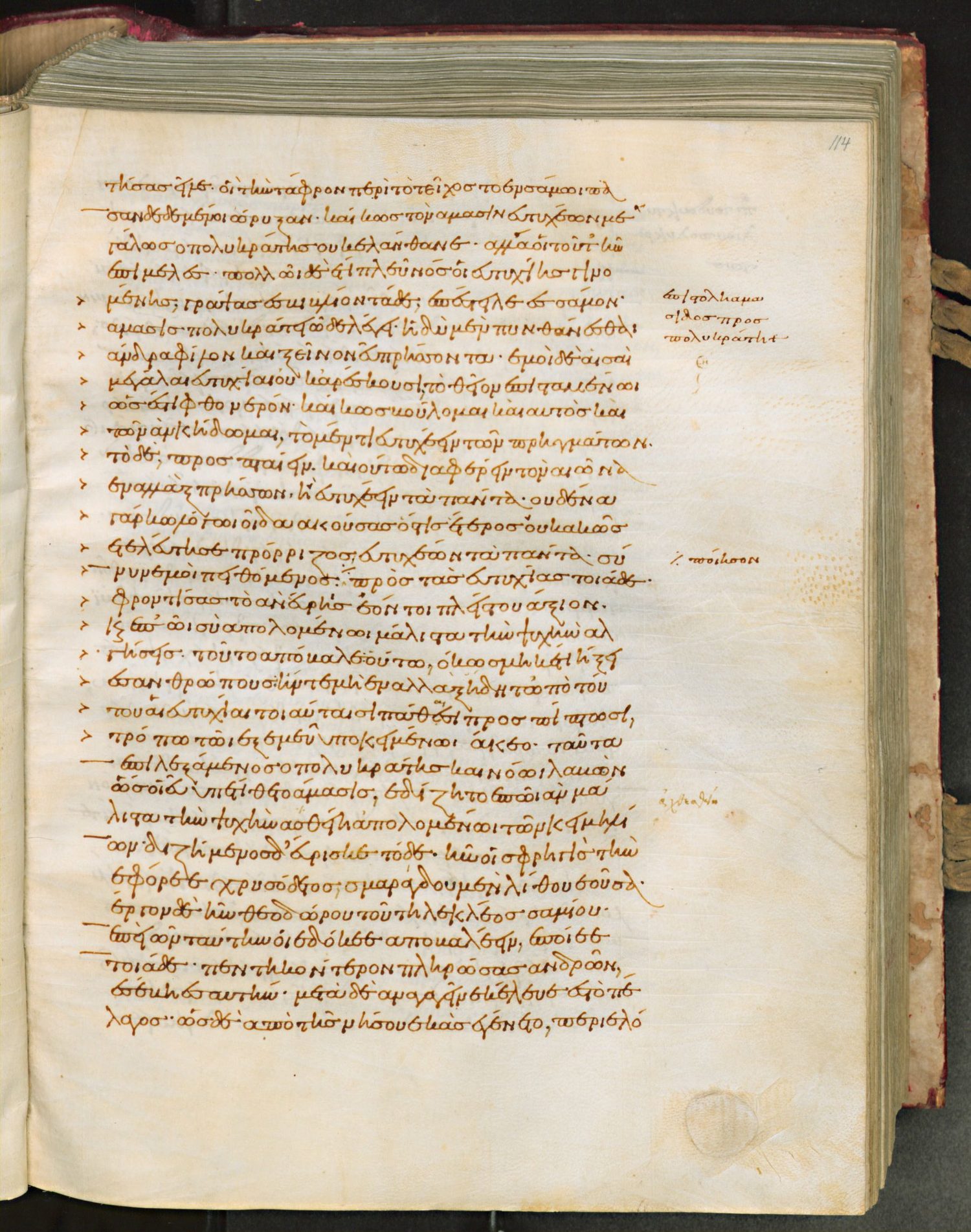
Laur. Plut. 70.3, fol. 114r: Greek here 3.39.4 to 3.41.2. Checked on the image (first and last words read and located in the Greek; each break checked against the neighbouring page): fol. 114r begins ‹-τήσας εἷλε, οἳ τὴν› (3.39.4), ends ‹νήσου ἑκὰς ἐγένετο, περιελό-› (3.41.2). The word ‹κρατήσας› is divided between fol. 113v and fol. 114r; it is given with fol. 113v. English here: 3.40.1 to 3.41.2 (Godley's sentences for the sections whose Greek lies mostly on this page).
3.39.4εἷλε, οἳ τὴν τάφρον περὶ τὸ τεῖχος τὸ ἐν Σάμῳ πᾶσαν δεδεμένοι ὤρυξαν. 3.40.1καί κως τὸν Ἄμασιν εὐτυχέων μεγάλως ὁ Πολυκράτης οὐκ ἐλάνθανε, ἀλλά οἱ τοῦτʼ ἦν ἐπιμελές. πολλῷ δὲ ἔτι πλεῦνός οἱ εὐτυχίης γινομένης γράψας ἐς βυβλίον τάδε ἐπέστειλε ἐς Σάμον. Ἄμασις Πολυκράτεϊ ὧδε λέγει. 3.40.2ἡδὺ μὲν πυνθάνεσθαι ἄνδρα φίλον καὶ ξεῖνον εὖ πρήσσοντα· ἐμοὶ δὲ αἱ σαὶ μεγάλαι εὐτυχίαι οὐκ ἀρέσκουσι, τὸ θεῖον ἐπισταμένῳ ὡς ἔστι φθονερόν· καί κως βούλομαι καὶ αὐτὸς καὶ τῶν ἂν κήδωμαι τὸ μέν τι εὐτυχέειν τῶν πρηγμάτων τὸ δὲ προσπταίειν, καὶ οὕτω διαφέρειν τὸν αἰῶνα ἐναλλὰξ πρήσσων ἢ εὐτυχέειν τὰ πάντα. 3.40.3οὐδένα γάρ κω λόγῳ οἶδα ἀκούσας ὅστις ἐς τέλος οὐ κακῶς ἐτελεύτησε πρόρριζος, εὐτυχέων τὰ πάντα. σύ νυν ἐμοὶ πειθόμενος ποίησον πρὸς τὰς εὐτυχίας τοιάδε· 3.40.4φροντίσας τὸ ἂν εὕρῃς ἐόν τοι πλείστου ἄξιον καὶ ἐπʼ ᾧ σὺ ἀπολομένῳ μάλιστα τὴν ψυχὴν ἀλγήσεις, τοῦτο ἀπόβαλε οὕτω ὅκως μηκέτι ἥξει ἐς ἀνθρώπους· ἤν τε μὴ ἐναλλὰξ ἤδη τὠπὸ τούτου αἱ εὐτυχίαι τοι τῇσι πάθῃσι προσπίπτωσι, τρόπῳ τῷ ἐξ ἐμεῦ ὑποκειμένῳ ἀκέο. 3.41.1ταῦτα ἐπιλεξάμενος ὁ Πολυκράτης καὶ νόῳ λαβὼν ὥς οἱ εὖ ὑπετίθετο Ἄμασις, ἐδίζητο ἐπʼ ᾧ ἂν μάλιστα τὴν ψυχὴν ἀσηθείη ἀπολομένῳ τῶν κειμηλίων, διζήμενος δὲ εὕρισκε τόδε. ἦν οἱ σφρηγὶς τὴν ἐφόρεε χρυσόδετος, σμαράγδου μὲν λίθου ἐοῦσα, ἔργον δὲ ἦν Θεοδώρου τοῦ Τηλεκλέος Σαμίου. 3.41.2ἐπεὶ ὦν ταύτην οἱ ἐδόκεε ἀποβαλεῖν, ἐποίεε τοιάδε· πεντηκόντερον πληρώσας ἀνδρῶν ἐσέβη ἐς αὐτήν, μετὰ δὲ ἀναγαγεῖν ἐκέλευε ἐς τὸ πέλαγος· ὡς δὲ ἀπὸ τῆς νήσου ἑκὰς ἐγένετο, περιελόμενος
3.40.1Now Amasis was in some wise aware and took good heed of Polycrates’ great good fortune; and this continuing to increase greatly, he wrote this letter and sent it to Samos: “From Amasis to Polycrates, these. 3.40.2It is pleasant to learn of the well-being of a friend and ally. But I like not these great successes of yours; for I know how jealous are the gods; and I do in some sort desire for myself and my friends a mingling of prosperity and mishap, and a life of weal and woe thus chequered, rather than unbroken good fortune. 3.40.3For from all I have heard I know of no man whom continual good fortune did not bring in the end to evil, and utter destruction. Therefore if you will be ruled by me do this in the face of your successes: 3.40.4consider what you deem most precious and what you will most grieve to lose, and cast it away so that it shall never again be seen among men; then, if after this the successes that come to you be not chequered by mishaps, strive to mend the matter as I have counselled you.” 3.41.1Reading this, and perceiving that Amasis’ advice was good, Polycrates considered which of his treasures it would most afflict his soul to lose, and to this conclusion he came: he wore a seal set in gold, an emerald, wrought by Theodorus son of Telecles of Samos; 3.41.2being resolved to cast this away, he embarked in a fifty-oared ship with its crew, and bade them put out to sea; and when he was far from the island, he took off the seal-ring in sight of all that were in the ship and cast it into the sea. This done, he sailed back and went to his house, where he grieved for the loss.
Where on the image
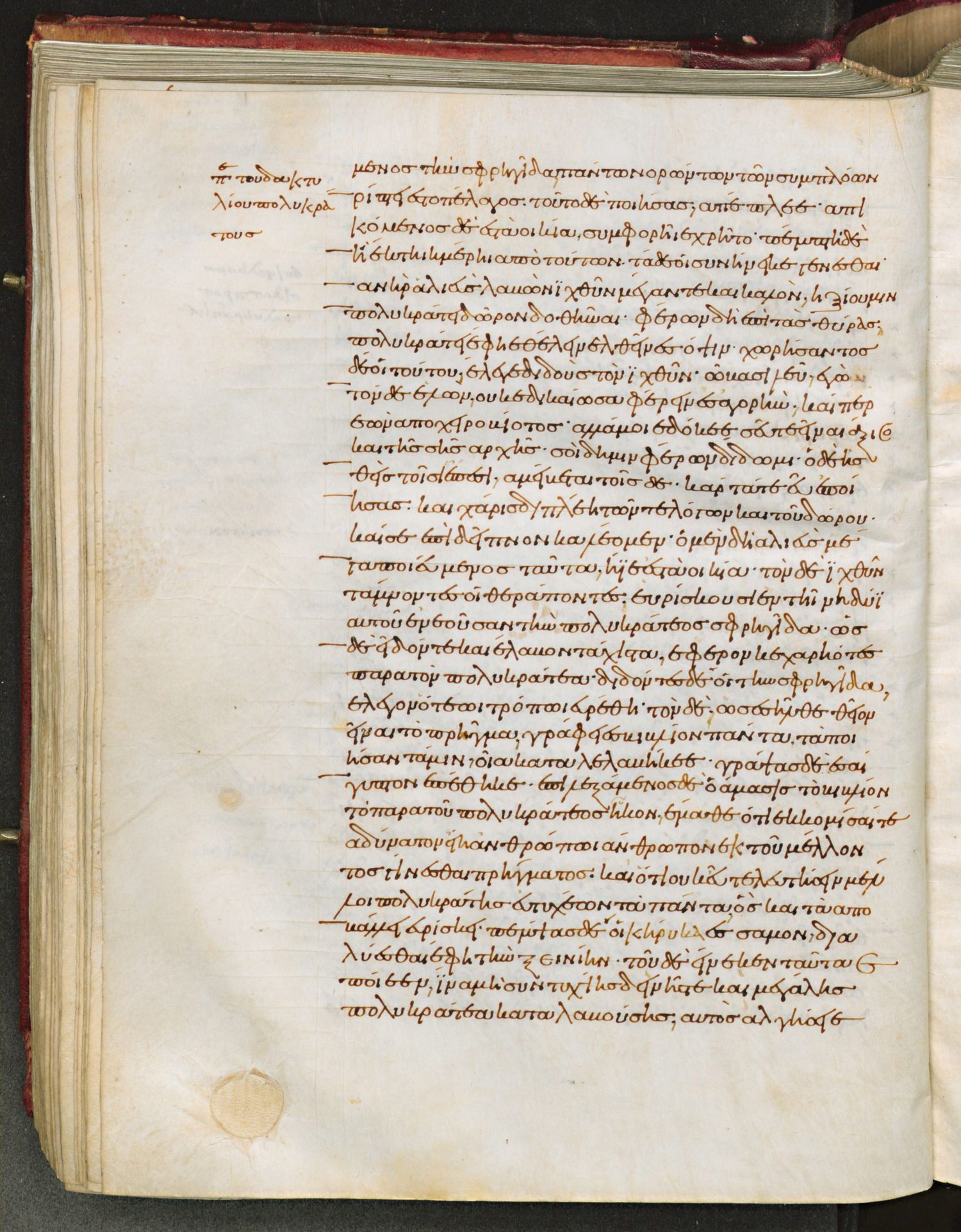
Laur. Plut. 70.3, fol. 114v: Greek here 3.41.2 to 3.43.2. Checked on the image (first and last words read and located in the Greek; each break checked against the neighbouring page): fol. 114v begins ‹-μενος τὴν σφρηγῖδα πάντων› (3.41.2), ends ‹Πολυκράτεα καταλαβούσης αὐτὸς ἀλγήσειε› (3.43.2). The word ‹περιελόμενος› is divided between fol. 114r and fol. 114v; it is given with fol. 114r. English here: 3.42.1 to 3.43.2 (Godley's sentences for the sections whose Greek lies mostly on this page).
3.41.2τὴν σφρηγῖδα πάντων ὁρώντων τῶν συμπλόων ῥίπτει ἐς τὸ πέλαγος. τοῦτο δὲ ποιήσας ἀπέπλεε, ἀπικόμενος δὲ ἐς τὰ οἰκία συμφορῇ ἐχρᾶτο. 3.42.1πέμπτῃ δὲ ἢ ἕκτῃ ἡμέρῃ ἀπὸ τούτων τάδε οἱ συνήνεικε γενέσθαι. ἀνὴρ ἁλιεὺς λαβὼν ἰχθὺν μέγαν τε καὶ καλὸν ἠξίου μιν Πολυκράτεϊ δῶρον δοθῆναι· φέρων δὴ ἐπὶ τὰς θύρας Πολυκράτεϊ ἔφη ἐθέλειν ἐλθεῖν ἐς ὄψιν, χωρήσαντος δέ οἱ τούτου ἔλεγε διδοὺς τὸν ἰχθύν 3.42.2ὦ βασιλεῦ, ἐγὼ τόνδε ἑλὼν οὐκ ἐδικαίωσα φέρειν ἐς ἀγορήν, καίπερ ἐὼν ἀποχειροβίοτος, ἀλλά μοι ἐδόκεε σεῦ τε εἶναι ἄξιος καὶ τῆς σῆς ἀρχῆς· σοὶ δή μιν φέρων δίδωμι. ὁ δὲ ἡσθεὶς τοῖσι ἔπεσι ἀμείβεται τοῖσιδε. κάρτα τε εὖ ἐποίησας καὶ χάρις διπλῆ τῶν τε λόγων καὶ τοῦ δώρου, καί σε ἐπὶ δεῖπνον καλέομεν. 3.42.3ὃ μὲν δὴ ἁλιεὺς μέγα ποιεύμενος ταῦτα ἤιε ἐς τὰ οἰκία, τὸν δὲ ἰχθὺν τάμνοντες οἱ θεράποντες εὑρίσκουσι ἐν τῇ νηδύι αὐτοῦ ἐνεοῦσαν τὴν Πολυκράτεος σφρηγῖδα. 3.42.4ὡς δὲ εἶδόν τε καὶ ἔλαβον τάχιστα, ἔφερον κεχαρηκότες παρὰ τὸν Πολυκράτεα, διδόντες δέ οἱ τὴν σφρηγῖδα ἔλεγον ὅτεῳ τρόπῳ εὑρέθη. τὸν δὲ ὡς ἐσῆλθε θεῖον εἶναι τὸ πρῆγμα, γράφει ἐς βυβλίον πάντα τὰ ποιήσαντά μιν οἷα καταλελάβηκε, γράψας δὲ ἐς Αἴγυπτον ἐπέθηκε. 3.43.1ἐπιλεξάμενος δὲ ὁ Ἄμασις τὸ βυβλίον τὸ παρὰ τοῦ Πολυκράτεος ἧκον, ἔμαθε ὅτι ἐκκομίσαι τε ἀδύνατον εἴη ἀνθρώπῳ ἄνθρωπον ἐκ τοῦ μέλλοντος γίνεσθαι πρήγματος, καὶ ὅτι οὐκ εὖ τελευτήσειν μέλλοι Πολυκράτης εὐτυχέων τὰ πάντα, ὃς καὶ τὰ ἀποβάλλει εὑρίσκει. 3.43.2πέμψας δέ οἱ κήρυκα ἐς Σάμον διαλύεσθαι ἔφη τὴν ξεινίην. τοῦδε δὲ εἵνεκεν ταῦτα ἐποίεε, ἵνα μὴ συντυχίης δεινῆς τε καὶ μεγάλης Πολυκράτεα καταλαβούσης αὐτὸς ἀλγήσειε
3.42.1But on the fifth or sixth day from this it so befell that a fisherman, who had taken a fine and great fish, and desired to make it a gift to Polycrates, brought it to the door and said that he wished to be seen by Polycrates. 3.42.2This being granted to him, he gave the fish, saying: “O King, I am a man that lives by his calling; but when I caught this fish I thought best not to take it to market; it seemed to me worthy of you and your greatness; wherefore I bring and offer it to you.” Polycrates was pleased with what the fisherman said; “You have done right well,” he answered, “and I give you double thanks, for your words and for the gift; and I bid you to dinner with me.” 3.42.3Proud of this honour, the fisherman went home; but the servants, cutting up the fish, found Polycrates’ seal-ring in 3.42.4its belly; which having seen and taken they brought with joy to Polycrates, gave him the ring, and told him how it was found. Polycrates saw the hand of heaven in this matter; he wrote a letter and sent it to Egypt, telling all that he had done, and what had befallen him. 3.43.1When Amasis had read Polycrates’ letter, he perceived that no man could save another from his destiny, and that Polycrates, being so continually fortunate that he even found what he cast away, must come to an evil end. 3.43.2So he sent a herald to Samos to renounce his friendship, with this intent, that when some great and terrible mishap overtook Polycrates, he himself might not have to grieve his heart for a friend.
Where on the image
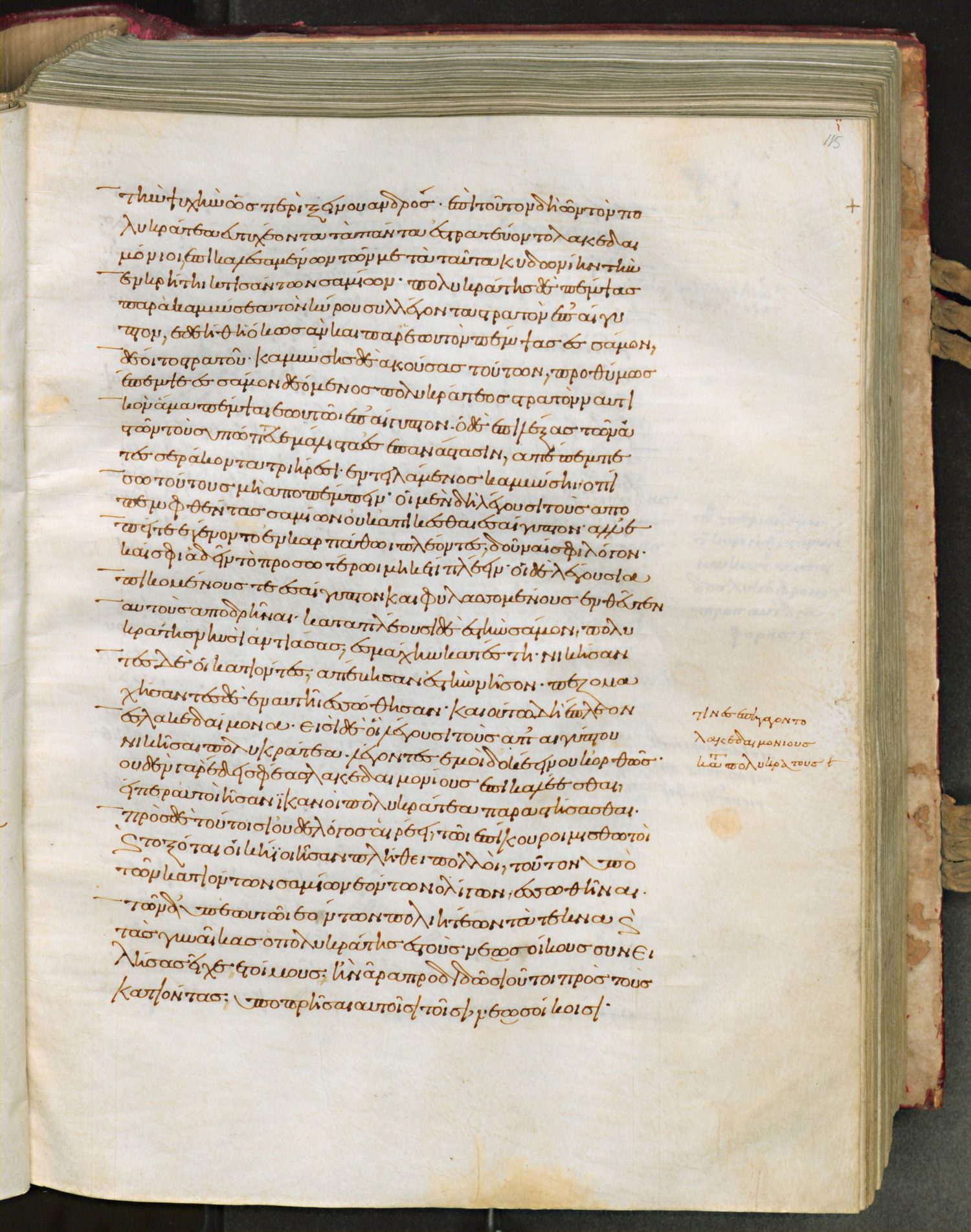
Laur. Plut. 70.3, fol. 115r: Greek here 3.43.2 to 3.45.4. Checked on the image (first and last words read and located in the Greek; each break checked against the neighbouring page): fol. 115r begins ‹τὴν ψυχὴν ὡς περὶ› (3.43.2), ends ‹ὑποπρῆσαι αὐτοῖσι τοῖσι νεωσοίκοισι› (3.45.4). English here: 3.44.1 to 3.45.4 (Godley's sentences for the sections whose Greek lies mostly on this page).
3.43.2τὴν ψυχὴν ὡς περὶ ξείνου ἀνδρός. 3.44.1ἐπὶ τοῦτον δὴ ὦν τὸν Πολυκράτεα εὐτυχέοντα τὰ πάντα ἐστρατεύοντο Λακεδαιμόνιοι, ἐπικαλεσαμένων τῶν μετὰ ταῦτα Κυδωνίην τὴν ἐν Κρήτῃ κτισάντων Σαμίων. πέμψας δὲ κήρυκα λάθρῃ Σαμίων Πολυκράτης παρὰ Καμβύσεα τὸν Κύρου συλλέγοντα στρατὸν ἐπʼ Αἴγυπτον, ἐδεήθη ὅκως ἂν καὶ παρʼ ἑωυτὸν πέμψας ἐς Σάμον δέοιτο στρατοῦ. 3.44.2Καμβύσης δὲ ἀκούσας τούτων προθύμως ἔπεμψε ἐς Σάμον δεόμενος Πολυκράτεος στρατὸν ναυτικὸν ἅμα πέμψαι ἑωυτῷ ἐπʼ Αἴγυπτον. ὁ δὲ ἐπιλέξας τῶν ἀστῶν τοὺς ὑπώπτευε μάλιστα ἐς ἐπανάστασιν ἀπέπεμπε τεσσεράκοντα τριήρεσι, ἐντειλάμενος Καμβύσῃ ὀπίσω τούτους μὴ ἀποπέμπειν. 3.45.1οἳ μὲν δὴ λέγουσι τοὺς ἀποπεμφθέντας Σαμίων ὑπὸ Πολυκράτεος οὐκ ἀπικέσθαι ἐς Αἴγυπτον, ἀλλʼ ἐπείτε ἐγένοντο ἐν Καρπάθῳ πλέοντες, δοῦναι σφίσι λόγον, καί σφι ἁδεῖν τὸ προσωτέρω μηκέτι πλέειν· οἳ δὲ λέγουσι ἀπικομένους τε ἐς Αἴγυπτον καὶ φυλασσομένους ἐνθεῦτεν αὐτοὺς ἀποδρῆναι. 3.45.2καταπλέουσι δὲ ἐς τὴν Σάμον Πολυκράτης νηυσὶ ἀντιάσας ἐς μάχην κατέστη· νικήσαντες δὲ οἱ κατιόντες ἀπέβησαν ἐς τὴν νῆσον, πεζομαχήσαντες δὲ ἐν αὐτῇ ἑσσώθησαν, καὶ οὕτω δὴ ἔπλεον ἐς Λακεδαίμονα. 3.45.3εἰσὶ δὲ οἳ λέγουσι τοὺς ἀπʼ Αἰγύπτου νικῆσαι Πολυκράτεα, λέγοντες ἐμοὶ δοκέειν οὐκ ὀρθῶς· οὐδὲν γὰρ ἔδει σφέας Λακεδαιμονίους ἐπικαλέεσθαι, εἴ περ αὐτοὶ ἦσαν ἱκανοὶ Πολυκράτεα παραστήσασθαι. πρὸς δὲ τούτοισι οὐδὲ λόγος αἱρέει, τῷ ἐπίκουροί τε μισθωτοὶ καὶ τοξόται οἰκήιοι ἦσαν πλήθεϊ πολλοί, τοῦτον ὑπὸ τῶν κατιόντων Σαμίων ἐόντων ὀλίγων ἑσσωθῆναι. 3.45.4τῶν δʼ ὑπʼ ἑωυτῷ ἐόντων πολιητέων τὰ τέκνα καὶ τὰς γυναῖκας ὁ Πολυκράτης ἐς τοὺς νεωσοίκους συνειλήσας εἶχε ἑτοίμους, ἢν ἄρα προδιδῶσι οὗτοι πρὸς τοὺς κατιόντας, ὑποπρῆσαι αὐτοῖσι τοῖσι νεωσοίκοισι.
3.44.1It was against this ever-victorious Polycrates that the Lacedaemonians now made war, being invited thereto by the Samians who afterwards founded Cydonia in Crete. Polycrates had without the knowledge of his subjects sent a herald to Cambyses son of Cyrus, then raising an army against Egypt, to ask that Cambyses should send to Samos too and require men from him. 3.44.2On this message Cambyses very readily sent to Samos, asking Polycrates to send a fleet to aid him against Egypt. Polycrates chose out those townsmen whom he most suspected of planning a rebellion against him, and sent them in forty triremes, charging Cambyses not to send the men back. 3.45.1Some say that these Samians who were sent by Polycrates never came to Egypt, but having got as far over the sea as Carpathus there took counsel together and resolved to sail no further; others say that they did come to Egypt and escaped thence from the guard that was set over them. 3.45.2But as they sailed back to Samos, Polycrates’ ships met them and joined battle; and the returning Samians gained the day and landed on the island, but were there worsted in a land battle, and so sailed to Lacedaemon. 3.45.3There is another story, that the Samians from Egypt defeated Polycrates; but to my thinking this is untrue; for if they were able to master Polycrates by themselves, they had no need of inviting the Lacedaemonians. Nay, moreover, it is not even reasonable to suppose that he, who had a great army of hired soldiers and bowmen of his own, was worsted by a few men like the returning Samians. 3.45.4Polycrates took the children and wives of the townsmen who were subject to him and shut them up in the arsenal, with intent to burn them and the arsenal too if their men should desert to the returned Samians.
Where on the image
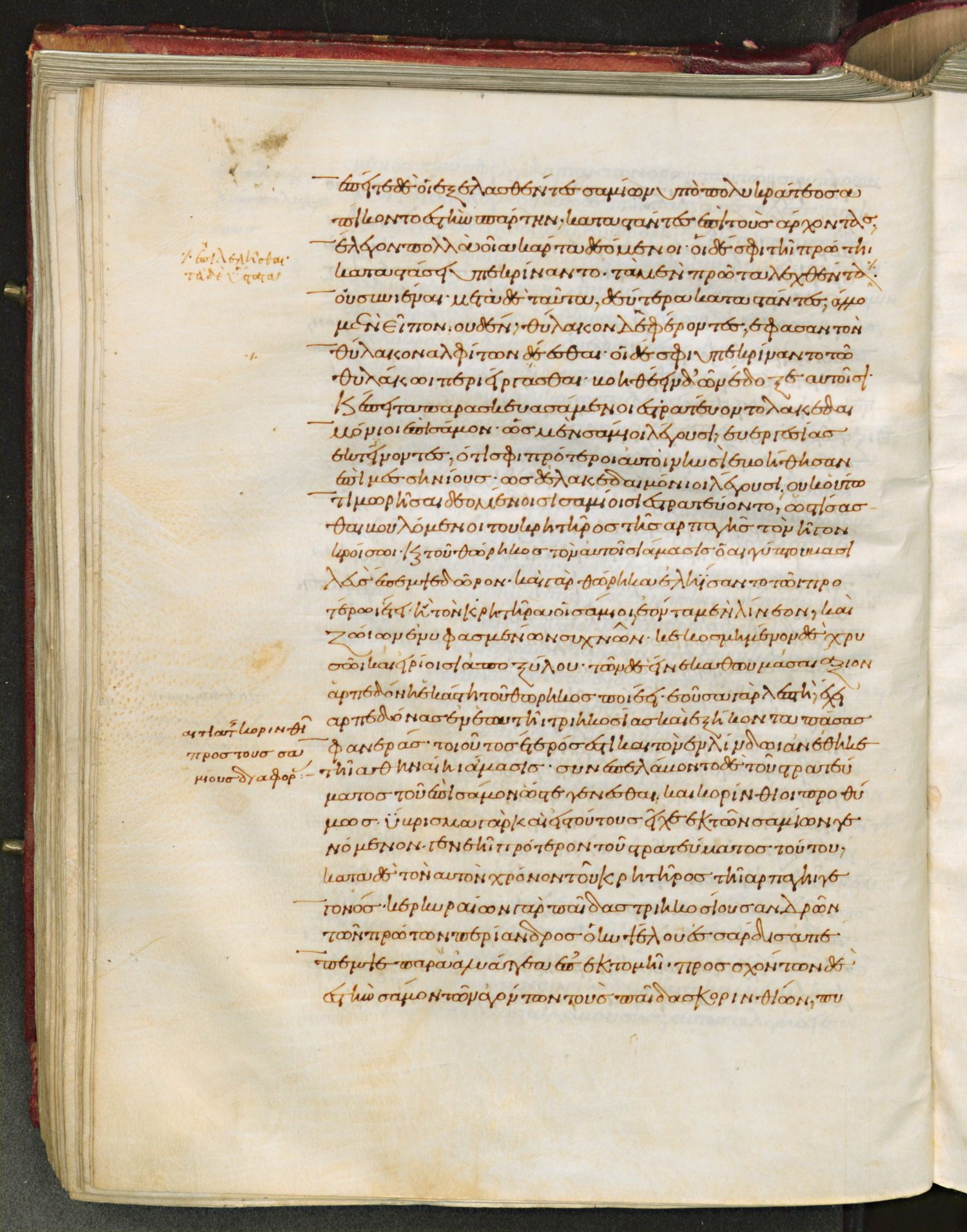
Laur. Plut. 70.3, fol. 115v: Greek here 3.46.1 to 3.48.2. Checked on the image (first and last words read and located in the Greek; each break checked against the neighbouring page): fol. 115v begins ‹ἐπείτε δὲ οἱ ἐξελασθέντες› (3.46.1), ends ‹τοὺς παῖδας Κορινθίων, πυ-› (3.48.2). English here: 3.46.1 to 3.48.3 (Godley's sentences for the sections whose Greek lies mostly on this page).
3.46.1ἐπείτε δὲ οἱ ἐξελασθέντες Σαμίων ὑπὸ Πολυκράτεος ἀπίκοντο ἐς τὴν Σπάρτην, καταστάντες ἐπὶ τοὺς ἄρχοντας ἔλεγον πολλὰ οἷα κάρτα δεόμενοι· οἳ δέ σφι τῇ πρώτῃ καταστάσι ὑπεκρίναντο τὰ μὲν πρῶτα λεχθέντα ἐπιλελῆσθαι, τὰ δὲ ὕστατα οὐ συνιέναι. 3.46.2μετὰ δὲ ταῦτα δεύτερα καταστάντες ἄλλο μὲν εἶπον οὐδέν, θύλακον δὲ φέροντες ἔφασαν τὸν θύλακον ἀλφίτων δέεσθαι. οἳ δέ σφι ὑπεκρίναντο τῷ θυλάκῳ περιεργάσθαι· βοηθέειν δʼ ὦν ἔδοξε αὐτοῖσι. 3.47.1καὶ ἔπειτα παρασκευασάμενοι ἐστρατεύοντο Λακεδαιμόνιοι ἐπὶ Σάμον, ὡς μὲν Σάμιοι λέγουσι, εὐεργεσίας ἐκτίνοντες, ὅτι σφι πρότεροι αὐτοὶ νηυσὶ ἐβοήθησαν ἐπὶ Μεσσηνίους· ὡς δὲ Λακεδαιμόνιοι λέγουσι, οὐκ οὕτω τιμωρῆσαι δεομένοισι Σαμίοισι ἐστρατεύοντο ὡς τίσασθαι βουλόμενοι τοῦ κρητῆρος τῆς ἁρπαγῆς, τὸν ἦγον Κροίσῳ, καὶ τοῦ θώρηκος, τὸν αὐτοῖσι Ἄμασις ὁ Αἰγύπτου βασιλεὺς ἔπεμψε δῶρον. 3.47.2καὶ γὰρ θώρηκα ἐληίσαντο τῷ προτέρῳ ἔτεϊ ἢ τὸν κρητῆρα οἱ Σάμιοι, ἐόντα μὲν λίνεον καὶ ζῴων ἐνυφασμένων συχνῶν, κεκοσμημένον δὲ χρυσῷ καὶ εἰρίοισι ἀπὸ ξύλου· 3.47.3τῶν δὲ εἵνεκα θωμάσαι ἄξιον, ἁρπεδόνη ἑκάστη τοῦ θώρηκος ποιέει· ἐοῦσα γὰρ λεπτὴ ἔχει ἁρπεδόνας ἐν ἑωυτῇ τριηκοσίας καὶ ἑξήκοντα, πάσας φανεράς. τοιοῦτος ἕτερος ἐστὶ καὶ τὸν ἐν Λίνδῳ ἀνέθηκε τῇ Ἀθηναίῃ Ἄμασις. 3.48.1συνεπελάβοντο δὲ τοῦ στρατεύματος τοῦ ἐπὶ Σάμον ὥστε γενέσθαι καὶ Κορίνθιοι προθύμως· ὕβρισμα γὰρ καὶ ἐς τούτους εἶχε ἐκ τῶν Σαμίων γενόμενον γενεῇ πρότερον τοῦ στρατεύματος τούτου, κατὰ δὲ τὸν αὐτὸν χρόνον τοῦ κρητῆρος τῇ ἁρπαγῇ γεγονός. 3.48.2Κερκυραίων γὰρ παῖδας τριηκοσίους ἀνδρῶν τῶν πρώτων Περίανδρος ὁ Κυψέλου ἐς Σάρδις ἀπέπεμψε παρὰ Ἀλυάττεα ἐπʼ ἐκτομῇ· προσσχόντων δὲ ἐς τὴν Σάμον τῶν ἀγόντων τοὺς παῖδας Κορινθίων, πυθόμενοι
3.46.1When the Samians who were expelled by Polycrates came to Sparta, they came before the ruling men and made a long speech to show the greatness of their need. But the Spartans at their first sitting answered that they had forgotten the beginning of the speech and could not understand its end. 3.46.2After this the Samians came a second time with a sack, and said nothing but this: “The sack wants meal.” To this the Spartans replied: “Your ‘sack’ was needless”; but they did resolve to help them. 3.47.1The Lacedaemonians then equipped and sent an army to Samos; the Samians say that this was the requital of services done, they having first sent a fleet to help the Lacedaemonians against Messenia; but the Lacedaemonians say that they sent this army less to aid the Samians in their need than to avenge the robbery of the bowl which they had been carrying to Croesus and the breastplate which Amasis King of Egypt had sent them as a gift. 3.47.2This breastplate had been stolen away by the Samians in the year before they took the bowl; it was of linen, decked with gold and cotton embroidery, and inwoven with many figures; 3.47.3but what makes the wonder of it is each several thread, for fine as each thread is, it is made up of three hundred and sixty strands, each plainly seen. It is the exact counterpart of that one which Amasis dedicated to Athene in Lindus. 3.48.1The Corinthians also helped zealously to further the expedition against Samos. They too had been treated in a high-handed fashion by the Samians a generation before this expedition, about the time of the robbery of the bowl. 3.48.2Periander son of Cypselus sent to Alyattes at Sardis three hundred boys, sons of notable men in Corcyra, to be made eunuchs. The Corinthians who brought the boys put in at Samos; and when the Samians heard why the boys were brought, first they bade them take sanctuary in the temple of Artemis, 3.48.3then they would not suffer the suppliants to be dragged from the temple; and when the Corinthians tried to starve the boys out, the Samians made a festival which they still celebrate in the same fashion; as long as the boys took refuge, nightly dances of youths and maidens were ordained to which it was made a custom to bring cakes of sesame and honey, that the Corcyraean boys might snatch these and so be fed.
Where on the image
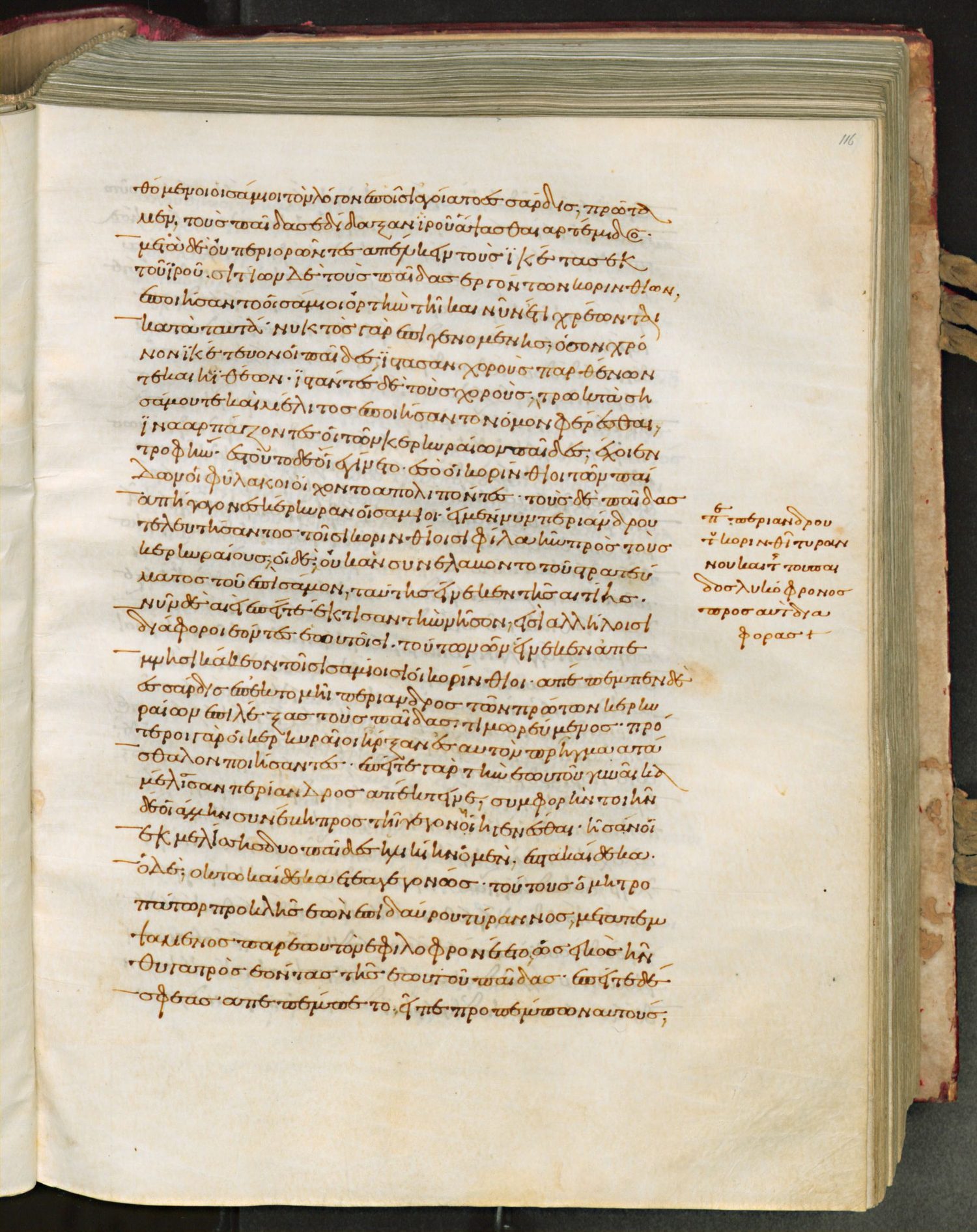
Laur. Plut. 70.3, fol. 116r: Greek here 3.48.2 to 3.49.2. Checked on the image (first and last words read and located in the Greek; each break checked against the neighbouring page): fol. 116r begins ‹-θόμενοι οἱ Σάμιοι τὸν› (3.48.2), ends ‹ἀπεπέμπετο, εἶπε προπέμπων αὐτούς› (3.50.2). The word ‹πυθόμενοι› is divided between fol. 115v and fol. 116r; it is given with fol. 115v. English here: 3.48.4 to 3.49.2 (Godley's sentences for the sections whose Greek lies mostly on this page).
3.48.2οἱ Σάμιοι τὸν λόγον, ἐπʼ οἷσι ἀγοίατο ἐς Σάρδις, πρῶτα μὲν τοὺς παῖδας ἐδίδαξαν ἱροῦ ἅψασθαι Ἀρτέμιδος· 3.48.3μετὰ δὲ οὐ περιορῶντες ἀπέλκειν τοὺς ἱκέτας ἐκ τοῦ ἱροῦ, σιτίων δὲ τοὺς παῖδας ἐργόντων Κορινθίων, ἐποιήσαντο οἱ Σάμιοι ὁρτήν, τῇ καὶ νῦν ἔτι χρέωνται κατὰ ταὐτά. νυκτὸς γὰρ ἐπιγενομένης, ὅσον χρόνον ἱκέτευον οἱ παῖδες, ἵστασαν χοροὺς παρθένων τε καὶ ἠιθέων, ἱστάντες δὲ τοὺς χοροὺς τρωκτὰ σησάμου τε καὶ μέλιτος ἐποιήσαντο νόμον φέρεσθαι, ἵνα ἁρπάζοντες οἱ τῶν Κερκυραίων παῖδες ἔχοιεν τροφήν. 3.48.4ἐς τοῦτο δὲ τόδε ἐγίνετο, ἐς ὃ οἱ Κορίνθιοι τῶν παίδων οἱ φύλακοι οἴχοντο ἀπολιπόντες· τοὺς δὲ παῖδας ἀπήγαγον ἐς Κέρκυραν οἱ Σάμιοι. 3.49.1εἰ μέν νυν Περιάνδρου τελευτήσαντος τοῖσι Κορινθίοισι φίλα ἦν πρὸς τοὺς Κερκυραίους, οἳ δὲ οὐκ ἂν συνελάβοντο τοῦ στρατεύματος τοῦ ἐπὶ Σάμον ταύτης εἵνεκεν τῆς αἰτίης. νῦν δὲ αἰεὶ ἐπείτε ἔκτισαν τὴν νῆσον εἰσὶ ἀλλήλοισι διάφοροι, ἐόντες ἑωυτοῖσι […] 3.49.2τούτων ὦν εἵνεκεν ἀπεμνησικάκεον τοῖσι Σαμίοισι οἱ Κορίνθιοι. ἀπέπεμπε δὲ ἐς Σάρδις ἐπʼ ἐκτομῇ Περίανδρος τῶν πρώτων Κερκυραίων ἐπιλέξας τοὺς παῖδας τιμωρεύμενος· πρότεροι γὰρ οἱ Κερκυραῖοι ἦρξαν ἐς αὐτὸν πρῆγμα ἀτάσθαλον ποιήσαντες.
3.48.4This continued to be done till the Corinthian guards left their charge and departed, and the Samians took the boys back to Corcyra. 3.49.1Now had the Corinthians after Periander’s death been well disposed towards the Corcyraeans, they would not have aided in the expedition against Samos merely for the reason given. But as it was, ever since the island was colonised they have been at feud with each other, for all their kinship. 3.49.2For these reasons the Corinthians bore a grudge against the Samians.
Notes
- Greek: the text printed in A. D. Godley's Loeb edition, via Perseus (tlg0016.tlg001.perseus-grc2). Square brackets mark words the editor considers later additions; [...] marks a gap the editor indicates. Perseus note markers are omitted.
- English: A. D. Godley, Herodotus vol. 2 (1921) (Loeb Classical Library), as transcribed on Wikisource. Godley's footnotes are omitted.
- Section numbers in the English were placed by comparing Godley's text with the Perseus version of his translation; where a section begins inside one of Godley's sentences, the English is kept with the page that holds the start of that sentence.
Cite
Sources
- Source: Florence, Laur. Plut. 70.3 (10th c.) via BML Teca Digitale + Greek of Godley's Loeb (Perseus) + English of A. D. Godley (Loeb, Wikisource) (holding institution)
- Critical edition: Greek of A. D. Godley's Loeb edition (1920-1925), via Perseus
← previous · → next · v cycle view · l back to library