Herodotus, Histories 3.50-60: Periander and Lycophron; the Samians
Introduction
Herodotus of Halicarnassus wrote the Histories in the third quarter of the 5th century BCE, an inquiry into the deeds of Greeks and barbarians and the causes of the wars between them, later divided into nine books. Book 3 tells of Cambyses' conquest of Egypt and his madness, Polycrates of Samos, the rising of the Magi and the seven Persians who overthrew them, the accession of Darius and his provinces, and the revolt and recapture of Babylon.
The photographs are of Florence, Biblioteca Medicea Laurenziana, Plut. 70.3 (parchment, 10th century, 374 folios, 31 lines a page), Herodotus, Histories (codex A of the editors), the oldest surviving manuscript of the complete Histories, from the Teca Digitale of the Biblioteca Medicea Laurenziana. Each section below is the text of one page, or of the part of a page that falls within these chapters. The first and last words of every page were read on the photograph and located in the Greek, and every page break was checked against the next page; the notes quote these words. Readers' notes in the margins are not part of the text and are mentioned where they occur.
The Greek is the text printed in A. D. Godley's Loeb edition (1920-1925), from Perseus; it is the edited text, not a transcription of the manuscript, whose wording differs in places. The English is Godley's translation as printed, from Wikisource. Godley's English carries only chapter numbers; the section numbers shown in it were placed by comparison with the Perseus version of his translation. Each page's English is cut at the end of one of Godley's sentences, so it can begin or end a few lines away from the Greek of the page; each note gives the exact ranges.
This entry covers chapters 3.50-60, on fol. 116r to 119r.
How was this verified? (Provenance)
Where on the image
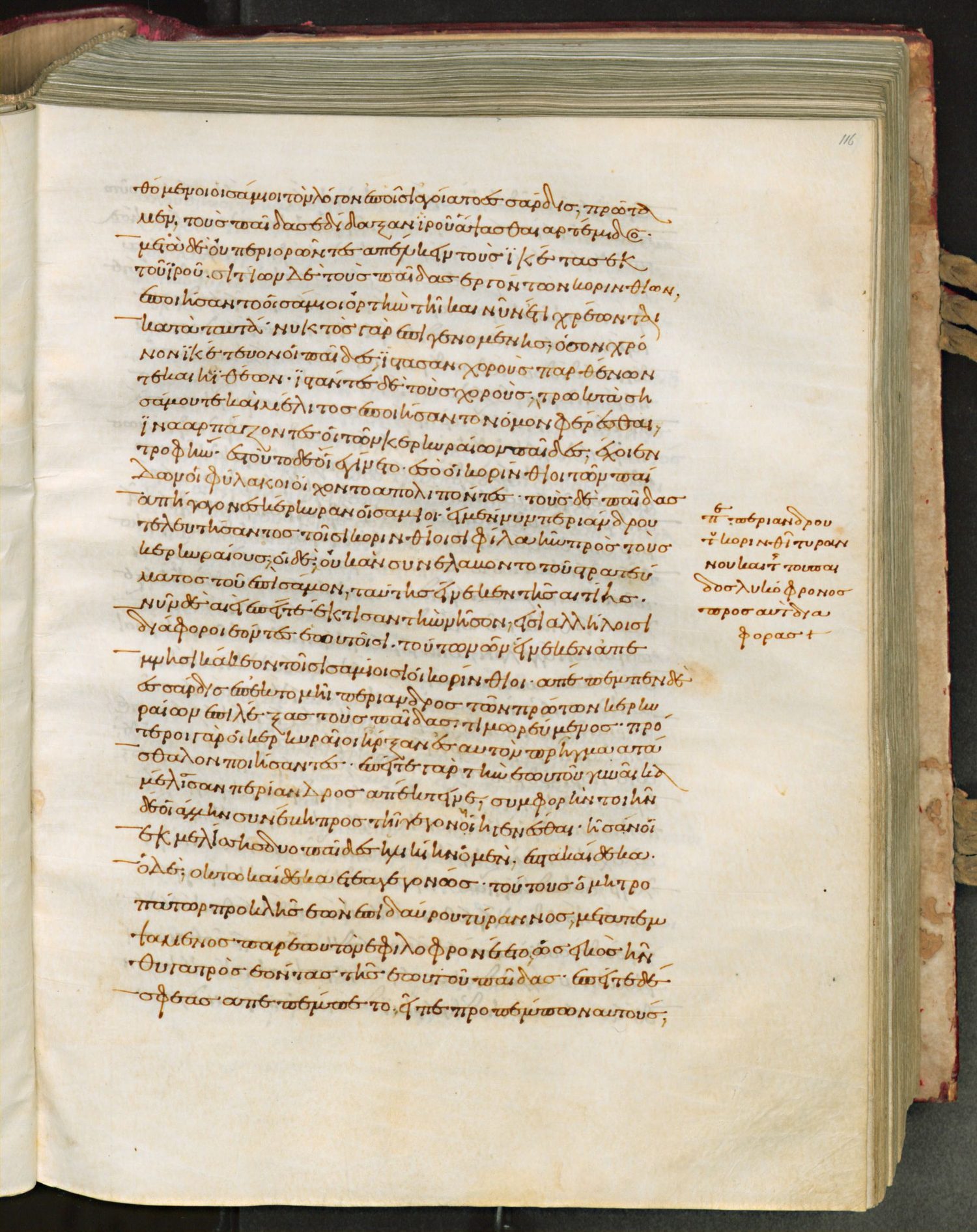
Laur. Plut. 70.3, fol. 116r: Greek here 3.50.1 to 3.50.2. Checked on the image (first and last words read and located in the Greek; each break checked against the neighbouring page): fol. 116r begins ‹-θόμενοι οἱ Σάμιοι τὸν› (3.48.2), ends ‹ἀπεπέμπετο, εἶπε προπέμπων αὐτούς› (3.50.2). The word ‹πυθόμενοι› is divided between fol. 115v and fol. 116r; it is given with fol. 115v. English here: 3.50.1 to 3.50.2 (Godley's sentences for the sections whose Greek lies mostly on this page).
3.50.1ἐπείτε γὰρ τὴν ἑωυτοῦ γυναῖκα Μέλισσαν Περίανδρος ἀπέκτεινε, συμφορὴν τοιήνδε οἱ ἄλλην συνέβη πρὸς τῇ γεγονυίῃ γενέσθαι. ἦσάν οἱ ἐκ Μελίσσης δύο παῖδες, ἡλικίην ὃ μὲν ἑπτακαίδεκα ὁ δὲ ὀκτωκαίδεκα ἔτεα γεγονώς. 3.50.2τούτους ὁ μητροπάτωρ Προκλέης ἐὼν Ἐπιδαύρου τύραννος μεταπεμψάμενος παρʼ ἑωυτὸν ἐφιλοφρονέετο, ὡς οἰκὸς ἦν θυγατρὸς ἐόντας τῆς ἑωυτοῦ παῖδας. ἐπείτε δὲ σφέας ἀπεπέμπετο, εἶπε προπέμπων αὐτούς
3.50.1It was in vengeance that Periander chose the sons of the notable Corcyraeans and sent them to Sardis to be made eunuchs; for the Corcyraeans had first begun the quarrel by committing a terrible crime against him. For after killing his own wife Melissa, Periander suffered yet another calamity besides what had already befallen him. He had two sons by Melissa, one seventeen and one eighteen years old. 3.50.2Their mother’s father, Procles, the despot of Epidaurus, sent for the boys and kindly entreated them, as was natural, seeing that they were his own daughter’s sons. When they left him, he said as he bade them farewell: “Know you, boys, him who slew your mother?”
Where on the image
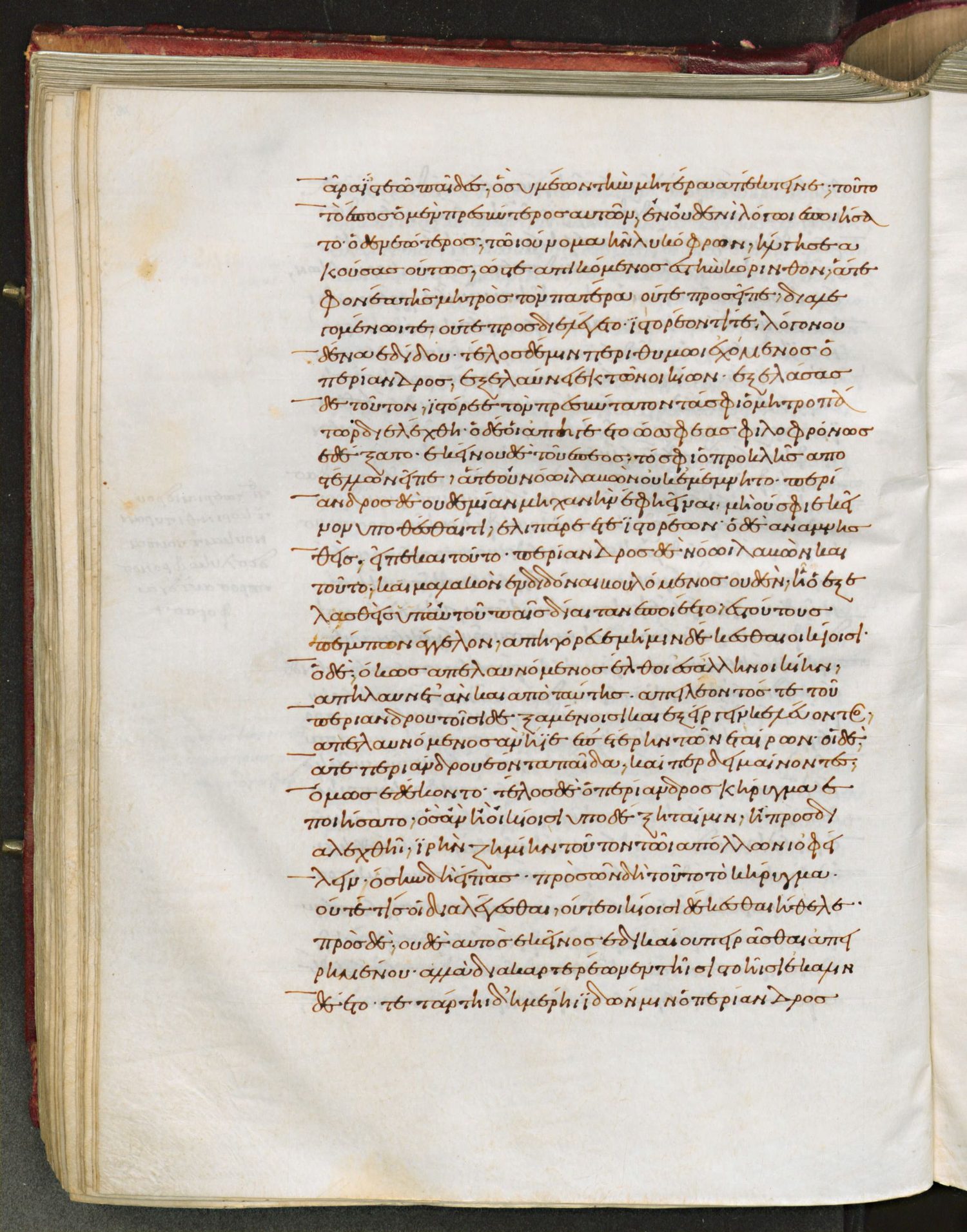
Laur. Plut. 70.3, fol. 116v: Greek here 3.50.3 to 3.52.3. Checked on the image (first and last words read and located in the Greek; each break checked against the neighbouring page): fol. 116v begins ‹ἆρα ἴστε, ὦ παῖδες,› (3.50.3), ends ‹ἰδών μιν ὁ Περίανδρος› (3.52.3). English here: 3.50.3 to 3.52.2 (Godley's sentences for the sections whose Greek lies mostly on this page).
3.50.3ἆρα ἴστε, ὦ παῖδες, ὃς ὑμέων τὴν μητέρα ἀπέκτεινε; τοῦτο τὸ ἔπος ὁ μὲν πρεσβύτερος αὐτῶν ἐν οὐδενὶ λόγῳ ἐποιήσατο· ὁ δὲ νεώτερος, τῷ οὔνομα ἦν Λυκόφρων, ἤλγησε ἀκούσας οὕτω ὥστε ἀπικόμενος ἐς τὴν Κόρινθον ἅτε φονέα τῆς μητρὸς τὸν πατέρα οὔτε προσεῖπε, διαλεγομένῳ τε οὔτε προσδιελέγετο ἱστορέοντί τε λόγον οὐδένα ἐδίδου. τέλος δέ μιν περιθύμως ἔχων ὁ Περίανδρος ἐξελαύνει ἐκ τῶν οἰκίων. 3.51.1ἐξελάσας δὲ τοῦτον ἱστόρεε τὸν πρεσβύτερον τά σφι ὁ μητροπάτωρ διελέχθη. ὁ δέ οἱ ἀπηγέετο ὡς σφέας φιλοφρόνως ἐδέξατο· ἐκείνου δὲ τοῦ ἔπεος τό σφι ὁ Προκλέης ἀποστέλλων εἶπε, ἅτε οὐ νόῳ λαβών, οὐκ ἐμέμνητο. Περίανδρος δὲ οὐδεμίαν μηχανὴν ἔφη εἶναι μὴ οὔ σφι ἐκεῖνον ὑποθέσθαι τι, ἐλιπάρεέ τε ἱστορέων· ὁ δὲ ἀναμνησθεὶς εἶπε καὶ τοῦτο. 3.51.2Περίανδρος δὲ νόῳ λαβὼν [καὶ τοῦτο] καὶ μαλακὸν ἐνδιδόναι βουλόμενος οὐδέν, τῇ ὁ ἐξελασθεὶς ὑπʼ αὐτοῦ παῖς δίαιταν ἐποιέετο, ἐς τούτους πέμπων ἄγγελον ἀπηγόρευε μή μιν δέκεσθαι οἰκίοισι. 3.51.3ὁ δὲ ὅκως ἀπελαυνόμενος ἔλθοι ἐς ἄλλην οἰκίην, ἀπηλαύνετʼ ἂν καὶ ἀπὸ ταύτης, ἀπειλέοντός τε τοῦ Περίανδρου τοῖσι δεξαμένοισι καὶ ἐξέργειν κελεύοντος· ἀπελαυνόμενος δʼ ἂν ἤιε ἐπʼ ἑτέρην τῶν ἑταίρων· οἳ δὲ ἅτε Περιάνδρου ἐόντα παῖδα καίπερ δειμαίνοντες ὅμως ἐδέκοντο. 3.52.1τέλος δὲ ὁ Περίανδρος κήρυγμα ἐποιήσατο, ὃς ἂν ἢ οἰκίοισι ὑποδέξηταί μιν ἢ προσδιαλεχθῇ, ἱρὴν ζημίην τοῦτον τῷ Ἀπόλλωνι ὀφείλειν, ὅσην δὴ εἴπας. 3.52.2πρὸς ὦν δὴ τοῦτο τὸ κήρυγμα οὔτε τίς οἱ διαλέγεσθαι οὔτε οἰκίοισι δέκεσθαι ἤθελε· πρὸς δὲ οὐδὲ αὐτὸς ἐκεῖνος ἐδικαίου πειρᾶσθαι ἀπειρημένου, ἀλλὰ διακαρτερέων ἐν τῇσι στοῇσι ἐκαλινδέετο. 3.52.3τετάρτῃ δὲ ἡμέρῃ ἰδών μιν ὁ Περίανδρος
3.50.3The elder of them paid no heed to these words; but the younger, whose name was Lycophron, was struck with such horror when he heard them that when he came to Corinth he would speak no word to his father, as being his mother’s murderer, nor would he answer him when addressed nor make any reply to his questions. At last Periander was so angry that he drove the boy from his house. 3.51.1Having so done he questioned the elder son, what their grandfather had said in converse to them. The boy told him that Procles had treated them kindly; but he made no mention of what he had said at parting; for he had taken no heed to it. Periander said it could not be but that Procles had given them some admonition; and he questioned his son earnestly; till the boy remembered, and told of that also. 3.51.2Being thus informed, Periander was resolved to show no weakness; he sent a message to those with whom his banished son was living and bade them not entertain him in their house. 3.51.3So the boy being driven forth and going to another house was ever rejected there too, Periander threatening all who received him and bidding them keep him out; so he would go, when driven forth, to some other house of his friends, who, though they were afraid, did yet receive him as being Periander’s son. 3.52.1At the last Periander made a proclamation, that whosoever should receive him into their houses or address him should be held liable to a fine consecrated to Apollo, and he named the sum. 3.52.2In face of this proclamation none would address or receive the boy into his house; nor did the boy himself think well to try to defy the warning, but hardened his heart and lay untended in porches.
Where on the image
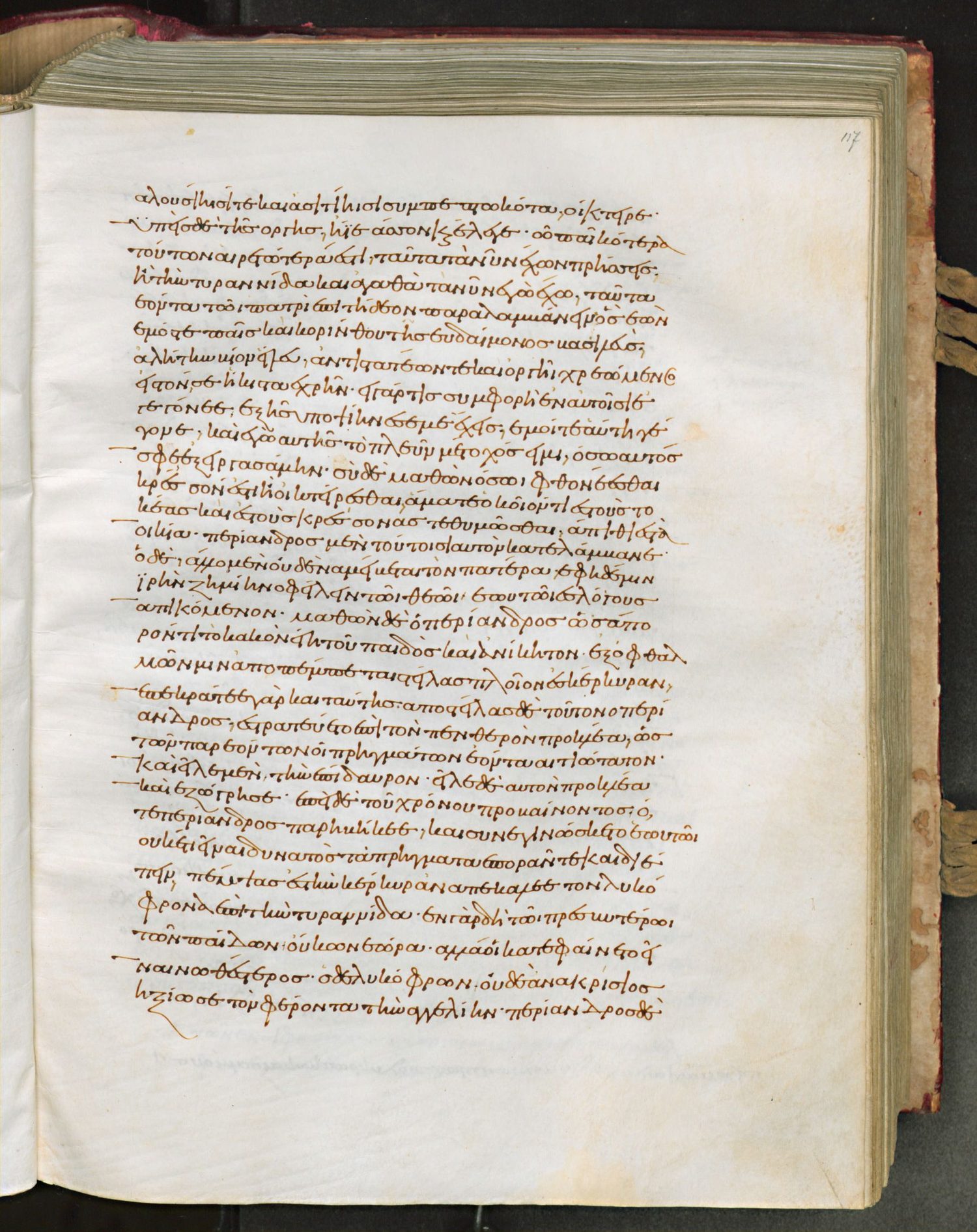
Laur. Plut. 70.3, fol. 117r: Greek here 3.52.3 to 3.53.2. Checked on the image (first and last words read and located in the Greek; each break checked against the neighbouring page): fol. 117r begins ‹ἀλουσίῃσί τε καὶ ἀσιτίῃσι› (3.52.3), ends ‹τὴν ἀγγελίην. Περίανδρος δὲ› (3.53.2). English here: 3.52.3 to 3.53.1 (Godley's sentences for the sections whose Greek lies mostly on this page).
3.52.3ἀλουσίῃσί τε καὶ ἀσιτίῃσι συμπεπτωκότα οἴκτειρε· ὑπεὶς δὲ τῆς ὀργῆς ἤιε ἆσσον καὶ ἔλεγε ὦ παῖ, κότερα τούτων αἱρετώτερα ἐστί, ταῦτα τὸ νῦν ἔχων πρήσσεις, ἢ τὴν τυραννίδα καὶ τὰ ἀγαθὰ τὰ νῦν ἐγὼ ἔχω, ταῦτα ἐόντα τῷ πατρὶ ἐπιτήδεον παραλαμβάνειν, 3.52.4ὃς ἐὼν ἐμός τε παῖς καὶ Κορίνθου τῆς εὐδαίμονος βασιλεὺς ἀλήτην βίον εἵλευ, ἀντιστατέων τε καὶ ὀργῇ χρεώμενος ἐς τόν σε ἥκιστα ἐχρῆν. εἰ γάρ τις συμφορὴ ἐν αὐτοῖσι γέγονε, ἐξ ἧς ὑποψίην ἐς ἐμὲ ἔχεις, ἐμοί τε αὕτη γέγονε καὶ ἐγὼ αὐτῆς τὸ πλεῦν μέτοχος εἰμί, ὅσῳ αὐτός σφεα ἐξεργασάμην. 3.52.5σὺ δὲ μαθὼν ὅσῳ φθονέεσθαι κρέσσον ἐστὶ ἢ οἰκτείρεσθαι, ἅμα τε ὁκοῖόν τι ἐς τοὺς τοκέας καὶ ἐς τοὺς κρέσσονας τεθυμῶσθαι, ἄπιθι ἐς τὰ οἰκία. 3.52.6Περίανδρος μὲν τούτοισι αὐτὸν κατελάμβανε· ὁ δὲ ἄλλο μὲν οὐδὲν ἀμείβεται τὸν πατέρα, ἔφη δέ μιν ἱρὴν ζημίην ὀφείλειν τῷ θεῷ ἑωυτῷ ἐς λόγους ἀπικόμενον. μαθὼν δὲ ὁ Περίανδρος ὡς ἄπορόν τι τὸ κακὸν εἴη τοῦ παιδὸς καὶ ἀνίκητον, ἐξ ὀφθαλμῶν μιν ἀποπέμπεται στείλας πλοῖον ἐς Κέρκυραν· ἐπεκράτεε γὰρ καὶ ταύτης· 3.52.7ἀποστείλας δὲ τοῦτον ὁ Περίανδρος ἐστρατεύετο ἐπὶ τὸν πενθερὸν Προκλέα ὡς τῶν παρεόντων οἱ πρηγμάτων ἐόντα αἰτιώτατον, καὶ εἷλε μὲν τὴν Ἐπίδαυρον, εἷλε δὲ αὐτὸν Προκλέα καὶ ἐζώγρησε. 3.53.1ἐπεὶ δὲ τοῦ χρόνου προβαίνοντος ὅ τε Περίανδρος παρηβήκεε καὶ συνεγινώσκετο ἑωυτῷ οὐκέτι εἶναι δυνατὸς τὰ πρήγματα ἐπορᾶν τε καὶ διέπειν, πέμψας ἐς τὴν Κέρκυραν ἀπεκάλεε τὸν Λυκόφρονα ἐπὶ τὴν τυραννίδα· ἐν γὰρ δὴ τῷ πρεσβυτέρῳ τῶν παίδων οὔκων ἐνώρα, ἀλλά οἱ κατεφαίνετο εἶναι νωθέστερος. 3.53.2ὁ δὲ Λυκόφρων οὐδὲ ἀνακρίσιος ἠξίωσε τὸν φέροντα τὴν ἀγγελίην. Περίανδρος δὲ
3.52.3After three days Periander saw him all starved and unwashed, and took pity on him: his anger being somewhat abated, he came near and said: “My son, which is the better way to choose—to follow your present way of life, or to obey your father and inherit my sovereignty and the good things which I now possess? 3.52.4You are my son, and a prince of wealthy Corinth; yet you have chosen the life of a vagrant, by withstanding and angrily entreating him who should least be so used by you. For if there has been any evil chance in the matter, which makes you to suspect me, ’tis on me that it has come and ’tis I that bear the greater share of it, inasmuch as the act was mine. 3.52.5Nay, bethink you how much better a thing it is to be envied than to be pitied, and likewise what comes of anger against parents and those that are stronger than you, and come away to my house.” 3.52.6Thus Periander tried to win his son. But the boy only answered: “You have made yourself liable to the fine consecrated to the god by speaking to me.” Then Periander saw that his son’s trouble was past cure or constraint, and sent him away in a ship to Corcyra out of his sight; for Corcyra 3.52.7too was subject to him; which done, he sent an army against Procles his father-in-law (deeming him to be the chief cause of his present troubles), and took Procles himself alive, besides taking Epidaurus. 3.53.1As time went on, Periander, now grown past his prime and aware that he could no longer oversee and direct all his business, sent to Corcyra inviting Lycophron to be despot; for he saw no hope in his eldest son, who seemed to him to be slow-witted.
Where on the image
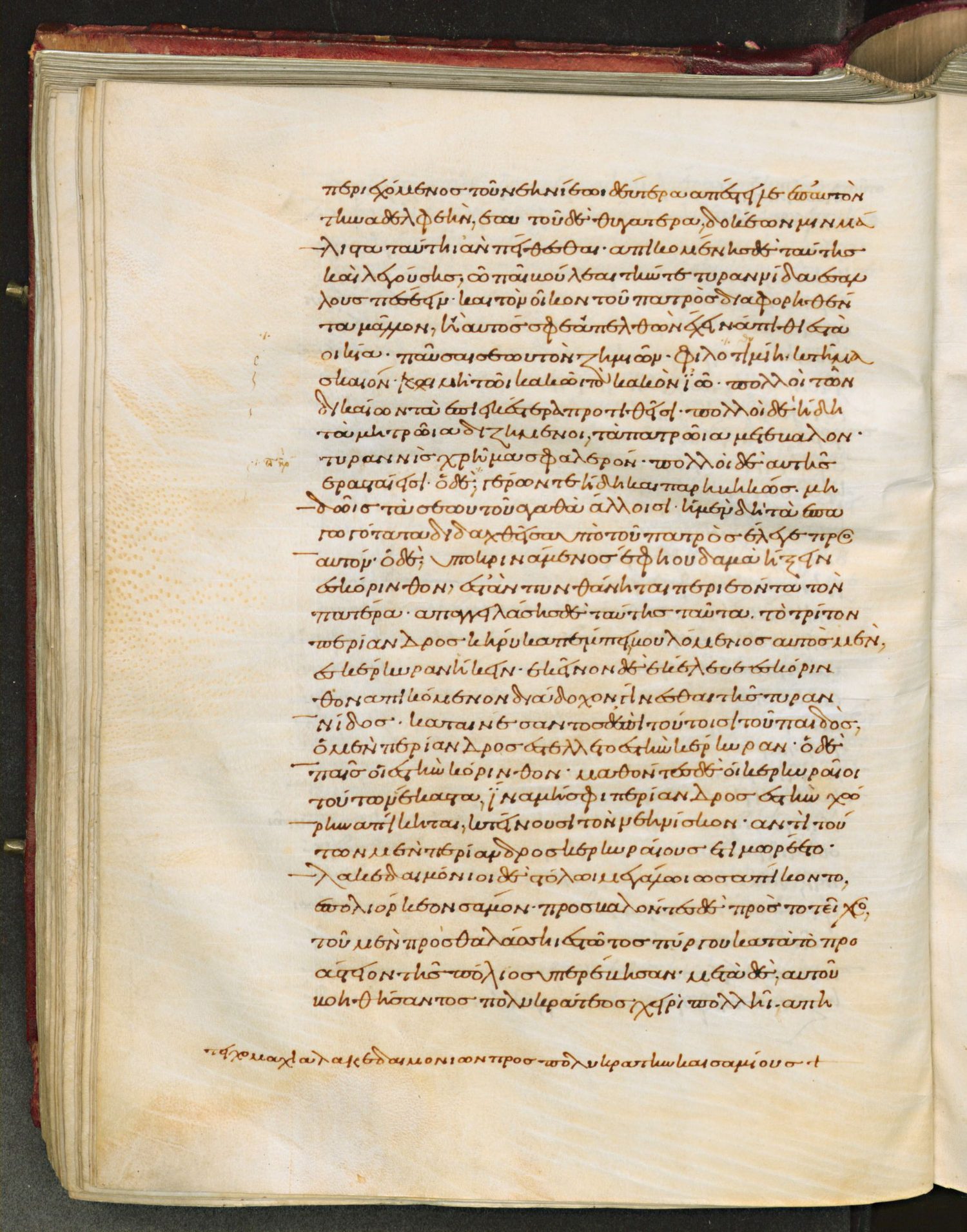
Laur. Plut. 70.3, fol. 117v: Greek here 3.53.2 to 3.54.1. Checked on the image (first and last words read and located in the Greek; each break checked against the neighbouring page): fol. 117v begins ‹περιεχόμενος τοῦ νεηνίεω δεύτερα› (3.53.2), ends ‹Πολυκράτεος χειρὶ πολλῇ ἀπη-› (3.54.1). Below the text, a reader's note on the battle of the Lacedaemonians against Polycrates and the Samians. English here: 3.53.2 to 3.54.1 (Godley's sentences for the sections whose Greek lies mostly on this page).
3.53.2περιεχόμενος τοῦ νεηνίεω δεύτερα ἀπέστειλε ἐπʼ αὐτὸν τὴν ἀδελφεήν, ἑωυτοῦ δὲ θυγατέρα, δοκέων μιν μάλιστα ταύτῃ ἂν πείθεσθαι. 3.53.3ἀπικομένης δὲ ταύτης καὶ λεγούσης, ὦ παῖ, βούλεαι τήν τε τυραννίδα ἐς ἄλλους πεσεῖν καὶ τὸν οἶκον τοῦ πατρὸς διαφορηθέντα μᾶλλον ἢ αὐτός σφεα ἀπελθὼν ἔχειν; ἄπιθι ἐς τὰ οἰκία, παῦσαι σεωυτὸν ζημιῶν. 3.53.4φιλοτιμίη κτῆμα σκαιόν. μὴ τῷ κακῷ τὸ κακὸν ἰῶ. πολλοὶ τῶν δικαίων τὰ ἐπιεικέστερα προτιθεῖσι, πολλοὶ δὲ ἤδη τὰ μητρώια διζήμενοι τὰ πατρώια ἀπέβαλον. τυραννὶς χρῆμα σφαλερόν, πολλοὶ δὲ αὐτῆς ἐρασταί εἰσι, ὁ δὲ γέρων τε ἤδη καὶ παρηβηκώς· μὴ δῷς τὰ σεωυτοῦ ἀγαθὰ ἄλλοισι. 3.53.5ἣ μὲν δὴ τὰ ἐπαγωγότατα διδαχθεῖσα ὑπὸ τοῦ πατρὸς ἔλεγε πρὸς αὐτόν· ὁ δὲ ὑποκρινάμενος ἔφη οὐδαμὰ ἥξειν ἐς Κόρινθον, ἔστʼ ἂν πυνθάνηται περιεόντα τὸν πατέρα. 3.53.6ἀπαγγειλάσης δὲ ταύτης ταῦτα, τὸ τρίτον Περίανδρος κήρυκα πέμπει βουλόμενος αὐτὸς μὲν ἐς Κέρκυραν ἥκειν, ἐκεῖνον δὲ ἐκέλευε ἐς Κόρινθον ἀπικόμενον διάδοχον γίνεσθαι τῆς τυραννίδος. 3.53.7καταινέσαντος δὲ ἐπὶ τούτοισι τοῦ παιδός, ὁ μὲν Περίανδρος ἐστέλλετο ἐς τὴν Κέρκυραν, ὁ δὲ παῖς οἱ ἐς τὴν Κόρινθον. μαθόντες δὲ οἱ Κερκυραῖοι τούτων ἕκαστα, ἵνα μή σφι Περίανδρος ἐς τὴν χώρην ἀπίκηται, κτείνουσι τὸν νεηνίσκον. ἀντὶ τούτων μὲν Περίανδρος Κερκυραίους ἐτιμωρέετο. 3.54.1Λακεδαιμόνιοι δὲ στόλῳ μεγάλῳ ὡς ἀπίκοντο, ἐπολιόρκεον Σάμον· προσβαλόντες δὲ πρὸς τὸ τεῖχος τοῦ μὲν πρὸς θαλάσσῃ ἑστεῶτος πύργου κατὰ τὸ προάστειον τῆς πόλιος ἐπέβησαν, μετὰ δὲ αὐτοῦ βοηθήσαντος Πολυκράτεος χειρὶ πολλῇ ἀπηλάσθησαν.
3.53.2Lycophron did not deign even to answer the messenger. Then Periander, greatly desiring that the young man should come, sent to him (as the next best way) his own daughter, the youth’s sister, thinking that he would be likeliest to obey her. 3.53.3She came and said, “Brother, would you see the sovereignty pass to others, and our father’s house despoiled, rather than come hence and have it for your own? Nay, come away home and cease from punishing yourself. 3.53.4Pride is the possession of fools. Seek not to cure one ill by another. There be many that set reason before righteousness; and many that by zeal for their mother’s cause have lost their father’s possessions. Despotism is a thing hard to hold; many covet it, and our father is now old and past his prime; give not what is your estate to others.” 3.53.5So, by her father’s teaching, she used such arguments as were most likely to win Lycophron; but he answered, that he would never come to Corinth as long as he knew his father to be alive. 3.53.6When she brought this answer back, Periander sent a third messenger, offering to go to Corcyra himself, and to make Lycophron, when he came, despot in his place. 3.53.7The son consented to this; Periander made ready to go to Corcyra and Lycophron to go to Corinth; but when the Corcyraeans learnt of all these matters they put the young man to death, lest Periander should come to their country. It was for this that Periander desired vengeance upon them. 3.54.1The Lacedaemonians then came with a great host, and laid siege to Samos. They assailed the fortress and made their way into the tower by the seaside in the outer part of the city; but presently Polycrates himself attacked them with a great force and drove them out.
Where on the image
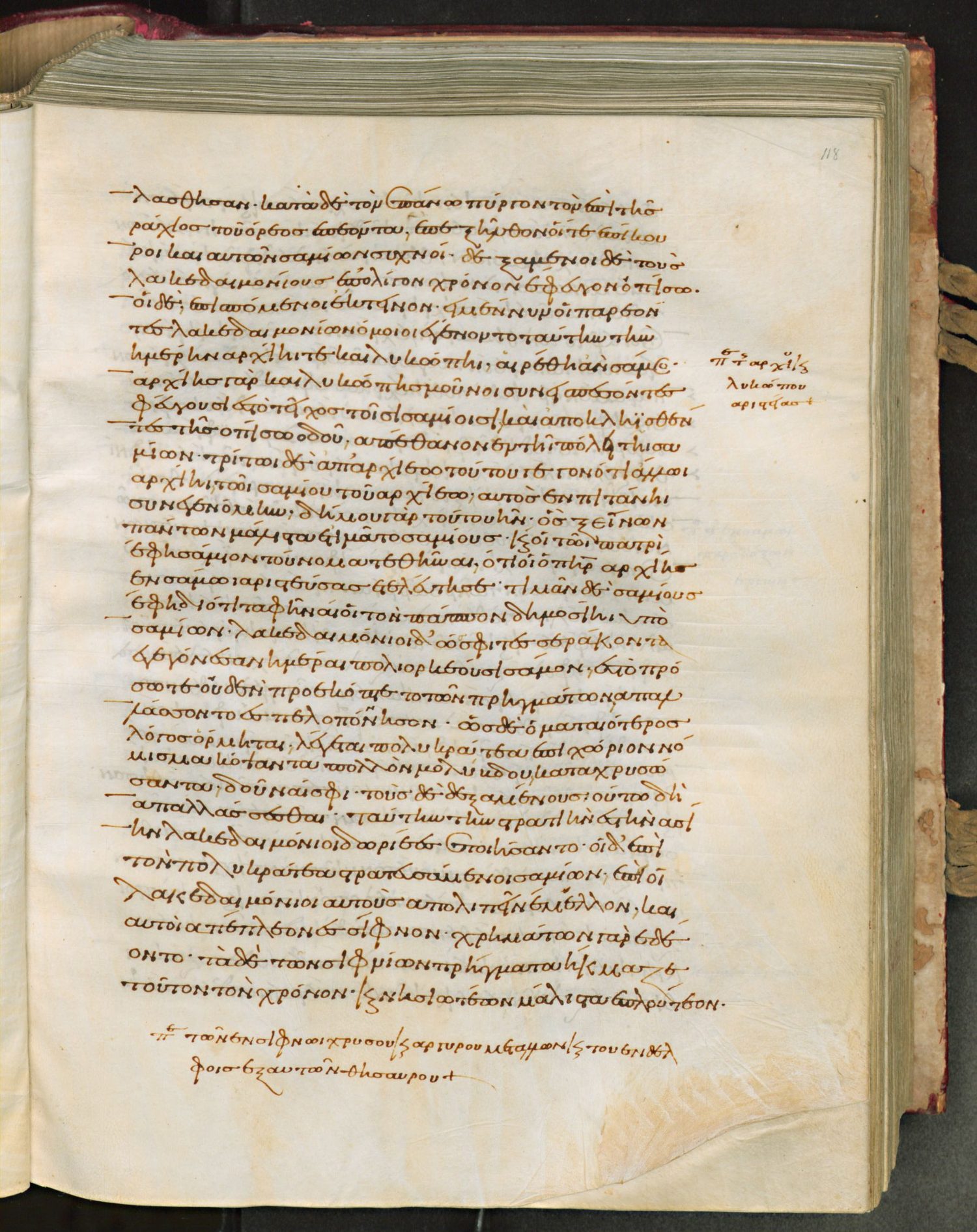
Laur. Plut. 70.3, fol. 118r: Greek here 3.54.2 to 3.57.2. Checked on the image (first and last words read and located in the Greek; each break checked against the neighbouring page): fol. 118r begins ‹-λάσθησαν.κατὰ δὲ τὸν ἐπάνω› (3.54.1), ends ‹καὶ νησιωτέων μάλιστα ἐπλούτεον› (3.57.2). The word ‹ἀπηλάσθησαν.› is divided between fol. 117v and fol. 118r; it is given with fol. 117v. Below the text, a reader's note on the gold and silver mines of Siphnos and the Siphnian treasury at Delphi. English here: 3.54.2 to 3.57.2 (Godley's sentences for the sections whose Greek lies mostly on this page).
3.54.2κατὰ δὲ τὸν ἐπάνω πύργον τὸν ἐπὶ τῆς ῥάχιος τοῦ ὄρεος ἐπεόντα ἐπεξῆλθον οἵ τε ἐπίκουροι καὶ αὐτῶν Σαμίων συχνοί, δεξάμενοι δὲ τοὺς Λακεδαιμονίους ἐπʼ ὀλίγον χρόνον ἔφευγον ὀπίσω, οἳ δὲ ἐπισπόμενοι ἔκτεινον. 3.55.1εἰ μέν νυν οἱ παρεόντες Λακεδαιμονίων ὅμοιοι ἐγένοντο ταύτην τὴν ἡμέρην Ἀρχίῃ τε καὶ Λυκώπῃ, αἱρέθη ἂν Σάμος· Ἀρχίης γὰρ καὶ Λυκώπης μοῦνοι συνεσπεσόντες φεύγουσι ἐς τὸ τεῖχος τοῖσι Σαμίοισι καὶ ἀποκληισθέντες τῆς ὀπίσω ὁδοῦ ἀπέθανον ἐν τῇ πόλι τῇ Σαμίων. 3.55.2τρίτῳ δέ ἀπʼ Ἀρχίεω τούτου γεγονότι ἄλλῳ Ἀρχίῃ τῷ Σαμίου τοῦ Ἀρχίεω αὐτὸς ἐν Πιτάνῃ συνεγενόμην (δήμου γὰρ τούτου ἦν), ὃς ξείνων πάντων μάλιστα ἐτίμα τε Σαμίους καί οἱ τῷ πατρὶ ἔφη Σάμιον τοὔνομα τεθῆναι, ὅτι οἱ ὁ πατὴρ Ἀρχίης ἐν Σάμῳ ἀριστεύσας ἐτελεύτησε· τιμᾶν δὲ Σαμίους ἔφη, διότι ταφῆναί οἱ τὸν πάππον δημοσίῃ ὑπὸ Σαμίων. 3.56.1Λακεδαιμόνιοι δέ, ὥς σφι τεσσεράκοντα ἐγεγόνεσαν ἡμέραι πολιορκέουσι Σάμον ἐς τὸ πρόσω τε οὐδὲν προεκόπτετο τῶν πρηγμάτων, ἀπαλλάσσοντο ἐς Πελοπόννησον. 3.56.2ὡς δὲ ὁ ματαιότερος λόγος ὅρμηται, λέγεται Πολυκράτεα ἐπιχώριον νόμισμα κόψαντα πολλὸν μολύβδου καταχρυσώσαντα δοῦναί σφι, τοὺς δὲ δεξαμένους οὕτω δὴ ἀπαλλάσσεσθαι. ταύτην πρώτην στρατηίην ἐς τὴν Ἀσίην Λακεδαιμόνιοι Δωριέες ἐποιήσαντο. 3.57.1οἱ δʼ ἐπὶ τὸν Πολυκράτεα στρατευσάμενοι Σαμίων, ἐπεὶ οἱ Λακεδαιμόνιοι αὐτοὺς ἀπολιπεῖν ἔμελλον, καὶ αὐτοὶ ἀπέπλεον ἐς Σίφνον, 3.57.2χρημάτων γὰρ ἐδέοντο, τὰ δὲ τῶν Σιφνίων πρήγματα ἤκμαζε τοῦτον τὸν χρόνον, καὶ νησιωτέων μάλιστα ἐπλούτεον,
3.54.2The foreign soldiery and many of the Samians themselves sallied out near the upper tower on the ridge of the hill, and withstood the Lacedaemonian onset for a little while; then they fled back, the Lacedaemonians pursuing and slaying them. 3.55.1Now had all the Lacedaemonians there fought as valiantly that day as Archias and Lycopas, Samos had been taken. These two alone entered the fortress along with the fleeing crowd of Samians, and their way back being barred were then slain in the city of Samos. 3.55.2I myself have met in his native township of Pitana another Archias (son of Samius, and grandson of the Archias afore-named), who honoured the Samians more than any other of his guest-friends, and told me that his father had borne the name Samius because he was the son of that Archias who was slain fighting gallantly at Samos. The reason of his honouring the Samians, he said, was that they had given his grandfather a public funeral. 3.56.1So when the Lacedaemonians had besieged Samos for forty days with no success, they went away to Peloponnesus. 3.56.2There is a foolish tale abroad that Poly crates bribed them to depart by making and giving them a great number of gilt leaden coins, as a native currency. This was the first expedition to Asia made by Dorians of Lacedaemon. 3.57.1When the Lacedaemonians were about to abandon them, the Samians who had brought an army against Polycrates sailed away too, and went to Siphnus; 3.57.2for they were in want of money; and the Siphnians were at this time very prosperous and the richest of the islanders, by reason of the gold and silver mines of the island. So wealthy were they that the treasury dedicated by them at Delphi, which is as rich as any there, was made from the tenth part of their revenues; and they made a distribution for themselves of each year’s revenue.
Where on the image
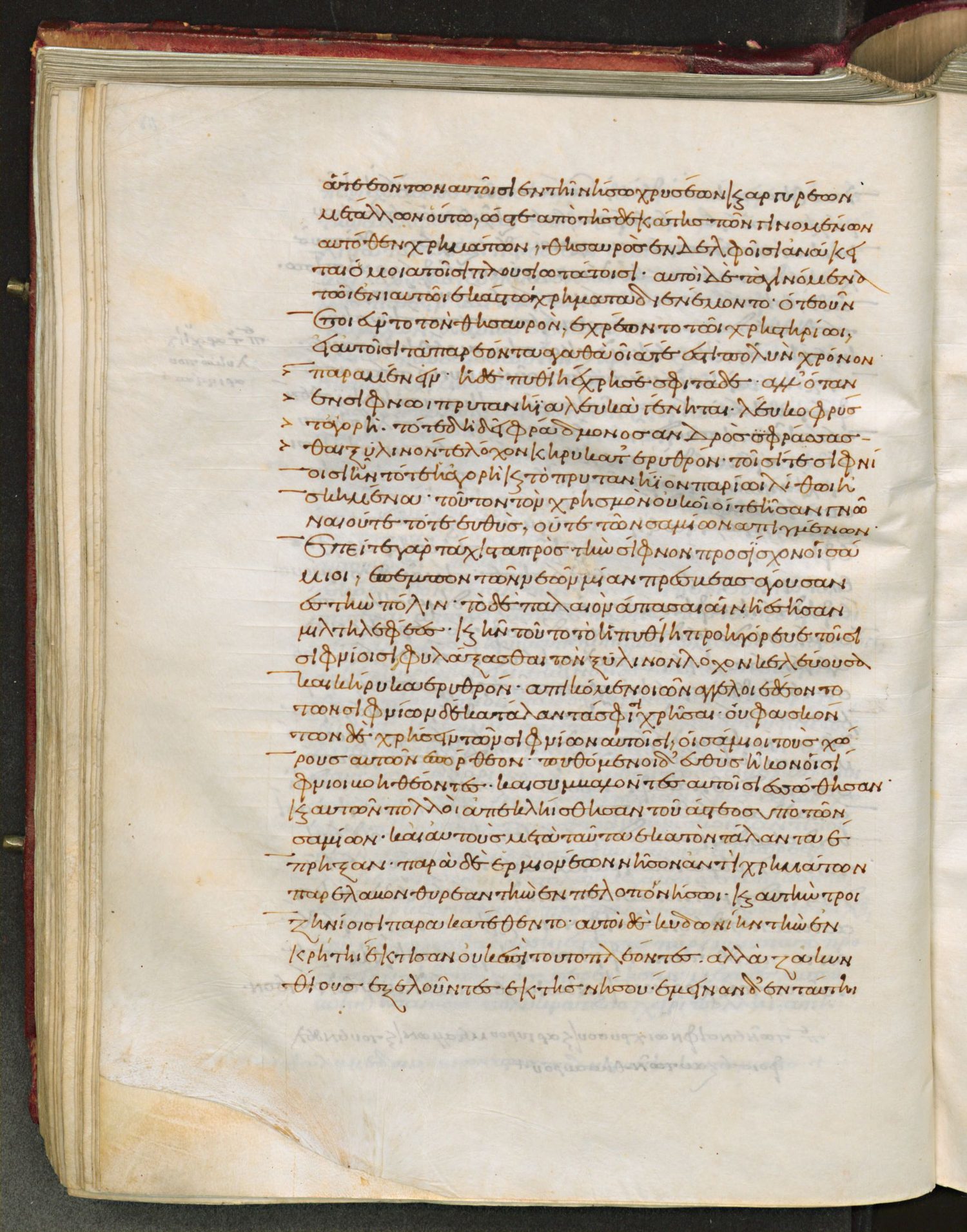
Laur. Plut. 70.3, fol. 118v: Greek here 3.57.2 to 3.59.2. Checked on the image (first and last words read and located in the Greek; each break checked against the neighbouring page): fol. 118v begins ‹ἅτε ἐόντων αὐτοῖσι ἐν› (3.57.2), ends ‹νήσου.ἔμειναν δʼ ἐν ταύτῃ› (3.59.2). English here: 3.57.3 to 3.59.1 (Godley's sentences for the sections whose Greek lies mostly on this page).
3.57.2ἅτε ἐόντων αὐτοῖσι ἐν τῇ νήσῳ χρυσέων καὶ ἀργυρέων μετάλλων, οὕτω ὥστε ἀπὸ τῆς δεκάτης τῶν γινομένων αὐτόθεν χρημάτων θησαυρὸς ἐν Δελφοῖσι ἀνάκειται ὅμοια τοῖσι πλουσιωτάτοισι· αὐτοὶ δὲ τὰ γινόμενα τῷ ἐνιαυτῷ ἑκάστῳ χρήματα διενέμοντο. 3.57.3ὅτε ὦν ἐποιεῦντο τὸν θησαυρόν, ἐχρέωντο τῷ χρηστηρίῳ εἰ αὐτοῖσι τὰ παρεόντα ἀγαθὰ οἷά τε ἐστὶ πολλὸν χρόνον παραμένειν· ἡ δὲ Πυθίη ἔχρησέ σφι τάδε. 3.57.4ἀλλʼ ὅταν ἐν Σίφνῳ πρυτανήια λευκὰ γένηται
λεύκοφρύς τʼ ἀγορή, τότε δὴ δεῖ φράδμονος ἀνδρός
φράσσασθαι ξύλινόν τε λόχον κήρυκά τʼ ἐρυθρόν.
τοῖσι δὲ Σιφνίοισι ἦν τότε ἡ ἀγορὴ καὶ τὸ πρυτανήιον Παρίῳ λίθῳ ἠσκημένα. 3.58.1τοῦτον τὸν χρησμὸν οὐκ οἷοί τε ἦσαν γνῶναι οὔτε τότε εὐθὺς οὔτε τῶν Σαμίων ἀπιγμένων. ἐπείτε γὰρ τάχιστα πρὸς τὴν Σίφνον προσῖσχον οἱ Σάμιοι, ἔπεμπον τῶν νεῶν μίαν πρέσβεας ἄγουσαν ἐς τὴν πόλιν. 3.58.2τὸ δὲ παλαιὸν ἅπασαι αἱ νέες ἦσαν μιλτηλιφέες, καὶ ἦν τοῦτο τὸ ἡ Πυθίη προηγόρευε τοῖσι Σιφνίοισι, φυλάξασθαι τὸν ξύλινον λόχον κελεύουσα καὶ κήρυκα ἐρυθρόν. 3.58.3ἀπικόμενοι ὦν οἱ ἄγγελοι ἐδέοντο τῶν Σιφνίων δέκα τάλαντά σφι χρῆσαι· οὐ φασκόντων δὲ χρήσειν τῶν Σιφνίων αὐτοῖσι, οἱ Σάμιοι τοὺς χώρους αὐτῶν ἐπόρθεον. 3.58.4πυθόμενοι δὲ εὐθὺς ἧκον οἱ Σίφνιοι βοηθέοντες καὶ συμβαλόντες αὐτοῖσι ἑσσώθησαν, καὶ αὐτῶν πολλοὶ ἀπεκληίσθησαν τοῦ ἄστεος ὑπὸ τῶν Σαμίων, καὶ αὐτοὺς μετὰ ταῦτα ἑκατὸν τάλαντα ἔπρηξαν. 3.59.1παρὰ δὲ Ἑρμιονέων νῆσον ἀντὶ χρημάτων παρέλαβον Ὑδρέην τὴν ἐπὶ Πελοποννήσῳ καὶ αὐτὴν Τροιζηνίοισι παρακατέθεντο· αὐτοὶ δὲ Κυδωνίην τὴν ἐν Κρήτῃ ἔκτισαν, οὐκ ἐπὶ τοῦτο πλέοντες ἀλλὰ Ζακυνθίους ἐξελῶντες ἐκ τῆς νήσου. 3.59.2ἔμειναν δʼ ἐν ταύτῃ
3.57.3Now when they were making the treasury they enquired of the oracle if their present well-being was like to abide long; whereto the priestess gave them this answer: “Siphnus, beware of the day 3.57.4when white is thy high prytaneum, White-browed thy mart likewise; right prudent then be thy counsel; Cometh an ambush of wood and a herald red to assail thee.” At this time the market-place and town-hall of Siphnus were adorned with Parian marble. 3.58.1They could not understand this oracle either when it was spoken or at the time of the Samians’ coming. As soon as the Samians put in at Siphnus, they sent ambassadors to the town in one of their ships; 3.58.2now in ancient times all ships were painted with vermilion; and this was what was meant by the warning given by the priestess to the Siphnians, to beware of a wooden ambush and a red herald. 3.58.3The messengers, then, demanded from the Siphnians a loan of ten talents; which being refused, the Samians set about ravaging their lands. 3.58.4Hearing this the Siphnians came out forthwith to drive them off, but they were worsted in battle, and many of them were cut off from their town by the Samians; who presently exacted from them a hundred talents. 3.59.1Then the Samians took from the men of Hermione, instead of money, the island Hydrea which is near to Peloponnesus, and gave it in charge to men of Troezen; they themselves settled at Cydonia in Crete, though their voyage had been made with no such intent, but rather to drive Zacynthians out of the island.
Where on the image
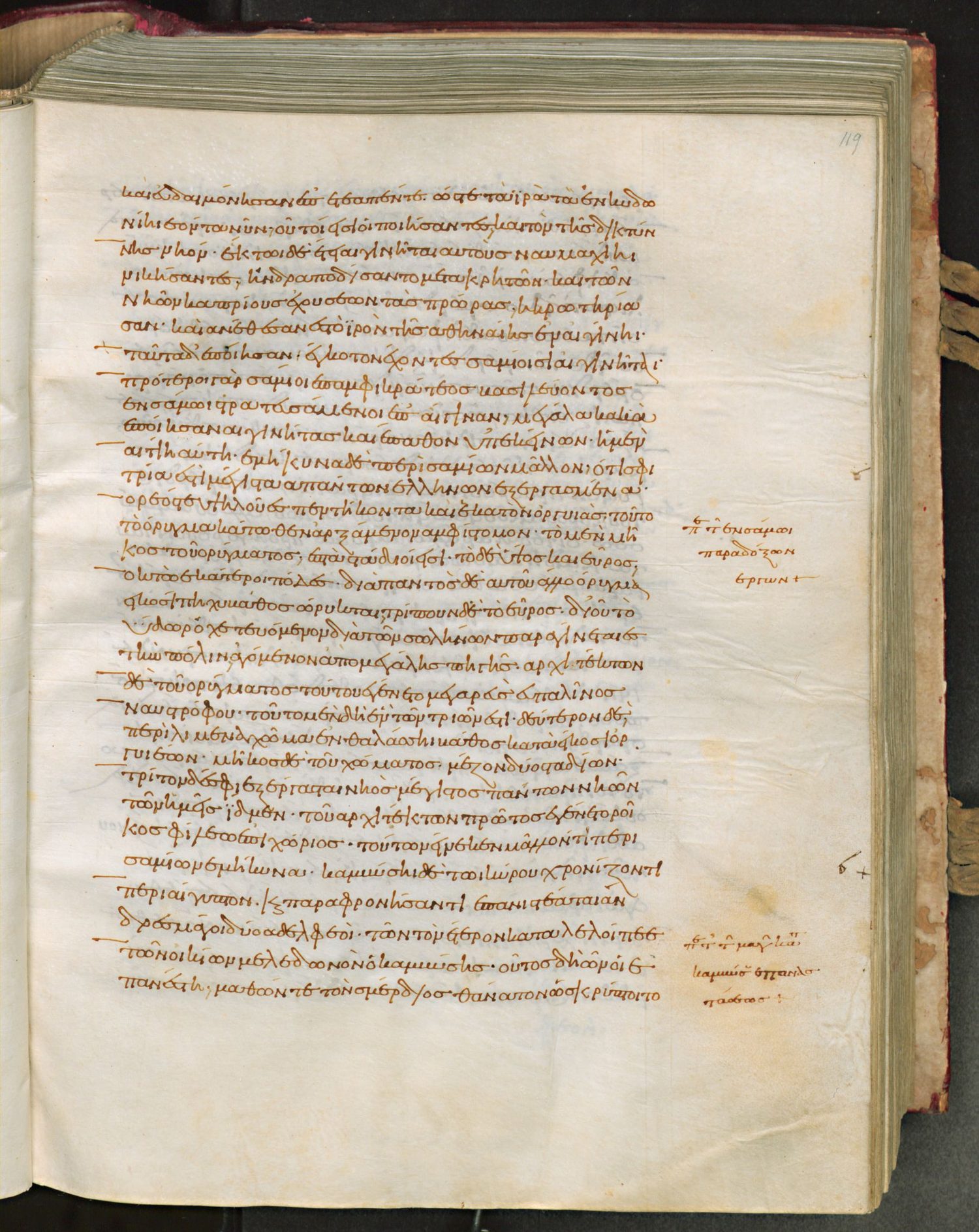
Laur. Plut. 70.3, fol. 119r: Greek here 3.59.2 to 3.60.4. Checked on the image (first and last words read and located in the Greek; each break checked against the neighbouring page): fol. 119r begins ‹καὶ εὐδαιμόνησαν ἐπʼ ἔτεα› (3.59.2), ends ‹Σμέρδιος θάνατον ὡς κρύπτοιτο› (3.61.1). English here: 3.59.2 to 3.60.4 (Godley's sentences for the sections whose Greek lies mostly on this page).
3.59.2καὶ εὐδαιμόνησαν ἐπʼ ἔτεα πέντε, ὥστε τὰ ἱρὰ τὰ ἐν Κυδωνίῃ ἐόντα νῦν οὗτοι εἰσὶ οἱ ποιήσαντες [καὶ τὸν τῆς Δικτύνης νηόν]. 3.59.3ἕκτῳ δὲ ἔτεϊ Αἰγινῆται αὐτοὺς ναυμαχίῃ νικήσαντες ἠνδραποδίσαντο μετὰ Κρητῶν, καὶ τῶν νεῶν καπρίους ἐχουσέων τὰς πρῴρας ἠκρωτηρίασαν καὶ ἀνέθεσαν ἐς τὸ ἱρὸν τῆς Ἀθηναίης ἐν Αἰγίνῃ. 3.59.4ταῦτα δὲ ἐποίησαν ἔγκοτον ἔχοντες Σαμίοισι Αἰγινῆται· πρότεροι γὰρ Σάμιοι ἐπʼ Ἀμφικράτεος βασιλεύοντος ἐν Σάμῳ στρατευσάμενοι ἐπʼ Αἴγιναν μεγάλα κακὰ ἐποίησαν Αἰγινήτας καὶ ἔπαθον ὑπʼ ἐκείνων. ἡ μὲν αἰτίη αὕτη. 3.60.1ἐμήκυνα δὲ περὶ Σαμίων μᾶλλον, ὅτι σφι τρία ἐστὶ μέγιστα ἁπάντων Ἑλλήνων ἐξεργασμένα, ὄρεός τε ὑψηλοῦ ἐς πεντήκοντα καὶ ἑκατὸν ὀργυιάς, τούτου ὄρυγμα κάτωθεν ἀρξάμενον, ἀμφίστομον. 3.60.2τὸ μὲν μῆκος τοῦ ὀρύγματος ἑπτὰ στάδιοι εἰσί, τὸ δὲ ὕψος καὶ εὖρος ὀκτὼ ἑκάτερον πόδες. διὰ παντὸς δὲ αὐτοῦ ἄλλο ὄρυγμα εἰκοσίπηχυ βάθος ὀρώρυκται, τρίπουν δὲ τὸ εὖρος, διʼ οὗ τὸ ὕδωρ ὀχετευόμενον διὰ τῶν σωλήνων παραγίνεται ἐς τὴν πόλιν ἀγόμενον ἀπὸ μεγάλης πηγῆς. 3.60.3ἀρχιτέκτων δὲ τοῦ ὀρύγματος τούτου ἐγένετο Μεγαρεὺς Εὐπαλῖνος Ναυστρόφου. τοῦτο μὲν δὴ ἓν τῶν τριῶν ἐστι, δεύτερον δὲ περὶ λιμένα χῶμα ἐν θαλάσσῃ, βάθος καὶ εἴκοσι ὀργυιέων· μῆκος δὲ τοῦ χώματος μέζον δύο σταδίων. 3.60.4τρίτον δέ σφι ἐξέργασται νηὸς μέγιστος πάντων νηῶν τῶν ἡμεῖς ἴδμεν· τοῦ ἀρχιτέκτων πρῶτος ἐγένετο Ῥοῖκος Φιλέω ἐπιχώριος. τούτων εἵνεκεν μᾶλλόν τι περὶ Σαμίων ἐμήκυνα.
3.59.2Here they stayed and prospered for five years; indeed, the temples now at Cydonia and the shrine of Dictyna are the Samians’ work; 3.59.3but in the sixth year came Aeginetans and Cretans and overcame them in a sea-fight and made slaves of them; moreover they cut off the ships’ prows, that were shaped like boars’ heads, and dedicated them in the temple of Athene in Aegina. 3.59.4This the Aeginetans did out of a grudge against the Samians, who had begun the quarrel; for when Amphicrates was king of Samos they had sent an army against Aegina, whereby now the Samians and now the Aeginetans had suffered great harm. Such was the cause of the feud. 3.60.1I have written thus at length of the Samians, because they are the makers of the three greatest works to be seen in any Greek land. First of these is the double-mouthed channel pierced for an hundred and fifty fathoms through the base of a high hill; 3.60.2the whole channel is seven furlongs long, eight feet high and eight feet wide; and throughout the whole of its length there runs another channel twenty cubits deep and three feet wide, wherethrough the water coming from an abundant spring is carried by its pipes to the city of Samos. 3.60.3The designer of this work was Eupalinus son of Naustrophus, a Megarian. This is one of the three works; the second is a mole in the sea enclosing the harbour, sunk full twenty fathoms, and more than two furlongs in length. 3.60.4The third Samian work is the temple, which is the greatest that I have seen; its first builder was Rhoecus son of Philes, a Samian. It is for this cause that I have written at length more than ordinary of Samos.
Notes
- Greek: the text printed in A. D. Godley's Loeb edition, via Perseus (tlg0016.tlg001.perseus-grc2). Square brackets mark words the editor considers later additions; [...] marks a gap the editor indicates. Perseus note markers are omitted.
- English: A. D. Godley, Herodotus vol. 2 (1921) (Loeb Classical Library), as transcribed on Wikisource. Godley's footnotes are omitted.
- Section numbers in the English were placed by comparing Godley's text with the Perseus version of his translation; where a section begins inside one of Godley's sentences, the English is kept with the page that holds the start of that sentence.
Cite
Sources
- Source: Florence, Laur. Plut. 70.3 (10th c.) via BML Teca Digitale + Greek of Godley's Loeb (Perseus) + English of A. D. Godley (Loeb, Wikisource) (holding institution)
- Critical edition: Greek of A. D. Godley's Loeb edition (1920-1925), via Perseus
← previous · → next · v cycle view · l back to library