Herodotus, Histories 3.80-88: The debate on government; Darius becomes king
Introduction
Herodotus of Halicarnassus wrote the Histories in the third quarter of the 5th century BCE, an inquiry into the deeds of Greeks and barbarians and the causes of the wars between them, later divided into nine books. Book 3 tells of Cambyses' conquest of Egypt and his madness, Polycrates of Samos, the rising of the Magi and the seven Persians who overthrew them, the accession of Darius and his provinces, and the revolt and recapture of Babylon.
The photographs are of Florence, Biblioteca Medicea Laurenziana, Plut. 70.3 (parchment, 10th century, 374 folios, 31 lines a page), Herodotus, Histories (codex A of the editors), the oldest surviving manuscript of the complete Histories, from the Teca Digitale of the Biblioteca Medicea Laurenziana. Each section below is the text of one page, or of the part of a page that falls within these chapters. The first and last words of every page were read on the photograph and located in the Greek, and every page break was checked against the next page; the notes quote these words. Readers' notes in the margins are not part of the text and are mentioned where they occur.
The Greek is the text printed in A. D. Godley's Loeb edition (1920-1925), from Perseus; it is the edited text, not a transcription of the manuscript, whose wording differs in places. The English is Godley's translation as printed, from Wikisource. Godley's English carries only chapter numbers; the section numbers shown in it were placed by comparison with the Perseus version of his translation. Each page's English is cut at the end of one of Godley's sentences, so it can begin or end a few lines away from the Greek of the page; each note gives the exact ranges.
This entry covers chapters 3.80-88, on fol. 125v to 128v.
How was this verified? (Provenance)
Where on the image
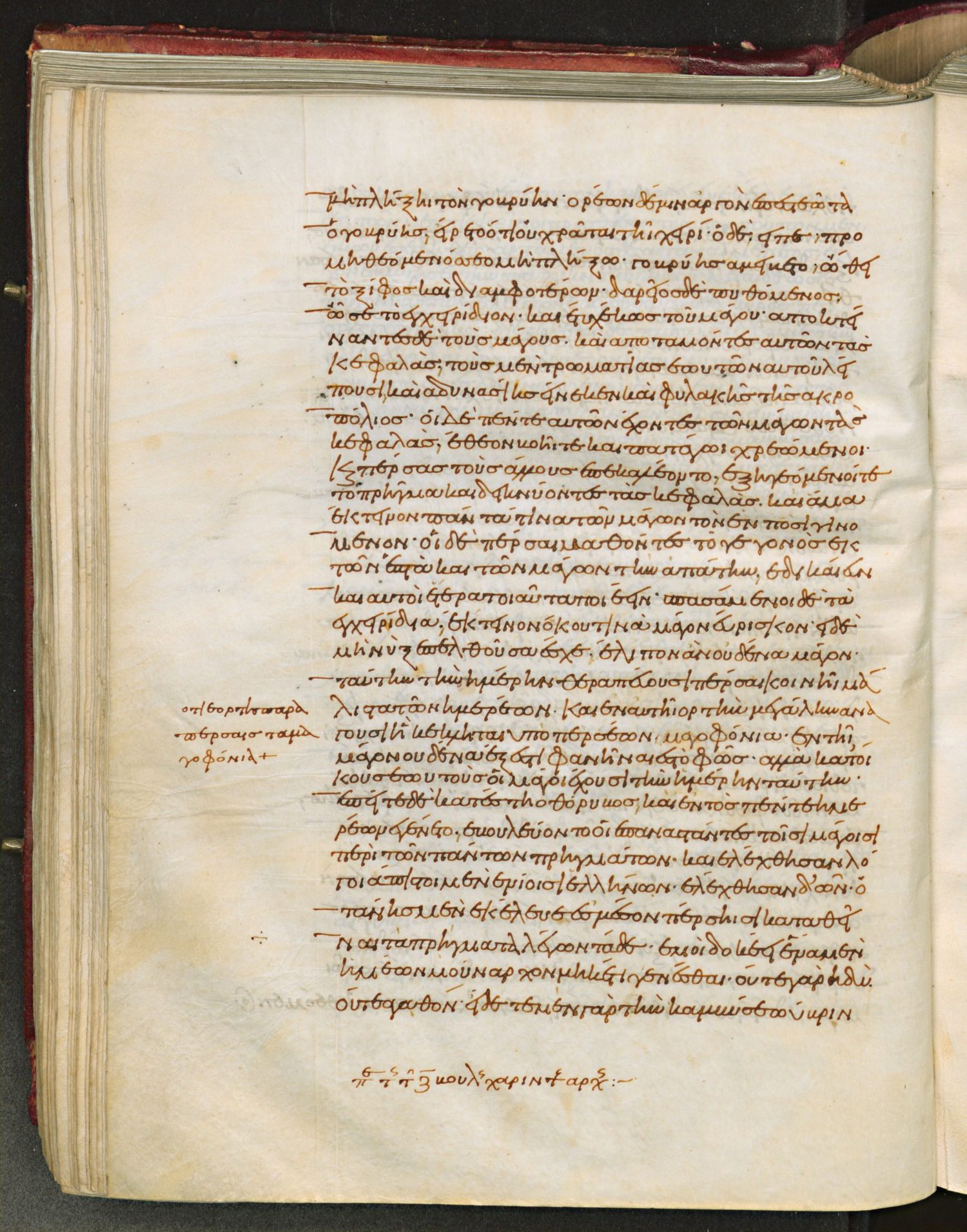
Laur. Plut. 70.3, fol. 125v: Greek here 3.80.1 to 3.80.2. Checked on the image (first and last words read and located in the Greek; each break checked against the neighbouring page): fol. 125v begins ‹μὴ πλήξῃ τὸν Γοβρύην.ὁρέων› (3.78.4), ends ‹γὰρ τὴν Καμβύσεω ὕβριν› (3.80.2). Below the text, a reader's note in the lower margin. English here: 3.80.1 to 3.80.2 (Godley's sentences for the sections whose Greek lies mostly on this page).
3.80.1ἐπείτε δὲ κατέστη ὁ θόρυβος καὶ ἐκτὸς πέντε ἡμερέων ἐγένετο, ἐβουλεύοντο οἱ ἐπαναστάντες τοῖσι Μάγοισι περὶ τῶν πάντων πρηγμάτων καὶ ἐλέχθησαν λόγοι ἄπιστοι μὲν ἐνίοισι Ἑλλήνων, ἐλέχθησαν δʼ ὦν. 3.80.2Ὀτάνης μὲν ἐκέλευε ἐς μέσον Πέρσῃσι καταθεῖναι τὰ πρήγματα, λέγων τάδε. ἐμοὶ δοκέει ἕνα μὲν ἡμέων μούναρχον μηκέτι γενέσθαι. οὔτε γὰρ ἡδὺ οὔτε ἀγαθόν. εἴδετε μὲν γὰρ τὴν Καμβύσεω ὕβριν
3.80.1When the tumult was abated, and five days had passed, the rebels against the Magians held a council on the whole state of affairs, at which words were uttered which to some Greeks seem incredible; but there is no doubt that they were spoken. 3.80.2Otanes was for giving the government to the whole body of the Persian people. “I hold,” he said, “that we must make an end of monarchy; there is no pleasure or advantage in it. You have seen to what lengths went the insolence of Cambyses, and you have borne your share of the insolence of the Magian.
Where on the image
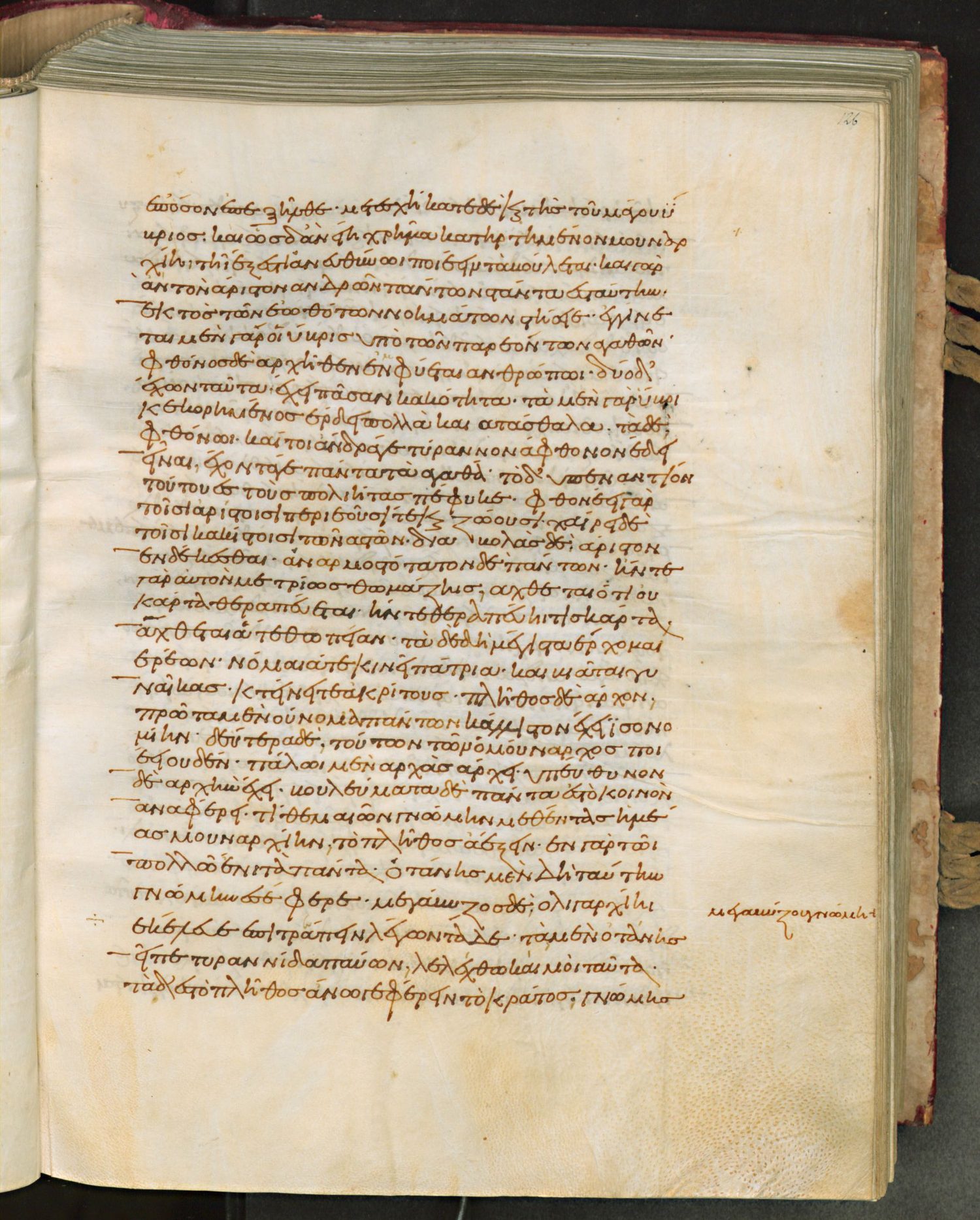
Laur. Plut. 70.3, fol. 126r: Greek here 3.80.2 to 3.81.1. Checked on the image (first and last words read and located in the Greek; each break checked against the neighbouring page): fol. 126r begins ‹ἐπʼ ὅσον ἐπεξῆλθε, μετεσχήκατε› (3.80.2), ends ‹φέρειν τὸ κράτος, γνώμης› (3.81.1). English here: 3.80.3 to 3.81.1 (Godley's sentences for the sections whose Greek lies mostly on this page).
3.80.2ἐπʼ ὅσον ἐπεξῆλθε, μετεσχήκατε δὲ καὶ τῆς τοῦ Μάγου ὕβριος. 3.80.3κῶς δʼ ἂν εἴη χρῆμα κατηρτημένον μουναρχίη, τῇ ἔξεστι ἀνευθύνῳ ποιέειν τὰ βούλεται; καὶ γὰρ ἂν τὸν ἄριστον ἀνδρῶν πάντων στάντα ἐς ταύτην ἐκτὸς τῶν ἐωθότων νοημάτων στήσειε. ἐγγίνεται μὲν γάρ οἱ ὕβρις ὑπὸ τῶν παρεόντων ἀγαθῶν, φθόνος δὲ ἀρχῆθεν ἐμφύεται ἀνθρώπῳ. 3.80.4δύο δʼ ἔχων ταῦτα ἔχει πᾶσαν κακότητα· τὰ μὲν γὰρ ὕβρι κεκορημένος ἔρδει πολλὰ καὶ ἀτάσθαλα, τὰ δὲ φθόνῳ. καίτοι ἄνδρα γε τύραννον ἄφθονον ἔδει εἶναι, ἔχοντά γε πάντα τὰ ἀγαθά. τὸ δὲ ὑπεναντίον τούτου ἐς τοὺς πολιήτας πέφυκε· φθονέει γὰρ τοῖσι ἀρίστοισι περιεοῦσί τε καὶ ζώουσι, χαίρει δὲ τοῖσι κακίστοισι τῶν ἀστῶν, διαβολὰς δὲ ἄριστος ἐνδέκεσθαι. 3.80.5ἀναρμοστότατον δὲ πάντων· ἤν τε γὰρ αὐτὸν μετρίως θωμάζῃς, ἄχθεται ὅτι οὐ κάρτα θεραπεύεται, ἤν τε θεραπεύῃ τις κάρτα, ἄχθεται ἅτε θωπί. τὰ δὲ δὴ μέγιστα ἔρχομαι ἐρέων· νόμαιά τε κινέει πάτρια καὶ βιᾶται γυναῖκας κτείνει τε ἀκρίτους. 3.80.6πλῆθος δὲ ἄρχον πρῶτα μὲν οὔνομα πάντων κάλλιστον ἔχει, ἰσονομίην, δεύτερα δὲ τούτων τῶν ὁ μούναρχος ποιέει οὐδέν· πάλῳ μὲν ἀρχὰς ἄρχει, ὑπεύθυνον δὲ ἀρχὴν ἔχει, βουλεύματα δὲ πάντα ἐς τὸ κοινὸν ἀναφέρει. τίθεμαι ὦν γνώμην μετέντας ἡμέας μουναρχίην τὸ πλῆθος ἀέξειν· ἐν γὰρ τῷ πολλῷ ἔνι τὰ πάντα. 3.81.1Ὀτάνης μὲν δὴ ταύτην γνώμην ἐσέφερε· Μεγάβυζος δὲ ὀλιγαρχίῃ ἐκέλευε ἐπιτρέπειν, λέγων τάδε. τὰ μὲν Ὀτάνης εἶπε τυραννίδα παύων, λελέχθω κἀμοὶ ταῦτα, τὰ δʼ ἐς τὸ πλῆθος ἄνωγε φέρειν τὸ κράτος, γνώμης
3.80.3What right order is there to be found in monarchy, when the ruler can do what he will, nor be held to account for it? Give this power to the best man on earth, and it would stir him to unwonted thoughts. The advantage which he holds breeds insolence, and nature makes all men jealous. 3.80.4This double cause is the root of all evil in him; sated with power he will do many reckless deeds, some from insolence, some from jealousy. For whereas an absolute ruler, as having all that heart can desire, should rightly be jealous of no man, yet it is contrariwise with him in his dealing with his countrymen; he is jealous of the safety of the good, and glad of the safety of the evil; and no man is so ready to believe calumny. 3.80.5Of all men he is the most inconsistent; accord him but just honour, and he is displeased that you make him not your first care; make him such, and he damns you for a flatterer. But I have yet worse to say of him than that; he turns the laws of the land upside down, he rapes women, he puts high and low to death. 3.80.6But the virtue of a multitude’s rule lies first in its excellent name, which signifies equality before the law; and secondly, in that it does none of the things that a monarch does. All offices are assigned by lot, and the holders are accountable for what they do therein; and the general assembly arbitrates on all counsels. Therefore I declare my opinion, that we make an end of monarchy and increase the power of the multitude, seeing that all good lies in the many.” 3.81.1Such was the judgment of Otanes: but Megabyzus’ counsel was to make a ruling oligarchy. “I agree,” said he, “to all that Otanes says against the rule of one; but when he bids you give the power to the multitude, his judgment falls short of the best.
Where on the image
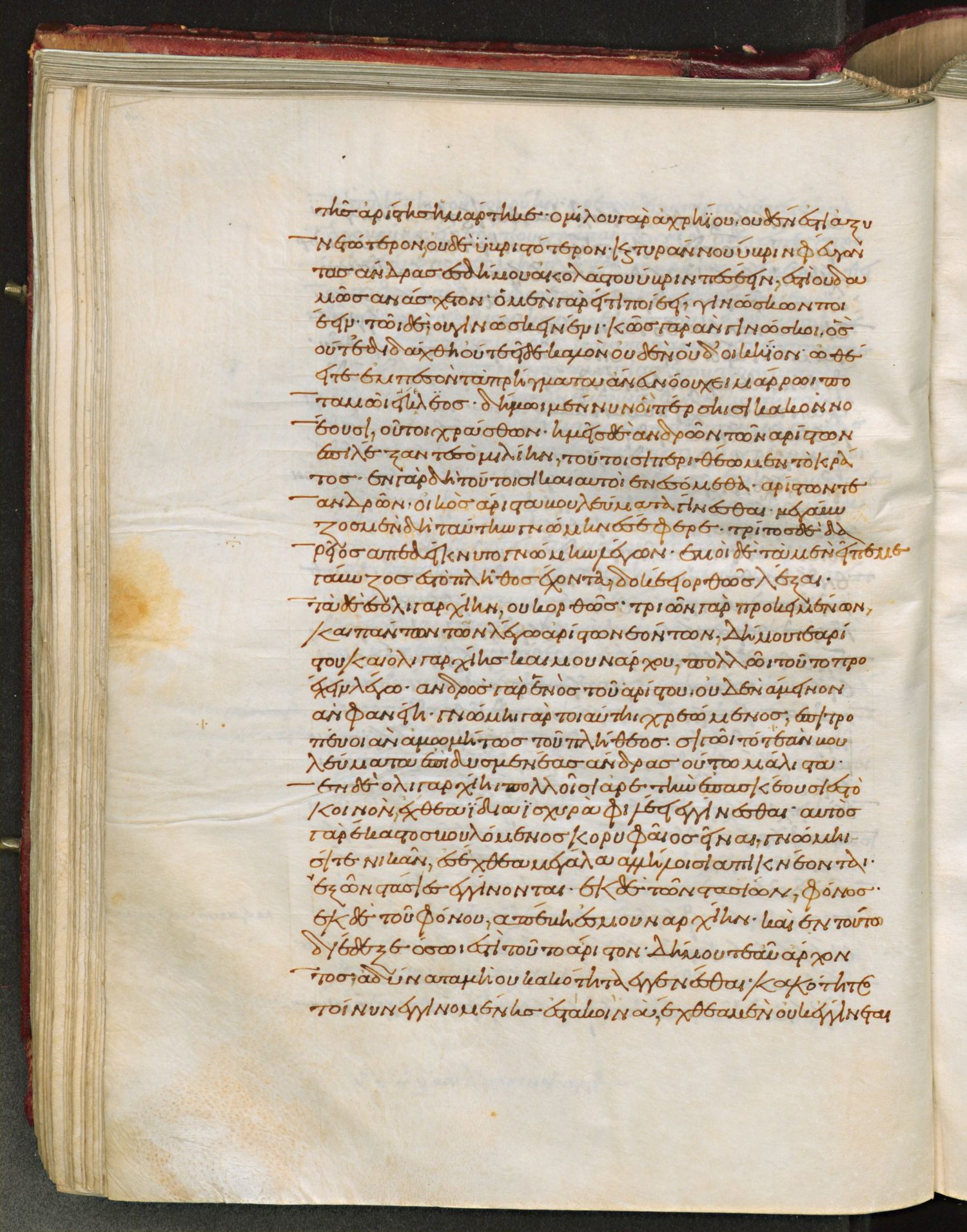
Laur. Plut. 70.3, fol. 126v: Greek here 3.81.1 to 3.82.4. Checked on the image (first and last words read and located in the Greek; each break checked against the neighbouring page): fol. 126v begins ‹τῆς ἀρίστης ἡμάρτηκε· ὁμίλου› (3.81.1), ends ‹ἔχθεα μὲν οὐκ ἐγγίνεται› (3.82.4). English here: 3.81.2 to 3.82.3 (Godley's sentences for the sections whose Greek lies mostly on this page).
3.81.1τῆς ἀρίστης ἡμάρτηκε· ὁμίλου γὰρ ἀχρηίου οὐδέν ἐστι ἀξυνετώτερον οὐδὲ ὑβριστότερον. 3.81.2καίτοι τυράννου ὕβριν φεύγοντας ἄνδρας ἐς δήμου ἀκολάστου ὕβριν πεσεῖν ἐστὶ οὐδαμῶς ἀνασχετόν. ὃ μὲν γὰρ εἴ τι ποιέει, γινώσκων ποιέει, τῷ δὲ οὐδὲ γινώσκειν ἔνι· κῶς γὰρ ἂν γινώσκοι ὃς οὔτʼ ἐδιδάχθη οὔτε εἶδε καλὸν οὐδὲν οἰκήιον,ὠθέει τε ἐμπεσὼν τὰ πρήγματα ἄνευ νόου, χειμάρρῳ ποταμῷ εἴκελος; 3.81.3δήμῳ μέν νυν, οἳ Πέρσῃσι κακὸν νοέουσι, οὗτοι χράσθων, ἡμεῖς δὲ ἀνδρῶν τῶν ἀρίστων ἐπιλέξαντες ὁμιλίην τούτοισι περιθέωμεν τὸ κράτος· ἐν γὰρ δὴ τούτοισι καὶ αὐτοὶ ἐνεσόμεθα· ἀρίστων δὲ ἀνδρῶν οἰκὸς ἄριστα βουλεύματα γίνεσθαι. 3.82.1Μεγάβυζος μὲν δὴ ταύτην γνώμην ἐσέφερε· τρίτος δὲ Δαρεῖος ἀπεδείκνυτο γνώμην, λέγων ἐμοὶ δὲ τὰ μὲν εἶπε Μεγάβυζος ἐς τὸ πλῆθος ἔχοντα δοκέει ὀρθῶς λέξαι, τὰ δὲ ἐς ὀλιγαρχίην οὐκ ὀρθῶς. τριῶν γὰρ προκειμένων καὶ πάντων τῷ λόγῳ ἀρίστων ἐόντων, δήμου τε ἀρίστου καὶ ὀλιγαρχίης καὶ μουνάρχου, πολλῷ τοῦτο προέχειν λέγω. 3.82.2ἀνδρὸς γὰρ ἑνὸς τοῦ ἀρίστου οὐδὲν ἄμεινον ἂν φανείη· γνώμῃ γὰρ τοιαύτῃ χρεώμενος ἐπιτροπεύοι ἂν ἀμωμήτως τοῦ πλήθεος, σιγῷτό τε ἂν βουλεύματα ἐπὶ δυσμενέας ἄνδρας οὕτω μάλιστα. 3.82.3ἐν δὲ ὀλιγαρχίῃ πολλοῖσι ἀρετὴν ἐπασκέουσι ἐς τὸ κοινὸν ἔχθεα ἴδια ἰσχυρὰ φιλέει ἐγγίνεσθαι· αὐτὸς γὰρ ἕκαστος βουλόμενος κορυφαῖος εἶναι γνώμῃσί τε νικᾶν ἐς ἔχθεα μεγάλα ἀλλήλοισι ἀπικνέονται, ἐξ ὧν στάσιες ἐγγίνονται, ἐκ δὲ τῶν στασίων φόνος· ἐκ δὲ τοῦ φόνου ἀπέβη ἐς μουναρχίην, καὶ ἐν τούτῳ διέδεξε ὅσῳ ἐστὶ τοῦτο ἄριστον. 3.82.4δήμου τε αὖ ἄρχοντος ἀδύνατα μὴ οὐ κακότητα ἐγγίνεσθαι· κακότητος τοίνυν ἐγγινομένης ἐς τὰ κοινὰ ἔχθεα μὲν οὐκ ἐγγίνεται
3.81.2Nothing is more foolish and violent than a useless mob; to save ourselves from the insolence of a despot by changing it for the insolence of the unbridled commonalty—that were unbearable indeed. Whatever the despot does, he does with knowledge; but the people have not even that; how can they have knowledge, who have neither learnt nor for themselves seen what is best, but ever rush headlong and drive blindly onward, like a river in spate? 3.81.3Let those stand for democracy who wish ill to Persia; but let us choose a company of the best men and invest these with the power. For we ourselves shall be of that company; and where we have the best men, there ’tis like that we shall have the best counsels.” 3.82.1Such was the judgment of Megabyzus. Darius was the third to declare his opinion. “Methinks,” said he, “Megabyzus speaks rightly concerning democracy, but not so concerning oligarchy. For the choice lying between these three, and each of them, democracy, oligarchy and monarchy being supposed to be the best of its kind, I hold that monarchy is by far the most excellent. 3.82.2Nothing can be found better than the rule of the one best man; his judgment being like to himself, he will govern the multitude with perfect wisdom, and best conceal plans made for the defeat of enemies. 3.82.3But in an oligarchy, the desire of many to do the state good service ofttimes engenders bitter enmity among them; for each one wishing to be chief of all and to make his counsels prevail, violent enmity is the outcome, enmity brings faction and faction bloodshed; and the end of bloodshed is monarchy; whereby it is shown that this fashion of government is the best.
Where on the image
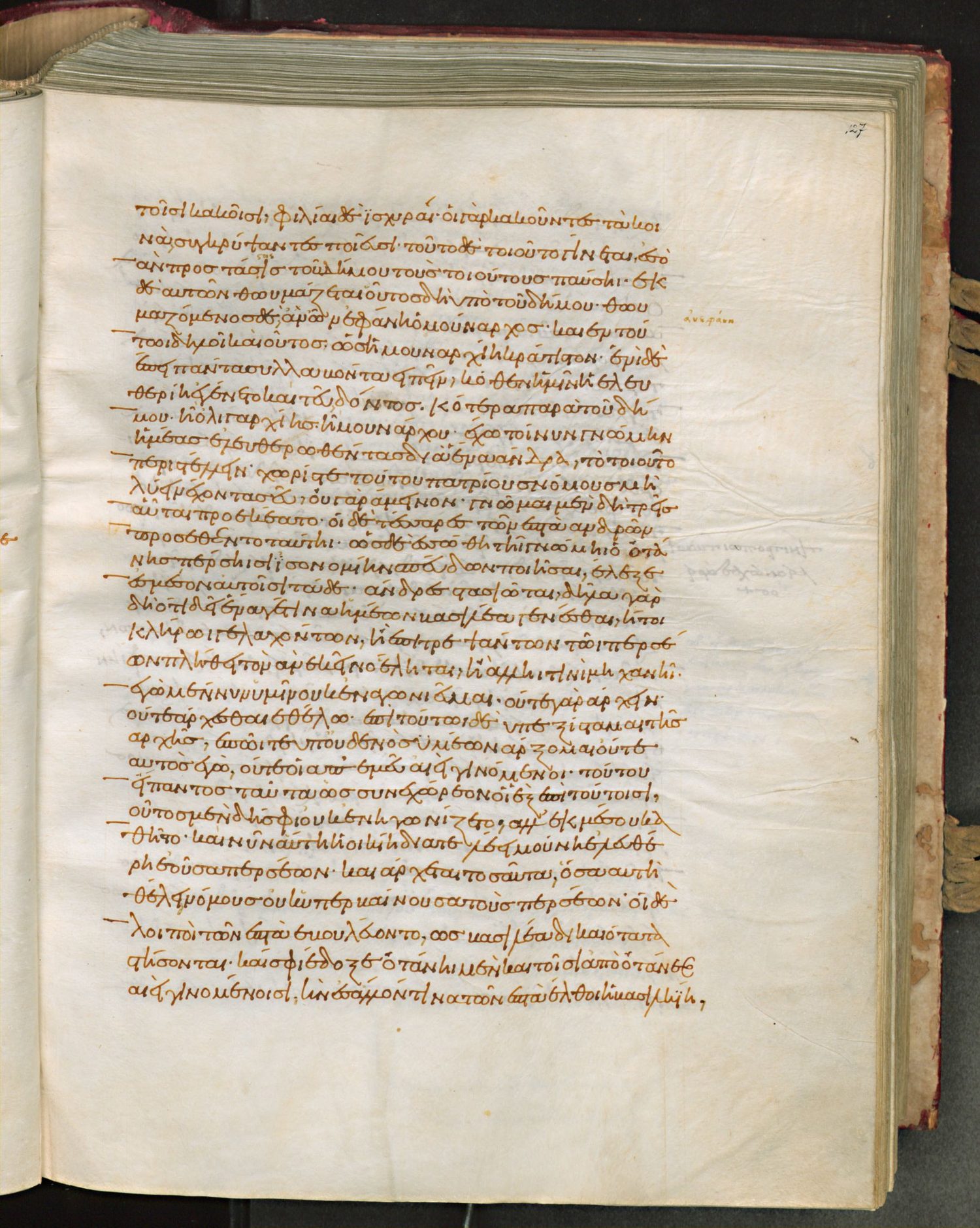
Laur. Plut. 70.3, fol. 127r: Greek here 3.82.4 to 3.84.1. Checked on the image (first and last words read and located in the Greek; each break checked against the neighbouring page): fol. 127r begins ‹τοῖσι κακοῖσι, φιλίαι δὲ› (3.82.4), ends ‹ἑπτὰ ἔλθῃ ἡ βασιληίη› (3.84.1). English here: 3.82.4 to 3.83.3 (Godley's sentences for the sections whose Greek lies mostly on this page).
3.82.4τοῖσι κακοῖσι, φιλίαι δὲ ἰσχυραί· οἱ γὰρ κακοῦντες τὰ κοινὰ συγκύψαντες ποιεῦσι. τοῦτο δὲ τοιοῦτο γίνεται ἐς ὃ ἂν προστάς τις τοῦ δήμου τοὺς τοιούτους παύσῃ. ἐκ δὲ αὐτῶν θωμάζεται οὗτος δὴ ὑπὸ τοῦ δήμου, θωμαζόμενος δὲ ἀνʼ ὦν ἐφάνη μούναρχος ἐών, καὶ ἐν τούτῳ δηλοῖ καὶ οὗτος ὡς ἡ μουναρχίη κράτιστον. 3.82.5ἑνὶ δὲ ἔπεϊ πάντα συλλαβόντα εἰπεῖν, κόθεν ἡμῖν ἡ ἐλευθερίη ἐγένετο καὶ τεῦ δόντος; κότερα παρὰ τοῦ δήμου ἢ ὀλιγαρχίης ἢ μουνάρχου; ἔχω τοίνυν γνώμην ἡμέας ἐλευθερωθέντας διὰ ἕνα ἄνδρα τὸ τοιοῦτο περιστέλλειν, χωρίς τε τούτου πατρίους νόμους μὴ λύειν ἔχοντας εὖ· οὐ γὰρ ἄμεινον. 3.83.1γνῶμαι μὲν δὴ τρεῖς αὗται προεκέατο, οἱ δὲ τέσσερες τῶν ἑπτὰ ἀνδρῶν προσέθεντο ταύτῃ. ὡς δὲ ἑσσώθη τῇ γνώμῃ ὁ Ὀτάνης Πέρσῃσι ἰσονομίην σπεύδων ποιῆσαι, ἔλεξε ἐς μέσον αὐτοῖσι τάδε. 3.83.2ἄνδρες στασιῶται, δῆλα γὰρ δὴ ὅτι δεῖ ἕνα γε τινὰ ἡμέων βασιλέα γενέσθαι, ἤτοι κλήρῳ γε λαχόντα, ἢ ἐπιτρεψάντων τῷ Περσέων πλήθεϊ τὸν ἂν ἐκεῖνο ἕληται, ἢ ἄλλῃ τινὶ μηχανῇ. ἐγὼ μέν νυν ὑμῖν οὐκ ἐναγωνιεῦμαι· οὔτε γὰρ ἄρχειν οὔτε ἄρχεσθαι ἐθέλω· ἐπὶ τούτῳ δὲ ὑπεξίσταμαι τῆς ἀρχῆς, ἐπʼ ᾧ τε ὑπʼ οὐδενὸς ὑμέων ἄρξομαι, οὔτε αὐτὸς ἐγὼ οὔτε οἱ ἀπʼ ἐμεῦ αἰεὶ γινόμενοι. 3.83.3τούτου εἴπαντος ταῦτα ὡς συνεχώρεον οἱ ἓξ ἐπὶ τούτοισι, οὗτος μὲν δή σφι οὐκ ἐνηγωνίζετο ἀλλʼ ἐκ μέσου κατῆστο, καὶ νῦν αὕτη ἡ οἰκίη διατελέει μούνη ἐλευθέρη ἐοῦσα Περσέων καὶ ἄρχεται τοσαῦτα ὅσα αὐτὴ θέλει, νόμους οὐκ ὑπερβαίνουσα τοὺς Περσέων. 3.84.1οἱ δὲ λοιποὶ τῶν ἑπτὰ ἐβουλεύοντο ὡς βασιλέα δικαιότατα στήσονται· καί σφι ἔδοξε Ὀτάνῃ μὲν καὶ τοῖσι ἀπὸ Ὀτάνεω αἰεὶ γινομένοισι, ἢν ἐς ἄλλον τινὰ τῶν ἑπτὰ ἔλθῃ ἡ βασιληίη,
3.82.4Again, the rule of the commonalty must of necessity engender evil-mindedness; and when evil-mindedness in public matters is engendered, bad men are not divided by enmity but united by close friendship; for they that would do evil to the commonwealth conspire together to do it. This continues till someone rises to champion the people’s cause and makes an end of such evil-doing. He therefore becomes the people’s idol, and being their idol is made their monarch; so his case also proves that monarchy is the best government. 3.82.5But (to conclude the whole matter in one word) tell me, whence and by whose gift came our freedom—from the commonalty or an oligarchy or a single ruler? I hold therefore, that as the rule of one man gave us freedom, so that rule we should preserve; and, moreover, that we should not repeal the good laws of our fathers; that were ill done.” 3.83.1Having to judge between these three opinions, four of the seven declared for the last. Then Otanes, his proposal to give the Persians equality being defeated, thus spoke among them all: “Friends and partisans! 3.83.2seeing that it is plain that one of us must be made king (whether by lot, or by our suffering the people of Persia to choose whom they will, or in some other way), know that I will not enter the lists with you; I desire neither to rule nor to be ruled; but if I waive my claim to be king, I make this condition, that neither I nor any of my posterity shall be subject to any one of you.” 3.83.3To these terms the six others agreed; Otanes took no part in the contest but stood aside; and to this day his house (and none other in Persia) remains free, nor is compelled to render any unwilling obedience, so long as it transgresses no Persian law.
Where on the image
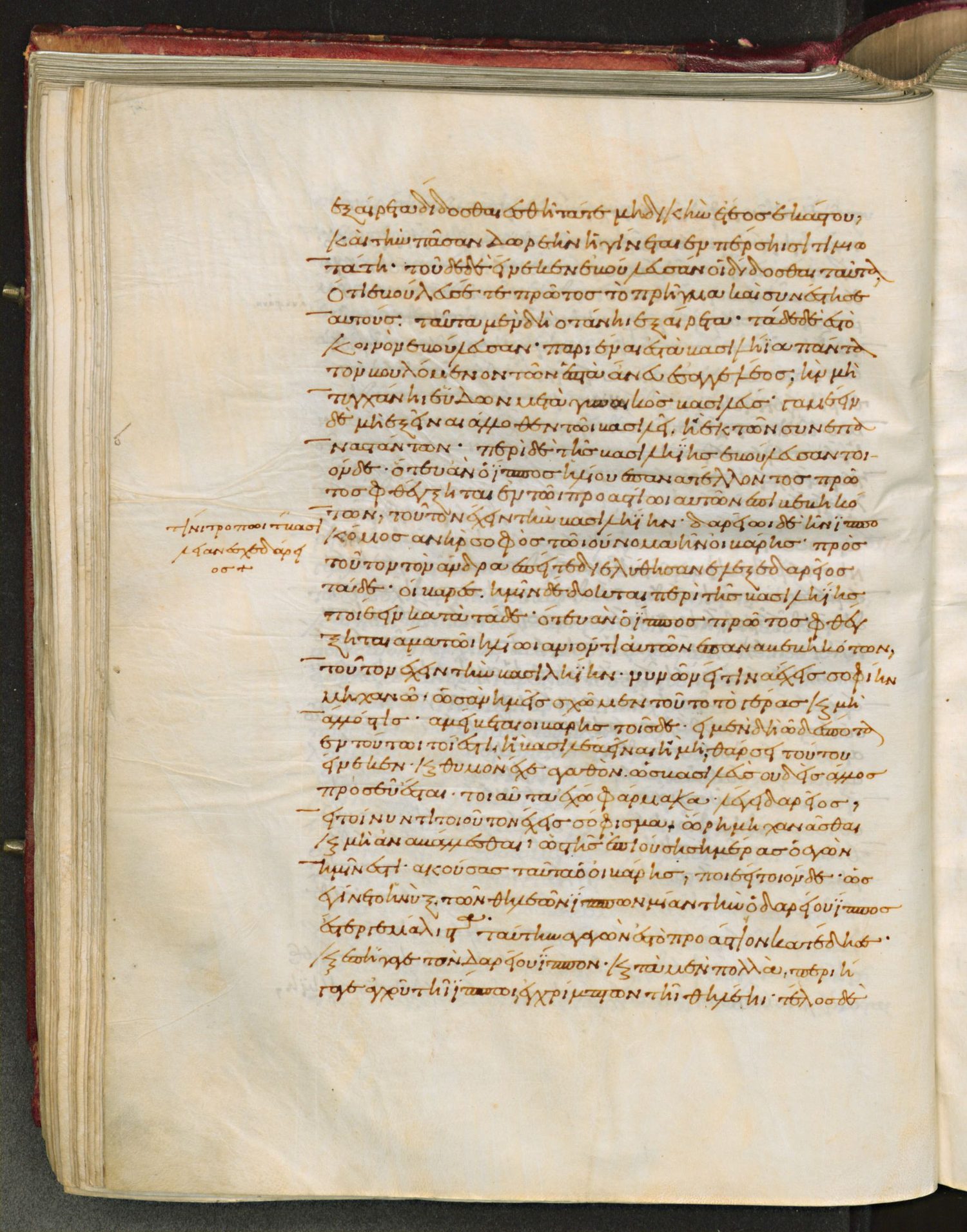
Laur. Plut. 70.3, fol. 127v: Greek here 3.84.1 to 3.85.3. Checked on the image (first and last words read and located in the Greek; each break checked against the neighbouring page): fol. 127v begins ‹ἐξαίρετα δίδοσθαι ἐσθῆτά τε› (3.84.1), ends ‹τῇ θηλέῃ, τέλος δὲ› (3.85.3). English here: 3.84.1 to 3.85.3 (Godley's sentences for the sections whose Greek lies mostly on this page).
3.84.1ἐξαίρετα δίδοσθαι ἐσθῆτά τε Μηδικὴν ἔτεος ἑκάστου καὶ τὴν πᾶσαν δωρεὴν ἣ γίνεται ἐν Πέρσῃσι τιμιωτάτη. τοῦδε δὲ εἵνεκεν ἐβούλευσάν οἱ δίδοσθαι ταῦτα, ὅτι ἐβούλευσέ τε πρῶτος τὸ πρῆγμα καὶ συνέστησε αὐτούς. 3.84.2ταῦτα μὲν δὴ Ὀτάνῃ ἐξαίρετα, τάδε δὲ ἐς τὸ κοινὸν ἐβούλευσαν, παριέναι ἐς τὰ βασιλήια πάντα τὸν βουλόμενον τῶν ἑπτὰ ἄνευ ἐσαγγελέος, ἢν μὴ τυγχάνῃ εὕδων μετὰ γυναικὸς βασιλεύς, γαμέειν δὲ μὴ ἐξεῖναι ἄλλοθεν τῷ βασιλέι ἢ ἐκ τῶν συνεπαναστάντων. 3.84.3περὶ δὲ τῆς βασιληίης ἐβούλευσαν τοιόνδε· ὅτευ ἂν ὁ ἵππος ἡλίου ἐπανατέλλοντος πρῶτος φθέγξηται, ἐν τῷ προαστείῳ αὐτῶν ἐπιβεβηκότων, τοῦτον ἔχειν τὴν βασιληίην. 3.85.1Δαρείῳ δὲ ἦν ἱπποκόμος ἀνὴρ σοφός, τῷ οὔνομα ἦν Οἰβάρης. πρὸς τοῦτον τὸν ἄνδρα, ἐπείτε διελύθησαν, ἔλεξε Δαρεῖος τάδε. Οἴβαρες, ἡμῖν δέδοκται περὶ τῆς βασιληίης ποιέειν κατὰ τάδε· ὅτευ ἂν ὁ ἵππος πρῶτος φθέγξηται ἅμα τῷ ἡλίῳ ἀνιόντι αὐτῶν ἐπαναβεβηκότων, τοῦτον ἔχειν τὴν βασιληίην. νῦν ὦν εἴ τινα ἔχεις σοφίην, μηχανῶ ὡς ἂν ἡμεῖς σχῶμεν τοῦτο τὸ γέρας καὶ μὴ ἄλλος τις. 3.85.2ἀμείβεται Οἰβάρης τοῖσιδε. εἰ μὲν δὴ ὦ δέσποτα ἐν τούτῳ τοι ἐστὶ ἢ βασιλέα εἶναι ἢ μή, θάρσεε τούτου εἵνεκεν καὶ θυμὸν ἔχε ἀγαθόν, ὡς βασιλεὺς οὐδεὶς ἄλλος πρὸ σεῦ ἔσται· τοιαῦτα ἔχω φάρμακα. λέγει Δαρεῖος εἰ τοίνυν τι τοιοῦτον ἔχεις σόφισμα, ὥρη μηχανᾶσθαι καὶ μὴ ἀναβάλλεσθαι, ὡς τῆς ἐπιούσης ἡμέρης ὁ ἀγὼν ἡμῖν ἐστί. 3.85.3ἀκούσας ταῦτα ὁ Οἰβάρης ποιέει τοιόνδε· ὡς ἐγίνετο ἡ νύξ, τῶν θηλέων ἵππων μίαν, τὴν ὁ Δαρείου ἵππος ἔστεργε μάλιστα, ταύτην ἀγαγὼν ἐς τὸ προάστειον κατέδησε καὶ ἐπήγαγε τὸν Δαρείου ἵππον, καὶ τὰ μὲν πολλὰ περιῆγε ἀγχοῦ τῇ ἵππῳ ἐγχρίμπτων τῇ θηλέῃ, τέλος δὲ
3.84.1The rest of the seven then consulted what was the justest way of making a king; and they resolved, if another of the seven than Otanes should gain the royal power, that Otanes and his posterity should receive for themselves specially a yearly gift of Median raiment and all such presents as the Persians hold most precious. The reason of this resolve was that it was he who had first contrived the matter and assembled the conspirators. 3.84.2To Otanes, then, they gave this peculiar honour; but with regard to all of them alike they decreed that any one of the seven should, if he so wished, enter the king’s palace unannounced, save if the king were sleeping with a woman; and that it should be forbidden to the king to take a wife saving from the households of the conspirators. 3.84.3As concerning the making of a king, they resolved that he should be elected whose horse, when they were all mounted in the suburb of the city, should first be heard to neigh at sunrise. 3.85.1Now Darius had a clever groom, whose name was Oebares. When the council broke up, Darius said to him: “Oebares, in the matter of the kingship, we are resolved that he shall be king whose horse, when we are all mounted, shall first neigh at sunrise. Now do you devise by whatever cunning you can that we and none other may win this prize.” 3.85.2“Master,” Oebares answered, “if this is to determine whether you be king or not, you have no cause to fear; be of good courage; no man but you shall be king; trust my arts for that.” “Then,” said Darius, “if you have any trick such as you say, set about it without delay, for to-morrow is the day of decision.” 3.85.3When Oebares heard that he did as I will show. At nightfall he brought a mare that was especially favoured by Darius’ horse, and tethered her in the suburb of the city; then bringing in Darius’ horse, he led him round her near, so as ever and anon to touch her, and at last let the stallion have his way with the mare.
Where on the image
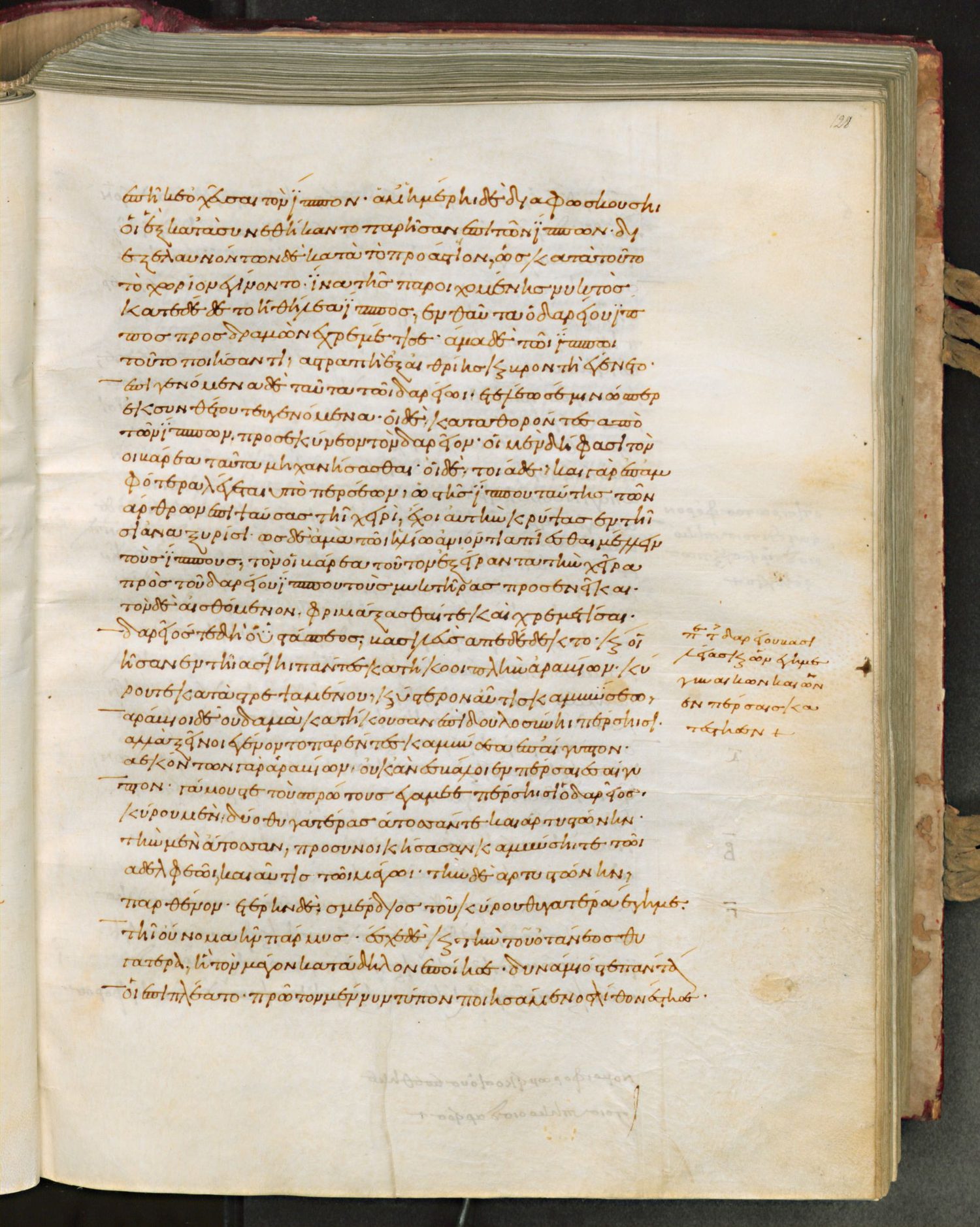
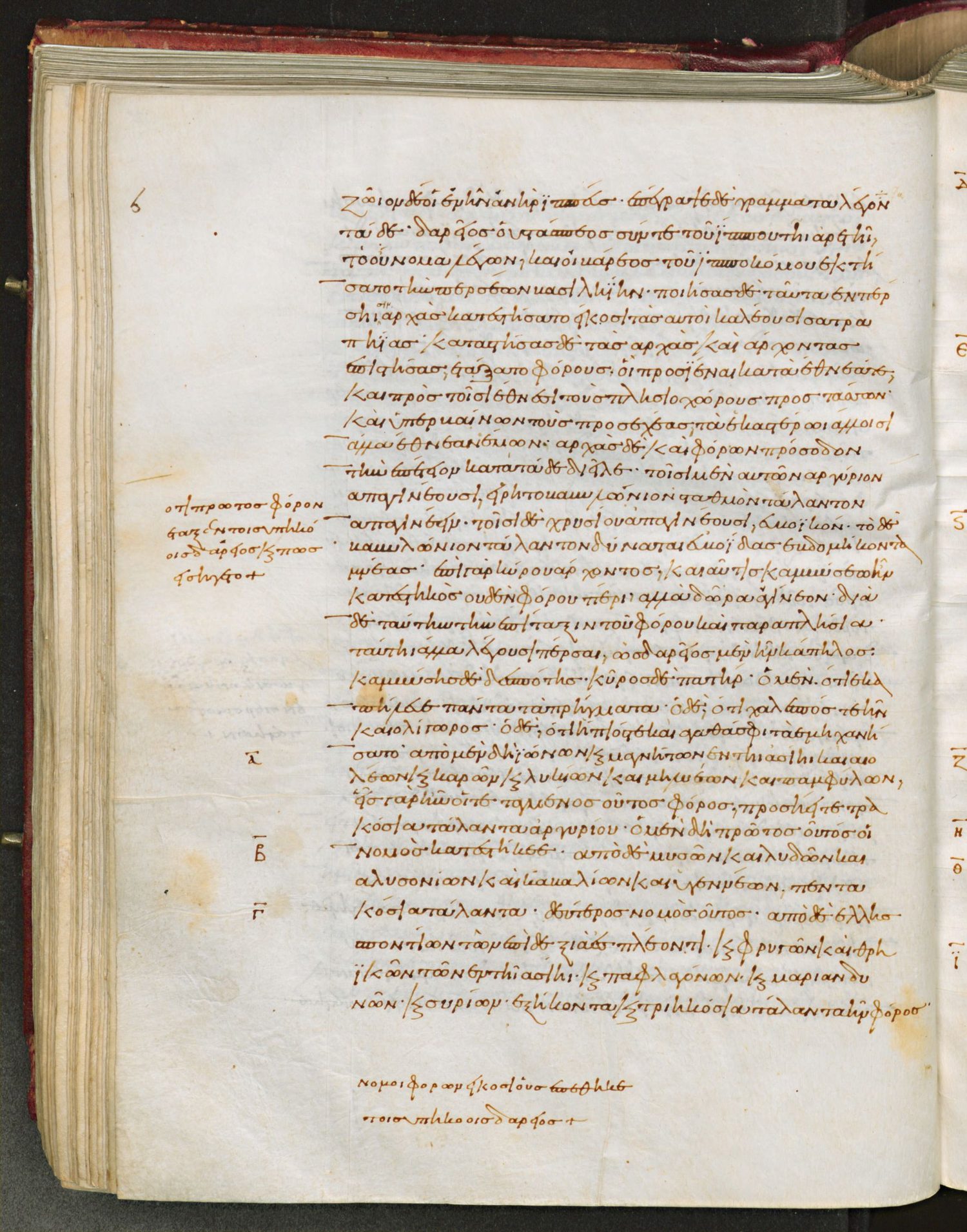
Laur. Plut. 70.3, fol. 128r, 128v: Greek here 3.85.3 to 3.88.3. Checked on the image (first and last words read and located in the Greek; each break checked against the neighbouring page): fol. 128r begins ‹ἐπῆκε ὀχεῦσαι τὸν ἵππον.ἅμʼ› (3.85.3), ends ‹τύπον ποιησάμενος λίθινον ἔστησε› (3.88.3). fol. 128v begins ‹ζῷον δέ οἱ ἐνῆν› (3.88.3), ends ‹τριηκόσια τάλαντα ἦν φόρος› (3.90.2). Two lines below the text hold a reader's note on the tribute districts set by Darius. This section joins the text of fol. 128r and 128v that belongs to these chapters, because the part on one of the pages is too short to carry any of Godley's sentences on its own. English here: 3.86.1 to 3.88.3 (Godley's sentences for the sections whose Greek lies mostly on this page).
3.85.3ἐπῆκε ὀχεῦσαι τὸν ἵππον. 3.86.1ἅμʼ ἡμέρῃ δὲ διαφωσκούσῃ οἱ ἓξ κατὰ συνεθήκαντο παρῆσαν ἐπὶ τῶν ἵππων· διεξελαυνόντων δὲ κατὰ τὸ προάστειον, ὡς κατὰ τοῦτο τὸ χωρίον ἐγίνοντο ἵνα τῆς παροιχομένης νυκτὸς κατεδέδετο ἡ θήλεα ἵππος, ἐνθαῦτα ὁ Δαρείου ἵππος προσδραμὼν ἐχρεμέτισε· 3.86.2ἅμα δὲ τῷ ἵππῳ τοῦτο ποιήσαντι ἀστραπὴ ἐξ αἰθρίης καὶ βροντὴ ἐγένετο. ἐπιγενόμενα δὲ ταῦτα τῷ Δαρείῳ ἐτελέωσέ μιν ὥσπερ ἐκ συνθέτου τευ γενόμενα· οἳ δὲ καταθορόντες ἀπὸ τῶν ἵππων προσεκύνεον τὸν Δαρεῖον. 3.87.1οἳ μὲν δή φασι τὸν Οἰβάρεα ταῦτα μηχανήσασθαι, οἳ δὲ τοιάδε (καὶ γὰρ ἐπʼ ἀμφότερα λέγεται ὑπὸ Περσέων), ὡς τῆς ἵππου ταύτης τῶν ἄρθρων ἐπιψαύσας τῇ χειρὶ ἔχοι αὐτὴν κρύψας ἐν τῇσι ἀναξυρίσι· ὡς δὲ ἅμα τῷ ἡλίῳ ἀνιόντι ἀπίεσθαι μέλλειν τοὺς ἵππους, τὸν Οἰβάρεα τοῦτον ἐξείραντα τὴν χεῖρα πρὸς τοῦ Δαρείου ἵππου τοὺς μυκτῆρας προσενεῖκαι, τὸν δὲ αἰσθόμενον φριμάξασθαί τε καὶ χρεμετίσαι. 3.88.1Δαρεῖός τε δὴ ὁ Ὑστάσπεος βασιλεὺς ἀπεδέδεκτο, καί οἱ ἦσαν ἐν τῇ Ἀσίῃ πάντες κατήκοοι πλὴν Ἀραβίων, Κύρου τε καταστρεψαμένου καὶ ὕστερον αὖτις Καμβύσεω. Ἀράβιοι δὲ οὐδαμὰ κατήκουσαν ἐπὶ δουλοσύνῃ Πέρσῃσι, ἀλλὰ ξεῖνοι ἐγένοντο παρέντες Καμβύσεα ἐπʼ Αἴγυπτον· ἀεκόντων γὰρ Ἀραβίων οὐκ ἂν ἐσβάλοιεν Πέρσαι ἐς Αἴγυπτον. 3.88.2γάμους τε τοὺς πρώτους ἐγάμεε Πέρσῃσι ὁ Δαρεῖος, Κύρου μὲν δύο θυγατέρας Ἄτοσσάν τε καὶ Ἀρτυστώνην, τὴν μὲν Ἄτοσσαν προσυνοικήσασαν Καμβύσῃ τε τῷ ἀδελφεῷ καὶ αὖτις τῷ Μάγῳ, τὴν δὲ Ἀρτυστώνην παρθένον· 3.88.3ἑτέρην δὲ Σμέρδιος τοῦ Κύρου θυγατέρα ἔγημε, τῇ οὔνομα ἦν Πάρμυς· ἔσχε δὲ καὶ τὴν τοῦ Ὀτάνεω θυγατέρα, ἣ τὸν Μάγον κατάδηλον ἐποίησε· δυνάμιός τε πάντα οἱ ἐπιμπλέατο. πρῶτον μέν νυν τύπον ποιησάμενος λίθινον ἔστησε· ζῷον δέ οἱ ἐνῆν ἀνὴρ ἱππεύς, ἐπέγραψε δὲ γράμματα λέγοντα τάδε· Δαρεῖος ὁ Ὑστάσπεος σύν τε τοῦ ἵππου τῇ ἀρετῇ τὸ οὔνομα λέγων καὶ Οἰβάρεος τοῦ ἱπποκόμου ἐκτήσατο τὴν Περσέων βασιληίην.
3.86.1At dawn of day came the six on horseback as they had agreed. As they rode out through the suburb and came to the place where the mare had been picketed in the past night, Darius’ horse trotted up to it and whinnied; 3.86.2and as he so did there came lightning and thunder out of a clear sky. These signs given to Darius were thought to be foreordained and made his election perfect; his companions leapt from their horses and did obeisance to him. 3.87.1Some say that this was Oebares’ plan; but there is another story in Persia besides this: that he touched the mare with his hand, and then kept it hidden in his breeches till the six were about to let go their horses at sunrise; when he took his hand out and held it to the nostrils of Darius’ horse, which forthwith snorted and whinnied. 3.88.1So Darius son of Hystaspes was made king, and the whole of Asia, which Cyrus first and Cambyses after him had subdued, was made subject to him, except the Arabians; these did not yield the obedience of slaves to the Persians, but were united to them by friendship, as having given Cambyses passage into Egypt, which the Persians could not enter without the consent of the Arabians. 3.88.2Darius took wives from the noblest houses of Persia, marrying Cyrus’ daughters Atossa and Artystone; Atossa had been wife of her brother Cambyses and afterwards of the Magian, Artystone was a virgin. 3.88.3He married also Parmys, daughter of Cyrus’ son Smerdis, and that daughter of Otanes who had discovered the truth about the Magian; and the whole land was full of his power. First he made and set up a carved stone, whereon was graven the figure of a horseman, with this inscription: “Darius son of Hystaspes, aided by the excellence of his horse” (here followed the horse’s name) “and of Oebares his groom, won the kingdom of Persia.”
Notes
- Greek: the text printed in A. D. Godley's Loeb edition, via Perseus (tlg0016.tlg001.perseus-grc2). Square brackets mark words the editor considers later additions; [...] marks a gap the editor indicates. Perseus note markers are omitted.
- English: A. D. Godley, Herodotus vol. 2 (1921) (Loeb Classical Library), as transcribed on Wikisource. Godley's footnotes are omitted.
- Section numbers in the English were placed by comparing Godley's text with the Perseus version of his translation; where a section begins inside one of Godley's sentences, the English is kept with the page that holds the start of that sentence.
Cite
Sources
- Source: Florence, Laur. Plut. 70.3 (10th c.) via BML Teca Digitale + Greek of Godley's Loeb (Perseus) + English of A. D. Godley (Loeb, Wikisource) (holding institution)
- Critical edition: Greek of A. D. Godley's Loeb edition (1920-1925), via Perseus
← previous · → next · v cycle view · l back to library