Herodotus, Histories 4.1-15: The origins of the Scythians
Introduction
Herodotus of Halicarnassus wrote the Histories in the third quarter of the 5th century BCE, an inquiry into the deeds of Greeks and barbarians and the causes of the wars between them, later divided into nine books. Book 4 tells of Darius' expedition against the Scythians, with Herodotus' account of Scythia, its peoples, rivers and customs, and of the shape of the world, and of the Persian expedition against Barca, with the history of Cyrene and a description of the peoples of Libya.
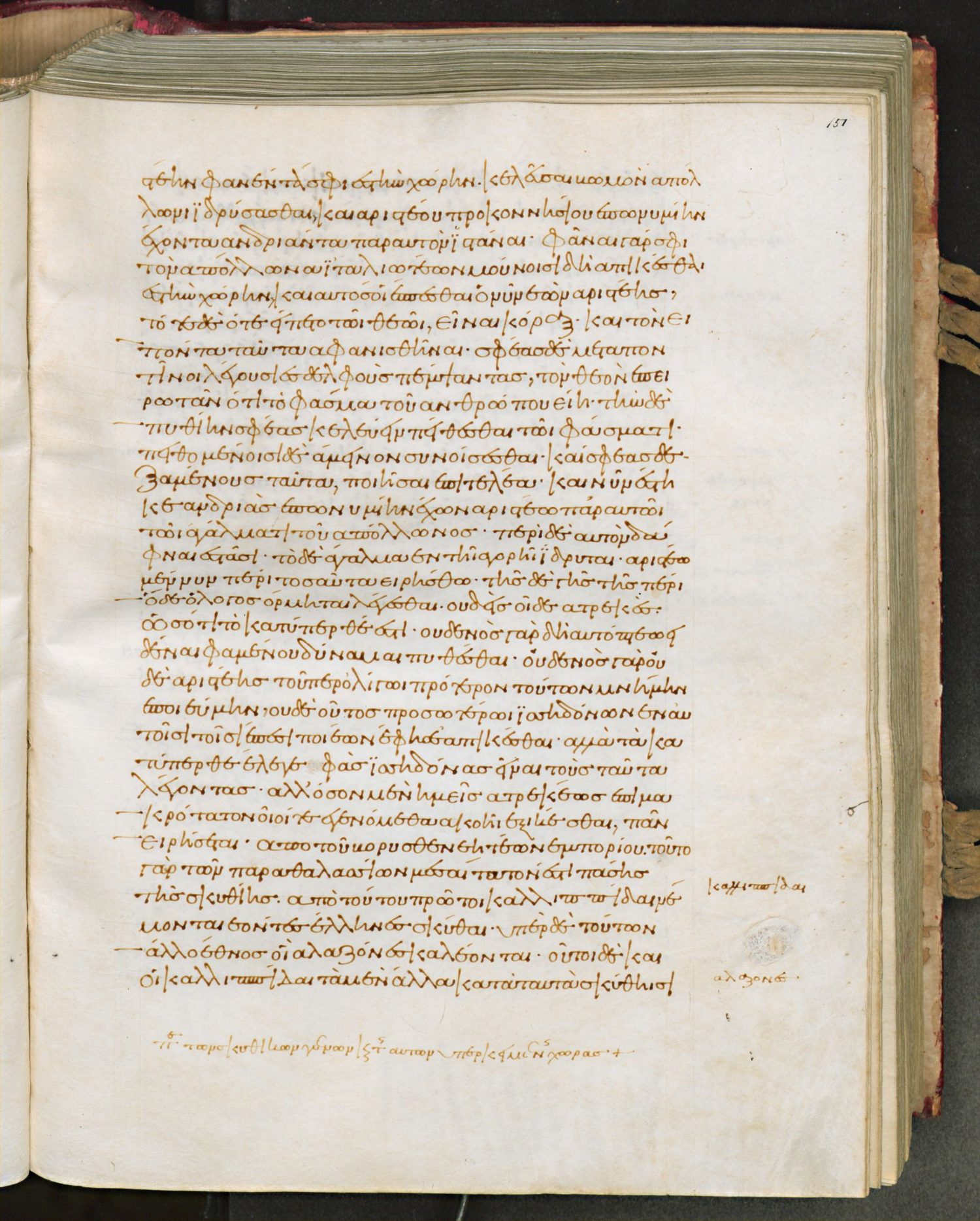
The photographs are of Florence, Biblioteca Medicea Laurenziana, Plut. 70.3 (parchment, 10th century, 374 folios, 31 lines a page), Herodotus, Histories (codex A of the editors), the oldest surviving manuscript of the complete Histories, from the Teca Digitale of the Biblioteca Medicea Laurenziana. Each section below is the text of one page, or of the part of a page that falls within these chapters. The first and last words of every page were read on the photograph and located in the Greek, and every page break was checked against the next page; the notes quote these words. Readers' notes in the margins are not part of the text and are mentioned where they occur.
The Greek is the text printed in A. D. Godley's Loeb edition (1920-1925), from Perseus; it is the edited text, not a transcription of the manuscript, whose wording differs in places. The English is Godley's translation as printed, from Wikisource. Godley's English carries only chapter numbers; the section numbers shown in it were placed by comparison with the Perseus version of his translation. Each page's English is cut at the end of one of Godley's sentences, so it can begin or end a few lines away from the Greek of the page; each note gives the exact ranges.
This entry covers chapters 4.1-15, on fol. 147r to 151r.
How was this verified? (Provenance)
Where on the image
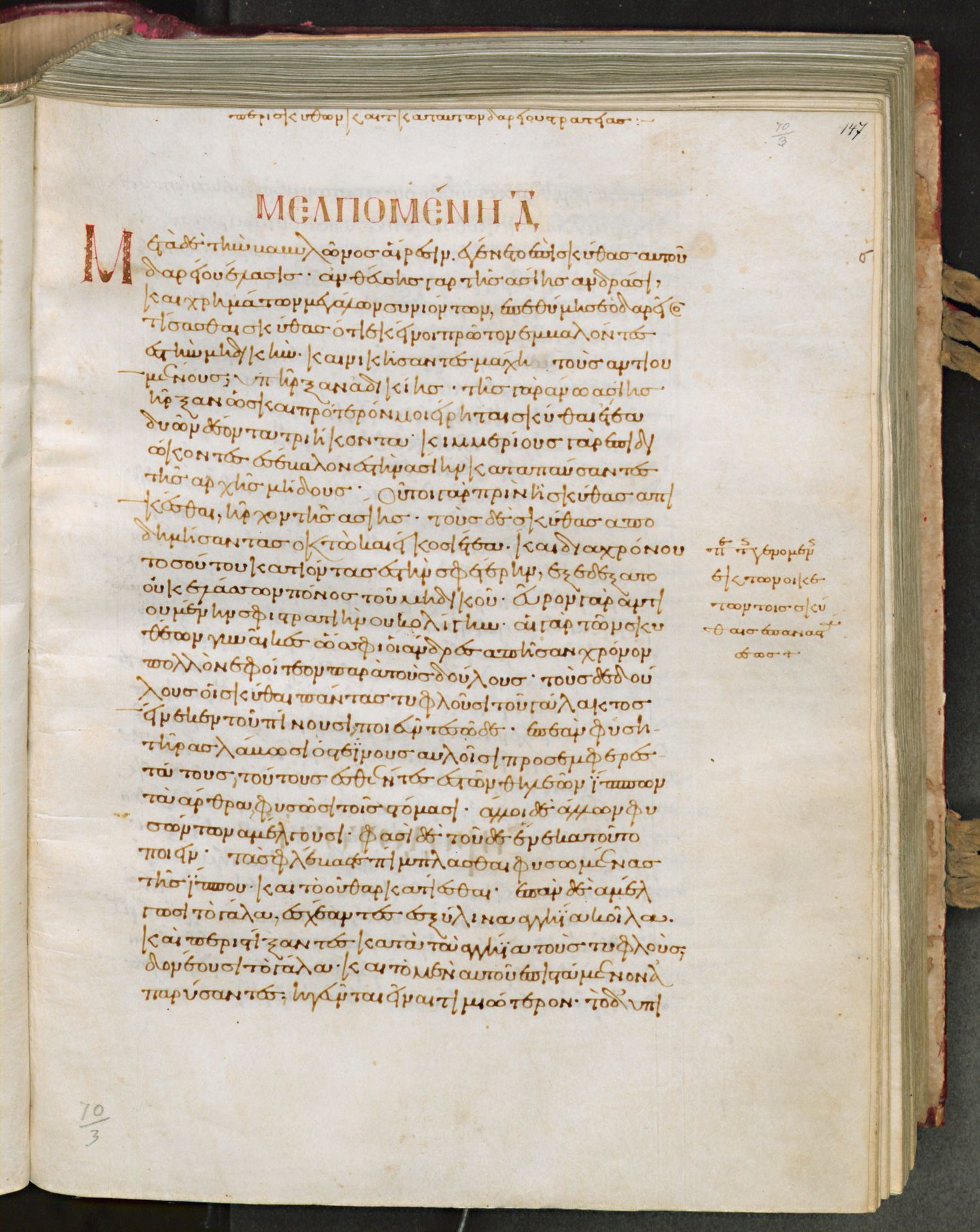
Laur. Plut. 70.3, fol. 147r: Greek here 4.1.1 to 4.2.2. Checked on the image (first and last words read and located in the Greek; each break checked against the neighbouring page): fol. 147r begins ‹μετὰ δὲ τὴν Βαβυλῶνος› (4.1.1), ends ‹τιμιώτερον, τό δʼ ὑπι-› (4.2.2). A reader's note on the Scythians and Darius' expedition against them stands in the upper margin; Book 4 begins under the red title Μελπομένη δ´ with a red initial Μ. English here: 4.1.1 to 4.2.2 (Godley's sentences for the sections whose Greek lies mostly on this page).
4.1.1μετὰ δὲ τὴν Βαβυλῶνος αἵρεσιν ἐγένετο ἐπὶ Σκύθας αὐτοῦ Δαρείου ἔλασις· ἀνθεύσης γὰρ τῆς Ἀσίης ἀνδράσι καὶ χρημάτων μεγάλων συνιόντων, ἐπεθύμησε ὁ Δαρεῖος τίσασθαι Σκύθας, ὅτι ἐκεῖνοι πρότεροι ἐσβαλόντες ἐς τὴν Μηδικὴν καὶ νικήσαντες μάχῃ τοὺς ἀντιουμένους ὑπῆρξαν ἀδικίης. 4.1.2τῆς γὰρ ἄνω Ἀσίης ἦρξαν, ὡς καὶ πρότερον μοι εἴρηται, Σκύθαι ἔτεα δυῶν δέοντα τριήκοντα. Κιμμερίους γὰρ ἐπιδιώκοντες ἐσέβαλον ἐς τὴν Ἀσίην, καταπαύσαντες τῆς ἀρχῆς Μήδους· οὗτοι γὰρ πρὶν ἢ Σκύθας ἀπικέσθαι ἦρχον τῆς Ἀσίης. 4.1.3τοὺς δὲ Σκύθας ἀποδημήσαντας ὀκτὼ καὶ εἴκοσι ἔτεα καὶ διὰ χρόνου τοσούτου κατιόντας ἐς τὴν σφετέρην ἐξεδέξατο οὐκ ἐλάσσων πόνος τοῦ Μηδικοῦ· εὗρον γὰρ ἀντιουμένην σφίσι στρατιήν οὐκ ὀλίγην. αἱ γὰρ τῶν Σκυθέων γυναῖκες, ὥς σφι οἱ ἄνδρες ἀπῆσαν χρόνον πολλόν, ἐφοίτεον παρὰ τοὺς δούλους. 4.2.1τοὺς δὲ δούλους οἱ Σκύθαι πάντας τυφλοῦσι τοῦ γάλακτος εἵνεκεν τοῦ πίνουσι ποιεῦντες ὧδε. ἐπεάν φυσητῆρας λάβωσι ὀστεΐνους αὐλοῖσι προσεμφερεστάτους, τούτους ἐσθέντες ἐς τῶν θηλέων ἵππων τά ἄρθρα φυσῶσι τοῖσι στόμασι, ἄλλοι δὲ ἄλλων φυσώντων ἀμέλγουσι. φασὶ δὲ τοῦδε εἵνεκα τοῦτο ποιέειν· τὰς φλέβας τε πίμπλασθαι φυσωμένας τῆς ἵππου καὶ τὸ οὖθαρ κατίεσθαι. 4.2.2ἐπεὰν δὲ ἀμέλξωσι τὸ γάλα, ἐσχέαντες ἐς ξύλινα ἀγγήια κοῖλα καὶ περιστίξαντες κατὰ τὰ ἀγγήια τοὺς τυφλοὺς δονέουσι τὸ γάλα, καὶ τὸ μὲν αὐτοῦ ἐπιστάμενον ἀπαρύσαντες ἡγεῦνται εἶναι τιμιώτερον, τό δʼ ὑπιστάμενον
4.1.1After the taking of Babylon, Darius himself marched against the Scythians. For seeing that Asia abounded in men and that he gathered from it a great revenue, he became desirous of punishing the Scythians for the unprovoked wrong they had done when they invaded Media and defeated those who encountered them. 4.1.2For the Scythians, as I have before shown, ruled the upper country of Asia for twenty-eight years; they invaded Asia in their pursuit of the Cimmerians, and made an end of the power of the Medes, who were the rulers of Asia before the coming of the Scythians. 4.1.3But when the Scythians had been away from their homes for eight and twenty years and returned to their country after so long a time, there awaited them another task as hard as their Median war. They found themselves encountered by a great host; for their husbands being now long away, the Scythian women consorted with their slaves. 4.2.1Now the Scythians blind all their slaves, by reason of the milk whereof they drink; and this is the way of their getting it: taking pipes of bone very like flutes, they thrust these into the secret parts of the mares and blow into them, some blowing and others milking. By what they say, their reason for so doing is that the blowing makes the mare’s veins to swell and her udder to be let down. 4.2.2When milking is done, they pour the milk into deep wooden buckets, and make their slaves to stand about the buckets and shake the milk; the surface part of it they draw off, and this they most value; what lies at the bottom is less esteemed. It is for this cause that the Scythians blind all prisoners whom they take; for they are not tillers of the soil, but wandering graziers.
Where on the image
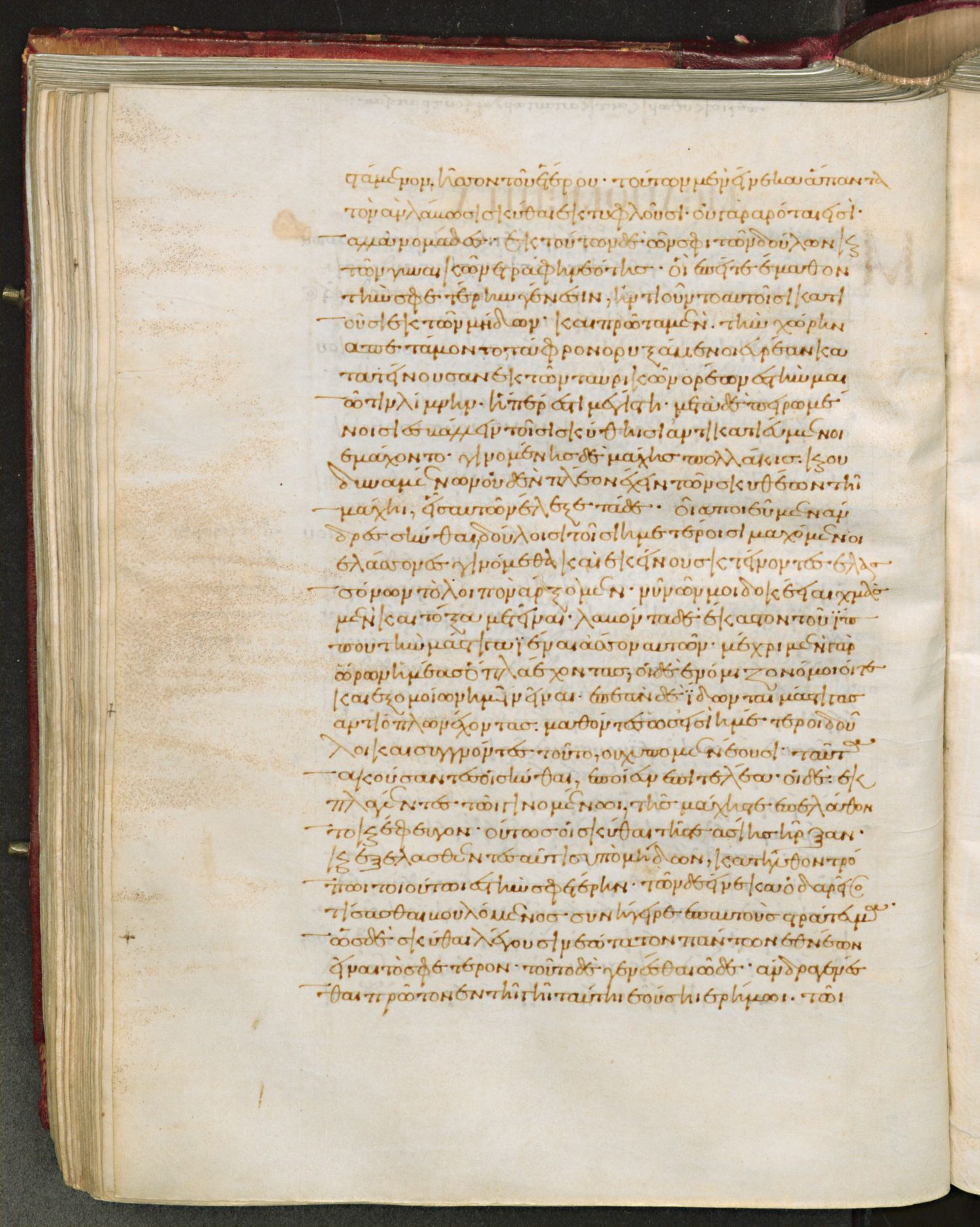
Laur. Plut. 70.3, fol. 147v: Greek here 4.2.2 to 4.5.1. Checked on the image (first and last words read and located in the Greek; each break checked against the neighbouring page): fol. 147v begins ‹-στάμενον ἧσσον τοῦ ἑτέρου.› (4.2.2), ends ‹ταύτῃ ἐούσῃ ἐρήμῳ τῳ› (4.5.1). The word ‹ὑπιστάμενον› is divided between fol. 147r and fol. 147v; it is given with fol. 147r. English here: 4.3.1 to 4.4.1 (Godley's sentences for the sections whose Greek lies mostly on this page).
4.2.2ἧσσον τοῦ ἑτέρου. τούτων μὲν εἵνεκα ἅπαντα τὸν ἂν λάβωσι οἱ Σκύθαι ἐκτυφλοῦσι. οὐ γὰρ ἀρόται εἰσὶ ἀλλὰ νομάδες. 4.3.1ἐκ τούτων δὴ ὦν σφι τῶν δούλων καὶ τῶν γυναικῶν ἐτράφη νεότης· οἳ ἐπείτε ἔμαθον τὴν σφετέρην γένεσιν, ἠντιοῦντο αὐτοῖσι κατιοῦσι ἐκ τῶν Μήδων. 4.3.2καὶ πρῶτα μὲν τὴν χώρην ἀπετάμοντο, τάφρον ὀρυξάμενοι εὐρέαν κατατείνουσαν ἐκ τῶν Ταυρικῶν ὀρέων ἐς τὴν Μαιῆτιν λίμνην, τῇ περ ἐστὶ μεγίστη· μετά γε πειρωμένοισι ἐσβάλλειν τοῖσι Σκύθῃσι ἀντικατιζόμενοι ἐμάχοντο. 4.3.3γινομένης δὲ μάχης πολλάκις καί οὐ δυναμένων οὐδὲν πλέον ἔχειν τῶν Σκυθέων τῇ μάχῃ, εἷς αὐτῶν ἔλεξε τάδε. οἷα ποιεῦμεν, ἄνδρες Σκύθαι· δούλοισι τοῖσι ἡμετέροισι μαχόμενοι αὐτοί τε κτεινόμενοι ἐλάσσονες γινόμεθα καὶ ἐκείνους κτείνοντες ἐλασσόνων τὸ λοιπὸν ἄρξομεν. 4.3.4νῦν ὦν μοι δοκέει αἰχμὰς μὲν καὶ τόξα μετεῖναι, λαβόντα δὲ ἕκαστον τοῦ ἵππου τὴν μάστιγα ἰέναι ἆσσον αὐτῶν. μέχρι μὲν γὰρ ὥρων ἡμέας ὅπλα ἔχοντας, οἳ δὲ ἐνόμιζον ὅμοιοί τε καί ἐξ ὁμοίων ἡμῖν εἶναι· ἐπεὰν δὲ ἴδωνται μάστιγας ἀντὶ ὅπλων ἔχοντας, μαθόντες ὡς εἰσὶ ἡμέτεροι δοῦλοι καὶ συγγνόντες τοῦτο, οὐκ ὑπομενέουσι. 4.4.1ταῦτα ἀκούσαντες οἱ Σκύθαι ἐποίευν ἐπιτελέα· οἳ δὲ ἐκπλαγέντες τῷ γινομένῳ τῆς μάχης τε ἐπελάθοντο καὶ ἔφευγον. οὕτω οἱ Σκύθαι τῆς τε Ἀσίης ἧρξαν καὶ ἐξελασθέντες αὖτις ὑπὸ Μήδων κατῆλθον τρόπῳ τοιούτῳ ἐς τὴν σφετέρην. τῶνδε εἵνεκα ὁ Δαρεῖυς τίσασθαι βουλόμενος συνήγειρε ἐπʼ αὐτοὺς στράτευμα. 4.5.1ὣς δὲ Σκύθαι λέγουσι, νεώτατον πάντων ἐθνέων εἶναι τὸ σφέτερον, τοῦτο δὲ γενέσθαι ὧδε. ἄνδρα γενέσθαι πρῶτον ἐν τῇ γῇ ταύτῃ ἐούσῃ ἐρήμῳ τῳ
4.3.1So it came about that a younger race grew up, born of these slaves and the women; and when the youths learnt of their lineage, they came out to do battle with the Scythians in their return from Media. 4.3.2First they barred the way to their country by digging a wide trench from the Tauric mountains to the broadest part of the Maeetian lake; and presently when the Scythians tried to force a passage they encamped over against them and met them in battle. 4.3.3Many fights there were, and the Scythians could gain no advantage thereby; at last one of them said, “Men of Scythia, see what we are about! We are fighting our own slaves; they slay us, and we grow fewer; we slay them, and thereafter shall have fewer slaves. 4.3.4Now therefore my counsel is that we drop our spears and bows, and go to meet them each with his horsewhip in hand. As long as they saw us armed, they thought themselves to be our peers and the sons of our peers; let them see us with whips and no weapons of war, and they will perceive that they are our slaves; and taking this to heart they will not abide our attack.” 4.4.1This the Scythians heard, and acted thereon; and their enemies, amazed by what they saw, had no more thought of fighting, but fled. Thus the Scythians ruled Asia and were driven out again by the Medes, and by such means they won their return to their own land. Desiring to punish them for what they did, Darius mustered an army against them.
Where on the image
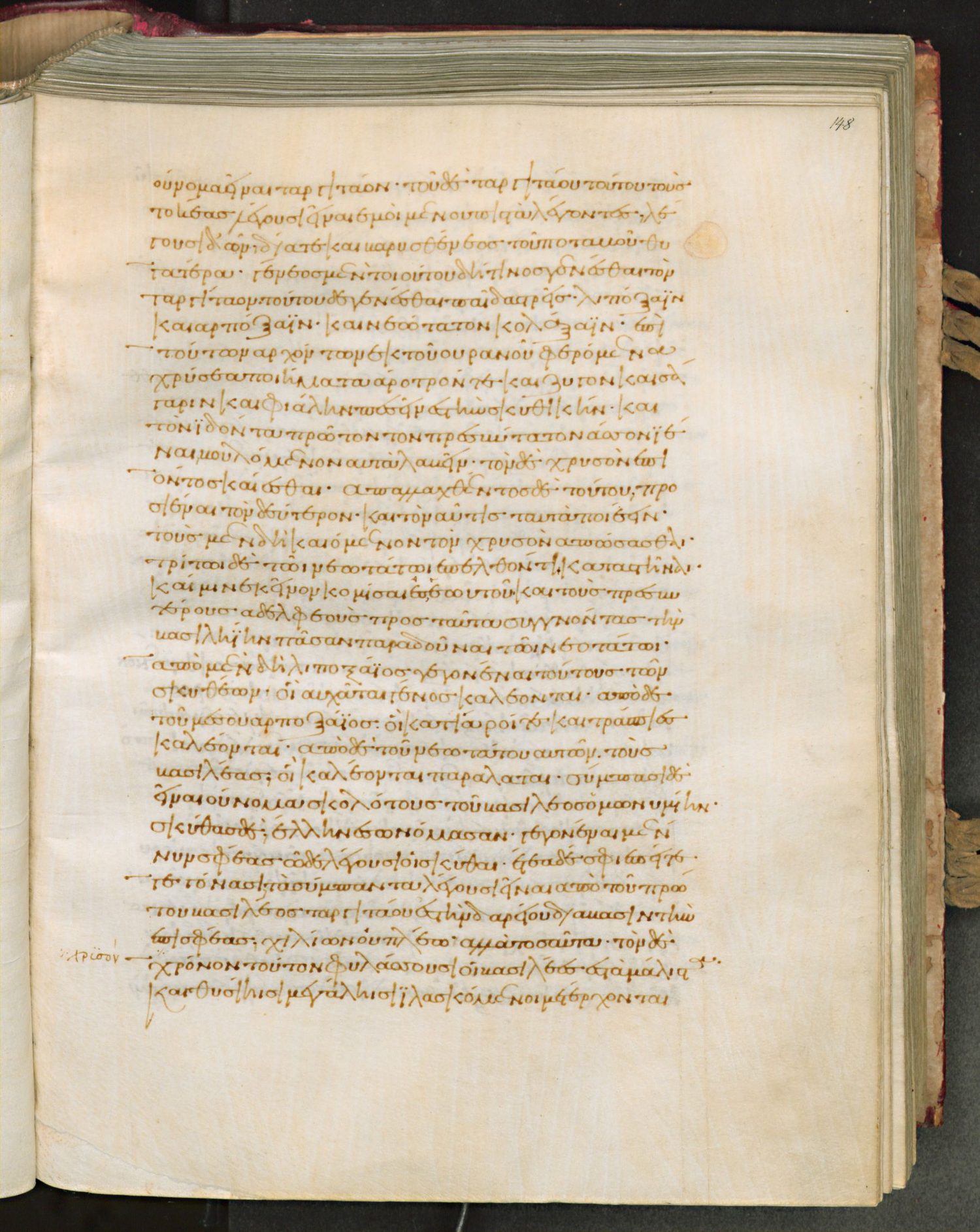
Laur. Plut. 70.3, fol. 148r: Greek here 4.5.1 to 4.7.1. Checked on the image (first and last words read and located in the Greek; each break checked against the neighbouring page): fol. 148r begins ‹οὔνομα εἶναι Ταργιτάον· τοῦ› (4.5.1), ends ‹θυσίῃσι μεγάλῃσι ἱλασκόμενοι μετέρχονται› (4.7.1). English here: 4.5.1 to 4.7.1 (Godley's sentences for the sections whose Greek lies mostly on this page).
4.5.1οὔνομα εἶναι Ταργιτάον· τοῦ δὲ Ταργιτάου τούτου τοὺς τοκέας λέγουσι εἶναι, ἐμοὶ μὲν οὐ πιστὰ λέγοντες, λέγουσι δʼ ὦν, Δία τε καὶ Βορυσθένεος τοῦ ποταμοῦ θυγατέρα. 4.5.2γένεος μὲν τοιούτου δὴ τινος γενέσθαι τὸν Ταργιτάον, τούτου δὲ γενέσθαι παῖδας τρεῖς, Λιπόξαϊν καὶ Ἀρπόξαϊν καὶ νεώτατον Κολάξαιν. 4.5.3ἐπὶ τούτων ἀρχόντων ἐκ τοῦ οὐρανοῦ φερομένα χρύσεα ποιήματα, ἄροτρόν τε καὶ ζυγόν καὶ σάγαριν καὶ φιάλην, πεσεῖν ἐς τὴν Σκυθικήν· καὶ τῶν ἰδόντα πρῶτον τὸν πρεσβύτατον ἆσσον ἰέναι βουλόμενον αὐτὰ λαβεῖν, τὸν δὲ χρυσόν ἐπιόντος καίεσθαι. 4.5.4ἀπαλλαχθέντος δὲ τούτου προσιέναι τὸν δεύτερον, καὶ τὸν αὖτις ταὐτὰ ποιέειν. τοὺς μὲν δὴ καιόμενον τὸν χρυσὸν ἀπώσασθαι, τρίτῳ δὲ τῷ νεωτάτῳ ἐπελθόντι κατασβῆναι, καὶ μιν ἐκεῖνον κομίσαι ἐς ἑωυτοῦ· καὶ τοὺς πρεσβυτέρους ἀδελφεοὺς πρὸς ταῦτα συγγνόντας τὴν βασιληίην πᾶσαν παραδοῦναι τῷ νεωτάτῳ. 4.6.1ἀπὸ μὲν δὴ Λιποξάιος γεγονέναι τούτους τῶν Σκυθέων οἳ Αὐχάται γένος καλέονται, ἀπὸ δὲ τοῦ μέσου Ἀρποξάιος οἳ Κατίαροί τε καὶ Τράσπιες καλέονται, ἀπὸ δὲ τοῦ νεωτάτου αὐτῶν τοῦ βασιλέος οἳ καλέονται Παραλάται· 4.6.2σύμπασι δὲ εἶναι οὔνομα Σκολότους, τοῦ βασιλέος ἐπωνυμίην. Σκύθας δὲ Ἕλληνες ὠνόμασαν. 4.7.1γεγονέναι μέν νυν σφέας ὧδε λέγουσι οἱ Σκύθαι, ἔτεα δὲ σφίσι ἐπείτε γεγόνασι τὰ σύμπαντα λέγουσι εἶναι ἀπὸ τοῦ πρώτου βασιλέος Ταργιτάου ἐς τὴν Δαρείου διάβασιν τὴν ἐπὶ σφέας χιλίων οὐ πλέω ἀλλὰ τοσαῦτα. τὸν δὲ χρυσόν τοῦτον τὸν ἱρὸν φυλάσσουσι οἱ βασιλέες ἐς τὰ μάλιστα, καὶ θυσίῃσι μεγάλῃσι ἱλασκόμενοι μετέρχονται
4.5.1The Scythians say that their nation is the youngest in all the world, and that it came into being on this wise. There appeared in this country, being then desert, a man whose name was Targitaus. His parents, they say—for my part I do not believe the tale, but it is told—were Zeus and a daughter of the river Borysthenes. 4.5.2Such (it is said) was Targitaus’ lineage; and he had three sons, Lipoxaïs, Arpoxaïs, and Colaxaïs, youngest of the three. 4.5.3In the time of their rule (so the story goes) there fell down from the sky into Scythia certain implements, all of gold, namely, a plough, a yoke, a sword, and a flask. The eldest of them, seeing this, came near with intent to take them; but the gold began to burn as he came, and he ceased from his essay; 4.5.4then the second approached, and the gold did again as before; when these two had been driven away by the burning of the gold, last came the youngest brother, and the burning was quenched at his approach; so he took the gold to his own house. At this his older brothers saw how matters stood, and made over the whole royal power to the youngest. 4.6.1Lipoxaïs, it is said, was the father of the Scythian clan called Auchatae; Arpoxaïs, the second brother, of those called Katiari and Traspians; the youngest, who was king, of those called Paralatae. 4.6.2All these together bear the name of Skoloti, after their king; “Scythians” is a name given them by Greeks. 4.7.1Such then is the Scythians’ account of their origin; they reckon that neither more nor less than a thousand years in all passed from the time of their first king Targitäus and the crossing over of Darius into their country. The kings guard this sacred gold most jealously, and every year offer to it solemn sacrifices of propitiation.
Where on the image
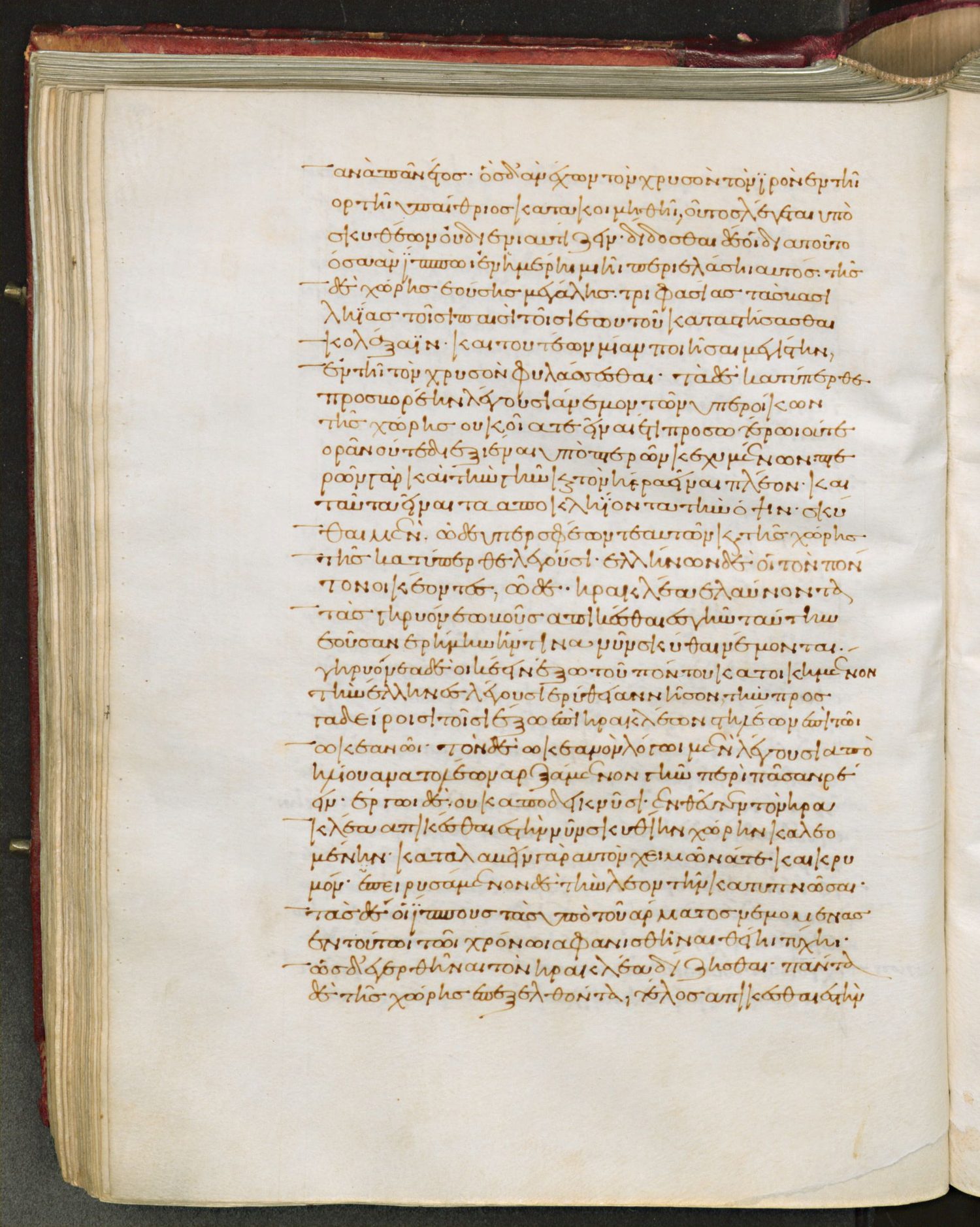
Laur. Plut. 70.3, fol. 148v: Greek here 4.7.1 to 4.9.1. Checked on the image (first and last words read and located in the Greek; each break checked against the neighbouring page): fol. 148v begins ‹ἀνὰ πᾶν ἔτος.ὃς δʼ› (4.7.1), ends ‹τέλος ἀπικέσθαι ἐς τὴν› (4.9.1). English here: 4.7.2 to 4.8.3 (Godley's sentences for the sections whose Greek lies mostly on this page).
4.7.1ἀνὰ πᾶν ἔτος. 4.7.2ὃς δʼ ἂν ἔχων τὸν χρυσὸν τὸν ἱρὸν ἐν τῇ ὁρτῇ ὑπαίθριος κατακοιμηθῇ, οὗτος λέγεται ὑπὸ Σκυθέων οὐ διενιαυτίζειν. δίδοσθαι δέ οἱ διὰ τοῦτο ὅσα ἂν ἵππῳ ἐν ἡμέρῃ μιῇ περιελάσῃ αὐτὸς. τῆς δὲ χώρης ἐούσης μεγάλης τριφασίας τὰς βασιληίας τοῖσι παισὶ τοῖσι ἑωυτοῦ καταστήσασθαι Κολάξαιν, καὶ τουτέων μίαν ποιῆσαι μεγίστην, ἐν τῇ τὸν χρυσὸν φυλάσσεσθαι. 4.7.3τὰ δὲ κατύπερθε πρὸς βορέην λέγουσι ἄνεμον τῶν ὑπεροίκων τῆς χώρης οὐκ οἷὰ τε εἶναι ἔτι προσωτέρω οὔτε ὁρᾶν οὔτε διεξιέναι ὑπὸ πτερῶν κεχυμένων· πτερῶν γὰρ καὶ τήν γῆν καὶ τὸν ἠέρα εἶναι πλέον, καὶ ταῦτα εἶναι τὰ ἀποκληίοντα τὴν ὄψιν. 4.8.1Σκύθαι μὲν ὧδε ὕπερ σφέων τε αὐτῶν καὶ τῆς χώρης τῆς κατύπερθε λέγουσι, Ἑλλήνων δὲ οἱ τὸν Πόντον οἰκέοντες ὧδε. Ἡρακλέα ἐλαύνοντα τὰς Γηρυόνεω βοῦς ἀπικέσθαι ἐς γῆν ταύτην ἐοῦσαν ἐρήμην, ἥντινα νῦν Σκύθαι νέμονται. 4.8.2Γηρυόνεα δὲ οἰκέειν ἔξω τοῦ Πόντου, κατοικημένον τὴν Ἕλληνές λέγουσι Ἐρύθειαν νῆσον τὴν πρὸς Γαδείροισι τοῖσι ἔξω Ἡρακλέων στηλέων ἐπὶ τῷ Ὠκεανῷ. τὸν δὲ Ὠκεανὸν λόγῳ μὲν λέγουσι ἀπὸ ἡλίου ἀνατολέων ἀρξάμενον γῆν περὶ πᾶσαν ῥέειν, ἔργῳ δὲ οὐκ ἀποδεικνῦσι. 4.8.3ἐνθεῦτεν τόν Ἡρακλέα ἀπικέσθαι ἐς τὴν νῦν Σκυθίην χώρην καλεομένην, καὶ καταλαβεῖν γὰρ αὐτὸν χειμῶνα τε καὶ κρυμὸν, ἐπειρυσάμενον τὴν λεοντέην κατυπνῶσαι, τὰς δὲ οἱ ἵππους τὰς ὑπὸ τοῦ ἅρματος νεμομένας ἐν τούτῳ τῳ χρόνῳ ἀφανισθῆναι θείῃ τύχῃ. 4.9.1ὥς δʼ ἐγερθῆναι τὸν Ἡρακλέα, δίζησθαι, πάντα δὲ τῆς χώρης ἐπεξελθόντα τέλος ἀπικέσθαι ἐς τὴν
4.7.2Whoever at this festival falls asleep in the open air, having with him the sacred gold, is said by the Scythians not to live out the year; for which reason (they say) there is given him as much land as he can himself ride round in one day. Because of the great size of the country, the lordships established by Colaxaïs for his sons were three, one of which, where they keep the gold, was the greatest. 4.7.3Above and northward of the neighbours of their country none (they say) can see or travel further, by reason of showers of feathers; for earth and sky are overspread by these, and it is this which hinders sight. 4.8.1Such is the Scythians’ account of themselves and the country north of them. But the story told by the Greeks who dwell in Pontus is as follows. Heracles, driving the kine of Geryones, came to this land, which was then desert, but is now inhabited by the Scythians. 4.8.2Geryones dwelt westward of the Pontus, being settled in the island called by the Greeks Erythea, on the shore of the Ocean near Gadira, outside the pillars of Heracles. As for the Ocean, the Greeks say that it flows from the sun’s rising round the whole world, but they cannot prove that this is so. 4.8.3Heracles came thence to the country now called Scythia, where, meeting with wintry and frosty weather, he drew his lion’s skin over him and fell asleep, and while he slept his mares, that were grazing yoked to the chariot, were marvellously spirited away.
Where on the image
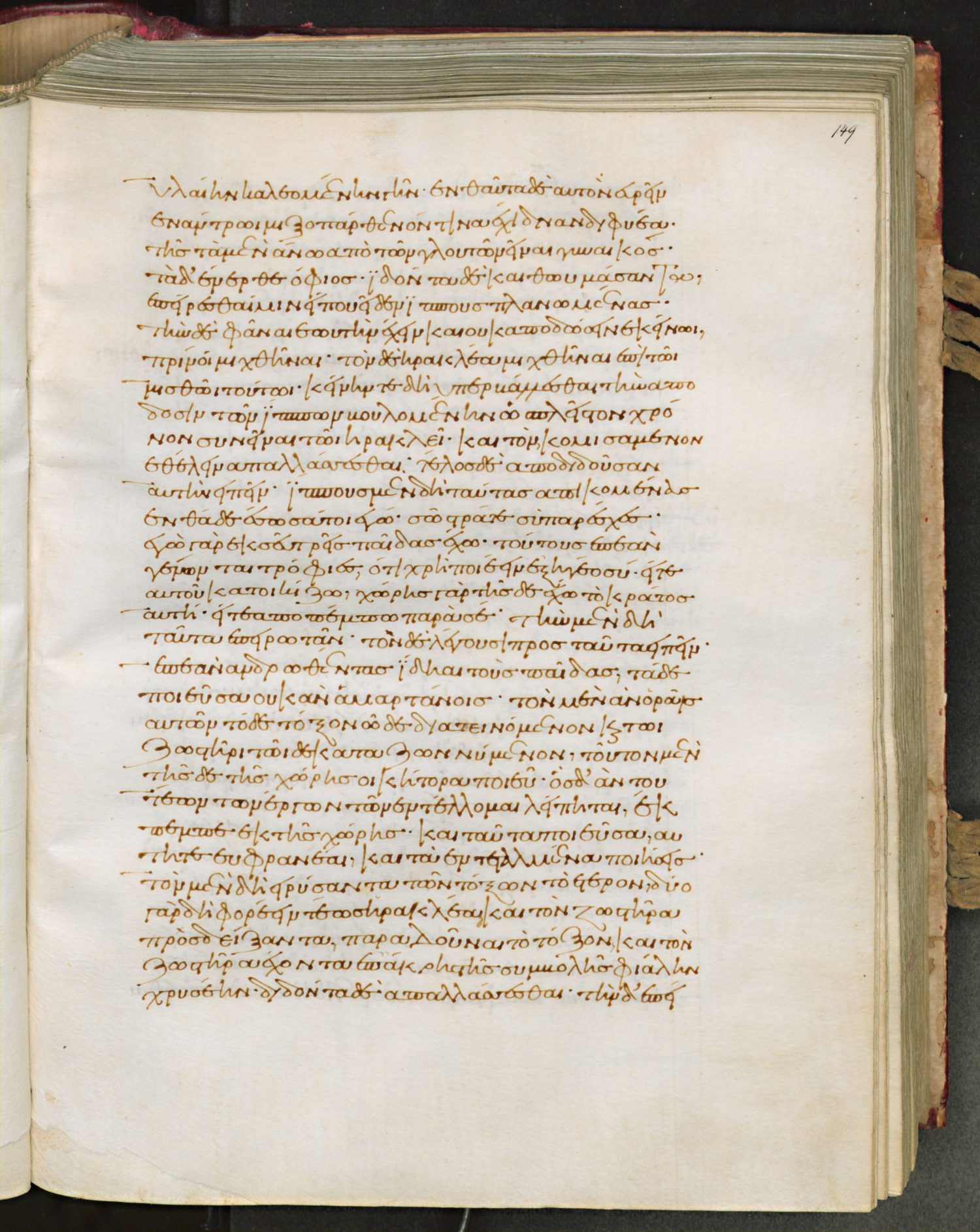
Laur. Plut. 70.3, fol. 149r: Greek here 4.9.1 to 4.10.1. Checked on the image (first and last words read and located in the Greek; each break checked against the neighbouring page): fol. 149r begins ‹Ὑλαίην καλεομένην γῆν· ἐνθαῦτα› (4.9.1), ends ‹ἀπαλλάσσεσθαι. τὴν δʼ, ἐπεὶ› (4.10.1). English here: 4.9.1 to 4.10.1 (Godley's sentences for the sections whose Greek lies mostly on this page).
4.9.1Ὑλαίην καλεομένην γῆν· ἐνθαῦτα δὲ αὐτὸν εὑρεῖν ἐν ἄντρῳ μιξοπάρθενον τινά, ἔχιδναν διφυέα, τῆς τὰ μὲν ἄνω ἀπὸ τῶν γλουτῶν εἶναι γυναικός, τὰ δὲ ἔνερθε ὄφιος. 4.9.2ἰδόντα δὲ καὶ θωμάσαντα ἐπειρέσθαι μιν εἴ κου ἴδοι ἵππους πλανωμένας· τὴν δὲ φάναι ἑωυτήν ἔχειν καὶ οὐκ ἀποδώσειν ἐκείνῳ πρὶν ἢ οἱ μιχθῇ· τὸν δὲ Ἡρακλέα μιχθῆναι ἐπὶ τῷ μισθῷ τούτῳ. 4.9.3κείνην τε δὴ ὑπερβάλλεσθαι τὴν ἀπόδοσιν τῶν ἵππων, βουλομένην ὡς πλεῖστον χρόνον συνεῖναι τῷ Ἡρακλεῖ, καὶ τὸν κομισάμενον ἐθέλειν ἀπαλλάσσεσθαι· τέλος δὲ ἀποδιδοῦσαν αὐτὴν εἰπεῖν Ἵππους μὲν δὴ ταύτας ἀπικομένας ἐνθάδε ἔσωσα τοὶ ἐγώ, σῶστρά τε σὺ παρέσχες· ἐγὼ γὰρ ἐκ σεῦ τρεῖς παῖδας ἔχω. 4.9.4τούτους, ἐπεὰν γένωνται τρόφιες, ὃ τι χρὴ ποιέειν, ἐξηγέο σύ, εἴτε αὐτοῦ κατοικίζω (χώρης γὰρ τῆσδε ἔχω τὸ κράτος αὕτη) εἴτε ἀποπέμπω παρὰ σέ. τὴν μὲν δὴ ταῦτα ἐπειρωτᾶν, τὸν δὲ λέγουσι πρὸς ταῦτα εἰπεῖν 4.9.5ἐπεὰν ἀνδρωθέντας ἴδῃ τοὺς παῖδας, τάδε ποιεῦσα οὐκ ἂν ἁμαρτάνοις· τὸν μὲν ἂν ὁρᾷς αὐτῶν τόδε τὸ τόξον ὧδε διατεινόμενον καὶ τῳ ζωστῆρι τῷδε κατὰ τάδε ζωννύμενον, τοῦτον μὲν τῆσδε τῆς χώρης οἰκήτορα ποιεῦ· ὃς δʼ ἂν τούτων τῶν ἔργων τῶν ἐντέλλομαι λείπηται, ἔκπεμπε ἐκ τῆς χώρης. καὶ ταῦτα ποιεῦσα αὐτή τε εὐφρανέαι καὶ τὰ ἐντεταλμένα ποιήσεις. 4.10.1τὸν μὲν δὴ εἰρύσαντα τῶν τόξων τὸ ἕτερον (δύο γὰρ δὴ φορέειν τέως Ἡρακλέα) καὶ τὸν ζωστῆρα προδέξαντα, παραδοῦναι τὸ τόξον τε καὶ τὸν ζωστῆρα ἔχοντα ἐπʼ ἄκρης τῆς συμβολῆς φιάλην χρυσέην, δόντα δὲ ἀπαλλάσσεσθαι. τὴν δʼ, ἐπεὶ
4.9.1When Heracles awoke he searched for them, visiting every part of the country, till at last he came to the land called the Woodland, and there he found in a cave a creature of double form that was half damsel and half serpent; above the buttocks she was a woman, below them a snake. 4.9.2When he saw her he was astonished, and asked her if she had anywhere seen his mares straying; she said that she had them, and would not restore them to him before he had intercourse with her; which Heracles did, in hope of this reward. 4.9.3But though he was fain to take the horses and depart, she delayed to restore them, that she might have Heracles with her for as long as might be; at last she gave them back, saying to him, “These mares came, and I kept them safe here for you, and you have paid me for keeping them, for I have three sons by you. 4.9.4Do you now tell me what I must do when they are grown big: shall I make them to dwell here (for I am the queen of this country), or shall I send them away to you?” Thus she inquired, and then (it is said) Heracles answered her: “ 4.9.5When you see the boys grown to man’s estate, act as I bid you and you will do rightly; whichever of them you see bending this bow thus and girding himself in this fashion with this girdle, make him a dweller in this land; but whoever fails to achieve these tasks which I command, send him away out of the country. Thus do and you will yourself have comfort, and my bidding will be done.” 4.10.1So he drew one of his bows (for till then Heracles ever bore two), and showed her the girdle, and delivered to her the bow and the girdle, that had a golden vessel on the end of its clasp; and, having given them, so departed. But she, when the sons born to her were grown men, gave them names, calling one of them Agathyrsus and the next Gelonus and the youngest Scythes; moreover, remembering the charge, she did as she was commanded.
Where on the image
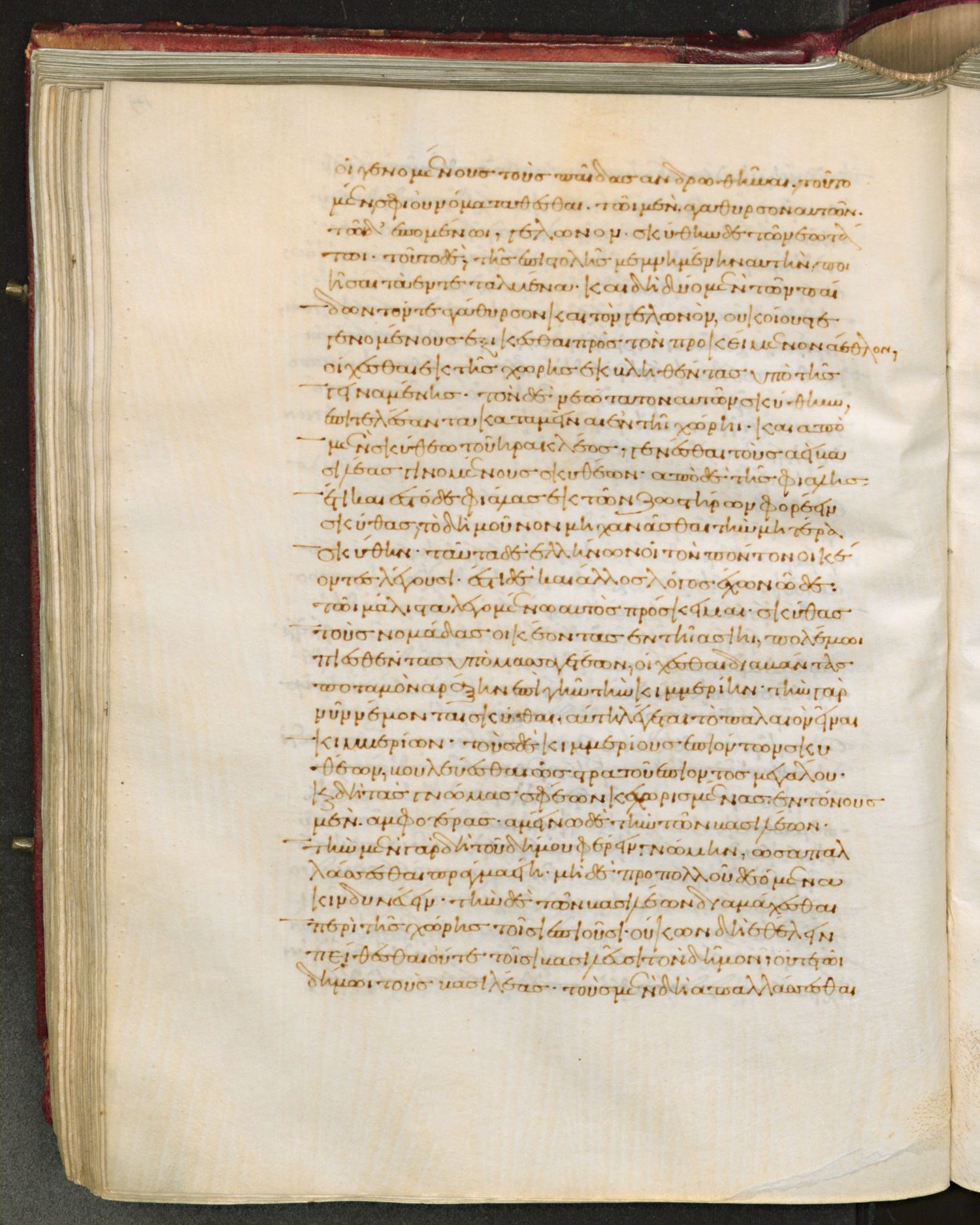
Laur. Plut. 70.3, fol. 149v: Greek here 4.10.1 to 4.11.3. Checked on the image (first and last words read and located in the Greek; each break checked against the neighbouring page): fol. 149v begins ‹οἱ γενομένους τοὺς παῖδας› (4.10.1), ends ‹τοὺς μὲν δὴ ἀπαλλάσσεσθαι› (4.11.3). English here: 4.10.2 to 4.11.2 (Godley's sentences for the sections whose Greek lies mostly on this page).
4.10.1οἱ γενομένους τοὺς παῖδας ἀνδρωθῆναι, τοῦτο μὲν σφι οὐνόματα θέσθαι, τῷ μὲν Ἀγάθυρσον αὐτῶν, τῷ δʼ ἑπομένῳ Γελωνόν, Σκύθην δὲ τῷ νεωτάτῳ, τοῦτο δὲ τῆς ἐπιστολῆς μεμνημένην αὐτὴν ποιῆσαι τά ἐντεταλμένα. 4.10.2καὶ δὴ δύο μὲν οἱ τῶν παίδων, τόν τε Ἀγάθυρσον καὶ τὸν Γελωνόν, οὐκ οἵους τε γενομένους ἐξικέσθαι πρὸς τὸν προκείμενον ἄεθλον, οἴχεσθαι ἐκ τῆς χώρης ἐκβληθέντας ὑπὸ τῆς γειναμένης, τὸν δὲ νεώτατον αὐτῶν Σκύθην ἐπιτελέσαντα καταμεῖναι ἐν τῇ χωρῇ. 4.10.3καὶ ἀπὸ μὲν Σκύθεω τοῦ Ἡρακλέος γενέσθαι τοὺς αἰεὶ βασιλέας γινομένους Σκυθέων, ἀπὸ δὲ τῆς φιάλης ἔτι καὶ ἐς τόδε φιάλας ἐκ τῶν ζωστήρων φορέειν Σκύθας· τὸ δὴ μοῦνον μηχανήσασθαι τὴν μητέρα Σκύθῃ. ταῦτα δὲ Ἑλλήνων οἱ τὸν Πόντον οἰκέοντες λέγουσι. 4.11.1ἔστι δὲ καὶ ἄλλος λόγος ἔχων ὧδε, τῷ μάλιστα λεγομένῳ αὐτός πρόσκειμαι, Σκύθας τοὺς νομάδας οἰκέοντας ἐν τῇ Ἀσίῃ, πολέμῳ πιεσθέντας ὑπὸ Μασσαγετέων, οἴχεσθαι διαβάντας ποταμὸν Ἀράξην ἐπὶ γῆν τὴν Κιμμερίην (τὴν γὰρ νῦν νέμονται Σκύθαι, αὕτη λέγεται τὸ παλαιὸν εἶναι Κιμμερίων), 4.11.2τοὺς δὲ Κιμμερίους ἐπιόντων Σκυθέων βουλεύεσθαι ὡς στρατοῦ ἐπιόντος μεγάλου, καὶ δὴ τὰς γνώμας σφέων κεχωρισμένας, ἐντόνους μὲν ἀμφοτέρας, ἀμείνω δὲ τὴν τῶν βασιλέων· τὴν μὲν γὰρ δὴ τοῦ δήμου φέρειν γνώμην ὡς ἀπαλλάσσεσθαι πρῆγμα εἴη μηδὲ πρὸ σποδοῦ μένοντας κινδυνεύειν, τὴν δὲ τῶν βασιλέων διαμάχεσθαι περὶ τῆς χώρης τοῖσι ἐπιοῦσι. 4.11.3οὔκων δὴ ἐθέλειν πείθεσθαι οὔτε τοῖσι βασιλεῦσι τὸν δῆμον οὔτε τῷ δήμῳ τοὺς βασιλέας· τοὺς μὲν δὴ ἀπαλλάσσεσθαι
4.10.2Two of her sons, Agathyrsus and Gelonus, not being able to achieve the appointed task, were cast out by their mother and left the country, but Scythes, the youngest, accomplished it and so abode in the land. 4.10.3From Scythes son of Heracles comes the whole line of the kings of Scythia; and it is because of the vessel that the Scythians carry vessels on their girdles to this day. This alone his mother contrived for Scythes. Such is the tale told by the Greek dwellers in Pontus. 4.11.1There is yet another tale, to the tradition whereof I myself do especially incline. It is to this purport: the nomad Scythians inhabiting Asia, being hard pressed in war by the Massagetae, fled away across the river Araxes to the Cimmerian country (for the country which the Scythians now inhabit is said to have belonged of old to the Cimmerians), 4.11.2and the Cimmerians, at the advance of the Scythians, took such counsel as behoved men threatened by a great host. Their opinions were divided; both were strongly held, but that of the princes was the more honourable; for the commonalty deemed that their business was to withdraw themselves and that there was no need to risk their lives for the dust of the earth; but the princes were for fighting to defend their country against the attackers.
Where on the image
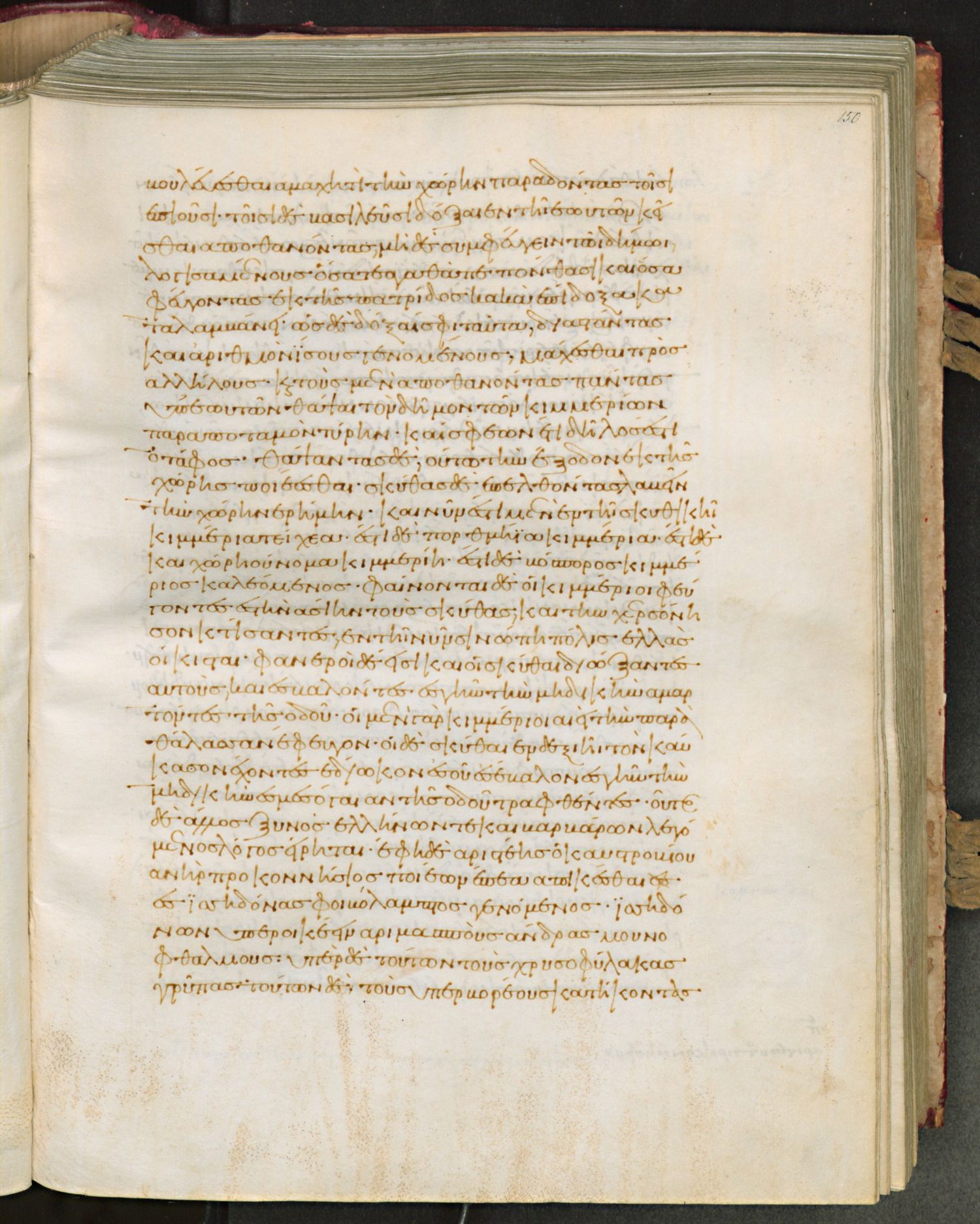
Laur. Plut. 70.3, fol. 150r: Greek here 4.11.3 to 4.13.1. Checked on the image (first and last words read and located in the Greek; each break checked against the neighbouring page): fol. 150r begins ‹βουλεύεσθαι ἀμαχητὶ τὴν χωρῆν› (4.11.3), ends ‹δὲ τοὺς Ὑπερβορέους κατήκοντας› (4.13.1). English here: 4.11.3 to 4.13.1 (Godley's sentences for the sections whose Greek lies mostly on this page).
4.11.3βουλεύεσθαι ἀμαχητὶ τὴν χωρῆν παραδόντας τοῖσι ἐπιοῦσι· τοῖσι δὲ βασιλεῦσι δόξαι ἐν τῇ ἑωυτῶν κεῖσθαι ἀποθανόντας μηδὲ συμφεύγειν τῷ δήμῳ, λογισαμένους ὅσα τε ἀγαθὰ πεπόνθασι καὶ ὅσα φεύγοντας ἐκ τῆς πατρίδος κακὰ ἐπίδοξα καταλαμβάνειν. 4.11.4ὡς δὲ δόξαι σφι ταῦτα, διαστάντας καὶ ἀριθμὸν ἴσους γενομένους μάχεσθαι πρὸς ἀλλήλους. καὶ τοὺς μὲν ἀποθανόντας πάντας ὑπʼ ἑωυτῶν θάψαι τὸν δῆμον τῶν Κιμμερίων παρὰ ποταμὸν Τύρην (καί σφεων ἔτι δῆλος ἐστὶ ὁ τάφος), θάψαντας δὲ οὕτω τὴν ἔξοδον ἐκ τῆς χώρης ποιέεσθαι· Σκύθας δὲ ἐπελθόντας λαβεῖν τὴν χώρην ἐρήμην. 4.12.1καὶ νῦν ἔστι μὲν ἐν τῇ Σκυθικῇ Κιμμέρια τείχεα, ἔστι δὲ πορθμήια Κιμμέρια, ἔστι δὲ καὶ χώρη οὔνομα Κιμμερίη, ἔστι δὲ Βόσπορος Κιμμέριος καλεόμενος· 4.12.2φαίνονται δὲ οἱ Κιμμέριοι φεύγοντες ἐς τὴν Ἀσίην τοὺς Σκύθας καὶ τὴν χερσόνησον κτίσαντες, ἐν τῇ νῦν Σινώπη πόλις Ἑλλὰς οἴκισται. φανεροὶ δὲ εἰσὶ καὶ οἱ Σκύθαι διώξαντες αὐτοὺς καὶ ἐσβαλόντες ἐς γῆν τὴν Μηδικὴν, ἁμαρτόντες τῆς ὁδοῦ· 4.12.3οἱ μὲν γὰρ Κιμμέριοι αἰεὶ τὴν παρὰ θάλασσαν ἔφευγον, οἱ δὲ Σκύθαι ἐν δεξιῇ τὸν Καύκασον ἔχοντες ἐδίωκον ἐς οὗ ἐσέβαλον ἐς γῆν τὴν Μηδικήν, ἐς μεσόγαιαν τῆς ὁδοῦ τραφθέντες. οὗτος δὲ ἄλλος ξυνὸς Ἑλλήνων τε καὶ βαρβάρων λεγόμενος λόγος εἴρηται. 4.13.1ἔφη δὲ Ἀριστέης ὁ Καϋστροβίου ἀνὴρ Προκοννήσιος ποιέων ἔπεα, ἀπικέσθαι ἐς Ἰσσηδόνας φοιβόλαμπτος γενόμενος, Ἰσσηδόνων δὲ ὑπεροικέειν Ἀριμασποὺς ἄνδρας μουνοφθάλμους ὕπερ δὲ τούτων τοὺς χρυσοφύλακας γρῦπας, τούτων δὲ τοὺς Ὑπερβορέους κατήκοντας
4.11.3Neither side would be persuaded by the other, neither the people by the princes nor the princes by the people; the one part planned to depart without fighting and deliver the country to their enemies, but the princes were resolved to lie slain in their own country and not to flee with the people, for they considered how happy their state had been and what ills were like to come upon them if they fled from their native land. 4.11.4Being thus resolved they parted asunder into two equal bands and fought with each other till they were all slain by their own hands; then the commonalty of the Cimmerians buried them by the river Tyras, where their tombs are still to be seen, and having buried them departed out of the land; and the country being empty, the Scythians came and took possession of it. 4.12.1And to this day there are in Scythia Cimmerian walls, and a Cimmerian ferry, and there is a country Cimmeria and a strait named Cimmerian. 4.12.2Moreover, it is clearly seen that the Cimmerians in their flight from the Scythians into Asia did also make a colony on the peninsula where now the Greek city of Sinope has been founded; and it is manifest that the Scythians pursued after them and invaded Media, missing their way; 4.12.3for the Cimmerians ever fled by the way of the coast, and the Scythians pursued with the Caucasus on their right till where they came into the Median land, turning inland on their way. I have now related this other tale, which is told alike by Greeks and foreigners. 4.13.1There is also a story related in a poem by Aristeas son of Caÿstrobius, a man of Proconnesus. This Aristeas, being then possessed by Phoebus, visited the Issedones; beyond these (he said) dwell the one-eyed Arimaspians, beyond whom are the griffins that guard gold, and beyond these again the Hyperboreans, whose territory reaches to the sea.
Where on the image
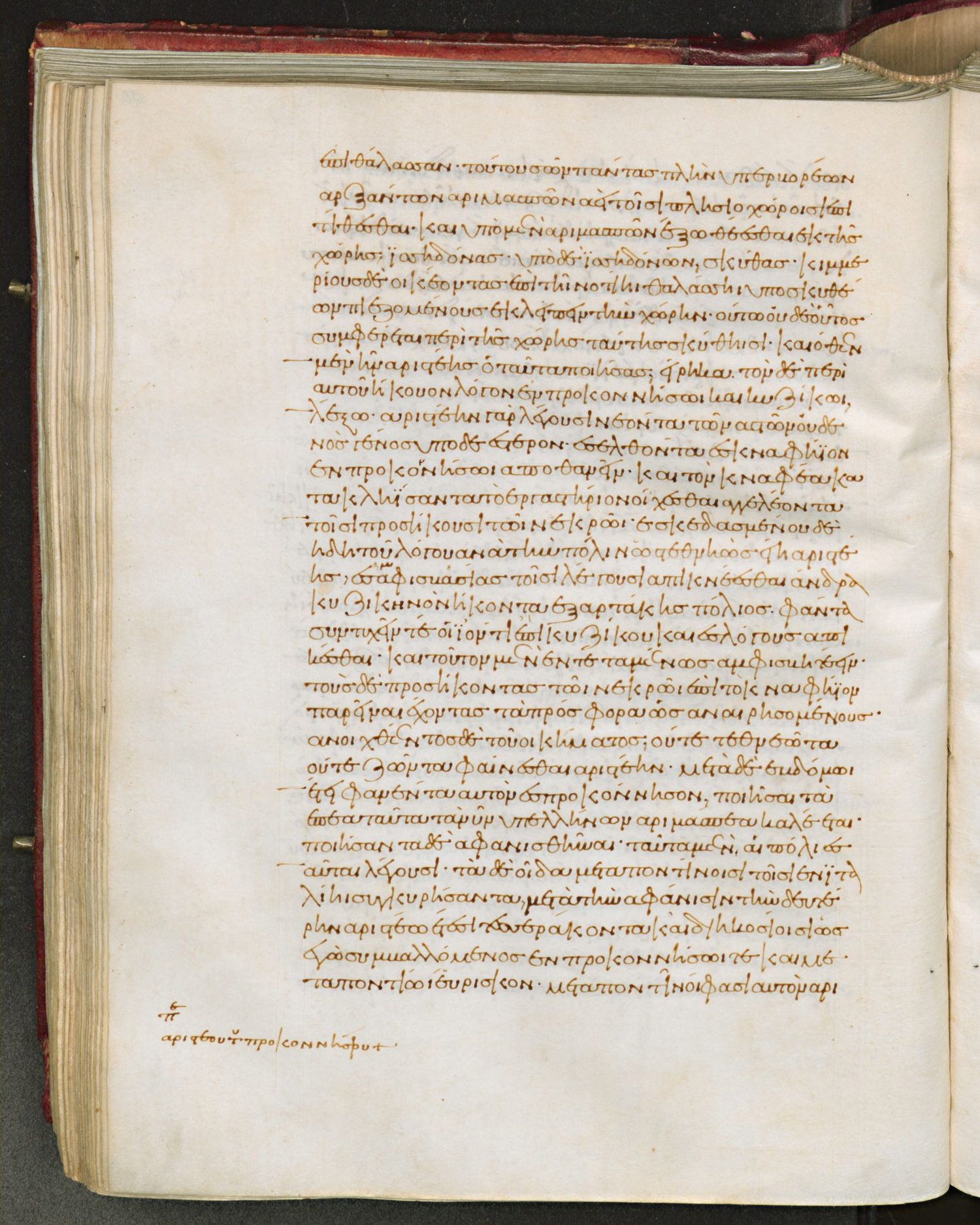
Laur. Plut. 70.3, fol. 150v: Greek here 4.13.1 to 4.15.2. Checked on the image (first and last words read and located in the Greek; each break checked against the neighbouring page): fol. 150v begins ‹ἐπὶ θάλασσαν.τούτους ὦν πάντας› (4.13.1), ends ‹εὕρισκον.Μεταποντῖνοι φασὶ αὐτὸν Ἀρι-› (4.15.2). English here: 4.13.2 to 4.15.2 (Godley's sentences for the sections whose Greek lies mostly on this page).
4.13.1ἐπὶ θάλασσαν. 4.13.2τούτους ὦν πάντας πλὴν Ὑπερβορέων, ἀρξάντων Ἀριμασπῶν, αἰεὶ τοῖσι πλησιοχώροισι ἐπιτίθεσθαι, καὶ ὑπὸ μὲν Ἀριμασπῶν ἐξωθέεσθαι ἐκ τῆς χώρης Ἰσσηδόνας, ὑπὸ δὲ Ἰσσηδόνων Σκύθας, Κιμμερίους δὲ οἰκέοντας ἐπὶ τῇ νοτίῃ θαλάσσῃ ὑπὸ Σκυθέων πιεζομένους ἐκλείπειν τὴν χώρην. οὕτω οὐδὲ οὗτος συμφέρεται περὶ τῆς χώρης ταύτης Σκύθῃσι. 4.14.1καὶ ὅθεν μὲν ἦν Ἀριστέης ὁ ταῦτα εἴπας, εἴρηκα, τὸν δὲ περὶ αὐτοῦ ἤκουον λόγον ἐν Προκοννήσῳ καί Κυζίκῳ, λέξω. Ἀριστέην γὰρ λέγουσι, ἐόντα τῶν ἀστῶν οὐδενὸς γένος ὑποδεέστερον, ἐσελθόντα ἐς κναφήιον ἐν Προκοννήσῳ ἀποθανεῖν, καὶ τόν κναφέα κατακληίσαντα τὸ ἐργαστήριον οἴχεσθαι ἀγγελέοντα τοῖσι προσήκουσι τῷ νεκρῷ. 4.14.2ἐσκεδασμένου δὲ ἤδη τοῦ λόγου ἀνὰ τὴν πόλιν ὡς τεθνεώς εἴη ὁ Ἀριστέης, ἐς ἀμφισβασίας τοῖσι λέγουσι ἀπικνέεσθαι ἄνδρα Κυζικηνὸν ἥκοντα ἐξ Ἀρτάκης πόλιος, φάντα συντυχεῖν τε οἱ ἰόντι ἐπὶ Κυζίκου καὶ ἐς λόγους ἀπικέσθαι. καὶ τοῦτον μὲν ἐντεταμένως ἀμφισβατέειν, τοὺς δὲ προσήκοντας τῷ νεκρῷ ἐπὶ τὸ κναφήιον παρεῖναι ἔχοντας τὰ πρόσφορα ὡς ἀναιρησομένους· 4.14.3ἀνοιχθέντος δὲ τοῦ οἰκήματος οὔτε τεθνεῶτα οὔτε ζῶντα φαίνεσθαι Ἀριστέην. μετὰ δὲ ἑβδόμῳ ἔτει φανέντα αὐτὸν ἐς Προκόννησον ποιῆσαι τὰ ἔπεα ταῦτα τὰ νῦν ὑπʼ Ἑλλήνων Ἀριμάσπεα καλέεται, ποιήσαντα δὲ ἀφανισθῆναι τὸ δεύτερον. 4.15.1ταῦτα μὲν αἱ πόλιες αὗται λέγουσι, τάδε δὲ οἶδα Μεταποντίνοισι τοῖσι ἐν Ἰταλίῃ συγκυρήσαντα μετὰ τὴν ἀφάνισιν τὴν δευτέρην Ἀριστέω ἔτεσι τεσσεράκοντα καὶ διηκοσίοισι, ὡς ἐγὼ συμβαλλόμενος ἐν Προκοννήσῳ τε καὶ Μεταποντίῳ εὕρισκον. 4.15.2Μεταποντῖνοι φασὶ αὐτὸν Ἀριστέην
4.13.2Except the Hyperboreans, all these nations (and first the Arimaspians) ever make war upon their neighbours; the Issedones were pushed from their lands by the Arimaspians, and the Scythians by the Issedones, and the Cimmerians, dwelling by the southern sea, were hard pressed by the Scythians and left their country. Thus neither does Aristeas’ story agree concerning this country with the Scythian account. 4.14.1Whence Aristeas came who wrote this I have already said; I will now tell the story which I heard concerning him at Proconnesus and Cyzicus. It is said that this Aristeas, who was as nobly born as any of his townsmen, went into a fuller’s shop at Proconnesus and there died; the fuller shut his workshop and went away to tell the dead man’s kinsfolk, 4.14.2and the report of Aristeas’ death being now spread about in the city, it was disputed by a man of Cyzicus, who had come from the town of Artace, and said that he had met Aristeas going towards Cyzicus and spoken with him. While he vehemently disputed, the kinsfolk of the dead man had come to the fuller’s shop with all that was needful for burial; 4.14.3but when the house was opened there was no Aristeas there, dead or alive. But in the seventh year after that Aristeas appeared at Proconnesus and made that poem which the Greeks now call the Arimaspeia, after which he vanished once again. 4.15.1Such is the tale told in these two towns. But this, I know, befell the Metapontines in Italy, two hundred and forty years after the second disappearance of Aristeas, as reckoning made at Proconnesus and Metapontium shows me: 4.15.2Aristeas, so the Metapontines say, appeared in their country and bade them set up an altar to Apollo, and set beside it a statue bearing the name of Aristeas the Proconnesian; for, he said, Apollo had come to their country alone of all Italiot lands, and he himself—who was now Aristeas, but then when he followed the god had been a crow—had come with him.
Where on the image
Laur. Plut. 70.3, fol. 151r: Greek here 4.15.2 to 4.15.4. Checked on the image (first and last words read and located in the Greek; each break checked against the neighbouring page): fol. 151r begins ‹-στέην φανέντα σφι ἐς› (4.15.2), ends ‹ἄλλα κατὰ ταὐτὰ Σκύθῃσι› (4.17.1). The word ‹Ἀριστέην› is divided between fol. 150v and fol. 151r; it is given with fol. 150v. English here: 4.15.3 to 4.15.4 (Godley's sentences for the sections whose Greek lies mostly on this page).
4.15.2φανέντα σφι ἐς τὴν χώρην κελεῦσαι βωμὸν Ἀπόλλωνος ἱδρύσασθαι καὶ Ἀριστέω τοῦ Προκοννησίου ἐπωνυμίην ἔχοντα ἀνδριάντα πὰρʼ αὐτὸν ἱστάναι· φάναι γὰρ σφι τὸν Ἀπόλλωνα Ἰταλιωτέων μούνοισι δὴ ἀπικέσθαι ἐς τὴν χώρην, καὶ αὐτὸς οἱ ἕπεσθαι ὁ νῦν ἐὼν Ἀριστέης· τότε δὲ, ὅτε εἵπετο τῷ θεῷ, εἶναι κόραξ. 4.15.3καὶ τὸν μὲν εἰπόντα ταῦτα ἀφανισθῆναι, σφέας δὲ Μεταποντῖνοι λέγουσι ἐς Δελφοὺς πέμψαντας τὸν θεὸν ἐπειρωτᾶν ὃ τι τὸ φάσμα τοῦ ἀνθρώπου εἴη. τὴν δὲ Πυθίην σφέας κελεύειν πείθεσθαι τῷ φάσματι, πειθομένοισι δὲ ἄμεινον συνοίσεσθαι. καὶ σφέας δεξαμένους ταῦτα ποιῆσαι ἐπιτελέα. 4.15.4καὶ νῦν ἔστηκε ἀνδριὰς ἐπωνυμίην ἔχων Ἀριστέω παρʼ αὐτῷ τῷ ἀγάλματι τοῦ Ἀπόλλωνος, πέριξ δὲ αὐτὸν δάφναι ἑστᾶσι· τὸ δὲ ἄγαλμα ἐν τῇ ἀγορῇ ἵδρυται. Ἀριστέω μέν νυν πέρι τοσαῦτα εἰρήσθω.
4.15.3Having said this, he vanished away. The Metapontines, so they say, sent to Delphi and inquired of the god what the vision of the man might be; and the Pythian priestess bade them obey the vision, saying that their fortune would be the better; having received which answer they did as commanded. 4.15.4And now there stands beside the very image of Apollo a statue bearing the name of Aristeas; a grove of bay-trees surrounds it; the image is set in the market-place. Suffice it then that I have said thus much of Aristeas.
Notes
- Greek: the text printed in A. D. Godley's Loeb edition, via Perseus (tlg0016.tlg001.perseus-grc2). Square brackets mark words the editor considers later additions; [...] marks a gap the editor indicates. Perseus note markers are omitted.
- English: A. D. Godley, Herodotus vol. 2 (1921) (Loeb Classical Library), as transcribed on Wikisource. Godley's footnotes are omitted.
- Section numbers in the English were placed by comparing Godley's text with the Perseus version of his translation; where a section begins inside one of Godley's sentences, the English is kept with the page that holds the start of that sentence.
Cite
Sources
- Source: Florence, Laur. Plut. 70.3 (10th c.) via BML Teca Digitale + Greek of Godley's Loeb (Perseus) + English of A. D. Godley (Loeb, Wikisource) (holding institution)
- Critical edition: Greek of A. D. Godley's Loeb edition (1920-1925), via Perseus
← previous · → next · v cycle view · l back to library