Herodotus, Histories 4.16-36: The peoples north of Scythia; the Hyperboreans
Introduction
Herodotus of Halicarnassus wrote the Histories in the third quarter of the 5th century BCE, an inquiry into the deeds of Greeks and barbarians and the causes of the wars between them, later divided into nine books. Book 4 tells of Darius' expedition against the Scythians, with Herodotus' account of Scythia, its peoples, rivers and customs, and of the shape of the world, and of the Persian expedition against Barca, with the history of Cyrene and a description of the peoples of Libya.
The photographs are of Florence, Biblioteca Medicea Laurenziana, Plut. 70.3 (parchment, 10th century, 374 folios, 31 lines a page), Herodotus, Histories (codex A of the editors), the oldest surviving manuscript of the complete Histories, from the Teca Digitale of the Biblioteca Medicea Laurenziana. Each section below is the text of one page, or of the part of a page that falls within these chapters. The first and last words of every page were read on the photograph and located in the Greek, and every page break was checked against the next page; the notes quote these words. Readers' notes in the margins are not part of the text and are mentioned where they occur.
The Greek is the text printed in A. D. Godley's Loeb edition (1920-1925), from Perseus; it is the edited text, not a transcription of the manuscript, whose wording differs in places. The English is Godley's translation as printed, from Wikisource. Godley's English carries only chapter numbers; the section numbers shown in it were placed by comparison with the Perseus version of his translation. Each page's English is cut at the end of one of Godley's sentences, so it can begin or end a few lines away from the Greek of the page; each note gives the exact ranges.
This entry covers chapters 4.16-36, on fol. 151r to 155v.
How was this verified? (Provenance)
Where on the image
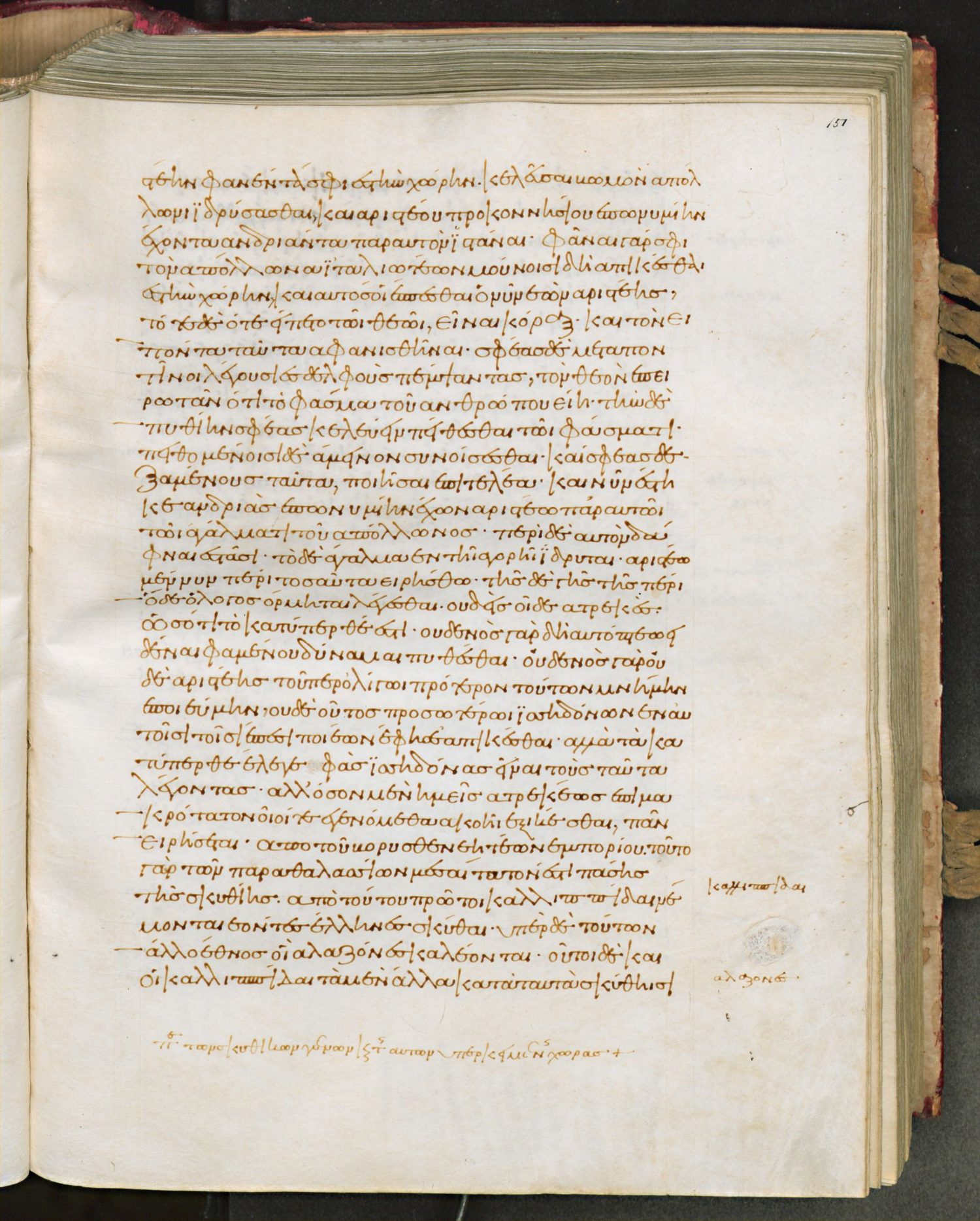
Laur. Plut. 70.3, fol. 151r: Greek here 4.16.1 to 4.17.1. Checked on the image (first and last words read and located in the Greek; each break checked against the neighbouring page): fol. 151r begins ‹-στέην φανέντα σφι ἐς› (4.15.2), ends ‹ἄλλα κατὰ ταὐτὰ Σκύθῃσι› (4.17.1). The word ‹Ἀριστέην› is divided between fol. 150v and fol. 151r; it is given with fol. 150v. English here: 4.16.1 to 4.17.1 (Godley's sentences for the sections whose Greek lies mostly on this page).
4.16.1τῆς δὲ γῆς, τῆς πέρι ὅδε ὁ λόγος ὅρμηται λέγεσθαι, οὐδεὶς οἶδε ἀτρεκέως ὃ τι τὸ κατύπερθε ἐστί· οὐδενὸς γὰρ δὴ αὐτόπτεω εἰδέναι φαμένου δύναμαι πυθέσθαι· οὐδὲ γὰρ οὐδὲ Ἀριστέης, τοῦ περ ὀλίγῳ πρότερον τούτων μνήμην ἐποιεύμην, οὐδὲ οὗτος προσωτέρω Ἰσσηδόνων ἐν αὐτοῖσι τοῖσι ἔπεσι ποιέων ἔφησε ἀπικέσθαι, ἀλλὰ τὰ κατύπερθε ἔλεγε ἀκοῇ, φας Ἰσσηδόνας εἶναι τοὺς ταῦτα λέγοντας. 4.16.2ἀλλʼ ὅσον μὲν ἡμεῖς ἀτρεκέως ἐπὶ μακρότατον οἷοι τε ἐγενόμεθα ἀκοῇ ἐξικέσθαι, πᾶν εἰρήσεται. 4.17.1ἀπὸ τοῦ Βορυσθενειτέων ἐμπορίου (τοῦτο γὰρ τῶν παραθαλασσίων μεσαίτατον ἐστὶ πάσης τῆς Σκυθίης), ἀπὸ τούτου πρῶτοι Καλλιππίδαι νέμονται ἐόντες Ἕλληνές Σκύθαι, ὕπερ δὲ τούτων ἄλλο ἔθνος οἳ Ἀλαζόνες καλέονται. οὗτοι δὲ καὶ οἱ Καλλιππίδαι τὰ μὲν ἄλλα κατὰ ταὐτὰ Σκύθῃσι
4.16.1As for the land of which my history has begun to speak, no one exactly knows what lies northward of it; for I can learn from none who claims to know as an eyewitness. For even Aristeas, of whom I lately made mention—even he did not claim to have gone beyond the Issedones, no, not even in his poems; but he spoke of what lay northward by hearsay; saying that the Issedones had so told him. 4.16.2But as far as we have been able to hear an exact report of the farthest lands, all shall be set forth. 4.17.1Northward of the port of the Borysthenites, which lies midway in the coastline of all Scythia, the first inhabitants are the Callippidae, who are Scythian Greeks; and beyond them another tribe called Alazones; these and the Callippidae, though in other matters they live like the Scythians, sow and eat com, and onions, garlic, lentils, and millet.
Where on the image
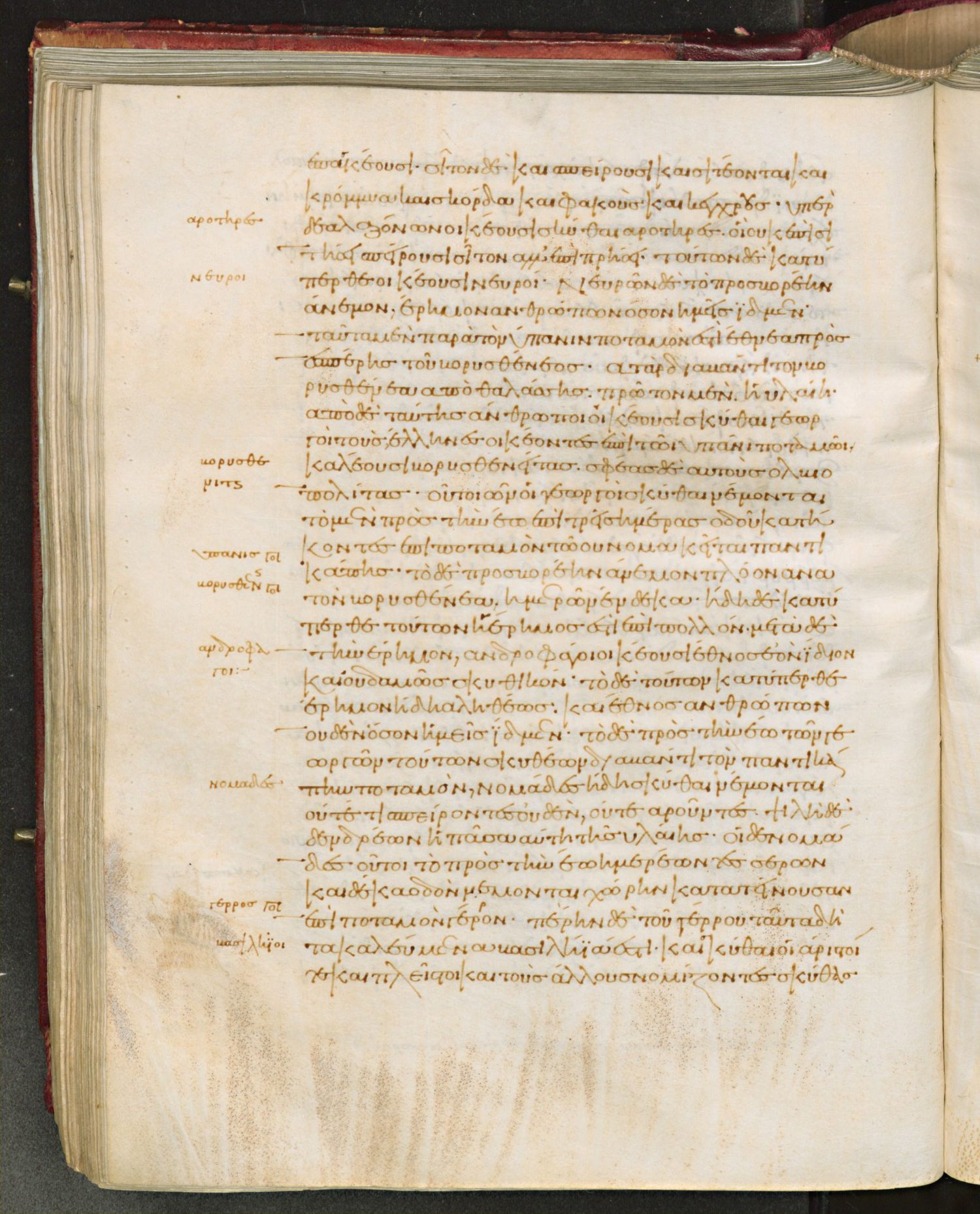
Laur. Plut. 70.3, fol. 151v: Greek here 4.17.1 to 4.20.1. Checked on the image (first and last words read and located in the Greek; each break checked against the neighbouring page): fol. 151v begins ‹ἐπασκέουσι, σῖτον δὲ καὶ› (4.17.1), ends ‹τοὺς ἄλλους νομίζοντες Σκύθας› (4.20.1). English here: 4.17.2 to 4.19.1 (Godley's sentences for the sections whose Greek lies mostly on this page).
4.17.1ἐπασκέουσι, σῖτον δὲ καὶ σπείρουσι καὶ σιτέονται, καὶ κρόμμυα καὶ σκόροδα καὶ φακούς καὶ κέγχρους. 4.17.2ὕπερ δὲ Ἀλαζόνων οἰκέουσι Σκύθαι ἀροτῆρες, οἳ οὐκ ἐπὶ σιτήσι σπείρουσι τὸν σῖτον ἀλλʼ ἐπὶ πρήσι. τούτων δὲ κατύπερθε οἰκέουσι Νευροί. Νευρῶν δὲ τὸ πρὸς βορέην ἄνεμον ἔρημον ἀνθρώπων, ὅσον ἡμεῖς ἴδμεν. 4.18.1ταῦτα μὲν παρὰ τὸν Ὕπανιν ποταμὸν ἐστι ἔθνεα πρὸς ἑσπέρης τοῦ Βορυσθένεος· ἀτὰρ διαβάντι τὸν Βορυσθένεα ἀπὸ θαλάσσης πρῶτον μὲν ᾗ Ὑλαίη, ἀπὸ δὲ ταύτης ἄνω ἰόντι οἰκέουσι Σκύθαι γεωργοί, τοὺς Ἕλληνές οἱ οἰκέοντες ἐπὶ τῷ Ὑπάνι ποταμῷ καλέουσι Βορυσθενεΐτας, σφέας δὲ αὐτοὺς Ὀλβιοπολίτας. 4.18.2οὗτοι ὦν οἱ γεωργοὶ Σκύθαι νέμονται τὸ μὲν πρὸς τὴν ἠῶ ἐπὶ τρεῖς ἡμέρας ὁδοῦ, κατήκοντες ἐπὶ ποταμὸν τῷ οὔνομα κεῖται Παντικάπης, τὸ δὲ πρὸς βορέην ἄνεμον πλόον ἀνὰ τὸν Βορυσθένεα ἡμερέων ἕνδεκα. ἤδη δὲ κατύπερθε τούτων ἡ ἔρημος ἐστὶ ἐπὶ πολλὸν. 4.18.3μετὰ δὲ τὴν ἔρημον Ἀνδροφάγοι οἰκέουσι, ἔθνος ἐὸν ἴδιον καὶ οὐδαμῶς Σκυθικόν. τὸ δὲ τούτων κατύπερθε ἔρημον ἤδη ἀληθέως καὶ ἔθνος ἀνθρώπων οὐδέν, ὅσον ἡμεῖς ἴδμεν. 4.19.1τὸ δὲ πρὸς τὴν ἠῶ τῶν γεωργῶν τούτων Σκυθέων, διαβάντι τὸν Παντικάπην ποταμόν, νομάδες ἤδη Σκύθαι νέμονται, οὔτε τι σπείροντες οὐδέν οὔτε ἀροῦντες· ψιλή δέ δενδρέων ἡ πᾶσα αὕτη πλήν τῆς Ὑλαίης. οἱ δὲ νομάδες οὗτοι τὸ πρὸς τὴν ἠῶ ἡμερέων τεσσέρων καὶ δέκα ὁδὸν νέμονται χώρην κατατείνουσαν ἐπὶ ποταμὸν Γέρρον. 4.20.1πέρην δὲ τοῦ Γέρρου ταῦτα δὴ τὰ καλεύμενα βασιλήια ἐστὶ καὶ Σκύθαι οἱ ἄριστοί τε καὶ πλεῖστοι καὶ τοὺς ἄλλους νομίζοντες Σκύθας
4.17.2Above the Alazones dwell Scythian tillers of the land, who sow corn not for eating but for selling; north of these, the Neuri; to the north of the Neuri the land is uninhabited so far as we know. 4.18.1These are the tribes by the river Hypanis, westwards of the Borysthenes. But on the other side of the Borysthenes the tribe nearest to the sea is the tribe of the Woodlands; and north of these dwell Scythian farmers, whom the Greek dwellers on the Hypanis river (who call themselves Olbiopolitae) call Borystheneitae. 4.18.2These farming Scythians inhabit a land stretching eastward a three days’ journey to a river called Panticapes, and northward as far as an eleven days’ voyage up the Borysthenes; and north of these the land is uninhabited for a long way; 4.18.3after which desert is the country of the Man-eaters, who are a nation by themselves and by no means Scythian; and beyond them is true desert, wherein no nation of men dwells, as far as we know. 4.19.1But to the east of these farming Scythians, cross the river Panticapes, and you are in the land of nomad Scythians, who sow nothing, nor plough; and all these lands except the Woodlands are bare of trees. These nomads inhabit to the eastward a country that stretches fourteen days’ journey to the river Gerrus.
Where on the image
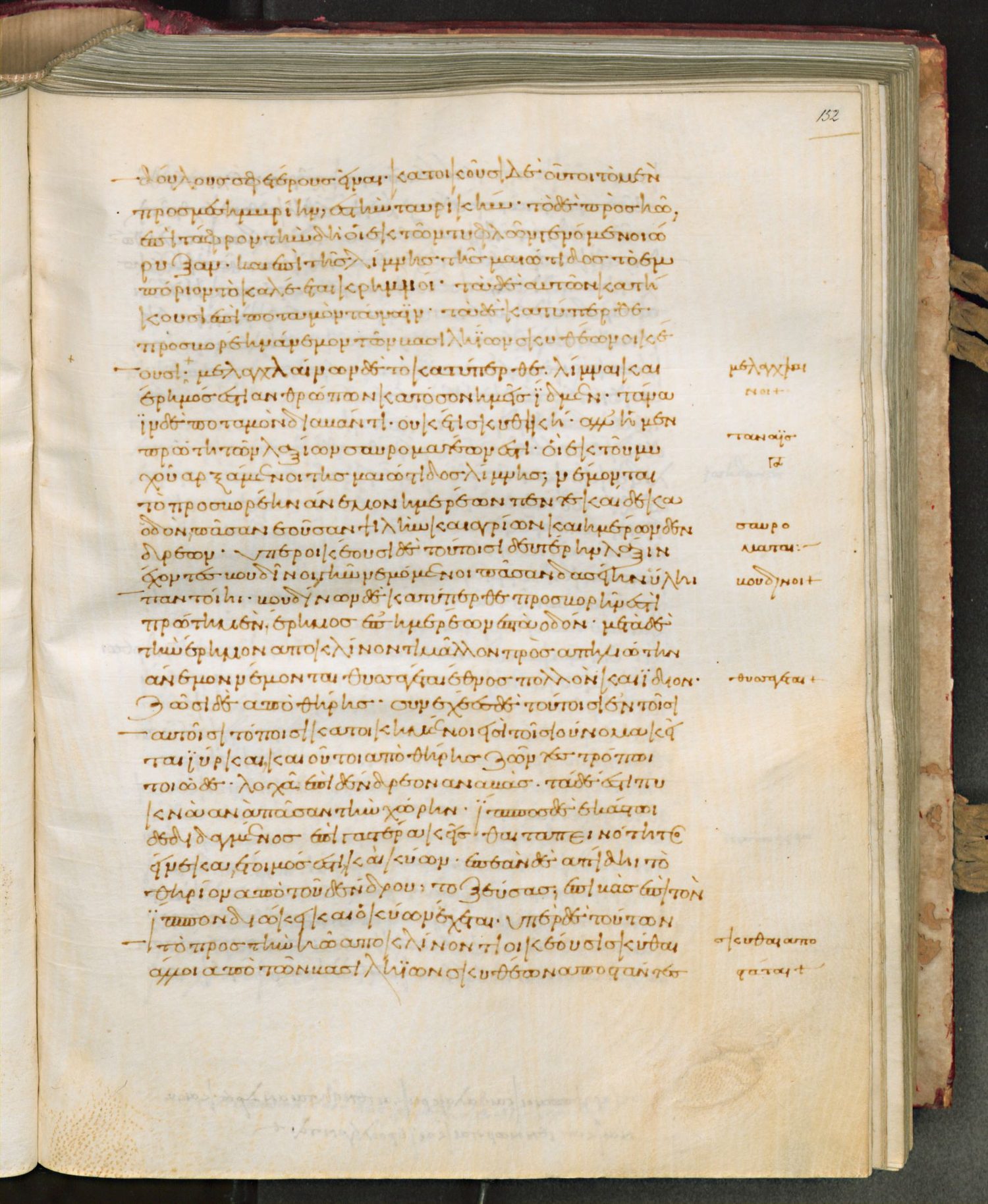
Laur. Plut. 70.3, fol. 152r: Greek here 4.20.1 to 4.22.3. Checked on the image (first and last words read and located in the Greek; each break checked against the neighbouring page): fol. 152r begins ‹δούλους σφετέρους εἶναι· κατήκουσι› (4.20.1), ends ‹τῶν βασιληίων Σκυθέων ἀποστάντες› (4.22.3). English here: 4.20.1 to 4.22.3 (Godley's sentences for the sections whose Greek lies mostly on this page).
4.20.1δούλους σφετέρους εἶναι· κατήκουσι δὲ οὗτοι τὸ μὲν πρὸς μεσαμβρίην ἐς τὴν Ταυρικήν, τὸ δὲ πρὸς ἠῶ ἐπί τε τάφρον, τὴν δὴ οἱ ἐκ τῶν τυφλῶν γενόμενοι ὤρυξαν, καὶ ἐπὶ τῆς λίμνης τῆς Μαιήτιδος τὸ ἐμπόριον τὸ καλέεται Κρημνοί· τὰ δὲ αὐτῶν κατήκουσι ἐπὶ ποταμὸν Τάναϊν. 4.20.2τὰ δὲ κατύπερθε πρὸς βορέην ἄνεμον τῶν βασιληίων Σκυθέων οἰκέουσι Μελάγχλαινοι, ἄλλο ἔθνος καὶ οὐ Σκυθικὸν. Μελαγχλαίνων δὲ τὸ κατύπερθε λίμναι καὶ ἔρημος ἐστὶ ἀνθρώπων, κατʼ ὅσον ἡμεῖς ἴδμεν. 4.21.1Τάναϊν δὲ ποταμὸν διαβάντι οὐκέτι Σκυθική, ἀλλʼ ἡ μὲν πρώτη τῶν λαξίων Σαυροματέων ἐστί, οἳ ἐκ τοῦ μυχοῦ ἀρξάμενοι τῆς Μαιήτιδος λίμνης νέμονται τὸ πρὸς βορέην ἄνεμον ἡμερέων πεντεκαίδεκα ὁδόν, πᾶσαν ἐοῦσαν ψιλὴν καὶ ἀγρίων καὶ ἡμέρων δενδρέων· ὑπεροικέουσι δὲ τούτων δευτέρην λάξιν ἔχοντες Βουδῖνοι, γῆν νεμόμενοι πᾶσαν δασέαν ὕλῃ παντοίῃ. 4.22.1Βουδίνων δὲ κατύπερθε πρὸς βορέην ἐστὶ πρώτη μὲν ἔρημος ἐπʼ ἡμερέων ἑπτὰ ὁδόν, μετὰ δὲ τὴν ἔρημον ἀποκλίνοντι μᾶλλον πρὸς ἀπηλιώτην ἄνεμον νέμονται Θυσσαγέται, ἔθνος πολλὸν καὶ ἴδιον· ζῶσι δὲ ἀπὸ θήρης. 4.22.2συνεχέες δὲ τούτοισι ἐν τοῖσι αὐτοῖσι τόποισι κατοικημένοι εἰσὶ τοῖσι οὔνομα κεῖται Ἰύρκαι, καὶ οὗτοι ἀπὸ θήρης ζῶντες τρόπῳ τοιῷδε· λοχᾷ ἐπὶ δένδρεον ἀναβάς, τὰ δὲ ἐστὶ πυκνὰ ἀνὰ πᾶσαν τὴν χώρην· ἵππος δὲ ἑκάστῳ δεδιδαγμένος ἐπὶ γαστέρα κεῖσθαι ταπεινότητος εἵνεκα ἕτοιμος ἐστὶ καὶ κύων· ἐπεὰν δὲ ἀπίδῃ τὸ θηρίον ἀπὸ τοῦ δενδρέου, τοξεύσας ἐπιβὰς ἐπὶ τὸν ἵππον διώκει, καὶ ὁ κύων ἔχεται, 4.22.3ὑπὲρ δὲ τούτων τὸ πρὸς τὴν ἠῶ ἀποκλίνοντι οἰκέουσι Σκύθαι ἄλλοι, ἀπὸ τῶν βασιληίων Σκυθέων ἀποστάντες
4.20.1Across the Gerrus are those lands called Royal, where are the best and most in number of the Scythians, who deem all other Scythians their slaves; their territory stretches southward to the Tauric land, and eastward to the fosse that was dug by the sons of the blind men, and on the Maeetian lake to the port called The Cliffs; and part of it stretches to the river Tanais. 4.20.2Above the Royal Scythians to the north dwell the Blackcloaks, who are of another and not a Scythian stock; and beyond the Blackcloaks the land is all marshes and uninhabited by men, so far as we know. 4.21.1Across the Tanais it is no longer Scythia; the first of the divisions belongs to the Sauromatae, whose country begins at the inner end of the Maeetian lake and stretches fifteen days’ journey to the north, and is all bare of both forest and garden trees. Above these in the second division dwell the Budini, inhabiting a country thickly overgrown with trees of all kinds. 4.22.1Northward of the Budini the land is uninhabited for seven days’ journey; after this desert, and somewhat more towards the east wind, dwell the Thyssagetae, a numerous and a separate nation, living by the chase. 4.22.2Adjoining these and in the same country dwell the people called Iyrkae; these also live by the chase, in such manner as I will show. The hunter climbs a tree, and there sits ambushed; for trees grow thick all over the land; and each man has his horse at hand, trained to couch upon its belly for lowliness’ sake, and his dog; and when he marks the quarry from the tree, he shoots with the bow and mounts his horse and pursues after it, and the dog follows closely after. 4.22.3Beyond these and somewhat towards the east dwell Scythians again, who revolted from the Royal Scythians and so came to this country.
Where on the image
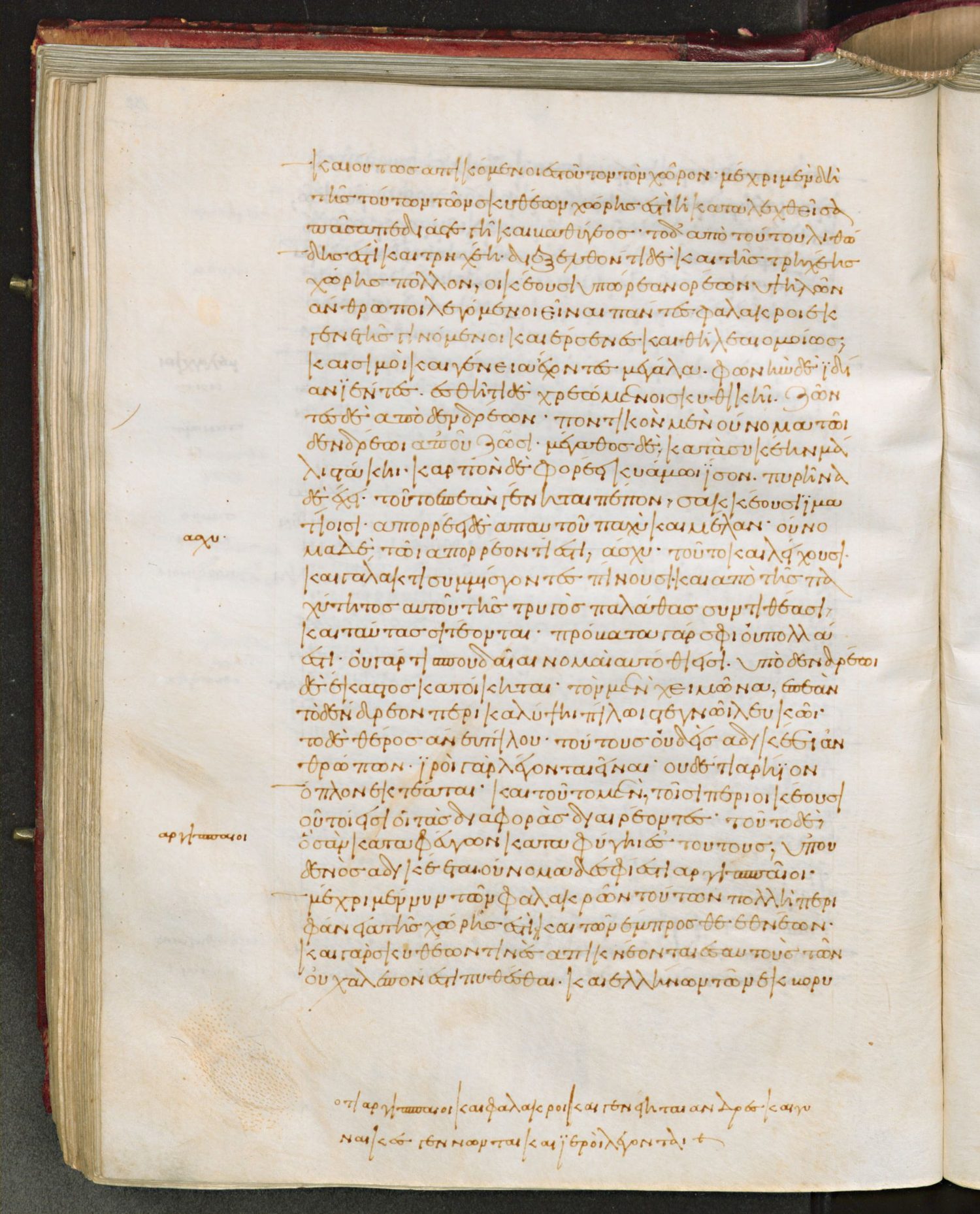
Laur. Plut. 70.3, fol. 152v: Greek here 4.22.3 to 4.24.1. Checked on the image (first and last words read and located in the Greek; each break checked against the neighbouring page): fol. 152v begins ‹καὶ οὕτω ἀπικόμενοι ἐς› (4.22.3), ends ‹Ἑλλήνων τῶν ἐκ Βορυ-› (4.24.1). Below the text, a reader's note on the Argippaei. English here: 4.23.1 to 4.24.1 (Godley's sentences for the sections whose Greek lies mostly on this page).
4.22.3καὶ οὕτω ἀπικόμενοι ἐς τοῦτον τὸν χῶρον. 4.23.1μέχρι μὲν δὴ τῆς τούτων τῶν Σκυθέων χώρης ἐστὶ ἡ καταλεχθεῖσα πᾶσα πεδιάς τε γῆ καὶ βαθύγαιος, τὸ δʼ ἀπὸ τούτου λιθώδης τʼ ἐστὶ καὶ τρηχέα. 4.23.2διεξελθόντι δὲ καὶ τῆς τρηχέης χώρης πολλὸν οἰκέουσι ὑπώρεαν ὀρέων ὑψηλῶν ἄνθρωποι λεγόμενοι εἶναι πάντες φαλακροὶ ἐκ γενετῆς γινόμενοι, καὶ ἔρσενες καὶ θήλεαι ὁμοίως, καὶ σιμοὶ καὶ γένεια ἔχοντες μεγάλα, φωνὴν δὲ ἰδίην ἱέντες, ἐσθῆτι δὲ χρεώμενοι Σκυθικῇ, ζῶντες δὲ ἀπὸ δενδρέων. 4.23.3ποντικὸν μὲν οὔνομα τῷ δενδρέῳ ἀπʼ οὗ ζῶσι, μέγαθος δὲ κατὰ συκέην μάλιστά κῃ. καρπὸν δὲ φορέει κυάμῳ ἴσον, πυρῆνα δὲ ἔχει. τοῦτο ἐπεὰν γένηται πέπον, σακκέουσι ἱματίοισι, ἀπορρέει δὲ ἀπʼ αὐτοῦ παχὺ καὶ μέλαν· οὔνομα δὲ τῷ ἀπορρέοντι ἐστὶ ἄσχυ· τοῦτο καὶ λείχουσι καὶ γάλακτι συμμίσγοντες πίνουσι, καὶ ἀπὸ τῆς παχύτητος αὐτοῦ τῆς τρυγὸς παλάθας συντιθεῖσι καὶ ταύτας σιτέονται. 4.23.4πρόβατα γάρ σφι οὐ πολλά ἐστι. οὐ γάρ τι σπουδαῖαι αἱ νομαὶ αὐτόθι εἰσί. ὑπὸ δενδρέῳ δὲ ἕκαστος κατοίκηται, τὸν μὲν χειμῶνα ἐπεὰν τὸ δένδρεον περικαλύψῃ πίλῳ στεγνῷ λευκῷ, τὸ δὲ θέρος ἄνευ πίλου. 4.23.5τούτους οὐδεὶς ἀδικέει ἀνθρώπων· ἱροὶ γὰρ λέγονται εἶναι· οὐδέ τι ἀρήιον ὅπλον ἐκτέαται. καὶ τοῦτο μὲν τοῖσι περιοικέουσι οὗτοι εἰσὶ οἱ τὰς διαφορὰς διαιρέοντες, τοῦτο δὲ ὃς ἂν φεύγων καταφύγῃ ἐς τούτους, ὑπʼ οὐδενὸς ἀδικέεται· οὔνομα δέ σφι ἐστὶ Ἀργιππαῖοι. 4.24.1μέχρι μέν νυν τῶν φαλακρῶν τούτων πολλὴ περιφανείη τῆς χώρης ἐστὶ καὶ τῶν ἔμπροσθε ἐθνέων· καὶ γὰρ Σκυθέων τινὲς ἀπικνέονται ἐς αὐτούς, τῶν οὐ χαλεπόν ἐστι πυθέσθαι καὶ Ἑλλήνων τῶν ἐκ Βορυσθένεος
4.23.1As far as the country of these Scythians all the aforesaid land is level and its soil is deep; but thereafter it is stony and rough. 4.23.2After a long passage through this rough country, there are men inhabiting the foothills of high mountains, who are said to be all bald from their birth (male and female alike) and snub-nosed and with long beards; they speak a tongue of their own, and wear Scythian raiment, and their fare comes from trees. 4.23.3The tree wherefrom they live is called “Pontic”; it is about the size of a fig-tree, and bears a fruit as big as a bean, with a stone in it. When this fruit is ripe, they strain it through cloth, and a thick black liquid flows from it, which they call “aschu”; they lick this up or mix it with milk for drinking, and of the thickest of the lees of it they make cakes, and eat them. 4.23.4For they have but few of smaller cattle, the pasture in their land not being good. They dwell each man under a tree, covering it in winter with a white felt cloth, but using no felt in summer. 4.23.5These people are wronged by no man, for they are said to be sacred; nor have they any weapon of war. These are they who judge in the quarrels between their neighbours; moreover, whatever banished man has taken refuge with them is wronged by none. They are called Argippeans. 4.24.1Now as far as the land of these bald men we have full knowledge of the country and the nations on the hither side of them; for some of the Scythians make their way to them, from whom it is easy to get knowledge, and from some too of the Greeks from the Borysthenes port and the other ports of Pontus; such Scythians as visit them do their business with seven interpreters and in seven languages.
Where on the image
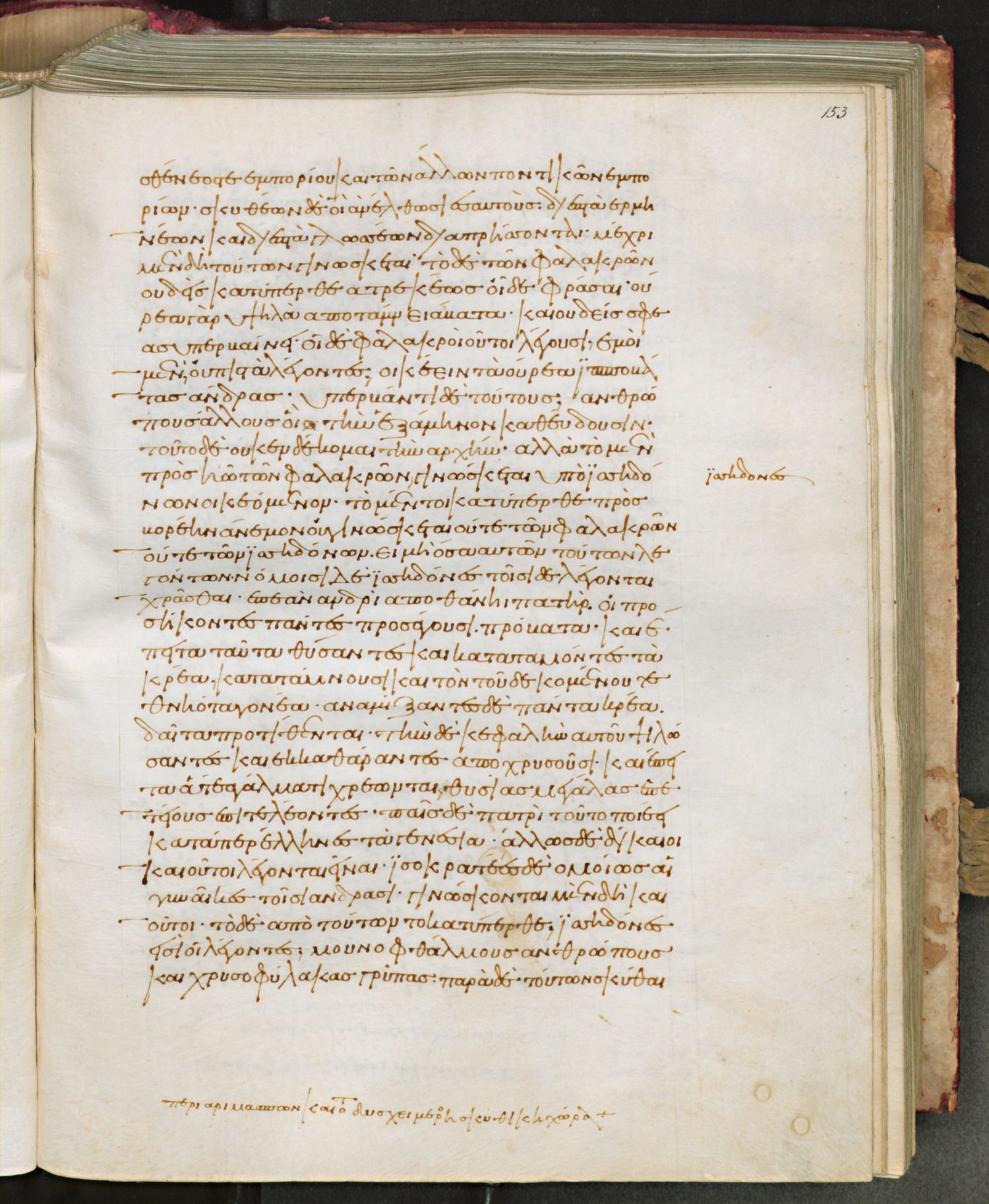
Laur. Plut. 70.3, fol. 153r: Greek here 4.24.1 to 4.27.1. Checked on the image (first and last words read and located in the Greek; each break checked against the neighbouring page): fol. 153r begins ‹-θένεος τε ἐμπορίου καὶ› (4.24.1), ends ‹παρὰ δὲ τούτων Σκύθαι› (4.27.1). The word ‹Βορυσθένεος› is divided between fol. 152v and fol. 153r; it is given with fol. 152v. Below the text, a reader's note on the Arimaspians. English here: 4.25.1 to 4.27.1 (Godley's sentences for the sections whose Greek lies mostly on this page).
4.24.1τε ἐμπορίου καὶ τῶν ἄλλων Ποντικῶν ἐμπορίων· Σκυθέων δὲ οἳ ἂν ἔλθωσι ἐς αὐτούς, διʼ ἑπτὰ ἑρμηνέων καὶ διʼ ἑπτὰ γλωσσέων διαπρήσσονται. 4.25.1μέχρι μὲν δὴ τούτων γινώσκεται, τὸ δὲ τῶν φαλακρῶν κατύπερθε οὐδεὶς ἀτρεκέως οἶδε φράσαι. ὄρεα γὰρ ὑψηλὰ ἀποτάμνει ἄβατα καὶ οὐδείς σφεα ὑπερβαίνει. οἱ δὲ φαλακροὶ οὗτοι λέγουσι, ἐμοὶ μὲν οὐ πιστὰ λέγοντες, οἰκέειν τὰ ὄρεα αἰγίποδας ἄνδρας, ὑπερβάντι δὲ τούτους ἀνθρώπους ἄλλους οἳ τὴν ἑξάμηνον κατεύδουσι. τοῦτο δὲ οὐκ ἐνδέκομαι τὴν ἀρχήν, 4.25.2ἀλλὰ τὸ μὲν πρὸς ἠῶ τῶν φαλακρῶν γινώσκεται ἀτρεκέως ὑπὸ Ἰσσηδόνων οἰκεόμενον, τὸ μέντοι κατύπερθε πρὸς βορέην ἄνεμον οὐ γινώσκεται οὔτε τῶν φαλακρῶν οὔτε τῶν Ἰσσηδόνων, εἰ μὴ ὅσα αὐτῶν τούτων λεγόντων. 4.26.1νόμοισι δὲ Ἰσσηδόνες τοῖσιδε λέγονται χρᾶσθαι. ἐπεὰν ἀνδρὶ ἀποθάνῃ πατήρ, οἱ προσήκοντες πάντες προσάγουσι πρόβατα, καὶ ἔπειτα ταῦτα θύσαντες καὶ καταταμόντες τὰ κρέα κατατάμνουσι καὶ τὸν τοῦ δεκομένου τεθνεῶτα γονέα, ἀναμίξαντες δὲ πάντα τὰ κρέα δαῖτα προτίθενται· 4.26.2τὴν δὲ κεφαλὴν αὐτοῦ ψιλώσαντες καὶ ἐκκαθήραντες καταχρυσοῦσι καὶ ἔπειτα ἅτε ἀγάλματι χρέωνται, θυσίας μεγάλας ἐπετείους ἐπιτελέοντες. παῖς δὲ πατρὶ τοῦτο ποιέει, κατά περ Ἕλληνες τὰ γενέσια. ἄλλως δὲ δίκαιοι καὶ οὗτοι λέγονται εἶναι, ἰσοκρατέες δὲ ὁμοίως αἱ γυναῖκες τοῖσι ἀνδράσι. 4.27.1γινώσκονται μὲν δὴ καὶ οὗτοι, τὸ δὲ ἀπὸ τούτων τὸ κατύπερθε Ἰσσηδόνες εἰσὶ οἱ λέγοντες μουνοφθάλμους ἀνθρώπους καὶ χρυσοφύλακας γρῦπας εἶναι· παρὰ δὲ τούτων Σκύθαι
4.25.1So far then as these men this country is known; but, for what lies north of the bald men, no one can speak with exact knowledge; for mountains high and impassable bar the way, and no man crosses them. These bald men say (but for my part I believe them not) that the mountains are inhabited by men with goats’ feet; and that beyond these again are men who sleep for six months of the twelve. This I cannot at all accept for true. 4.25.2But the country east of the bald-heads is known for certain to be inhabited by the Issedones; howbeit, of what lies northward either of the bald-heads or the Issedones we have no knowledge, save what comes from the report of these latter. 4.26.1It is said to be the custom of the Issedones, that whenever a man’s father dies, all the nearest of kin bring beasts of the flock, and having killed these and cut up the flesh they cut up also the dead father of their host, and set out all the flesh mingled together for a feast. 4.26.2As for his head, they strip it bare and cleanse and gild it, and keep it for a sacred relic, whereto they offer yearly solemn sacrifice. Every son does so by his father, even as the Greeks in their festivals in honour of the dead. For the rest, these also are said to be a law-abiding people; and the women have equal power with the men. 4.27.1Of these then also we have knowledge; but for what is northward of them, it is from the Issedones that the tale comes of the one-eyed men and the griffins that guard gold; this is told by the Scythians, who have heard it from them; and we again have taken it for true from the Scythians, and call these people by the Scythian name, Arimaspians; for in the Scythian tongue arima is one, and spou is the eye.
Where on the image
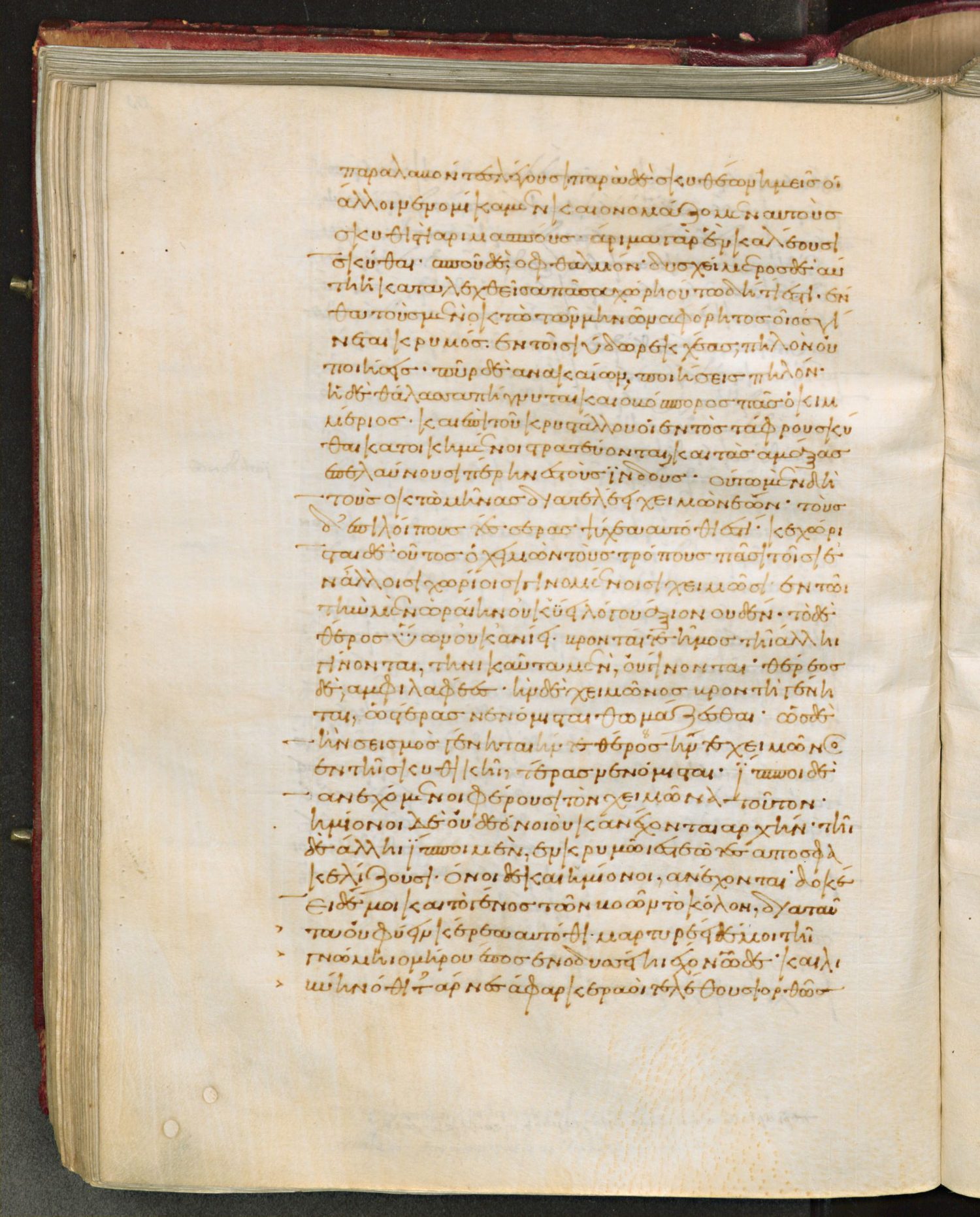
Laur. Plut. 70.3, fol. 153v: Greek here 4.27.1 to 4.29.1. Checked on the image (first and last words read and located in the Greek; each break checked against the neighbouring page): fol. 153v begins ‹παραλαβόντες λέγουσι, παρὰ δὲ› (4.27.1), ends ‹ἄφαρ κεραοὶ τελέθουσι, ὀρθῶς› (4.29.1). English here: 4.28.1 to 4.29.1 (Godley's sentences for the sections whose Greek lies mostly on this page).
4.27.1παραλαβόντες λέγουσι, παρὰ δὲ Σκυθέων ἡμεῖς οἱ ἄλλοι νενομίκαμεν καὶ ὀνομάζομεν αὐτοὺς σκυθιστὶ Ἀριμασπούς· ἄριμα γὰρ ἓν καλέουσι Σκύθαι, σποῦ δὲ ὀφθαλμόν. 4.28.1δυσχείμερος δὲ αὕτη ἡ καταλεχθεῖσα πᾶσα χώρη οὕτω δή τι ἐστί, ἔνθα τοὺς μὲν ὀκτὼ τῶν μηνῶν ἀφόρητος οἷος γίνεται κρυμός, ἐν τοῖσι ὕδωρ ἐκχέας πηλὸν οὐ ποιήσεις, πῦρ δὲ ἀνακαίων ποιήσεις πηλόν·ἡ δὲ θάλασσα πήγνυται καὶ ὁ Βόσπορος πᾶς ὁ Κιμμέριος, καὶ ἐπὶ τοῦ κρυστάλλου οἱ ἐντὸς τάφρου Σκύθαι κατοικημένοι στρατεύονται καὶ τὰς ἁμάξας ἐπελαύνουσι πέρην ἐς τοὺς Σίνδους. 4.28.2οὕτω μὲν δὴ τοὺς ὀκτὼ μῆνας διατελέει χειμὼν ἐών, τοὺς δʼ ἐπιλοίπους τέσσερας ψύχεα αὐτόθι ἐστί. κεχώρισται δὲ οὗτος ὁ χειμὼν τοὺς τρόπους πᾶσι τοῖσι ἐν ἄλλοισι χωρίοισι γινομένοισι χειμῶσι, ἐν τῷ τὴν μὲν ὡραίην οὐκ ὕει λόγου ἄξιον οὐδέν, τὸ δὲ θέρος ὕων οὐκ ἀνιεῖ· 4.28.3βρονταί τε ἦμος τῇ ἄλλῃ γίνονται, τηνικαῦτα μὲν οὐ γίνονται, θέρεος δὲ ἀμφιλαφέες· ἢν δὲ χειμῶνος βροντὴ γένηται, ὡς τέρας νενόμισται θωμάζεσθαι. ὣς δὲ καὶ ἢν σεισμὸς γένηται ἤν τε θέρεος ἤν τε χειμῶνος ἐν τῇ Σκυθικῇ, τέρας νενόμισται. 4.28.4ἵπποι δὲ ἀνεχόμενοι φέρουσι τὸν χειμῶνα τοῦτον, ἡμίονοι δὲ οὐδὲ ὄνοι οὐκ ἀνέχονται ἀρχήν· τῇ δὲ ἄλλῃ ἵπποι μὲν ἐν κρυμῷ ἑστεῶτες ἀποσφακελίζουσι, ὄνοι δὲ καὶ ἡμίονοι ἀνέχονται. 4.29.1δοκέει δέ μοι καὶ τὸ γένος τῶν βοῶν τὸ κόλον διὰ ταῦτα οὐ φύειν κέρεα αὐτόθι· μαρτυρέει δέ μοι τῇ γνώμῃ καὶ Ὁμήρου ἔπος ἐν Ὀδυσσείῃ ἔχον ὧδε,
καὶ Λιβύην, ὅθι τʼ ἄρνες ἄφαρ κεραοὶ τελέθουσι,
ὀρθῶς
4.28.1All this aforementioned country is exceeding cold; for eight months of every year there is frost unbearable, and in these you shall not make mud by pouring out water but by lighting a fire; the sea freezes, and all the Cimmerian Bosporus; and the Scythians dwelling this side of the fosse lead armies over the ice, and drive their wains across to the land of the Sindi. 4.28.2So it is ever winter for eight months, and it is cold in that country for the four that remain. Here is a winter of a different sort from the winters that come in other lands; for in the season for rain there falls scarce any, but for all the summer there is rain unceasing; 4.28.3and when there are thunderstorms in other lands, here there are none, but in summer there is great plenty of them; if there come a thunderstorm in winter they are wont to marvel at it for a portent. And so too if there come an earthquake, be it in summer or winter, it is esteemed a portent in Scythia, 4.28.4Horses have endurance to bear the Scythian winter, mules and asses cannot at all bear it; yet in other lands, whereas asses and mules can endure frost, horses that stand in it are frostbitten. 4.29.1And to my thinking it is for this cause that the hornless kind of oxen grows no horns in Scythia. There is a verse of Homer in the Odyssey that witnesses to my judgment; it is this: ::“Libya, the land where lambs are born with horns on their foreheads,” wherein it is rightly signified, that in hot countries the horns grow quickly, whereas in very cold countries beasts grow horns hardly, or not at all.
Where on the image
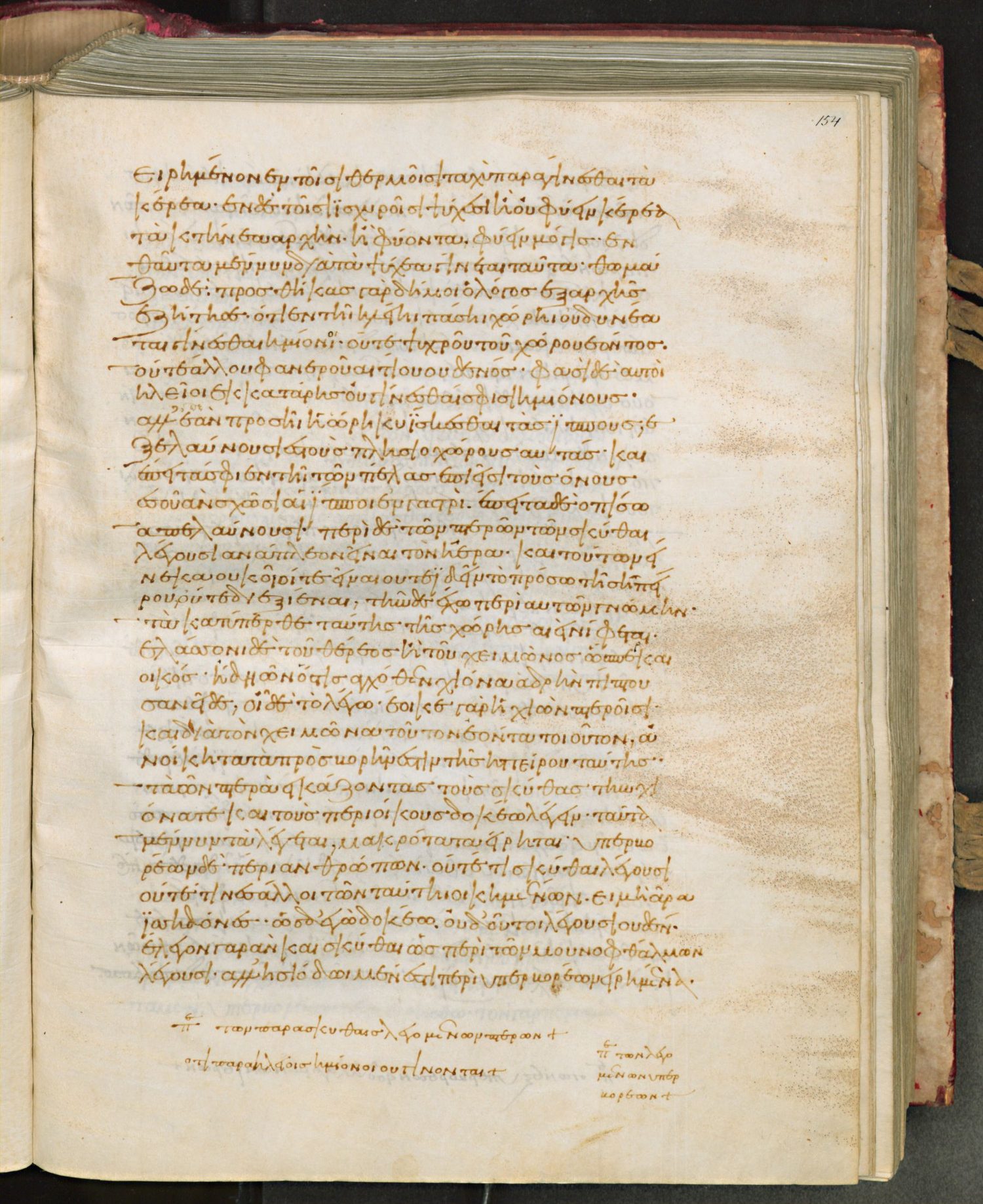
Laur. Plut. 70.3, fol. 154r: Greek here 4.29.1 to 4.32.1. Checked on the image (first and last words read and located in the Greek; each break checked against the neighbouring page): fol. 154r begins ‹εἰρημένον, ἐν τοῖσι θερμοῖσι› (4.29.1), ends ‹ἐστὶ περὶ Ὑπερβορέων εἰρημένα› (4.32.1). Below the text and in the margin, readers' notes. English here: 4.30.1 to 4.32.1 (Godley's sentences for the sections whose Greek lies mostly on this page).
4.29.1εἰρημένον, ἐν τοῖσι θερμοῖσι ταχὺ παραγίνεσθαι τὰ κέρεα, ἐν δὲ τοῖσι ἰσχυροῖσι ψύχεσι ἢ οὐ φύειν κέρεα τὰ κτήνεα ἀρχὴν ἡ φύοντα φύειν μόγις. 4.30.1ἐνθαῦτα μέν νυν διὰ τὰ ψύχεα γίνεται ταῦτα. θωμάζω δέ (προσθήκας γὰρ δή μοι ὁ λόγος ἐξ ἀρχῆς ἐδίζητο) ὅτι ἐν τῇ Ἠλείῃ πάσῃ χώρῃ οὐ δυνέαται γίνεσθαι ἡμίονοι, οὔτε ψυχροῦ τοῦ χώρου ἐόντος οὔτε ἄλλου φανεροῦ αἰτίου οὐδενός. φασὶ δὲ αὐτοὶ Ἠλεῖοι ἐκ κατάρης τευ οὐ γίνεσθαι σφίσι ἡμιόνους, 4.30.2ἀλλʼ ἐπεὰν προσίῃ ἡ ὥρη κυΐσκεσθαι τὰς ἵππους, ἐξελαύνουσι ἐς τοὺς πλησιοχώρους αὐτάς, καὶ ἔπειτά σφι ἐν τῇ τῶν πέλας ἐπιεῖσι τοὺς ὄνους, ἐς οὗ ἂν σχῶσι αἱ ἵπποι ἐν γαστρί· ἔπειτα δὲ ἀπελαύνουσι. 4.31.1περὶ δὲ τῶν πτερῶν τῶν Σκύθαι λέγουσι ἀνάπλεον εἶναι τὸν ἠέρα, καὶ τούτων εἵνεκα οὐκ οἷοί τε εἶναι οὔτε ἰδεῖν τὸ πρόσω τῆς ἠπείρου οὔτε διεξιέναι, τήνδε ἔχω περὶ αὐτῶν γνώμην· τὰ κατύπερθε ταύτης τῆς χώρης αἰεὶ νίφεται, ἐλάσσονι δὲ τοῦ θέρεος ἢ τοῦ χειμῶνος, ὥσπερ καὶ οἰκός. 4.31.2ἤδη ὦν ὅστις ἀγχόθεν χιόνα ἁδρὴν πίπτουσαν εἶδε οἶδε τὸ λέγω· ἔοικε γὰρ ἡ χιὼν πτεροῖσι καὶ διὰ τὸν χειμῶνα τοῦτον ἐόντα τοιοῦτον ἀνοίκητα τὰ πρὸς βορέην ἐστὶ τῆς ἠπείρου ταύτης. τὰ ὦν πτερὰ εἰκάζοντας τὴν χιόνα τοὺς Σκύθας τε καὶ τοὺς περιοίκους δοκέω λέγειν. ταῦτα μέν νυν τὰ λέγεται μακρότατα εἴρηται. 4.32.1Ὑπερβορέων δὲ πέρι ἀνθρώπων οὔτε τι Σκύθαι λέγουσι οὐδὲν οὔτε τινὲς ἄλλοι τῶν ταύτῃ οἰκημένων, εἰ μὴ ἄρα Ἰσσηδόνες. ὡς δὲ ἐγὼ δοκέω, οὐδʼ οὗτοι λέγουσι οὐδέν· ἔλεγον γὰρ ἂν καὶ Σκύθαι, ὡς περὶ τῶν μουνοφθάλμων λέγουσι. ἀλλʼ Ἡσιόδῳ μὲν ἐστὶ περὶ Ὑπερβορέων εἰρημένα,
4.30.1In Scythia, then, this happens because of the cold. But I hold it strange (for it was ever the way of my history to seek after subsidiary matters) that in the whole of Elis no mules can be begotten, albeit neither is the country cold nor is there any manifest cause. The Eleans themselves say that it is by reason of a curse that mules cannot be begotten among them; 4.30.2but whenever the season is at hand for the mares to conceive, they drive them away into the countries of their neighbours, and then send the asses to them in the neighbouring land, till the mares be pregnant; and then they drive them home again. 4.31.1But as touching the feathers whereof the Scythians say that the air is full, insomuch that none can see or traverse the land beyond, I hold this opinion. Northward of that country snow falls continually, though less in summer than in winter, as is to be expected. 4.31.2Whoever has seen snow falling thickly near him knows of himself my meaning; for the snow is like feathers; and by reason of the winter, which is such as I have said, the parts to the north of this continent are uninhabited. I think therefore that in this tale of feathers the Scythians and their neighbours do but speak of snow in a figure. Thus then I have spoken of those parts that are said to be most distant. 4.32.1Concerning the Hyperborean people neither the Scythians nor any other dwellers in these lands tell us anything, except perchance the Issedones. And, as I think, even they tell nothing; for were it not so, then the Scythians too would have told, even as they tell of the one-eyed men. But Hesiod speaks of Hyperboreans, and Homer too in his poem The Heroes’ Sons, if that be truly the work of Homer.
Where on the image
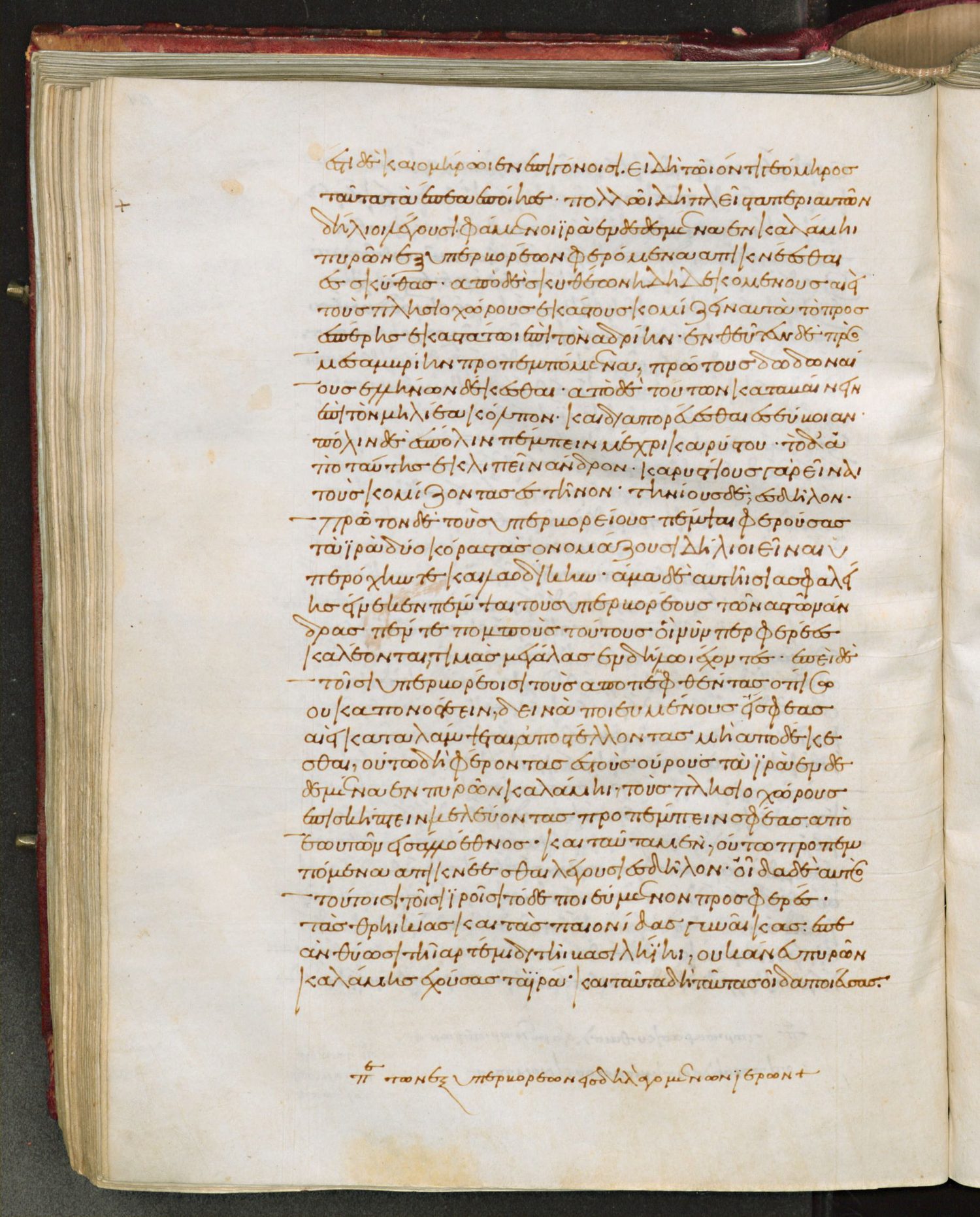
Laur. Plut. 70.3, fol. 154v: Greek here 4.32.1 to 4.34.1. Checked on the image (first and last words read and located in the Greek; each break checked against the neighbouring page): fol. 154v begins ‹ἔστι δὲ καὶ Ὁμήρῳ› (4.32.1), ends ‹δὴ ταύτας οἶδα ποιεύσας› (4.34.1). English here: 4.33.1 to 4.33.5 (Godley's sentences for the sections whose Greek lies mostly on this page).
4.32.1ἔστι δὲ καὶ Ὁμήρῳ ἐν Ἐπιγόνοισι, εἰ δὴ τῷ ἐόντι γε Ὅμηρος ταῦτα τὰ ἔπεα ἐποίησε. 4.33.1πολλῷ δέ τι πλεῖστα περὶ αὐτῶν Δήλιοι λέγουσι, φάμενοι ἱρὰ ἐνδεδεμένα ἐν καλάμῃ πυρῶν ἐξ Ὑπερβορέων φερόμενα ἀπικνέεσθαι ἐς Σκύθας, ἀπὸ δὲ Σκυθέων ἤδη δεκομένους αἰεὶ τοὺς πλησιοχώρους ἑκάστους κομίζειν αὐτὰ τὸ πρὸς ἑσπέρης ἑκαστάτω ἐπὶ τὸν Ἀδρίην, 4.33.2ἐνθεῦτεν δὲ πρὸς μεσαμβρίην προπεμπόμενα πρώτους Δωδωναίους Ἑλλήνων δέκεσθαι, ἀπὸ δὲ τούτων καταβαίνειν ἐπὶ τὸν Μηλιέα κόλπον καὶ διαπορεύεσθαι ἐς Εὔβοιαν, πόλιν τε ἐς πόλιν πέμπειν μέχρι Καρύστου, τὸ δʼ ἀπὸ ταύτης ἐκλιπεῖν Ἄνδρον· Καρυστίους γὰρ εἶναι τοὺς κομίζοντας ἐς Τῆνον, Τηνίους δὲ ἐς Δῆλον. 4.33.3ἀπικνέεσθαι μέν νυν οὕτω ταῦτα τὰ ἱρὰ λέγουσι ἐς Δῆλον· πρῶτον δὲ τοὺς Ὑπερβορέους πέμψαι φερούσας τὰ ἱρὰ δὺο κόρας, τὰς ὀνομάζουσι Δήλιοι εἶναι Ὑπερόχην τε καὶ Λαοδίκην· ἅμα δὲ αὐτῇσι ἀσφαλείης εἵνεκεν πέμψαι τοὺς Ὑπερβορέους τῶν ἀστῶν ἄνδρας πέντε πομπούς, τούτους οἳ νῦν Περφερέες καλέονται τιμὰς μεγάλας ἐν Δήλῳ ἔχοντες. 4.33.4ἐπεὶ δὲ τοῖσι Ὑπερβορέοισι τοὺς ἀποπεμφθέντας ὀπίσω οὐκ ἀπονοστέειν, δεινὰ ποιευμένους εἰ σφέας αἰεὶ καταλάμψεται ἀποστέλλοντας μὴ ἀποδέκεσθαι, οὕτω δὴ φέροντας ἐς τοὺς οὔρους τὰ ἱρὰ ἐνδεδεμένα ἐν πυρῶν καλάμῃ τοὺς πλησιοχώρους ἐπισκήπτειν κελεύοντας προπέμπειν σφέα ἀπὸ ἑωυτῶν ἐς ἄλλο ἔθνος. 4.33.5καὶ ταῦτα μὲν οὕτω προπεμπόμενα ἀπικνέεσθαι λέγουσι ἐς Δῆλον. οἶδα δὲ αὐτὸς τούτοισι τοῖσι ἱροῖσι τόδε ποιεύμενον προσφερές, τὰς Θρηικίας καὶ τὰς Παιονίδας γυναῖκας, ἐπεὰν θύωσι τῇ Ἀρτέμιδι τῇ βασιλείῃ, οὐκ ἄνευ πυρῶν καλάμης ἐχούσας τὰ ἱρά. 4.34.1καὶ ταῦτα μὲν δὴ ταύτας οἶδα ποιεύσας·
4.33.1But the Delians tell much more concerning them than do any others. They say that offerings wrapt in wheat-straw are brought from the Hyperboreans to Scythia; when they have passed Scythia, each nation in turn receives them from its neighbours till they are carried to the Adriatic sea, which is the most westerly limit of their 4.33.2journey; thence they are brought on to the south, the people of Dodona being the first Greeks to receive them. From Dodona they come down to the Melian gulf, and are carried across to Euboea, and city sends them on to city till they come to Carystus; after this, Andros is left out of their journey, for it is Carystians who carry them to Tenos, and Tenians to Delos. 4.33.3Thus (they say) these offerings come to Delos. But on the first journey the Hyperboreans sent two maidens bearing the offerings, to whom the Delians give the names Hyperoche and Laodice, sending with them for safe conduct five men of their people as escort, those who are now called Perpherees and greatly honoured at Delos. 4.33.4But when the Hyperboreans found that those whom they sent never returned, they were very ill content that it should ever be their fate not to receive their messengers back; wherefore they carry the offerings, wrapt in wheat-straw, to their borders, and charge their neighbours to send them on from their own country to the next; 4.33.5and the offerings, it is said, come by this conveyance to Delos. I can say of my own knowledge that there is a custom like these offerings, namely, that when the Thracian and Paeonian women sacrifice to the Royal Artemis, they have wheat-straw with them while they sacrifice.
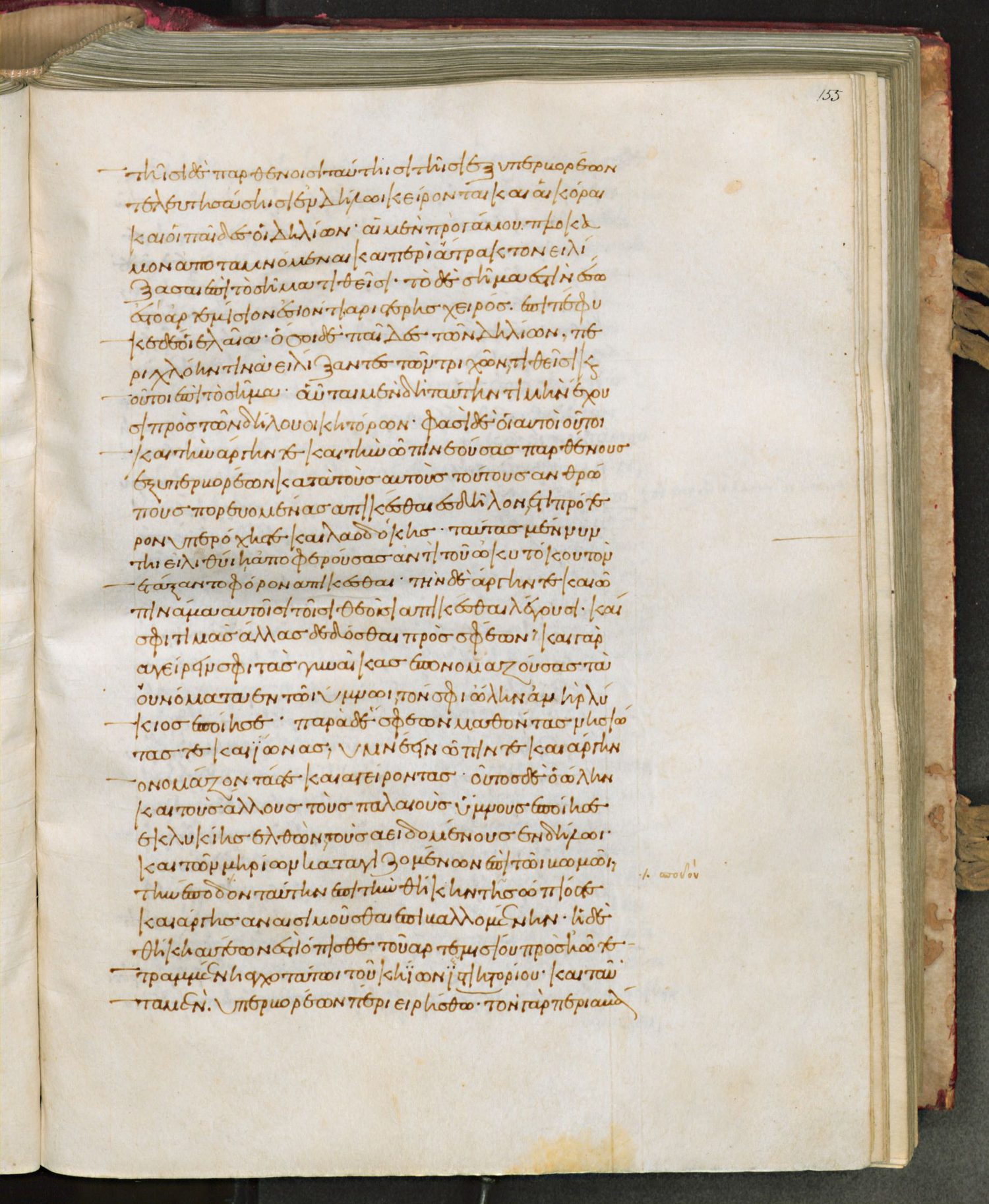
Where on the image
Laur. Plut. 70.3, fol. 155r: Greek here 4.34.1 to 4.36.1. Checked on the image (first and last words read and located in the Greek; each break checked against the neighbouring page): fol. 155r begins ‹τῇσι δὲ παρθένοισι ταύτῃσι› (4.34.1), ends ‹τὸν γὰρ περὶ Ἀβά-› (4.36.1). English here: 4.34.1 to 4.35.4 (Godley's sentences for the sections whose Greek lies mostly on this page).
4.34.1τῇσι δὲ παρθένοισι ταύτῃσι τῇσι ἐξ Ὑπερβορέων τελευτησάσῃσι ἐν Δήλῳ κείρονται καὶ αἱ κόραι καὶ οἱ παῖδες οἱ Δηλίων· αἱ μὲν πρὸ γάμου πλόκαμον ἀποταμνόμεναι καὶ περὶ ἄτρακτον εἱλίξασαι ἐπὶ τὸ σῆμα τιθεῖσι 4.34.2ʽτὸ δὲ σῆμα ἐστὶ ἔσω ἐς τὸ Ἀρτεμίσιον ἐσιόντι ἀριστερῆς χειρός, ἐπιπέφυκε δέ οἱ ἐλαίἠ, ὅσοι δὲ παῖδες τῶν Δηλίων, περὶ χλόην τινὰ εἱλίξαντες τῶν τριχῶν τιθεῖσι καὶ οὗτοι ἐπὶ τὸ σῆμα. 4.35.1αὗται μὲν δὴ ταύτην τιμὴν ἔχουσι πρὸς τῶν Δήλου οἰκητόρων. φασὶ δὲ οἱ αὐτοὶ οὗτοι καὶ τὴν Ἄργην τε καὶ τὴν Ὦπιν ἐούσας παρθένους ἐξ Ὑπερβορέων κατὰ τοὺς αὐτοὺς τούτους ἀνθρώπους πορευομένας ἀπικέσθαι ἐς Δῆλον ἔτι πρότερον Ὑπερόχης τε καὶ Λαοδίκης. 4.35.2ταύτας μέν νυν τῇ Εἰλειθυίῃ ἀποφερούσας ἀντὶ τοῦ ὠκυτόκου τὸν ἐτάξαντο φόρον ἀπικέσθαι, τὴν δὲ Ἄργην τε καὶ τὴν Ὦπιν ἅμα αὐτοῖσι θεοῖσι ἀπικέσθαι λέγουσι καὶ σφι τιμὰς ἄλλας δεδόσθαι πρὸς σφέων· 4.35.3καὶ γὰρ ἀγείρειν σφι τὰς γυναῖκας ἐπονομαζούσας τὰ οὐνόματα ἐν τῷ ὕμνῳ τόν σφι Ὠλὴν ἀνὴρ Λύκιος ἐποίησε, παρὰ δὲ σφέων μαθόντας νησιώτας τε καὶ Ἴωνας ὑμνέειν Ὦπίν τε καὶ Ἄργην ὀνομάζοντάς τε καὶ ἀγείροντας ʽοὗτος δὲ ὁ Ὠλὴν καὶ τοὺς ἄλλους τοὺς παλαιοὺς ὕμνους ἐποίησε ἐκ Λυκίης ἐλθὼν τοὺς ἀειδομένους ἐν Δήλᾠ, 4.35.4καὶ τῶν μηρίων καταγιζομένων ἐπὶ τῷ βωμῷ τὴν σποδὸν ταύτην ἐπὶ τὴν θήκην τῆς Ὤπιός τε καὶ Ἄργης ἀναισιμοῦσθαι ἐπιβαλλομένην. ἡ δὲ θήκη αὐτέων ἐστὶ ὄπισθε τοῦ Ἀρτεμισίου, πρὸς ἠῶ τετραμμένη, ἀγχοτάτω τοῦ Κηίων ἱστιητορίου. 4.36.1καὶ ταῦτα μὲν Ὑπερβορέων πέρι εἰρήσθω· τὸν γὰρ περὶ Ἀβάριος
4.34.1This I know that they do. The Delian girls and boys cut their hair in honour of these Hyperborean maidens, who died at Delos; the girls before their marriage cut off a tress and lay it on the tomb, wound about a spindle; 4.34.2this tomb is at the foot of an olive-tree, on the left hand of the entrance of the temple of Artemis; the Delian boys twine some of their hair round a green stalk, and they likewise lay it on the tomb. 4.35.1Thus then are these maidens honoured by the inhabitants of Delos, These same Delians relate that two virgins, Arge and Opis, came from the Hyperboreans by way of the peoples aforesaid to Delos, yet earlier than the coming of Hyperoche and Laodice; 4.35.2these latter came to bring to Ilithyia the tribute whereto they had bound themselves for ease of child-bearing; but Arge and Opis, they say, came with the gods themselves, and received honours of their own from the Delians. 4.35.3For the women collected gifts for them, calling upon their names in the hymn made for them by Olen a man of Lycia; it was from Delos that the islanders and Ionians learnt to sing hymns to Opis and Arge, calling upon their names and collecting gifts (this Olen after his coming from Lycia made also the other and ancient hymns that are sung at Delos). 4.35.4Further they say that when the thighbones are burnt in sacrifice on the altar, the ashes of them are all used for casting on the burial-place of Opis and Arge; which burial-place is behind the temple of Artemis, looking eastwards, nearest to the refectory of the people of Ceos.
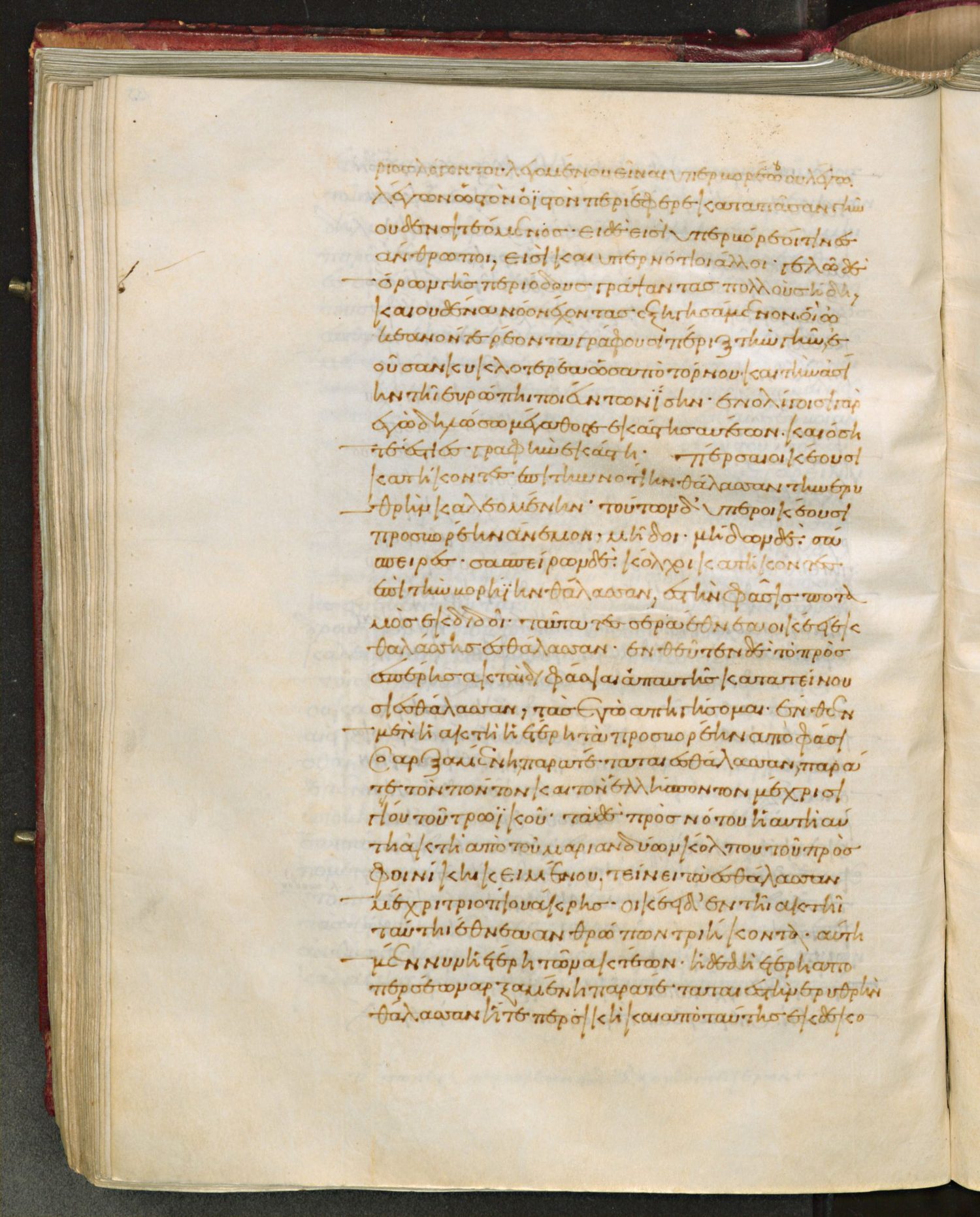
Where on the image
Laur. Plut. 70.3, fol. 155v: Greek here 4.36.1 to 4.36.2. Checked on the image (first and last words read and located in the Greek; each break checked against the neighbouring page): fol. 155v begins ‹-ριος λόγον τοῦ λεγομένου› (4.36.1), ends ‹καὶ ἀπὸ ταύτης ἐκδεκο-› (4.39.1). The word ‹Ἀβάριος› is divided between fol. 155r and fol. 155v; it is given with fol. 155r. English here: 4.36.1 to 4.36.2 (Godley's sentences for the sections whose Greek lies mostly on this page).
4.36.1λόγον τοῦ λεγομένου εἶναι Ὑπερβορέου οὐ λέγω, ὡς τὸν ὀιστὸν περιέφερε κατὰ πᾶσαν γῆν οὐδὲν σιτεόμενος. εἰ δὲ εἰσὶ ὑπερβόρεοι τινὲς ἄνθρωποι, εἰσὶ καὶ ὑπερνότιοι ἄλλοι. 4.36.2γελῶ δὲ ὁρέων γῆς περιόδους γράψαντας πολλοὺς ἤδη καὶ οὐδένα νοονεχόντως ἐξηγησάμενον· οἳ Ὠκεανόν τε ῥέοντα γράφουσι πέριξ τὴν γῆν ἐοῦσαν κυκλοτερέα ὡς ἀπὸ τόρνου, καὶ τὴν Ἀσίην τῇ Εὐρώπῃ ποιεύντων ἴσην. ἐν ὀλίγοισι γὰρ ἐγὼ δηλώσω μέγαθός τε ἑκάστης αὐτέων καὶ οἵη τις ἐστὶ ἐς γραφὴν ἑκάστη.
4.36.1Thus far have I spoken of the Hyperboreans, and let it suffice; for I do not tell the story of that Abaris, alleged to be a Hyperborean, who carried the arrow over the whole world, fasting the while. But if there be men beyond the north wind, then there are others beyond the south. 4.36.2And I laugh to see how many have ere now drawn maps of the world, not one of them showing the matter reasonably; for they draw the world as round as if fashioned by compasses, encircled by the river of Ocean, and Asia and Europe of a like bigness. For myself, I will in a few words show the extent of the two, and how each should be drawn.
Notes
- Greek: the text printed in A. D. Godley's Loeb edition, via Perseus (tlg0016.tlg001.perseus-grc2). Square brackets mark words the editor considers later additions; [...] marks a gap the editor indicates. Perseus note markers are omitted.
- English: A. D. Godley, Herodotus vol. 2 (1921) (Loeb Classical Library), as transcribed on Wikisource. Godley's footnotes are omitted.
- Section numbers in the English were placed by comparing Godley's text with the Perseus version of his translation; where a section begins inside one of Godley's sentences, the English is kept with the page that holds the start of that sentence.
Cite
Sources
- Source: Florence, Laur. Plut. 70.3 (10th c.) via BML Teca Digitale + Greek of Godley's Loeb (Perseus) + English of A. D. Godley (Loeb, Wikisource) (holding institution)
- Critical edition: Greek of A. D. Godley's Loeb edition (1920-1925), via Perseus
← previous · → next · v cycle view · l back to library