Herodotus, Histories 4.118-131: Darius pursues the Scythians
Introduction
Herodotus of Halicarnassus wrote the Histories in the third quarter of the 5th century BCE, an inquiry into the deeds of Greeks and barbarians and the causes of the wars between them, later divided into nine books. Book 4 tells of Darius' expedition against the Scythians, with Herodotus' account of Scythia, its peoples, rivers and customs, and of the shape of the world, and of the Persian expedition against Barca, with the history of Cyrene and a description of the peoples of Libya.
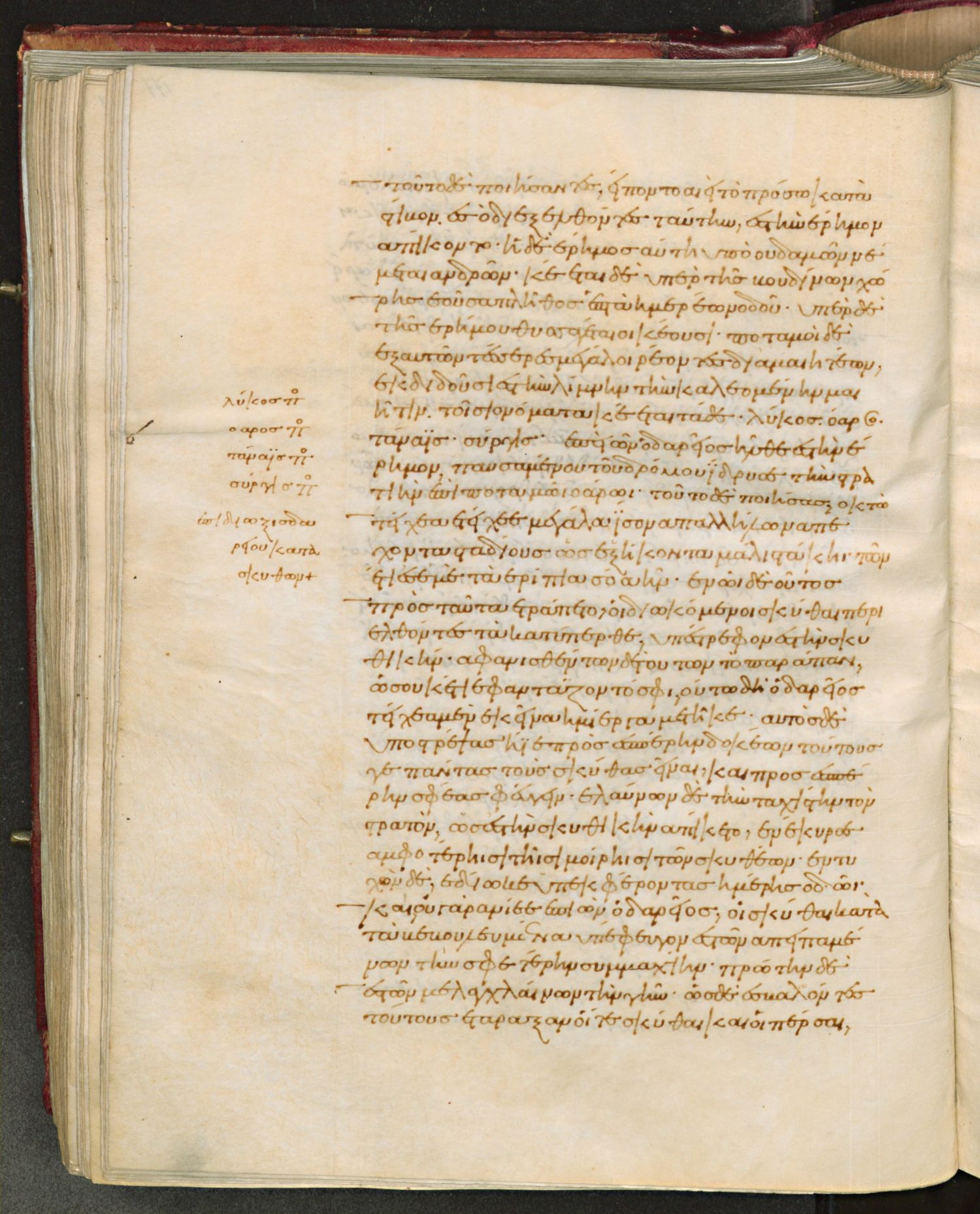
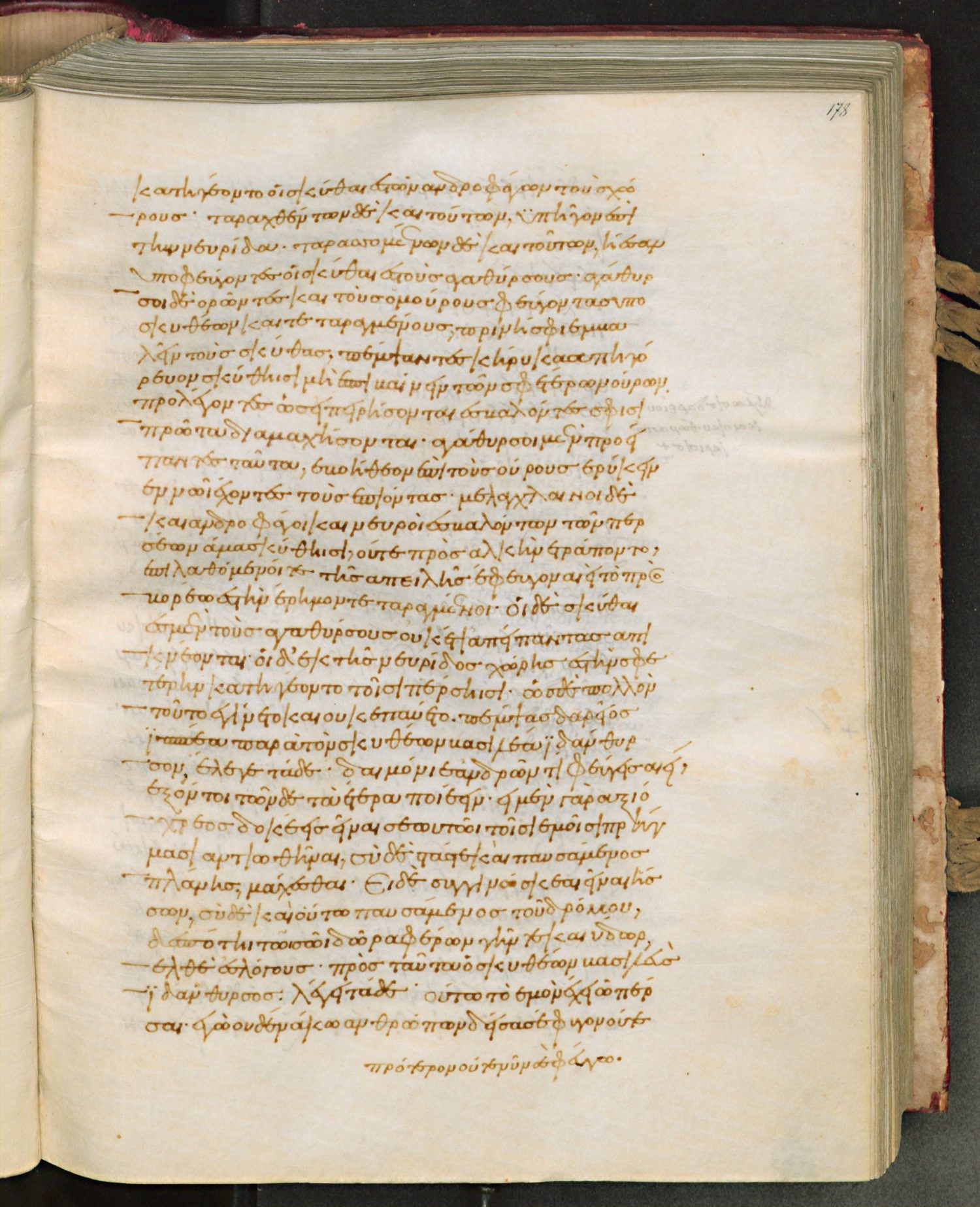
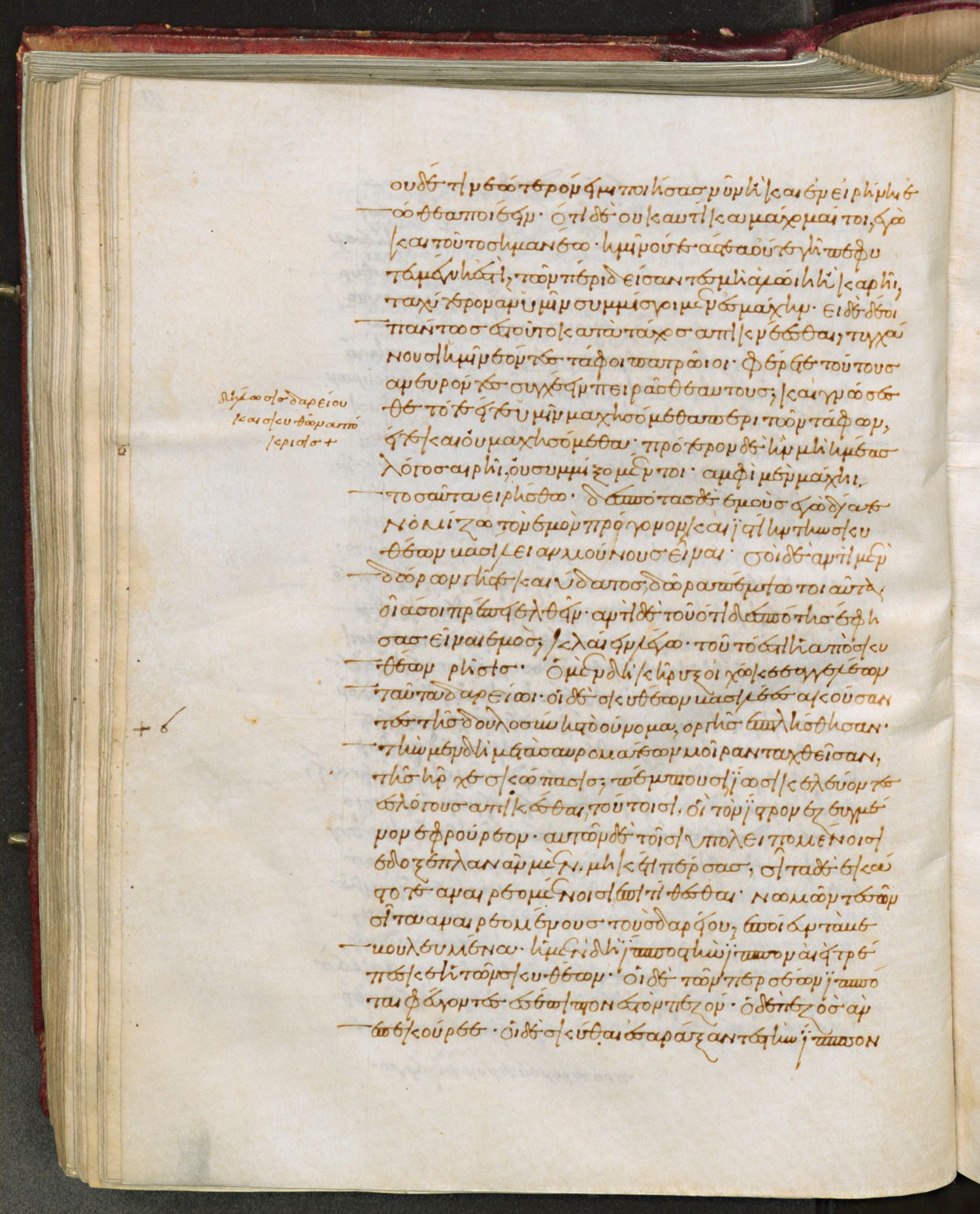
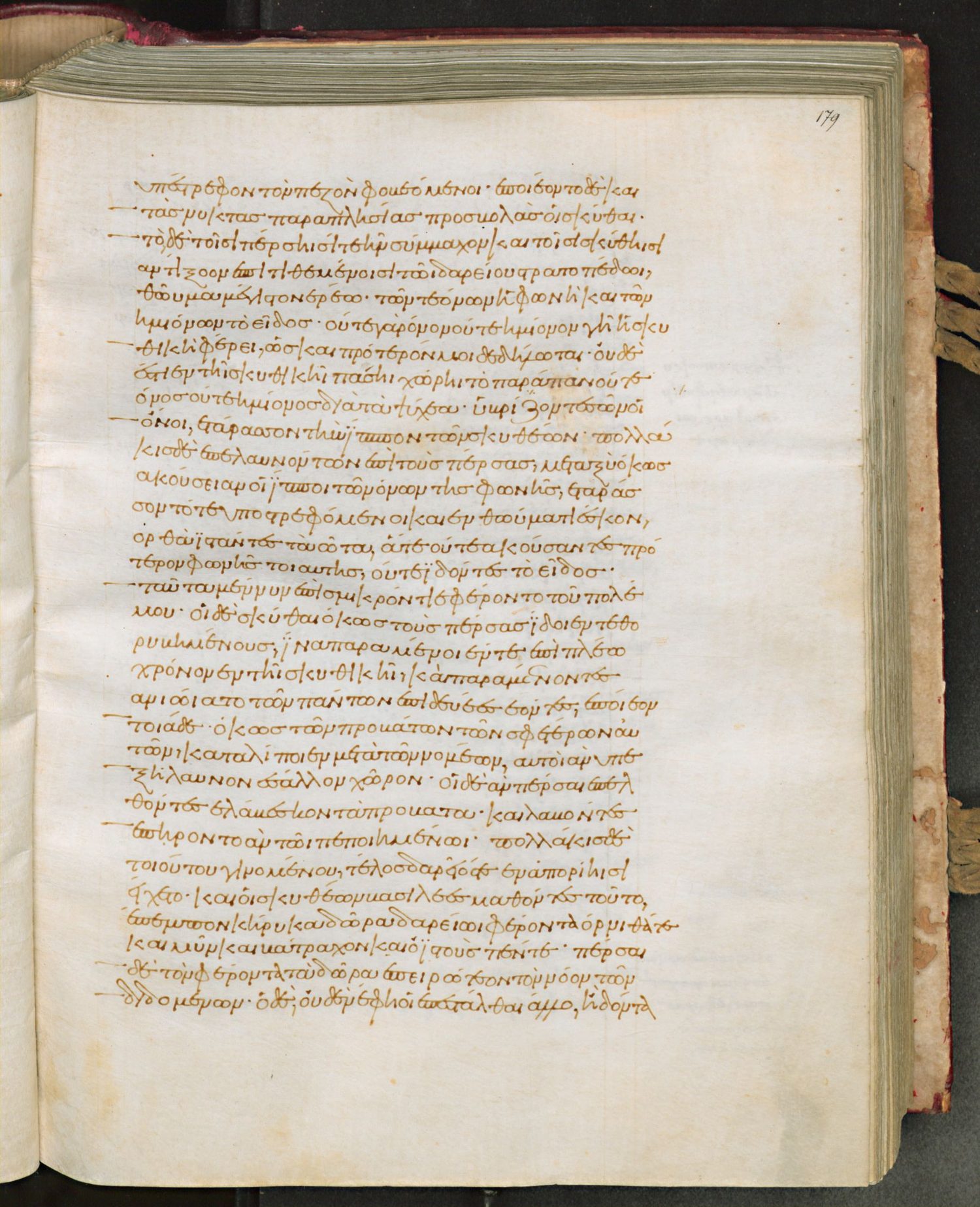
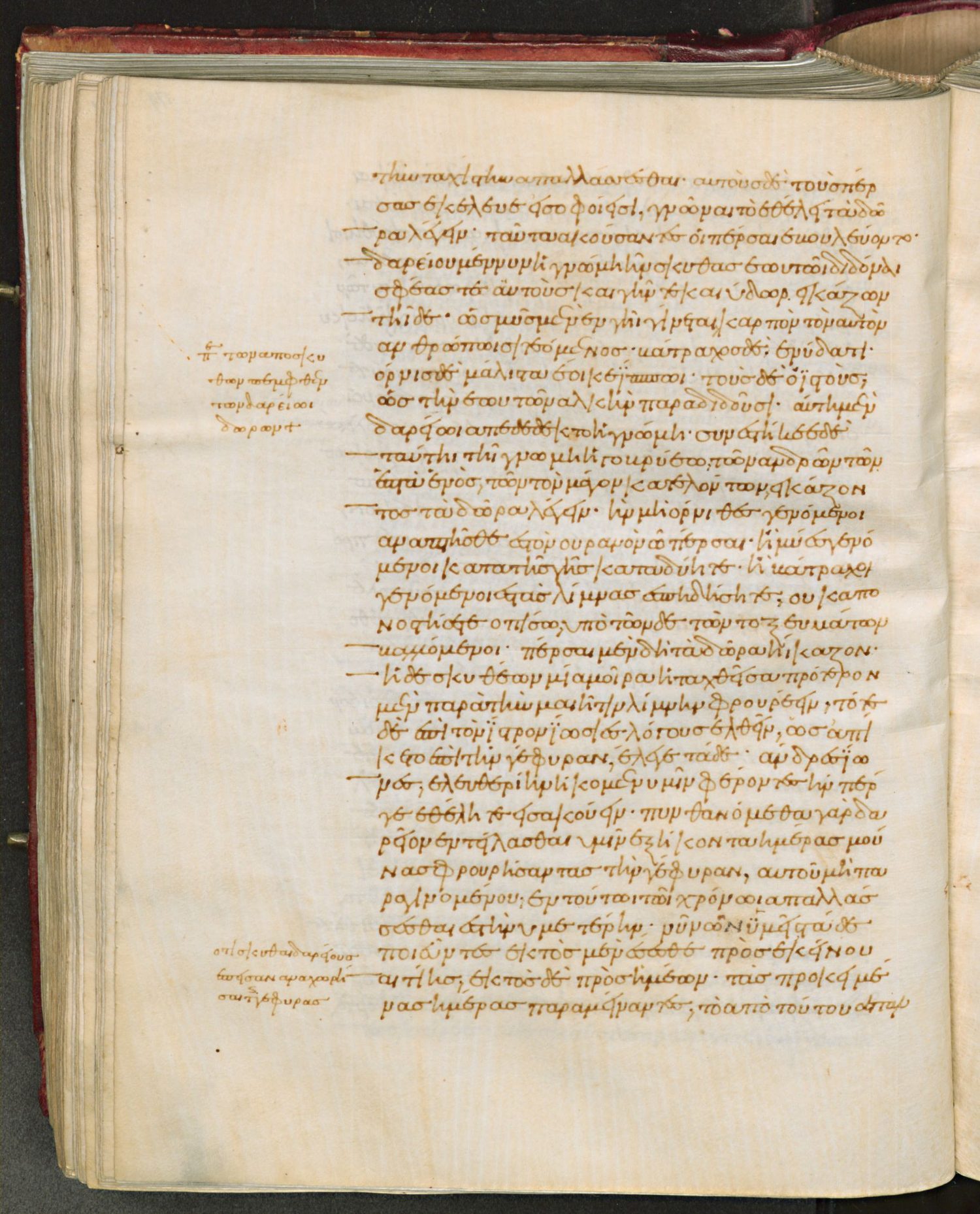
The photographs are of Florence, Biblioteca Medicea Laurenziana, Plut. 70.3 (parchment, 10th century, 374 folios, 31 lines a page), Herodotus, Histories (codex A of the editors), the oldest surviving manuscript of the complete Histories, from the Teca Digitale of the Biblioteca Medicea Laurenziana. Each section below is the text of one page, or of the part of a page that falls within these chapters. The first and last words of every page were read on the photograph and located in the Greek, and every page break was checked against the next page; the notes quote these words. Readers' notes in the margins are not part of the text and are mentioned where they occur.
The Greek is the text printed in A. D. Godley's Loeb edition (1920-1925), from Perseus; it is the edited text, not a transcription of the manuscript, whose wording differs in places. The English is Godley's translation as printed, from Wikisource. Godley's English carries only chapter numbers; the section numbers shown in it were placed by comparison with the Perseus version of his translation. Each page's English is cut at the end of one of Godley's sentences, so it can begin or end a few lines away from the Greek of the page; each note gives the exact ranges.
This entry covers chapters 4.118-131, on fol. 175v to 179v.
How was this verified? (Provenance)
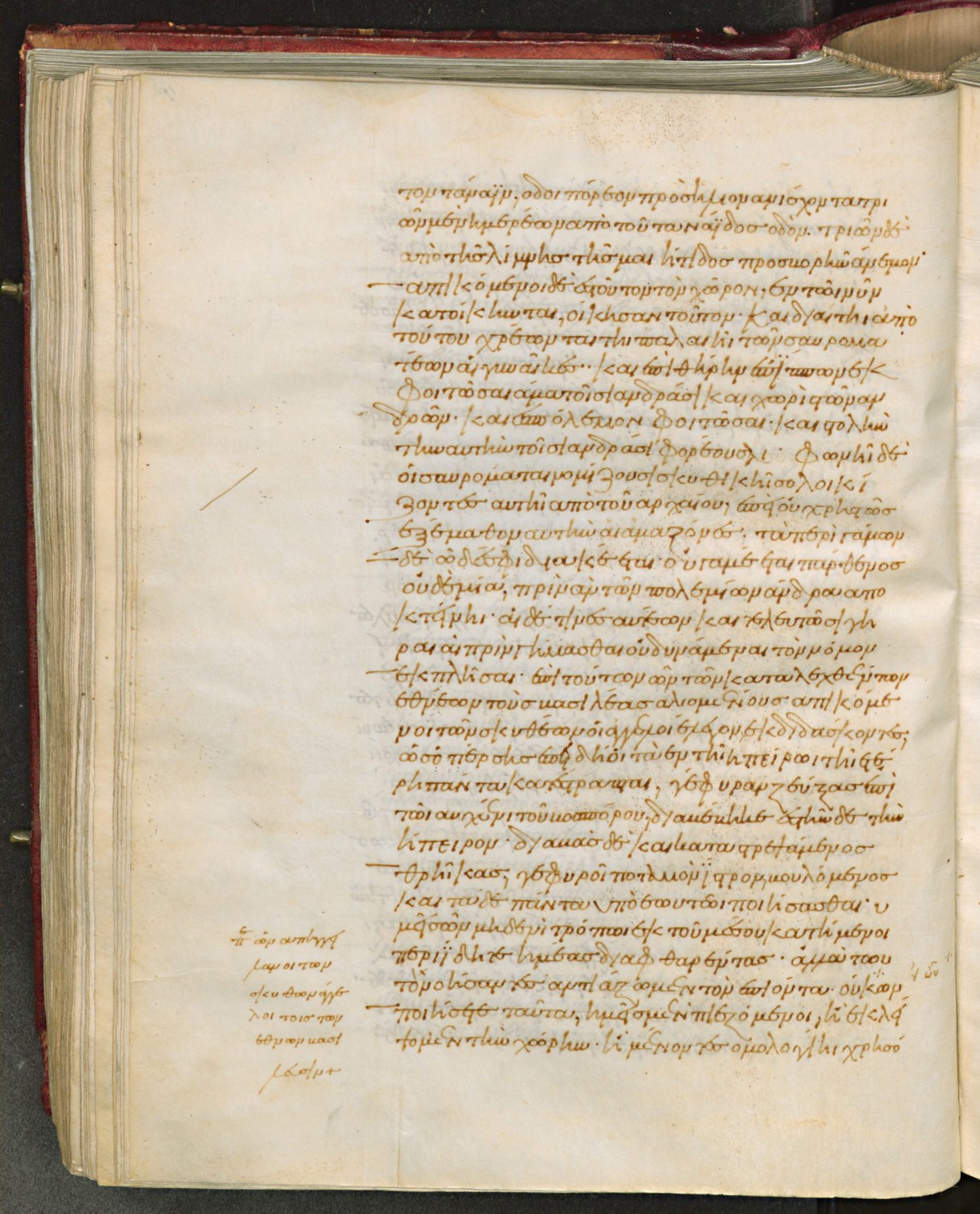
Where on the image
Laur. Plut. 70.3, fol. 175v: Greek here 4.118.1 to 4.118.2. Checked on the image (first and last words read and located in the Greek; each break checked against the neighbouring page): fol. 175v begins ‹τὸν Τάναϊν ὁδοιπόρεον πρὸς› (4.116.1), ends ‹ἢ μένοντες ὁμολογίῃ χρησό-› (4.118.2). English here: 4.118.1 to 4.118.2 (Godley's sentences for the sections whose Greek lies mostly on this page).
4.118.1ἐπὶ τούτων ὦν τῶν καταλεχθέντων ἐθνέων τοὺς βασιλέας ἁλισμένους ἀπικόμενοι τῶν Σκυθέων οἱ ἄγγελοι ἔλεγον ἐκδιδάσκοντες ὡς ὁ Πέρσης, ἐπειδή οἱ τὰ ἐν τῇ ἠπείρῳ τῇ ἑτέρῃ πάντα κατέστραπται, γέφυραν ζεύξας ἐπὶ τῷ αὐχένι τοῦ Βοσπόρου διαβέβηκε ἐς τήνδε τὴν ἤπειρον, διαβὰς δὲ καὶ καταστρεψάμενος Θρήικας γεφυροῖ ποταμὸν Ἴστρον, βουλόμενος καὶ τάδε πάντα ὑπʼ ἑωυτῷ ποιήσασθαι. 4.118.2ὑμεῖς ὦν μηδενὶ τρόπῳ ἐκ τοῦ μέσου κατήμενοι περιίδητε ἡμέας διαφθαρέντας, ἀλλὰ τὠυτὸ νοήσαντες ἀντιάζωμεν τὸν ἐπιόντα. οὔκων ποιήσετε ταῦτα; ἡμεῖς μὲν πιεζόμενοι ἢ ἐκλείψομεν τὴν χώρην ἢ μένοντες ὁμολογίῃ χρησόμεθα.
4.118.1The kings then of these aforesaid nations being assembled, the Scythian messengers came and laid all exactly before them, telling how the Persian, now that the whole of the other continent was subject to him, had crossed over to their continent by a bridge thrown across the gut of the Bosporus, and how having crossed it and subdued the Thracians he was now bridging the Ister, that he might make all that region subject like the others to himself. “Do you, then.” 4.118.2said they, “by no means sit apart and suffer us to be destroyed; rather let us unite and encounter this invader. If you will not do this, then shall we either be driven perforce out of our country, or abide and make terms.
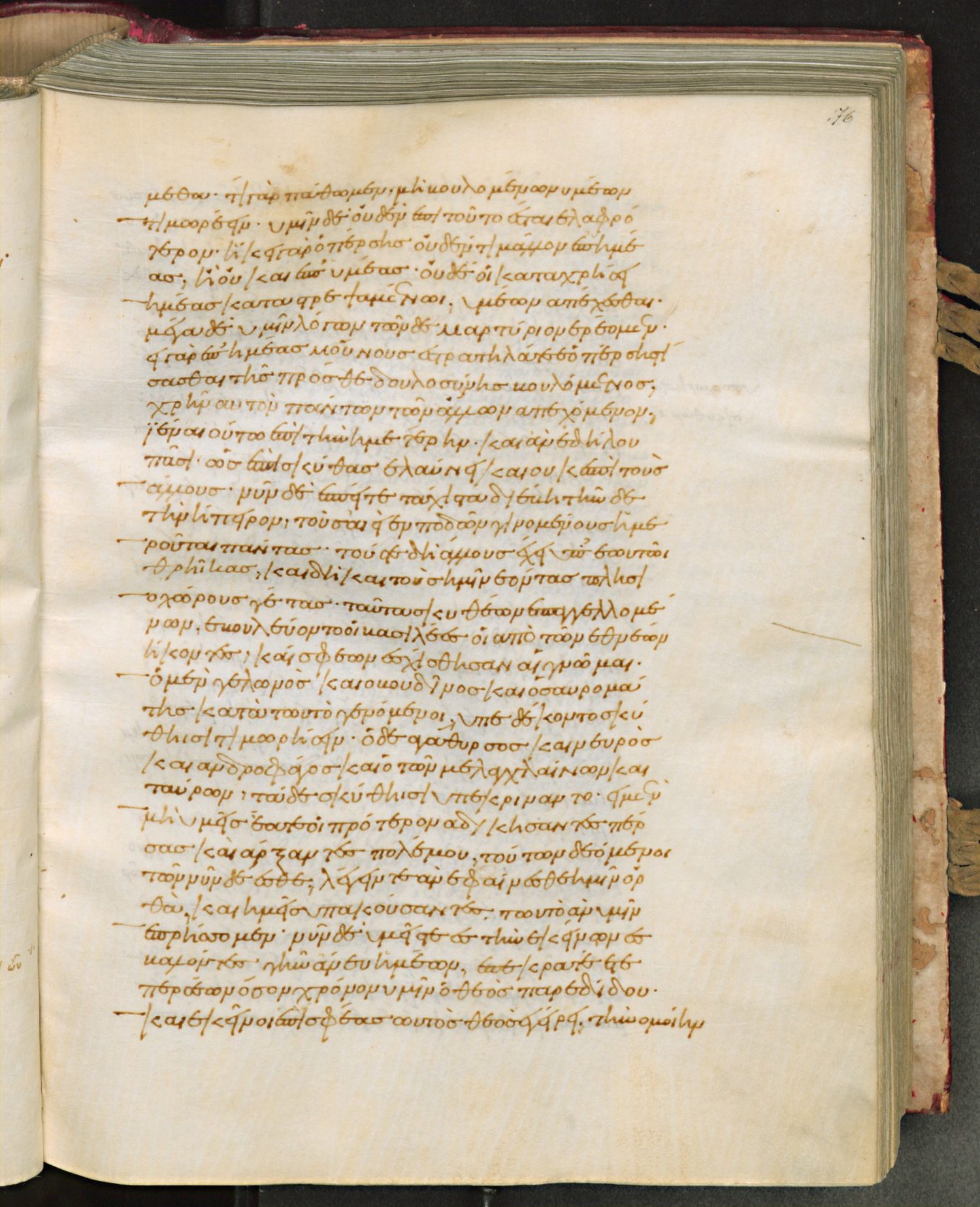
Where on the image
Laur. Plut. 70.3, fol. 176r: Greek here 4.118.3 to 4.119.3. Checked on the image (first and last words read and located in the Greek; each break checked against the neighbouring page): fol. 176r begins ‹-μεθα.τί γὰρ πάθωμεν μὴ› (4.118.2), ends ‹θεὸς ἐγείρει, τὴν ὁμοίην› (4.119.3). The word ‹χρησόμεθα.› is divided between fol. 175v and fol. 176r; it is given with fol. 175v. English here: 4.118.3 to 4.119.3 (Godley's sentences for the sections whose Greek lies mostly on this page).
4.118.3τί γὰρ πάθωμεν μὴ βουλομένων ὑμέων τιμωρέειν; ὑμῖν δὲ οὐδὲν ἐπὶ τούτῳ ἔσται ἐλαφρότερον. ἥκει γὰρ ὁ Πέρσης οὐδέν τι μᾶλλον ἐπʼ ἡμέας ἢ οὐ καὶ ἐπʼ ὑμέας, οὐδέ οἱ καταχρήσει ἡμέας καταστρεψαμένῳ ὑμέων ἀπέχεσθαι. 4.118.4μέγα δὲ ὑμῖν λόγων τῶνδε μαρτύριον ἐρέομεν. εἰ γὰρ ἐπʼ ἡμέας μούνους ἐστρατηλάτεε ὁ Πέρσης τίσασθαι τῆς πρόσθε δουλοσύνης βουλόμενος, χρῆν αὐτὸν πάντων τῶν ἄλλων ἀπεχόμενον ἰέναι οὕτω ἐπὶ τὴν ἡμετέρην, καὶ ἂν ἐδήλου πᾶσι ὡς ἐπὶ Σκύθας ἐλαύνει καὶ οὐκ ἐπὶ τοὺς ἄλλους. 4.118.5νῦν δὲ ἐπείτε τάχιστα διέβη ἐς τήνδε τὴν ἤπειρον, τοὺς αἰεὶ ἐμποδὼν γινομένους ἡμεροῦται πάντας· τούς τε δὴ ἄλλους ἔχει ὑπʼ ἑωυτῷ Θρήικας καὶ δὴ καὶ τοὺς ἡμῖν ἐόντας πλησιοχώρους Γέτας. 4.119.1ταῦτα Σκυθέων ἐπαγγελλομένων ἐβουλεύοντο οἱ βασιλέες οἱ ἀπὸ τῶν ἐθνέων ἥκοντες, καί σφεων ἐσχίσθησαν αἱ γνῶμαι· ὁ μὲν γὰρ Γελωνὸς καὶ ὁ Βουδῖνος καὶ ὁ Σαυρομάτης κατὰ τὠυτὸ γενόμενοι ὑπεδέκοντο Σκύθῃσι τιμωρήσειν, ὁ δὲ Ἀγάθυρσος καὶ Νευρὸς καὶ Ἀνδροφάγος καὶ οἱ τῶν Μελαγχλαίνων καὶ Ταύρων τάδε Σκύθῃσι ὑπεκρίναντο. 4.119.2εἰ μὲν μὴ ὑμεῖς ἔατε οἱ πρότεροι ἀδικήσαντες Πέρσας καὶ ἄρξαντες πολέμου, τούτων δεόμενοι τῶν νῦν δέεσθε λέγειν τε ἂν ἐφαίνεσθε ἡμῖν ὀρθά, καὶ ἡμεῖς ὑπακούσαντες τὠυτὸ ἂν ὑμῖν ἐπρήσσομεν. 4.119.3νῦν δὲ ὑμεῖς τε ἐς τὴν ἐκείνων ἐσβαλόντες γῆν ἄνευ ἡμέων ἐπεκρατέετε Περσέων ὅσον χρόνον ὑμῖν ὁ θεὸς παρεδίδου, καὶ ἐκεῖνοι, ἐπεί σφεας ὡυτὸς θεὸς ἐγείρει, τὴν ὁμοίην
4.118.3For what is to become of us if you will not aid us? And thereafter it will be no light matter for you yourselves; for the Persian is come to attack you no whit less than us, nor when he has subdued us will he be content to leave you alone. 4.118.4We can give you full proof of what we say: were it we alone against whom the Persian is marching, to be avenged on us for our former enslaving of his country, it is certain that he would leave others alone and make straight for us, thus making it plain to all that Scythia and no other country is his goal. 4.118.5But now, from the day of his crossing over to this continent, he has been ever taming all that come in his way, and he holds in subjection, not only the rest of Thrace, but also our neighbours the Getae.” 4.119.1Such being the message of the Scythians, the kings who had come from their nations took counsel, and their opinions were divided. The kings of the Geloni and the Budini and the Sauromatae made common cause and promised to help the Scythians; but the kings of the Agathyrsi and Neuri and Maneaters and Black-cloaks and Tauri made this answer to the messengers: “ 4.119.2Had it not been you who did unprovoked wrong to the Persians and so began the war, this request that you proffer would seem to us right, and we would consent and act jointly with you. 4.119.3But now, you and not we invaded their land and held it for such time as the god permitted; and the Persians, urged on by the same god, are but requiting you in like manner.
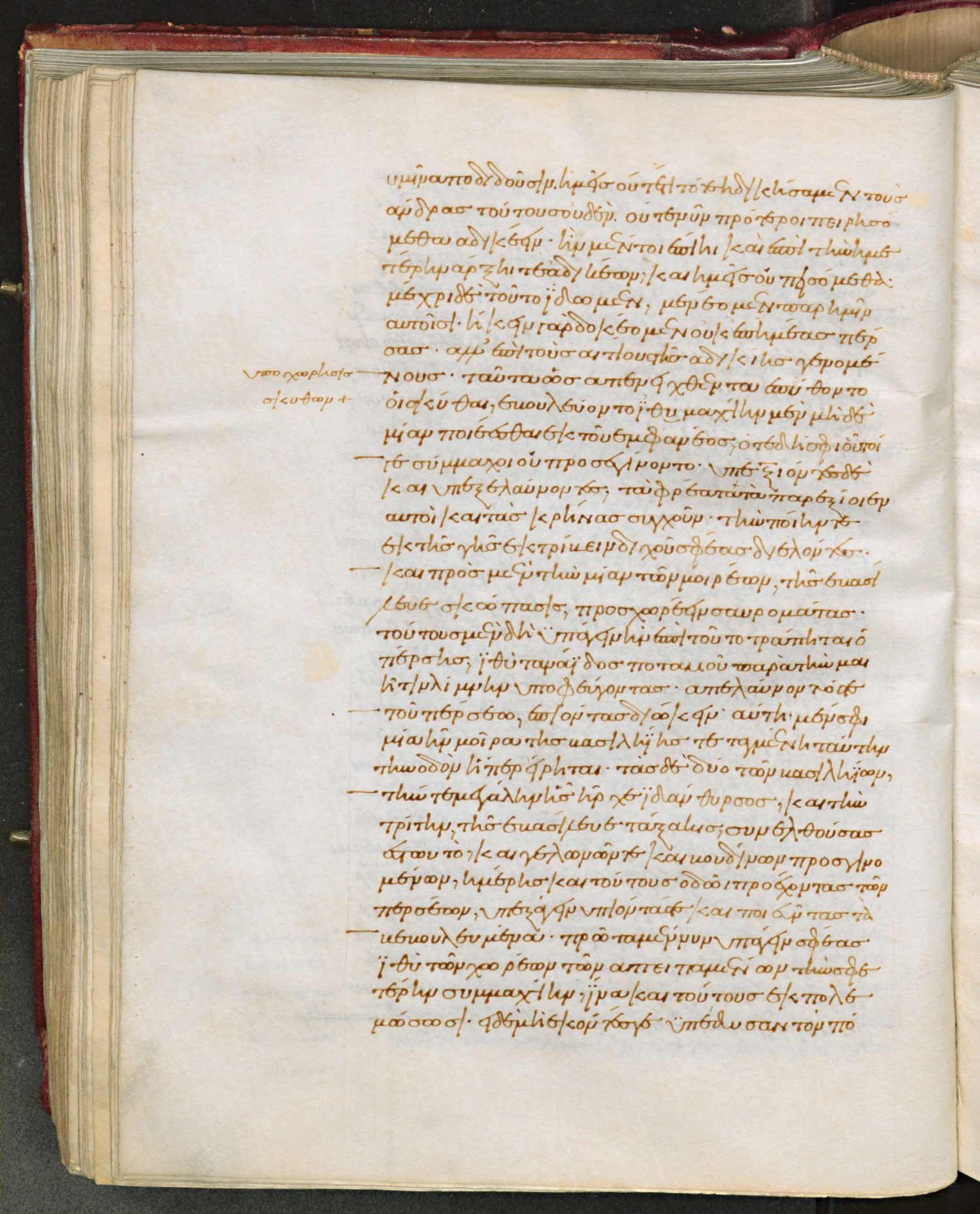
Where on the image
Laur. Plut. 70.3, fol. 176v: Greek here 4.119.3 to 4.120.4. Checked on the image (first and last words read and located in the Greek; each break checked against the neighbouring page): fol. 176v begins ‹ὑμῖν ἀποδιδοῦσι.ἡμεῖς δὲ οὔτε› (4.119.3), ends ‹γε ὑπέδυσαν τὸν πό-› (4.120.4). English here: 4.119.4 to 4.120.4 (Godley's sentences for the sections whose Greek lies mostly on this page).
4.119.3ὑμῖν ἀποδιδοῦσι. 4.119.4ἡμεῖς δὲ οὔτε τι τότε ἠδικήσαμεν τοὺς ἄνδρας τούτους οὐδὲν οὔτε νῦν πρότεροι πειρησόμεθα ἀδικέειν. ἢν μέντοι ἐπίῃ καὶ τὴν ἡμετέρην ἄρξῃ τε ἀδικέων, καὶ ἡμεῖς οὐ πεισόμεθα,μέχρι δὲ τοῦτο ἴδωμεν, μενέομεν παρʼ ἡμῖν αὐτοῖσι· ἥκειν γὰρ δοκέομεν οὐκ ἐπʼ ἡμέας Πέρσας ἀλλʼ ἐπὶ τοὺς αἰτίους τῆς ἀδικίης γενομὲνους. 4.120.1ταῦτα ὡς ἀπενειχθέντα ἐπύθοντο οἱ Σκύθαι, ἐβουλεύοντο ἰθυμαχίην μὲν μηδεμίαν ποιέεσθαι ἐκ τοῦ ἐμφανέος, ὅτε δὴ σφι οὗτοι γε σύμμαχοι οὐ προσεγίνοντο, ὑπεξιόντες δὲ καὶ ὑπεξελαύνοντες τὰ φρέατα τὰ παρεξίοιεν αὐτοὶ καὶ τὰς κρήνας συγχοῦν, τὴν ποίην τε ἐκ τῆς γῆς ἐκτρίβειν, διχοῦ σφέας διελόντες. 4.120.2καὶ πρὸς μὲν τὴν μίαν τῶν μοιρέων, τῆς ἐβασίλευε Σκώπασις, προσχωρέειν Σαυρομάτας· τούτους μὲν δὴ ὑπάγειν, ἢν ἐπὶ τοῦτο τράπηται ὁ Πέρσης ἰθὺ Τανάιδος ποταμοῦ παρὰ τὴν Μαιῆτιν λίμνην ὑποφεύγοντας, ἀπελαύνοντος τε τοῦ Πέρσεω ἐπιόντας διώκειν. αὕτη μέν σφι μία ἦν μοῖρα τῆς βασιληίης, τεταγμένη ταύτην τὴν ὁδὸν ἥ περ εἴρηται· 4.120.3τὰς δὲ δύο τῶν βασιληίων, τήν τε μεγάλην τῆς ἦρχε Ἰδάνθυρσος καὶ τὴν τρίτην τῆς ἐβασίλευε Τάξακις, συνελθούσας ἐς τὠυτὸ καὶ Γελωνῶν τε καὶ Βουδίνων προσγενομένων, ἡμέρης καὶ τούτους ὁδῷ προέχοντας τῶν Περσέων ὑπεξάγειν, ὑπιόντας τε καὶ ποιεῦντας τὰ βεβουλευμένα· 4.120.4πρῶτα μέν νυν ὑπάγειν σφέας ἰθὺ τῶν χωρέων τῶν ἀπειπαμένων τὴν σφετέρην συμμαχίην, ἵνα καὶ τούτους ἐκπολεμώσωσι· εἰ γὰρ μὴ ἑκόντες γε ὑπέδυσαν τὸν πόλεμον
4.119.4But we did these men no wrong in that former time, nor will we essay to harm them now unprovoked; natheless if the Persian come against our land too and do the first act of wrong, then we two will not consent to it; but till we see that; we will abide where we are by ourselves. For in our judgment the Persians are attacking not us but those at whose door the offence lies.” 4.120.1This answer being brought back and made known to the Scythians, they resolved not to meet their enemy in the open field, seeing that they could not get the allies that they sought, but rather to withdraw and drive off their herds, choking the wells and springs on their way and destroying the grass from the earth; and they divided themselves into two companies. 4.120.2It was their will that to one of their divisions, over which Scopasis was king, the Sauromatae should be added; this host should, if the Persian marched that way, retire before him and draw off towards the river Tanais, by the Maeetian lake, and if the Persian turned to depart then they should attack and pursue him. This was one of the divisions of the royal people, and it was appointed to follow the way aforesaid; 4.120.3their two other divisions, namely, the greater whereof the ruler was Idanthyrsus, and the third whose king was Taxakis, were to unite, and taking to them also the Geloni and Budini, to draw off like the others at the Persian approach, ever keeping one day’s march in front of the enemy, avoiding a meeting and doing what had been resolved. 4.120.4First, then, they must retreat in a straight course towards the countries which refused their alliance, so that these too might be compelled to fight; for if they would not of their own accord enter the lists against the Persians, they must be driven to war willy-nilly; and after that, the host must turn back to its own country, and attack the enemy, if in debate this should seem good.
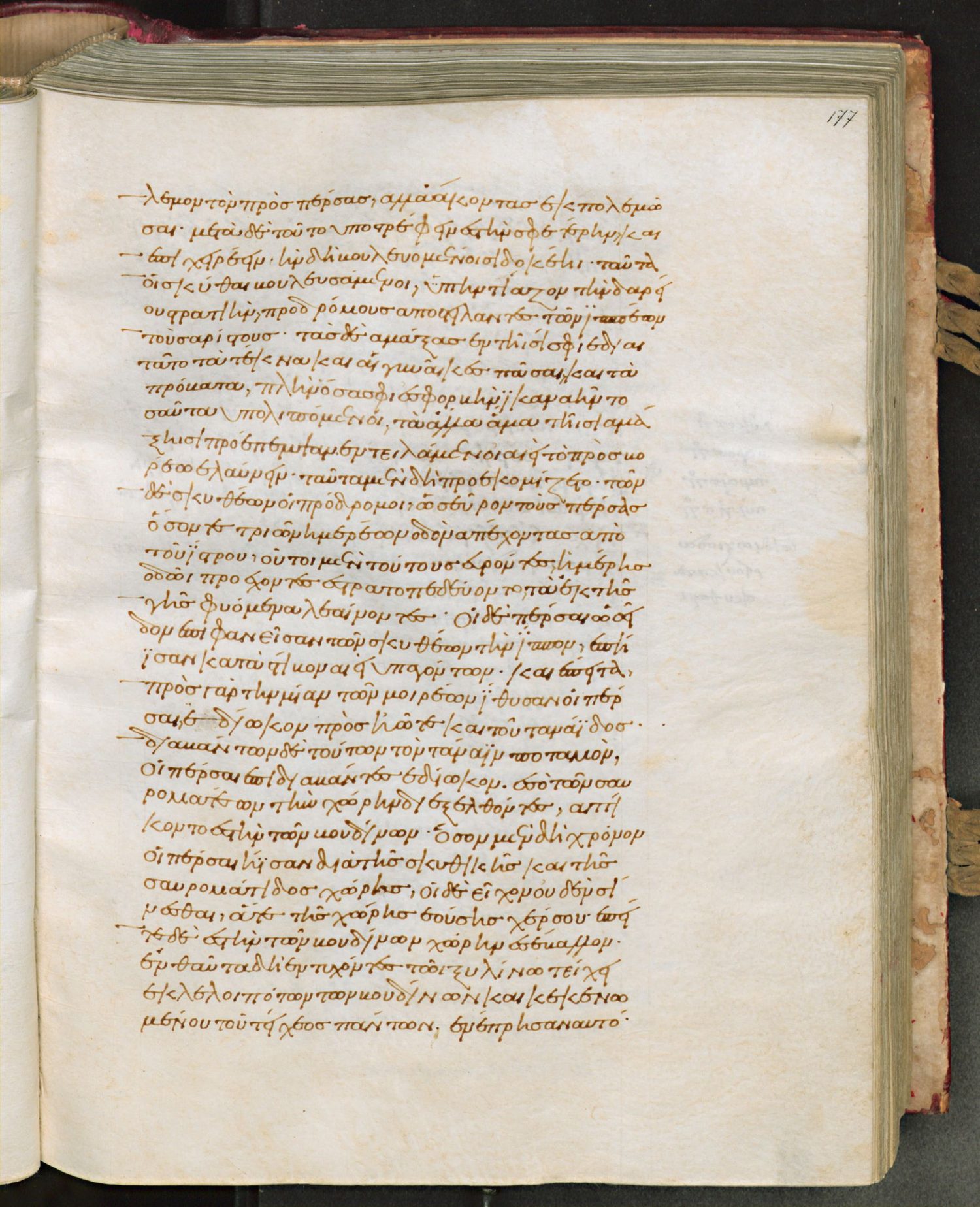
Where on the image
Laur. Plut. 70.3, fol. 177r: Greek here 4.120.4 to 4.123.1. Checked on the image (first and last words read and located in the Greek; each break checked against the neighbouring page): fol. 177r begins ‹-λεμον τὸν πρὸς Πέρσας,› (4.120.4), ends ‹τείχεος πάντων, ἐνέπρησαν αὐτό› (4.123.1). The word ‹πόλεμον› is divided between fol. 176v and fol. 177r; it is given with fol. 176v. English here: 4.121.1 to 4.123.1 (Godley's sentences for the sections whose Greek lies mostly on this page).
4.120.4τὸν πρὸς Πέρσας, ἀλλʼ ἀέκοντας ἐκπολεμώσειν· μετὰ δὲ τοῦτο ὑποστρέφειν ἐς τὴν σφετέρην καὶ ἐπιχειρέειν, ἢν δὴ βουλευομένοισι δοκέῃ. 4.121.1ταῦτα οἱ Σκύθαι βουλευσάμενοι ὑπηντίαζον τὴν Δαρείου στρατιήν, προδρόμους ἀποστείλαντες τῶν ἱππέων τοὺς ἀρίστους. τὰς δὲ ἁμάξας ἐν τῇσι σφι διαιτᾶτο τὰ τέκνα καὶ αἱ γυναῖκες πάσας καὶ τὰ πρόβατα πάντα, πλὴν ὅσα σφι ἐς φορβὴν ἱκανὰ ἦν τοσαῦτα ὑπολιπόμενοι, τὰ ἄλλα ἅμα τῇσι ἁμάξῃσι προέπεμψαν, ἐντειλάμενοι αἰεὶ τὸ πρὸς βορέω ἐλαύνειν. 4.122.1ταῦτα μὲν δὴ προεκομίζετο. τῶν δὲ Σκυθέων οἱ πρόδρομοι ὡς εὗρον τοὺς Πέρσας ὅσον τε τριῶν ἡμερέων ὁδὸν ἀπέχοντας ἀπὸ τοῦ Ἴστρου, οὗτοι μὲν τούτους εὑρόντες, ἡμέρης ὁδῷ προέχοντες, ἐστρατοπεδεύοντο τὰ ἐκ τῆς γῆς φυόμενα λεαίνοντες, 4.122.2οἱ δὲ Πέρσαι ὡς εἶδον ἐπιφανεῖσαν τῶν Σκυθέων τὴν ἵππον, ἐπήισαν κατὰ στίβον αἰεὶ ὑπαγόντων· καὶ ἔπειτα (πρὸς γὰρ τὴν μίαν τῶν μοιρέων ἴθυσαν) οἱ Πέρσαι ἐδίωκον πρὸς ἠῶ τε καὶ ἰθὺ Τανάιδος. 4.122.3διαβάντων δὲ τούτων τὸν Τάναιν ποταμὸν οἱ Πέρσαι ἐπιδιαβάντες ἐδίωκον, ἐς ὃ τῶν Σαυροματέων τὴν χώρην διεξελθόντες ἀπίκοντο ἐς τὴν τῶν Βουδίνων. 4.123.1ὅσον μὲν δὴ χρόνον οἱ Πέρσαι ἤισαν διὰ τῆς Σκυθικῆς καὶ τῆς Σαυρομάτιδος χώρης, οἳ δὲ εἶχον οὐδὲν σίνεσθαι ἅτε τῆς χώρης ἐούσης χέρσου· ἐπείτε δὲ ἐς τὴν τῶν Βουδίνων χώρην ἐσέβαλλον, ἐνθαῦτα δὴ ἐντυχόντες τῷ ξυλίνῳ τείχεϊ, ἐκλελοιπότων τῶν Βουδίνων καὶ κεκενωμένου τοῦ τείχεος πάντων, ἐνέπρησαν αὐτό.
4.121.1Being resolved on this plan, the Scythians sent an advance guard of the best of their horsemen to meet Darius’ army. As for the waggons in which their children and wives lived, all these they sent forward, charged to drive ever northward; and with the waggons they sent all their flocks, keeping none back save such as were sufficient for their food. 4.122.1This convoy being first sent on its way, the advance guard of the Scythians found the Persians about a three days’ march distant from the Ister; and having found them they encamped a day’s march ahead of the enemy and set about clearing the land of all growing things. 4.122.2When the Persians saw the Scythian cavalry appearing, they marched on in its tracks, the horsemen ever withdrawing before them; and then, making for the one Scythian division, the Persians held on in pursuit towards the east and the river Tanais; which 4.122.3when the horsemen had crossed the Persians crossed also, and pursued till they had marched through the land of the Sauromatae to the land of the Budini. 4.123.1As long as the Persians were traversing the Scythian and Sauromatic territory there was nothing for them to harm, as the land was dry and barren. But when they entered the country of the Budini, they found themselves before the wooden-walled town; the Budini had deserted it and left nothing therein, and the Persians burnt the town.
Where on the image
Laur. Plut. 70.3, fol. 177v: Greek here 4.123.2 to 4.125.3. Checked on the image (first and last words read and located in the Greek; each break checked against the neighbouring page): fol. 177v begins ‹τοῦτο δὲ ποιήσαντες εἵποντο› (4.123.2), ends ‹Σκύθαι καὶ οἱ Πέρσαι› (4.125.3). English here: 4.123.2 to 4.125.2 (Godley's sentences for the sections whose Greek lies mostly on this page).
4.123.2τοῦτο δὲ ποιήσαντες εἵποντο αἰεὶ τὸ πρόσω κατὰ στίβον, ἐς ὃ διεξελθόντες ταύτην ἐς τὴν ἔρημον ἀπίκοντο. ἡ δὲ ἔρημος αὕτη ὑπὸ οὐδαμῶν νέμεται ἀνδρῶν, κέεται δὲ ὑπὲρ τῆς Βουδίνων χώρης ἐοῦσα πλῆθος ἑπτὰ ἡμερέων ὁδοῦ. 4.123.3ὑπὲρ δὲ τῆς ἐρήμου Θυσσαγέται οἰκέουσι, ποταμοὶ δὲ ἐξ αὐτῶν τέσσερες μεγάλοι ῥέοντες διὰ Μαιητέων ἐκδιδοῦσι ἐς τὴν λίμνην τὴν καλεομένην Μαιῆτιν, τοῖσι οὐνόματα κέεται τάδε, Λύκος Ὄαρος Τάναις Σύργις. 4.124.1ἐπεὶ ὦν ὁ Δαρεῖος ἦλθε ἐς τὴν ἔρημον, παυσάμενος τοῦ δρόμου ἵδρυσε τὴν στρατιὴν ἐπὶ ποταμῷ Ὀάρῳ. τοῦτο δὲ ποιήσας ὀκτὼ τείχεα ἐτείχεε μεγάλα, ἴσον ἀπʼ ἀλλήλων ἀπέχοντα, σταδίους ὡς ἑξήκοντα μάλιστά κῃ· τῶν ἔτι ἐς ἐμὲ τὰ ἐρείπια σόα ἦν. 4.124.2ἐν ᾧ δὲ οὗτος πρὸς ταῦτα ἐτράπετο, οἱ διωκόμενοι Σκύθαι περιελθόντες τὰ κατύπερθε ὑπέστρεφον ἐς τὴν Σκυθικήν. ἀφανισθέντων δὲ τούτων τὸ παράπαν, ὡς οὐκέτι ἐφαντάζοντό σφι, οὕτω δὴ ὁ Δαρεῖος τείχεα μὲν ἐκεῖνα ἡμίεργα μετῆκε, αὐτὸς δὲ ὑποστρέψας ἤιε πρὸς ἑσπέρην, δοκέων τούτους τε πάντας τοὺς Σκύθας εἶναι καὶ πρὸς ἑσπέρην σφέας φεύγειν. 4.125.1ἐλαύνων δὲ τὴν ταχίστην τὸν στρατὸν ὡς ἐς τὴν Σκυθικὴν ἀπίκετο, ἐνέκυρσε ἀμφοτέρῃσι τῇσι μοίρῃσι τῶν Σκυθέων, ἐντυχὼν δὲ ἐδίωκε ὑπεκφέροντας ἡμέρης ὁδῷ. 4.125.2καὶ οὐ γὰρ ἀνίει ἐπιὼν ὁ Δαρεῖος, οἱ Σκύθαι κατὰ τὰ βεβουλευμένα ὑπέφευγον ἐς τῶν ἀπειπαμένων τὴν σφετέρην συμμαχίην, πρώτην δὲ ἐς τῶν Μελαγχλαίνων τὴν γῆν. 4.125.3ὡς δὲ ἐσβαλόντες τούτους ἐτάραξαν οἵ τε Σκύθαι καὶ οἱ Πέρσαι,
4.123.2Then going still forward in the horsemen’s tracks they passed through this country into the desert, which is inhabited by no men; it lies to the north of the Budini and its breadth is a seven days’ march. 4.123.3Beyond this desert dwell the Thyssagetae; four great rivers flow from their country through the land of the Maeetians, and issue into the lake called the Maeetian; their names are Lycus, Oarus, Tanais, Syrgis. 4.124.1When Darius came into the desert, he halted in his race and encamped on the river Oarus, where he built eight great forts, all at an equal distance of about sixty furlongs from each other, the ruins of which were standing even in my lifetime. 4.124.2While he was busied with these, the Scythians whom he pursued fetched a compass northwards and turned back into Scythia. When they had altogether vanished and were no longer within the Persians’ sight, Darius then left those forts but half finished, and he too turned about and marched westward, thinking that those Scythians were the whole army, and that they were fleeing towards the west. 4.125.1But when he came by forced marches into Scythia, he met the two divisions of the Scythians, and pursued them, they keeping ever a day’s march away from him; 4.125.2and because he would not cease from pursuing them, the Scythians, according to the plan they had made, fled before him to the countries of those who had refused their alliance, and first to the land of the Black-cloaks.
Where on the image
Laur. Plut. 70.3, fol. 178r: Greek here 4.125.3 to 4.127.1. Checked on the image (first and last words read and located in the Greek; each break checked against the neighbouring page): fol. 178r begins ‹κατηγέοντο οἱ Σκύθαι ἐς› (4.125.3), ends ‹οὔτε νῦν σὲ φεύγω› (4.127.1). English here: 4.125.3 to 4.127.1 (Godley's sentences for the sections whose Greek lies mostly on this page).
4.125.3κατηγέοντο οἱ Σκύθαι ἐς τῶν Ἀνδροφάγων τοὺς χώρους· ταραχθέντων δὲ καὶ τούτων ὑπῆγον ἐπὶ τὴν Νευρίδα· ταρασσομένων δὲ καὶ τούτων ἤισαν ὑποφεύγοντες οἱ Σκύθαι ἐς τοὺς Ἀγαθύρσους. 4.125.4Ἀγαθύρσοι δὲ ὁρέοντες καὶ τοὺς ὁμούρους φεύγοντας ὑπὸ Σκυθέων καὶ τεταραγμένους, πρὶν ἤ σφι ἐμβαλεῖν τοὺς Σκύθας πέμψαντες κήρυκα ἀπηγόρευον Σκύθῃσι μὴ ἐπιβαίνειν τῶν σφετέρων οὔρων, προλέγοντες ὡς εἰ πειρήσονται ἐσβαλόντες, σφίσι πρῶτα διαμαχήσονται. 4.125.5Ἀγάθυρσοι μὲν προείπαντες ταῦτα ἐβοήθεον ἐπὶ τοὺς οὔρους, ἐρύκειν ἐν νόῳ ἔχοντες τοὺς ἐπιόντας· Μελάγχλαινοι δὲ καὶ Ἀνδροφάγοι καὶ Νευροὶ ἐσβαλόντων τῶν Περσέων ἅμα Σκύθησι οὔτε πρὸς ἀλκὴν ἐτράποντο ἐπιλαθόμενοί τε τῆς ἀπειλῆς ἔφευγον αἰεὶ τὸ πρὸς βορέω ἐς τὴν ἔρημον τεταραγμένοι. 4.125.6οἱ δὲ Σκύθαι ἐς μὲν τοὺς Ἀγαθύρσους οὐκέτι ἀπείπαντας ἀπικνέοντο, οἳ δὲ ἐκ τῆς Νευρίδος χώρης ἐς τὴν σφετέρην κατηγέοντο τοῖσι Πέρσῃσι. 4.126.1ὡς δὲ πολλὸν τοῦτο ἐγίνετο καὶ οὐκ ἐπαύετο, πέμψας Δαρεῖος ἱππέα παρὰ τὸν Σκυθέων βασιλέα Ἰδάνθυρσον ἔλεγε τάδε. δαιμόνιε ἀνδρῶν, τί φεύγεις αἰεί, ἐξεόν τοι τῶνδε τὰ ἕτερα ποιέειν; εἰ μὲν γὰρ ἀξιόχρεος δοκέεις εἶναι σεωυτῷ τοῖσι ἐμοῖσι πρήγμασι ἀντιωθῆναι, σὺ δὲ στάς τε καὶ παυσάμενος πλάνης μάχεσθαι· εἰ δὲ συγγινώσκεαι εἶναι ἥσσων, σὺ δὲ καὶ οὕτω παυσάμενος τοῦ δρόμου δεσπότῃ τῷ σῷ δῶρα φέρων γῆν τε καὶ ὕδωρ ἐλθὲ ἐς λόγους. 4.127.1πρὸς ταῦτα ὁ Σκυθέων βασιλεὺς Ἰδάνθυρσος λέγει τάδε. οὕτω τὸ ἐμὸν ἔχει, ὦ Πέρσα. ἐγὼ οὐδένα κω ἀνθρώπων δείσας ἔφυγον οὔτε πρότερον οὔτε νῦν σὲ φεύγω,
4.125.3Into their land the Scythians and Persians burst, troubling their peace; and thence the Scythians led the Persians into the country of the Man-eaters, troubling them too; whence they drew off with a like effect into the country of the Neuri, and troubling them also, fled to the Agathyrsi. 4.125.4But these, seeing their very neighbours fleeing panic-stricken at the Scythians’ approach, before the Scythians could break into their land sent a herald to forbid them to set foot on their borders, warning the Scythians that if they essayed to break through they must first fight with the Agathyrsi. 4.125.5With this warning they mustered on their borders, with intent to stay the invaders. But the Black-cloaks and Man-eaters and Neuri, when the Persians and the Scythians broke into their lands, made no resistance, but forgot their threats and fled panic-stricken ever northward into the desert. 4.125.6The Scythians, being warned off by the Agathyrsi, made no second attempt on that country, but led the Persians from the lands of the Neuri into Scythia. 4.126.1All this continuing long, and there being no end to it, Darius sent a horseman to Idanthyrsus the Scythian king, with this message: “Sir, these are strange doings. Why will you ever flee? You can choose which of two things you will do: if you deem yourself strong enough to withstand my power, wander no further, but stand and fight; but if you know yourself to be the weaker, then make an end of this running to and fro, and come to terms with your master, sending him gifts of earth and water.” 4.127.1To this Idanthyrsus the Scythian king made answer: “It is thus with me, Persian: I have never fled for fear of any man, nor do I now flee from you; this that I have done is no new thing or other than my practice in peace.
Where on the image
Laur. Plut. 70.3, fol. 178v: Greek here 4.127.1 to 4.128.3. Checked on the image (first and last words read and located in the Greek; each break checked against the neighbouring page): fol. 178v begins ‹οὐδέ τι νεώτερον εἰμὶ› (4.127.1), ends ‹Σκύθαι ἐσαράξαντες τὴν ἵππον› (4.128.3). English here: 4.127.2 to 4.128.3 (Godley's sentences for the sections whose Greek lies mostly on this page).
4.127.1οὐδέ τι νεώτερον εἰμὶ ποιήσας νῦν ἢ καὶ ἐν εἰρήνῃ ἐώθεα ποιέειν. 4.127.2ὅ τι δὲ οὐκ αὐτίκα μάχομαι τοι, ἐγὼ καὶ τοῦτο σημανέω. ἡμῖν οὔτε ἄστεα οὔτε γῆ πεφυτευμένη ἐστί, τῶν πέρι δείσαντες μὴ ἁλῷ ἢ καρῇ ταχύτερον ἂν ὑμῖν συμμίσγοιμεν ἐς μάχην. εἰ δὲ δέοι πάντως ἐς τοῦτο κατὰ τάχος ἀπικνέεσθαι, τυγχάνουσι ἡμῖν ἐόντες τάφοι πατρώιοι· 4.127.3φέρετε, τούτους ἀνευρόντες συγχέειν πειρᾶσθε αὐτούς, καὶ γνώσεσθε τότε εἴτε ὑμῖν μαχησόμεθα περὶ τῶν τάφων εἴτε καὶ οὐ μαχησόμεθα. πρότερον δέ, ἢν μὴ ἡμέας λόγος αἱρέῃ, οὐ συμμίξομεν τοι. 4.127.4ἀμφὶ μὲν μάχῃ τοσαῦτα εἰρήσθω, δεσπότας δὲ ἐμοὺς ἐγὼ Δία τε νομίζω τὸν ἐμὸν πρόγονον καὶ Ἱστίην τὴν Σκυθέων βασίλειαν μούνους εἶναι. σοὶ δὲ ἀντὶ μὲν δώρων γῆς τε καὶ ὕδατος δῶρα πέμψω τοιαῦτα οἷα σοὶ πρέπει ἐλθεῖν, ἀντὶ δὲ τοῦ ὅτι δεσπότης ἔφησας εἶναι ἐμός, κλαίειν λέγω. τοῦτο ἐστὶ ἡ ἀπὸ Σκυθέων ῥῆσις. 4.128.1ὁ μὲν δὴ κῆρυξ οἰχώκεε ἀγγελέων ταῦτα Δαρείῳ, οἱ δὲ Σκυθέων βασιλέες ἀκούσαντες τῆς δουλοσύνης τὸ οὔνομα ὀργῆς ἐπλήσθησαν. 4.128.2τὴν μὲν δὴ μετὰ Σαυροματέων μοῖραν ταχθεῖσαν, τῆς ἦρχε Σκώπασις, πέμπουσι Ἴωσι κελεύοντες ἐς λόγους ἀπικέσθαι, τούτοισι οἳ τὸν Ἴστρον ἐζευγμένον ἐφρούρεον· αὐτῶν δὲ τοῖσι ὑπολειπομένοισι ἔδοξε πλανᾶν μὲν μηκέτι Πέρσας, σῖτα δὲ ἑκάστοτε ἀναιρεομένοισι ἐπιτίθεσθαι. νωμῶντες ὦν σῖτα ἀναιρεομένους τοὺς Δαρείου ἐποίευν τὰ βεβουλευμένα. 4.128.3ἡ μὲν δὴ ἵππος τὴν ἵππον αἰεὶ τράπεσκε ἡ τῶν Σκυθέων, οἱ δὲ τῶν Περσέων ἱππόται φεύγοντες ἐσέπιπτον ἐς τὸν πεζόν, ὁ δὲ πεζὸς ἂν ἐπεκούρεε· οἱ δὲ Σκύθαι ἐσαράξαντες τὴν ἵππον
4.127.2But as to the reason why I do not straightway fight with you, this too I will tell you. For we Scythians have no towns or planted lands, that we might meet you the sooner in battle, fearing lest the one be taken or the other be wasted. But if nothing will serve you but fighting straightway, we have the graves of our fathers; 4.127.3come, find these and essay to destroy them; then shall you know whether we will fight you for those graves or no. Till then we will not join battle unless we think good. 4.127.4Thus much I say of fighting; for my masters, I hold them to be Zeus my forefather and Hestia queen of the Scythians, and none other. Gifts I will send you, not earth and water, but such as you should rightly receive; and for your boast that you are my master, take my malison for it.” Such is the proverbial “Scythian speech.” 4.128.1So the herald went to carry this message to Darius; but the Scythian kings were full of anger when they heard the name of slavery. 4.128.2They sent then the division of the Scythians to which the Sauromatae were attached, and which was led by Scopasis, to speak with those Ionians who guarded the bridge over the Ister; as for those of the Scythians who were left behind, it was resolved that they should no longer lead the Persians astray, but attack them whenever they were foraging for provision. So they watched for the time when Darius’ men were foraging, and did according to their plan. 4.128.3The Scythian horse ever routed the Persian horse, and the Persian horsemen falling back in flight on their footmen, the foot would come to their aid; and the Scythians, once they had driven in the horse, turned about for fear of the foot. The Scythians attacked in this fashion by night as well as by day.
Where on the image
Laur. Plut. 70.3, fol. 179r, 179v: Greek here 4.128.3 to 4.131.2. Checked on the image (first and last words read and located in the Greek; each break checked against the neighbouring page): fol. 179r begins ‹ὑπέστρεφον τὸν πεζὸν φοβεόμενοι.› (4.128.3), ends ‹ἐπεστάλθαι ἄλλο ἢ δόντα› (4.131.2). fol. 179v begins ‹τὴν ταχίστην ἀπαλλάσσεσθαι· αὐτοὺς› (4.131.2), ends ‹τὸ ἀπὸ τούτου ἀπαλ-› (4.133.3). This section joins the text of fol. 179r and 179v that belongs to these chapters, because the part on one of the pages is too short to carry any of Godley's sentences on its own. English here: 4.129.1 to 4.131.2 (Godley's sentences for the sections whose Greek lies mostly on this page).
4.128.3ὑπέστρεφον τὸν πεζὸν φοβεόμενοι. ἐποιέοντο δὲ καὶ τὰς νύκτας παραπλησίας προσβολὰς οἱ Σκύθαι. 4.129.1τὸ δὲ τοῖσι Πέρσῃσι τε ἦν σύμμαχον καὶ τοῖσι Σκύθῃσι ἀντίξοον ἐπιτιθεμένοισι τῷ Δαρείου στρατοπέδῳ, θῶμα μέγιστον ἐρέω, τῶν τε ὄνων ἡ φωνὴ καὶ τῶν ἡμιόνων τὸ εἶδος. 4.129.2οὔτε γὰρ ὄνον οὔτε ἡμίονον γῆ ἡ Σκυθικὴ φέρει, ὡς καὶ πρότερόν μοι δεδήλωται, οὐδὲ ἔστι ἐν τῇ Σκυθικῇ πάσῃ χώρῃ τὸ παράπαν οὔτε ὄνος οὔτε ἡμίονος διὰ τὰ ψύχεα. ὑβρίζοντες ὧν οἱ ὄνοι ἐτάρασσον τὴν ἵππον τῶν Σκυθέων. 4.129.3πολλάκις δὲ ἐπελαυνόντων ἐπὶ τοὺς Πέρσας μεταξὺ ὅκως ἀκούσειαν οἱ ἵπποι τῶν ὄνων τῆς φωνῆς, ἐταράσσοντο τε ὑποστρεφόμενοι καὶ ἐν θώματι ἔσκον, ὀρθὰ ἱστάντες τὰ ὦτα, ἅτε οὔτε ἀκούσαντες πρότερον φωνῆς τοιαύτης οὔτε ἰδόντες τὸ εἶδος. 4.130.1ταῦτα μέν νυν ἐπὶ σμικρόν τι ἐφέροντο τοῦ πολέμου. οἱ δὲ Σκύθαι ὅκως τοὺς Πέρσας ἴδοιεν τεθορυβημένους, ἵνα παραμένοιεν τε ἐπὶ πλέω χρόνον ἐν τῇ Σκυθικῇ καὶ παραμένοντες ἀνιῴατο τῶν πάντων ἐπιδευέες ἐόντες, ἐποίεον τοιάδε· ὅκως τῶν προβάτων τῶν σφετέρων αὐτῶν καταλίποιεν μετὰ τῶν νομέων, αὐτοὶ ἂν ὑπεξήλαυνον ἐς ἄλλον χῶρον. οἱ δὲ ἂν Πέρσαι ἐπελθόντες λάβεσκον τὰ πρόβατα καὶ λαβόντες ἐπηείροντο ἂν τῷ πεποιημένῳ. 4.131.1πολλάκις δὲ τοιούτου γινομένου, τέλος Δαρεῖος τε ἐν ἀπορίῃσι εἴχετο, καὶ οἱ Σκυθέων βασιλέες μαθόντες τοῦτο ἔπεμπον κήρυκα δῶρα Δαρείῳ φέροντα ὄρνιθά τε καὶ μῦν καὶ βάτραχον καὶ ὀιστοὺς πέντε. 4.131.2Πέρσαι δὲ τὸν φέροντα τὰ δῶρα ἐπειρώτεον τὸν νόον τῶν διδομένων. ὃ δὲ οὐδὲν ἔφη οἱ ἐπεστάλθαι ἄλλο ἢ δόντα τὴν ταχίστην ἀπαλλάσσεσθαι· αὐτοὺς δὲ τοὺς Πέρσας ἐκέλευε, εἰ σοφοί εἰσι, γνῶναι τὸ θέλει τὰ δῶρα λέγειν.
4.129.1Most strange it is to relate, but what aided the Persians and thwarted the Scythians in their attacks on Darius’ army was the braying of the asses and the appearance of the mules. 4.129.2For, as I have before shown, Scythia bears no asses or mules; nor is there in the whole of Scythia any ass or mule, by reason of the cold. Therefore the asses, when they brayed loudly, alarmed the Scythian horses; 4.129.3and often, when they were in the act of charging the Persians, if the horses heard the asses bray they would turn back in affright or stand astonished with ears erect, never having heard a like noise or seen a like creature. 4.130.1The Persians gained thus very little in the war, for when the Scythians saw that the Persians were shaken, they formed a plan whereby they might remain longer in Scythia and so remaining might be distressed by lack of all things needful: they would leave some of their flocks behind with the shepherds, themselves moving away to another place; and the Persians would come and take the sheep, and be uplifted by this achievement. 4.131.1This having often happened, Darius was in a quandary, and when they perceived this, the Scythian kings sent a herald bringing Darius the gift of a bird, a mouse, a frog, and five arrows. 4.131.2The Persians asked the bringer of these gifts what they might mean; but he said that no charge had been laid on him save to give the gifts and then depart with all speed; let the Persians (he said), if they were clever enough, discover the signification of the presents.
Notes
- Greek: the text printed in A. D. Godley's Loeb edition, via Perseus (tlg0016.tlg001.perseus-grc2). Square brackets mark words the editor considers later additions; [...] marks a gap the editor indicates. Perseus note markers are omitted.
- English: A. D. Godley, Herodotus vol. 2 (1921) (Loeb Classical Library), as transcribed on Wikisource. Godley's footnotes are omitted.
- Section numbers in the English were placed by comparing Godley's text with the Perseus version of his translation; where a section begins inside one of Godley's sentences, the English is kept with the page that holds the start of that sentence.
Cite
Sources
- Source: Florence, Laur. Plut. 70.3 (10th c.) via BML Teca Digitale + Greek of Godley's Loeb (Perseus) + English of A. D. Godley (Loeb, Wikisource) (holding institution)
- Critical edition: Greek of A. D. Godley's Loeb edition (1920-1925), via Perseus
← previous · → next · v cycle view · l back to library