Herodotus, Histories 4.99-117: The Tauri and the neighbours of Scythia; the Amazons
Introduction
Herodotus of Halicarnassus wrote the Histories in the third quarter of the 5th century BCE, an inquiry into the deeds of Greeks and barbarians and the causes of the wars between them, later divided into nine books. Book 4 tells of Darius' expedition against the Scythians, with Herodotus' account of Scythia, its peoples, rivers and customs, and of the shape of the world, and of the Persian expedition against Barca, with the history of Cyrene and a description of the peoples of Libya.
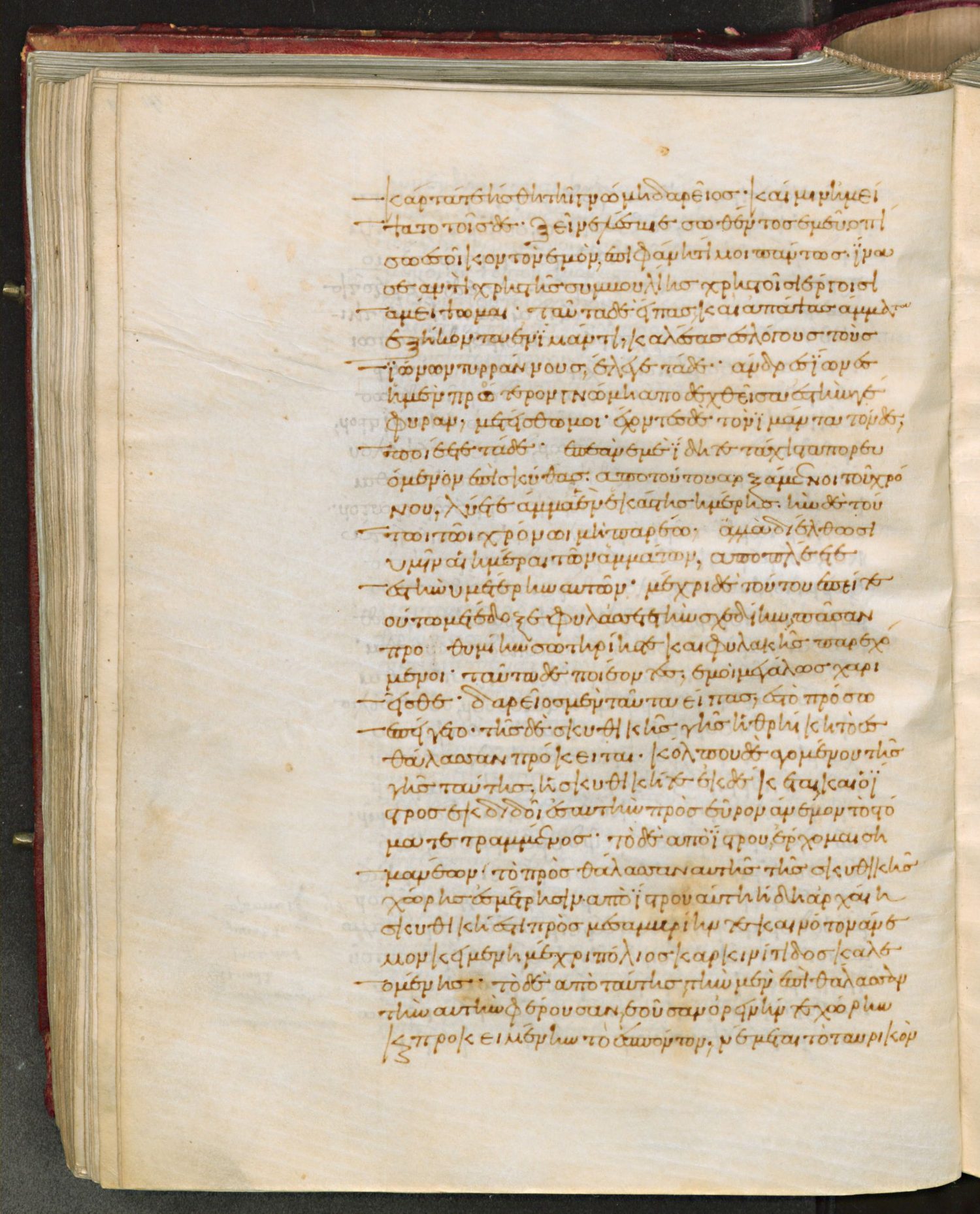
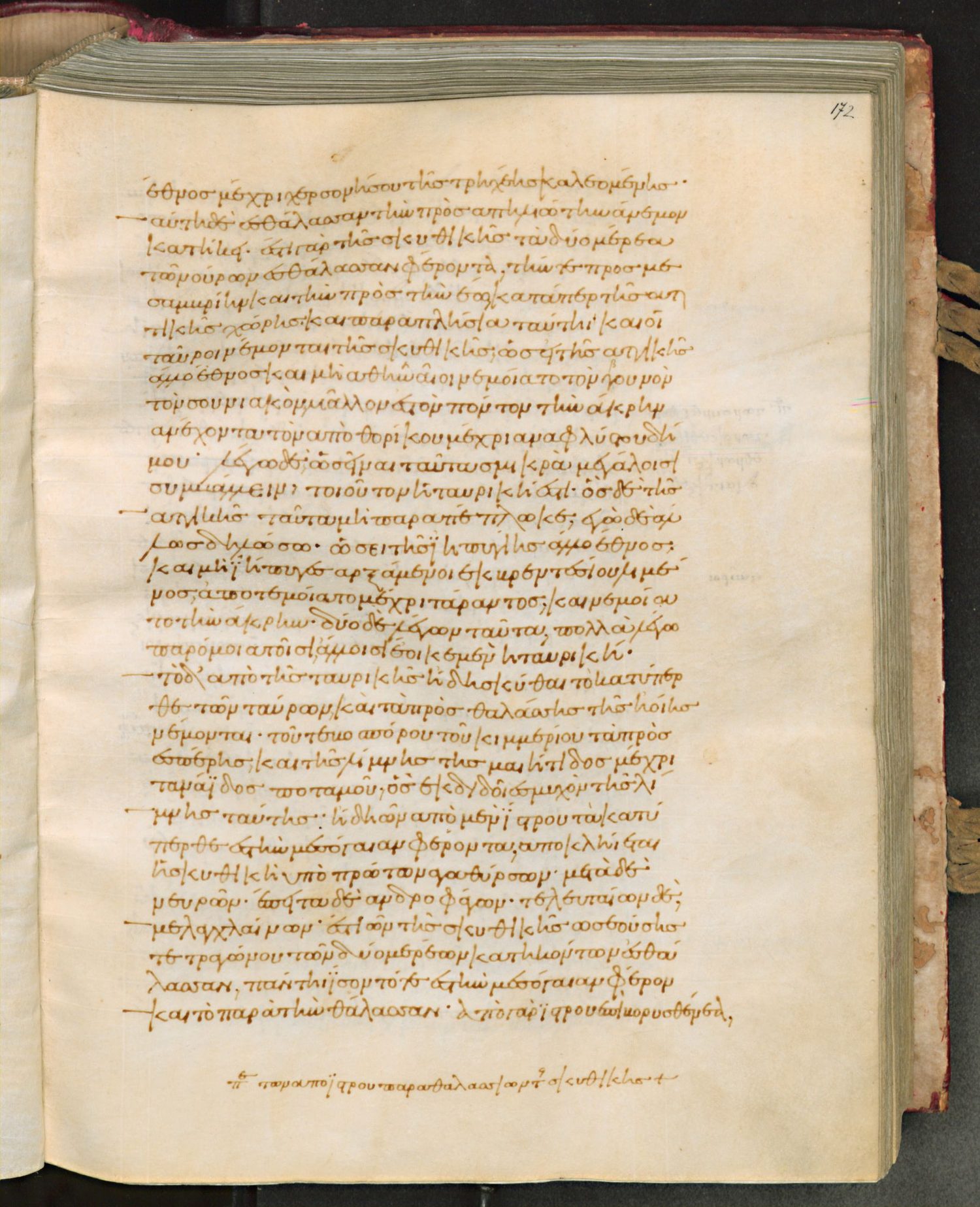
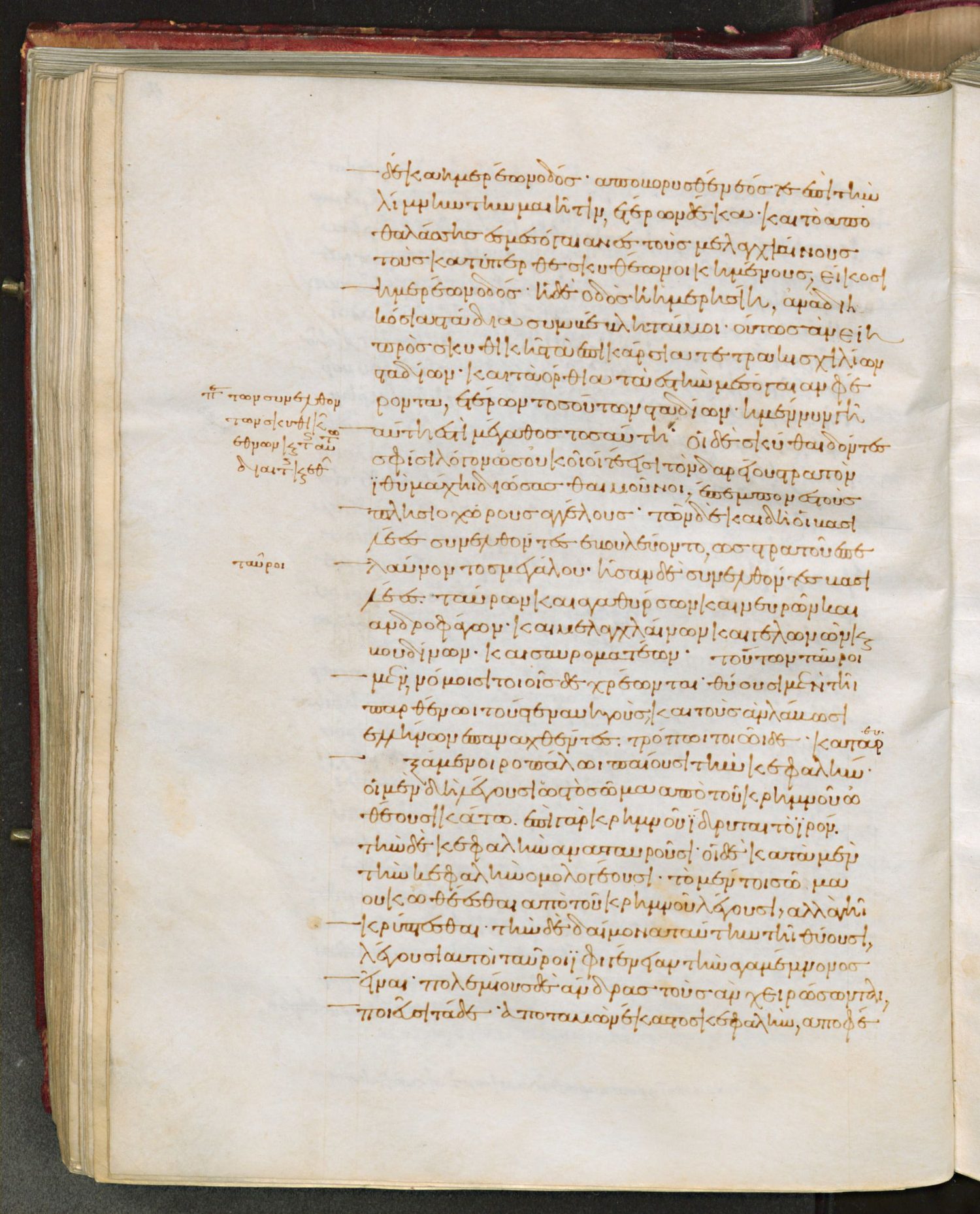
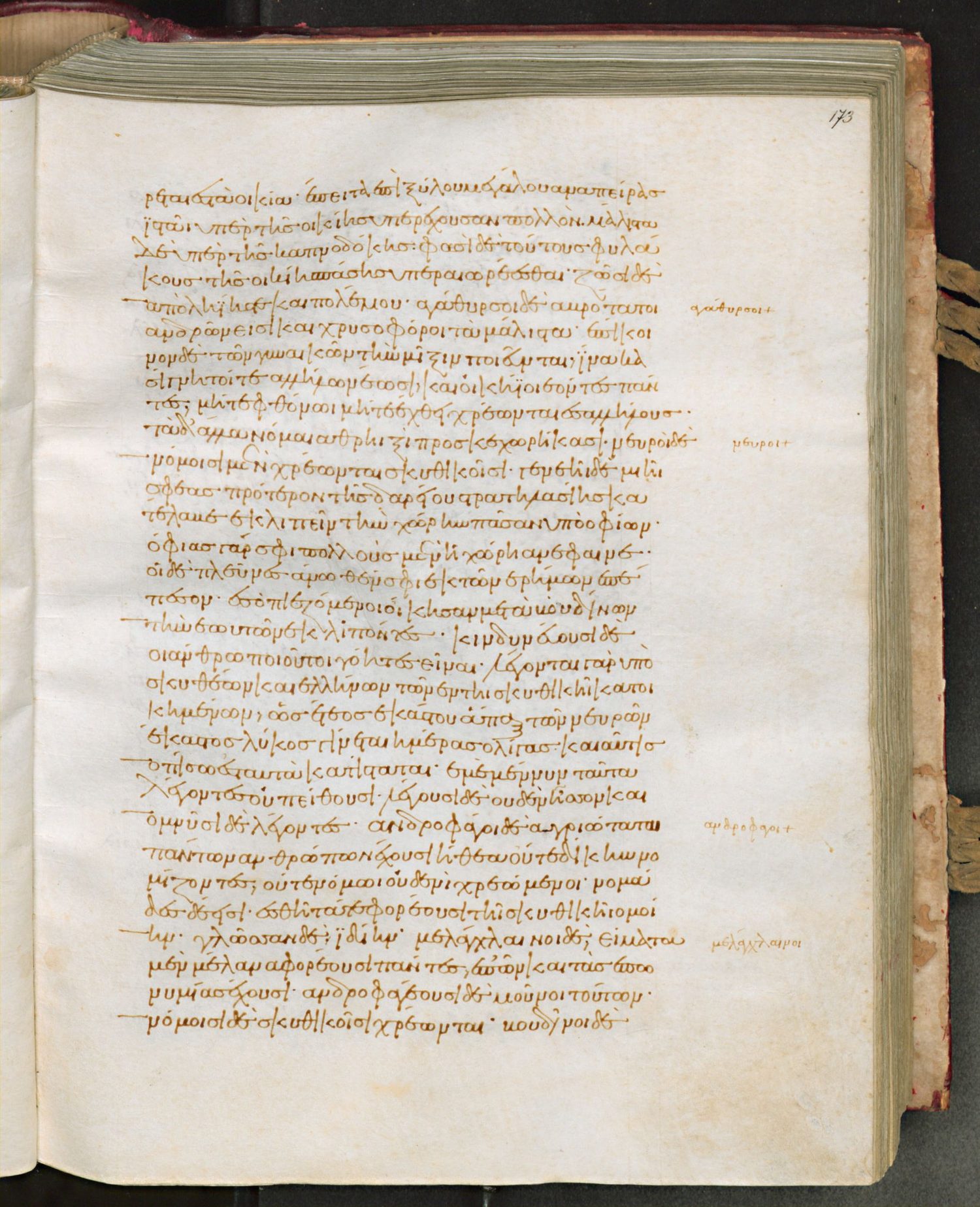
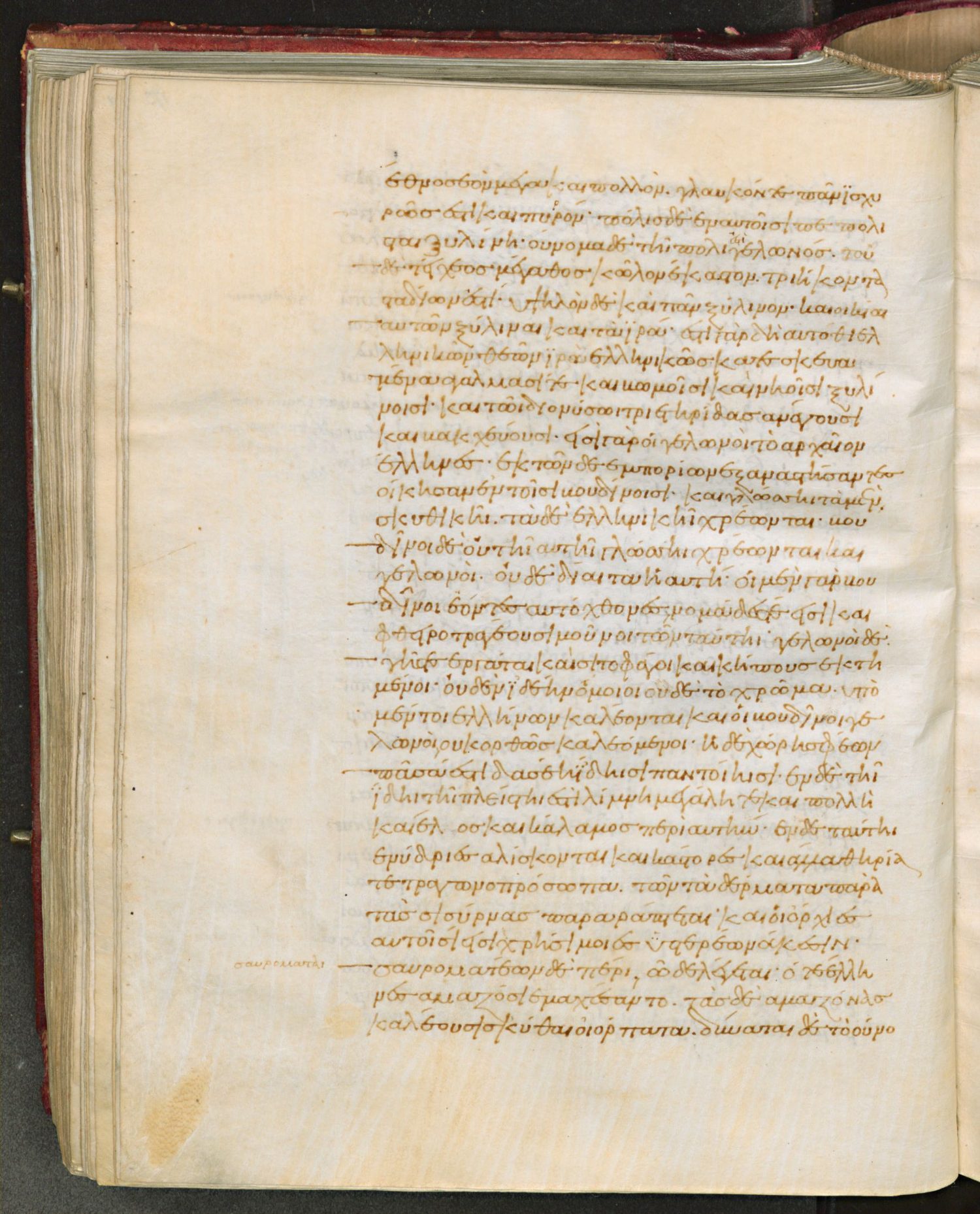
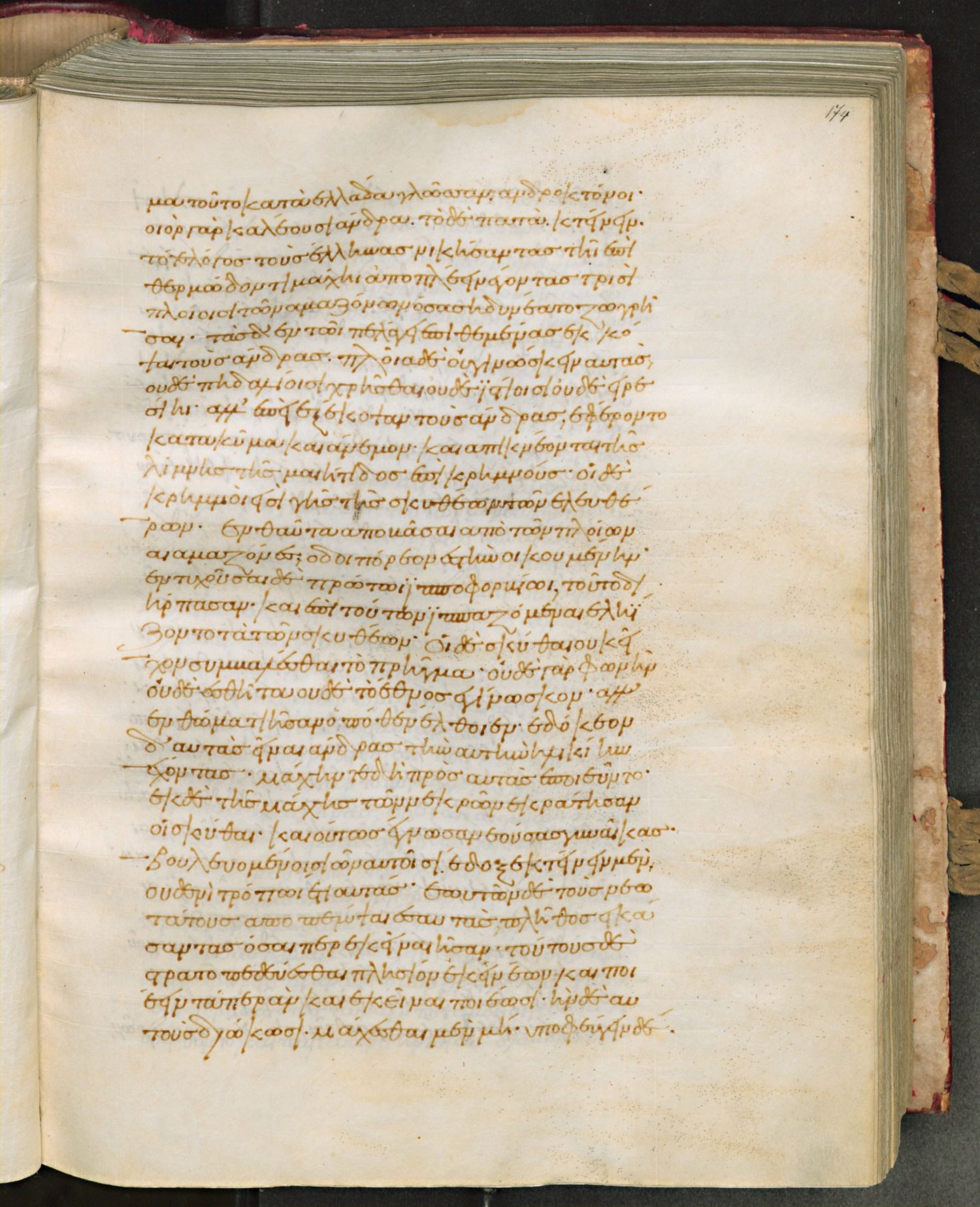
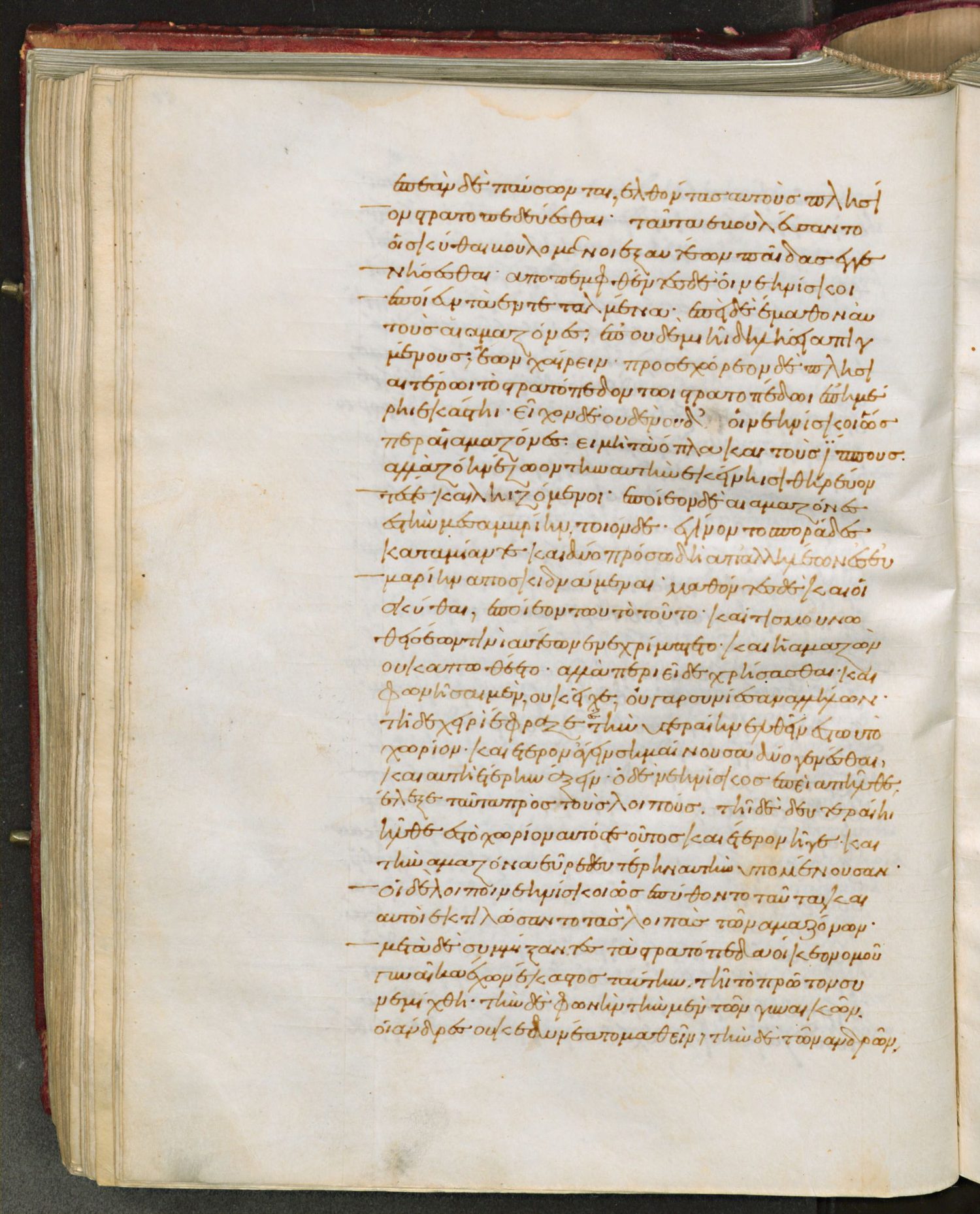
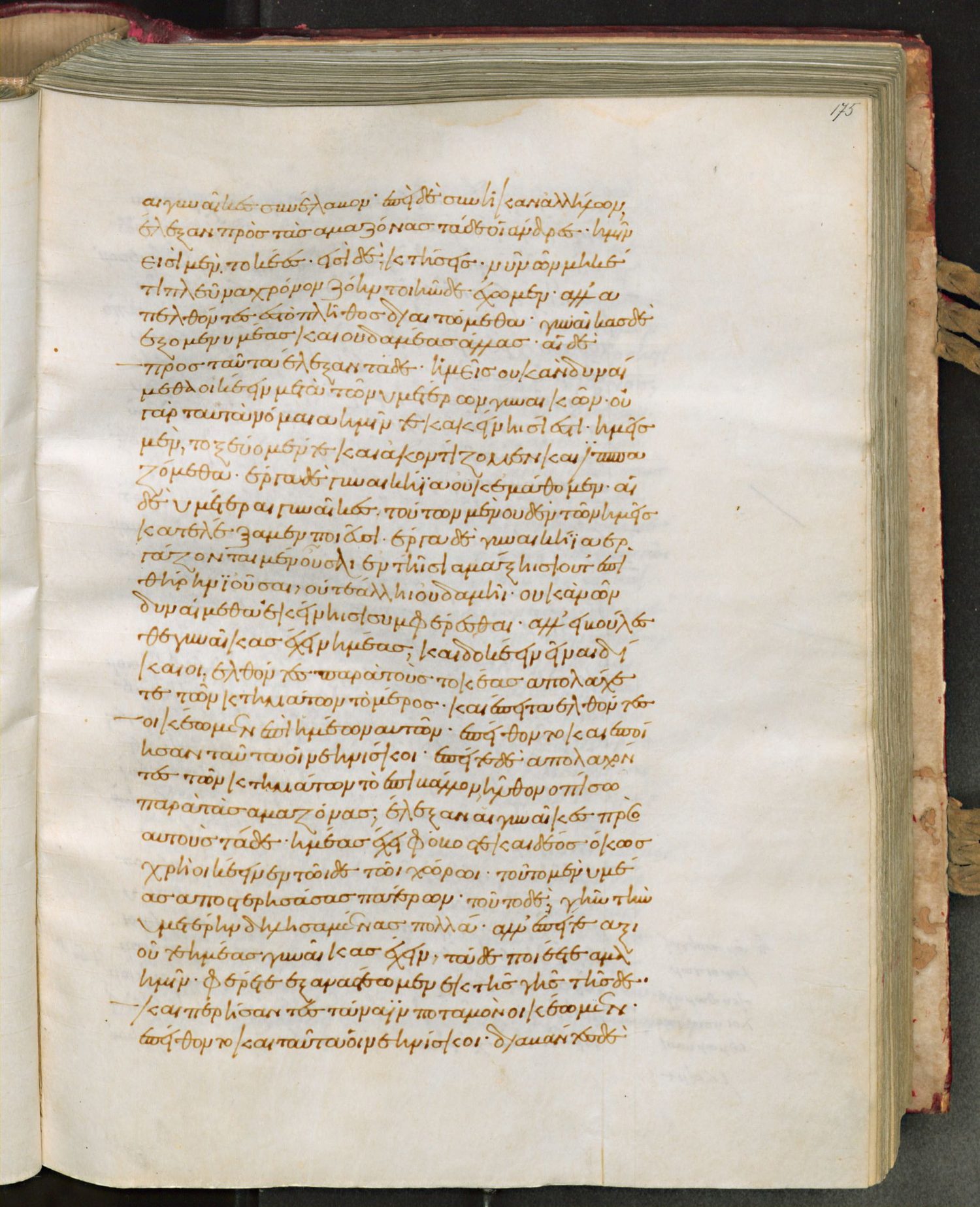
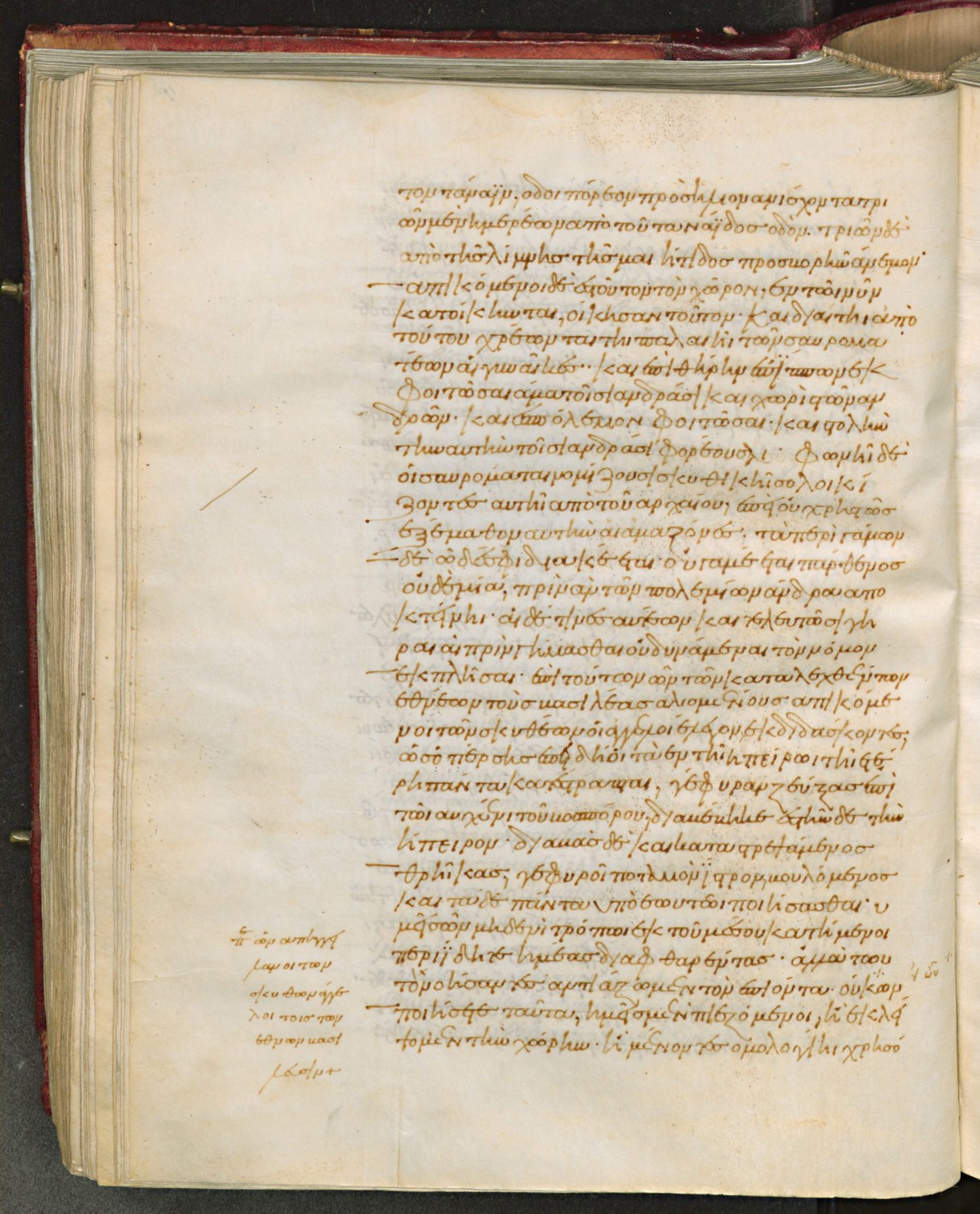
The photographs are of Florence, Biblioteca Medicea Laurenziana, Plut. 70.3 (parchment, 10th century, 374 folios, 31 lines a page), Herodotus, Histories (codex A of the editors), the oldest surviving manuscript of the complete Histories, from the Teca Digitale of the Biblioteca Medicea Laurenziana. Each section below is the text of one page, or of the part of a page that falls within these chapters. The first and last words of every page were read on the photograph and located in the Greek, and every page break was checked against the next page; the notes quote these words. Readers' notes in the margins are not part of the text and are mentioned where they occur.
The Greek is the text printed in A. D. Godley's Loeb edition (1920-1925), from Perseus; it is the edited text, not a transcription of the manuscript, whose wording differs in places. The English is Godley's translation as printed, from Wikisource. Godley's English carries only chapter numbers; the section numbers shown in it were placed by comparison with the Perseus version of his translation. Each page's English is cut at the end of one of Godley's sentences, so it can begin or end a few lines away from the Greek of the page; each note gives the exact ranges.
This entry covers chapters 4.99-117, on fol. 171v to 175v.
How was this verified? (Provenance)
Where on the image
Laur. Plut. 70.3, fol. 171v: Greek here 4.99.1 to 4.99.3. Checked on the image (first and last words read and located in the Greek; each break checked against the neighbouring page): fol. 171v begins ‹κάρτα τε ἥσθη τῇ› (4.97.6), ends ‹Πόντον, νέμεται τὸ Ταυρικὸν› (4.99.3). English here: 4.99.1 to 4.99.3 (Godley's sentences for the sections whose Greek lies mostly on this page).
4.99.1τῆς δὲ Σκυθικῆς γῆς ἡ Θρηίκη τὸ ἐς θάλασσαν πρόκειται· κόλπου δὲ ἀγομένου τῆς γῆς ταύτης, ἡ Σκυθική τε ἐκδέκεται καὶ ὁ Ἴστρος ἐκδιδοῖ ἐς αὐτήν, πρὸς εὖρον ἄνεμον τὸ στόμα τετραμμένος. 4.99.2τὸ δὲ ἀπὸ Ἴστρου ἔρχομαι σημανέων τὸ πρὸς θάλασσαν αὐτῆς τῆς Σκυθικῆς χώρης ἐς μέτρησιν. ἀπὸ Ἴστρου αὕτη ἤδη ἡ ἀρχαίη Σκυθίη ἐστί, πρὸς μεσαμβρίην τε καὶ νότον ἄνεμον κειμένη, μέχρι πόλιος Καρκινίτιδος καλεομένης. 4.99.3τὸ δὲ ἀπὸ ταύτης τὴν μὲν ἐπὶ θάλασσαν τὴν αὐτὴν φέρουσαν, ἐοῦσαν ὀρεινήν τε χώρην καὶ προκειμένην τὸ ἐς Πόντον, νέμεται τὸ Ταυρικὸν
4.99.1Thrace runs farther out into the sea than Scythia; and where a bay is formed in its coast, Scythia begins, and the mouth of the Ister, which faces to the south-east, is in that country. 4.99.2Now I will describe the coast of the true Scythia from the Ister, and give its measurements. At the Ister begins the ancient Scythian land, which lies facing the south and the south wind, as far as the city called Carcinitis. 4.99.3Beyond this place, the country fronting the same sea is hilly and projects into the Pontus; it is inhabited by the Tauric nation as far as what is called the Rough Peninsula; and this ends in the eastern sea.
Where on the image
Laur. Plut. 70.3, fol. 172r: Greek here 4.99.3 to 4.101.2. Checked on the image (first and last words read and located in the Greek; each break checked against the neighbouring page): fol. 172r begins ‹ἔθνος μέχρι χερσονήσου τῆς› (4.99.3), ends ‹γὰρ Ἴστρου ἐπὶ Βορυσθένεα› (4.101.2). Below the text, a reader's note. English here: 4.99.4 to 4.101.2 (Godley's sentences for the sections whose Greek lies mostly on this page).
4.99.3ἔθνος μέχρι χερσονήσου τῆς τρηχέης καλεομένης· αὕτη δὲ ἐς θάλασσαν τὴν πρὸς ἀπηλιώτην ἄνεμον κατήκει. 4.99.4ἔστι γὰρ τῆς Σκυθικῆς τὰ δύο μέρεα τῶν οὔρων ἐς θάλασσαν φέροντα, τήν τε πρὸς μεσαμβρίην καὶ τὴν πρὸς τὴν ἠῶ, κατά περ τῆς Ἀττικῆς χώρης· καὶ παραπλήσια ταύτῃ καὶ οἱ Ταῦροι νέμονται τῆς Σκυθικῆς, ὡς εἰ τῆς Ἀττικῆς ἄλλο ἔθνος καὶ μὴ Ἀθηναῖοι νεμοίατο τὸν γουνὸν τὸν Σουνιακόν, μᾶλλον ἐς τὸν πόντον τὴν ἄκρην ἀνέχοντα, τὸν ἀπὸ Θορικοῦ μέχρι Ἀναφλύστου δήμου· 4.99.5λέγω δὲ ὡς εἶναι ταῦτα σμικρὰ μεγάλοισι συμβάλλειν· τοιοῦτον ἡ Ταυρική ἐστι. ὃς δὲ τῆς Ἀττικῆς ταῦτα μὴ παραπέπλωκε, ἐγὼ δὲ ἄλλως δηλώσω· ὡς εἰ τῆς Ἰηπυγίης ἄλλο ἔθνος καὶ μὴ Ἰήπυγες ἀρξάμενοι ἐκ Βρεντεσίου λιμένος ἀποταμοίατο μέχρι Τάραντος καὶ νεμοίατο τὴν ἄκρην. δύο δὲ λέγων ταῦτα πολλὰ λέγω παρόμοια, τοῖσι ἄλλοισι ἔοικε ἡ Ταυρική. 4.100.1τὸ δʼ ἀπὸ τῆς Ταυρικῆς ἤδη Σκύθαι τὰ κατύπερθε τῶν Ταύρων καὶ τὰ πρὸς θαλάσσης τῆς ἠοίης νέμονται, τοῦ τε Βοσπόρου τοῦ Κιμμερίου τὰ πρὸς ἑσπέρης καὶ τῆς λίμνης τῆς Μαιήτιδος μέχρι Τανάιδος ποταμοῦ, ὃς ἐκδιδοῖ ἐς μυχὸν τῆς λίμνης ταύτης. 4.100.2ἤδη ὦν ἀπὸ μὲν Ἴστρου τὰ κατύπερθε ἐς τὴν μεσόγαιαν φέροντα ἀποκληίεται ἡ Σκυθικὴ ὑπὸ πρώτων Ἀγαθύρσων, μετὰ δὲ Νευρῶν, ἔπειτα δὲ Ἀνδροφάγων, τελευταίων δὲ Μελαγχλαίνων. 4.101.1ἔστι ὦν τῆς Σκυθικῆς ὡς ἐούσης τετραγώνου, τῶν δύο μερέων κατηκόντων ἐς θάλασσαν, πάντῃ ἴσον τό τε ἐς τὴν μεσόγαιαν φέρον καὶ τὸ παρὰ τὴν θάλασσαν. 4.101.2ἀπὸ γὰρ Ἴστρου ἐπὶ Βορυσθένεα
4.99.4For the sea to the south and the sea to the east are two of the four boundary lines of Scythia, even as the seas are boundaries of Attica; and the Tauri dwelling as they do in a part of Scythia which is like Attica, it is as though some other people, not Attic, were to inhabit the heights of Sunium from Thoricus to the township of Anaphlystus, did Sunium but jut farther out into the sea. 4.99.5I say this in so far as one may compare small things with great. Such a land is the Tauric country. But those who have not coasted along that part of Attica may understand from this other way of showing: it is as though in Iapygia some other people, not Iapygian, were to dwell on the promontory within a line drawn from the harbour of Brentesium to Taras. Of these two countries I speak, but there are many others of a like kind which Tauris resembles. 4.100.1Beyond the Tauric country the Scythians begin, dwelling north of the Tauri and beside the eastern sea, westward of the Cimmerian Bosporus and the Maeetian lake, as far as the river Tanais, which issues into the end of that lake. 4.100.2Now it has been seen that on its northern and inland side, which runs from the Ister, Scythia is bounded first by the Agathyrsi, next by the Neuri, next by the Man-eaters, and last by the Black-cloaks. 4.101.1Scythia, then, being a four-sided country, whereof two sides are sea-board, the frontiers running inland and those that are by the sea make it a perfect square; 4.101.2for it is a ten days’ journey from the Ister to the Borysthenes, and the same from the Borysthenes to the Maeetian lake; and it is a twenty days’ journey from the sea inland to the country of the Black-cloaks who dwell north of Scythia.
Where on the image
Laur. Plut. 70.3, fol. 172v: Greek here 4.101.2 to 4.103.3. Checked on the image (first and last words read and located in the Greek; each break checked against the neighbouring page): fol. 172v begins ‹δέκα ἡμερέων ὁδός ἀπὸ› (4.101.2), ends ‹ἀποταμὼν ἕκαστος κεφαλὴν ἀποφέ-› (4.103.3). English here: 4.101.3 to 4.103.2 (Godley's sentences for the sections whose Greek lies mostly on this page).
4.101.2δέκα ἡμερέων ὁδός ἀπὸ Βορυσθένεος τε ἐπὶ τὴν λίμνην τὴν Μαιῆτιν ἑτερέων δέκα· καὶ τὸ ἀπὸ θαλάσσης ἐς μεσόγαιαν ἐς τοὺς Μελαγχλαίνους τοὺς κατύπερθε Σκυψέων οἰκημένους εἴκοσι ἡμερέων ὁδὸς. 4.101.3ἡ δὲ ὁδὸς ἡ ἡμερησίη ἀνὰ διηκόσια στάδια συμβέβληταί μοι. οὕτω ἂν εἴη τῆς Σκυθικῆς τὰ ἐπικάρσια τετρακισχιλίων σταδίων καὶ τὰ ὄρθια τὰ ἐς τὴν μεσόγαιαν φέροντα ἑτέρων τοσούτων σταδίων. ἡ μέν νυν γῆ αὕτη ἐστὶ μέγαθος τοσαύτη. 4.102.1οἱ δὲ Σκύθαι δόντες σφίσι λόγον ὡς οὐκ οἷοί τε εἰσὶ τὸν Δαρείου στρατὸν ἰθυμαχίῃ διώσασθαι μοῦνοι, ἔπεμπον ἐς τοὺς πλησιοχώρους ἀγγέλους· τῶν δὲ καὶ δὴ οἱ βασιλέες συνελθόντες ἐβουλεύοντο ὡς στρατοῦ ἐπελαύνοντος μεγάλου. 4.102.2ἦσαν δὲ οἱ συνελθόντες βασιλέες Ταύρων καὶ Ἀγαθύρσων καὶ Νευρῶν καὶ Ἀνδροφάγων καὶ Μελαγχλαίνων καὶ Γελωνῶν καὶ Βουδίνων καὶ Σαυροματέων. 4.103.1τούτων Ταῦροι μὲν νόμοισι τοιοῖσιδε χρέωνται· θύουσι μὲν τῇ Παρθένῳ τούς τε ναυηγοὺς καὶ τοὺς ἂν λάβωσι Ἑλλήνων ἐπαναχθέντες τρόπῳ τοιῷδε· 4.103.2καταρξάμενοι ῥοπάλῳ παίουσι τὴν κεφαλήν. οἳ μὲν δὴ λέγουσι ὡς τὸ σῶμα ἀπὸ τοῦ κρημνοῦ ὠθέουσι κάτω (ἐπὶ γὰρ κρημνοῦ ἵδρυται τὸ ἱρόν), τὴν δὲ κεφαλὴν ἀνασταυροῦσι· οἳ δὲ κατὰ μὲν τὴν κεφαλὴν ὁμολογέουσι, τὸ μέντοι σῶμα οὐκ ὠθέεσθαι ἀπὸ τοῦ κρημνοῦ λέγουσι ἀλλὰ γῇ κρύπτεσθαι. τὴν δὲ δαίμονα ταύτην τῇ θύουσι λέγουσι αὐτοὶ Ταῦροι Ἰφιγένειαν τὴν Ἀγαμέμνονος εἶναι. 4.103.3πολεμίους δὲ ἄνδρας τοὺς ἂν χειρώσωνται ποιεῦσι τάδε· ἀποταμὼν ἕκαστος κεφαλὴν ἀποφέρεται
4.101.3Now as I reckon a day’s journey at two hundred furlongs, the cross-measurement of Scythia would be a distance of four thousand furlongs, and the line drawn straight up inland the same. Such then is the extent of this land. 4.102.1The Scythians, reckoning that they were not able by themselves to repel Darius’ army in open warfare, sent messengers to their neighbours, whose kings had already met and were taking counsel, as knowing that a great army was marching against them. 4.102.2Those that had so met were the kings of the Tauri, Agathyrsi, Neuri, Maneaters, Black-cloaks, Geloni, Budini, and Sauromatae. 4.103.1Among these, the Tauri have the following customs: all ship-wrecked men, and any Greeks whom they take in their sea-raiding, they sacrifice to the Virgin goddess as I will show: after the first rites of sacrifice, they smite the victim on the head with a club; 4.103.2according to some, they then throw down the body from the cliff whereon their temple stands, and place the head on a pole; others agree with this as to the head, but say that the body is buried, not thrown down from the cliff. This deity to whom they sacrifice is said by the Tauri themselves to be Agamemnon’s daughter Iphigenia.
Where on the image
Laur. Plut. 70.3, fol. 173r: Greek here 4.103.3 to 4.108.1. Checked on the image (first and last words read and located in the Greek; each break checked against the neighbouring page): fol. 173r begins ‹-ρεται ἐς τὰ οἰκία,› (4.103.3), ends ‹δὲ Σκυθικοῖσι χρέωνται.Βουδῖνοι δὲ› (4.108.1). The word ‹ἀποφέρεται› is divided between fol. 172v and fol. 173r; it is given with fol. 172v. English here: 4.103.3 to 4.107.1 (Godley's sentences for the sections whose Greek lies mostly on this page).
4.103.3ἐς τὰ οἰκία, ἔπειτα ἐπὶ ξύλου μεγάλου ἀναπείρας ἱστᾷ ὑπὲρ τῆς οἰκίης ὑπερέχουσαν πολλόν, μάλιστα δὲ ὑπὲρ τῆς καπνοδόκης. φασὶ δὲ τούτους φυλάκους τῆς οἰκίης πάσης ὑπεραιωρέεσθαι. ζῶσι δὲ ἀπὸ ληίης τε καὶ πολέμου. 4.104.1Ἀγάθυρσοι δὲ ἁβρότατοι ἀνδρῶν εἰσι καὶ χρυσοφόροι τὰ μάλιστα, ἐπίκοινον δὲ τῶν γυναικῶν τὴν μῖξιν ποιεῦνται, ἵνα κασίγνητοι τε ἀλλήλων ἔωσι καὶ οἰκήιοι ἐόντες πάντες μήτε φθόνῳ μήτε ἔχθεϊ χρέωνται ἐς ἀλλήλους. τὰ δὲ ἄλλα νόμαια Θρήιξι προσκεχωρήκασι. 4.105.1Νευροὶ δὲ νόμοισι μὲν χρέωνται Σκυθικοῖσι, γενεῇ δὲ μιῇ πρότερον σφέας τῆς Δαρείου στρατηλασίης κατέλαβε ἐκλιπεῖν τὴν χώρην πᾶσαν ὑπὸ ὀφίων· ὄφιας γάρ σφι πολλοὺς μὲν ἡ χώρη ἀνέφαινε, οἱ δὲ πλεῦνες ἄνωθέν σφι ἐκ τῶν ἐρήμων ἐπέπεσον, ἐς ὃ πιεζόμενοι οἴκησαν μετὰ Βουδίνων τὴν ἑωυτῶν ἐκλιπόντες. κινδυνεύουσι δὲ οἱ ἄνθρωποι οὗτοι γόητες εἶναι. 4.105.2λέγονται γὰρ ὑπὸ Σκυθέων καὶ Ἑλλήνων τῶν ἐν τῇ Σκυθικῇ κατοικημένων ὡς ἔτεος ἑκάστου ἅπαξ τῶν Νευρῶν ἕκαστος λύκος γίνεται ἡμέρας ὀλίγας καὶ αὖτις ὀπίσω ἐς τὠυτὸ κατίσταται. ἐμὲ μέν νυν ταῦτα λέγοντες οὐ πείθουσι, λέγουσι δὲ οὐδὲν ἧσσον, καὶ ὀμνῦσι δὲ λέγοντες. 4.106.1ἀνδροφάγοι δὲ ἀγριώτατα πάντων ἀνθρώπων ἔχουσι ἤθεα, οὔτε δίκην νομίζοντες οὔτε νόμῳ οὐδενὶ χρεώμενοι· νομάδες δὲ εἰσι, ἐσθῆτά τε φορέουσι τῇ Σκυθικῇ ὁμοίην, γλῶσσαν δὲ ἰδίην, ἀνδροφαγέουσι δὲ μοῦνοι τούτων. 4.107.1μελάγχλαινοι δὲ εἵματα μὲν μέλανα φορέουσι πάντες, ἐπʼ ὧν καὶ τὰς ἐπωνυμίας ἔχουσι, νόμοισι δὲ Σκυθικοῖσι χρέωνται. 4.108.1Βουδῖνοι δὲ
4.103.3As for the enemies whom they overcome, each man cuts off his enemy’s head and carries it away to his house, where he places it on a tall pole and sets it standing high above the dwelling, above the smoke-vent for the most part. These heads, they say, are set aloft to guard the whole house. The Tauri live by plundering and war. 4.104.1The Agathyrsi live more delicately than all other men, and are greatly given to wearing gold. Their intercourse with women is promiscuous, that they may be brothers and that as they are all kinsfolk to each other they may neither envy nor hate their fellows. In the rest of their customs they are like to the Thracians. 4.105.1The Neuri follow Scythian usages; but one generation before the coming of Darius’ army it fell out that they were driven from their country by snakes; for their land brought forth great numbers of these, and yet more came down upon them out of the desert on the north, till at last the Neuri were so hard pressed that they left their own country and dwelt among the Budini. 4.105.2It may be that they are wizards; for the Scythians, and the Greeks settled in Scythia, say that once a year every one of the Neuri is turned into a wolf, and after remaining so for a few days returns again to his former shape. For myself, I cannot believe this tale; but they tell it nevertheless, yea, and swear to its truth. 4.106.1The Man-eaters are of all men the most savage in their manner of life; they know no justice and obey no law. They are nomads, wearing a dress like the Scythian, but speaking a language of their own; they are the only people of all these that eat men. 4.107.1The Black-cloaks all wear black raiment, whence they take their name; their usages are Scythian.
Where on the image
Laur. Plut. 70.3, fol. 173v: Greek here 4.108.1 to 4.110.1. Checked on the image (first and last words read and located in the Greek; each break checked against the neighbouring page): fol. 173v begins ‹ἔθνος ἐὸν μέγα καὶ› (4.108.1), ends ‹δύναται δὲ τὸ οὔνομα› (4.110.1). English here: 4.108.1 to 4.109.2 (Godley's sentences for the sections whose Greek lies mostly on this page).
4.108.1ἔθνος ἐὸν μέγα καὶ πολλὸν γλαυκόν τε πᾶν ἰσχυρῶς ἐστι καὶ πυρρόν· πόλις δὲ ἐν αὐτοῖσι πεπόλισται ξυλίνη, οὔνομα δὲ τῇ πόλι ἐστὶ Γελωνός. τοῦ δὲ τείχεος μέγαθος κῶλον ἕκαστον τριήκοντα σταδίων ἐστί, ὑψηλὸν δὲ καὶ πᾶν ξύλινον, καὶ αἱ οἰκίαι αὐτῶν ξύλιναι καὶ τὰ ἱρά. 4.108.2ἔστι γὰρ δὴ αὐτόθι Ἑλληνικῶν θεῶν ἱρὰ Ἑλληνικῶς κατεσκευασμένα ἀγάλμασί τε καὶ βωμοῖσι καὶ νηοῖσι ξυλίνοισι, καὶ τῷ Διονύσῳ τριετηρίδας ἀνάγουσι καὶ βακχεύουσι. εἰσὶ γὰρ οἱ Γελωνοὶ τὸ ἀρχαῖον Ἕλληνες, ἐκ τῶν δὲ ἐμπορίων ἐξαναστάντες οἴκησαν ἐν τοῖσι Βουδίνοισι· καὶ γλώσσῃ τὰ μὲν Σκυθικῇ, τὰ δὲ Ἑλληνικῇ χρέωνται. 4.109.1Βουδῖνοι δὲ οὐ τῇ αὐτῇ γλώσσῃ χρέωνται καὶ Γελωνοί, οὐδὲ δίαιτα ἡ αὐτή. οἱ μὲν γὰρ Βουδῖνοι ἐόντες αὐτόχθονες νομάδες τε εἰσὶ καὶ φθειροτραγέουσι μοῦνοι τῶν ταύτῃ, Γελωνοὶ δὲ γῆς τε ἐργάται καὶ σιτοφάγοι καὶ κήπους ἐκτημένοι, οὐδὲν τὴν ἰδέην ὅμοιοι οὐδὲ τὸ χρῶμα. ὑπὸ μέντοι Ἑλλήνων καλέονται καὶ οἱ Βουδῖνοι Γελωνοί, οὐκ ὀρθῶς καλεόμενοι. 4.109.2ἡ δὲ χώρη σφέων πᾶσα ἐστὶ δασέα ἴδῃσι παντοίῃσι· ἐν δὲ τῇ ἴδῃ τῇ πλείστῃ ἐστὶ λίμνη μεγάλη τε καὶ πολλὴ καὶ ἕλος καὶ κάλαμος περὶ αὐτήν. ἐν δὲ ταύτῃ ἐνύδριες ἁλίσκονται καὶ κάστορες καὶ ἄλλα θηρία τετραγωνοπρόσωπα, τῶν τὰ δέρματα παρὰ τὰς σισύρνας παραρράπτεται, καὶ οἱ ὄρχιες αὐτοῖσι εἰσὶ χρήσιμοι ἐς ὑστερέων ἄκεσιν. 4.110.1Σαυροματέων δὲ πὲρι ὧδε λέγεται. ὅτε Ἕλληνες Ἀμαζόσι ἐμαχέσαντο (τὰς δὲ Ἀμαζόνας καλέουσι Σκύθαι Οἰόρπατα, δύναται δὲ τὸ οὔνομα
4.108.1The Budini are a great and numerous nation; the eyes of all of them are very bright, and they are ruddy. They have a city built of wood, called Gelonus. The wall of it is thirty furlongs in length on each side of the city; this wall is high and all of wood; and their houses are wooden, and their temples; 4.108.2for there are among them temples of Greek gods, furnished in Greek fashion with images and altars and shrines of wood; and they honour Dionysus every two years with festivals and revels. For the Geloni are by their origin Greeks, who left their trading ports to settle among the Budini; and they speak a language half Greek and half Scythian. But the Budini speak not the same language as the Geloni, nor is their manner of life the same. 4.109.1The Budini are native to the soil; they are nomads, and the only people in these parts that eat fir-cones; the Geloni are tillers of the soil, eating grain and possessing gardens; they are wholly unlike the Budini in form and in complexion. Yet the Greeks call the Budini too Geloni; but this is wrong. 4.109.2All their country is thickly wooded with every kind of tree; in the depth of the forests there is a great and wide lake and marsh surrounded by reeds; otters are caught in it, and beavers, besides certain square-faced creatures whose skins serve for the trimming of mantles, and their testicles are used by the people to heal sicknesses of the womb.
Where on the image
Laur. Plut. 70.3, fol. 174r: Greek here 4.110.1 to 4.111.2. Checked on the image (first and last words read and located in the Greek; each break checked against the neighbouring page): fol. 174r begins ‹τοῦτο κατὰ Ἑλλάδα γλῶσσαν› (4.110.1), ends ‹μὲν μή, ὑποφεύγειν δέ› (4.111.2). English here: 4.110.1 to 4.111.2 (Godley's sentences for the sections whose Greek lies mostly on this page).
4.110.1τοῦτο κατὰ Ἑλλάδα γλῶσσαν ἀνδροκτόνοι· οἰὸρ γὰρ καλέουσι ἄνδρα, τὸ δὲ πατὰ κτείνειν), τότε λόγος τοὐς Ἕλληνας νικήσαντας τῇ ἐπὶ Θερμώδοντι μάχῃ ἀποπλέειν ἄγοντας τρισὶ πλοίοισι τῶν Ἀμαζόνων ὅσας ἐδυνέατο ζωγρῆσαι, τὰς δὲ ἐν τῷ πελάγει ἐπιθεμένας ἐκκόψαι τοὺς ἄνδρας. 4.110.2πλοῖα δὲ οὐ γινώσκειν αὐτὰς οὐδὲ πηδαλίοισι χρᾶσθαι οὐδὲ ἱστίοισι οὐδὲ εἰρεσίῃ· ἀλλʼ ἐπεὶ ἐξέκοψαν τοὺς ἄνδρας ἐφέροντο κατὰ κῦμα καὶ ἄνεμον, καὶ ἀπικνέονται τῆς λίμνης τῆς Μαιήτιδος ἐπὶ Κρημνούς· οἱ δὲ Κρημνοὶ εἰσὶ γῆς τῆς Σκυθέων τῶν ἐλευθέρων. ἐνθαῦτα ἀποβᾶσαι ἀπὸ τῶν πλοίων αἱ Ἀμαζόνες ὁδοιπόρεον ἐς τὴν οἰκεομένην. ἐντυχοῦσαι δὲ πρώτῳ ἱπποφορβίῳ τοῦτο διήρπασαν, καὶ ἐπὶ τούτων ἱππαζόμεναι ἐληίζοντο τὰ τῶν Σκυθέων. 4.111.1οἱ δὲ Σκύθαι οὐκ εἶχον συμβαλέσθαι τὸ πρῆγμα· οὔτε γὰρ φωνὴν οὔτε ἐσθῆτα οὔτε τὸ ἔθνος ἐγίνωσκον, ἀλλʼ ἐν θώματι ἦσαν ὁκόθεν ἔλθοιεν, ἐδόκεον δʼ αὐτὰς εἶναι ἄνδρας τὴν αὐτὴν ἡλικίην ἔχοντας, μάχην τε δὴ πρὸς αὐτὰς ἐποιεῦντο. ἐκ δὲ τῆς μάχης τῶν νεκρῶν ἐκράτησαν οἱ Σκύθαι, καὶ οὕτω ἔγνωσαν ἐούσας γυναῖκας. 4.111.2βουλευομένοισι ὦν αὐτοῖσι ἔδοξε κτείνειν μὲν οὐδενὶ τρόπῳ ἔτι αὐτάς, ἑωυτῶν δὲ τοὺς νεωτάτους ἀποπέμψαι ἐς αὐτάς, πλῆθος εἰκάσαντας ὅσαι περ ἐκεῖναι ἦσαν τούτους δὲ στρατοπεδεύεσθαι πλησίον ἐκεινέων καὶ ποιέειν τὰ περ ἂν καὶ ἐκεῖναι ποιέωσι. ἢν δὲ αὐτοὺς διώκωσι, μάχεσθαι μὲν μή, ὑποφεύγειν δέ·
4.110.1The history of the Sauromatae is as I will now show. When the Greeks warred with the Amazons (whom the Scythians call Oiorpata, a name signifying in our tongue killers of men, for in Scythian a man is oior, and to kill is pata) the story runs that after their victory on the Thermodon they sailed away carrying in three ships as many Amazons as they had been able to take alive; and out at sea the Amazons set upon the crews and slew them. 4.110.2But they knew nothing of ships, nor how to use rudder or sail or oar; and the men having been slain they were borne at the mercy of waves and winds, till they came to the Cliffs by the Maeetian lake; this place is in the country of the free Scythians. There the Amazons landed, and set forth on their journey to the inhabited country, and seized the first troop of horses they met, and mounted on them they raided the Scythian lands. 4.111.1The Scythians could not understand the matter; for they knew not the women’s speech nor their dress nor their nation, but wondered whence they had come, and supposed them to be men all of the same age; and they met the Amazons in battle. The end of the fight was that the Scythians got possession of the dead, and so came to know that their foes were women. 4.111.2Wherefore taking counsel they resolved by no means to slay them as heretofore, but to send to them their youngest men, of a number answering (as they guessed) to the number of the women. They bade these youths encamp near to the Amazons and to imitate all that they did; if the women pursued them, then not to fight, but to flee; and when the pursuit ceased, to come and encamp near to them. This was the plan of the Scythians, for they desired that children should be born of the women. The young men, being sent, did as they were charged.
Where on the image
Laur. Plut. 70.3, fol. 174v: Greek here 4.111.2 to 4.114.1. Checked on the image (first and last words read and located in the Greek; each break checked against the neighbouring page): fol. 174v begins ‹ἐπεὰν δὲ παύσωνται, ἐλθόντας› (4.111.2), ends ‹τὴν δὲ τῶν ἀνδρῶν› (4.114.1). English here: 4.112.1 to 4.114.2 (Godley's sentences for the sections whose Greek lies mostly on this page).
4.111.2ἐπεὰν δὲ παύσωνται, ἐλθόντας αὖτις πλησίον στρατοπεδεύεσθαι. ταῦτα ἐβουλεύσαντο οἱ Σκύθαι βουλόμενοι ἐξ αὐτέων παῖδας ἐκγενήσεσθαι. ἀποπεμφθέντες δὲ οἱ νεηνίσκοι ἐποίευν τὰ ἐντεταλμένα. 4.112.1ἐπεὶ δὲ ἔμαθον αὐτοὺς αἱ Ἀμαζόνες ἐπʼ οὐδεμιῇ δηλήσι ἀπιγμένους, ἔων χαίρειν· προσεχώρεον δὲ πλησιαιτέρω τὸ στρατόπεδον τῷ στρατοπέδῳ ἐπʼ ἡμέρῃ ἑκάστῃ. εἶχον δὲ οὐδὲν οὐδʼ οἱ νεηνίσκοι, ὥσπερ αἱ Ἀμαζόνες, εἰ μὴ τὰ ὅπλα καὶ τοὺς ἵππους, ἀλλὰ ζόην ἔζωον τὴν αὐτὴν ἐκείνῃσι, θηρεύοντές τε καὶ ληιζόμενοι. 4.113.1ἐποίευν δὲ αἱ Ἀμαζόνες ἐς τὴν μεσαμβρίην τοιόνδε· ἐγίνοντο σποράδες κατὰ μίαν τε καὶ δύο, πρόσω δὴ ἀπʼ ἀλληλέων ἐς εὐμαρείην ἀποσκιδνάμεναι. μαθόντες δὲ καὶ οἱ Σκύθαι ἐποίευν τὠυτὸ τοῦτο. καί τις μουνωθεισέων τινὶ αὐτέων ἐνεχρίμπτετο, 4.113.2καὶ ἡ Ἀμαζὼν οὐκ ἀπωθέετο ἀλλὰ περιεῖδε χρήσασθαι. καὶ φωνῆσαι μὲν οὐκ εἶχε, οὐ γὰρ συνίεσαν ἀλλήλων, τῇ δὲ χειρὶ ἔφραζε ἐς τὴν ὑστεραίην ἐλθεῖν ἐς τωὐτὸ χωρίον καὶ ἕτερον ἄγειν, σημαίνουσα δύο γενέσθαι καὶ αὐτὴ ἑτέρην ἄξειν. 4.113.3ὁ δὲ νεηνίσκος, ἐπεὶ ἀπῆλθε, ἔλεξε ταῦτα πρὸς τοὺς λοιπούς· τῇ δὲ δευτεραίῃ ἦλθε ἐς τὸ χωρίον αὐτός τε οὗτος καὶ ἕτερον ἦγε, καὶ τὴν Ἀμαζόνα εὗρε δευτέρην αὐτὴν ὑπομένουσαν. οἱ δὲ λοιποὶ νεηνίσκοι ὡς ἐπύθοντο ταῦτα, καὶ αὐτοὶ ἐκτιλώσαντο τὰς λοιπὰς τῶν Ἀμαζόνων. 4.114.1μετὰ δὲ συμμίξαντες τὰ στρατόπεδα οἴκεον ὁμοῦ, γυναῖκα ἔχων ἕκαστος ταύτην τῇ τὸ πρῶτον συνεμίχθη. τὴν δὲ φωνὴν τὴν μὲν τῶν γυναικῶν οἱ ἄνδρες οὐκ ἐδυνέατο μαθεῖν, τὴν δὲ τῶν ἀνδρῶν
4.112.1When the Amazons perceived that the youths meant them no harm, they let them be; but every day the two camps drew nearer to each other. Now the young men, like the Amazons, had nothing but their arms and their horses, and lived as did the women, by hunting and plunder. 4.113.1At midday the Amazons would scatter and go singly or in pairs away from each other, roaming thus apart for greater comfort. The Scythians marked this and did likewise; and as the women wandered alone, a young man laid hold of one of them, and the woman made no resistance but suffered him to do his will; 4.113.2and since they understood not each other’s speech and she could not speak to him, she signed with the hand that he should come on the next day to the same place bringing another youth with him (showing by signs that there should be two), and she would bring another woman with her. 4.113.3The youth went away and told his comrades; and the next day he came himself with another to the place, where he found the Amazon and another with her awaiting him. When the rest of the young men learnt of this, they had intercourse with the rest of the Amazons. 4.114.1Presently they joined their camps and dwelt together, each man having for his wife the woman with whom he had had intercourse at first. Now the men could not learn the women’s language, but the women mastered the speech of the men; 4.114.2and when they understood each other, the men said to the Amazons, “We have parents and possessions; now therefore let us no longer live as we do, but return to our people and consort with them; and we will still have you, and no others, for our wives.”
Where on the image
Laur. Plut. 70.3, fol. 175r: Greek here 4.114.1 to 4.116.1. Checked on the image (first and last words read and located in the Greek; each break checked against the neighbouring page): fol. 175r begins ‹αἱ γυναῖκες συνέλαβον.ἐπεὶ δὲ› (4.114.1), ends ‹οἱ νεηνίσκοι, διαβάντες δὲ› (4.116.1). English here: 4.114.3 to 4.115.3 (Godley's sentences for the sections whose Greek lies mostly on this page).
4.114.1αἱ γυναῖκες συνέλαβον. 4.114.2ἐπεὶ δὲ συνῆκαν ἀλλήλων, ἔλεξαν πρὸς τὰς Ἀμαζόνας τάδε οἱ ἄνδρες. ἡμῖν εἰσὶ μὲν τοκέες, εἰσὶ δὲ κτήσιες· νῦν ὦν μηκέτι πλεῦνα χρόνον ζόην τοιήνδε ἔχωμεν, ἀλλʼ ἀπελθόντες ἐς τὸ πλῆθος διαιτώμεθα. γυναῖκας δὲ ἕξομεν ὑμέας καὶ οὐδαμὰς ἄλλας. αἳ δὲ πρὸς ταῦτα ἔλεξαν τάδε. 4.114.3ἡμεῖς οὐκ ἂν δυναίμεθα οἰκέειν μετὰ τῶν ὑμετερέων γυναικῶν· οὐ γὰρ τὰ αὐτὰ νόμαια ἡμῖν τε κἀκείνῃσι ἐστί. ἡμεῖς μὲν τοξεύομέν τε καὶ ἀκοντίζομεν καὶ ἱππαζόμεθα, ἔργα δὲ γυναικήια οὐκ ἐμάθομεν· αἱ δὲ ὑμέτεραι γυναῖκες τούτων μὲν οὐδὲν τῶν ἡμεῖς κατελέξαμεν ποιεῦσι, ἔργα δὲ γυναικήια ἐργάζονται μένουσαι ἐν τῇσι ἁμάξῃσι, οὔτʼ ἐπὶ θήρην ἰοῦσαι οὔτε ἄλλῃ οὐδαμῇ. 4.114.4οὐκ ἂν ὦν δυναίμεθα ἐκείνῃσι συμφέρεσθαι. ἀλλʼ εἰ βούλεσθε γυναῖκας ἔχειν ἡμέας καὶ δοκέειν εἶναι δίκαιοι, ἐλθόντες παρὰ τοὺς τοκέας ἀπολάχετε τῶν κτημάτων τὸ μέρος, καὶ ἔπειτα ἐλθόντες οἰκέωμεν ἐπὶ ἡμέων αὐτῶν. ἐπείθοντο καὶ ἐποίησαν ταῦτα οἱ νεηνίσκοι. 4.115.1ἐπείτε δὲ ἀπολαχόντες τῶν κτημάτων τὸ ἐπιβάλλον ἦλθον ὀπίσω παρὰ τὰς Ἀμαζόνας, ἔλεξαν αἱ γυναῖκες πρὸς αὐτοὺς τάδε. 4.115.2ἡμέας ἔχει φόβος τε καὶ δέος ὅκως χρὴ οἰκέειν ἐν τῷδε τῷ χώρῳ, τοῦτο μὲν ὑμέας ἀποστερησάσας πατέρων, τοῦτο δὲ γῆν τὴν ὑμετέρην δηλησαμένας πολλά. 4.115.3ἀλλʼ ἐπείτε ἀξιοῦτε ἡμέας γυναῖκας ἔχειν, τάδε ποιέετε ἅμα ἡμῖν· φέρετε ἐξαναστέωμεν ἐκ τῆς γῆς τῆσδε καὶ περήσαντες Τάναιν ποταμὸν οἰκέωμεν. 4.116.1ἐπείθοντο καὶ ταῦτα οἱ νεηνίσκοι, διαβάντες δὲ
4.114.3To this the women replied: “Nay, we could not dwell with your women; for we and they have not the same customs. We shoot with the bow and throw the javelin and ride, but the crafts of women we have never learned; and your women do none of the things whereof we speak, but abide in their waggons working at women’s crafts, and never go abroad a-hunting or for aught else. 4.114.4We and they therefore could never agree. Nay, if you desire to keep us for wives and to have the name of just men, go to your parents and let them give you the allotted share of their possessions, and after that let us go and dwell by ourselves.” The young men agreed and did this. 4.115.1So when they had been given the allotted share of possessions which fell to them, and returned to the Amazons, the women said to them: “ 4.115.2We are in fear and dread, to think how we should dwell in this country; seeing that not only have we bereaved you of your parents, but we have done much hurt to your land. 4.115.3Nay, since you think right to have us for wives, let us all together, we and you, remove out of this country and dwell across the river Tanais.”
Where on the image
Laur. Plut. 70.3, fol. 175v: Greek here 4.116.1 to 4.117.1. Checked on the image (first and last words read and located in the Greek; each break checked against the neighbouring page): fol. 175v begins ‹τὸν Τάναϊν ὁδοιπόρεον πρὸς› (4.116.1), ends ‹ἢ μένοντες ὁμολογίῃ χρησό-› (4.118.2). English here: 4.116.1 to 4.117.1 (Godley's sentences for the sections whose Greek lies mostly on this page).
4.116.1τὸν Τάναϊν ὁδοιπόρεον πρὸς ἥλιον ἀνίσχοντα τριῶν μὲν ἡμερέων ἀπὸ τοῦ Τανάιδος ὁδόν, τριῶν δὲ ἀπὸ τῆς λίμνης τῆς Μαιήτιδος πρὸς βορέην ἄνεμον. ἀπικόμενοι δὲ ἐς τοῦτον τὸν χῶρον ἐν τῷ νυν κατοίκηνται, οἴκησαν τοῦτον. 4.116.2καὶ διαίτῃ ἀπὸ τούτου χρὲωνται τῇ παλαιῇ τῶν Σαυροματέων αἱ γυναῖκες, καὶ ἐπὶ θήρην ἐπʼ ἵππων ἐκφοιτῶσαι ἅμα τοῖσι ἀνδράσι καὶ χωρὶς τῶν ἀνδρῶν, καὶ ἐς πόλεμον φοιτῶσαι καὶ στολὴν τὴν αὐτὴν τοῖσι ἀνδράσι φορέουσαι. 4.117.1φωνῇ δὲ οἱ Σαυρομάται νομίζουσι Σκυθικῇ, σολοικίζοντες αὐτῇ ἀπὸ τοῦ ἀρχαίου, ἐπεὶ οὐ χρηστῶς ἐξέμαθον αὐτὴν αἱ Ἀμαζόνες. τὰ περὶ γάμων δὲ ὧδέ σφι διακέεται. οὐ γαμὲεται παρθένος οὐδεμία πρὶν ἂν τῶν πολεμίων ἄνδρα ἀποκτείνῃ· αἳ δὲ τινὲς αὐτέων καὶ τελευτῶσι γηραιαὶ πρὶν γήμασθαι, οὐ δυνάμεναι τὸν νόμον ἐκπλῆσαι.
4.116.1To this too the youths consented; and crossing the Tanais they went a three days’ journey from the river eastwards, and a three days’ journey from the Maeetian lake northwards; and when they came to the region in which they now dwell, they made their abode there. 4.116.2Ever since then the women of the Sauromatae have followed their ancient usage; they ride a-hunting with their men or without them; they go to war, and wear the same dress as the men. 4.117.1The language of the Sauromatae is Scythian, but not spoken in its ancient purity, seeing that the Amazons never rightly learnt it. In regard to marriage, it is the custom that no virgin weds till she has slain a man of the enemy; and some of them grow old and die unmarried, because they cannot fulfil the law.
Notes
- Greek: the text printed in A. D. Godley's Loeb edition, via Perseus (tlg0016.tlg001.perseus-grc2). Square brackets mark words the editor considers later additions; [...] marks a gap the editor indicates. Perseus note markers are omitted.
- English: A. D. Godley, Herodotus vol. 2 (1921) (Loeb Classical Library), as transcribed on Wikisource. Godley's footnotes are omitted.
- Section numbers in the English were placed by comparing Godley's text with the Perseus version of his translation; where a section begins inside one of Godley's sentences, the English is kept with the page that holds the start of that sentence.
Cite
Sources
- Source: Florence, Laur. Plut. 70.3 (10th c.) via BML Teca Digitale + Greek of Godley's Loeb (Perseus) + English of A. D. Godley (Loeb, Wikisource) (holding institution)
- Critical edition: Greek of A. D. Godley's Loeb edition (1920-1925), via Perseus
← previous · → next · v cycle view · l back to library