Herodotus, Histories 4.143-158: The Minyae, Thera and the founding of Cyrene
Introduction
Herodotus of Halicarnassus wrote the Histories in the third quarter of the 5th century BCE, an inquiry into the deeds of Greeks and barbarians and the causes of the wars between them, later divided into nine books. Book 4 tells of Darius' expedition against the Scythians, with Herodotus' account of Scythia, its peoples, rivers and customs, and of the shape of the world, and of the Persian expedition against Barca, with the history of Cyrene and a description of the peoples of Libya.
The photographs are of Florence, Biblioteca Medicea Laurenziana, Plut. 70.3 (parchment, 10th century, 374 folios, 31 lines a page), Herodotus, Histories (codex A of the editors), the oldest surviving manuscript of the complete Histories, from the Teca Digitale of the Biblioteca Medicea Laurenziana. Each section below is the text of one page, or of the part of a page that falls within these chapters. The first and last words of every page were read on the photograph and located in the Greek, and every page break was checked against the next page; the notes quote these words. Readers' notes in the margins are not part of the text and are mentioned where they occur.
The Greek is the text printed in A. D. Godley's Loeb edition (1920-1925), from Perseus; it is the edited text, not a transcription of the manuscript, whose wording differs in places. The English is Godley's translation as printed, from Wikisource. Godley's English carries only chapter numbers; the section numbers shown in it were placed by comparison with the Perseus version of his translation. Each page's English is cut at the end of one of Godley's sentences, so it can begin or end a few lines away from the Greek of the page; each note gives the exact ranges.
This entry covers chapters 4.143-158, on fol. 182r to 187r.
How was this verified? (Provenance)
Where on the image
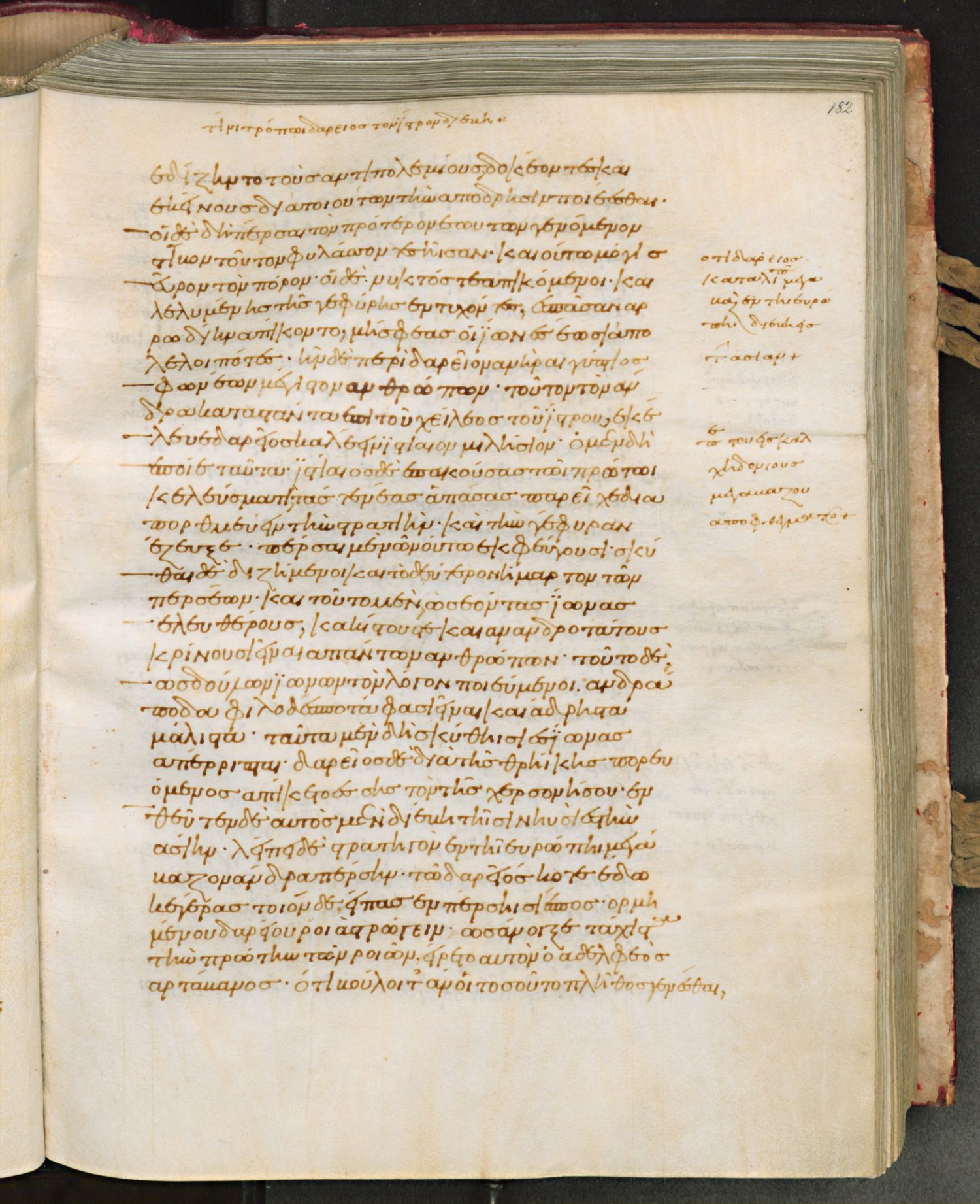
Laur. Plut. 70.3, fol. 182r: Greek here 4.143.1 to 4.143.2. Checked on the image (first and last words read and located in the Greek; each break checked against the neighbouring page): fol. 182r begins ‹ἐδίζηντο τοὺς ἀντιπολεμίους, δοκέοντες› (4.140.3), ends ‹οἱ τοσοῦτο πλῆθος γενέσθαι› (4.143.2). A reader's heading on how Darius crossed the Ister stands in the upper margin. English here: 4.143.1 to 4.143.2 (Godley's sentences for the sections whose Greek lies mostly on this page).
4.143.1Δαρεῖος δὲ διὰ τῆς Θρηίκης πορευόμενος ἀπίκετο ἐς Σηστὸν τῆς Χερσονήσου. ἐνθεῦτεν δὲ αὐτὸς μὲν διέβη τῇσι νηυσὶ ἐς τὴν Ἀσίην, λείπει δὲ στρατηγὸν ἐν τῇ Εὐρώπῃ Μεγάβαζον ἄνδρα Πέρσην· τῷ Δαρεῖος κοτὲ ἔδωκε γέρας, τοιόνδε εἴπας ἐν Πέρσῃσι ἔπος. 4.143.2ὁρμημένου Δαρείου ῥοιὰς τρώγειν, ὡς ἄνοιξε τάχιστα τὴν πρώτην τῶν ῥοιέων, εἴρετο αὐτὸν ὁ ἀδελφεὸς Ἀρτάβανος ὅ τι βούλοιτʼ ἄν οἱ τοσοῦτο πλῆθος γενέσθαι
4.143.1Darius marched through Thrace to Sestos on the Chersonesus; thence he crossed over with his ships to Asia, leaving as his general in Europe Megabazus, a Persian, to whom he once did honour by saying among Persians what I here set down. 4.143.2Darius was about to eat pomegranates; and no sooner had he opened the first of them than his brother Artabanus asked him of what thing he would wish to have as many as there were seeds in his pomegranate; whereupon Darius said, that he would rather have that number of men like Megabazus than make all Hellas subject to him.
Where on the image
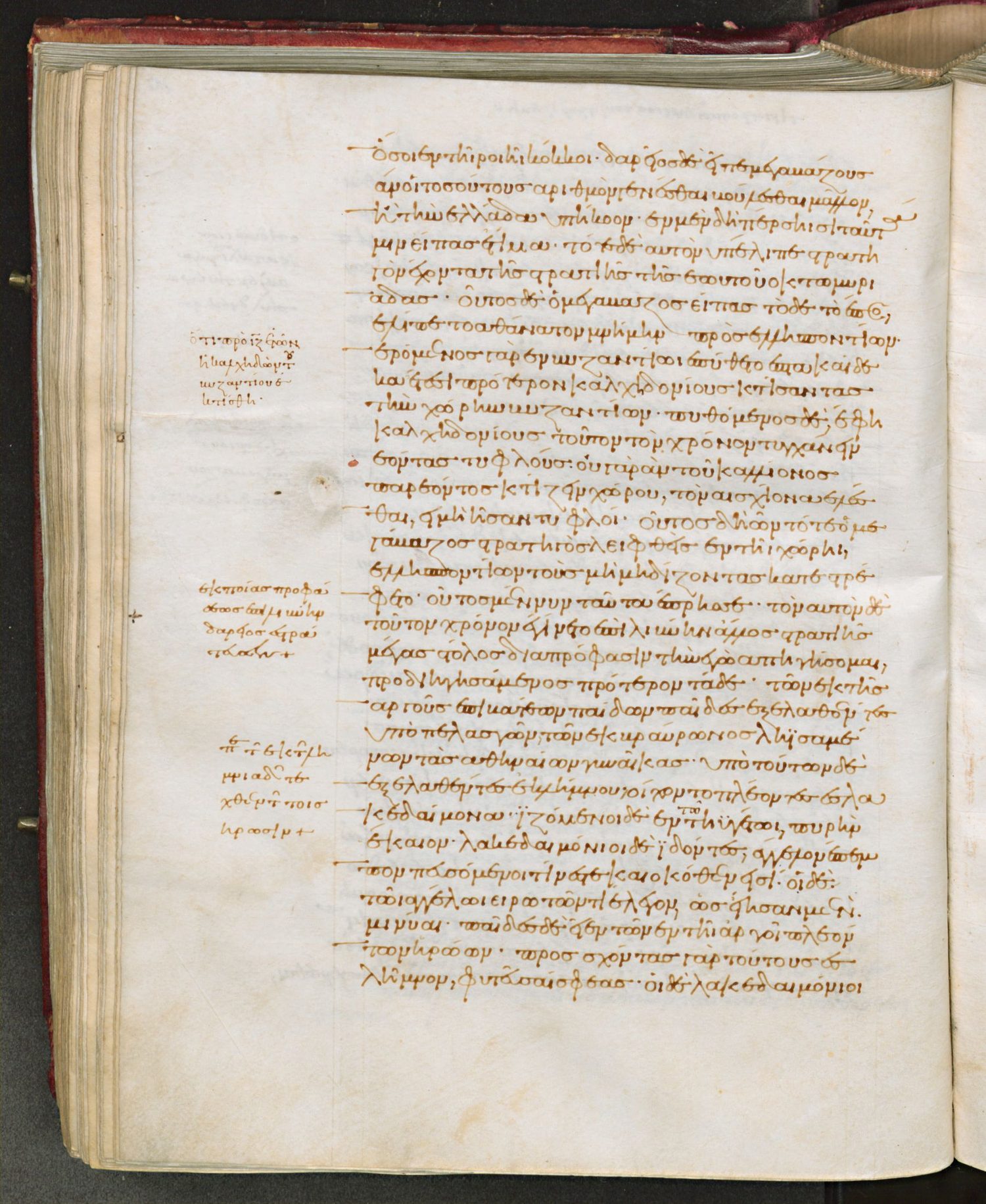
Laur. Plut. 70.3, fol. 182v: Greek here 4.143.2 to 4.145.4. Checked on the image (first and last words read and located in the Greek; each break checked against the neighbouring page): fol. 182v begins ‹ὅσοι ἐν τῇ ῥοιῇ› (4.143.2), ends ‹φυτεῦσαι σφέας.οἱ δὲ Λακεδαιμόνιοι› (4.145.4). English here: 4.143.3 to 4.145.3 (Godley's sentences for the sections whose Greek lies mostly on this page).
4.143.2ὅσοι ἐν τῇ ῥοιῇ κόκκοι· Δαρεῖος δὲ εἶπε Μεγαβάζους ἄν οἱ τοσούτους ἀριθμὸν γενέσθαι βούλεσθαι μᾶλλον ἢ τὴν Ἑλλάδα ὑπήκοον. 4.143.3ἐν μὲν δὴ Πέρσησι ταῦτά μιν εἴπας ἐτίμα, τότε δὲ αὐτὸν ὑπέλιπε στρατηγὸν ἔχοντα τῆς στρατιῆς τῆς ἑωυτοῦ ὀκτὼ μυριάδας. 4.144.1οὗτος δὲ ὁ Μεγάβαζος εἴπας τόδε τὸ ἔπος ἐλίπετο ἀθάνατον μνήμην πρὸς Ἑλλησποντίων. 4.144.2γενόμενος γὰρ ἐν Βυζαντίῳ ἐπύθετο ἑπτακαίδεκα ἔτεσι πρότερον Καλχηδονίους κτίσαντας τὴν χώρην Βυζαντίων, πυθόμενος δὲ ἔφη Καλχηδονίους τοῦτον τὸν χρόνον τυγχάνειν ἐόντας τυφλούς· οὐ γὰρ ἂν τοῦ καλλίονος παρεόντος κτίζειν χώρου τὸν αἰσχίονα ἑλέσθαι, εἰ μὴ ἦσαν τυφλοί. 4.144.3οὗτος δὴ ὦν τότε ὁ Μεγάβαζος στρατηγὸς λειφθεὶς ἐν τῇ χώρῃ Ἑλλησποντίων τοὺς μὴ μηδίζοντας κατεστρέφετο. 4.145.1οὗτος μέν νυν ταῦτα ἔπρησσε. τὸν αὐτὸν δὲ τοῦτον χρόνον ἐγίνετο ἐπὶ Λιβύην ἄλλος στρατιῆς μέγας στόλος, διὰ πρόφασιν τὴν ἐγὼ ἀπηγήσομαι προδιηγησάμενος πρότερον τάδε. 4.145.2τῶν ἐκ τῆς Ἀργοῦς ἐπιβατέων παίδων παῖδες ἐξελασθέντες ὑπὸ Πελασγῶν τῶν ἐκ Βραυρῶνος ληισαμένων τὰς Ἀθηναίων γυναῖκας, ὑπὸ τούτων ἐξελασθέντες ἐκ Λήμνου οἴχοντο πλέοντες ἐς Λακεδαίμονα, ἱζόμενοι δὲ ἐν τῷ Τηϋγέτῳ πῦρ ἀνέκαιον. 4.145.3Λακεδαιμόνιοι δὲ ἰδόντες ἄγγελον ἔπεμπον πευσόμενοι τίνες τε καὶ ὁκόθεν εἰσί· οἳ δὲ τῷ ἀγγέλῳ εἰρωτῶντι ἔλεγον ὡς εἴησαν μὲν Μινύαι, παῖδες δὲ εἶεν τῶν ἐν τῇ Ἀργοῖ πλεόντων ἡρώων, προσσχόντας δὲ τούτους ἐς Λῆμνον φυτεῦσαι σφέας. 4.145.4οἱ δὲ Λακεδαιμόνιοι
4.143.3By thus speaking among Persians the king did honour to Megabazus; and now he left him behind as his general, at the head of eighty thousand of his army. 4.144.1This Megabazus is for ever remembered by the people of the Hellespont for his saying— 4.144.2when, being at Byzantium, he was told that the people of Calchedon had founded their town seventeen years before the Byzantines had founded theirs—that the Calchedonians must at that time have been blind; for had they not been so, they would never have chosen the meaner site for their city when they might have had the fairer. 4.144.3This Megabazus, being now left as general in the country, subdued all the people of the Hellespont who did not take the side of the Persians. 4.145.1Thus Megabazus did. About this time a great armament was sent against Libya also, for a reason which I will show after this story which I will now relate. 4.145.2The descendants of the crew of the Argo had been driven out by those Pelasgians who carried off the Athenian women from Brauron; being driven out of Lemnos by these, they sailed away to Lacedaemon, and there encamped on Taÿgetum and kindled a fire. 4.145.3Seeing this, the Lacedaemonians sent a messenger to enquire who they were and whence they came. They answered the messenger that they were Minyae, descendants of the heroes who had sailed in the Argo, and had put in at Lemnos and there begotten their race.
Where on the image
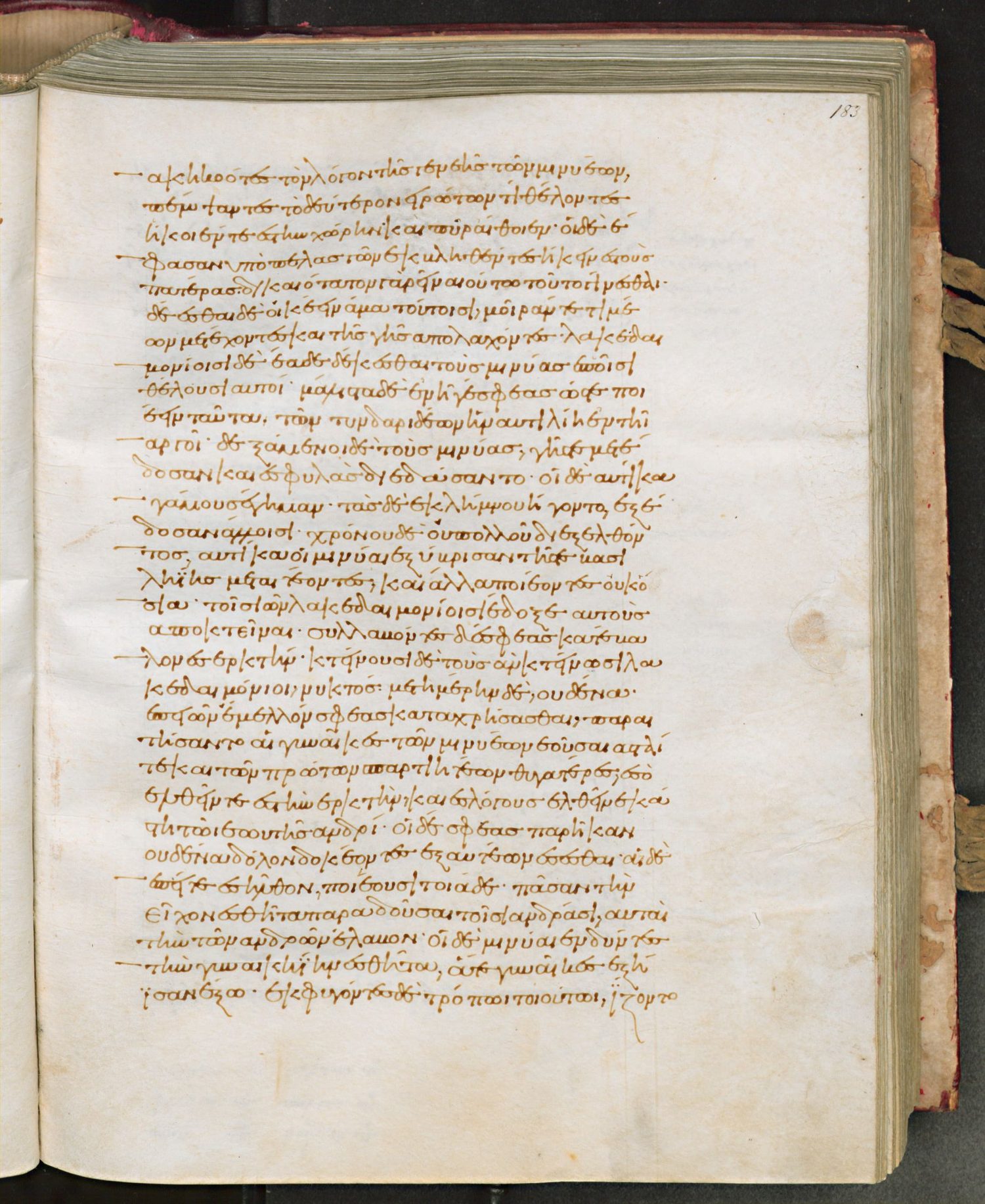
Laur. Plut. 70.3, fol. 183r: Greek here 4.145.4 to 4.146.4. Checked on the image (first and last words read and located in the Greek; each break checked against the neighbouring page): fol. 183r begins ‹ἀκηκοότες τὸν λόγον τῆς› (4.145.4), ends ‹δὲ τρόπῳ τοιούτῳ ἵζοντο› (4.146.4). English here: 4.145.4 to 4.146.4 (Godley's sentences for the sections whose Greek lies mostly on this page).
4.145.4ἀκηκοότες τὸν λόγον τῆς γενεῆς τῶν Μινυέων, πέμψαντες τὸ δεύτερον εἰρώτων τί θέλοντες ἥκοιέν τε ἐς τὴν χώρην καὶ πῦρ αἴθοιεν. οἳ δὲ ἔφασαν ὑπὸ Πελασγῶν ἐκβληθέντες ἥκειν ἐς τοὺς πατέρας· δικαιότατον γὰρ εἶναι οὕτω τοῦτο γίνεσθαι. δέεσθαι δὲ οἰκέειν ἅμα τούτοισι μοῖράν τε τιμέων μετέχοντες καὶ τῆς γῆς ἀπολαχόντες. 4.145.5Λακεδαιμονίοισι δὲ ἕαδε δέκεσθαι τοὺς Μινύας ἐπʼ οἷσι θέλουσι αὐτοί. μάλιστα δὲ ἐνῆγε σφέας ὥστε ποιέειν ταῦτα τῶν Τυνδαριδέων ἡ ναυτιλίη ἐν τῇ Ἀργοῖ. δεξάμενοι δὲ τοὺς Μινύας γῆς τε μετέδοσαν καὶ ἐς φυλὰς διεδάσαντο. οἳ δὲ αὐτίκα μὲν γάμους ἔγημαν, τὰς δὲ ἐκ Λήμνου ἤγοντο ἐξέδοσαν ἄλλοισι. 4.146.1χρόνου δὲ οὐ πολλοῦ διεξελθόντος αὐτίκα οἱ Μινύαι ἐξύβρισαν, τῆς τε βασιληίης μεταιτέοντες καὶ ἄλλα ποιέοντες οὐκ ὅσια. 4.146.2τοῖσι ὦν Λακεδαιμονίοισι ἔδοξε αὐτοὺς ἀποκτεῖναι, συλλαβόντες δὲ σφέας κατέβαλον ἐς ἑρκτήν. κτείνουσι δὲ τοὺς ἂν κτείνωσι Λακεδαιμόνιοι νυκτός, μετʼ ἡμέρην δὲ οὐδένα. 4.146.3ἐπεὶ ὦν ἔμελλον σφέας καταχρήσασθαι, παραιτήσαντο αἱ γυναῖκες τῶν Μινυέων, ἐοῦσαι ἀσταί τε καὶ τῶν πρώτων Σπαρτιητέων θυγατέρες, ἐσελθεῖν τε ἐς τὴν ἑρκτὴν καὶ ἐς λόγους ἐλθεῖν ἑκάστη τῷ ἑωυτῆς ἀνδρί. οἳ δὲ σφέας παρῆκαν, οὐδένα δόλον δοκέοντες ἐξ αὐτέων ἔσεσθαι. 4.146.4αἳ δὲ ἐπείτε ἐσῆλθον, ποιέουσι τοιάδε· πᾶσαν τὴν εἶχον ἐσθῆτα παραδοῦσαι τοῖσι ἀνδράσι αὐταὶ τὴν τῶν ἀνδρῶν ἔλαβον, οἱ δὲ Μινύαι ἐνδύντες τὴν γυναικηίην ἐσθῆτα ἅτε γυναῖκες ἐξήισαν ἔξω, ἐκφυγόντες δὲ τρόπῳ τοιούτῳ ἵζοντο
4.145.4Hearing the story of the lineage of the Minyae, the Lacedaemonians sent a second time and asked to what end they had come into Laconia and kindled a fire. They replied, that being expelled by the Pelasgians they had come to the land of their fathers, as (they said) was most just; and for their desire, it was that they might dwell with their father’s people, sharing in their rights and receiving allotted parcels of land. 4.145.5It pleased the Lacedaemonians to receive the Minyae on the terms which their guests desired; the chief cause of their so consenting was that the Tyndaridae had been in the ship’s company of the Argo; so they received the Minyae and gave them of their land and divided them among their own tribes. The Minyae forthwith wedded wives, and gave in marriage to others the women they had brought from Lemnos. 4.146.1But in no long time these Minyae waxed over-proud, demanding an equal right to the kingship, and doing other impious things; 4.146.2wherefore the Lacedaemonians resolved to slay them, and they seized and cast them into prison. (When the Lacedaemonians kill, they do it by night, never by day.) 4.146.3Now when they were about to kill the prisoners, the wives of the Minyae, who were native to the country, daughters of the chief among the Spartans, entreated leave to enter the prison and have speech each with her husband; the Lacedaemonians granted this, not suspecting that the women would deal craftily with them. 4.146.4But when the wives came into the prison, they gave to their husbands all their own garments, and themselves put on the men’s dress; so the Minyae donned the female dress and so passed out in the guise of women, and having thus escaped once more encamped on Taÿgetum.
Where on the image
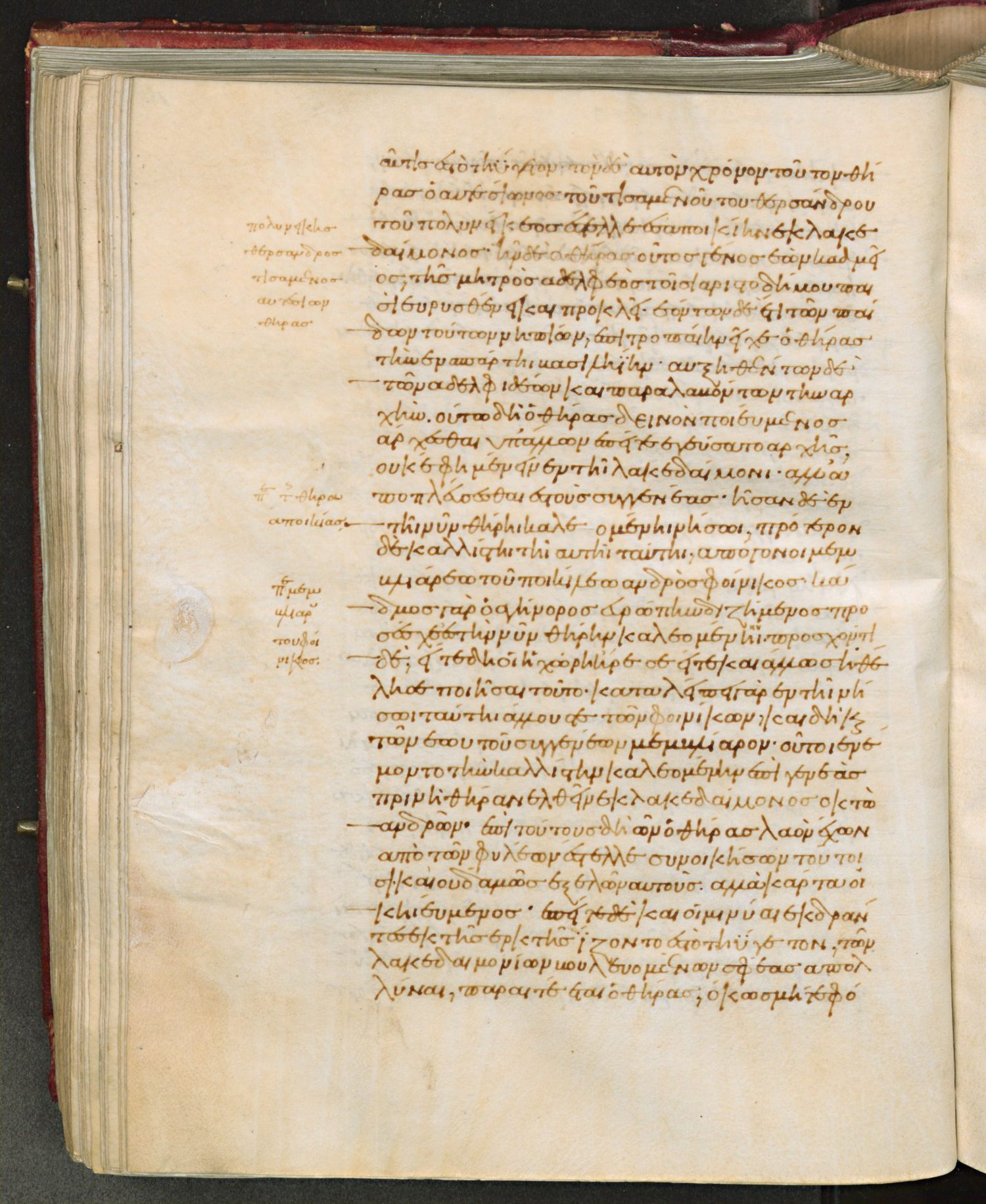
Laur. Plut. 70.3, fol. 183v: Greek here 4.146.4 to 4.148.2. Checked on the image (first and last words read and located in the Greek; each break checked against the neighbouring page): fol. 183v begins ‹αὖτις ἐς τὸ Τηΰγετον.τὸν› (4.146.4), ends ‹Θήρας, ὅκως μήτε φό-› (4.148.2). English here: 4.147.1 to 4.148.2 (Godley's sentences for the sections whose Greek lies mostly on this page).
4.146.4αὖτις ἐς τὸ Τηΰγετον. 4.147.1τὸν δὲ αὐτὸν τοῦτον χρόνον Θήρας ὁ Αὐτεσίωνος τοῦ Τισαμενοῦ τοῦ Θερσάνδρου τοῦ Πολυνείκεος ἔστελλε ἐς ἀποικίην ἐκ Λακεδαίμονος· 4.147.2ἦν δὲ ὁ Θήρας οὗτος, γένος ἐὼν Καδμεῖος, τῆς μητρὸς ἀδελφεὸς τοῖσι Ἀριστοδήμου παισὶ Εὐρυσθένεϊ καὶ Προκλέι. ἐόντων δὲ ἔτι τῶν παίδων τούτων νηπίων ἐπιτροπαίην εἶχε ὁ Θήρας τὴν ἐν Σπάρτῃ βασιληίην. 4.147.3αὐξηθέντων δὲ τῶν ἀδελφιδέων καὶ παραλαβόντων τὴν ἀρχήν, οὕτω δὴ ὁ Θήρας δεινὸν ποιεύμενος ἄρχεσθαι ὑπʼ ἄλλων ἐπείτε ἐγεύσατο ἀρχῆς, οὐκ ἔφη μένειν ἐν τῇ Λακεδαίμονι ἀλλʼ ἀποπλεύσεσθαι ἐς τοὺς συγγενέας. 4.147.4ἦσαν δὲ ἐν τῇ νῦν Θήρῃ καλεομένῃ νήσῳ, πρότερον δὲ Καλλίστῃ τῇ αὐτῇ ταύτῃ, ἀπόγονοι Μεμβλιάρου τοῦ Ποικίλεω ἀνδρὸς Φοίνικος. Κάδμος γὰρ ὁ Ἀγήνορος Εὐρώπην διζήμενος προσέσχε ἐς τὴν νῦν Θήρην καλεομένην· προσσχόντι δὲ εἴτε δή οἱ ἡ χώρη ἤρεσε, εἴτε καὶ ἄλλως ἠθέλησε ποιῆσαι τοῦτο· καταλείπει γὰρ ἐν τῇ νήσῳ ταύτῃ ἄλλους τε τῶν Φοινίκων καὶ δὴ καὶ τῶν ἑωυτοῦ συγγενέων Μεμβλίαρον. 4.147.5οὗτοι ἐνέμοντο τὴν Καλλίστην καλεομένην ἐπὶ γενεάς, πρὶν ἤ Θήραν ἐλθεῖν ἐκ Λακεδαίμονος, ὀκτὼ ἀνδρῶν. 4.148.1ἐπὶ τούτους δὴ ὦν ὁ Θήρας λεὼν ἔχων ἀπὸ τῶν φυλέων ἔστελλε, συνοικήσων τούτοισι καὶ οὐδαμῶς ἐξελῶν αὐτοὺς ἀλλὰ κάρτα οἰκηιούμενος. 4.148.2ἐπείτε δὲ καὶ οἱ Μινύαι ἐκδράντες ἐκ τῆς ἑρκτῆς ἵζοντο ἐς τὸ Τηΰγετον, τῶν Λακεδαιμονίων βουλευομένων σφέας ἀπολλύναι παραιτέεται ὁ Θήρας, ὅκως μήτε φόνος
4.147.1Now about this same time Theras (who was a descendant of Polynices, through Thersander, Tisamenus, and Autesion) was preparing to lead out colonists from Lacedaemon. 4.147.2This Theras was of the lineage of Cadmus and an uncle on the mother’s side of Aristodemus’ sons Eurysthenes and Procles; and while these boys were yet children he held the royal power of Sparta as regent; 4.147.3but when his nephews grew up and became kings, then Theras could not brook to be a subject when he had had a taste of supreme power, and said he would abide no longer in Lacedaemon but sail away to his kinsfolk. 4.147.4There were in the island now called Thera, but then Calliste, descendants of Membliarus the son of Poeciles, a Phoenician; for Cadmus son of Agenor, in his search for Europa, had put in at the place now called Thera; and having put in, either because the land pleased him, or because for some other reason he desired so to do, he left in this island, among other Phoenicians, his own kinsman Membliarus. 4.147.5These dwelt in the island Calliste for eight generations before Theras came from Lacedaemon. 4.148.1It was these whom Theras was preparing to join, taking with him a company of people from the tribes; it was his intent to settle among the folk of Calliste, and not to drive them out but to claim them as verily his own people. 4.148.2So when the Minyae escaped out of prison and encamped on Taÿgetum, and the Lacedaemonians were taking counsel to put them to death, Theras entreated for their lives, that there might be no killing, promising himself to lead them out of the country.
Where on the image
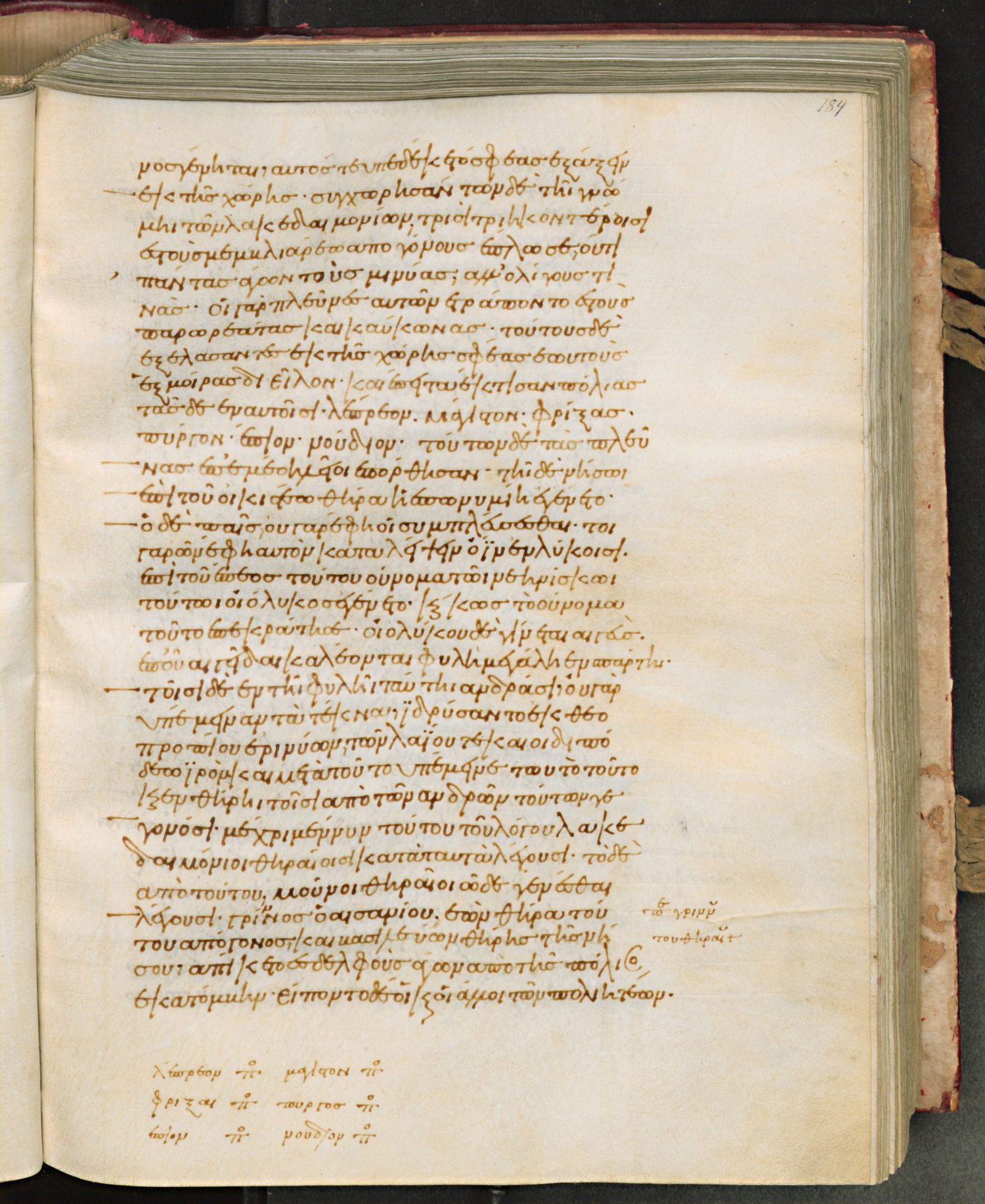
Laur. Plut. 70.3, fol. 184r: Greek here 4.148.2 to 4.150.2. Checked on the image (first and last words read and located in the Greek; each break checked against the neighbouring page): fol. 184r begins ‹-νος γένηται, αὐτός τε› (4.148.2), ends ‹καὶ ἄλλοι τῶν πολιητέων› (4.150.2). The word ‹φόνος› is divided between fol. 183v and fol. 184r; it is given with fol. 183v. Below the text, a reader's note listing place names. English here: 4.148.3 to 4.150.2 (Godley's sentences for the sections whose Greek lies mostly on this page).
4.148.2γένηται, αὐτός τε ὑπεδέκετο σφέας ἐξάξειν ἐκ τῆς χώρης. 4.148.3συγχωρησάντων δὲ τῇ γνώμῃ τῶν Λακεδαιμονίων, τρισὶ τριηκοντέροισι ἐς τοὺς Μεμβιάρου ἀπογόνους ἔπλωσε, οὔτι πάντας ἄγων τοὺς Μινύας ἀλλʼ ὀλίγους τινάς. 4.148.4οἱ γὰρ πλεῦνες αὐτῶν ἐτράποντο ἐς τοὺς Παρωρεάτας καὶ Καύκωνας, τούτους δὲ ἐξελάσαντες ἐκ τῆς χώρης σφέας αὐτοὺς ἓξ μοίρας διεῖλον, καὶ ἔπειτα ἔκτισαν πόλιας τάσδε ἐν αὐτοῖσι, Λέπρεον Μάκιστον Φρίξας Πύργον Ἔπιον Νούδιον. τουτέων δὲ τὰς πλεῦνας ἐπʼ ἐμέο Ἠλεῖοι ἐπόρθησαν. τῇ δὲ νήσῳ ἐπὶ τοῦ οἰκιστέω Θήρα ἡ ἐπωνυμίη ἐγένετο. 4.149.1ὁ δὲ παῖς οὐ γὰρ ἔφη οἱ συμπλεύσεσθαι, τοιγαρῶν ἔφη αὐτὸν καταλείψειν ὄιν ἐν λύκοισι. ἐπὶ του ἔπεος τούτου οὔνομα τῷ νεηνίσκῳ τούτῳ Οἰόλυκος ἐγένετο, καί κως τὸ οὔνομα τοῦτο ἐπεκράτησε. Οἰολύκου δὲ γίνεται Αἰγεύς, ἐπʼ οὗ Αἰγεῖδαι καλέονται φυλὴ μεγάλη ἐν Σπάρτῃ. 4.149.2τοῖσι δὲ ἐν τῇ φυλῇ ταύτῃ ἀνδράσι οὐ γὰρ ὑπέμειναν τὰ τέκνα, ἱδρύσαντο ἐκ θεοπροπίου Ἐρινύων τῶν Λαΐου τε καὶ Οἰδιπόδεω ἱρόν· καὶ μετὰ τοῦτο ὑπέμειναν […] τὠυτὸ τοῦτο καὶ ἐν Θήρῃ τοῖσι ἀπὸ τῶν ἀνδρῶν τούτων γεγονόσι. 4.150.1μέχρι μέν νυν τούτου τοῦ λόγου Λακεδαιμόνιοι Θηραίοισι κατὰ ταὐτὰ λέγουσι, τὸ δὲ ἀπὸ τούτου μοῦνοι Θηραῖοι ὧδε γενέσθαι λέγουσι. 4.150.2Γρῖννος ὁ Αἰσανίου ἐὼν Θήρα τούτου ἀπόγονος καὶ βασιλεύων Θήρης τῆς νήσου ἀπίκετο ἐς Δελφούς, ἄγων ἀπὸ τῆς πόλιος ἑκατόμβην· εἵποντο δέ οἱ καὶ ἄλλοι τῶν πολιητέων
4.148.3The Lacedaemonians consenting to this, Theras sailed with three thirty-oared ships to join the descendants of Membliarus, taking with him not all the Minyae but a few only; 4.148.4for the greater part of them made their way to the lands of the Paroreatae and Caucones, whom having driven out of the country they divided themselves into six companies and founded in the land they had won the cities of Lepreum, Macistus, Phrixae, Pyrgus, Epium, Nudium; most of which were in my time taken and sacked by the Eleans. As for the island Calliste, it was called Thera after its colonist. 4.149.1But as Theras’ son would not sail with him, his father therefore said that he would leave him behind as a sheep among wolves; after which saying the stripling got the nickname of Oeolycus, and it so fell out that this became his customary name. He had a son born to him, Aegeus, from whom the Aegidae, a great Spartan clan, take their name. 4.149.2The men of this clan, finding that none of their children lived, set up, by the instruction of an oracle, a temple of the avenging spirits of Laïus and Oedipus, after which the children lived. Thus it fared also with the children of the Aegidae at Thera. 4.150.1Thus far in my story the Lacedaemonian and Theraean records agree; for the rest we have only the word of the Theraeans. 4.150.2Grinnus son of Aesanius, king of Thera, a descendant of this same Theras, came to Delphi bringing an hecatomb from his city; there came with him, among others of his people, Battus son of Polymnestus, a descendant of Euphemus of the Minyan clan.
Where on the image
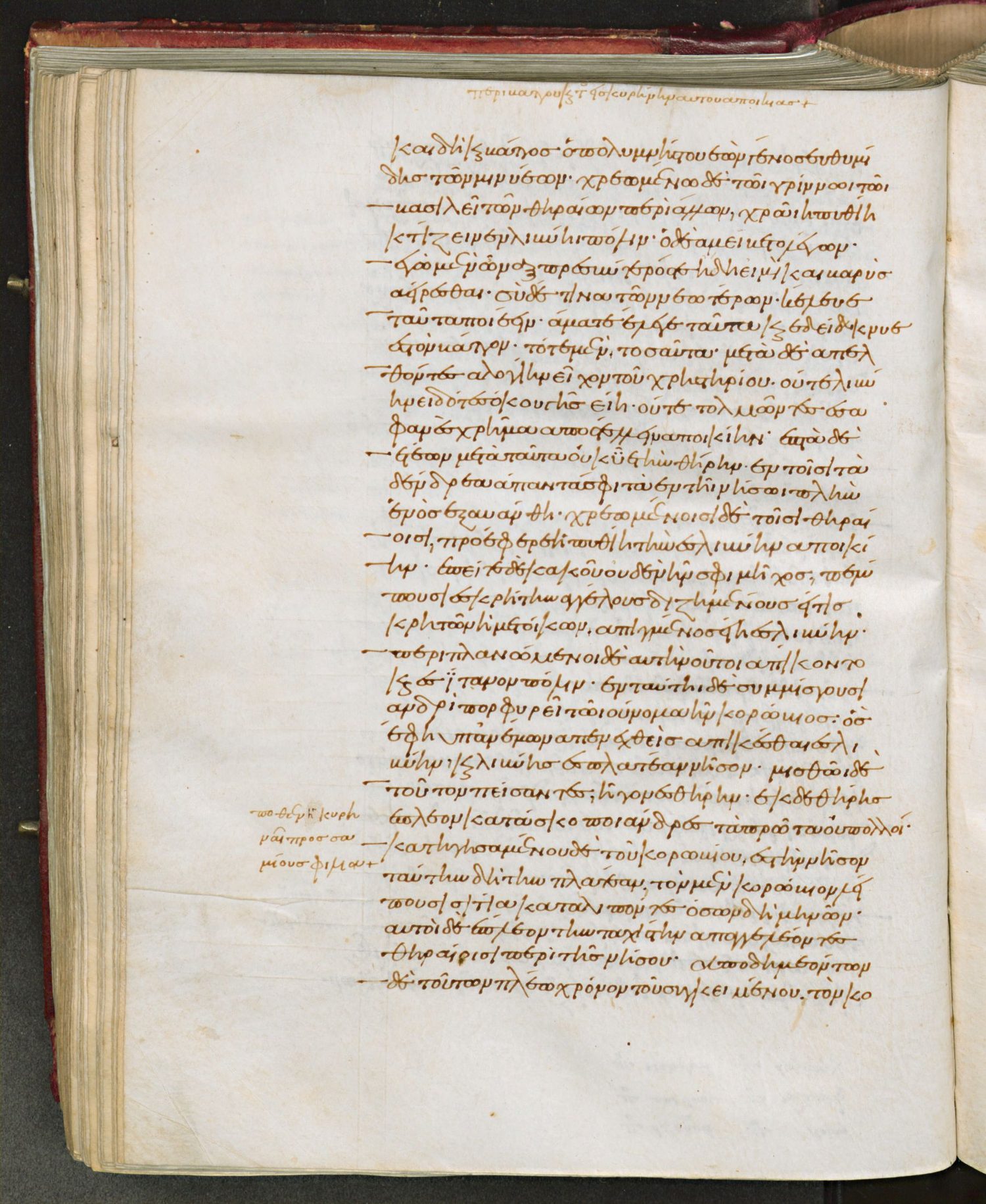
Laur. Plut. 70.3, fol. 184v: Greek here 4.150.2 to 4.152.1. Checked on the image (first and last words read and located in the Greek; each break checked against the neighbouring page): fol. 184v begins ‹καὶ δὴ καὶ Βάττος› (4.150.2), ends ‹τοῦ συγκειμένου τὸν Κο-› (4.152.1). English here: 4.150.3 to 4.151.3 (Godley's sentences for the sections whose Greek lies mostly on this page).
4.150.2καὶ δὴ καὶ Βάττος ὁ Πολυμνήστου, ἐὼν γένος Εὐφημίδης τῶν Μινυέων. 4.150.3χρεωμένῳ δὲ τῷ Γρίννῳ τῷ βασιλέι τῶν Θηραίων περὶ ἄλλων χρᾷ ἡ Πυθίη κτίζειν ἐν Λιβύη πόλιν. ὁ δὲ ἀμείβετο λέγων ἐγὼ μὲν ὦναξ πρεσβύτερός τε ἤδη εἰμὶ καὶ βαρὺς ἀείρεσθαι· σὺ δὲ τινὰ τῶνδε τῶν νεωτέρων κέλευε ταῦτα ποιέειν. ἅμα τε ἔλεγε ταῦτα καὶ ἐδείκνυε ἐς τὸν Βάττον. 4.150.4τότε μὲν τοσαῦτα. μετὰ δὲ ἀπελθόντες ἀλογίην εἶχον τοῦ χρηστηρίου, οὔτε Λιβύην εἰδότες ὅκου γῆς εἴη οὔτε τολμῶντες ἐς ἀφανὲς χρῆμα ἀποστέλλειν ἀποικίην. 4.151.1ἑπτὰ δὲ ἐτέων μετὰ ταῦτα οὐκ ὗε τὴν Θήρην, ἐν τοῖσι τὰ δένδρεα πάντα σφι τὰ ἐν τῇ νήσῳ πλὴν ἑνὸς ἐξαυάνθη. χρεωμένοισι δὲ τοῖσι Θηραίοισι προέφερε ἡ Πυθίη τὴν ἐς Λιβύην ἀποικίην. 4.151.2ἐπείτε δὲ κακοῦ οὐδὲν ἦν σφι μῆχος, πέμπουσι ἐς Κρήτην ἀγγέλους διζημένους εἴ τις Κρητῶν ἢ μετοίκων ἀπιγμένος εἴη ἐς Λιβύην. περιπλανώμενοι δὲ αὐτὴν οὗτοι ἀπίκοντο καὶ ἐς Ἴτανον πόλιν, ἐν ταύτῃ δὲ συμμίσγουσι ἀνδρὶ πορφυρέι τῷ οὕνομα ἦν Κορώβιος, ὃς ἔφη ὑπʼ ἀνέμων ἀπενειχθεὶς ἀπικέσθαι ἐς Λιβύην καὶ Λιβύης ἐς Πλατέαν νῆσον. 4.151.3μισθῷ δὲ τοῦτον πείσαντες ἦγον ἐς Θήρην, ἐκ δὲ Θήρης ἔπλεον κατάσκοποι ἄνδρες τὰ πρῶτα οὐ πολλοί· κατηγησαμένου δὲ τοῦ Κορωβίου ἐς τὴν νῆσον ταύτην δὴ τὴν Πλατέαν, τὸν μέν Κορώβιον λείπουσι, σιτία καταλιπόντες ὅσων δὴ μηνῶν, αὐτοὶ δὲ ἔπλεον τὴν ταχίστην ἀπαγγελέοντες Θηραίοισι περὶ τῆς νήσου. 4.152.1ἀποδημεόντων δὲ τούτων πλέω χρόνον τοῦ συγκειμένου τὸν Κορώβιον
4.150.3When Grinnus king of Thera inquired of the oracle concerning other matters, the priestess’ answer was that he should found a city in Libya. “Nay, Lord,” answered Grinnus, “I am grown old and heavy to stir; do thou lay this command on some one of these younger men,’’ pointing as he spoke to Battus. 4.150.4No more was then said. But when they had departed, they neglected to obey the oracle, seeing that they knew not where Libya was, and feared to send a colony out to an uncertain goal. 4.151.1Then for seven years after this there was no rain in Thera; all their trees in the island save one were withered. The Theraeans inquired again at Delphi, and the priestess made mention of the colony they should send to Libya. 4.151.2So since there was no remedy for their ills, they sent messengers to Crete to seek out any Cretan or sojourner there who had travelled to Libya. These, in their journeys about the island, came to the town of Itanus, where they met a fisher of murex called Corobius, who told them that he had once been driven out of his course by winds to Libya, to an island there called Platea. 4.151.3This man they hired to come with them to Thera; thence but a few men were first sent on shipboard to spy out the land, who, being guided by Corobius to the aforesaid island Platea, left him there with provision for some months, and themselves sailed back with all speed to Thera to bring news of the island.
Where on the image
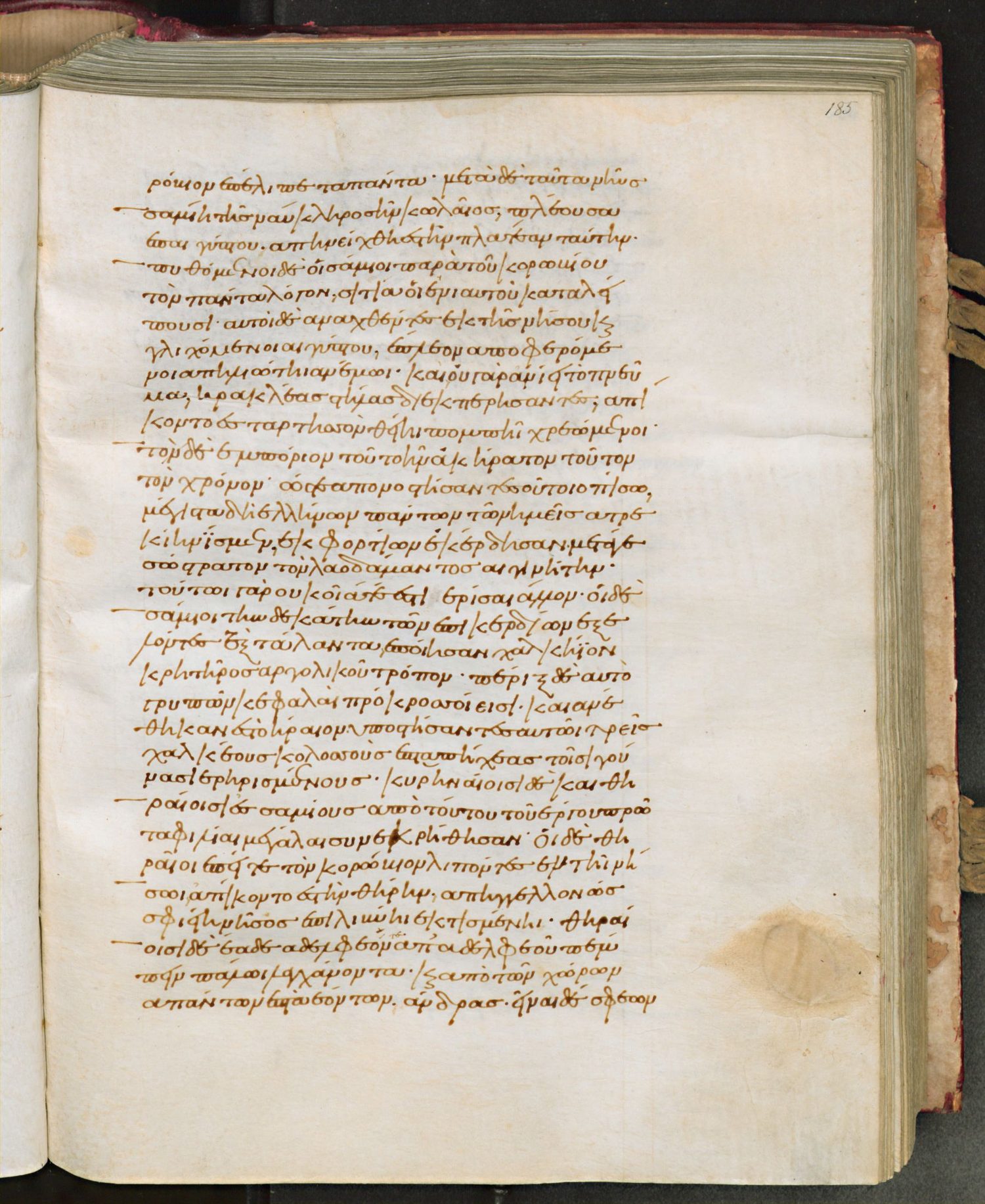
Laur. Plut. 70.3, fol. 185r: Greek here 4.152.1 to 4.153.1. Checked on the image (first and last words read and located in the Greek; each break checked against the neighbouring page): fol. 185r begins ‹-ρώβιον ἐπέλιπε τὰ πάντα,› (4.152.1), ends ‹ἄνδρας, εἶναι δὲ σφέων› (4.153.1). The word ‹Κορώβιον› is divided between fol. 184v and fol. 185r; it is given with fol. 184v. English here: 4.152.1 to 4.153.1 (Godley's sentences for the sections whose Greek lies mostly on this page).
4.152.1ἐπέλιπε τὰ πάντα, μετὰ δὲ ταῦτα νηῦς Σαμίη, τῆς ναύκληρος ἦν Κωλαῖος, πλέουσα ἐπʼ Αἰγύπτου ἀπηνείχθη ἐς τὴν Πλατέαν ταύτην· πυθόμενοι δὲ οἱ Σάμιοι παρὰ τοῦ Κορωβίου τὸν πάντα λόγον, σιτία οἱ ἐνιαυτοῦ καταλείπουσι. 4.152.2αὐτοὶ δὲ ἀναχθέντες ἐκ τῆς νήσου καὶ γλιχόμενοι Αἰγύπτου ἔπλεον, ἀποφερόμενοι ἀπηλιώτῃ ἀνέμῳ· καὶ οὐ γὰρ ἀνίει τὸ πνεῦμα, Ἡρακλέας στήλας διεκπερήσαντες ἀπίκοντο ἐς Ταρτησσόν, θείῃ πομπῇ χρεώμενοι. 4.152.3τὸ δὲ ἐμπόριον τοῦτο ἦν ἀκήρατον τοῦτον τὸν χρόνον, ὥστε ἀπονοστήσαντες οὗτοι ὀπίσω μέγιστα δὴ Ἑλλήνων πάντων τῶν ἡμεῖς ἀτρεκείην ἴδμεν ἐκ φορτίων ἐκέρδησαν, μετά γε Σώστρατον τὸν Λαοδάμαντος Αἰγινήτην· τούτῳ γὰρ οὐκ οἷά τε ἐστὶ ἐρίσαι ἄλλον. 4.152.4οἱ δὲ Σάμιοι τὴν δεκάτην τῶν ἐπικερδίων ἐξελόντες ἓξ τάλαντα ἐποιήσαντο χαλκήιον κρητῆρος Ἀργολικοῦ τρόπον· πέριξ δὲ αὐτοῦ γρυπῶν κεφαλαὶ πρόκροσσοί εἰσι. καὶ ἀνέθηκαν ἐς τὸ Ἥραιον, ὑποστήσαντες αὐτῷ τρεῖς χαλκέους κολοσσοὺς ἑπταπήχεας τοῖσι γούνασι ἐρηρεισμένους. 4.152.5Κυρηναίοισι δὲ καὶ Θηραίοισι ἐς Σαμίους ἀπὸ τούτου τοῦ ἔργου πρῶτα φιλίαι μεγάλαι συνεκρήθησαν. 4.153.1οἱ δὲ Θηραῖοι ἐπείτε τὸν Κορώβιον λιπόντες ἐν τῇ νήσῳ ἀπίκοντο ἐς τὴν Θήρην, ἀπήγγελλον ὥς σφι εἴη νῆσος ἐπὶ Λιβύῃ ἐκτισμένη. Θηραίοισι δὲ ἕαδε ἀδελφεόν τε ἀπʼ ἀδελφεοῦ πέμπειν πάλῳ λαγχάνοντα καὶ ἀπὸ τῶν χώρων ἁπάντων ἑπτὰ ἐόντων ἄνδρας, εἶναι δὲ σφέων
4.152.1But when they had been away for longer than the agreed time, and Corobius had no provision left, a Samian ship sailing for Egypt, whereof the captain was Colaeus, was driven out of her course to Platea, where the Samians heard the whole story from Corobius and left him provision for a year; 4.152.2they then put out to sea from the island and would have voyaged to Egypt, but an easterly wind drove them from their course, and ceased not till they had passed through the Pillars of Heracles and came (by heaven’s providence) to Tartessus. 4.152.3Now this was at that time a virgin port; wherefore the Samians brought back from it so great a profit on their wares as no Greeks ever did of whom we have any exact knowledge, save only Sostratus of Aegina, son of Laodamas; with him none could vie. 4.152.4The Samians took six talents, the tenth part of their profit, and made therewith a bronze vessel, like an Argolic cauldron, with griffins’ heads projecting from the rim all round; this they set up in their temple of Here, supporting it with three colossal kneeling figures of bronze, each seven cubits high. 4.152.5This that the Samians had done was the beginning of a close friendship between them and the men of Cyrene and Thera. 4.153.1As for the Theraeans, when they came to Thera after leaving Corobius on the island, they brought word that they had founded a settlement on an island off Libya. The Theraeans resolved to send out men from their seven regions, taking by lot one of every pair of brothers, and making Battus leader and king of all. Then they manned two fifty-oared ships and sent them to Platea.
Where on the image
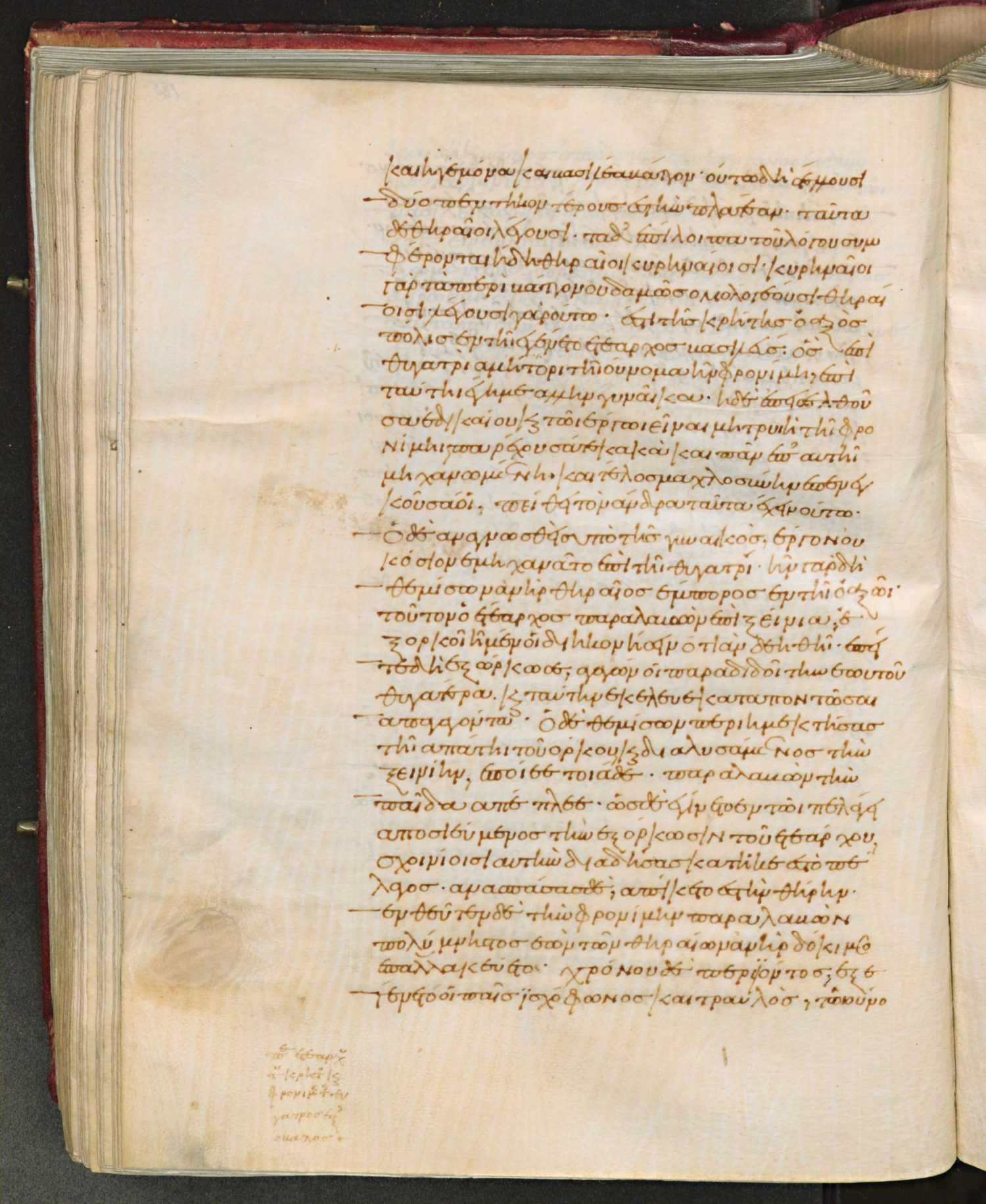
Laur. Plut. 70.3, fol. 185v: Greek here 4.153.1 to 4.155.1. Checked on the image (first and last words read and located in the Greek; each break checked against the neighbouring page): fol. 185v begins ‹καὶ ἡγεμόνα καὶ βασιλέα› (4.153.1), ends ‹καὶ τραυλός, τῷ οὔνομα› (4.155.1). English here: 4.154.1 to 4.155.2 (Godley's sentences for the sections whose Greek lies mostly on this page).
4.153.1καὶ ἡγεμόνα καὶ βασιλέα Βάττον. οὕτω δὴ στέλλουσι δύο πεντηκοντέρους ἐς τὴν Πλατέαν. 4.154.1ταῦτα δὲ Θηραῖοι λέγουσι, τὰ δʼ ἐπίλοιπα τοῦ λόγου συμφέρονται ἤδη Θηραῖοι Κυρηναίοισι. Κυρηναῖοι γὰρ τὰ περὶ Βάττον οὐδαμῶς ὁμολογέουσι Θηραίοισι λέγουσι γὰρ οὕτω. ἔστι τῆς Κρήτης Ὀαξὸς πόλις, ἐν τῇ ἐγένετο Ἐτέαρχος βασιλεύς, ὃς ἐπὶ θυγατρὶ ἀμήτορι τῇ οὔνομα ἦν Φρονίμη, ἐπὶ ταύτῃ ἔγημε ἄλλην γυναῖκα. 4.154.2ἣ δὲ ἐπεσελθοῦσα ἐδικαίου καὶ τῷ ἔργῳ εἶναι μητρυιὴ τῇ Φρονίμῃ, παρέχουσα τε κακὰ καὶ πᾶν ἐπʼ αὐτῇ μηχανωμένη, καὶ τέλος μαχλοσύνην ἐπενείκασά οἱ πείθει τὸν ἄνδρα ταῦτα ἔχειν οὕτω. ὁ δὲ ἀναγνωσθεὶς ὑπὸ τῆς γυναικὸς ἔργον οὐκ ὅσιον ἐμηχανᾶτο ἐπὶ τῇ θυγατρί. 4.154.3ἦν γὰρ δὴ Θεμίσων ἀνὴρ Θηραῖος ἔμπορος ἐν τῇ Ὀαξῷ· τοῦτον ὁ Ἐτέαρχος παραλαβὼν ἐπὶ ξείνια ἐξορκοῖ ἦ μέν οἱ διηκονήσειν ὅ τι ἂν δεηθῇ. ἐπείτε δὴ ἐξώρκωσε, ἀγαγών οἱ παραδιδοῖ τὴν ἑωυτοῦ θυγατέρα καὶ ταύτην ἐκέλευε καταποντῶσαι ἀπαγαγόντα. 4.154.4ὁ δὲ Θεμίσων περιημεκτήσας τῇ ἀπάτῃ τοῦ ὅρκου καὶ διαλυσάμενος τὴν ξεινίην ἐποίεε τοιάδε· παραλαβὼν τὴν παῖδα ἀπέπλεε· ὡς δὲ ἐγίνετο ἐν τῷ πελάγεϊ, ἀποσιεύμενος τὴν ἐξόρκωσιν τοῦ Ἐτεάρχου, σχοινίοισι αὐτὴν διαδήσας κατῆκε ἐς τὸ πέλαγος, ἀνασπάσας δὲ ἀπίκετο ἐς τὴν Θήρην. 4.155.1ἐνθεῦτεν δὲ τὴν Φρονίμην παραλαβὼν Πολύμνηστος, ἐὼν τῶν Θηραίων ἀνὴρ δόκιμος, ἐπαλλακεύετο. χρόνου δὲ περιιόντος ἐξεγένετό οἱ παῖς ἰσχόφωνος καὶ τραυλός, τῷ οὔνομα
4.154.1This is what the Theraeans say; and now begins the part in which the Theraean and Cyrenaean stories agree, but not till now, for the Cyrenaeans tell a wholly different tale of Battus, which is this. There is a town in Crete called Oaxus, of which one Etearchus became ruler. He had a motherless daughter called Phronime, but he must needs marry another wife too. 4.154.2When the second wife came into his house, she thought fit to be in very deed a stepmother to Phronime, ill-treating her and devising all evil against her; at last she accused the girl of lewdness, and persuaded her husband that the charge was true. So Etearchus was over-persuaded by his wife and devised a great sin against his daughter. 4.154.3There was at Oaxus a Theraean trader, one Themison; Etearchus made this man his guest and friend, and took an oath of him that he would do him whatever service he desired; which done, he gave the man his own daughter, bidding him take her away and throw her into the sea. 4.154.4But Themison was very angry at being so tricked with the oath and renounced his friendship with Etearchus; presently he took the girl and sailed away, and that he might duly fulfil the oath that he had sworn to Etearchus, when he was on the high seas he bound her about with ropes and let her down into the sea and drew her up again, and presently came to Thera. 4.155.1There Polymnestus, a notable Theraean, took Phronime and made her his concubine. In time there was born to him a son of weak and stammering speech, to whom he gave the name Battus, as the Theraeans and Cyrenaeans say; but to my thinking the boy was given some other name, 4.155.2and changed it to Battus on his coming to Libya, taking this new name by reason of the oracle given to him at Delphi and the honourable office which he received. For the Libyan word for king is “battus,” and this (methinks) is why the Pythian priestess called him so in her prophecy, using a Libyan name because she knew that he was to be king in Libya.
Where on the image
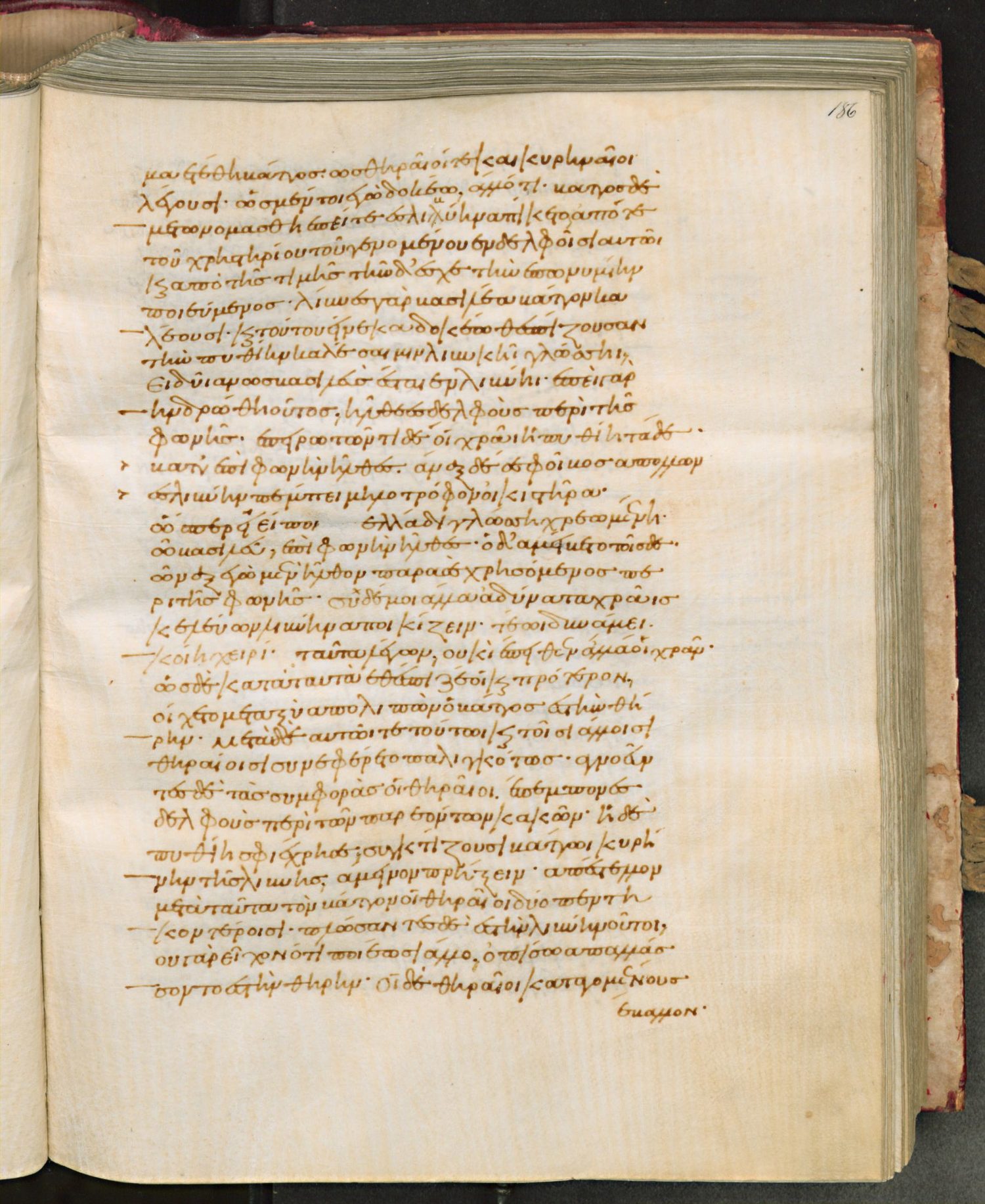
Laur. Plut. 70.3, fol. 186r: Greek here 4.155.1 to 4.156.3. Checked on the image (first and last words read and located in the Greek; each break checked against the neighbouring page): fol. 186r begins ‹ἐτέθη Βάττος, ὡς Θηραῖοι› (4.155.1), ends ‹δὲ Θηραῖοι καταγομένους ἔβαλλον› (4.156.3). The last line holds only ἔβαλλον; the manuscript reads καταγομένους where the edition prints καταπλέοντας (4.156.3). English here: 4.155.3 to 4.156.2 (Godley's sentences for the sections whose Greek lies mostly on this page).
4.155.1ἐτέθη Βάττος, ὡς Θηραῖοι τε καὶ Κυρηναῖοι λέγουσι, ὡς μέντοι ἐγὼ δοκέω, ἄλλο τι· 4.155.2Βάττος δὲ μετωνομάσθη, ἐπείτε ἐς Λιβύην ἀπίκετο, ἀπό τε τοῦ χρηστηρίου τοῦ γενομένου ἐν Δελφοῖσι αὐτῷ καὶ ἀπὸ τῆς τιμῆς τὴν ἔσχε τὴν ἐπωνυμίην ποιεύμενος. Λίβυες γὰρ βασιλέα βάττον καλέουσι, καὶ τούτου εἵνεκα δοκέω θεσπίζουσαν τὴν Πυθίην καλέσαι μιν Λιβυκῇ γλώσσῃ, εἰδυῖαν ὡς βασιλεὺς ἔσται ἐν Λιβύῃ. 4.155.3ἐπείτε γὰρ ἠνδρώθη οὗτος, ἦλθε ἐς Δελφοὺς περὶ τῆς φωνῆς· ἐπειρωτῶντι δέ οἱ χρᾷ ἡ Πυθίη τάδε.
Βάττʼ ἐπὶ φωνὴν ἦλθες. ἄναξ δέ σε Φοῖβος Ἀπόλλων
ἐς Λιβύην πέμπει μηλοτρόφον οἰκιστῆρα,
ὥσπερ εἰ εἴποι Ἑλλάδι γλώσσῃ χρεωμένη ὦ βασιλεῦ, ἐπὶ φωνὴν ἦλθες. 4.155.4ὃ δʼ ἀμείβετο τοῖσιδε. ὦναξ, ἐγὼ μὲν ἦλθον παρὰ σὲ χρησάμενος περὶ τῆς φωνῆς, σὺ δέ μοι ἄλλα ἀδύνατα χρᾷς, κελεύων Λιβύην ἀποικίζειν τέῳ δυνάμι, κοίῃ χειρί; ταῦτα λέγων οὐκὶ ἔπειθε ἄλλα οἱ χρᾶν· ὡς δε κατὰ ταὐτὰ ἐθέσπιζέ οἱ καὶ πρότερον, οἴχετο μεταξὺ ἀπολιπὼν ὁ Βάττος ἐς τὴν Θήρην. 4.156.1μετὰ δὲ αὐτῷ τε τούτῳ καὶ τοῖσι ἄλλοισι Θηραίοισι συνεφέρετο παλιγκότως. ἀγνοεῦντες δὲ τὰς συμφορὰς οἱ Θηραῖοι ἔπεμπον ἐς Δελφοὺς περὶ τῶν παρεόντων κακῶν. 4.156.2ἡ δὲ Πυθίη σφι ἔχρησε συγκτίζουσι Βάττῳ Κυρήνην τῆς Λιβύης ἄμεινον πρήξειν. ἀπέστελλον μετὰ ταῦτα τὸν Βάττον οἱ Θηραῖοι δύο πεντηκοντέροισι. πλώσαντες δὲ ἐς τὴν Λιβύην οὗτοι, οὐ γὰρ εἶχον ὅ τι ποιέωσι ἄλλο, ὀπίσω ἀπαλλάσσοντο ἐς τὴν Θήρην. 4.156.3οἱ δὲ Θηραῖοι καταγομένους ἔβαλλον
4.155.3For when he came to man’s estate, he went to Delphi to enquire concerning his voice; and the priestess in answer gave him this oracle: “Battus, thou askest a voice; but the King, ev’n Phoebus Apollo,
Sends thee to found thee a home in Libya, the country of sheepfolds,” even as though she said to him, using our word, “O King, thou askest a voice.” 4.155.4But he made answer: “Lord, I came to thee to enquire concerning my speech; but thy answer is of other matters, things impossible of performance; thou biddest me plant a colony in Libya; where shall I get me the power or might of hand for it?” Thus spoke Battus, but the god not being won to give him another oracle and ever answering as before, he departed while the priestess yet spake, and went away to Thera. 4.156.1But afterwards matters went untowardly with Battus and the rest of the Theraeans; and when, knowing not the cause of their misfortunes, they sent to Delphi to enquire concerning their present ills, 4.156.2the priestess declared that they would fare better if they aided Battus to plant a colony at Cyrene in Libya. Then the Theraeans sent Battus with two fifty-oared ships; these sailed to Libya, but presently not knowing what else to do returned back to Thera.
Where on the image
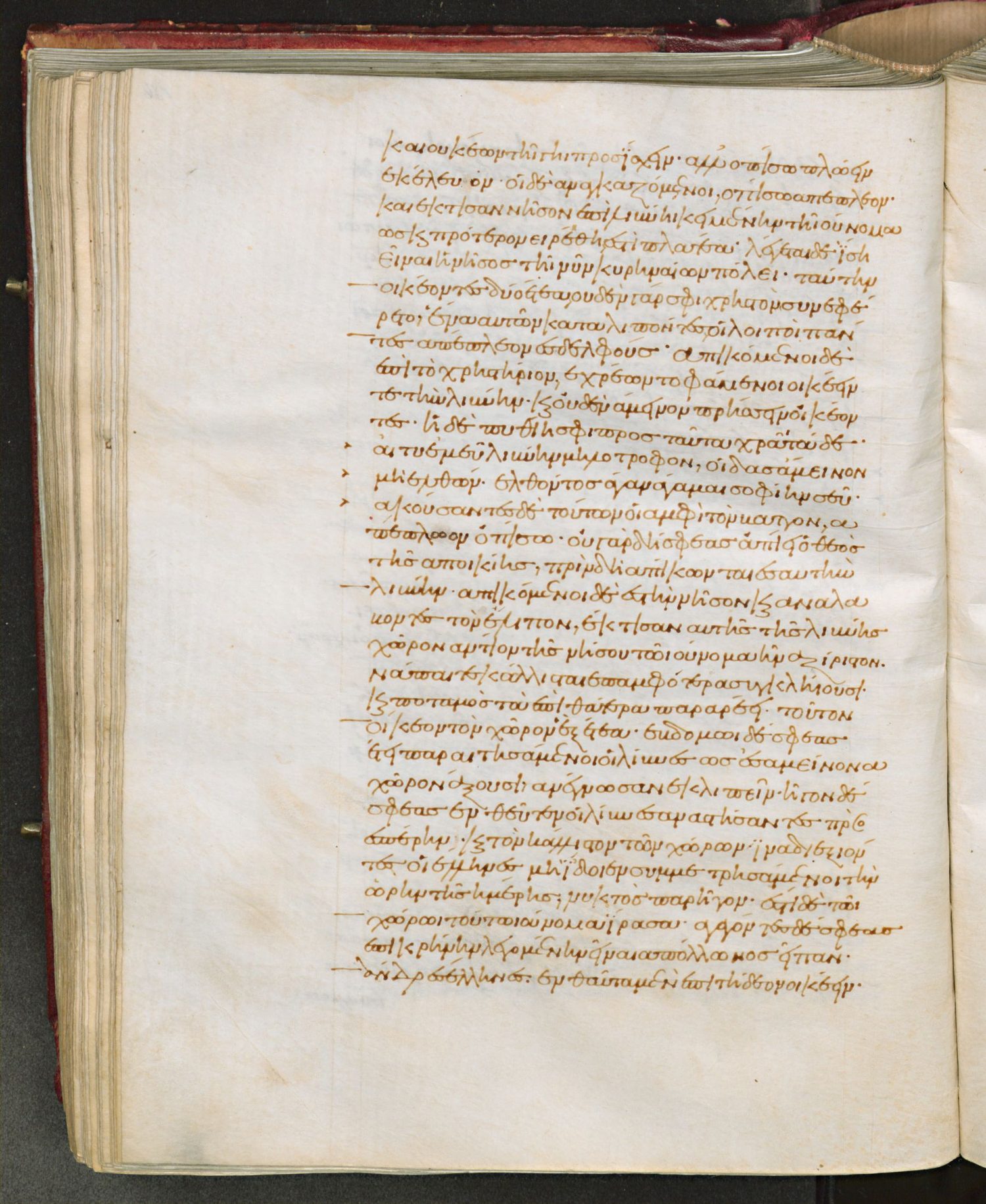
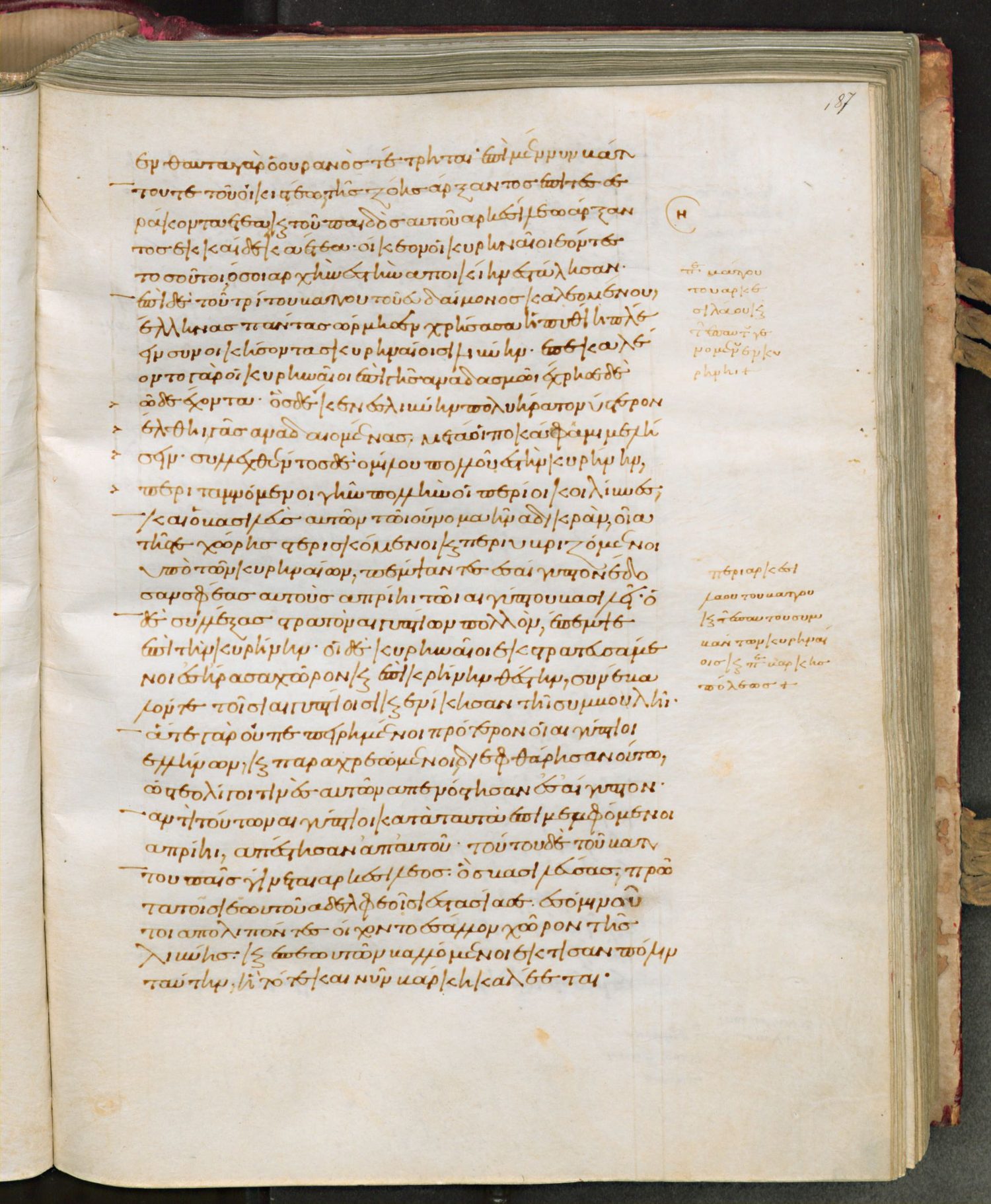
Laur. Plut. 70.3, fol. 186v, 187r: Greek here 4.156.3 to 4.158.3. Checked on the image (first and last words read and located in the Greek; each break checked against the neighbouring page): fol. 186v begins ‹καὶ οὐκ ἔων τῇ› (4.156.3), ends ‹ἐνθαῦτα ὑμῖν ἐπιτήδεον οἰκέειν› (4.158.3). fol. 187r begins ‹ἐνθαῦτα γὰρ ὁ οὐρανὸς› (4.158.3), ends ‹καὶ νῦν Βάρκη κλέεται› (4.160.1). This section joins the text of fol. 186v and 187r that belongs to these chapters, because the part on one of the pages is too short to carry any of Godley's sentences on its own. English here: 4.156.3 to 4.158.3 (Godley's sentences for the sections whose Greek lies mostly on this page).
4.156.3καὶ οὐκ ἔων τῇ γῇ προσίσχειν, ἀλλʼ ὀπίσω πλώειν ἐκέλευον. οἳ δὲ ἀναγκαζόμενοι ὀπίσω ἀπέπλεον καὶ ἔκτισαν νῆσον ἐπὶ Λιβύῃ κειμένην, τῇ οὔνομα, ὡς καὶ πρότερον εἰρέθη, ἐστὶ Βλατέα. λέγεται δὲ ἴση εἶναι ἡ νῆσος τῇ νῦν Κυρηναίων πόλι. 4.157.1ταύτην οἰκέοντες δύο ἔτεα, οὐδὲν γάρ σφι χρηστὸν συνεφέρετο, ἕνα αὐτῶν καταλιπόντες οἱ λοιποὶ πάντες ἀπέπλεον ἐς Δελφούς, ἀπικόμενοι δὲ ἐπὶ τὸ χρηστήριον ἐχρέωντο, φάμενοι οἰκέειν τε τὴν Λιβύην καὶ οὐδὲν ἄμεινον πρήσσειν οἰκεῦντες. 4.157.2ἡ δὲ Πυθίη σφι πρὸς ταῦτα χρᾷ τάδε.
αἰ τὺ ἐμεῦ Λιβύην μηλοτρόφον οἶδας ἄμεινον,
μὴ ἐλθὼν ἐλθόντος, ἄγαν ἄγαμαι σοφίην σεῦ.
ἀκούσαντες δὲ τούτων οἱ ἀμφὶ τὸν Βάττον ἀπέπλωον ὀπίσω· οὐ γὰρ δή σφεας ἀπίει ὁ θεὸς τῆς ἀποικίης, πρὶν δὴ ἀπίκωνται ἐς αὐτὴν Λιβύην. 4.157.3ἀπικόμενοι δὲ ἐς τὴν νῆσον καὶ ἀναλαβόντες τὸν ἔλιπον, ἔκτισαν αὐτῆς τῆς Λιβύης χῶρον ἀντίον τῆς νήσου τῷ οὔνομα ἦν Ἄζιρις· τὸν νάπαι τε κάλλισται ἐπʼ ἀμφότερα συγκληίουσι καὶ ποταμὸς τὰ ἐπὶ θάτερα παραρρέει. 4.158.1τοῦτον οἴκεον τὸν χῶρον ἓξ ἔτεα, ἑβδόμῳ δὲ σφέας ἔτει παραιτησάμενοι οἱ Λίβυες ὡς ἐς ἀμείνονα χῶρον ἄξουσι, ἀνέγνωσαν ἐκλιπεῖν. 4.158.2ἦγον δὲ σφέας ἐνθεῦτεν οἱ Λίβυες ἀναστήσαντες πρὸς ἑσπέρην, καὶ τὸν κάλλιστον τῶν χώρων ἵνα διεξιόντες οἱ Ἕλληνες μὴ ἴδοιεν, συμμετρησάμενοι τὴν ὥρην τῆς ἡμέρης νυκτὸς παρῆγον. ἔστι δὲ τῷ χώρῳ τούτῳ οὔνομα Ἴρασα. 4.158.3ἀγαγόντες δὲ σφέας ἐπὶ κρήνην λεγομένην εἶναι Ἀπόλλωνος εἶπαν ἄνδρες Ἕλληνες, ἐνθαῦτα ὑμῖν ἐπιτήδεον οἰκέειν. ἐνθαῦτα γὰρ ὁ οὐρανὸς τέτρηται.
4.156.3There the Theraeans shot at them as they came to land and would not suffer the ship to put in, bidding them sail back; which under stress of necessity they did, and planted a colony in an island off the Libyan coast called (as I have said already) Platea. This island is said to be as big as the city of Cyrene is now. 4.157.1Here they dwelt for two years; but as all went wrong with them, leaving there one of themselves the rest voyaged to Delphi, and on their coming enquired of the oracle, and said that they were dwelling in Libya, but that they were none the better off for that. 4.157.2Then the priestess gave them this reply: “I have seen Libya’s pastures: thine eyes have never beheld them.
Knowest them better than I? then wondrous indeed is thy wisdom.” Hearing this, Battus and his men sailed back again; for the god would not suffer them to do aught short of colonising Libya itself; 4.157.3and having come to the island and taken again him whom they had left there, they made a settlement at a place in Libya itself, over against the island which was called Aziris This is a place enclosed on both sides by the fairest of groves, and a river flows by one side of it. 4.158.1Here they dwelt for six years; but in the seventh the Libyans persuaded them by entreaty to leave the place, saying that they would lead them to a better; 4.158.2and they brought the Greeks from Aziris and led them westwards, so reckoning the hours of daylight that they led the Greeks by night past the fairest place in their country, called I rasa, lest the Greeks should see it in their passage. 4.158.3Then they brought the Greeks to what is called the Fountain of Apollo, and said to them: “Here, ye Greeks, it befits you to dwell; for here is a hole in the sky.”
Notes
- Greek: the text printed in A. D. Godley's Loeb edition, via Perseus (tlg0016.tlg001.perseus-grc2). Square brackets mark words the editor considers later additions; [...] marks a gap the editor indicates. Perseus note markers are omitted.
- English: A. D. Godley, Herodotus vol. 2 (1921) (Loeb Classical Library), as transcribed on Wikisource. Godley's footnotes are omitted.
- Section numbers in the English were placed by comparing Godley's text with the Perseus version of his translation; where a section begins inside one of Godley's sentences, the English is kept with the page that holds the start of that sentence.
Cite
Sources
- Source: Florence, Laur. Plut. 70.3 (10th c.) via BML Teca Digitale + Greek of Godley's Loeb (Perseus) + English of A. D. Godley (Loeb, Wikisource) (holding institution)
- Critical edition: Greek of A. D. Godley's Loeb edition (1920-1925), via Perseus
← previous · → next · v cycle view · l back to library