Herodotus, Histories 4.37-45: The shape of the world: Asia, Libya and Europe
Introduction
Herodotus of Halicarnassus wrote the Histories in the third quarter of the 5th century BCE, an inquiry into the deeds of Greeks and barbarians and the causes of the wars between them, later divided into nine books. Book 4 tells of Darius' expedition against the Scythians, with Herodotus' account of Scythia, its peoples, rivers and customs, and of the shape of the world, and of the Persian expedition against Barca, with the history of Cyrene and a description of the peoples of Libya.
The photographs are of Florence, Biblioteca Medicea Laurenziana, Plut. 70.3 (parchment, 10th century, 374 folios, 31 lines a page), Herodotus, Histories (codex A of the editors), the oldest surviving manuscript of the complete Histories, from the Teca Digitale of the Biblioteca Medicea Laurenziana. Each section below is the text of one page, or of the part of a page that falls within these chapters. The first and last words of every page were read on the photograph and located in the Greek, and every page break was checked against the next page; the notes quote these words. Readers' notes in the margins are not part of the text and are mentioned where they occur.
The Greek is the text printed in A. D. Godley's Loeb edition (1920-1925), from Perseus; it is the edited text, not a transcription of the manuscript, whose wording differs in places. The English is Godley's translation as printed, from Wikisource. Godley's English carries only chapter numbers; the section numbers shown in it were placed by comparison with the Perseus version of his translation. Each page's English is cut at the end of one of Godley's sentences, so it can begin or end a few lines away from the Greek of the page; each note gives the exact ranges.
This entry covers chapters 4.37-45, on fol. 155v to 158r.
How was this verified? (Provenance)
Where on the image
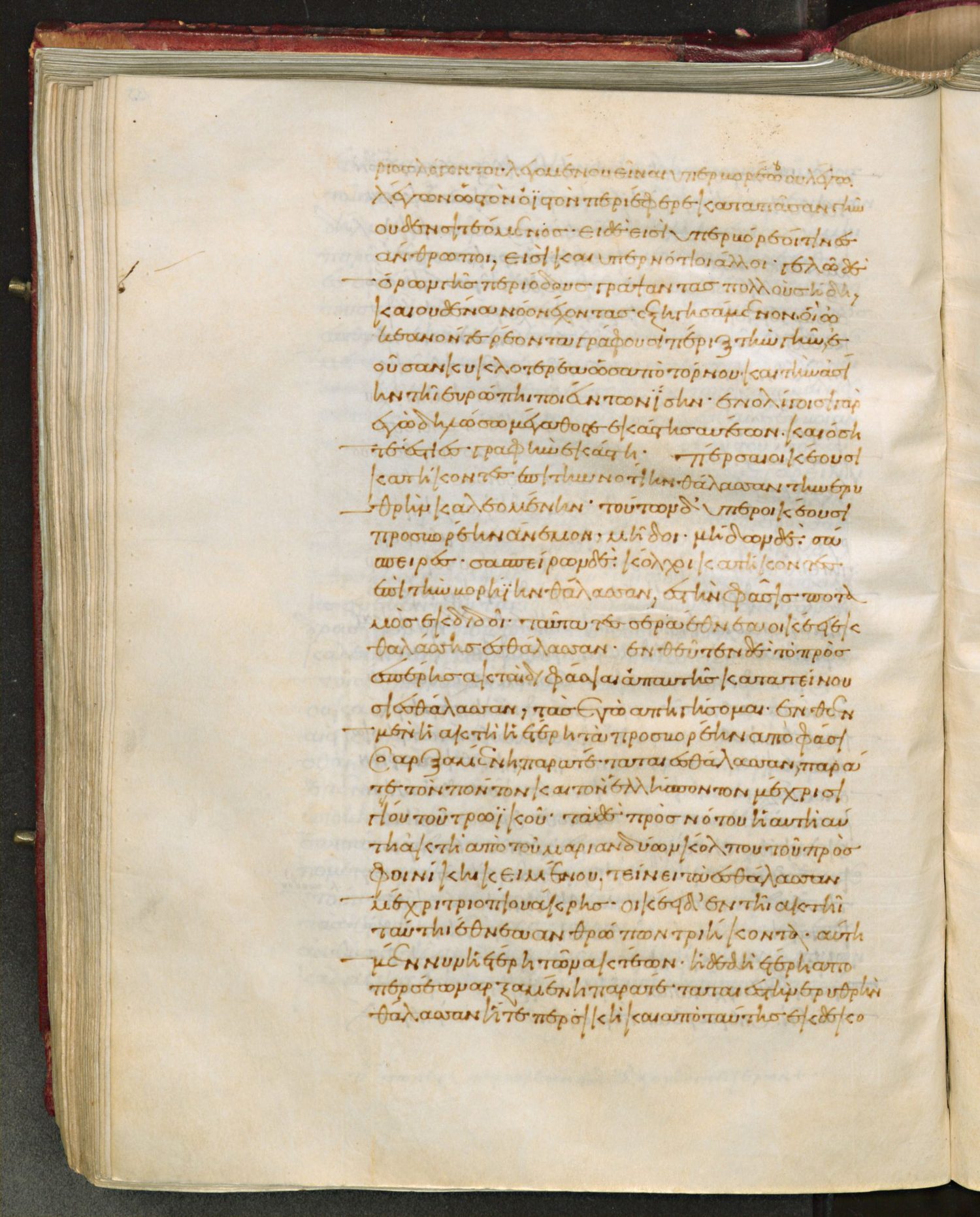
Laur. Plut. 70.3, fol. 155v: Greek here 4.37.1 to 4.39.1. Checked on the image (first and last words read and located in the Greek; each break checked against the neighbouring page): fol. 155v begins ‹-ριος λόγον τοῦ λεγομένου› (4.36.1), ends ‹καὶ ἀπὸ ταύτης ἐκδεκο-› (4.39.1). The word ‹Ἀβάριος› is divided between fol. 155r and fol. 155v; it is given with fol. 155r. English here: 4.37.1 to 4.39.1 (Godley's sentences for the sections whose Greek lies mostly on this page).
4.37.1Πέρσαι οἰκέουσι κατήκοντες ἐπὶ τὴν νοτίην θάλασσαν τὴν Ἐρυθρὴν καλεομένην, τούτων δὲ ὑπεροικέουσι πρὸς βορέην ἄνεμον Μῆδοι, Μήδων δὲ Σάσπειρες, Σασπείρων δὲ Κόλχοι κατήκοντες ἐπὶ τὴν βορηίην θάλασσαν, ἐς τὴν Φᾶσις ποταμὸς ἐκδιδοῖ. ταῦτα τέσσερα ἔθνεα οἰκέει ἐκ θαλάσσης ἐς θάλασσαν. 4.38.1ἐνθεῦτεν δὲ τὸ πρὸς ἑσπέρης ἀκταὶ διφάσιαι ἀπʼ αὐτῆς κατατείνουσι ἐς θάλασσαν, τὰς ἐγὼ ἀπηγήσομαι· 4.38.2ἔνθεν μὲν ἡ ἀκτὴ ἡ ἑτέρη τὰ πρὸς βορέην ἀπὸ Φάσιος ἀρξαμένη παρατέταται ἐς θάλασσαν παρά τε τὸν Πόντον καὶ τὸν Ἑλλήσποντον μέχρι Σιγείου τοῦ Τρωικοῦ· τὰ δὲ πρὸς νότου ἡ αὐτὴ αὕτη ἀκτὴ ἀπὸ τοῦ Μυριανδικοῦ κόλπου τοῦ πρὸς Φοινίκῃ κειμένου τείνει τὰ ἐς θάλασσαν μέχρι Τριοπίου ἄκρης. οἰκέει δὲ ἐν τῇ ἀκτῇ ταύτῃ ἔθνεα ἀνθρώπων τριήκοντα. 4.39.1αὕτη μέν νυν ἡ ἑτέρη τῶν ἀκτέων, ἡ δὲ δὴ ἑτέρη ἀπὸ Περσέων ἀρξαμένη παρατέταται ἐς τὴν Ἐρυθρὴν θάλασσαν, ἥ τε Περσικὴ καὶ ἀπὸ ταύτης ἐκδεκομένη
4.37.1The land where the Persians dwell reaches to the southern sea, that sea which is called Red; beyond these to the north are the Medes, and beyond the Medes the Saspires, and beyond the Saspires the Colchians, whose country reaches to the northern sea into which issues the river Phasis; so these four nations dwell between the one sea and the other. 4.38.1But westwards of this region two peninsulas stretch out from it into the sea, which I will now describe. 4.38.2On the north side one of the peninsulas begins at the Phasis and stretches seaward along the Pontus and the Hellespont, as far as Sigeum in the Troad; on the south side the same peninsula has a seacoast beginning at the Myriandric gulf that is near Phoenice, and stretching seaward as far as the Triopian headland. On this peninsula dwell thirty nations. 4.39.1This is the first peninsula. But the second, beginning with Persia, stretches to the Red Sea, being the Persian land, and next the neighbouring country of Assyria, and after Assyria, Arabia; this peninsula ends (yet not truly but only by common consent) at the Arabian Gulf, whereunto Darius brought a canal from the Nile.
Where on the image
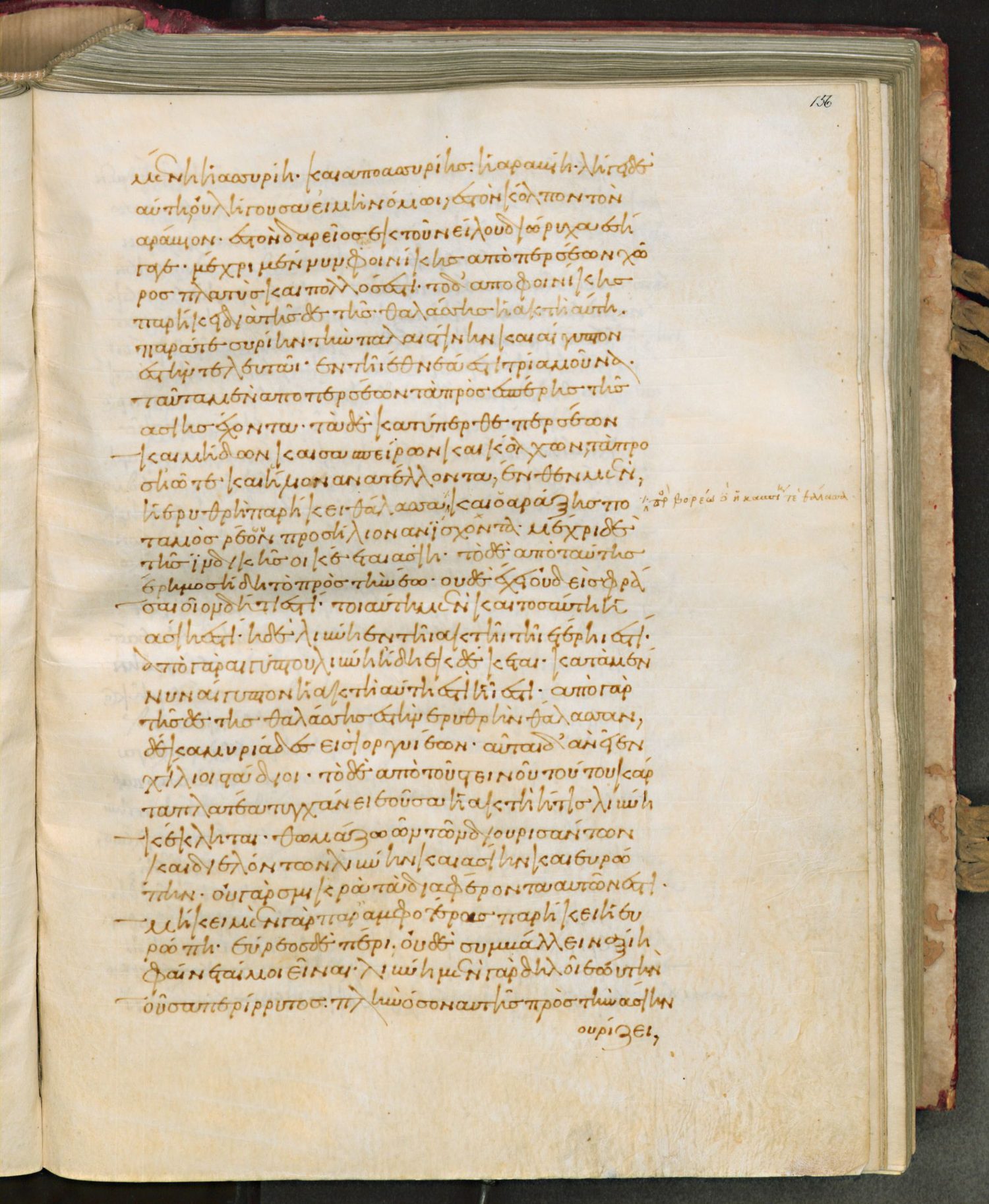
Laur. Plut. 70.3, fol. 156r: Greek here 4.39.1 to 4.42.2. Checked on the image (first and last words read and located in the Greek; each break checked against the neighbouring page): fol. 156r begins ‹-μένη ἡ Ἀσσυρίη καὶ› (4.39.1), ends ‹πρὸς τὴν Ἀσίην οὐρίζει› (4.42.2). The word ‹ἐκδεκομένη› is divided between fol. 155v and fol. 156r; it is given with fol. 155v. English here: 4.39.2 to 4.42.1 (Godley's sentences for the sections whose Greek lies mostly on this page).
4.39.1ἡ Ἀσσυρίη καὶ ἀπὸ Ἀσσυρίης ἡ Ἀραβίη· λήγει δὲ αὕτη, οὐ λήγουσα εἰ μὴ νόμῳ, ἐς τὸν κόλπον τὸν Ἀράβιον, ἐς τὸν Δαρεῖος ἐκ τοῦ Νείλου διώρυχα ἐσήγαγε. 4.39.2μέχρι μέν νυν Φοινίκης ἀπὸ Περσέων χῶρος πλατὺς καὶ πολλός ἐστι· τὸ δὲ ἀπὸ Φοινίκης παρήκει διὰ τῆσδε τῆς θαλάσσης ἡ ἀκτὴ αὕτη παρά τε Συρίην τὴν Παλαιστίνην καὶ Αἴγυπτον, ἐς τὴν τελευτᾷ· ἐν τῇ ἔθνεα ἐστὶ τρία μοῦνα. 4.40.1ταῦτα μὲν ἀπὸ Περσέων τὰ πρὸς ἑσπέρην τῆς Ἀσίης ἔχοντα ἐστί· τὰ δὲ κατύπερθε Περσέων καὶ Μήδων καὶ Σασπείρων καὶ Κόλχων, τὰ πρὸς ἠῶ τε καὶ ἥλιον ἀνατέλλοντα, ἔνθεν μὲν ἡ Ἐρυθρὴ παρήκει θάλασσα, πρὸς βορέω δὲ ἡ Κασπίη τε θάλασσα καὶ ὁ Ἀράξης ποταμός, ῥέων πρὸς ἥλιον ἀνίσχοντα. 4.40.2μέχρι δὲ τῆς Ἰνδικῆς οἰκέεται Ἀσίη· τὸ δὲ ἀπὸ ταύτης ἔρημος ἤδη τὸ πρὸς τὴν ἠῶ, οὐδὲ ἔχει οὐδεὶς φράσαι οἷον δή τι ἐστί. 4.41.1τοιαύτη μὲν καὶ τοσαύτη ἡ Ἀσίη ἐστί, ἡ δὲ Λιβύη ἐν τῇ ἀκτῇ τῇ ἑτέρῃ ἐστί· ἀπὸ γὰρ Αἰγύπτου Λιβύη ἤδη ἐκδέκεται. κατὰ μέν νυν Αἴγυπτον ἡ ἀκτὴ αὕτη στεινή ἐστι· ἀπὸ γὰρ τῆσδε τῆς θαλάσσης ἐς τὴν Ἐρυθρὴν θάλασσαν δέκα μυριάδες εἰσὶ ὀργυιέων, αὗται δʼ ἂν εἶεν χίλιοι στάδιοι· τὸ δὲ ἀπὸ τοῦ στεινοῦ τούτου κάρτα πλατέα τυγχάνει ἐοῦσα ἡ ἀκτὴ ἥτις Λιβύη κέκληται. 4.42.1θωμάζω ὦν τῶν διουρισάντων καὶ διελόντων Λιβύην τε καὶ Ἀσίην καὶ Εὐρώπην· οὐ γὰρ σμικρὰ τὰ διαφέροντα αὐτέων ἐστί· μήκεϊ μὲν γὰρ παρʼ ἀμφοτέρας παρήκει ἡ Εὐρώπη, εὔρεος δὲ πέρι οὐδὲ συμβάλλειν ἀξίη φαίνεταί μοι εἶναι. 4.42.2Λιβύη μὲν γὰρ δηλοῖ ἑωυτὴν ἐοῦσα περίρρυτος, πλὴν ὅσον αὐτῆς πρὸς τὴν Ἀσίην οὐρίζει,
4.39.2Now from the Persian country to Phoenice there is a wide and great tract of land; and from Phoenice this peninsula runs beside our sea by the way of the Syrian Palestine and Egypt, which is at the end of it; in this peninsula there are but three nations. 4.40.1So much for the parts of Asia west of the Persians. But what is beyond the Persians, and Medes, and Saspires, and Colchians, eastward and toward the rising sun, this is bounded on the one hand by the Red Sea, and to the north by the Caspian Sea, and the river Araxes, that flows towards the sun’s rising. 4.40.2As far as India, Asia is an inhabited land; but thereafter all to the east is desert, nor can any man say what kind of land is there. 4.41.1Such is Asia and such its extent. But Libya is on this second peninsula; for Libya comes next after Egypt. The Egyptian part of this peninsula is narrow; for from our sea to the Red Sea it is a distance of an hundred thousand fathoms, that is, a thousand furlongs; but after this narrow part the peninsula which is called Libya is very broad. 4.42.1I wonder, then, at those who have mapped out and divided the world into Libya, Asia, and Europe; for the difference between them is great, seeing that in length Europe stretches along both the others together, and it appears to me to be beyond all comparison broader.
Where on the image
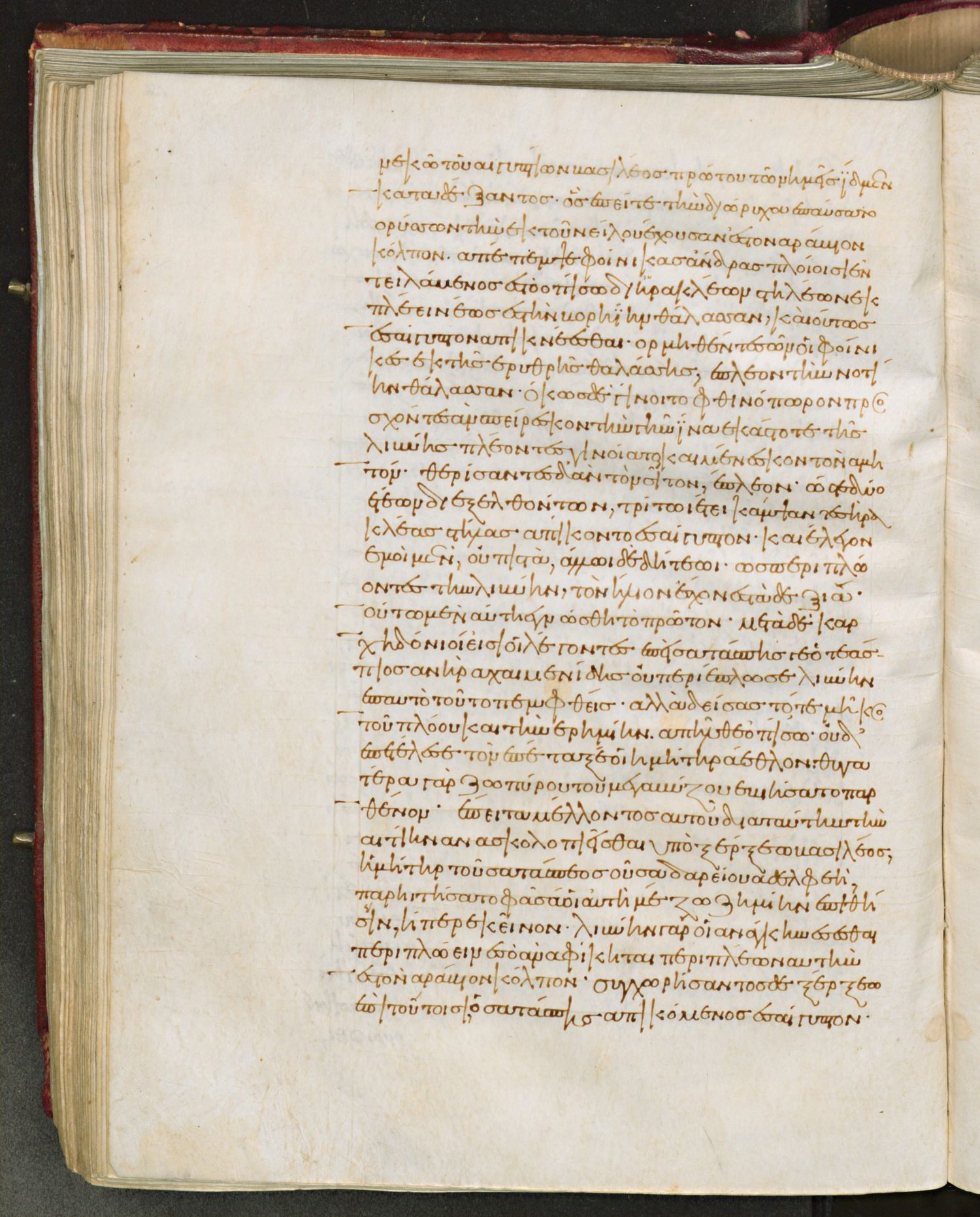
Laur. Plut. 70.3, fol. 156v: Greek here 4.42.2 to 4.43.3. Checked on the image (first and last words read and located in the Greek; each break checked against the neighbouring page): fol. 156v begins ‹Νεκῶ τοῦ Αἰγυπτίων βασιλέος› (4.42.2), ends ‹Σατάσπης ἀπικόμενος ἐς Αἴγυπτον› (4.43.3). English here: 4.42.2 to 4.43.3 (Godley's sentences for the sections whose Greek lies mostly on this page).
4.42.2Νεκῶ τοῦ Αἰγυπτίων βασιλέος πρώτου τῶν ἡμεῖς ἴδμεν καταδέξαντος· ὃς ἐπείτε τὴν διώρυχα ἐπαύσατο ὀρύσσων τὴν ἐκ τοῦ Νείλου διέχουσαν ἐς τὸν Ἀράβιον κόλπον, ἀπέπεμψε Φοίνικας ἄνδρας πλοίοισι, ἐντειλάμενος ἐς τὸ ὀπίσω διʼ Ἡρακλέων στηλέων ἐκπλέειν ἕως ἐς τὴν βορηίην θάλασσαν καὶ οὕτω ἐς Αἴγυπτον ἀπικνέεσθαι. 4.42.3ὁρμηθέντες ὦν οἱ Φοίνικες ἐκ τῆς Ἐρυθρῆς θαλάσσης ἔπλεον τὴν νοτίην θάλασσαν· ὅκως δὲ γίνοιτο φθινόπωρον προσσχόντες ἂν σπείρεσκον τὴν γῆν, ἵνα ἑκάστοτε τῆς Λιβύης πλέοντες γινοίατο, καὶ μένεσκον τὸν ἄμητον· 4.42.4θερίσαντες δʼ ἂν τὸν σῖτον ἔπλεον, ὥστε δύο ἐτέων διεξελθόντων τρίτῳ ἔτεϊ κάμψαντες Ἡρακλέας στήλας ἀπίκοντο ἐς Αἴγυπτον. καὶ ἔλεγον ἐμοὶ μὲν οὐ πιστά, ἄλλῳ δὲ δή τεῳ, ὡς περιπλώοντες τὴν Λιβύην τὸν ἥλιον ἔσχον ἐς τὰ δεξιά. 4.43.1οὕτω μὲν αὕτη ἐγνώσθη τὸ πρῶτον, μετὰ δὲ Καρχηδόνιοι εἰσὶ οἱ λέγοντες· ἐπεὶ Σατάσπης γε ὁ Τεάσπιος ἀνὴρ Ἀχαιμενίδης οὐ περιέπλωσε Λιβύην, ἐπʼ αὐτὸ τοῦτο πεμφθείς, ἀλλὰ δείσας τό τε μῆκος τοῦ πλόου καὶ τὴν ἐρημίην ἀπῆλθε ὀπίσω, οὐδʼ ἐπετέλεσε τὸν ἐπέταξε οἱ ἡ μήτηρ ἄεθλον. 4.43.2θυγατέρα γὰρ Ζωπύρου τοῦ Μεγαβύζου ἐβιήσατο παρθένον· ἔπειτα μέλλοντος αὐτοῦ διὰ ταύτην τὴν αἰτίην ἀνασκολοπιεῖσθαι ὑπὸ Ξέρξεω βασιλέος, ἡ μήτηρ τοῦ Σατάσπεος ἐοῦσα Δαρείου ἀδελφεὴ παραιτήσατο, φᾶσά οἱ αὐτὴ μέζω ζημίην ἐπιθήσειν ἤ περ ἐκεῖνον· 4.43.3Λιβύην γάρ οἱ ἀνάγκην ἔσεσθαι περιπλώειν, ἐς ὃ ἂν ἀπίκηται περιπλέων αὐτὴν ἐς τὸν Ἀράβιον κόλπον. συγχωρήσαντος δὲ Ξέρξεω ἐπὶ τούτοισι, ὁ Σατάσπης ἀπικόμενος ἐς Αἴγυπτον
4.42.2For Libya shows clearly that it is encompassed by the sea, save only where it borders on Asia; and this was proved first (as far as we know) by Necos king of Egypt. He, when he had made an end of digging the canal which leads from the Nile to the Arabian Gulf, sent Phoenicians in ships, charging them to sail on their return voyage past the Pillars of Heracles till they should come into the northern sea and so to Egypt. 4.42.3So the Phoenicians set out from the Red Sea and sailed the southern sea; whenever autumn came they would put in and sow the land, to whatever part of Libya they might come, and there await the harvest; 4.42.4then, having gathered in the crop, they sailed on, so that after two years had passed, it was in the third that they rounded the Pillars of Heracles and came to Egypt. There they said (what some may believe, though I do not) that in sailing round Libya they had the sun on their right hand. 4.43.1Thus the first knowledge of Libya was gained. The next story is that of the Carchedonians: for as for Sataspes son of Teaspes, an Achaemenid, he did not sail round Libya, though he was sent for that end; but he feared the length and the loneliness of the voyage and so returned back without accomplishing the task laid upon him by his mother. 4.43.2For he had raped the virgin daughter of Zopyrus son of Megabyzus; and when on this charge he was to be impaled by King Xerxes, Sataspes’ mother, who was Darius’ sister, begged for his life, saying that she would lay a heavier punishment on him than did Xerxes; 4.43.3for he should be compelled to sail round Libya, till he completed his voyage and came to the Arabian Gulf. Xerxes agreeing to this, Sataspes went to Egypt, where he received a ship and a crew from the Egyptians, and sailed past the Pillars of Heracles.
Where on the image
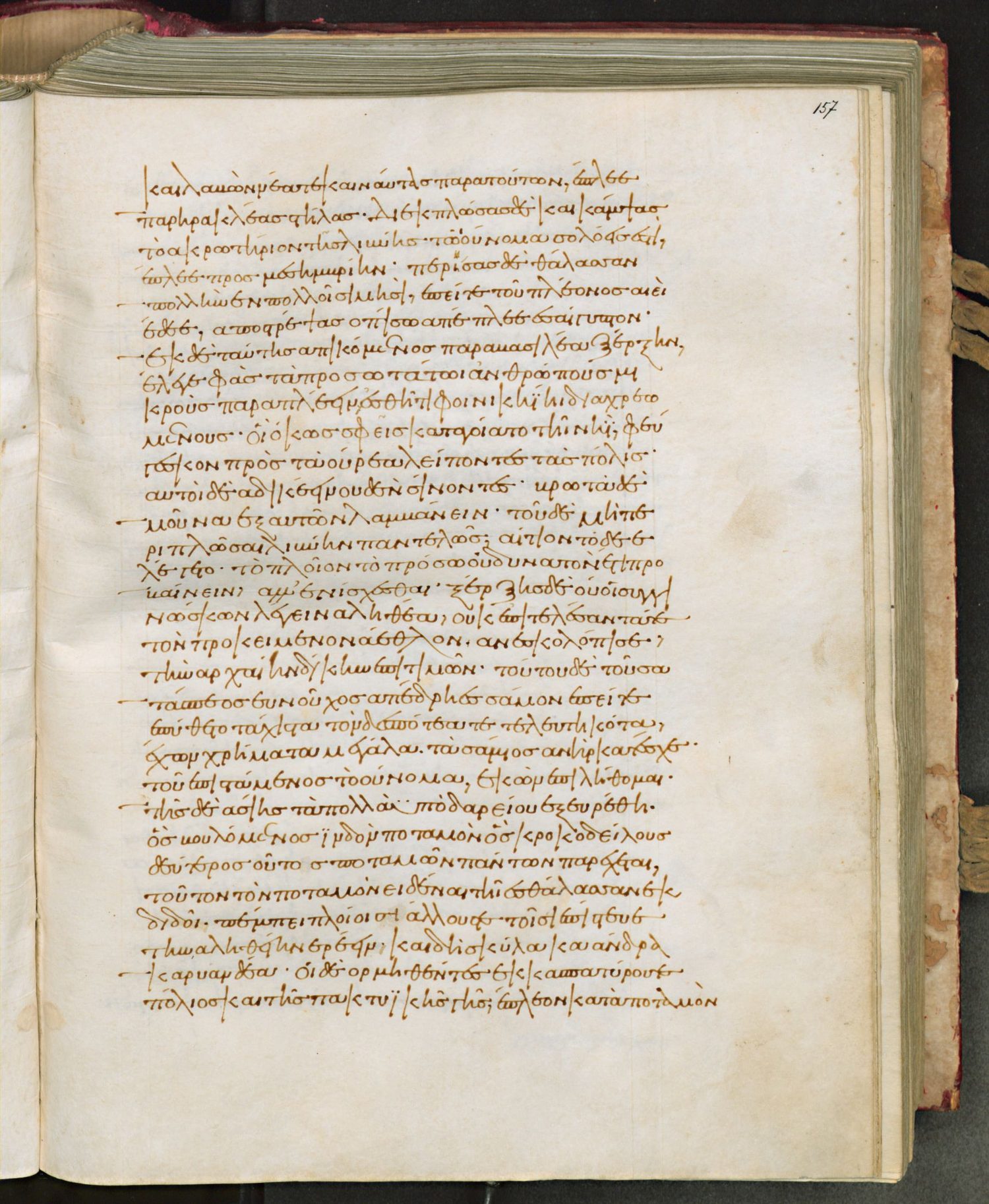
Laur. Plut. 70.3, fol. 157r: Greek here 4.43.3 to 4.44.2. Checked on the image (first and last words read and located in the Greek; each break checked against the neighbouring page): fol. 157r begins ‹καὶ λαβὼν νέα τε› (4.43.3), ends ‹γῆς ἔπλεον κατὰ ποταμὸν› (4.44.2). English here: 4.43.4 to 4.44.2 (Godley's sentences for the sections whose Greek lies mostly on this page).
4.43.3καὶ λαβὼν νέα τε καὶ ναύτας παρὰ τούτων ἔπλεε ἐπὶ Ἡρακλέας στήλας· 4.43.4διεκπλώσας δὲ καὶ κάμψας τὸ ἀκρωτήριον τῆς Λιβύης τῷ οὔνομα Σολόεις ἐστί, ἔπλεε πρὸς μεσαμβρίην· περήσας δὲ θάλασσαν πολλὴν ἐν πολλοῖσι μησί, ἐπείτε τοῦ πλεῦνος αἰεὶ ἔδεε, ἀποστρέψας ὀπίσω ἀπέπλεε ἐς Αἴγυπτον. 4.43.5ἐκ δὲ ταύτης ἀπικόμενος παρὰ βασιλέα Ξέρξεα ἔλεγε φὰς τὰ προσωτάτω ἀνθρώπους μικροὺς παραπλέειν ἐσθῆτι φοινικηίῃ διαχρεωμένους, οἳ ὅκως σφεῖς καταγοίατο τῇ νηὶ φεύγεσκον πρὸς τὰ ὄρεα λείποντες τὰς πόλιας· αὐτοὶ δὲ ἀδικέειν οὐδὲν ἐσιόντες, βρωτὰ δὲ μοῦνα ἐξ αὐτέων λαμβάνειν. 4.43.6τοῦ δὲ μὴ περιπλῶσαι Λιβύην παντελέως αἴτιον τόδε ἔλεγε, τὸ πλοῖον τὸ πρόσω οὐ δυνατὸν ἔτι εἶναι προβαίνειν ἀλλʼ ἐνίσχεσθαι. Ξέρξης δὲ οὔ οἱ συγγινώσκων λέγειν ἀληθέα οὐκ ἐπιτελέσαντά τε τὸν προκείμενον ἄεθλον ἀνεσκολόπισε, τὴν ἀρχαίην δίκην ἐπιτιμῶν. 4.43.7τούτου δὲ τοῦ Σατάσπεος εὐνοῦχος ἀπέδρη ἐς Σάμον, ἐπείτε ἐπύθετο τάχιστα τὸν δεσπότεα τετελευτηκότα, ἔχων χρήματα μεγάλα, τὰ Σάμιος ἀνὴρ κατέσχε, τοῦ ἐπιστάμενος τὸ οὔνομα ἑκὼν ἐπιλήθομαι. 4.44.1τῆς δὲ Ἀσίης τὰ πολλὰ ὑπὸ Δαρείου ἐξευρέθη, ὃς βουλόμενος Ἰνδὸν ποταμόν, ὃς κροκοδείλους δεύτερος οὗτος ποταμῶν πάντων παρέχεται, τοῦτον τὸν ποταμὸν εἰδέναι τῇ ἐς θάλασσαν ἐκδιδοῖ, πέμπει πλοίοισι ἄλλους τε τοῖσι ἐπίστευε τὴν ἀληθείην ἐρέειν καὶ δὴ καὶ Σκύλακα ἄνδρα Καρυανδέα. 4.44.2οἳ δὲ ὁρμηθέντες ἐκ Κασπατύρου τε πόλιος καὶ τῆς Πακτυικῆς γῆς ἔπλεον κατὰ ποταμὸν
4.43.4Having sailed out beyond them, and rounded the Libyan promontory called Solois, he sailed southward; but when he had been many months sailing far over the sea, and ever there was more before him, he turned back and made sail for Egypt. 4.43.5Thence coming to Xerxes, he told in his story how when he was farthest distant he sailed by a country of little men, who wore palm-leaf raiment; these, whenever he and his men put in to land with their ship, would ever leave their towns and flee to the hills; he and his men did no wrong when they landed, and took naught from the people but what they needed for eating. 4.43.6As to his not sailing wholly round Libya, the reason (he said) was that the ship could move no farther, but was stayed. But Xerxes did not believe that Sataspes spoke truth, and as the task appointed was unfulfilled he impaled him, punishing him on the charge first brought against him. 4.43.7This Sataspes had an eunuch, who as soon as he heard of his master’s death escaped to Samos, with a great store of wealth, of which a man of Samos possessed himself. I know the man’s name but of set purpose forget it. 4.44.1But as to Asia, most of it was discovered by Darius. There is a river Indus, which of all rivers comes second in producing crocodiles. Darius, desiring to know where this Indus issues into the sea, sent ships manned by Scylax, a man of Caryanda, and others in whose word he trusted; 4.44.2these set out from the city Caspatyrus and the Pactyic country, and sailed down the river towards the east and the sunrise till they came to the sea; and voyaging over the sea westwards, they came in the thirtieth month to that place whence the Egyptian king sent the Phoenicians afore-mentioned to sail round Libya.
Where on the image
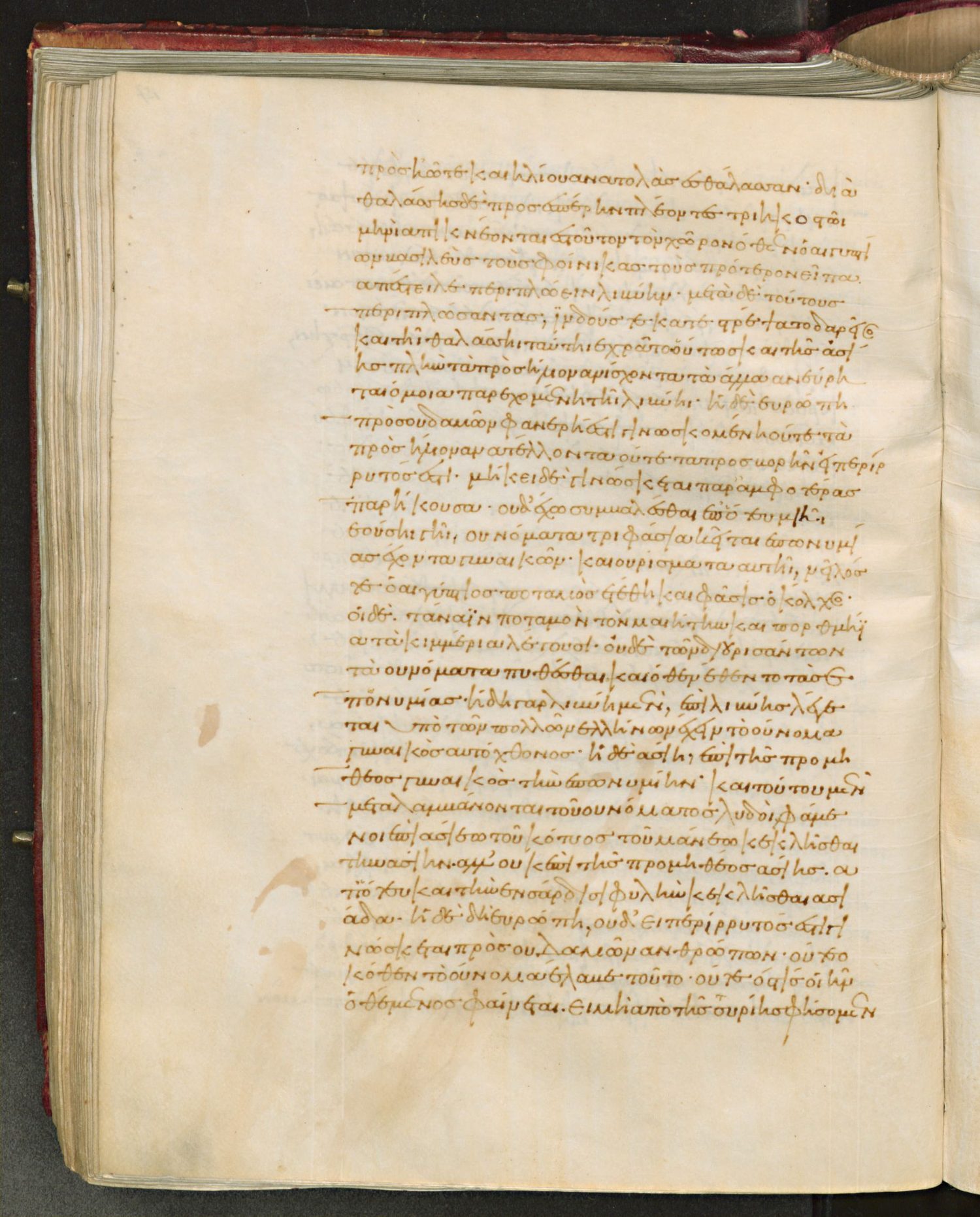
Laur. Plut. 70.3, fol. 157v: Greek here 4.44.2 to 4.45.4. Checked on the image (first and last words read and located in the Greek; each break checked against the neighbouring page): fol. 157v begins ‹πρὸς ἠῶ τε καὶ› (4.44.2), ends ‹ἀπὸ τῆς Τυρίης φήσομεν› (4.45.4). English here: 4.44.3 to 4.45.4 (Godley's sentences for the sections whose Greek lies mostly on this page).
4.44.2πρὸς ἠῶ τε καὶ ἡλίου ἀνατολὰς ἐς θάλασσαν, διὰ θαλάσσης δὲ πρὸς ἑσπέρην πλέοντες τριηκοστῷ μηνὶ ἀπικνέονται ἐς τοῦτον τὸν χῶρον ὅθεν ὁ Αἰγυπτίων βασιλεὺς τοὺς Φοίνικας τοὺς πρότερον εἶπα ἀπέστειλε περιπλώειν Λιβύην. 4.44.3μετὰ δὲ τούτους περιπλώσαντας Ἰνδούς τε κατεστρέψατο Δαρεῖος καὶ τῇ θαλάσσῃ ταύτῃ ἐχρᾶτο. οὕτω καὶ τῆς Ἀσίης, πλὴν τὰ πρὸς ἥλιον ἀνίσχοντα, τὰ ἄλλα ἀνεύρηται ὃμοια παρεχομένη τῇ Λιβύῃ. 4.45.1ἡ δὲ Εὐρώπη πρὸς οὐδαμῶν φανερή ἐστι γινωσκομένη, οὔτε τὰ πρὸς ἥλιον ἀνατέλλοντα οὔτε τὰ πρὸς βορέην, εἰ περίρρυτος ἐστί· μήκεϊ δὲ γινώσκεται παρʼ ἀμφοτέρας παρήκουσα. 4.45.2οὐδʼ ἔχω συμβαλέσθαι ἐπʼ ὅτευ μιῇ ἐούσῃ γῇ οὐνόματα τριφάσια κέεται ἐπωνυμίας ἔχοντα γυναικῶν, καὶ οὐρίσματα αὐτῇ Νεῖλός τε ὁ Αἰγύπτιος ποταμὸς ἐτέθη καὶ Φᾶσις ὁ Κόλχος (οἳ δὲ Τάναιν ποταμὸν τὸν Μαιήτην καὶ πορθμήια τὰ Κιμμέρια λέγουσι), οὐδὲ τῶν διουρισάντων τὰ οὐνόματα πυθέσθαι, καὶ ὅθεν ἔθεντο τὰς ἐπωνυμίας. 4.45.3ἤδη γὰρ Λιβύη μὲν ἐπὶ Λιβύης λέγεται ὑπὸ τῶν πολλῶν Ἑλλήνων ἔχειν τὸ οὔνομα γυναικὸς αὐτόχθονος, ἡ δὲ Ἀσίη ἐπὶ τῆς Προμηθέος γυναικὸς τὴν ἐπωνυμίην. καὶ τούτου μὲν μεταλαμβάνονται τοῦ οὐνόματος Λυδοί, φάμενοι ἐπὶ Ἀσίεω τοῦ Κότυος τοῦ Μάνεω κεκλῆσθαι τὴν Ἀσίην, ἀλλʼ οὐκ ἐπὶ τῆς Προμηθέος Ἀσίης· ἀπʼ ὅτευ καὶ τὴν ἐν Σάρδισι φυλὴν κεκλῆσθαι Ἀσιάδα. 4.45.4ἡ δὲ δὴ Εὐρώπη οὔτε εἰ περίρρυτος ἐστὶ γινώσκεται πρὸς οὐδαμῶν ἀνθρώπων, οὔτε ὁκόθεν τὸ οὔνομα ἔλαβε τοῦτο, οὔτε ὅστις οἱ ἦν ὁ θέμενος φαίνεται, εἰ μὴ ἀπὸ τῆς Τυρίης φήσομεν
4.44.3After this circumnavigation Darius subdued the Indians and made use of this sea. Thus was it discovered that Asia, saving the parts towards the rising sun, was in other respects like Libya. 4.45.1But of Europe it is plain that none have obtained knowledge of its eastern or its northern parts so as to say if it is encompassed by seas; its length is known to be enough to stretch along both Asia and Libya. 4.45.2Nor can I guess for what reason the earth, which is one, has three names, all of women, and why the boundary lines set for it are the Egyptian river Nile and the Colchian river Phasis (though some say that the Maeetian river Tanaïs and the Cimmerian Ferries are boundaries); nor can I learn the names of those who divided the world, or whence they got the names which they gave. 4.45.3For Libya is said by most Greeks to be called after a native woman of that name, and Asia after the wife of Prometheus; yet the Lydians claim a share in the latter name, saying that Asia was not called after Prometheus’ wife Asia, but after Asies, the son of Cotys, who was the son of Manes, and that from him the Asiad clan at Sardis also takes its name. 4.45.4But as for Europe, no men have any knowledge whether it be surrounded or not by seas, nor whence it took its name, nor is it clear who gave the name, unless we are to say that the land took its name from the Tyrian Europa, having been (as it would seem) till then nameless like the others.
Where on the image
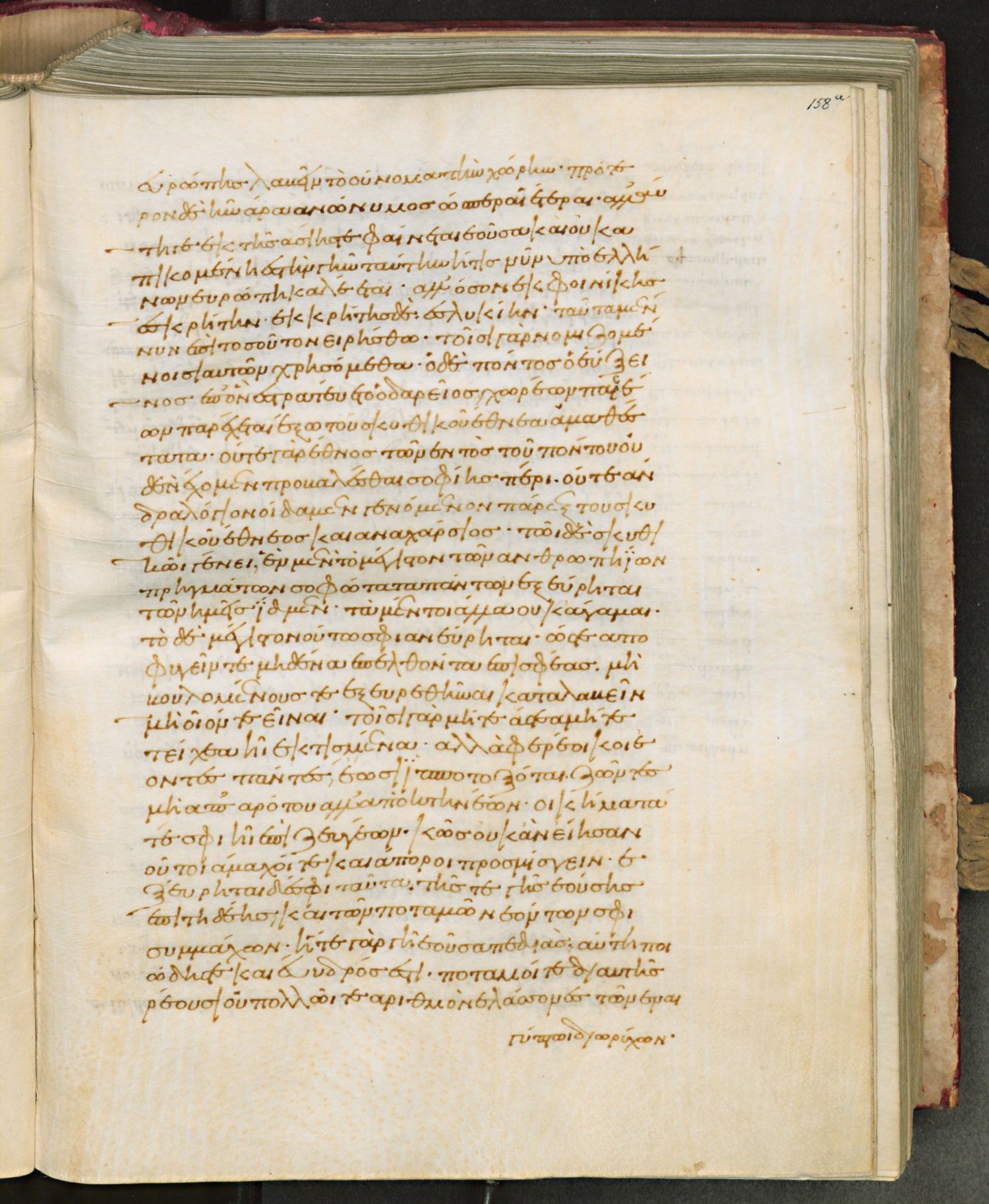
Laur. Plut. 70.3, fol. 158r: Greek here 4.45.4 to 4.45.5. Checked on the image (first and last words read and located in the Greek; each break checked against the neighbouring page): fol. 158r begins ‹Εὐρώπης λαβεῖν τὸ οὔνομα› (4.45.4), ends ‹τῶν ἐν Αἰγύπτῳ διωρύχων› (4.47.1). English here: 4.45.5 (Godley's sentences for the sections whose Greek lies mostly on this page).
4.45.4Εὐρώπης λαβεῖν τὸ οὔνομα τὴν χώρην· πρότερον δὲ ἦν ἄρα ἀνώνυμος ὥσπερ αἱ ἕτεραι. 4.45.5ἀλλʼ αὕτη γε ἐκ τῆς Ἀσίης τε φαίνεται ἐοῦσα καὶ οὐκ ἀπικομένη ἐς τὴν γῆν ταύτην ἥτις νῦν ὑπὸ Ἑλλήνων Εὐρώπη καλέεται, ἀλλʼ ὅσον ἐκ Φοινίκης ἐς Κρήτην, ἐκ Κρήτης δὲ ἐς Λυκίην. ταῦτα μέν νυν ἐπὶ τοσοῦτον εἰρήσθω· τοῖσι γὰρ νομιζομένοισι αὐτῶν χρησόμεθα.
4.45.5But it is plain that this woman was of Asiatic birth, and never came to this land which the Greeks now call Europe, but only from Phoenice to Crete and from Crete to Lycia. Thus far have I spoken of these matters, and let it suffice; we will use the names by custom established.
Notes
- Greek: the text printed in A. D. Godley's Loeb edition, via Perseus (tlg0016.tlg001.perseus-grc2). Square brackets mark words the editor considers later additions; [...] marks a gap the editor indicates. Perseus note markers are omitted.
- English: A. D. Godley, Herodotus vol. 2 (1921) (Loeb Classical Library), as transcribed on Wikisource. Godley's footnotes are omitted.
- Section numbers in the English were placed by comparing Godley's text with the Perseus version of his translation; where a section begins inside one of Godley's sentences, the English is kept with the page that holds the start of that sentence.
Cite
Sources
- Source: Florence, Laur. Plut. 70.3 (10th c.) via BML Teca Digitale + Greek of Godley's Loeb (Perseus) + English of A. D. Godley (Loeb, Wikisource) (holding institution)
- Critical edition: Greek of A. D. Godley's Loeb edition (1920-1925), via Perseus
← previous · → next · v cycle view · l back to library