Herodotus, Histories 4.168-185: The peoples of Libya
Introduction
Herodotus of Halicarnassus wrote the Histories in the third quarter of the 5th century BCE, an inquiry into the deeds of Greeks and barbarians and the causes of the wars between them, later divided into nine books. Book 4 tells of Darius' expedition against the Scythians, with Herodotus' account of Scythia, its peoples, rivers and customs, and of the shape of the world, and of the Persian expedition against Barca, with the history of Cyrene and a description of the peoples of Libya.
The photographs are of Florence, Biblioteca Medicea Laurenziana, Plut. 70.3 (parchment, 10th century, 374 folios, 31 lines a page), Herodotus, Histories (codex A of the editors), the oldest surviving manuscript of the complete Histories, from the Teca Digitale of the Biblioteca Medicea Laurenziana. Each section below is the text of one page, or of the part of a page that falls within these chapters. The first and last words of every page were read on the photograph and located in the Greek, and every page break was checked against the next page; the notes quote these words. Readers' notes in the margins are not part of the text and are mentioned where they occur.
The Greek is the text printed in A. D. Godley's Loeb edition (1920-1925), from Perseus; it is the edited text, not a transcription of the manuscript, whose wording differs in places. The English is Godley's translation as printed, from Wikisource. Godley's English carries only chapter numbers; the section numbers shown in it were placed by comparison with the Perseus version of his translation. Each page's English is cut at the end of one of Godley's sentences, so it can begin or end a few lines away from the Greek of the page; each note gives the exact ranges.
This entry covers chapters 4.168-185, on fol. 189v to 193v.
How was this verified? (Provenance)
Where on the image
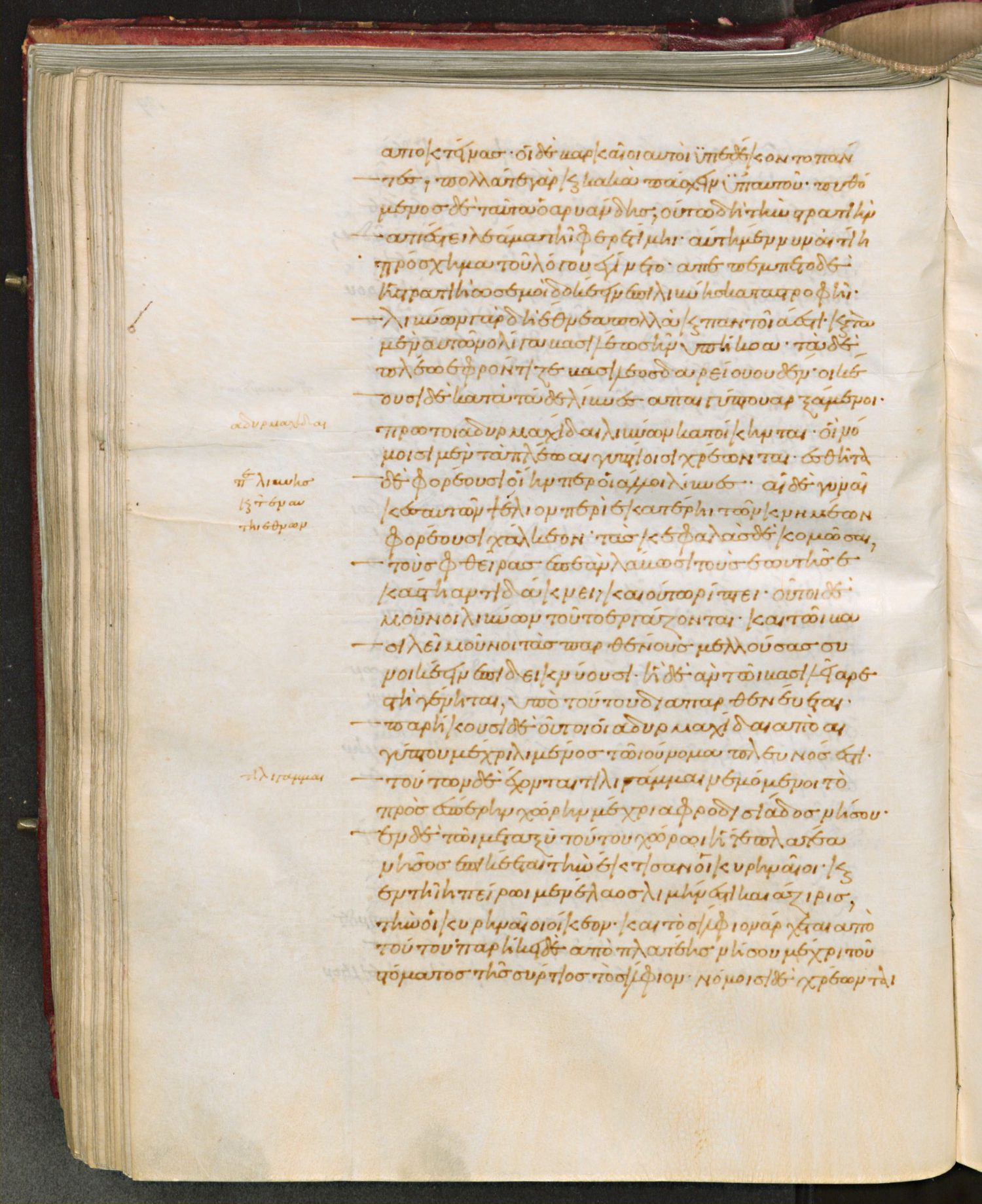
Laur. Plut. 70.3, fol. 189v: Greek here 4.168.1 to 4.169.2. Checked on the image (first and last words read and located in the Greek; each break checked against the neighbouring page): fol. 189v begins ‹ἀποκτείνας. οἱ δὲ Βαρκαῖοι› (4.167.2), ends ‹σίλφιον. νόμοισι δὲ χρέωνται› (4.169.2). English here: 4.168.1 to 4.169.2 (Godley's sentences for the sections whose Greek lies mostly on this page).
4.168.1οἰκέουσι δὲ κατὰ τάδε Λίβυες. ἀπʼ Αἰγύπτου ἀρξάμενοι πρῶτοι Ἀδυρμαχίδαι Λιβύων κατοίκηνται, οἳ νόμοισι μὲν τὰ πλέω Αἰγυπτίοισι χρέωνται, ἐσθῆτα δὲ φορέουσι οἵην περ οἱ ἄλλοι Λίβυες. αἱ δὲ γυναῖκες αὐτῶν ψέλιον περὶ ἑκατέρῃ τῶν κνημέων φορέουσι χάλκεον· τὰς κεφαλὰς δὲ κομῶσαι, τοὺς φθεῖρας ἐπεὰν λάβωσι τοὺς ἑωυτῆς ἑκάστη ἀντιδάκνει καὶ οὕτω ῥίπτει. 4.168.2οὗτοι δὲ μοῦνοι Λιβύων τοῦτο ἐργάζονται, καὶ τῷ βασιλέι μοῦνοι τὰς παρθένους μελλούσας συνοικέειν ἐπιδεικνύουσι. ἣ δὲ ἂν τῷ βασιλέι ἀρεστὴ γένηται, ὑπὸ τούτου διαπαρθενεύεται. παρήκουσι δὲ οὗτοι οἱ Ἀδυρμαχίδαι ἀπʼ Αἰγύπτου μέχρι λιμένος τῷ οὔνομα Πλυνός ἐστι. 4.169.1τούτων δὲ ἔχονται Γιλιγάμαι, νεμόμενοι τὸ πρὸς ἑσπέρην χώρηνμέχρι Ἀφροδισιάδος νήσου. ἐν δὲ τῷ μεταξὺ τούτου χώρῳ ἥ τε Πλατέα νῆσος ἐπικέεται, τὴν ἔκτισαν οἱ Κυρηναῖοι, καὶ ἐν τῇ ἠπείρῳ Μενέλαος λιμήν ἐστι καὶ Ἄζιρις, τὴν οἱ Κυρηναῖοι οἴκεον, καὶ τὸ σίλφιον ἄρχεται ἀπὸ τούτου· 4.169.2παρήκει δὲ ἀπὸ Πλατέης νήσου μέχρι τοῦ στόματος τῆς Σύρτιος τὸ σίλφιον. νόμοισι δὲ χρέωνται
4.168.1Now as concerning the lands inhabited by Libyans, the Adyrmachidae are the people that dwell nearest to Egypt; they follow Egyptian usages for the most part, but wear a dress like that of other Libyans. Their women wear bronze torques on both legs; their hair is long; they catch each her own lice, then bite and throw them away. 4.168.2They are the only Libyans that do this, and that show the king all virgins that are to be wedded; the king takes the virginity of whichever of these pleases him. These Adyrmachidae reach from Egypt to the harbour called Plynus. 4.169.1Next to them are the Giligamae, who inhabit the country to the west as far as the island Aphrodisias; ere this is reached the island Platea, which the Cyrenaeans colonised, lies off the coast, and on the mainland is the haven called Menelaus, and that Aziris which was a settlement of the Cyrenaeans. 4.169.2Here begins the country of silphium, which reaches from the island Platea to the entrance of the Syrtis. This people is like the others in its usages.
Where on the image
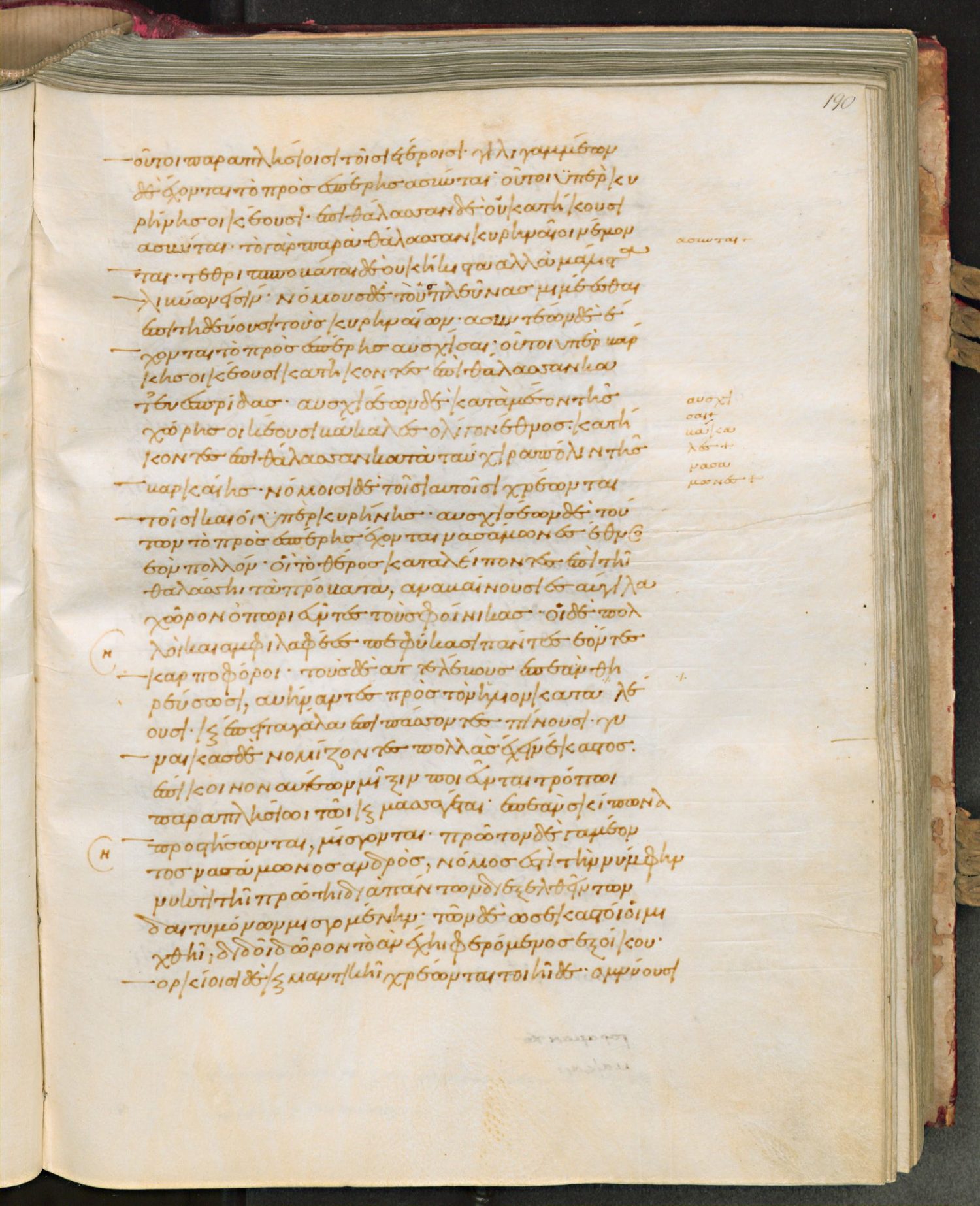
Laur. Plut. 70.3, fol. 190r: Greek here 4.169.2 to 4.172.3. Checked on the image (first and last words read and located in the Greek; each break checked against the neighbouring page): fol. 190r begins ‹οὗτοι παραπλησίοισι τοῖσι ἑτέροισι.Γιλιγαμέων› (4.169.2), ends ‹μαντικῇ χρέωνται τοιῇδε· ὀμνύουσι› (4.172.3). English here: 4.170.1 to 4.172.2 (Godley's sentences for the sections whose Greek lies mostly on this page).
4.169.2οὗτοι παραπλησίοισι τοῖσι ἑτέροισι. 4.170.1Γιλιγαμέων δὲ ἔχονται τὸ πρὸς ἑσπέρης Ἀσβύσται. οὗτοι ὑπὲρ Κυρήνης οἰκέουσι. ἐπὶ θάλασσαν δὲ οὐ κατήκουσι Ἀσβύσται τὸ γὰρ παρὰ θάλασσαν Κυρηναῖοι νέμονται. τεθριπποβάται δὲ οὐκ ἥκιστα ἀλλὰ μάλιστα Λιβύων εἰσί, νόμους δὲ τοὺς πλεῦνας μιμέεσθαι ἐπιτηδεύουσι τοὺς Κυρηναίων. 4.171.1Ἀσβυστέων δὲ ἔχονται τὸ πρὸς ἑσπέρης Αὐσχίσαι· οὗτοι ὑπὲρ Βάρκης οἰκέουσι, κατήκοντες ἐπὶ θάλασσαν κατʼ Εὐεσπερίδας. Αὐσχισέων δὲ κατὰ μέσον τῆς χώρης οἰκέουσι Βάκαλες, ὀλίγον ἔθνος, κατήκοντες ἐπὶ θάλασσαν κατὰ Ταύχειρα πόλιν τῆς Βαρκαίης· νόμοισι δὲ τοῖσι αὐτοῖσι χρέωνται τοῖσι καὶ οἱ ὑπὲρ Κυρήνης. 4.172.1Αὐσχισέων δὲ τούτων τὸ πρὸς ἑσπέρης ἔχονται Νασαμῶνες, ἔθνος ἐὸν πολλόν, οἳ τὸ θέρος καταλείποντες ἐπὶ τῇ θαλάσσῃ τὰ πρόβατα ἀναβαίνουσι ἐς Αὔγιλα χῶρον ὀπωριεῦντες τοὺς φοίνικας. οἳ δὲ πολλοὶ καὶ ἀμφιλαφέες πεφύκασι, πάντες ἐόντες καρποφόροι. τοὺς δὲ ἀττελέβους ἐπεὰν θηρεύσωσι, αὐήναντες πρὸς τὸν ἥλιον καταλέουσι καὶ ἔπειτα ἐπὶ γάλα ἐπιπάσσοντες πίνουσι. 4.172.2γυναῖκας δὲ νομίζοντες πολλὰς ἔχειν ἕκαστος ἐπίκοινον αὐτέων τὴν μῖξιν ποιεῦνται τρόπῳ παραπλησίῳ τῷ καὶ Μασσαγέται· ἐπεὰν σκίπωνα προστήσωνται, μίσγονται. πρῶτον δὲ γαμέοντος Νασαμῶνος ἀνδρὸς νόμος ἐστὶ τὴν νύμφην νυκτὶ τῇ πρώτῃ διὰ πάντων διεξελθεῖν τῶν δαιτυμόνων μισγομένην· τῶν δὲ ὡς ἕκαστος οἱ μιχθῇ, διδοῖ δῶρον τὸ ἂν ἔχῃ φερόμενος ἐξ οἴκου. 4.172.3ὁρκίοισι δὲ καὶ μαντικῇ χρέωνται τοιῇδε· ὀμνύουσι
4.170.1The next people westward of the Giligamae are the Asbystae, who dwell inland of Cyrene, not coming down to the sea-coast; for that is Cyrenaean territory. These are drivers of four-horse chariots to a greater extent than any other Libyans; it is their practice to imitate most of the Cyrenaean usages. 4.171.1Next westward of the Asbystae are the Auschisae, dwelling inland of Barce, and touching the sea-coast at Euhesperidae. About the middle of the land of the Auschisae dwells the little tribe of the Bacales, whose territory comes down to the sea at Tauchira, a town in the Barcaean country; their usages are the same as those of the dwellers inland of Cyrene. 4.172.1Next westward of these Auschisae is the populous country of the Nasamones, who in summer leave their flocks by the sea and go up to the land called Augila to gather dates from the palm-trees which grow there in great abundance, and all bear fruit. They hunt locusts, which when taken they dry in the sun, and after grinding sprinkle them into milk and so drink it. 4.172.2It is their custom for every man to have many wives; their intercourse with women is promiscuous, in like manner as among the Massagetae; a staff is planted before the dwelling and then they have intercourse. When a man of the Nasamones first weds; on the first night the bride must by custom lie with each of the whole company in turn; and each man after intercourse gives her whatever gift he has brought from his house.
Where on the image
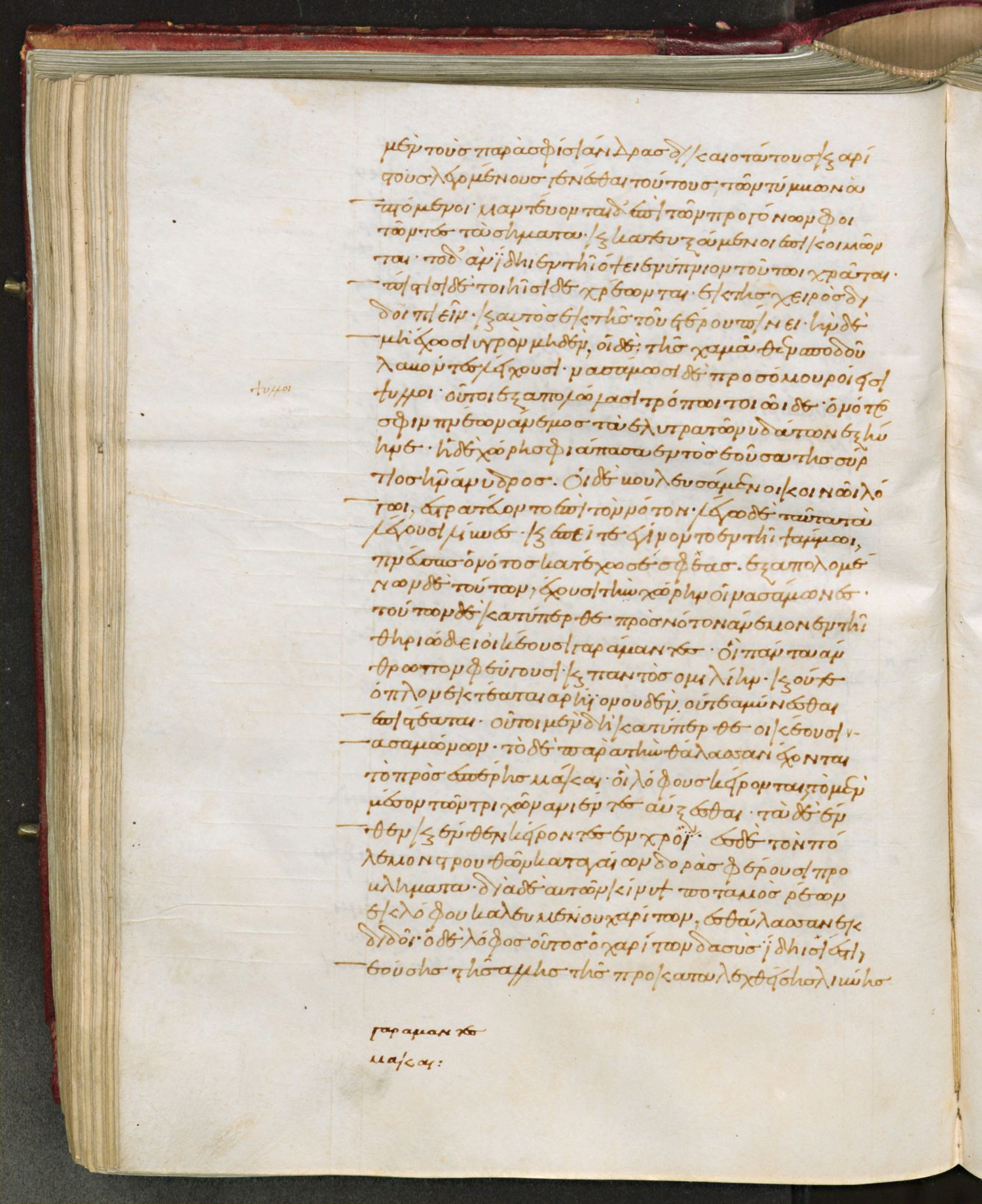
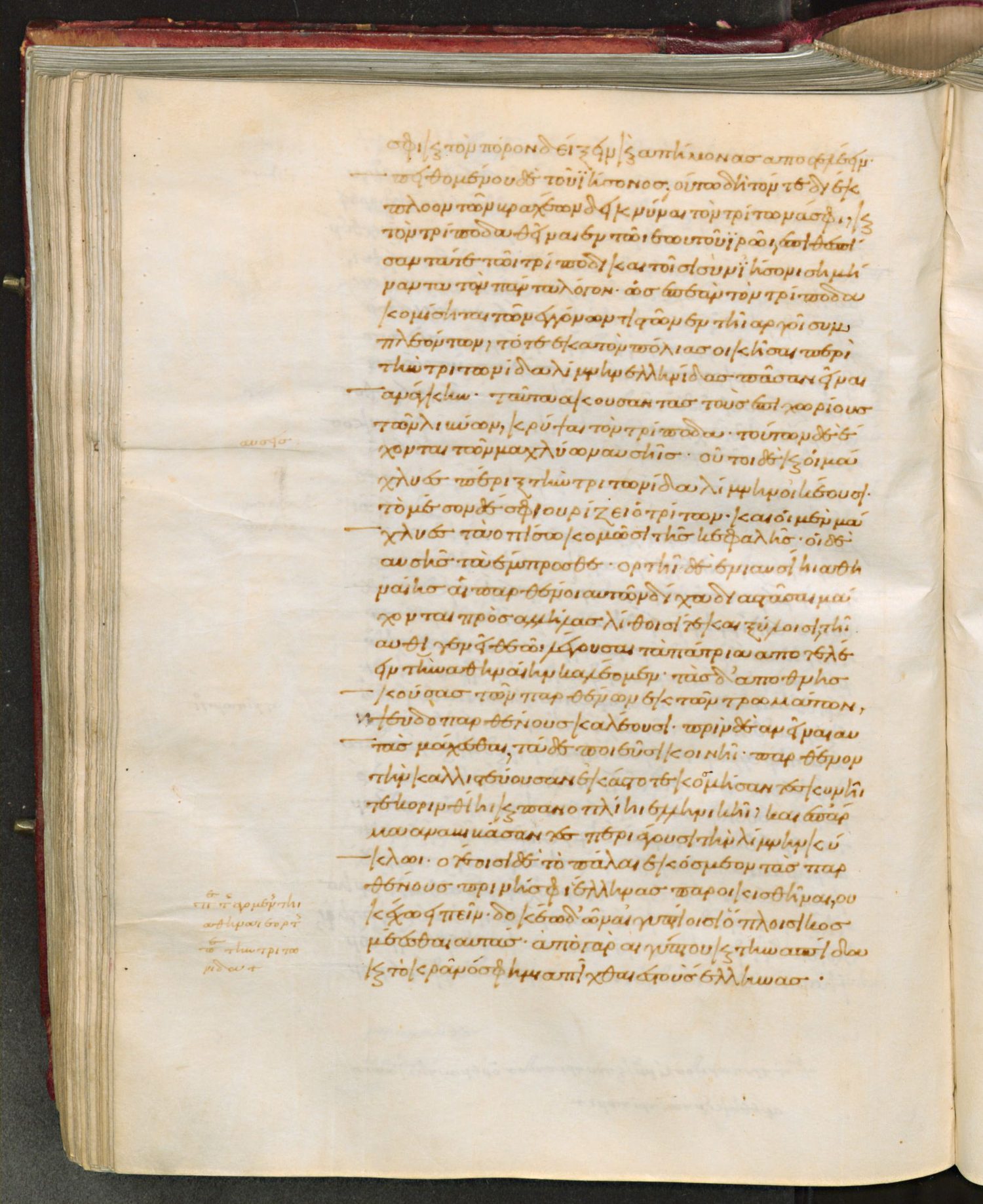
Laur. Plut. 70.3, fol. 190v: Greek here 4.172.3 to 4.175.2. Checked on the image (first and last words read and located in the Greek; each break checked against the neighbouring page): fol. 190v begins ‹μὲν τοὺς παρὰ σφίσι› (4.172.3), ends ‹τῆς ἄλλης τῆς προκαταλεχθείσης› (4.175.2). English here: 4.172.3 to 4.175.2 (Godley's sentences for the sections whose Greek lies mostly on this page).
4.172.3μὲν τοὺς παρὰ σφίσι ἄνδρας δικαιοτάτους καὶ ἀρίστους λεγομένους γενέσθαι, τούτους, τῶν τύμβων ἁπτόμενοι· μαντεύονται δὲ ἐπὶ τῶν προγόνων φοιτέοντες τὰ σήματα, καὶ κατευξάμενοι ἐπικατακοιμῶνται· τὸ δʼ ἂν ἴδη ἐν τῇ ὄψι ἐνύπνιον, τούτῳ χρᾶται. 4.172.4πίστισι δὲ τοιῇσιδε χρέωνται· ἐκ τῆς χειρὸς διδοῖ πιεῖν καὶ αὐτὸς ἐκ τῆς τοῦ ἑτέρου πίνει. ἢν δὲ μὴ ἔχωσι ὑγρὸν μηδέν, οἳ δὲ τῆς χαμᾶθεν σποδοῦ λαβόντες λείχουσι. 4.173.1Νασαμῶσι δὲ προσόμουροι εἰσὶ Ψύλλοι. οὗτοι ἐξαπολώλασι τρόπῳ τοιῷδε· ὁ νότος σφι πνέων ἄνεμος τὰ ἔλυτρα τῶν ὑδάτων ἐξηύηνε, ἡ δὲ χώρη σφι ἅπασα ἐντὸς ἐοῦσα τῆς Σύρτιος ἦν ἄνυδρος. οἳ δὲ βουλευσάμενοι κοινῷ λόγῳ ἐστρατεύοντο ἐπὶ τὸν νότον (λέγω δὲ ταῦτα τὰ λέγουσι Λίβυες), καὶ ἐπείτε ἐγίνοντο ἐν τῇ ψάμμῳ, πνεύσας ὁ νότος κατέχωσε σφέας. ἐξαπολομένων δὲ τούτων ἔχουσι τὴν χώρην οἱ Νασαμῶνες. 4.174.1τούτων δὲ κατύπερθε πρὸς νότον ἄνεμον ἐν τῇ θηριώδεϊ οἰκέουσι Γαράμαντες, οἳ πάντα ἄνθρωπον φεύγουσι καὶ παντὸς ὁμιλίην, καὶ οὔτε ὅπλον ἐκτέαται ἀρήιον οὐδὲν οὔτε ἀμύνεσθαι ἐπιστέαται. 4.175.1οὗτοι μὲν δὴ κατύπερθε οἰκέουσι Νασαμώνων· τὸ δὲ παρὰ τὴν θάλασσαν ἔχονται τὸ πρὸς ἑσπέρης Μάκαι, οἳ λόφους κείρονται, τὸ μὲν μέσον τῶν τριχῶν ἀνιέντες αὔξεσθαι, τὰ δὲ ἔνθεν καὶ ἔνθεν κείροντες ἐν χροΐ, ἐς δὲ τὸν πόλεμον στρουθῶν καταγαίων δορὰς φορέουσι προβλήματα. 4.175.2διὰ δὲ αὐτῶν Κῖνυψ ποταμὸς ῥέων ἐκ λόφου καλευμένου Χαρίτων ἐς θάλασσαν ἐκδιδοῖ. ὁ δὲ λόφος οὗτος ὁ Χαρίτων δασὺς ἴδῃσι ἐστί, ἐούσης τῆς ἄλλης τῆς προκαταλεχθείσης
4.172.3As for their manner of swearing and divination, they lay their hands on the graves of the men reputed to have been the most just and good among them, and by these men they swear; their practice of divination is to go to the tombs of their ancestors, where after making prayers they lie down to sleep, and take whatever dreams come to them for oracles. 4.172.4They give and receive pledges by drinking each from the hand of the other party; and if they have nothing liquid they take of the dust of the earth and lick it up. 4.173.1On the borders of the Nasamones is the country of the Psylli, who perished in this wise: the force of the south wind dried up their water-tanks, and all their country, lying within the region of the Syrtis, was waterless. Taking counsel together they marched southward (I tell the story as it is told by the Libyans), and when they came into the sandy desert a strong south wind buried them. So they perished utterly, and the Nasamones have their country. 4.174.1Inland of these to the southward the Garamantes dwell in the wild beasts’ country. They shun the sight and fellowship of men, and have no weapons of war, nor know how to defend themselves. 4.175.1These dwell inland of the Nasamones; the neighbouring seaboard to the west is the country of the Macae, who shave their hair to a crest, leaving that on the top of their heads to grow and shaving clean off what is on either side; they carry in war bucklers made of ostrich skins. 4.175.2The river Cinyps flows into their sea through their country from a hill called the Hill of the Graces. This hill is thickly wooded, while the rest of Libya whereof I have spoken is bare of trees; it is two hundred furlongs distant from the sea.
Where on the image
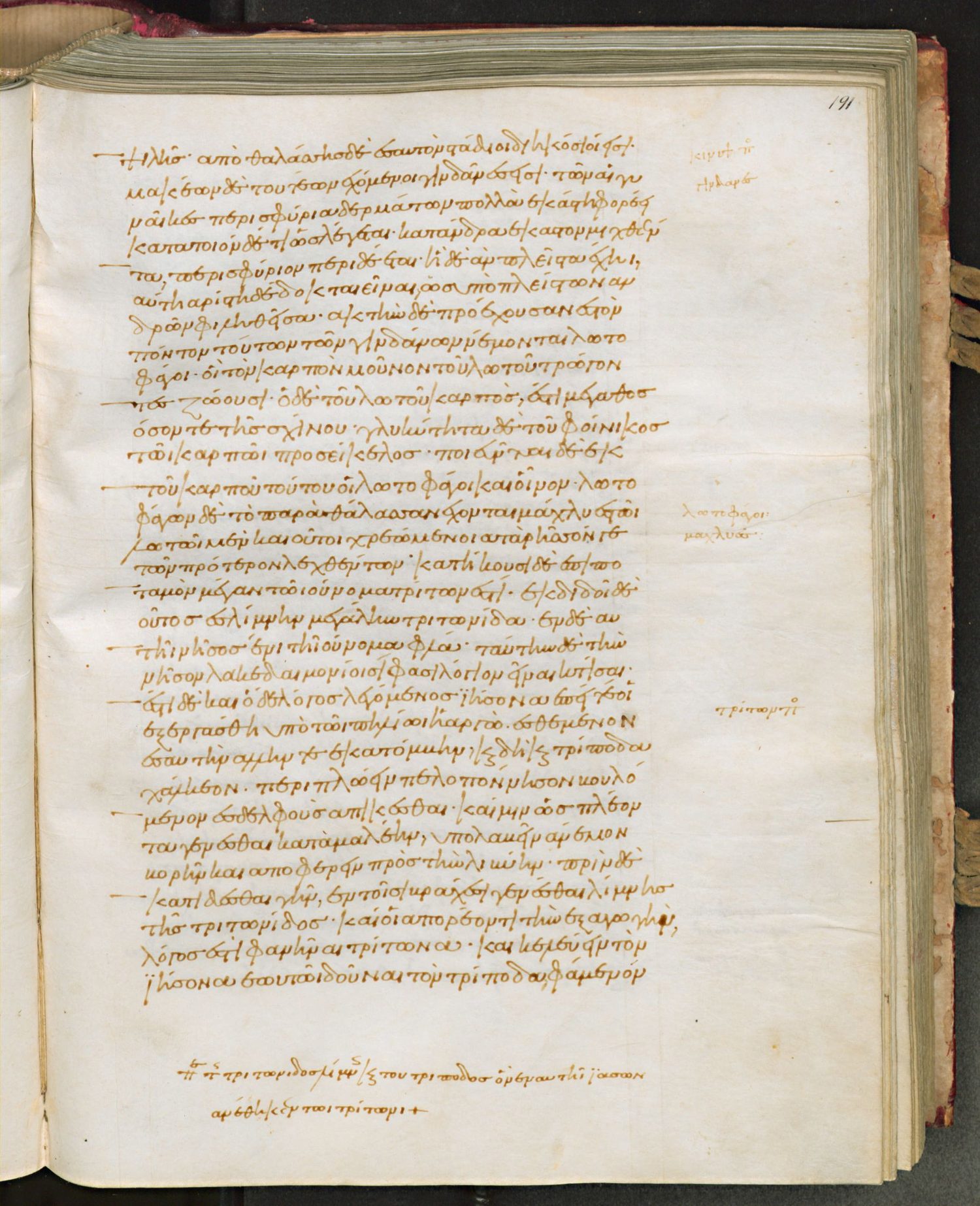
Laur. Plut. 70.3, fol. 191r: Greek here 4.175.2 to 4.179.2. Checked on the image (first and last words read and located in the Greek; each break checked against the neighbouring page): fol. 191r begins ‹Λιβύης ψιλῆς· ἀπὸ θαλάσσης› (4.175.2), ends ‹δοῦναι τὸν τρίποδα, φάμενόν› (4.179.2). Below the text, a reader's note on the tripod of Jason. English here: 4.176.1 to 4.179.2 (Godley's sentences for the sections whose Greek lies mostly on this page).
4.175.2Λιβύης ψιλῆς· ἀπὸ θαλάσσης δὲ ἐς αὐτὸν στάδιοι διηκόσιοι εἰσί. 4.176.1Μακέων δὲ τούτων ἐχόμενοι Γινδᾶνες εἰσί, τῶν αἱ γυναῖκες περισφύρια δερμάτων πολλὰ ἑκάστη φορέει κατὰ τοιόνδε τι, ὡς λέγεται· κατʼ ἄνδρα ἕκαστον μιχθέντα περισφύριον περιδέεται· ἣ δὲ ἂν πλεῖστα ἔχῃ, αὕτη ἀρίστη δέδοκται εἶναι ὡς ὑπὸ πλείστων ἀνδρῶν φιληθεῖσα. 4.177.1ἀκτὴν δὲ προέχουσαν ἐς τὸν πόντον τούτων τῶν Γινδάνων νέμονται Λωτοφάγοι, οἳ τὸν καρπὸν μοῦνον τοῦ λωτοῦ τρώγοντες ζώουσι. ὁ δὲ τοῦ λωτοῦ καρπὸς ἐστὶ μέγαθος ὅσον τε τῆς σχίνου, γλυκύτητα δὲ τοῦ φοίνικος τῷ καρπῷ προσείκελος. ποιεῦνται δὲ ἐκ τοῦ καρποῦ τούτου οἱ Λωτοφάγοι καὶ οἶνον. 4.178.1λωτοφάγων δὲ τὸ παρὰ θάλασσαν ἔχονται Μάχλυες, τῷ λωτῷ μὲν καὶ οὗτοι χρεώμενοι, ἀτὰρ ἧσσον γε τῶν πρότερον λεχθέντων, κατήκουσι δὲ ἐπὶ ποταμὸν μέγαν τῷ οὔνομα Τρίτων ἐστί· ἐκδιδοῖ δὲ οὗτος ἐς λίμνην μεγάλην Τριτωνίδα. ἐν δὲ αὐτῇ, νῆσος ἔνι τῇ, οὔνομα Φλά. ταύτην δὲ τὴν νῆσον Λακεδαιμονίοισι φασὶ λόγιον εἶναι κτίσαι. 4.179.1ἔστι δὲ καὶ ὅδε λόγος λεγόμενος. Ἰήσονα, ἐπείτε οἱ ἐξεργάσθη ὑπὸ τῷ Πηλίῳ ἡ Ἀργώ, ἐσθέμενον ἐς αὐτὴν ἄλλην τε ἑκατόμβην καὶ δὴ καὶ τρίποδα χάλκεον περιπλώειν Πελοπόννησον, βουλόμενον ἐς Δελφοὺς ἀπικέσθαι. 4.179.2καί μιν, ὡς πλέοντα γενέσθαι κατὰ Μαλέην, ὑπολαβεῖν ἄνεμον βορέην καὶ ἀποφέρειν πρὸς τὴν Λιβύην· πρὶν δὲ κατιδέσθαι γῆν, ἐν τοῖσι βράχεσι γενέσθαι λίμνης τῆς Τριτωνίδος. καί οἱ ἀπορέοντι τὴν ἐξαγωγὴν λόγος ἐστὶ φανῆναι Τρίτωνα καὶ κελεύειν τὸν Ἰήσονα ἑωυτῷ δοῦναι τὸν τρίποδα, φάμενόν
4.176.1Next to these Macae are the Gindanes, where every woman wears many leathern anklets, because (so it is said) she puts on an anklet for every man with whom she has had intercourse; and she who wears most is reputed the best, because she has been loved by most men. 4.177.1There is a headland jutting out to sea from the land of the Gindanes; on it dwell the Lotus-eaters, whose only fare is the lotus. The lotus fruit is of the bigness of a mastich-berry: it has a sweet taste like the fruit of a date-palm; the lotus-eaters not only eat it but make wine of it. 4.178.1Next to these along the coast are the Machlyes, who also use the lotus, but less than the people aforesaid. Their country reaches to a great river called Triton, which issues into the great Tritonian lake, wherein is an island called Phla. It is said that the Lacedaemonians were bidden by an oracle to plant a settlement on this island. 4.179.1The following story is also told:—Jason (it is said) when the Argo had been built at the foot of Pelion, put therein besides a hecatomb a bronze tripod, and set forth to sail round Peloponnesus, that he might come to Delphi. 4.179.2But when in his course he was off Malea, a north wind caught and carried him away to Libya; and before he could spy land he came into the shallows of the Tritonian lake. There, while yet he could find no way out, Triton (so goes the story) appeared to him and bade Jason give him the tripod, promising so to show the shipmen the channel and send them on their way unharmed.
Where on the image
Laur. Plut. 70.3, fol. 191v: Greek here 4.179.2 to 4.180.4. Checked on the image (first and last words read and located in the Greek; each break checked against the neighbouring page): fol. 191v begins ‹σφι καὶ τὸν πόρον› (4.179.2), ends ‹ἀπῖχθαι ἐς τοὺς Ἕλληνας› (4.180.4). English here: 4.179.3 to 4.180.4 (Godley's sentences for the sections whose Greek lies mostly on this page).
4.179.2σφι καὶ τὸν πόρον δέξειν καὶ ἀπήμονας ἀποστελέειν. 4.179.3πειθομένου δὲ τοῦ Ἰήσονος, οὕτω δὴ τόν τε διέκπλοον τῶν βραχέων δεικνύναι τὸν Τρίτωνά σφι καὶ τὸν τρίποδα θεῖναι ἐν τῷ ἑωυτοῦ ἱρῷ, ἐπιθεσπίσαντά τε τῷ τρίποδι καὶ τοῖσι σὺν Ἰήσονι σημήναντα τὸν πάντα λόγον, ὡς ἐπεὰν τὸν τρίποδα κομίσηται τῶν ἐκγόνων τις τῶν ἐν τῇ Ἀργοῖ συμπλεόντων, τότε ἑκατὸν πόλιας οἰκῆσαι περὶ τὴν Τριτωνίδα λίμνην Ἑλληνίδας πᾶσαν εἶναι ἀνάγκην. ταῦτα ἀκούσαντας τοὺς ἐπιχωρίους τῶν Λιβύων κρύψαι τὸν τρίποδα. 4.180.1τούτων δὲ ἔχονται τῶν Μαχλύων Αὐσέες· οὗτοι δὲ καὶ οἱ Μάχλυες πέριξ τὴν Τριτωνίδα λίμνην οἰκέουσι, τὸ μέσον δέ σφι οὐρίζει ὁ Τρίτων. καὶ οἱ μὲν Μάχλυες τὰ ὀπίσω κομῶσι τῆς κεφαλῆς, οἱ δὲ Αὐσέες τὰ ἔμπροσθε. 4.180.2ὁρτῇ δὲ ἐνιαυσίῃ Ἀθηναίης αἱ παρθένοι αὐτῶν δίχα διαστᾶσαι μάχονται πρὸς ἀλλήλας λίθοισί τε καὶ ξύλοισι, τῷ αὐθιγενέι θεῷ λέγουσαι τὰ πάτρια ἀποτελέειν, τὴν Ἀθηναίην καλέομεν. τὰς δὲ ἀποθνησκούσας τῶν παρθένων ἐκ τῶν τρωμάτων ψευδοπαρθένους καλέουσι. 4.180.3πρὶν δὲ ἀνεῖναι αὐτὰς μάχεσθαι, τάδε ποιεῦσι κοινῇ. παρθένον τὴν καλλιστεύουσαν ἑκάστοτε κοσμήσαντες κυνέῃ τε Κορινθίῃ καὶ πανοπλίῃ Ἑλληνικῇ καὶ ἐπʼ ἅρμα ἀναβιβάσαντες περιάγουσι τὴν λίμνην κύκλῳ. 4.180.4ὁτέοισι δὲ τὸ πάλαι ἐκόσμεον τὰς παρθένους πρὶν ἤ σφι Ἕλληνας παροικισθῆναι, οὐκ ἔχω εἰπεῖν, δοκέω δʼ ὦν Αἰγυπτίοισι ὅπλοισι κοσμέεσθαι αὐτάς· ἀπὸ γὰρ Αἰγύπτου καὶ τὴν ἀσπίδα καὶ τὸ κράνος φημὶ ἀπῖχθαι ἐς τοὺς Ἕλληνας.
4.179.3Jason did his bidding, and Triton then showed them the passage out of the shallows and set the tripod in his own temple; but first he prophesied over it, declaring the whole matter to Jason’s comrades: to wit, that when any descendant of the Argo’s crew should take away the tripod, then needs must a hundred Greek cities be founded on the shores of the Tritonian lake. Hearing this (it is said) the Libyan people of the country hid the tripod. 4.180.1Next to these Machlyes are the Auseans; these and the Machlyes, divided by the Triton, dwell on the shores of the Tritonian lake. The Machlyes wear the hair of their heads long behind, the Auseans in front. 4.180.2They make a yearly festival to Athene, whereat their maidens are parted into two bands and fight each other with stones and staves, thus (as they say) honouring after the manner of their ancestors that native goddess whom we call Athene. Maidens that die of their wounds are called false virgins. 4.180.3Before the girls are set fighting, the whole people choose ever the fairest maiden, and equip her with a Corinthian helmet and Greek panoply, to be then mounted on a chariot and drawn all along the lake shore. 4.180.4With what armour they equipped their maidens before Greeks came to dwell near them, I cannot say; but I suppose the armour to have been Egyptian; for I hold that the Greeks got their shield and helmet from Egypt.
Where on the image
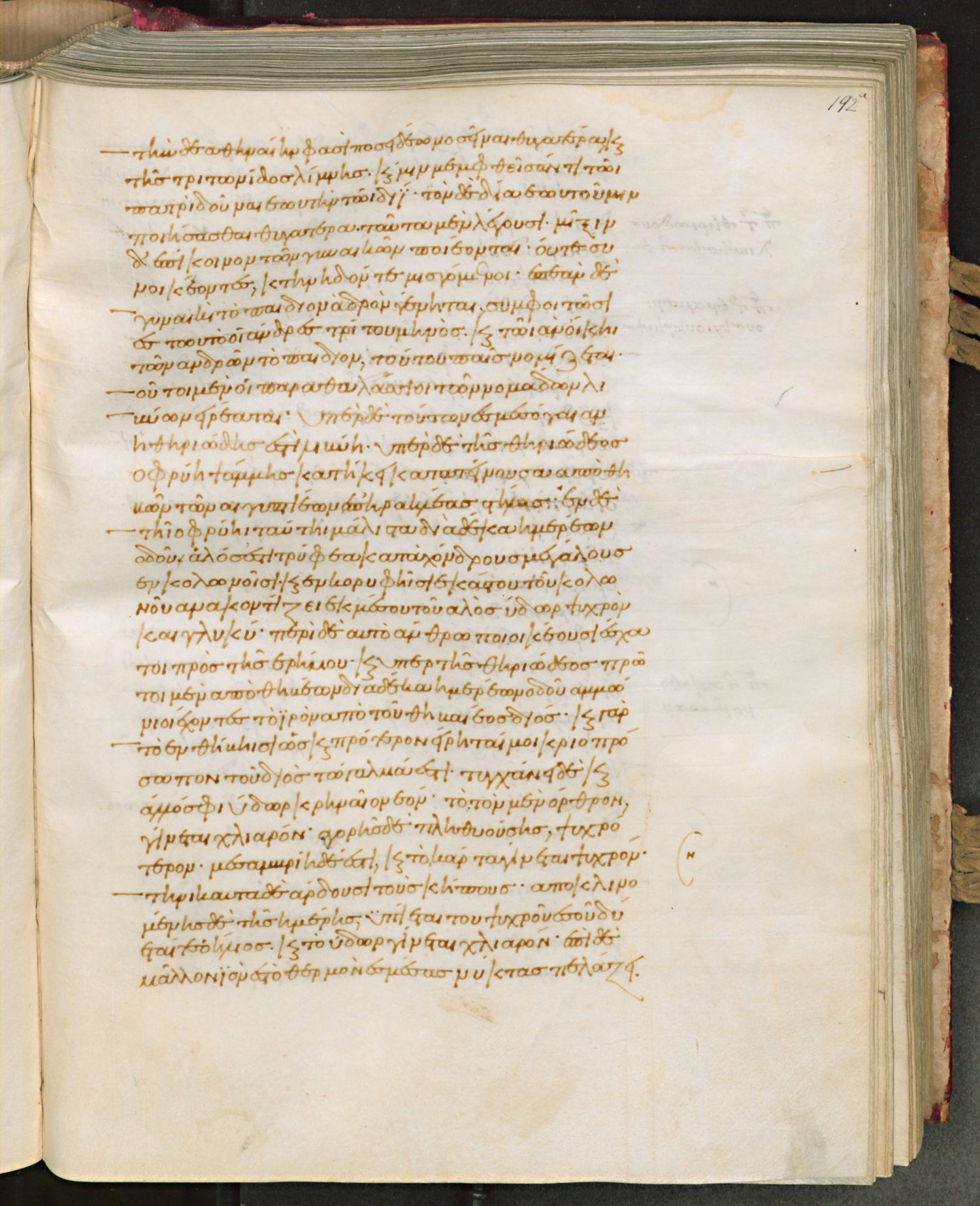
Laur. Plut. 70.3, fol. 192r: Greek here 4.180.5 to 4.181.4. Checked on the image (first and last words read and located in the Greek; each break checked against the neighbouring page): fol. 192r begins ‹τὴν δὲ Ἀθηναίην φασὶ› (4.180.5), ends ‹ἐς μέσας νύκτας πελάζει› (4.181.4). English here: 4.180.5 to 4.181.4 (Godley's sentences for the sections whose Greek lies mostly on this page).
4.180.5τὴν δὲ Ἀθηναίην φασὶ Ποσειδέωνος εἶναι θυγατέρα καὶ τῆς Τριτωνίδος λίμνης, καί μιν μεμφθεῖσάν τι τῷ πατρὶ δοῦναι ἑωυτὴν τῷ Διί, τὸν δὲ Δία ἑωυτοῦ μιν ποιήσασθαι θυγατέρα. ταῦτα μὲν λέγουσι, μῖξιν δὲ ἐπίκοινον τῶν γυναικῶν ποιέονται, οὔτε συνοικέοντες κτηνηδόν τε μισγόμενοι. 4.180.6ἐπεὰν δὲ γυναικὶ τὸ παιδίον ἁδρὸν γένηται, συμφοιτῶσι ἐς τὠυτὸ οἱ ἄνδρες τρίτου μηνός, καὶ τῷ ἂν οἴκῃ τῶν ἀνδρῶν τὸ παιδίον, τούτου παῖς νομίζεται. 4.181.1οὗτοι μὲν οἱ παραθαλάσσιοι τῶν νομάδων Λιβύων εἰρέαται, ὑπὲρ δὲ τούτων ἐς μεσόγαιαν ἡ θηριώδης ἐστὶ Λιβύη, ὑπὲρ δὲ τῆς θηριώδεος ὀφρύη ψάμμης κατήκει παρατείνουσα ἀπὸ Θηβέων τῶν Αἰγυπτιέων ἐπʼ Ἡρακλέας στήλας. 4.181.2ἐν δὲ τῇ ὀφρύῃ ταύτῃ μάλιστα διὰ δέκα ἡμερέων ὁδοῦ ἁλός ἐστι τρύφεα κατὰ χόνδρους μεγάλους ἐν κολωνοῖσι, καὶ ἐν κορυφῇσι ἑκάστου τοῦ κολωνοῦ ἀνακοντίζει ἐκ μέσου τοῦ ἁλὸς ὕδωρ ψυχρὸν καὶ γλυκύ, περὶ δὲ αὐτὸν ἄνθρωποι οἰκέουσι ἔσχατοι πρὸς τῆς ἐρήμου καὶ ὑπὲρ τῆς θηριώδεος, πρῶτοι μὲν ἀπὸ Θηβέων διὰ δέκα ἡμερέων ὁδοῦ Ἀμμώνιοι, ἔχοντες τὸ ἱρὸν ἀπὸ τοῦ Θηβαιέος Διός· καὶ γὰρ τὸ ἐν Θήβῃσι, ὡς καὶ πρότερον εἴρηταί μοι, κριοπρόσωπον τοῦ Διὸς τὤγαλμα ἐστί. 4.181.3τυγχάνει δὲ καὶ ἄλλο σφι ὕδωρ κρηναῖον ἐὸν, τὸ τὸν μὲν ὄρθρον γίνεται χλιαρόν, ἀγορῆς δὲ πληθυούσης ψυχρότερον, μεσαμβρίη τε ἐστὶ καὶ τὸ κάρτα γίνεται ψυχρόν· 4.181.4τηνικαῦτα δὲ ἄρδουσι τοὺς κήπους· ἀποκλινομένης δὲ τῆς ἡμέρης ὑπίεται τοῦ ψυχροῦ, ἐς οὗ δύεταί τε ὁ ἥλιος καὶ τὸ ὕδωρ γίνεται χλιαρόν. ἐπὶ δὲ μᾶλλον ἰὸν ἐς τὸ θερμὸν ἐς μέσας νύκτας πελάζει,
4.180.5As for Athene, they say that she was daughter of Poseidon and the Tritonian lake, and that, being for some cause wroth with her father, she gave herself to Zeus, who made her his own daughter. Such is their tale. The intercourse of men and women there is promiscuous; they do not cohabit but have intercourse like cattle. 4.180.6When a woman’s child is well grown, within three months thereafter the men assemble, and the child is adjudged to be that man’s to whom it is most like. 4.181.1I have now told of all the nomad Libyans that dwell on the sea-coast. Farther inland than these is that Libyan country which is haunted by wild beasts, and beyond this wild beasts’ land there runs a ridge of sand that stretches from Thebes of Egypt to the Pillars of Heracles. 4.181.2At intervals of about ten days’ journey along this ridge there are masses of great lumps of salt in hillocks; on the top of every hillock a fountain of cold sweet water shoots up from the midst of the salt; men dwell round it who are farthest away towards the desert and inland from the wild beasts’ country. The first on the journey from Thebes, ten days distant from that place, are the Ammonians, who follow the worship of the Zeus of Thebes; for, as I have before said, the image of Zeus at Thebes has the head of a ram. 4.181.3They have another spring of water besides, which is warm at dawn, and colder at market-time, and very cold at noon; 4.181.4and it is then that they water their gardens; as the day declines the coldness abates, till at sunset the water grows warm. It becomes ever hotter and hotter till midnight, and then it boils and bubbles; after midnight it becomes ever cooler till dawn. This spring is called the spring of the sun.
Where on the image
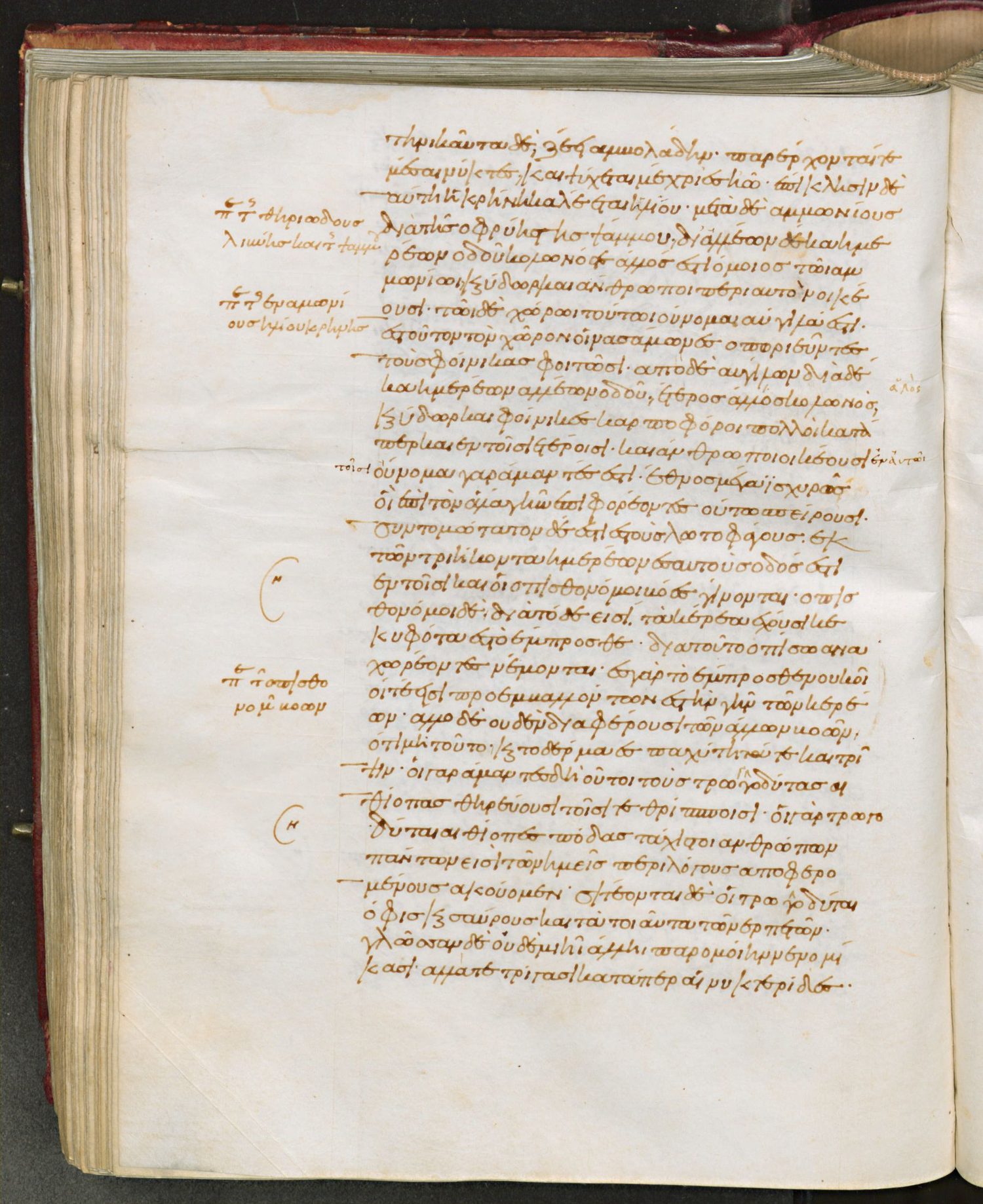
Laur. Plut. 70.3, fol. 192v: Greek here 4.181.4 to 4.183.4. Checked on the image (first and last words read and located in the Greek; each break checked against the neighbouring page): fol. 192v begins ‹τηνικαῦτα δὲ ζέει ἀμβολάδην·› (4.181.4), ends ‹κατά περ αἱ νυκτερίδες› (4.183.4). English here: 4.182.1 to 4.183.4 (Godley's sentences for the sections whose Greek lies mostly on this page).
4.181.4τηνικαῦτα δὲ ζέει ἀμβολάδην· παρέρχονται τε μέσαι νύκτες καὶ ψύχεται μέχρι ἐς ἠῶ. ἐπίκλησιν δὲ αὕτη ἡ κρήνη καλέεται ἡλίου. 4.182.1μετὰ δὲ Ἀμμωνίους διὰ τῆς ὀφρύης τῆς ψάμμου διʼ ἀλλέων δέκα ἡμερέων ὁδοῦ κολωνός τε ἁλός ἐστι ὅμοιος τῷ Ἀμμωνίῳ καὶ ὕδωρ, καὶ ἄνθρωποι περὶ αὐτὸν οἰκέουσι· τῷ δὲ χώρῳ τούτῳ οὔνομα Αὔγιλα ἐστί. ἐς τοῦτον τὸν χῶρον οἱ Νασαμῶνες ὀπωριεῦντες τοὺς φοίνικας φοιτῶσι. 4.183.1ἀπὸ δὲ Αὐγίλων διὰ δέκα ἡμερέων ἀλλέων ὁδοῦ ἕτερος ἁλὸς κολωνὸς καὶ ὕδωρ καὶ φοίνικες καρποφόροι πολλοί, κατά περ καὶ ἐν τοῖσι ἑτέροισι· καὶ ἄνθρωποι οἰκέουσι ἐν αὐτῷ τοῖσι οὔνομα Γαράμαντες ἐστί, ἔθνος μέγα ἰσχυρῶς, οἳ ἐπὶ τὸν ἅλα γῆν ἐπιφορέοντες οὕτω σπείρουσι. 4.183.2συντομώτατον δʼ ἐστὶ ἐς τοὺς Λωτοφάγους, ἐκ τῶν τριήκοντα ἡμερέων ἐς αὐτοὺς ὁδός ἐστι· ἐν τοῖσι καὶ οἱ ὀπισθονόμοι βόες γίνονται· ὀπισθονόμοι δὲ διὰ τόδε εἰσι. τὰ κέρεα ἔχουσι κεκυφότα ἐς τὸ ἔμπροσθε· 4.183.3διὰ τοῦτο ὀπίσω ἀναχωρέοντες νέμονται· ἐς γὰρ τὸ ἔμπροσθε οὐκ οἷοι τε εἰσὶ προεμβαλλόντων ἐς τὴν γῆν τῶν κερέων. ἄλλο δὲ οὐδὲν διαφέρουσι τῶν ἄλλων βοῶν ὅτι μὴ τοῦτο καὶ τὸ δέρμα ἐς παχύτητά τε καὶ τρῖψιν. 4.183.4οἱ Γαράμαντες δὴ οὗτοι τοὺς τρωγλοδύτας Αἰθίοπας θηρεύουσι τοῖσι τεθρίπποισι· οἱ γὰρ τρωγλοδύται Αἰθίοπες πόδας τάχιστοι ἀνθρώπων πάντων εἰσὶ τῶν ἡμεῖς πέρι λόγους ἀποφερομένους ἀκούομεν. σιτέονται δὲ οἱ τρωγλοδύται ὄφις καὶ σαύρους καὶ τὰ τοιαῦτα τῶν ἑρπετῶν· γλῶσσαν δὲ οὐδεμιῇ ἄλλῃ παρομοίην νενομίκασι, ἀλλὰ τετρίγασι κατά περ αἱ νυκτερίδες.
4.182.1At a distance of ten days’ journey again from the Ammonians along the sandy ridge, there is a hillock of salt like that of the Ammonians, and springs of water, where men dwell; this place is called Augila; it is to this that the Nasamones are wont to come to gather palm-fruit. 4.183.1After ten days’ journey again from Augila there is yet another hillock of salt and springs of water and many fruit-bearing palms, as at the other places; men dwell there called Garamantes, an exceeding great nation, who sow in earth which they have laid on the salt. 4.183.2Hence is the shortest way to the Lotus-eaters’ country, thirty days’ journey distant. Among the Garamantes are the oxen that go backward as they graze; whereof the reason is that their horns curve forward; 4.183.3therefore they walk backward in their grazing, not being able to go forward, seeing that the horns would project into the ground. In all else they are like other oxen, save that their hide is thicker, and harder to the touch. 4.183.4These Garamantes go in their four-horse chariots chasing the cave-dwelling Ethiopians: for the Ethiopian cave-dwellers are swifter of foot than any men of whom tales are brought to us. They live on snakes, and lizards, and such-like creeping things. Their speech is like none other in the world; it is like the squeaking of bats.
Where on the image
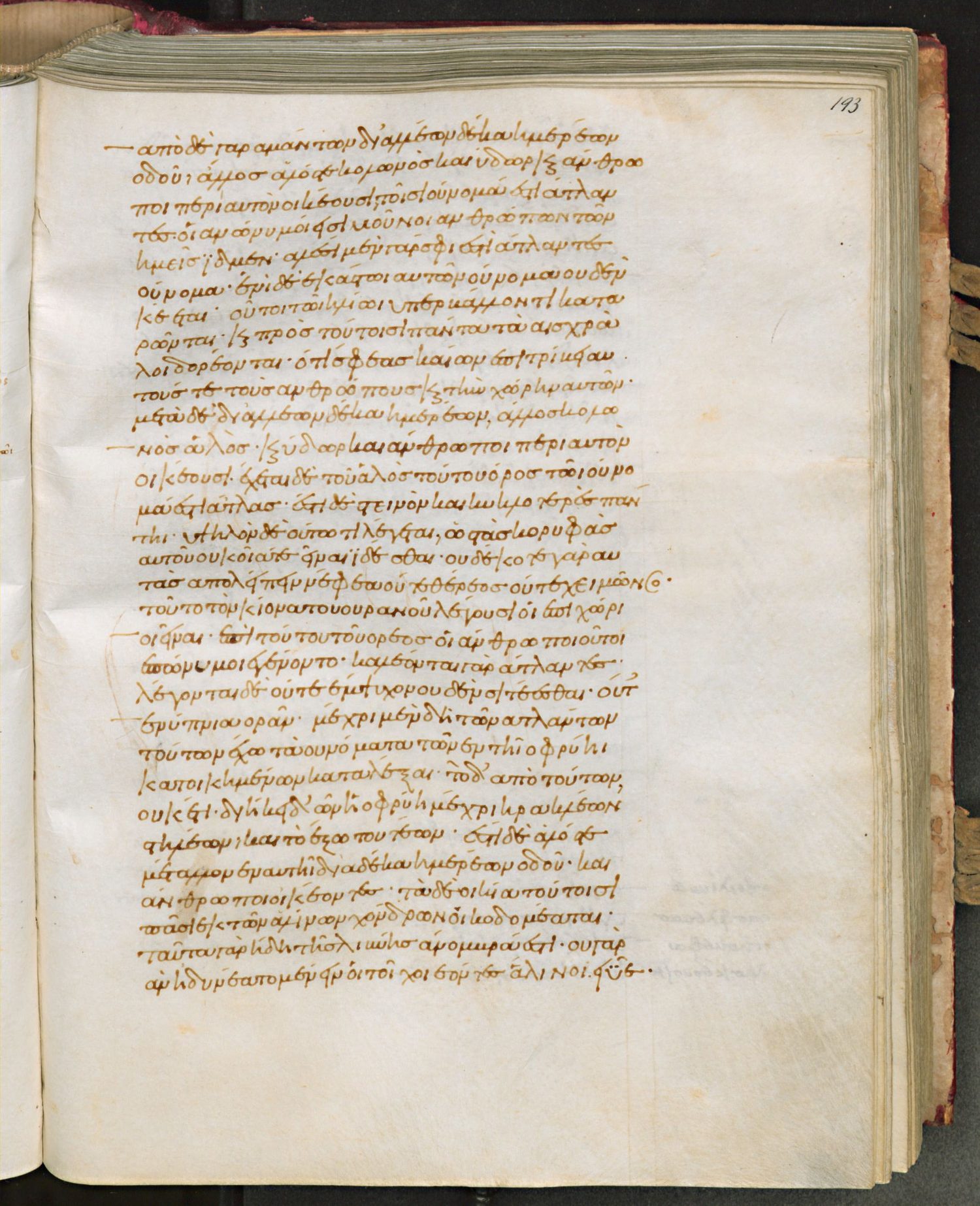
Laur. Plut. 70.3, fol. 193r: Greek here 4.184.1 to 4.185.2. Checked on the image (first and last words read and located in the Greek; each break checked against the neighbouring page): fol. 193r begins ‹ἀπὸ δὲ Γαραμάντων διʼ› (4.184.1), ends ‹ἐόντες ἅλινοι, εἰ ὗε› (4.185.2). English here: 4.184.1 to 4.185.2 (Godley's sentences for the sections whose Greek lies mostly on this page).
4.184.1ἀπὸ δὲ Γαραμάντων διʼ ἀλλέων δέκα ἡμερέων ὁδοῦ ἄλλος ἁλός τε κολωνὸς καὶ ὕδωρ, καὶ ἄνθρωποι περὶ αὐτὸν οἰκέουσι τοῖσι οὔνομα ἐστὶ Ἀτάραντες, οἳ ἀνώνυμοι εἰσὶ μοῦνοι ἀνθρώπων τῶν ἡμεῖς ἴδμεν· ἁλέσι μὲν γάρ σφι ἐστὶ Ἀτάραντες οὔνομα, ἑνὶ δὲ ἑκάστῳ αὐτῶν οὔνομα οὐδὲν κέεται. 4.184.2οὗτοι τῷ ἡλίῳ ὑπερβάλλοντι καταρῶνται καὶ πρὸς τούτοισι πάντα τὰ αἰσχρὰ λοιδορέονται, ὅτι σφέας καίων ἐπιτρίβει, αὐτούς τε τοὺς ἀνθρώπους καὶ τὴν χώρην αὐτῶν. 4.184.3μετὰ δὲ διʼ ἀλλέων δέκα ἡμερέων ἄλλος κολωνὸς ἁλὸς καὶ ὕδωρ, καὶ ἄνθρωποι περὶ αὐτὸν οἰκέουσι. ἔχεται δὲ τοῦ ἁλὸς τούτου ὄρος τῷ οὔνομα ἐστὶ Ἄτλας, ἔστι δὲ στεινὸν καὶ κυκλοτερὲς πάντῃ, ὑψηλὸν δὲ οὕτω δή τι λέγεται ὡς τὰς κορυφὰς αὐτοῦ οὐκ οἶά τε εἶναι ἰδέσθαι. οὐδέκοτε γὰρ αὐτὰς ἀπολείπειν νέφεα οὔτε θέρεος οὔτε χειμῶνος. τοῦτο τὸν κίονα τοῦ οὐρανοῦ λέγουσι οἱ ἐπιχώριοι εἶναι. 4.184.4ἐπὶ τούτου τοῦ ὄρεος οἱ ἄνθρωποι οὗτοι ἐπώνυμοι ἐγένοντο· καλέονται γὰρ δὴ Ἄτλαντες. λέγονται δὲ οὔτε ἔμψυχον οὐδὲν σιτέεσθαι οὔτε ἐνύπνια ὁρᾶν. 4.185.1μέχρι μὲν δὴ τῶν Ἀτλάντων τούτων ἔχω τὰ οὐνόματα τῶν ἐν τῇ ὀφρύῃ κατοικημένων καταλέξαι, τὸ δʼ ἀπὸ τούτων οὐκέτι. διήκει δʼ ὦν ἡ ὀφρύη μέχρι Ἡρακλέων στηλέων καὶ τὸ ἔξω τουτέων. 4.185.2ἔστι δὲ ἁλός τε μέταλλον ἐν αὐτῇ διὰ δέκα ἡμερέων ὁδοῦ καὶ ἄνθρωποι οἰκέοντες. τὰ δὲ οἰκία τούτοισι πᾶσι ἐκ τῶν ἁλίνων χόνδρων οἰκοδομέαται. ταῦτα γὰρ ἤδη τῆς Λιβύης ἄνομβρα ἐστί· οὐ γὰρ ἂν ἠδυνέατο μένειν οἱ τοῖχοι ἐόντες ἅλινοι, εἰ ὗε.
4.184.1After another ten days’ journey from the Garamantes there is again a salt hillock and water; men dwell there called Atarantes. These are the only men known to us who have no names; for the whole people are called Atarantes, but no man has a name of his own. 4.184.2These when the sun is exceeding high curse and most foully revile him, for that his burning heat afflicts their people and their land. 4.184.3After another ten days’ journey there is again a hillock of salt, and water, and men dwelling there. Near to this salt is a mountain called Atlas, the shape whereof is slender and a complete circle; and it is said to be so high that its summits cannot be seen, for cloud is ever upon them winter and summer. The people of the country call it the pillar of heaven. 4.184.4These men have got their name, which is Atlantes, from this mountain. It is said that they eat no living creature, and see no dreams in their sleep. 4.185.1I know and can tell the names of all the peoples that dwell on the ridge as far as the Atlantes, but no farther than that. But this I know, that the ridge reaches as far as the Pillars of Heracles and beyond them. 4.185.2There is a mine of salt on it every ten days’ journey, and men dwell there. Their houses are all built of the blocks of salt; for even these are parts of Libya where no rain falls; for the walls, being of salt, could not stand firm if there were rain.
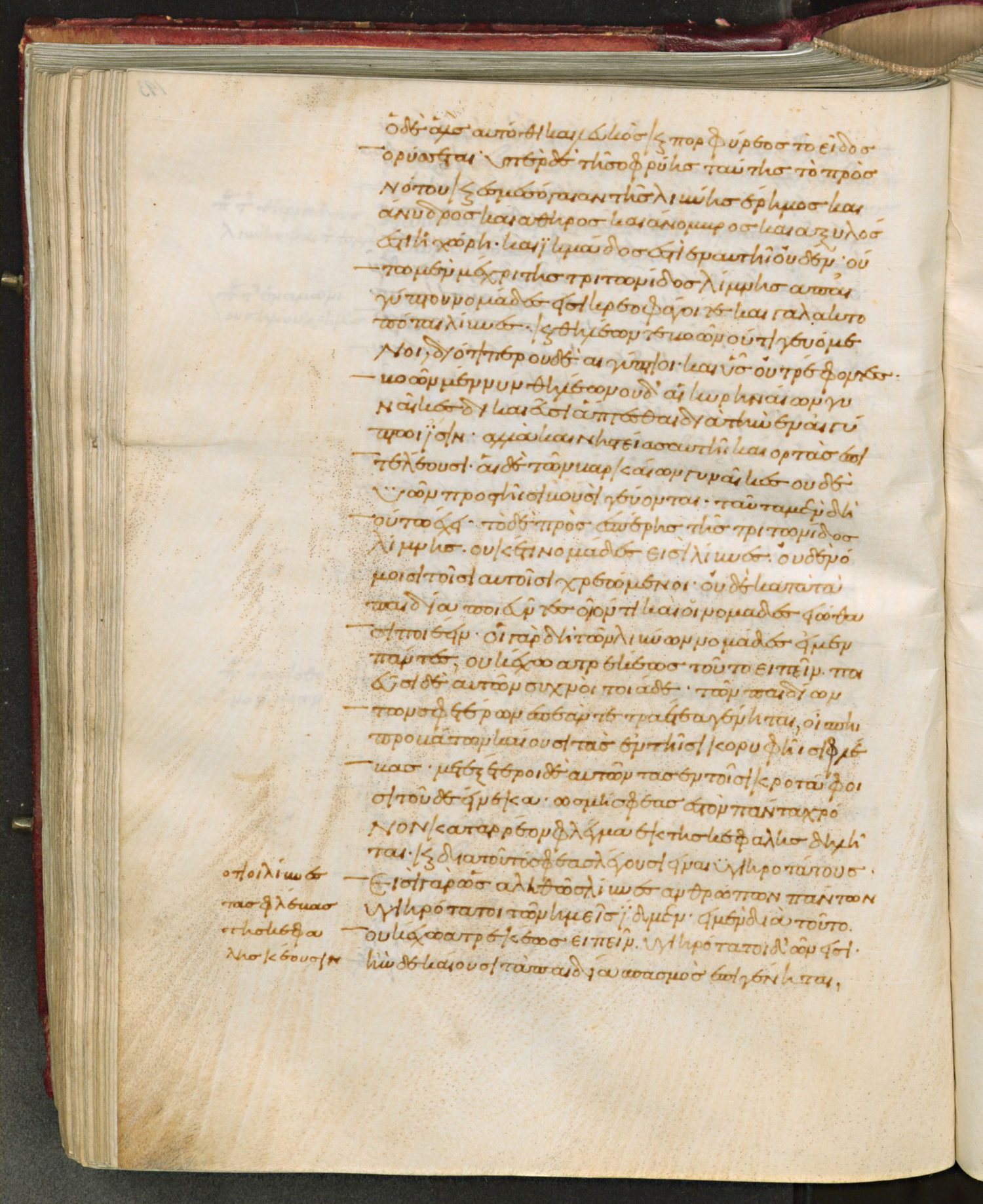
Where on the image
Laur. Plut. 70.3, fol. 193v: Greek here 4.185.3. Checked on the image (first and last words read and located in the Greek; each break checked against the neighbouring page): fol. 193v begins ‹ὁ δὲ ἃλς αὐτόθι› (4.185.3), ends ‹τὰ παιδία σπασμὸς ἐπιγένηται› (4.187.3). English here: 4.185.3 (Godley's sentences for the sections whose Greek lies mostly on this page).
4.185.3ὁ δὲ ἃλς αὐτόθι καὶ λευκὸς καὶ πορφύρεος τὸ εἶδος ὀρύσσεται. ὑπὲρ δὲ τῆς ὀφρύης τὸ πρὸς νότου καὶ ἐς μεσόγαιαν τῆς Λιβύης ἔρημος καὶ ἄνυδρος καὶ ἄθηρος καὶ ἄνομβρος καὶ ἄξυλος ἐστὶ ἡ χώρη, καὶ ἰκμάδος ἐστὶ ἐν αὐτῇ οὐδέν.
4.185.3The salt there is both white and purple. Beyond this ridge the southern and inland parts of Libya are desert and waterless; no wild beasts are there, nor rain, nor forests; this region is wholly without moisture.
Notes
- Greek: the text printed in A. D. Godley's Loeb edition, via Perseus (tlg0016.tlg001.perseus-grc2). Square brackets mark words the editor considers later additions; [...] marks a gap the editor indicates. Perseus note markers are omitted.
- English: A. D. Godley, Herodotus vol. 2 (1921) (Loeb Classical Library), as transcribed on Wikisource. Godley's footnotes are omitted.
- Section numbers in the English were placed by comparing Godley's text with the Perseus version of his translation; where a section begins inside one of Godley's sentences, the English is kept with the page that holds the start of that sentence.
Cite
Sources
- Source: Florence, Laur. Plut. 70.3 (10th c.) via BML Teca Digitale + Greek of Godley's Loeb (Perseus) + English of A. D. Godley (Loeb, Wikisource) (holding institution)
- Critical edition: Greek of A. D. Godley's Loeb edition (1920-1925), via Perseus
← previous · → next · v cycle view · l back to library