Herodotus, Histories 4.186-199: Libyan customs, animals and trade
Introduction
Herodotus of Halicarnassus wrote the Histories in the third quarter of the 5th century BCE, an inquiry into the deeds of Greeks and barbarians and the causes of the wars between them, later divided into nine books. Book 4 tells of Darius' expedition against the Scythians, with Herodotus' account of Scythia, its peoples, rivers and customs, and of the shape of the world, and of the Persian expedition against Barca, with the history of Cyrene and a description of the peoples of Libya.
The photographs are of Florence, Biblioteca Medicea Laurenziana, Plut. 70.3 (parchment, 10th century, 374 folios, 31 lines a page), Herodotus, Histories (codex A of the editors), the oldest surviving manuscript of the complete Histories, from the Teca Digitale of the Biblioteca Medicea Laurenziana. Each section below is the text of one page, or of the part of a page that falls within these chapters. The first and last words of every page were read on the photograph and located in the Greek, and every page break was checked against the next page; the notes quote these words. Readers' notes in the margins are not part of the text and are mentioned where they occur.
The Greek is the text printed in A. D. Godley's Loeb edition (1920-1925), from Perseus; it is the edited text, not a transcription of the manuscript, whose wording differs in places. The English is Godley's translation as printed, from Wikisource. Godley's English carries only chapter numbers; the section numbers shown in it were placed by comparison with the Perseus version of his translation. Each page's English is cut at the end of one of Godley's sentences, so it can begin or end a few lines away from the Greek of the page; each note gives the exact ranges.
This entry covers chapters 4.186-199, on fol. 193v to 196r.
How was this verified? (Provenance)
Where on the image
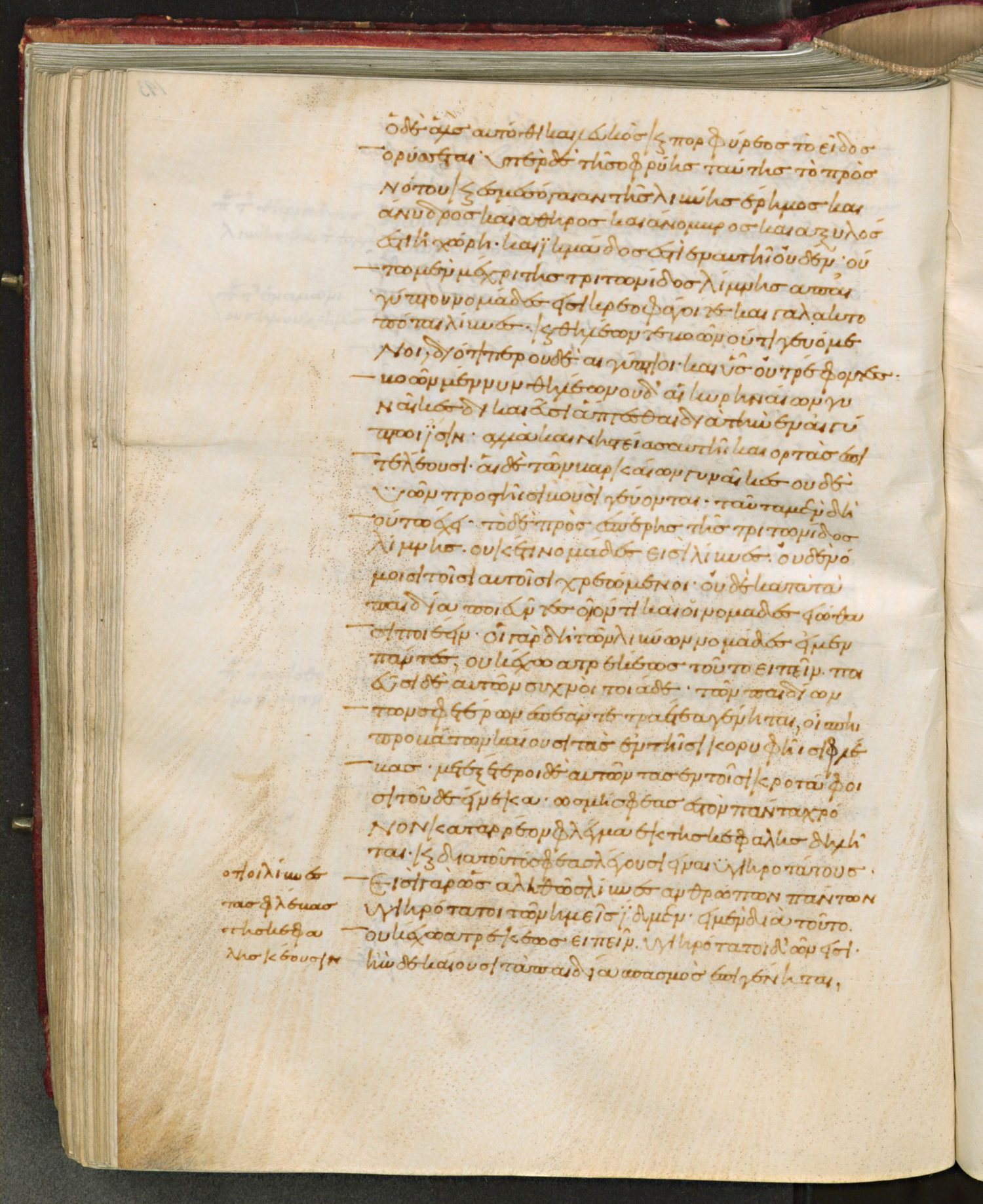
Laur. Plut. 70.3, fol. 193v: Greek here 4.186.1 to 4.187.3. Checked on the image (first and last words read and located in the Greek; each break checked against the neighbouring page): fol. 193v begins ‹ὁ δὲ ἃλς αὐτόθι› (4.185.3), ends ‹τὰ παιδία σπασμὸς ἐπιγένηται› (4.187.3). English here: 4.186.1 to 4.187.3 (Godley's sentences for the sections whose Greek lies mostly on this page).
4.186.1οὕτω μὲν μέχρι τῆς Τριτωνίδος λίμνης ἀπʼ Αἰγύπτου νομάδες εἰσὶ κρεοφάγοι τε καὶ γαλακτοπόται Λίβυες, καὶ θηλέων τε βοῶν οὔτι γευόμενοι, διότι περ οὐδὲ Αἰγύπτιοι, καὶ ὗς οὐ τρέφοντες. 4.186.2βοῶν μέν νυν θηλέων οὐδʼ αἱ Κυρηναίων γυναῖκες δικαιοῦσι πατέεσθαι διὰ τὴν ἐν Αἰγύπτῳ Ἶσιν, ἀλλὰ καὶ νηστηίας αὐτῇ καὶ ὁρτὰς ἐπιτελέουσι. αἱ δὲ τῶν Βαρκαίων γυναῖκες οὐδὲ ὑῶν πρὸς τῇσι βουσὶ γεύονται. 4.187.1ταῦτα μὲν δὴ οὕτω ἔχει. τὸ δὲ πρὸς ἑσπέρης τῆς Τριτωνίδος λίμνης οὐκέτι νομάδες εἰσὶ Λίβυες οὐδὲ νόμοισι τοῖσι αὐτοῖσι χρεώμενοι, οὐδὲ κατὰ τὰ παιδία ποιεῦντες οἷον τι καὶ οἱ νομάδες ἐώθασι ποιέειν. 4.187.2οἱ γὰρ δὴ τῶν Λιβύων νομάδες, εἰ μὲν πάντες, οὐκ ἔχω ἀτρεκέως τοῦτο εἰπεῖν, ποιεῦσι δὲ αὐτῶν συχνοὶ τοιάδε· τῶν παιδίων τῶν σφετέρων, ἐπεὰν τετραέτεα γένηται, οἴσπῃ προβάτων καίουσι τὰς ἐν τῇσι κορυφῇσι φλέβας, μετεξέτεροι δὲ αὐτῶν τὰς ἐν τοῖσι κροτάφοισι, τοῦδε εἵνεκα ὡς μή σφεας ἐς τὸν πάντα χρόνον καταρρέον φλέγμα ἐκ τῆς κεφαλῆς δηλέηται. 4.187.3καὶ διὰ τοῦτο σφέας λέγουσι εἶναι ὑγιηροτάτους· εἰσὶ γὰρ ὡς ἀληθέως οἱ Λίβυες ἀνθρώπων πάντων ὑγιηρότατοι τῶν ἡμεῖς ἴδμεν, εἰ μὲν διὰ τοῦτο, οὐκ ἔχω ἀτρεκέως εἰπεῖν, ὑγιηρότατοι δʼ ὦν εἰσί. ἢν δὲ καίουσι τὰ παιδία σπασμὸς ἐπιγένηται,
4.186.1Thus from Egypt to the Tritonian lake, the Libyans are nomads that eat meat and drink milk; for the same reason as the Egyptians too profess, they will not touch the flesh of cows; and they rear no swine. 4.186.2The women of Cyrene too deem it wrong to eat cows’ flesh, because of the Isis of Egypt; nay, they even honour her with fasts and festivals; and the Barcaean women refuse to eat swine too as well as cows. 4.187.1Thus it is with this region. But westward of the Tritonian lake the Libyans are not nomads; they follow not the same usages, nor treat their children as the nomads are wont to do. 4.187.2For the practice of many Libyan nomads (I cannot with exactness say whether it be the practice of all) is to take their children when four years old, and with grease of sheep’s wool to burn the veins of their scalps or sometimes of their temples, that so the children may be never afterwards afflicted by phlegm running down from the head. 4.187.3They say that this makes their children most healthy. In truth no men known to us are so healthy as the Libyans; whether it be by reason of this practice, I cannot with exactness say; but most healthy they certainly are. When the children smart from the pain of the burning the Libyans have found a remedy, which is, to heal them by moistening with goats’ urine. This is what the Libyans themselves say.
Where on the image
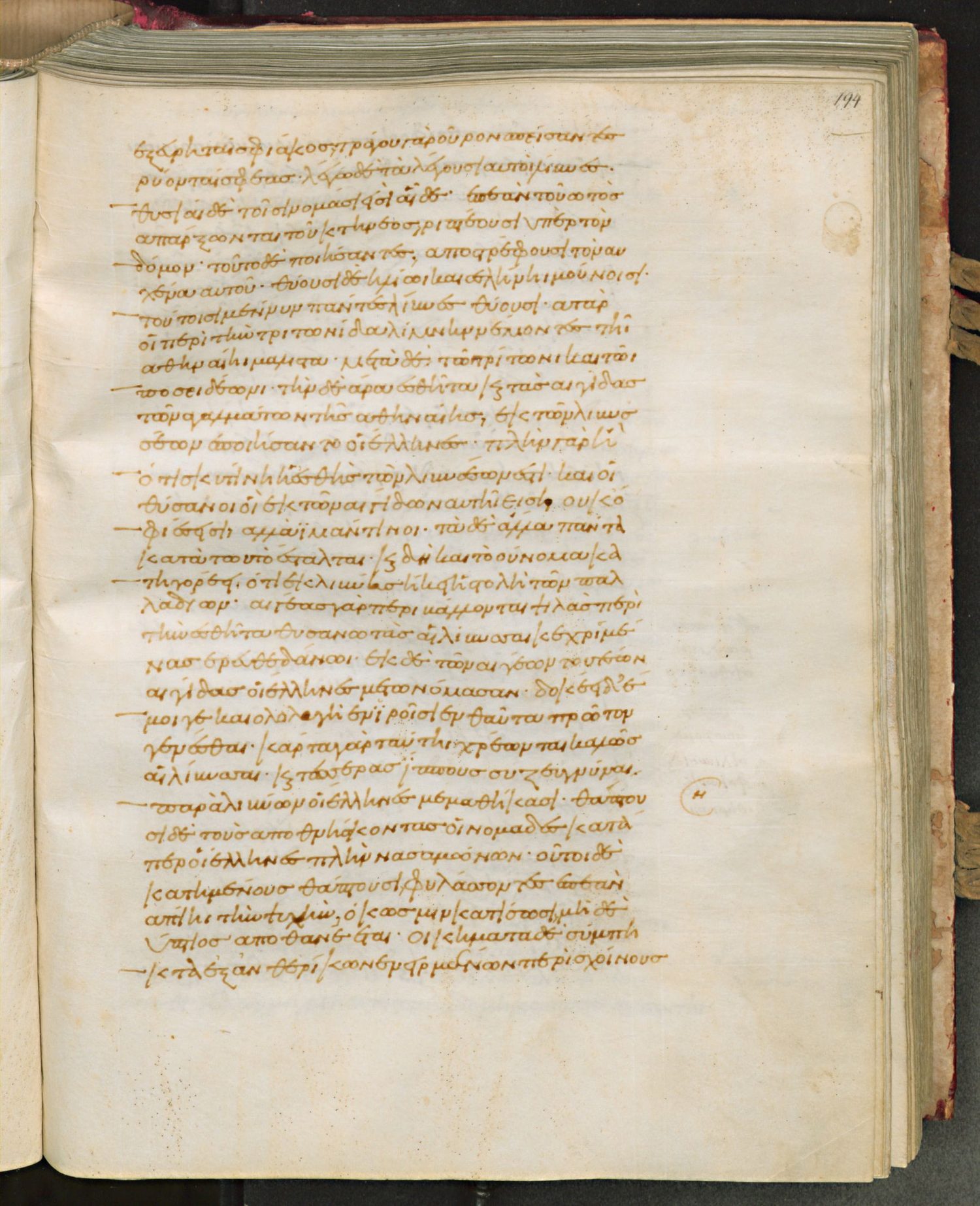
Laur. Plut. 70.3, fol. 194r: Greek here 4.187.3 to 4.190.1. Checked on the image (first and last words read and located in the Greek; each break checked against the neighbouring page): fol. 194r begins ‹ἐξεύρηταί σφι ἄκος· τράγου› (4.187.3), ends ‹ἀνθερίκων ἐνειρμένων περὶ σχοίνους› (4.190.1). English here: 4.188.1 to 4.190.1 (Godley's sentences for the sections whose Greek lies mostly on this page).
4.187.3ἐξεύρηταί σφι ἄκος· τράγου γὰρ οὖρον σπείσαντες ῥύονται σφέα. λέγω δὲ τὰ λέγουσι αὐτοὶ Λίβυες. 4.188.1θυσίαι δὲ τοῖσι νομάσι εἰσὶ αἵδε. ἐπεὰν τοῦ ὠτὸς ἀπάρξωνται τοῦ κτήνεος, ῥιπτέουσι ὑπὲρ τὸν δόμον, τοῦτο δὲ ποιήσαντες ἀποστρέφουσι τὸν αὐχένα αὐτοῦ· θύουσι δὲ ἡλίῳ καὶ σελήνῃ μούνοισι. τούτοισι μέν νυν πάντες Λίβυες θύουσι, ἀτὰρ οἱ περὶ τὴν Τριτωνίδα λίμνην νέμοντες τῇ Ἀθηναίῃ μάλιστα, μετὰ δὲ τῷ Τρίτωνι καὶ τῷ Ποσειδέωνι. 4.189.1τὴν δὲ ἄρα ἐσθῆτα καὶ τὰς αἰγίδας τῶν ἀγαλμάτων τῆς Ἀθηναίης ἐκ τῶν Λιβυσσέων ἐποιήσαντο οἱ Ἕλληνες· πλὴν γὰρ ἢ ὅτι σκυτίνη ἡ ἐσθὴς τῶν Λιβυσσέων ἐστὶ καὶ οἱ θύσανοι οἱ ἐκ τῶν αἰγίδων αὐτῇσι οὐκ ὄφιες εἰσὶ ἀλλὰ ἱμάντινοι, τά γε ἄλλα πάντα κατὰ τὠυτὸ ἔσταλται. 4.189.2καὶ δὴ καὶ τὸ οὔνομα κατηγορέει ὅτι ἐκ Λιβύης ἥκει ἡ στολὴ τῶν Παλλαδίων· αἰγέας γὰρ περιβάλλονται ψιλὰς περὶ τὴν ἐσθῆτα θυσανωτὰς αἱ Λίβυσσαι κεχριμένας ἐρευθεδάνῳ, ἐκ δὲ τῶν αἰγέων τουτέων αἰγίδας οἱ Ἕλληνες μετωνόμασαν. 4.189.3δοκέει δʼ ἔμοιγε καὶ ὀλολυγὴ ἐν ἱροῖσι ἐνθαῦτα πρῶτον γενέσθαι· κάρτα γὰρ ταύτῃ χρέωνται καλῶς αἱ Λίβυσσαι. καὶ τέσσερας ἵππους συζευγνύναι παρὰ Λιβύων οἱ Ἕλληνες μεμαθήκασι. 4.190.1θάπτουσι δὲ τοὺς ἀποθνήσκοντας οἱ νομάδες κατά περ οἱ Ἕλληνες, πλὴν Νασαμώνων· οὗτοι δε κατημένους θάπτουσι, φυλάσσοντες, ἐπεὰν ἀπιῇ τὴν ψυχήν, ὅκως μιν κατίσουσι μηδὲ ὕπτιος ἀποθανέεται. οἰκήματα δὲ σύμπηκτα ἐξ ἀνθερίκων ἐνειρμένων περὶ σχοίνους
4.188.1The nomads’ manner of sacrificing is to cut a piece from the victim’s ear for first-fruits and throw it over the house; which done they turn back the victim’s neck. They sacrifice to no gods save the sun and moon; that is, this is the practice of the whole nation; but the dwellers by the Tritonian lake sacrifice to Athene chiefly, and next to Triton and Poseidon. 4.189.1It would seem that the robe and aegis of the images of Athene were copied by the Greeks from the Libyan women; for save that the dress of Libyan women is leathern, and that the tassels of their goatskin corselets are not snakes hut made of thongs of hide, in all else their equipment is the same. 4.189.2Nay, the very name bewrays that the raiment of the statues of Pallas has come from Libya; for Libyan women wear hairless tasselled goatskins over their dress, coloured with madder, and the Greeks have changed the name of these goatskins into their “aegis.” 4.189.3Further, to my thinking the ceremonial chant first took its rise in Libya: for the women of that country chant very tunefully. And it is from the Libyans that the Greeks have learnt to drive four-horse chariots. 4.190.1The dead are buried by the nomads in Greek fashion, save by the Nasamones. These bury their dead sitting, being careful to make the dying man sit when he gives up the ghost, and not die lying supine. Their dwellings are compact of asphodel-stalks twined about reeds; they can be carried hither and thither. Such are the Libyan usages.
Where on the image
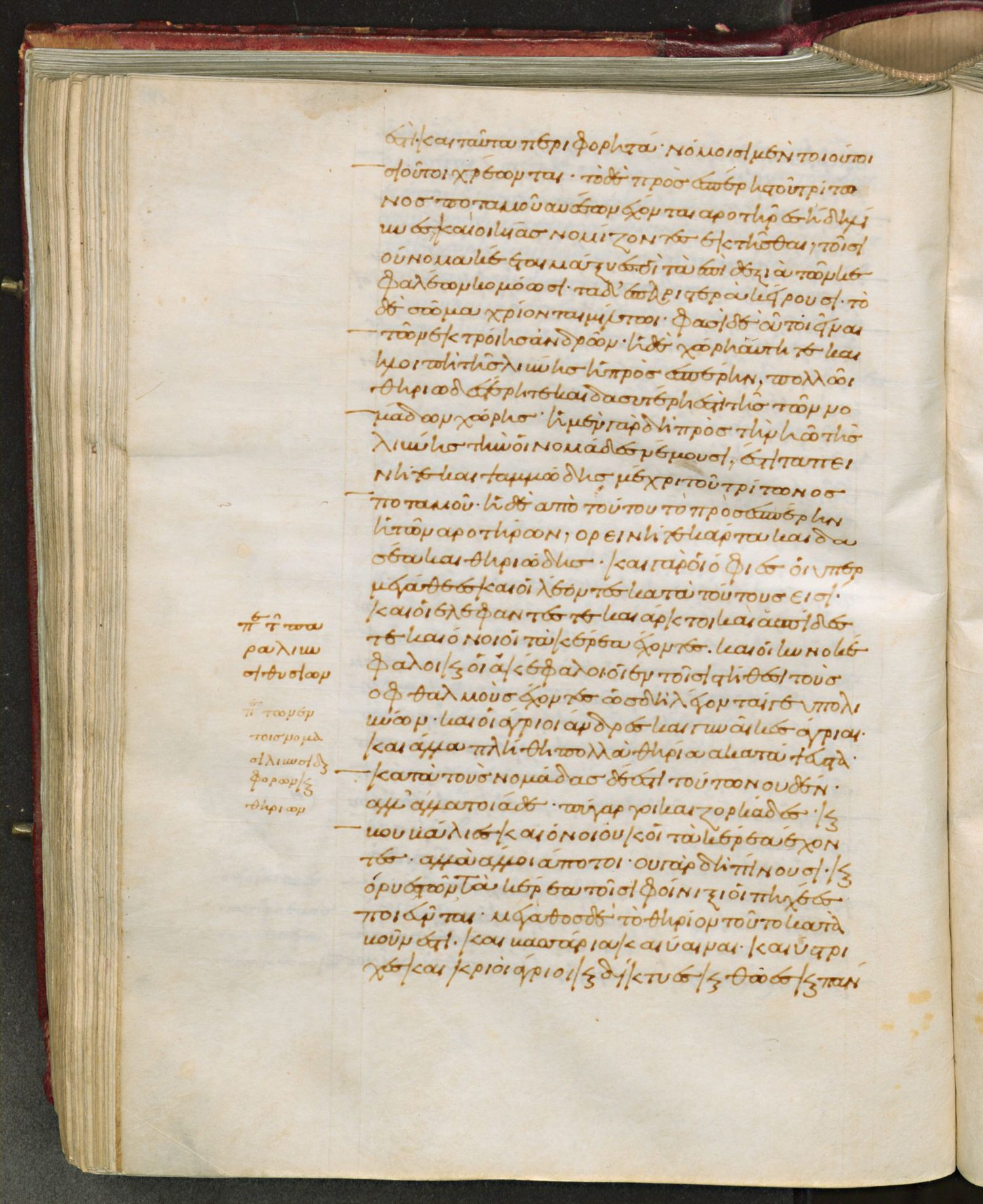
Laur. Plut. 70.3, fol. 194v: Greek here 4.190.1 to 4.192.2. Checked on the image (first and last words read and located in the Greek; each break checked against the neighbouring page): fol. 194v begins ‹ἐστί, καὶ ταῦτα περιφορητά.› (4.190.1), ends ‹ἄγριος ἐν Λιβύῃ πάμ-› (4.192.2). English here: 4.191.1 to 4.192.2 (Godley's sentences for the sections whose Greek lies mostly on this page).
4.190.1ἐστί, καὶ ταῦτα περιφορητά. νόμοισι μὲν τοιούτοισι οὗτοι χρέωνται. 4.191.1τὸ δὲ πρὸς ἑσπέρης τοῦ Τρίτωνος ποταμοῦ Αὐσέων ἔχονται ἀροτῆρες ἤδη Λίβυες καὶ οἰκίας νομίζοντες ἐκτῆσθαι, τοῖσι οὔνομα κέεται Μάξυες. οἳ τὰ ἐπὶ δεξιὰ τῶν κεφαλέων κομόωσι, τὰ δʼ ἐπʼ ἀριστερὰ κείρουσι, τὸ δὲ σῶμα χρίονται μίλτῳ. φασὶ δὲ οὗτοι εἶναι τῶν ἐκ Τροίης ἀνδρῶν. 4.191.2ἡ δὲ χώρη αὕτη τε καὶ ἡ λοιπὴ τῆς Λιβύης ἡ πρὸς ἑσπέρην πολλῷ θηριωδεστέρη τε καὶ δασυτέρη ἐστὶ τῆς τῶν νομάδων χώρης. 4.191.3ἡ μὲν γὰρ δὴ πρὸς τὴν ἠῶ τῆς Λιβύης, τὴν οἱ νομάδες νέμουσι, ἐστὶ ταπεινή τε καὶ ψαμμώδης μέχρι τοῦ Τρίτωνος ποταμοῦ, ἡ δὲ ἀπὸ τούτου τὸ πρὸς ἑσπέρην ἡ τῶν ἀροτήρων ὀρεινή τε κάρτα καὶ δασέα καὶ θηριώδης· 4.191.4καὶ γὰρ οἱ ὄφιες οἱ ὑπερμεγάθεες καὶ οἱ λέοντες κατὰ τούτους εἰσὶ καὶ οἱ ἐλέφαντές τε καὶ ἄρκτοι καὶ ἀσπίδες τε καὶ ὄνοι οἱ τὰ κέρεα ἔχοντες καὶ οἱ κυνοκέφαλοι καὶ οἱ ἀκέφαλοι οἱ ἐν τοῖσι στήθεσι τοὺς ὀφθαλμοὺς ἔχοντες, ὡς δὴ λέγονταί γε ὑπὸ Λιβύων, καὶ οἱ ἄγριοι ἄνδρες καὶ γυναῖκες ἄγριαι, καὶ ἄλλα πλήθεϊ πολλὰ θηρία ἀκατάψευστα. 4.192.1κατὰ τοὺς νομάδας δὲ ἐστὶ τούτων οὐδέν, ἀλλʼ ἄλλα τοιάδε, πύγαργοι καὶ ζορκάδες καὶ βουβάλιες καὶ ὄνοι, οὐκ οἱ τὰ κέρεα ἔχοντες ἀλλʼ ἄλλοι ἄποτοι (οὐ γὰρ δὴ πίνουσι), καὶ ὄρυες, τῶν τὰ κέρεα τοῖσι φοίνιξι οἱ πήχεες ποιεῦνται (μέγαθος δὲ τὸ θηρίον τοῦτο κατὰ βοῦν ἐστι), 4.192.2καὶ βασσάρια καὶ ὕαιναι καὶ ὕστριχες καὶ κριοὶ ἄγριοι καὶ δίκτυες καὶ θῶες καὶ πάνθηρες καὶ βόρυες, καὶ κροκόδειλοι ὅσον τε τριπήχεες χερσαῖοι, τῇσι σαύρῃσι ἐμφερέστατοι, καὶ στρουθοὶ κατάγαιοι, καὶ ὄφιες μικροί, κέρας ἓν ἕκαστος ἔχοντες· ταῦτά τε δὴ αὐτόθι ἐστὶ θηρία καὶ τά περ τῇ ἄλλῃ, πλὴν ἐλάφου τε καὶ ὑὸς ἀγρίου· ἔλαφος δὲ καὶ ὗς ἄγριος ἐν Λιβύῃ πάμπαν
4.191.1Westward of the river Triton and next to the Aseans begins the country of Libyans who till the soil and possess houses; they are called Maxyes; they wear their hair long on the right side of their heads and shave the left, and they paint their bodies with vermilion. 4.191.2These claim descent from the men who came from Troy. Their country, and the rest of the western part of Libya is much fuller of wild beasts and more wooded than the country of the nomads. 4.191.3For the eastern region of Libya, which the nomads inhabit, is low-lying and sandy as far as the river Triton; but the land westward of this, where dwell the tillers of the soil, is exceeding mountainous and wooded and full of wild beasts. 4.191.4In that country are the huge snakes and the lions, and the elephants and bears and asps, the horned asses, the dog-headed men and the headless that have their eyes in their breasts, as the Libyans say, and the wild men and women, besides many other creatures not fabulous. 4.192.1But in the nomads’ country there are none of these; yet there are others, white-rumped antelopes, gazelles, hartebeest, asses, not the horned asses, but those that are called “undrinking” (for indeed they never drink), the oryx, the horns whereof are made into the sides of a lyre, 4.192.2foxes, hyenas, porcupines, wild rams, the dictys, jackals, panthers, the borys, land crocodiles three cubits long, most like to lizards, and ostriches and little one-horned serpents; all these beasts are there besides those that are elsewhere too, save only deer and wild boar; of these two kinds there are none at all in Libya.
Where on the image
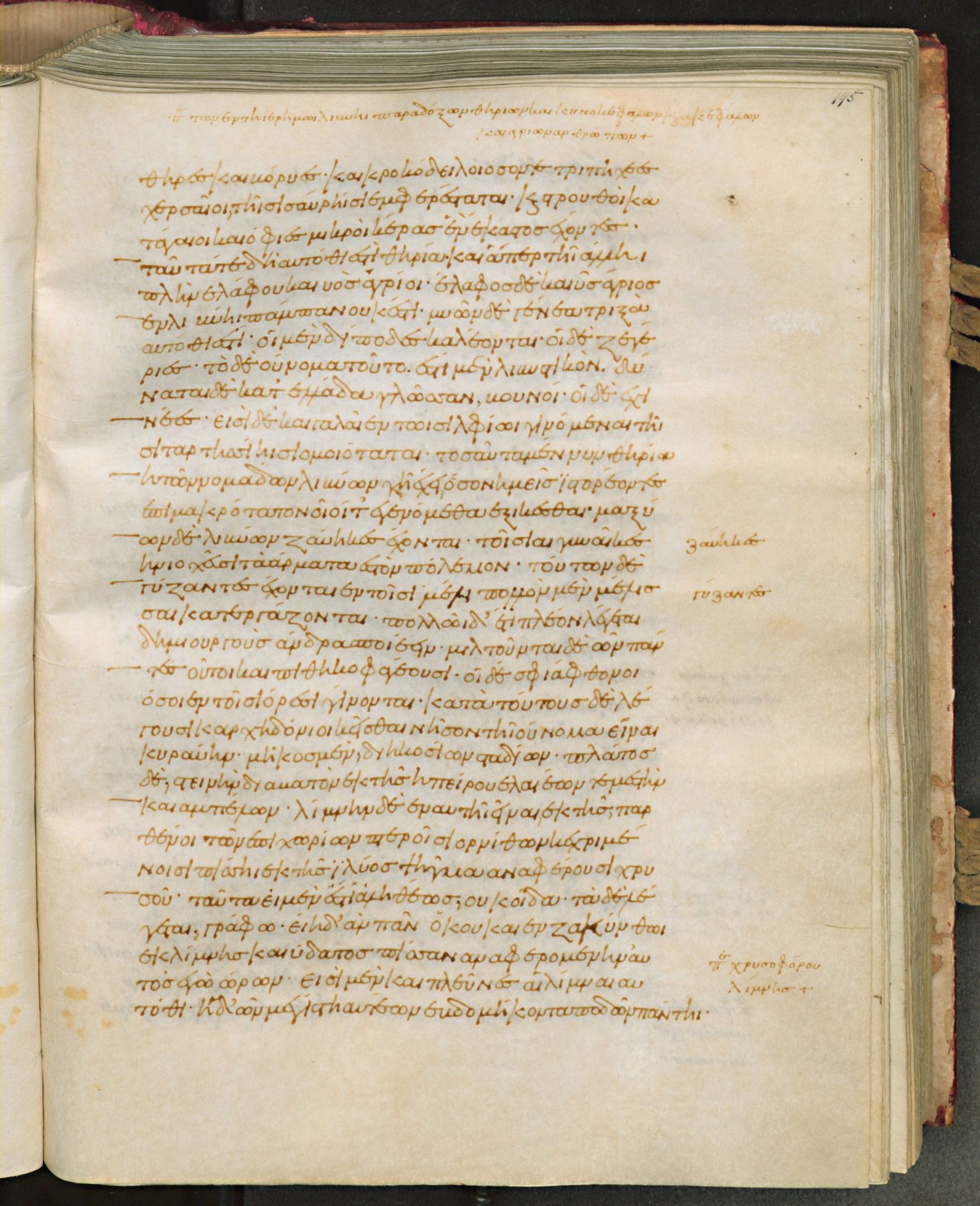
Laur. Plut. 70.3, fol. 195r: Greek here 4.192.2 to 4.195.3. Checked on the image (first and last words read and located in the Greek; each break checked against the neighbouring page): fol. 195r begins ‹-παν οὐκ ἔστι.μυῶν δὲ› (4.192.2), ends ‹αὐτέων ἑβδομήκοντα ποδῶν πάντῃ› (4.195.3). The word ‹πάμπαν› is divided between fol. 194v and fol. 195r; it is given with fol. 194v. A reader's note on the animals of the Libyan desert stands in the upper margin. English here: 4.192.3 to 4.195.2 (Godley's sentences for the sections whose Greek lies mostly on this page).
4.192.2οὐκ ἔστι. 4.192.3μυῶν δὲ γένεα τριξὰ αὐτόθι ἔστι· οἳ μὲν δίποδες καλέονται, οἳ δὲ ζεγέριες (τὸ δὲ οὔνομα τοῦτο ἐστὶ μὲν Λιβυστικόν, δύναται δὲ κατʼ Ἑλλάδα γλῶσσαν βουνοί), οἳ δὲ ἐχινέες. εἰσὶ δὲ καὶ γαλαῖ ἐν τῷ σιλφίῳ γινόμεναι τῇσι Ταρτησσίῃσι ὁμοιόταται. τοσαῦτα μέν νυν θηρία ἡ τῶν νομάδων Λιβύων γῆ ἔχει, ὅσον ἡμεῖς ἱστορέοντες ἐπὶ μακρότατον οἷοί τε ἐγενόμεθα ἐξικέσθαι. 4.193.1Μαξύων δὲ Λιβύων Ζαύηκες ἔχονται, τοῖσι αἱ γυναῖκες ἡνιοχεῦσι τὰ ἅρματα ἐς τὸν πόλεμον. 4.194.1τούτων δὲ Γύζαντες ἔχονται, ἐν τοῖσι μέλι πολλὸν μὲν μέλισσαι κατεργάζονται, πολλῷ δʼ ἔτι πλέον λέγεται δημιοεργοὺς ἄνδρας ποιέειν. μιλτοῦνται δʼ ὦν πάντες οὗτοι καὶ πιθηκοφαγέουσι. οἳ δὲ σφι ἄφθονοι ὅσοι ἐν τοῖσι ὄρεσι γίνονται. 4.195.1κατὰ τούτους δὲ λέγουσι Καρχηδόνιοι κεῖσθαι νῆσον τῇ οὔνομα εἶναι Κύραυιν, μῆκος μὲν διηκοσίων σταδίων, πλάτος δὲ στεινήν, διαβατὸν ἐκ τῆς ἠπείρου, ἐλαιέων τε μεστὴν καὶ ἀμπέλων. 4.195.2λίμνην δὲ ἐν αὐτῇ εἶναι, ἐκ τῆς αἱ παρθένοι τῶν ἐπιχωρίων πτεροῖσι ὀρνίθων κεχριμένοισι πίσσῃ ἐκ τῆς ἰλύος ψῆγμα ἀναφέρουσι χρυσοῦ. ταῦτα εἰ μὲν ἔστι ἀληθέως οὐκ οἶδα, τὰ δὲ λέγεται γράφω· εἴη δʼ ἂν πᾶν, ὅκου καὶ ἐν Ζακύνθῳ ἐκ λίμνης καὶ ὕδατος πίσσαν ἀναφερομένην αὐτὸς ἐγὼ ὥρων. 4.195.3εἰσὶ μὲν καὶ πλεῦνες αἱ λίμναι αὐτόθι, ἡ δʼ ὦν μεγίστη αὐτέων ἑβδομήκοντα ποδῶν πάντῃ,
4.192.3There are in this country three kinds of mice, the two-footed, the “zegeriës” (this is a Libyan word, signifying in our language hills), and the bristly-haired, as they are called. There are also weasels found in the silphium, very like to the weasels of Tartessus. So many are the wild creatures of the nomads’ country, as far as by our utmost enquiry we have been able to learn. 4.193.1Next to the Maxyes of Libya are the Zauekes, whose women drive their chariots to war. 4.194.1Next to these are the Gyzantes, where much honey is made by bees, and much more yet (so it is said) by craftsmen. It is certain that they all paint themselves with vermilion and eat apes, which do greatly abound in their mountains. 4.195.1Off their coast (say the Carchedonians) there lies an island called Cyrauis, two hundred furlongs long and narrow across; there is a passage to it from the mainland; it is full of olives and vines. 4.195.2It is said that there is a lake in this island wherefrom the maidens of the country draw up gold-dust out of the mud with feathers smeared with pitch. I know not if this be truly so; I write but what is said. Yet all things are possible; for I myself saw pitch drawn from the water of a pool in Zacynthus.
Where on the image
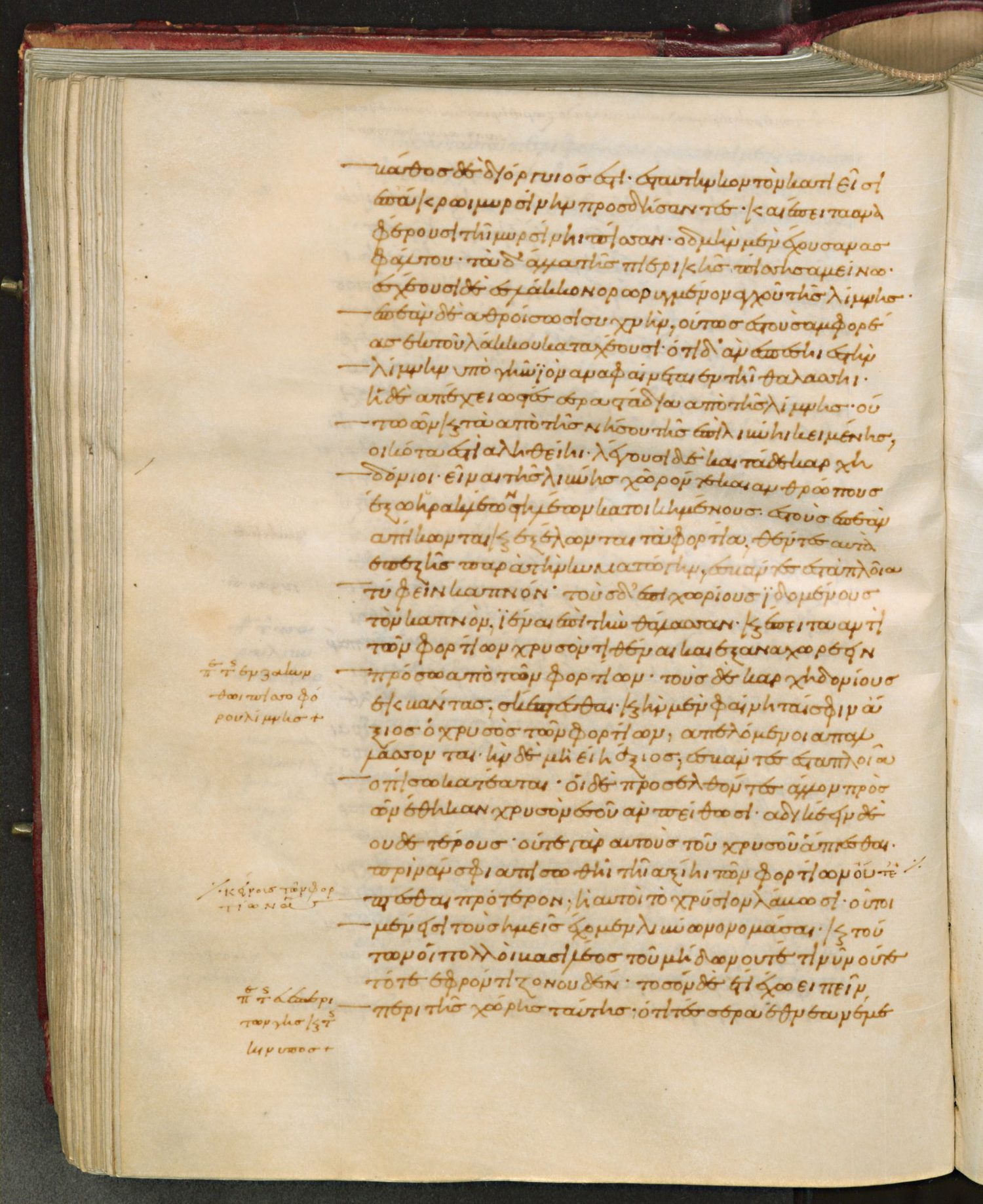
Laur. Plut. 70.3, fol. 195v: Greek here 4.195.3 to 4.197.2. Checked on the image (first and last words read and located in the Greek; each break checked against the neighbouring page): fol. 195v begins ‹βάθος δὲ διόργυιος ἐστί·› (4.195.3), ends ‹ὅτι τέσσερα ἔθνεα νέμεται› (4.197.2). English here: 4.195.3 to 4.197.1 (Godley's sentences for the sections whose Greek lies mostly on this page).
4.195.3βάθος δὲ διόργυιος ἐστί· ἐς ταύτην κοντὸν κατιεῖσι ἐπʼ ἄκρῳ μυρσίνην προσδήσαντες καὶ ἔπειτα ἀναφέρουσι τῇ μυρσίνῃ πίσσαν, ὀδμὴν μὲν ἔχουσαν ἀσφάλτου, τὰ δʼ ἄλλα τῆς Πιερικῆς πίσσης ἀμείνω. ἐσχέουσι δὲ ἐς λάκκον ὀρωρυγμένον ἀγχοῦ τῆς λίμνης. ἐπεὰν δὲ ἀθροίσωσι συχνήν, οὕτω ἐς τοὺς ἀμφορέας ἐκ τοῦ λάκκου καταχέουσι. 4.195.4ὁ τι δʼ ἂν ἐσπέσῃ ἐς τὴν λίμνην, ὑπὸ γῆν ἰὸν ἀναφαίνεται ἐν τῇ θαλάσσῃ· ἣ δὲ ἀπέχει ὡς τέσσερα στάδια ἀπὸ τῆς λίμνης. οὕτω ὦν καὶ τὰ ἀπὸ τῆς νήσου τῆς ἐπὶ Λιβύῃ κειμένης οἰκότα ἐστὶ ἀληθείῃ. 4.196.1λέγουσι δὲ καὶ τάδε Καρχηδόνιοι. εἶναι τῆς Λιβύης χῶρόν τε καὶ ἀνθρώπους ἔξω Ἡρακλέων στηλέων κατοικημένους· ἐς τοὺς ἐπεὰν ἀπίκωνται καὶ ἐξέλωνται τὰ φορτία, θέντες αὐτὰ ἐπεξῆς παρὰ τὴν κυματωγήν, ἐσβάντες ἐς τὰ πλοῖα τύφειν καπνόν. τοὺς δʼ ἐπιχωρίους ἰδομένους τὸν καπνὸν ἰέναι ἐπὶ τὴν θάλασσαν καὶ ἔπειτα ἀντὶ τῶν φορτίων χρυσὸν τιθέναι καὶ ἐξαναχωρέειν πρόσω ἀπὸ τῶν φορτίων. 4.196.2τοὺς δὲ Καρχηδονίους ἐκβάντας σκέπτεσθαι, καὶ ἢν μὲν φαίνηταί σφι ἄξιος ὁ χρυσὸς τῶν φορτίων, ἀνελόμενοι ἀπαλλάσσονται, ἢν δὲ μὴ ἄξιος, ἐσβάντες ὀπίσω ἐς τὰ πλοῖα κατέαται· οἱ δὲ προσελθόντες ἄλλον πρὸς ὦν ἔθηκαν χρυσόν, ἐς οὗ ἂν πείθωσι. ἀδικέειν δὲ οὐδετέρους. 4.196.3οὔτε γὰρ αὐτοὺς τοῦ χρυσοῦ ἅπτεσθαι πρὶν ἄν σφι ἀπισωθῇ τῇ ἀξίῃ τῶν φορτίων, οὔτʼ ἐκείνους τῶν φορτίων ἅπτεσθαι πρότερον ἢ αὐτοὶ τὸ χρυσίον λάβωσι. 4.197.1οὗτοι μὲν εἶσὶ τοὺς ἡμεῖς ἔχομεν Λιβύων ὀνομάσαι, καὶ τούτων οἱ πολλοὶ βασιλέος τοῦ Μήδων οὔτε τι νῦν οὔτε τότε ἐφρόντιζον οὐδέν. 4.197.2τοσόνδε δὲ ἔτι ἔχω εἰπεῖν περὶ τῆς χώρης ταύτης, ὅτι τέσσερα ἔθνεα νέμεται
4.195.3The pools there are many; the greatest of them is seventy feet long and broad, and two fathoms deep. Into this they drop a pole with a myrtle branch made fast to its end, and bring up pitch on the myrtle, smelling like asphalt, and for the rest better than the pitch of Pieria. Then they pour it into a pit that they have dug near the pool; and when much is collected there, they fill their vessels from the pit. 4.195.4Whatever thing falls into the pool is carried under ground and appears again in the sea, which is about four furlongs distant from the pool. Thus, then, the story coming from the island off the Libyan coast is like the truth. 4.196.1Another story too is told by the Carchedonians. There is a place in Libya, they say, where men dwell beyond the Pillars of Heracles; to this they come and unload their cargo; then having laid it orderly along the beach they go aboard their ships and light a smoking fire. The people of the country see the smoke, and coming to the sea they lay down gold to pay for the cargo and withdraw away from the wares. 4.196.2Then the Carchedonians disembark and examine the gold; if it seems to them a fair price for their cargo, they take it and go their ways; but if not, they go aboard again and wait, and the people come back and add more gold till the shipmen are satisfied. 4.196.3Herein neither party (it is said) defrauds the other; the Carchedonians do not lay hands on the gold till it matches the value of their cargo, nor do the people touch the cargo till the shipmen have taken the gold. 4.197.1These are all the Libyans whom we can name, and of their kings the most part cared nothing for the king of the Medes at the time of which I write, nor do they care for him now.
Where on the image
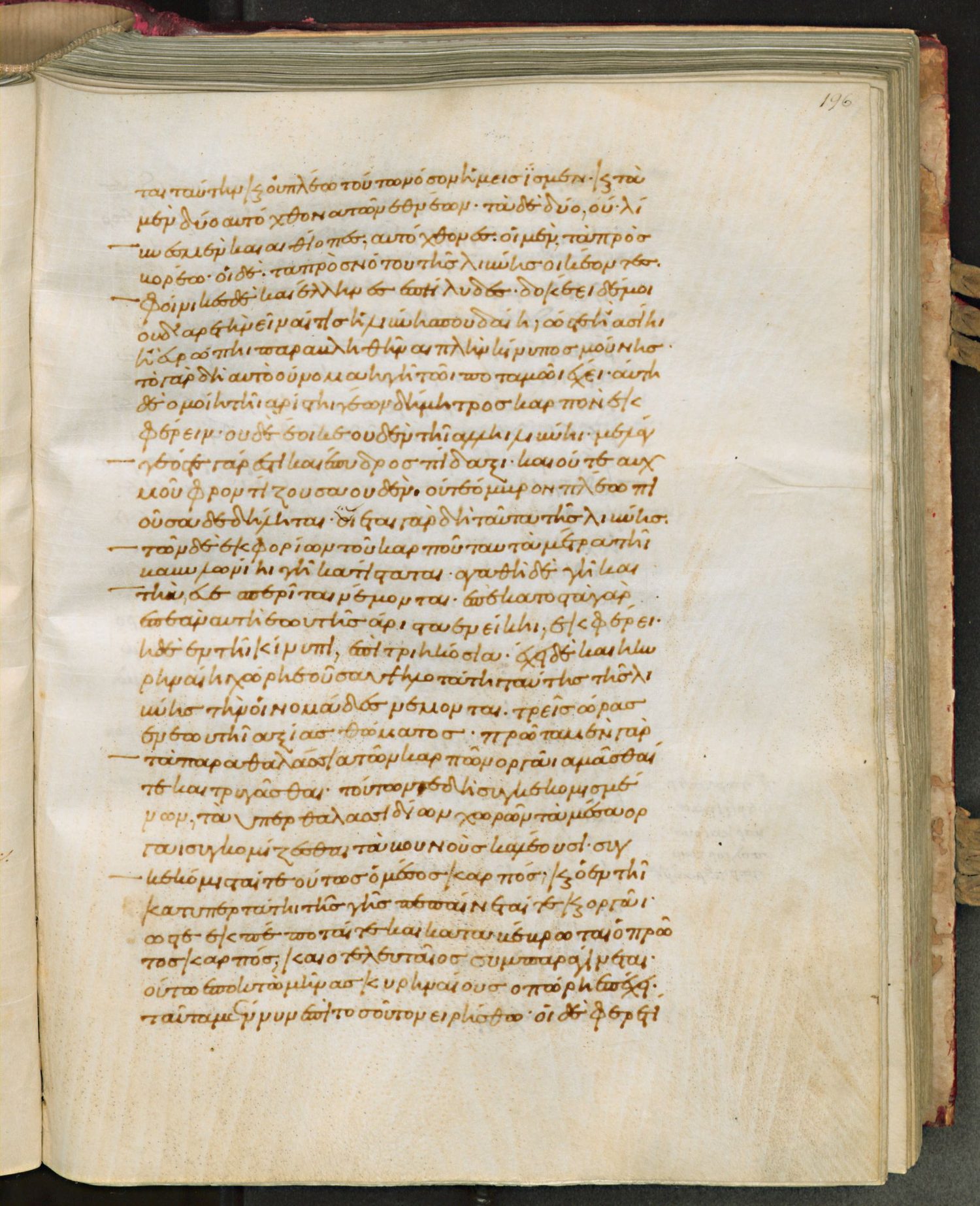
Laur. Plut. 70.3, fol. 196r: Greek here 4.197.2 to 4.199.2. Checked on the image (first and last words read and located in the Greek; each break checked against the neighbouring page): fol. 196r begins ‹αὐτὴν καὶ οὐ πλέω› (4.197.2), ends ‹τοσοῦτον εἰρήσθω.οἱ δὲ Φερε-› (4.200.1). English here: 4.197.2 to 4.199.2 (Godley's sentences for the sections whose Greek lies mostly on this page).
4.197.2αὐτὴν καὶ οὐ πλέω τούτων, ὅσον ἡμεῖς ἴδμεν, καὶ τὰ μὲν δύο αὐτόχθονα τῶν ἐθνέων τὰ δὲ δύο οὔ, Λίβυες μὲν καὶ Αἰθίοπες αὐτόχθονες, οἳ μὲν τὰ πρὸς βορέω οἳ δὲ τὰ πρὸς νότου τῆς Λιβύης οἰκέοντες, Φοίνικες δὲ καὶ Ἕλληνες ἐπήλυδες. 4.198.1δοκέει δέ μοι οὐδʼ ἀρετὴν εἶναι τις ἡ Λιβύη σπουδαίη ὥστε ἢ Ἀσίῃ ἢ Εὐρώπῃ παραβληθῆναι, πλὴν Κίνυπος μούνης· τὸ γὰρ δὴ αὐτὸ οὔνομα ἡ γῆ τῷ ποταμῷ ἔχει. 4.198.2αὕτη δὲ ὁμοίη τῇ ἀρίστῃ γέων Δήμητρος καρπὸν ἐκφέρειν οὐδὲ ἔοικε οὐδὲν τῇ ἄλλῃ Λιβύῃ. μελάγγαιός τε γὰρ ἐστὶ καὶ ἔπυδρος πίδαξι, καὶ οὔτε αὐχμοῦ φροντίζουσα οὐδὲν οὔτε ὄμβρον πλέω πιοῦσα δεδήληται. ὕεται γὰρ δὴ ταῦτα τῆς Λιβύης. τῶν δὲ ἐκφορίων τοῦ καρποῦ ταὐτὰ μέτρα τῇ Βαβυλωνίῃ γῇ κατίσταται. ἀγαθὴ δὲ γῆ καὶ τὴν Εὐεσπερῖται νέμονται· 4.198.3ἐπʼ ἑκατοστὰ γάρ, ἐπεὰν αὐτὴ ἑωυτῆς ἄριστα ἐνείκῃ, ἐκφέρει, ἣ δὲ ἐν τῆ Κίνυπι ἐπὶ τριηκόσια. 4.199.1ἔχει δὲ καὶ ἡ Κυρηναίη χώρη, ἐοῦσα ὑψηλοτάτη ταύτης τῆς Λιβύης τὴν οἱ νομάδες νέμονται, τρεῖς ὥρας ἐν ἑωυτῇ ἀξίας θώματος. πρῶτα μὲν γὰρ τὰ παραθαλάσσια τῶν καρπῶν ὀργᾷ ἀμᾶσθαι τε καὶ τρυγᾶσθαι· τούτων τε δὴ συγκεκομισμένων τὰ ὑπὲρ τῶν θαλασσιδίων χώρων τὰ μέσα ὀργᾷ συγκομίζεσθαι, τὰ βουνοὺς καλέουσι· 4.199.2συγκεκόμισται τε οὗτος ὁ μέσος καρπὸς καὶ ὁ ἐν τῇ κατυπερτάτῃ τῆς γῆς πεπαίνεταί τε καὶ ὀργᾷ, ὥστε ἐκπέποται τε καὶ καταβέβρωται ὁ πρῶτος καρπὸς καὶ ὁ τελευταῖος συμπαραγίνεται. οὕτω ἐπʼ ὀκτὼ μῆνας Κυρηναίους ὀπώρη ἐπέχει. ταῦτα μέν νυν ἐπὶ τοσοῦτον εἰρήσθω.
4.197.2I have thus much further to say of this country: four nations and no more, as far as our knowledge serves, inhabit it, whereof two are aboriginal and two are not; the Libyans in the north and the Ethiopians in the south of Libya are aboriginal, the Phoenicians and Greeks are later settlers. 4.198.1To my thinking, there is in no part of Libya any great excellence whereby it should be compared to Asia or Europe, save only in the region which is called by the same name as its river, Cinyps. 4.198.2But this region is a match for the most fertile cornlands in the world, nor is it at all like to the rest of Libya. For the soil is black and well watered by springs, and has no fear of drought, nor is it harmed by drinking excessíve showers (there is rain in this part of Libya). Its yield of corn is of the same measure as in the land of Babylon. 4.198.3The land inhabited by the Euhesperitae is also good; it yields at the most an hundredfold; but the land of the Cinyps region yields three hundredfold. 4.199.1The country of Cyrene, which is the highest part of that Libya which the nomads inhabit, has the marvellous boon of three harvest seasons. First on the sea-coast the fruits of the earth are ripe for reaping and plucking: when these are gathered, the middle region above the coast, that which they call the Hills, is ripe for gathering: 4.199.2and no sooner is this yield of the middle country gathered than the highest-lying crops are mellow and ripe, so that the latest fruits of the earth are coming in when the earliest are already spent by way of food and drink. Thus the Cyrenaeans have a harvest lasting eight months. Of these matters, then, enough.
Notes
- Greek: the text printed in A. D. Godley's Loeb edition, via Perseus (tlg0016.tlg001.perseus-grc2). Square brackets mark words the editor considers later additions; [...] marks a gap the editor indicates. Perseus note markers are omitted.
- English: A. D. Godley, Herodotus vol. 2 (1921) (Loeb Classical Library), as transcribed on Wikisource. Godley's footnotes are omitted.
- Section numbers in the English were placed by comparing Godley's text with the Perseus version of his translation; where a section begins inside one of Godley's sentences, the English is kept with the page that holds the start of that sentence.
Cite
Sources
- Source: Florence, Laur. Plut. 70.3 (10th c.) via BML Teca Digitale + Greek of Godley's Loeb (Perseus) + English of A. D. Godley (Loeb, Wikisource) (holding institution)
- Critical edition: Greek of A. D. Godley's Loeb edition (1920-1925), via Perseus
← previous · → next · v cycle view · l back to library