Herodotus, Histories 4.200-205: The siege of Barca and the death of Pheretime
Introduction
Herodotus of Halicarnassus wrote the Histories in the third quarter of the 5th century BCE, an inquiry into the deeds of Greeks and barbarians and the causes of the wars between them, later divided into nine books. Book 4 tells of Darius' expedition against the Scythians, with Herodotus' account of Scythia, its peoples, rivers and customs, and of the shape of the world, and of the Persian expedition against Barca, with the history of Cyrene and a description of the peoples of Libya.
The photographs are of Florence, Biblioteca Medicea Laurenziana, Plut. 70.3 (parchment, 10th century, 374 folios, 31 lines a page), Herodotus, Histories (codex A of the editors), the oldest surviving manuscript of the complete Histories, from the Teca Digitale of the Biblioteca Medicea Laurenziana. Each section below is the text of one page, or of the part of a page that falls within these chapters. The first and last words of every page were read on the photograph and located in the Greek, and every page break was checked against the next page; the notes quote these words. Readers' notes in the margins are not part of the text and are mentioned where they occur.
The Greek is the text printed in A. D. Godley's Loeb edition (1920-1925), from Perseus; it is the edited text, not a transcription of the manuscript, whose wording differs in places. The English is Godley's translation as printed, from Wikisource. Godley's English carries only chapter numbers; the section numbers shown in it were placed by comparison with the Perseus version of his translation. Each page's English is cut at the end of one of Godley's sentences, so it can begin or end a few lines away from the Greek of the page; each note gives the exact ranges.
This entry covers chapters 4.200-205, on fol. 196r to 197v.
How was this verified? (Provenance)
Where on the image
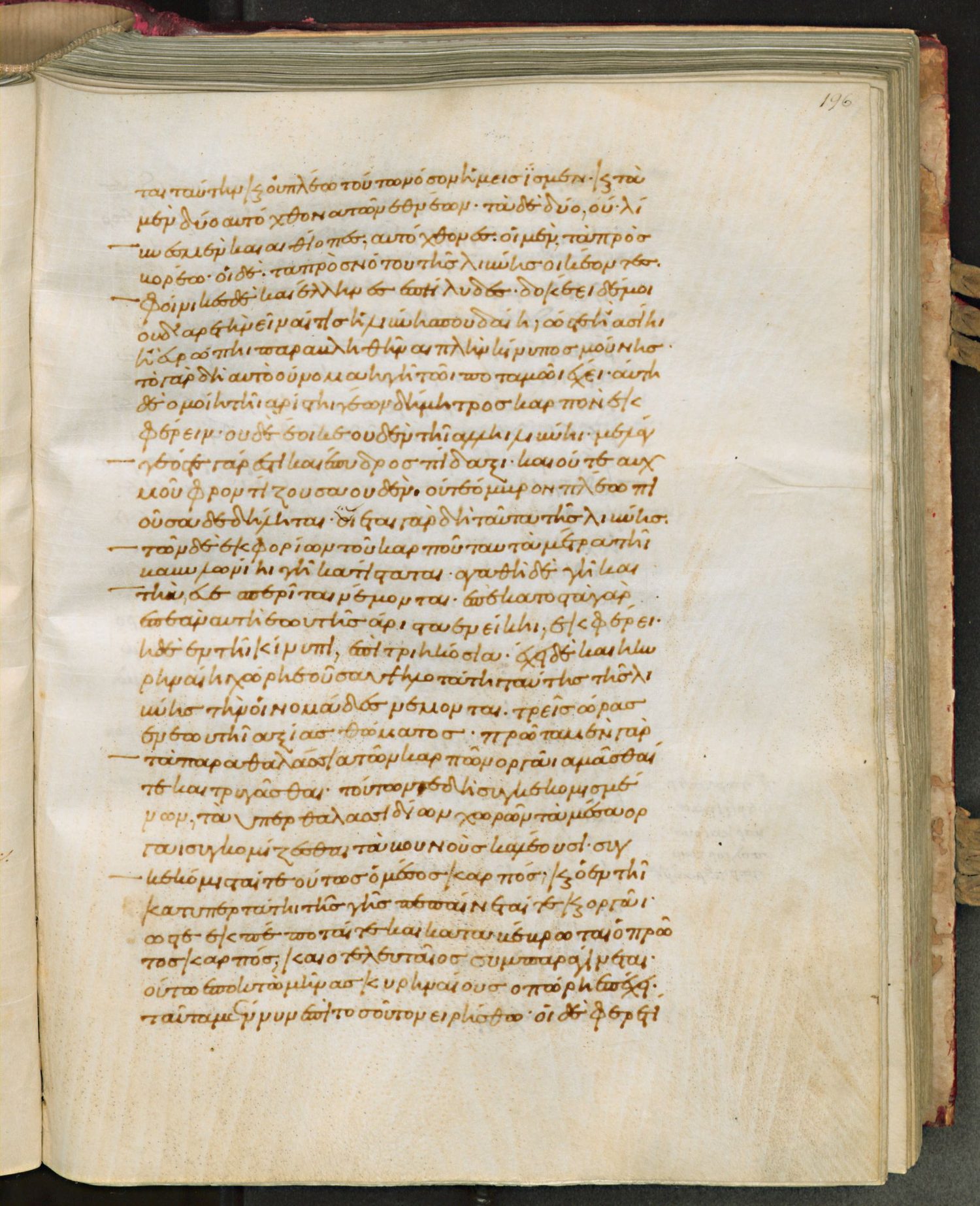
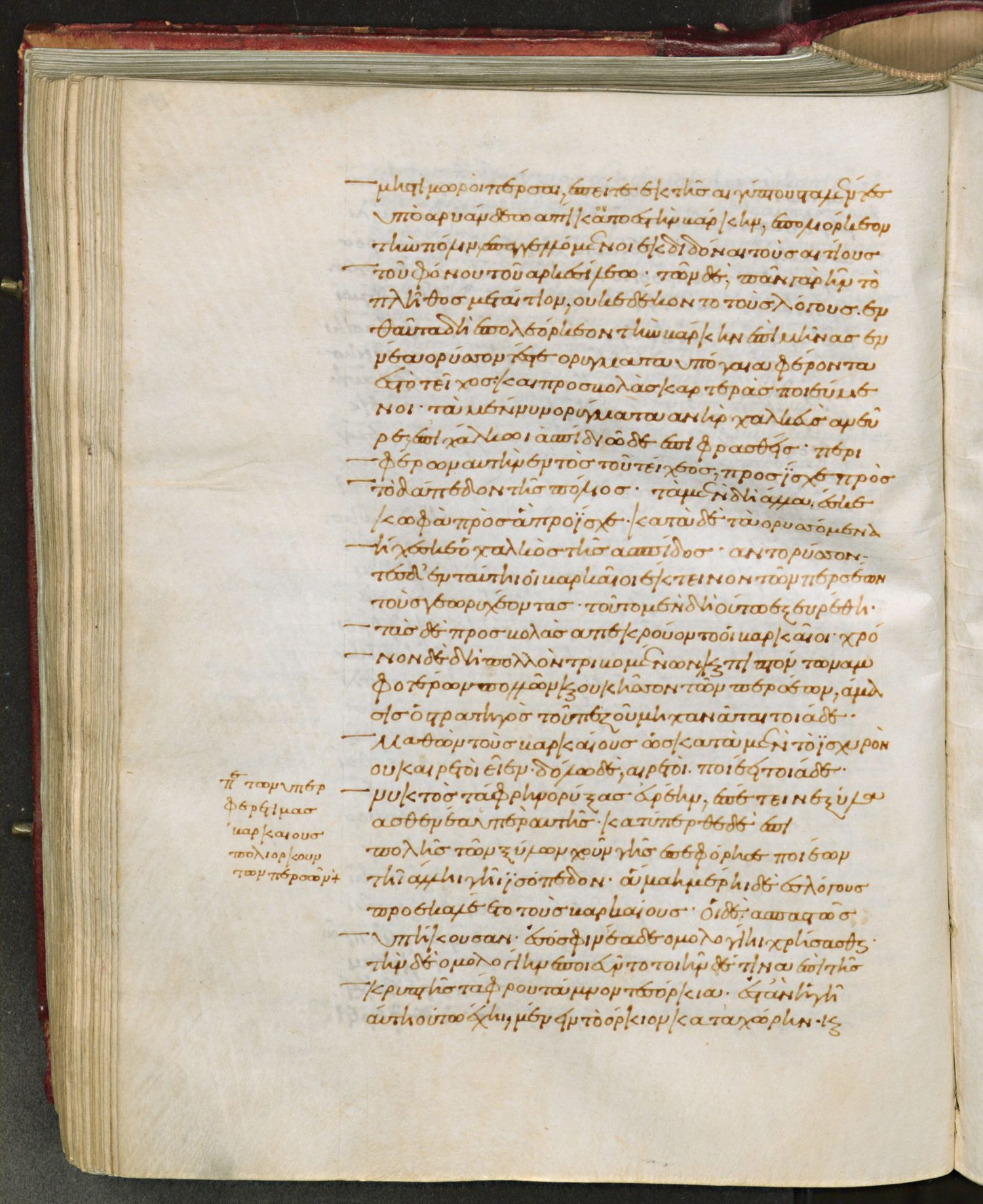
Laur. Plut. 70.3, fol. 196r, 196v: Greek here 4.200.1 to 4.201.2. Checked on the image (first and last words read and located in the Greek; each break checked against the neighbouring page): fol. 196r begins ‹αὐτὴν καὶ οὐ πλέω› (4.197.2), ends ‹τοσοῦτον εἰρήσθω.οἱ δὲ Φερε-› (4.200.1). fol. 196v begins ‹-τίμης τιμωροὶ Πέρσαι ἐπείτε› (4.200.1), ends ‹ὅρκιον κατὰ χώρην, καὶ› (4.201.2). The word ‹Φερετίμης› is divided between fol. 196r and fol. 196v; it is given with fol. 196r. This section joins the text of fol. 196r and 196v that belongs to these chapters, because the part on one of the pages is too short to carry any of Godley's sentences on its own. English here: 4.200.1 to 4.201.2 (Godley's sentences for the sections whose Greek lies mostly on this page).
4.200.1οἱ δὲ Φερετίμης τιμωροὶ Πέρσαι ἐπείτε ἐκ τῆς Αἰγύπτου σταλέντες ὑπὸ Ἀρυάνδεω ἀπίκατο ἐς τὴν Βάρκην, ἐπολιόρκεον τὴν πόλιν ἐπαγγελλόμενοι ἐκδιδόναι τοὺς αἰτίους τοῦ φόνου τοῦ Ἀρκεσίλεω· τῶν δὲ πᾶν γὰρ ἦν τὸ πλῆθος μεταίτιον, οὐκ ἐδέκοντο τοὺς λόγους. 4.200.2ἐνθαῦτα δὴ ἐπολιόρκεον τὴν Βάρκην ἐπὶ μῆνας ἐννέα, ὀρύσσοντες τε ὀρύγματα ὑπόγαια φέροντα ἐς τὸ τεῖχος καὶ προσβολὰς καρτερὰς ποιεύμενοι. τὰ μέν νυν ὀρύγματα ἀνὴρ χαλκεὺς ἀνεῦρε ἐπιχάλκῳ ἀσπίδι, ὧδε ἐπιφρασθείς· περιφέρων αὐτὴν ἐντὸς τοῦ τείχεος προσῖσχε πρὸς τὸ δάπεδον τῆς πόλιος. 4.200.3τὰ μὲν δὴ ἄλλα ἔσκε κωφὰ πρὸς τὰ προσῖσχε, κατὰ δὲ τὰ ὀρυσσόμενα ἠχέεσκε ὁ χαλκὸς τῆς ἀσπίδος. ἀντορύσσοντες δʼ ἂν ταύτῃ οἱ Βαρκαῖοι ἔκτεινον τῶν Περσέων τοὺς γεωρυχέοντας. τοῦτο μὲν δὴ οὕτω ἐξευρέθη, τὰς δὲ προσβολὰς ἀπεκρούοντο οἱ Βαρκαῖοι. 4.201.1χρόνον δὲ δὴ πολλὸν τριβομένων καὶ πιπτόντων ἀμφοτέρων πολλῶν καὶ οὐκ ἧσσον τῶν Περσέων, Ἄμασις ὁ στρατηγὸς τοῦ πεζοῦ μηχανᾶται τοιάδε. μαθὼν τοὺς Βορκαίους ὡς κατὰ μὲν τὸ ἰσχυρὸν οὐκ αἱρετοὶ εἶεν, δόλῳ δὲ αἱρετοί, ποιέει τοιάδε· νυκτὸς τάφρην ὀρύξας εὐρέαν ἐπέτεινε ξύλα ἀσθενέα ὑπὲρ αὐτῆς, κατύπερθε δὲ ἐπιπολῆς τῶν ξύλων χοῦν γῆς ἐπεφόρησε ποιέων τῇ ἄλλῃ γῇ ἰσόπεδον. 4.201.2ἅμα ἡμέρῃ δὲ ἐς λόγους προεκαλέετο τοὺς Βαρκαίους· οἳ δὲ ἀσπαστῶς ὑπήκουσαν, ἐς ὅ σφι ἕαδε ὁμολογίῃ χρήσασθαι. τὴν δὲ ὁμολογίην ἐποιεῦντο τοιήνδε τινά, ἐπὶ τῆς κρυπτῆς τάφρου τάμνοντες ὅρκια, ἔστʼ ἂν ἡ γῆ αὕτη οὕτω ἔχῃ, μένειν τὸ ὅρκιον κατὰ χώρην, καὶ
4.200.1Now when the Persians sent by Aryandes from Egypt to avenge Pheretime came to Barce, they laid siege to the city, demanding the surrender of those who were guilty of the slaying of Arcesilaus: but the Barcaeans, whose whole people were accessory to the deed, would not consent. 4.200.2Then the Persians besieged Barce for nine months, digging under ground passages leading to the walls, and making violent assaults. As for the mines, a smith discovered them by the means of a brazen shield, and this is how he found them: carrying the shield round the inner side of the walls he smote it against the ground of the city; 4.200.3all other places where he smote it returned but a dull sound, but where the mines were the bronze of the shield rang clear. Here the Barcaeans made a countermine and slew those Persians who were digging the earth. Thus the mines were discovered, and the assaults were beaten off by the townsmen. 4.201.1When much time was spent and ever many on both sides (not less of the Persians than of their foes) were slain, Amasis the general of the land army devised a plot, as knowing that Barce could not be taken by force but might be taken by guile: he dug by night a wide trench and laid frail planks across it, which he then covered over with a layer of earth level with the ground about it. 4.201.2Then when day came he invited the Barcaeans to confer with him, and they readily consented; at last all agreed to conditions of peace. This was done thus: standing on the hidden trench, they gave and took a sworn assurance that their treaty should hold good while the ground where they stood was unchanged; the Barcaeans should promise to pay a due sum to the king, and the Persians should do the Barcaeans no hurt.
Where on the image
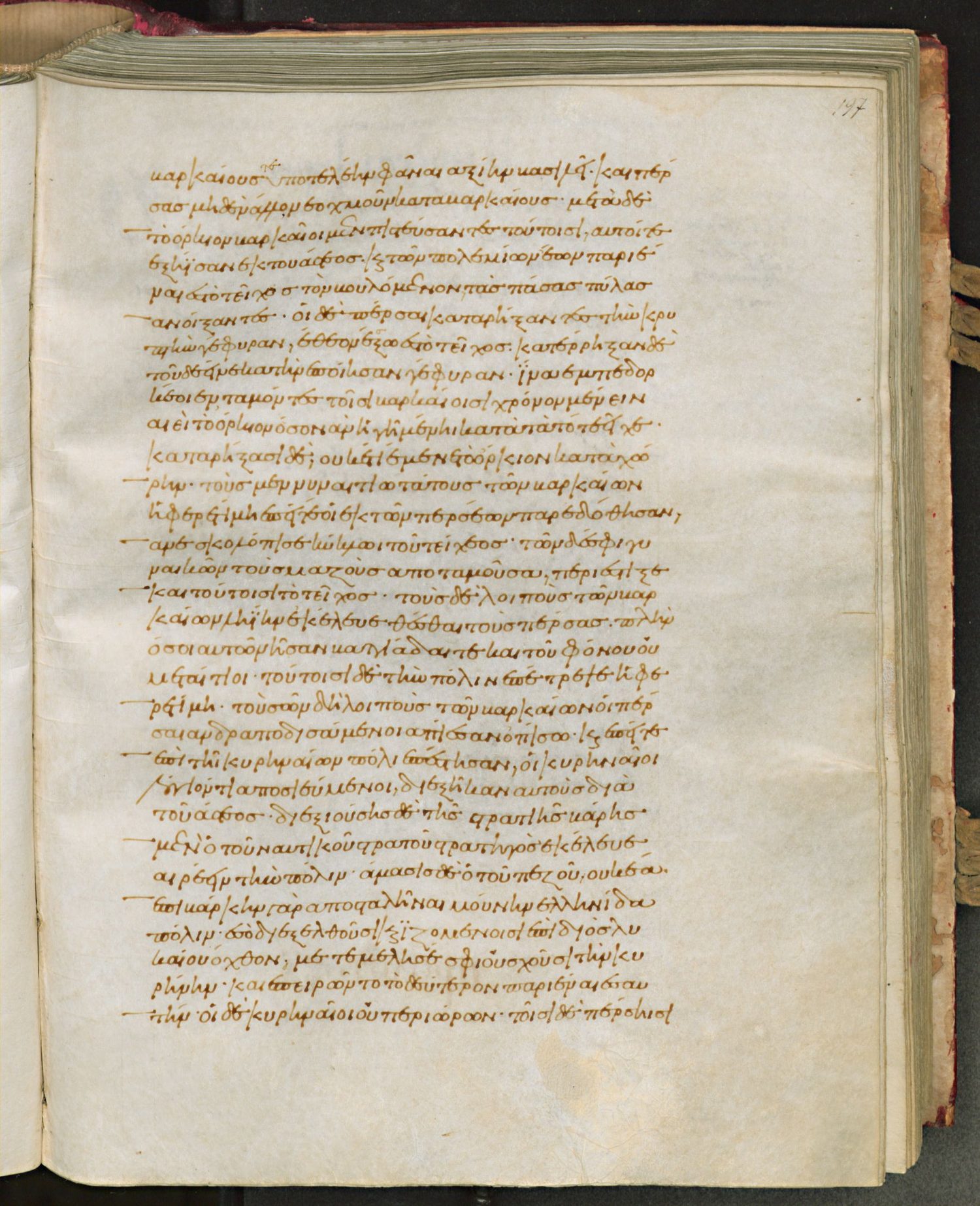
Laur. Plut. 70.3, fol. 197r: Greek here 4.201.2 to 4.203.3. Checked on the image (first and last words read and located in the Greek; each break checked against the neighbouring page): fol. 197r begins ‹Βαρκαίους τε ὑποτελέειν φάναι› (4.201.2), ends ‹οὐ περιώρων.τοῖσι δὲ Πέρσῃσι› (4.203.3). English here: 4.201.3 to 4.203.2 (Godley's sentences for the sections whose Greek lies mostly on this page).
4.201.2Βαρκαίους τε ὑποτελέειν φάναι ἀξίην βασιλέι καὶ Πέρσας μηδὲν ἄλλο νεοχμοῦν κατὰ Βαρκαίους. 4.201.3μετὰ δὲ τὸ ὅρκιον Βαρκαῖοι μὲν πιστεύσαντες τούτοισι αὐτοί τε ἐξῄσαν ἐκ τοῦ ἄστεος καὶ τῶν πολεμίων ἔων παριέναι ἐς τὸ τεῖχος τὸν βουλόμενον, τὰς πάσας πύλας ἀνοίξαντες. οἱ δὲ Πέρσαι καταρρήξαντες τὴν κρυπτὴν γέφυραν ἔθεον ἔσω ἐς τὸ τεῖχος. κατέρρηξαν δὲ τοῦδε εἵνεκα τὴν ἐποίησαν γέφυραν, ἵνα ἐμπεδορκέοιεν, ταμόντες τοῖσι Βαρκαίοισι χρόνον μένειν αἰεὶ τὸ ὅρκιον ὅσον ἂν ἡ γῆ μένῃ κατὰ τότε εἶχε· καταρρήξασι δὲ οὐκέτι ἔμενε τὸ ὅρκιον κατὰ χώρην. 4.202.1τοὺς μέν νυν αἰτιωτάτους τῶν Βαρκαίων ἡ Φερετίμη, ἐπείτε οἱ ἐκ τῶν Περσέων παρεδόθησαν, ἀνεσκολόπισε κύκλῳ τοῦ τείχεος, τῶν δέ σφι γυναικῶν τοὺς μαζοὺς ἀποταμοῦσα περιέστιξε καὶ τούτοισι τὸ τεῖχος· 4.202.2τοὺς δὲ λοιποὺς τῶν Βαρκαίων ληίην ἐκέλευε θέσθαι τοὺς Πέρσας, πλὴν ὅσοι αὐτῶν ἦσαν Βαττιάδαι τε καὶ τοῦ φόνου οὐ μεταίτιοι· τούτοισι δὲ τὴν πόλιν ἐπέτρεψε ἡ Φερετίμη. 4.203.1τοὺς ὦν δὴ λοιποὺς τῶν Βαρκαίων οἱ Πέρσαι ἀνδραποδισάμενοι ἀπήισαν ὀπίσω· καὶ ἐπείτε ἐπὶ τῇ Κυρηναίων πόλι ἐπέστησαν, οἱ Κυρηναῖοι λόγιόν τι ἀποσιεύμενοι διεξῆκαν αὐτοὺς διὰ τοῦ ἄστεος. 4.203.2διεξιούσης δὲ τῆς στρατιῆς Βάδρης μὲν ὁ τοῦ ναυτικοῦ στρατοῦ στρατηγὸς ἐκέλευε αἱρέειν τὴν πόλιν, Ἄμασις δὲ ὁ τοῦ πεζοῦ οὐκ ἔα· ἐπὶ Βάρκην γὰρ ἀποσταλῆναι μούνην Ἑλληνίδα πόλιν· ἐς ὃ διεξελθοῦσι καὶ ἱζομένοισι ἐπὶ Διὸς Λυκαίου ὄχθον μετεμέλησέ σφι οὐ σχοῦσι τὴν Κυρήνην. καὶ ἐπειρῶντο τὸ δεύτερον παριέναι ἐς αὐτήν· οἱ δὲ Κυρηναῖοι οὐ περιώρων. 4.203.3τοῖσι δὲ Πέρσῃσι
4.201.3When the sworn agreement was made, the townsmen, trusting in it and opening all their gates, themselves came out of the city, and suffered all their enemies who so desired to enter within the walls: but the Persians broke down the hidden bridge and ran into the city. They broke down the bridge that they had made, that so they might keep the oath which they had sworn to the Barcaeans, namely, that this treaty should hold good for as long as the ground remained as it was; but if they broke the bridge the treaty held good no longer. 4.202.1Pheretime took the most guilty of the Barcaeans, when they were delivered to her by the Persians, and set them impaled round the top of the wall; she cut off the breasts of their women and planted them round the wall in like manner. 4.202.2As for the remnant of the Barcaeans, she bade the Persians take them as their booty, save as many as were of the house of Battus and not accessory to the murder; to these she committed the governance of the city. 4.203.1The Persians thus enslaved the rest of the Barcaeans, and departed homewards. When they appeared before the city of Cyrene, the Cyrenaeans suffered them to pass through their city, that a certain oracle might be fulfilled. 4.203.2As the army was passing through, Badres the admiral of the fleet was for taking the city, but Amasis the general of the land army would not consent, saying that he had been sent against Barce and no other Greek city; at last they passed through Cyrene and encamped on the hill of Lycaean Zeus; there they repented of not having taken the city, and essayed to enter it again, but the Cyrenaeans would not suffer them.
Where on the image
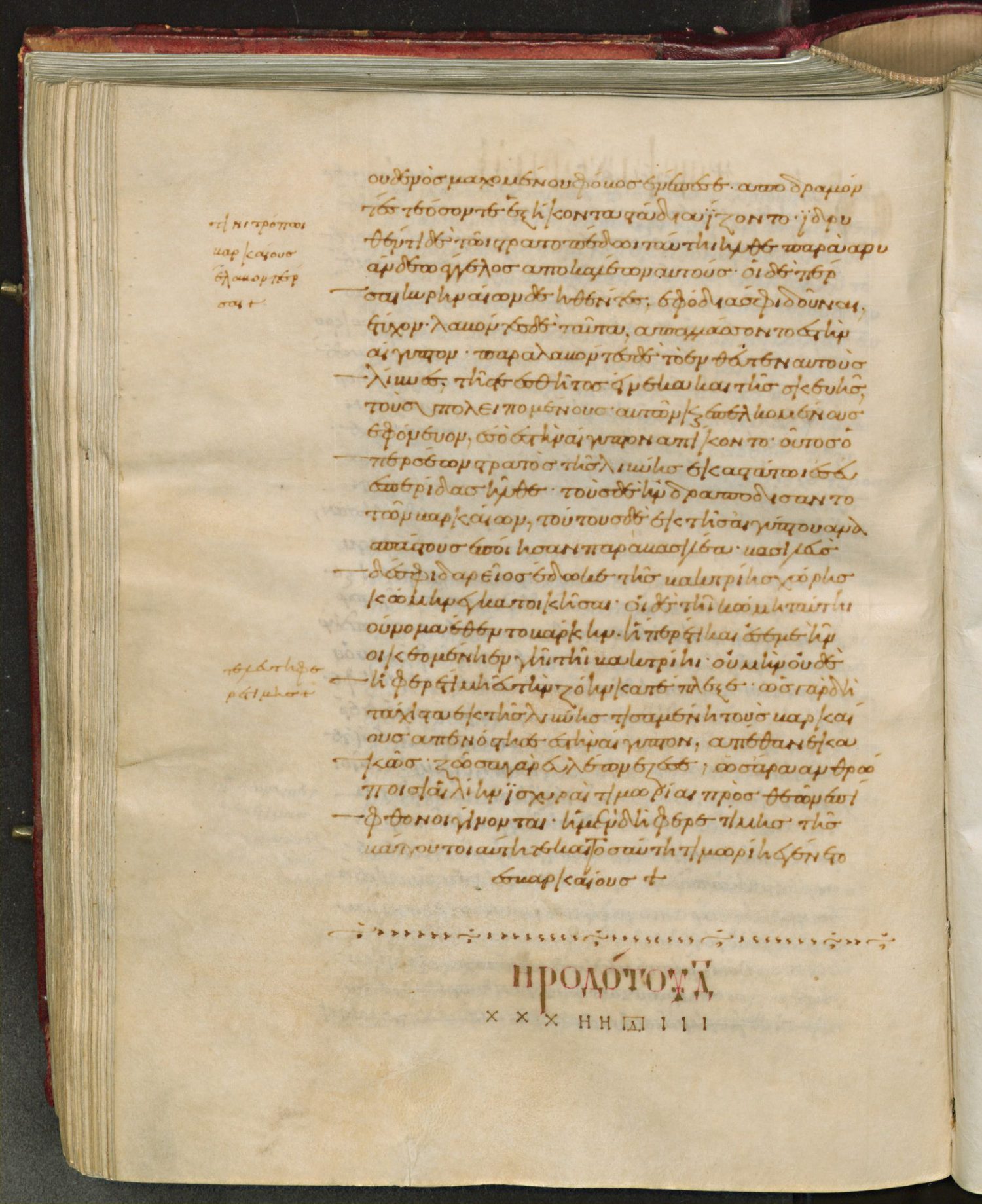
Laur. Plut. 70.3, fol. 197v: Greek here 4.203.3 to 4.205.1. Checked on the image (first and last words read and located in the Greek; each break checked against the neighbouring page): fol. 197v begins ‹οὐδενὸς μαχομένου φόβος ἐνέπεσε,› (4.203.3), ends ‹τιμωρίη ἐγένετο ἐς Βαρκαίους› (4.205.1). Book 4 ends with a short last line; below it, a decorative line, the subscription Ἡροδότου δ´ in red and a stichometric figure. English here: 4.203.3 to 4.205.1 (Godley's sentences for the sections whose Greek lies mostly on this page).
4.203.3οὐδενὸς μαχομένου φόβος ἐνέπεσε, ἀποδραμόντες τε ὅσον τε ἑξήκοντα στάδια ἵζοντο· ἱδρυθέντι δὲ τῷ στρατοπέδῳ ταύτῃ ἦλθε παρὰ Ἀρυνάνδεω ἄγγελος ἀποκαλέων αὐτούς. οἱ δὲ Πέρσαι Κυρηναίων δεηθέντες ἐπόδιά σφι δοῦναι ἔτυχον, λαβόντες δὲ ταῦτα ἀπαλλάσσοντο ἐς τὴν Αἴγυπτον. 4.203.4παραλαβόντες δὲ τὸ ἐνθεῦτεν αὐτοὺς Λίβυες τῆς τε ἐσθῆτος εἵνεκα καὶ τῆς σκευῆς τοὺς ὑπολειπομένους αὐτῶν καὶ ἐπελκομένους ἐφόνευον, ἐς ὃ ἐς τὴν Αἴγυπτον ἀπίκοντο. 4.204.1οὗτος ὁ Περσέων στρατὸς τῆς Λιβύης ἑκαστάτω ἐς Εὐεσπερίδας ἦλθε. τοὺς δὲ ἠνδραποδίσαντο τῶν Βαρκαίων, τούτους δὲ ἐκ τῆς Αἰγύπτου ἀνασπάστους ἐποίησαν παρὰ βασιλέα, βασιλεὺς δέ σφι Δαρεῖος ἔδωκε τῆς Βακτρίης χώρης κώμην ἐγκατοικῆσαι. οἳ δὲ τῇ κώμῃ ταύτῃ οὔνομα ἔθεντο Βάρκην, ἥ περ ἔτι καὶ ἐς ἐμὲ ἦν οἰκεομένη ἐν γῇ τῇ Βακτρίῃ. 4.205.1οὐ μὲν οὐδὲ ἡ Φερετίμη εὖ τὴν ζόην κατέπλεξε. ὡς γὰρ δὴ τάχιστα ἐκ τῆς Λιβύης τισαμένη τοὺς Βαρκαίους ἀπενόστησε ἐς τὴν Αἴγυπτον, ἀπέθανε κακῶς· ζῶσα γὰρ εὐλέων ἐξέζεσε, ὡς ἄρα ἀνθρώποισι αἱ λίην ἰσχυραὶ τιμωρίαι πρὸς θεῶν ἐπίφθονοι γίνονται·ἐκ μὲν δὴ Φερετίμης τῆς Βάττου τοιαύτη τε καὶ τοσαύτη τιμωρίη ἐγένετο ἐς Βαρκαίους.
4.203.3Then, though none attacked them, fear fell upon the Persians, and they fled to a place sixty furlongs distant and there en camped; and presently while they were there a messenger from Aryandes came to the camp bidding them return. The Persians asked and obtained of the Cyrenaeans provisions for their march, having received which they departed, to go to Egypt; 4.203.4but after that they fell into the hands of the Libyans, who slew the laggards and stragglers of the host for the sake of their garments and possessions; till at last they came to Egypt. 4.204.1This Persian armament advanced as far as Euhesperidae in Libya and no farther. As for the Barcaeans whom they had taken for slaves, they carried them from Egypt into banishment and brought them to the king, and Darius gave them a town of Bactria to dwell in. They gave this town the name Barce, and it remained an inhabited place in Bactria till my own lifetime. 4.205.1But Pheretime fared ill too, and made no good ending of her life. For immediately after she had revenged herself on the Barcaeans and returned to Egypt, she died a foul death; her living body festered and bred worms: so wroth, it would seem, are the gods with over-violent human vengeance. Such, and so great, was the vengeance which Pheretime daughter of Battus wrought upon the people of Barce.
Notes
- Greek: the text printed in A. D. Godley's Loeb edition, via Perseus (tlg0016.tlg001.perseus-grc2). Square brackets mark words the editor considers later additions; [...] marks a gap the editor indicates. Perseus note markers are omitted.
- English: A. D. Godley, Herodotus vol. 2 (1921) (Loeb Classical Library), as transcribed on Wikisource. Godley's footnotes are omitted.
- Section numbers in the English were placed by comparing Godley's text with the Perseus version of his translation; where a section begins inside one of Godley's sentences, the English is kept with the page that holds the start of that sentence.
Cite
Sources
- Source: Florence, Laur. Plut. 70.3 (10th c.) via BML Teca Digitale + Greek of Godley's Loeb (Perseus) + English of A. D. Godley (Loeb, Wikisource) (holding institution)
- Critical edition: Greek of A. D. Godley's Loeb edition (1920-1925), via Perseus
← previous · → next · v cycle view · l back to library