Herodotus, Histories 5.1-16: Megabazus in Thrace; the Paeonians
Introduction
Herodotus of Halicarnassus wrote the Histories in the third quarter of the 5th century BCE, an inquiry into the deeds of Greeks and barbarians and the causes of the wars between them, later divided into nine books. Book 5 tells of the Persian advance in Thrace and Macedonia, the outbreak of the Ionian revolt under Aristagoras of Miletus, his appeals to Sparta and Athens, with Herodotus' accounts of Sparta and of Athens after the tyrants, and the burning of Sardis and the first years of the revolt.
The photographs are of Florence, Biblioteca Medicea Laurenziana, Plut. 70.3 (parchment, 10th century, 374 folios, 31 lines a page), Herodotus, Histories (codex A of the editors), the oldest surviving manuscript of the complete Histories, from the Teca Digitale of the Biblioteca Medicea Laurenziana. Each section below is the text of one page, or of the part of a page that falls within these chapters. The first and last words of every page were read on the photograph and located in the Greek, and every page break was checked against the next page; the notes quote these words. Readers' notes in the margins are not part of the text and are mentioned where they occur.
The Greek is the text printed in A. D. Godley's Loeb edition (1920-1925), from Perseus; it is the edited text, not a transcription of the manuscript, whose wording differs in places. The English is Godley's translation as printed, from Wikisource. Godley's English carries only chapter numbers; the section numbers shown in it were placed by comparison with the Perseus version of his translation. Each page's English is cut at the end of one of Godley's sentences, so it can begin or end a few lines away from the Greek of the page; each note gives the exact ranges.
This entry covers chapters 5.1-16, on fol. 198r to 201v.
How was this verified? (Provenance)
Where on the image
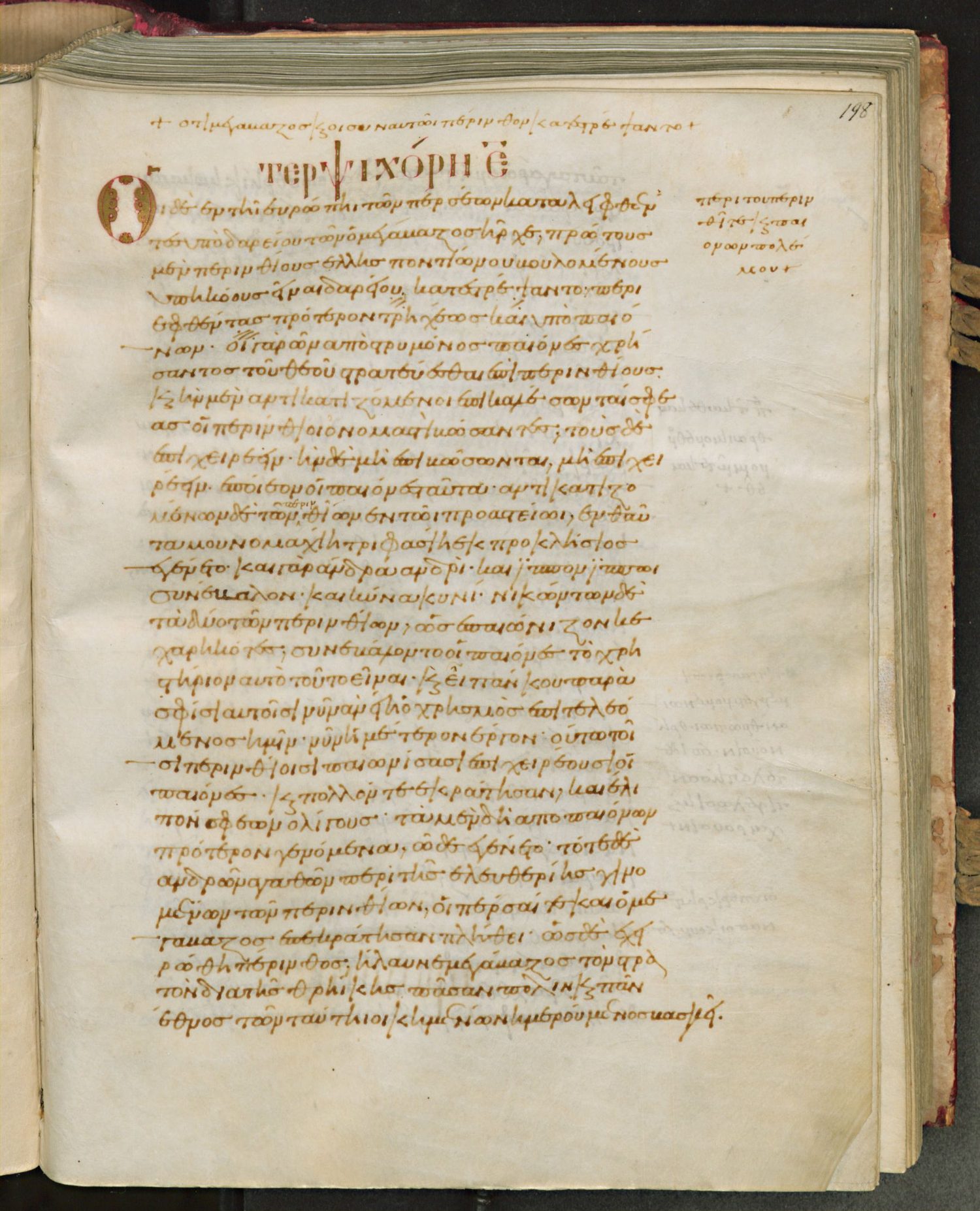
Laur. Plut. 70.3, fol. 198r: Greek here 5.1.1 to 5.2.2. Checked on the image (first and last words read and located in the Greek; each break checked against the neighbouring page): fol. 198r begins ‹οἱ δὲ ἐν τῇ› (5.1.1), ends ‹ταύτῃ οἰκημένων ἡμερούμενος βασιλέι› (5.2.2). A reader's note on Megabazus stands in the upper margin; Book 5 begins under the red title Τερψιχόρη ε´ with a red initial Ο. English here: 5.1.1 to 5.2.2 (Godley's sentences for the sections whose Greek lies mostly on this page).
5.1.1οἱ δὲ ἐν τῇ Εὐρώπῃ τῶν Περσέων καταλειφθέντες ὑπὸ Δαρείου, τῶν ὁ Μεγάβαζος ἦρχε, πρώτους μὲν Περινθίους Ἑλλησποντίων οὐ βουλομένους ὑπηκόους εἶναι Δαρείου κατεστρέψαντο, περιεφθέντας πρότερον καὶ ὑπὸ Παιόνων τρηχέως. 5.1.2οἱ γὰρ ὦν ἀπὸ Στρυμόνος Παίονες χρήσαντος τοῦ θεοῦ στρατεύεσθαι ἐπὶ Περινθίους, καὶ ἢν μὲν ἀντικατιζόμενοι ἐπικαλέσωνται σφέας οἱ Περίνθιοι ὀνομαστὶ βώσαντες, τοὺς δὲ ἐπιχειρέειν, ἢν δὲ μὴ ἐπιβώσωνται, μὴ ἐπιχειρέειν, ἐποίεον οἱ Παίονες ταῦτα. ἀντικατιζομένων δὲ τῶν Περινθίων ἐν τῷ προαστείῳ, ἐνθαῦτα μουνομαχίη τριφασίη ἐκ προκλήσιός σφι ἐγένετο· καὶ γὰρ ἄνδρα ἀνδρὶ καὶ ἵππον ἵππῳ συνέβαλον καὶ κύνα κυνί. 5.1.3νικώντων δὲ τὰ δύο τῶν Περινθίων, ὡς ἐπαιώνιζον κεχαρηκότες, συνεβάλοντο οἱ Παίονες τὸ χρηστήριον αὐτὸ τοῦτο εἶναι καὶ εἶπάν κου παρὰ σφίσι αὐτοῖσι νῦν ἂν εἴη ὁ χρησμὸς ἐπιτελεόμενος ἡμῖν, νῦν ἡμέτερον ἔργον. οὕτω τοῖσι Περινθίοισι παιωνίσασι ἐπιχειρέουσι οἱ Παίονες, καὶ πολλόν τε ἐκράτησαν καὶ ἔλιπον σφέων ὀλίγους. 5.2.1τὰ μὲν δὴ ἀπὸ Παιόνων πρότερον γενόμενα ὧδε ἐγένετο· τότε δὲ ἀνδρῶν ἀγαθῶν περὶ τῆς ἐλευθερίης γινομένων τῶν Περινθίων οἱ Πέρσαι τε καὶ ὁ Μεγάβαζος ἐπεκράτησαν πλήθεϊ. 5.2.2ὡς δὲ ἐχειρώθη ἡ Πέρινθος, ἤλαυνε Μεγάβαζος τὸν στρατὸν διὰ τῆς Θρηίκης, πᾶσαν πόλιν καὶ πᾶν ἔθνος τῶν ταύτῃ οἰκημένων ἡμερούμενος βασιλέι.
5.1.1Those Persians whom Darius had left in Europe under the command of Megabazus, finding the Perinthians unwilling to be Darius’ subjects, subdued them before any others of the people of the Hellespont. These Perinthians had already been roughly handled by the Paeonians. 5.1.2For the Paeonians from the Strymon had been bidden by an oracle of their god to march against Perinthus, and if the Perinthians being encamped over against them should call to them, crying out their name, then to attack them, but, if there were no such call, then not to attack. Thus the Paeonians did; and the Perinthians being encamped in front of their city, the armies challenged each other to a threefold duel, wherein man was matched against man, horse against horse, and dog against dog. 5.1.3The Perinthians won the victory in two of the combats and raised the cry of “Paean” in their joy. The Paeonians reasoned that this was that whereof the oracle spoke; they said to each other, as I suppose, “This is surely the fulfilment of the prophecy; now here is work for us”; and with that, the Perinthians having cried “Paean,” the Paeonians set upon them and won a great victory, leaving few of their enemies alive. 5.2.1he Perinthians had already been thus treated by the Paeonians; and now they fought like brave men for their liberty, but Megabazus and the Persians overcame them by weight of numbers. 5.2.2Perinthus being taken, Megabazus marched his army through Thrace, subduing to the king’s will every city and every people of that region. For this was the charge given him by Darius, even the conquest of Thrace.
Where on the image
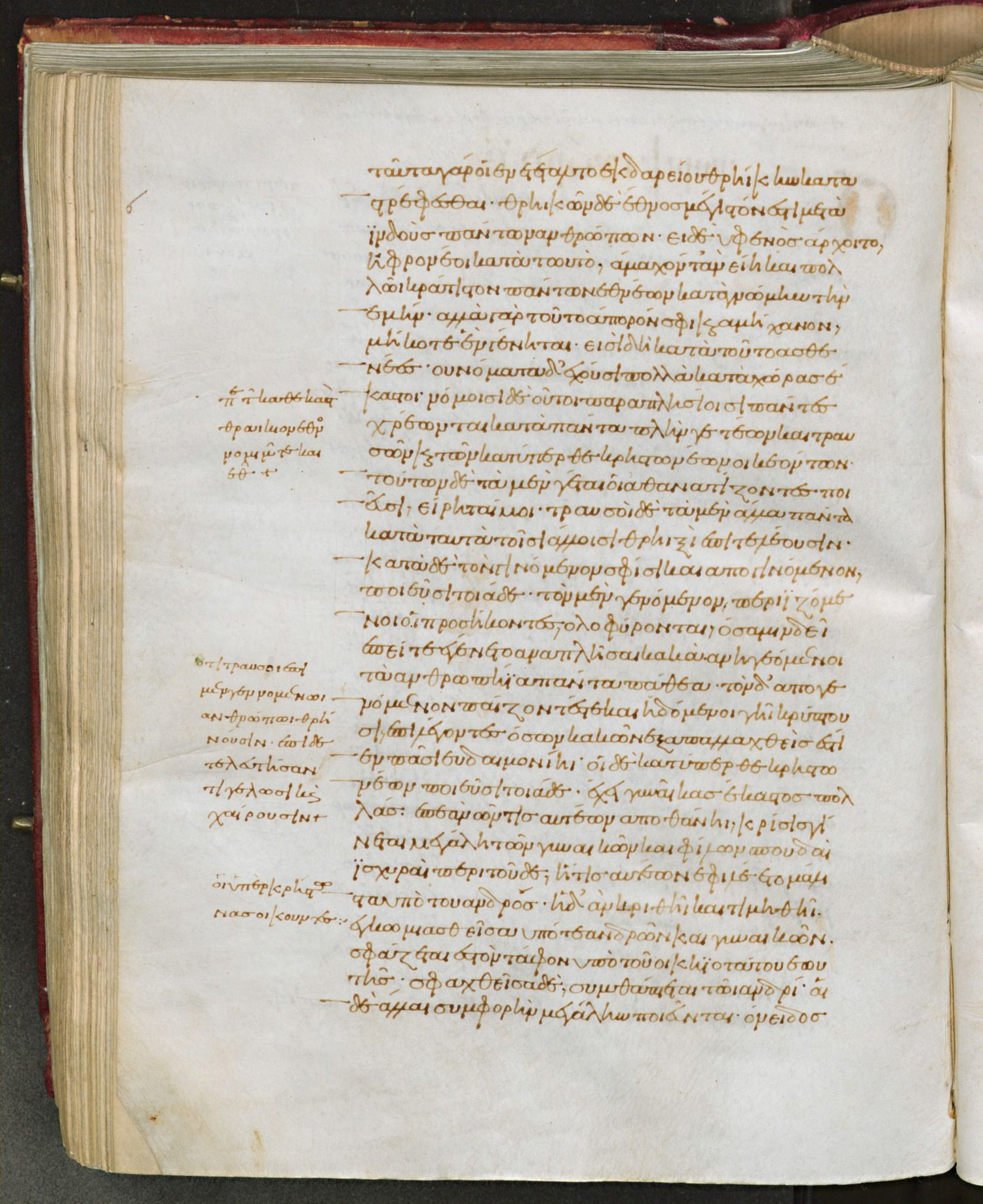
Laur. Plut. 70.3, fol. 198v: Greek here 5.2.2 to 5.5.1. Checked on the image (first and last words read and located in the Greek; each break checked against the neighbouring page): fol. 198v begins ‹ταῦτα γάρ οἱ ἐνετέταλτο› (5.2.2), ends ‹συμφορὴν μεγάλην ποιεῦνται· ὄνειδος› (5.5.1). English here: 5.3.1 to 5.5.1 (Godley's sentences for the sections whose Greek lies mostly on this page).
5.2.2ταῦτα γάρ οἱ ἐνετέταλτο ἐκ Δαρείου, Θρηίκην καταστρέφεσθαι. 5.3.1Θρηίκων δὲ ἔθνος μέγιστον ἐστὶ μετά γε Ἰνδοὺς πάντων ἀνθρώπων· εἰ δὲ ὑπʼ ἑνὸς ἄρχοιτο ἢ φρονέοι κατὰ τὠυτό, ἄμαχόν τʼ ἂν εἴη καὶ πολλῷ κράτιστον πάντων ἐθνέων κατὰ γνώμην τὴν ἐμήν. ἀλλὰ γὰρ τοῦτο ἄπορόν σφι καὶ ἀμήχανον μή κοτε ἐγγένηται, εἰσὶ δὴ κατὰ τοῦτο ἀσθενέες. 5.3.2οὐνόματα δʼ ἔχουσι πολλὰ κατὰ χώρας ἕκαστοι, νόμοισι δὲ οὗτοι παραπλησίοισι πάντες χρέωνται κατὰ πάντα, πλὴν Γετέων καὶ Τραυσῶν καὶ τῶν κατύπερθε Κρηστωναίων οἰκεόντων. 5.4.1τούτων δὲ τὰ μὲν Γέται οἱ ἀθανατίζοντες ποιεῦσι, εἴρηταί μοι· Τραυσοὶ δὲ τὰ μὲν ἄλλα πάντα κατὰ ταὐτὰ τοῖσι ἄλλοισι Θρήιξι ἐπιτελέουσι, κατὰ δὲ τὸν γινόμενόν σφι καὶ ἀπογινόμενον ποιεῦσι τοιάδε· 5.4.2τὸν μὲν γενόμενον περιιζόμενοι οἱ προσήκοντες ὀλοφύρονται, ὅσα μιν δεῖ ἐπείτε ἐγένετο ἀναπλῆσαι κακά, ἀνηγεόμενοι τὰ ἀνθρωπήια πάντα πάθεα· τὸν δʼ ἀπογενόμενον παίζοντές τε καὶ ἡδόμενοι γῇ κρύπτουσι, ἐπιλέγοντες ὅσων κακῶν ἐξαπαλλαχθεὶς ἐστὶ ἐν πάσῃ εὐδαιμονίῃ. 5.5.1οἱ δὲ κατύπερθε Κρηστωναίων ποιεῦσι τοιάδε. ἔχει γυναῖκας ἕκαστος πολλά,· ἐπεὰν ὦν τις αὐτῶν ἀποθάνῃ, κρίσις γίνεται μεγάλη τῶν γυναικῶν καὶ φίλων σπουδαὶ ἰσχυραὶ περὶ τοῦδε, ἥτις αὐτέων ἐφιλέετο μάλιστα ὑπὸ τοῦ ἀνδρός· ἣ δʼ ἂν κριθῇ καὶ τιμηθῇ, ἐγκωμιασθεῖσα ὑπό τε ἀνδρῶν καὶ γυναικῶν σφάζεται ἐς τὸν τάφον ὑπὸ τοῦ οἰκηιοτάτου ἑωυτῆς, σφαχθεῖσα δὲ συνθάπτεται τῷ ἀνδρί. αἱ δὲ ἄλλαι συμφορὴν μεγάλην ποιεῦνται· ὄνειδος
5.3.1The Thracians are the biggest nation in the world, next to the Indians; were they under one ruler, or united, they would in my judgment be invincible and the strongest nation on earth; but since there is no way or contrivance to bring this about, they are for this reason weak. 5.3.2They have many names, each tribe according to its region. All these Thracians are alike in all their usages, save the Getae, and the Trausi, and those that dwell above the Crestonaeans. 5.4.1As for the Getae who claim to be immortal, I have already told what they do; the Trausi, who in all else fulfil the customs of other Thracians, do as I will show at the seasons of birth and death. 5.4.2When a child is born, the kinsfolk sit round and lament for all the tale of ills that it must endure from its birth onward, recounting all the sorrows of men; but the dead they bury with jollity and gladness, for the reason that he is quit of so many ills and is in perfect blessedness. 5.5.1Those who dwell above the Crestonaeans have a custom of their own: each man having many wives, at his death there is great rivalry among his wives, and eager contention on their friends’ part, to prove which wife was best loved by her husband; and she to whom the honour is adjudged is praised by men and women, and then slain over the tomb by her nearest of kin, and after the slaying she is buried with the husband. The rest of the wives take this sorely to heart, deeming themselves deeply dishonoured.
Where on the image
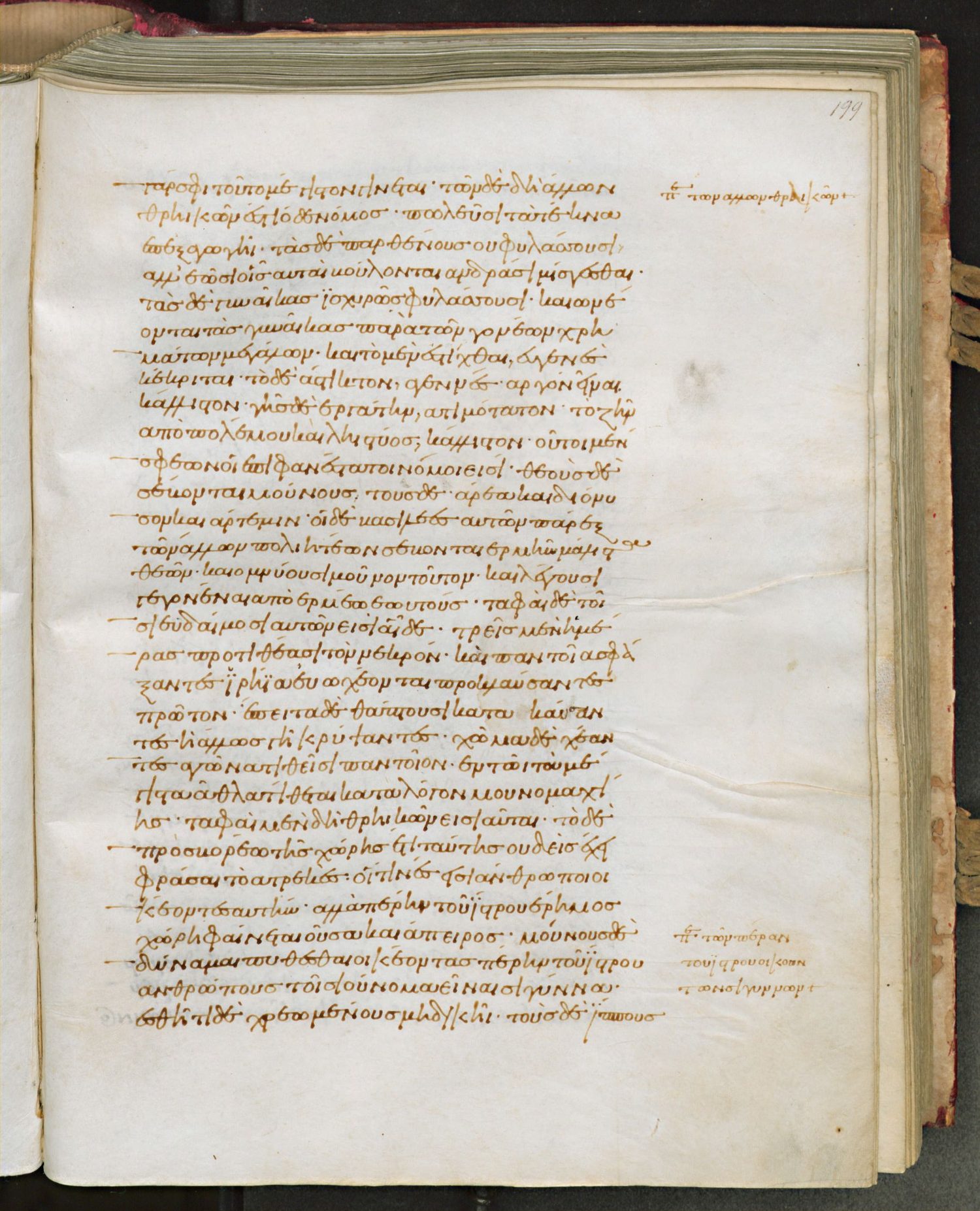
Laur. Plut. 70.3, fol. 199r: Greek here 5.5.1 to 5.9.2. Checked on the image (first and last words read and located in the Greek; each break checked against the neighbouring page): fol. 199r begins ‹γάρ σφι τοῦτο μέγιστον› (5.5.1), ends ‹χρεωμένους Μηδικῇ·τοὺς δὲ ἵππους› (5.9.2). English here: 5.6.1 to 5.9.1 (Godley's sentences for the sections whose Greek lies mostly on this page).
5.5.1γάρ σφι τοῦτο μέγιστον γίνεται. 5.6.1τῶν δὲ δὴ ἄλλων Θρηίκων ἐστὶ ὅδε νόμος· πωλεῦσι τὰ τέκνα ἐπʼ ἐξαγωγῇ, τὰς δὲ παρθένους οὐ φυλάσσουσι, ἀλλʼ ἐῶσι τοῖσι αὐταὶ βούλονται ἀνδράσι μίσγεσθαι· τὰς δὲ γυναῖκας ἰσχυρῶς φυλάσσουσι καὶ ὠνέονται τὰς γυναῖκας παρὰ τῶν γονέων χρημάτων μεγάλων. 5.6.2καὶ τὸ μὲν ἐστίχθαι εὐγενὲς κέκριται, τὸ δὲ ἄστικτον ἀγεννές. ἀργὸν εἶναι κάλλιστον, γῆς δὲ ἐργάτην ἀτιμότατον· τὸ ζῆν ἀπὸ πολέμου καὶ ληιστύος κάλλιστον. 5.7.1οὗτοι μὲν σφέων οἱ ἐπιφανέστατοι νόμοι εἰσί, θεοὺς δὲ σέβονται μούνους τούσδε, Ἄρεα καὶ Διόνυσον καὶ Ἄρτεμιν. οἱ δὲ βασιλέες αὐτῶν, πάρεξ τῶν ἄλλων πολιητέων, σέβονται Ἑρμέην μάλιστα θεῶν, καὶ ὀμνύουσι μοῦνον τοῦτον, καὶ λέγουσι γεγονέναι ἀπὸ Ἑρμέω ἑωυτούς. 5.8.1ταφαὶ δὲ τοῖσι εὐδαίμοσι αὐτῶν εἰσὶ αἵδε· τρεῖς μὲν ἡμέρας προτιθεῖσι τὸν νεκρόν, καὶ παντοῖα σφάξαντες ἱρήια εὐωχέονται, προκλαύσαντες πρῶτον· ἔπειτα δὲ θάπτουσι κατακαύσαντες ἢ ἄλλως γῇ κρύψαντες, χῶμα δὲ χέαντες ἀγῶνα τιθεῖσι παντοῖον, ἐν τῷ τὰ μέγιστα ἄεθλα τίθεται κατὰ λόγον μουνομαχίης. ταφαὶ μὲν δὴ Θρηίκων εἰσὶ αἵδε. 5.9.1τὸ δὲ πρὸς βορέω τῆς χώρης ἔτι ταύτης οὐδεὶς ἔχει φράσαι τὸ ἀτρεκὲς οἵτινες εἰσὶ ἄνθρωποι οἰκέοντες αὐτήν, ἀλλὰ τὰ πέρην ἤδη τοῦ Ἴστρου ἔρημος χώρη φαίνεται ἐοῦσα καὶ ἄπειρος. μούνους δὲ δύναμαι πυθέσθαι οἰκέοντας πέρην τοῦ Ἴστρου ἀνθρώπους τοῖσι οὔνομα εἶναι Σιγύννας, ἐσθῆτι δὲ χρεωμένους Μηδικῇ· 5.9.2τοὺς δὲ ἵππους
5.6.1Among the rest of the Thracians, it is the custom to sell their children to be carried out of the country. They take no care of their maidens, allowing them to have intercourse with what men they will: but their wives they strictly guard, and buy them for a great price from the parents. 5.6.2To be tattooed is a sign of noble birth; to bear no such marks is for the baser sort. The idler is most honoured, the tiller of the soil most contemned; he is held in highest honour who lives by war and foray. 5.7.1These are the most notable of their usages. They worship no gods but Ares, Dionysus, and Artemis. But their princes, unlike the rest of their countrymen, worship Hermes above all gods and swear only by him, claiming him for their ancestor. 5.8.1Among those of them that are rich, the funeral rites are these:—They lay out the dead for three days, then after killing all kinds of victims and first making lamentation they feast; after that they make away with the body either by fire or else by burial in the earth, and when they have built a barrow they set on foot all kinds of contests, wherein the greatest prizes are offered for the hardest fashion of single combat. Such are the Thracian funeral rites. 5.9.1For what lies north of this country none can tell with certainty what men dwell there; cross the Ister and you shall see but an infinite tract of deserts. I can learn of no men dwelling beyond the Ister save certain that are called Sigynnae, and wear Median dress.
Where on the image
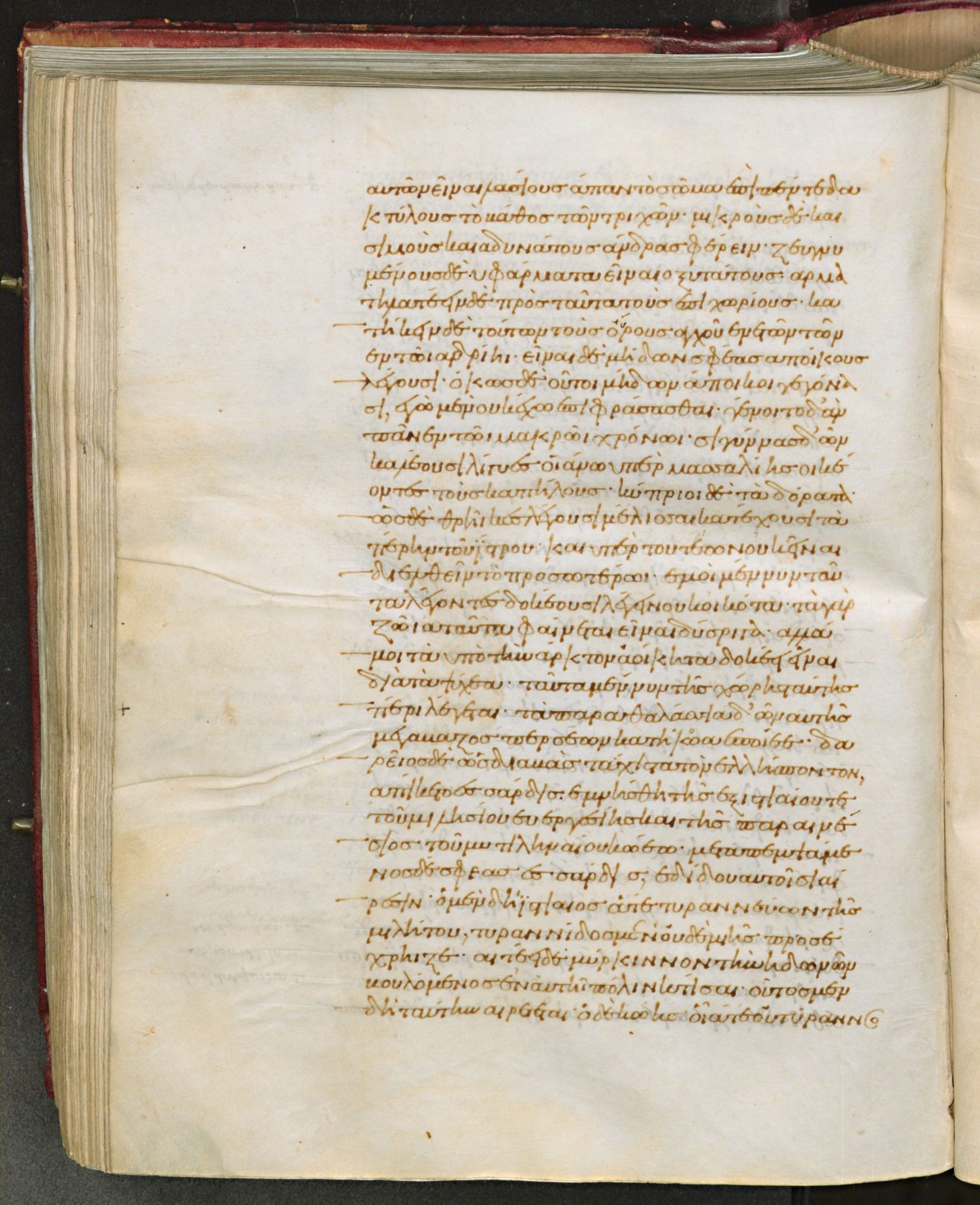
Laur. Plut. 70.3, fol. 199v: Greek here 5.9.2 to 5.11.2. Checked on the image (first and last words read and located in the Greek; each break checked against the neighbouring page): fol. 199v begins ‹αὐτῶν εἶναι λασίους ἅπαν› (5.9.2), ends ‹οἷά τε οὐ τύραννος› (5.11.2). English here: 5.9.2 to 5.11.2 (Godley's sentences for the sections whose Greek lies mostly on this page).
5.9.2αὐτῶν εἶναι λασίους ἅπαν τὸ σῶμα ἐπὶ πέντε δακτύλους τὸ βάθος τῶν τριχῶν, μικροὺς δὲ καὶ σιμοὺς καὶ ἀδυνάτους ἄνδρας φέρειν, ζευγνυμένους δὲ ὑπʼ ἅρματα εἶναι ὀξυτάτους· ἁρματηλατέειν δὲ πρὸς ταῦτα τοὺς ἐπιχωρίους. κατήκειν δὲ τούτων τοὺς οὔρους ἀγχοῦ Ἐνετῶν τῶν ἐν τῷ Ἀδρίῃ. 5.9.3εἶναι δὲ Μήδων σφέας ἀποίκους λέγουσι. ὅκως δὲ οὗτοι Μήδων ἄποικοι γεγόνασι, ἐγὼ μὲν οὐκ ἔχω ἐπιφράσασθαι, γένοιτο δʼ ἂν πᾶν ἐν τῷ μακρῷ χρόνῳ. Σιγύννας δʼ ὦν καλέουσι Δίγυες οἱ ἄνω ὑπὲρ Μασσαλίης οἰκέοντες τοὺς καπήλους, Κύπριοι δὲ τὰ δόρατα. 5.10.1ὡς δὲ Θρήικες λέγουσι, μέλισσαι κατέχουσι τὰ πέρην τοῦ Ἴστρου, καὶ ὑπὸ τουτέων οὐκ εἶναι διελθεῖν τὸ προσωτέρω. ἐμοὶ μέν νυν ταῦτα λέγοντες δοκέουσι λέγειν οὐκ οἰκότα· τὰ γὰρ ζῷα ταῦτα φαίνεται εἶναι δύσριγα· ἀλλά μοι τὰ ὑπὸ τὴν ἄρκτον ἀοίκητα δοκέει εἶναι διὰ τὰ ψύχεα. ταῦτα μέν νυν τῆς χώρης ταύτης πέρι λέγεται· τὰ παραθαλάσσια δʼ ὦν αὐτῆς Μεγάβαζος Περσέων κατήκοα ἐποίεε. 5.11.1Δαρεῖος δὲ ὡς διαβὰς τάχιστα τὸν Ἑλλήσποντον ἀπίκετο ἐς Σάρδις, ἐμνήσθη τῆς ἐξ Ἱστιαίου τε τοῦ Μιλησίου εὐεργεσίης καὶ τῆς παραινέσιος τοῦ Μυτιληναίου Κώεω, μεταπεμψάμενος δὲ σφέας ἐς Σάρδις ἐδίδου αὐτοῖσι αἵρεσιν. 5.11.2ὁ μὲν δὴ Ἱστιαῖος, ἅτε τυραννεύων τῆς Μιλήτου, τυραννίδος μὲν οὐδεμιῆς προσεχρήιζε, αἰτέει δὲ Μύρκινον τὴν Ἠδωνῶν, βουλόμενος ἐν αὐτῇ πόλιν κτίσαι. οὗτος μὲν δὴ ταύτην αἱρέεται, ὁ δὲ Κώης, οἷά τε οὐ τύραννος
5.9.2Their horses are said to be covered all over with shaggy hair five fingers’ breadth long, and to be small and blunt-nosed and unable to bear men on their backs, but very swift when yoked to chariots; wherefore to drive chariots is the usage of the country. These men’s borders, it is said, reach nigh as far as the Eneti on the Adriatic Sea. 5.9.3They call themselves colonists from Media, How this has come about I myself cannot understand; but all is possible in the long ages of time. However that be, we know that the Ligyes who dwell inland of Massalia use the word “sigynnae” for hucksters, and the Cyprians use it for spears. 5.10.1But the Thracians say that all the land beyond the Ister is full of bees, and that by reason of these none can travel there. This is no credible tale, to my mind; for those creatures are ill able to bear cold; but it appears to me rather that it is by reason of the cold that the northern lands are not inhabited. Such, then, are the stories about this region. Whatever be the truth, Megabazus made its sea-coast subject to the Persians. 5.11.1As soon as Darius had crossed the Hellespont and come to Sardis, he remembered the good service done him by Histiaeus of Miletus and the counsel of Coes the Mytilenaean; and he sent for them to come to Sardis and offered them the choice of what they would. 5.11.2Then Histiaeus, seeing that he was despot of Miletus, desired no further sovereignty than that, but asked for Myrcinus in the Edonian land, that he might there build a city. This was Histiaeus’ choice; but Coes, inasmuch as he was no despot but a plain citizen, asked that he might be made despot of Mytilene.
Where on the image
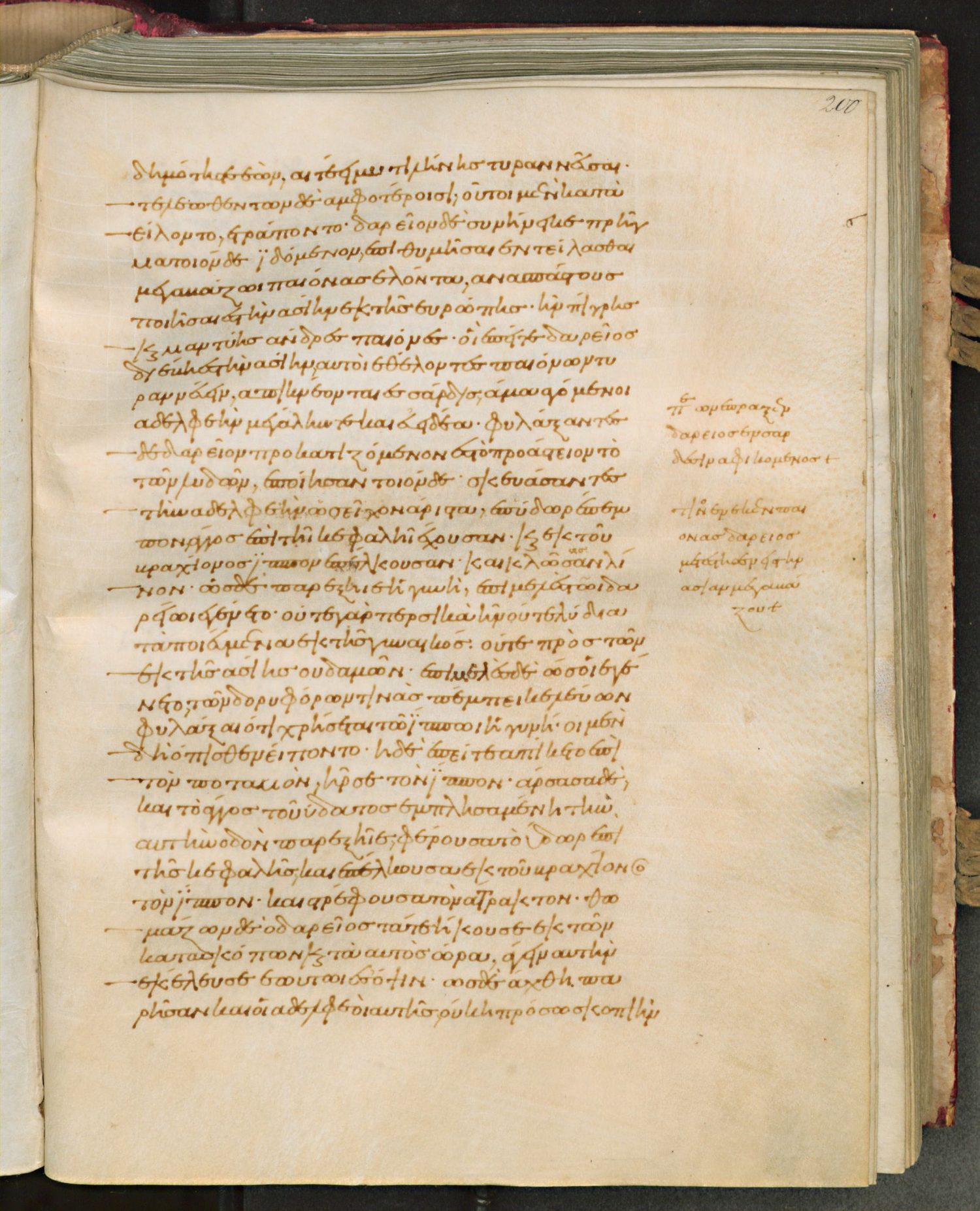
Laur. Plut. 70.3, fol. 200r: Greek here 5.11.2 to 5.13.1. Checked on the image (first and last words read and located in the Greek; each break checked against the neighbouring page): fol. 200r begins ‹δημότης τε ἐών, αἰτέει› (5.11.2), ends ‹οὔ κῃ πρόσω σκοπιὴν› (5.13.1). English here: 5.12.1 to 5.13.1 (Godley's sentences for the sections whose Greek lies mostly on this page).
5.11.2δημότης τε ἐών, αἰτέει Μυτιλήνης τυραννεῦσαι. 5.12.1τελεωθέντων δὲ ἀμφοτέροισι, οὗτοι μὲν κατὰ τὰ εἵλοντο ἐτράποντο, Δαρεῖον δὲ συνήνεικε πρῆγμα τοιόνδε ἰδόμενον ἐπιθυμῆσαι ἐντείλασθαι Μεγαβάζῳ Παίονας ἑλόντα ἀνασπάστους ποιῆσαι ἐς τὴν Ἀσίην ἐκ τῆς Εὐρώπης. ἦν Πίγρης καὶ Μαντύης ἄνδρες Παίονες, οἳ ἐπείτε Δαρεῖος διέβη ἐς τὴν Ἀσίην, αὐτοὶ ἐθέλοντες Παιόνων τυραννεύειν ἀπικνέονται ἐς Σάρδις, ἅμα ἀγόμενοι ἀδελφεὴν μεγάλην τε καὶ εὐειδέα. 5.12.2φυλάξαντες δὲ Δαρεῖον προκατιζόμενον ἐς τὸ προάστειον τὸ τῶν Λυδῶν ἐποίησαν τοιόνδε· σκευάσαντες τὴν ἀδελφεὴν ὡς εἶχον ἄριστα, ἐπʼ ὕδωρ ἔπεμπον ἄγγος ἐπὶ τῇ κεφαλῇ ἔχουσαν καὶ ἐκ τοῦ βραχίονος ἵππον ἐπέλκουσαν καὶ κλώθουσαν λίνον. 5.12.3ὡς δὲ παρεξήιε ἡ γυνή, ἐπιμελὲς τῷ Δαρείῳ ἐγένετο· οὔτε γὰρ Περσικὰ ἦν οὔτε Λύδια τὰ ποιεύμενα ἐκ τῆς γυναικός, οὔτε πρὸς τῶν ἐκ τῆς Ἀσίης οὐδαμῶν. ἐπιμελὲς δὲ ὥς οἱ ἐγένετο, τῶν δορυφόρων τινὰς πέμπει κελεύων φυλάξαι ὅ τι χρήσεται τῷ ἵππῳ ἡ γυνή. 5.12.4οἳ μὲν δὴ ὄπισθε εἵποντο· ἣ δὲ ἐπείτε ἀπίκετο ἐπὶ τὸν ποταμόν, ἦρσε τὸν ἵππον, ἄρσασα δὲ καὶ τὸ ἄγγος τοῦ ὕδατος ἐμπλησαμένη τὴν αὐτὴν ὁδὸν παρεξήιε, φέρουσα τὸ ὕδωρ ἐπὶ τῆς κεφαλῆς καὶ ἐπέλκουσα ἐκ τοῦ βραχίονος τὸν ἵππον καὶ στρέφουσα τὸν ἄτρακτον. 5.13.1θωμάζων δὲ ὁ Δαρεῖος τά τε ἤκουσε ἐκ τῶν κατασκόπων καὶ τὰ αὐτὸς ὥρα, ἄγειν αὐτὴν ἐκέλευε ἑωυτῷ ἐς ὄψιν. ὡς δὲ ἄχθη, παρῆσαν καὶ οἱ ἀδελφεοὶ αὐτῆς οὔ κῃ πρόσω σκοπιὴν
5.12.1The desire of both being granted, they went their ways to the places of their choice; but Darius, as it fell out, saw a sight which put it in his mind to bid Megabazus take the Paeonians and carry them from their homes out of Europe into Asia. There were two Paeonians, Pigres and Mantyes; these would themselves be rulers of their countrymen, and when Darius had crossed into Asia came to Sardis, bringing with them their sister, a woman tall and fair. 5.12.2There, waiting till Darius should be sitting in the suburb of the Lydian city, they put on their sister the best adornment they had, and sent her to draw water, bearing a vessel on her head and leading a horse by the bridle on her arm and spinning flax the while. 5.12.3Darius took note of the woman as she passed by him; for what she did was not in the manner of the Persians or Lydians or any of the peoples of Asia. Having taken note of the thing, he sent certain of his guard, bidding them watch what the woman would do with the horse. 5.12.4So they followed behind her; and she, coming to the river, watered the horse; then, having so done, and filled her vessel with the water, she passed back again by the same way, bearing the water on her head and leading the horse on her arm and plying her distaff. 5.13.1Marvelling at what he heard from his watchers and what he saw for himself, Darius bade the woman be brought before him. When she was brought, her brothers, who watched all this from a place near by, came too; and Darius asking of what nation she were, the young man told him that they were Paeonians, and she their sister.
Where on the image
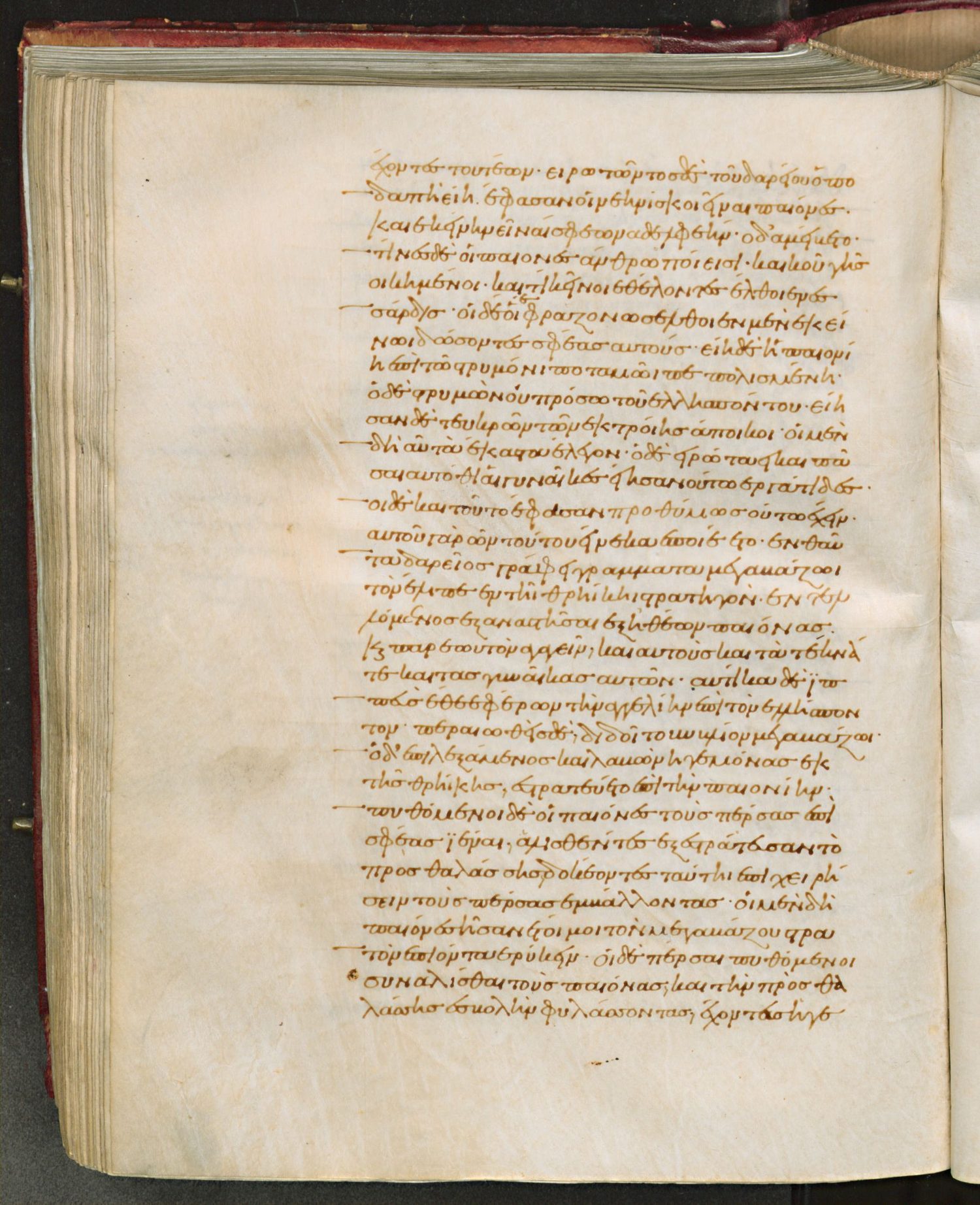
Laur. Plut. 70.3, fol. 200v: Greek here 5.13.1 to 5.15.2. Checked on the image (first and last words read and located in the Greek; each break checked against the neighbouring page): fol. 200v begins ‹ἔχοντες τούτων. εἰρωτῶντος δὲ› (5.13.1), ends ‹ἐσβολὴν φυλάσσοντας, ἔχοντες ἡγε-› (5.15.2). English here: 5.13.2 to 5.15.2 (Godley's sentences for the sections whose Greek lies mostly on this page).
5.13.1ἔχοντες τούτων. εἰρωτῶντος δὲ τοῦ Δαρείου ὁποδαπὴ εἴη, ἔφασαν οἱ νεηνίσκοι εἶναι Παίονες καὶ ἐκείνην εἶναι σφέων ἀδελφεήν. 5.13.2ὃ δʼ ἀμείβετο, τίνες δὲ οἱ Παίονες ἄνθρωποι εἰσὶ καὶ κοῦ γῆς οἰκημένοι, καὶ τί κεῖνοι ἐθέλοντες ἔλθοιεν ἐς Σάρδις. οἳ δέ οἱ ἔφραζον ὡς ἔλθοιεν μὲν ἐκείνῳ δώσοντες σφέας αὐτούς, εἴη δὲ ἡ Παιονίη ἐπὶ τῷ Στρυμόνι ποταμῷ πεπολισμένη, ὁ δὲ Στρυμὼν οὐ πρόσω τοῦ Ἑλλησπόντου, εἴησαν δὲ Τευκρῶν τῶν ἐκ Τροίης ἄποικοι. 5.13.3οἳ μὲν δὴ ταῦτα ἕκαστα ἔλεγον, ὁ δὲ εἰρώτα εἰ καὶ πᾶσαι αὐτόθι αἱ γυναῖκες εἴησαν οὕτω ἐργάτιδες. οἳ δὲ καὶ τοῦτο ἔφασαν προθύμως οὕτω ἔχειν· αὐτοῦ γὰρ ὦν τούτου εἵνεκα καὶ ἐποιέετο. 5.14.1ἐνθαῦτα Δαρεῖος γράφει γράμματα Μεγαβάζῳ, τὸν ἔλιπε ἐν τῇ Θρηίκῃ στρατηγόν, ἐντελλόμενος ἐξαναστῆσαι ἐξ ἠθέων Παίονας καὶ παρʼ ἑωυτὸν ἀγαγεῖν καὶ αὐτοὺς καὶ τὰ τέκνα τε καὶ τὰς γυναῖκας αὐτῶν. 5.14.2αὐτίκα δὲ ἱππεὺς ἔθεε φέρων τὴν ἀγγελίην ἐπὶ τὸν Ἑλλήσποντον, περαιωθεὶς δὲ διδοῖ τὸ βυβλίον τῷ Μεγαβάζῳ. ὁ δὲ ἐπιλεξάμενος καὶ λαβὼν ἡγεμόνας ἐκ τῆς Θρηίκης ἐστρατεύετο ἐπὶ τὴν Παιονίην. 5.15.1πυθόμενοι δὲ οἱ Παίονες τοὺς Πέρσας ἐπὶ σφέας ἰέναι, ἁλισθέντες ἐξεστρατεύσαντο πρὸς θαλάσσης, δοκέοντες ταύτῃ ἐπιχειρήσειν τοὺς Πέρσας ἐμβάλλοντας. 5.15.2οἱ μὲν δὴ Παίονες ἦσαν ἕτοιμοι τὸν Μεγαβάζου στρατὸν ἐπιόντα ἐρύκειν· οἱ δὲ Πέρσαι πυθόμενοι συναλίσθαι τοὺς Παίονας καὶ τὴν πρὸς θαλάσσης ἐσβολὴν φυλάσσοντας, ἔχοντες ἡγεμόνας
5.13.2“But who” he answered, “are the Paeonians, and where dwell they, and with what intent are you come to Sardis?” They showed him, that they were come to be his men; that the towns of Paeonia were on the Strymon, a river not far from the Hellespont; and that they were colonists from the Teucrians of Troy. 5.13.3So they told him all this; and the king asked them if all the women of their country were as notable workers. To this too they very readily answered (for it was for this very purpose that they had come), that it was indeed so. 5.14.1Then Darius wrote a letter to Megabazus, whom he had left as his general in Thrace, bidding him take the Paeonians from their houses, and bring them to him, men, women, and children. 5.14.2Immediately a horseman sped with this message to the Hellespont, and crossing it gave the letter to Megabazus; who, having read it, took guides from Thrace and led his army to Paeonia. 5.15.1When the Paeonians learnt that the Persians were coming against them, they gathered themselves together and marched away to the sea, thinking that the Persians would essay to attack them by that way. 5.15.2So the Paeonians were ready to stay the onset of Megabazus’ army; but the Persians, learning that the Paeonians had gathered their forces and were guarding the sea-coast way into their country, got them guides and marched instead by the highland road, whereby they took the Paeonians unawares and won entrance into their cities, which were left without men; and finding these empty at their onfall they easily gained them.
Where on the image
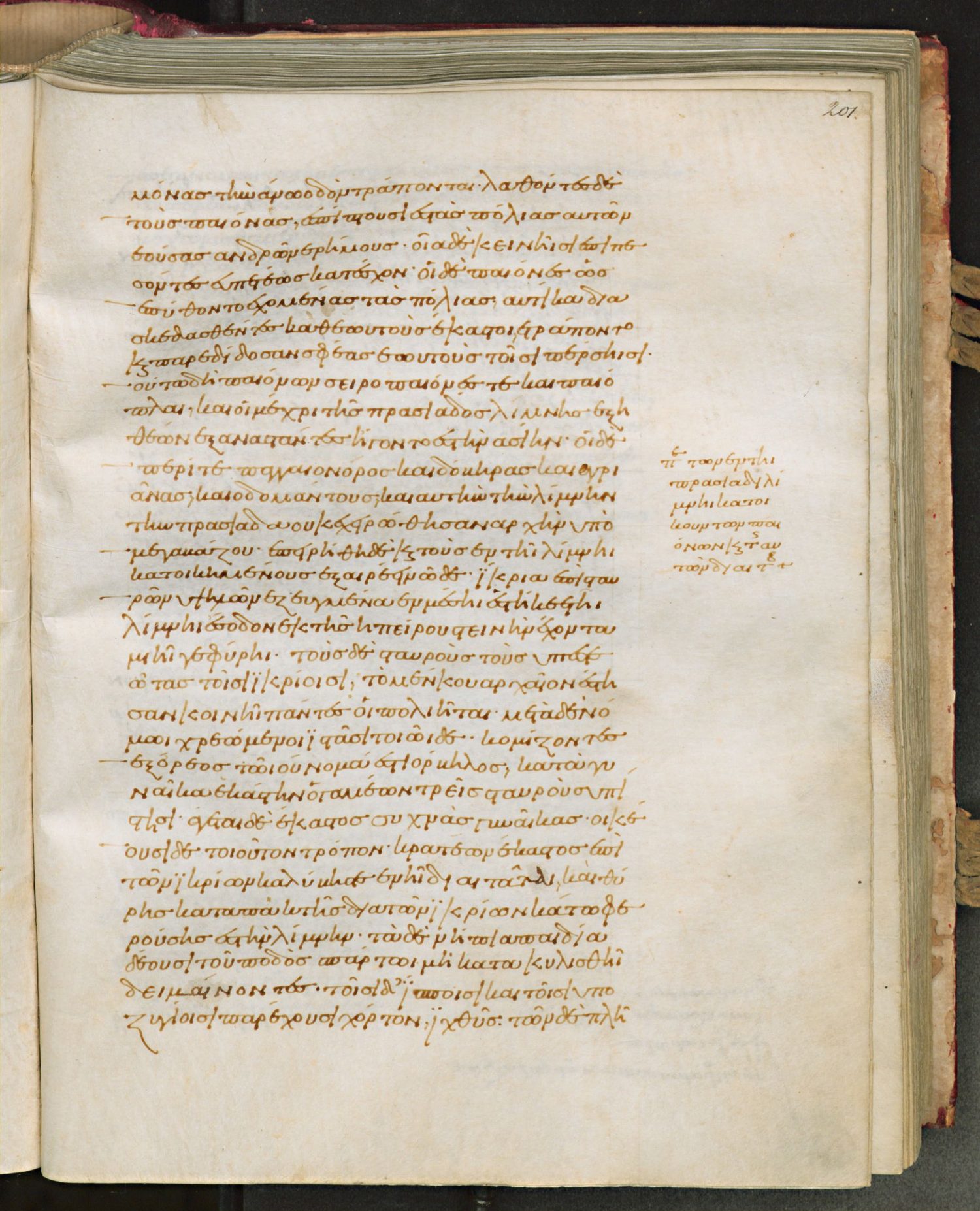
Laur. Plut. 70.3, fol. 201r: Greek here 5.15.2 to 5.16.4. Checked on the image (first and last words read and located in the Greek; each break checked against the neighbouring page): fol. 201r begins ‹-μόνας τὴν ἄνω ὁδὸν› (5.15.2), ends ‹ἰχθῦς· τῶν δὲ πλῆ-› (5.16.4). The word ‹ἡγεμόνας› is divided between fol. 200v and fol. 201r; it is given with fol. 200v. English here: 5.15.3 to 5.16.3 (Godley's sentences for the sections whose Greek lies mostly on this page).
5.15.2τὴν ἄνω ὁδὸν τρέπονται, λαθόντες δὲ τοὺς Παίονας ἐσπίπτουσι ἐς τὰς πόλιας αὐτῶν ἐούσας ἀνδρῶν ἐρήμους· οἷα δὲ κεινῇσι ἐπιπεσόντες εὐπετέως κατέσχον. 5.15.3οἱ δὲ Παίονες ὡς ἐπύθοντο ἐχομένας τὰς πόλιας, αὐτίκα διασκεδασθέντες κατʼ ἑωυτοὺς ἕκαστοι ἐτράποντο καὶ παρεδίδοσαν σφέας αὐτοὺς τοῖσι Πέρσῃσι. οὕτω δὴ Παιόνων Σιριοπαίονές τε καὶ Παιόπλαι καὶ οἱ μέχρι τῆς Πρασιάδος λίμνης ἐξ ἠθέων ἐξαναστάντες ἤγοντο ἐς τὴν Ἀσίην. 5.16.1οἱ δὲ περί τε Πάγγαιον ὄρος καὶ Δόβηρας καὶ Ἀγριᾶνας καὶ Ὀδομάντουςκαὶ αὐτὴν τὴν λίμνην τὴν Πρασιάδα οὐκ ἐχειρώθησαν ἀρχὴν ὑπὸ Μεγαβάζου· ἐπειρήθη δὲ καὶ τοὺς ἐν τῇ λίμνῃ κατοικημένους ἐξαιρέειν ὧδε. ἴκρια ἐπὶ σταυρῶν ὑψηλῶν ἐζευγμένα ἐν μέσῃ ἕστηκε τῇ λίμνῃ, ἔσοδον ἐκ τῆς ἠπείρου στεινὴν ἔχοντα μιῇ γεφύρῃ. 5.16.2τοὺς δὲ σταυροὺς τοὺς ὑπεστεῶτας τοῖσι ἰκρίοισι τὸ μέν κου ἀρχαῖον ἔστησαν κοινῇ πάντες οἱ πολιῆται, μετὰ δὲ νόμῳ χρεώμενοι ἱστᾶσι τοιῷδε· κομίζοντες ἐξ ὄρεος τῷ οὔνομα ἐστὶ Ὄρβηλος, κατὰ γυναῖκα ἑκάστην ὁ γαμέων τρεῖς σταυροὺς ὑπίστησι· ἄγεται δὲ ἕκαστος συχνὰς γυναῖκας. 5.16.3οἰκέουσι δὲ τοιοῦτον τρόπον, κρατέων ἕκαστος ἐπὶ τῶν ἰκρίων καλύβης τε ἐν τῇ διαιτᾶται καὶ θύρης καταπακτῆς διὰ τῶν ἰκρίων κάτω φερούσης ἐς τὴν λίμνην. τὰ δὲ νήπια παιδία δέουσι τοῦ ποδὸς σπάρτῳ, μὴ κατακυλισθῇ δειμαίνοντες. 5.16.4τοῖσι δὲ ἵπποισι καὶ τοῖσι ὑποζυγίοισι παρέχουσι χόρτον ἰχθῦς· τῶν δὲ πλῆθος
5.15.3The Paeonians, learning that their towns were taken, straightway broke and went each his own way and yielded themselves up to the Persians. Thus of the Paeonians the Siriopaeones and Paeoplae and all that dwelt as far as the Prasiad lake were taken away from their homes and carried into Asia. 5.16.1But those near the Pangaean mountains and the country of the Doberes and the Agrianes and the Odomanti and the Prasiad lake itself were never subdued at all by Megabazus; albeit he tried to take the lake-dwellers, whose dwellings were such as I shall show:—There is set in the midst of the lake a platform made fast on tall piles, whereto one bridge gives a narrow passage from the land. 5.16.2The piles which support the platform were set there in old times by all the people working together, but by a later custom this is the manner of their setting: the piles are brought from a mountain called Orbelus, and every man plants three for each woman that he weds; and each has many wives. 5.16.3For the manner of their dwelling, each man on the platform owns the hut wherein he lives and a trap-door in the platform leading down into the lake. They make a cord fast to the feet of their little children, lest the children fall into the water.
Where on the image
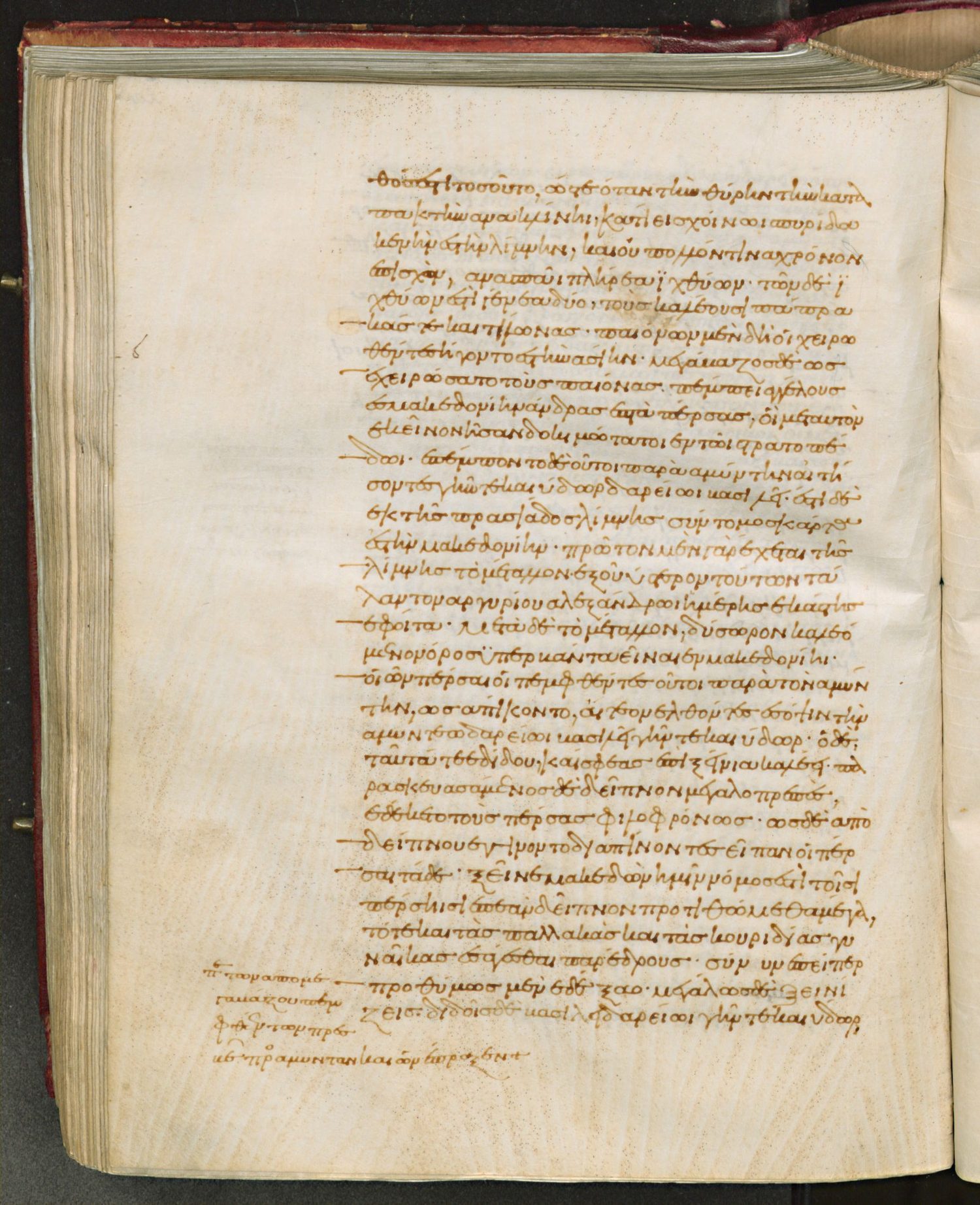
Laur. Plut. 70.3, fol. 201v: Greek here 5.16.4. Checked on the image (first and last words read and located in the Greek; each break checked against the neighbouring page): fol. 201v begins ‹-θος ἐστὶ τοσοῦτο ὥστε,› (5.16.4), ends ‹γῆν τε καὶ ὕδωρ› (5.18.2). The word ‹πλῆθος› is divided between fol. 201r and fol. 201v; it is given with fol. 201r. English here: 5.16.4 (Godley's sentences for the sections whose Greek lies mostly on this page).
5.16.4ἐστὶ τοσοῦτο ὥστε, ὅταν τὴν θύρην τὴν καταπακτὴν ἀνακλίνῃ, κατιεῖ σχοίνῳ σπυρίδα κεινὴν ἐς τὴν λίμνην, καὶ οὐ πολλόν τινα χρόνον ἐπισχὼν ἀνασπᾷ πλήρεα ἰχθύων. τῶν δὲ ἰχθύων ἐστὶ γένεα δύο, τοὺς καλέουσι πάπρακάς τε καὶ τίλωνας.
5.16.4They give fish for fodder to their horses and beasts of burden; and of fish there is such abundance, that a man opens his trap-door and lets an empty basket down by a line into the lake, and it is no long time before he draws it up full of fish. There are two kinds of these, some called “paprakes,” some “tilones.”
Notes
- Greek: the text printed in A. D. Godley's Loeb edition, via Perseus (tlg0016.tlg001.perseus-grc2). Square brackets mark words the editor considers later additions; [...] marks a gap the editor indicates. Perseus note markers are omitted.
- English: A. D. Godley, Herodotus vol. 3 (1922) (Loeb Classical Library), as transcribed on Wikisource. Godley's footnotes are omitted.
- Section numbers in the English were placed by comparing Godley's text with the Perseus version of his translation; where a section begins inside one of Godley's sentences, the English is kept with the page that holds the start of that sentence.
Cite
Sources
- Source: Florence, Laur. Plut. 70.3 (10th c.) via BML Teca Digitale + Greek of Godley's Loeb (Perseus) + English of A. D. Godley (Loeb, Wikisource) (holding institution)
- Critical edition: Greek of A. D. Godley's Loeb edition (1920-1925), via Perseus
← previous · → next · v cycle view · l back to library