Herodotus, Histories 4.46-58: The rivers of Scythia
Introduction
Herodotus of Halicarnassus wrote the Histories in the third quarter of the 5th century BCE, an inquiry into the deeds of Greeks and barbarians and the causes of the wars between them, later divided into nine books. Book 4 tells of Darius' expedition against the Scythians, with Herodotus' account of Scythia, its peoples, rivers and customs, and of the shape of the world, and of the Persian expedition against Barca, with the history of Cyrene and a description of the peoples of Libya.
The photographs are of Florence, Biblioteca Medicea Laurenziana, Plut. 70.3 (parchment, 10th century, 374 folios, 31 lines a page), Herodotus, Histories (codex A of the editors), the oldest surviving manuscript of the complete Histories, from the Teca Digitale of the Biblioteca Medicea Laurenziana. Each section below is the text of one page, or of the part of a page that falls within these chapters. The first and last words of every page were read on the photograph and located in the Greek, and every page break was checked against the next page; the notes quote these words. Readers' notes in the margins are not part of the text and are mentioned where they occur.
The Greek is the text printed in A. D. Godley's Loeb edition (1920-1925), from Perseus; it is the edited text, not a transcription of the manuscript, whose wording differs in places. The English is Godley's translation as printed, from Wikisource. Godley's English carries only chapter numbers; the section numbers shown in it were placed by comparison with the Perseus version of his translation. Each page's English is cut at the end of one of Godley's sentences, so it can begin or end a few lines away from the Greek of the page; each note gives the exact ranges.
This entry covers chapters 4.46-58, on fol. 158r to 160v.
How was this verified? (Provenance)
Where on the image
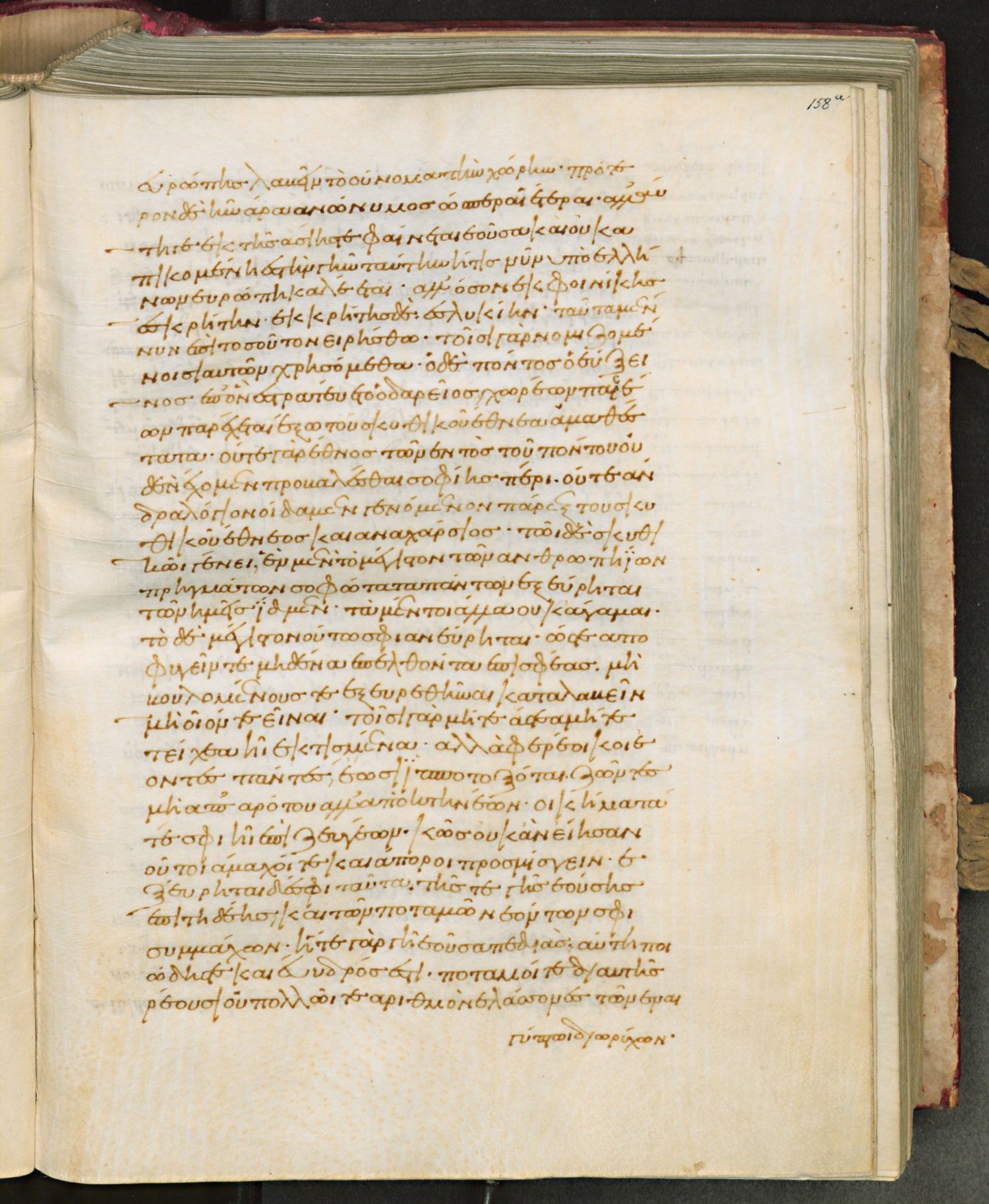
Laur. Plut. 70.3, fol. 158r: Greek here 4.46.1 to 4.47.1. Checked on the image (first and last words read and located in the Greek; each break checked against the neighbouring page): fol. 158r begins ‹Εὐρώπης λαβεῖν τὸ οὔνομα› (4.45.4), ends ‹τῶν ἐν Αἰγύπτῳ διωρύχων› (4.47.1). English here: 4.46.1 to 4.47.1 (Godley's sentences for the sections whose Greek lies mostly on this page).
4.46.1ὁ δὲ Πόντος ὁ Εὔξεινος, ἐπʼ ὃν ἐστρατεύετο ὁ Δαρεῖος, χωρέων πασέων παρέχεται ἔξω τοῦ Σκυθικοῦ ἔθνεα ἀμαθέστατα. οὔτε γὰρ ἔθνος τῶν ἐντὸς τοῦ Πόντου οὐδὲν ἔχομεν προβαλέσθαι σοφίης πέρι οὔτε ἄνδρα λόγιον οἴδαμεν γενόμενον, πάρεξ τοῦ Σκυθικοῦ ἔθνεος καὶ Ἀναχάρσιος. 4.46.2τῷ δὲ Σκυθικῷ γένει ἓν μὲν τὸ μέγιστον τῶν ἀνθρωπηίων πρηγμάτων σοφώτατα πάντων ἐξεύρηται τῶν ἡμεῖς ἴδμεν, τὰ μέντοι ἄλλα οὐκ ἄγαμαι· τὸ δὲ μέγιστον οὕτω σφι ἀνεύρηται ὥστε ἀποφυγεῖν τε μηδένα ἐπελθόντα ἐπὶ σφέας, μὴ βουλομένους τε ἐξευρεθῆναι καταλαβεῖν μὴ οἷον τε εἶναι. 4.46.3τοῖσι γὰρ μήτε ἄστεα μήτε τείχεα ᾖ ἐκτισμένα, ἀλλὰ φερέοικοι ἐόντες πάντες ἔωσι ἱπποτοξόται, ζῶντες μὴ ἀπʼ ἀρότου ἀλλʼ ἀπὸ κτηνέων, οἰκήματα τε σφι ᾖ ἐπὶ ζευγέων, κῶς οὐκ ἂν εἴησαν οὗτοι ἄμαχοί τε καὶ ἄποροι προσμίσγειν; 4.47.1ἐξεύρηται δέ σφι ταῦτα τῆς τε γῆς ἐούσης ἐπιτηδέης καὶ τῶν ποταμῶν ἐόντων σφι συμμάχων. ἥ τε γὰρ γῆ ἐοῦσα πεδιὰς αὕτη ποιώδης τε καὶ εὔυδρος ἐστί, ποταμοί τε διʼ αὐτῆς ῥέουσι οὐ πολλῷ τεῳ ἀριθμὸν ἐλάσσονες τῶν ἐν Αἰγύπτῳ διωρύχων.
4.46.1Nowhere are men seen so dull-witted (I say not this of the Scythian nation) as in the lands by the Euxine Pontus, against which Darius led his army. For we cannot show that any nation within the region of the Pontus has aught of cleverness, nor do we know (not reckoning the Scythian nation and Anacharsis) of any notable man born there. 4.46.2But the Scythian race has in that matter which of all human affairs is of greatest import made the cleverest discovery that we know; I praise not the Scythians in all respects, but in this greatest matter they have so devised that none who attacks them can escape, and none can catch them if they desire not to be found. 4.46.3For when men have no stablished cities or fortresses, but all are house-bearers and mounted archers, living not by tilling the soil but by cattle-rearing and carrying their dwellings on waggons, how should these not be invincible and unapproachable? 4.47.1This invention they have made in a land which suits their purpose and has rivers which are their allies; for their country is level and grassy and well watered and rivers run through it not much less in number than the canals of Egypt.
Where on the image
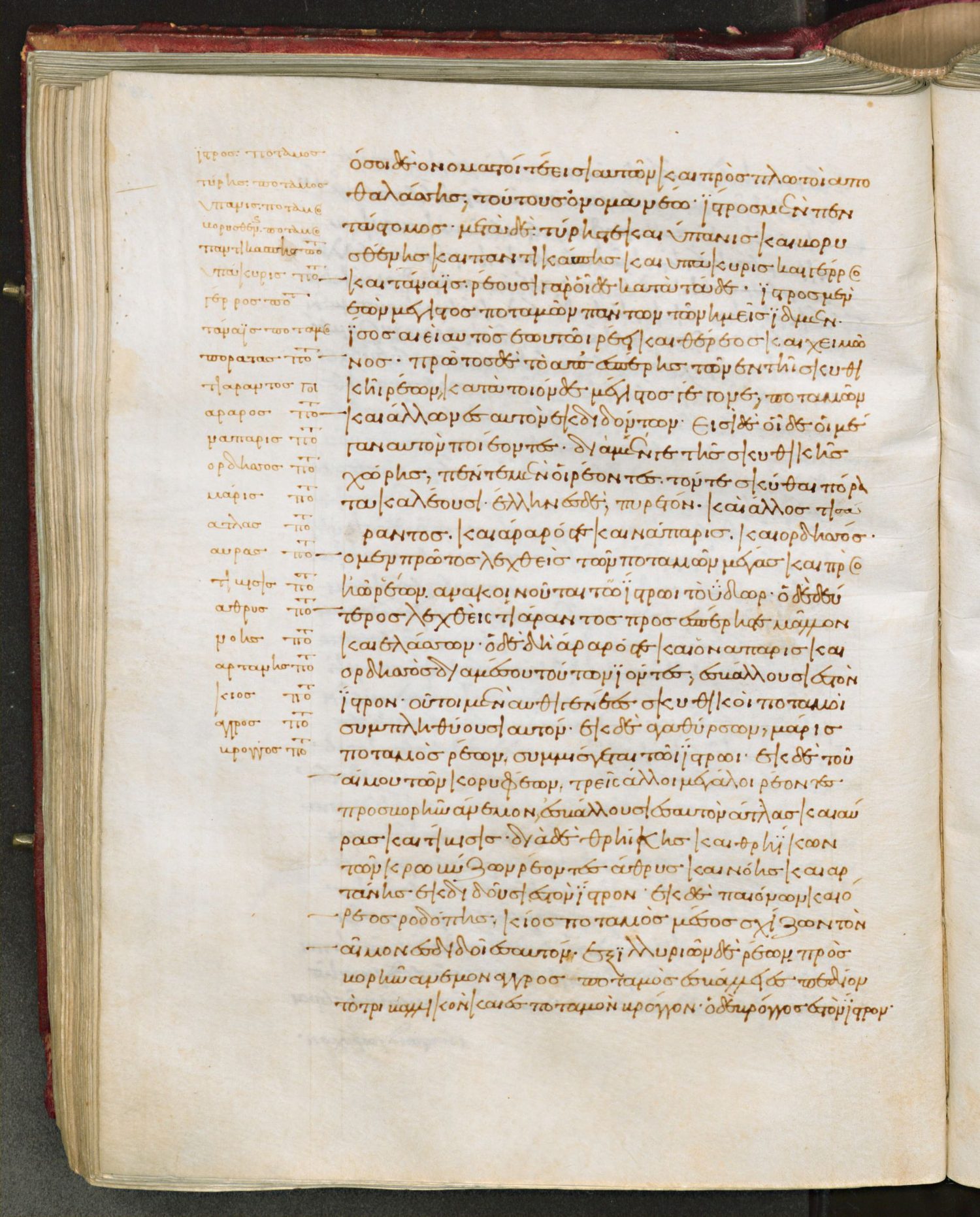
Laur. Plut. 70.3, fol. 158v: Greek here 4.47.2 to 4.49.2. Checked on the image (first and last words read and located in the Greek; each break checked against the neighbouring page): fol. 158v begins ‹ὅσοι δὲ ὀνομαστοί τε› (4.47.2), ends ‹Βρόγγος ἐς τὸν Ἴστρον› (4.49.2). English here: 4.47.2 to 4.49.1 (Godley's sentences for the sections whose Greek lies mostly on this page).
4.47.2ὅσοι δὲ ὀνομαστοί τε εἰσὶ αὐτῶν καὶ προσπλωτοὶ ἀπὸ θαλάσσης, τούτους ὀνομανέω […] Ἴστρος μὲν πεντάστομος, μετὰ δὲ Τύρης τε καὶ Ὕπανις καὶ Βορυσθένης καὶ Παντικάπης καὶ Ὑπάκυρις καὶ Γέρρος καὶ Τάναϊς. ῥέουσι δὲ οἵδε κατὰ τάδε. 4.48.1Ἴστρος μέν, ἐὼν μέγιστος ποταμῶν πάντων τῶν ἡμεῖς ἴδμεν, ἴσος αἰεὶ αὐτὸς ἑωυτῷ ῥέει καὶ θέρεος καὶ χειμῶνος, πρῶτος δὲ τὸ ἀπʼ ἑσπέρης τῶν ἐν τῇ Σκυθικῇ ῥέων κατὰ τοιόνδε μέγιστος γέγονε· ποταμῶν καὶ ἄλλων ἐς αὐτὸν ἐκδιδόντων 4.48.2εἰσὶ δὴ οἵδε οἱ μέγαν αὐτὸν ποιεῦντες, διὰ μέν γε τῆς Σκυθικῆς χώρης πέντε μὲν οἱ ῥέοντες, τὸν τε Σκύθαι Πόρατα καλέουσι Ἑλλήνες δὲ Πυρετόν, καὶ ἄλλος Τιάραντος καὶ Ἄραρος τε καὶ Νάπαρις καὶ Ὀρδησσός. 4.48.3ὁ μὲν πρῶτος λεχθεὶς τῶν ποταμῶν μέγας καὶ πρὸς ἠῶ ῥέων ἀνακοινοῦται τῷ Ἴστρῳ τὸ ὕδωρ, ὁ δὲ δεύτερος λεχθεὶς Τιάραντος πρὸς ἑσπέρης τε μᾶλλον καὶ ἐλάσσων, ὁ δὲ δὴ Ἄραρός τε καὶ ὁ Νάπαρις καὶ ὁ Ὀρδησσὸς καὶ μέσου τούτων ἰόντες ἐσβάλλουσι ἐς τὸν Ἴστρον. 4.49.1οὗτοι μὲν αὐθιγενέες Σκυθικοὶ ποταμοὶ συμπληθύουσι αὐτόν, ἐκ δὲ Ἀγαθύρσων Μάρις ποταμὸς ῥέων συμμίσγεται τῷ Ἴστρῳ, ἐκ δὲ τοῦ Αἵμου τῶν κορυφέων τρεῖς ἄλλοι μεγάλοι ῥέοντες πρὸς βορέην ἄνεμον ἐσβάλλουσι ἐς αὐτόν, Ἄτλας καὶ Αὔρας καὶ Τίβισις. διὰ δὲ Θρηίκης καὶ Θρηίκων τῶν Κροβύζων ῥέοντες Ἄθρυς καὶ Νόης καὶ Ἀρτάνης ἐκδιδοῦσι ἐς τὸν Ἴστρον· ἐκ δὲ Παιόνων καὶ ὄρεος Ῥοδόπης Κίος ποταμὸς μέσον σχίζων τὸν Αἷμον ἐκδιδοῖ ἐς αὐτόν. 4.49.2ἐξ Ἰλλυριῶν δὲ ῥέων πρὸς βορέην ἄνεμον Ἄγγρος ποταμὸς ἐσβάλλει ἐς πεδίον τὸ Τριβαλλικὸν καὶ ἐς ποταμὸν Βρόγγον, ὁ δὲ Βρόγγος ἐς τὸν Ἴστρον·
4.47.2As many of them as are famous and can be entered from the sea, these I will name. … There is the Ister, that has five mouths, and next, the Tyras, and Hypanis, and Borysthenes, and Panticapes, and Hypacuris, and Gerrhus, and Tanais. Their courses are as I will show. 4.48.1The Ister, the greatest of all rivers known to us, flows with ever the same volume in summer and winter; it is the farthest westward of all the Scythian rivers, and the reason of its greatness is as follows: Many other rivers are its tributaries, but these are 4.48.2those that make it great, five flowing through the Scythian country: the river called by Scythians Porata and by Greeks Pyretus, and besides this the Tiarantus, the Ararus, the Naparis, and the Ordessus. 4.48.3The first-named of these rivers is a great stream flowing eastwards and uniting its waters with the Ister, the second, the Tiarantus, is more to the west and smaller; the Ararus, Naparis, and Ordessus flow between these two and pour their waters into the Ister. 4.49.1These are the native-born Scythian rivers that help to swell it; but the river Maris, which commingles with the Ister, flows from the Agathyrsi; the Atlas, Auras, and Tibisis, three other great rivers that pour into it, flow northward from the heights of Haemus. The Athrys, the Noes, and the Artanes issue into the Ister from the country of the Crobyzi in Thrace; the river Cius, which cuts through the midst of Haemus, from the Paeonians and the mountain range of Rhodope.
Where on the image
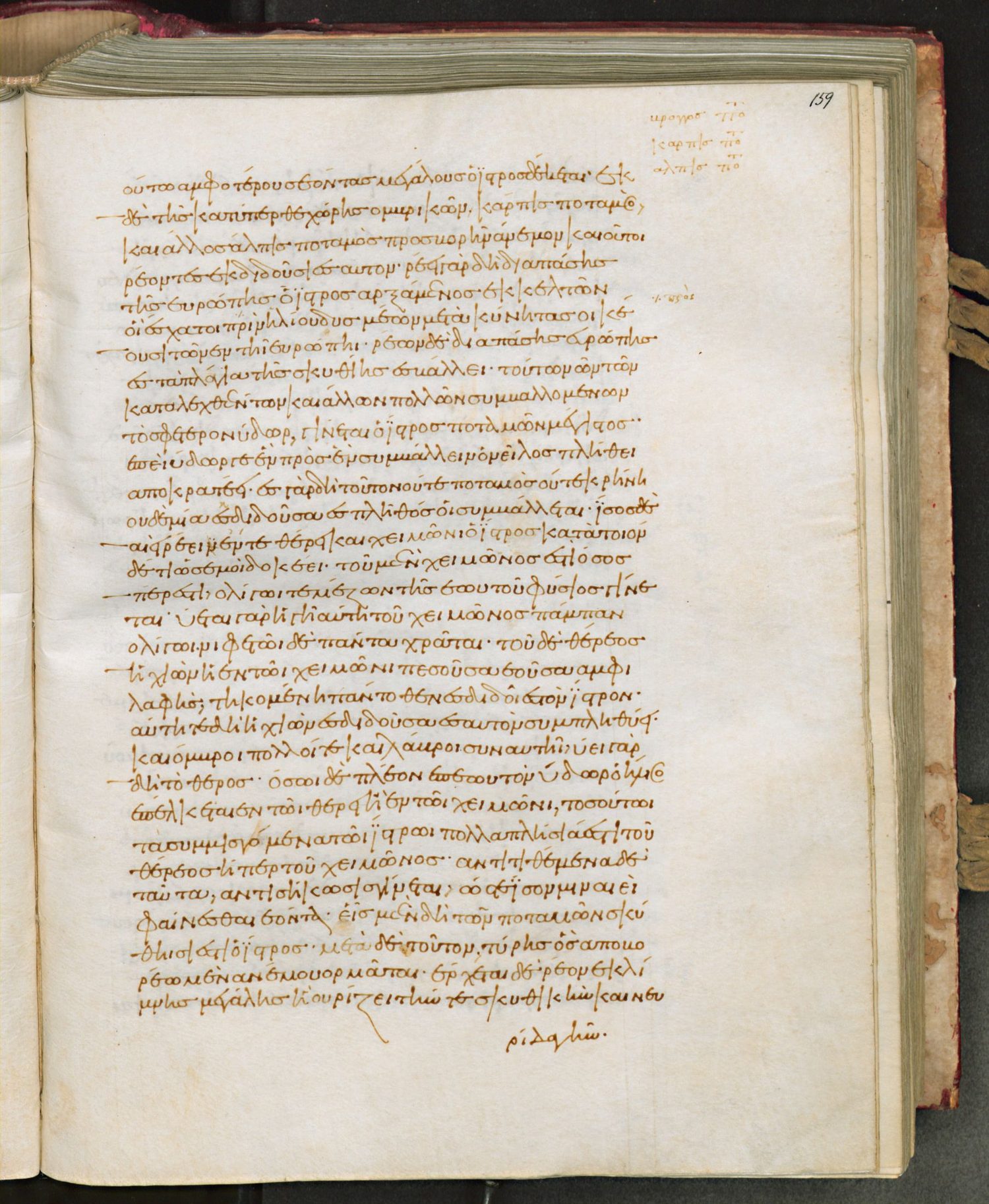
Laur. Plut. 70.3, fol. 159r: Greek here 4.49.2 to 4.51.1. Checked on the image (first and last words read and located in the Greek; each break checked against the neighbouring page): fol. 159r begins ‹οὕτω ἀμφοτέρους ἐόντας μεγάλους› (4.49.2), ends ‹Σκυθικὴν καὶ Νευρίδα γῆν› (4.51.1). The last line holds only ρίδα γῆν. English here: 4.49.2 to 4.51.1 (Godley's sentences for the sections whose Greek lies mostly on this page).
4.49.2οὕτω ἀμφοτέρους ἐόντας μεγάλους ὁ Ἴστρος δέκεται. ἐκ δὲ τῆς κατύπερθε χώρης Ὀμβρικῶν Κάρπις ποταμὸς καὶ ἄλλος Ἄλπις ποταμὸς πρὸς βορέην ἄνεμον καὶ οὗτοι ῥέοντες ἐκδιδοῦσι ἐς αὐτόν· 4.49.3ῥέει γὰρ δὴ διὰ πάσης τῆς Εὐρώπης ὁ Ἴστρος, ἀρξάμενος ἐκ Κελτῶν, οἳ ἔσχατοι πρὸς ἡλίου δυσμέων μετὰ Κύνητας οἰκέουσι τῶν ἐν τῇ Εὐρώπη· ῥέων δὲ διὰ πάσης τῆς Εὐρώπης ἐς τὰ πλάγια τῆς Σκυθίης ἐσβάλλει. 4.50.1τούτων ὦν τῶν καταλεχθέντων καὶ ἄλλων πολλῶν συμβαλλομένων τὸ σφέτερον ὕδωρ γίνεται ὁ Ἴστρος ποταμῶν μέγιστος, ἐπεὶ ὕδωρ γε ἓν πρὸς ἓν συμβάλλειν ὁ Νεῖλος πλήθει ἀποκρατέει. ἐς γὰρ δὴ τοῦτον οὔτε ποταμὸς οὔτε κρήνη οὐδεμία ἐσδιδοῦσα ἐς πλῆθός οἱ συμβάλλεται. 4.50.2ἴσος δὲ αἰεὶ ῥέει ἐν τε θέρει καὶ χειμῶνι ὁ Ἴστρος κατὰ τοιόνδε τι, ὡς ἐμοὶ δοκέει· τοῦ μὲν χειμῶνος ἐστὶ ὅσος περ ἐστι, ὀλίγῳ τε μέζων τῆς ἑωυτοῦ φύσιος γίνεται· ὕεται γὰρ ἡ γῆ αὕτη τοῦ χειμῶνος πάμπαν ὀλίγῳ, νιφετῷ δὲ πάντα χρᾶται· 4.50.3τοῦ δὲ θέρεος ἡ χιὼν ἡ ἐν τῷ χειμῶνι πεσοῦσα, ἐοῦσα ἀμφιλαφής, τηκομένη πάντοθεν ἐσδιδοῖ ἐς τὸν Ἴστρον. αὕτη τε δὴ ἡ χιὼν ἐσδιδοῦσα ἐς αὐτὸν συμπληθύει καὶ ὄμβροι πολλοί τε καὶ λάβροι σὺν αὐτῇ· ὕει γὰρ δὴ τὸ θέρος. 4.50.4ὅσῳ δὲ πλέον ἐπʼ ἑωυτὸν ὕδωρ ὁ ἥλιος ἐπέλκεται ἐν τῶ θέρει ἢ ἐν τῷ χειμῶνι, τοσούτῳ τὰ συμμισγόμενα τῷ Ἴστρῳ πολλαπλήσια ἐστὶ τοῦ θέρεος ἤ περ τοῦ χειμῶνος· ἀντιτιθέμενα δὲ ταῦτα ἀντισήκωσις γίνεται, ὥστε ἴσον μιν αἰεὶ φαίνεσθαι ἐόντα. 4.51.1εἷς μὲν δὴ τῶν ποταμῶν τοῖσι Σκύθῃσι ἐστὶ ὁ Ἴστρος, μετὰ δὲ τοῦτον Τύρης, ὃς ἀπὸ βορέω μὲν ἀνέμου ὁρμᾶται, ἄρχεται δὲ ῥέων ἐκ λίμνης μεγάλης ἣ οὐρίζει τήν τε Σκυθικὴν καὶ Νευρίδα γῆν.
4.49.2The river Angrus flows northward from Illyria into the Triballic plain and the river Brongus, and the Brongus into the Ister, which so receives these two great rivers into itself. The Carpis and another river called Alpis also flow northward, from the country north of the Ombrici, to issue into it; 4.49.3for the Ister traverses the whole of Europe, rising among the Celts who, save only the Cynetes, are the most westerly dwellers in Europe, and flowing thus clean across Europe it issues forth along the borders of Scythia. 4.50.1Seeing, then, that these aforesaid rivers, and many others too, are its tributaries, the Ister becomes the greatest of all rivers; stream for stream, indeed, the Nile has a greater volume, for no river or spring joins it to swell its volume of water. 4.50.2But the Ister is ever of the same height in summer and winter, whereof I think this to be the reason. In winter it is of its customary size, or only a little greater than is natural to it, for in that country in winter there is very little rain, but snow everywhere. 4.50.3But in the summer the abundant snow which has fallen in winter melts and pours from all sides into the Ister; so this snow pours into the river and helps to swell it with much violent rain besides, the summer being the season of rain. 4.50.4And in the same degree as the sun draws to itself more water in summer than in winter, the water that commingles with the Ister is many times more abundant in summer than it is in winter; these opposites keep the balance true, so that the volume of the river appears ever the same. 4.51.1One of the rivers of the Scythians, then, is the Ister. The next is the Tyras; this comes from the north, flowing at first out of a great lake, which is the boundary between the Scythian and the Neurian countries; at the mouth of the river there is a settlement of Greeks, who are called Tyritae.
Where on the image
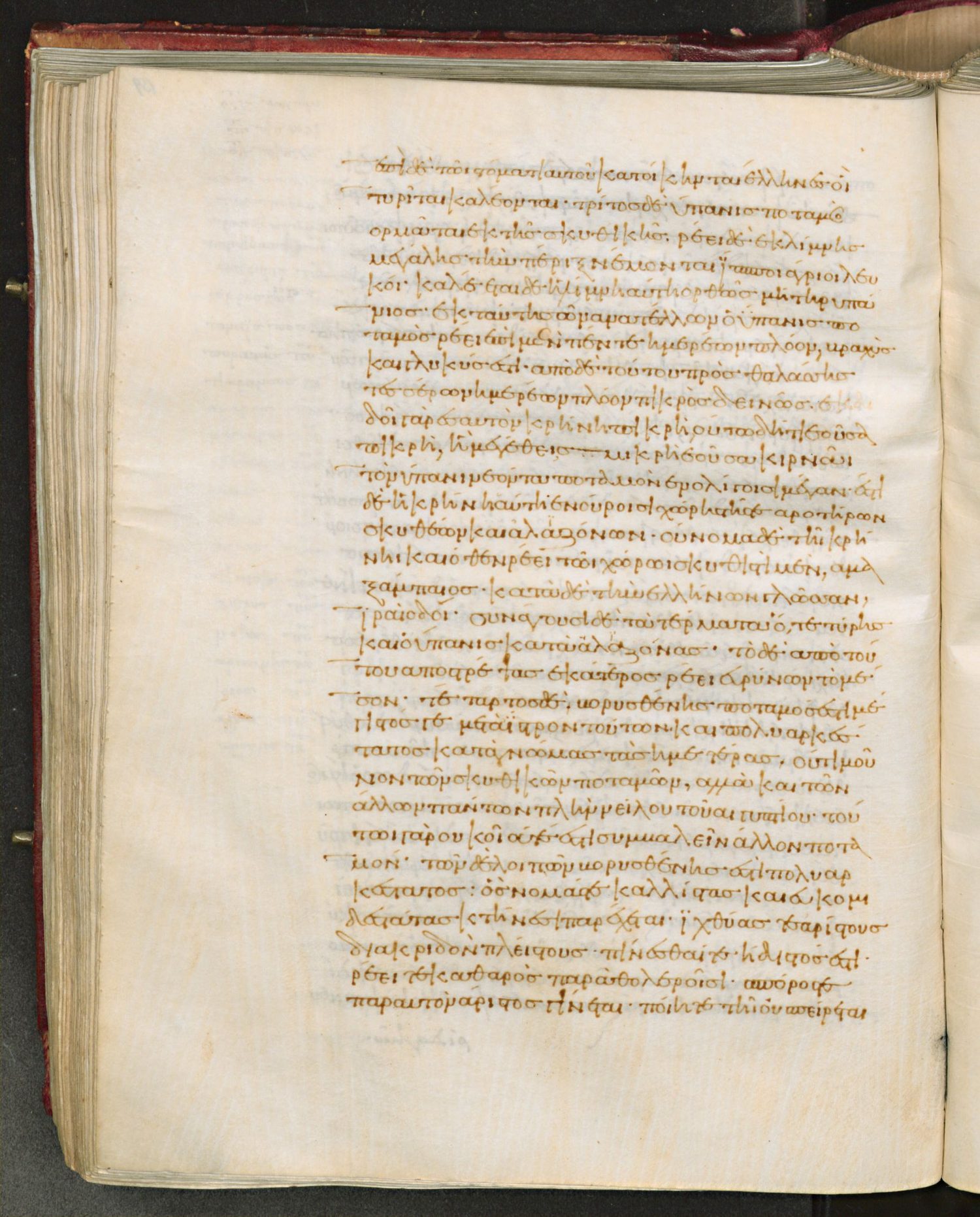
Laur. Plut. 70.3, fol. 159v: Greek here 4.51.1 to 4.53.2. Checked on the image (first and last words read and located in the Greek; each break checked against the neighbouring page): fol. 159v begins ‹ἐπὶ δὲ τῷ στόματι› (4.51.1), ends ‹τε, τῇ οὐ σπείρεται› (4.53.2). English here: 4.52.1 to 4.53.3 (Godley's sentences for the sections whose Greek lies mostly on this page).
4.51.1ἐπὶ δὲ τῷ στόματι αὐτοῦ κατοίκηνται Ἕλληνες οἳ Τυρῖται καλέονται. 4.52.1τρίτος δὲ Ὕπανις ποταμὸς ὁρμᾶται μὲν ἐκ τῆς Σκυθικῆς, ῥέει δὲ ἐκ λίμνης μεγάλης τὴν πέριξ νέμονται ἵπποι ἄγριοι λευκοί· καλέεται δὲ ἡ λίμνη αὕτη ὀρθῶς μήτηρ Ὑπάνιος. 4.52.2ἐκ ταύτης ὦν ἀνατέλλων ὁ Ὕπανις ποταμὸς ῥέει ἐπὶ μὲν πέντε ἡμερέων πλόον βραχὺς καὶ γλυκύς ἐστι, ἀπὸ δὲ τούτου πρὸς θαλάσσης τεσσέρων ἡμερέων πλόον πικρὸς δεινῶς· 4.52.3ἐκδιδοῖ γὰρ ἐς αὐτὸν κρήνη πικρή, οὕτω δή τι ἐοῦσα πικρή, ἣ μεγάθεϊ σμικρὴ ἐοῦσα κιρνᾷ τὸν Ὕπανιν ἐόντα ποταμὸν ἐν ὀλίγοισι μέγαν. ἔστι δὲ ἡ κρήνη αὕτη ἐν οὔροισι χώρης τῆς τε ἀροτήρων Σκυθέων καὶ Ἀλαζόνων· οὔνομα δὲ τῇ κρήνῃ καὶ ὅθεν ῥέει τῷ χώρῳ σκυθιστὶ μὲν Ἐξαμπαῖος, κατὰ δὲ τὴν Ἑλλήνων γλῶσσαν Ἱραὶ ὁδοί. 4.52.4συνάγουσι δὲ τὰ τέρματα ὅ τε Τύρης καὶ ὁ Ὕπανις κατὰ Ἀλαζόνας, τὸ δὲ ἀπὸ τούτου ἀποστρέψας ἑκάτερος ῥέει εὐρύνων τὸ μέσον. 4.53.1τέταρτος δὲ Βορυσθένης ποταμός, ὃς ἐστί τε μέγιστος μετὰ Ἴστρον τούτων καὶ πολυαρκέστατος κατὰ γνώμας τὰς ἡμετέρας οὔτι μοῦνον τῶν Σκυθικῶν ποταμῶν ἀλλὰ καὶ τῶν ἄλλων ἁπάντων, πλὴν Νείλου τοῦ Αἰγυπτίου· τούτῳ γὰρ οὐκ οἷά τε ἐστὶ συμβαλεῖν ἄλλον ποταμόν· 4.53.2τῶν δὲ λοιπῶν Βορυσθένης ἐστὶ πολυαρκέστατος, ὃς νομάς τε καλλίστας καὶ εὐκομιδεστάτας κτήνεσι παρέχεται ἰχθύας τε ἀρίστους διακριδὸν καὶ πλείστους, πίνεσθαι τε ἥδιστος ἐστί, ῥέει τε καθαρὸς παρὰ θολεροῖσι, σπόρος τε παρʼ αὐτὸν ἄριστος γίνεται, ποίη τε, τῇ οὐ σπείρεται
4.52.1The third river is the Hypanis; this comes from Scythia, flowing out of a great lake, round which wild white horses graze. This lake is truly called the mother of the Hypanis. 4.52.2Here, then, the Hypanis rises; for five days’ journey its waters are shallow and still sweet; after that for four days’ journey seaward it is wondrous bitter, 4.52.3for a spring issues into it which is so bitter that although its volume is small its admixture taints the Hypanis, one of the few great rivers of the world. This spring is on the borderland between the farming Scythians and the Alazones; the name of it and of the place whence it flows is in Scythian Exampaeus, in the Greek tongue Sacred Ways. 4.52.4The Tyras and the Hypanis draw their courses near together in the Alazones’ country; after that they flow divergent, making the intervening space wider. 4.53.1The fourth is the river Borysthenes. This is the next greatest of them after the Ister, and the most serviceable, according to our judgment, not only of the Scythian rivers but of all, except the Egyptian Nile, with which no other river can be compared. 4.53.2But of the rest the Borysthenes is the most serviceable; it provides for beasts the fairest pasture lands and best nurturing, and the fish in it are beyond all in their excellence and their abundance. Its water is most sweet to drink, flowing with a clear current, whereas the other rivers are turbid. There is excellent tilth on its banks, and very rich grass where the land is not sown; 4.53.3and self-formed crusts of salt abound at its mouth; it provides great spineless fish, called sturgeons, for the salting, and many other wondrous things besides.
Where on the image
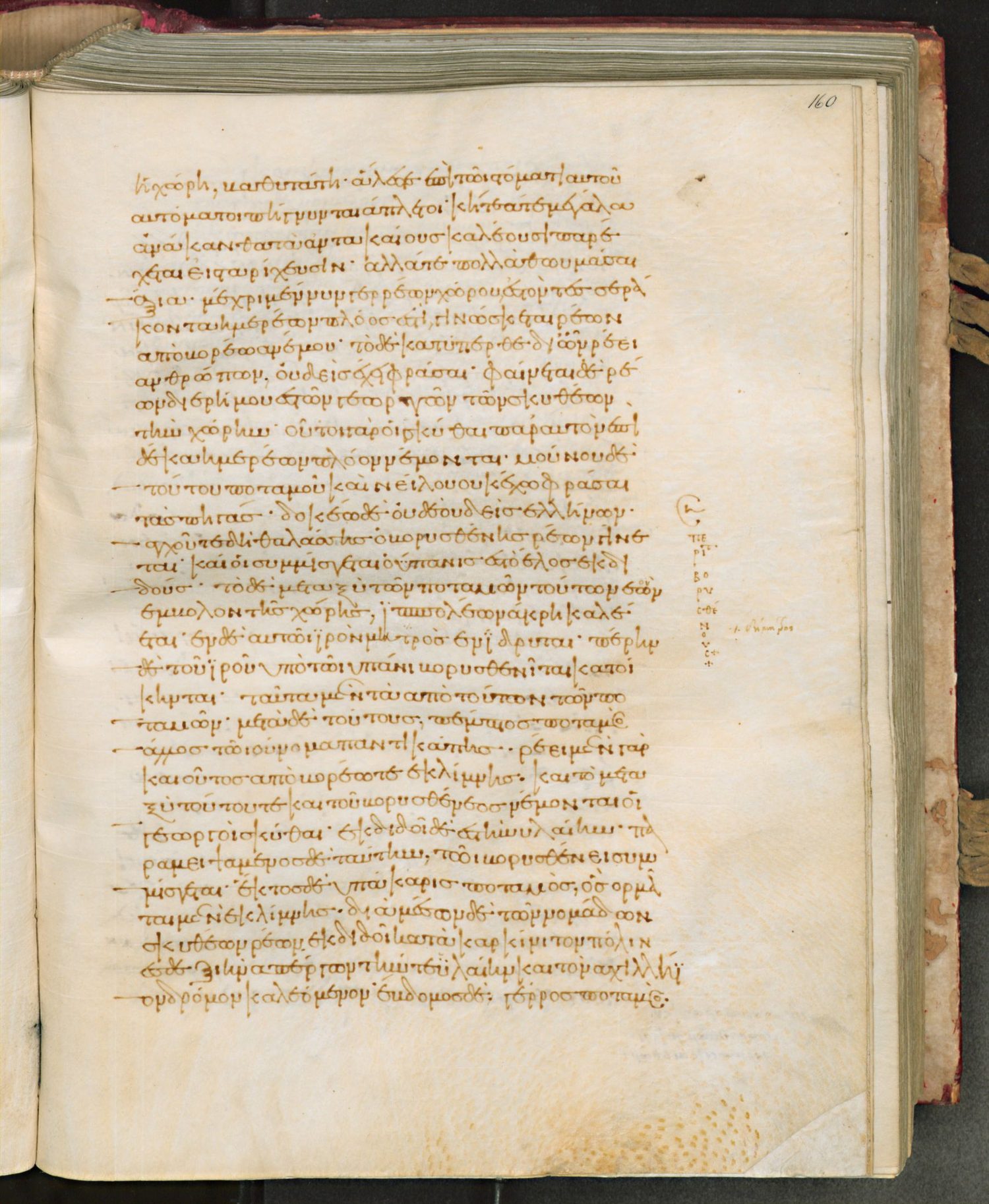
Laur. Plut. 70.3, fol. 160r: Greek here 4.53.2 to 4.56.1. Checked on the image (first and last words read and located in the Greek; each break checked against the neighbouring page): fol. 160r begins ‹ἡ χώρη, βαθυτάτη·ἅλες τε› (4.53.2), ends ‹καλεόμενον.ἕβδομος δὲ Γέρρος ποταμὸς› (4.56.1). English here: 4.53.4 to 4.55.1 (Godley's sentences for the sections whose Greek lies mostly on this page).
4.53.2ἡ χώρη, βαθυτάτη· 4.53.3ἅλες τε ἐπὶ τῷ στόματι αὐτοῦ αὐτόματοι πήγνυνται ἄπλετοι· κήτεά τε μεγάλα ἀνάκανθα, τὰ ἀντακαίους καλέουσι, παρέχεται ἐς ταρίχευσιν, ἄλλα τε πολλὰ θωμάσαι ἄξια. 4.53.4μέχρι μέν νυν Γερρέων χώρου, ἐς τὸν τεσσεράκοντα ἡμερέων πλόος ἐστί, γινώσκεται ῥέων ἀπὸ βορέω ἀνέμου· τὸ δὲ κατύπερθε διʼ ὧν ῥέει ἀνθρώπων οὐδεὶς ἔχει φράσαι· φαίνεται δὲ ῥέων διʼ ἐρήμου ἐς τῶν γεωργῶν Σκυθέων τὴν χώρην· οὗτοι γὰρ οἱ Σκύθαι παρʼ αὐτὸν ἐπὶ δέκα ἡμερέων πλόον νέμονται. 4.53.5μούνου δὲ τούτου τοῦ ποταμοῦ καὶ Νείλου οὐκ ἔχω φράσαι τὰς πηγάς, δοκέω δέ, οὐδὲ οὐδεὶς Ἑλλήνων. ἀγχοῦ τε δὴ θαλάσσης ὁ Βορυσθένης ῥέων γίνεται καὶ οἱ συμμίσγεται ὁ Ὕπανις ἐς τὠυτὸ ἕλος ἐκδιδούς. 4.53.6τὸ δὲ μεταξὺ τῶν ποταμῶν τούτων, ἐὸν ἔμβολον τῆς χώρης, Ἱππόλεω ἄκρη καλέεται, ἐν δὲ αὐτῷ, ἱρὸν Δήμητρος ἐνίδρυται· πέρην δὲ τοῦ ἱροῦ ἐπὶ τῷ Ὑπάνι Βορυσθενεῗται κατοίκηνται. 4.54.1ταῦτα μὲν τὰ ἀπὸ τούτων τῶν ποταμῶν, μετὰ δὲ τούτους πέμπτος ποταμὸς ἄλλος, τῷ οὔνομα Παντικάπης, ῥέει μὲν καὶ οὗτος ἀπὸ βορέω τε καὶ ἐκ λίμνης, καὶ τὸ μεταξὺ τούτου τε καὶ τοῦ Βορυσθένεος νέμονται οἱ γεωργοὶ Σκύθαι, ἐκδιδοῖ δὲ ἐς τὴν Ὑβλαίην, παραμειψάμενος δὲ ταύτην τῷ Βορυσθένεϊ συμμίσγεται. 4.55.1ἕκτος δὲ Ὑπάκυρις ποταμός, ὃς ὁρμᾶται μὲν ἐκ λίμνης, διὰ μέσων δὲ τῶν νομάδων Σκυθέων ῥέων ἐκδιδοῖ κατὰ Καρκινῖτιν πόλιν, ἐς δεξιὴν ἀπέργων τήν τε Ὑλαίην καὶ τὸν Ἀχιλλήιον δρόμον καλεόμενον. 4.56.1ἕβδομος δὲ Γέρρος ποταμὸς
4.53.4Its course is from the north, and there is knowledge of it as far as the Gerrhan land, that is, for forty days’ voyage; beyond that, no man can say through what nations it flows; but it is plain that it flows through desert country to the land of the farming Scythians, who dwell beside it for a ten days’ voyage. 4.53.5This is the only river, besides the Nile, whereof I cannot say what is the source; nor, I think, can any Greek. When the stream of the Borysthenes comes near the sea, the Hypanis mingles with it, issuing into the same marsh; 4.53.6the land between these rivers, where the land projects like a ship’s beak, is called Hippolaus’ promontory; a temple of Demeter stands there. The settlement of the Borystheneitae is beyond the temple, on the Hypanis. 4.54.1This is the knowledge that comes to us from these rivers. After these there is a fifth river called Panticapas; this also flows from the north out of a lake, and the land between it and the Borysthenes is inhabited by the farming Scythians; it issues into the Woodland country; which having passed it mingles with the Borysthenes. 4.55.1The sixth is the river Hypacuris, which rises from a lake, and flowing through the midst of the nomad Scythians issues out near the city of Carcine, bordering on its right the Woodland and the region called the Racecourse of Achilles.
Where on the image
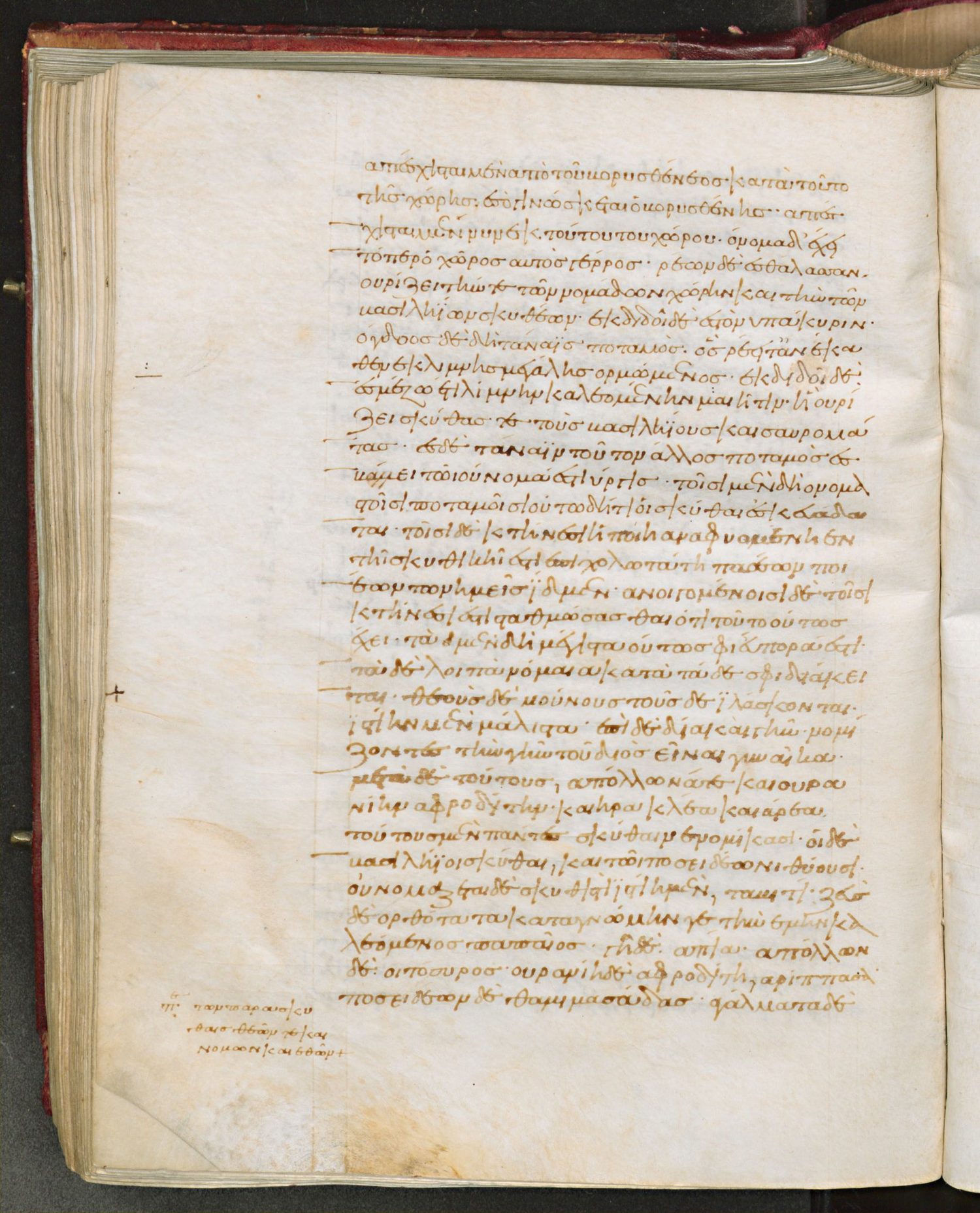
Laur. Plut. 70.3, fol. 160v: Greek here 4.56.1 to 4.58.1. Checked on the image (first and last words read and located in the Greek; each break checked against the neighbouring page): fol. 160v begins ‹ἀπέσχισται μὲν ἀπὸ τοῦ› (4.56.1), ends ‹δὲ Θαγιμασάδας. ἀγάλματα δὲ› (4.59.2). English here: 4.56.1 to 4.58.1 (Godley's sentences for the sections whose Greek lies mostly on this page).
4.56.1ἀπέσχισται μὲν ἀπὸ τοῦ Βορυσθένεος κατὰ τοῦτο τῆς χώρης ἐς ὃ γινώσκεται ὁ Βορυσθένης· ἀπέσχισται μέν νυν ἐκ τούτου τοῦ χώρου, οὔνομα δὲ ἔχει τό περ ὁ χῶρος αὐτός, Γέρρος, ῥέων δὲ ἐς θάλασσαν οὐρίζει τήν τε τῶν νομάδων χώρην καὶ τὴν τῶν βασιληίων Σκυθέων, ἐκδιδοῖ δὲ ἐς τὸν Ὑπάκυριν. 4.57.1ὄγδοος δὲ δὴ Τάναϊς ποταμός, ὃς ῥέει τἀνέκαθεν ἐκ λίμνης μεγάλης ὁρμώμενος, ἐκδιδοῖ δὲ ἐς μέζω ἔτι λίμνην καλεόμενον Μαιῆτιν, ἣ οὐρίζει Σκύθας τε τοὺς βασιληίους καὶ Σαυρομάτας. ἐς δὲ Τάναϊν τοῦτον ἄλλος ποταμὸς ἐσβάλλει τῷ οὔνομα ἐστὶ Ὕργις. 4.58.1τοῖσι μὲν δὴ ὀνομαστοῖσι ποταμοῖσι οὕτω δή τι οἱ Σκύθαι ἐσκευάδαται, τοῖσι δὲ κτήνεσι ἡ ποίη ἀναφυομένη ἐν τῇ Σκυθικῆ ἐστι ἐπιχολωτάτη πασέων ποιέων τῶν ἡμεῖς ἴδμεν· ἀνοιγομένοισι δὲ τοῖσι κτήνεσι ἐστὶ σταθμώσασθαι ὅτι τοῦτο οὕτω ἔχει.
4.56.1The seventh river, the Gerrhus, parts from the Borysthenes at about the place which is the end of our knowledge of that river; at this place it parts, and has the same name as the place itself, Gerrhus; then in its course to the sea it divides the country of the Nomads and the country of the Royal Scythians, and issues into the Hypacuris. 4.57.1The eighth is the river Tanaïs; this in its upper course begins by flowing out of a great lake, and enters a yet greater lake called the Maeetian, which divides the Royal Scythians from the Sauromatae; another river, called Hyrgis, is a tributary of this Tanaïs. 4.58.1These are the rivers of name with which the Scythians are provided. For the rearing of cattle the grass growing in Scythia is the most bile-making of all pastures known to us; it can be judged by the opening of the bodies of the cattle that this is so.
Notes
- Greek: the text printed in A. D. Godley's Loeb edition, via Perseus (tlg0016.tlg001.perseus-grc2). Square brackets mark words the editor considers later additions; [...] marks a gap the editor indicates. Perseus note markers are omitted.
- English: A. D. Godley, Herodotus vol. 2 (1921) (Loeb Classical Library), as transcribed on Wikisource. Godley's footnotes are omitted.
- Section numbers in the English were placed by comparing Godley's text with the Perseus version of his translation; where a section begins inside one of Godley's sentences, the English is kept with the page that holds the start of that sentence.
Cite
Sources
- Source: Florence, Laur. Plut. 70.3 (10th c.) via BML Teca Digitale + Greek of Godley's Loeb (Perseus) + English of A. D. Godley (Loeb, Wikisource) (holding institution)
- Critical edition: Greek of A. D. Godley's Loeb edition (1920-1925), via Perseus
← previous · → next · v cycle view · l back to library