Herodotus, Histories 4.59-75: Scythian gods, war customs and burials
Introduction
Herodotus of Halicarnassus wrote the Histories in the third quarter of the 5th century BCE, an inquiry into the deeds of Greeks and barbarians and the causes of the wars between them, later divided into nine books. Book 4 tells of Darius' expedition against the Scythians, with Herodotus' account of Scythia, its peoples, rivers and customs, and of the shape of the world, and of the Persian expedition against Barca, with the history of Cyrene and a description of the peoples of Libya.
The photographs are of Florence, Biblioteca Medicea Laurenziana, Plut. 70.3 (parchment, 10th century, 374 folios, 31 lines a page), Herodotus, Histories (codex A of the editors), the oldest surviving manuscript of the complete Histories, from the Teca Digitale of the Biblioteca Medicea Laurenziana. Each section below is the text of one page, or of the part of a page that falls within these chapters. The first and last words of every page were read on the photograph and located in the Greek, and every page break was checked against the next page; the notes quote these words. Readers' notes in the margins are not part of the text and are mentioned where they occur.
The Greek is the text printed in A. D. Godley's Loeb edition (1920-1925), from Perseus; it is the edited text, not a transcription of the manuscript, whose wording differs in places. The English is Godley's translation as printed, from Wikisource. Godley's English carries only chapter numbers; the section numbers shown in it were placed by comparison with the Perseus version of his translation. Each page's English is cut at the end of one of Godley's sentences, so it can begin or end a few lines away from the Greek of the page; each note gives the exact ranges.
This entry covers chapters 4.59-75, on fol. 160v to 165r.
How was this verified? (Provenance)
Where on the image
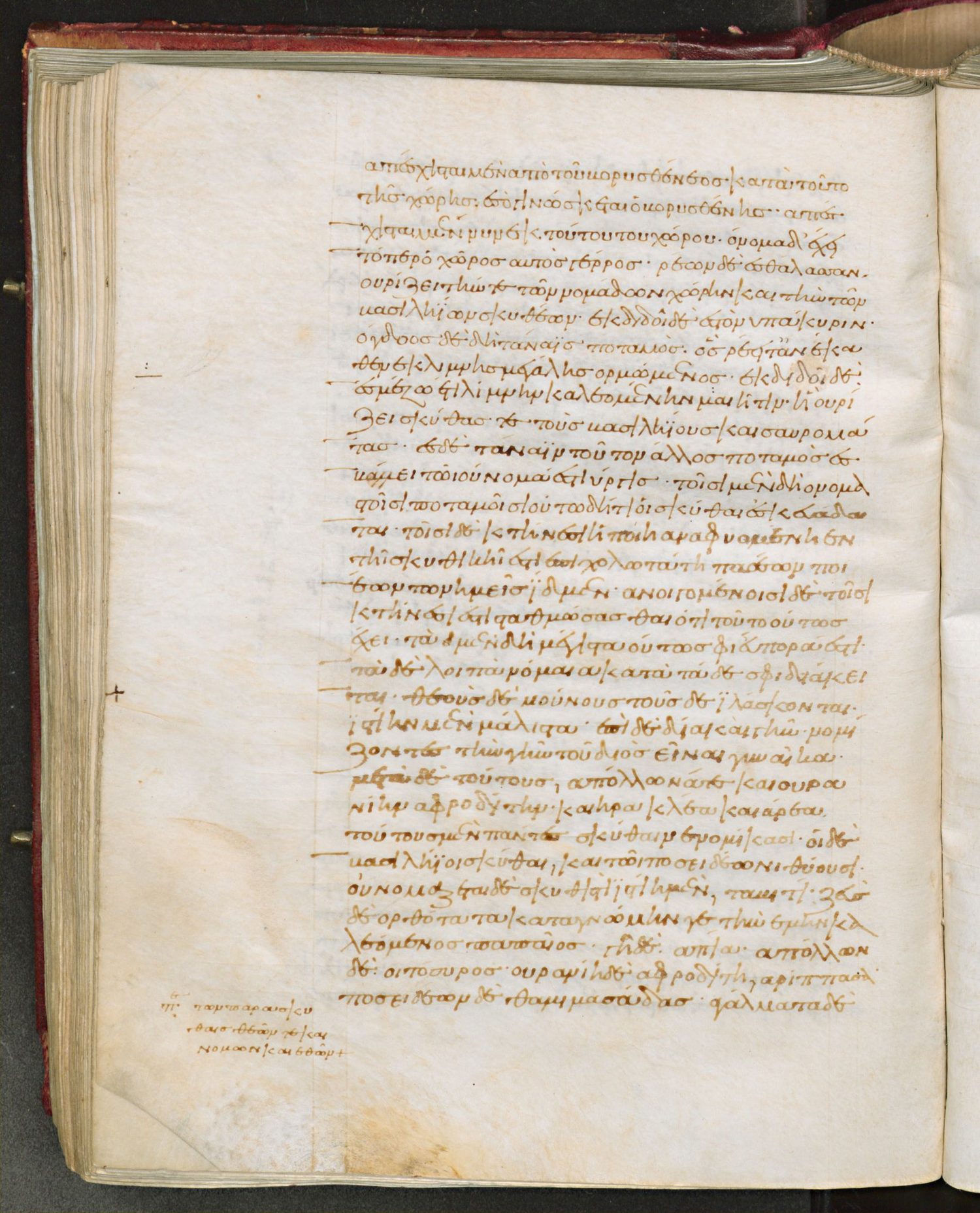
Laur. Plut. 70.3, fol. 160v: Greek here 4.59.1 to 4.59.2. Checked on the image (first and last words read and located in the Greek; each break checked against the neighbouring page): fol. 160v begins ‹ἀπέσχισται μὲν ἀπὸ τοῦ› (4.56.1), ends ‹δὲ Θαγιμασάδας. ἀγάλματα δὲ› (4.59.2). English here: 4.59.1 to 4.59.2 (Godley's sentences for the sections whose Greek lies mostly on this page).
4.59.1τὰ μὲν δὴ μέγιστα οὕτω σφι εὔπορα ἐστί, τὰ δὲ λοιπὰ νόμαια κατὰ τάδε σφι διακέεται. θεοὺς μὲν μούνους τούσδε ἱλάσκονται, Ἱστίην μὲν μάλιστα, ἐπὶ δὲ Δία καὶ Γῆν, νομίζοντες τὴν Γῆν τοῦ Διὸς εἶναι γυναῖκα, μετὰ δὲ τούτους, Ἀπόλλωνά τε καὶ οὐρανίην Ἀφροδίτην καὶ Ἡρακλέα καὶ Ἄρεα. τούτους μὲν πάντες Σκύθαι νενομίκασι, οἱ δὲ καλεόμενοι βασιλήιοι Σκύθαι καὶ τῷ Ποσειδέωνι θύουσι. 4.59.2ὀνομάζεται δὲ σκυθιστὶ Ἱστίη μὲν Ταβιτί, Ζεὺς δὲ ὀρθότατα κατὰ γνώμην γε τὴν ἐμὴν καλεόμενος Παπαῖος, Γῆ δὲ Ἀπί. Ἀπόλλων δὲ Γοιτόσυρος, οὐρανίη δὲ Ἀφροδίτη Ἀργίμπασα, Ποσειδέων δὲ Θαγιμασάδας. ἀγάλματα δὲ
4.59.1The Scythians then have what most concerns them ready to hand. It remains now to show the customs which are established among them. The only gods whom they propitiate by worship are these: Hestia in especial, and secondly Zeus and Earth, whom they deem to be the wife of Zeus; after these, Apollo, and the Heavenly Aphrodite, and Heracles, and Ares. All the Scythians worship these as gods; the Scythians called Royal sacrifice also to Poseidon. 4.59.2In the Scythian tongue Hestia is called Tahiti: Zeus (in my judgment most rightly so called) Papaeus; Earth is Api, Apollo Goetosyrus, the Heavenly Aphrodite Argimpasa, and Poseidon Thagimasadas. It is their practice to make images and altars and shrines for Ares, but for no other god.
Where on the image
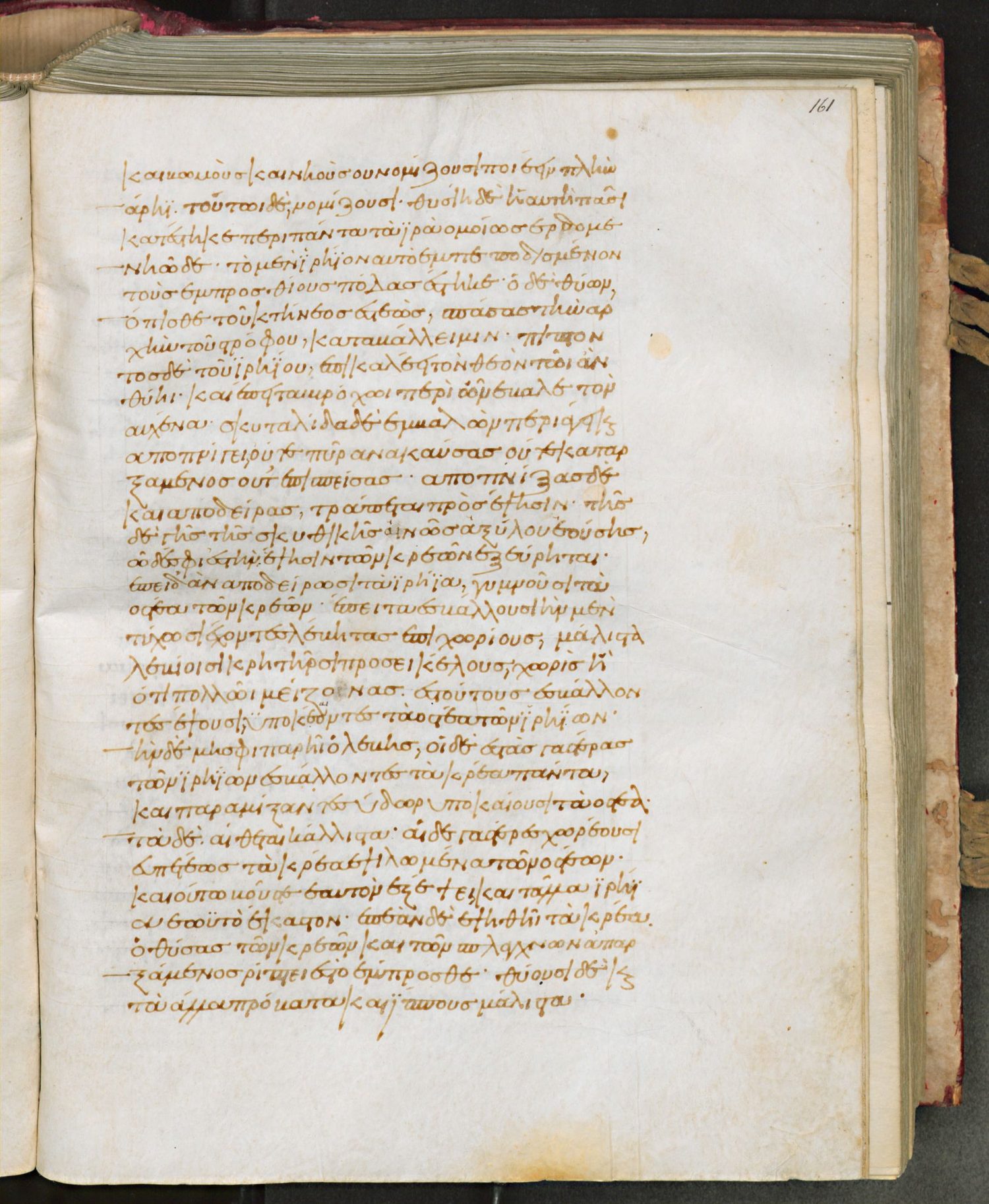
Laur. Plut. 70.3, fol. 161r: Greek here 4.59.2 to 4.61.2. Checked on the image (first and last words read and located in the Greek; each break checked against the neighbouring page): fol. 161r begins ‹καὶ βωμοὺς καὶ νηοὺς› (4.59.2), ends ‹πρόβατα καὶ ἵππους μάλιστα› (4.61.2). English here: 4.60.1 to 4.61.2 (Godley's sentences for the sections whose Greek lies mostly on this page).
4.59.2καὶ βωμοὺς καὶ νηοὺς οὐ νομίζουσι ποιέειν πλὴν Ἄρεϊ. τούτῳ δὲ νομίζουσι. 4.60.1θυσίη δὲ ἡ αὐτὴ πᾶσι κατέστηκε περὶ πάντα τὰ ἱρὰ ὁμοίως, ἐρδομένη ὧδε· τὸ μὲν ἱρήιον αὐτὸ ἐμπεποδισμένον τοὺς ἐμπροσθίους πόδας ἔστηκε, ὁ δὲ θύων ὄπισθε τοῦ κτήνεος ἑστεὼς σπάσας τὴν ἀρχὴν τοῦ στρόφου καταβάλλει μιν, 4.60.2πίπτοντος δὲ τοῦ ἱρηίου ἐπικαλέει τὸν θεὸν τῷ ἂν θύῃ, καὶ ἔπειτα βρόχῳ περὶ ὦν ἔβαλε τὸν αὐχένα, σκυταλίδα δὲ ἐμβαλὼν περιάγει καὶ ἀποπνίγει, οὔτε πῦρ ἀνακαύσας οὔτε καταρξάμενος οὔτʼ ἐπισπείσας· ἀποπνίξας δὲ καὶ ἀποδείρας τρέπεται πρὸς ἕψησιν. 4.61.1τῆς δὲ γῆς τῆς Σκυθικῆς αἰνῶς ἀξύλου ἐούσης ὧδε σφι ἐς τὴν ἕψησιν τῶν κρεῶν ἐξεύρηται· ἐπειδὰν ἀποδείρωσι τὰ ἱρήια, γυμνοῦσι τὰ ὀστέα τῶν κρεῶν, ἔπειτα ἐσβάλλουσι, ἢν μὲν τύχωσι ἔχοντες, ἐς λέβητας ἐπιχωρίους, μάλιστα Λεσβίοισι κρητῆρσι προσεικέλους, χωρὶς ἢ ὅτι πολλῷ μέζονας· ἐς τούτους ἐσβάλλοντες ἕψουσι ὑποκαίοντες τὰ ὀστέα τῶν ἱρηίων. ἢν δὲ μή σφι παρῇ ὁ λέβης, οἳ δὲ ἐς τὰς γαστέρας τῶν ἱρηίων ἐσβάλλοντες τὰ κρέα πάντα καὶ παραμίξαντες ὕδωρ ὑποκαίουσι τὰ ὀστέα· 4.61.2τὰ δὲ αἴθεται κάλλιστα, αἱ δὲ γαστέρες χωρέουσι εὐπετέως τὰ κρέα ἐψιλωμένα τῶν ὀστέων· καὶ οὕτω βοῦς τε ἑωυτὸν ἐξέψει καὶ τἆλλα ἱρήια ἑωυτὸ ἕκαστον. ἐπεὰν δὲ ἑψηθῇ τὰ κρέα, ὁ θύσας τῶν κρεῶν καὶ τῶν σπλάγχνων ἀπαρξάμενος ῥίπτει ἐς τὸ ἔμπροσθε. θύουσι δὲ καὶ τὰ ἄλλα πρόβατα καὶ ἵππους μάλιστα.
4.60.1In all their sacred services alike they follow the same method of sacrifice; this is how it is offered. The victim itself stands with its forefeet shackled together; the sacrificer stands behind the beast, and throws it down by plucking the end of the rope; 4.60.2as the victim falls, he invokes whatever god it is to whom he sacrifices. Then, throwing a noose round the beast’s neck, he thrusts in a stick and twists it and so strangles the victim, lighting no fire nor offering the firstfruits, nor pouring any libation; and having strangled and flayed the beast, he sets about cooking it. 4.61.1Now the Scythian land is wondrous bare of wood: so this is their device for cooking the flesh. When they have flayed the victims, they strip the flesh from the bones and throw it into the cauldrons of the country, if they have such: these are most like to Lesbian bowls, save that they are much bigger; into these then they throw the flesh, and cook it by lighting a fire beneath with the bones of the victims. But if they have no cauldron, then they cast all the flesh into the victim’s stomachs, adding water thereto, and make a fire beneath of the bones, 4.61.2which burn finely; the stomachs easily hold the flesh when it is stripped from the bones; thus an ox serves to cook itself, and every other victim does likewise. When the flesh is cooked, the sacrificer takes the firstfruits of the flesh and the entrails and casts it before him. They use all beasts of the flock for sacrifice, but chiefly horses.
Where on the image
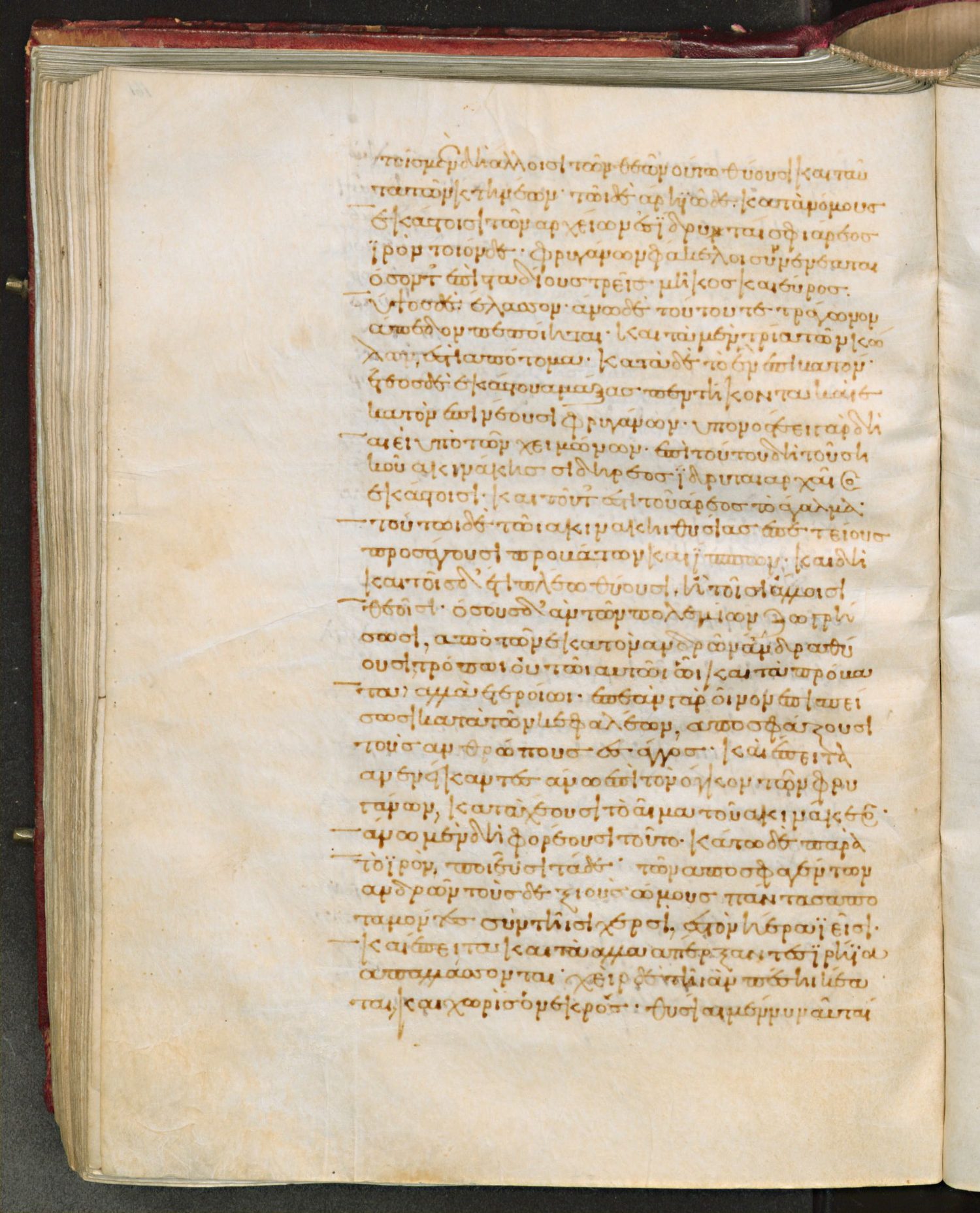
Laur. Plut. 70.3, fol. 161v: Greek here 4.62.1 to 4.63.1. Checked on the image (first and last words read and located in the Greek; each break checked against the neighbouring page): fol. 161v begins ‹τοῖσι μὲν δὴ ἄλλοισι› (4.62.1), ends ‹νεκρός.θυσίαι μέν νυν αὗταί› (4.63.1). English here: 4.62.1 to 4.62.4 (Godley's sentences for the sections whose Greek lies mostly on this page).
4.62.1τοῖσι μὲν δὴ ἄλλοισι τῶν θεῶν οὕτω θύουσι καὶ ταῦτα τῶν κτηνέων, τῷ δὲ Ἄρεϊ ὧδε. κατὰ νομοὺς ἑκάστους τῶν ἀρχέων ἐσίδρυται σφι Ἄρεος ἱρὸν· τοιόνδε φρυγάνων φάκελοι συννενέαται ὅσον τʼ ἐπὶ σταδίους τρεῖς μῆκος καὶ εὖρος, ὕψος δὲ ἔλασσον· ἄνω δὲ τούτου τετράγωνον ἄπεδον πεποίηται, καὶ τὰ μὲν τρία τῶν κώλων ἐστὶ ἀπότομα, κατὰ δὲ τὸ ἓν ἐπιβατόν. 4.62.2ἔτεος δὲ ἑκάστου ἁμάξας πεντήκοντα καὶ ἑκατὸν ἐπινέουσι φρυγάνων· ὑπονοστέει γὰρ δὴ αἰεὶ ὑπὸ τῶν χειμώνων. ἐπὶ τούτου δὴ τοῦ σηκοῦ ἀκινάκης σιδήρεος ἵδρυται ἀρχαῖος ἑκάστοισι, καὶ τοῦτʼ ἐστὶ τοῦ Ἄρεος τὸ ἄγαλμα. τούτῳ δὲ τῷ ἀκινάκῃ θυσίας ἐπετείους προσάγουσι προβάτων καὶ ἵππων, καὶ δὴ καὶ τοῖσιδʼ ἔτι πλέω θύουσι ἢ τοῖσι ἄλλοισι θεοῖσι· 4.62.3ὅσους ἂν τῶν πολεμίων ζωγρήσωσι, ἀπὸ τῶν ἑκατὸν ἀνδρῶν ἄνδρα θύουσι τρόπῳ οὐ τῷ αὐτῷ καὶ τὰ πρόβατα, ἀλλʼ ἑτεροίῳ. ἐπεὰν γὰρ οἶνον ἐπισπείσωσι κατὰ τῶν κεφαλέων, ἀποσφάζουσι τοὺς ἀνθρώπους ἐς ἄγγος καὶ ἔπειτα ἀνενείκαντες ἄνω ἐπὶ τὸν ὄγκον τῶν φρυγάνων καταχέουσι τὸ αἷμα τοῦ ἀκινάκεω. 4.62.4ἄνω μὲν δὴ φορέουσι τοῦτο, κάτω δὲ παρὰ τὸ ἱρὸν ποιεῦσι τάδε· τῶν ἀποσφαγέντων ἀνδρῶν τοὺς δεξιοὺς ὤμους πάντας ἀποταμόντες σὺν τῇσι χερσὶ ἐς τὸν ἠέρα ἱεῖσι, καὶ ἔπειτα καὶ τὰ ἄλλα ἀπέρξαντες ἱρήια ἀπαλλάσσονται. χεὶρ δὲ τῇ ἂν πέσῃ κέεται, καὶ χωρὶς ὁ νεκρός. 4.63.1θυσίαι μέν νυν αὗταί
4.62.1Such is their way of sacrificing to all other gods and such are the beasts offered; but their sacrifices to Ares are on this wise. Every district in each of the governments has in it a structure sacred to Ares, to wit, a pile of fagots of sticks three furlongs broad and long, but of a less height, on the top of which there is a flattened four-sided surface; three of its sides are sheer, but the fourth can be ascended. 4.62.2In every year an hundred and fifty waggon-loads of sticks are heaped upon this; for the storms of winter ever make it sink down. On this sacred pile there is set for each people an ancient scimitar of iron, which is their image of Ares; to this scimitar they bring yearly sacrifice of sheep and goats and horses, offering to these symbols even more than they do to the other gods. 4.62.3Of all their enemies that they take alive, they sacrifice one man in every hundred, not according to their fashion of sacrificing sheep and goats, but differently. They pour wine on the men’s heads and cut their throats over a vessel; then they carry the blood up on to the pile of sticks and pour it on the scimitar. 4.62.4So they carry the blood aloft, but below by the sacred pile they cut off all the slain men’s right arms and hands and throw these into the air, and presently depart when they have sacrificed the rest of the victims; the arm lies where it has fallen, and the body apart from it.
Where on the image
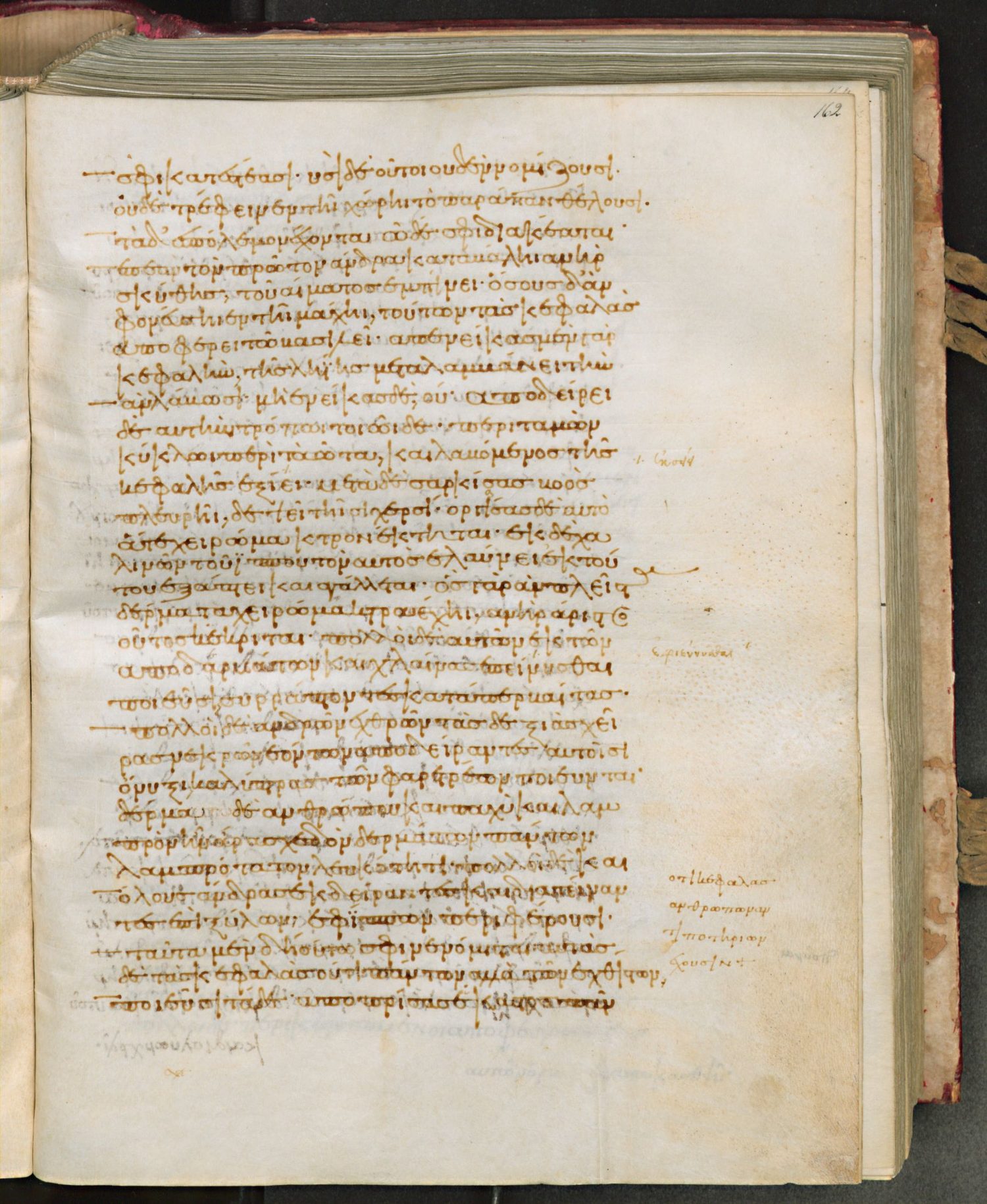
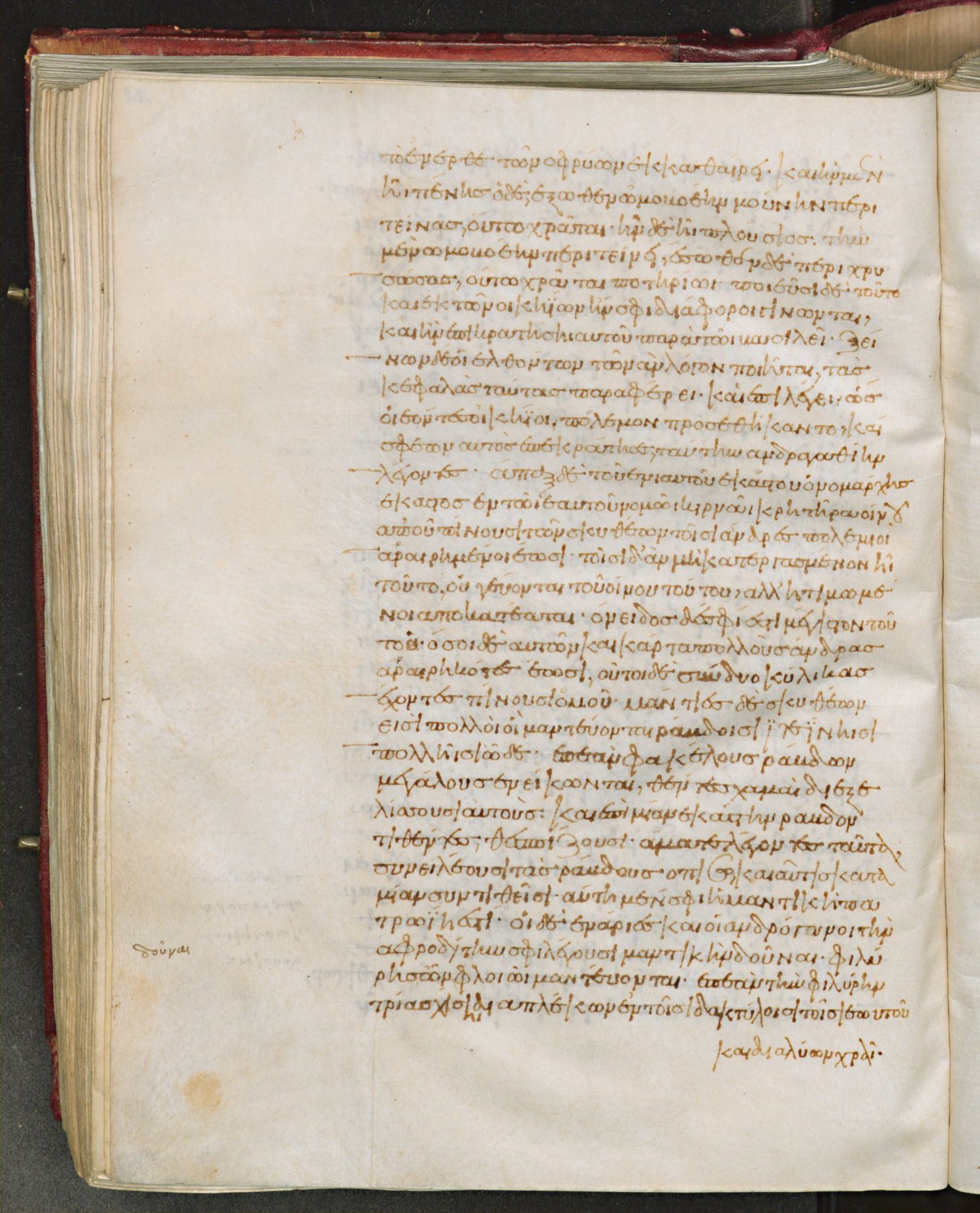
Laur. Plut. 70.3, fol. 162r: Greek here 4.63.1 to 4.65.1. Checked on the image (first and last words read and located in the Greek; each break checked against the neighbouring page): fol. 162r begins ‹σφι κατεστᾶσι. ὑσὶ δὲ› (4.63.1), ends ‹τάδε· ἀποπρίσας ἕκαστος πᾶν› (4.65.1). English here: 4.63.1 to 4.64.4 (Godley's sentences for the sections whose Greek lies mostly on this page).
4.63.1σφι κατεστᾶσι. ὑσὶ δὲ οὗτοι οὐδὲν νομίζουσι, οὐδὲ τρέφειν ἐν τῇ χώρῃ τὸ παράπαν θέλουσι. 4.64.1τὰ δʼ ἐς πόλεμον ἔχοντα ὧδέ σφι διακέαται· ἐπεὰν τὸν πρῶτον ἄνδρα καταβάλῃ ἀνὴρ Σκύθης, τοῦ αἵματος ἐμπίνει, ὅσους δʼ ἂν φονεύσῃ ἐν τῇ μάχῃ, τούτων τὰς κεφαλὰς ἀποφέρει τῷ βασιλέι. ἀπενείκας μὲν γὰρ κεφαλὴν τῆς ληίης μεταλαμβάνει τὴν ἂν λάβωσι, μὴ ἐνείκας δὲ οὔ. 4.64.2ἀποδείρει δὲ αὐτὴν τρόπῳ τοιῷδε· περιταμὼν κύκλῳ περὶ τὰ ὦτα καὶ λαβόμενος τῆς κεφαλῆς ἐκσείει, μετὰ δὲ σαρκίσας βοὸς πλευρῇ δέψει τῇσι χερσί, ὀργάσας δὲ αὐτὸ ἅτε χειρόμακτρον ἔκτηται, ἐκ δὲ τῶν χαλινῶν τοῦ ἵππου τὸν αὐτὸς ἐλαύνει, ἐκ τούτου ἐξάπτει καὶ ἀγάλλεται· ὃς γὰρ ἂν πλεῖστα δέρματα χειρόμακτρα ἔχῃ, ἀνὴρ ἄριστος οὗτος κέκριται. 4.64.3πολλοὶ δὲ αὐτῶν ἐκ τῶν ἀποδερμάτων καὶ χλαίνας ἐπείνυσθαι ποιεῦσι, συρράπτοντες κατά περ βαίτας. πολλοὶ δὲ ἀνδρῶν ἐχθρῶν τὰς δεξιὰς χεῖρας νεκρῶν ἐόντων ἀποδείραντες αὐτοῖσι ὄνυξι καλύπτρας τῶν φαρετρέων ποιεῦνται. δέρμα δὲ ἀνθρώπου καὶ παχὺ καὶ λαμπρὸν ἦν ἄρα, σχεδὸν δερμάτων πάντων λαμπρότατον λευκότητι. 4.64.4πολλοὶ δὲ καὶ ὅλους ἄνδρας ἐκδείραντες καὶ διατείναντες ἐπὶ ξύλων ἐπʼ ἵππων περιφέρουσι. 4.65.1ταῦτα μὲν δὴ οὕτω σφι νενόμισται, αὐτὰς δὲ τὰς κεφαλάς, οὔτι πάντων ἀλλὰ τῶν ἐχθίστων, ποιεῦσι τάδε· ἀποπρίσας ἕκαστος πᾶν
4.63.1These then are their established fashions of sacrifice; but of swine these Scythians make no offerings; nor are they willing for the most part to rear them in their country. 4.64.1As to war, these are their customs. A Scythian drinks of the blood of the first man whom he has overthrown. He carries to his king the heads of all whom he has slain in the battle; for he receives a share of the booty taken if he bring a head, but not otherwise. 4.64.2He scalps the head by making a cut round it by the ears, then grasping the scalp and shaking the head off. Then he scrapes out the flesh with the rib of an ox, and kneads the skin with his hands, and having made it supple he keeps it for a napkin, fastening it to the bridle of the horse which he himself rides, and taking pride in it; for he is judged the best man who has most scalps for napkins. 4.64.3Many Scythians even make garments for wear out of these scalps, sewing them together like coats of skin. Many too take off the skin, nails and all, from their dead enemies’ right hands, and make thereof coverings for their quivers; it would seem that the human skin is thick and shining, of all skins, one may say, the brightest and whitest. 4.64.4There are many too that flay the skin from the whole body and carry it about on horseback stretched on a wooden frame.
Where on the image
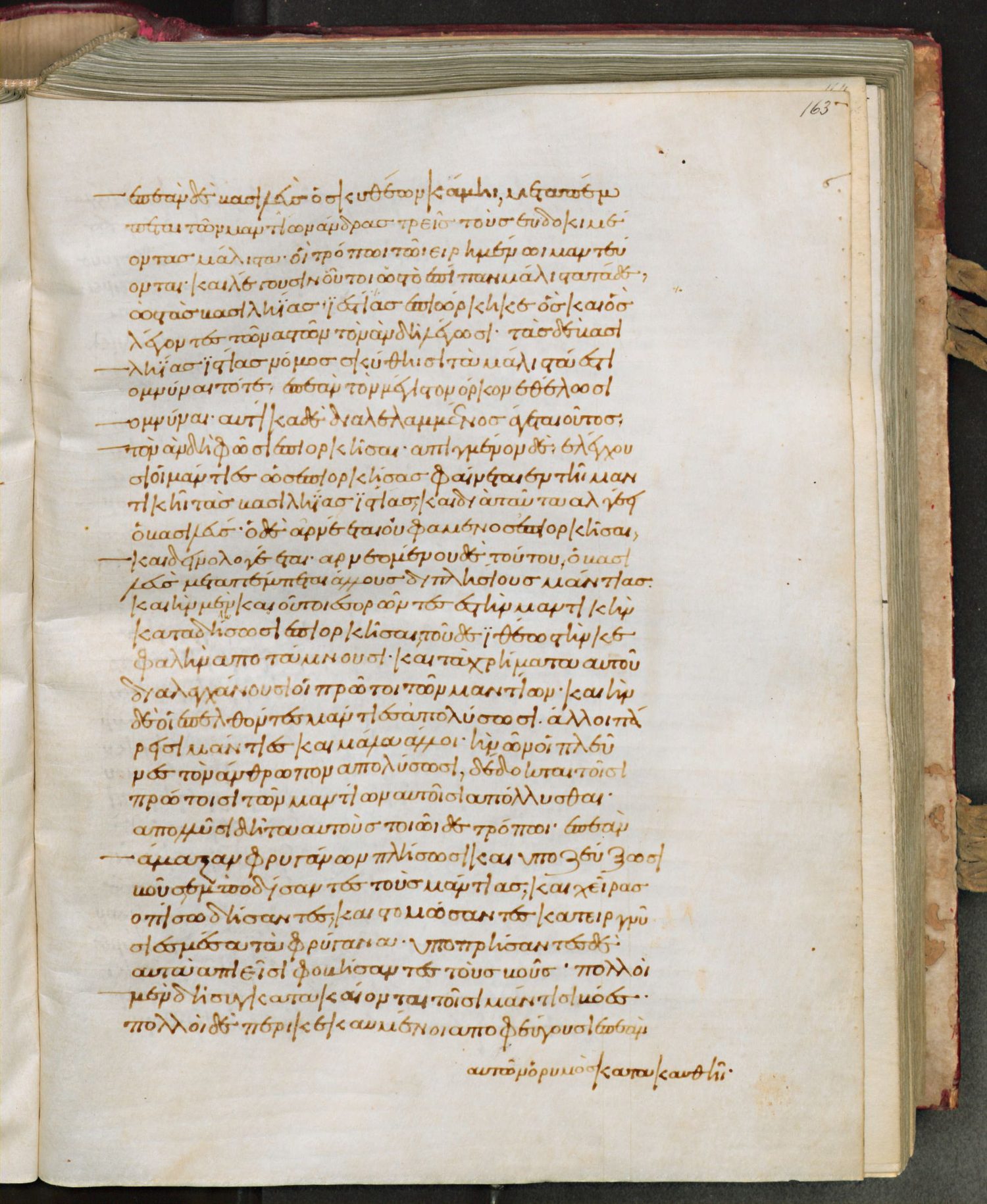
Laur. Plut. 70.3, fol. 162v: Greek here 4.65.1 to 4.67.2. Checked on the image (first and last words read and located in the Greek; each break checked against the neighbouring page): fol. 162v begins ‹τὸ ἔνερθε τῶν ὀφρύων› (4.65.1), ends ‹τοῖσι δακτύλοισι τοῖσι ἑωυτοῦ› (4.67.2). Fol. 162v ends τοῖσι δακτύλοισι τοῖσι ἑωυτοῦ and fol. 163r begins ἐπεὰν δὲ βασιλεύς: the edition's καὶ διαλύων χρᾷ (4.67.2) is not at the page break. English here: 4.65.1 to 4.67.2 (Godley's sentences for the sections whose Greek lies mostly on this page).
4.65.1τὸ ἔνερθε τῶν ὀφρύων ἐκκαθαίρει· καὶ ἢν μὲν ᾖ πένης, ὁ δὲ ἔξωθεν ὠμοβοέην μούνην περιτείνας οὕτω χρᾶται, ἢν δὲ ᾖ πλούσιος, τὴν μὲν ὠμοβοέην περιτείνει, ἔσωθεν δὲ καταχρυσώσας οὕτω χρᾶται ποτηρίῳ. 4.65.2ποιεῦσι δὲ τοῦτο καὶ ἐκ τῶν οἰκηίων ἤν σφι διάφοροι γένωνται καὶ ἢν ἐπικρατήσῃ αὐτοῦ παρὰ τῷ βασιλέι, ξείνων δέ οἱ ἐλθόντων τῶν ἂν λόγον ποιέηται, τὰς κεφαλὰς ταύτας παραφέρει καὶ ἐπιλέγει ὡς οἱ ἐόντες οἰκήιοι πόλεμον προσεθήκαντο καί σφεων αὐτὸς ἐπεκράτησε, ταύτην ἀνδραγαθίην λέγοντες. 4.66.1ἅπαξ δὲ τοῦ ἐνιαυτοῦ ἑκάστου ὁ νομάρχης ἕκαστος ἐν τῷ ἑωυτοῦ νομῷ κιρνᾷ κρητῆρα οἴνου, ἀπʼ οὗ πίνουσι τῶν Σκυθέων τοῖσι ἂν ἄνδρες πολέμιοι ἀραιρημένοι ἔωσι. τοῖσι δʼ ἂν μὴ κατεργασμένον ᾖ τοῦτο, οὐ γεύονται τοῦ οἴνου τούτου, ἀλλʼ ἠτιμωμένοι ἀποκατέαται· ὄνειδος δέ σφι ἐστὶ μέγιστον τοῦτο. ὅσοι δὲ ἂν αὐτῶν καὶ κάρτα πολλοὺς ἄνδρας ἀραιρηκότες ἔωσι, οὗτοι δὲ σύνδυο κύλικας ἔχοντες πίνουσι ὁμοῦ. 4.67.1μάντιες δὲ Σκυθέων εἰσὶ πολλοί, οἳ μαντεύονται ῥάβδοισι ἰτεΐνῃσι πολλῇσι ὧδε· ἐπεὰν φακέλους ῥάβδων μεγάλους ἐνείκωνται, θέντες χαμαὶ διεξειλίσσουσι αὐτούς, καὶ ἐπὶ μίαν ἑκάστην ῥάβδον τιθέντες θεσπίζουσι, ἅμα τε λέγοντες ταῦτα συνειλέουσι τὰς ῥάβδους ὀπίσω καὶ αὖτις κατὰ μίαν συντιθεῖσι. 4.67.2αὕτη μὲν σφι ἡ μαντικὴ πατρωίη ἐστί. οἱ δὲ Ἐνάρεες οἱ ἀνδρόγυνοι τὴν Ἀφροδίτην σφίσι λέγουσι μαντικὴν δοῦναι· φιλύρης δʼ ὦν φλοιῷ μαντεύονται· ἐπεὰν τὴν φιλύρην τρίχα σχίσῃ, διαπλέκων ἐν τοῖσι δακτύλοισι τοῖσι ἑωυτοῦ καὶ διαλύων χρᾷ.
4.65.1The heads themselves, not of all but of their bitterest foes, they treat in this wise. Each saws off all the part beneath the eyebrows, and cleanses the rest. If he be a poor man, then he does but cover the outside with a piece of raw hide, and so makes use of it; but if he be rich, he covers the head with the raw hide, and gilds the inside of it and so uses it for a drinking-cup. 4.65.2Such cups a man makes also of the head of his own kinsman with whom he has been at feud, and whom he has vanquished in single combat before the king; and if guests whom he honours visit him he will serve them with these heads, and show how the dead were his kinsfolk who made war upon him and were worsted by him; this they call manly valour. 4.66.1Moreover once in every year each governor of a province brews a bowl of wine in his own province, whereof those Scythians drink who have slain enemies; those who have not achieved this taste not this wine but sit apart dishonoured; and this they count a very great disgrace; but as many as have slain not one but many enemies, they have each two cups and so drink of them both. 4.67.1There are among the Scythians many diviners, who divine by means of many willow wands as I will show. They bring great bundles of wands, which they lay on the ground and unfasten, and utter their divinations laying the rods down one by one; and while they yet speak they gather up the rods once more and again place them together; this manner of divination is hereditary among them. 4.67.2The Enareis, who are epicene, say that Aphrodite gave them the art of divination, which they practise by means of lime-tree bark. They cut this bark into three portions, and prophesy while they plait and unplait these in their fingers.
Where on the image
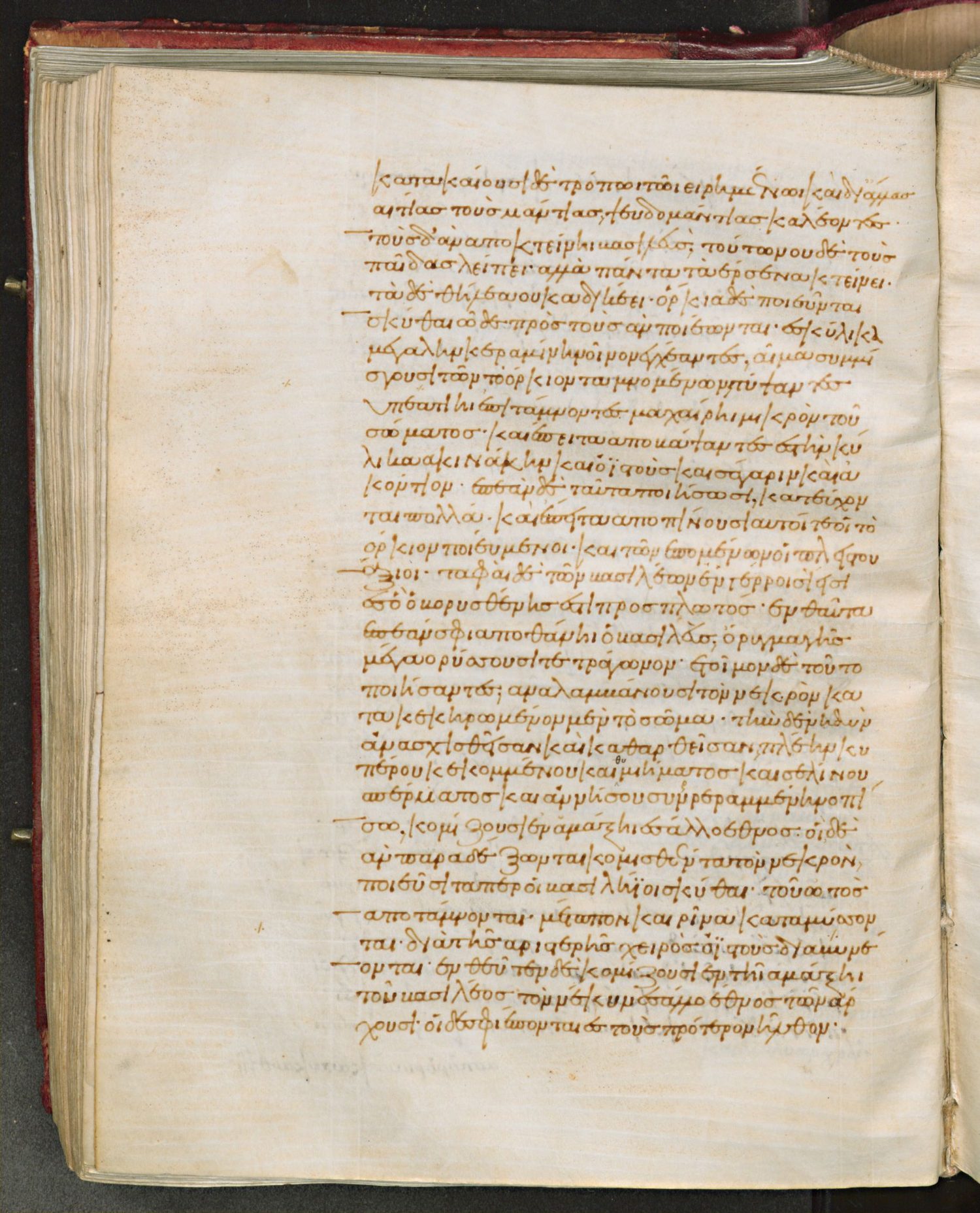
Laur. Plut. 70.3, fol. 163r: Greek here 4.68.1 to 4.69.2. Checked on the image (first and last words read and located in the Greek; each break checked against the neighbouring page): fol. 163r begins ‹ἐπεὰν δὲ βασιλεὺς ὁ› (4.68.1), ends ‹αὐτῶν ὁ ῥυμὸς κατακαυθῇ› (4.69.2). Fol. 162v ends τοῖσι δακτύλοισι τοῖσι ἑωυτοῦ and fol. 163r begins ἐπεὰν δὲ βασιλεύς: the edition's καὶ διαλύων χρᾷ (4.67.2) is not at the page break. The last line is short and holds only αὐτῶν ὁ ῥυμὸς κατακαυθῇ. English here: 4.68.1 to 4.69.2 (Godley's sentences for the sections whose Greek lies mostly on this page).
4.68.1ἐπεὰν δὲ βασιλεὺς ὁ Σκυθέων κάμῃ, μεταπέμπεται τῶν μαντίων ἄνδρας τρεῖς τοὺς εὐδοκιμέοντας μάλιστα, οἳ τρόπῳ τῷ εἰρημένῳ μαντεύονται· καὶ λέγουσι οὗτοι ὡς τὸ ἐπίπαν μάλιστα τάδε, ὡς τὰς βασιληίας ἱστίας ἐπιώρκηκε ὃς καὶ ὅς, λέγοντες τῶν ἀστῶν τὸν ἂν δὴ λέγωσι. 4.68.2τὰς δὲ βασιληίας ἱστίας νόμος Σκύθῃσι τὰ μάλιστα ἐστὶ ὀμνύναι τότε ἐπεὰν τὸν μέγιστον ὅρκον ἐθέλωσι ὀμνύναι. αὐτίκα δὲ διαλελαμμένος ἄγεται οὗτος τὸν ἂν δὴ φῶσι ἐπιορκῆσαι, ἀπιγμένον δὲ ἐλέγχουσι οἱ μάντιες ὡς ἐπιορκήσας φαίνεται ἐν τῇ μαντικῇ τὰς βασιληίας ἱστίας καὶ διὰ ταῦτα ἀλγέει ὁ βασιλεύς· ὁ δὲ ἀρνέεται, οὐ φάμενος ἐπιορκῆσαι, καὶ δεινολογέεται. 4.68.3ἀρνεομένου δὲ τούτου ὁ βασιλεὺς μεταπέμπεται ἄλλους διπλησίους μάντιας· καὶ ἢν μὲν καὶ οὗτοι ἐσορῶντες ἐς τὴν μαντικὴν καταδήσωσι ἐπιορκῆσαι, τοῦ δὲ ἰθέως τὴν κεφαλὴν ἀποτάμνουσι, καὶ τὰ χρήματα αὐτοῦ διαλαγχάνουσι οἱ πρῶτοι τῶν μαντίων· 4.68.4ἢν δὲ οἱ ἐπελθόντες μάντιες ἀπολύσωσι, ἄλλοι πάρεισι μάντιες καὶ μάλα ἄλλοι. ἢν ὦν οἱ πλεῦνες τὸν ἄνθρωπον ἀπολύσωσι, δέδοκται τοῖσι πρώτοισι τῶν μαντίων αὐτοῖσι ἀπόλλυσθαι. 4.69.1ἀπολλῦσι δῆτα αὐτοὺς τρόπῳ τοιῷδε· ἐπεὰν ἅμαξαν φρυγάνων πλήσωσι καὶ ὑποζεύξωσι βοῦς, ἐμποδίσαντες τοὺς μάντιας καὶ χεῖρας ὀπίσω δήσαντες καὶ στομώσαντες κατεργνῦσι ἐς μέσα τὰ φρύγανα. ὑποπρήσαντες δὲ αὐτὰ ἀπιεῖσι φοβήσαντες τοὺς βοῦς. 4.69.2πολλοὶ μὲν δὴ συγκατακαίονται τοῖσι μάντισι βόες, πολλοὶ δὲ περικεκαυμένοι ἀποφεύγουσι, ἐπεὰν αὐτῶν ὁ ῥυμὸς κατακαυθῇ.
4.68.1But whenever the king of the Scythians falls sick, he sends for the three diviners most in repute, who prophesy in the aforesaid manner; and they for the most part tell him that such and such a man (naming whoever it is of the people of the country) has forsworn himself by the king’s hearth; 4.68.2for when the Scythians will swear their mightiest oath, it is by the king’s hearth that they are usually accustomed to swear. Forthwith the man whom they allege to be forsworn is seized and brought in, and when he comes the diviners accuse him, saying that their divination shows him to have forsworn himself by the king’s hearth, and that this is the cause of the king’s sickness; and the man vehemently denies that he is forsworn. 4.68.3So when he denies it the king sends for twice as many diviners: and if they too, looking into their art, prove him guilty of perjury, then straightway he is beheaded and his goods are divided among the first diviners; 4.68.4but if the later diviners acquit him, then other diviners come, and yet again others. If then the greater number of them acquit the man, it is decreed that the first diviners shall themselves be put to death. 4.69.1And this is the manner of their death. Men yoke oxen to a waggon laden with sticks and make the diviners fast amid these, fettering their legs and binding their hands behind them and gagging them; then they set fire to the sticks and drive the oxen away, affrighting them. 4.69.2Often the oxen are burnt to death with the diviners, and often the pole of their waggon is burnt through and the oxen escape with a scorching. They burn their diviners for other reasons, too, in the manner aforesaid, calling them false prophets.
Where on the image
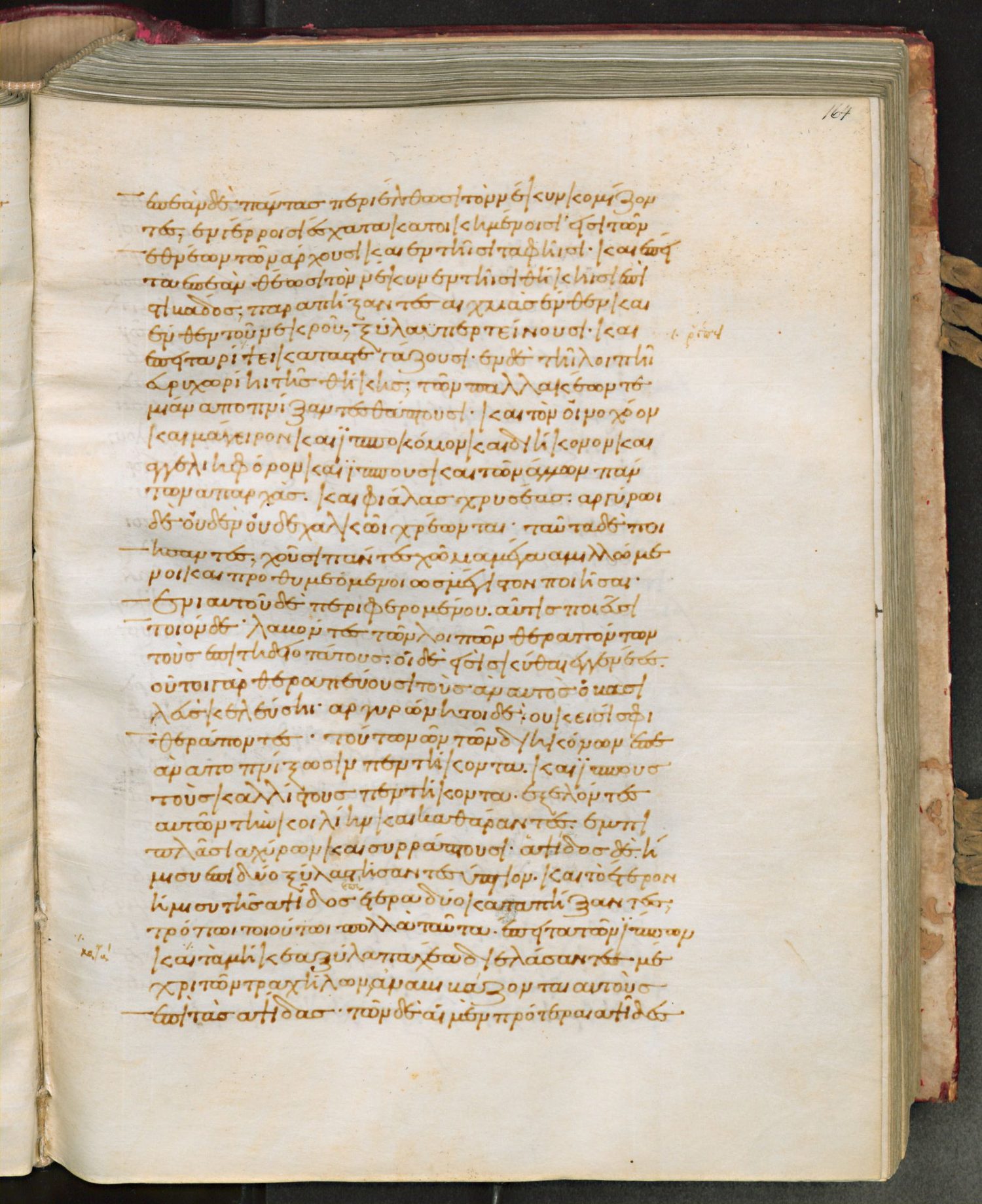
Laur. Plut. 70.3, fol. 163v: Greek here 4.69.2 to 4.71.3. Checked on the image (first and last words read and located in the Greek; each break checked against the neighbouring page): fol. 163v begins ‹κατακαίουσι δὲ τρόπῳ τῷ› (4.69.2), ends ‹ἐς τοὺς πρότερον ἦλθον› (4.71.3). English here: 4.69.3 to 4.71.2 (Godley's sentences for the sections whose Greek lies mostly on this page).
4.69.2κατακαίουσι δὲ τρόπῳ τῷ εἰρημένῳ καὶ διʼ ἄλλας αἰτίας τοὺς μάντιας, ψευδομάντιας καλέοντες. 4.69.3τοὺς δʼ ἂν ἀποκτείνῃ βασιλεύς, τούτων οὐδὲ τοὺς παῖδας λείπει, ἀλλὰ πάντα τὰ ἔρσενα κτείνει, τὰ δὲ θήλεα οὐκ ἀδικέει. 4.70.1ὅρκια δὲ ποιεῦνται Σκύθαι ὧδε πρὸς τοὺς ἂν ποιέωνται· ἐς κύλικα μεγάλην κεραμίνην οἶνον ἐγχέαντες αἷμα συμμίσγουσι τῶν τὸ ὅρκιον ταμνομένων, τύψαντες ὑπέατι ἢ ἐπιταμόντες μαχαίρῃ σμικρὸν τοῦ σώματος, καὶ ἔπειτα ἀποβάψαντες ἐς τὴν κύλικα ἀκινάκην καὶ ὀιστοὺς καὶ σάγαριν καὶ ἀκόντιον· ἐπεὰν δὲ ταῦτα ποιήσωσι, κατεύχονται πολλὰ καὶ ἔπειτα ἀποπίνουσι αὐτοί τε οἱ τὸ ὅρκιον ποιεύμενοι καὶ τῶν ἑπομένων οἱ πλείστου ἄξιοι. 4.71.1ταφαὶ δὲ τῶν βασιλέων ἐν Γέρροισι εἰσὶ ἐς ὃ ὁ Βορυσθένης ἐστὶ προσπλωτός·ἐνθαῦτα, ἐπεάν σφι ἀποθάνῃ ὁ βασιλεύς, ὄρυγμα γῆς μέγα ὀρύσσουσι τετράγωνον, ἕτοιμον δὲ τοῦτο ποιήσαντες ἀναλαμβάνουσι τὸν νεκρόν, κατακεκηρωμένον μὲν τὸ σῶμα, τὴν δὲ νηδὺν ἀνασχισθεῖσαν καὶ καθαρθεῖσαν, πλέην κυπέρου κεκομμένου καὶ θυμιήματος καὶ σελίνου σπέρματος καὶ ἀννήσου, συνερραμμένην ὀπίσω, καὶ κομίζουσι ἐν ἁμάξῃ ἐς ἄλλο ἔθνος. 4.71.2οἳ δὲ ἂν παραδέξωνται κομισθέντα τὸν νεκρόν, ποιεῦσι τά περ οἱ βασιλήιοι Σκύθαι· τοῦ ὠτὸς ἀποτάμνονται, τρίχας περικείρονται, βραχίονας περιτάμνονται, μέτωπον καὶ ῥῖνα καταμύσσονται, διὰ τῆς ἀριστερῆς χειρὸς ὀιστοὺς διαβυνέονται. 4.71.3ἐνθεῦτεν δὲ κομίζουσι ἐν τῇ ἀμάξῃ τοῦ βασιλέος τὸν νέκυν ἐς ἄλλο ἔθνος τῶν ἄρχουσι· οἳ δέ σφι ἕπονται ἐς τοὺς πρότερον ἦλθον.
4.69.3When the king puts a man to death, neither does he leave the sons alive, but kills all the males of the family; to the females he does no hurt. 4.70.1As for the giving of sworn pledges to such as are to receive them, this is the Scythian fashion: they take blood from the parties to the agreement by making a little hole or cut in the body with an awl or a knife, and pour it mixed with wine into a great earthenware bowl, wherein they then dip a scimitar and arrows and an axe and a javelin; and when this is done the makers of the sworn agreement themselves, and the most honourable of their followers, drink of the blood after solemn imprecations. 4.71.1The burial-places of the kings are in the land of the Gerrhi, which is the end of the navigation of the Borysthenes. There, whenever their king has died, the Scythians dig a great four-cornered pit in the ground; when this is ready they take up the dead man—his body enclosed in wax, his belly cut open and cleansed and filled with cut marsh-plants and frankincense, and parsley and anise seed, and sewn up again—and carry him on a waggon to another tribe. 4.71.2Then those that receive the dead man at his coming do the same as do the Royal Scythians; that is, they cut off a part of their ears, shave their heads, make cuts round their arms, tear their foreheads and noses, and pierce their left hands with arrows.
Where on the image
Laur. Plut. 70.3, fol. 164r: Greek here 4.71.3 to 4.72.4. Checked on the image (first and last words read and located in the Greek; each break checked against the neighbouring page): fol. 164r begins ‹ἐπεὰν δὲ πάντας περιέλθωσι› (4.71.3), ends ‹αἱ μὲν πρότεραι ἀψῖδες› (4.72.4). English here: 4.71.3 to 4.72.4 (Godley's sentences for the sections whose Greek lies mostly on this page).
4.71.3ἐπεὰν δὲ πάντας περιέλθωσι τὸν νέκυν κομίζοντες, ἔν τε Γέρροισι ἔσχατα κατοικημένοισι εἰσὶ τῶν ἐθνέων τῶν ἄρχουσι καὶ ἐν τῇσι ταφῇσι. 4.71.4καὶ ἔπειτα, ἐπεὰν θέωσι τὸν νέκυν ἐν τῇσι θήκῃσι ἐπὶ στιβάδος, παραπήξαντες αἰχμὰς ἔνθεν καὶ ἔνθεν τοῦ νεκροῦ ξύλα ὑπερτείνουσι καὶ ἔπειτα ῥιψὶ καταστεγάζουσι, ἐν δὲ τῇ λοιπῇ εὐρυχωρίῃ τῆς θήκης τῶν παλλακέων τε μίαν ἀποπνίξαντες θάπτουσι καὶ τὸν οἰνοχόον καὶ μάγειρον καὶ ἱπποκόμον καὶ διήκονον καὶ ἀγγελιηφόρον καὶ ἵππους καὶ τῶν ἄλλων πάντων ἀπαρχὰς καὶ φιάλας χρυσέας· ἀργύρῳ δὲ οὐδὲν οὐδὲ χαλκῷ χρέωνται. 4.71.5ταῦτα δὲ ποιήσαντες χοῦσι πάντες χῶμα μέγα, ἁμιλλώμενοι καὶ προθυμεόμενοι ὡς μέγιστον ποιῆσαι. 4.72.1ἐνιαυτοῦ δὲ περιφερομένου αὖτις ποιεῦσι τοιόνδε· λαβόντες τῶν λοιπῶν θεραπόντων τοὺς ἐπιτηδεοτάτους (οἳ δὲ εἰσὶ Σκύθαι ἐγγενέες· οὗτοι γὰρ θεραπεύουσι τοὺς ἂν αὐτὸς ὁ βασιλεὺς κελεύσῃ ἀργυρώνητοι δὲ οὐκ εἰσί σφι θεράποντες), 4.72.2τούτων ὦν τῶν διηκόνων ἐπεὰν ἀποπνίξωσι πεντήκοντα καὶ ἵππους τοὺς καλλίστους πεντήκοντα, ἐξελόντες αὐτῶν τὴν κοιλίην καὶ καθήραντες ἐμπιπλᾶσι ἀχύρων καὶ συρράπτουσι. 4.72.3ἁψῖδος δὲ ἥμισυ ἐπὶ δύο ξύλα στήσαντες ὕπτιον καὶ τὸ ἕτερον ἥμισυ τῆς ἁψῖδος ἐπʼ ἕτερα δύο, καταπήξαντες τρόπῳ τοιούτῳ πολλὰ ταῦτα, ἔπειτα τῶν ἵππων κατὰ τὰ μήκεα ξύλα παχέα διελάσαντες μέχρι τῶν τραχήλων ἀναβιβάζουσι αὐτοὺς ἐπὶ τὰς ἁψῖδας· 4.72.4τῶν δὲ αἱ μὲν πρότεραι ἀψῖδες
4.71.3Thence the bearers carry the king’s body on the waggon to another of the tribes which they rule, and those to whom they have already come follow them; and having carried the dead man to all in turn, they are in the country of the Gerrhi, the farthest distant of all tribes under their rule, and at the place of burial. 4.71.4Then, having laid the dead in the tomb on a couch, they plant spears on each side of the body and lay across them wooden planks, which they then roof over with plaited oziers; in the open space which is left in the tomb they bury, after strangling, one of the king’s concubines, his cupbearer, his cook, his groom, his squire, and his messenger, besides horses, and first-fruits of all else, and golden cups; for the Scythians make no use of silver or bronze. 4.71.5Having done this they all build a great barrow of earth, vying zealously with one another to make this as great as may be. 4.72.1With the completion of a year they begin a fresh practice. Taking the trustiest of the rest of the king’s servants (and these are native-born Scythians, for only those serve the king whom he bids so to do, and none of the Scythians have servants bought by money) 4.72.2they strangle fifty of these squires and fifty of their best horses and empty and cleanse the bellies of all, fill them with chaff, and sew them up again. 4.72.3Then they make fast the half of a wheel to two posts, the hollow upwards, and the other half to another pair of posts, till many posts thus furnished are planted in the ground, and, presently, driving thick stakes lengthways through the horses’ bodies to their necks, they lay the horses aloft on the wheels 4.72.4so that the wheel in front supports the horse’s shoulders and the wheel behind takes the weight of the belly by the hindquarters, and the forelegs and hindlegs hang free; and putting bridles and bits in the horses’ mouths they stretch the bridles to the front and make them fast with pegs.
Where on the image
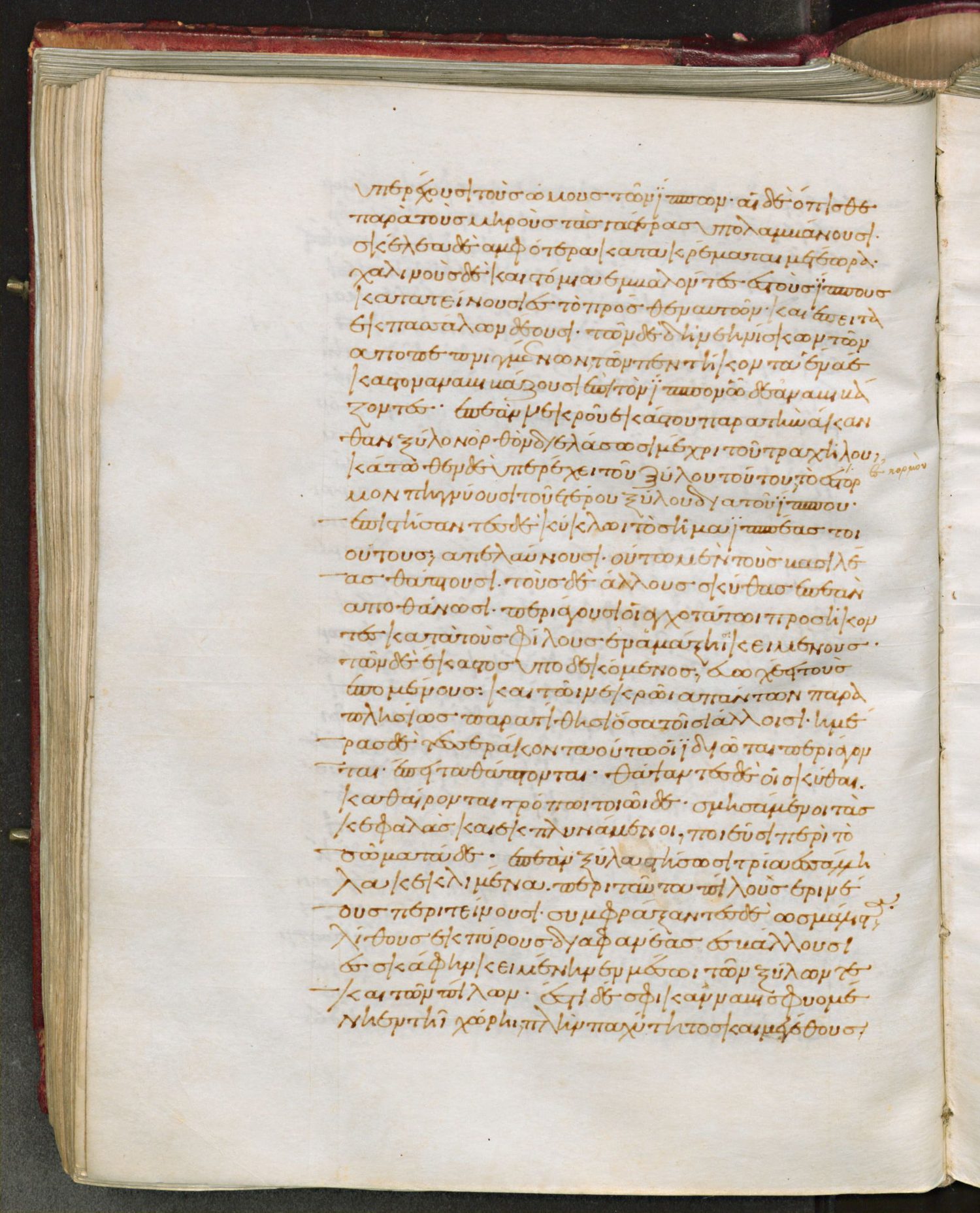
Laur. Plut. 70.3, fol. 164v: Greek here 4.72.4 to 4.74.1. Checked on the image (first and last words read and located in the Greek; each break checked against the neighbouring page): fol. 164v begins ‹ὑπέχουσι τοὺς ὤμους τῶν› (4.72.4), ends ‹πλὴν παχύτητος καὶ μεγάθεος› (4.74.1). English here: 4.72.5 to 4.73.2 (Godley's sentences for the sections whose Greek lies mostly on this page).
4.72.4ὑπέχουσι τοὺς ὤμους τῶν ἵππων, αἱ δὲ ὄπισθε παρὰ τοὺς μηροὺς τὰς γαστέρας ὑπολαμβάνουσι· σκέλεα δὲ ἀμφότερα κατακρέμαται μετέωρα. χαλινοὺς δὲ καὶ στόμια ἐμβαλόντες ἐς τοὺς ἵππους κατατείνουσι ἐς τὸ πρόσθε αὐτῶν καὶ ἔπειτα ἐκ πασσάλων δέουσι. 4.72.5τῶν δὲ δὴ νεηνίσκων τῶν ἀποπεπνιγμένων τῶν πεντήκοντα ἕνα ἕκαστον ἀναβιβάζουσι ἐπὶ τὸν ἵππον, ὧδε ἀναβιβάζοντες, ἐπεὰν νεκροῦ ἑκάστου παρὰ τὴν ἄκανθαν ξύλον ὀρθὸν διελάσωσι μέχρι τοῦ τραχήλου· κάτωθεν δὲ ὑπερέχει τοῦ ξύλου τούτου τὸ ἐς τόρμον πηγνύουσι τοῦ ἑτέρου ξύλου τοῦ διὰ τοῦ ἵππου. ἐπιστήσαντες δὲ κύκλῳ τὸ σῆμα ἱππέας τοιούτους ἀπελαύνουσι. 4.73.1οὕτω μὲν τοὺς βασιλέας θάπτουσι· τοὺς δὲ ἄλλους Σκύθας, ἐπεὰν ἀποθάνωσι, περιάγουσι οἱ ἀγχοτάτω προσήκοντες κατὰ τοὺς φίλους ἐν ἀμάξῃσι κειμένους. τῶν δὲ ἕκαστος ὑποδεκόμενος εὐωχέει τοὺς ἑπομένους, καὶ τῷ νεκρῷ ἁπάντων παραπλησίως παρατίθησι ὅσα τοῖσι ἄλλοισι. ἡμέρας δὲ τεσσεράκοντα οὕτω οἱ ἰδιῶται περιάγονται, ἔπειτα θάπτονται. 4.73.2θάψαντες δὲ οἱ Σκύψαι καθαίρονται τρόπῳ τοιῷδε. σμησάμενοι τὰς κεφαλὰς καὶ ἐκπλυνάμενοι ποιεῦσι περὶ τὸ σῶμα τάδε ἐπεὰν ξύλα στήσωσι τρία ἐς ἄλληλα κεκλιμένα, περὶ ταῦτα πίλους εἰρινέους περιτείνουσι, συμφράξαντες δὲ ὡς μάλιστα λίθους ἐκ πυρὸς διαφανέας ἐσβάλλουσι ἐς σκάφην κειμένην ἐν μέσῳ τῶν ξύλων τε καὶ τῶν πίλων. 4.74.1ἔστι δέ σφι κάνναβις φυομένη ἐν τῇ χώρῃ πλὴν παχύτητος καὶ μεγάθεος
4.72.5Then they take each one of the fifty strangled young men and mount him on the horse; their way of doing it is to drive an upright stake through each body passing up by the spine to the neck, and enough of the stake projects below to be fixed in a hole made in the other stake, that which passes through the horse. So having set horsemen of this fashion round about the tomb they ride away. 4.73.1Such is their way of burying their kings. All other Scythians, when they die, are laid in waggons and carried about among their friends by their nearest of kin; each receives them and entertains the retinue hospitably, setting before the dead man about as much of the fare as he serves to the rest. All but the kings are thus borne about for forty days and then buried. 4.73.2After the burial the Scythians cleanse themselves as I will show: they anoint and wash their heads; as for their bodies, they set up three poles leaning together to a point and cover these over with woollen mats; then, in the place so enclosed to the best of their power, they make a pit in the centre beneath the poles and the mats and throw red-hot stones into it.
Where on the image
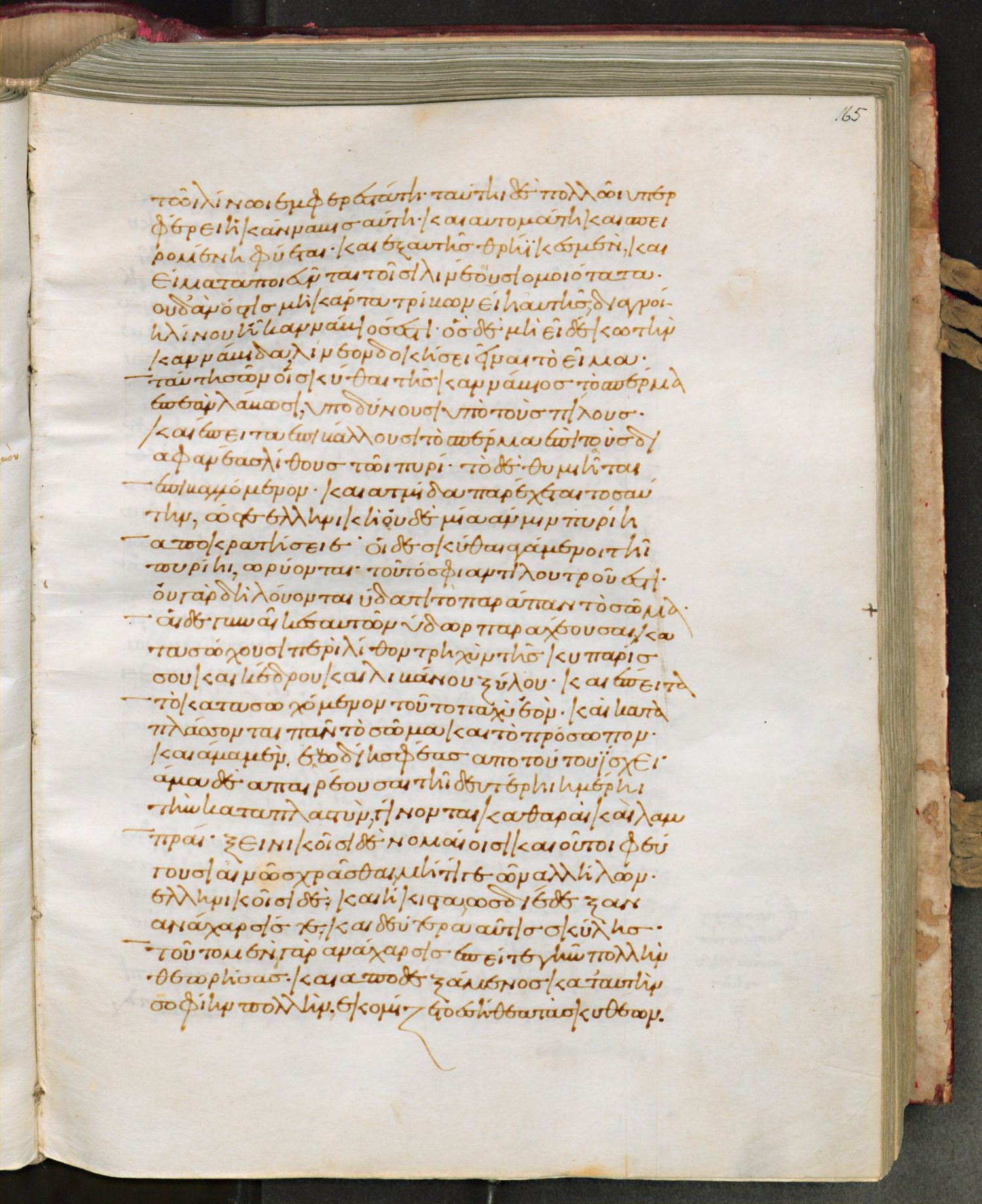
Laur. Plut. 70.3, fol. 165r: Greek here 4.74.1 to 4.75.3. Checked on the image (first and last words read and located in the Greek; each break checked against the neighbouring page): fol. 165r begins ‹τῷ λίνῳ ἐμφερεστάτη· ταύτῃ› (4.74.1), ends ‹ἐς ἤθεα τὰ Σκυθέων› (4.76.2). English here: 4.74.1 to 4.75.3 (Godley's sentences for the sections whose Greek lies mostly on this page).
4.74.1τῷ λίνῳ ἐμφερεστάτη· ταύτῃ δὲ πολλῷ ὑπερφέρει ἡ κάνναβις. αὕτη καὶ αὐτομάτη καὶ σπειρομένη φύεται, καὶ ἐξ αὐτῆς Θρήικες μὲν καὶ εἵματα ποιεῦνται τοῖσι λινέοισι ὁμοιότατα· οὐδʼ ἄν, ὅστις μὴ κάρτα τρίβων εἴη αὐτῆς, διαγνοίη λίνου ἢ καννάβιος ἐστί· ὃς δὲ μὴ εἶδε κω τὴν κανναβίδα, λίνεον δοκήσει εἶναι τὸ εἷμα. 4.75.1ταύτης ὦν οἱ Σκύθαι τῆς καννάβιος τὸ σπέρμα ἐπεὰν λάβωσι, ὑποδύνουσι ὑπὸ τοὺς πίλους, καὶ ἔπειτα ἐπιβάλλουσι τὸ σπέρμα ἐπὶ τοὺς διαφανέας λίθους τῷ πυρί· τὸ δὲ θυμιᾶται ἐπιβαλλόμενον καὶ ἀτμίδα παρέχεται τοσαύτην ὥστε Ἑλληνικὴ οὐδεμία ἄν μιν πυρίη ἀποκρατήσειε. 4.75.2οἱ δὲ Σκύθαι ἀγάμενοι τῇ πυρίῃ ὠρύονται. τοῦτό σφι ἀντὶ λουτροῦ ἐστι. οὐ γὰρ δὴ λούονται ὕδατι τὸ παράπαν τὸ σῶμα. 4.75.3αἱ δὲ γυναῖκες αὐτῶν ὕδωρ παραχέουσαι κατασώχουσι περὶ λίθον τρηχὺν τῆς κυπαρίσσου καὶ κέδρου καὶ λιβάνου ξύλου, καὶ ἔπειτα τὸ κατασωχόμενον τοῦτο παχὺ ἐὸν καταπλάσσονται πᾶν τὸ σῶμα καὶ τὸ πρόσωπον· καὶ ἅμα μὲν εὐωδίη σφέας ἀπὸ τούτου ἴσχει, ἅμα δὲ ἀπαιρέουσαι τῇ δευτέρῃ ἡμέρῃ τὴν καταπλαστὺν γίνονται καθαραὶ καὶ λαμπραί.
4.74.1They have hemp growing in their country, very like flax, save that the hemp is by much the thicker and taller. This grows both of itself and also by their sowing, and of it the Thracians even make garments which are very like linen; nor could any, save he were a past master in hemp, know whether they be hempen or linen; whoever has never yet seen hemp will think the garment to be linen. 4.75.1The Scythians then take the seed of this hemp and, creeping under the mats, they throw it on the red-hot stones; and, being so thrown, it smoulders and sends forth so much steam that no Greek vapour-bath could surpass it. 4.75.2The Scythians howl in their joy at the vapour-bath. This serves them instead of bathing, for they never wash their bodies with water. 4.75.3But their women pound on a rough stone cypress and cedar and frankincense wood, pouring water also thereon, and with the thick stuff so pounded they anoint all their bodies and faces, whereby not only does a fragrant scent abide upon them, but when on the second day they take off the ointment their skin becomes clean and shining.
Notes
- Greek: the text printed in A. D. Godley's Loeb edition, via Perseus (tlg0016.tlg001.perseus-grc2). Square brackets mark words the editor considers later additions; [...] marks a gap the editor indicates. Perseus note markers are omitted.
- English: A. D. Godley, Herodotus vol. 2 (1921) (Loeb Classical Library), as transcribed on Wikisource. Godley's footnotes are omitted.
- Section numbers in the English were placed by comparing Godley's text with the Perseus version of his translation; where a section begins inside one of Godley's sentences, the English is kept with the page that holds the start of that sentence.
Cite
Sources
- Source: Florence, Laur. Plut. 70.3 (10th c.) via BML Teca Digitale + Greek of Godley's Loeb (Perseus) + English of A. D. Godley (Loeb, Wikisource) (holding institution)
- Critical edition: Greek of A. D. Godley's Loeb edition (1920-1925), via Perseus
← previous · → next · v cycle view · l back to library