Herodotus, Histories 4.76-82: Anacharsis, Scyles and the size of Scythia
Introduction
Herodotus of Halicarnassus wrote the Histories in the third quarter of the 5th century BCE, an inquiry into the deeds of Greeks and barbarians and the causes of the wars between them, later divided into nine books. Book 4 tells of Darius' expedition against the Scythians, with Herodotus' account of Scythia, its peoples, rivers and customs, and of the shape of the world, and of the Persian expedition against Barca, with the history of Cyrene and a description of the peoples of Libya.
The photographs are of Florence, Biblioteca Medicea Laurenziana, Plut. 70.3 (parchment, 10th century, 374 folios, 31 lines a page), Herodotus, Histories (codex A of the editors), the oldest surviving manuscript of the complete Histories, from the Teca Digitale of the Biblioteca Medicea Laurenziana. Each section below is the text of one page, or of the part of a page that falls within these chapters. The first and last words of every page were read on the photograph and located in the Greek, and every page break was checked against the next page; the notes quote these words. Readers' notes in the margins are not part of the text and are mentioned where they occur.
The Greek is the text printed in A. D. Godley's Loeb edition (1920-1925), from Perseus; it is the edited text, not a transcription of the manuscript, whose wording differs in places. The English is Godley's translation as printed, from Wikisource. Godley's English carries only chapter numbers; the section numbers shown in it were placed by comparison with the Perseus version of his translation. Each page's English is cut at the end of one of Godley's sentences, so it can begin or end a few lines away from the Greek of the page; each note gives the exact ranges.
This entry covers chapters 4.76-82, on fol. 165r to 167v.
How was this verified? (Provenance)
Where on the image
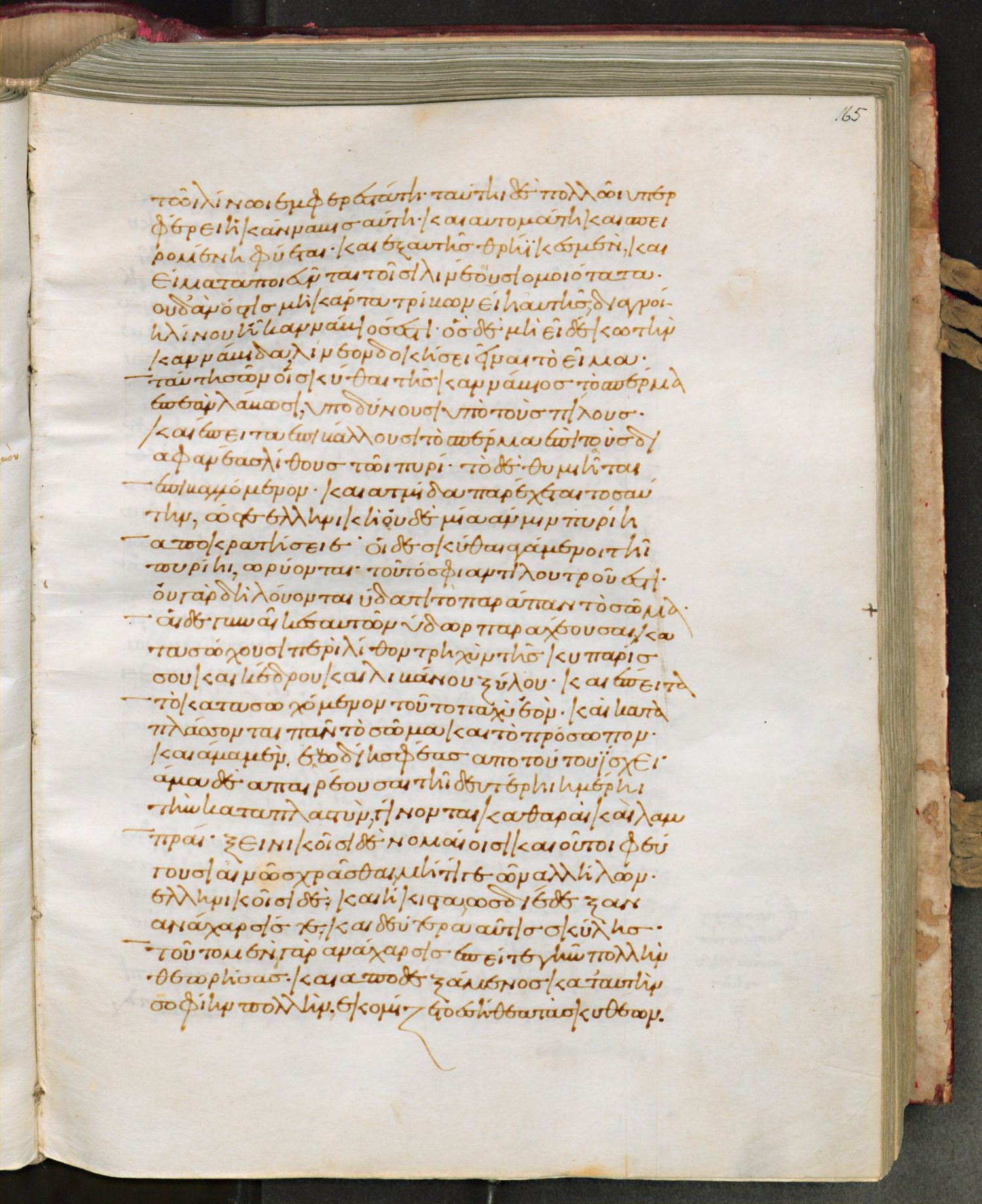
Laur. Plut. 70.3, fol. 165r: Greek here 4.76.1 to 4.76.2. Checked on the image (first and last words read and located in the Greek; each break checked against the neighbouring page): fol. 165r begins ‹τῷ λίνῳ ἐμφερεστάτη· ταύτῃ› (4.74.1), ends ‹ἐς ἤθεα τὰ Σκυθέων› (4.76.2). English here: 4.76.1 to 4.76.3 (Godley's sentences for the sections whose Greek lies mostly on this page).
4.76.1ξεινικοῖσι δὲ νομαίοισι καὶ οὗτοι φεύγουσι αἰνῶς χρᾶσθαι, μήτε τεῶν ἄλλων, Ἑλληνικοῖσι δὲ καὶ ἥκιστα, ὡς διέδεξαν Ἀνάχαρσις τε καὶ δεύτερα αὖτις Σκύλης. 4.76.2τοῦτο μὲν γὰρ Ἀνάχαρσις ἐπείτε γῆν πολλὴν θεωρήσας καὶ ἀποδεξάμενος κατʼ αὐτὴν σοφίην πολλὴν ἐκομίζετο ἐς ἤθεα τὰ Σκυθέων,
4.76.1But as regards foreign usages, the Scythians (as others) are wondrous loth to practise those of any other country, and particularly of Hellas, as was proved in the case of Anacharsis and again also of Scyles. 4.76.2For when Anacharsis, having seen much of the world in his travels and given many proofs of his wisdom therein, was coming back to the Scythian country, he sailed through the Hellespont and put in at Cyzicus; 4.76.3where, finding the Cyzicenes celebrating the feast of the Mother of the Gods with great pomp, he vowed to this same Mother that, if he returned to his own country safe and sound, he would sacrifice to her as he saw the Cyzicenes do, and establish a nightly rite of worship.
Where on the image
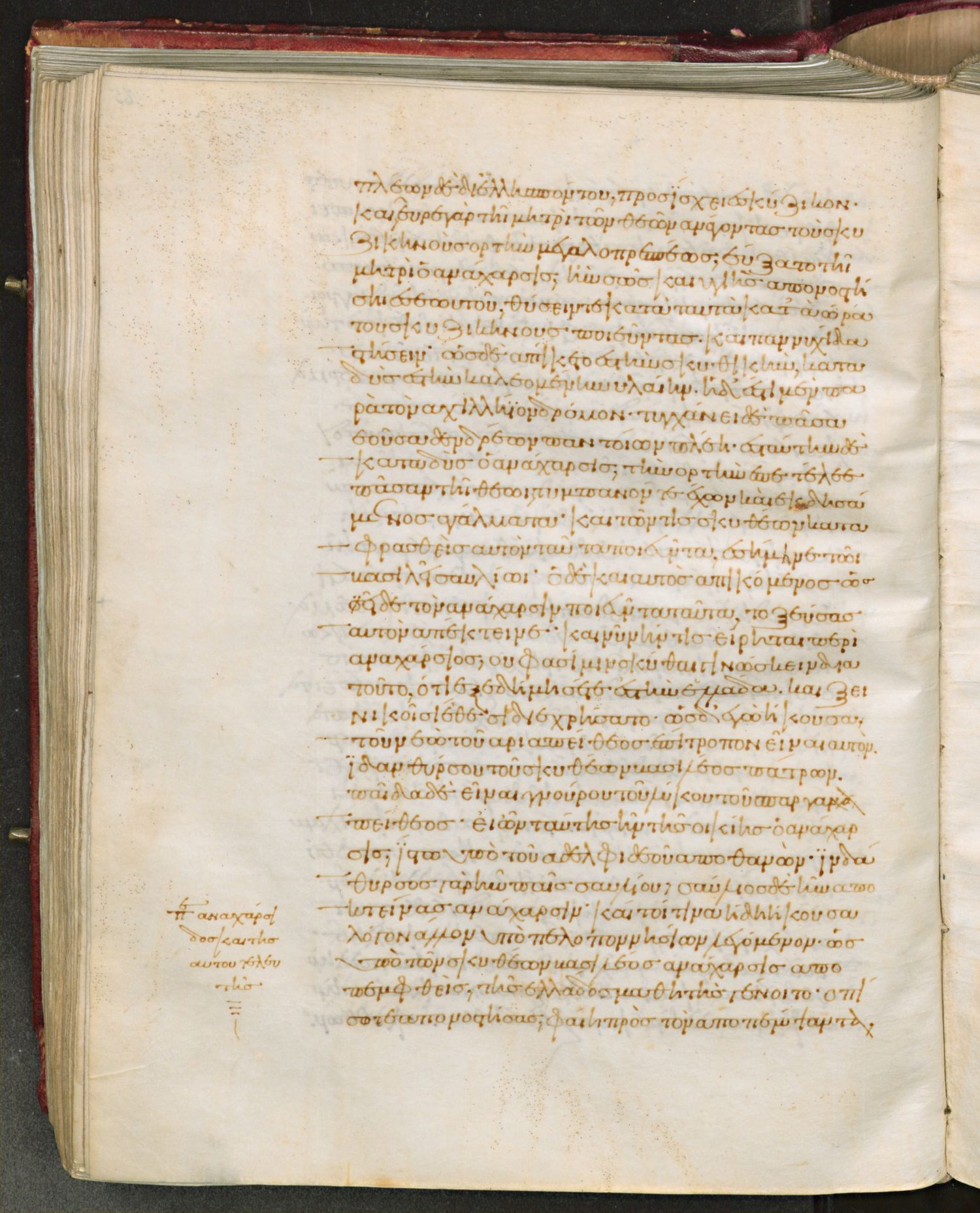
Laur. Plut. 70.3, fol. 165v: Greek here 4.76.2 to 4.77.1. Checked on the image (first and last words read and located in the Greek; each break checked against the neighbouring page): fol. 165v begins ‹πλέων διʼ Ἑλλησπόντου προσίσχει› (4.76.2), ends ‹φαίη πρὸς τὸν ἀποπέμψαντα› (4.77.1). English here: 4.76.4 to 4.77.1 (Godley's sentences for the sections whose Greek lies mostly on this page).
4.76.2πλέων διʼ Ἑλλησπόντου προσίσχει ἐς Κύζικον. 4.76.3καὶ εὗρε γὰρ τῇ μητρὶ τῶν θεῶν ἀνάγοντας τοὺς Κυζικηνοὺς ὁρτὴν μεγαλοπρεπέως κάρτα, εὔξατο τῇ μητρὶ ὁ Ἀνάχαρσις, ἢν σῶς καὶ ὑγιὴς ἀπονοστήσῃ ἐς ἑωυτοῦ, θύσειν τε κατὰ ταὐτὰ κατὰ ὥρα τοὺς Κυζικηνοὺς ποιεῦντας καὶ παννυχίδα στήσειν. 4.76.4ὡς δὲ ἀπίκετο ἐς τὴν Σκυθικήν καταδὺς ἐς τὴν καλεομένην Ὑλαίην (ἡ δʼ ἔστι μὲν παρὰ τὸν Ἀχιλλήιον δρόμον, τυγχάνει δὲ πᾶσα ἐοῦσα δενδρέων παντοίων πλέη), ἐς ταύτην δὴ καταδὺς ὁ Ἀνάχαρσις τὴν ὁρτὴν ἐπετέλεε πᾶσαν τῇ θεῷ, τύμπανον τε ἔχων καὶ ἐκδησάμενος ἀγάλματα. 4.76.5καὶ τῶν τις Σκυθέων καταφρασθεὶς αὐτὸν ταῦτα ποιεῦντα ἐσήμηνε τῷ βασιλέι Σαυλίω· ὁ δὲ καὶ αὐτὸς ἀπικόμενος ὡς εἶδε τὸν Ἀνάχαρσιν ποιεῦντα ταῦτα, τοξεύσας αὐτὸν ἀπέκτεινε. καὶ νῦν ἤν τις εἴρηται περὶ Ἀναχάρσιος, οὐ φασί μιν Σκύθαι γινώσκειν, διὰ τοῦτο ὅτι ἐξεδήμησέ τε ἐς τὴν Ἑλλάδα καὶ ξεινικοῖσι ἔθεσι διεχρήσατο. 4.76.6ὡς δʼ ἐγὼ ἤκουσα Τύμνεω τοῦ Ἀριαπείθεος ἐπιτρόπου, εἶναι αὐτὸν Ἰδανθύρσου τοῦ Σκυθέων βασιλέος πάτρων, παῖδα δὲ εἶναι Γνούρου τοῦ Λύκου τοῦ Σπαργαπείθεος. εἰ ὦν ταύτης ἦν τῆς οἰκίης ὁ Ἀνάχαρσις, ἴστω ὑπὸ τοῦ ἀδελφεοῦ ἀποθανών· Ἰδάνθυρσος γὰρ ἦν παῖς Σαυλίου, Σαύλιος δὲ ἦν ὁ ἀποκτείνας Ἀνάχαρσιν. 4.77.1καίτοι τινὰ ἤδη ἤκουσα λόγον ἄλλον ὑπὸ Πελοποννησίων λεγόμενον, ὡς ὑπὸ τοῦ Σκυθέων βασιλέος Ἀνάχαρσις ἀποπεμφθεὶς τῆς Ἑλλάδος μαθητὴς γένοιτο, ὀπίσω τε ἀπονοστήσας φαίη πρὸς τὸν ἀποπέμψαντα
4.76.4So when he came to Scythia, he hid himself in the country called Woodland (which is beside the Race of Achilles, and is all overgrown with every kind of wood); hiding himself there Anacharsis celebrated the goddess’s ritual with exactness, carrying a small drum and hanging about himself images. 4.76.5Then some Scythian marked him doing this and told it to the king, Saulius; who, coming himself to the place and seeing Anacharsis performing these rites, shot an arrow at him and slew him. And now the Scythians, if they are asked about Anacharsis, say they have no knowledge of him; this is because he left his country for Hellas and followed the customs of strangers. 4.76.6But according to what I heard from Tymnes, the deputy for Ariapithes, Anacharsis was uncle to Idanthyrsus king of Scythia, and he was the son of Gnurus, son of Lycus, son of Spargapithes. Now if Anacharsis was truly of this family, then I would have him know that he was slain by his own brother; for Idanthyrsus was the son of Saulius, and it was Saulius who slew Anacharsis. 4.77.1It is true that I have heard another story told by the Pelponnesians; namely, that Anacharsis had been sent by the king of Scythia and had been a learner of the ways of Hellas, and after his return told the king who sent him that all Greeks were zealous for every kind of learning, save only the Lacedaemonians; but that these were the only Greeks who spoke and listened with discretion.
Where on the image
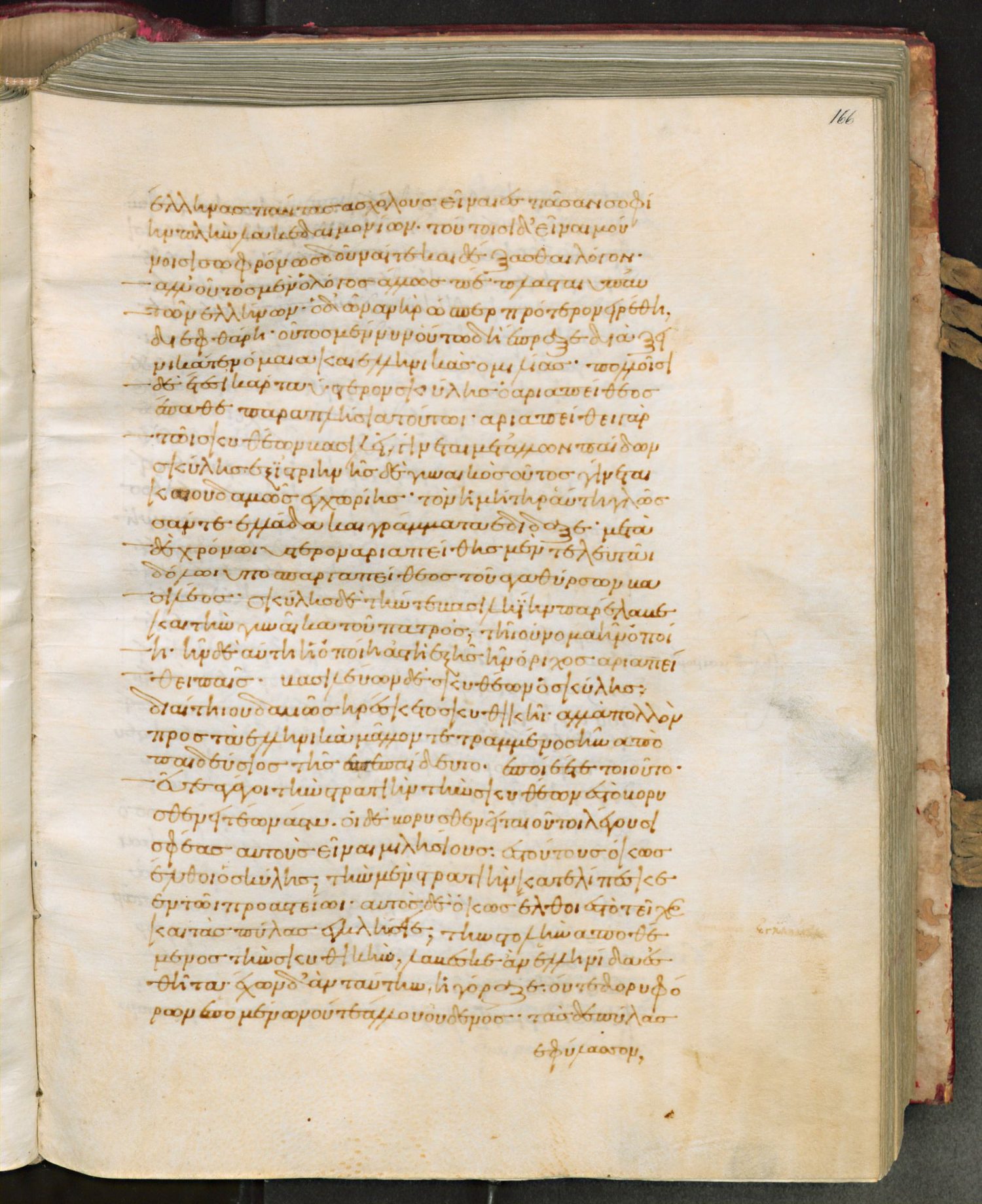
Laur. Plut. 70.3, fol. 166r: Greek here 4.77.1 to 4.78.4. Checked on the image (first and last words read and located in the Greek; each break checked against the neighbouring page): fol. 166r begins ‹Ἕλληνας πάντας ἀσχόλους εἶναι› (4.77.1), ends ‹οὐδενός· τὰς δὲ πύλας› (4.78.4). Fol. 166r ends τὰς δὲ πύλας and fol. 166v begins μή τίς μιν Σκυθέων: the edition's ἐφύλασσον (4.78.4) is not at the page break. English here: 4.77.2 to 4.78.4 (Godley's sentences for the sections whose Greek lies mostly on this page).
4.77.1Ἕλληνας πάντας ἀσχόλους εἶναι ἐς πᾶσαν σοφίην πλὴν Λακεδαιμονίων, τούτοισι δὲ εἶναι μούνοισι σωφρόνως δοῦναι τε καὶ δέξασθαι λόγον. 4.77.2ἀλλʼ οὗτος μὲν ὁ λόγος ἄλλως πέπλασται ὑπʼ αὐτῶν Ἑλλήνων, ὁ δʼ ὦν ἀνὴρ ὥσπερ πρότερον εἰρέθη διεφθάρη. 4.78.1οὗτος μέν νυν οὕτω δὴ ἔπρηξε διὰ ξεινικά τε νόμαια καὶ Ἑλληνικὰς ὁμιλίας. πολλοῖσι δὲ κάρτα ἔτεσι ὕστερον Σκύλης ὁ Ἀριαπείθεος ἔπαθε παραπλήσια τούτῳ. Ἀριαπείθεϊ γὰρ τῷ Σκυθέων βασιλέι γίνεται μετʼ ἄλλων παίδων Σκύλης· ἐξ Ἰστριηνῆς δὲ γυναικὸς οὗτος γίνεται καὶ οὐδαμῶς ἐγχωρίης· τὸν ἡ μήτηρ αὕτη γλῶσσάν τε Ἑλλάδα καὶ γράμματα ἐδίδαξε. 4.78.2μετὰ δὲ χρόνῳ ὕστερον Ἀριαπείθης μὲν τελευτᾷ δόλῳ ὑπὸ Σπαργαπείθεος τοῦ Ἀγαθύρσων βασιλέος, Σκύλης δὲ τήν τε βασιληίην παρέλαβε καὶ τὴν γυναῖκα τοῦ πατρός, τῇ οὔνομα ἦν Ὀποίη· ἦν δὲ αὕτη ἡ Ὀποίη ἀστή, ἐξ ἧς ἦν Ὄρικος Ἀριαπείθεϊ παῖς. 4.78.3βασιλεύων δὲ Σκυθέων ὁ Σκύλης διαίτῃ οὐδαμῶς ἠρέσκετο Σκυθικῇ, ἀλλὰ πολλὸν πρὸς τὰ Ἑλληνικὰ μᾶλλον τετραμμένος ἦν ἀπὸ παιδεύσιος τῆς ἐπεπαίδευτο, ἐποίεέ τε τοιοῦτο· εὖτε ἀγάγοι τὴν στρατιὴν τὴν Σκυθέων ἐς τὸ Βορυσθενειτέων ἄστυ (οἱ δὲ Βορυσθενεῗται οὗτοι λέγουσι σφέας αὐτοὺς εἶναι Μιλησίους), ἐς τούτους ὅκως ἔλθοι ὁ Σκύλης, τὴν μὲν στρατιὴν καταλίπεσκε ἐν τῷ προαστείῳ, 4.78.4αὐτὸς δὲ ὅκως ἔλθοι ἐς τὸ τεῖχος καὶ τὰς πύλας ἐγκλῄσειε, τὴν στολὴν ἀποθέμενος τὴν Σκυθικὴν λάβεσκε ἂν Ἑλληνίδα ἐσθῆτα, ἔχων δʼ ἂν ταύτην ἠγόραζε οὔτε δορυφόρων ἑπομένων οὔτε ἄλλου οὐδενός· τὰς δὲ πύλας ἐφύλασσον,
4.77.2But this is a tale vainly invented by the Greeks themselves; and be this as it may, the man was put to death as I have said. 4.78.1Such-like, then, was the fortune that befell Anacharsis, all for his foreign usages and his companionship with Greeks; and a great many years afterwards, Scyles, son of Ariapithes, suffered a like fate. Scyles was one of the sons born to Ariapithes, king of Scythia; but his mother was of Istria, and not native-born; and she taught him to speak and read Greek. 4.78.2As time passed, Ariapithes was treacherously slain by Spargapithes, king of the Agathyrsi, and Scyles inherited the kingship and his father’s wife, whose name was Opoea, a Scythian woman, and she bore to Scyles a son, Oricus. 4.78.3So Scyles was king of Scythia; but he was in no wise content with the Scythian manner of life, and was much more inclined to Greek ways, from the bringing up which he had received; so this is what he did: having led the Scythian army to the city of the Borysthenites (who say that they are Milesians)—having, I say, come thither, he would ever leave his army in the suburb of the city, 4.78.4but he himself, entering within the walls and shutting the gates would doff his Scythian apparel and don a Greek dress; and in it he went among the townsmen unattended by spearmen or any others (the people guarding the gates, lest any Scythian should see him wearing this apparel), and in every way followed the Greek manner of life, and worshipped the gods according to Greek usage.
Where on the image
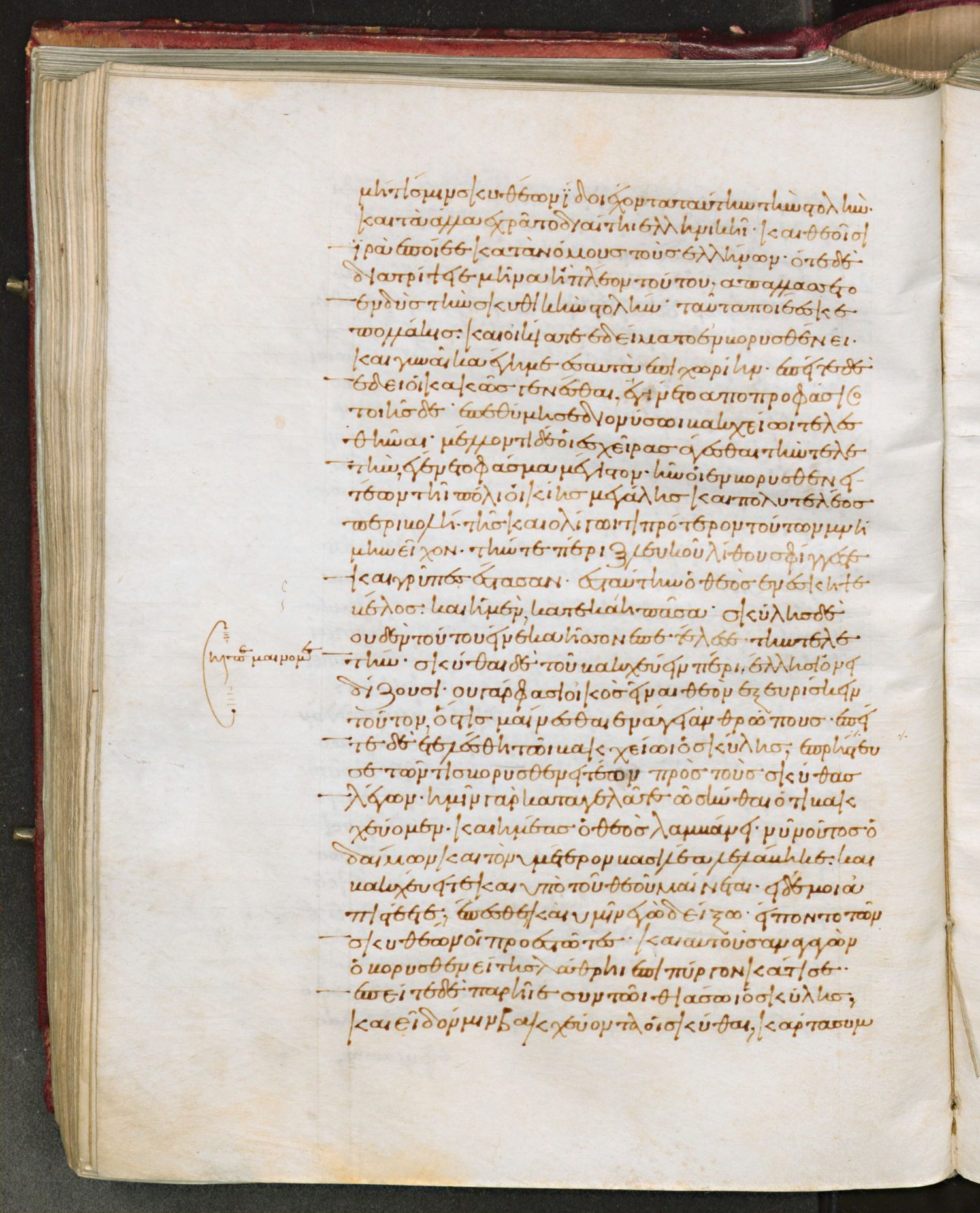
Laur. Plut. 70.3, fol. 166v: Greek here 4.78.4 to 4.79.5. Checked on the image (first and last words read and located in the Greek; each break checked against the neighbouring page): fol. 166v begins ‹μή τίς μιν Σκυθέων› (4.78.4), ends ‹οἱ Σκύθαι, κάρτα συμ-› (4.79.5). Fol. 166r ends τὰς δὲ πύλας and fol. 166v begins μή τίς μιν Σκυθέων: the edition's ἐφύλασσον (4.78.4) is not at the page break. English here: 4.78.5 to 4.79.5 (Godley's sentences for the sections whose Greek lies mostly on this page).
4.78.4μή τίς μιν Σκυθέων ἴδοι ἔχοντα ταύτην τὴν στολήν· καὶ τά τε ἄλλα ἐχρᾶτο διαίτῃ Ἑλληνικῇ καὶ θεοῖσι ἱρὰ ἐποίεε κατὰ νόμους τοὺς Ἑλλήνων. 4.78.5ὅτε δὲ διατρίψειε μῆνα ἢ πλέον τούτου, ἀπαλλάσσετο ἐνδὺς τὴν Σκυθικὴν στολήν. ταῦτα ποιέεσκε πολλάκις καὶ οἰκία τε ἐδείματο ἐν Βορυσθένεϊ καὶ γυναῖκα ἔγημε ἐς αὐτὰ ἐπιχωρίην. 4.79.1ἐπείτε δὲ ἔδεέ οἱ κακῶς γενέσθαι, ἐγίνετο ἀπὸ προφάσιος τοιῆσδε. ἐπεθύμησε Διονύσῳ Βακχείῳ τελεσθῆναι· μέλλοντι δέ οἱ ἐς χεῖρας ἄγεσθαι τὴν τελετὴν ἐγένετο φάσμα μέγιστον. 4.79.2ἦν οἱ ἐν Βορυσθενεϊτέων τῇ πόλι οἰκίης μεγάλης καὶ πολυτελέος περιβολή, τῆς καὶ ὀλίγῳ τι πρότερον τούτων μνήμην εἶχον, τὴν πέριξ λευκοῦ λίθου σφίγγες τε καὶ γρῦπες ἕστασαν· ἐς ταύτην ὁ θεὸς ἐνέσκηψε βέλος. καὶ ἣ μὲν κατεκάη πᾶσα, Σκύλης δὲ οὐδὲν τούτου εἵνεκα ἧσσον ἐπετέλεσε τὴν τελετήν. 4.79.3Σκύθαι δὲ τοῦ βακχεύειν πέρι Ἕλλησι ὀνειδίζουσι· οὐ γὰρ φασὶ οἰκὸς εἶναι θεὸν ἐξευρίσκειν τοῦτον ὅστις μαίνεσθαι ἐνάγει ἀνθρώπους. 4.79.4ἐπείτε δὲ ἐτελέσθη τῷ Βακχείῳ ὁ Σκύλης, διεπρήστευσε τῶν τις Βορυσθενειτέων πρὸς τοὺς Σκύθας λέγων ἡμῖν γὰρ καταγελᾶτε, ὦ Σκύθαι, ὅτι βακχεύομεν καὶ ἡμέας ὁ θεὸς λαμβάνει· νῦν οὗτος ὁ δαίμων καὶ τὸν ὑμέτερον βασιλέα λελάβηκε, καὶ βακχεύει τε καὶ ὑπὸ τοῦ θεοῦ μαίνεται. εἰ δέ μοι ἀπιστέετε, ἕπεσθε, καὶ ὑμῖν ἐγὼ δέξω. 4.79.5εἵποντο τῶν Σκύθεων οἱ προεστεῶτες, καὶ αὐτοὺς ἀναγαγὼν ὁ Βορυσθενεΐτης λάθρῃ ἐπὶ πύργον κατεῖσε. ἐπείτε δὲ παρήιε σὺν τῷ θιάσῳ ὁ Σκύλης καὶ εἶδόν μιν βακχεύοντα οἱ Σκύθαι, κάρτα συμφορὴν
4.78.5Then having so spent a month or more, he put on Scythian dress and left the city. This he did often; and he built him a house in Borysthenes, and married and brought thither a wife of the people of the country. 4.79.1But when the time came that evil should befall him, this was the cause of it: he conceived a desire to be initiated into the rites of the Bacchic Dionysus; and when he was about to begin the sacred mysteries, he saw a wondrous vision. 4.79.2He had in the city of the Borysthenites a spacious house, great and costly (that same house whereof I have just made mention), all surrounded by sphinxes and griffins wrought in white marble; this house was smitten by a thunderbolt and wholly destroyed by fire. But none the less for this did Scyles perform the rite to the end. 4.79.3Now the Scythians make this Bacchic revelling a reproach against the Greeks, saying that it is not reasonable to set up a god who leads men on to madness. 4.79.4So when Scyles had been initiated into the Bacchic rite, some one of the Borysthenites scoffed at the Scythians: “Why,” said he, “you Scythians mock us for revelling and being possessed by the god; but now this deity has taken possession of your own king, so that he is revelling and is maddened by the god. If you will not believe me, follow me now and I will show him to you.” 4.79.5The chief men among the Scythians followed him, and the Borysthenite brought them up secretly and set them on a tower; whence presently, when Scyles passed by with his company of worshippers, they saw him among the revellers; whereat being greatly moved, they left the city and told the whole army what they had seen.
Where on the image
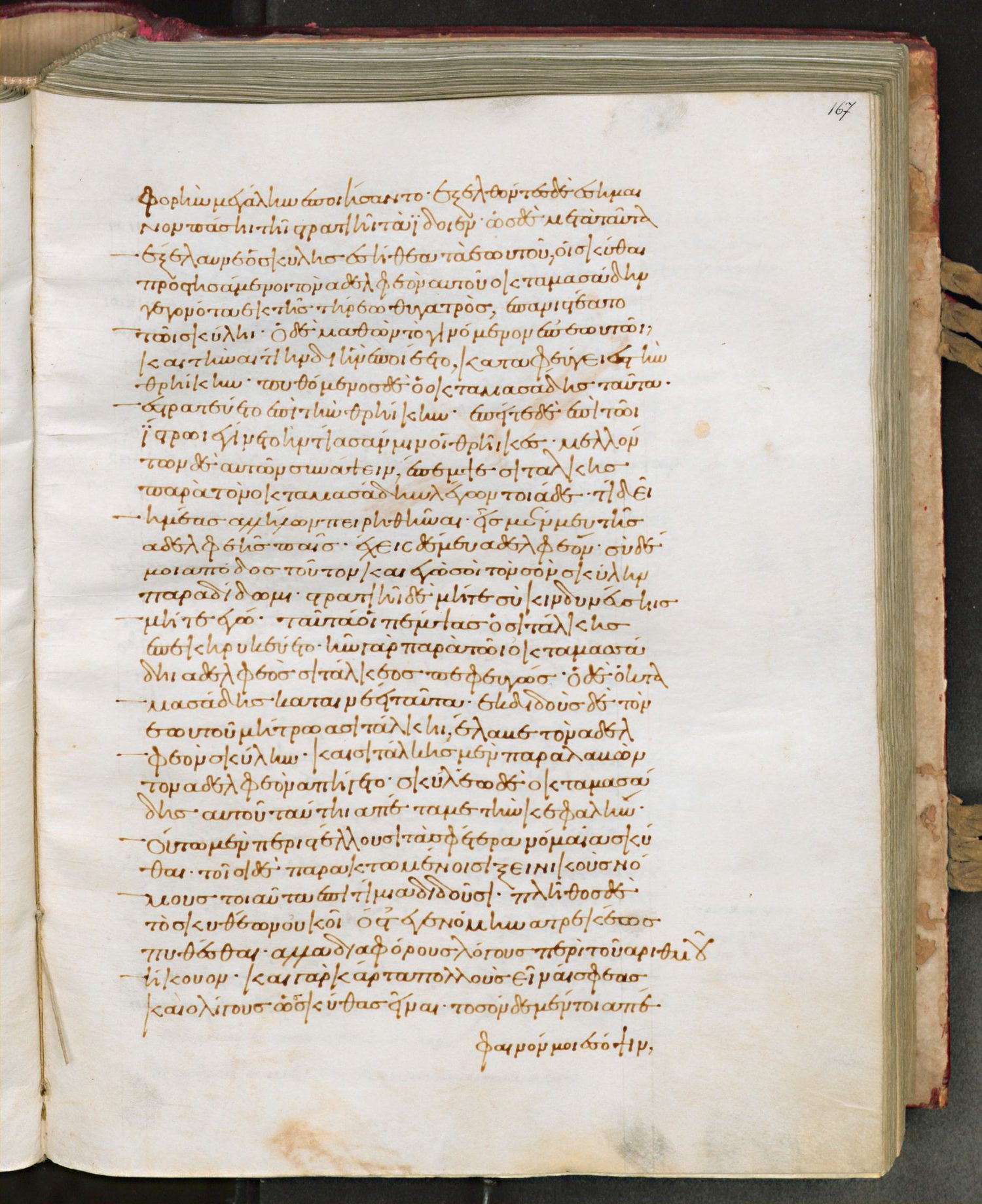
Laur. Plut. 70.3, fol. 167r: Greek here 4.79.5 to 4.81.2. Checked on the image (first and last words read and located in the Greek; each break checked against the neighbouring page): fol. 167r begins ‹-φορὴν μεγάλην ἐποιήσαντο, ἐξελθόντες› (4.79.5), ends ‹Σκύθας εἶναι.τοσόνδε μέντοι ἀπέ-› (4.81.2). The word ‹συμφορὴν› is divided between fol. 166v and fol. 167r; it is given with fol. 166v. English here: 4.80.1 to 4.81.1 (Godley's sentences for the sections whose Greek lies mostly on this page).
4.79.5μεγάλην ἐποιήσαντο, ἐξελθόντες δὲ ἐσήμαινον πάσῃ τῇ στρατιῇ τὰ ἴδοιεν. 4.80.1ὡς δὲ μετὰ ταῦτα ἐξήλαυνε ὁ Σκύλης ἐς ἤθεα τὰ ἑωυτοῦ, οἱ Σκύθαι προστησάμενοι τὸν ἀδελφεὸν αὐτοῦ Ὀκταμασάδην, γεγονότα ἐκ τῆς Τήρεω θυγατρός, ἐπανιστέατο τῷ Σκύλῃ. 4.80.2ὁ δὲ μαθὼν τὸ γινόμενον ἐπʼ ἑωυτῷ καὶ τὴν αἰτίην διʼ ἣν ἐποιέετο, καταφεύγει ἐς τὴν Θρηίκην. πυθόμενος δὲ ὁ Ὀκταμασάδης ταῦτα ἐστρατεύετο ἐπὶ τὴν Θρηίκην. ἐπείτε δὲ ἐπὶ τῷ Ἴστρῳ ἐγένετο, ἠντίασάν μιν οἱ Θρήικες, μελλόντων δὲ αὐτῶν συνάψειν ἔπεμψε Σιτάλκης παρὰ τὸν Ὀκταμασάδην λέγων τοιάδε. 4.80.3τι δεῖ ἡμέας ἀλλήλων πειρηθῆναι; εἶς μέν μευ τῆς ἀδελφεῆς παῖς, ἔχεις δέ μευ ἀδελφεόν. σὺ δέ μοι ἀπόδος τοῦτον, καὶ ἐγὼ σοὶ τὸν σὸν Σκύλην παραδίδωμι· στρατιῇ δὲ μήτε σὺ κινδυνεύσῃς μήτʼ ἐγώ. 4.80.4ταῦτά οἱ πέμψας ὁ Σιτάλκης ἐπεκηρυκεύετο· ἦν γὰρ παρὰ τῷ Ὀκταμασάδη ἀδελφεὸς Σιτάλκεω πεφευγώς. ὁ δὲ Ὀκταμασάδης καταινέει ταῦτα, ἐκδοὺς δὲ τὸν ἑωυτοῦ μήτρωα Σιτάλκῃ ἔλαβε τὸν ἀδελφεὸν Σκύλην. 4.80.5καὶ Σιτάλκης μὲν παραλαβὼν τὸν ἀδελφεὸν ἀπήγετο, Σκύλεω δὲ Ὀκταμασάδης αὐτοῦ ταύτῃ ἀπέταμε τὴν κεφαλήν. οὕτω μὲν περιστέλλουσι τὰ σφέτερα νόμαια Σκύθαι, τοῖσι δὲ παρακτωμένοισι ξεινικοὺς νόμους τοιαῦτα ἐπιτίμια διδοῦσι. 4.81.1πλῆθος δὲ τὸ Σκυθέων οὐκ οἷος τε ἐγενόμην ἀτρεκέως πυθέσθαι, ἀλλὰ διαφόρους λόγους περὶ τοῦ ἀριθμοῦ ἤκουον· καὶ γὰρ κάρτα πολλοὺς εἶναι σφέας καὶ ὀλίγους ὡς Σκύθας εἶναι. 4.81.2τοσόνδε μέντοι ἀπέφαινόν
4.80.1After this Scyles rode away to his own place; but the Scythians rebelled against him, setting up for their king his brother Octamasades, son of the daughter of Teres. 4.80.2Scyles, learning how they dealt with him and the reason of their so doing, fled into Thrace; and when Octamasades heard this he led his army thither. But when he was beside the Ister, the Thracians barred his way; and when the armies were like to join battle Sitalces sent this message to Octamasades: “Wherefore should we essay each other’s strength? 4.80.3You are my sister’s son, and you have with you my brother; do you give him back to me, and I give up your Scyles to you; and let neither of us endanger our armies.” 4.80.4Such was the offer sent to him by Sitalces; for Sitalces’ brother had fled from him and was with Octamasades. The Scythian agreed to this, and received his brother Scyles, giving up his own uncle to Sitalces. 4.80.5Sitalces then took his brother and carried him away, but Octamasades beheaded Scyles on the spot. So closely do the Scythians guard their usages, and such penalties do they lay on those who add foreign customs to their own. 4.81.1How many the Scythians are I was not able to learn with exactness, but the accounts which I heard concerning the number did not tally, some saying that they are very many, and some that they are but few, so far as they are true Scythians.
Where on the image
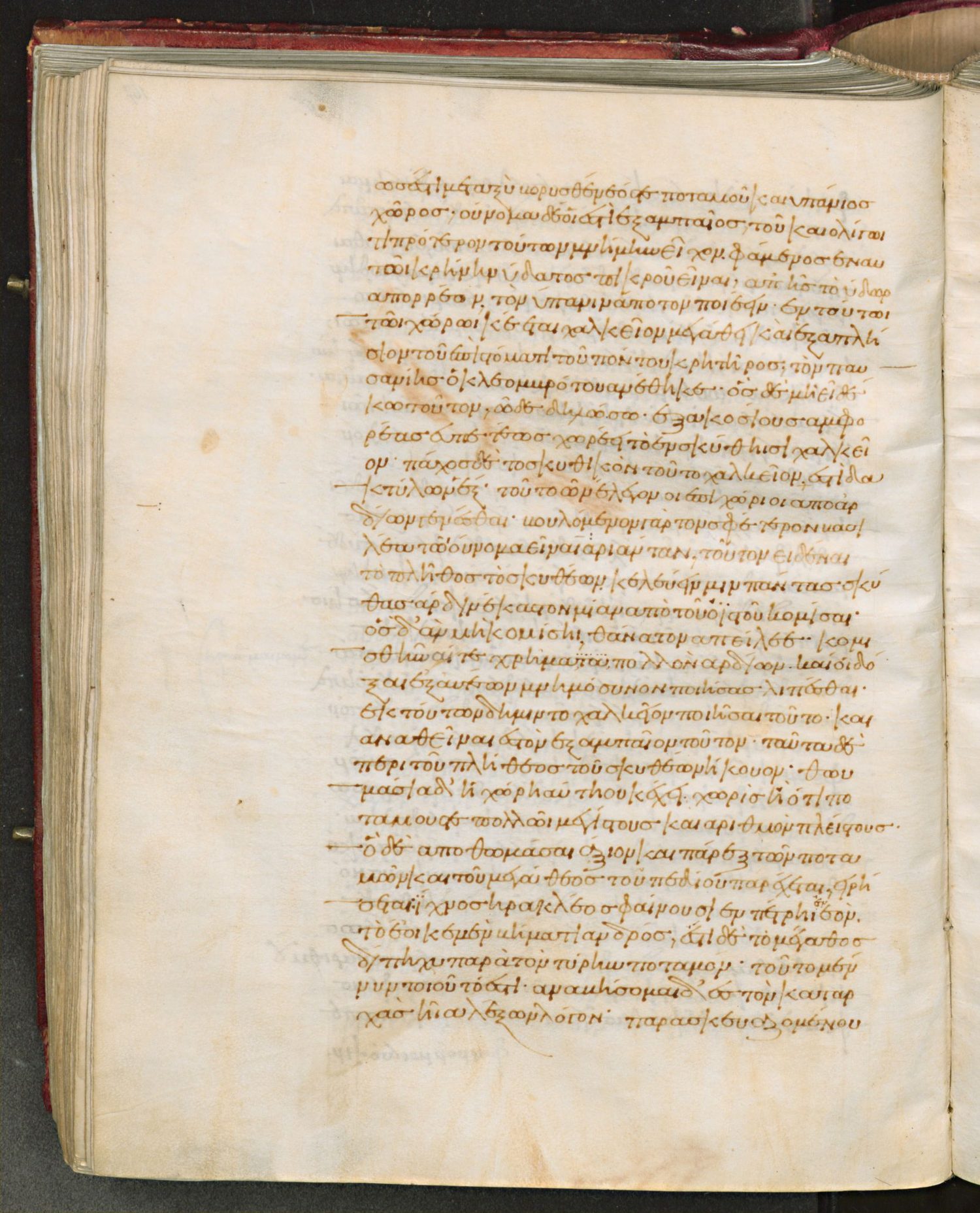
Laur. Plut. 70.3, fol. 167v: Greek here 4.81.2 to 4.82.1. Checked on the image (first and last words read and located in the Greek; each break checked against the neighbouring page): fol. 167v begins ‹-φαινόν μοι ἐς ὄψιν.› (4.81.2), ends ‹ἀρχὰς ἤια λέξων λόγον.παρασκευαζομένου› (4.83.1). The word ‹ἀπέφαινόν› is divided between fol. 167r and fol. 167v; it is given with fol. 167r. English here: 4.81.2 to 4.82.1 (Godley's sentences for the sections whose Greek lies mostly on this page).
4.81.2μοι ἐς ὄψιν. ἔστι μεταξὺ Βορυσθένεός τε ποταμοῦ καὶ Ὑπάνιος χῶρος, οὔνομα δέ οἱ ἐστὶ Ἐξαμπαῖος· τοῦ καὶ ὀλίγῳ τι πρότερον τούτων μνήμην εἶχον, φάμενος ἐν αὐτῷ κρήνην ὕδατος πικροῦ εἶναι, ἀπʼ ἧς τὸ ὕδωρ ἀπορρέον τὸν Ὕπανιν ἄποτον ποιέειν. 4.81.3ἐν τούτῳ τῷ χώρῳ κέεται χαλκήιον, μεγάθει καὶ ἑξαπλήσιον τοῦ ἐπὶ στόματι τοῦ Πόντου κρητῆρος, τὸν Παυσανίης ὁ Κλεομβρότου ἀνέθηκε. 4.81.4ὃς δὲ μὴ εἶδε κω τοῦτον, ὧδε δηλώσω. ἑξακοσίους ἀμφορέας εὐπετέως χωρέει τὸ ἐν Σκύθῃσι χαλκήιον, πάχος δὲ τὸ Σκυθικὸν τοῦτο χαλκήιον ἐστὶ δακτύλων ἕξ. τοῦτο ὦν ἔλεγον οἱ ἐπιχώριοι ἀπὸ ἀρδίων γενέσθαι. 4.81.5βουλόμενον γὰρ τὸν σφέτερον βασιλέα, τῶ οὔνομα εἶναι Ἀριάνταν, τοῦτον εἰδέναι τὸ πλῆθος τὸ Σκυθέων κελεύειν μιν πάντας Σκύθας ἄρδιν ἕκαστον μίαν ἀπὸ τοῦ ὀιστοῦ κομίσαι. ὃς δʼ ἄν μὴ κομίσῃ, θάνατον ἀπείλεε. 4.81.6κομισθῆναι τε δὴ χρῆμα πολλὸν ἀρδίων καί οἱ δόξαι ἐξ αὐτέων μνημόσυνον ποιήσαντι λιπέσθαι. ἐκ τουτέων δή μιν τὸ χαλκήιον ποιῆσαι τοῦτο καὶ ἀναθεῖναι ἐς τὸν Ἐξαμπαῖον τοῦτον. ταῦτα δὲ περὶ τοῦ πλήθεος τοῦ Σκυθέων ἤκουον. 4.82.1θωμάσια δὲ ἡ χώρη αὕτη οὐκ ἔχει, χωρὶς ἢ ὅτι ποταμούς τε πολλῷ μεγίστους καὶ ἀριθμὸν πλείστους. τὸ δὲ ἀποθωμάσαι ἄξιον καὶ πάρεξ τῶν ποταμῶν καὶ τοῦ μεγάθεος τοῦ πεδίου παρέχεται, εἰρήσεται. ἴχνος Ἡρακλέος φαίνουσι ἐν πέτρῃ ἐνεόν, τὸ ἔοικε μὲν βήματι ἀνδρός, ἔστι δὲ τὸ μέγαθος δίπηχυ, παρὰ τὸν Τύρην ποταμόν. τοῦτο μέν νυν τοιοῦτο ἐστί, ἀναβήσομαι δὲ ἐς τὸν κατʼ ἀρχὰς ἤια λέξων λόγον.
4.81.2But thus much they made me to see for myself:—There is a region between the rivers Borysthenes and Hypanis, the name of which is Exampaeus; this is the land whereof I lately made mention when I said that there is a spring of salt water in it, the water from which makes the Hypanis unfit to drink. 4.81.3In this region stands a bronze vessel, as much as six times greater than the cauldron dedicated by Pausanias son of Cleombrotus at the entrance of the Pontus. 4.81.4To any who has not yet seen this latter I will thus make my meaning plain: the Scythian bronze vessel easily contains five thousand and four hundred gallons, and it is of six fingers’ thickness. This vessel (so said the people of the country) was made out of arrowheads. 4.81.5For their king, whose name was Ariantas, desiring to know the numbers of the Scythians, commanded every Scythian to bring him the point from an arrow, threatening all who should not so do with death. 4.81.6So a vast number of arrow-heads was brought, and he resolved to make and leave a memorial out of them; and he made of these this bronze vessel, and set it up in this country Exampaeus. Thus much I heard concerning the number of the Scythians. 4.82.1As for marvels, there are none in the land, save that it has rivers by far the greatest and the most numerous in the world; and over and above the rivers and the great extent of the plains there is one most wondrous thing for me to tell of: they show a footprint of Heracles by the river Tyras stamped on rock, like the mark of a man’s foot, but two cubits in length. Having so described this I will now return to the story which I began to relate.
Notes
- Greek: the text printed in A. D. Godley's Loeb edition, via Perseus (tlg0016.tlg001.perseus-grc2). Square brackets mark words the editor considers later additions; [...] marks a gap the editor indicates. Perseus note markers are omitted.
- English: A. D. Godley, Herodotus vol. 2 (1921) (Loeb Classical Library), as transcribed on Wikisource. Godley's footnotes are omitted.
- Section numbers in the English were placed by comparing Godley's text with the Perseus version of his translation; where a section begins inside one of Godley's sentences, the English is kept with the page that holds the start of that sentence.
Cite
Sources
- Source: Florence, Laur. Plut. 70.3 (10th c.) via BML Teca Digitale + Greek of Godley's Loeb (Perseus) + English of A. D. Godley (Loeb, Wikisource) (holding institution)
- Critical edition: Greek of A. D. Godley's Loeb edition (1920-1925), via Perseus
← previous · → next · v cycle view · l back to library