Herodotus, Histories 4.83-98: Darius crosses into Europe
Introduction
Herodotus of Halicarnassus wrote the Histories in the third quarter of the 5th century BCE, an inquiry into the deeds of Greeks and barbarians and the causes of the wars between them, later divided into nine books. Book 4 tells of Darius' expedition against the Scythians, with Herodotus' account of Scythia, its peoples, rivers and customs, and of the shape of the world, and of the Persian expedition against Barca, with the history of Cyrene and a description of the peoples of Libya.
The photographs are of Florence, Biblioteca Medicea Laurenziana, Plut. 70.3 (parchment, 10th century, 374 folios, 31 lines a page), Herodotus, Histories (codex A of the editors), the oldest surviving manuscript of the complete Histories, from the Teca Digitale of the Biblioteca Medicea Laurenziana. Each section below is the text of one page, or of the part of a page that falls within these chapters. The first and last words of every page were read on the photograph and located in the Greek, and every page break was checked against the next page; the notes quote these words. Readers' notes in the margins are not part of the text and are mentioned where they occur.
The Greek is the text printed in A. D. Godley's Loeb edition (1920-1925), from Perseus; it is the edited text, not a transcription of the manuscript, whose wording differs in places. The English is Godley's translation as printed, from Wikisource. Godley's English carries only chapter numbers; the section numbers shown in it were placed by comparison with the Perseus version of his translation. Each page's English is cut at the end of one of Godley's sentences, so it can begin or end a few lines away from the Greek of the page; each note gives the exact ranges.
This entry covers chapters 4.83-98, on fol. 167v to 171v.
How was this verified? (Provenance)
Where on the image
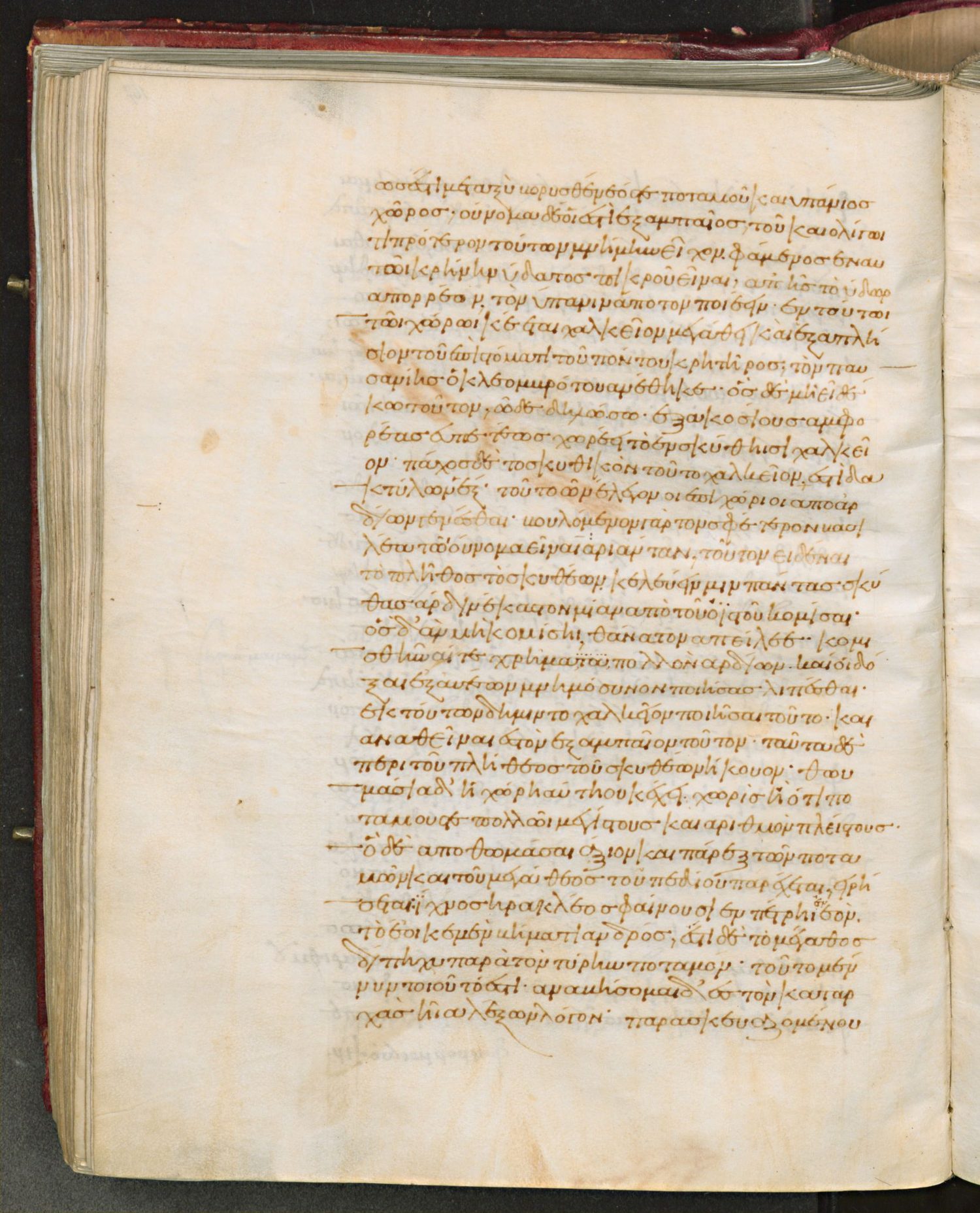
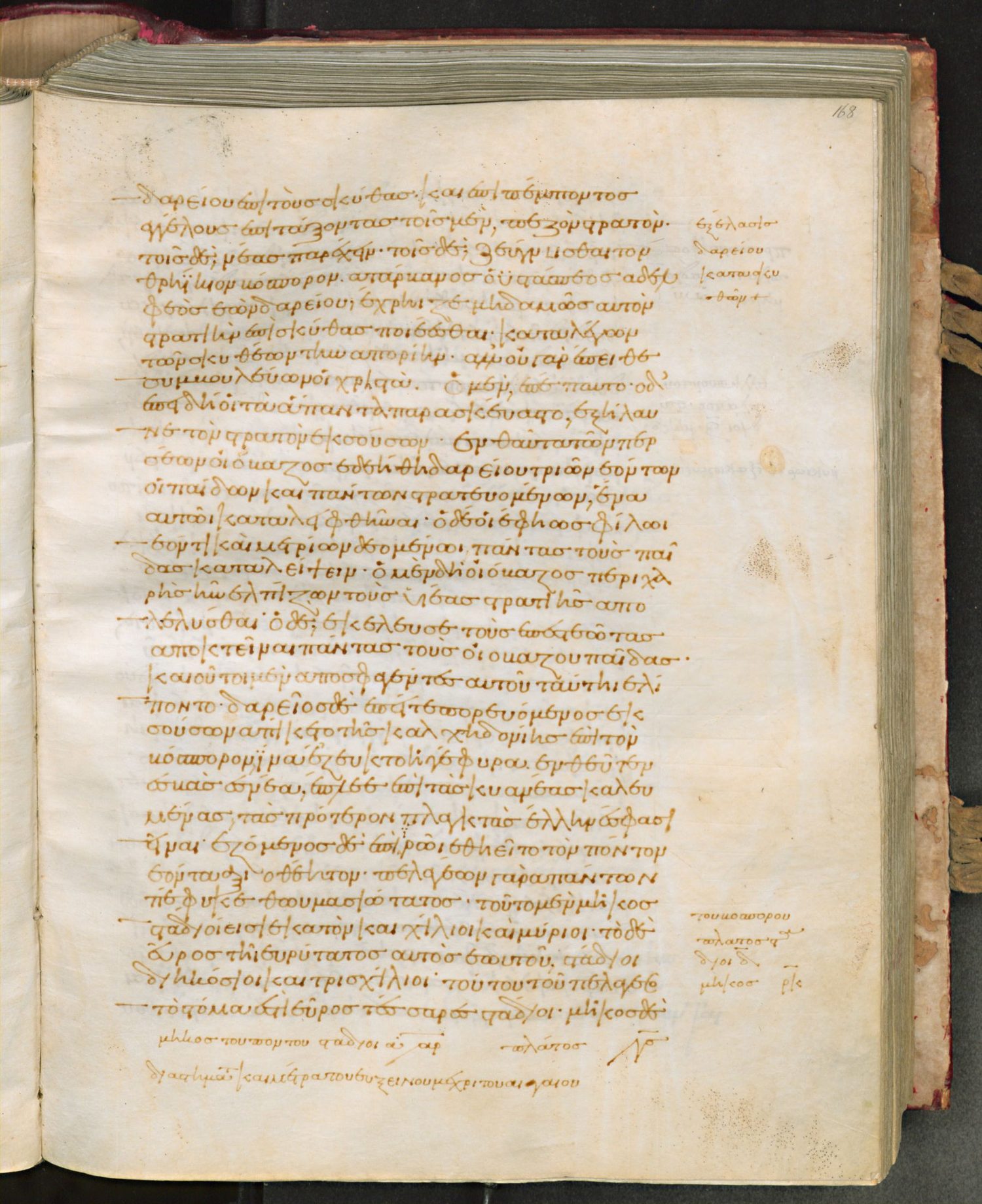
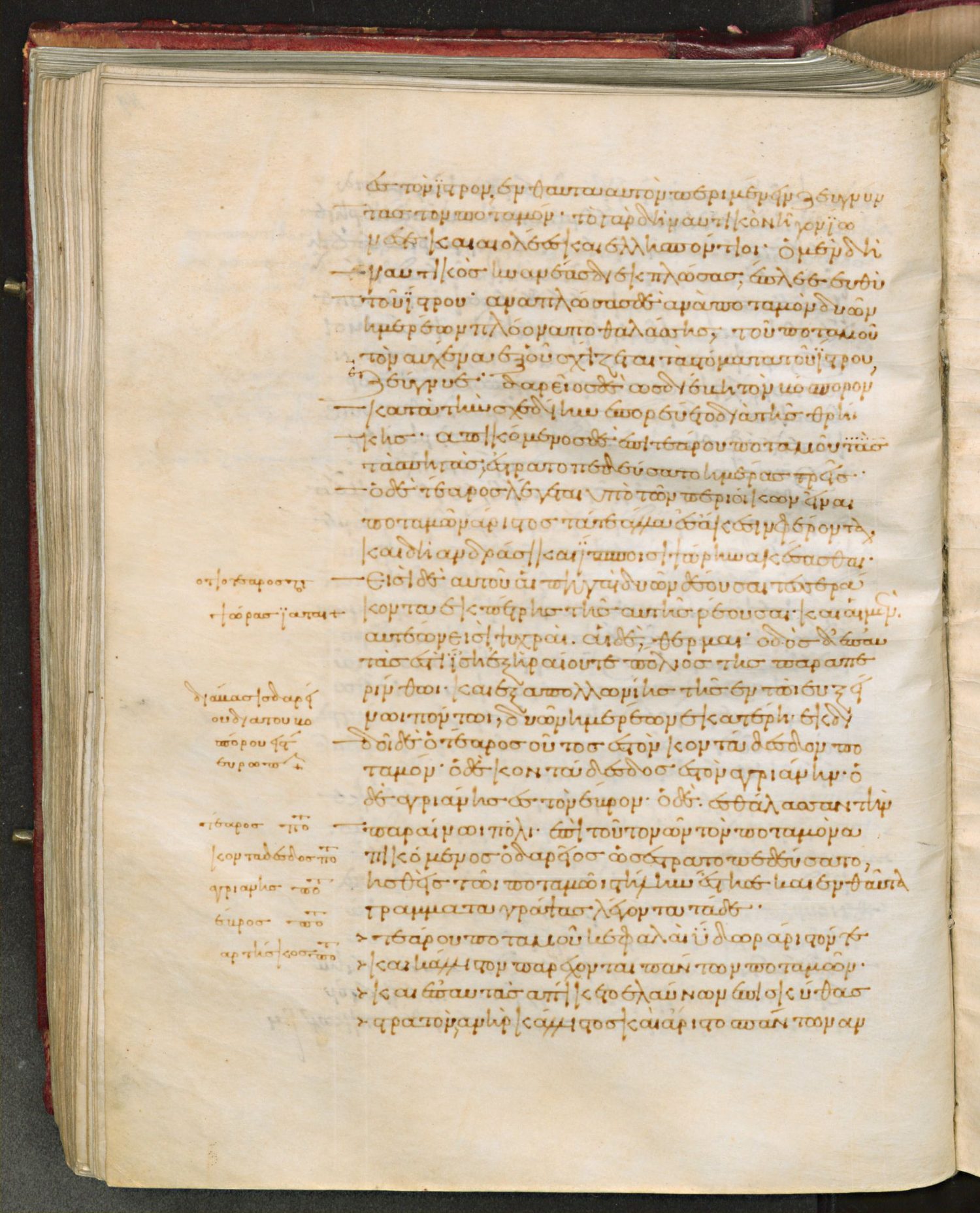
Laur. Plut. 70.3, fol. 167v, 168r: Greek here 4.83.1 to 4.85.3. Checked on the image (first and last words read and located in the Greek; each break checked against the neighbouring page): fol. 167v begins ‹-φαινόν μοι ἐς ὄψιν.› (4.81.2), ends ‹ἀρχὰς ἤια λέξων λόγον.παρασκευαζομένου› (4.83.1). The word ‹ἀπέφαινόν› is divided between fol. 167r and fol. 167v; it is given with fol. 167r. fol. 168r begins ‹Δαρείου ἐπὶ τοὺς Σκύθας› (4.83.1), ends ‹τέσσερες στάδιοι· μῆκος δὲ› (4.85.3). Readers' notes stand in the lower and outer margins. This section joins the text of fol. 167v and 168r that belongs to these chapters, because the part on one of the pages is too short to carry any of Godley's sentences on its own. English here: 4.83.1 to 4.85.2 (Godley's sentences for the sections whose Greek lies mostly on this page).
4.83.1παρασκευαζομένου Δαρείου ἐπὶ τοὺς Σκύθας καὶ ἐπιπέμποντος ἀγγέλους ἐπιτάξοντας τοῖσι μὲν πεζὸν στρατόν, τοῖσι δὲ νέας παρέχειν, τοῖσι δὲ ζεύγνυσθαι τὸν Θρηίκιον Βόσπορον Ἀρτάβανος ὁ Ὑστάσπεος, ἀδελφεὸς ἐὼν Δαρείου, ἐχρήιζε μηδαμῶς αὐτὸν στρατηίην ἐπὶ Σκύθας ποιέεσθαι, καταλέγων τῶν Σκυθέων τὴν ἀπορίην. 4.83.2ἀλλʼ οὐ γὰρ ἔπειθε συμβουλεύων οἱ χρηστά, ὃ μὲν ἐπέπαυτο, ὁ δέ, ἐπειδή οἱ τὰ ἅπαντα παρεσκεύαστο, ἐξήλαυνε τὸν στρατὸν ἐκ Σούσων. 4.84.1ἐνθαῦτα τῶν Περσέων Οἰόβαζος ἐδεήθη Δαρείου τριῶν ἐόντων οἱ παίδων καὶ πάντων στρατευομένων ἕνα αὐτῷ καταλειφθῆναι. ὁ δὲ ἔφη ὡς φίλῳ ἐόντι καὶ μετρίων δεομένῳ πάντας τοὺς παῖδας καταλείψειν. 4.84.2ὁ μὲν δὴ Οἰόβαζος περιχαρὴς ἦν, ἐλπίζων τοὺς υἱέας στρατηίης ἀπολελύσθαι. ὁ δὲ ἐκέλευσε τοὺς ἐπὶ τούτων ἐπεστεῶτας ἀποκτεῖναι πάντας τοὺς Οἰοβάζου παῖδας. 4.85.1καὶ οὗτοι μὲν ἀποσφαγέντες αὐτοῦ ταύτῃ ἐλείποντο· Δαρεῖος δὲ ἐπείτε πορευόμενος ἐκ Σούσων ἀπίκετο τῆς Καλχηδονίης ἐπὶ τὸν Βόσπορον ἵνα ἔζευκτο ἡ γέφυρα, ἐνθεῦτεν ἐσβὰς ἐς νέα ἔπλεε ἐπὶ τὰς Κυανέας καλευμένας, τὰς πρότερον πλαγκτὰς Ἕλληνες φασὶ εἶναι, ἑζόμενος δὲ ἐπὶ ῥίῳ ἐθηεῖτο τὸν Πόντον ἐόντα ἀξιοθέητον. 4.85.2πελαγέων γὰρ ἁπάντων πέφυκε θωμασιώτατος· τοῦ τὸ μὲν μῆκος στάδιοι εἰσὶ ἑκατὸν καὶ χίλιοι καὶ μύριοι, τὸ δὲ εὖρος, τῇ εὐρύτατος αὐτὸς ἑωυτοῦ, στάδιοι τριηκόσιοι καὶ τρισχίλιοι. 4.85.3τούτου τοῦ πελάγεος τὸ στόμα ἐστὶ εὖρος τέσσερες στάδιοι· μῆκος δὲ,
4.83.1While Darius was making preparations against the Scythians, and sending messengers to charge some to furnish an army and some to furnish ships, and others again to bridge the Thracian Bosporus, Artabanus, son of Hystaspes and Darius’ brother, desired of him by no means to make an expedition against the Scythians, telling him how hard that people were to deal withal. 4.83.2But when he could not move the king for all his good counsel, Artabanus ceased to advise, and Darius, all his preparations being now made, led his army from Susa. 4.84.1Then Oeobazus a Persian, who had three sons, all with the army, entreated Darius that one might be left behind. “Nay,” said the king, “you are my friend, and your desire is but reasonable; I will leave all your sons.” 4.84.2Oeobazus rejoiced greatly, supposing that his sons were released from service; but Darius bade those whose business it was to put all Oeobazus’ sons to death. 4.85.1So their throats were cut, and they were all left there; but Darius, when in his march from Susa he came to that place in the territory of Calchedon where the Bosporus was bridged, took ship and sailed to the Dark Rocks (as they are called) which the Greeks say did formerly move upon the waters; there he sat on a headland and viewed the Pontus, a marvellous sight. 4.85.2For it is of all seas the most wonderful. Its length is eleven thousand one hundred furlongs, and its breadth, at the place where it is widest, three thousand three hundred.
Where on the image
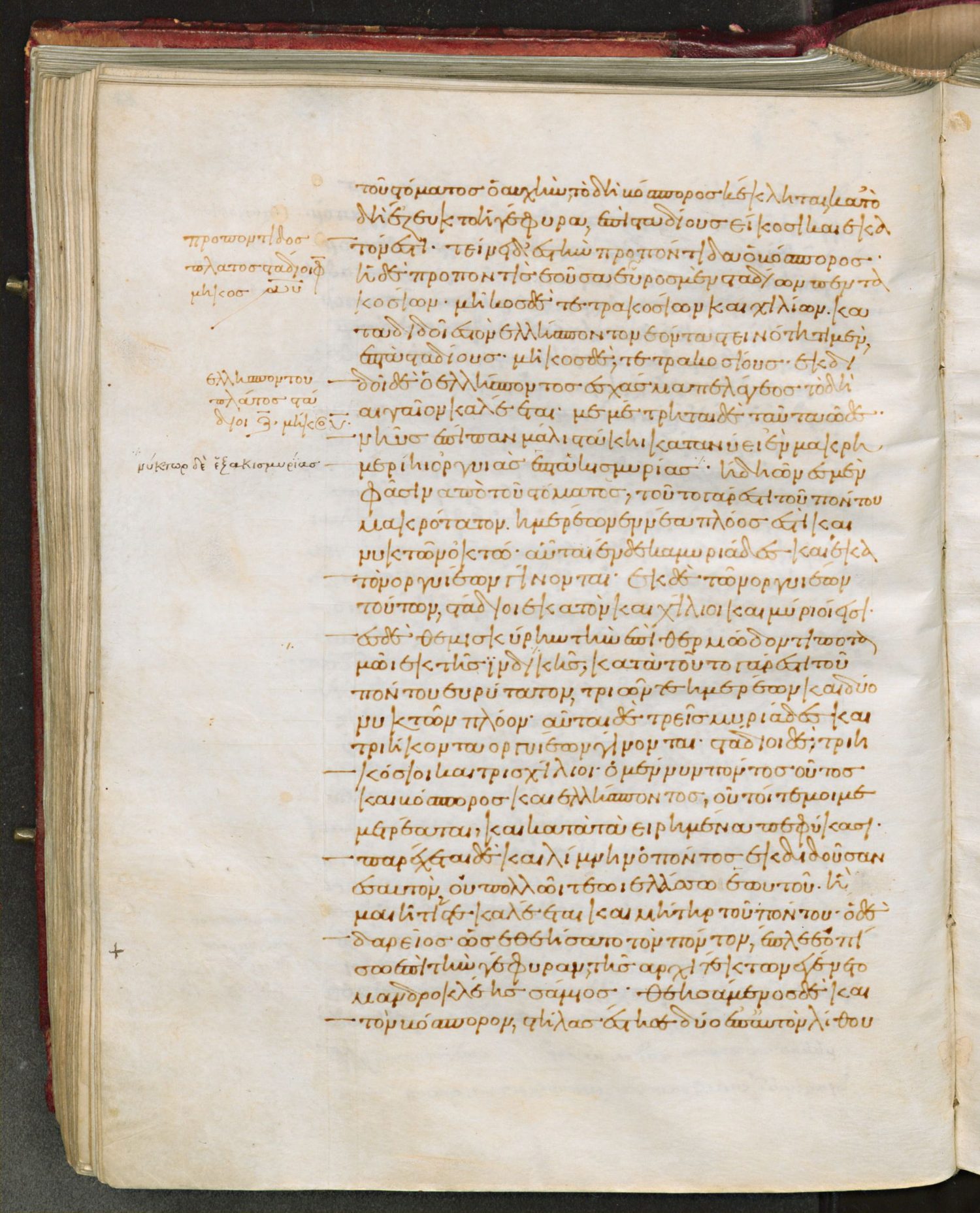
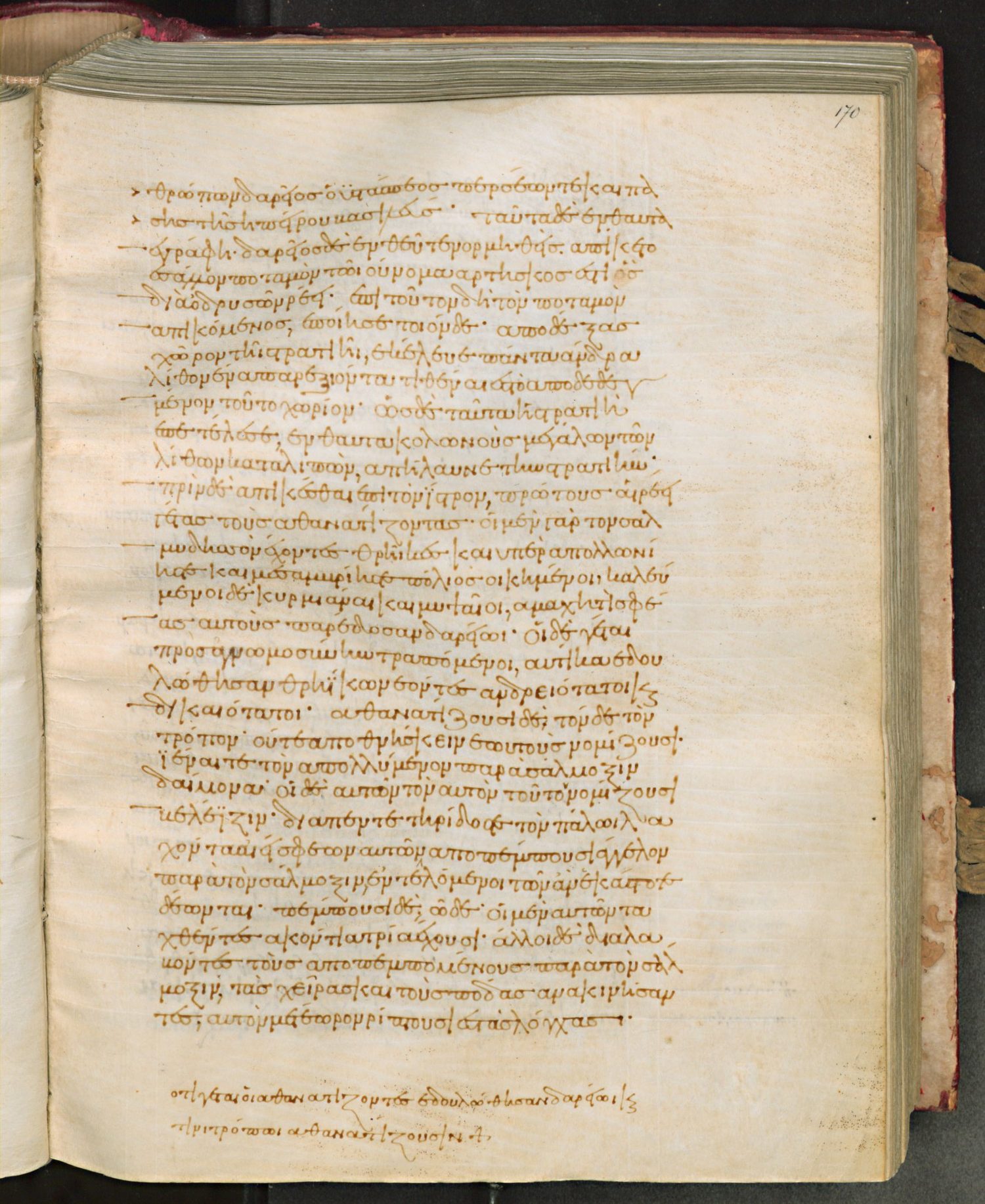
Laur. Plut. 70.3, fol. 168v: Greek here 4.85.3 to 4.87.1. Checked on the image (first and last words read and located in the Greek; each break checked against the neighbouring page): fol. 168v begins ‹τοῦ στόματος ὁ αὐχήν,› (4.85.3), ends ‹δύο ἐπʼ αὐτοῦ λίθου› (4.87.1). English here: 4.85.3 to 4.86.4 (Godley's sentences for the sections whose Greek lies mostly on this page).
4.85.3τοῦ στόματος ὁ αὐχήν, τὸ δὴ Βόσπορος κέκληται, κατʼ ὃ δὴ ἔζευκτο ἡ γέφυρα, ἐπὶ σταδίους εἴκοσι καὶ ἑκατόν ἐστι. τείνει δʼ ἐς τὴν Προποντίδα ὁ Βόσπορος· 4.85.4ἡ δὲ Προποντὶς ἐοῦσα εὖρος μὲν σταδίων πεντακοσίων, μῆκος δὲ τετρακοσίων καὶ χιλίων, καταδιδοῖ ἐς τὸν Ἑλλήσποντον ἐόντα στεινότητα μὲν ἑπτὰ σταδίους, μῆκος δὲ τετρακοσίους. ἐκδιδοῖ δὲ ὁ Ἑλλήσποντος ἐς χάσμα πελάγεος τὸ δὴ Αἰγαῖον καλέεται. 4.86.1μεμέτρηται δὲ ταῦτα ὧδε. νηῦς ἐπίπαν μάλιστα κῃ κατανύει ἐν μακρημερίῃ ὀργυιὰς ἑπτακισμυρίας, νυκτὸς δὲ ἑξακισμυρίας. 4.86.2ἤδη ὦν ἐς μὲν Φᾶσιν ἀπὸ τοῦ στόματος (τοῦτο γὰρ ἐστὶ τοῦ Πόντου μακρότατον) ἡμερέων ἐννέα πλόος ἐστὶ καὶ νυκτῶν ὀκτώ· αὗται ἕνδεκα μυριάδες καὶ ἑκατὸν ὀργυιέων γίνονται, ἐκ δὲ τῶν ὀργυιέων τουτέων στάδιοι ἑκατὸν καὶ χίλιοι καὶ μύριοι εἰσί. 4.86.3ἐς δὲ Θεμισκύρην τὴν ἐπὶ Θερμώδοντι ποταμῷ ἐκ τῆς Σινδικῆς (κατὰ τοῦτο γὰρ ἐστὶ τοῦ Πόντου εὐρύτατον) τριῶν τε ἡμερέων καὶ δύο νυκτῶν πλόος· αὗται δὲ τρεῖς μυριάδες καὶ τριήκοντα ὀργυιέων γίνονται, στάδιοι δὲ τριηκόσιοι καὶ τρισχίλιοι. 4.86.4ὁ μέν νυν Πόντος οὗτος καὶ Βόσπορός τε καὶ Ἑλλήσποντος οὕτω τέ μοι μεμετρέαται καὶ κατὰ τὰ εἰρημένα πεφύκασι, παρέχεται δὲ καὶ λίμνην ὁ Πόντος οὗτος ἐκδιδοῦσαν ἐς αὐτὸν οὐ πολλῷ τεῳ ἐλάσσω ἑωυτοῦ, ἣ Μαιῆτίς τε καλέεται καὶ μήτηρ τοῦ Πόντου. 4.87.1ὁ δὲ Δαρεῖος ὡς ἐθεήσατο τὸν Πόντον, ἔπλεε ὀπίσω ἐπὶ τὴν γέφυραν, τῆς ἀρχιτέκτων ἐγένετο Μανδροκλέης Σάμιος· θεησάμενος δὲ καὶ τὸν Βόσπορον στήλας ἔστησε δύο ἐπʼ αὐτοῦ λίθου
4.85.3The channel at the entrance of this sea is four furlongs broad; and in length, the narrow neck of the channel called Bosporus, across which the bridge was thrown, is as much as an hundred and twenty furlongs. 4.85.4The Bosporus reaches as far as to the Propontis; and the Propontis is five hundred furlongs wide and fourteen hundred long; its outlet is the Hellespont, which is no wider than seven furlongs, and four hundred in length. The Hellespont issues into a gulf of the sea which we call Aegaean. 4.86.1These measurements have been made after this manner: a ship will for the most part accomplish seventy thousand fathoms in a long day’s voyage, and sixty thousand by night. 4.86.2This being granted, seeing that from the Pontus’ mouth to the Phasis (which is the greatest length of the sea) it is a voyage of nine days and eight nights, the length of it will be eleven hundred and ten thousand fathoms, which make eleven thousand one hundred furlongs. 4.86.3From the Sindic region to Themiscura on the river Thermodon (for here is the greatest width of the Pontus) it is a voyage of three days and two nights, that is of three hundred and thirty thousand fathoms, or three thousand three hundred furlongs. 4.86.4Thus have I measured this Pontus and the Bosporus and Hellespont, and they are such as I have said. Moreover, there is seen a lake issuing into the Pontus and not much smaller than the sea itself; it is called the Maeetian lake, and the mother of the Pontus.
Where on the image
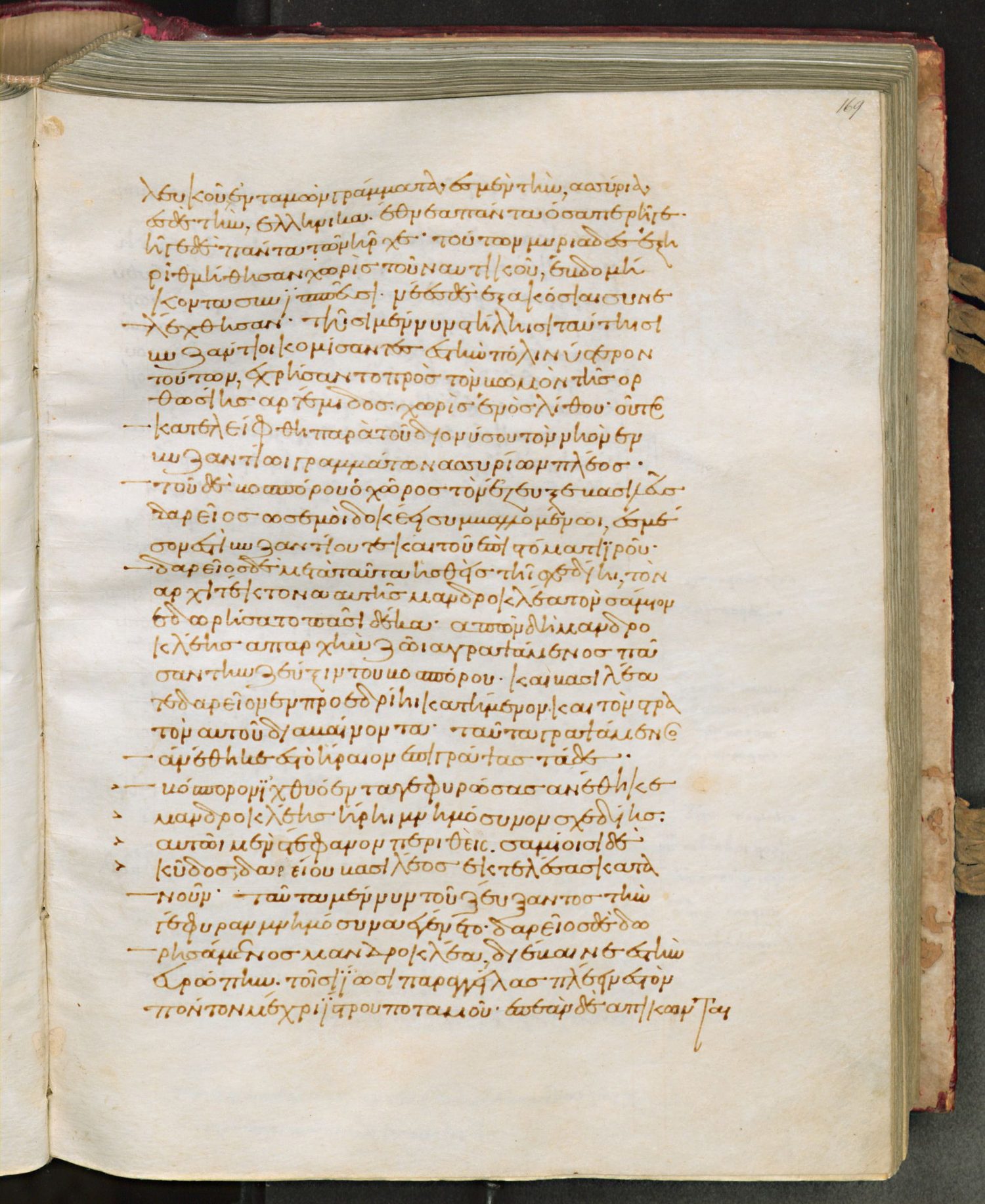
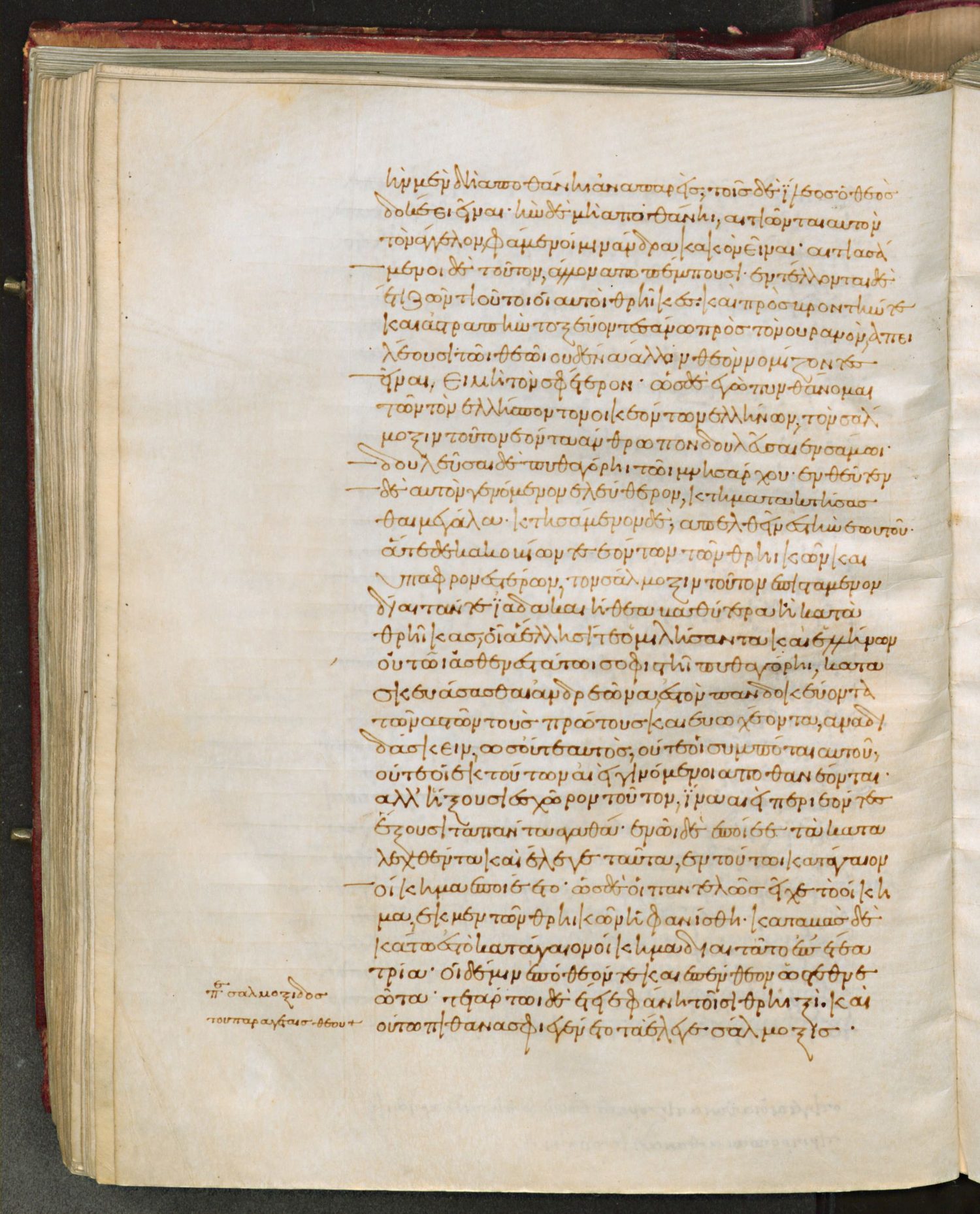
Laur. Plut. 70.3, fol. 169r: Greek here 4.87.1 to 4.89.1. Checked on the image (first and last words read and located in the Greek; each break checked against the neighbouring page): fol. 169r begins ‹λευκοῦ, ἐνταμὼν γράμματα ἐς› (4.87.1), ends ‹ποταμοῦ, ἐπεὰν δὲ ἀπίκωνται› (4.89.1). English here: 4.87.1 to 4.89.1 (Godley's sentences for the sections whose Greek lies mostly on this page).
4.87.1λευκοῦ, ἐνταμὼν γράμματα ἐς μὲν τὴν Ἀσσύρια ἐς δὲ τὴν Ἑλληνικά, ἔθνεα πάντα ὅσα περ ἦγε· ἦγε δὲ πάντα τῶν ἦρχε. τούτων μυριάδες ἐξηριθμήθησαν, χωρὶς τοῦ ναυτικοῦ, ἑβδομήκοντα σὺν ἱππεῦσι, νέες δὲ ἑξακόσιαι συνελέχθησαν. 4.87.2τῇσι μέν νυν στήλῃσι ταύτῃσι Βυζάντιοι κομίσαντες ἐς τὴν πόλιν ὕστερον τούτων ἐχρήσαντο πρὸς τὸν βωμὸν τῆς Ὀρθωσίης Ἀρτέμιδος, χωρὶς ἑνὸς λίθου· οὗτος δὲ κατελείφθη παρὰ τοῦ Διονύσου τὸν νηὸν ἐν Βυζαντίῳ, γραμμάτων Ἀσσυρίων πλέος. τοῦ δὲ Βοσπόρου ὁ χῶρος τὸν ἔζευξε βασιλεὺς Δαρεῖος, ὡς ἐμοὶ δοκέει συμβαλλομένῳ, μέσον ἐστὶ Βυζαντίου τε καὶ τοῦ ἐπὶ στόματι ἱροῦ. 4.88.1Δαρεῖος δὲ μετὰ ταῦτα ἡσθεὶς τῆ σχεδίῃ τὸν ἀρχιτέκτονα αὐτῆς Μανδροκλέα τὸν Σάμιον ἐδωρήσατο πᾶσι δέκα· ἀπʼ ὧν δὴ Μανδροκλέης ἀπαρχὴν ζῷα γραψάμενος πᾶσαν τὴν ζεῦξιν τοῦ Βοσπόρου καὶ βασιλέα τε Δαρεῖον ἐν προεδρίῃ κατήμενον καὶ τὸν στρατὸν αὐτοῦ διαβαίνοντα ταῦτα γραψάμενος ἀνέθηκε ἔς τὸ Ἥραιον, ἐπιγράψας τάδε. 4.88.2Βόσπορον ἰχθυόεντα γεφυρώσας ἀνέθηκε
Μανδροκλέης Ἥρῃ μνημόσυνον σχεδίης,
αὑτῷ μὲν στέφανον περιθείς, Σαμίοισι δὲ κῦδος,
Δαρείου βασιλέος ἐκτελέσας κατὰ νοῦν. 4.89.1ταῦτα μέν νυν τοῦ ζεύξαντος τὴν γέφυραν μνημόσυνα ἐγένετο. Δαρεῖος δὲ δωρησάμενος Μανδροκλέα διέβαινε ἐς τὴν Εὐρώπην, τοῖσι Ἴωσι παραγγείλας πλέειν ἐς τὸν Πόντον μέχρι Ἴστρου ποταμοῦ, ἐπεὰν δὲ ἀπίκωνται
4.87.1Having viewed the Pontus, Darius sailed back to the bridge, of which Mandrocles of Samos was the chief builder; and when he had viewed the Bosporus also, he set up by it two pillars of white marble, engraving on the one in Assyrian and on the other in Greek characters the names of all the nations that were in his army; in which were all the nations subject to him. The full tale of these, over and above the fleet, was seven hundred thousand men, reckoning therewith horsemen, and the number of ships that mustered was six hundred. 4.87.2These pillars were afterwards carried by the Byzantines into their city and there used to build the altar of Orthosian Artemis, save for one column covered with Assyrian writing that was left beside the temple of Dionysus at Byzantium. Now if my reckoning be true, the place where king Darius bridged the Bosporus was midway between Byzantium and the temple at the entrance of the sea. 4.88.1After this, Darius, being well content with his bridge of boats, made to Mandrocles the Samian a gift of ten of every kind; wherefrom Mandrocles took the firstfruits and therewith had a picture made showing the whole bridge of the Bosporus, and Darius sitting aloft on his throne and his army crossing; this he set up in the 4.88.2temple of Here, with this inscription: “This Picture Mandrocles to Here gives,
Whereby for ever his Achievement lives;
A Bridge of Boats o’er Bosp’rus’ fishful Flood
He built; Darius saw, and judg’d it good;
Thus for himself won Mandrocles a Crown,
And for his isle of Samos high Renown.” 4.89.1This then was done to preserve the name of the builder of the bridge. Darius, having rewarded Mandrocles, crossed over to Europe; he had bidden the Ionians to sail into the Pontus as far as the river Ister, and when they should come thither to wait for him there, bridging the river meanwhile; for the fleet was led by Ionians and Aeolians and men of the Hellespont.
Where on the image
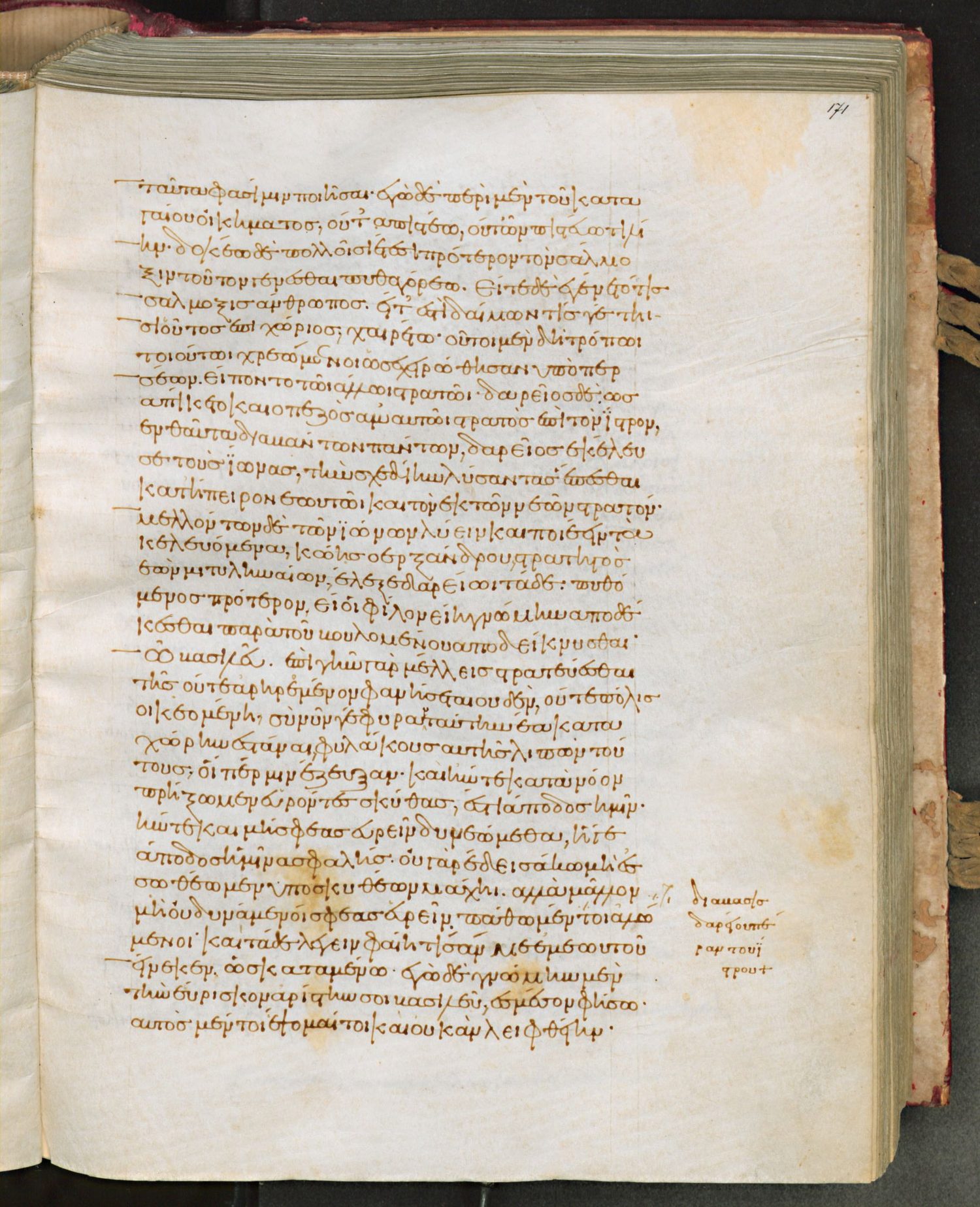
Laur. Plut. 70.3, fol. 169v: Greek here 4.89.1 to 4.91.2. Checked on the image (first and last words read and located in the Greek; each break checked against the neighbouring page): fol. 169v begins ‹ἐς τὸν Ἴστρον, ἐνθαῦτα› (4.89.1), ends ‹καὶ κάλλιστος πάντων ἀν-› (4.91.2). English here: 4.89.2 to 4.91.2 (Godley's sentences for the sections whose Greek lies mostly on this page).
4.89.1ἐς τὸν Ἴστρον, ἐνθαῦτα αὐτὸν περιμένειν ζευγνύντας τὸν ποταμόν. τὸ γὰρ δὴ ναυτικὸν ἦγον Ἴωνές τε καὶ Αἰολέες καὶ Ἑλλησπόντιοι. 4.89.2ὁ μὲν δὴ ναυτικὸς στρατὸς Κυανέας διεκπλώσας ἔπλεε ἰθὺ τοῦ Ἴστρου, ἀναπλώσας δὲ ἀνὰ ποταμὸν δυῶν ἡμερέων πλόον ἀπὸ θαλάσσης, τοῦ ποταμοῦ τὸν αὐχένα, ἔκ τοῦ σχίζεται τὰ στόματα τοῦ Ἴστρου, ἐζεύγνυε. 4.89.3Δαρεῖος δὲ ὡς διέβη τὸν Βόσπορον κατὰ τὴν σχεδίην, ἐπορεύετο διὰ τῆς Θρηίκης, ἀπικόμενος δὲ ἐπὶ Τεάρου ποταμοῦ τὰς πηγὰς ἐστρατοπεδεύσατο ἡμέρας τρεῖς. 4.90.1ὁ δὲ Τέαρος λέγεται ὑπὸ τῶν περιοίκων εἶναι ποταμῶν ἄριστος τὰ τε ἄλλα τὰ ἐς ἄκεσιν φέροντα καὶ δὴ καὶ ἀνδράσι καὶ ἵπποισι ψώρην ἀκέσασθαι. εἰσὶ δὲ αὐτοῦ αἱ πηγαὶ δυῶν δέουσαι τεσσεράκοντα, ἐκ πέτρης τῆς αὐτῆς ῥέουσαι, καὶ αἳ μὲν αὐτέων εἰσὶ ψυχραὶ αἳ δὲ θερμαί. 4.90.2ὁδὸς δʼ ἐπʼ αὐτάς ἐστι ἴση ἐξ Ἡραίου τε πόλιος τῆς παρὰ Περίνθῳ καὶ ἐξ Ἀπολλωνίης τῆς ἐν τῷ Εὐξείνῳ πόντῳ, δυῶν ἡμερέων ἑκατέρη. ἐκδιδοῖ δὲ ὁ Τέαρος οὗτος ἐς τὸν Κοντάδεσδον ποταμόν, ὁ δὲ Κοντάδεσδος ἐς τὸν Ἀγριάνην, ὁ δὲ Ἀγριάνης ἐς τὸν Ἕβρον, ὁ δὲ ἐς θάλασσαν τὴν παρʼ Αἴνῳ πόλι. 4.91.1ἐπὶ τοῦτον ὦν τὸν ποταμὸν ἀπικόμενος ὁ Δαρεῖος ὡς ἐστρατοπεδεύσατο, ἡσθεὶς τῷ ποταμῷ στήλην ἔστησε καὶ ἐνθαῦτα, γράμματα ἐγγράψας λέγοντα τάδε. 4.91.2Τεάρου ποταμοῦ κεφαλαὶ ὕδωρ ἄριστόν τε καὶ κάλλιστον παρέχονται πάντων ποταμῶν· καὶ ἐπʼ αὐτὰς ἀπίκετο ἐλαύνων ἐπὶ Σκύθας στρατὸν ἀνὴρ ἄριστος τε καὶ κάλλιστος πάντων ἀνθρώπων,
4.89.2So the fleet passed between the Dark Rocks and made sail straight for the Ister, and, having gone a two days’ voyage up the river from the sea, set about bridging the narrow channel of the river where its divers mouths part asunder. 4.89.3But Darius, having passed over the Bosporus on the bridge of ships, journeyed through Thrace to the sources of the river Tearus, where he encamped for three days. 4.90.1The Tearus is said in the country round to be the best of all rivers for all purposes of healing, but especially for the healing of the scab in men and horses. Its springs are thirty-eight in number, some cold and some hot, all flowing from the same rock. 4.90.2There are two roads to the place, one from the town of Heraeum near to Perinthus, one from Apollonia on the Euxine sea; each is a two days’ journey. This Tearus is a tributary of the river Contadesdus, and that of the Agrianes, and that again of the Hebrus, which issues into the sea near the city of Aenus. 4.91.1Having then come to this river and there encamped, Darius was pleased with the sight of it, and set up yet another pillar there, graven with this inscription,” 4.91.2From the sources of the river Tearus flows the best and fairest of all river waters; hither came, leading his army against the Scythians, the best and fairest of all men, even Darius son of Hystaspes and king of Persia and all the mainland.” Such was the inscription.
Where on the image
Laur. Plut. 70.3, fol. 170r: Greek here 4.91.2 to 4.94.2. Checked on the image (first and last words read and located in the Greek; each break checked against the neighbouring page): fol. 170r begins ‹-θρώπων, Δαρεῖος ὁ Ὑστάσπεος,› (4.91.2), ends ‹ῥίπτουσι ἐς τὰς λόγχας› (4.94.2). The word ‹ἀνθρώπων,› is divided between fol. 169v and fol. 170r; it is given with fol. 169v. English here: 4.92.1 to 4.94.2 (Godley's sentences for the sections whose Greek lies mostly on this page).
4.91.2Δαρεῖος ὁ Ὑστάσπεος, Περσέων τε καὶ πάσης τῆς ἠπείρου βασιλεύς. ταῦτα δὲ ἐνθαῦτα ἐγράφη. 4.92.1Δαρεῖος δὲ ἐνθεῦτεν ὁρμηθεὶς ἀπίκετο ἐπʼ ἄλλον ποταμὸν τῷ οὔνομα Ἀρτησκός ἐστι, ὃς διὰ Ὀδρυσέων ῥέει. ἐπὶ τοῦτον δὴ τὸν ποταμὸν ἀπικόμενος ἐποίησε τοιόνδε· ἀποδέξας χωρίον τῇ στρατιῇ ἐκέλευε πάντα ἄνδρα λίθον ἕνα παρεξιόντα τιθέναι ἐς τὸ ἀποδεδεγμένον τοῦτο χωρίον. ὡς δὲ ταῦτα ἡ στρατιὴ ἐπετέλεσε, ἐνθαῦτα κολωνοὺς μεγάλους τῶν λίθων καταλιπὼν ἀπήλαυνε τὴν στρατιήν. 4.93.1πρὶν δὲ ἀπικέσθαι ἐπὶ τὸν Ἴστρον, πρώτους αἱρέει Γέτας τοὺς ἀθανατίζοντας. οἱ μὲν γὰρ τὸν Σαλμυδησσὸν ἔχοντες Θρήικες καὶ ὑπὲρ Ἀπολλωνίης τε καὶ Μεσαμβρίης πόλιος οἰκημένοι, καλεύμενοι δὲ Κυρμιάναι καὶ Νιψαῖοι, ἀμαχητὶ σφέας αὐτοὺς παρέδοσαν Δαρείῳ· οἱ δὲ Γέται πρὸς ἀγνωμοσύνην τραπόμενοι αὐτίκα ἐδουλώθησαν, Θρηίκων ἐόντες ἀνδρηιότατοι καὶ δικαιότατοι. 4.94.1ἀθανατίζουσι δὲ τόνδε τὸν τρόπον· οὔτε ἀποθνήσκειν ἑωυτοὺς νομίζουσι ἰέναι τε τὸν ἀπολλύμενον παρὰ Σάλμοξιν δαίμονα· οἳ δὲ αὐτῶν τὸν αὐτὸν τοῦτον ὀνομάζουσι Γεβελέιζιν· 4.94.2διὰ πεντετηρίδος τε τὸν πάλῳ λαχόντα αἰεὶ σφέων αὐτῶν ἀποπέμπουσι ἄγγελον παρὰ τὸν Σάλμοξιν, ἐντελλόμενοι τῶν ἂν ἑκάστοτε δέωνται, πέμπουσι δὲ ὧδε· οἳ μὲν αὐτῶν ταχθέντες ἀκόντια τρία ἔχουσι, ἄλλοι δὲ διαλαβόντες τοῦ ἀποπεμπομένου παρὰ τὸν Σάλμοξιν τὰς χεῖρας καὶ τοὺς πόδας, ἀνακινήσαντες αὐτὸν μετέωρον ῥίπτουσι ἐς τὰς λόγχας.
4.92.1Thence Darius set forth and came to another river called Artescus, which flows through the country of the Odrysae; whither having come, he marked a place for the army to see, and bade every man as he passed by lay one stone in this place which he had shown. His army having so done, he made and left great hillocks of the stones and led his army away. 4.93.1But before he came to the Ister, he first subdued the Getae, who pretend to be immortal. The Thracians of Salmydessus and of the country above the towns of Apollonia and Mesambria, who are called Cyrmianae and Nipsaei, surrendered themselves unresisting to Darius; but the Getae, who are the bravest and most law-abiding of all Thracians, resisted with obstinacy, and were enslaved forthwith. 4.94.1As to their claim to be immortal, this is how they show it: they believe that they do not die, but that he who perishes goes to the god Salmoxis, or Gebeleïzis, as some of them call him. 4.94.2Once in every five years they choose by lot one of their people and send him as a messenger to Salmoxis, charged to tell of their needs; and this is their manner of sending: Three lances are held by men thereto appointed; others seize the messenger to Salmoxis by his hands and feet, and swing and hurl him aloft on to the spear-points.
Where on the image
Laur. Plut. 70.3, fol. 170v: Greek here 4.94.2 to 4.95.5. Checked on the image (first and last words read and located in the Greek; each break checked against the neighbouring page): fol. 170v begins ‹ἢν μὲν δὴ ἀποθάνῃ› (4.94.2), ends ‹τὰ ἔλεγε ὁ Σάλμοξις› (4.95.5). English here: 4.94.3 to 4.95.5 (Godley's sentences for the sections whose Greek lies mostly on this page).
4.94.2ἢν μὲν δὴ ἀποθάνῃ ἀναπαρείς, τοῖσι δὲ ἵλεος ὁ θεὸς δοκέει εἶναι· 4.94.3ἢν δὲ μὴ ἀποθάνῃ, αἰτιῶνται αὐτὸν τὸν ἄγγελον, φάμενοί μιν ἄνδρα κακὸν εἶναι, αἰτιησάμενοι δὲ τοῦτον ἄλλον ἀποπέμπουσι· ἐντέλλονται δὲ ἔτι ζῶντι. 4.94.4οὗτοι οἱ αὐτοὶ Θρήικες καὶ πρὸς βροντήν τε καὶ ἀστραπὴν τοξεύοντες ἄνω πρὸς τὸν οὐρανὸν ἀπειλέουσι τῷ θεῷ, οὐδένα ἄλλον θεὸν νομίζοντες εἶναι εἰ μὴ τὸν σφέτερον. 4.95.1ὡς δὲ ἐγὼ πυνθάνομαι τῶν τὸν Ἑλλήσποντον οἰκεόντων Ἑλλήνων καὶ Πόντον, τὸν Σάλμοξιν τοῦτον ἐόντα ἄνθρωπον δουλεῦσαι ἐν Σάμῳ, δουλεῦσαι δὲ Πυθαγόρῃ τῷ Μνησάρχου, 4.95.2ἐνθεῦτεν δὲ αὐτὸν γενόμενον ἐλεύθερον χρήματα κτήσασθαι μεγάλα, κτησάμενον δὲ ἀπελθεῖν ἐς τὴν ἑωυτοῦ. ἅτε δὲ κακοβίων τε ἐόντων τῶν Θρηίκων καὶ ὑπαφρονεστέρων, τὸν Σάλμοξιν τοῦτον ἐπιστάμενον δίαιτάν τε Ἰάδα καὶ ἤθεα βαθύτερα ἢ κατὰ Θρήικας, οἷα Ἕλλησι τε ὁμιλήσαντα καὶ Ἑλλήνων οὐ τῷ ἀσθενεστάτῳ σοφιστῇ Πυθαγόρῃ, 4.95.3κατασκευάσασθαι ἀνδρεῶνα, ἐς τὸν πανδοκεύοντα τῶν ἀστῶν τοὺς πρώτους καὶ εὐωχέοντα ἀναδιδάσκειν ὡς οὔτε αὐτὸς οὔτε οἱ συμπόται αὐτοῦ οὔτε οἱ ἐκ τούτων αἰεὶ γινόμενοι ἀποθανέονται, ἀλλʼ ἥξουσι ἐς χῶρον τοῦτον ἵνα αἰεὶ περιεόντες ἕξουσι τὰ πάντα ἀγαθά. 4.95.4ἐν ᾧ δὲ ἐποίεε τὰ καταλεχθέντα καὶ ἔλεγε ταῦτα, ἐν τούτῳ κατάγαιον οἴκημα ἐποιέετο. ὡς δέ οἱ παντελέως εἶχε τὸ οἴκημα, ἐκ μὲν τῶν Θρηίκων ἠφανίσθη, καταβὰς δὲ κάτω ἐς τὸ κατάγαιον οἴκημα διαιτᾶτο ἐπʼ ἔτεα τρία· 4.95.5οἳ δὲ μιν ἐπόθεόν τε καὶ ἐπένθεον ὡς τεθνεῶτα. τετάρτω δὲ ἔτεϊ ἐφάνη τοῖσι Θρήιξι, καὶ οὕτω πιθανά σφι ἐγένετο τὰ ἔλεγε ὁ Σάλμοξις.
4.94.3If he be killed by the cast, they believe that the god regards them with favour; but if he be not killed, they blame the messenger himself, deeming him a bad man, and send another messenger in place of him whom they blame. It is while the man yet lives that they charge him with the message. 4.94.4Moreover when there is thunder and lightning these same Thracians shoot arrows skyward as a threat to the god, believing in no other god but their own. 4.95.1For myself, I have been told by the Greeks who dwell beside the Hellespont and Pontus that this Salmoxis was a man who was once a slave in Samos, his master being Pythagoras son of Mnesarchus; 4.95.2presently, after being freed and gaining great wealth, he returned to his own country. Now the Thracians were a meanly-living and simple-witted folk, but this Salmoxis knew Ionian usages and a fuller way of life than the Thracian; for he had consorted with Greeks, and moreover with one of the greatest Greek teachers, Pythagoras; 4.95.3wherefore he made himself a hall, where he entertained and feasted the chief among his countrymen, and taught them that neither he nor his guests nor any of their descendants should ever die, but that they should go to a place where they would live for ever and have all good things. 4.95.4While he was doing as I have said and teaching this doctrine, he was all the while making him an underground chamber. When this was finished, he vanished from the sight of the Thracians, and descended into the underground chamber, where he lived for three 4.95.5years, the Thracians wishing him back and mourning him for dead; then in the fourth year he appeared to the Thracians, and thus they came to believe what Salmoxis had told them. Such is the Greek story about him.
Where on the image
Laur. Plut. 70.3, fol. 171r: Greek here 4.95.5 to 4.97.5. Checked on the image (first and last words read and located in the Greek; each break checked against the neighbouring page): fol. 171r begins ‹ταῦτα φασί μιν ποιῆσαι.ἐγὼ› (4.95.5), ends ‹καὶ οὐκ ἂν λειφθείην› (4.97.5). English here: 4.96.1 to 4.97.5 (Godley's sentences for the sections whose Greek lies mostly on this page).
4.95.5ταῦτα φασί μιν ποιῆσαι. 4.96.1ἐγὼ δὲ περὶ μὲν τούτου καὶ τοῦ καταγαίου οἰκήματος οὔτε ἀπιστέω οὔτε ὦν πιστεύω τι λίην, δοκέω δὲ πολλοῖσι ἔτεσι πρότερον τὸν Σάλμοξιν τοῦτον γενέσθαι Πυθαγόρεω. 4.96.2εἴτε δὲ ἐγένετό τις Σάλμοξις ἄνθρωπος, εἴτʼ ἐστὶ δαίμων τις Γέτῃσι οὗτος ἐπιχώριος, χαιρέτω. οὗτοι μὲν δὴ τρόπῳ τοιούτῳ χρεώμενοι ὡς ἐχειρώθησαν ὑπὸ Περσέων, εἵποντο τῷ ἄλλῳ στρατῷ. 4.97.1Δαρεῖος δὲ ὡς ἀπίκετο καὶ ὁ πεζὸς ἅμʼ αὐτῷ στρατὸς ἐπὶ τὸν Ἴστρον, ἐνθαῦτα διαβάντων πάντων Δαρεῖος ἐκέλευσε τούς τε Ἴωνας τὴν σχεδίην λύσαντας ἕπεσθαι κατʼ ἤπειρον ἑωυτῷ καὶ τὸν ἐκ τῶν νεῶν στρατόν. 4.97.2μελλόντων δὲ τῶν Ἰώνων λύειν καὶ ποιέειν τὰ κελευόμενα, Κώης ὁ Ἐρξάνδρου στρατηγὸς ἐὼν Μυτιληναίων ἔλεξε Δαρείῳ τάδε, πυθόμενος πρότερον εἰ οἱ φίλον εἴη γνώμην ἀποδέκεσθαι παρὰ τοῦ βουλομένου ἀποδείκνυσθαι. 4.97.3ὦ βασιλεῦ, ἐπὶ γῆν γὰρ μέλλεις στρατεύεσθαι τῆς οὔτε ἀρηρομένον φανήσεται οὐδὲν οὔτε πόλις οἰκεομένη· σύ νυν γέφυραν ταύτὴν ἔα κατὰ χώρην ἑστάναι, φυλάκους αὐτῆς λιπὼν τούτους οἵπερ μιν ἔζευξαν. 4.97.4καὶ ἤν τε κατὰ νόον πρήξωμεν εὑρόντες Σκύθας, ἔστι ἄποδος ἡμῖν, ἤν τε καὶ μή σφεας εὑρεῖν δυνώμεθα, ἥ γε ἄποδος ἡμῖν ἀσφαλής· οὐ γὰρ ἔδεισά κω μὴ ἑσσωθέωμεν ὑπὸ Σκυθέων μάχῃ, ἁλλὰ μᾶλλον μὴ οὐ δυνάμενοι σφέας εὑρεῖν πάθωμεν τι ἀλώμενοι. 4.97.5καὶ τάδε λέγειν φαίη τις ἄν με ἐμεωυτοῦ εἵνεκεν, ὡς καταμένω· ἐγὼ δὲ γνώμην μὲν τὴν εὕρισκον ἀρίστην σοί, βασιλεῦ, ἐς μέσον φέρω, αὐτὸς μέντοι ἕψομαί τοι καὶ οὐκ ἂν λειφθείην.
4.96.1For myself, I neither disbelieve nor fully believe the tale about Salmoxis and his underground chamber; but I think that he lived many years before Pythagoras; 4.96.2and whether there was a man called Salmoxis, or this be a name among the Getae for a god of their country, I have done with him. 4.97.1Such were the ways of the Getae, who were now subdued by the Persians and followed their army. When Darius and the land army with him had come to the Ister, and all had crossed, he bade the Ionians break the bridge and follow him in his march across the mainland, together with the men of the fleet. 4.97.2So the Ionians were preparing to break the bridge and do Darius’ behest; but Cöes son of Erxander, the general of the Mytilenaeans, having first enquired if Darius were willing to receive counsel from any man desiring to give it, said, “Seeing, O king! 4.97.3that you are about to march against a country where you will find neither tilled lands nor inhabited cities, do you now suffer this bridge to stand where it is, leaving those who made it to be its guards. 4.97.4Thus, if we find the Scythians and accomplish our will, we have a way of return; and even if we find them not, yet at least our way back is safe; for my fear has never yet been lest we be overcome by the Scythians in the field, but rather lest we should not be able to find them, and so wander astray to our hurt. 4.97.5Now perchance it may be said that I speak thus for my own sake, because I desire to remain behind; but it is not so; I do but declare before all that counsel which I judge best for you, and as for myself I would not be left here but will follow you.”
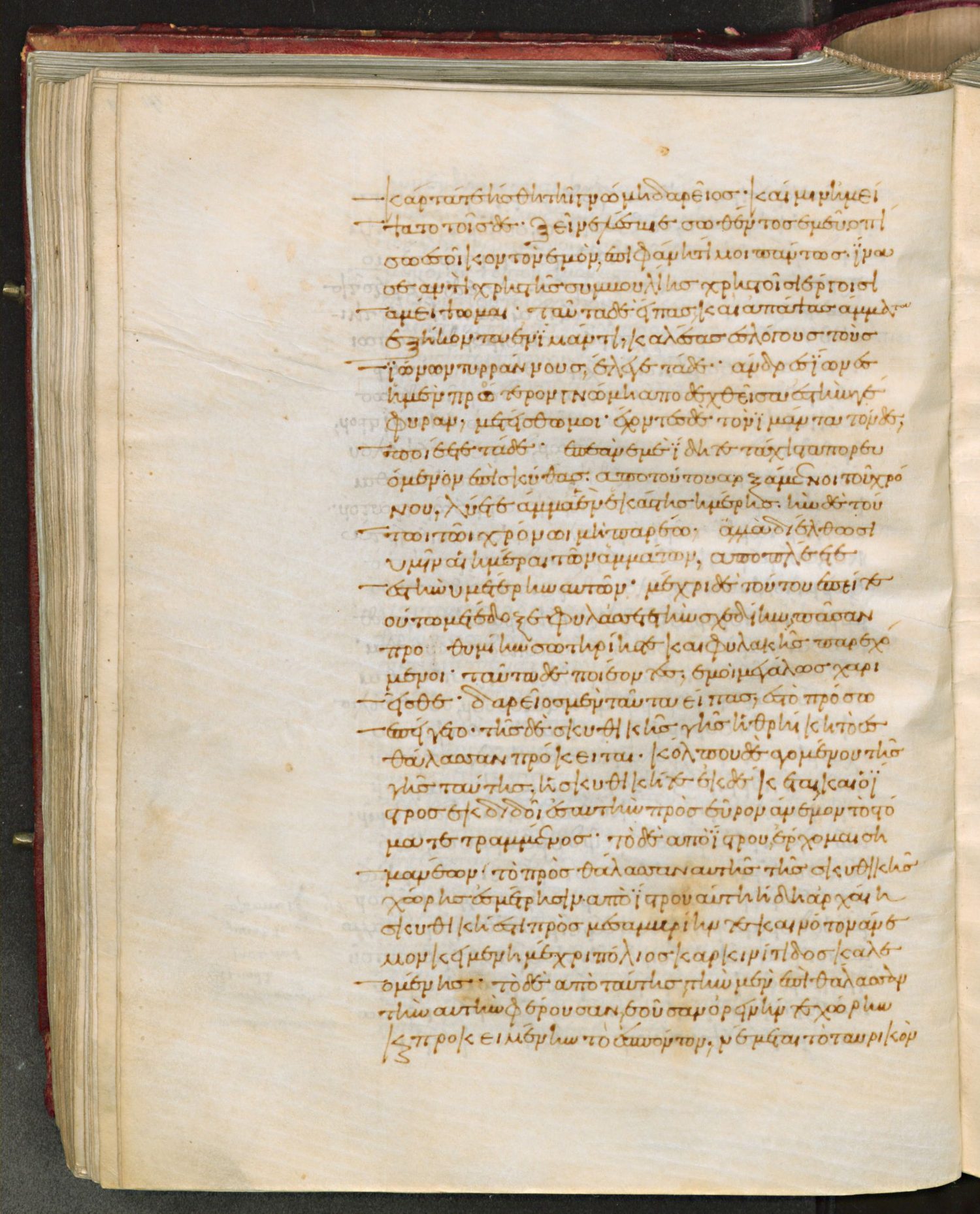
Where on the image
Laur. Plut. 70.3, fol. 171v: Greek here 4.97.6 to 4.98.3. Checked on the image (first and last words read and located in the Greek; each break checked against the neighbouring page): fol. 171v begins ‹κάρτα τε ἥσθη τῇ› (4.97.6), ends ‹Πόντον, νέμεται τὸ Ταυρικὸν› (4.99.3). English here: 4.97.6 to 4.98.3 (Godley's sentences for the sections whose Greek lies mostly on this page).
4.97.6κάρτα τε ἥσθη τῇ γνώμῃ Δαρεῖος καὶ μιν ἀμείψατο τοῖσιδε. ξεῖνε Λέσβιε, σωθέντος ἐμεῦ ὀπίσω ἐς οἶκον τὸν ἐμὸν ἐπιφάνηθί μοι πάντως, ἵνα σε ἀντὶ χρηστῆς συμβουλίης χρηστοῖσι ἔργοισι ἀμείψωμαι. 4.98.1ταῦτα δὲ εἴπας καὶ ἀπάψας ἅμματα ἑξήκοντα ἐν ἱμάντι καλέσας ἐς λόγους τοὺς Ἰώνων τυράννους ἔλεγε τάδε. 4.98.2ἄνδρες Ἴωνες, ἡ μὲν πρότερον γνώμη ἀποδεχθεῖσα ἐς τὴν γέφυραν μετείσθω μοι, ἔχοντες δὲ τὸν ἱμάντα τόνδε ποιέετε τάδε. ἐπεὰν ἐμὲ ἴδητε τάχιστα πορευόμενον ἐπὶ Σκύθας, ἀπὸ τούτου ἀρξάμενοι τοῦ χρόνου λύετε ἅμμα ἓν ἑκάστης ἡμέρης· ἢν δὲ ἐν τούτῳ τῷ χρόνῳ μὴ παρέω ἀλλὰ διεξέλθωσι ὑμῖν αἱ ἡμέραι τῶν ἁμμάτων, ἀποπλέετε ἐς τὴν ὑμετέρην αὐτῶν. 4.98.3μέχρι δὲ τούτου, ἐπείτε οὕτω μετέδοξε, φυλάσσετε τὴν σχεδίην, πᾶσαν προθυμίην σωτηρίης τε καὶ φυλακῆς παρεχόμενοι. ταῦτα δὲ ποιεῦντες ἐμοὶ μεγάλως χαριεῖσθε. Δαρεῖος μὲν ταῦτα εἴπας ἐς τὸ πρόσω ἐπείγετο.
4.97.6With this counsel Darius was greatly pleased, and he answered Cöes thus: “My good Lesbian, fail not to show yourself to me when I return safe to my house, that so I may make you a good return for your good advice.” 4.98.1Having thus spoken, he tied sixty knots in a thong, and calling the despots of the Ionians to an audience he said 4.98.2to them: “Ionians, I renounce the opinion which I before declared concerning the bridge; do you now take this thong and do as I command you. Begin to reckon from the day when you shall see me march away against the Scythians, and loose one knot each day: and if the days marked by the knots have all passed and I have not returned ere then, take ship for your own homes. 4.98.3But till then, seeing that my counsel is thus changed, I bid you guard the bridge, using all zeal to save and defend it. This do, and you will render me a most acceptable service.” Having thus spoken, Darius made haste to march further.
Notes
- Greek: the text printed in A. D. Godley's Loeb edition, via Perseus (tlg0016.tlg001.perseus-grc2). Square brackets mark words the editor considers later additions; [...] marks a gap the editor indicates. Perseus note markers are omitted.
- English: A. D. Godley, Herodotus vol. 2 (1921) (Loeb Classical Library), as transcribed on Wikisource. Godley's footnotes are omitted.
- Section numbers in the English were placed by comparing Godley's text with the Perseus version of his translation; where a section begins inside one of Godley's sentences, the English is kept with the page that holds the start of that sentence.
Cite
Sources
- Source: Florence, Laur. Plut. 70.3 (10th c.) via BML Teca Digitale + Greek of Godley's Loeb (Perseus) + English of A. D. Godley (Loeb, Wikisource) (holding institution)
- Critical edition: Greek of A. D. Godley's Loeb edition (1920-1925), via Perseus
← previous · → next · v cycle view · l back to library