Herodotus, Histories 5.114-126: The Carians and the end of Aristagoras
Introduction
Herodotus of Halicarnassus wrote the Histories in the third quarter of the 5th century BCE, an inquiry into the deeds of Greeks and barbarians and the causes of the wars between them, later divided into nine books. Book 5 tells of the Persian advance in Thrace and Macedonia, the outbreak of the Ionian revolt under Aristagoras of Miletus, his appeals to Sparta and Athens, with Herodotus' accounts of Sparta and of Athens after the tyrants, and the burning of Sardis and the first years of the revolt.
The photographs are of Florence, Biblioteca Medicea Laurenziana, Plut. 70.3 (parchment, 10th century, 374 folios, 31 lines a page), Herodotus, Histories (codex A of the editors), the oldest surviving manuscript of the complete Histories, from the Teca Digitale of the Biblioteca Medicea Laurenziana. Each section below is the text of one page, or of the part of a page that falls within these chapters. The first and last words of every page were read on the photograph and located in the Greek, and every page break was checked against the next page; the notes quote these words. Readers' notes in the margins are not part of the text and are mentioned where they occur.
The Greek is the text printed in A. D. Godley's Loeb edition (1920-1925), from Perseus; it is the edited text, not a transcription of the manuscript, whose wording differs in places. The English is Godley's translation as printed, from Wikisource. Godley's English carries only chapter numbers; the section numbers shown in it were placed by comparison with the Perseus version of his translation. Each page's English is cut at the end of one of Godley's sentences, so it can begin or end a few lines away from the Greek of the page; each note gives the exact ranges.
This entry covers chapters 5.114-126, on fol. 231v to 234r.
How was this verified? (Provenance)
Where on the image
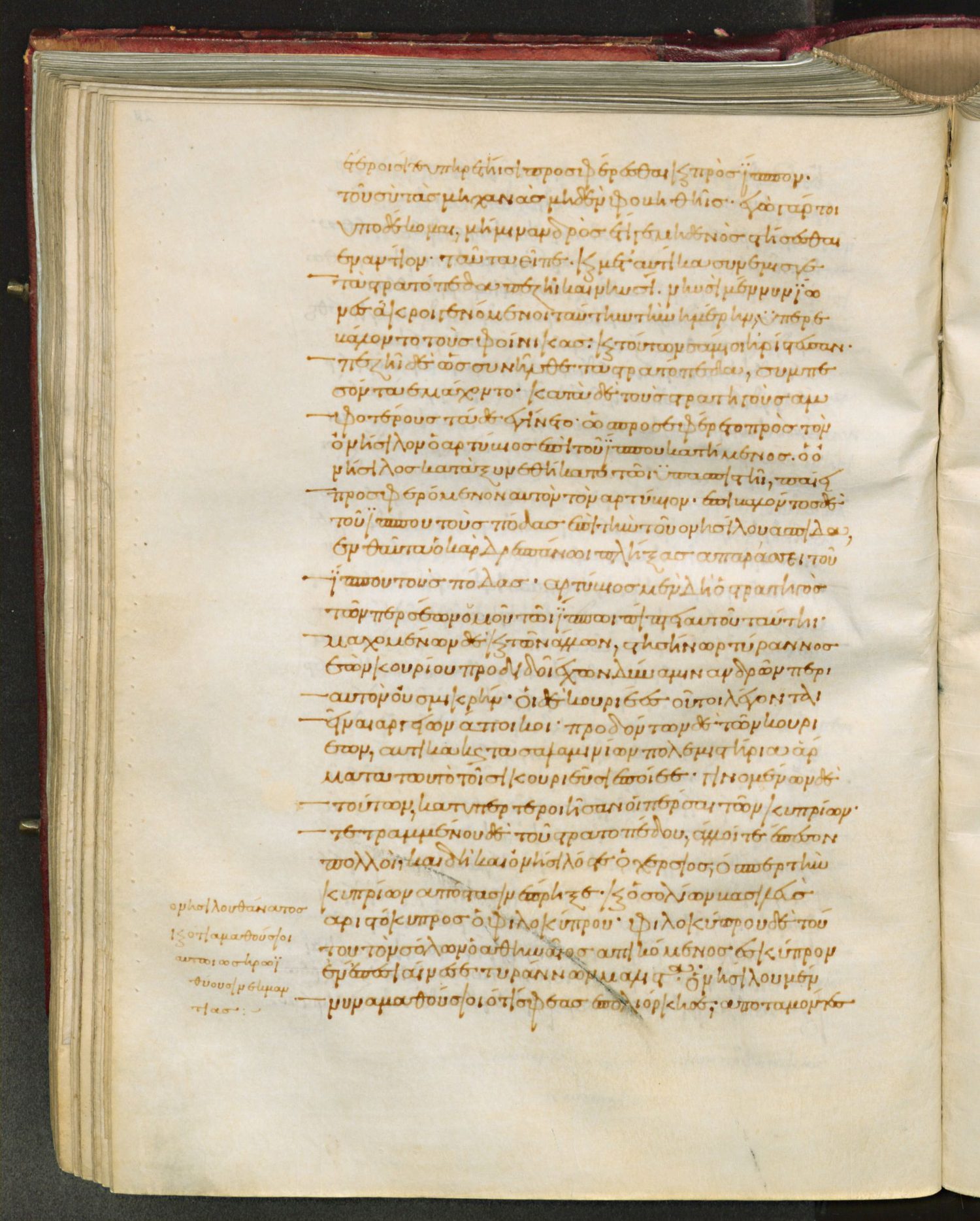
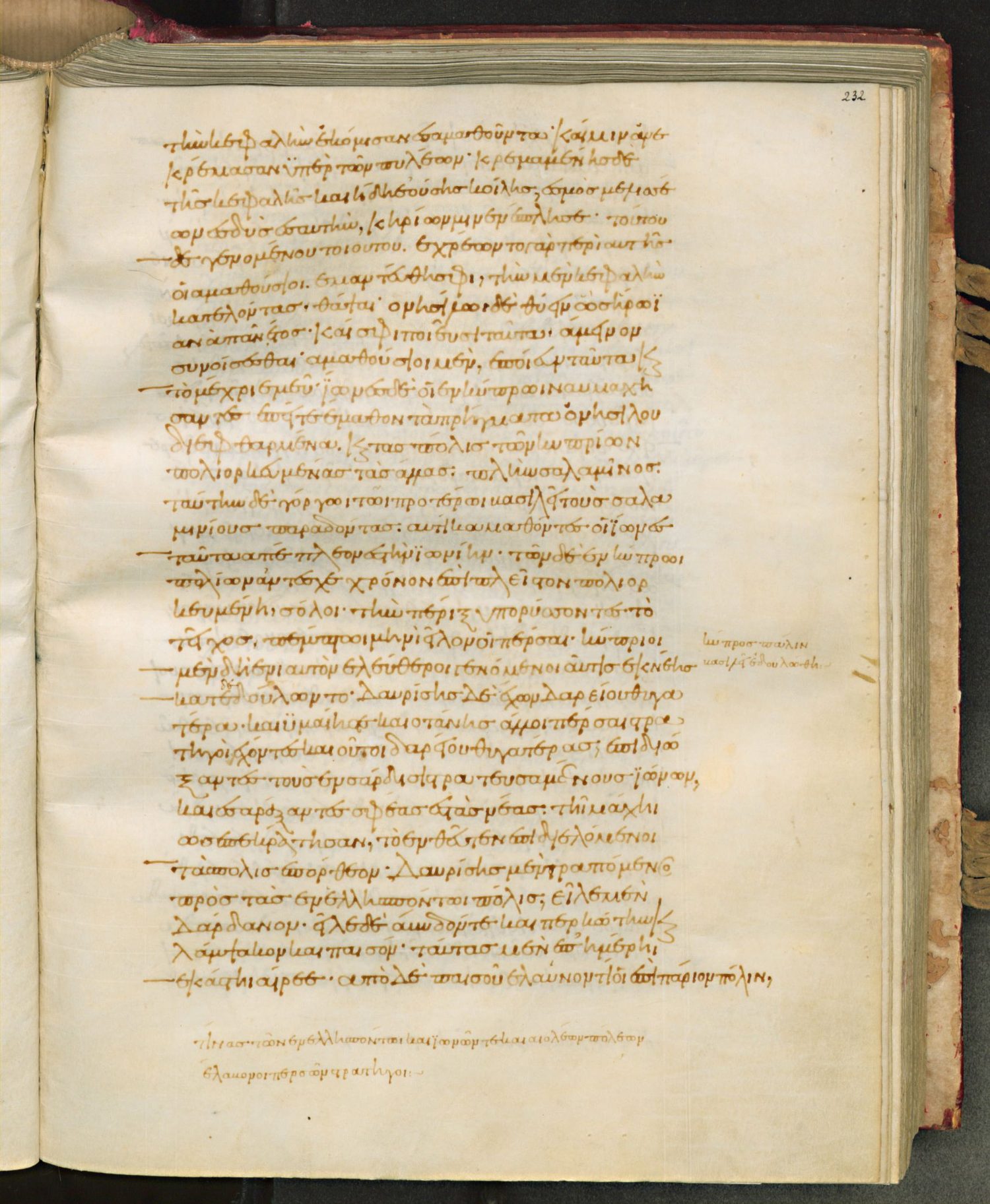
Laur. Plut. 70.3, fol. 231v, 232r: Greek here 5.114.1 to 5.117.1. Checked on the image (first and last words read and located in the Greek; each break checked against the neighbouring page): fol. 231v begins ‹ἑτέροισί τε ὑπηρέτῃσι προσφέρεσθαι› (5.111.4), ends ‹ὅτι σφέας ἐπολιόρκησε, ἀποταμόντες› (5.114.1). fol. 232r begins ‹τὴν κεφαλὴν ἐκόμισαν ἐς› (5.114.1), ends ‹οἱ ἐπὶ Πάριον πόλιν› (5.117.1). Below the text, a reader's note in two lines. This section joins the text of fol. 231v and 232r that belongs to these chapters, because the part on one of the pages is too short to carry any of Godley's sentences on its own. English here: 5.114.1 to 5.117.1 (Godley's sentences for the sections whose Greek lies mostly on this page).
5.114.1Ὀνησίλου μέν νυν Ἀμαθούσιοι, ὅτι σφέας ἐπολιόρκησε, ἀποταμόντες τὴν κεφαλὴν ἐκόμισαν ἐς Ἀμαθοῦντα καί μιν ἀνεκρέμασαν ὑπὲρ τῶν πυλέων· κρεμαμένης δὲ τῆς κεφαλῆς καὶ ἤδη ἐούσης κοίλης, ἐσμὸς μελισσέων ἐσδὺς ἐς αὐτὴν κηρίων μιν ἐνέπλησε. 5.114.2τούτου δὲ γενομένου τοιούτου, ἐχρέωντο γὰρ περὶ αὐτῆς οἱ Ἀμαθούσιοι, ἐμαντεύθη σφι τὴν μὲν κεφαλὴν κατελόντας θάψαι, Ὀνησίλῳ δὲ θύειν ὡς ἥρωϊ ἀνὰ πᾶν ἔτος, καί σφι ποιεῦσι ταῦτα ἄμεινον συνοίσεσθαι. 5.115.1Ἀμαθούσιοι μέν νυν ἐποίευν ταῦτα καὶ τὸ μέχρι ἐμεῦ· Ἴωνες δὲ οἱ ἐν Κύπρῳ ναυμαχήσαντες ἐπείτε ἔμαθον τὰ πρήγματα τὰ Ὀνησίλου διεφθαρμένα καὶ τὰς πόλις τῶν Κυπρίων πολιορκευμένας τὰς ἄλλας πλὴν Σαλαμῖνος, ταύτην δὲ Γόργῳ τῷ προτέρῳ βασιλέι τοὺς Σαλαμινίους παραδόντας, αὐτίκα μαθόντες οἱ Ἴωνες ταῦτα ἀπέπλεον ἐς τὴν Ἰωνίην. 5.115.2τῶν δὲ ἐν Κύπρῳ πολίων ἀντέσχε χρόνον ἐπὶ πλεῖστον πολιορκευμένη Σόλοι, τὴν πέριξ ὑπορύσσοντες τὸ τεῖχος πέμπτῳ μηνὶ εἷλον οἱ Πέρσαι. 5.116.1Κύπριοι μὲν δὴ ἐνιαυτὸν ἐλεύθεροι γενόμενοι αὖτις ἐκ νέης κατεδεδούλωντο. Δαυρίσης δὲ ἔχων Δαρείου θυγατέρα καὶ Ὑμαίης τε καὶ Ὀτάνης ἄλλοι Πέρσαι στρατηγοί, ἔχοντες καὶ οὗτοι Δαρείου θυγατέρας, ἐπιδιώξαντες τοὺς ἐς Σάρδις στρατευσαμένους Ἰώνων καὶ ἐσαράξαντες σφέας ἐς τὰς νέας, τῇ μάχῃ ὡς ἐπεκράτησαν, τὸ ἐνθεῦτεν ἐπιδιελόμενοι τὰς πόλις ἐπόρθεον. 5.117.1Δαυρίσης μὲν τραπόμενος πρὸς τὰς ἐν Ἑλλησπόντῳ πόλις εἷλε μὲν Δάρδανον, εἷλε δὲ Ἄβυδόν τε καὶ Περκώτην καὶ Λάμψακον καὶ Παισόν. ταύτας μὲν ἐπʼ ἡμέρῃ ἑκάστῃ αἵρεε, ἀπὸ δὲ Παισοῦ ἐλαύνοντί οἱ ἐπὶ Πάριον πόλιν
5.114.1As for Onesilus, then, the Amathusians cut off his head and brought it to Amathus, where they set it aloft above their gates, because he had besieged their city; and the head being there set aloft, when it was hollow a swarm of bees entered it and filled it with their cells. 5.114.2On this an oracle was given to the Amathusians (for they had enquired concerning the matter) that they should take the head down and bury it, and offer yearly sacrifice to Onesilus as to a hero; so doing (said the oracle) they should fare the better. 5.115.1This the Amathusians did, and have done to this day. But when the Ionians of the sea-fight off Cyprus learnt that Onesilus’ cause was lost, and that all the cities of Cyprus were beleaguered save only Salamis, which the Salaminians had delivered up to their former king Gorgus, straightway at this news they made sail away to Ionia. 5.115.2Of the Cyprian cities that which longest stood a siege was Soli; the Persians took it in the fifth month by digging a mine under its walls. 5.116.1So the Cyprians, having won freedom for a year, were enslaved once more. Daurises and Hymaees and Otanes, all of them Persian generals and married to daughters of Darius, pursued after those Ionians who had marched to Sardis and drove them to their ships; after which victory they divided the cities among themselves and sacked them. 5.117.1Daurises made for the cities of the Hellespont and took Dardanus, Abydus, Percote, Lampsacus, and Paesus, each of these on its own day; and as he marched from Paesus against Parium, news came to him that the Carians had made common cause with the Ionians and revolted from the Persians; wherefore he turned aside from the Hellespont and marched his army to Caria.
Where on the image
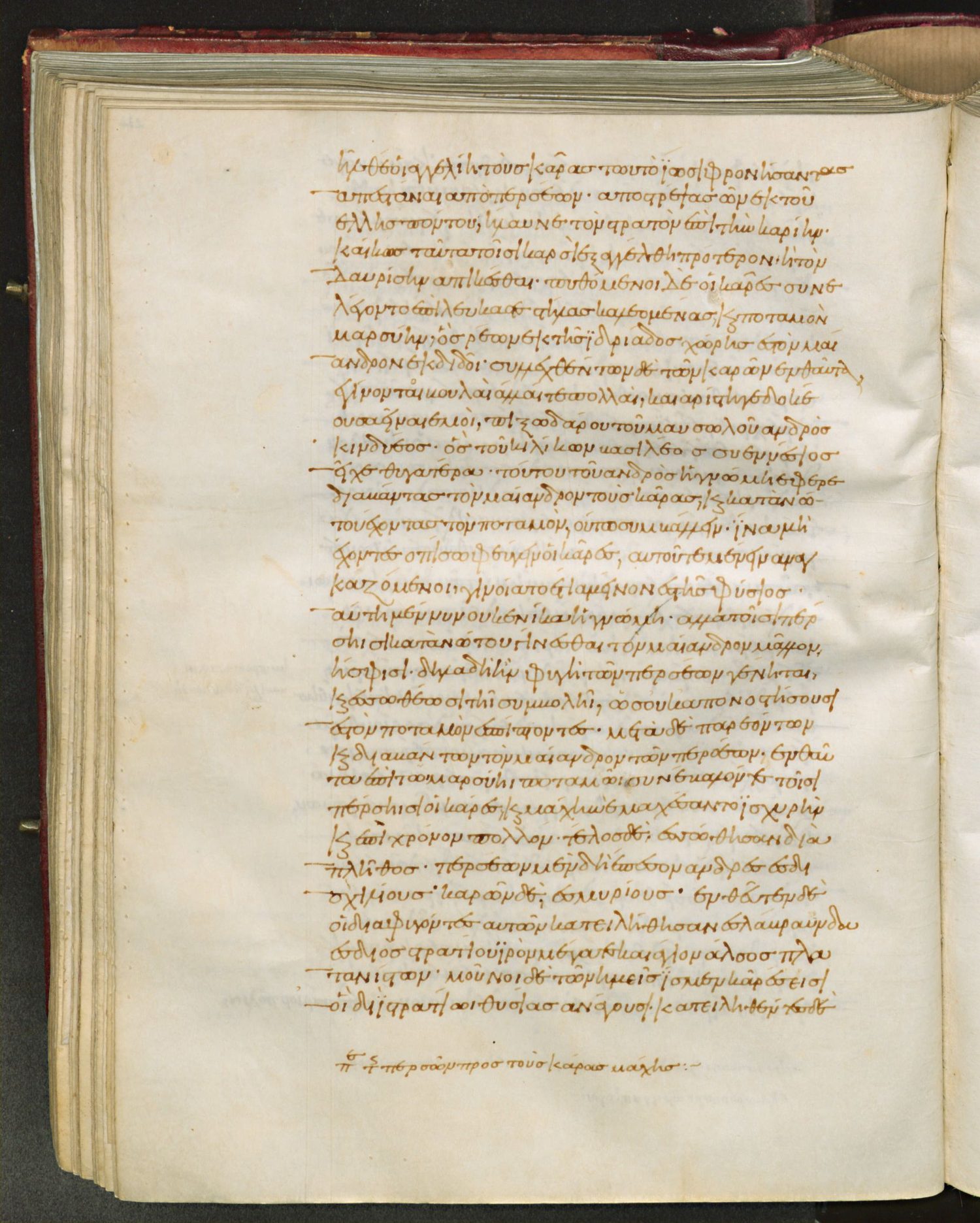
Laur. Plut. 70.3, fol. 232v: Greek here 5.117.1 to 5.119.2. Checked on the image (first and last words read and located in the Greek; each break checked against the neighbouring page): fol. 232v begins ‹ἦλθε ἀγγελίη τοὺς Κᾶρας› (5.117.1), ends ‹θυσίας ἀνάγουσι. κατειληθέντες δὲ› (5.119.2). Below the text, a reader's note on the battle of the Persians against the Carians. English here: 5.118.1 to 5.119.2 (Godley's sentences for the sections whose Greek lies mostly on this page).
5.117.1ἦλθε ἀγγελίη τοὺς Κᾶρας τὠυτὸ Ἴωσι φρονήσαντας ἀπεστάναι ἀπὸ Περσέων. ἀποστρέψας ὦν ἐκ τοῦ Ἑλλησπόντου ἤλαυνε τὸν στρατὸν ἐπὶ τὴν Καρίην. 5.118.1καί κως ταῦτα τοῖσι Καρσὶ ἐξαγγέλθη πρότερον ἢ τὸν Δαυρίσην ἀπικέσθαι· πυθόμενοι δὲ οἱ Κᾶρες συνελέγοντο ἐπὶ Λευκάς τε στήλας καλεομένας καὶ ποταμὸν Μαρσύην, ὃς ῥέων ἐκ τῆς Ἰδριάδος χώρης ἐς τὸν Μαίανδρον ἐκδιδοῖ. 5.118.2συλλεχθέντων δὲ τῶν Καρῶν ἐνθαῦτα ἐγίνοντο βουλαὶ ἄλλαι τε πολλαὶ καὶ ἀρίστη γε δοκέουσα εἶναι ἐμοὶ Πιξωδάρου τοῦ Μαυσώλου ἀνδρὸς Κινδυέος, ὃς τοῦ Κιλίκων βασιλέος Συεννέσιος εἶχε θυγατέρα· τούτου τοῦ ἀνδρὸς ἡ γνώμη ἔφερε διαβάντας τὸν Μαίανδρον τοὺς Κᾶρας καὶ κατὰ νώτου ἔχοντας τὸν ποταμὸν οὕτω συμβάλλειν, ἵνα μὴ ἔχοντες ὀπίσω φεύγειν οἱ Κᾶρες αὐτοῦ τε μένειν ἀναγκαζόμενοι γινοίατο ἔτι ἀμείνονες τῆς φύσιος. 5.118.3αὕτη μέν νυν οὐκ ἐνίκα ἡ γνώμη, ἀλλὰ τοῖσι Πέρσῃσι κατὰ νώτου γίνεσθαι τὸν Μαίανδρον μᾶλλον ἢ σφίσι, δηλαδὴ ἢν φυγὴ τῶν Περσέων γένηται καὶ ἑσσωθέωσι τῇ συμβολῇ, ὡς οὐκ ἀπονοστήσουσι ἐς τὸν ποταμὸν ἐσπίπτοντες. 5.119.1μετὰ δὲ παρεόντων καὶ διαβάντων τὸν Μαίανδρον τῶν Περσέων, ἐνθαῦτα ἐπὶ τῷ Μαρσύῃ ποταμῷ συνέβαλόν τε τοῖσι Πέρσῃσι οἱ Κᾶρες καὶ μάχην ἐμαχέσαντο ἰσχυρὴν καὶ ἐπὶ χρόνον πολλόν, τέλος δὲ ἑσσώθησαν διὰ πλῆθος. Περσέων μὲν δὴ ἔπεσον ἄνδρες ἐς δισχιλίους, Καρῶν δὲ ἐς μυρίους. 5.119.2ἐνθεῦτεν δὲ οἱ διαφυγόντες αὐτῶν κατειλήθησαν ἐς Λάβραυνδα ἐς Διὸς στρατίου ἱρόν, μέγα τε καὶ ἅγιον ἄλσος πλατανίστων. μοῦνοι δὲ τῶν ἡμεῖς ἴδμεν Κᾶρες εἰσὶ οἳ Διὶ στρατίῳ θυσίας ἀνάγουσι. κατειληθέντες δὲ
5.118.1It chanced that news of this was brought to the Carians before Daurises’ coming; and when the Carians heard, they mustered at the place called the White Pillars, by the river Marsyas which flows from the region of Idria and issues into the Maeander. 5.118.2There they mustered, and many plans were laid before them, the best of which, in my judgment, was that of Pixodarus of Cindya, son of Mausolus (he had to wife the daughter of Syennesis, king of Cilicia); the purport of Pixodarus’ opinion was, that the Carians should cross the Maeander and fight with the river at their back, that so being unable to flee and compelled to stand their ground they might prove themselves even braver than nature made them. 5.118.3Yet not this, but another opinion prevailed, to wit, that the Persians and not the Cilicians should have the Maeander at their back, the intent being that if the Persians were worsted in the battle and put to flight they should not escape but be hurled into the river. 5.119.1Presently, when the Persians had come and had crossed the Maeander, they and the Carians joined battle by the river Marsyas; the Carians fought obstinately and long, but at the last they were overcome by odds. Of the Persians there fell as many as two thousand men, and of the Carians ten thousand. 5.119.2Those of them that escaped thence were driven into the precinct of Zeus of Armies at Labraunda, a great and a holy grove of plane-trees. (The Carians are the only people known to us who offer sacrifices to Zeus by this name.) Being driven thither, they took counsel how best to save themselves, whether it were better for them to surrender themselves to the Persians or depart wholly away from Asia.
Where on the image
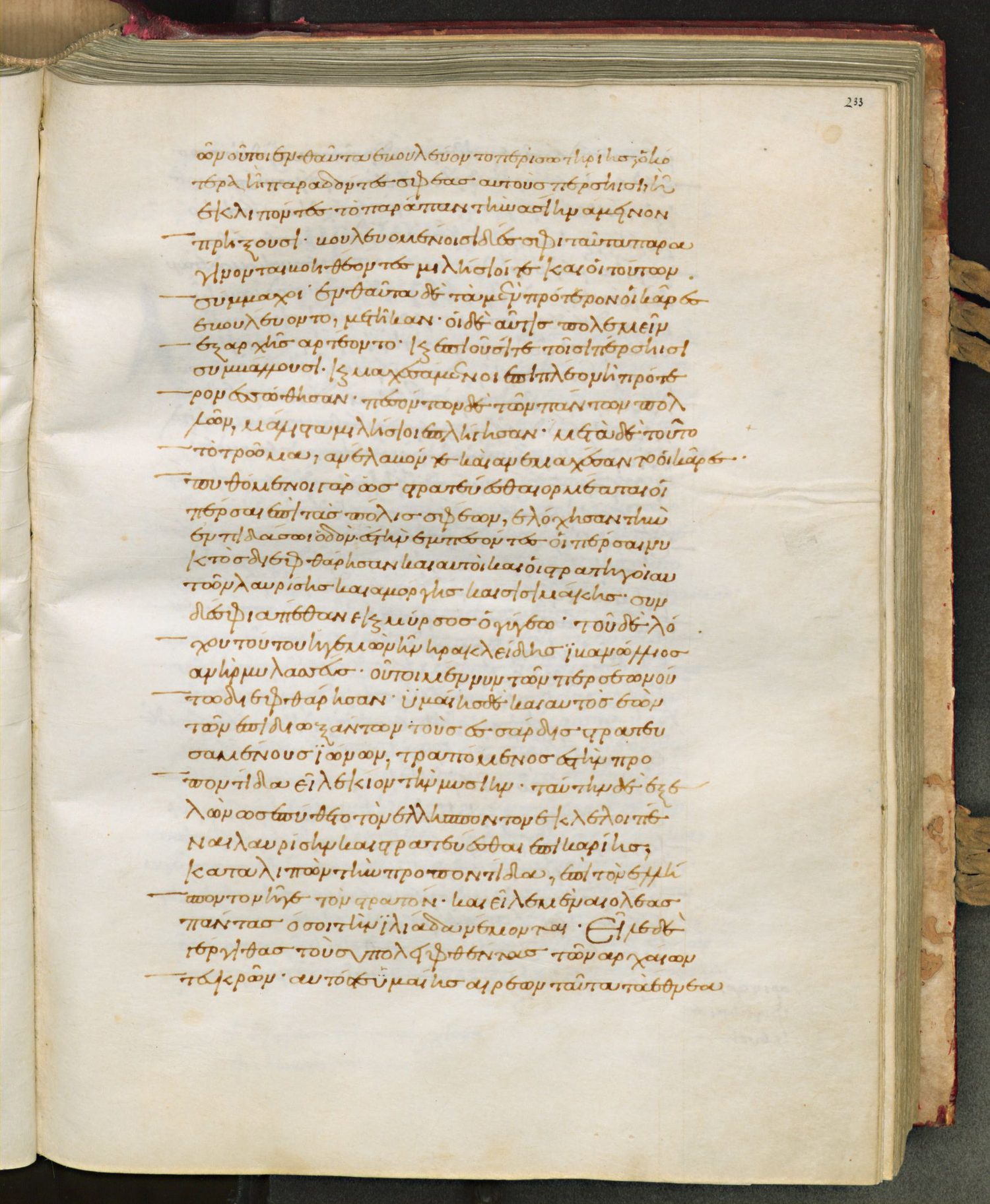
Laur. Plut. 70.3, fol. 233r: Greek here 5.119.2 to 5.122.2. Checked on the image (first and last words read and located in the Greek; each break checked against the neighbouring page): fol. 233r begins ‹ὦν οὗτοι ἐνθαῦτα ἐβουλεύοντο› (5.119.2), ends ‹αἱρέων ταῦτα τὰ ἔθνεα› (5.122.2). English here: 5.120.1 to 5.122.2 (Godley's sentences for the sections whose Greek lies mostly on this page).
5.119.2ὦν οὗτοι ἐνθαῦτα ἐβουλεύοντο περὶ σωτηρίης, ὁκότερα ἢ παραδόντες σφέας αὐτοὺς Πέρσῃσι ἢ ἐκλιπόντες τὸ παράπαν τὴν Ἀσίην ἄμεινον πρήξουσι. 5.120.1βουλευομένοισι δέ σφι ταῦτα παραγίνονται βοηθέοντες Μιλήσιοί τε καὶ οἱ τούτων σύμμαχοι· ἐνθαῦτα δὲ τὰ μὲν πρότερον οἱ Κᾶρες ἐβουλεύοντο μετῆκαν, οἳ δὲ αὖτις πολεμέειν ἐξ ἀρχῆς ἀρτέοντο. καὶ ἐπιοῦσί τε τοῖσι Πέρσῃσι συμβάλλουσι καὶ μαχεσάμενοι ἐπὶ πλέον ἢ πρότερον ἑσσώθησαν· πεσόντων δὲ τῶν πάντων πολλῶν μάλιστα Μιλήσιοι ἐπλήγησαν. 5.121.1μετὰ δὲ τοῦτο τὸ τρῶμα ἀνέλαβόν τε καὶ ἀνεμαχέσαντο οἱ Κᾶρες· πυθόμενοι γὰρ ὡς στρατεύεσθαι ὁρμέαται οἱ Πέρσαι ἐπὶ τὰς πόλις σφέων, ἐλόχησαν τὴν ἐν Πηδάσῳ ὁδόν, ἐς τὴν ἐμπεσόντες οἱ Πέρσαι νυκτὸς διεφθάρησαν καὶ αὐτοὶ καὶ οἱ στρατηγοὶ αὐτῶν Δαυρίσης καὶ Ἀμόργης καὶ Σισιμάκης· σὺν δέ σφι ἀπέθανε καὶ Μύρσος ὁ Γύγεω. τοῦ δὲ λόχου τούτου ἡγεμὼν ἦν Ἡρακλείδης Ἰβανώλλιος ἀνὴρ Μυλασσεύς. 5.122.1οὗτοι μέν νυν τῶν Περσέων οὕτω διεφθάρησαν· Ὑμαίης δὲ καὶ αὐτὸς ἐὼν τῶν ἐπιδιωξάντων τοὺς ἐς Σάρδις στρατευσαμένους Ἰώνων, τραπόμενος ἐς τὸν Προποντίδα εἷλε Κίον τὴν Μυσίην· 5.122.2ταύτην δὲ ἐξελών, ὡς ἐπύθετο τὸν Ἑλλήσποντον ἐκλελοιπέναι Δαυρίσην καὶ στρατεύεσθαι ἐπὶ Καρίης, καταλιπὼν τὴν Προποντίδα ἐπὶ τὸν Ἑλλήσποντον ἦγε τὸν στρατόν, καὶ εἷλε μὲν Αἰολέας πάντας ὅσοι τὴν Ἰλιάδα νέμονται, εἷλε δὲ Γέργιθας τοὺς ὑπολειφθέντας τῶν ἀρχαίων Τευκρῶν· αὐτός τε Ὑμαίης αἱρέων ταῦτα τὰ ἔθνεα
5.120.1But while they took counsel, the Milesians and their allies came up to their aid; whereupon the Carians put aside their former plans, and prepared to wage a new war over again. They met the Persian attack and suffered a heavier defeat in the battle than the first; many of their whole army fell, but the Milesians were hardest stricken. 5.121.1Yet the Carians rallied and fought again after this disaster; for learning that the Persians had set forth to march against their cities, they beset the road with an ambush at Pedasus, whereinto the Persians fell by night and perished, they and their generals, Daurises and Amorges and Sisimaces; and with these fell also Myrsus, son of Gyges. The captain of this ambuscade was Heraclides of Mylasas, son of Ibanollis. 5.122.1Thus did these Persians perish. Hymaees, who had also been one of those who pursued after the Ionians who marched on Sardis, turned now towards the Propontis, and there took Cius in Mysia; having subdued which, 5.122.2when he heard that Daurises had left the Hellespont and was marching towards Caria, he left the Propontis and led his army to the Hellespont, and made himself master of ail the Aeolians that dwell in the territory of Ilium, and of the Gergithae, who are all the remnant that is left of the ancient Teucri; but while he was conquering these nations, Hymaees himself died of a sickness in the Troad.
Where on the image
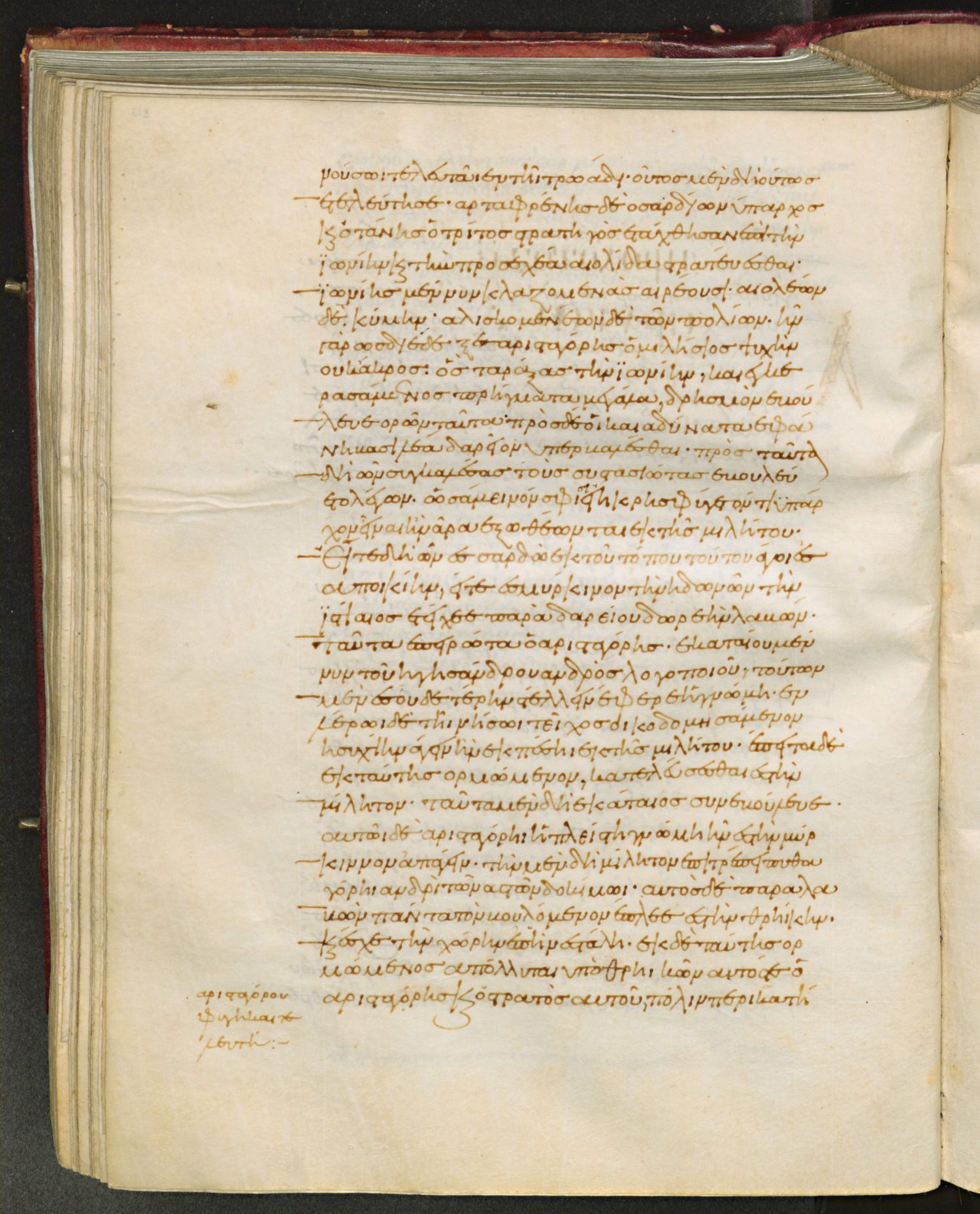
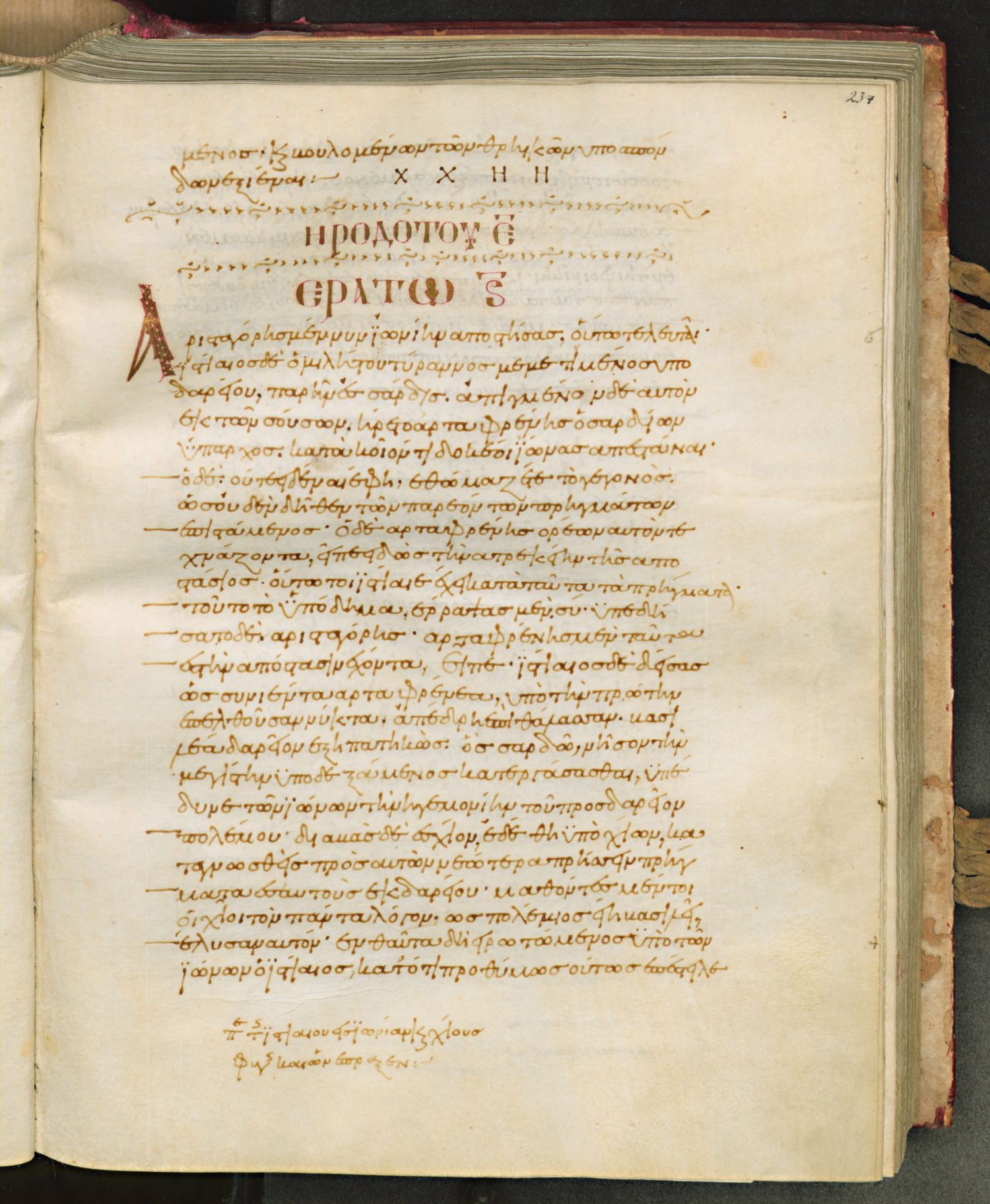
Laur. Plut. 70.3, fol. 233v, 234r: Greek here 5.122.2 to 5.126.2. Checked on the image (first and last words read and located in the Greek; each break checked against the neighbouring page): fol. 233v begins ‹νούσῳ τελευτᾷ ἐν τῇ› (5.122.2), ends ‹στρατὸς αὐτοῦ, πόλιν περικατή-› (5.126.2). fol. 234r begins ‹-μενος καὶ βουλομένων τῶν› (5.126.2), ends ‹τι προθύμως οὕτω ἐπέστειλε› (6.3.1). The word ‹περικατήμενος› is divided between fol. 233v and fol. 234r; it is given with fol. 233v. Book 5 ends in the second line, followed by a stichometric figure (ΧΧΗΗ), a decorative line and the red title Ἡροδότου ς´ Ἐρατώ ς´; Book 6 begins with a red initial Α. Below the text, a reader's note in two lines on Histiaeus. This section joins the text of fol. 233v and 234r that belongs to these chapters, because the part on one of the pages is too short to carry any of Godley's sentences on its own. English here: 5.123.1 to 5.126.2 (Godley's sentences for the sections whose Greek lies mostly on this page).
5.122.2νούσῳ τελευτᾷ ἐν τῇ Τρῳάδι. 5.123.1οὗτος μὲν δὴ οὕτω ἐτελεύτησε, Ἀρταφρένης δὲ ὁ Σαρδίων ὕπαρχος καὶ Ὀτάνης ὁ τρίτος στρατηγὸς ἐτάχθησαν ἐπὶ τὴν Ἰωνίην καὶ τὴν προσεχέα Αἰολίδα στρατεύεσθαι. Ἰωνίης μέν νυν Κλαζομενὰς αἱρέουσι, Αἰολέων δὲ Κύμην. 5.124.1ἁλισκομενέων δὲ τῶν πολίων, ἦν γὰρ ὡς διέδεξε Ἀρισταγόρης ὁ Μιλήσιος ψυχὴν οὐκ ἄκρος, ὃς ταράξας τὴν Ἰωνίην καὶ ἐγκερασάμενος πρήγματα μεγάλα δρησμὸν ἐβούλευε ὁρέων ταῦτα· πρὸς δέ οἱ καὶ ἀδύνατα ἐφάνη βασιλέα Δαρεῖον ὑπερβαλέσθαι· 5.124.2πρὸς ταῦτα δὴ ὦν συγκαλέσας τοὺς συστασιώτας ἐβουλεύετο, λέγων ὡς ἄμεινον σφίσι εἴη κρησφύγετόν τι ὑπάρχον εἶναι, ἢν ἄρα ἐξωθέωνται ἐκ τῆς Μιλήτου, εἴτε δὴ ὦν ἐς Σαρδὼ ἐκ τοῦ τόπου τούτου ἄγοι ἐς ἀποικίην, εἴτε ἐς Μύρκινον τὴν Ἠδωνῶν, τὴν Ἱστιαῖος ἐτείχεε παρὰ Δαρείου δωρεὴν λαβών. ταῦτα ἐπειρώτα ὁ Ἀρισταγόρης. 5.125.1Ἑκαταίου μέν νυν τοῦ Ἡγησάνδρου, ἀνδρὸς λογοποιοῦ, τουτέων μὲν ἐς οὐδετέρην στέλλειν ἔφερε ἡ γνώμη, ἐν Λέρῳ δὲ τῇ νήσῳ τεῖχος οἰκοδομησάμενον ἡσυχίην ἄγειν, ἢν ἐκπέσῃ ἐκ τῆς Μιλήτου· ἔπειτα δὲ ἐκ ταύτης ὁρμώμενον κατελεύσεσθαι ἐς τὴν Μίλητον. 5.126.1ταῦτα μὲν δὴ Ἑκαταῖος συνεβούλευε, αὐτῷ δὲ Ἀρισταγόρῃ ἡ πλείστη γνώμη ἦν ἐς τὴν Μύρκινον ἀπάγειν. τὴν μὲν δὴ Μίλητον ἐπιτράπει Πυθαγόρῃ ἀνδρὶ τῶν ἀστῶν δοκίμῳ, αὐτὸς δὲ παραλαβὼν πάντα τὸν βουλόμενον ἔπλεε ἐς τὴν Θρηίκην, καὶ ἔσχε τὴν χώρην ἐπʼ ἣν ἐστάλη· 5.126.2ἐκ δὲ ταύτης ὁρμώμενος ἀπόλλυται ὑπὸ Θρηίκων αὐτός τε ὁ Ἀρισταγόρης καὶ ὁ στρατὸς αὐτοῦ, πόλιν περικατήμενος καὶ βουλομένων τῶν Θρηίκων ὑποσπόνδων ἐξιέναι.
5.123.1So he died there; and Artaphrenes, viceroy of Sardis, and Otanes, the third general, were appointed to lead the army against Ionia and the Aeolian territory on its borders. They took Clazomenae in Ionia, and in Aeolia Cyme. 5.124.1Aristagoras the Milesian was a man of no high courage, as he plainly showed; for after he had troubled Ionia and thrown all into dire confusion, when he saw what he had done he began to bethink himself of flight; and moreover it seemed to him to be impossible to overcome Darius; wherefore, 5.124.2while the cities were being taken, he called his fellow-rebels together and took counsel with them, saying that it was best for them to have some place of refuge provided, if they should be thrust out of Miletus; and questioning whether he should lead them thence to a settlement in Sardo, or Myrcinus in Edonia, which Histiaeus had received as a gift from Darius and fortified. Thus questioned Aristagoras. 5.125.1Hecataeus the historian, son of Hegesander, inclined to the opinion that they should set forth to neither of these places, but that Aristagoras should build him a fortress in the island of Leros and there abide, if he were driven from Miletus; and afterwards he might set out from thence and return to Miletus. 5.126.1Such was the counsel of Hecataeus, but Aristagoras himself deemed it best to take his departure for Myrcinus. So he entrusted Miletus to Pythagoras, a citizen of repute, and himself sailed to Thrace with any that would follow him, and took possession of the place whither he had set out; and issuing 5.126.2from thence he was put to the sword by the Thracians, he and his army, while he beleaguered a town, even though the Thracians were ready to depart from it under treaty.
Notes
- Greek: the text printed in A. D. Godley's Loeb edition, via Perseus (tlg0016.tlg001.perseus-grc2). Square brackets mark words the editor considers later additions; [...] marks a gap the editor indicates. Perseus note markers are omitted.
- English: A. D. Godley, Herodotus vol. 3 (1922) (Loeb Classical Library), as transcribed on Wikisource. Godley's footnotes are omitted.
- Section numbers in the English were placed by comparing Godley's text with the Perseus version of his translation; where a section begins inside one of Godley's sentences, the English is kept with the page that holds the start of that sentence.
Cite
Sources
- Source: Florence, Laur. Plut. 70.3 (10th c.) via BML Teca Digitale + Greek of Godley's Loeb (Perseus) + English of A. D. Godley (Loeb, Wikisource) (holding institution)
- Critical edition: Greek of A. D. Godley's Loeb edition (1920-1925), via Perseus
← previous · → next · v cycle view · l back to library