Herodotus, Histories 5.97-113: The burning of Sardis; the revolt of Cyprus
Introduction
Herodotus of Halicarnassus wrote the Histories in the third quarter of the 5th century BCE, an inquiry into the deeds of Greeks and barbarians and the causes of the wars between them, later divided into nine books. Book 5 tells of the Persian advance in Thrace and Macedonia, the outbreak of the Ionian revolt under Aristagoras of Miletus, his appeals to Sparta and Athens, with Herodotus' accounts of Sparta and of Athens after the tyrants, and the burning of Sardis and the first years of the revolt.
The photographs are of Florence, Biblioteca Medicea Laurenziana, Plut. 70.3 (parchment, 10th century, 374 folios, 31 lines a page), Herodotus, Histories (codex A of the editors), the oldest surviving manuscript of the complete Histories, from the Teca Digitale of the Biblioteca Medicea Laurenziana. Each section below is the text of one page, or of the part of a page that falls within these chapters. The first and last words of every page were read on the photograph and located in the Greek, and every page break was checked against the next page; the notes quote these words. Readers' notes in the margins are not part of the text and are mentioned where they occur.
The Greek is the text printed in A. D. Godley's Loeb edition (1920-1925), from Perseus; it is the edited text, not a transcription of the manuscript, whose wording differs in places. The English is Godley's translation as printed, from Wikisource. Godley's English carries only chapter numbers; the section numbers shown in it were placed by comparison with the Perseus version of his translation. Each page's English is cut at the end of one of Godley's sentences, so it can begin or end a few lines away from the Greek of the page; each note gives the exact ranges.
This entry covers chapters 5.97-113, on fol. 227r to 231v.
How was this verified? (Provenance)
Where on the image
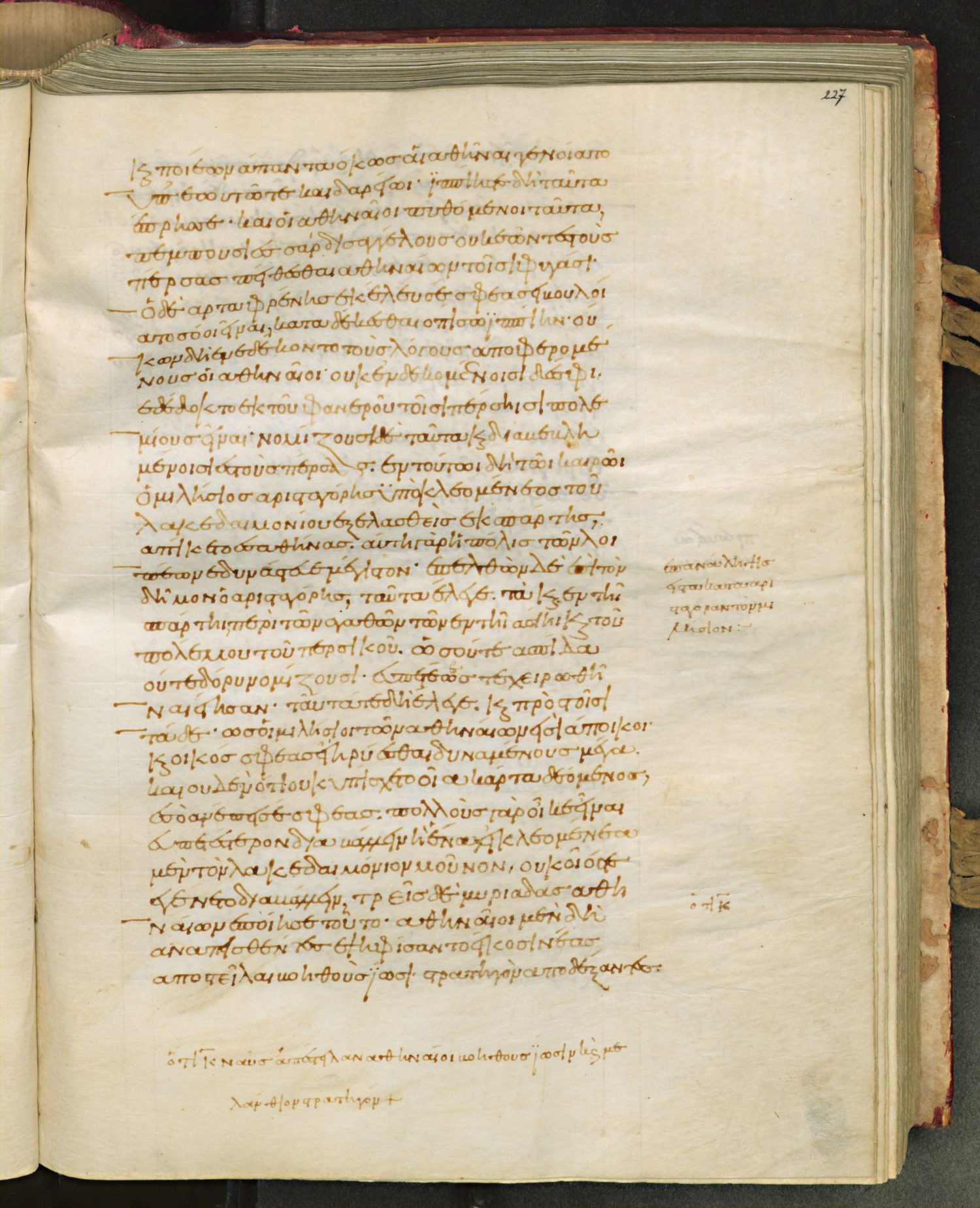
Laur. Plut. 70.3, fol. 227r: Greek here 5.97.1 to 5.97.3. Checked on the image (first and last words read and located in the Greek; each break checked against the neighbouring page): fol. 227r begins ‹καὶ ποιέων ἅπαντα ὅκως› (5.96.1), ends ‹βοηθοὺς Ἴωσι, στρατηγὸν ἀποδέξαντες› (5.97.3). Below the text, a reader's note on the twenty ships the Athenians sent to help the Ionians. English here: 5.97.1 to 5.97.2 (Godley's sentences for the sections whose Greek lies mostly on this page).
5.97.1νομίζουσι δὲ ταῦτα καὶ διαβεβλημένοισι ἐς τοὺς Πέρσας, ἐν τούτῳ δὴ τῷ καιρῷ ὁ Μιλήσιος Ἀρισταγόρης, ὑπὸ Κλεομένεος τοῦ Λακεδαιμονίου ἐξελασθεὶς ἐκ τῆς Σπάρτης, ἀπίκετο ἐς Ἀθήνας· αὕτη γὰρ ἡ πόλις τῶν λοιπέων ἐδυνάστευε μέγιστον. ἐπελθὼν δὲ ἐπὶ τὸν δῆμον ὁ Ἀρισταγόρης ταὐτὰ ἔλεγε τὰ καὶ ἐν τῇ Σπάρτῃ περὶ τῶν ἀγαθῶν τῶν ἐν τῇ Ἀσίῃ καὶ τοῦ πολέμου τοῦ Περσικοῦ, ὡς οὔτε ἀσπίδα οὔτε δόρυ νομίζουσι εὐπετέες τε χειρωθῆναι εἴησαν. 5.97.2ταῦτά τε δὴ ἔλεγε καὶ πρὸς τοῖσι τάδε, ὡς οἱ Μιλήσιοι τῶν Ἀθηναίων εἰσὶ ἄποικοι, καὶ οἰκός σφεας εἴη ῥύεσθαι δυναμένους μέγα· καὶ οὐδὲν ὅ τι οὐκ ὑπίσχετο οἷα κάρτα δεόμενος, ἐς ὃ ἀνέπεισε σφέας. πολλοὺς γὰρ οἶκε εἶναι εὐπετέστερον διαβάλλειν ἢ ἕνα, εἰ Κλεομένεα μὲν τὸν Λακεδαιμόνιον μοῦνον οὐκ οἷός τε ἐγένετο διαβάλλειν, τρεῖς δὲ μυριάδας Ἀθηναίων ἐποίησε τοῦτο. 5.97.3Ἀθηναῖοι μὲν δὴ ἀναπεισθέντες ἐψηφίσαντο εἴκοσι νέας ἀποστεῖλαι βοηθοὺς Ἴωσι, στρατηγὸν ἀποδέξαντες
5.97.1They being thus minded, and the Persians hearing an evil report of them, at this moment Aristagoras the Milesian, driven from Sparta by Cleomenes the Lacedaemonian, came to Athens; for that city was more powerful than any of the rest. Coming before the people, Aristagoras spoke to the same effect as at Sparta, of the good things of Asia, and bow the Persians in war were wont to carry neither shield nor spear and could easily be overcome. 5.97.2This he said, and added thereto, that the Milesians were settlers from Athens, and it was but right to save them, being a very wealthy people; and there was nothing that he did not promise in the earnestness of his entreaty, till at last he over-persuaded them. Truly it would seem that it is easier to deceive many than one; for he could not deceive Cleomenes of Lacedaemon, one single man, but thirty thousand Athenians he could.
Where on the image
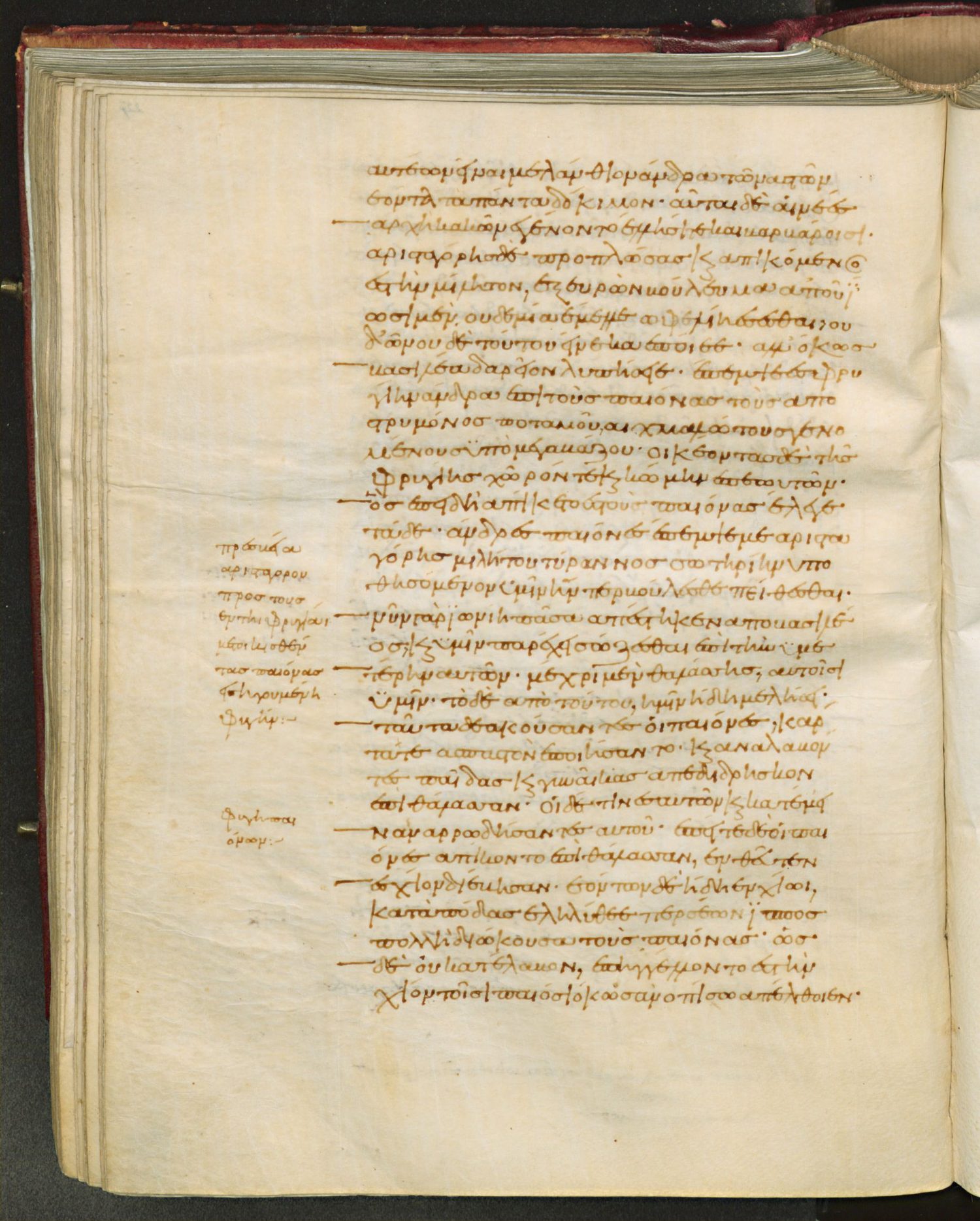
Laur. Plut. 70.3, fol. 227v: Greek here 5.97.3 to 5.98.4. Checked on the image (first and last words read and located in the Greek; each break checked against the neighbouring page): fol. 227v begins ‹αὐτῶν εἶναι Μελάνθιον ἄνδρα› (5.97.3), ends ‹ὅκως ἂν ὀπίσω ἀπέλθοιεν› (5.98.4). English here: 5.97.3 to 5.98.4 (Godley's sentences for the sections whose Greek lies mostly on this page).
5.97.3αὐτῶν εἶναι Μελάνθιον ἄνδρα τῶν ἀστῶν ἐόντα τὰ πάντα δόκιμον· αὗται δὲ αἱ νέες ἀρχὴ κακῶν ἐγένοντο Ἕλλησί τε καὶ βαρβάροισι. 5.98.1Ἀρισταγόρης δὲ προπλώσας καὶ ἀπικόμενος ἐς τὴν Μίλητον, ἐξευρὼν βούλευμα ἀπʼ οὗ Ἴωσι μὲν οὐδεμία ἔμελλε ὠφελίη ἔσεσθαι, οὐδʼ ὦν οὐδὲ τούτου εἵνεκα ἐποίεε ἀλλʼ ὅκως βασιλέα Δαρεῖον λυπήσειε, ἔπεμψε ἐς τὴν Φρυγίην ἄνδρα ἐπὶ τοὺς Παίονας τοὺς ἀπὸ Στρυμόνος ποταμοῦ αἰχμαλώτους γενομένους ὑπὸ Μεγαβάζου, οἰκέοντας δὲ τῆς Φρυγίης χῶρόν τε καὶ κώμην ἐπʼ ἑωυτῶν· ὃς ἐπειδὴ ἀπίκετο ἐς τοὺς Παίονας, ἔλεγε τάδε. 5.98.2ἄνδρες Παίονες, ἔπεμψέ με Ἀρισταγόρης ὁ Μιλήτου τύραννος σωτηρίην ὑποθησόμενον ὑμῖν, ἤν περ βούλησθε πείθεσθαι. νῦν γὰρ Ἰωνίη πᾶσα ἀπέστηκε ἀπὸ βασιλέος, καὶ ὑμῖν παρέχει σώζεσθαι ἐπὶ τὴν ὑμετέρην αὐτῶν· μέχρι μὲν θαλάσσης αὐτοῖσι ὑμῖν, τὸ δὲ ἀπὸ τούτου ἡμῖν ἤδη μελήσει. 5.98.3ταῦτα δὲ ἀκούσαντες οἱ Παίονες κάρτα τε ἀσπαστὸν ἐποιήσαντο καὶ ἀναλαβόντες παῖδας καὶ γυναῖκας ἀπεδίδρησκον ἐπὶ θάλασσαν, οἳ δὲ τινὲς αὐτῶν καὶ κατέμειναν ἀρρωδήσαντες αὐτοῦ. ἐπείτε δὲ οἱ Παίονες ἀπίκοντο ἐπὶ θάλασσαν, ἐνθεῦτεν ἐς Χίον διέβησαν. 5.98.4ἐόντων δὲ ἤδη ἐν Χίῳ, κατὰ πόδας ἐληλύθεε Περσέων ἵππος πολλὴ διώκουσα τοὺς Παίονας. ὡς δὲ οὐ κατέλαβον, ἐπηγγέλλοντο ἐς τὴν Χίον τοῖσι Παίοσι ὅκως ἂν ὀπίσω ἀπέλθοιεν.
5.97.3The Athenians, then, were over-persuaded, and voted the sending of twenty ships in aid of the Ionians, appointing for their admiral Melanthius, a citizen of Athens in all ways of good repute. These ships were the beginning of troubles for Greeks and foreigners. 5.98.1Aristagoras sailed before the rest; and coming to Miletus, he invented a design where from no advantage was to accrue to the Ionians (nor indeed was that the purpose of his plan, but rather to vex king Darius): he sent a man into Phrygia, to the Paeonians who had been led captive from the Strymon by Megabazus, and now dwelt in a Phrygian territory and village by themselves; and when the man came to the Paeonians, he thus spoke: “ 5.98.2Men of Paeonia, I am sent by Aristagoras, despot of Miletus, to point you the way to deliverance, if you will be guided by him. All Ionia is now in revolt against the king, and you have the power to win back safely to your own country; this shall be your business as far as the sea, and thereafter we will see to it.” 5.98.3The Paeonians were right glad when they heard that; some of them abode where they were, fearing danger; but the rest took their children and women and made their flight to the sea. Having come thither, the Paeonians crossed over to Chios; and 5.98.4they were already there, when a great host of Persian horse came hard after them in pursuit. Not being able to overtake them, the Persians sent to Chios, commanding the Paeonians to return back; whereto the Paeonians would not consent, but were brought from Chios by the Chians to Lesbos, and carried by the Lesbians to Doriscus; whence they made their way by land to Paeonia.
Where on the image
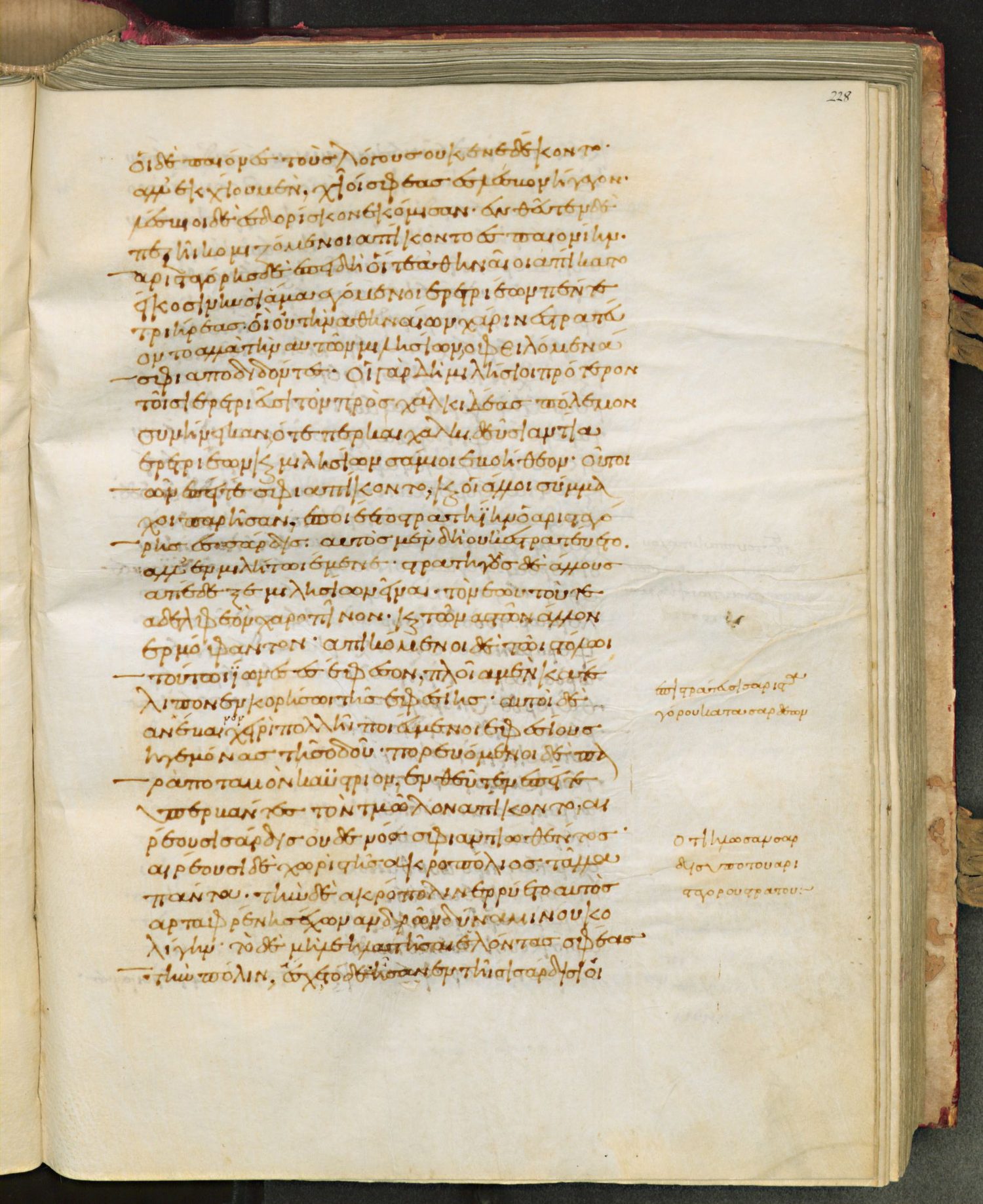
Laur. Plut. 70.3, fol. 228r: Greek here 5.98.4 to 5.101.1. Checked on the image (first and last words read and located in the Greek; each break checked against the neighbouring page): fol. 228r begins ‹οἱ δὲ Παίονες τοὺς› (5.98.4), ends ‹ἐν τῇσι Σάρδισι οἰ-› (5.101.1). English here: 5.99.1 to 5.100.1 (Godley's sentences for the sections whose Greek lies mostly on this page).
5.98.4οἱ δὲ Παίονες τοὺς λόγους οὐκ ἐνεδέκοντο, ἀλλʼ ἐκ Χίου μὲν Χῖοι σφέας ἐς Λέσβον ἤγαγον, Λέσβιοι δὲ ἐς Δορίσκον ἐκόμισαν, ἐνθεῦτεν δὲ πεζῇ κομιζόμενοι ἀπίκοντο ἐς Παιονίην. 5.99.1Ἀρισταγόρης δέ, ἐπειδὴ οἵ τε Ἀθηναῖοι ἀπίκοντο εἴκοσι νηυσί, ἅμα ἀγόμενοι Ἐρετριέων πέντε τριήρεας, οἳ οὐ τὴν Ἀθηναίων χάριν ἐστρατεύοντο ἀλλὰ τὴν αὐτῶν Μιλησίων, ὀφειλόμενά σφι ἀποδιδόντες· οἱ γὰρ δὴ Μιλήσιοι πρότερον τοῖσι Ἐρετριεῦσι τὸν πρὸς Χαλκιδέας πόλεμον συνδιήνεικαν, ὅτε περ καὶ Χαλκιδεῦσι ἀντία Ἐρετριέων καὶ Μιλησίων Σάμιοι ἐβοήθεον· οὗτοι ὦν ἐπείτε σφι ἀπίκοντο καὶ οἱ ἄλλοι σύμμαχοι παρῆσαν, ἐποιέετο στρατηίην ὁ Ἀρισταγόρης ἐς Σάρδις. 5.99.2αὐτὸς μὲν δὴ οὐκ ἐστρατεύετο ἀλλʼ ἔμενε ἐν Μιλήτῳ, στρατηγοὺς δὲ ἄλλους ἀπέδεξε Μιλησίων εἶναι, τὸν ἑωυτοῦ τε ἀδελφεὸν Χαροπῖνον καὶ τῶν ἀστῶν ἄλλον Ἑρμόφαντον. 5.100.1ἀπικόμενοι δὲ τῷ στόλῳ τούτῳ Ἴωνες ἐς Ἔφεσον πλοῖα μὲν κατέλιπον ἐν Κορησῷ τῆς Ἐφεσίης, αὐτοὶ δὲ ἀνέβαινον χειρὶ πολλῇ, ποιεύμενοι Ἐφεσίους ἡγεμόνας τῆς ὁδοῦ. πορευόμενοι δὲ παρὰ ποταμὸν Καΰστριον, ἐνθεῦτεν ἐπείτε ὑπερβάντες τὸν Τμῶλον ἀπίκοντο, αἱρέουσι Σάρδις οὐδενός σφι ἀντιωθέντος, αἱρέουσι δὲ χωρὶς τῆς ἀκροπόλιος τἆλλα πάντα· τὴν δὲ ἀκρόπολιν ἐρρύετο αὐτὸς Ἀρταφρένης ἔχων ἀνδρῶν δύναμιν οὐκ ὀλίγην. 5.101.1τὸ δὲ μὴ λεηλατῆσαι ἑλόντας σφέας τὴν πόλιν ἔσχε τόδε. ἦσαν ἐν τῇσι Σάρδισι οἰκίαι
5.99.1As for Aristagoras, when the Athenians came with their twenty ships, bringing with them five triremes of the Eretrians (who came to the war to please not the Athenians but the Milesians themselves, thereby repaying their debt; for ere now the Milesians had been the allies of the Eretrians in the war against Chalcis, when the Samians came to aid the Chalcidians against the Eretrians and Milesians)—when these, then, and the rest of the allies had all come, Aristagoras planned a march against Sardis. 5.99.2He himself went not with the army but stayed still at Miletus, and appointed others to be generals of the Milesians, namely, his own brother Charopinus, and another citizen named Hermophantus. 5.100.1The Ionians, having with this armament come to Ephesus, left their ships at Coresus in the Ephesian territory, and themselves marched inland with a great host, taking Ephesians to guide them on their way. Journeying beside the river Caicus, and crossing thence over Tmolus, they came to Sardis and took it, none withstanding them; all of it they took, save only the citadel, which was held by Artaphrenes himself with a great power.
Where on the image
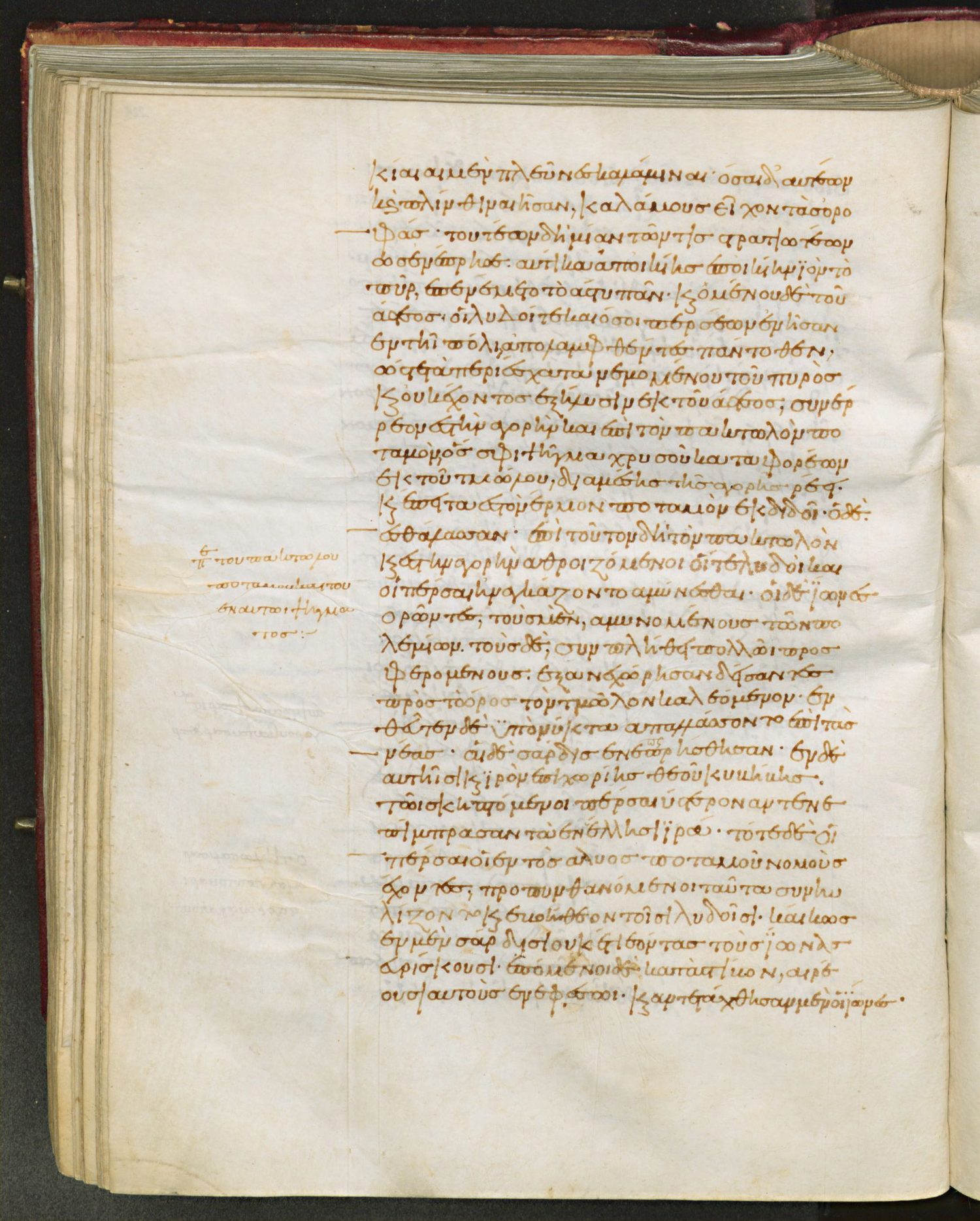
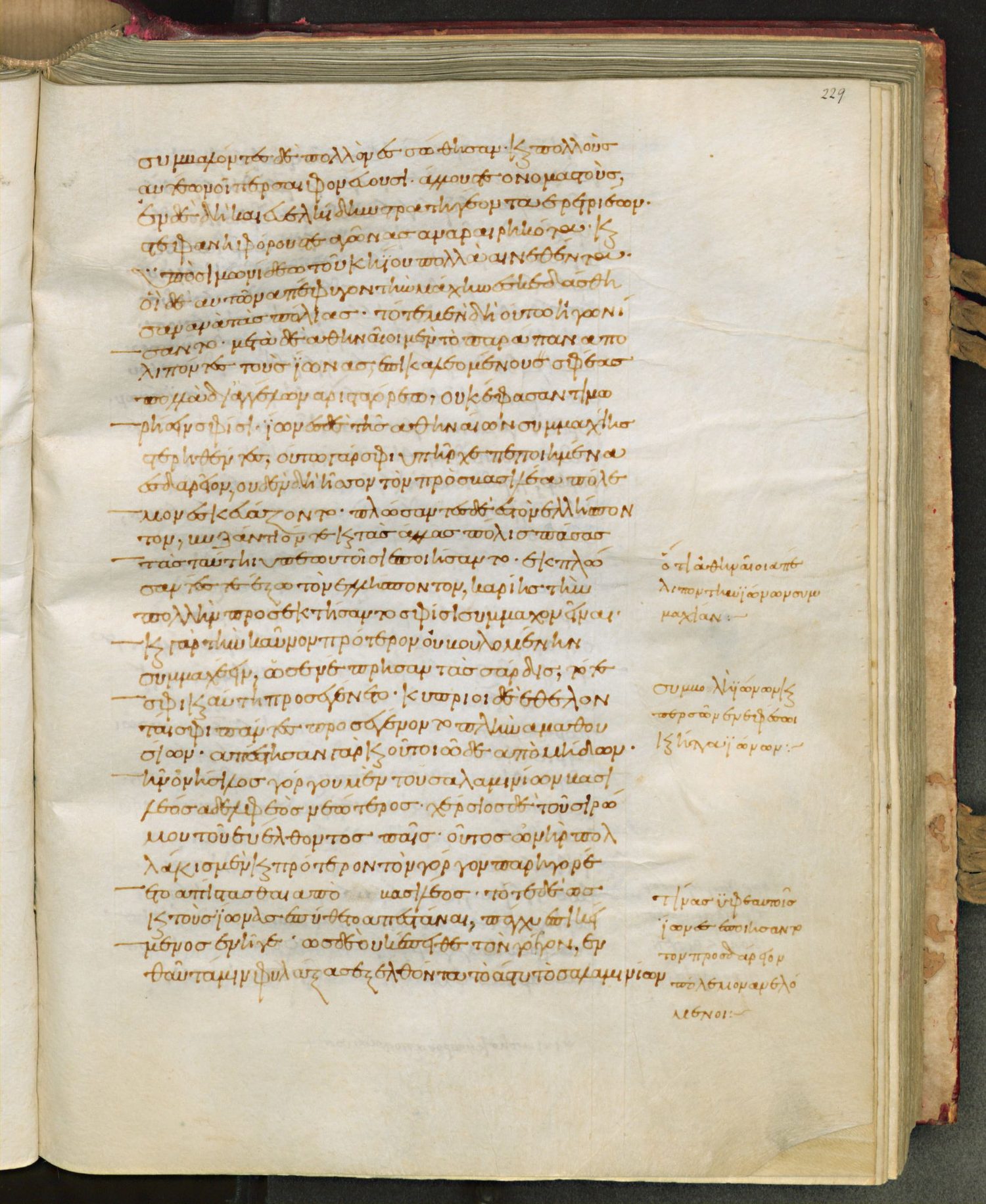
Laur. Plut. 70.3, fol. 228v: Greek here 5.101.1 to 5.102.2. Checked on the image (first and last words read and located in the Greek; each break checked against the neighbouring page): fol. 228v begins ‹-κίαι αἱ μὲν πλεῦνες› (5.101.1), ends ‹ἀντετάχθησαν μὲν οἱ Ἴωνες› (5.102.2). The word ‹οἰκίαι› is divided between fol. 228r and fol. 228v; it is given with fol. 228r. English here: 5.101.1 to 5.102.3 (Godley's sentences for the sections whose Greek lies mostly on this page).
5.101.1αἱ μὲν πλεῦνες καλάμιναι, ὅσαι δʼ αὐτέων καὶ πλίνθιναι ἦσαν, καλάμου εἶχον τὰς ὀροφάς· τουτέων δὴ μίαν τῶν τις στρατιωτέων ὡς ἐνέπρησε, αὐτίκα ἀπʼ οἰκίης ἐπʼ οἰκίην ἰὸν τὸ πῦρ ἐπενέμετο τὸ ἄστυ πᾶν. 5.101.2καιομένου δὲ τοῦ ἄστεος οἱ Λυδοί τε καὶ ὅσοι Περσέων ἐνῆσαν ἐν τῇ πόλι, ἀπολαμφθέντες πάντοθεν ὥστε τὰ περιέσχατα νεμομένου τοῦ πυρός, καὶ οὐκ ἔχοντες ἐξήλυσιν ἐκ τοῦ ἄστεος, συνέρρεον ἔς τε τὴν ἀγορὴν καὶ ἐπὶ τὸν Πακτωλὸν ποταμόν, ὅς σφι ψῆγμα χρυσοῦ καταφορέων ἐκ τοῦ Τμώλου διὰ μέσης τῆς ἀγορῆς ῥέει καὶ ἔπειτα ἐς τὸν Ἕρμον ποταμὸν ἐκδιδοῖ, ὁ δὲ ἐς θάλασσαν· ἐπὶ τοῦτον δὴ τὸν Πακτωλὸν καὶ ἐς τὴν ἀγορὴν ἀθροιζόμενοι οἵ τε Λυδοὶ καὶ οἱ Πέρσαι ἠναγκάζοντο ἀμύνεσθαι. 5.101.3οἱ δὲ Ἴωνες ὁρέοντες τοὺς μὲν ἀμυνομένους τῶν πολεμίων τοὺς δὲ σὺν πλήθεϊ πολλῷ προσφερομένους, ἐξανεχώρησαν δείσαντες πρὸς τὸ ὄρος τὸν Τμῶλον καλεόμενον, ἐνθεῦτεν δὲ ὑπὸ νύκτα ἀπαλλάσσοντο ἐπὶ τὰς νέας. 5.102.1καὶ Σάρδιες μὲν ἐνεπρήσθησαν, ἐν δὲ αὐτῇσι καὶ ἱρὸν ἐπιχωρίης θεοῦ Κυβήβης· τὸ σκηπτόμενοι οἱ Πέρσαι ὕστερον ἀντενεπίμπρασαν τὰ ἐν Ἕλλησι ἱρά. τότε δὲ οἱ Πέρσαι οἱ ἐντὸς Ἅλυος ποταμοῦ νομοὺς ἔχοντες, προπυνθανόμενοι ταῦτα, συνηλίζοντο καὶ ἐβοήθεον τοῖσι Λυδοῖσι. 5.102.2καὶ κως ἐν μὲν Σάρδισι οὐκέτι ἐόντας τοὺς Ἴωνας εὑρίσκουσι, ἑπόμενοι δὲ κατὰ στίβον αἱρέουσι αὐτοὺς ἐν Ἐφέσῳ. καὶ ἀντετάχθησαν μὲν οἱ Ἴωνες,
5.101.1Now this it was that hindered them from plundering the city. The greater part of the houses in Sardis were of reeds, and as many as were of brick, even they had roofs of reeds. So it was that when one of these was set afire by a soldier, the names spread from house to house all over the whole city. 5.101.2While the city was burning, the Lydians and all the Persians that were in the citadel, being hemmed in on every side (for the fire was consuming the outer parts), and having no exit from the city, came thronging into the marketplace and to the river Pactolus, which flows through the market-place carrying down gold dust from Tmolus, and issues into the river Hermus as does the Hermus into the sea; they assembled in the market-place by this Pactolus, and there of necessity defended themselves, Lydians and Persians. 5.101.3When the Ionians saw some of their enemies defending themselves and a great multitude of others approaching, they were afraid, and drew off out of the city to the mountain called Tmolus; whence at nightfall they departed to their ships. 5.102.1So Sardis was burnt, and therein the temple of Cybebe, the goddess of that country; which burning the Persians afterwards made their pretext for burning the temples of Hellas. But, at this time, the Persians of the provinces this side the Halys, on hearing of these matters, gathered together and came to aid the Lydians. 5.102.2It chanced that they found the Ionians no longer at Sardis; but following on their tracks they caught them at Ephesus. There the Ionians stood arrayed to meet them, but were utterly routed in the battle; many men of renown among them 5.102.3the Persians put to the sword, of whom was Evalcides the general of the Eretrians, one that had won crowns as victor in the lists and been greatly belauded by Simonides of Ceos; those of the Ionians that escaped from the battle fled scattered, each to his city.
Where on the image
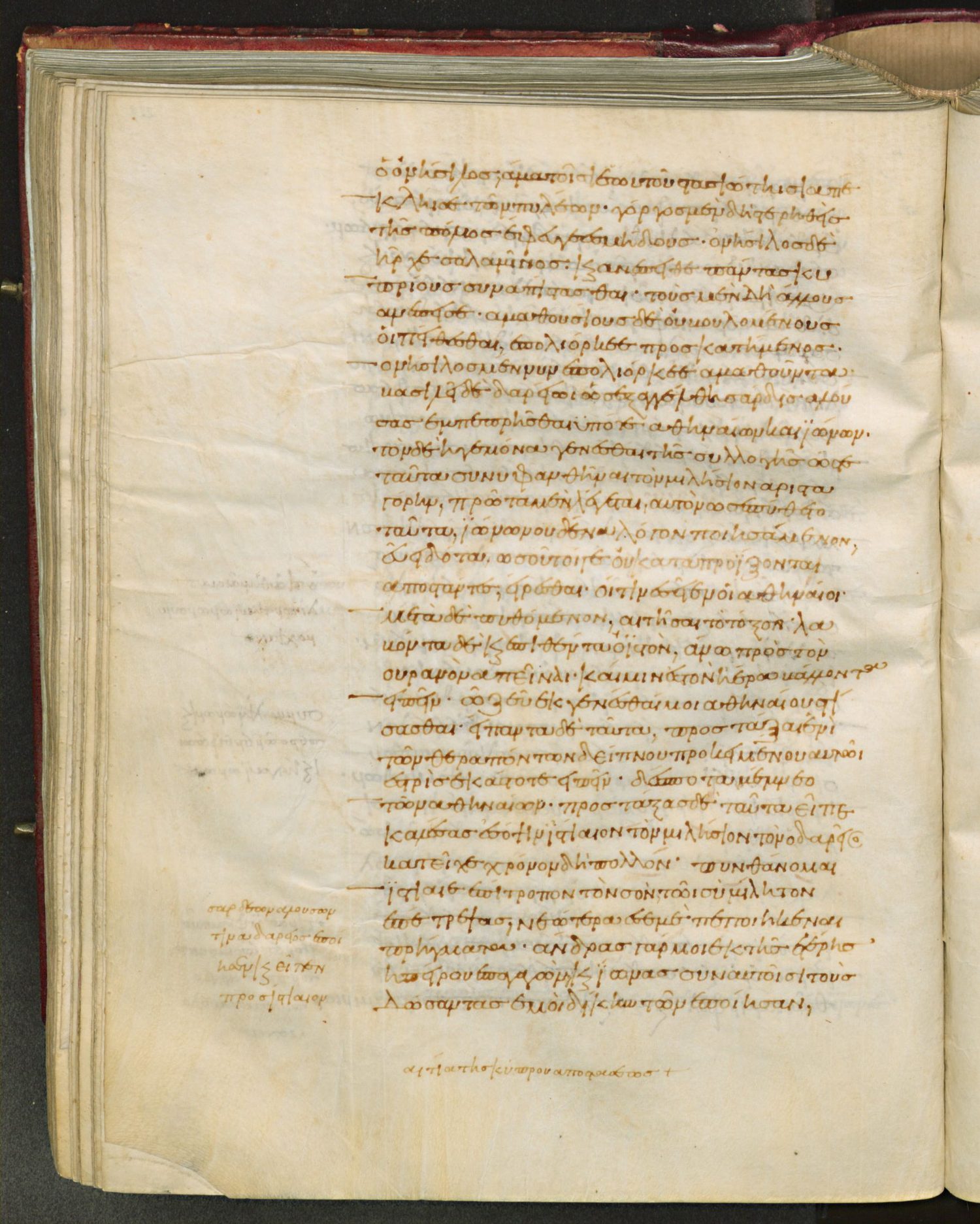
Laur. Plut. 70.3, fol. 229r: Greek here 5.102.2 to 5.104.2. Checked on the image (first and last words read and located in the Greek; each break checked against the neighbouring page): fol. 229r begins ‹συμβαλόντες δὲ πολλὸν ἑσσώθησαν.καὶ› (5.102.2), ends ‹τὸ ἄστυ τὸ Σαλαμινίων› (5.104.2). English here: 5.103.1 to 5.104.2 (Godley's sentences for the sections whose Greek lies mostly on this page).
5.102.2συμβαλόντες δὲ πολλὸν ἑσσώθησαν. 5.102.3καὶ πολλοὺς αὐτῶν οἱ Πέρσαι φονεύουσι ἄλλους τε ὀνομαστούς, ἐν δὲ δὴ καὶ Εὐαλκίδην στρατηγέοντα Ἐρετριέων, στεφανηφόρους τε ἀγῶνας ἀναραιρηκότα καὶ ὑπὸ Σιμωνίδεω τοῦ Κηίου πολλὰ αἰνεθέντα· οἳ δὲ αὐτῶν ἀπέφυγον τὴν μάχην, ἐσκεδάσθησαν ἀνὰ τὰς πόλιας. 5.103.1τότε μὲν δὴ οὕτω ἠγωνίσαντο. μετὰ δὲ Ἀθηναῖοι μὲν τὸ παράπαν ἀπολιπόντες τοὺς Ἴωνας, ἐπικαλεομένου σφέας πολλὰ διʼ ἀγγέλων Ἀρισταγόρεω, οὐκ ἔφασαν τιμωρήσειν σφι· Ἴωνες δὲ τῆς Ἀθηναίων συμμαχίης στερηθέντες, οὕτω γάρ σφι ὑπῆρχε πεποιημένα ἐς Δαρεῖον, οὐδὲν δὴ ἧσσον τὸν πρὸς βασιλέα πόλεμον ἐσκευάζοντο. 5.103.2πλώσαντες δὲ ἐς τὸν Ἑλλήσποντον Βυζάντιόν τε καὶ τὰς ἄλλας πόλιας πάσας τὰς ταύτῃ ὑπʼ ἑωυτοῖσι ἐποιήσαντο, ἐκπλώσαντές τε ἔξω τὸν Ἑλλήσποντον Καρίης τὴν πολλὴν προσεκτήσαντο σφίσι σύμμαχον εἶναι· καὶ γὰρ τὴν Καῦνον πρότερον οὐ βουλομένην συμμαχέειν, ὡς ἐνέπρησαν τὰς Σάρδις, τότε σφι καὶ αὕτη προσεγένετο. 5.104.1Κύπριοι δὲ ἐθελονταί σφι πάντες προσεγένοντο πλὴν Ἀμαθουσίων· ἀπέστησαν γὰρ καὶ οὗτοι ὧδε ἀπὸ Μήδων. ἦν Ὀνήσιλος Γόργου μὲν τοῦ Σαλαμινίων βασιλέος ἀδελφεὸς νεώτερος, Χέρσιος δὲ τοῦ Σιρώμου τοῦ Εὐέλθοντος παῖς. 5.104.2οὗτος ὡνὴρ πολλάκις μὲν καὶ πρότερον τὸν Γόργον παρηγορέετο ἀπίστασθαι ἀπὸ βασιλέος, τότε δέ, ὡς καὶ τοὺς Ἴωνας ἐπύθετο ἀπεστάναι, πάγχυ ἐπικείμενος ἐνῆγε· ὡς δὲ οὐκ ἔπειθε τὸν Γόργον, ἐνθαῦτά μιν φυλάξας ἐξελθόντα τὸ ἄστυ τὸ Σαλαμινίων
5.103.1Thus for the nonce they fared in their fighting. But presently the Athenians wholly separated themselves from the Ionians and refused to aid them, though Aristagoras sent messages of earnest entreaty; yet the Ionians, though bereft of their Athenian allies, did none the less busily carry forward their war against the king, so heavily they stood committed by what they had done to Darius. 5.103.2They sailed to the Hellespont and made Byzantium subject to them, and all the other cities of that region; then sailing out from the Hellespont they gained to their cause the greater part of Caria; for even Caunus, which till then had not willed to be their ally, did now join itself to them after the burning of Sardis. 5.104.1The Cyprians did likewise of their own free will, all save the people of Amathus; for these too revolted from the Medes in such manner as I will show. There was one Onesilus, a younger brother of Gorgus king of the Salaminians, and son of Chersis, who was the son of Siromus, who was the son of Evelthon. 5.104.2This man had often before counselled Gorgus to revolt from Darius, and now when he learnt that the Ionians too had revolted he was very instant in striving to move him; but when he could not persuade Gorgus, he and his faction waited till his brother had gone out of the city of Salamis, and shut him out of the gates.
Where on the image
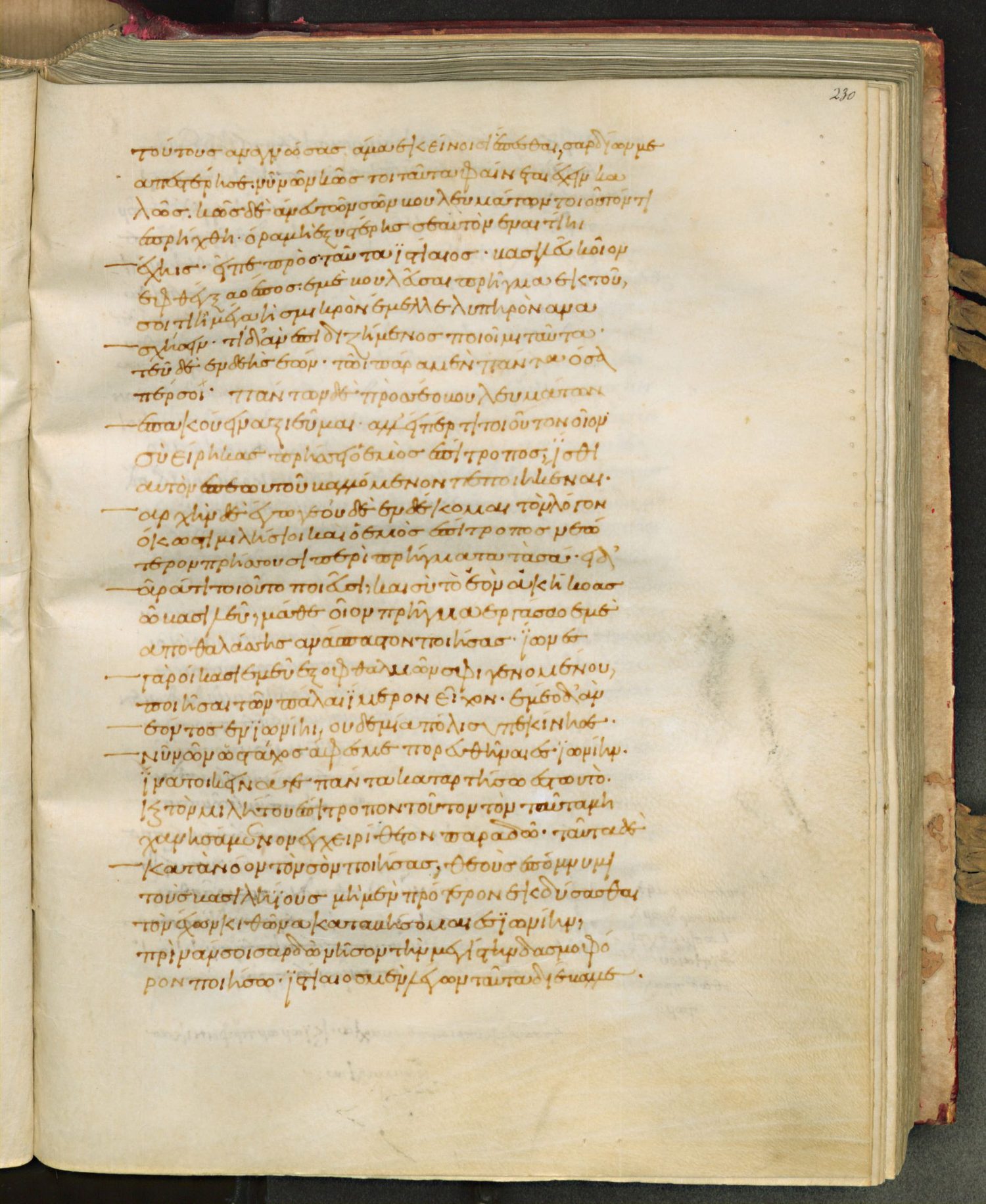
Laur. Plut. 70.3, fol. 229v: Greek here 5.104.2 to 5.106.1. Checked on the image (first and last words read and located in the Greek; each break checked against the neighbouring page): fol. 229v begins ‹ὁ Ὀνήσιλος ἅμα τοῖσι› (5.104.2), ends ‹ἐμοὶ δίκην τῶν ἐποίησαν› (5.106.1). Below the text, a reader's note on the cause of the revolt of Cyprus. English here: 5.104.3 to 5.106.1 (Godley's sentences for the sections whose Greek lies mostly on this page).
5.104.2ὁ Ὀνήσιλος ἅμα τοῖσι ἑωυτοῦ στασιώτῃσι ἀπεκλήισε τῶν πυλέων. 5.104.3Γόργος μὲν δὴ στερηθεὶς τῆς πόλιος ἔφευγε ἐς Μήδους, Ὀνήσιλος δὲ ἦρχε Σαλαμῖνος καὶ ἀνέπειθε πάντας Κυπρίους συναπίστασθαι. τοὺς μὲν δὴ ἄλλους ἀνέπεισε, Ἀμαθουσίους δὲ οὐ βουλομένους οἱ πείθεσθαι ἐπολιόρκεε προσκατήμενος. 5.105.1Ὀνήσιλος μέν νυν ἐπολιόρκεε Ἀμαθοῦντα. βασιλέι δὲ Δαρείῳ ὡς ἐξαγγέλθη Σάρδις ἁλούσας ἐμπεπρῆσθαι ὑπό τε Ἀθηναίων καὶ Ἰώνων, τὸν δὲ ἡγεμόνα γενέσθαι τῆς συλλογῆς ὥστε ταῦτα συνυφανθῆναι τὸν Μιλήσιον Ἀρισταγόρην, πρῶτα μὲν λέγεται αὐτόν, ὡς ἐπύθετο ταῦτα, Ἰώνων οὐδένα λόγον ποιησάμενον, εὖ εἰδότα ὡς οὗτοί γε οὐ καταπροΐξονται ἀποστάντες, εἰρέσθαι οἵτινες εἶεν οἱ Ἀθηναῖοι, μετὰ δὲ πυθόμενον αἰτῆσαι τὸ τόξον, λαβόντα δὲ καὶ ἐπιθέντα δὲ ὀιστὸν ἄνω πρὸς τὸν οὐρανὸν ἀπεῖναι, καί μιν ἐς τὸν ἠέρα βάλλοντα εἰπεῖν 5.105.2ὦ Ζεῦ, ἐκγενέσθαι μοι Ἀθηναίους τίσασθαι, εἴπαντα δὲ ταῦτα προστάξαι ἑνὶ τῶν θεραπόντων δείπνου προκειμένου αὐτῷ ἐς τρὶς ἑκάστοτε εἰπεῖν δέσποτα, μέμνεο τῶν Ἀθηναίων. 5.106.1προστάξας δὲ ταῦτα εἶπε, καλέσας ἐς ὄψιν Ἱστιαῖον τὸν Μιλήσιον, τὸν ὁ Δαρεῖος κατεῖχε χρόνον ἤδη πολλόν, πυνθάνομαι Ἱστιαῖε ἐπίτροπον τὸν σόν, τῷ σὺ Μίλητον ἐπέτρεψας, νεώτερα ἐς ἐμὲ πεποιηκέναι πρήγματα· ἄνδρας γάρ μοι ἐκ τῆς ἑτέρης ἠπείρου ἐπαγαγών, καὶ Ἴωνας σὺν αὐτοῖσι τοὺς δώσοντας ἐμοὶ δίκην τῶν ἐποίησαν,
5.104.3Gorgus then having lost his city took refuge with the Medes, and Onesilus was king of Salamis and over-persuaded all Cyprus to revolt with him, all save the Amathusians, who would not consent; and he sat down before their city and besieged it. 5.105.1Onesilus, then, besieged Amathus. But when it was told to Darius that Sardis had been taken and burnt by the Athenians and Ionians, and that Aristagoras the Milesian had been leader of the conspiracy for the weaving of this plan, at his first hearing of it (it is said) he took no account of the Ionians,—being well assured that they of all men would not go scatheless for their rebellion,—but asked who were the Athenians; and being told, he called for his bow, which he took, and laid an arrow on it and shot it into the sky, praying as he sent it aloft, “ 5.105.2O Zeus, grant me vengeance on the Athenians,” and therewithal he charged one of his servants to say to him thrice whenever dinner was set before him, “Master, remember the Athenians.” 5.106.1Having given this charge, he called before him Histiaeus the Milesian, whom Darius had now kept for a long while with him, and said: “I learn, Histiaeus! that your vicegerent, to whom you gave Miletus in charge, has done me strange wrong: he has brought men from the mainland overseas, and persuaded to follow them certain Ionians,—who shall yet pay me the penalty of their deeds,—and has robbed me of Sardis.
Where on the image
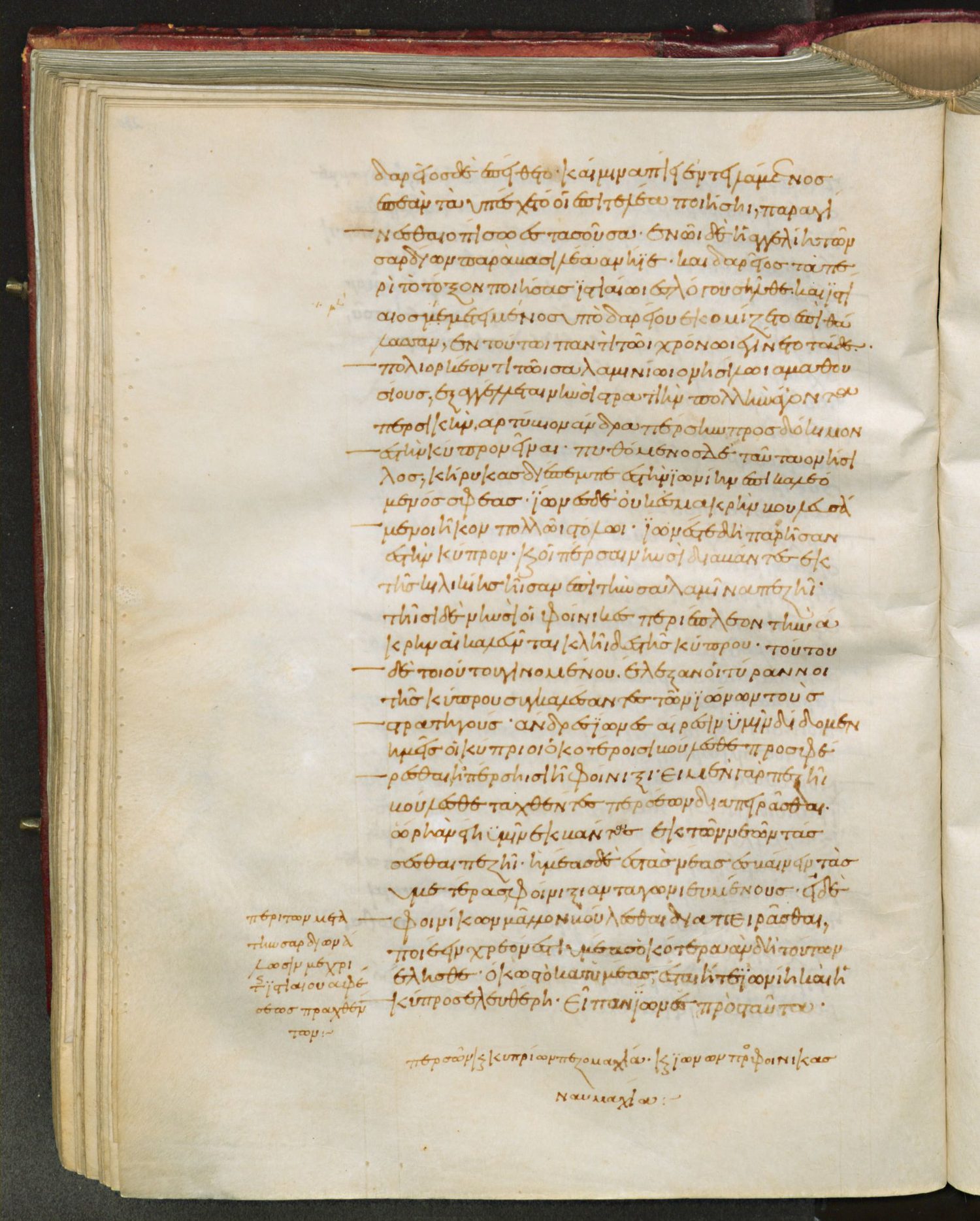
Laur. Plut. 70.3, fol. 230r: Greek here 5.106.1 to 5.107.1. Checked on the image (first and last words read and located in the Greek; each break checked against the neighbouring page): fol. 230r begins ‹τούτους ἀναγνώσας ἅμα ἐκείνοισι› (5.106.1), ends ‹μὲν λέγων ταῦτα διέβαλλε› (5.107.1). English here: 5.106.2 to 5.106.6 (Godley's sentences for the sections whose Greek lies mostly on this page).
5.106.1τούτους ἀναγνώσας ἅμα ἐκείνοισι ἕπεσθαι, Σαρδίων με ἀπεστέρησε. νῦν ὦν κῶς τοι ταῦτα φαίνεται ἔχειν καλῶς; 5.106.2κῶς δὲ ἄνευ τῶν σῶν βουλευμάτων τούτων τι ἐπρήχθη; ὅρα μὴ ἐξ ὑστέρης σεωυτὸν ἐν αἰτίῃ σχῇς. 5.106.3εἶπε πρὸς ταῦτα Ἱστιαῖος βασιλεῦ, κοῖον ἐφθέγξαο ἔπος, ἐμὲ βουλεῦσαι πρῆγμα ἐκ τοῦ σοί τι ἢ μέγα ἢ σμικρὸν ἔμελλε λυπηρὸν ἀνασχήσειν; τί δʼ ἂν ἐπιδιζήμενος ποιέοιμι ταῦτα, τεῦ δὲ ἐνδεὴς ἐών; τῷ πάρα μὲν πάντα ὅσα περ σοί, πάντων δὲ πρὸς σέο βουλευμάτων ἐπακούειν ἀξιοῦμαι. 5.106.4ἀλλʼ εἴ περ τι τοιοῦτον οἷον σὺ εἴρηκας πρήσσει ὁ ἐμὸς ἐπίτροπος, ἴσθι αὐτὸν ἐπʼ ἑωυτοῦ βαλόμενον πεποιηκέναι. ἀρχὴν δὲ ἔγωγε οὐδὲ ἐνδέκομαι τὸν λόγον, ὅκως τι Μιλήσιοι καὶ ὁ ἐμὸς ἐπίτροπος νεώτερον πρήσσουσι περὶ πρήγματα τὰ σά. εἰ δʼ ἄρα τι τοιοῦτο ποιεῦσι καὶ σὺ τὸ ἐὸν ἀκήκοας ὦ βασιλεῦ, μάθε οἷον πρῆγμα ἐργάσαο ἐμὲ ἀπὸ θαλάσσης ἀνάσπαστον ποιήσας. 5.106.5Ἴωνες γὰρ οἴκασι ἐμεῦ ἐξ ὀφθαλμῶν σφι γενομένου ποιῆσαι τῶν πάλαι ἵμερον εἶχον· ἐμέο δʼ ἂν ἐόντος ἐν Ἰωνίῃ οὐδεμία πόλις ὑπεκίνησε. νῦν ὦν ὡς τάχος ἄπες με πορευθῆναι ἐς Ἰωνίην, ἵνα τοι κεῖνά τε πάντα καταρτίσω ἐς τὠυτὸ καὶ τὸν Μιλήτου ἐπίτροπον τοῦτον τὸν ταῦτα μηχανησάμενον ἐγχειρίθετον παραδῶ. 5.106.6ταῦτα δὲ κατὰ νόον τὸν σὸν ποιήσας, θεοὺς ἐπόμνυμι τοὺς βασιληίους μὴ μὲν πρότερον ἐκδύσασθαι τὸν ἔχων κιθῶνα καταβήσομαι ἐς Ἰωνίην, πρὶν ἄν τοι Σαρδὼ νῆσον τὴν μεγίστην δασμοφόρον ποιήσω. 5.107.1Ἱστιαῖος μὲν λέγων ταῦτα διέβαλλε,
5.106.2Now, therefore, I ask you, how think you that this is well done? And how came such things to be done without counsel from you? Look well to it, that you have not cause to blame yourself hereafter.” 5.106.3To this Histiaeus made answer: “Sire, what is this word that you utter—that I and none other should devise a plan whence aught great or small was like to arise for your hurt? And what then have I to desire, and what do I lack, that I should do that? All that you have is mine, and I am deemed worthy to hear all your counsels. 5.106.4Nay, if indeed my vicegerent has any such thing in hand as this whereof you speak, be well assured that he has acted of his own motion. For myself, I cannot even so much as believe the report that the Milesians and my vicegerent are doing you strange wrong. But if it appears that they are so dealing, and it is the truth, O king, that you have heard, then I bid you perceive what it was that you wrought when you brought me from the sea into exile. 5.106.5For it would seem that the Ionians have taken occasion by my being removed out of their sight to do that whereon their hearts had long been set; but had I been in Ionia no city would have stirred. Now therefore send me away on my journey to Ionia with all speed, that I may bring that country to its former peace, and deliver into your hands that vicegerent of Miletus who has devised all this. 5.106.6Then, when I have done this according to your desire, I swear by the gods of your kingship that I will not doff the tunic which I wear when I go down to Ionia, ere I make Sardo, the greatest of the isles of the sea, tributary to you.”
Where on the image
Laur. Plut. 70.3, fol. 230v: Greek here 5.107.1 to 5.109.3. Checked on the image (first and last words read and located in the Greek; each break checked against the neighbouring page): fol. 230v begins ‹Δαρεῖος δὲ ἐπείθετο καί› (5.107.1), ends ‹ἐλευθέρη.εἶπαν Ἴωνες πρὸς ταῦτα› (5.109.3). Below the text, a reader's note in two lines on the battles of the Persians and Cypriots on land and of the Ionians and Phoenicians at sea; another note stands in the left margin. English here: 5.107.1 to 5.109.2 (Godley's sentences for the sections whose Greek lies mostly on this page).
5.107.1Δαρεῖος δὲ ἐπείθετο καί μιν ἀπίει, ἐντειλάμενος, ἐπεὰν τὰ ὑπέσχετό οἱ ἐπιτελέα ποιήσῃ, παραγίνεσθαί οἱ ὀπίσω ἐς τὰ Σοῦσα. 5.108.1ἐν ᾧ δὲ ἡ ἀγγελίη τε περὶ τῶν Σαρδίων παρὰ βασιλέα ἀνήιε καὶ Δαρεῖος τὰ περὶ τὸ τόξον ποιήσας Ἱστιαίῳ ἐς λόγους ἦλθε καὶ Ἱστιαῖος μεμετιμένος ὑπὸ Δαρείου ἐκομίζετο ἐπὶ θάλασσαν, ἐν τούτῳ παντὶ τῷ χρόνῳ ἐγίνετο τάδε. πολιορκέοντι τῷ Σαλαμινίῳ Ὀνησίλῳ Ἀμαθουσίους ἐξαγγέλλεται νηυσὶ στρατιὴν πολλὴν ἄγοντα Περσικὴν Ἀρτύβιον ἄνδρα Πέρσην προσδόκιμον ἐς τὴν Κύπρον εἶναι· 5.108.2πυθόμενος δὲ ταῦτα ὁ Ὀνήσιλος κήρυκας διέπεμπε ἐς τὴν Ἰωνίην ἐπικαλεύμενος σφέας, Ἴωνες δὲ οὐκ ἐς μακρὴν βουλευσάμενοι ἧκον πολλῷ στόλῳ. Ἴωνές τε δὴ παρῆσαν ἐς τὴν Κύπρον καὶ οἱ Πέρσαι νηυσὶ διαβάντες ἐκ τῆς Κιλικίης ἤισαν ἐπὶ τὴν Σαλαμῖνα πεζῇ. τῇσι δὲ νηυσὶ οἱ Φοίνικες περιέπλεον τὴν ἄκρην αἳ καλεῦνται Κληῖδες τῆς Κύπρου. 5.109.1τούτου δὲ τοιούτου γινομένου ἔλεξαν οἱ τύραννοι τῆς Κύπρου, συγκαλέσαντες τῶν Ἰώνων τοὺς στρατηγούς, ἄνδρες Ἴωνες, αἵρεσιν ὑμῖν δίδομεν ἡμεῖς οἱ Κύπριοι ὁκοτέροισι βούλεσθε προσφέρεσθαι, ἢ Πέρσῃσι ἢ Φοίνιξι. 5.109.2εἰ μὲν γὰρ πεζῇ βούλεσθε ταχθέντες Περσέων διαπειρᾶσθαι, ὥρη ἂν εἴη ὑμῖν ἐκβάντας ἐκ τῶν νεῶν τάσσεσθαι πεζῇ, ἡμέας δὲ ἐς τὰς νέας ἐσβαίνειν τὰς ὑμετέρας Φοίνιξι ἀνταγωνιευμένους· εἰ δὲ Φοινίκων μᾶλλον βούλεσθε διαπειρᾶσθαι, ποιέειν χρεόν ἐστι ὑμέας, ὁκότερα ἂν δὴ τούτων ἕλησθε, ὅκως τὸ κατʼ ὑμέας ἔσται ἥ τε Ἰωνίη καὶ ἡ Κύπρος ἐλευθέρη. 5.109.3εἶπαν Ἴωνες πρὸς ταῦτα
5.107.1Thus spoke Histiaeus, with intent to deceive; and Darius consented and let him go, charging Histiaeus to appear before him at Susa when he should have achieved what he promised. 5.108.1Now while the message concerning Sardis went up to the king, and Darius, having done as I said with his bow, held converse with Histiaeus, and Histiaeus being suffered to go by Darius made his way to the sea, in all this time matters fell out as I shall show. While Onesilus of Salamis was besieging the Amathusians, news was brought him that Artybius, a Persian, was thought to be coming to Cyprus with a great Persian 5.108.2host; learning which, Onesilus sent heralds about to Ionia to summon the people, and the Ionians after no long deliberation came with a great armament. So the Ionians were in Cyprus when the Persians, crossing from Cilicia, marched to Salamis by land, while the Phoenicians in their ships sailed round the headland which is called the Keys of Cyprus. 5.109.1In this turn of affairs, the despots of Cyprus assembled the generals of the Ionians, and said to them: “Ionians, we Cyprians bid you choose which you will encounter, the Persians or the Phoenicians For 5.109.2if you will set your army in array on land and try conclusions with the Persians, then it is time for you to get you out of your ships and array yourselves on land, and for us to embark in your ships to contend with the Phoenicians; but if you desire rather to try conclusions with the Phoenicians, you must so act, whichever you choose, that as far as in you lies Ionia and Cyprus shall be free.”
Where on the image
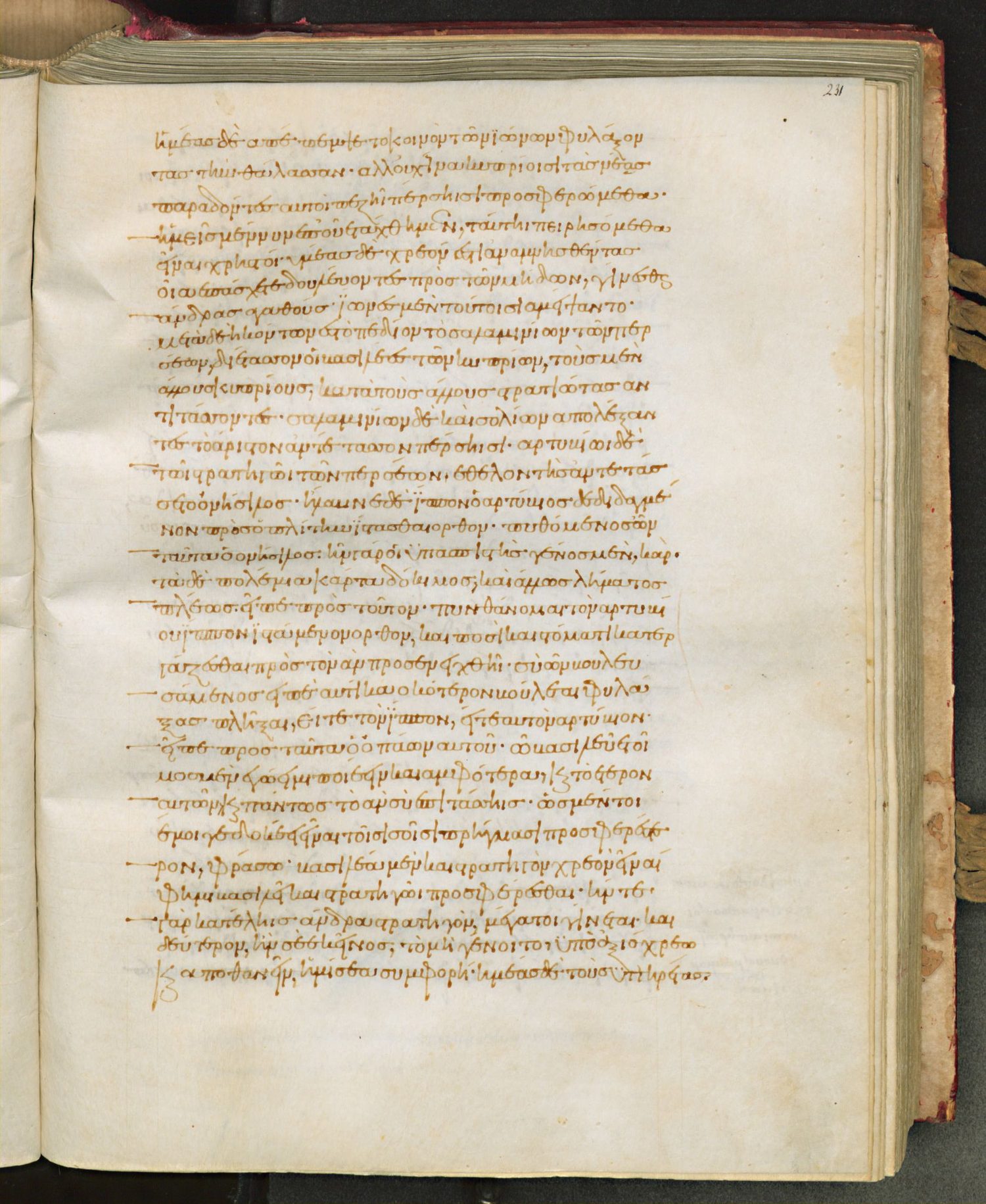
Laur. Plut. 70.3, fol. 231r: Greek here 5.109.3 to 5.111.4. Checked on the image (first and last words read and located in the Greek; each break checked against the neighbouring page): fol. 231r begins ‹ἡμέας δὲ ἀπέπεμψε τὸ› (5.109.3), ends ‹ἡμέας δὲ τοὺς ὑπηρέτας› (5.111.4). English here: 5.109.3 to 5.111.4 (Godley's sentences for the sections whose Greek lies mostly on this page).
5.109.3ἡμέας δὲ ἀπέπεμψε τὸ κοινὸν τῶν Ἰώνων φυλάξοντας τὴν θάλασσαν, ἀλλʼ οὐκ ἵνα Κυπρίοισι τὰς νέας παραδόντες αὐτοὶ πεζῇ Πέρσῃσι προσφερώμεθα. ἡμεῖς μέν νυν ἐπʼ οὗ ἐτάχθημεν, ταύτῃ πειρησόμεθα εἶναι χρηστοί· ὑμέας δὲ χρεόν ἐστι ἀναμνησθέντας οἷα ἐπάσχετε δουλεύοντες πρὸς τῶν Μήδων, γίνεσθαι ἄνδρας ἀγαθούς. 5.110.1Ἴωνες μὲν τούτοισι ἀμείψαντο· μετὰ δε ἡκόντων ἐς τὸ πεδίον τὸ Σαλαμινίων τῶν Περσέων, διέτασσον οἱ βασιλέες τῶν Κυπρίων, τοὺς μὲν ἄλλους Κυπρίους κατὰ τοὺς ἄλλους στρατιώτας ἀντιτάσσοντες, Σαλαμινίων δὲ καὶ Σολίων ἀπολέξαντες τὸ ἄριστον ἀντέτασσον Πέρσῃσι· Ἀρτυβίῳ δὲ τῷ στρατηγῷ τῶν Περσέων ἐθελοντὴς ἀντετάσσετο Ὀνήσιλος. 5.111.1ἤλαυνε δὲ ἵππον ὁ Ἀρτύβιος δεδιδαγμένον πρὸς ὁπλίτην ἵστασθαι ὀρθόν. πυθόμενος ὦν ταῦτα ὁ Ὀνήσιλος, ἦν γάρ οἱ ὑπασπιστὴς γένος μὲν Κὰρ τὰ δὲ πολέμια κάρτα δόκιμος καὶ ἄλλως λήματος πλέος, εἶπε πρὸς τοῦτον 5.111.2πυνθάνομαι τὸν Ἀρτυβίου ἵππον ἱστάμενον ὀρθὸν καὶ ποσὶ καὶ στόματι κατεργάζεσθαι πρὸς τὸν ἂν προσενειχθῇ· σὺ ὦν βουλευσάμενος εἰπὲ αὐτίκα ὁκότερον βούλεαι φυλάξας πλῆξαι, εἴτε τὸν ἵππον εἴτε αὐτὸν Ἀρτύβιον. 5.111.3εἶπε πρὸς ταῦτα ὁ ὀπάων αὐτοῦ ὦ βασιλεῦ, ἕτοιμος μὲν ἐγώ εἰμι ποιέειν καὶ ἀμφότερα καὶ τὸ ἕτερον αὐτῶν, καὶ πάντως τὸ ἂν σὺ ἐπιτάσσῃς· ὡς μέντοι ἔμοιγε δοκέει εἶναι τοῖσι σοῖσι πρήγμασι προσφερέστερον, φράσω. 5.111.4βασιλέα μὲν καὶ στρατηγὸν χρεὸν εἶναι φημὶ βασιλέι τε καὶ στρατηγῷ προσφέρεσθαι. ἤν τε γὰρ κατέλῃς ἄνδρα στρατηγόν, μέγα τοι γίνεται, καὶ δεύτερα, ἢν σὲ ἐκεῖνος, τὸ μὴ γένοιτο, ὑπὸ ἀξιοχρέου καὶ ἀποθανεῖν ἡμίσεα συμφορή· ἡμέας δὲ τοὺς ὑπηρέτας
5.109.3To this the Ionians answered, “Nay, we were sent by the common voice of Ionia to guard the seas, not to deliver our ships to men of Cyprus and encounter the Persians on land. We will essay then to bear ourselves bravely in the task whereto we were set; and it is for you to prove yourselves valiant men, remembering what you suffered when you were slaves to the Medians.” 5.110.1Thus answered the Ionians; and presently, the Persians being now in the plain of Salamis, the Cyprian kings ordered their battle line, arraying the chosen flower of the Salaminians and Solians over against the Persians and the rest of the Cyprians against the rest of the enemy’s army; Onesilus chose for himself a place where he had before him Artybius, the Persian general. 5.111.1Now the horse whereon Artybius rode was trained to fight with men-at-arms by rearing up. Hearing this, Onesilus said to his esquire (who was Carian born, of great renown in war, and a valiant man ever), “ 5.111.2I learn that Artybius’ horse rears up and kicks and bites to death whomsoever he encounters. Bethink you then and tell me straightway which you will watch and smite, Artybius himself or his horse.” 5.111.3To this his henchman answered, “O King, ready am I to do either or both, and whatever your bidding be, that to do; yet I will tell you what I judge to accord best with your state. 5.111.4To my mind, it is right that king and general should by king and general be encountered. For if you lay low a man that is a general, you have achieved a great feat; and failing that, if he lay you low (as I pray he may not), it is but half the misfortune to be slain by a noble foe; and for us that are servants it is meet that we fight with servants like ourselves, yea, and with that horse; fear not his tricks; for I promise you that never again shall he do battle with any man.”
Where on the image
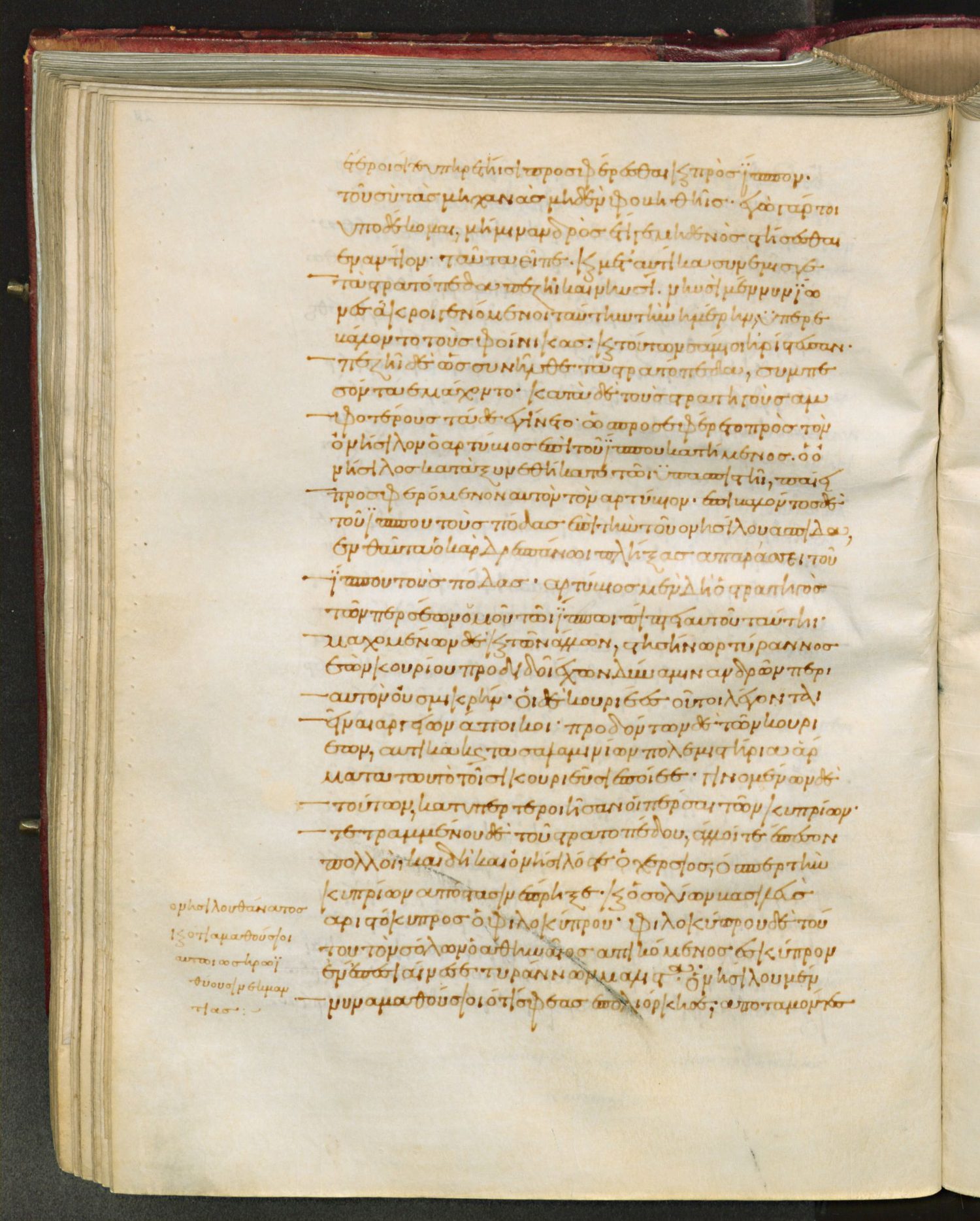
Laur. Plut. 70.3, fol. 231v: Greek here 5.111.4 to 5.113.2. Checked on the image (first and last words read and located in the Greek; each break checked against the neighbouring page): fol. 231v begins ‹ἑτέροισί τε ὑπηρέτῃσι προσφέρεσθαι› (5.111.4), ends ‹ὅτι σφέας ἐπολιόρκησε, ἀποταμόντες› (5.114.1). English here: 5.112.1 to 5.113.2 (Godley's sentences for the sections whose Greek lies mostly on this page).
5.111.4ἑτέροισί τε ὑπηρέτῃσι προσφέρεσθαι καὶ πρὸς ἵππον· τοῦ σὺ τὰς μηχανὰς μηδὲν φοβηθῇς· ἐγὼ γάρ τοι ὑποδέκομαι μή μιν ἀνδρὸς ἔτι γε μηδενὸς στήσεσθαι ἐναντίον. 5.112.1ταῦτα εἶπε, καὶ μεταυτίκα συνέμισγε τὰ στρατόπεδα πεζῇ καὶ νηυσί. νηυσὶ μέν νυν Ἴωνες ἄκροι γενόμενοι ταύτην τὴν ἡμέρην ὑπερεβάλοντο τοὺς Φοίνικας, καὶ τούτων Σάμιοι ἠρίστευσαν· πεζῇ δέ, ὡς συνῆλθε τὰ στρατόπεδα, συμπεσόντα ἐμάχοντο. 5.112.2κατὰ δὲ τοὺς στρατηγοὺς ἀμφοτέρους τάδε ἐγίνετο· ὡς προσεφέρετο πρὸς τὸν Ὀνήσιλον ὁ Ἀρτύβιος ἐπὶ τοῦ ἵππου κατήμενος, ὁ Ὀνήσιλος κατὰ τὰ συνεθήκατο τῷ ὑπασπιστῇ παίει προσφερόμενον αὐτὸν τὸν Ἀρτύβιον· ἐπιβαλόντος δὲ τοῦ ἵππου τοὺς πόδας ἐπὶ τὴν Ὀνησίλου ἀσπίδα, ἐνθαῦτα ὁ Κὰρ δρεπάνῳ πλήξας ἀπαράσσει τοῦ ἵππου τοὺς πόδας. 5.113.1Ἀρτύβιος μὲν δὴ ὁ στρατηγὸς τῶν Περσέων ὁμοῦ τῷ ἵππῳ πίπτει αὐτοῦ ταύτῃ. μαχομένων δὲ καὶ τῶν ἄλλων, Στησήνωρ τύραννος ἐὼν Κουρίου προδιδοῖ ἔχων δύναμιν ἀνδρῶν περὶ ἑωυτὸν οὐ σμικρήν. οἱ δὲ Κουριέες οὗτοι λέγονται εἶναι Ἀργείων ἄποικοι. προδόντων δὲ τῶν Κουριέων αὐτίκα καὶ τὰ Σαλαμινίων πολεμιστήρια ἅρματα τὠυτὸ τοῖσι Κουριεῦσι ἐποίεε. γινομένων δὲ τούτων κατυπέρτεροι ἦσαν οἱ Πέρσαι τῶν Κυπρίων. 5.113.2τετραμμένου δὲ τοῦ στρατοπέδου ἄλλοι τε ἔπεσον πολλοὶ καὶ δὴ καὶ Ὀνήσιλός τε ὁ Χέρσιος, ὅς περ τὴν Κυπρίων ἀπόστασιν ἔπρηξε, καὶ ὁ Σολίων βασιλεὺς Ἀριστόκυπρος ὁ Φιλοκύπρου, Φιλοκύπρου δὲ τούτου τὸν Σόλων ὁ Ἀθηναῖος ἀπικόμενος ἐς Κύπρον ἐν ἔπεσι αἴνεσε τυράννων μάλιστα.
5.112.1Thus he spoke; and immediately the mellay of the hosts began by land and sea. The Ionian shipmen showed surpassing excellence that day, and overcame the Phoenicians; among them, the Samians were most valorous; and on land, when the armies met, they charged and fought. 5.112.2With the two generals it fared as I shall show. Artybius rode at Onesilus; Onesilus, as he had agreed with his esquire, dealt Artybius a blow as he bore down upon him; and when the horse smote his hoofs on Onesilus’ shield, the Carian shore away the horse’s legs with a stroke of his falchion. 5.113.1Thus and there fell Artybius the Persian general, with his horse. While the rest yet fought, Stesenor despot of Curium (which is said to be an Argive settlement) played the traitor, with his great company of men; and at the treachery of the Curians the war-chariots of the Salaminians did likewise. Thus it was brought about, that the Persians gained the upper hand over the Cyprians. 5.113.2So the army was routed, and many were there slain; among whom was Onesilus, son of Chersis, who had wrought the Cyprian revolt, and the king of the Solians, Aristocyprus son of Philocyprus—that Philocyprus whom Solon of Athens, when he came to Cyprus, extolled in a poem above all other despots.
Notes
- Greek: the text printed in A. D. Godley's Loeb edition, via Perseus (tlg0016.tlg001.perseus-grc2). Square brackets mark words the editor considers later additions; [...] marks a gap the editor indicates. Perseus note markers are omitted.
- English: A. D. Godley, Herodotus vol. 3 (1922) (Loeb Classical Library), as transcribed on Wikisource. Godley's footnotes are omitted.
- Section numbers in the English were placed by comparing Godley's text with the Perseus version of his translation; where a section begins inside one of Godley's sentences, the English is kept with the page that holds the start of that sentence.
Cite
Sources
- Source: Florence, Laur. Plut. 70.3 (10th c.) via BML Teca Digitale + Greek of Godley's Loeb (Perseus) + English of A. D. Godley (Loeb, Wikisource) (holding institution)
- Critical edition: Greek of A. D. Godley's Loeb edition (1920-1925), via Perseus
← previous · → next · v cycle view · l back to library