Herodotus, Histories 6.1-17: Histiaeus; the battle of Lade
Introduction
Herodotus of Halicarnassus wrote the Histories in the third quarter of the 5th century BCE, an inquiry into the deeds of Greeks and barbarians and the causes of the wars between them, later divided into nine books. Book 6 tells of the end of the Ionian revolt at Lade and Miletus, the first Persian expeditions against Greece under Mardonius and under Datis and Artaphrenes, the quarrels of Sparta, Athens and Aegina, and the battle of Marathon.
The photographs are of Florence, Biblioteca Medicea Laurenziana, Plut. 70.3 (parchment, 10th century, 374 folios, 31 lines a page), Herodotus, Histories (codex A of the editors), the oldest surviving manuscript of the complete Histories, from the Teca Digitale of the Biblioteca Medicea Laurenziana. Each section below is the text of one page, or of the part of a page that falls within these chapters. The first and last words of every page were read on the photograph and located in the Greek, and every page break was checked against the next page; the notes quote these words. Readers' notes in the margins are not part of the text and are mentioned where they occur.
The Greek is the text printed in A. D. Godley's Loeb edition (1920-1925), from Perseus; it is the edited text, not a transcription of the manuscript, whose wording differs in places. The English is Godley's translation as printed, from Wikisource. Godley's English carries only chapter numbers; the section numbers shown in it were placed by comparison with the Perseus version of his translation. Each page's English is cut at the end of one of Godley's sentences, so it can begin or end a few lines away from the Greek of the page; each note gives the exact ranges.
This entry covers chapters 6.1-17, on fol. 234r to 237v.
How was this verified? (Provenance)
Where on the image
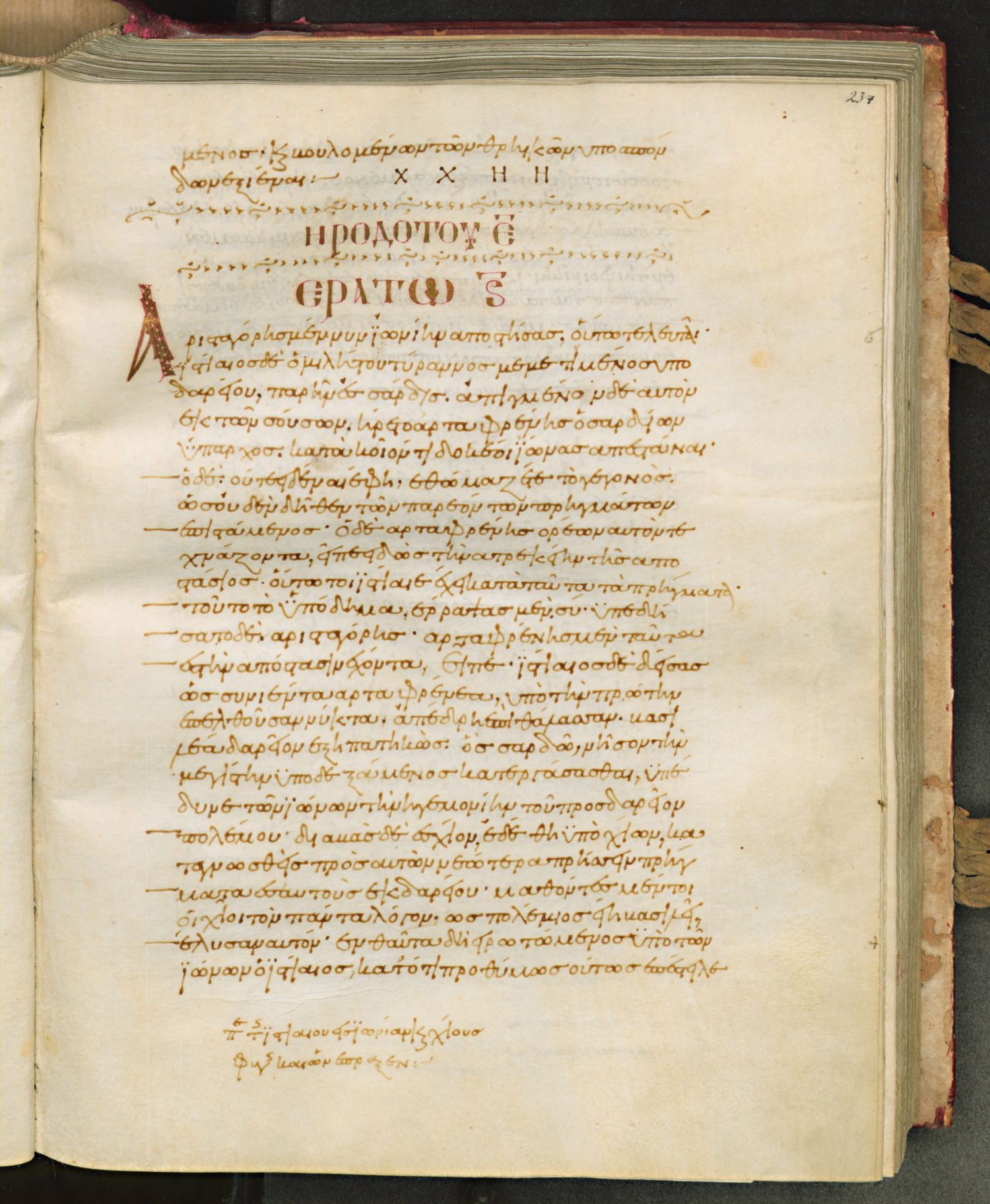
Laur. Plut. 70.3, fol. 234r: Greek here 6.1.1 to 6.3.1. Checked on the image (first and last words read and located in the Greek; each break checked against the neighbouring page): fol. 234r begins ‹-μενος καὶ βουλομένων τῶν› (5.126.2), ends ‹τι προθύμως οὕτω ἐπέστειλε› (6.3.1). The word ‹περικατήμενος› is divided between fol. 233v and fol. 234r; it is given with fol. 233v. Book 5 ends in the second line, followed by a stichometric figure (ΧΧΗΗ), a decorative line and the red title Ἡροδότου ς´ Ἐρατώ ς´; Book 6 begins with a red initial Α. Below the text, a reader's note in two lines on Histiaeus. English here: 6.1.1 to 6.2.2 (Godley's sentences for the sections whose Greek lies mostly on this page).
6.1.1Ἀρισταγόρης μέν νυν Ἰωνίην ἀποστήσας οὕτω τελευτᾷ. Ἱστιαῖος δὲ ὁ Μιλήτου τύραννος μεμετιμένος ὑπὸ Δαρείου παρῆν ἐς Σάρδις· ἀπιγμένον δὲ αὐτὸν ἐκ τῶν Σούσων εἴρετο Ἀρταφρένης ὁ Σαρδίων ὕπαρχος κατὰ κοῖόν τι δοκέοι Ἴωνας ἀπεστάναι. ὁ δὲ οὔτε εἰδέναι ἔφη ἐθώμαζέ τε τὸ γεγονός, ὡς οὐδὲν δῆθεν τῶν παρεόντων πρηγμάτων ἐπιστάμενος. 6.1.2ὁ δὲ Ἀρταφρένης ὁρέων αὐτὸν τεχνάζοντα εἶπε, εἰδὼς τὴν ἀτρεκείην τῆς ἀποστάσιος, οὕτω τοι Ἱστιαῖε ἔχει κατὰ ταῦτα τὰ πρήγματα· τοῦτο τὸ ὑπόδημα ἔρραψας μὲν σύ, ὑπεδήσατο δὲ Ἀρισταγόρης. 6.2.1Ἀρταφρένης μὲν ταῦτα ἐς τὴν ἀπόστασιν ἔχοντα εἶπε. Ἱστιαῖος δὲ δείσας ὡς συνιέντα Ἀρταφρένεα ὑπὸ τὴν πρώτην ἐπελθοῦσαν νύκτα ἀπέδρη ἐπὶ θάλασσαν, βασιλέα Δαρεῖον ἐξηπατηκώς· ὃς Σαρδὼ νῆσον τὴν μεγίστην ὑποδεξάμενος κατεργάσασθαι ὑπέδυνε τῶν Ἰώνων τὴν ἡγεμονίην τοῦ πρὸς Δαρεῖον πολέμου. 6.2.2διαβὰς δὲ ἐς Χίον ἐδέθη ὑπὸ Χίων, καταγνωσθεὶς πρὸς αὐτῶν νεώτερα πρήσσειν πρήγματα ἐς αὐτοὺς ἐκ Δαρείου. μαθόντες μέντοι οἱ Χῖοι τὸν πάντα λόγον, ὡς πολέμιος εἴη βασιλέι, ἔλυσαν αὐτόν. 6.3.1ἐνθαῦτα δὴ εἰρωτώμενος ὑπὸ τῶν Ἰώνων ὁ Ἱστιαῖος κατʼ ὅ τι προθύμως οὕτω ἐπέστειλε
6.1.1This was the end of Aristagoras, after he had brought about the Ionian revolt. But Histiaeus, the despot of Miletus, being let go by Darius, arrived in Sardis. When he came thither from Susa, Artaphrenes the governor of Sardis asked him for what reason he supposed the Ionians to have rebelled; Histiaeus said that he did not know, and that he marvelled at what had happened; pretending to have no knowledge of the present troubles. 6.1.2But Artaphrenes saw that he dissembled, and said, speaking out of his exact knowledge of the story of the revolt: “I will tell you, Histiaeus, the truth of this business: it was you that stitched this shoe, and Aristagoras that put it on.” 6.2.1Thus said Artaphrenes regarding the revolt; and Histiaeus, affrighted by Artaphrenes’ understanding of the matter, fled at the next nightfall to the sea; for he had deceived Darius, promising to subdue Sardo, the greatest of the islands, with secret intent to make himself leader of the Ionians in their war against Darius. 6.2.2Crossing over to Chios, he was taken and bound by the Chians, they judging him to be sent by Darius to do them some mischief; howbeit when they learnt the whole story of his enmity to the king they set him free.
Where on the image
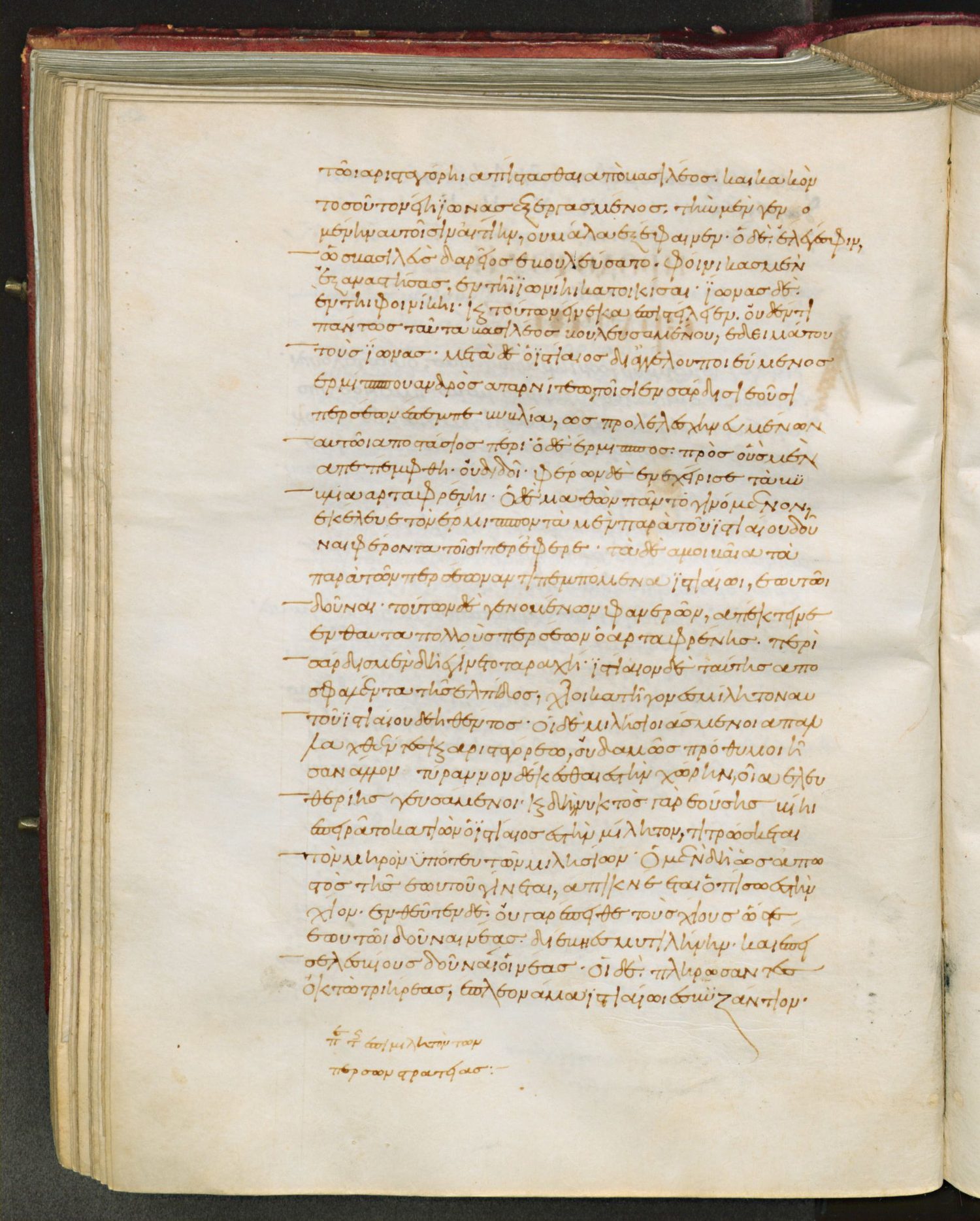
Laur. Plut. 70.3, fol. 234v: Greek here 6.3.1 to 6.5.3. Checked on the image (first and last words read and located in the Greek; each break checked against the neighbouring page): fol. 234v begins ‹τῷ Ἀρισταγόρῃ ἀπίστασθαι ἀπὸ› (6.3.1), ends ‹ἅμα Ἱστιαίῳ ἐς Βυζάντιον› (6.5.3). Below the text, a reader's note in two lines. English here: 6.3.1 to 6.5.2 (Godley's sentences for the sections whose Greek lies mostly on this page).
6.3.1τῷ Ἀρισταγόρῃ ἀπίστασθαι ἀπὸ βασιλέος καὶ κακὸν τοσοῦτον εἴη Ἴωνας ἐξεργασμένος, τὴν μὲν γενομένην αὐτοῖσι αἰτίην οὐ μάλα ἐξέφαινε, ὁ δὲ ἔλεγέ σφι ὡς βασιλεὺς Δαρεῖος ἐβουλεύσατο Φοίνικας μὲν ἐξαναστήσας ἐν τῇ Ἰωνίῃ κατοικίσαι, Ἴωνας δὲ ἐν τῇ Φοινίκῃ, καὶ τούτων εἵνεκα ἐπιστείλειε. οὐδέν τι πάντως ταῦτα βασιλέος βουλευσαμένου ἐδειμάτου τοὺς Ἴωνας. 6.4.1μετὰ δὲ ὁ Ἱστιαῖος διʼ ἀγγέλου ποιεύμενος Ἑρμίππου ἀνδρὸς Ἀταρνίτεω τοῖσι ἐν Σάρδισι ἐοῦσι Περσέων ἔπεμπε βυβλία, ὡς προλελεσχηνευμένων αὐτῷ ἀποστάσιος πέρι. ὁ δὲ Ἕρμιππος πρὸς τοὺς μὲν ἀπεπέμφθη οὐ διδοῖ, φέρων δὲ ἐνεχείρισε τὰ βυβλία Ἀρταφρένεϊ· 6.4.2ὁ δὲ μαθὼν πᾶν τὸ γινόμενον ἐκέλευε τὸν Ἕρμιππον τὰ μὲν παρὰ τοῦ Ἱστιαίου δοῦναι φέροντα τοῖσί περ ἔφερε, τὰ δὲ ἀμοιβαῖα τὰ παρὰ τῶν Περσέων ἀντιπεμπόμενα Ἱστιαίῳ ἑωυτῷ δοῦναι. τούτων δὲ γενομένων φανερῶν ἀπέκτεινε ἐνθαῦτα πολλοὺς Περσέων ὁ Ἀρταφρένης. 6.5.1περὶ Σάρδις μὲν δὴ ἐγίνετο ταραχή. Ἱστιαῖον δὲ ταύτης ἀποσφαλέντα τῆς ἐλπίδος Χῖοι κατῆγον ἐς Μίλητον, αὐτοῦ Ἱστιαίου δεηθέντος. οἱ δὲ Μιλήσιοι, ἄσμενοι ἀπαλλαχθέντες καὶ Ἀρισταγόρεω, οὐδαμῶς πρόθυμοι ἦσαν ἄλλον τύραννον δέκεσθαι ἐς τὴν χώρην, οἷα ἐλευθερίης γευσάμενοι. 6.5.2καὶ δὴ νυκτὸς γὰρ ἐούσης βίῃ ἐπειρᾶτο κατιὼν ὁ Ἱστιαῖος ἐς τὴν Μίλητον, τιτρώσκεται τὸν μηρὸν ὑπό τευ τῶν Μιλησίων. ὃ μὲν δὴ ὡς ἀπωστὸς τῆς ἑωυτοῦ γίνεται, ἀπικνέεται ὀπίσω ἐς τὴν Χίον· ἐνθεῦτεν δέ, οὐ γὰρ ἔπειθε τοὺς Χίους ὥστε ἑωυτῷ δοῦναι νέας, διέβη ἐς Μυτιλήνην καὶ ἔπεισε Λεσβίους δοῦναί οἱ νέας. 6.5.3οἳ δὲ πληρώσαντες ὀκτὼ τριήρεας ἔπλεον ἅμα Ἱστιαίῳ ἐς Βυζάντιον,
6.3.1Then Histiaeus was asked by the Ionians, why he had so zealously charged Aristagoras to revolt from the king and done the Ionians so great harm; the true reason he did by no means reveal to them, but told them instead that king Darius had planned to remove the Phoenicians and settle them in Ionia, and the Ionians in Phoenice; for this reason, he said, he had sent the charge. No such plan had the king made; but Histiaeus would affright the Ionians. 6.4.1Presently Histiaeus, using for messenger Hermippus, a man of Atarneus, sent letters to the Persians at Sardis; this he did, because they had ere now held converse with him about revolt. But Hermippus gave not these letters to those to whom he was sent, and carried and delivered them to Artaphrenes instead. 6.4.2Artaphrenes, learning all that was afoot, bade Hermippus carry Histiaeus’ letters to those for whom he was bringing them, and give him those which the Persians sent in answer to Histiaeus. Thus these men became known to Artaphrenes, and he put many Persians there and then to death. 6.5.1So troubles arose in Sardis. Histiaeus being disappointed of this hope, the Chians brought him back to Miletus, at his own entreaty. But the Milesians were glad enough to be rid of Aristagoras himself, and had no wish to receive another despot into their country, now that they had tasted of freedom; and 6.5.2when Histiaeus essayed by night to force his way into Miletus, he was wounded by a Milesian in the thigh. So, being thrust out from his own city, he went back to Chios; and there, when he could not persuade the Chians to give him ships, he crossed over to Mytilene and strove to persuade the Lesbians to give him ships.
Where on the image
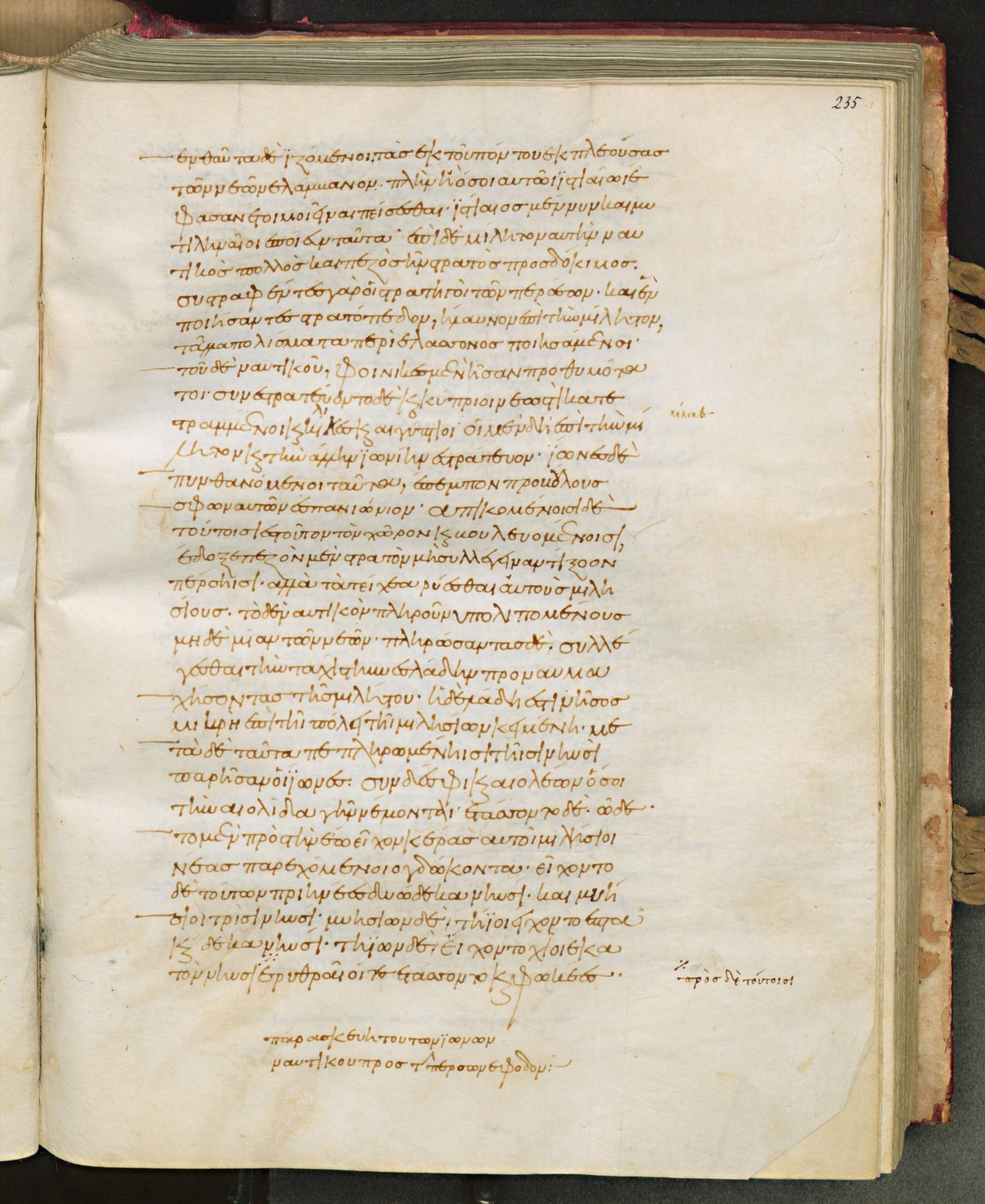
Laur. Plut. 70.3, fol. 235r: Greek here 6.5.3 to 6.8.2. Checked on the image (first and last words read and located in the Greek; each break checked against the neighbouring page): fol. 235r begins ‹ἐνθαῦτα δὲ ἱζόμενοι τὰς› (6.5.3), ends ‹τε ἐτάσσοντο καὶ Φωκαέες› (6.8.2). Below the text, a reader's note in two lines on the Ionian fleet's preparations against the Persians. English here: 6.5.3 to 6.8.1 (Godley's sentences for the sections whose Greek lies mostly on this page).
6.5.3ἐνθαῦτα δὲ ἱζόμενοι τὰς ἐκ τοῦ Πόντου ἐκπλεούσας τῶν νεῶν ἐλάμβανον, πλὴν ἢ ὅσοι αὐτῶν Ἱστιαίῳ ἔφασαν ἕτοιμοι εἶναι πείθεσθαι. 6.6.1Ἱστιαῖος μέν νυν καὶ Μυτιληναῖοι ἐποίευν ταῦτα. ἐπὶ δὲ Μίλητον αὐτὴν ναυτικὸς πολλὸς καὶ πεζὸς ἦν στρατὸς προσδόκιμος· συστραφέντες γὰρ οἱ στρατηγοὶ τῶν Περσέων καὶ ἓν ποιήσαντες στρατόπεδον ἤλαυνον ἐπὶ τὴν Μίλητον, τἆλλα πολίσματα περὶ ἐλάσσονος ποιησάμενοι. τοῦ δὲ ναυτικοῦ Φοίνικες μὲν ἦσαν προθυμότατοι, συνεστρατεύοντο δὲ καὶ Κύπριοι νεωστὶ κατεστραμμένοι καὶ Κίλικές τε καὶ Αἰγύπτιοι. 6.7.1οἳ μὲν δὴ ἐπὶ τὴν Μίλητον καὶ τὴν ἄλλην Ἰωνίην ἐστρατεύοντο, Ἴωνες δὲ πυνθανόμενοι ταῦτα ἔπεμπον προβούλους σφέων αὐτῶν ἐς Πανιώνιον. ἀπικομένοισι δὲ τούτοισι ἐς τοῦτον τὸν χῶρον καὶ βουλευομένοισι ἔδοξε πεζὸν μὲν στρατὸν μηδένα συλλέγειν ἀντίξοον Πέρσῃσι, ἀλλὰ τὰ τείχεα ῥύεσθαι αὐτοὺς Μιλησίους, τὸ δὲ ναυτικὸν πληροῦν ὑπολιπομένους μηδεμίαν τῶν νεῶν πληρώσαντας δὲ συλλέγεσθαι τὴν ταχίστην ἐς Λάδην προναυμαχήσοντας τῆς Μιλήτου. ἡ δὲ Λάδη ἐστὶ νῆσος μικρὴ ἐπὶ τῇ πόλι τῇ Μιλησίων κειμένη. 6.8.1μετὰ δὲ ταῦτα πεπληρωμένῃσι τῇσι νηυσὶ παρῆσαν οἱ Ἴωνες, σὺν δέ σφι καὶ Αἰολέων ὅσοι τὴν Λέσβον νέμονται. ἐτάσσοντο δὲ ὧδε. τὸ μὲν πρὸς τὴν ἠῶ εἶχον κέρας αὐτοὶ Μιλήσιοι, νέας παρεχόμενοι ὀγδώκοντα· εἴχοντο δὲ τούτων Πριηνέες δυώδεκα νηυσὶ καὶ Μυήσιοι τρισὶ νηυσί, Μυησίων δὲ Τήιοι εἴχοντο ἑπτακαίδεκα νηυσί, Τηίων δὲ εἴχοντο Χῖοι ἑκατὸν νηυσί· 6.8.2πρὸς δὲ τούτοισι Ἐρυθραῖοί τε ἐτάσσοντο καὶ Φωκαέες,
6.5.3They manned eight triremes, and sailed with Histiaeus to Byzantium; there they encamped, and seized all the ships that were sailing out of the Euxine, save when the crews consented to serve Histiaeus. 6.6.1Such were the doings of Histiaeus and the Mytilenaeans. As regards Miletus itself, there was expectation of a great fleet and army coming against it; for the Persian generals had joined their power together and made one host, which they led against Miletus, taking less account of the other fortresses. Of the fleet, the Phoenicians were the most eager to fight, and there came with them to the war the newly subdued Cyprians, and the Cilicians and Egyptians. 6.7.1These then coming to attack Miletus and the rest of Ionia, the Ionians, when they had word of it, sent men of their own to take counsel for them in the Panionium. These, when they came to that place and there consulted, resolved to raise no land army to meet the Persians, but to leave the Milesians themselves to defend their walls, and to man their fleet to the last ship and muster with all speed at Lade, there to fight for Miletus at sea. This Lade is an islet lying off the city of Miletus. 6.8.1The Ionians came presently thither with their ships manned, and as many Aeolians with them as dwell in Lesbos. And this was their order of battle:—The Milesians themselves had the eastern wing, bringing eighty ships; next to them were the men of Priene with twelve ships, and they of Myus with three; next to the men of Myus were the men of Teos with seventeen ships; next to these the Chians with a hundred; near these in the line were the Erythraeans, bringing eight ships, and the Phocaeans with three, and next to these the Lesbians with seventy; last of all in the line were the Samians, holding the western wing with sixty ships.
Where on the image
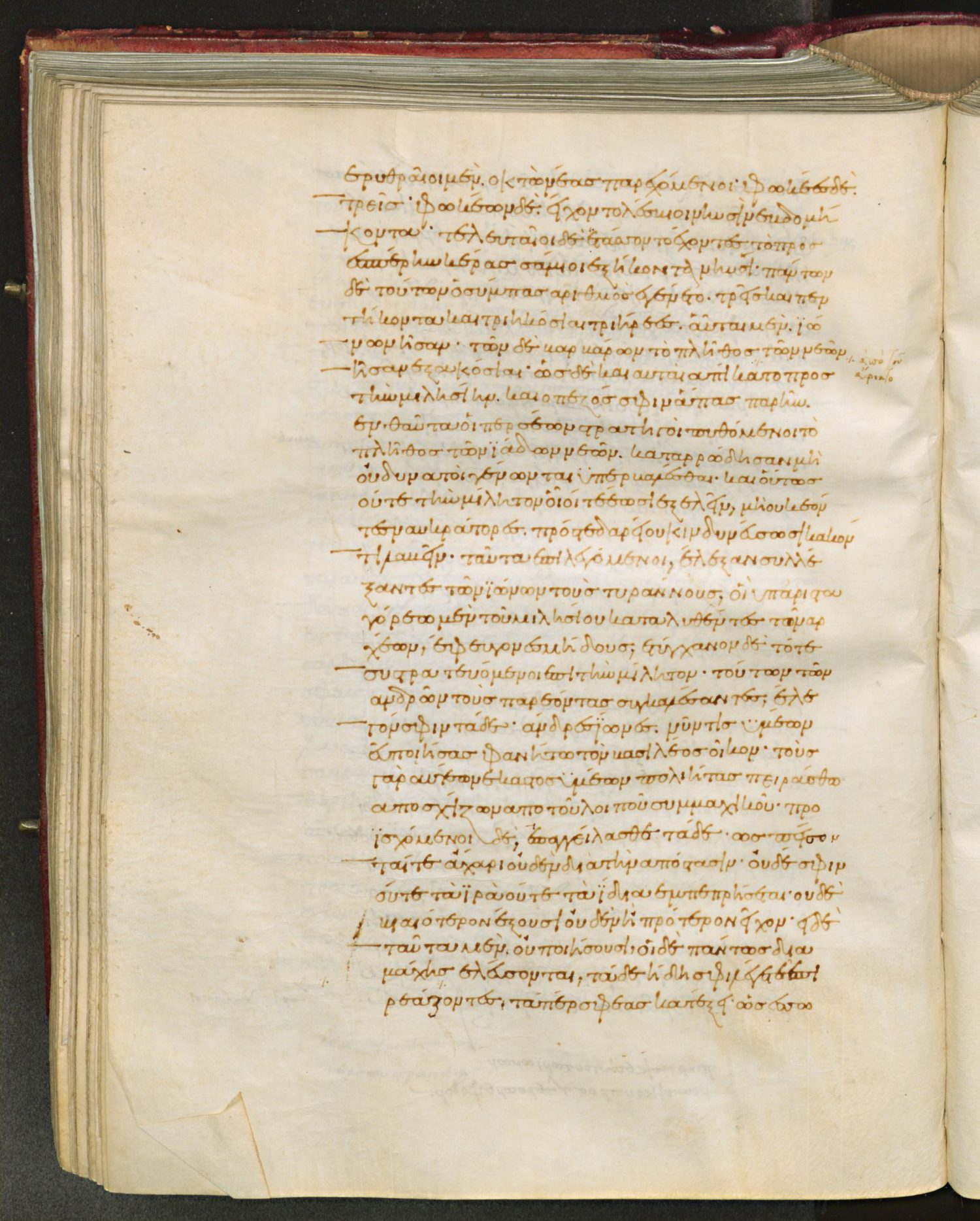
Laur. Plut. 70.3, fol. 235v: Greek here 6.8.2 to 6.9.4. Checked on the image (first and last words read and located in the Greek; each break checked against the neighbouring page): fol. 235v begins ‹Ἐρυθραῖοι μὲν ὀκτὼ νέας› (6.8.2), ends ‹σφέας κατέξει, ὡς ἑσσω-› (6.9.4). English here: 6.8.2 to 6.9.3 (Godley's sentences for the sections whose Greek lies mostly on this page).
6.8.2Ἐρυθραῖοι μὲν ὀκτὼ νέας παρεχόμενοι, Φωκαέες δὲ τρεῖς· Φωκαέων δὲ εἴχοντο Λέσβιοι νηυσὶ ἑβδομήκοντα· τελευταῖοι δὲ ἐτάσσοντο ἔχοντες τὸ πρὸς ἑσπέρην κέρας Σάμιοι ἑξήκοντα νηυσί. πάντων δὲ τούτων ὁ σύμπας ἀριθμὸς ἐγένετο τρεῖς καὶ πεντήκοντα καὶ τριηκόσιαι τριήρεες. 6.9.1αὗται μὲν Ἰώνων ἦσαν, τῶν δὲ βαρβάρων τὸ πλῆθος τῶν νεῶν ἦσαν ἑξακόσιαι. ὡς δὲ καὶ αὗται ἀπίκατο πρὸς τὴν Μιλησίην καὶ ὁ πεζός σφι ἅπας παρῆν, ἐνθαῦτα οἱ Περσέων στρατηγοὶ πυθόμενοι τὸ πλῆθος τῶν Ἰάδων νεῶν καταρρώδησαν μὴ οὐ δυνατοὶ γένωνται ὑπερβαλέσθαι, καὶ οὕτω οὔτε τὴν Μίλητον οἷοί τε ἔωσι ἐξελεῖν μὴ οὐκ ἐόντες ναυκράτορες, πρός τε Δαρείου κινδυνεύσωσι κακόν τι λαβεῖν. 6.9.2ταῦτα ἐπιλεγόμενοι, συλλέξαντες τῶν Ἰώνων τοὺς τυράννους, οἳ ὑπʼ Ἀρισταγόρεω μὲν τοῦ Μιλησίου καταλυθέντες τῶν ἀρχέων ἔφευγον ἐς Μήδους, ἐτύγχανον δὲ τότε συστρατευόμενοι ἐπὶ τὴν Μίλητον, τούτων τῶν ἀνδρῶν τοὺς παρεόντας συγκαλέσαντες ἔλεγόν σφι τάδε. 6.9.3ἄνδρες Ἴωνες, νῦν τις ὑμέων εὖ ποιήσας φανήτω τὸν βασιλέος οἶκον· τοὺς γὰρ ἑωυτοῦ ἕκαστος ὑμέων πολιήτας πειράσθω ἀποσχίζων ἀπὸ τοῦ λοιποῦ συμμαχικοῦ. προϊσχόμενοι δὲ ἐπαγγείλασθε τάδε, ὡς πείσονταί τε ἄχαρι οὐδὲν διὰ τὴν ἀπόστασιν, οὐδέ σφι οὔτε τὰ ἱρὰ οὔτε τὰ ἴδια ἐμπεπρήσεται, οὐδὲ βιαιότερον ἕξουσι οὐδὲν ἢ πρότερον εἶχον. 6.9.4εἰ δὲ ταῦτα μὲν οὐ ποιήσουσι, οἳ δὲ πάντως διὰ μάχης ἐλεύσονται, τάδε ἤδη σφι λέγετε ἐπηρεάζοντες, τά περ σφέας κατέξει, ὡς ἑσσωθέντες
6.8.2All these together attained to the number of three hundred and fifty-three triremes. 6.9.1These were the Ionian ships; the ships of the foreigners were six hundred. Now these, too, being come to the Milesian shore, and all their land power being there, the Persian generals, when they learnt the number of the Ionian ships, began to fear lest they should be too weak to overcome the Greeks, and thereby, if they had not the mastery of the sea, should fail of taking Miletus and peradventure be evilly entreated by Darius. 6.9.2Having this in mind, they assembled the despots of the Ionians, who had been deposed from their governments by Aristagoras of Miletus and had fled to the Medes, and were now as it chanced with the army that was led against Miletus; they assembled, I say, as many of these as were with them, and thus they addressed them: “ 6.9.3Men of Ionia, let each one of you now show that he has done good service to the king’s house; let every one of you essay severally to separate his own countrymen from the rest of the allied power. Set this before them, and promise withal, that they shall suffer no hurt for their rebellion, and that neither their temples shall be burnt nor their houses, nor shall they in any regard be more violently used than aforetime.
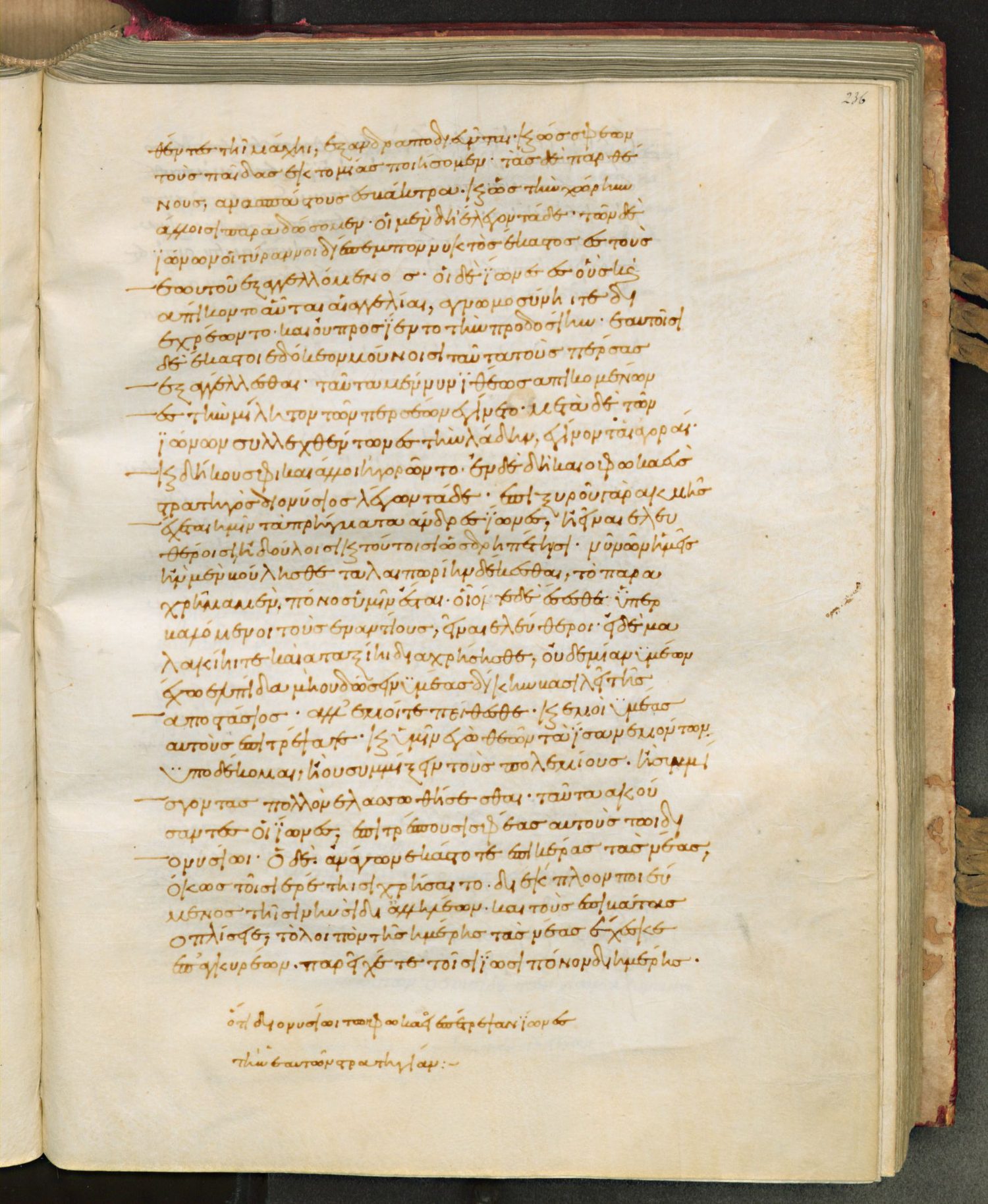
Where on the image
Laur. Plut. 70.3, fol. 236r: Greek here 6.9.4 to 6.12.1. Checked on the image (first and last words read and located in the Greek; each break checked against the neighbouring page): fol. 236r begins ‹-θέντες τῇ μάχῃ ἐξανδραποδιεῦνται,› (6.9.4), ends ‹Ἴωσι πόνον διʼ ἡμέρης› (6.12.1). The word ‹ἑσσωθέντες› is divided between fol. 235v and fol. 236r; it is given with fol. 235v. Below the text, a reader's note in two lines on the Ionians giving the command to Dionysius of Phocaea. English here: 6.9.4 to 6.12.1 (Godley's sentences for the sections whose Greek lies mostly on this page).
6.9.4τῇ μάχῃ ἐξανδραποδιεῦνται, καὶ ὡς σφέων τοὺς παῖδας ἐκτομίας ποιήσομεν, τὰς δὲ παρθένους ἀνασπάστους ἐς Βάκτρα, καὶ ὡς τὴν χώρην ἄλλοισι παραδώσομεν. 6.10.1οἳ μὲν δὴ ἔλεγον τάδε. τῶν δὲ Ἰώνων οἱ τύραννοι διέπεμπον νυκτὸς ἕκαστος ἐς τοὺς ἑωυτοῦ ἐξαγγελλόμενος. οἱ δὲ Ἴωνες, ἐς τοὺς καὶ ἀπίκοντο αὗται αἱ ἀγγελίαι, ἀγνωμοσύνῃ τε διεχρέωντο καὶ οὐ προσίεντο τὴν προδοσίην· ἑωυτοῖσι δὲ ἕκαστοι ἐδόκεον μούνοισι ταῦτα τοὺς Πέρσας ἐξαγγέλλεσθαι. 6.11.1ταῦτα μέν νυν ἰθέως ἀπικομένων ἐς τὴν Μίλητον τῶν Περσέων ἐγίνετο· μετὰ δὲ τῶν Ἰώνων συλλεχθέντων ἐς τὴν Λάδην ἐγίνοντο ἀγοραί, καὶ δή κού σφι καὶ ἄλλοι ἠγορόωντο, ἐν δὲ δὴ καὶ ὁ Φωκαεὺς στρατηγὸς Διονύσιος λέγων τάδε. 6.11.2ἐπὶ ξυροῦ γὰρ ἀκμῆς ἔχεται ἡμῖν τὰ πρήγματα, ἄνδρες Ἴωνες, ἢ εἶναι ἐλευθέροισι ἢ δούλοισι, καὶ τούτοισι ὡς δρηπέτῃσι· νῦν ὦν ὑμεῖς ἢν μὲν βούλησθε ταλαιπωρίας ἐνδέκεσθαι, τὸ παραχρῆμα μὲν πόνος ὑμῖν ἔσται, οἷοί τε δὲ ἔσεσθε ὑπερβαλόμενοι τοὺς ἐναντίους εἶναι ἐλεύθεροι· εἰ δὲ μαλακίῃ τε καὶ ἀταξίῃ διαχρήσησθε, οὐδεμίαν ὑμέων ἔχω ἐλπίδα μὴ οὐ δώσειν ὑμέας δίκην βασιλέι τῆς ἀποστάσιος. 6.11.3ἀλλʼ ἐμοί τε πείθεσθε καὶ ἐμοὶ ὑμέας αὐτοὺς ἐπιτρέψατε· καὶ ὑμῖν ἐγώ, θεῶν τὰ ἴσα νεμόντων, ὑποδέκομαι ἢ οὐ συμμίξειν τοὺς πολεμίους ἢ συμμίσγοντας πολλὸν ἐλασσωθήσεσθαι. 6.12.1ταῦτα ἀκούσαντες οἱ Ἴωνες ἐπιτρέπουσι σφέας αὐτοὺς τῷ Διονυσίῳ. ὁ δὲ ἀνάγων ἑκάστοτε ἐπὶ κέρας τὰς νέας, ὅκως τοῖσι ἐρέτῃσι χρήσαιτο διέκπλοον ποιεύμενος τῇσι νηυσὶ διʼ ἀλληλέων καὶ τοὺς ἐπιβάτας ὁπλίσειε, τὸ λοιπὸν τῆς ἡμέρης τὰς νέας ἔχεσκε ἐπʼ ἀγκυρέων, παρεῖχέ τε τοῖσι Ἴωσι πόνον διʼ ἡμέρης.
6.9.4But if they will not be so guided, and nothing will serve them but fighting, then utter a threat that shall put constraint upon them, and tell them that if they are worsted in battle they shall be enslaved; we will make eunuchs of their boys, and carry their maidens captive to Bactra, and deliver their land to others.” 6.10.1Thus said the generals; the Ionian despots sent their messages by night, each to his own countrymen; but the Ionians to whom these messages did indeed come were stubborn and would have none of the treachery, each part thinking that the Persians made this offer to it alone. 6.11.1This befel immediately after the Persians’ coming to Miletus. Presently, the Ionians being gathered at Lade, assemblies of them were held; among those whom I suppose to have addressed them were Dionysius the Phocaean general, who spoke thus: “ 6.11.2Our cause, Ionians, stands on the very razor-edge of decision whether we be freemen or slaves, yea, runaway slaves; now therefore if you consent to endure hardness, you will have toil for the present time, but it will be in your power to overcome your enemies and gain freedom; but if you will still be slothful and disorderly, I see nothing that can save you from being punished by the king for your rebellion. 6.11.4Nay, do you take my word, and entrust yourselves to me; and I promise you that (if heaven deal fairly with us) either our enemies shall not meet us in battle, or if they so do they shall be utterly vanquished.” 6.12.1When the Ionians heard this, they put themselves in Dionysius’ hands. He then ever put out to sea with ships in column, and having used the rowers to pierce each other’s line of ships, and armed the fighting men on board, he would for the rest of the day keep the fleet at anchor; all day he made the Ionians work.
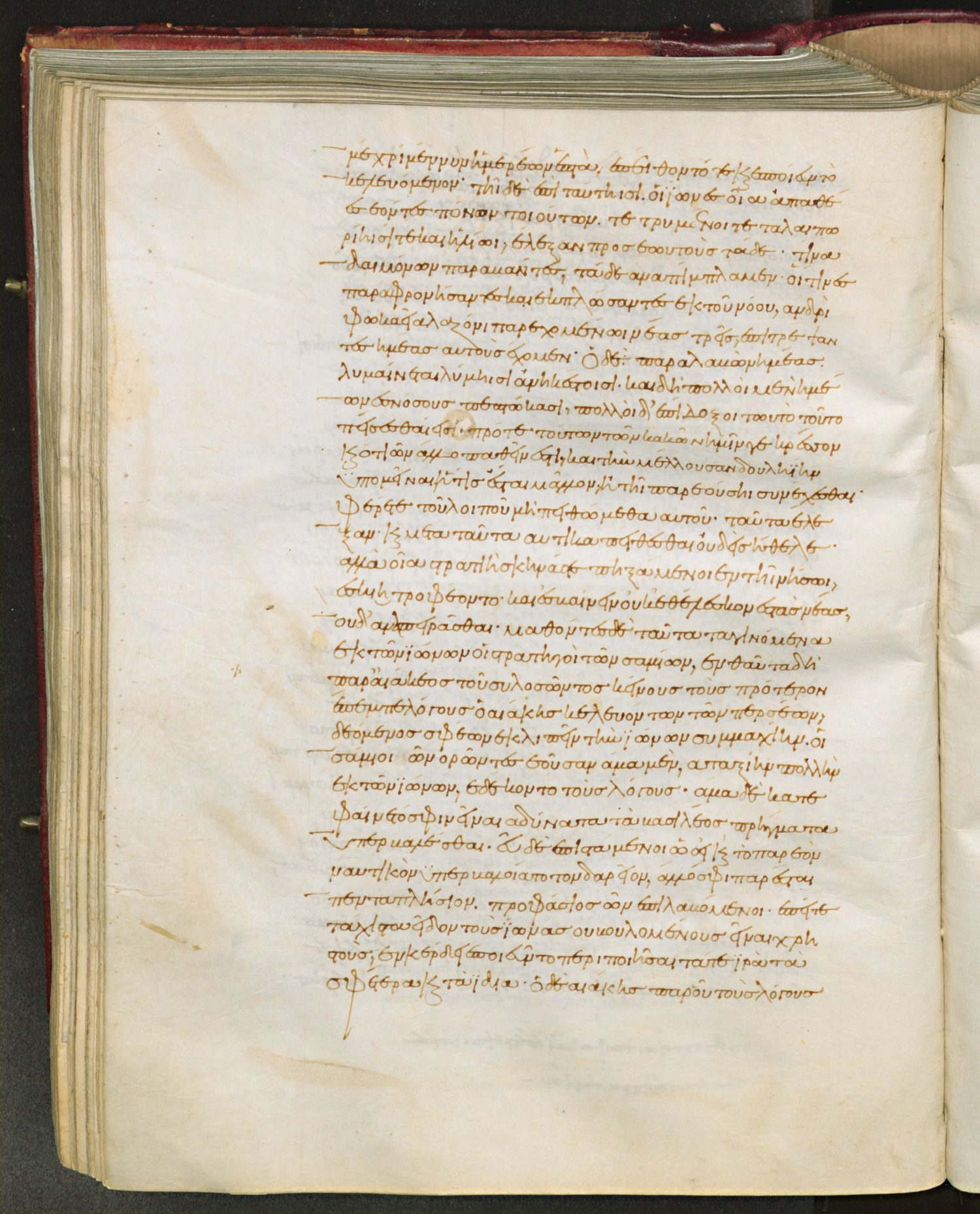
Where on the image
Laur. Plut. 70.3, fol. 236v: Greek here 6.12.2 to 6.13.2. Checked on the image (first and last words read and located in the Greek; each break checked against the neighbouring page): fol. 236v begins ‹μέχρι μέν νυν ἡμερέων› (6.12.2), ends ‹παρʼ ὅτευ τοὺς λόγους› (6.13.2). English here: 6.12.2 to 6.13.2 (Godley's sentences for the sections whose Greek lies mostly on this page).
6.12.2μέχρι μέν νυν ἡμερέων ἑπτὰ ἐπείθοντό τε καὶ ἐποίευν τὸ κελευόμενον· τῇ δὲ ἐπὶ ταύτῃσι οἱ Ἴωνες, οἷα ἀπαθέες ἐόντες πόνων τοιούτων τετρυμένοι τε ταλαιπωρίῃσί τε καὶ ἡλίῳ, ἔλεξαν πρὸς ἑωυτοὺς τάδε. 6.12.3τίνα δαιμόνων παραβάντες τάδε ἀναπίμπλαμεν; οἵτινες παραφρονήσαντες καὶ ἐκπλώσαντες ἐκ τοῦ νόου ἀνδρὶ Φωκαέι ἀλαζόνι, παρεχομένῳ νέας τρεῖς, ἐπιτρέψαντες ἡμέας αὐτοὺς ἔχομεν· ὁ δὲ παραλαβὼν ἡμέας λυμαίνεται λύμῃσι ἀνηκέστοισι, καὶ δὴ πολλοὶ μὲν ἡμέων ἐς νούσους πεπτώκασι, πολλοὶ δὲ ἐπίδοξοι τὠυτὸ τοῦτο πείσεσθαι εἰσί, πρό τε τούτων τῶν κακῶν ἡμῖν γε κρέσσον καὶ ὅ τι ὦν ἄλλο παθεῖν ἐστι καὶ τὴν μέλλουσαν δουληίην ὑπομεῖναι ἥτις ἔσται, μᾶλλον ἢ τῇ παρεούσῃ συνέχεσθαι. φέρετε, τοῦ λοιποῦ μὴ πειθώμεθα αὐτοῦ. 6.12.4ταῦτα ἔλεξαν, καὶ μετὰ ταῦτα αὐτίκα πείθεσθαι οὐδεὶς ἤθελε, ἀλλʼ οἷα στρατιὴ σκηνάς τε πηξάμενοι ἐν τῇ νήσῳ ἐσκιητροφέοντο καὶ ἐσβαίνειν οὐκ ἐθέλεσκον ἐς τὰς νέας οὐδʼ ἀναπειρᾶσθαι. 6.13.1μαθόντες δὲ ταῦτα τὰ γινόμενα ἐκ τῶν Ἰώνων οἱ στρατηγοὶ τῶν Σαμίων ἐνθαῦτα δὴ παρʼ Αἰάκεος τοῦ Συλοσῶντος κείνους τοὺς πρότερον ἔπεμπε λόγους ὁ Αἰάκης κελευόντων τῶν Περσέων, δεόμενος σφέων ἐκλιπεῖν τὴν Ἰώνων συμμαχίην· οἱ Σάμιοι ὦν ὁρῶντες ἐοῦσαν ἅμα μὲν ἀταξίην πολλὴν ἐκ τῶν Ἰώνων ἐδέκοντο τοὺς λόγους, ἅμα δὲ κατεφαίνετό σφι εἶναι ἀδύνατα τὰ βασιλέος πρήγματα ὑπερβαλέσθαι, εὖ δὲ ἐπιστάμενοι ὡς εἰ καὶ τὸ παρεὸν ναυτικὸν ὑπερβαλοίατο τὸν Δαρεῖον, ἄλλο σφι παρέσται πενταπλήσιον. 6.13.2προφάσιος ὦν ἐπιλαβόμενοι, ἐπείτε τάχιστα εἶδον τοὺς Ἴωνας οὐ βουλομένους εἶναι χρηστούς, ἐν κέρδεϊ ἐποιεῦντο περιποιῆσαι τά τε ἱρὰ τὰ σφέτερα καὶ τὰ ἴδια. ὁ δὲ Αἰάκης, παρʼ ὅτευ τοὺς λόγους
6.12.2For seven days they obeyed him and did his bidding; but on the next day, untried as they were in such labour and worn out by hard work and the sun’s heat, the Ionians began to say each to other, “ 6.12.3Against what god have we sinned that we fulfil this hard measure? We have gone clean daft and launched out into folly, committing ourselves into the hands of this Phocaean braggart, who brings but three ships; and having got us he afflicts us with afflictions incurable, whereby many of us have fallen sick already and many are like so to do; better than these ills it were for us to endure any and every lot, and abide this coming slavery whatsoever it be, rather than be oppressed by that which is now upon us. Marry, let us obey him no longer!” 6.12.4Thus they said; and from that day no man would obey: they built them booths on the island (as though they had been an army) wherein they lived sheltered from the sun, and never would embark in their ships nor exercise themselves therein. 6.13.1But when the generals of the Samians learnt of this that the Ionians did, they bethought them of that message which Aeaces son of Syloson had already sent them at the Persians’ bidding, entreating them to desert the Ionian alliance; now therefore, when they saw much disorder on the Ionian side, they consented to the message; moreover, it seemed to them to be a thing impossible to overcome the king’s power, and they were well assured that if they overcame Darius’ present fleet they would have another fivefold greater on their hands. 6.13.2Therefore as soon as they saw that the Ionians would not be serviceable, they laid hold on that for a pretext, thinking themselves in luck’s way so to save their temples and their own houses. This Aeaces, to whose message the Samians consented, was son of Syloson the son of Aeaces, and had been despot of Samos, till he was deposed from his government by Aristagoras of Miletus, even as the other Ionian despots.
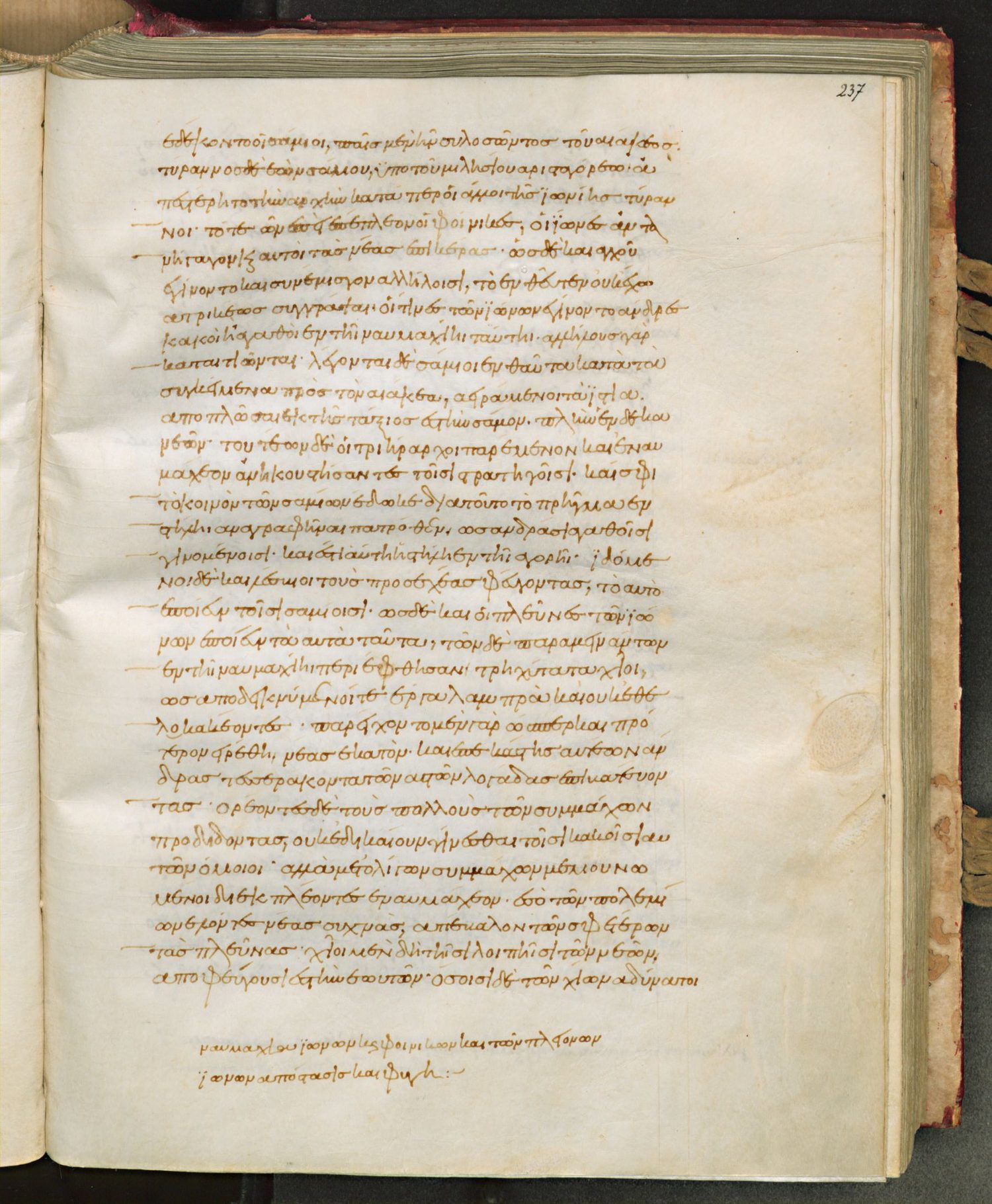
Where on the image
Laur. Plut. 70.3, fol. 237r: Greek here 6.13.2 to 6.16.1. Checked on the image (first and last words read and located in the Greek; each break checked against the neighbouring page): fol. 237r begins ‹ἐδέκοντο οἱ Σάμιοι, παῖς› (6.13.2), ends ‹δὲ τῶν Χίων ἀδύνατοι› (6.16.1). English here: 6.14.1 to 6.15.2 (Godley's sentences for the sections whose Greek lies mostly on this page).
6.13.2ἐδέκοντο οἱ Σάμιοι, παῖς μὲν ἦν Συλοσῶντος τοῦ Αἰάκεος, τύραννος δὲ ἐὼν Σάμου ὑπὸ τοὺ Μιλησίου Ἀρισταγόρεω ἀπεστέρητο τὴν ἀρχὴν κατά περ οἱ ἄλλοι τῆς Ἰωνίης τύραννοι. 6.14.1τότε ὦν ἐπεὶ ἐπέπλεον οἱ Φοίνικες, οἱ Ἴωνες ἀντανῆγον καὶ αὐτοὶ τὰς νέας ἐπὶ κέρας. ὡς δὲ καὶ ἀγχοῦ ἐγίνοντο καὶ συνέμισγον ἀλλήλοισι, τὸ ἐνθεῦτεν οὐκ ἔχω ἀτρεκέως συγγράψαι οἵτινες τῶν Ἰώνων ἐγίνοντο ἄνδρες κακοὶ ἢ ἀγαθοὶ ἐν τῇ ναυμαχίῃ ταύτῃ· ἀλλήλους γὰρ καταιτιῶνται. 6.14.2λέγονται δὲ Σάμιοι ἐνθαῦτα κατὰ τὰ συγκείμενα πρὸς τὸν Αἰάκεα ἀειράμενοι τὰ ἱστία ἀποπλῶσαι ἐκ τῆς τάξιος ἐς τὴν Σάμον, πλὴν ἕνδεκα νεῶν· τουτέων δὲ οἱ τριήραρχοι παρέμενον καὶ ἐναυμάχεον ἀνηκουστήσαντες τοῖσι στρατηγοῖσι· 6.14.3καί σφι τὸ κοινὸν τῶν Σαμίων ἔδωκε διὰ τοῦτο τὸ πρῆγμα ἐν στήλῃ ἀναγραφῆναι πατρόθεν ὡς ἀνδράσι ἀγαθοῖσι γενομένοισι, καὶ ἔστι αὕτη ἡ στήλη ἐν τῇ ἀγορῇ. ἰδόμενοι δὲ καὶ Λέσβιοι τοὺς προσεχέας φεύγοντας τὠυτὸ ἐποίευν τοῖσι Σαμίοισι· ὣς δὲ καὶ οἱ πλεῦνες τῶν Ἰώνων ἐποίευν τὰ αὐτὰ ταῦτα. 6.15.1τῶν δὲ παραμεινάντων ἐν τῇ ναυμαχίῃ περιέφθησαν τρηχύτατα Χῖοι ὡς ἀποδεικνύμενοί τε ἔργα λαμπρὰ καὶ οὐκ ἐθελοκακέοντες. παρείχοντο μὲν γάρ, ὥσπερ καὶ πρότερον εἰρέθη, νέας ἑκατόν, καὶ ἐπʼ ἑκάστης αὐτέων ἄνδρας τεσσεράκοντα τῶν ἀστῶν λογάδας ἐπιβατεύοντας. 6.15.2ὁρέοντες δὲ τοὺς πολλοὺς τῶν συμμάχων προδιδόντας οὐκ ἐδικαίευν γίνεσθαι τοῖσι κακοῖσι αὐτῶν ὅμοιοι, ἀλλὰ μετʼ ὀλίγων συμμάχων μεμουνωμένοι διεκπλέοντες ἐναυμάχεον, ἐς ὃ τῶν πολεμίων ἑλόντες νέας συχνὰς ἀπέβαλον τῶν σφετερέων τὰς πλεῦνας. 6.16.1Χῖοι μὲν δὴ τῇσι λοιπῇσι τῶν νεῶν ἀποφεύγουσι ἐς τὴν ἑωυτῶν· ὅσοισι δὲ τῶν Χίων ἀδύνατοι
6.14.1Now therefore, when the Phoenician fleet came sailing against them, the Ionians for their part put out to sea with their ships in column. When they drew near together and met in battle, which of the Ionians did thereafter quit themselves ill or well in that sea-fight my history cannot with exactness record; for they all blame each other. 6.14.2But this is said, that the Samians, according to their compact with Aeaces, did then make all sail for Samos, leaving their post, all save eleven ships, 6.14.3the captains whereof stood their ground and fought, disobeying their admirals; and by reason of this deed the Samian people granted them for their valour that their names and their fathers’ should be engraved on a pillar, which pillar now stands in their market-place. But the Lesbians, seeing their neigh bours fly, did even as the Samians; and so, too, the greater part of the Ionians did likewise. 6.15.1Of those that stood their ground in the sea-fight, most roughly handled were the Chians, for they would not be cravens but achieved deeds of renown. They brought an hundred ships, as I have before told, to the fleet, and on each ship were forty picked men of their citizens; and 6.15.2seeing themselves betrayed by the greater part of their allies they thought shame to bear themselves like the baser sort of the rest, but albeit with none but a few allies to aid them they fought on and broke the enemy’s line, till they had taken many of his ships but lost the greater part of their own.
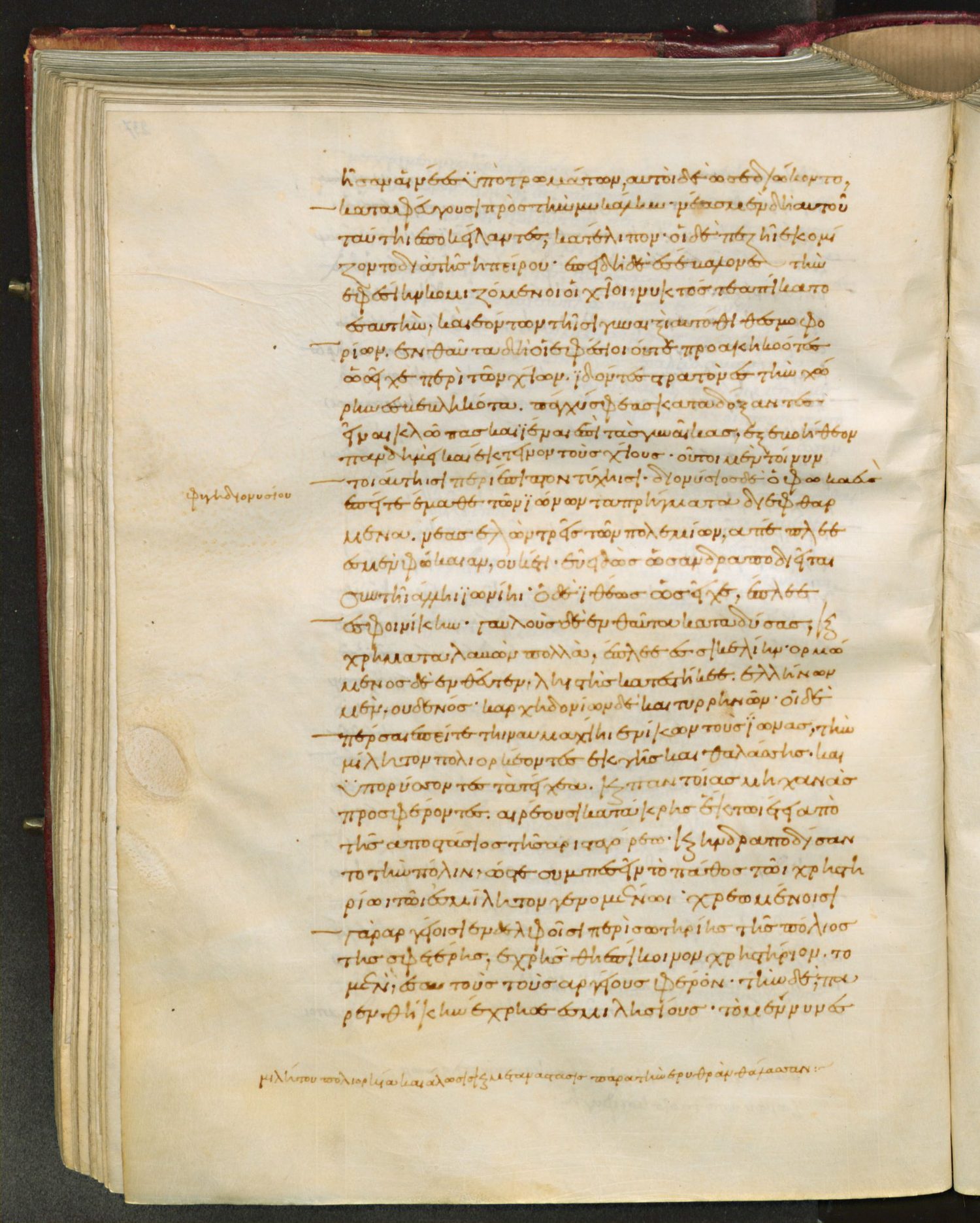
Where on the image
Laur. Plut. 70.3, fol. 237v: Greek here 6.16.1 to 6.17.1. Checked on the image (first and last words read and located in the Greek; each break checked against the neighbouring page): fol. 237v begins ‹ἦσαν αἱ νέες ὑπὸ› (6.16.1), ends ‹Μιλησίους. τὸ μέν νυν› (6.19.1). English here: 6.16.1 to 6.17.1 (Godley's sentences for the sections whose Greek lies mostly on this page).
6.16.1ἦσαν αἱ νέες ὑπὸ τρωμάτων, οὗτοι δὲ ὡς ἐδιώκοντο καταφυγγάνουσι πρὸς τὴν Μυκάλην. νέας μὲν δὴ αὐτοῦ ταύτῃ ἐποκείλαντες κατέλιπον, οἳ δὲ πεζῇ ἐκομίζοντο διὰ τῆς ἠπείρου. 6.16.2ἐπειδὴ δὲ ἐσέβαλον ἐς τὴν Ἐφεσίην κομιζόμενοι οἱ Χῖοι, νυκτός τε γὰρ ἀπίκατο ἐς αὐτὴν καὶ ἐόντων τῇσι γυναιξὶ αὐτόθι θεσμοφορίων, ἐνθαῦτα δὴ οἱ Ἐφέσιοι, οὔτε προακηκοότες ὡς εἶχε περὶ τῶν Χίων ἰδόντες τε στρατὸν ἐς τὴν χώρην ἐσβεβληκότα, πάγχυ σφέας καταδόξαντες εἶναι κλῶπας καὶ ἰέναι ἐπὶ τὰς γυναῖκας, ἐξεβοήθεον πανδημεὶ καὶ ἔκτεινον τοὺς Χίους. 6.17.1οὗτοι μὲν τοίνυν τοιαύτῃσι περιέπιπτον τύχῃσι. Διονύσιος δὲ ὁ Φωκαεὺς ἐπείτε ἔμαθε τῶν Ἰώνων τὰ πρήγματα διεφθαρμένα, νέας ἑλὼν τρεῖς τῶν πολεμίων ἀπέπλεε ἐς μὲν Φώκαιαν οὐκέτι, εὖ εἰδὼς ὡς ἀνδραποδιεῖται σὺν τῇ ἄλλῃ Ἰωνίῃ· ὁ δὲ ἰθέως ὡς εἶχε ἔπλεε ἐς Φοινίκην, γαύλους δὲ ἐνθαῦτα καταδύσας καὶ χρήματα λαβὼν πολλὰ ἔπλεε ἐς Σικελίην, ὁρμώμενος δὲ ἐνθεῦτεν ληιστὴς κατεστήκεε Ἑλλήνων μὲν οὐδενός, Καρχηδονίων δὲ καὶ Τυρσηνῶν.
6.16.1So with the remnant of their ships the Chians fled to their own country; but the crews of the Chian ships that were crippled by hurts fled before the pursuit to Mycale. There the men beached and left their ships, and made their way thence across the mainland. 6.16.2But when the Chians entered the lands of Ephesus on their march, it chanced that they came by night and the women were keeping their Thesmophoria; and the Ephesians thereupon, never having heard the story of the Chians and seeing an army invading their country, were fully persuaded that these were robbers come after their women; so they mustered all their force and slew the Chians. 6.17.1They, then, met with such fate as I have said. As for Dionysius the Phocaean, when he saw that the Ionian cause was lost, he sailed away with three enemy ships that he had taken; but not to Phocaea, now that he knew well that it would be enslaved with the rest of Ionia; he sailed then and there with a straight course to Phoenice instead, and having sunk there certain galleons and taken much substance he made sail to Sicily, making which his station he set up for a pirate, robbing Carchedonians and Tyrrhenians, but no Greeks.
Notes
- Greek: the text printed in A. D. Godley's Loeb edition, via Perseus (tlg0016.tlg001.perseus-grc2). Square brackets mark words the editor considers later additions; [...] marks a gap the editor indicates. Perseus note markers are omitted.
- English: A. D. Godley, Herodotus vol. 3 (1922) (Loeb Classical Library), as transcribed on Wikisource. Godley's footnotes are omitted.
- Section numbers in the English were placed by comparing Godley's text with the Perseus version of his translation; where a section begins inside one of Godley's sentences, the English is kept with the page that holds the start of that sentence.
Cite
Sources
- Source: Florence, Laur. Plut. 70.3 (10th c.) via BML Teca Digitale + Greek of Godley's Loeb (Perseus) + English of A. D. Godley (Loeb, Wikisource) (holding institution)
- Critical edition: Greek of A. D. Godley's Loeb edition (1920-1925), via Perseus
← previous · → next · v cycle view · l back to library