Herodotus, Histories 5.39-48: Cleomenes and Dorieus
Introduction
Herodotus of Halicarnassus wrote the Histories in the third quarter of the 5th century BCE, an inquiry into the deeds of Greeks and barbarians and the causes of the wars between them, later divided into nine books. Book 5 tells of the Persian advance in Thrace and Macedonia, the outbreak of the Ionian revolt under Aristagoras of Miletus, his appeals to Sparta and Athens, with Herodotus' accounts of Sparta and of Athens after the tyrants, and the burning of Sardis and the first years of the revolt.
The photographs are of Florence, Biblioteca Medicea Laurenziana, Plut. 70.3 (parchment, 10th century, 374 folios, 31 lines a page), Herodotus, Histories (codex A of the editors), the oldest surviving manuscript of the complete Histories, from the Teca Digitale of the Biblioteca Medicea Laurenziana. Each section below is the text of one page, or of the part of a page that falls within these chapters. The first and last words of every page were read on the photograph and located in the Greek, and every page break was checked against the next page; the notes quote these words. Readers' notes in the margins are not part of the text and are mentioned where they occur.
The Greek is the text printed in A. D. Godley's Loeb edition (1920-1925), from Perseus; it is the edited text, not a transcription of the manuscript, whose wording differs in places. The English is Godley's translation as printed, from Wikisource. Godley's English carries only chapter numbers; the section numbers shown in it were placed by comparison with the Perseus version of his translation. Each page's English is cut at the end of one of Godley's sentences, so it can begin or end a few lines away from the Greek of the page; each note gives the exact ranges.
This entry covers chapters 5.39-48, on fol. 208r to 210v.
How was this verified? (Provenance)
Where on the image
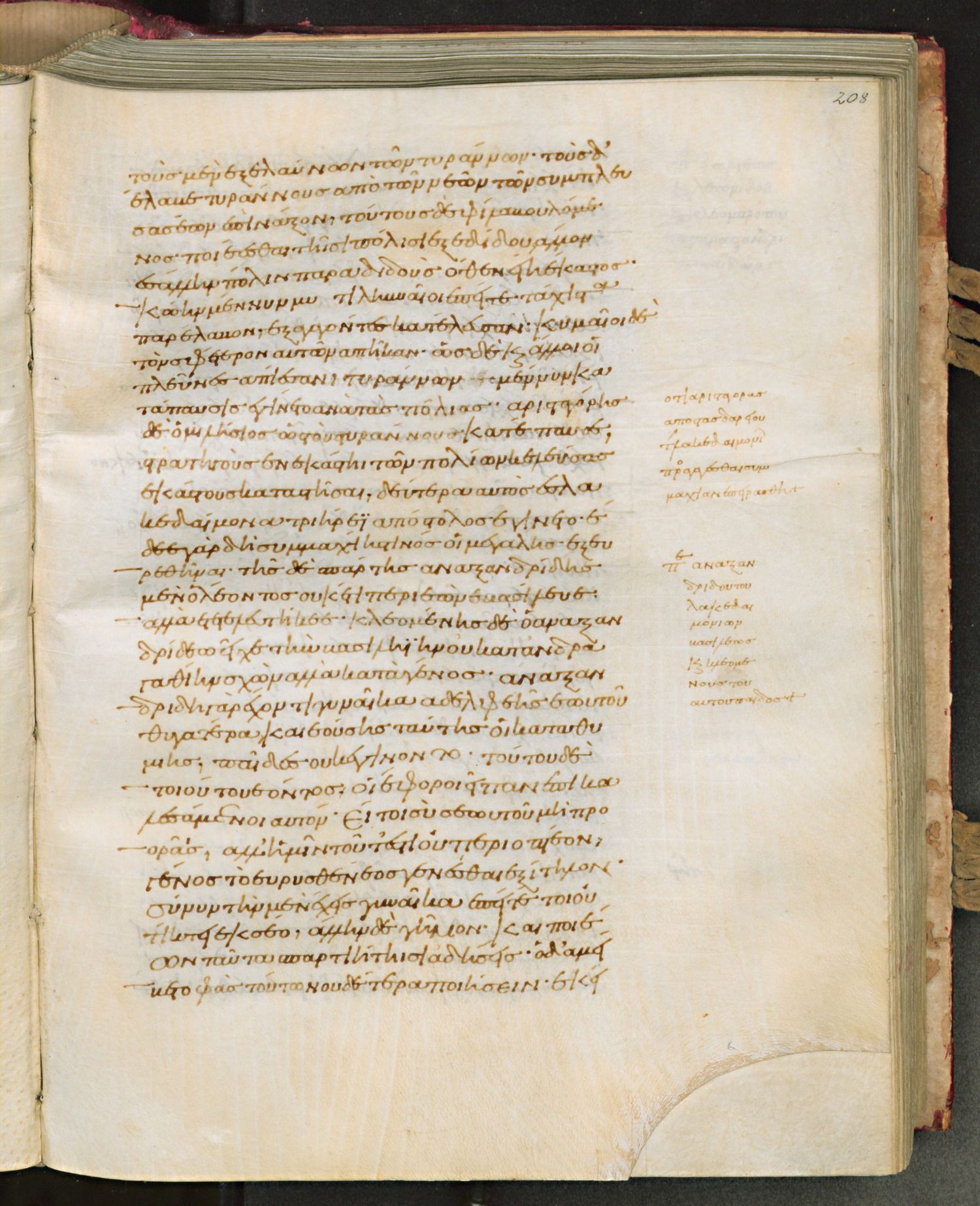
Laur. Plut. 70.3, fol. 208r: Greek here 5.39.1 to 5.39.2. Checked on the image (first and last words read and located in the Greek; each break checked against the neighbouring page): fol. 208r begins ‹τοὺς μὲν ἐξελαύνων τῶν› (5.37.2), ends ‹τούτων οὐδέτερα ποιήσειν, ἐκ-› (5.39.2). English here: 5.39.1 to 5.39.2 (Godley's sentences for the sections whose Greek lies mostly on this page).
5.39.1τῆς δὲ Σπάρτης Ἀναξανδρίδης μὲν ὁ Λέοντος οὐκέτι περιεὼν ἐβασίλευε ἀλλὰ ἐτετελευτήκεε, Κλεομένης δὲ ὁ Ἀναξανδρίδεω εἶχε τὴν βασιληίην, οὐ κατʼ ἀνδραγαθίην σχὼν ἀλλὰ κατὰ γένος. Ἀναξανδρίδῃ γὰρ ἔχοντι γυναῖκα ἀδελφεῆς ἑωυτοῦ θυγατέρα, καὶ ἐούσης ταύτης οἱ καταθυμίης, παῖδες οὐκ ἐγίνοντο. 5.39.2τούτου δὲ τοιούτου ἐόντος, οἱ ἔφοροι εἶπαν ἐπικαλεσάμενοι αὐτὸν εἴ τοι σὺ σεωυτοῦ μὴ προορᾷς, ἀλλʼ ἡμῖν τοῦτʼ ἐστὶ οὐ περιοπτέον, γένος τὸ Εὐρυσθένεος γενέσθαι ἐξίτηλον. σύ νυν τὴν μὲν ἔχεις γυναῖκα, ἐπείτε τοι οὐ τίκτει, ἔξεο, ἄλλην δὲ γῆμον· καὶ ποιέων ταῦτα Σπαρτιήτῃσι ἁδήσεις. ὃ δʼ ἀμείβετο φὰς τούτων οὐδέτερα ποιήσειν, ἐκείνους
5.39.1At Sparta, Anaxandrides the son of Leon, who had been king, was now no longer alive but was dead, and Cleomenes son of Anaxandrides held the royal power. This he had won not by manly merit but by right of birth. For Anaxandrides had to wife his own sister’s daughter, and he was well content with her; but no children were born to him. 5.39.2This being so, the Ephors called him to them, and said, “If you care not to provide for yourself, yet we cannot suffer it to come to pass that the house of Eurysthenes should perish. Do you therefore send away the wife that you have, seeing that she bears you no children, and wed another; this do, and you will please the Spartans.” But Anaxandrides answered and said that he would do neither the one nor the other: “And you,” said he, “are no good counsellors, when you bid me send away the wife that I have, who is void of offence against me, and take another to my house; I will not consent to it.”
Where on the image
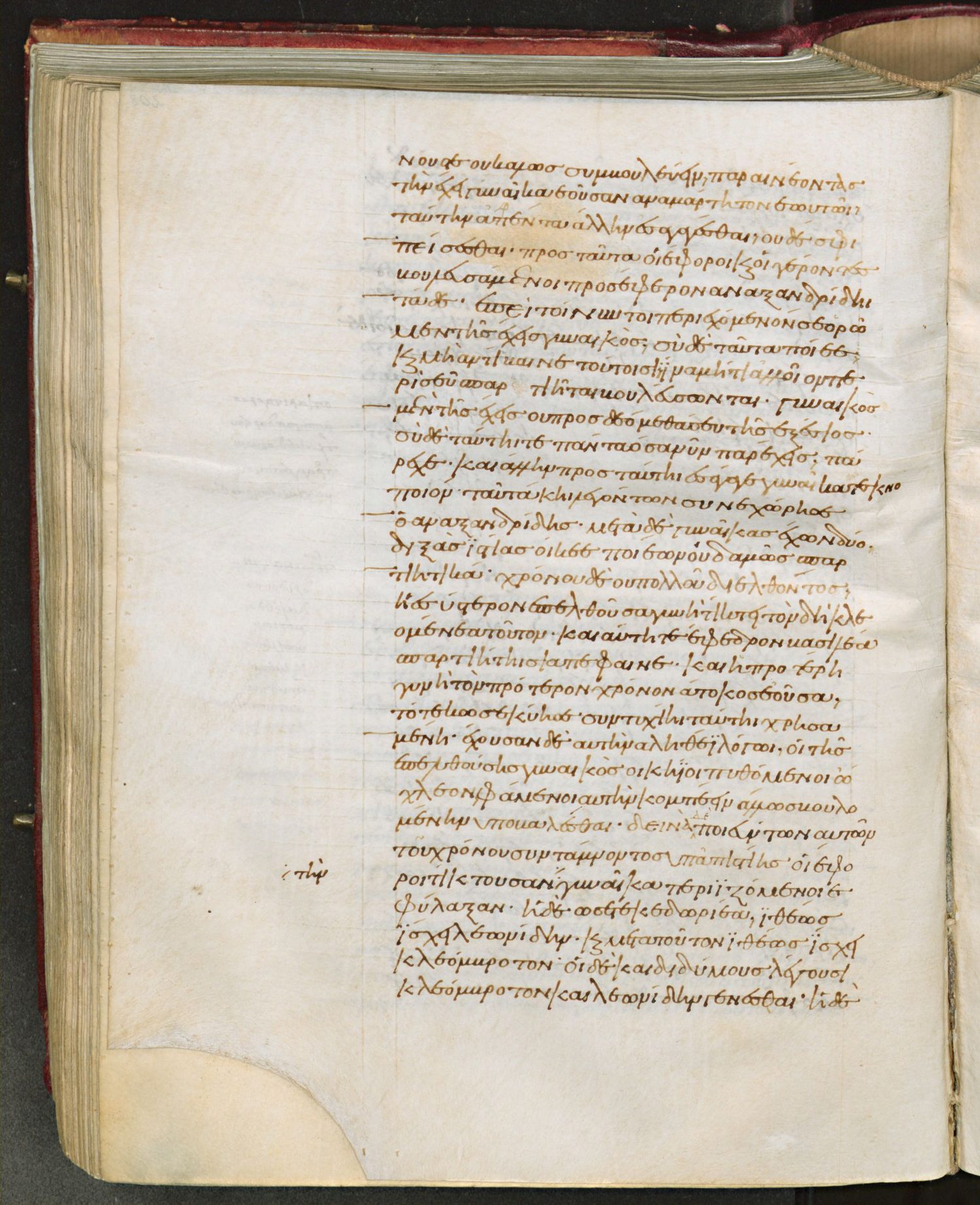
Laur. Plut. 70.3, fol. 208v: Greek here 5.39.2 to 5.41.3. Checked on the image (first and last words read and located in the Greek; each break checked against the neighbouring page): fol. 208v begins ‹-είνους τε οὐ καλῶς› (5.39.2), ends ‹Κλεόμβροτον καὶ Λεωνίδην γενέσθαι› (5.41.3). The word ‹ἐκείνους› is divided between fol. 208r and fol. 208v; it is given with fol. 208r. English here: 5.40.1 to 5.41.3 (Godley's sentences for the sections whose Greek lies mostly on this page).
5.39.2τε οὐ καλῶς συμβουλεύειν παραινέοντας, τὴν ἔχει γυναῖκα ἐοῦσαν ἀναμάρτητον ἑωυτῷ, ταύτην ἀπέντα ἄλλην ἐσαγαγέσθαι· οὐδέ σφι πείσεσθαι. 5.40.1πρὸς ταῦτα οἱ ἔφοροι καὶ οἱ γέροντες βουλευσάμενοι προσέφερον Ἀναξανδρίδῃ τάδε. ἐπεὶ τοίνυν τοι περιεχόμενόν σε ὁρῶμεν τῆς ἔχεις γυναικός, σὺ δὲ ταῦτα ποίεε, καὶ μὴ ἀντίβαινε τούτοισι, ἵνα μή τι ἀλλοῖον περὶ σεῦ Σπαρτιῆται βουλεύσωνται· 5.40.2γυναικὸς μὲν τῆς ἔχεις οὐ προσδεόμεθά σευ τῆς ἐξέσιος, σὺ δὲ ταύτῃ τε πάντα ὅσα νῦν παρέχεις πάρεχε καὶ ἄλλην πρὸς ταύτῃ ἐσάγαγε γυναῖκα τεκνοποιόν. ταῦτά κῃ λεγόντων συνεχώρησε ὁ Ἀναξανδρίδης, μετὰ δὲ γυναῖκας ἔχων δύο διξὰς ἱστίας οἴκεε, ποιέων οὐδαμῶς Σπαρτιητικά. 5.41.1χρόνου δὲ οὐ πολλοῦ διελθόντος ἡ ἐσύστερον ἐπελθοῦσα γυνὴ τίκτει τὸν δὴ Κλεομένεα τοῦτον. καὶ αὕτη τε ἔφεδρον βασιλέα Σπαρτιήτῃσι ἀπέφαινε, καὶ ἡ προτέρη γυνὴ τὸν πρότερον χρόνον ἄτοκος ἐοῦσα τότε κως ἐκύησε, συντυχίῃ ταύτῃ χρησαμένη. 5.41.2ἔχουσαν δὲ αὐτὴν ἀληθεῖ λόγῳ οἱ τῆς ἐπελθούσης γυναικὸς οἰκήιοι πυθόμενοι ὤχλεον, φάμενοι αὐτὴν κομπέειν ἄλλως βουλομένην ὑποβαλέσθαι. δεινὰ δὲ ποιεύντων αὐτῶν, τοῦ χρόνου συντάμνοντος, ὑπʼ ἀπιστίης οἱ ἔφοροι τίκτουσαν τὴν γυναῖκα περιιζόμενοι ἐφύλαξαν. 5.41.3ἣ δὲ ὡς ἔτεκε Δωριέα ἰθέως ἴσχει Λεωνίδην, καὶ μετὰ τοῦτον ἰθέως ἴσχει Κλεόμβροτον· οἳ δὲ καὶ διδύμους λέγουσι Κλεόμβροτον καὶ Λεωνίδην γενέσθαι.
5.40.1Then the Ephors and Elders took counsel, and laid this proposal before Anaxandrides: “Seeing then that you cleave, as we see, to the wife that you have, do this our command, and stand not out against it, lest the Spartans find some new way of dealing with you. 5.40.2As for the wife that you have, we ask not that you should send her away; rather, give her all that you give her now, and marry another woman besides who can give you children.” So they spoke, and Anaxandrides consented; and presently he had two wives and kept two households, a thing in nowise customary at Sparta. 5.41.1After no long time the second wife gave birth to the Cleomenes afore-mentioned. So she gave the Spartans an heir to the royal power; and (as luck would have it) the first wife, having hitherto been barren, did at that very time conceive. 5.41.2She being verily with child, the friends of the later wife learnt of it and began to trouble her; for, they said, she was making a vain boast, that she might substitute a child; and as they were angry, and her time drew nigh, the Ephors would not believe her and sat round to watch her in childbirth; and 5.41.3she gave birth first to Dorieus, then straightway bore Leonidas, and straightway after him Cleombrotus; though some say that Cleombrotus and Leonidas were twins. But the later wife, Cleomenes’ mother (she was the daughter of Prinetadas son of Demarmenus), bore no more children.
Where on the image
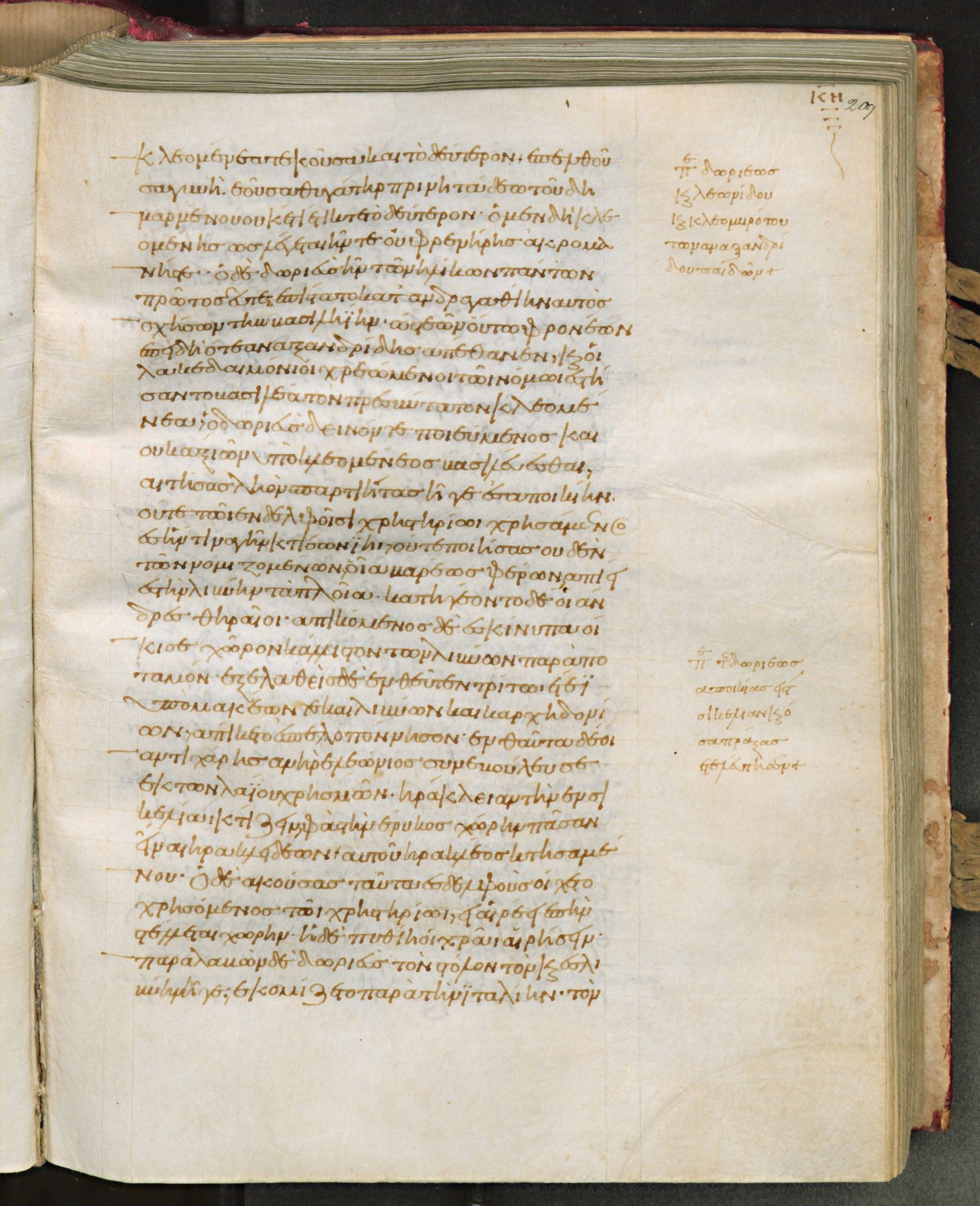
Laur. Plut. 70.3, fol. 209r: Greek here 5.41.3 to 5.44.1. Checked on the image (first and last words read and located in the Greek; each break checked against the neighbouring page): fol. 209r begins ‹ἣ δὲ Κλεομένεα τεκοῦσα› (5.41.3), ends ‹ἐκομίζετο παρὰ τὴν Ἰταλίην.τὸν› (5.44.1). English here: 5.42.1 to 5.43.1 (Godley's sentences for the sections whose Greek lies mostly on this page).
5.41.3ἣ δὲ Κλεομένεα τεκοῦσα καὶ τὸ δεύτερον ἐπελθοῦσα γυνή, ἐοῦσα θυγάτηρ Πρινητάδεω τοῦ Δημαρμένου, οὐκέτι ἔτικτε τὸ δεύτερον. 5.42.1ὁ μὲν δὴ Κλεομένης, ὡς λέγεται, ἦν τε οὐ φρενήρης ἀκρομανής τε, ὁ δὲ Δωριεὺς ἦν τῶν ἡλίκων πάντων πρῶτος, εὖ τε ἐπίστατο κατʼ ἀνδραγαθίην αὐτὸς σχήσων τὴν βασιληίην. 5.42.2ὥστε ὦν οὕτω φρονέων, ἐπειδὴ ὅ τε Ἀναξανδρίδης ἀπέθανε καὶ οἱ Λακεδαιμόνιοι χρεώμενοι τῷ νόμῳ ἐστήσαντο βασιλέα τὸν πρεσβύτατον Κλεομένεα, ὁ Δωριεὺς δεινόν τε ποιεύμενος καὶ οὐκ ἀξιῶν ὑπὸ Κλεομένεος βασιλεύεσθαι, αἰτήσας λεὼν Σπαρτιήτας ἦγε ἐς ἀποικίην, οὔτε τῷ ἐν Δελφοῖσι χρηστηρίῳ χρησάμενος ἐς ἥντινα γῆν κτίσων ἴῃ, οὔτε ποιήσας οὐδὲν τῶν νομιζομένων· οἷα δὲ βαρέως φέρων, ἀπίει ἐς τὴν Λιβύην τὰ πλοῖα· κατηγέοντο δέ οἱ ἄνδρες Θηραῖοι. 5.42.3ἀπικόμενος δὲ ἐς Λιβύην οἴκισε χῶρον κάλλιστον τῶν Λιβύων παρὰ Κίνυπα ποταμόν. ἐξελασθεὶς δὲ ἐνθεῦτεν τρίτῳ ἔτεϊ ὑπὸ Μακέων τε Λιβύων καὶ Καρχηδονίων ἀπίκετο ἐς Πελοπόννησον. 5.43.1ἐνθαῦτα δέ οἱ Ἀντιχάρης ἀνὴρ Ἐλεώνιος συνεβούλευσε ἐκ τῶν Λαΐου χρησμῶν Ἡρακλείην τὴν ἐν Σικελίῃ κτίζειν, φὰς τὴν Ἔρυκος χώρην πᾶσαν εἶναι Ἡρακλειδέων αὐτοῦ Ἡρακλέος κτησαμένου. ὁ δὲ ἀκούσας ταῦτα ἐς Δελφοὺς οἴχετο χρησόμενος τῷ χρηστηρίῳ, εἰ αἱρέει ἐπʼ ἣν στέλλεται χώρην· ἡ δὲ Πυθίη οἱ χρᾷ αἱρήσειν. παραλαβὼν δὲ Δωριεὺς τὸν στόλον τὸν καὶ ἐς Λιβύην ἦγε, ἐκομίζετο παρὰ τὴν Ἰταλίην. 5.44.1τὸν
5.42.1Now Cleomenes, as the story goes, was not in his right senses, but crazy; but Dorieus was first among all of like age with himself; and he fully believed that he would be made king for his manly worth. 5.42.2Being thus minded, when at Anaxandrides’ death the Lacedaemonians followed their custom and made Cleomenes king by right of age, Dorieus was very angry and would not brook to be subject to Cleomenes; and he asked the Spartans for a company of folk, whom he took away as colonists; he neither enquired of the oracle at Delphi in what land he should plant his settlement, nor did aught else that was customary; but he set sail in great wrath for Libya, with men of Thera to guide him. 5.42.3Thither he came, and settled by the Cinyps river, in the fairest part of Libya; but in the third year he was driven out by the Macae and Libyans and Carchedonians, and returned to Peloponnesus. 5.43.1There Antichares, a man of Eleon, counselled him to plant a colony at Heraclea in Sicily, according to the word of one of Laius’ oracles; for Heracles himself (said Antichares) had won all the region of Eryx, and it belonged to his descendants. When Dorieus heard that, he went away to Delphi to enquire of the oracle if he should win the place whither he was preparing to go; and the priestess telling him that so it should be, he took with him the company that he had led to Libya, and went to Italy.
Where on the image
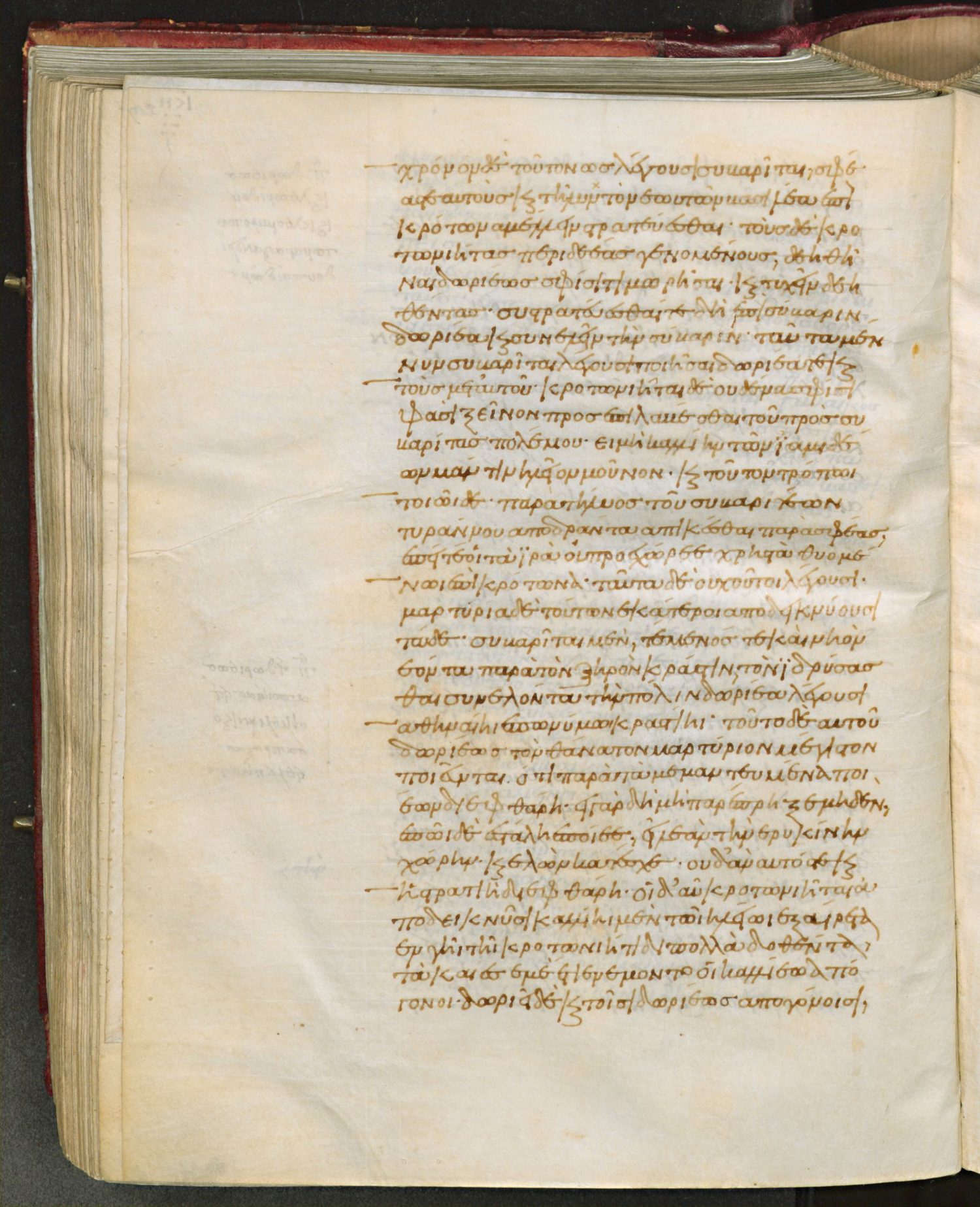
Laur. Plut. 70.3, fol. 209v: Greek here 5.44.1 to 5.45.2. Checked on the image (first and last words read and located in the Greek; each break checked against the neighbouring page): fol. 209v begins ‹χρόνον δὲ τοῦτον, ὡς› (5.44.1), ends ‹καὶ τοῖσι Δωριέος ἀπογόνοισι› (5.45.2). English here: 5.44.1 to 5.45.1 (Godley's sentences for the sections whose Greek lies mostly on this page).
5.44.1χρόνον δὲ τοῦτον, ὡς λέγουσι Συβαρῖται, σφέας τε αὐτοὺς καὶ Τῆλυν τὸν ἑωυτῶν βασιλέα ἐπὶ Κρότωνα μέλλειν στρατεύεσθαι, τοὺς δὲ Κροτωνιήτας περιδεέας γενομένους δεηθῆναι Δωριέος σφίσι τιμωρῆσαι καὶ τυχεῖν δεηθέντας· συστρατεύεσθαί τε δὴ ἐπὶ Σύβαριν Δωριέα καὶ συνελεῖν τὴν Σύβαριν. 5.44.2ταῦτα μέν νυν Συβαρῖται λέγουσι ποιῆσαι Δωριέα τε καὶ τοὺς μετʼ αὐτοῦ, Κροτωνιῆται δὲ οὐδένα σφίσι φασὶ ξεῖνον προσεπιλαβέσθαι τοῦ πρὸς Συβαρίτας πολέμου εἰ μὴ Καλλίην τῶν Ἰαμιδέων μάντιν Ἠλεῖον μοῦνον, καὶ τοῦτον τρόπῳ τοιῷδε· παρὰ Τήλυος τοῦ Συβαριτέων τυράννου ἀποδράντα ἀπικέσθαι παρὰ σφέας, ἐπείτε οἱ τὰ ἱρὰ οὐ προεχώρεε χρηστὰ θυομένῳ ἐπὶ Κρότωνα. 5.45.1ταῦτα δὲ οὗτοι λέγουσι. μαρτύρια δὲ τούτων ἑκάτεροι ἀποδεικνύουσι τάδε, Συβαρῖται μὲν τέμενός τε καὶ νηὸν ἐόντα παρὰ τὸν ξηρὸν Κρᾶθιν, τὸν ἱδρύσασθαι συνελόντα τὴν πόλιν Δωριέα λέγουσι Ἀθηναίῃ ἐπωνύμῳ Κραθίῃ· τοῦτο δὲ αὐτοῦ Δωριέος τὸν θάνατον μαρτύριον μέγιστον ποιεῦνται, ὅτι παρὰ τὰ μεμαντευμένα ποιέων διεφθάρη· εἰ γὰρ δὴ μὴ παρέπρηξε μηδέν, ἐπʼ ὁ δὲ ἐστάλη ἐποίεε, εἷλε ἂν τὴν Ἐρυκίνην χώρην καὶ ἑλὼν κατέσχε, οὐδʼ ἂν αὐτός τε καὶ ἡ στρατιὴ διεφθάρη. 5.45.2οἱ δʼ αὖ Κροτωνιῆται ἀποδεικνῦσι Καλλίῃ μὲν τῷ Ἠλείῳ ἐξαίρετα ἐν γῇ τῇ Κροτωνιήτιδι πολλὰ δοθέντα, τὰ καὶ ἐς ἐμὲ ἔτι ἐνέμοντο οἱ Καλλίεω ἀπόγονοι, Δωριέι δὲ καὶ τοῖσι Δωριέος ἀπογόνοισι
5.44.1Now at this time, as the Sybarites say, they and their king Telys were making ready to march against Croton, and the men of Croton, being greatly affrighted, entreated Dorieus to come to their aid; their request was granted; Dorieus marched with them to Sybaris and helped them to take it. 5.44.2Such is the story which the Sybarites tell of Dorieus and his companions; but the Crotoniats say that they were aided by no stranger in their war with Sybaris save only by Callias, an Elean diviner of the Iamid clan; of whom the story was that he had fled to Croton from Telys, the despot of Sybaris, because when he was sacrificing for victory over Croton he could get no favourable omens. 5.45.1This is their tale. Both cities bring proof of the truth of what they say: the Sybarites show a precinct and a temple beside the dry bed of the Crathis, which, they say, Dorieus founded in honour of Athene of Crathis, after he had helped to take their city; and moreover they find their strongest proof in his death, because he perished in the doing of more than the oracle bade him; for had he done that for which he set out and nought beyond it, he would have taken and held the Erycine region, and so neither he nor his army would have perished.
Where on the image
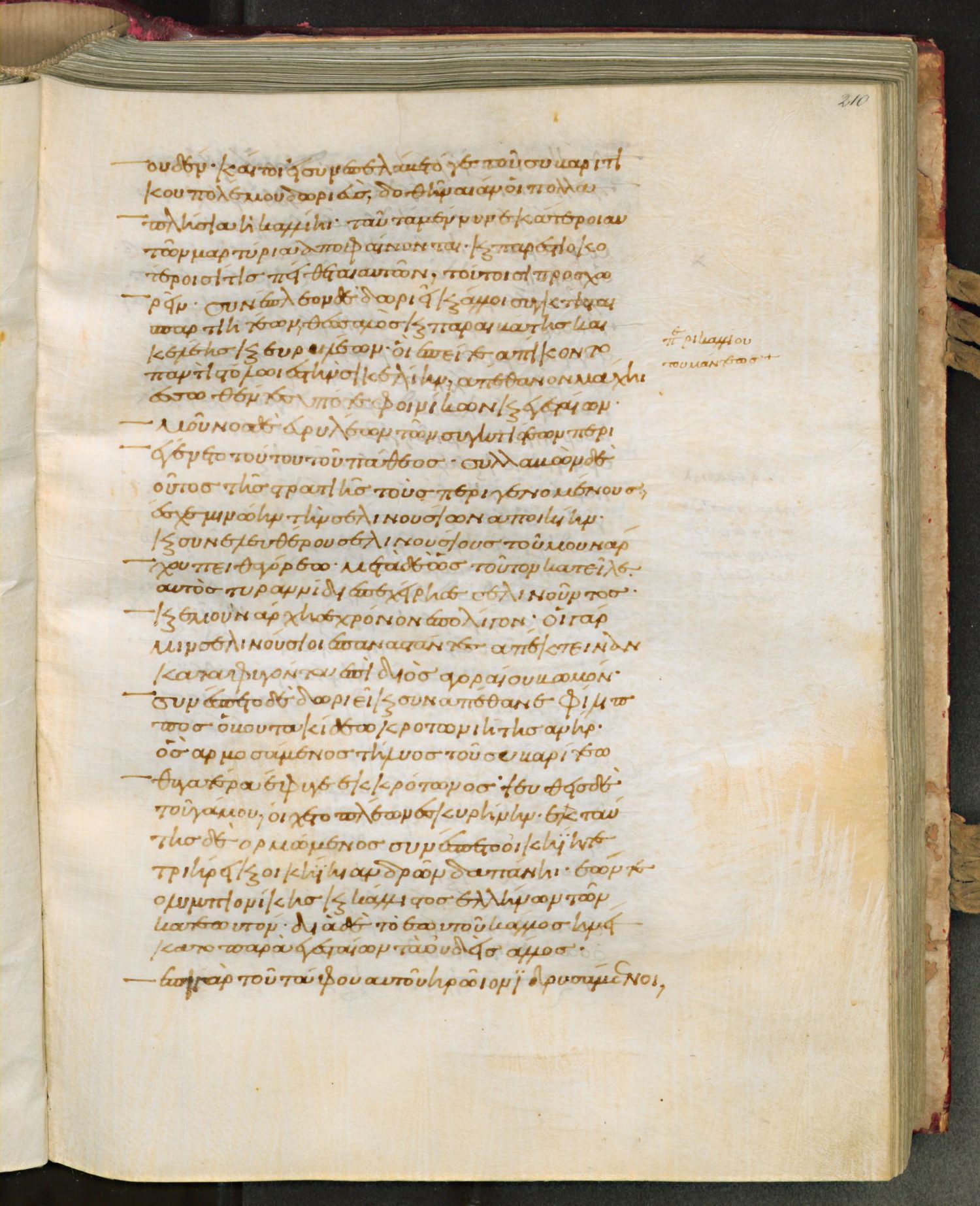
Laur. Plut. 70.3, fol. 210r: Greek here 5.45.2 to 5.47.2. Checked on the image (first and last words read and located in the Greek; each break checked against the neighbouring page): fol. 210r begins ‹οὐδέν. καίτοι εἰ συνεπελάβετό› (5.45.2), ends ‹τάφου αὐτοῦ ἡρώιον ἱδρυσάμενοι› (5.47.2). English here: 5.45.2 to 5.47.2 (Godley's sentences for the sections whose Greek lies mostly on this page).
5.45.2οὐδέν. καίτοι εἰ συνεπελάβετό γε τοῦ Συβαριτικοῦ πολέμου Δωριεύς, δοθῆναι ἄν οἱ πολλαπλήσια ἢ Καλλίῃ. ταῦτα μέν νυν ἑκάτεροι αὐτῶν μαρτύρια ἀποφαίνονται, καὶ πάρεστι, ὁκοτέροισί τις πείθεται αὐτῶν, τούτοισι προσχωρέειν. 5.46.1συνέπλεον δὲ Δωριέι καὶ ἄλλοι συγκτίσται Σπαρτιητέων, Θεσσαλὸς καὶ Παραιβάτης καὶ Κελέης καὶ Εὐρυλέων· οἳ ἐπείτε ἀπίκοντο παντὶ στόλῳ ἐς τὴν Σικελίην, ἀπέθανον μάχῃ ἑσσωθέντες ὑπό τε Φοινίκων καὶ Ἐγεσταίων· μοῦνος δὲ Εὐρυλέων τῶν συγκτιστέων περιεγένετο τούτου τοῦ πάθεος. 5.46.2συλλαβὼν δὲ οὗτος τῆς στρατιῆς τοὺς περιγενομένους ἔσχε Μινώην τὴν Σελινουσίων ἀποικίην, καὶ συνελευθέρου Σελινουσίους τοῦ μουνάρχου Πειθαγόρεω· μετὰ δὲ ὡς τοῦτον κατεῖλε, αὐτὸς τυραννίδι ἐπεχείρησε Σελινοῦντος καὶ ἐμουνάρχησε χρόνον ἐπʼ ὀλίγον· οἱ γάρ μιν Σελινούσιοι ἐπαναστάντες ἀπέκτειναν καταφυγόντα ἐπὶ Διὸς ἀγοραίου βωμόν. 5.47.1συνέσπετο δὲ Δωριέι καὶ συναπέθανε Φίλιππος ὁ Βουτακίδεω Κροτωνιήτης ἀνήρ, ὃς ἁρμοσάμενος Τήλυος τοῦ Συβαρίτεω θυγατέρα ἔφυγε ἐκ Κρότωνος, ψευσθεὶς δὲ τοῦ γάμου οἴχετο πλέων ἐς Κυρήνην, ἐκ ταύτης δὲ ὁρμώμενος συνέσπετο οἰκηίῃ τε τριήρεϊ καὶ οἰκηίῃ ἀνδρῶν δαπάνῃ, ἐών τε Ὀλυμπιονίκης καὶ κάλλιστος Ἑλλήνων τῶν κατʼ ἑωυτόν. 5.47.2διὰ δὲ τὸ ἑωυτοῦ κάλλος ἠνείκατο παρὰ Ἐγεσταίων τὰ οὐδεὶς ἄλλος· ἐπὶ γὰρ τοῦ τάφου αὐτοῦ ἡρώιον ἱδρυσάμενοι
5.45.2But the Crotoniats on the other hand show many gifts of land in the country of Croton that were set apart for Callias of Elis (on which lands Callias’ posterity dwelt even to my time), but no gift to Dorieus and his descendants. Yet (they plead) had Dorieus aided them in their war with Sybaris, he would have received a reward many times greater than what was given to Callias. These, then, are the proofs brought by each party; we may take whichever side seems to deserve most credence. 5.46.1Other Spartans too sailed with Dorieus to found his colony, namely, Thessalus, Paraebates, Celees, and Euryleon. These, having come with all their company to Sicily, were overcome and slain in battle by the Phoenicians and Egestans,—all save Euryleon, who was the only settler that survived this disaster. 5.46.2He mustered the remnant of his army and took Minoa, the colony from Selinus, and aided in freeing the people of Selinus from their monarch Pithagoras. Having deposed this man he himself essayed to be despot of Selinus, and was monarch there, but for a little while only; for the people of the place rose against him and slew him at the altar of Zeus of the Market-place, whither he had fled for refuge. 5.47.1Another that followed Dorieus and was with him slain was Philippus of Croton, son of Butacides; he had betrothed himself to the daughter of Telys of Sybaris and was banished from Croton; but being disappointed of his marriage he sailed away to Cyrene, whence he set forth and followed Dorieus, bringing his own trireme and paying all charges for his men; this Philippus was a victor at Olympia and the goodliest Greek of his day. 5.47.2For the beauty of his person he received honours from the Egestans accorded to none else: they built a hero’s shrine by his grave, and offer him sacrifices of propitiation.
Where on the image
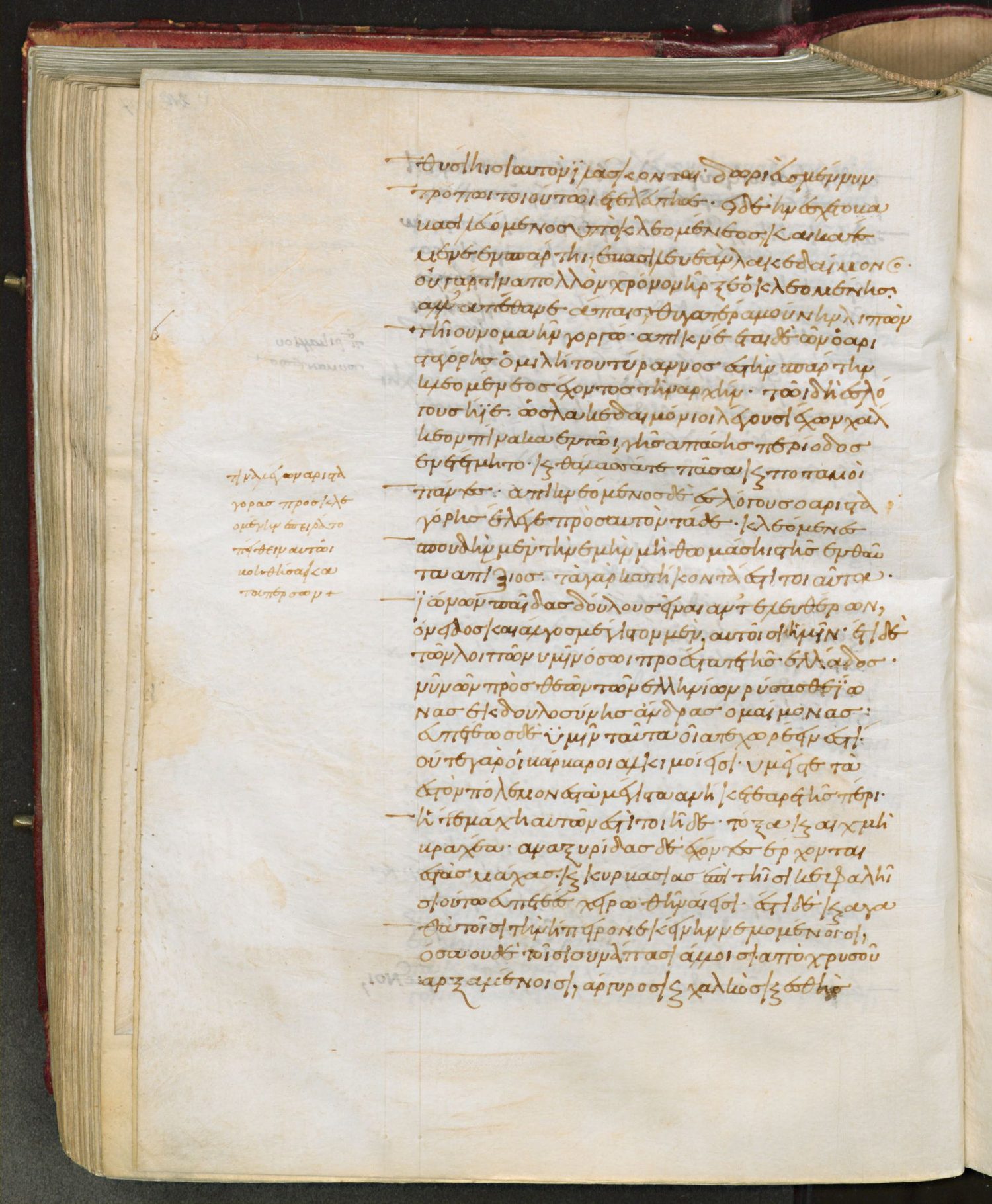
Laur. Plut. 70.3, fol. 210v: Greek here 5.47.2 to 5.48.1. Checked on the image (first and last words read and located in the Greek; each break checked against the neighbouring page): fol. 210v begins ‹θυσίῃσι αὐτὸν ἱλάσκονται.Δωριεὺς μέν› (5.47.2), ends ‹καὶ χαλκὸς καὶ ἐσθὴς› (5.49.4). English here: 5.48.1 (Godley's sentences for the sections whose Greek lies mostly on this page).
5.47.2θυσίῃσι αὐτὸν ἱλάσκονται. 5.48.1Δωριεὺς μέν νυν τρόπῳ τοιούτῳ ἐτελεύτησε· εἰ δὲ ἠνέσχετο βασιλευόμενος ὑπὸ Κλεομένεος καὶ κατέμενε ἐν Σπάρτῃ, ἐβασίλευσε ἂν Λακεδαίμονος· οὐ γάρ τινα πολλὸν χρόνον ἦρξε ὁ Κλεομένης, ἀλλʼ ἀπέθανε ἄπαις, θυγατέρα μούνην λιπών, τῇ οὔνομα ἦν Γοργώ.
5.48.1Such, then, was the manner of Dorieus’ death. Had he endured Cleomenes’ rule and stayed at Sparta, he would have been king of Lacedaemon; for Cleomenes reigned no long time, and died leaving no son but one only daughter, whose name was Gorgo.
Notes
- Greek: the text printed in A. D. Godley's Loeb edition, via Perseus (tlg0016.tlg001.perseus-grc2). Square brackets mark words the editor considers later additions; [...] marks a gap the editor indicates. Perseus note markers are omitted.
- English: A. D. Godley, Herodotus vol. 3 (1922) (Loeb Classical Library), as transcribed on Wikisource. Godley's footnotes are omitted.
- Section numbers in the English were placed by comparing Godley's text with the Perseus version of his translation; where a section begins inside one of Godley's sentences, the English is kept with the page that holds the start of that sentence.
Cite
Sources
- Source: Florence, Laur. Plut. 70.3 (10th c.) via BML Teca Digitale + Greek of Godley's Loeb (Perseus) + English of A. D. Godley (Loeb, Wikisource) (holding institution)
- Critical edition: Greek of A. D. Godley's Loeb edition (1920-1925), via Perseus
← previous · → next · v cycle view · l back to library