Herodotus, Histories 5.49-61: Aristagoras at Sparta; the Royal Road; the Cadmean letters
Introduction
Herodotus of Halicarnassus wrote the Histories in the third quarter of the 5th century BCE, an inquiry into the deeds of Greeks and barbarians and the causes of the wars between them, later divided into nine books. Book 5 tells of the Persian advance in Thrace and Macedonia, the outbreak of the Ionian revolt under Aristagoras of Miletus, his appeals to Sparta and Athens, with Herodotus' accounts of Sparta and of Athens after the tyrants, and the burning of Sardis and the first years of the revolt.
The photographs are of Florence, Biblioteca Medicea Laurenziana, Plut. 70.3 (parchment, 10th century, 374 folios, 31 lines a page), Herodotus, Histories (codex A of the editors), the oldest surviving manuscript of the complete Histories, from the Teca Digitale of the Biblioteca Medicea Laurenziana. Each section below is the text of one page, or of the part of a page that falls within these chapters. The first and last words of every page were read on the photograph and located in the Greek, and every page break was checked against the next page; the notes quote these words. Readers' notes in the margins are not part of the text and are mentioned where they occur.
The Greek is the text printed in A. D. Godley's Loeb edition (1920-1925), from Perseus; it is the edited text, not a transcription of the manuscript, whose wording differs in places. The English is Godley's translation as printed, from Wikisource. Godley's English carries only chapter numbers; the section numbers shown in it were placed by comparison with the Perseus version of his translation. Each page's English is cut at the end of one of Godley's sentences, so it can begin or end a few lines away from the Greek of the page; each note gives the exact ranges.
This entry covers chapters 5.49-61, on fol. 210v to 214r.
How was this verified? (Provenance)
Where on the image
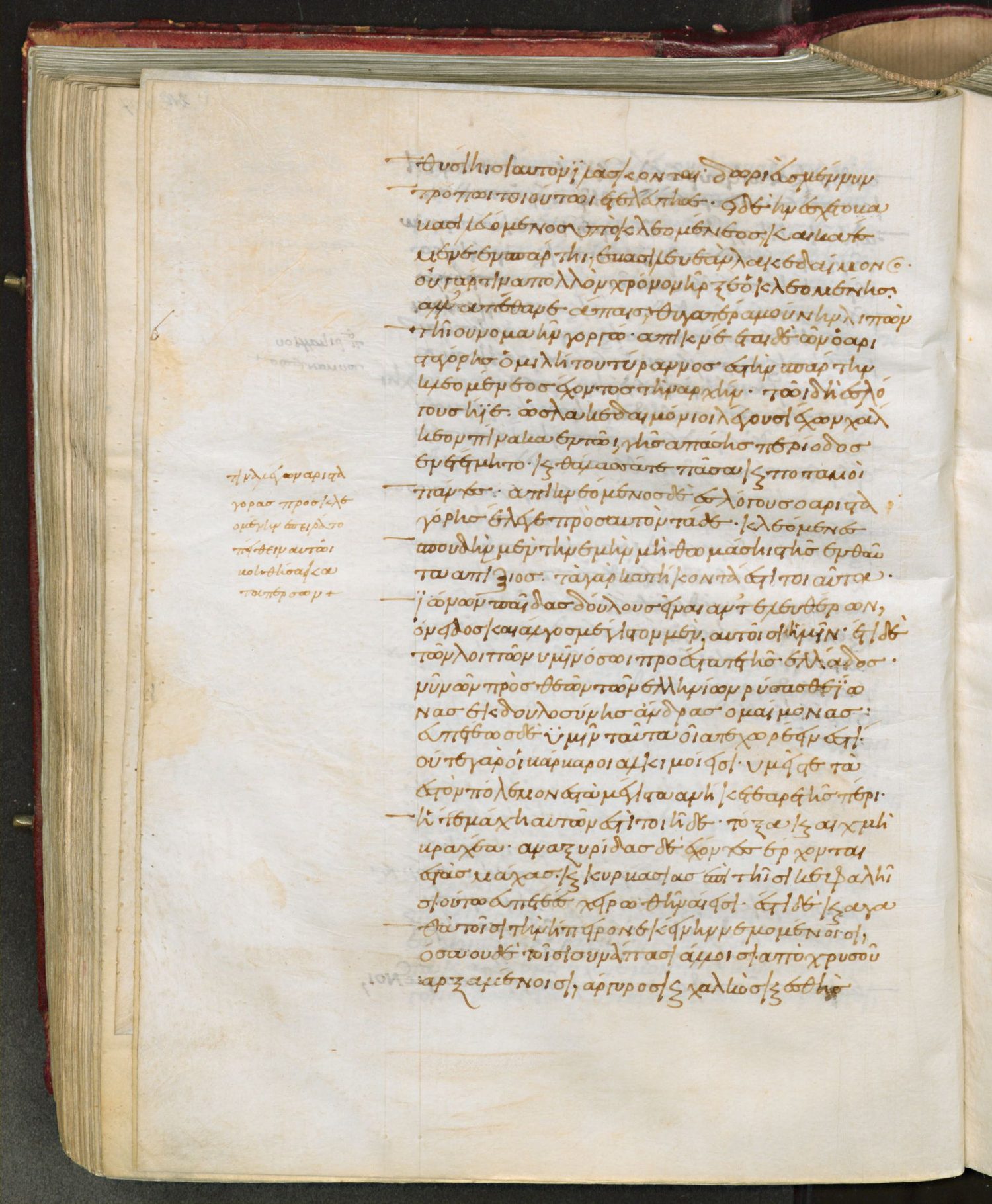
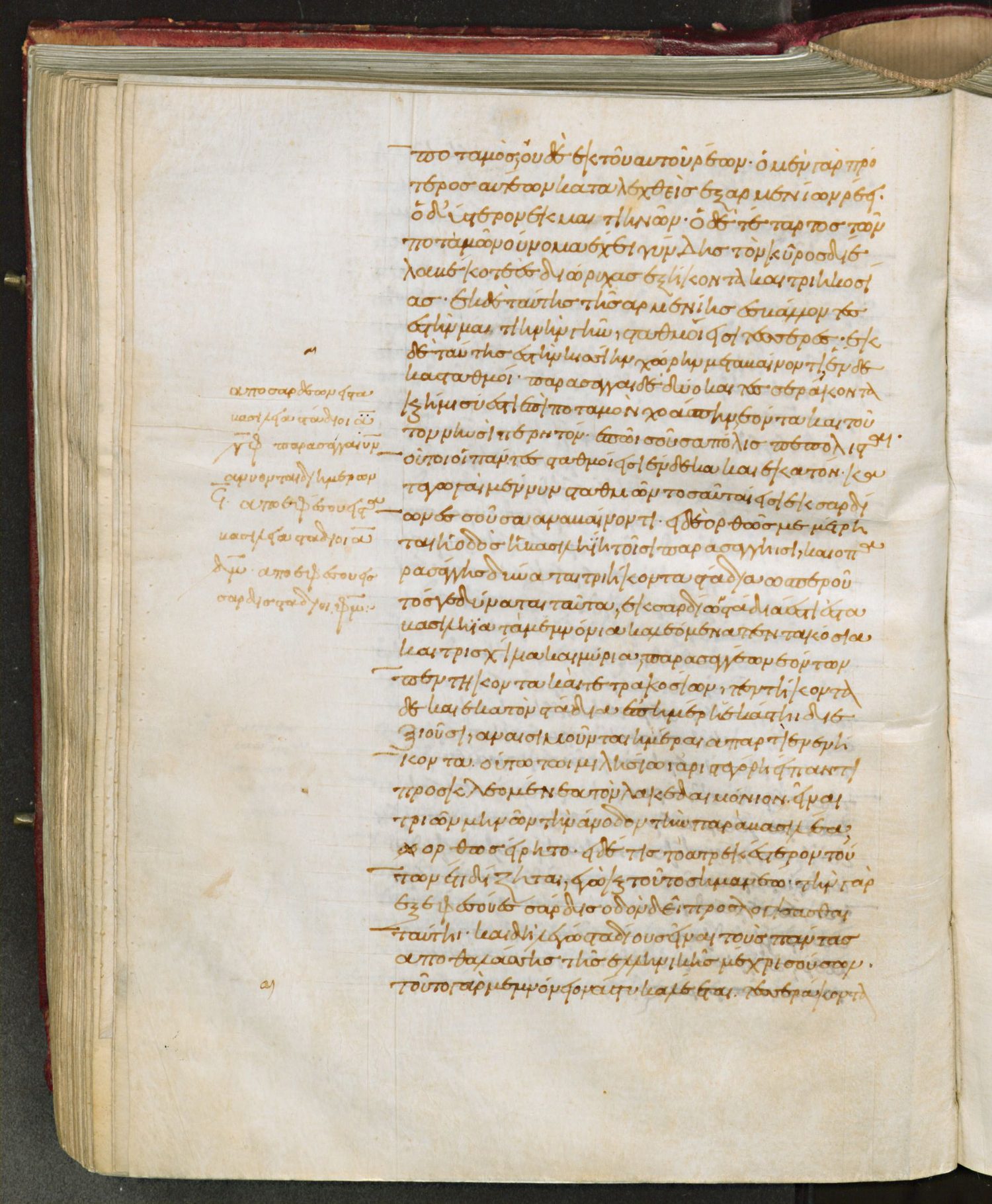
Laur. Plut. 70.3, fol. 210v: Greek here 5.49.1 to 5.49.4. Checked on the image (first and last words read and located in the Greek; each break checked against the neighbouring page): fol. 210v begins ‹θυσίῃσι αὐτὸν ἱλάσκονται.Δωριεὺς μέν› (5.47.2), ends ‹καὶ χαλκὸς καὶ ἐσθὴς› (5.49.4). English here: 5.49.1 to 5.49.4 (Godley's sentences for the sections whose Greek lies mostly on this page).
5.49.1ἀπικνέεται δὲ ὦν ὁ Ἀρισταγόρης ὁ Μιλήτου τύραννος ἐς τὴν Σπάρτην Κλεομένεος ἔχοντος τὴν ἀρχήν· τῷ δὴ ἐς λόγους ἤιε, ὡς Λακεδαιμόνιοι λέγουσι, ἔχων χάλκεον πίνακα ἐν τῷ γῆς ἁπάσης περίοδος ἐνετέτμητο καὶ θάλασσά τε πᾶσα καὶ ποταμοὶ πάντες. 5.49.2ἀπικνεόμενος δὲ ἐς λόγους ὁ Ἀρισταγόρης ἔλεγε πρὸς αὐτὸν τάδε. Κλεόμενες, σπουδὴν μὲν τὴν ἐμὴν μὴ θωμάσῃς τῆς ἐνθαῦτα ἀπίξιος· τὰ γὰρ κατήκοντα ἐστὶ τοιαῦτα· Ἰώνων παῖδας δούλους εἶναι ἀντʼ ἐλευθέρων ὄνειδος καὶ ἄλγος μέγιστον μὲν αὐτοῖσι ἡμῖν, ἔτι δὲ τῶν λοιπῶν ὑμῖν, ὅσῳ προέστατε τῆς Ἑλλάδος. 5.49.3νῦν ὦν πρὸς θεῶν τῶν Ἑλληνίων ῥύσασθε Ἴωνας ἐκ δουλοσύνης ἄνδρας ὁμαίμονας. εὐπετέως δὲ ὑμῖν ταῦτα οἷά τε χωρέειν ἐστί· οὔτε γὰρ οἱ βάρβαροι ἄλκιμοι εἰσί, ὑμεῖς τε τὰ ἐς τὸν πόλεμον ἐς τὰ μέγιστα ἀνήκετε ἀρετῆς πέρι, ἥ τε μάχη αὐτῶν ἐστὶ τοιήδε, τόξα καὶ αἰχμὴ βραχέα· ἀναξυρίδας δὲ ἔχοντες ἔρχονται ἐς τὰς μάχας καὶ κυρβασίας ἐπὶ τῇσι κεφαλῇσι. 5.49.4οὕτω εὐπετέες χειρωθῆναι εἰσί. ἔστι δὲ καὶ ἀγαθὰ τοῖσι τὴν ἤπειρον ἐκείνην νεμομένοισι ὅσα οὐδὲ τοῖσι συνάπασι ἄλλοισι, ἀπὸ χρυσοῦ ἀρξαμένοισι, ἄργυρος καὶ χαλκὸς καὶ ἐσθὴς
5.49.1I return to my story. It was in the reign of Cleomenes that Aristagoras the despot of Miletus came to Sparta; and when he had audience of the king (so the Lacedaemonians say) he brought with him a bronze tablet on which the map of all the earth was engraved, and all the sea and all the rivers. 5.49.2Having been admitted to converse with Cleomenes, Aristagoras spoke thus to him: “Wonder not, Cleomenes, that I have been so zealous to come hither; for such is our present state: that the sons of the Ionians should be slaves and not free men is a shame and grief to ourselves in especial, and of all others to you, inasmuch as you are the leaders of Hellas. 5.49.3Now, therefore, we beseech you by the gods of Hellas, save your Ionian kinsmen from slavery. This is a thing that you may easily achieve; for the strangers are no valiant men, and your valour in war is preëminent. And for their fashion of fighting, they carry bows and short spears; and they go to battle with breeches on their legs and turbans on their heads; so they are easy to overcome. 5.49.4Further, the dwellers in that continent have more good things than all other men together, gold first, and silver too and bronze and coloured raiment and beasts of burden and slaves; all this you can have at your heart’s desire.
Where on the image
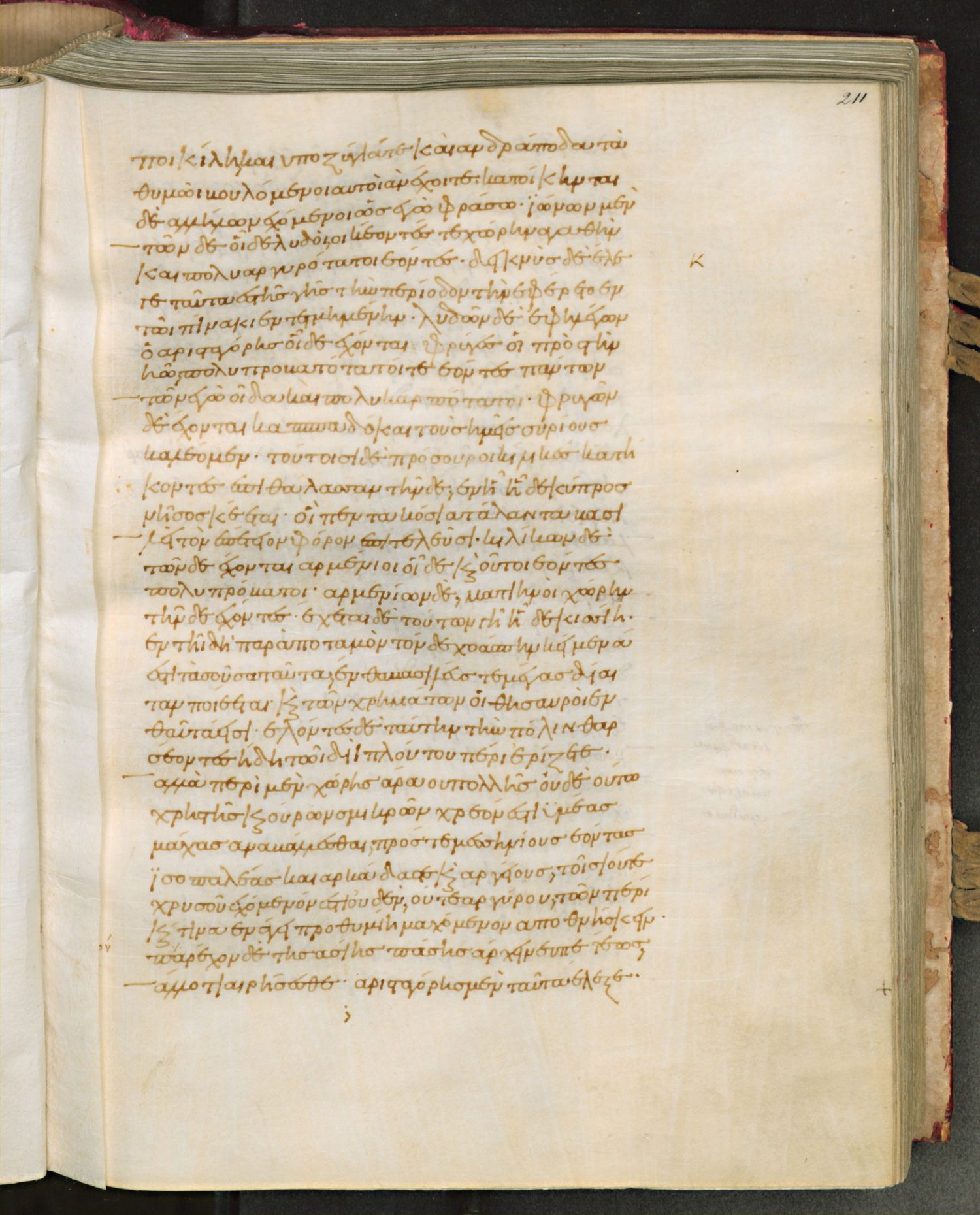
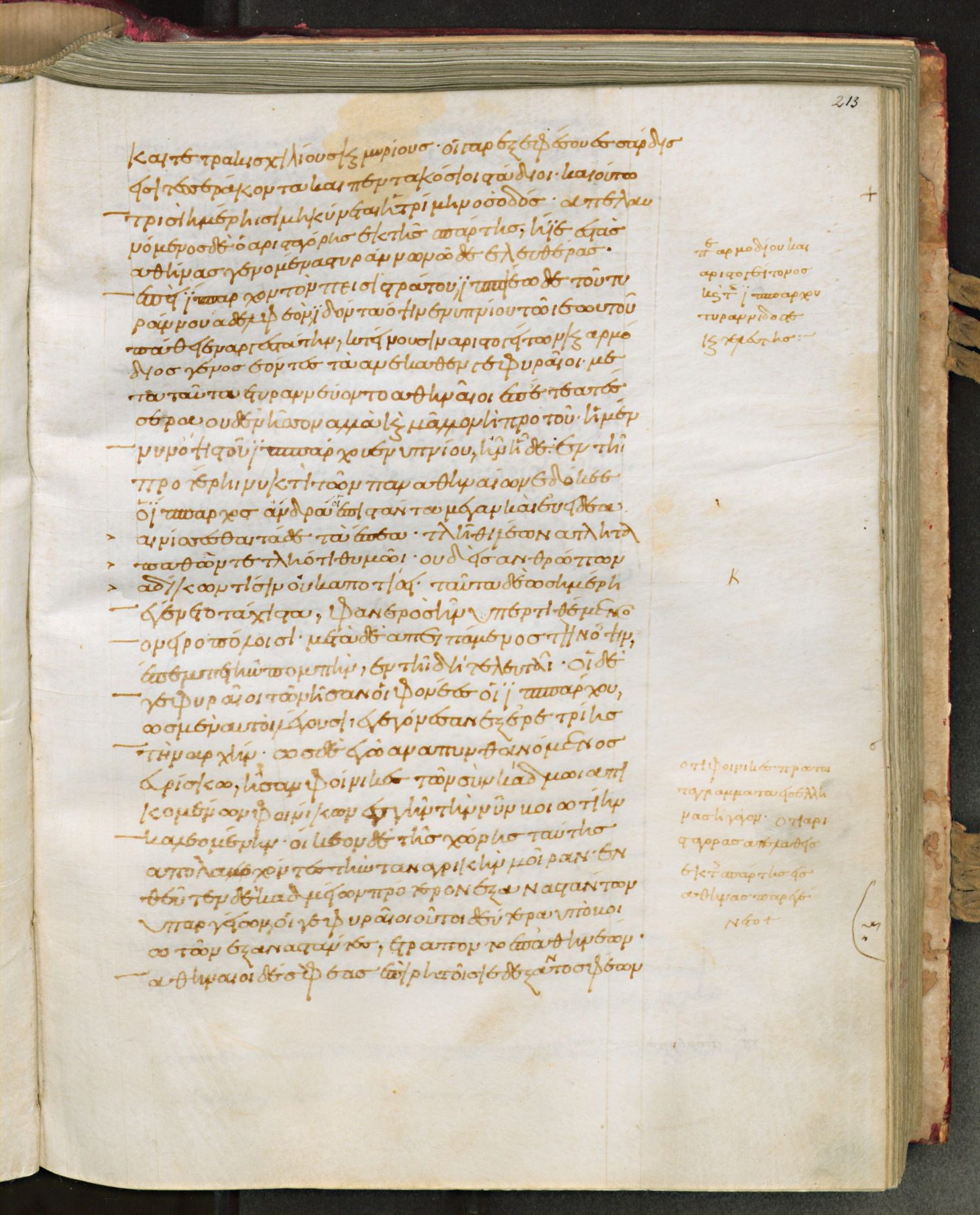
Laur. Plut. 70.3, fol. 211r: Greek here 5.49.4 to 5.49.9. Checked on the image (first and last words read and located in the Greek; each break checked against the neighbouring page): fol. 211r begins ‹ποικίλη καὶ ὑποζύγιά τε› (5.49.4), ends ‹αἱρήσεσθε;Ἀρισταγόρης μὲν ταῦτα ἔλεξε› (5.49.9). English here: 5.49.5 to 5.49.8 (Godley's sentences for the sections whose Greek lies mostly on this page).
5.49.4ποικίλη καὶ ὑποζύγιά τε καὶ ἀνδράποδα· τὰ θυμῷ βουλόμενοι αὐτοὶ ἂν ἔχοιτε. 5.49.5κατοίκηνται δὲ ἀλλήλων ἐχόμενοι ὡς ἐγὼ φράσω, Ἰώνων μὲν τῶνδε οἵδε Λυδοί, οἰκέοντές τε χώρην ἀγαθὴν καὶ πολυαργυρώτατοι ἐόντες. δεικνὺς δὲ ἔλεγε ταῦτα ἐς τῆς γῆς τὴν περίοδον, τὴν ἐφέρετο ἐν τῷ πίνακι ἐντετμημένην. Λυδῶν δέ ἔφη λέγων ὁ Ἀρισταγόρης οἵδε ἔχονται Φρύγες οἱ πρὸς τὴν ἠῶ, πολυπροβατώτατοί τε ἐόντες πάντων τῶν ἐγὼ οἶδα καὶ πολυκαρπότατοι. 5.49.6Φρυγῶν δὲ ἔχονται Καππαδόκαι, τοὺς ἡμεῖς Συρίους καλέομεν. τούτοισι δὲ πρόσουροι Κίλικες, κατήκοντες ἐπὶ θάλασσαν τήνδε, ἐν τῇ ἥδε Κύπρος νῆσος κέεται· οἳ πεντακόσια τάλαντα βασιλέι τὸν ἐπέτειον φόρον ἐπιτελεῦσι. Κιλίκων δὲ τῶνδε ἔχονται Ἀρμένιοι οἵδε, καὶ οὗτοι ἐόντες πολυπρόβατοι, Ἀρμενίων δὲ Ματιηνοὶ χώρην τήνδε ἔχοντες. 5.49.7ἔχεται δὲ τούτων γῆ ἥδε Κισσίη, ἐν τῇ δὴ παρὰ ποταμὸν τόνδε Χοάσπην κείμενα ἐστὶ τὰ Σοῦσα ταῦτα, ἔνθα βασιλεύς τε μέγας δίαιταν ποιέεται, καὶ τῶν χρημάτων οἱ θησαυροὶ ἐνθαῦτα εἰσί· ἑλόντες δὲ ταύτην τὴν πόλιν θαρσέοντες ἤδη τῷ Διὶ πλούτου πέρι ἐρίζετε. 5.49.8ἀλλὰ περὶ μὲν χώρης ἄρα οὐ πολλῆς οὐδὲ οὕτω χρηστῆς καὶ οὔρων σμικρῶν χρεόν ἐστι ὑμέας μάχας ἀναβάλλεσθαι πρός τε Μεσσηνίους ἐόντας ἰσοπαλέας καὶ Ἀρκάδας τε καὶ Ἀργείους, τοῖσι οὔτε χρυσοῦ ἐχόμενον ἐστι οὐδὲν οὔτε ἀργύρου, τῶν πέρι καί τινα ἐνάγει προθυμίη μαχόμενον ἀποθνήσκειν· παρέχον δὲ τῆς Ἀσίης πάσης ἄρχειν εὐπετέως, ἄλλο τι αἱρήσεσθε; 5.49.9Ἀρισταγόρης μὲν ταῦτα ἔλεξε,
5.49.5And the lands wherein they dwell lie next to each other, as I shall show you:—here are the Ionians, and here the Lydians, who inhabit a good land and have great store of silver” (showing as he spoke the map of the earth which he had brought engraved on the tablet), “and next to the Lydians” (said Aristagoras in his speech) “you see the Phrygians, to the east, men that of all known to me are the richest in flocks and in the earth’s produce. 5.49.6Close by them are the Cappadocians, whom we call Syrians; and their neighbours are the Cilicians, whose land reaches to the sea yonder, wherein you see the island of Cyprus lying; the yearly tribute which they pay to the king is five hundred talents. Next to the Cilicians, here are the Armenians, another people rich in flocks, and after the Armenians the Matieni, whose country I show 5.49.7you; and you see the Cissian land adjoining theirs; therein, on the Choaspes (yonder it is), lies that Susa where lives the great king, and there are the storehouses of his wealth; take that city, and then you need not fear to challenge Zeus for riches. What! 5.49.8you must needs then fight for straitened strips of land of no great worth—fight for that with Messenians, who are as strong as you, and Arcadians and Argives, men that have nought in the way of gold or silver, for which things many are spurred by zeal to fight and die: yet when you can readily be masters of all Asia, will you refuse to essay it?”
Where on the image
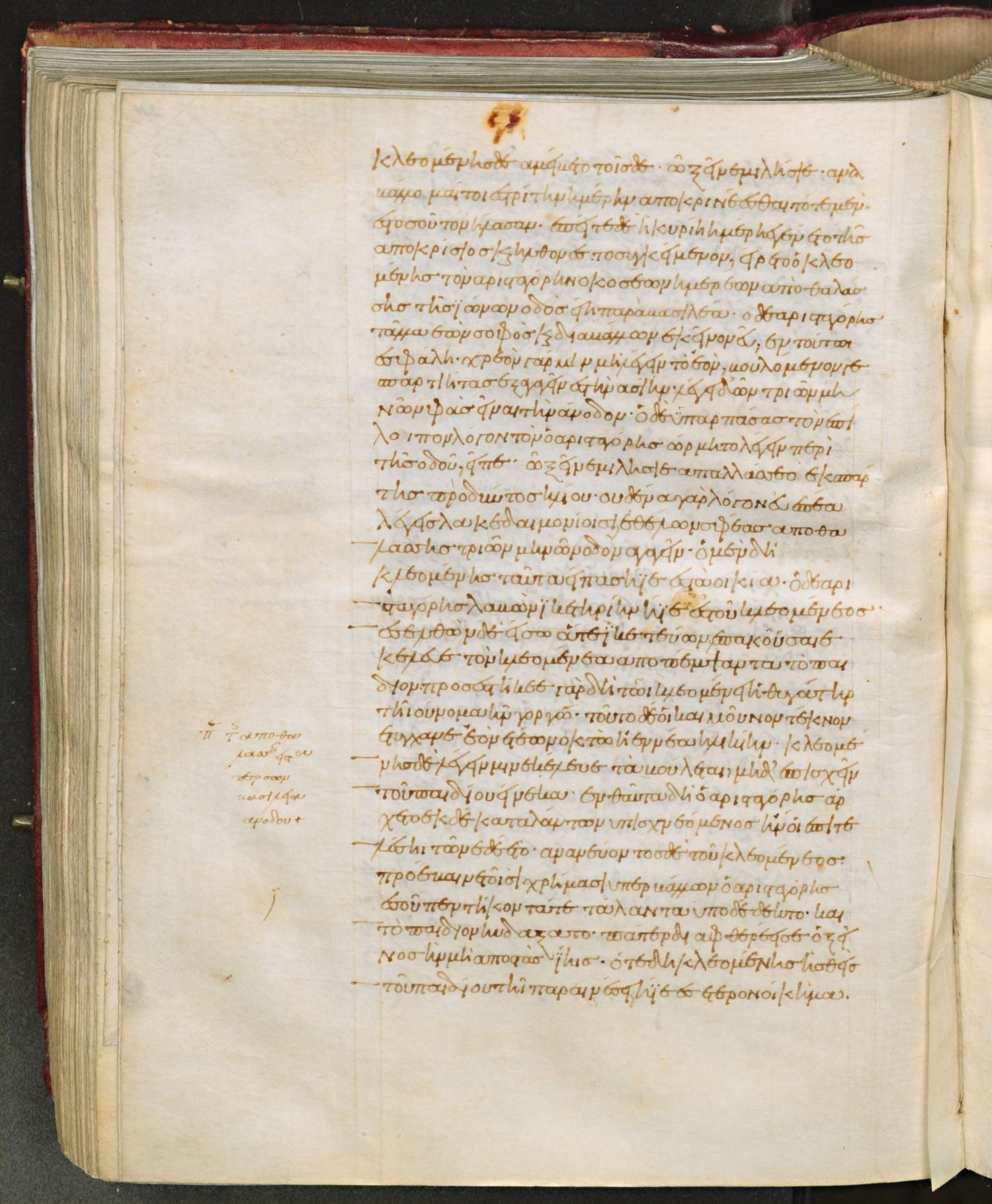
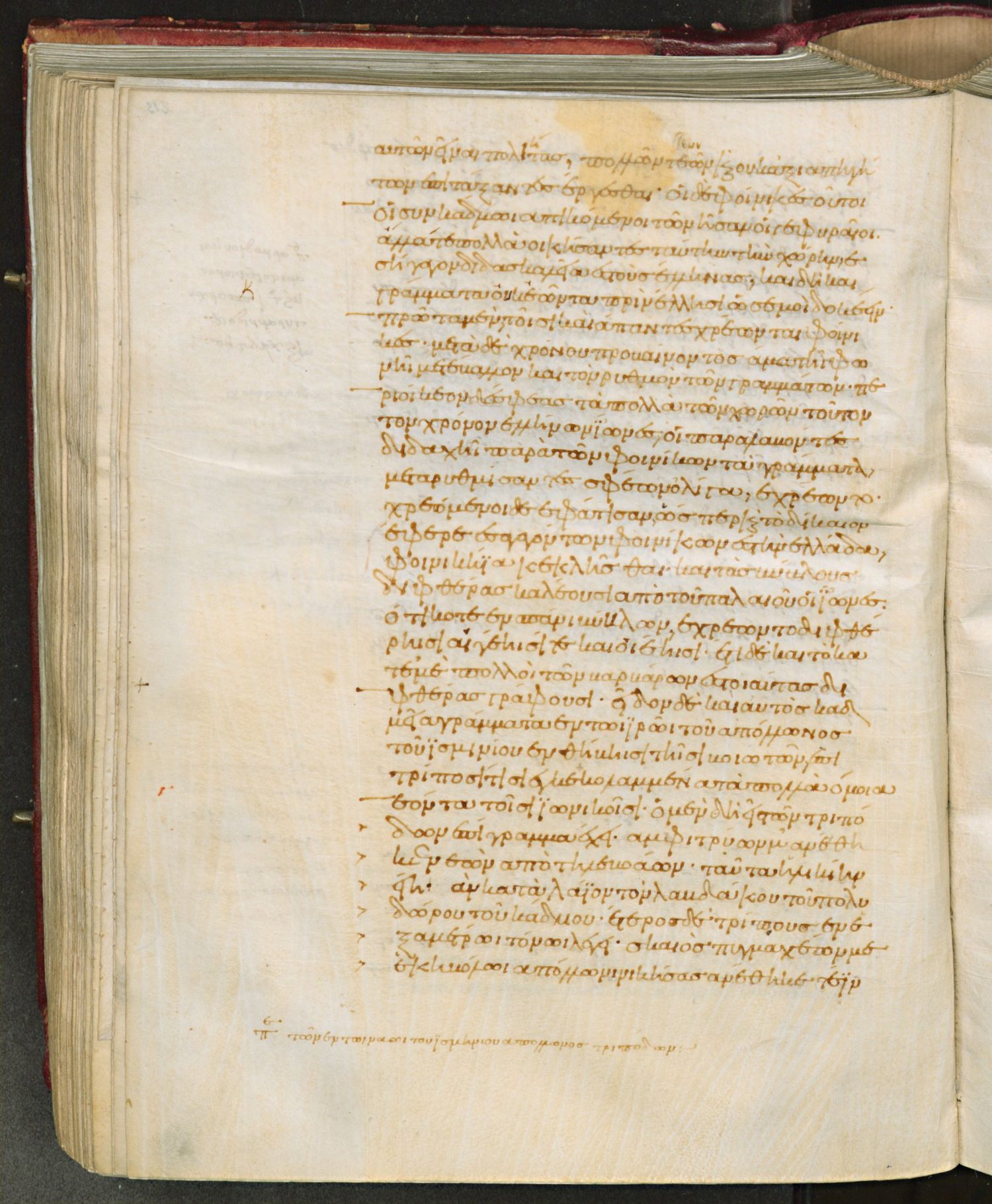
Laur. Plut. 70.3, fol. 211v: Greek here 5.49.9 to 5.51.3. Checked on the image (first and last words read and located in the Greek; each break checked against the neighbouring page): fol. 211v begins ‹Κλεομένης δὲ ἀμείβετο τοῖσιδε.› (5.49.9), ends ‹ἤιε ἐς ἕτερον οἴκημα› (5.51.3). English here: 5.49.9 to 5.51.2 (Godley's sentences for the sections whose Greek lies mostly on this page).
5.49.9Κλεομένης δὲ ἀμείβετο τοῖσιδε. ὦ ξεῖνε Μιλήσιε, ἀναβάλλομαί τοι ἐς τρίτην ἡμέρην ὑποκρινέεσθαι. 5.50.1τότε μὲν ἐς τοσοῦτον ἤλασαν· ἐπείτε δὲ ἡ κυρίη ἡμέρη ἐγένετο τῆς ὑποκρίσιος καὶ ἦλθον ἐς τὸ συγκείμενον, εἴρετο ὁ Κλεομένης τὸν Ἀρισταγόρην ὁκοσέων ἡμερέων ἀπὸ θαλάσσης τῆς Ἰώνων ὁδὸς εἴη παρὰ βασιλέα. 5.50.2ὁ δὲ Ἀρισταγόρης τἆλλα ἐὼν σοφὸς καὶ διαβάλλων ἐκεῖνον εὖ ἐν τούτῳ ἐσφάλη· χρὲον γάρ μιν μὴ λέγειν τὸ ἐόν, βουλόμενόν γε Σπαρτιήτας ἐξαγαγεῖν ἐς τὴν Ἀσίην, λέγει δʼ ὦν τριῶν μηνῶν φὰς εἶναι τὴν ἄνοδον. ὁ δὲ ὑπαρπάσας τὸν ἐπίλοιπον λόγον τὸν ὁ Ἀρισταγόρης ὥρμητο λέγειν περὶ τῆς ὁδοῦ, εἶπε 5.50.3ὦ ξεῖνε Μιλήσιε, ἀπαλλάσσεο ἐκ Σπάρτης πρὸ δύντος ἡλίου· οὐδένα γὰρ λόγον εὐεπέα λέγεις Λακεδαιμονίοισι, ἐθέλων σφέας ἀπὸ θαλάσσης τριῶν μηνῶν ὁδὸν ἀγαγεῖν. 5.51.1ὁ μὲν Κλεομένης ταῦτα εἴπας ἤιε ἐς τὰ οἰκία, ὁ δὲ Ἀρισταγόρης λαβὼν ἱκετηρίην ἤιε ἐς τοῦ Κλεομένεος, ἐσελθὼν δὲ ἔσω ἅτε ἱκετεύων ἐπακοῦσαι ἐκέλευε τὸν Κλεομένεα ἀποπέμψαντα τὸ παιδίον· προσεστήκεε γὰρ δὴ τῷ Κλεομένεϊ ἡ θυγάτηρ, τῇ οὔνομα ἦν Γοργώ· τοῦτο δέ οἱ καὶ μοῦνον τέκνον ἐτύγχανε ἐὸν ἐτέων ὀκτὼ ἢ ἐννέα ἡλικίην. Κλεομένης δὲ λέγειν μιν ἐκέλευε τὰ βούλεται μηδὲ ἐπισχεῖν τοῦ παιδίου εἵνεκα. 5.51.2ἐνθαῦτα δὴ ὁ Ἀρισταγόρης ἄρχετο ἐκ δέκα ταλάντων ὑπισχνεόμενος, ἤν οἱ ἐπιτελέσῃ τῶν ἐδέετο. ἀνανεύοντος δὲ τοῦ Κλεομένεος προέβαινε τοῖσι χρήμασι ὑπερβάλλων ὁ Ἀρισταγόρης, ἐς οὗ πεντήκοντά τε τάλαντα ὑπεδέδεκτο καὶ τὸ παιδίον ηὐδάξατο πάτερ, διαφθερέει σε ὁ ξεῖνος, ἢν μὴ ἀποστὰς ἴῃς. 5.51.3ὅ τε δὴ Κλεομένης ἡσθεὶς τοῦ παιδίου τῇ παραινέσι ἤιε ἐς ἕτερον οἴκημα,
5.49.9Thus spoke Aristagoras. Cleomenes replied: “Milesian, my guest, wait till the third day for my answer.” 5.50.1Thus far they advanced at that hearing. But when on the day appointed for the answer they came to the place whereon they had agreed, Cleomenes asked Aristagoras how many days’ journey it was from the Ionian sea to the king. 5.50.2Till now, Aristagoras had been cunning and fooled the Spartan right well; but here he made a false step; for if he desired to bring the Spartans away into Asia he should never have told the truth; but he did tell it, and said that it was a three months’ journey inland. 5.50.3At that, Cleomenes cut short all the rest that Aristagoras began to tell him about the journey, and bade his Milesian guest depart from Sparta before sunset; for never (he said) would the Lacedaemonians listen to the plan, if Aristagoras desired to lead them a three months’ journey from the sea. 5.51.1Having thus spoken Cleomenes went to his house; but Aristagoras took a suppliant’s garb and followed him thither, and entering in he used a suppliant’s right to beseech Cleomenes to hear him, but first send the child away; for Cleomenes’ daughter, whose name was Gorgo, was standing by him; she was his only child, and was about eight or nine years of age. Cleomenes bade him say what he would and not let the child’s presence hinder him. 5.51.2Then Aristagoras began to promise Cleomenes from ten talents upwards, if he would grant his request. Cleomenes refusing, Aristagoras offered him ever more and yet more, till when he promised fifty talents the child cried out, “Father, the stranger will corrupt you, unless you leave him and go away.”
Where on the image
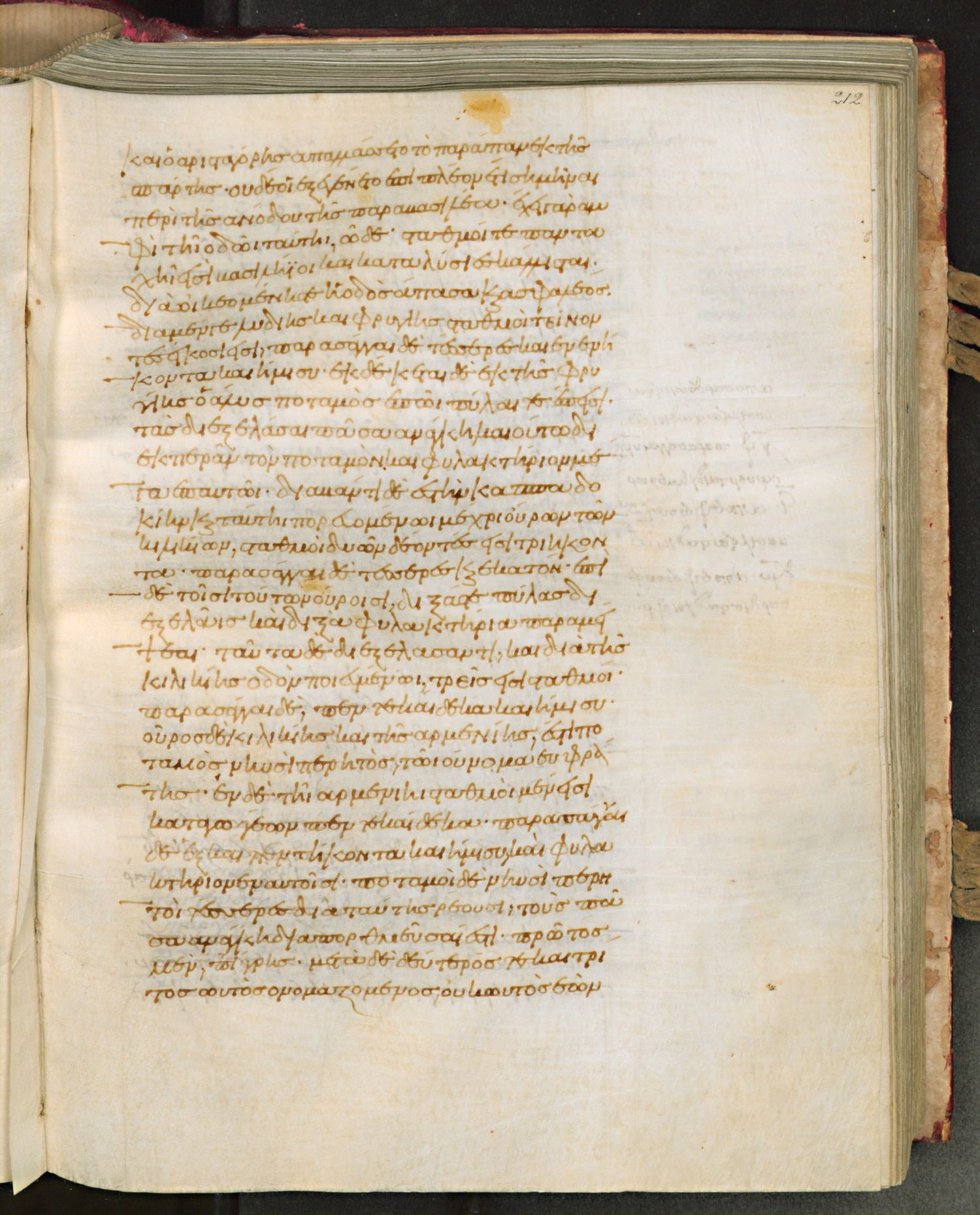
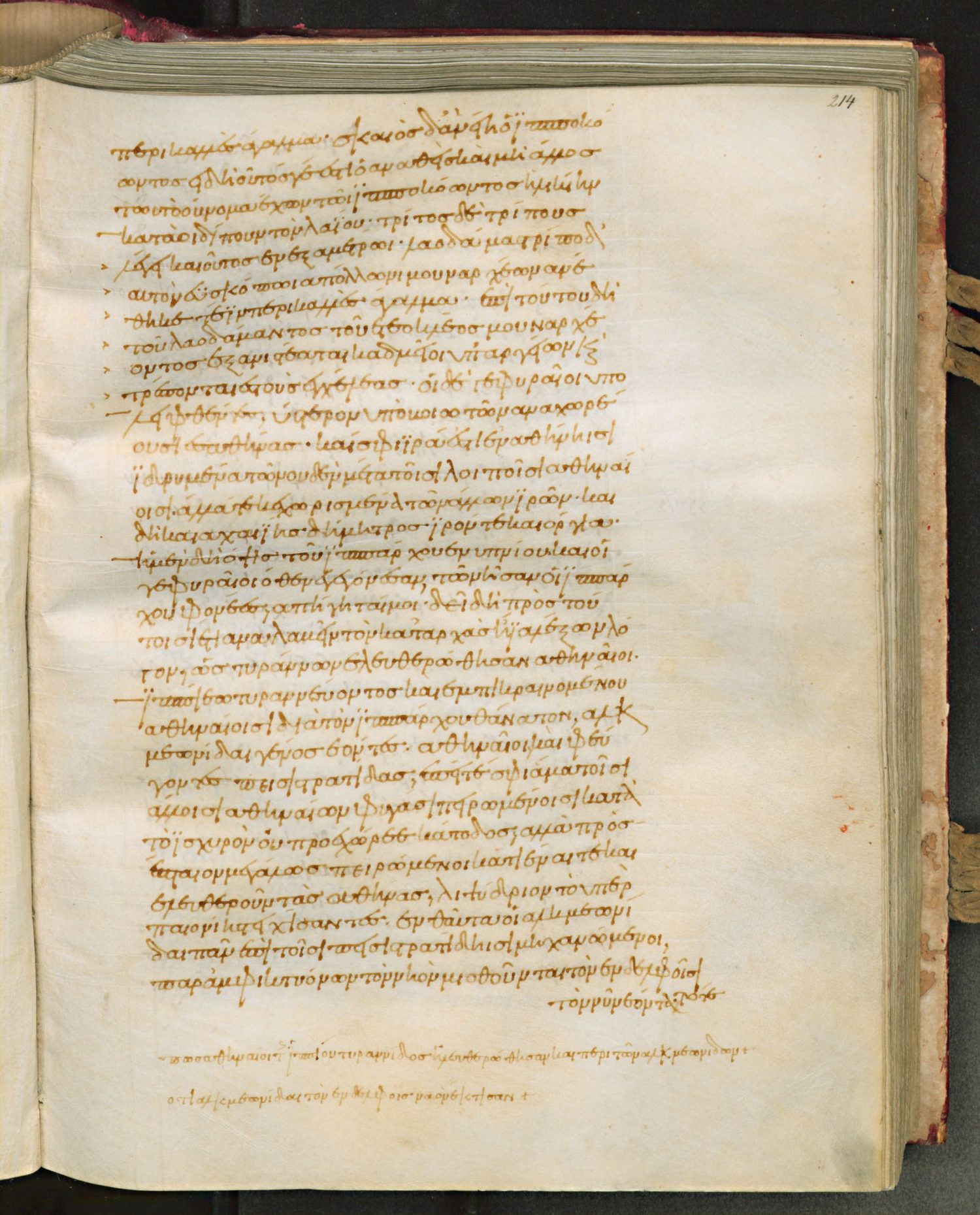
Laur. Plut. 70.3, fol. 212r: Greek here 5.51.3 to 5.52.4. Checked on the image (first and last words read and located in the Greek; each break checked against the neighbouring page): fol. 212r begins ‹καὶ ὁ Ἀρισταγόρης ἀπαλλάσσετο› (5.51.3), ends ‹ὀνομαζόμενος, οὐκ ὡυτὸς ἐὼν› (5.52.4). English here: 5.51.3 to 5.52.5 (Godley's sentences for the sections whose Greek lies mostly on this page).
5.51.3καὶ ὁ Ἀρισταγόρης ἀπαλλάσσετο τὸ παράπαν ἐκ τῆς Σπάρτης, οὐδέ οἱ ἐξεγένετο ἐπὶ πλέον ἔτι σημῆναι περὶ τῆς ἀνόδου τῆς παρὰ βασιλέα. 5.52.1ἔχει γὰρ ἀμφὶ τῇ ὁδῷ ταύτῃ ὧδε· σταθμοί τε πανταχῇ εἰσι βασιλήιοι καὶ καταλύσιες κάλλισται, διὰ οἰκεομένης τε ἡ ὁδὸς ἅπασα καὶ ἀσφαλέος. διὰ μέν γε Λυδίης καὶ Φρυγίης σταθμοὶ τείνοντες εἴκοσι εἰσί, παρασάγγαι δὲ τέσσερες καὶ ἐνενήκοντα καὶ ἥμισυ. 5.52.2ἐκδέκεται δὲ ἐκ τῆς Φρυγίης ὁ Ἅλυς ποταμός, ἐπʼ ᾧ πύλαι τε ἔπεισι, τὰς διεξελάσαι πᾶσα ἀνάγκη καὶ οὕτω διεκπερᾶν τὸν ποταμόν, καὶ φυλακτήριον μέγα ἐπʼ αὐτῷ. διαβάντι δὲ ἐς τὴν Καππαδοκίην καὶ ταύτῃ πορευομένῳ μέχρι οὔρων τῶν Κιλικίων σταθμοὶ δυῶν δέοντες εἰσὶ τριήκοντα, παρασάγγαι δὲ τέσσερες καὶ ἑκατόν. ἐπὶ δὲ τοῖσι τούτων οὔροισι διξάς τε πύλας διεξελᾷς καὶ διξὰ φυλακτήρια παραμείψεαι. 5.52.3ταῦτα δὲ διεξελάσαντι καὶ διὰ τῆς Κιλικίης ὁδὸν ποιευμένῳ τρεῖς εἱσι σταθμοί, παρασάγγαι δὲ πεντεκαίδεκα καὶ ἥμισυ. οὖρος δὲ Κιλικίης καὶ τῆς Ἀρμενίης ἐστὶ ποταμὸς νηυσιπέρητος, τῷ οὔνομα Εὐφρήτης. ἐν δὲ τῇ Ἀρμενίῃ σταθμοὶ μὲν εἰσὶ καταγωγέων πεντεκαίδεκα, παρασάγγαι δὲ ἓξ καὶ πεντήκοντα καὶ ἥμισυ, καὶ φυλακτήριον ἐν αὐτοῖσι. 5.52.4ἐκ δὲ ταύτης τῆς Ἀρμενίης ἐς βάλλοντι ἐς τὴν Ματιηνὴν γῆν σταθμοί εἰσι τέσσερες καὶ τριήκοντα, παρασάγγαι δὲ ἑπτὰ καὶ τριήκοντα καὶ ἑκατόν. ποταμοὶ δὲ νηυσιπέρητοι τέσσερες διὰ ταύτης ῥέουσι, τοὺς πᾶσα ἀνάγκη διαπορθμεῦσαι ἐστί, πρῶτος μὲν Τίγρης, μετὰ δὲ δεύτερός τε καὶ τρίτος ὡυτὸς ὀνομαζόμενος, οὐκ ὡυτὸς ἐὼν
5.51.3Cleomenes was pleased with the child’s counsel and went into another room; and Aristagoras departed clean out of Sparta, and could find no occasion for telling further of the journey inland to the king’s place. 5.52.1Now the nature of this road is as I shall show. All along it are the king’s stages and exceeding good hostelries, and the whole of it passes through country that is inhabited and safe. Its course through Lydia and Phrygia is of the length of twenty stages, and ninety-four and a half parasangs. 5.52.2Next after Phrygia it comes to the river Halys, where there is a defile, which must be passed ere the river can be crossed, and a great fortress to guard it. After the passage into Cappadocia the road in that land as far as the borders of Cilicia is of twenty-eight stages and an hundred and four parasangs. On this frontier you must ride through two defiles and pass two fortresses; 5.52.3ride past these, and you will have a journey through Cilicia of three stages and fifteen and a half parasangs. The boundary of Cilicia and Armenia is a navigable river whereof the name is Euphrates. In Armenia there are fifteen resting-stages, and fifty-six parasangs and a half, and there is a fortress there. From Armenia the road enters the Matienian land, wherein are thirty-four stages, and an hundred and thirty-seven parasangs. 5.52.4Through this land flow four navigable rivers, that must needs be passed by ferries, first the Tigris, then a second and a third of the same name, yet not the same stream nor flowing from the same source; for the first-mentioned of them flows from the Armenians and the second from the Matieni; and 5.52.5the fourth river is called Gyndes, that Gyndes which Cyrus parted once into three hundred and sixty channels.
Where on the image
Laur. Plut. 70.3, fol. 212v: Greek here 5.52.4 to 5.54.2. Checked on the image (first and last words read and located in the Greek; each break checked against the neighbouring page): fol. 212v begins ‹ποταμὸς οὐδὲ ἐκ τοῦ› (5.52.4), ends ‹Μεμνόνειον ἄστυ καλέεται), τεσσεράκοντα› (5.54.2). English here: 5.52.6 to 5.54.1 (Godley's sentences for the sections whose Greek lies mostly on this page).
5.52.4ποταμὸς οὐδὲ ἐκ τοῦ αὐτοῦ ῥέων· ὁ μὲν γὰρ πρότερον αὐτῶν καταλεχθεὶς ἐξ Ἀρμενίων ῥέει, ὁ δʼ ὕστερον ἐκ Ματιηνῶν· 5.52.5ὁ δὲ τέταρτος τῶν ποταμῶν οὔνομα ἔχει Γύνδης, τὸν Κῦρος διέλαβε κοτὲ ἐς διώρυχας ἑξήκοντα καὶ τριηκοσίας. 5.52.6ἐκ δὲ ταύτης ἐς τὴν Κισσίην χώρην μεταβαίνοντι ἕνδεκα σταθμοί, παρασάγγαι δὲ δύο καὶ τεσσεράκοντα καὶ ἥμισυ ἐστὶ ἐπὶ ποταμὸν Χοάσπην, ἐόντα καὶ τοῦτον νηυσιπέρητον· ἐπʼ ᾧ Σοῦσα πόλις πεπόλισται. 5.53.1οὗτοι οἱ πάντες σταθμοί εἰσι ἕνδεκα καὶ ἑκατόν. καταγωγαὶ μέν νυν σταθμῶν τοσαῦται εἰσὶ ἐκ Σαρδίων ἐς Σοῦσα ἀναβαίνοντι. εἰ δὲ ὀρθῶς μεμέτρηται ἡ ὁδὸς ἡ βασιληίη τοῖσι παρασάγγῃσι καὶ ὁ παρασάγγης δύναται τριήκοντα στάδια, ὥσπερ οὗτός γε δύναται ταῦτα, ἐκ Σαρδίων στάδια ἐστὶ ἐς τὰ βασιλήια τὰ Μεμνόνια καλεόμενα πεντακόσια καὶ τρισχίλια καὶ μύρια, παρασαγγέων ἐόντων πεντήκοντα καὶ τετρακοσίων. πεντήκοντα δὲ καὶ ἑκατὸν στάδια ἐπʼ ἡμέρῃ ἑκάστῃ διεξιοῦσι ἀναισιμοῦνται ἡμέραι ἀπαρτὶ ἐνενήκοντα. 5.54.1οὕτω τῷ Μιλησίῳ Ἀρισταγόρῃ εἴπαντι πρὸς Κλεομένεα τὸν Λακεδαιμόνιον εἶναι τριῶν μηνῶν τὴν ἄνοδον τὴν παρὰ βασιλέα ὀρθῶς εἴρητο. εἰ δέ τις τὸ ἀτρεκέστερον τούτων ἔτι δίζηται, ἐγὼ καὶ τοῦτο σημανέω· τὴν γὰρ ἐξ Ἐφέσου ἐς Σάρδις ὁδὸν δεῖ προσλογίσασθαι ταύτῃ. 5.54.2καὶ δὴ λέγω σταδίους εἶναι τοὺς πάντας ἀπὸ θαλάσσης τῆς Ἑλληνικῆς μέχρι Σούσων (τοῦτο γὰρ Μεμνόνειον ἄστυ καλέεται), τεσσεράκοντα
5.52.6When this country is passed, the road is in the Cissian land, where are eleven stages and forty-two and a half parasangs, as far as yet another navigable river, the Choaspes, whereon stands the city of Susa. 5.53.1Thus the whole tale of stages is an hundred and eleven. So many resting-stages then there are in the going up from Sardis to Susa. If I have rightly numbered the parasangs of the royal road, and the parasang is of thirty furlongs’ length (which assuredly it is), then between Sardis and the king’s abode called Memnonian there are thirteen thousand and five hundred furlongs, the number of parasangs being four hundred and fifty; and if each day’s journey be an hundred and fifty furlongs, then the sum of days spent is ninety, neither more nor less. 5.54.1Thus Aristagoras of Miletus spoke the truth to Cleomenes the Lacedaemonian when he said that the journey inland was three months long. But if any desire a measurement yet exacter, I will give him that too; for the journey from Ephesus to Sardis must be added to the rest.
Where on the image
Laur. Plut. 70.3, fol. 213r: Greek here 5.54.2 to 5.57.2. Checked on the image (first and last words read and located in the Greek; each break checked against the neighbouring page): fol. 213r begins ‹καὶ τετρακισχιλίους καὶ μυρίους·› (5.54.2), ends ‹ἐπὶ ῥητοῖσι ἐδέξαντο σφέων› (5.57.2). English here: 5.54.2 to 5.57.2 (Godley's sentences for the sections whose Greek lies mostly on this page).
5.54.2καὶ τετρακισχιλίους καὶ μυρίους· οἱ γὰρ ἐξ Ἑφέσου ἐς Σάρδις εἰσὶ τεσσεράκοντα καὶ πεντακόσιοι στάδιοι, καὶ οὕτω τρισὶ ἡμέρῃσι μηκύνεται ἡ τρίμηνος ὁδός. 5.55.1ἀπελαυνόμενος δὲ ὁ Ἀρισταγόρης ἐκ τῆς Σπάρτης ἤιε ἐς τὰς Ἀθήνας γενομένας τυράννων ὧδε ἐλευθέρας. ἐπεὶ Ἵππαρχον τὸν Πεισιστράτου, Ἱππίεω δὲ τοῦ τυράννου ἀδελφεόν, ἰδόντα ὄψιν ἐνυπνίου τῷ ἑωυτοῦ πάθεϊ ἐναργεστάτην κτείνουσι Ἀριστογείτων καὶ Ἁρμόδιος, γένος ἐόντες τὰ ἀνέκαθεν Γεφυραῖοι, μετὰ ταῦτα ἐτυραννεύοντο Ἀθηναῖοι ἐπʼ ἔτεα τέσσερα οὐδὲν ἧσσον ἀλλὰ καὶ μᾶλλον ἢ πρὸ τοῦ. 5.56.1ἡ μέν νυν ὄψις τοῦ Ἱππάρχου ἐνυπνίου ἦν ἥδε· ἐν τῇ προτέρῃ νυκτὶ τῶν Παναθηναίων ἐδόκεε ὁ Ἵππαρχος ἄνδρα οἱ ἐπιστάντα μέγαν καὶ εὐειδέα αἰνίσσεσθαι τάδε τὰ ἔπεα.
τλῆθι λέων ἄτλητα παθὼν τετληότι θυμῷ·
οὐδεὶς ἀνθρώπων ἀδικῶν τίσιν οὐκ ἀποτίσει. 5.56.2ταῦτα δέ, ὡς ἡμέρη ἐγένετο τάχιστα, φανερὸς ἦν ὑπερτιθέμενος ὀνειροπόλοισι· μετὰ δὲ ἀπειπάμενος τὴν ὄψιν ἔπεμπε τὴν πομπήν, ἐν τῇ δὴ τελευτᾷ. 5.57.1οἱ δὲ Γεφυραῖοι, τῶν ἦσαν οἱ φονέες οἱ Ἱππάρχου, ὡς μὲν αὐτοὶ λέγουσι, ἐγεγόνεσαν ἐξ Ἐρετρίης τὴν ἀρχήν, ὡς δὲ ἐγὼ ἀναπυνθανόμενος εὑρίσκω, ἦσαν Φοίνικες τῶν σὺν Κάδμῳ ἀπικομένων Φοινίκων ἐς γῆν τὴν νῦν Βοιωτίην καλεομένην, οἴκεον δὲ τῆς χώρης ταύτης ἀπολαχόντες τὴν Ταναγρικὴν μοῖραν. 5.57.2ἐνθεῦτεν δὲ Καδμείων πρότερον ἐξαναστάντων ὑπʼ Ἀργείων, οἱ Γεφυραῖοι οὗτοι δεύτερα ὑπὸ Βοιωτῶν ἐξαναστάντες ἐτράποντο ἐπʼ Ἀθηνέων. Ἀθηναῖοι δὲ σφέας ἐπὶ ῥητοῖσι ἐδέξαντο σφέων
5.54.2So then I declare that from the Greek sea to Susa (for that is the city called Memnonian) it is a journey of fourteen thousand and forty stages; for there are five hundred and forty furlongs from Ephesus to Sardis, and thus the three months’ journey is made longer by three days. 5.55.1Being compelled to leave Sparta, Aristagoras went to Athens; which had been freed from its ruling despots in the manner that I shall show. When Hipparchus, son of Pisistratus and brother of Hippias the despot, had been slain (after seeing in a dream a very clear picture of the evil that befel him) by Aristogiton and Harmodius, men of Gephyraean descent, after this the Athenians were subject for four years to a despotism not less but even more absolute than before. 5.56.1Now this was the vision which Hipparchus saw in a dream: in the night before the Panathenaea he thought that a tall and goodly man stood over him uttering these riddling verses: Bear an unbearable lot; O lion, be strong for the bearing:
No man on earth doth wrong but at last shall suffer requital. 5.56.2As soon as it was day, he imparted this (as was seen) to the interpreters of dreams; and presently putting the vision from his mind, he led the procession in which he met his death. 5.57.1Now the Gephyraean clan, of which were the slayers of Hipparchus, is said by themselves to have come at first from Eretria; but my own enquiry shows that they were some of the Phoenicians who came with Cadmus to the country now called Boeotia, and in that country the lands of Tanagra were allotted to them, where they settled. 5.57.2The Cadmeans having been first expelled thence by the Argives, these Gephyraeans were in turn expelled by the Boeotians and betook themselves to Athens. The Athenians received them as citizens of their own on set terms, debarring them from many practices not here deserving mention.
Where on the image
Laur. Plut. 70.3, fol. 213v: Greek here 5.57.2 to 5.60.1. Checked on the image (first and last words read and located in the Greek; each break checked against the neighbouring page): fol. 213v begins ‹αὐτῶν εἶναι πολιήτας, πολλῶν› (5.57.2), ends ‹Ἀπόλλωνι νικήσας ἀνέθηκε τεῒν› (5.60.1). English here: 5.58.1 to 5.59.1 (Godley's sentences for the sections whose Greek lies mostly on this page).
5.57.2αὐτῶν εἶναι πολιήτας, πολλῶν τεῶν καὶ οὐκ ἀξιαπηγήτων ἐπιτάξαντες ἔργεσθαι. 5.58.1οἱ δὲ Φοίνικες οὗτοι οἱ σὺν Κάδμῳ ἀπικόμενοι, τῶν ἦσαν οἱ Γεφυραῖοι, ἄλλα τε πολλὰ οἰκήσαντες ταύτην τὴν χώρην ἐσήγαγον διδασκάλια ἐς τοὺς Ἕλληνας καὶ δὴ καὶ γράμματα, οὐκ ἐόντα πρὶν Ἕλλησι ὡς ἐμοὶ δοκέειν, πρῶτα μὲν τοῖσι καὶ ἅπαντες χρέωνται Φοίνικες· μετὰ δὲ χρόνου προβαίνοντος ἅμα τῇ φωνῇ μετέβαλλον καὶ τὸν ῥυθμὸν τῶν γραμμάτων. 5.58.2περιοίκεον δὲ σφέας τὰ πολλὰ τῶν χώρων τοῦτον τὸν χρόνον Ἑλλήνων Ἴωνες, οἳ παραλαβόντες διδαχῇ παρὰ τῶν Φοινίκων τὰ γράμματα, μεταρρυθμίσαντες σφέων ὀλίγα ἐχρέωντο, χρεώμενοι δὲ ἐφάτισαν, ὥσπερ καὶ τὸ δίκαιον ἔφερε, ἐσαγαγόντων Φοινίκων ἐς τὴν Ἑλλάδα, Φοινικήια κεκλῆσθαι. 5.58.3καὶ τὰς βύβλους διφθέρας καλέουσι ἀπὸ τοῦ παλαιοῦ οἱ Ἴωνες, ὅτι κοτὲ ἐν σπάνι βύβλων ἐχρέωντο διφθέρῃσι αἰγέῃσί τε καὶ οἰέῃσι· ἔτι δὲ καὶ τὸ κατʼ ἐμὲ πολλοὶ τῶν βαρβάρων ἐς τοιαύτας διφθέρας γράφουσι. 5.59.1εἶδον δὲ καὶ αὐτὸς Καδμήια γράμματα ἐν τῷ ἱρῷ τοῦ Ἀπόλλωνος τοῦ Ἰσμηνίου ἐν Θήβῃσι τῇσι Βοιωτῶν, ἐπὶ τρίποσι τισὶ ἐγκεκολαμμένα, τὰ πολλὰ ὅμοια ἐόντα τοῖσι Ἰωνικοῖσι. ὁ μὲν δὴ εἷς τῶν τριπόδων ἐπίγραμμα ἔχει
ἀμφιτρύων μʼ ἀνέθηκʼ ἐνάρων ἀπὸ Τηλεβοάων.
ταῦτα ἡλικίην εἴη ἂν κατὰ Λάιον τὸν Λαβδάκου τοῦ Πολυδώρου τοῦ Κάδμου. 5.60.1ἕτερος δὲ τρίπους ἐν ἑξαμέτρῳ τόνῳ λέγει
Σκαῖος πυγμαχέων με ἑκηβόλῳ Ἀπόλλωνι
νικήσας ἀνέθηκε τεῒν
5.58.1These Phoenicians who came with Cadmus (of whom the Gephyraeans were a part) at their settlement in this country, among many other kinds of learning, brought into Hellas the alphabet, which had hitherto been unknown, as I think, to the Greeks; and presently as time went on the sound and the form of the letters were changed. 5.58.2At this time the Greeks that dwelt round them for the most part were Ionians; who, having been taught the letters by the Phoenicians, used them with some few changes of form, and in so doing gave to these characters (as indeed was but just, seeing that the Phoenicians had brought them into Hellas) the name of Phoenician. 5.58.3Thus also the Ionians have from ancient times called papyrus-sheets skins, because formerly for lack of papyrus they used the skins of sheep and goats; and even to this day there are many foreigners who write on such skins. 5.59.1I have myself seen Cadmean characters in the temple of Ismenian Apollo at Thebes of Boeotia, graven on certain tripods and for the most part like Ionian letters. On one of the tripods there is this inscription: {{c|I am Amphitryon’s gift, from spoils Teleboan fashioned.}} This would be of the time of Laïus, the son of Labdacus, who was the son of Polydorus, who was the son of Cadmus.
Where on the image
Laur. Plut. 70.3, fol. 214r: Greek here 5.60.1 to 5.61.2. Checked on the image (first and last words read and located in the Greek; each break checked against the neighbouring page): fol. 214r begins ‹περικαλλὲς ἄγαλμα. Σκαῖος δʼ› (5.60.1), ends ‹τὸν νῦν ἐόντα τότε› (5.62.2). The verse inscriptions of 5.59-61 are written as prose. The last line is short (τὸν νῦν ἐόντα, τότε); below the text, two readers' notes, on the Athenians freed from the tyrants and on the Alcmaeonids and the temple at Delphi. English here: 5.60.1 to 5.61.2 (Godley's sentences for the sections whose Greek lies mostly on this page).
5.60.1περικαλλὲς ἄγαλμα.
Σκαῖος δʼ ἂν εἴη ὁ Ἱπποκόωντος, εἰ δὴ οὗτός γε ἐστὶ ὁ ἀναθεὶς καὶ μὴ ἄλλος τὠυτὸ οὔνομα ἔχων τῷ Ἱπποκόωντος, ἡλικίην κατὰ Οἰδίπουν τὸν Λαΐου. 5.61.1τρίτος δὲ τρίπους λέγει καὶ οὗτος ἐν ἑξαμέτρῳ
Λαοδάμας τρίποδʼ αὐτὸς ἐυσκόπῳ Ἀπόλλωνι
μουναρχέων ἀνέθηκε τεῒν περικαλλὲς ἄγαλμα. 5.61.2ἐπὶ τούτου δὴ τοῦ Λαοδάμαντος τοῦ Ἐτεοκλέος μουναρχέοντος ἐξανιστέαται Καδμεῖοι ὑπʼ Ἀργείων καὶ τρέπονται ἐς τοὺς Ἐγχελέας. οἱ δὲ Γεφυραῖοι ὑπολειφθέντες ὕστερον ὑπὸ Βοιωτῶν ἀναχωρέουσι ἐς Ἀθήνας· καί σφι ἱρά ἐστι ἐν Ἀθήνῃσι ἱδρυμένα, τῶν οὐδὲν μέτα τοῖσι λοιποῖσι Ἀθηναίοισι, ἄλλα τε κεχωρισμένα τῶν ἄλλων ἱρῶν καὶ δὴ καὶ Ἀχαιίης Δήμητρος ἱρόν τε καὶ ὄργια.
5.60.1A second tripod says, in hexameter verse: I am a gift that is given by Scaeus, the conquering boxer,
Archer Apollo, to thee for thy temple’s beauteous adornment. Scaeus the son of Hippocoon, if indeed the dedicator be he and not another of the same name as Hippocoon’s son, would be of the time of Oedipus son of Laïus. 5.61.1The third tripod says, in hexameter verse again: I am the tripod that erst Laodamas, sovereign ruler
Gave to far-seeing Apollo, his temple’s beauteous adornment. 5.61.2In the sovereignty of this Laodamas son of Eteocles, the Cadmeans were expelled by the Argives and betook themselves to the Encheleis. The Gephyraeans were left behind, but were later compelled by the Boeotians to withdraw to Athens; and they have certain set forms of worship at Athens, wherein the rest of the Athenians have no part; these, and in especial the rites and mysteries of Achaean Demeter, are different from the other worships.
Notes
- Greek: the text printed in A. D. Godley's Loeb edition, via Perseus (tlg0016.tlg001.perseus-grc2). Square brackets mark words the editor considers later additions; [...] marks a gap the editor indicates. Perseus note markers are omitted.
- English: A. D. Godley, Herodotus vol. 3 (1922) (Loeb Classical Library), as transcribed on Wikisource. Godley's footnotes are omitted.
- Section numbers in the English were placed by comparing Godley's text with the Perseus version of his translation; where a section begins inside one of Godley's sentences, the English is kept with the page that holds the start of that sentence.
Cite
Sources
- Source: Florence, Laur. Plut. 70.3 (10th c.) via BML Teca Digitale + Greek of Godley's Loeb (Perseus) + English of A. D. Godley (Loeb, Wikisource) (holding institution)
- Critical edition: Greek of A. D. Godley's Loeb edition (1920-1925), via Perseus
← previous · → next · v cycle view · l back to library