Herodotus, Histories 5.62-78: The freeing of Athens; Cleisthenes; Athens against her neighbours
Introduction
Herodotus of Halicarnassus wrote the Histories in the third quarter of the 5th century BCE, an inquiry into the deeds of Greeks and barbarians and the causes of the wars between them, later divided into nine books. Book 5 tells of the Persian advance in Thrace and Macedonia, the outbreak of the Ionian revolt under Aristagoras of Miletus, his appeals to Sparta and Athens, with Herodotus' accounts of Sparta and of Athens after the tyrants, and the burning of Sardis and the first years of the revolt.
The photographs are of Florence, Biblioteca Medicea Laurenziana, Plut. 70.3 (parchment, 10th century, 374 folios, 31 lines a page), Herodotus, Histories (codex A of the editors), the oldest surviving manuscript of the complete Histories, from the Teca Digitale of the Biblioteca Medicea Laurenziana. Each section below is the text of one page, or of the part of a page that falls within these chapters. The first and last words of every page were read on the photograph and located in the Greek, and every page break was checked against the next page; the notes quote these words. Readers' notes in the margins are not part of the text and are mentioned where they occur.
The Greek is the text printed in A. D. Godley's Loeb edition (1920-1925), from Perseus; it is the edited text, not a transcription of the manuscript, whose wording differs in places. The English is Godley's translation as printed, from Wikisource. Godley's English carries only chapter numbers; the section numbers shown in it were placed by comparison with the Perseus version of his translation. Each page's English is cut at the end of one of Godley's sentences, so it can begin or end a few lines away from the Greek of the page; each note gives the exact ranges.
This entry covers chapters 5.62-78, on fol. 214r to 219r.
How was this verified? (Provenance)
Where on the image
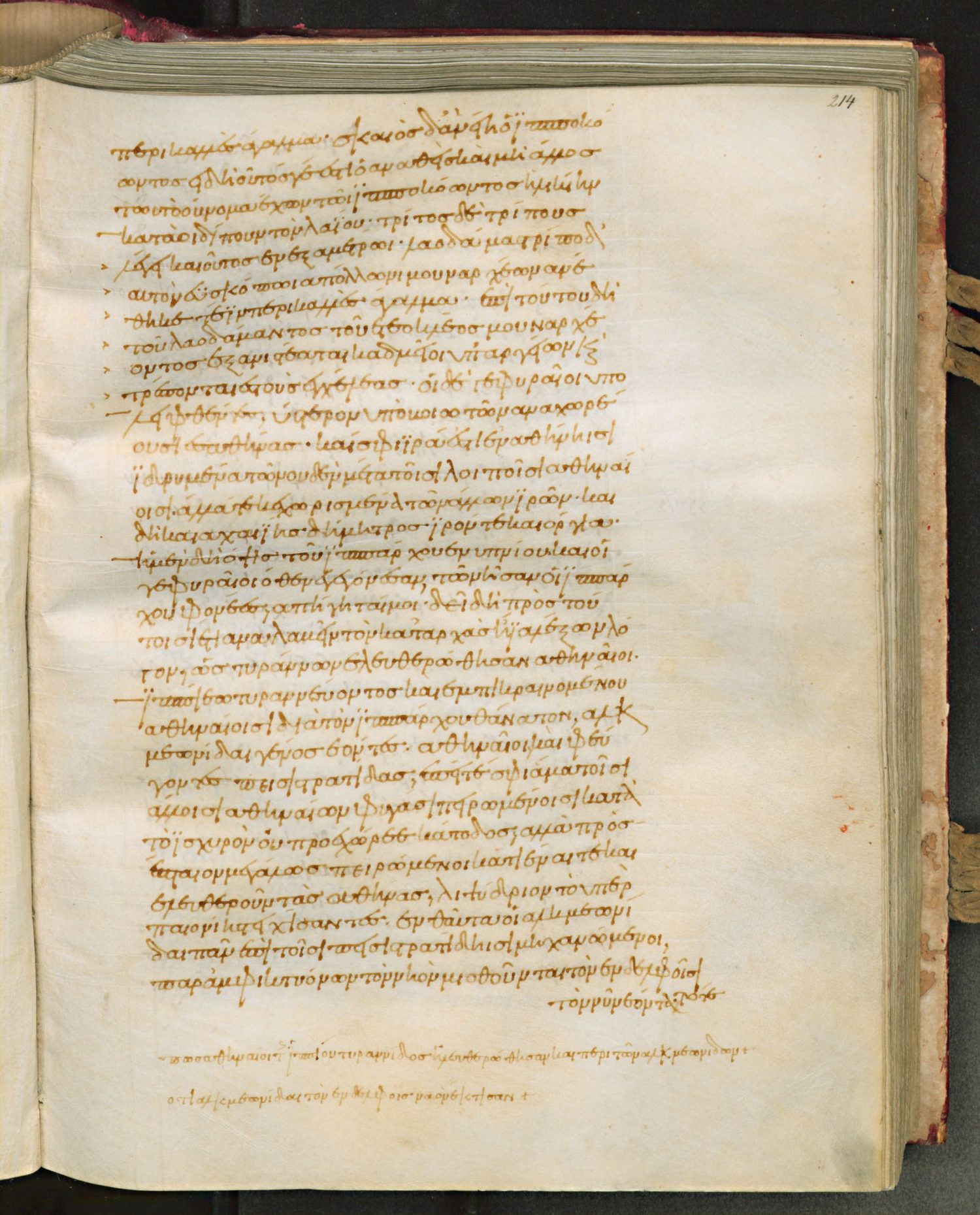
Laur. Plut. 70.3, fol. 214r: Greek here 5.62.1 to 5.62.2. Checked on the image (first and last words read and located in the Greek; each break checked against the neighbouring page): fol. 214r begins ‹περικαλλὲς ἄγαλμα. Σκαῖος δʼ› (5.60.1), ends ‹τὸν νῦν ἐόντα τότε› (5.62.2). The verse inscriptions of 5.59-61 are written as prose. The last line is short (τὸν νῦν ἐόντα, τότε); below the text, two readers' notes, on the Athenians freed from the tyrants and on the Alcmaeonids and the temple at Delphi. English here: 5.62.1 to 5.62.2 (Godley's sentences for the sections whose Greek lies mostly on this page).
5.62.1ἡ μὲν δὴ ὄψις τοῦ Ἱππάρχου ἐνυπνίου καὶ οἱ Γεφυραῖοι ὅθεν ἐγεγόνεσαν, τῶν ἦσαν οἱ Ἱππάρχου φονέες, ἀπήγηταί μοι· δεῖ δὲ πρὸς τούτοισι ἔτι ἀναλαβεῖν τὸν κατʼ ἀρχὰς ἤια λέξων λόγον, ὡς τυράννων ἐλευθερώθησαν Ἀθηναῖοι. 5.62.2Ἱππίεω τυραννεύοντος καὶ ἐμπικραινομένου Ἀθηναίοισι διὰ τὸν Ἱππάρχου θάνατον, Ἀλκμεωνίδαι γένος ἐόντες Ἀθηναῖοι καὶ φεύγοντες Πεισιστρατίδας, ἐπείτε σφι ἅμα τοῖσι ἄλλοισι Ἀθηναίων φυγάσι πειρωμένοισι κατὰ τὸ ἰσχυρὸν οὐ προεχώρεε κάτοδος, ἀλλὰ προσέπταιον μεγάλως πειρώμενοι κατιέναι τε καὶ ἐλευθεροῦν τὰς Ἀθήνας, Λειψύδριον τὸ ὑπὲρ Παιονίης τειχίσαντες, ἐνθαῦτα οἱ Ἀλκμεωνίδαι πᾶν ἐπὶ τοῖσι Πεισιστρατίδῃσι μηχανώμενοι παρʼ Ἀμφικτυόνων τὸν νηὸν μισθοῦνται τὸν ἐν Δελφοῖσι, τὸν νῦν ἐόντα τότε
5.62.1I have shown what was the vision of Hipparchus’ dream, and what the first origin of the Gephyraeans, of whom were the slayers of Hipparchus; now I must go further and return to the story which I began to tell, namely, how the Athenians were freed from their despots. 5.62.2Hippias being their despot and growing ever bitterer in enmity against the Athenians by reason of Hipparchus’ death, the Alcmeonidae, a family of Athenian stock banished by the sons of Pisistratus, essayed with the rest of the banished Athenians to make their way back by force and free Athens, but could not prosper in their return and rather suffered great hurt. They had fortified Lipsydrium north of Paeonia; then, in their desire to use all devices against the sons of Pisistratus, they hired themselves to the Amphictyons for the building of the temple at Delphi which now is but then as yet was not there.
Where on the image
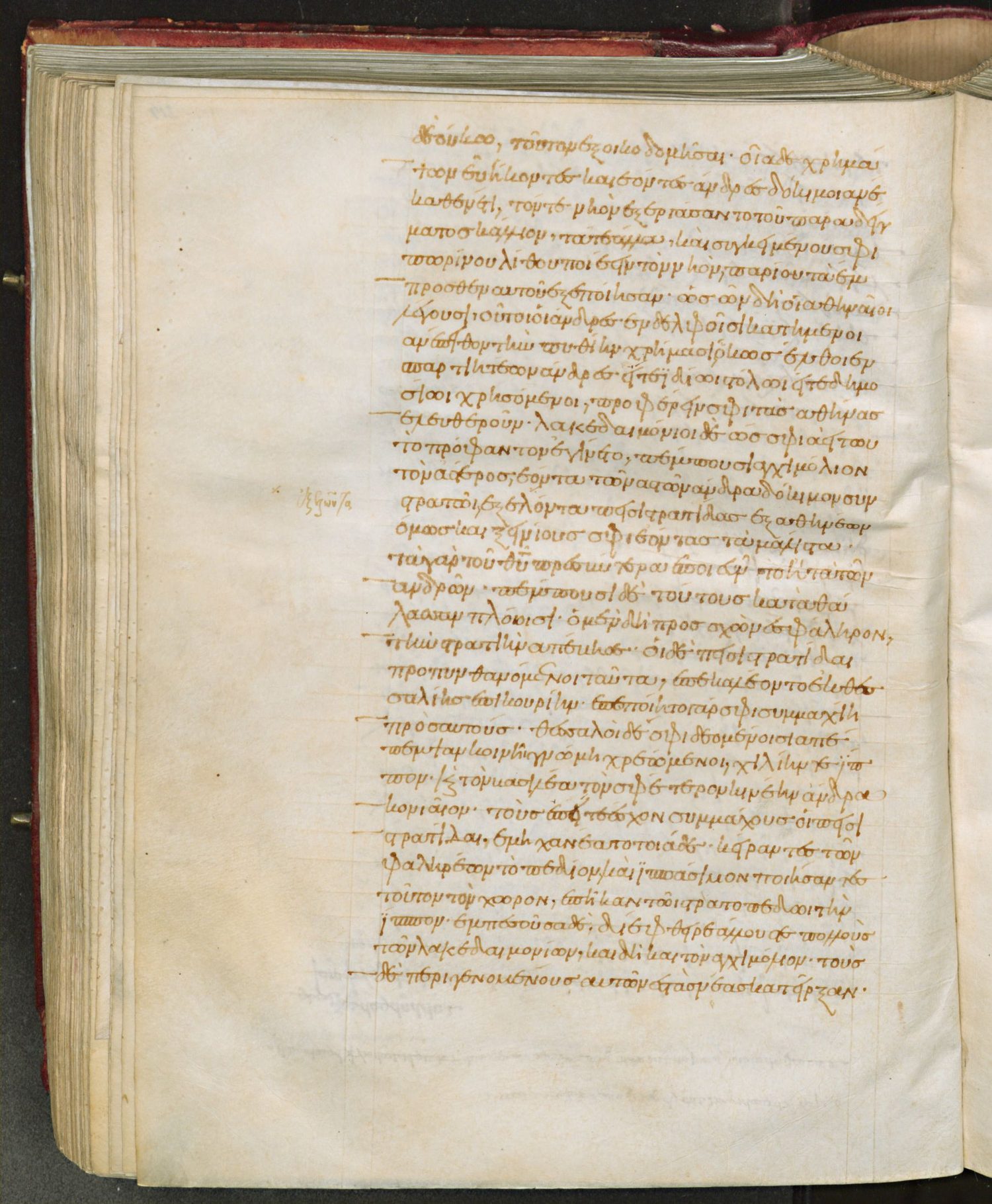
Laur. Plut. 70.3, fol. 214v: Greek here 5.62.2 to 5.63.4. Checked on the image (first and last words read and located in the Greek; each break checked against the neighbouring page): fol. 214v begins ‹δὲ οὔκω, τοῦτον ἐξοικοδομῆσαι.οἷα› (5.62.2), ends ‹ἐς τὰς νέας κατεῖρξαν› (5.63.4). English here: 5.62.3 to 5.63.4 (Godley's sentences for the sections whose Greek lies mostly on this page).
5.62.2δὲ οὔκω, τοῦτον ἐξοικοδομῆσαι. 5.62.3οἷα δὲ χρημάτων εὖ ἥκοντες καὶ ἐόντες ἄνδρες δόκιμοι ἀνέκαθεν ἔτι, τόν τε νηὸν ἐξεργάσαντο τοῦ παραδείγματος κάλλιον τά τε ἄλλα καὶ συγκειμένου σφι πωρίνου λίθου ποιέειν τὸν νηόν, Παρίου τὰ ἔμπροσθε αὐτοῦ ἐξεποίησαν. 5.63.1ὡς ὦν δὴ οἱ Ἀθηναῖοι λέγουσι, οὗτοι οἱ ἄνδρες ἐν Δελφοῖσι κατήμενοι ἀνέπειθον τὴν Πυθίην χρήμασι, ὅκως ἔλθοιεν Σπαρτιητέων ἄνδρες εἴτε ἰδίῳ στόλῳ εἴτε δημοσίῳ χρησόμενοι, προφέρειν σφι τὰς Ἀθήνας ἐλευθεροῦν. 5.63.2Λακεδαιμόνιοι δέ, ὥς σφι αἰεὶ τὠυτὸ πρόφαντον ἐγίνετο, πέμπουσι Ἀγχιμόλιον τὸν Ἀστέρος, ἐόντα τῶν ἀστῶν ἄνδρα δόκιμον, σὺν στρατῷ ἐξελῶντα Πεισιστρατίδας ἐξ Ἀθηνέων ὅμως καὶ ξεινίους σφι ἐόντας τὰ μάλιστα· τὰ γὰρ τοῦ θεοῦ πρεσβύτερα ἐποιεῦντο ἢ τὰ τῶν ἀνδρῶν· πέμπουσι δὲ τούτους κατὰ θάλασσαν πλοίοισι. 5.63.3ὃ μὲν δὴ προσσχὼν ἐς Φάληρον τὴν στρατιὴν ἀπέβησε, οἱ δὲ Πεισιστρατίδαι προπυνθανόμενοι ταῦτα ἐπεκαλέοντο ἐκ Θεσσαλίης ἐπικουρίην· ἐπεποίητο γάρ σφι συμμαχίη πρὸς αὐτούς. Θεσσαλοὶ δέ σφι δεομένοισι ἀπέπεμψαν κοινῇ γνώμῃ χρεώμενοι χιλίην τε ἵππον καὶ τὸν βασιλέα τὸν σφέτερον Κινέην ἄνδρα Κονιαῖον· τοὺς ἐπείτε ἔσχον συμμάχους οἱ Πεισιστρατίδαι, ἐμηχανῶντο τοιάδε· 5.63.4κείραντες τῶν Φαληρέων τὸ πεδίον καὶ ἱππάσιμον ποιήσαντες τοῦτον τὸν χῶρον ἐπῆκαν τῷ στρατοπέδῳ τὴν ἵππον· ἐμπεσοῦσα δὲ διέφθειρε ἄλλους τε πολλοὺς τῶν Λακεδαιμονίων καὶ δὴ καὶ τὸν Ἀγχιμόλιον· τοὺς δὲ περιγενομένους αὐτῶν ἐς τὰς νέας κατεῖρξαν.
5.62.3Being wealthy and like their fathers men of reputation, they wrought the temple into a fairer form than the model shown; in particular, whereas they had agreed to build the temple of tufa, they made its front of Parian marble. 5.63.1These men then, as the Athenians say, sat them down at Delphi and bribed the Pythian priestess, whenever any Spartans should come to enquire of her on a private or a public account, to bid them set Athens free. 5.63.2Then the Lacedaemonians, when the same command was ever revealed to them, sent Anchimolius the son of Aster, a citizen of repute, to drive out the sons of Pisistratus with an army, albeit the Pisistratids were their close friends; for the gods’ will weighed with them more than the will of man. 5.63.3They sent these men by sea on shipboard. So Anchimolius put in at Phalerum and there disembarked his army; but the sons of Pisistratus had got word of the plan already, and sent to ask help from Thessaly, wherewith they had an alliance. The Thessalians at their entreaty joined together and sent their own king, Cineas of Conium, with a thousand horsemen. 5.63.4When the Pisistratids got these allies, they devised a plan whereby they laid the plain of Phalerum waste, so that all that land could be ridden over, and then launched their cavalry against the enemy’s army; the horsemen charged and slew Anchimolius and many more of the Lacedaemonians, and drove those that survived to their ships. Thus faring, the first Lacedaemonian armament drew off; and Anchimolius’ tomb is at Alopecae in Attica, near to the Heracleum in Cynosarges.
Where on the image
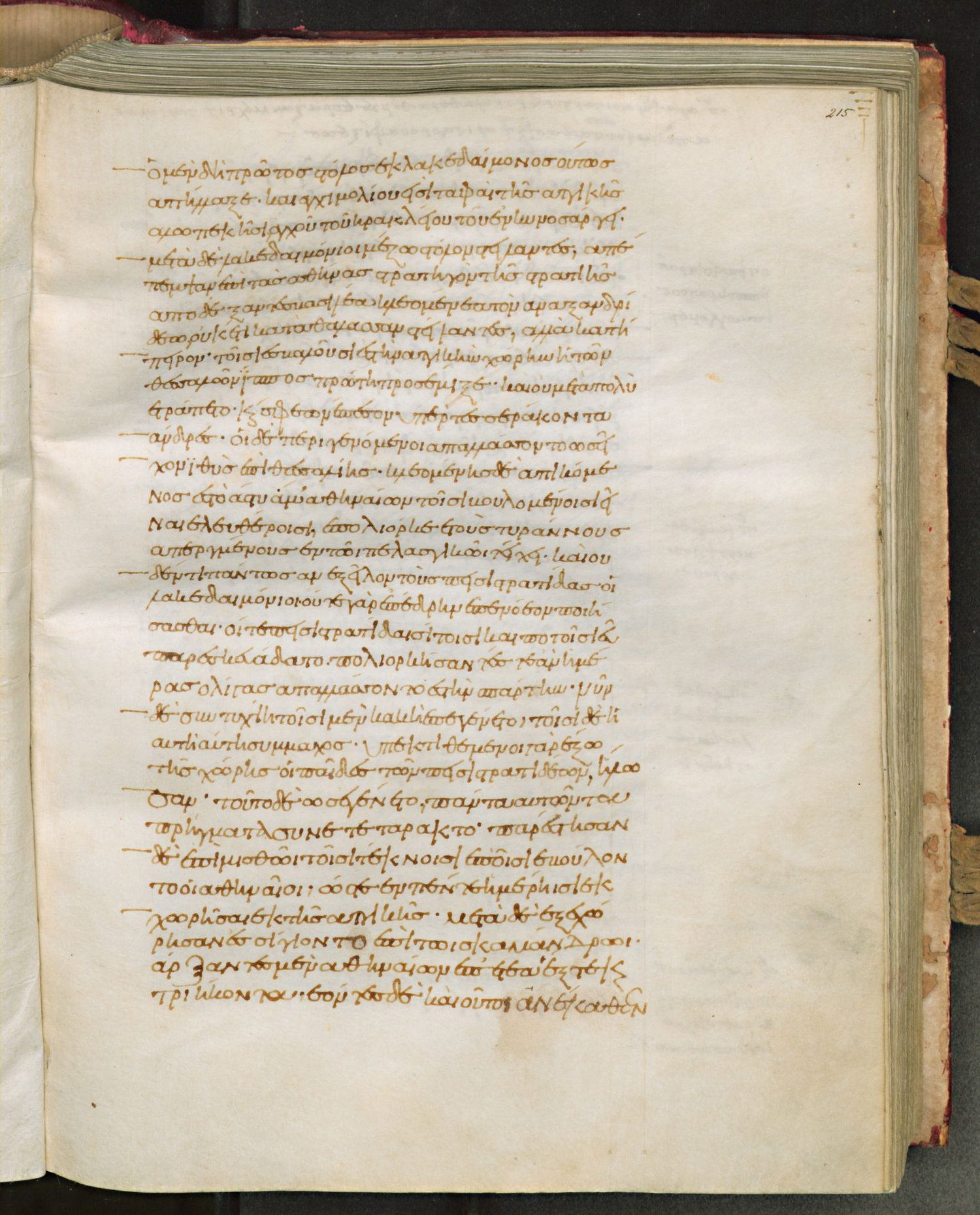
Laur. Plut. 70.3, fol. 215r: Greek here 5.63.4 to 5.65.3. Checked on the image (first and last words read and located in the Greek; each break checked against the neighbouring page): fol. 215r begins ‹ὁ μὲν δὴ πρῶτος› (5.63.4), ends ‹δὲ καὶ οὗτοι ἀνέκαθεν› (5.65.3). English here: 5.64.1 to 5.65.2 (Godley's sentences for the sections whose Greek lies mostly on this page).
5.63.4ὁ μὲν δὴ πρῶτος στόλος ἐκ Λακεδαίμονος οὕτω ἀπήλλαξε, καὶ Ἀγχιμολίου εἰσὶ ταφαὶ τῆς Ἀττικῆς Ἀλωπεκῆσι, ἀγχοῦ τοῦ Ἡρακλείου τοῦ ἐν Κυνοσάργεϊ. 5.64.1μετὰ δὲ Λακεδαιμόνιοι μέζω στόλον στείλαντες ἀπέπεμψαν ἐπὶ τὰς Ἀθήνας, στρατηγὸν τῆς στρατιῆς ἀποδέξαντες βασιλέα Κλεομένεα τὸν Ἀναξανδρίδεω, οὐκέτι κατὰ θάλασσαν στείλαντες ἀλλὰ κατʼ ἤπειρον· 5.64.2τοῖσι ἐσβαλοῦσι ἐς τὴν Ἀττικὴν χώρην ἡ τῶν Θεσσαλῶν ἵππος πρώτη προσέμιξε καὶ οὐ μετὰ πολλὸν ἐτράπετο, καὶ σφεων ἔπεσον ὑπὲρ τεσσεράκοντα ἄνδρας· οἱ δὲ περιγενόμενοι ἀπαλλάσσοντο ὡς εἶχον εὐθὺς ἐπὶ Θεσσαλίης. Κλεομένης δὲ ἀπικόμενος ἐς τὸ ἄστυ ἅμα Ἀθηναίων τοῖσι βουλομένοισι εἶναι ἐλευθέροισι ἐπολιόρκεε τοὺς τυράννους ἀπεργμένους ἐν τῷ Πελασγικῷ τείχεϊ. 5.65.1καὶ οὐδέν τι πάντως ἂν ἐξεῖλον Πεισιστρατίδας οἱ Λακεδαιμόνιοι· οὔτε γὰρ ἐπέδρην ἐπενόεον ποιήσασθαι, οἵ τε Πεισιστρατίδαι σίτοισι καὶ ποτοῖσι εὖ παρεσκευάδατο, πολιορκήσαντές τε ἂν ἡμέρας ὀλίγας ἀπαλλάσσοντο ἐς τὴν Σπάρτην. νῦν δὲ συντυχίη τοῖσι μὲν κακὴ ἐπεγένετο, τοῖσι δὲ ἡ αὐτὴ αὕτη σύμμαχος· ὑπεκτιθέμενοι γὰρ ἔξω τῆς χώρης οἱ παῖδες τῶν Πεισιστρατιδέων ἥλωσαν. 5.65.2τοῦτο δὲ ὡς ἐγένετο, πάντα αὐτῶν τὰ πρήγματα συνετετάρακτο, παρέστησαν δὲ ἐπὶ μισθῷ τοῖσι τέκνοισι, ἐπʼ οἷσι ἐβούλοντο οἱ Ἀθηναῖοι, ὥστε ἐν πέντε ἡμέρῃσι ἐκχωρῆσαι ἐκ τῆς Ἀττικῆς. 5.65.3μετὰ δὲ ἐξεχώρησαν ἐς Σίγειον τὸ ἐπὶ τῷ Σκαμάνδρῳ, ἄρξαντες μὲν Ἀθηναίων ἐπʼ ἔτεα ἕξ τε καὶ τριήκοντα, ἐόντες δὲ καὶ οὗτοι ἀνέκαθεν
5.64.1After this the Lacedaemonians sent out a greater army to attack Athens, appointing as its general their king Cleomenes son of Anaxandrides; this army they sent no longer by sea but by land. 5.64.2When they broke into Attica the Thessalian horse was the first to meet them, and was presently routed and more than forty men were slain; those that were left alive made off for Thessaly by the nearest way they could. Then Cleomenes, when he and the Athenians that desired freedom came before the city, drove the despots’ family within the Pelasgic wall and there beleaguered them. 5.65.1And assuredly the Lacedaemonians would never have taken the Pisistratid stronghold; for they had no mind to blockade it, and the Pisistratids were well furnished with food and drink; and the Lacedaemonians would but have besieged the place for a few days and then returned back to Sparta. But as it was, there befel a turn of fortune that harmed the one party and helped the other; for the sons of the Pisistratid family were taken as they were being privily carried out of the country. 5.65.2This made all their plans to be confounded; and they submitted to depart out of Attica within five days on the terms prescribed to them by the Athenians, in return for the recovery of their children.
Where on the image
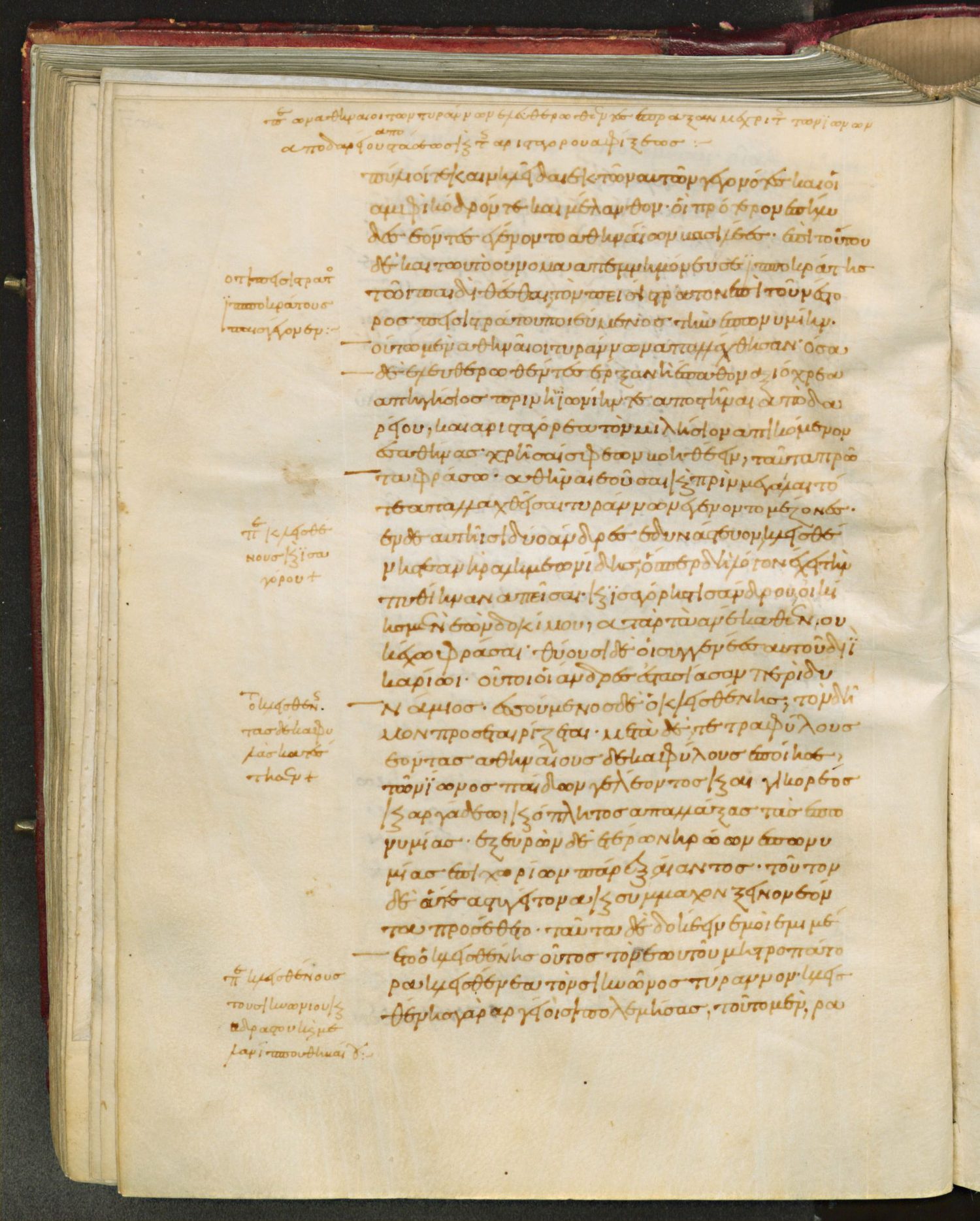
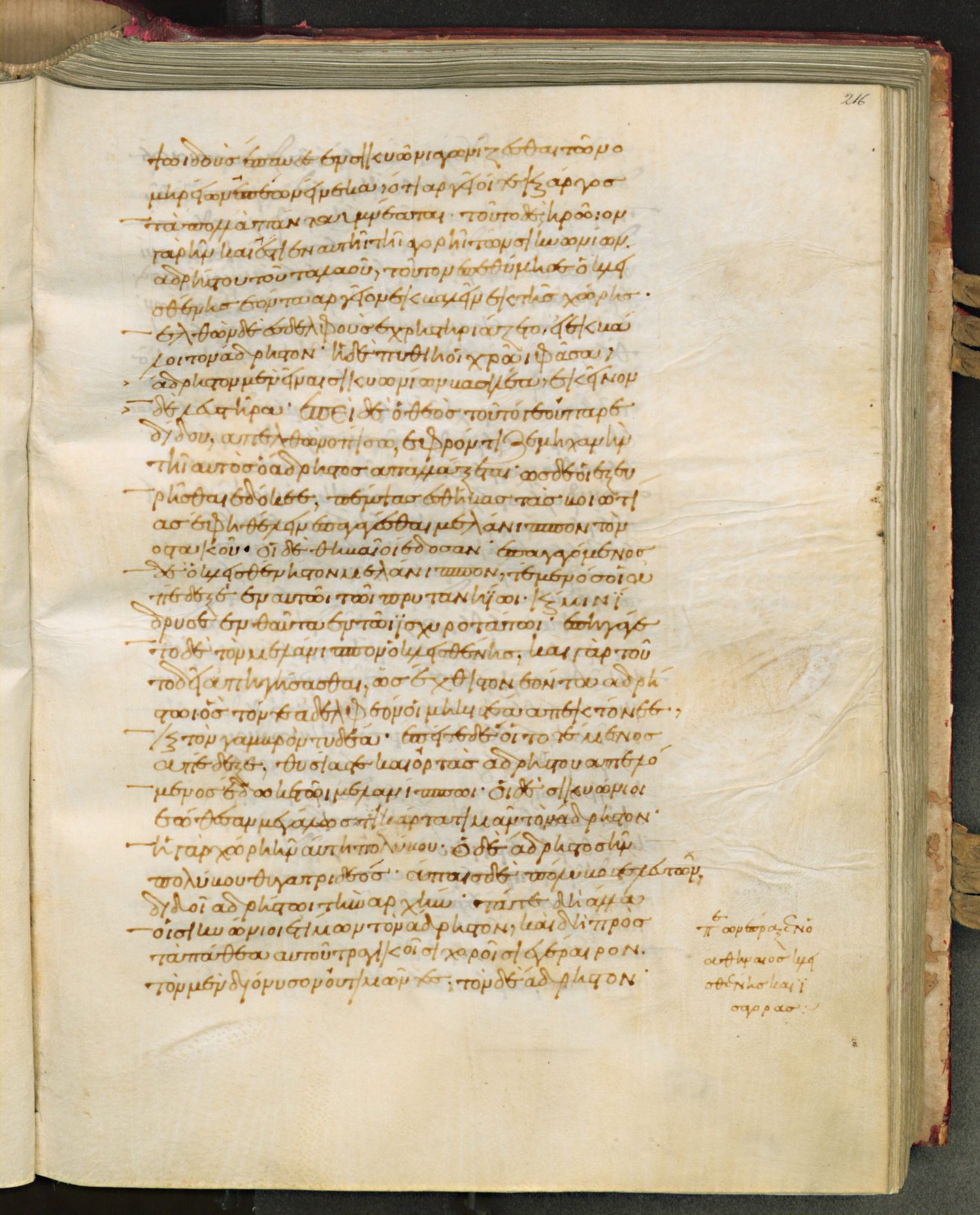
Laur. Plut. 70.3, fol. 215v: Greek here 5.65.3 to 5.67.1. Checked on the image (first and last words read and located in the Greek; each break checked against the neighbouring page): fol. 215v begins ‹Πύλιοί τε καὶ Νηλεῖδαι,› (5.65.3), ends ‹πολεμήσας τοῦτο μὲν ῥαψ-› (5.67.1). A reader's note stands in the upper margin. English here: 5.65.3 to 5.66.2 (Godley's sentences for the sections whose Greek lies mostly on this page).
5.65.3Πύλιοί τε καὶ Νηλεῖδαι, ἐκ τῶν αὐτῶν γεγονότες καὶ οἱ ἀμφὶ Κόδρον τε καὶ Μέλανθον, οἳ πρότερον ἐπήλυδες ἐόντες ἐγένοντο Ἀθηναίων βασιλέες. 5.65.4ἐπὶ τούτου δὲ καὶ τὠυτὸ οὔνομα ἀπεμνημόνευσε Ἱπποκράτης τῷ παιδὶ θέσθαι τὸν Πεισίστρατον, ἐπὶ τοῦ Νέστορος Πεισιστράτου ποιεύμενος τὴν ἐπωνυμίην. 5.65.5οὕτω μὲν Ἀθηναῖοι τυράννων ἀπαλλάχθησαν· ὅσα δὲ ἐλευθερωθέντες ἔρξαν ἢ ἔπαθον ἀξιόχρεα ἀπηγήσιος, πρὶν ἢ Ἰωνίην τε ἀποστῆναι ἀπὸ Δαρείου καὶ Ἀρισταγόρεα τὸν Μιλήσιον ἀπικόμενον ἐς Ἀθήνας χρηίσαι σφέων βοηθέειν, ταῦτα πρῶτα φράσω. 5.66.1Ἀθῆναι, ἐοῦσαι καὶ πρὶν μεγάλαι, τότε ἀπαλλαχθεῖσαι τυράννων ἐγίνοντο μέζονες· ἐν δὲ αὐτῇσι δύο ἄνδρες ἐδυνάστευον, Κλεισθένης τε ἀνὴρ Ἀλκμεωνίδης, ὅς περ δὴ λόγον ἔχει τὴν Πυθίην ἀναπεῖσαι, καὶ Ἰσαγόρης Τισάνδρου οἰκίης μὲν ἐὼν δοκίμου, ἀτὰρ τὰ ἀνέκαθεν οὐκ ἔχω φράσαι· θύουσι δὲ οἱ συγγενέες αὐτοῦ Διὶ Καρίῳ. 5.66.2οὗτοι οἱ ἄνδρες ἐστασίασαν περὶ δυνάμιος, ἑσσούμενος δὲ ὁ Κλεισθένης τὸν δῆμον προσεταιρίζεται. μετὰ δὲ τετραφύλους ἐόντας Ἀθηναίους δεκαφύλους ἐποίησε, τῶν Ἴωνος παίδων Γελέοντος καὶ Αἰγικόρεος καὶ Ἀργάδεω καὶ Ὅπλητος ἀπαλλάξας τὰς ἐπωνυμίας, ἐξευρὼν δὲ ἑτέρων ἡρώων ἐπωνυμίας ἐπιχωρίων, πάρεξ Αἴαντος· τοῦτον δὲ ἅτε ἀστυγείτονα καὶ σύμμαχον, ξεῖνον ἐόντα προσέθετο. 5.67.1ταῦτα δέ, δοκέειν ἐμοί, ἐμιμέετο ὁ Κλεισθένης οὗτος τὸν ἑωυτοῦ μητροπάτορα Κλεισθένεα τὸν Σικυῶνος τύραννον. Κλεισθένης γὰρ Ἀργείοισι πολεμήσας τοῦτο μὲν ῥαψῳδοὺς
5.65.3Presently they departed to Sigeum on the Scamander. They had ruled the Athenians for six-and-thirty years; they too were in lineage of the house of Pylos and Neleus, born of the same ancestors as the families of Codrus and Melanthus, who had formerly come from foreign parts to be kings of Athens. 5.65.4Hence it was that Hippocrates gave his son for a remembrance the name Pisistratus, calling him after Pisistratus the son of Nestor. 5.65.5Thus the Athenians got quit of their despots; and all the noteworthy things that they did or endured, after they were freed and before Ionia revolted from Darius and Aristagoras of Miletus came to Athens to ask help of its people—these first I will now declare. 5.66.1Athens, which had before been great, grew now yet greater when rid of her despots; and those that were of chief power there were two, Cleisthenes an Alcmaeonid (it is he who is reputed to have over-persuaded the Pythian priestess), and Isagoras son of Tisandrus, a man of a notable house, but of what lineage I cannot tell; his kinsfolk sacrifice to Zeus of Caria. 5.66.2These men with their factions fell to contending for power, wherein Cleisthenes being worsted took the commonalty into partnership. Presently he divided the Athenians into ten tribes, instead of four as formerly; he called none any more after the names of the sons of Ion, Geleon, Aegicores, Argades, and Hoples, but invented for them names taken from other heroes, all native to the country save only Aias; him he added, albeit a stranger, because he was a neighbour and an ally.
Where on the image
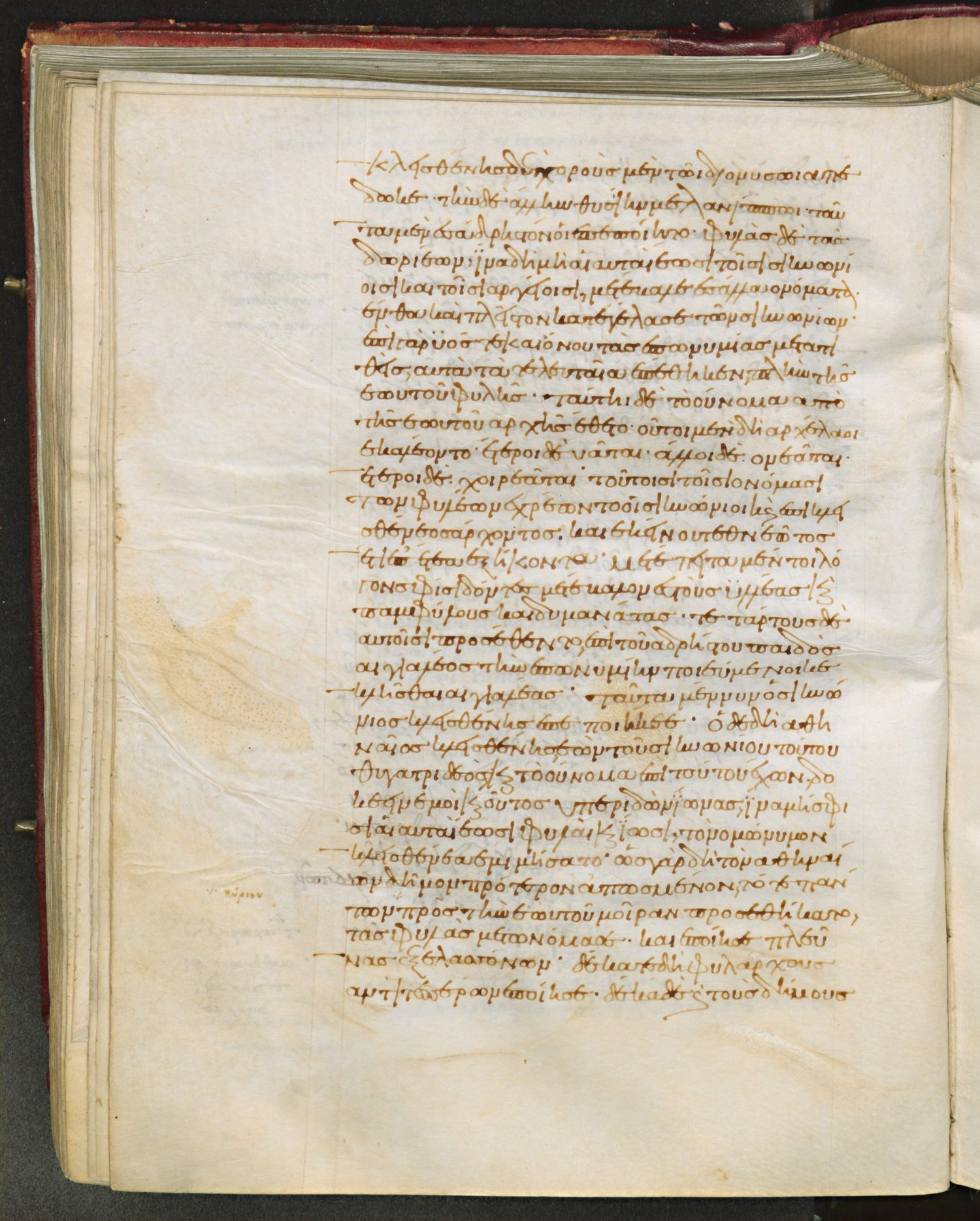
Laur. Plut. 70.3, fol. 216r: Greek here 5.67.1 to 5.67.5. Checked on the image (first and last words read and located in the Greek; each break checked against the neighbouring page): fol. 216r begins ‹-ῳδοὺς ἔπαυσε ἐν Σικυῶνι› (5.67.1), ends ‹τιμῶντες, τὸν δὲ Ἄδρηστον› (5.67.5). The word ‹ῥαψῳδοὺς› is divided between fol. 215v and fol. 216r; it is given with fol. 215v. English here: 5.67.1 to 5.67.5 (Godley's sentences for the sections whose Greek lies mostly on this page).
5.67.1ἔπαυσε ἐν Σικυῶνι ἀγωνίζεσθαι τῶν Ὁμηρείων ἐπέων εἵνεκα, ὅτι Ἀργεῖοί τε καὶ Ἄργος τὰ πολλὰ πάντα ὑμνέαται· τοῦτο δέ, ἡρώιον γὰρ ἦν καὶ ἔστι ἐν αὐτῇ τῇ ἀγορῇ τῶν Σικυωνίων Ἀδρήστου τοῦ Ταλαοῦ, τοῦτον ἐπεθύμησε ὁ Κλεισθένης ἐόντα Ἀργεῖον ἐκβαλεῖν ἐκ τῆς χώρης. 5.67.2ἐλθὼν δὲ ἐς Δελφοὺς ἐχρηστηριάζετο εἰ ἐκβάλοι τὸν Ἄδρηστον· ἡ δὲ Πυθίη οἱ χρᾷ φᾶσα Ἄδρηστον μὲν εἶναι Σικυωνίων βασιλέα, κεῖνον δὲ λευστῆρα. ἐπεὶ δὲ ὁ θεὸς τοῦτό γε οὐ παρεδίδου, ἀπελθὼν ὀπίσω ἐφρόντιζε μηχανὴν τῇ αὐτὸς ὁ Ἄδρηστος ἀπαλλάξεται. ὡς δέ οἱ ἐξευρῆσθαι ἐδόκεε, πέμψας ἐς Θήβας τὰς Βοιωτίας ἔφη θέλειν ἐπαγαγέσθαι Μελάνιππον τὸν Ἀστακοῦ· οἱ δὲ Θηβαῖοι ἔδοσαν. 5.67.3ἐπαγαγόμενος δὲ ὁ Κλεισθένης τὸν Μελάνιππον τέμενός οἱ ἀπέδεξε ἐν αὐτῷ τῷ πρυτανηίῳ καί μιν ἵδρυσε ἐνθαῦτα ἐν τῷ ἰσχυροτάτῳ. ἐπηγάγετο δὲ τὸν Μελάνιππον ὁ Κλεισθένης ʽ καὶ γὰρ τοῦτο δεῖ ἀπηγήσασθαἰ ὡς ἔχθιστον ἐόντα Ἀδρήστῳ, ὃς τόν τε ἀδελφεόν οἱ Μηκιστέα ἀπεκτόνεε καὶ τὸν γαμβρὸν Τυδέα. 5.67.4ἐπείτε δέ οἱ τὸ τέμενος ἀπέδεξε, θυσίας τε καὶ ὁρτὰς Ἀδρήστου ἀπελόμενος ἔδωκε τῷ Μελανίππῳ. οἱ δὲ Σικυώνιοι ἐώθεσαν μεγαλωστὶ κάρτα τιμᾶν τὸν Ἄδρηστον· ἡ γὰρ χώρη ἦν αὕτη Πολύβου, ὁ δὲ Ἄδρηστος ἦν Πολύβου θυγατριδέος, ἄπαις δὲ Πόλυβος τελευτῶν διδοῖ Ἀδρήστῳ τὴν ἀρχήν. 5.67.5τά τε δὴ ἄλλα οἱ Σικυώνιοι ἐτίμων τὸν Ἄδρηστον καὶ δὴ πρὸς τὰ πάθεα αὐτοῦ τραγικοῖσι χοροῖσι ἐγέραιρον, τὸν μὲν Διόνυσον οὐ τιμῶντες, τὸν δὲ Ἄδρηστον.
5.67.1Now herein, to my thinking, this Cleisthenes was imitating his own mother’s father, Cleisthenes the despot of Sicyon. For Cleisthenes, after going to war with the Argives, made an end of minstrels’ contests at Sicyon by reason of the Homeric poems, because wellnigh everywhere in these it is Argives and Argos that are the theme of song; furthermore, he conceived the desire to cast out from the land (as being an Argive) Adrastus son of Talaus, the hero whose shrine stood then as now in the very market-place of Sicyon. 5.67.2He went then to Delphi, and enquired of the oracle if he should cast Adrastus out; but the priestess in answer said: “Adrastus is king of Sicyon, and thou but a common slayer.” When the god would not suffer him to work his will in that, he returned back and strove to devise some plan which might rid him of Adrastus; and when he thought he had found one, he sent to Thebes of Boeotia and said he would fain bring into his country Melanippus son of Astacus; whom when the Thebans 5.67.3gave him he brought to Sicyon, and gave him a precinct in the very town-hall of the city, setting him there in its strongest place. Now the reason why Cleisthenes thus brought Melanippus (for this too I must relate) was, that Melanippus was Adrastus deadliest foe; for Adrastus had slain his brother Mecisteus and his son-in-law Tydeus. 5.67.4Having then appointed the precinct for him, Cleisthenes took away all Adrastus’ sacrifices and festivals and gave them to Melanippus. The Sicyonians had been wont to pay very great honour to Adrastus; for Polybus had been lord of that land, and Adrastus was the son of Polybus’ daughter; and Polybus, dying without a son, gave the lordship to Adrastus. 5.67.5Now besides other honours paid to Adrastus by the Sicyonians, they celebrated his lamentable fate with tragic choruses, not in honour of Dionysus but of Adrastus. But Cleisthenes gave the choruses back to Dionysus and the rest of the worship to Melanippus.
Where on the image
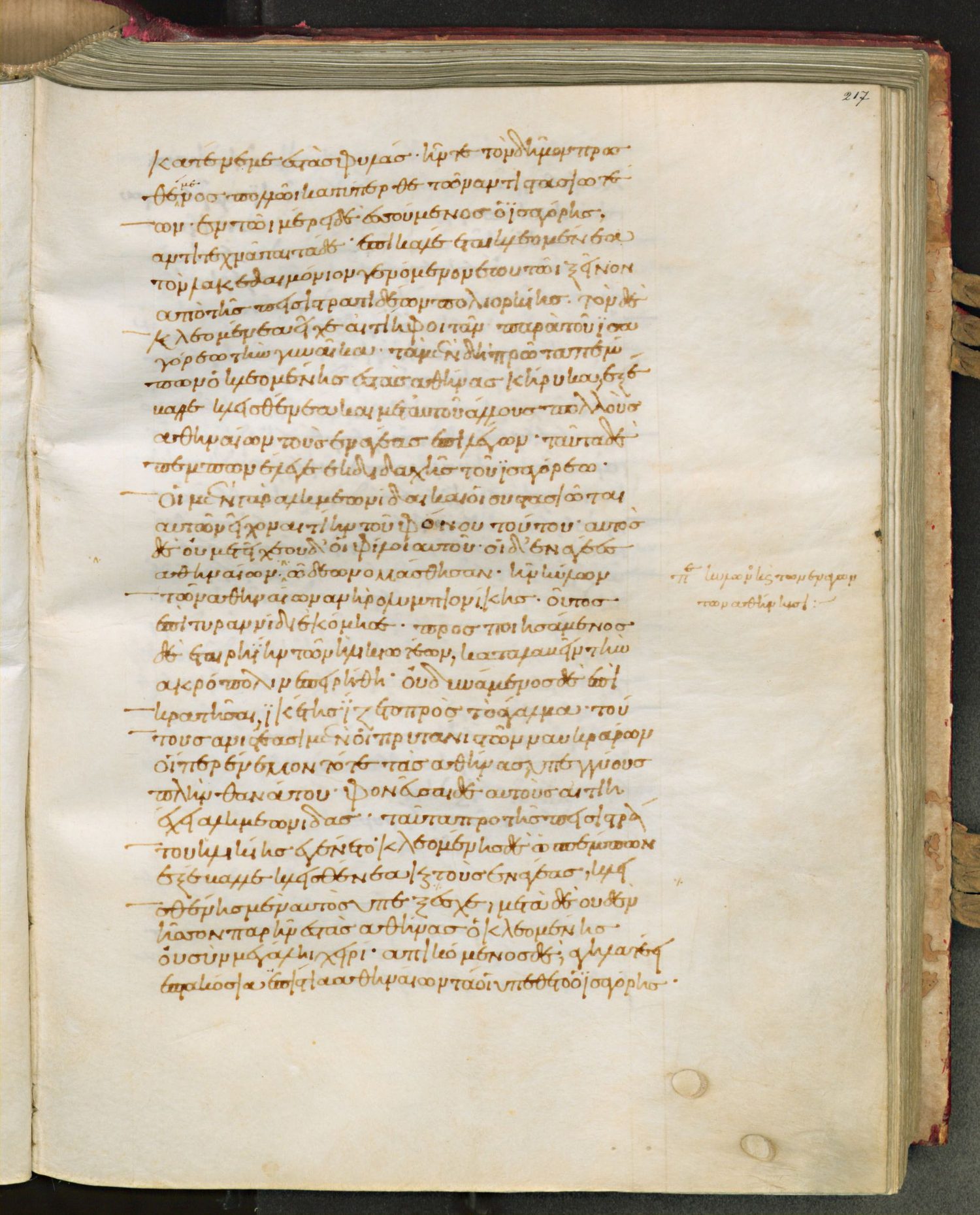
Laur. Plut. 70.3, fol. 216v: Greek here 5.67.5 to 5.69.2. Checked on the image (first and last words read and located in the Greek; each break checked against the neighbouring page): fol. 216v begins ‹Κλεισθένης δὲ χοροὺς μὲν› (5.67.5), ends ‹δέκαχαδὲ καὶ τοὺς δήμους› (5.69.2). English here: 5.68.1 to 5.69.2 (Godley's sentences for the sections whose Greek lies mostly on this page).
5.67.5Κλεισθένης δὲ χοροὺς μὲν τῷ Διονύσῳ ἀπέδωκε, τὴν δὲ ἄλλην θυσίην Μελανίππῳ. 5.68.1ταῦτα μὲν ἐς Ἄδρηστόν οἱ ἐπεποίητο, φυλὰς δὲ τὰς Δωριέων, ἵνα δὴ μὴ αἱ αὐταὶ ἔωσι τοῖσι Σικυωνίοισι καὶ τοῖσι Ἀργείοισι, μετέβαλε ἐς ἄλλα οὐνόματα. ἔνθα καὶ πλεῖστον κατεγέλασε τῶν Σικυωνίων· ἐπὶ γὰρ ὑός τε καὶ ὄνου τὰς ἐπωνυμίας μετατιθεὶς αὐτὰ τὰ τελευταῖα ἐπέθηκε, πλὴν τῆς ἑωυτοῦ φυλῆς· ταύτῃ δὲ τὸ οὔνομα ἀπὸ τῆς ἑωυτοῦ ἀρχῆς ἔθετο. οὗτοι μὲν δὴ Ἀρχέλαοι ἐκαλέοντο, ἕτεροι δὲ Ὑᾶται, ἄλλοι δὲ Ὀνεᾶται, ἕτεροι δὲ Χοιρεᾶται. 5.68.2τούτοισι τοῖσι οὐνόμασι τῶν φυλέων ἐχρέωντο οἱ Σικυώνιοι καὶ ἐπὶ Κλεισθένεος ἄρχοντος καὶ ἐκείνου τεθνεῶτος ἔτι ἐπʼ ἔτεα ἑξήκοντα· μετέπειτα μέντοι λόγον σφίσι δόντες μετέβαλον ἐς τοὺς Ὑλλέας καὶ Παμφύλους καὶ Δυμανάτας, τετάρτους δὲ αὐτοῖσι προσέθεντο ἐπὶ τοῦ Ἀδρήστου παιδὸς Αἰγιαλέος τὴν ἐπωνυμίην ποιεύμενοι κεκλῆσθαι Αἰγιαλέας. 5.69.1ταῦτα μέν νυν ὁ Σικυώνιος Κλεισθένης ἐπεποιήκεε· ὁ δὲ δὴ Ἀθηναῖος Κλεισθένης ἐὼν τοῦ Σικυωνίου τούτου θυγατριδέος καὶ τὸ οὔνομα ἐπὶ τούτου ἔχων, δοκέειν ἐμοὶ καὶ οὗτος ὑπεριδὼν Ἴωνας, ἵνα μὴ σφίσι αἱ αὐταὶ ἔωσι φυλαὶ καὶ Ἴωσι, τὸν ὁμώνυμον Κλεισθένεα ἐμιμήσατο. 5.69.2ὡς γὰρ δὴ τὸν Ἀθηναίων δῆμον πρότερον ἀπωσμένον τότε πάντων πρὸς τὴν ἑωυτοῦ μοῖραν προσεθήκατο, τὰς φυλὰς μετωνόμασε καὶ ἐποίησε πλεῦνας ἐξ ἐλασσόνων· δέκα τε δὴ φυλάρχους ἀντὶ τεσσέρων ἐποίησε, δέκαχαδὲ καὶ τοὺς δήμους
5.68.1Such had been his treatment of Adrastus; but as to the tribes of the Dorians, he changed their names, that so these tribes should not be common to Sicyonians and Argives. In this especially he made a laughing-stock of the Sicyonians; for he named the tribes instead after swine and asses, adding the former ending of the titles, save only for his own tribe; to this he gave a name signifying his own lordship, and calling its folk People-rulers; the rest were Swinites and Assites and Porkites. 5.68.2These were the names of the tribes which the Sicyonians used under Cleisthenes’ rule and for sixty years more after his death; but afterwards they took counsel together and changed the names of three to Hylleis, Pamphyli, and Dymanatae, adding thereto a fourth which they made to be called Aegialeis after Aegialeus son of Adrastus. 5.69.1Thus had the Sicyonian Cleisthenes done; and the Athenian Cleisthenes, who was the son of that Sicyonian’s daughter and bore his name, did to my thinking imitate his namesake because he contemned the Ionians with his grandsire’s contempt and desired that the tribes should not be common to his own people and the Ionians. 5.69.2For having drawn to his own party the Athenian commonalty, which was then debarred from all rights, he gave the tribes new names and increased their number, making ten tribe-wardens in place of four, and assigning ten districts to each tribe; and having won over the commonalty he was stronger by far than the rival faction.
Where on the image
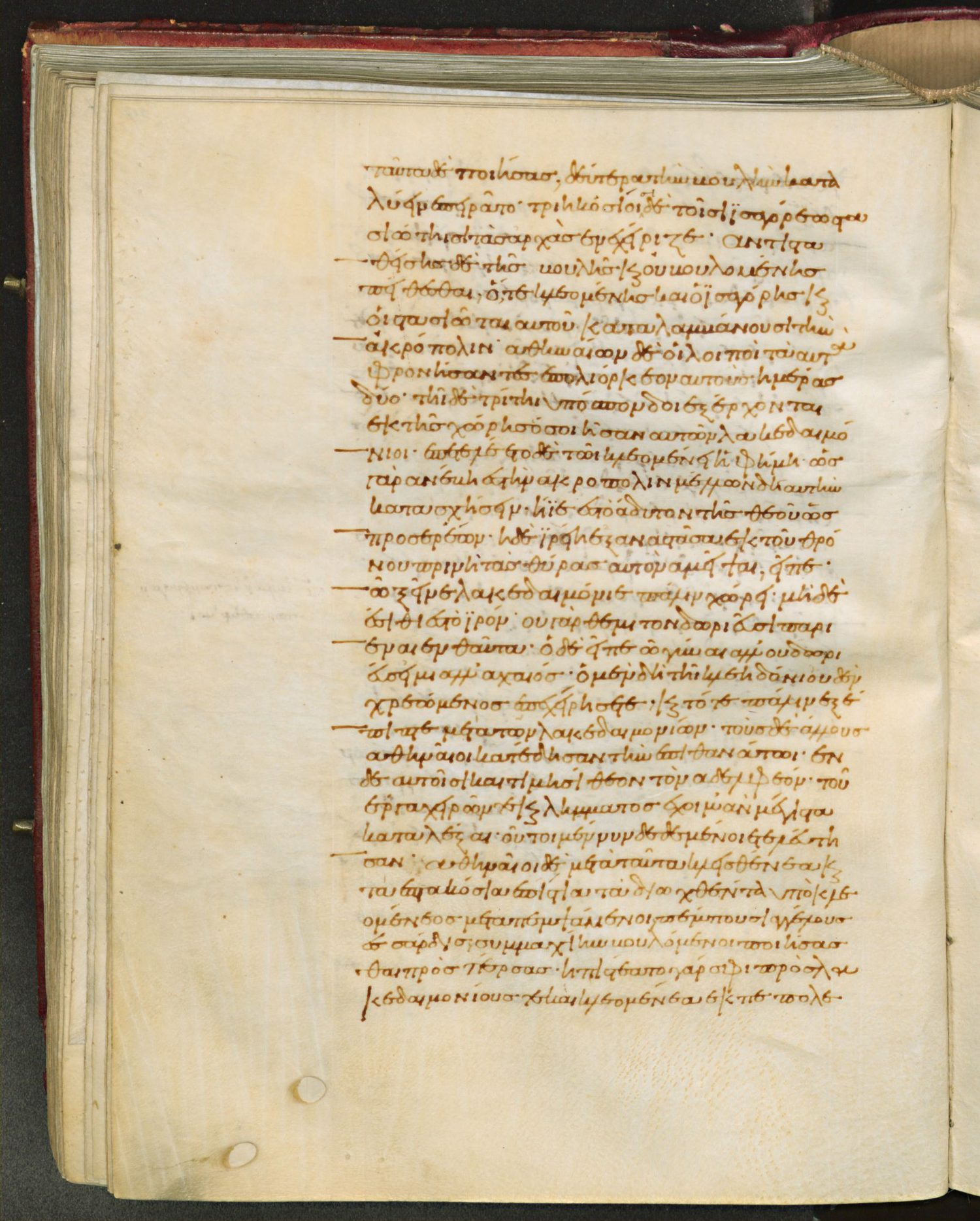
Laur. Plut. 70.3, fol. 217r: Greek here 5.69.2 to 5.72.1. Checked on the image (first and last words read and located in the Greek; each break checked against the neighbouring page): fol. 217r begins ‹κατένειμε ἐς τὰς φυλάς·› (5.69.2), ends ‹οἱ ὑπέθετο ὁ Ἰσαγόρης› (5.72.1). English here: 5.70.1 to 5.72.1 (Godley's sentences for the sections whose Greek lies mostly on this page).
5.69.2κατένειμε ἐς τὰς φυλάς· ἦν τε τὸν δῆμον προσθέμενος πολλῷ κατύπερθε τῶν ἀντιστασιωτέων. 5.70.1ἐν τῷ μέρεϊ δὲ ἑσσούμενος ὁ Ἰσαγόρης ἀντιτεχνᾶται τάδε· ἐπικαλέεται Κλεομένεα τὸν Λακεδαιμόνιον γενόμενον ἑωυτῷ ξεῖνον ἀπὸ τῆς Πεισιστρατιδέων πολιορκίης· τὸν δὲ Κλεομένεα εἶχε αἰτίη φοιτᾶν παρὰ τοῦ Ἰσαγόρεω τὴν γυναῖκα. 5.70.2τὰ μὲν δὴ πρῶτα πέμπων ὁ Κλεομένης ἐς τὰς Ἀθήνας κήρυκα ἐξέβαλλε Κλεισθένεα καὶ μετʼ αὐτοῦ ἄλλους πολλοὺς Ἀθηναίων, τοὺς ἐναγέας ἐπιλέγων· ταῦτα δὲ πέμπων ἔλεγε ἐκ διδαχῆς τοῦ Ἰσαγόρεω. οἱ μὲν γὰρ Ἀλκμεωνίδαι καὶ οἱ συστασιῶται αὐτῶν εἶχον αἰτίην τοῦ φόνου τούτου, αὐτὸς δὲ οὐ μετεῖχε οὐδʼ οἱ φίλοι αὐτοῦ. 5.71.1οἱ δʼ ἐναγέες Ἀθηναίων ὧδε ὠνομάσθησαν. ἦν Κύλων τῶν Ἀθηναίων ἀνὴρ Ὀλυμπιονίκης· οὗτος ἐπὶ τυραννίδι ἐκόμησε, προσποιησάμενος δὲ ἑταιρηίην τῶν ἡλικιωτέων καταλαβεῖν τὴν ἀκρόπολιν ἐπειρήθη, οὐ δυνάμενος δὲ ἐπικρατῆσαι ἱκέτης ἵζετο πρὸς τὸ ἄγαλμα. 5.71.2τούτους ἀνιστᾶσι μὲν οἱ πρυτάνιες τῶν ναυκράρων, οἵ περ ἔνεμον τότε τὰς Ἀθήνας, ὑπεγγύους πλὴν θανάτου· φονεῦσαι δὲ αὐτοὺς αἰτίη ἔχει Ἀλκμεωνίδας. ταῦτα πρὸ τῆς Πεισιστράτου ἡλικίης ἐγένετο. 5.72.1Κλεομένης δὲ ὡς πέμπων ἐξέβαλλε Κλεισθένεα καὶ τοὺς ἐναγέας, Κλεισθένης μὲν αὐτὸς ὑπεξέσχε, μετὰ δὲ οὐδὲν ἧσσον παρῆν ἐς τὰς Ἀθήνας ὁ Κλεομένης οὐ σὺν μεγάλῃ χειρί, ἀπικόμενος δὲ ἀγηλατέει ἑπτακόσια ἐπίστια Ἀθηναίων, τά οἱ ὑπέθετο ὁ Ἰσαγόρης.
5.70.1Then Isagoras, being on the losing side in his turn, devised a counter-plot, and invited the aid of Cleomenes, who had been his friend since the besieging of the Pisistratids; nay, it was laid to Cleomenes’ charge that he resorted to Isagoras’ wife. 5.70.2Then Cleomenes first sent a herald to Athens demanding the banishment of Cleisthenes and many other Athenians with him, the Accursed, as he called them; and this he said in his message by Isagoras’ instruction; for the Alcmeonidae and their faction were held guilty of that bloody deed, but Isagoras and his friends had no part therein. 5.71.1Now the Accursed at Athens got their name on this wise. There was an Athenian named Cylon, that had been a winner at Olympia. This man put on the brave air of one that aimed at despotism; and gathering a company of men of like age he essayed to seize the citadel; but when he could not win it he took sanctuary by the goddess’ statue. 5.71.2Then he and his men were brought away by the presidents of the naval boards (who then ruled Athens), being held liable to any penalty save death; but they were slain, and the slaying of them was laid to the door of the Alcmeonidae. All this befel before the time of Pisistratus. 5.72.1Cleomenes then having sent and demanded the banishment of Cleisthenes and the Accursed, Cleisthenes himself privily departed; but none the less did Cleomenes presently appear before Athens, with no great force; and having come he banished seven hundred Athenian households named for him by Isagoras, to take away the curse. Having so done he next essayed to dissolve the Council, entrusting the offices of governance to Isagoras’ faction.
Where on the image
Laur. Plut. 70.3, fol. 217v: Greek here 5.72.1 to 5.73.1. Checked on the image (first and last words read and located in the Greek; each break checked against the neighbouring page): fol. 217v begins ‹ταῦτα δὲ ποιήσας δεύτερα› (5.72.1), ends ‹Λακεδαιμονίουςτε καὶ Κλεομένεα ἐκπεπολε-› (5.73.1). English here: 5.72.2 to 5.73.1 (Godley's sentences for the sections whose Greek lies mostly on this page).
5.72.1ταῦτα δὲ ποιήσας δεύτερα τὴν βουλὴν καταλύειν ἐπειρᾶτο, τριηκοσίοισι δὲ τοῖσι Ἰσαγόρεω στασιώτῃσι τὰς ἀρχὰς ἐνεχείριζε. 5.72.2ἀντισταθείσης δὲ τῆς βουλῆς καὶ οὐ βουλομένης πείθεσθαι, ὅ τε Κλεομένης καὶ ὁ Ἰσαγόρης καὶ οἱ στασιῶται αὐτοῦ καταλαμβάνουσι τὴν ἀκρόπολιν. Ἀθηναίων δὲ οἱ λοιποὶ τὰ αὐτὰ φρονήσαντες ἐπολιόρκεον αὐτοὺς ἡμέρας δύο· τῇ δὲ τρίτῃ ὑπόσπονδοι ἐξέρχονται ἐκ τῆς χώρης ὅσοι ἦσαν αὐτῶν Λακεδαιμόνιοι. ἐπετελέετο δὲ τῷ Κλεομένεϊ ἡ φήμη. 5.72.3ὡς γὰρ ἀνέβη ἐς τὴν ἀκρόπολιν μέλλων δὴ αὐτὴν κατασχήσειν, ἤιε ἐς τὸ ἄδυτον τῆς θεοῦ ὡς προσερέων· ἡ δὲ ἱρείη ἐξαναστᾶσα ἐκ τοῦ θρόνου, πρὶν ἢ τὰς θύρας αὐτὸν ἀμεῖψαι, εἶπε ὦ ξεῖνε Λακεδαιμόνιε, πάλιν χώρεε μηδὲ ἔσιθι ἐς τὸ ἱρόν· οὐ γὰρ θεμιτὸν Δωριεῦσι παριέναι ἐνθαῦτα. ὁ δὲ εἶπε ὦ γύναι, ἀλλʼ οὐ Δωριεύς εἰμι ἀλλʼ Ἀχαιός. 5.72.4ὃ μὲν δὴ τῇ κλεηδόνι οὐδὲν χρεώμενος ἐπεχείρησέ τε καὶ τότε πάλιν ἐξέπιπτε μετὰ τῶν Λακεδαιμονίων· τοὺς δὲ ἄλλους Ἀθηναῖοι κατέδησαν τὴν ἐπὶ θανάτῳ, ἐν δὲ αὐτοῖσι καὶ Τιμησίθεον τὸν Δελφόν, τοῦ ἔργα χειρῶν τε καὶ λήματος ἔχοιμʼ ἂν μέγιστα καταλέξαι. 5.73.1οὗτοι μέν νυν δεδεμένοι ἐτελεύτησαν. Ἀθηναῖοι δὲ μετὰ ταῦτα Κλεισθένεα καὶ τὰ ἑπτακόσια ἐπίστια τὰ διωχθέντα ὑπὸ Κλεομένεος μεταπεμψάμενοι πέμπουσι ἀγγέλους ἐς Σάρδις, συμμαχίην βουλόμενοι ποιήσασθαι πρὸς Πέρσας· ἠπιστέατο γὰρ σφίσι Λακεδαιμονίουςτε καὶ Κλεομένεα ἐκπεπολεμῶσθαι.
5.72.2But the Council resisted him and would not consent; whereupon Cleomenes and Isagoras and his partisans seized the acropolis. The rest of the Athenians united and besieged them for two days; and on the third they departed out of the country under treaty, as many of them as were Lacedaemonians. 5.72.3Thus the prophetic voice that Cleomenes heard had its fulfilment; for when he went up to the acropolis with intent to take possession of it, he approached the shrine of the goddess to address himself to her; but the priestess rose up from her seat, and said, before he had passed through the doorway: “Go back, Lacedaemonian stranger, and enter not into the holy place; for it is not lawful that Dorians should pass in here.” “Nay, lady,” he answered, “no Dorian am I, but an Achaean.” 5.72.4So he took no heed to the word of omen, but essayed to work his will, and was, as I have said, then again cast out, with his Lacedaemonians. As for the rest, the Athenians put them in ward under sentence of death, Timesitheus the Delphian among them, whose achievements of strength and courage were most mighty, as I could relate. 5.73.1So these were bound and put to death. After that, the Athenians sent to bring back Cleisthenes and the seven hundred households banished by Cleomenes; then they despatched envoys to Sardis, desiring to make an alliance with the Persians; for they knew that they had provoked the Lacedaemonians and Cleomenes to war.
Where on the image
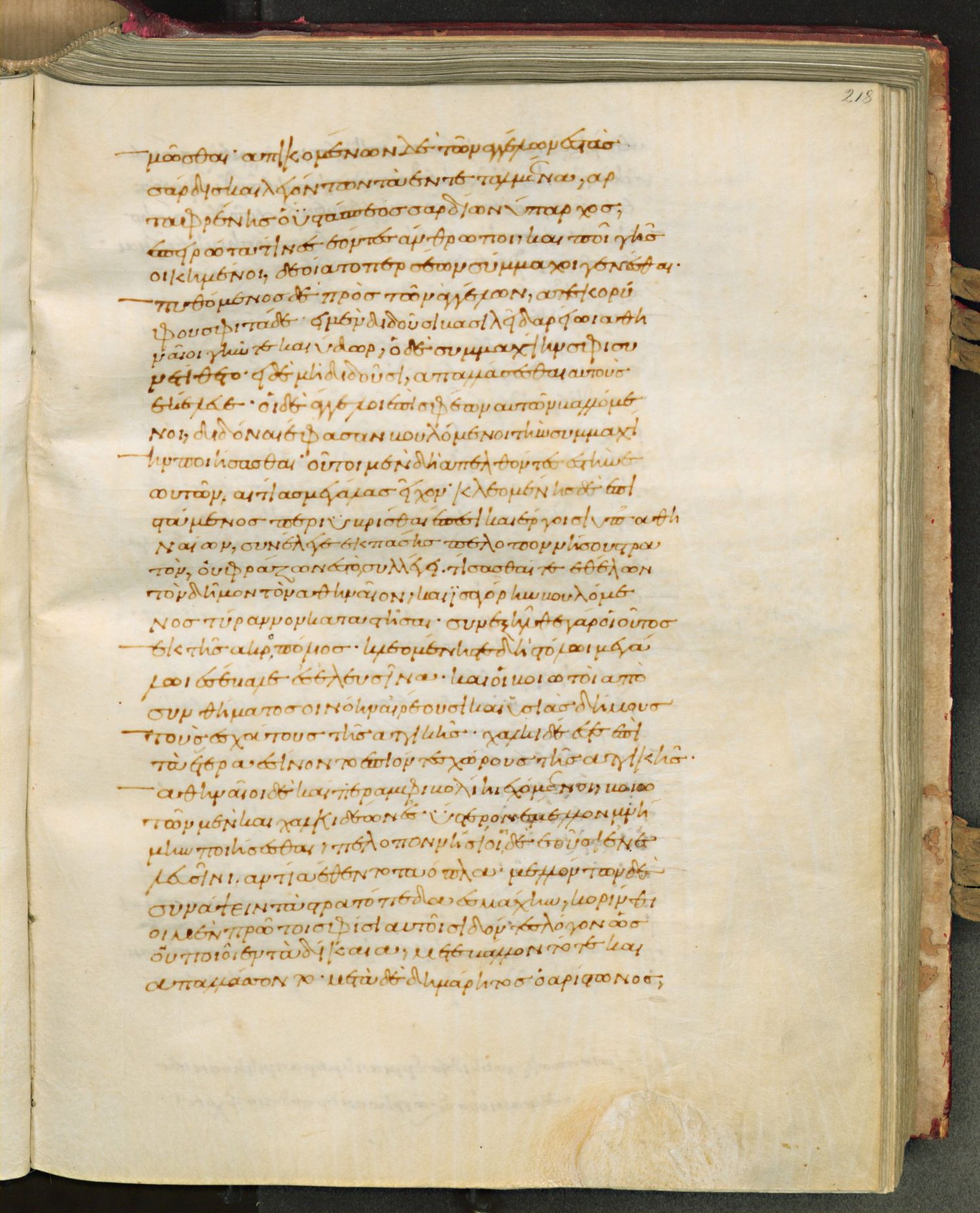
Laur. Plut. 70.3, fol. 218r: Greek here 5.73.2 to 5.75.1. Checked on the image (first and last words read and located in the Greek; each break checked against the neighbouring page): fol. 218r begins ‹-μῶσθαι.ἀπικομένων δὲ τῶν ἀγγέλων› (5.73.1), ends ‹δὲ Δημάρητος ὁ Ἀρίστωνος› (5.75.1). The word ‹ἐκπεπολεμῶσθαι.› is divided between fol. 217v and fol. 218r; it is given with fol. 217v. English here: 5.73.2 to 5.75.1 (Godley's sentences for the sections whose Greek lies mostly on this page).
5.73.2ἀπικομένων δὲ τῶν ἀγγέλων ἐς τὰς Σάρδις καὶ λεγόντων τὰ ἐντεταλμένα, Ἀρταφρένης ὁ Ὑστάσπεος Σαρδίων ὕπαρχος ἐπειρώτα τίνες ἐόντες ἄνθρωποι καὶ κοῦ γῆς οἰκημένοι δεοίατο Περσέων σύμμαχοι γενέσθαι, πυθόμενος δὲ πρὸς τῶν ἀγγέλων ἀπεκορύφου σφι τάδε· εἰ μὲν διδοῦσι βασιλέι Δαρείῳ Ἀθηναῖοι γῆν τε καὶ ὕδωρ, ὁ δὲ συμμαχίην σφι συνετίθετο, εἰ δὲ μὴ διδοῦσι, ἀπαλλάσσεσθαι αὐτοὺς ἐκέλευε. 5.73.3οἱ δὲ ἄγγελοι ἐπὶ σφέων αὐτῶν βαλόμενοι διδόναι ἔφασαν, βουλόμενοι τὴν συμμαχίην ποιήσασθαι. οὗτοι μὲν δὴ ἀπελθόντες ἐς τὴν ἑωυτῶν αἰτίας μεγάλας εἶχον. 5.74.1Κλεομένης δὲ ἐπιστάμενος περιυβρίσθαι ἔπεσι καὶ ἔργοισι ὑπʼ Ἀθηναίων συνέλεγε ἐκ πάσης Πελοποννήσου στρατόν, οὐ φράζων ἐς τὸ συλλέγει, τίσασθαι τε ἐθέλων τὸν δῆμον τὸν Ἀθηναίων καὶ Ἰσαγόρην βουλόμενος τύραννον καταστῆσαι· συνεξῆλθε γάρ οἱ οὗτος ἐκ τῆς ἀκροπόλιος. 5.74.2Κλεομένης τε δὴ στόλῳ μεγάλῳ ἐσέβαλε ἐς Ἐλευσῖνα, καὶ οἱ Βοιωτοὶ ἀπὸ συνθήματος Οἰνόην αἱρέουσι καὶ Ὑσιὰς δήμους τοὺς ἐσχάτους τῆς Ἀττικῆς, Χαλκιδέες τε ἐπὶ τὰ ἕτερα ἐσίνοντο ἐπιόντες χώρους τῆς Ἀττικῆς. Ἀθηναῖοι δέ, καίπερ ἀμφιβολίῃ ἐχόμενοι, Βοιωτῶν μὲν καὶ Χαλκιδέων ἐς ὕστερον ἔμελλον μνήμην ποιήσεσθαι, Πελοποννησίοισι δὲ ἐοῦσι ἐν Ἐλευσῖνι ἀντία ἔθεντο τὰ ὅπλα. 5.75.1μελλόντων δὲ συνάψειν τὰ στρατόπεδα ἐς μάχην, Κορίνθιοι μὲν πρῶτοι σφίσι αὐτοῖσι δόντες λόγον ὡς οὐ ποιέοιεν δίκαια μετεβάλλοντό τε καὶ ἀπαλλάσσοντο, μετὰ δὲ Δημάρητος ὁ Ἀρίστωνος,
5.73.2When the envoys came to Sardis and spoke as they had been bidden, Artaphrenes son of Hystaspes, viceroy of Sardis, asked them, “What men are you, and where dwell you, who desire alliance with the Persians?” Being informed by the envoys, he gave them an answer whereof the substance was, that if the Athenians gave king Darius earth and water, then he would make alliance with them; but if not, his command was that they should begone. 5.73.3The envoys consulted together and consented to give what was asked, in their desire to make the alliance. So they returned to their own country, and were there greatly blamed for what they had done. 5.74.1But Cleomenes, for the despite which he deemed that the Athenians had done him by word and deed, mustered an army from the whole of Peloponnesus, not declaring the purpose for which he mustered it, which was, to avenge himself on the Athenian commonalty and set up Isagoras as despot;—for Isagoras too had come with him out of the acropolis. 5.74.2So Cleomenes broke in as far as Eleusis with a great host, and the Boeotians by a concerted plan took Oenoe and Hysiae, districts on the borders of Attica, while the Chalcidians attacked on another side and raided lands in Attica. The Athenians, thus caught in a ring of foes, kept the Boeotians and Chalcidians for future remembrance, but set up their array against the Peloponnesians where they were at Eleusis. 5.75.1But when the armies were to join battle, the Corinthians first agreed among themselves that they were doing unjustly, and so changed about and departed; and presently Demaratus son of Ariston, the other king of Sparta, did likewise, albeit he had come with Cleomenes from Lacedaemon in joint command of the army and had not till now been at variance with him.
Where on the image
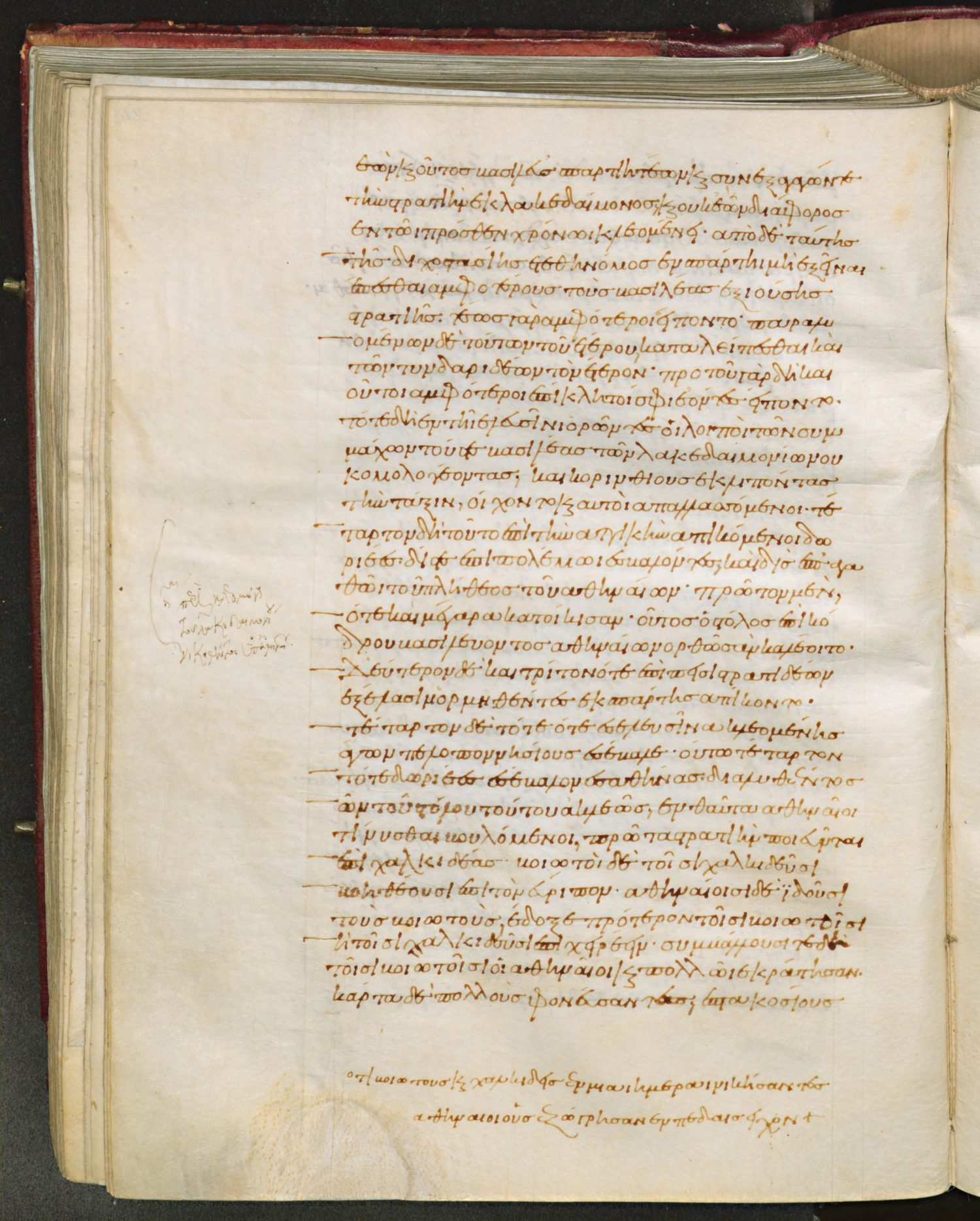
Laur. Plut. 70.3, fol. 218v: Greek here 5.75.1 to 5.77.2. Checked on the image (first and last words read and located in the Greek; each break checked against the neighbouring page): fol. 218v begins ‹ἐὼν καὶ οὗτος βασιλεὺς› (5.75.1), ends ‹δὲ πολλοὺς φονεύσαντες ἑπτακοσίους› (5.77.2). Below the text, a reader's note in two lines on the Athenian victory over the Chalcidians and the prisoners kept in fetters. English here: 5.75.2 to 5.77.3 (Godley's sentences for the sections whose Greek lies mostly on this page).
5.75.1ἐὼν καὶ οὗτος βασιλεὺς Σπαρτιητέων καὶ συνεξαγαγών τε τὴν στρατιὴν ἐκ Λακεδαίμονος καὶ οὐκ ἐὼν διάφορος ἐν τῷ πρόσθε χρόνῳ Κλεομένεϊ. 5.75.2ἀπὸ δὲ ταύτης τῆς διχοστασίης ἐτέθη νόμος ἐν Σπάρτῃ μὴ ἐξεῖναι ἕπεσθαι ἀμφοτέρους τοὺς βασιλέας ἐξιούσης στρατιῆς· τέως γὰρ ἀμφότεροι εἵποντο· παραλυομένου δὲ τούτων τοῦ ἑτέρου καταλείπεσθαι καὶ τῶν Τυνδαριδέων τὸν ἕτερον· πρὸ τοῦ γὰρ δὴ καὶ οὗτοι ἀμφότεροι ἐπίκλητοί σφι ἐόντες εἵποντο. 5.75.3τότε δὴ ἐν τῇ Ἐλευσῖνι ὁρῶντες οἱ λοιποὶ τῶν συμμάχων τούς τε βασιλέας τῶν Λακεδαιμονίων οὐκ ὁμολογέοντας καὶ Κορινθίους ἐκλιπόντας τὴν τάξιν, οἴχοντο καὶ αὐτοὶ ἀπαλλασσόμενοι, 5.76.1τέταρτον δὴ τοῦτο ἐπὶ τὴν Ἀττικὴν ἀπικόμενοι Δωριέες, δίς τε ἐπὶ πολέμῳ ἐσβαλόντες καὶ δὶς ἐπʼ ἀγαθῷ τοῦ πλήθεος τοῦ Ἀθηναίων, πρῶτον μὲν ὅτε καὶ Μέγαρα κατοίκισαν· οὗτος ὁ στόλος ἐπὶ Κόδρου βασιλεύοντος Ἀθηναίων ὀρθῶς ἂν καλέοιτο· δεύτερον δὲ καὶ τρίτον ὅτε ἐπὶ Πεισιστρατιδέων ἐξέλασιν ὁρμηθέντες ἐκ Σπάρτης ἀπίκοντο, τέταρτον δὲ τότε ὅτε ἐς Ἐλευσῖνα Κλεομένης ἄγων Πελοποννησίους ἐσέβαλε. οὕτω τέταρτον τότε Δωριέες ἐσέβαλον ἐς Ἀθήνας. 5.77.1διαλυθέντος ὦν τοῦ στόλου τούτου ἀκλεῶς, ἐνθαῦτα Ἀθηναῖοι τίνυσθαι βουλόμενοι πρῶτα στρατηίην ποιεῦνται ἐπὶ Χαλκιδέας. Βοιωτοὶ δὲ τοῖσι Χαλκιδεῦσι βοηθέουσι ἐπὶ τὸν Εὔριπον. Ἀθηναίοισι δὲ ἰδοῦσι τοὺς Βοιωτοὺς ἔδοξε πρότερον τοῖσι Βοιωτοῖσι ἢ τοῖσι Χαλκιδεῦσι ἐπιχειρέειν. 5.77.2συμβάλλουσί τε δὴ τοῖσι Βοιωτοῖσι οἱ Ἀθηναῖοι καὶ πολλῷ ἐκράτησαν, κάρτα δὲ πολλοὺς φονεύσαντες ἑπτακοσίους
5.75.2From this disunion a law was made at Sparta that when an army was despatched both kings should not be suffered to go with it (for till then they had both gone together); thus one of the kings being released from service, one of the sons of Tyndarus too could be left at home; for before that time, both of these also were entreated to aid and went with the 5.75.3army. 5.76.1So now at Eleusis, when the rest of the allies saw that the Lacedaemonian kings were not of one mind and that the Corinthians had left their post, they too went off and away. This was the fourth time that Dorians had come into Attica. Twice had they come as invaders in war, and twice to the help of the Athenian commonalty; the first time was when they planted a settlement at Megara (this expedition may rightly be said to have been in the reign of Codrus), the second and third when they set out from Sparta to drive out the sons of Pisistratus, and the fourth was now, when Cleomenes broke in as far as Eleusis with his following of Peloponnesians; thus this was the fourth Dorian invasion of Athens. 5.77.1This armament then having been ingloriously scattered, the Athenians first marched against the Chalcidians, to punish them. The Boeotians came to the Euripus to help the Chalcidians. When the Athenians saw the helpers they resolved to attack the Boeotians before the 5.77.2Chalcidians; and meeting the Boeotians in battle they won a great victory; very many they slew, and seven hundred of them they took prisoners. And on that same day the Athenians crossed to Euboea, where they met the Chalcidians too in battle, and having overcome them likewise they left four thousand tenant farmers on the lands of the horse-breeders; 5.77.3for that was the name of the men of substance among the Chalcidians. As many as they took alive of these also, they fettered and kept in ward with the captive Boeotians; but in time they set them free, each for an assessed ransom of two minae. The fetters in which the prisoners had been bound they hung up in the acropolis, where they were still to be seen in my time, hanging from walls that the Medes’ fire had charred, over against the cell that faces westwards.
Where on the image
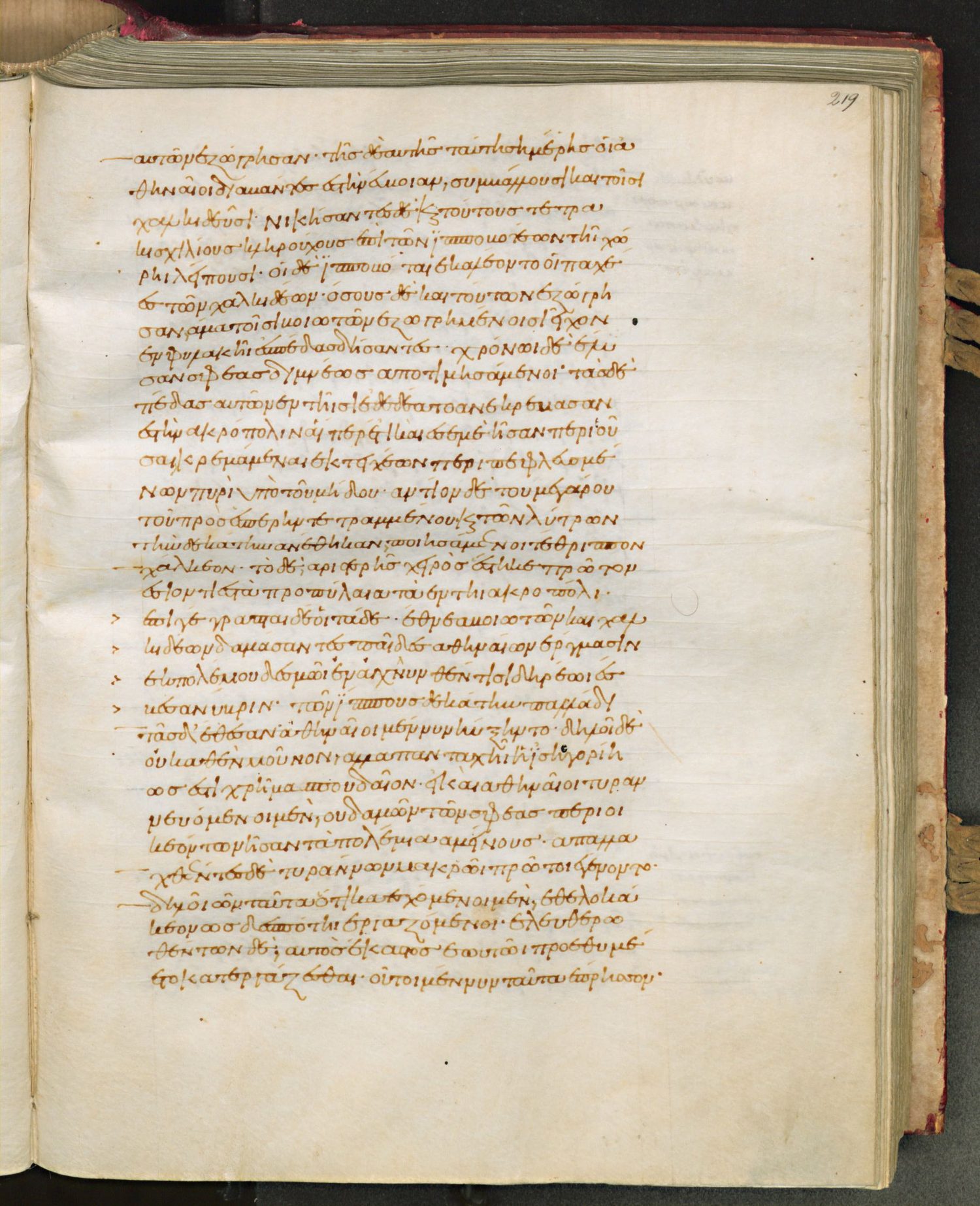
Laur. Plut. 70.3, fol. 219r: Greek here 5.77.2 to 5.78.1. Checked on the image (first and last words read and located in the Greek; each break checked against the neighbouring page): fol. 219r begins ‹αὐτῶν ἐζώγρησαν. τῆς δὲ› (5.77.2), ends ‹μέν νυν ταῦτα ἔπρησσον› (5.79.1). English here: 5.77.4 to 5.78.1 (Godley's sentences for the sections whose Greek lies mostly on this page).
5.77.2αὐτῶν ἐζώγρησαν. τῆς δὲ αὐτῆς ταύτης ἡμέρης οἱ Ἀθηναῖοι διαβάντες ἐς τὴν Εὔβοιαν συμβάλλουσι καὶ τοῖσι Χαλκιδεῦσι, νικήσαντες δὲ καὶ τούτους τετρακισχιλίους κληρούχους ἐπὶ τῶν ἱπποβοτέων τῇ χώρῃ λείπουσι. οἱ δὲ ἱπποβόται ἐκαλέοντο οἱ παχέες τῶν Χαλκιδέων. 5.77.3ὅσους δὲ καὶ τούτων ἐζώγρησαν, ἅμα τοῖσι Βοιωτῶν ἐζωγρημένοισι εἶχον ἐν φυλακῇ ἐς πέδας δήσαντες· χρόνῳ δὲ ἔλυσαν σφέας δίμνεως ἀποτιμησάμενοι. τὰς δὲ πέδας αὐτῶν, ἐν τῇσι ἐδεδέατο, ἀνεκρέμασαν ἐς τὴν ἀκρόπολιν· αἵ περ ἔτι καὶ ἐς ἐμὲ ἦσαν περιεοῦσαι, κρεμάμεναι ἐκ τειχέων περιπεφλευσμένων πυρὶ ὑπὸ τοῦ Μήδου, ἀντίον δὲ τοῦ μεγάρου τοῦ πρὸς ἑσπέρην τετραμμένου. 5.77.4καὶ τῶν λύτρων τὴν δεκάτην ἀνέθηκαν ποιησάμενοι τέθριππον χάλκεον· τὸ δὲ ἀριστερῆς χειρὸς ἕστηκε πρῶτον ἐσιόντι ἐς τὰ προπύλαια τὰ ἐν τῇ ἀκροπόλι· ἐπιγέγραπται δέ οἱ τάδε.
ἔθνεα Βοιωτῶν καὶ Χαλκιδέων δαμάσαντες
παῖδες Ἀθηναίων ἔργμασιν ἐν πολέμου,
δεσμῷ ἐν ἀχλυόεντι σιδηρέῳ ἔσβεσαν ὕβριν·
τῶν ἵππους δεκάτην Παλλάδι τάσδʼ ἔθεσαν. 5.78.1Ἀθηναῖοι μέν νυν ηὔξηντο. δηλοῖ δὲ οὐ κατʼ ἓν μοῦνον ἀλλὰ πανταχῇ ἡ ἰσηγορίη ὡς ἔστι χρῆμα σπουδαῖον, εἰ καὶ Ἀθηναῖοι τυραννευόμενοι μὲν οὐδαμῶν τῶν σφέας περιοικεόντων ἦσαν τὰ πολέμια ἀμείνους, ἀπαλλαχθέντες δὲ τυράννων μακρῷ πρῶτοι ἐγένοντο. δηλοῖ ὦν ταῦτα ὅτι κατεχόμενοι μὲν ἐθελοκάκεον ὡς δεσπότῃ ἐργαζόμενοι, ἐλευθερωθέντων δὲ αὐτὸς ἕκαστος ἑωυτῷ προεθυμέετο κατεργάζεσθαι.
5.77.4Moreover, they dedicated a tenth part of the ransoms, making of it a four-horse chariot; this stands on the left hand of the entrance into the outer porch of the acropolis, bearing this inscription Athens’ bold Sons, what time in glorious Fight
They quelled Boeotian and Chalcidian Might,
In Chains and Darkness did its Pride enslave;
As Ransom’s Tithe these Steeds to Pallas gave. 5.78.1Thus grew the power of Athens; and it is proved not by one but by many instances that equality is a good thing; seeing that while they were under despotic rulers the Athenians were no better in war than any of their neighbours, yet once they got quit of despots they were far and away the first of all. This, then, shows that while they were oppressed they willed to be cravens, as men working for a master, but when they were freed each one was zealous to achieve for himself.
Notes
- Greek: the text printed in A. D. Godley's Loeb edition, via Perseus (tlg0016.tlg001.perseus-grc2). Square brackets mark words the editor considers later additions; [...] marks a gap the editor indicates. Perseus note markers are omitted.
- English: A. D. Godley, Herodotus vol. 3 (1922) (Loeb Classical Library), as transcribed on Wikisource. Godley's footnotes are omitted.
- Section numbers in the English were placed by comparing Godley's text with the Perseus version of his translation; where a section begins inside one of Godley's sentences, the English is kept with the page that holds the start of that sentence.
Cite
Sources
- Source: Florence, Laur. Plut. 70.3 (10th c.) via BML Teca Digitale + Greek of Godley's Loeb (Perseus) + English of A. D. Godley (Loeb, Wikisource) (holding institution)
- Critical edition: Greek of A. D. Godley's Loeb edition (1920-1925), via Perseus
← previous · → next · v cycle view · l back to library