Herodotus, Histories 5.79-96: Thebes and Aegina; the speech of Socles
Introduction
Herodotus of Halicarnassus wrote the Histories in the third quarter of the 5th century BCE, an inquiry into the deeds of Greeks and barbarians and the causes of the wars between them, later divided into nine books. Book 5 tells of the Persian advance in Thrace and Macedonia, the outbreak of the Ionian revolt under Aristagoras of Miletus, his appeals to Sparta and Athens, with Herodotus' accounts of Sparta and of Athens after the tyrants, and the burning of Sardis and the first years of the revolt.
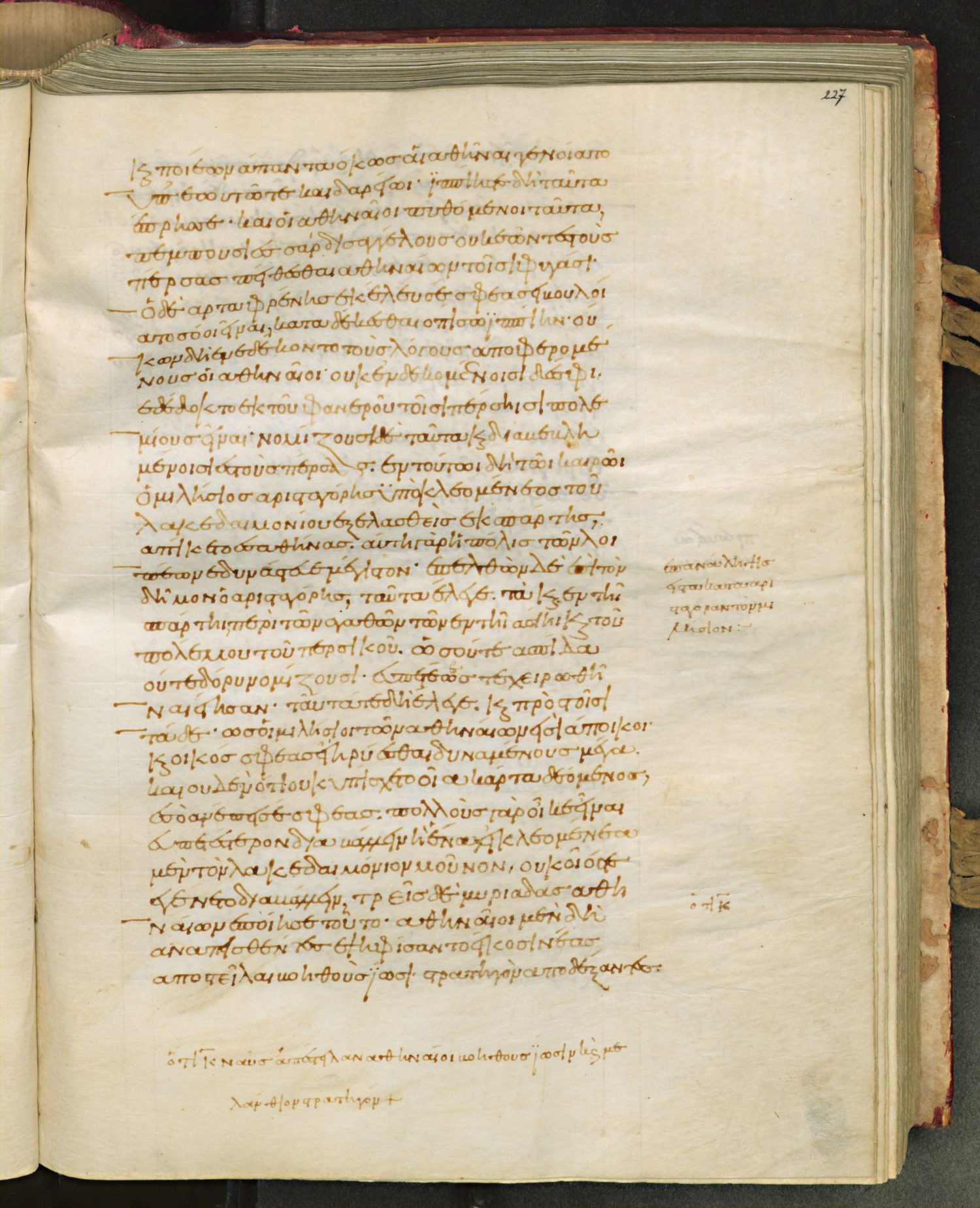
The photographs are of Florence, Biblioteca Medicea Laurenziana, Plut. 70.3 (parchment, 10th century, 374 folios, 31 lines a page), Herodotus, Histories (codex A of the editors), the oldest surviving manuscript of the complete Histories, from the Teca Digitale of the Biblioteca Medicea Laurenziana. Each section below is the text of one page, or of the part of a page that falls within these chapters. The first and last words of every page were read on the photograph and located in the Greek, and every page break was checked against the next page; the notes quote these words. Readers' notes in the margins are not part of the text and are mentioned where they occur.
The Greek is the text printed in A. D. Godley's Loeb edition (1920-1925), from Perseus; it is the edited text, not a transcription of the manuscript, whose wording differs in places. The English is Godley's translation as printed, from Wikisource. Godley's English carries only chapter numbers; the section numbers shown in it were placed by comparison with the Perseus version of his translation. Each page's English is cut at the end of one of Godley's sentences, so it can begin or end a few lines away from the Greek of the page; each note gives the exact ranges.
This entry covers chapters 5.79-96, on fol. 219r to 227r.
How was this verified? (Provenance)
Where on the image
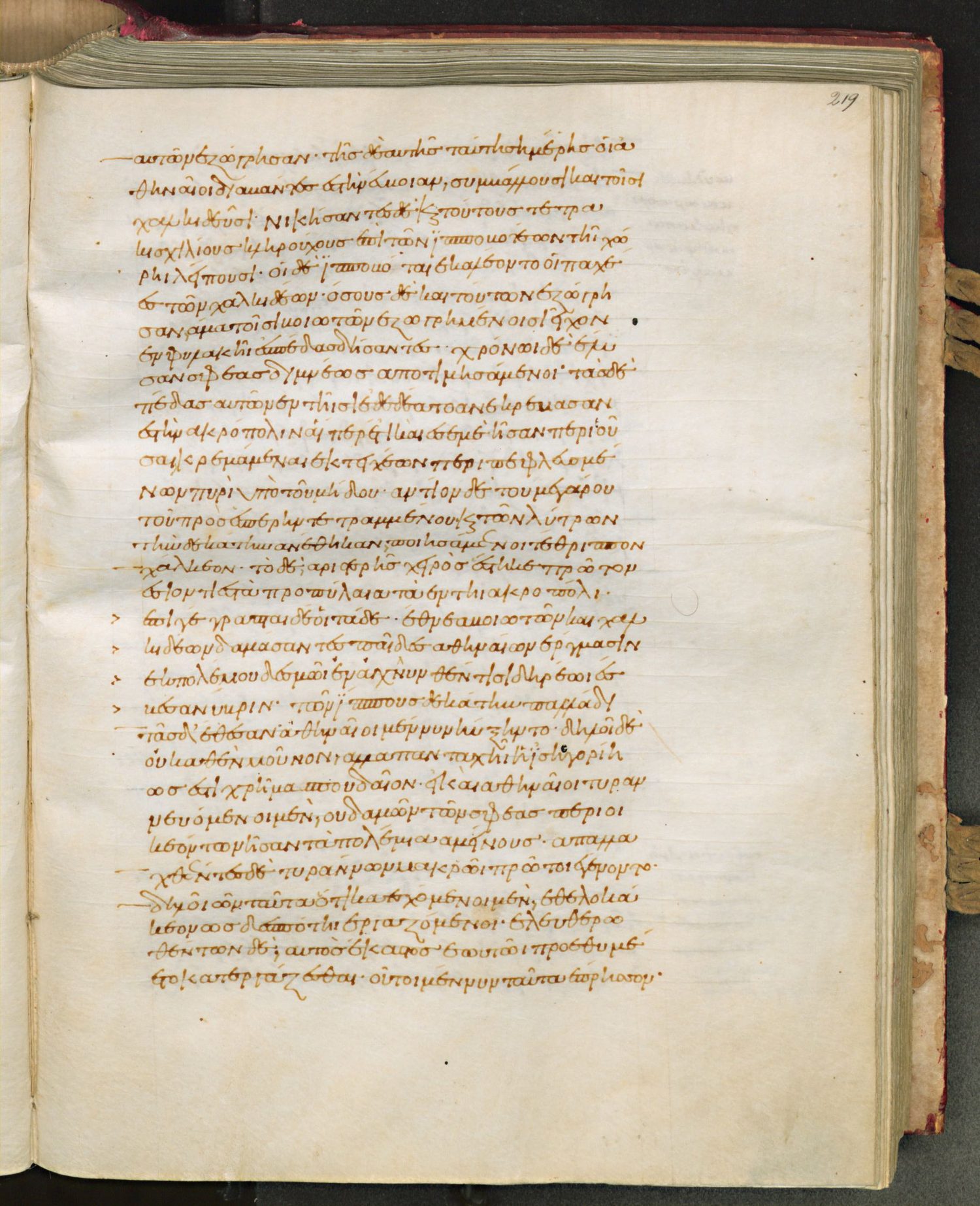
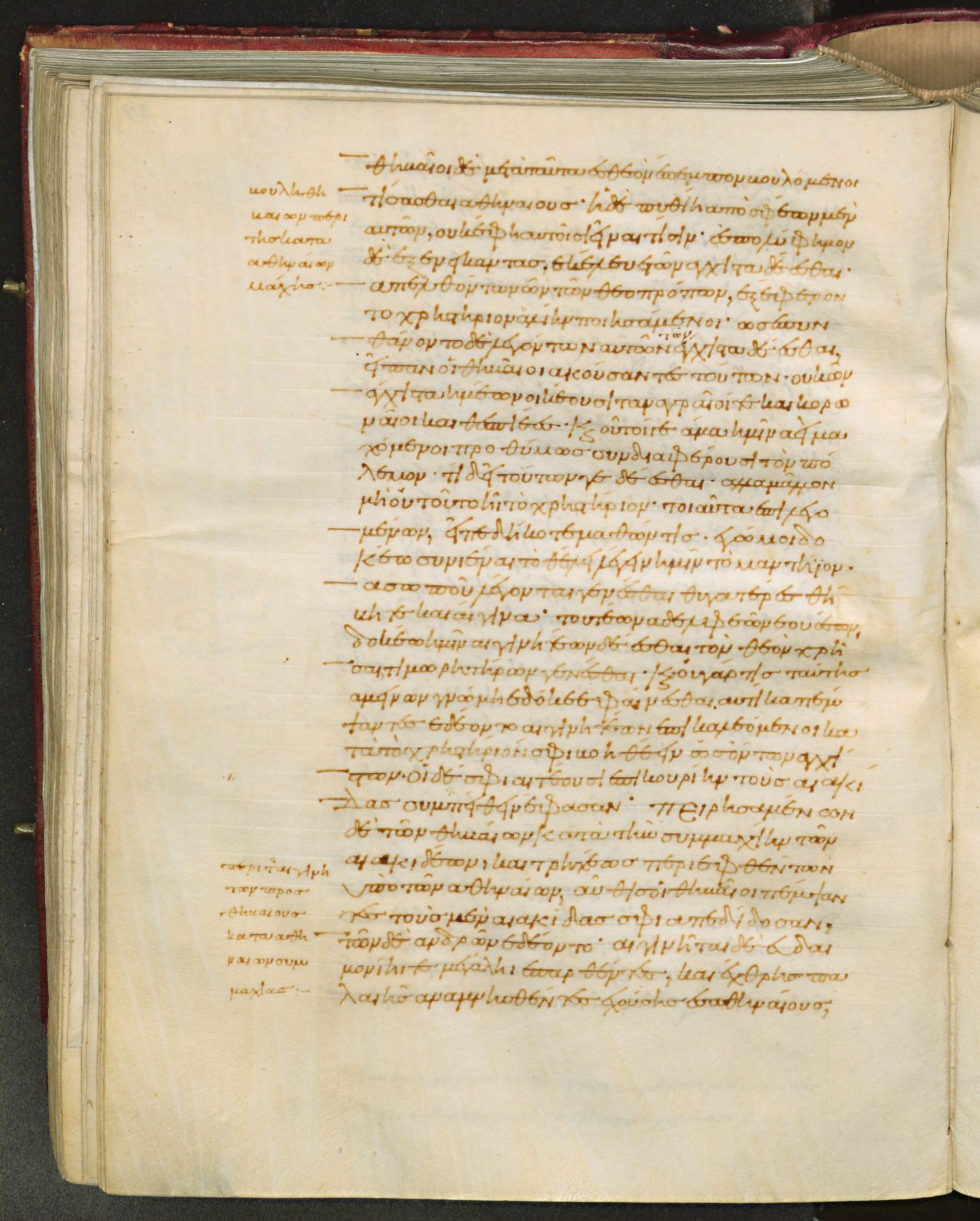
Laur. Plut. 70.3, fol. 219r, 219v: Greek here 5.79.1 to 5.81.2. Checked on the image (first and last words read and located in the Greek; each break checked against the neighbouring page): fol. 219r begins ‹αὐτῶν ἐζώγρησαν. τῆς δὲ› (5.77.2), ends ‹μέν νυν ταῦτα ἔπρησσον› (5.79.1). fol. 219v begins ‹Θῃβαῖοι δὲ μετὰ ταῦτα› (5.79.1), ends ‹ἀναμνησθέντες ἐχούσης ἐς Ἀθηναίους› (5.81.2). This section joins the text of fol. 219r and 219v that belongs to these chapters, because the part on one of the pages is too short to carry any of Godley's sentences on its own. English here: 5.79.1 to 5.81.3 (Godley's sentences for the sections whose Greek lies mostly on this page).
5.79.1οὗτοι μέν νυν ταῦτα ἔπρησσον. Θῃβαῖοι δὲ μετὰ ταῦτα ἐς θεὸν ἔπεμπον, βουλόμενοι τίσασθαι Ἀθηναίους. ἡ δὲ Πυθίη ἀπὸ σφέων μὲν αὐτῶν οὐκ ἔφη αὐτοῖσι εἶναι τίσιν, ἐς πολύφημον δὲ ἐξενείκαντας ἐκέλευε τῶν ἄγχιστα δέεσθαι. 5.79.2ἀπελθόντων ὦν τῶν θεοπρόπων, ἐξέφερον τὸ χρηστήριον ἁλίην ποιησάμενοι· ὡς ἐπυνθάνοντο δὲ λεγόντων αὐτῶν τῶν ἄγχιστα δέεσθαι, εἶπαν οἱ Θηβαῖοι ἀκούσαντες τούτων οὐκ ὦν ἄγχιστα ἡμέων οἰκέουσι Ταναγραῖοί τε καὶ Κορωναῖοι καὶ Θεσπιέες; καὶ οὗτοί γε ἅμα ἡμῖν αἰεὶ μαχόμενοι προθύμως συνδιαφέρουσι τὸν πόλεμον· τί δεῖ τούτων γε δέεσθαι; ἀλλὰ μᾶλλον μὴ οὐ τοῦτο ᾖ τὸ χρηστήριον. 5.80.1τοιαῦτα ἐπιλεγομένων εἶπε δή κοτε μαθών τις ἐγώ μοι δοκέω συνιέναι τὸ θέλει λέγειν ἡμῖν τὸ μαντήιον. Ἀσωποῦ λέγονται γενέσθαι θυγατέρες Θήβη τε καὶ Αἴγινα· τουτέων ἀδελφεῶν ἐουσέων, δοκέω ἡμῖν Αἰγινητέων δέεσθαι τὸν θεὸν χρῇσαι τιμωρητήρων γενέσθαι. 5.80.2καὶ οὐ γάρ τις ταύτης ἀμείνων γνώμη ἐδόκεε φαίνεσθαι, αὐτίκα πέμψαντες ἐδέοντο Αἰγινητέων ἐπικαλεόμενοι κατὰ τὸ χρηστήριόν σφι βοηθέειν, ὡς ἐόντων ἀγχίστων· οἳ δέ σφι αἰτέουσι ἐπικουρίην τοὺς Αἰακίδας συμπέμπειν ἔφασαν. 5.81.1πειρησαμένων δὲ τῶν Θηβαίων κατὰ τὴν συμμαχίην τῶν Αἰακιδέων καὶ τρηχέως περιεφθέντων ὑπὸ τῶν Ἀθηναίων, αὖτις οἱ Θηβαῖοι πέμψαντες τοὺς μὲν Αἰακίδας σφι ἀπεδίδοσαν, τῶν δὲ ἀνδρῶν ἐδέοντο. 5.81.2Αἰγινῆται δὲ εὐδαιμονίῃ τε μεγάλῃ ἐπαερθέντες καὶ ἔχθρης παλαιῆς ἀναμνησθέντες ἐχούσης ἐς Ἀθηναίους,
5.79.1Thus then the Athenians did. But presently the Thebans sent to the god, desiring vengeance on Athens. The Pythian priestess said that from the Thebans themselves there was no vengeance for them; they must lay the matter before the “many-voiced” and entreat their nearest. 5.79.2So when the enquirers returned an assembly was called and the oracle laid before it; and when the Thebans learnt the message “that they must entreat their nearest,” they said when they heard it: “If this be so, our nearest neighbours are the men of Tanagra and Coronea and Thespiae; yet these are ever our comrades in battle and zealously wage our wars; what need to entreat them? Nay, mayhap the oracle means not this.” 5.80.1Thuswise they reasoned, till at last one understood, and said: “Methinks I perceive what it is that the oracle will have us know. Thebe and Aegina, it is said, were daughters of Asopus and sisters; the gods’ answer is, I think, that we should entreat the Aeginetans to be our avengers.” 5.80.2Seeing that there seemed to be no better opinion before them than this, they sent forthwith to entreat the Aeginetans and invite their aid, such being the oracle’s bidding, and the Aeginetans being their nearest. These replied to their demand that they were sending the Sons of Aeacus in aid. 5.81.1The Thebans took the field on the strength of their alliance with that House, and were roughly handled by the Athenians; and they sent again, giving back Aeacus and his sons, and asking for the men instead. 5.81.2But the Aeginetans were uplifted by great prosperity, and had in mind an ancient feud with Athens; wherefore now at the entreaty of the Thebans, without sending of herald they made war 5.81.3on the Athenians; while these were busied with the Boeotians, they descended on Attica in ships of war, and ravaged Phaleron and many other seaboard townships. By so doing they dealt the Athenians a very shrewd blow.
Where on the image
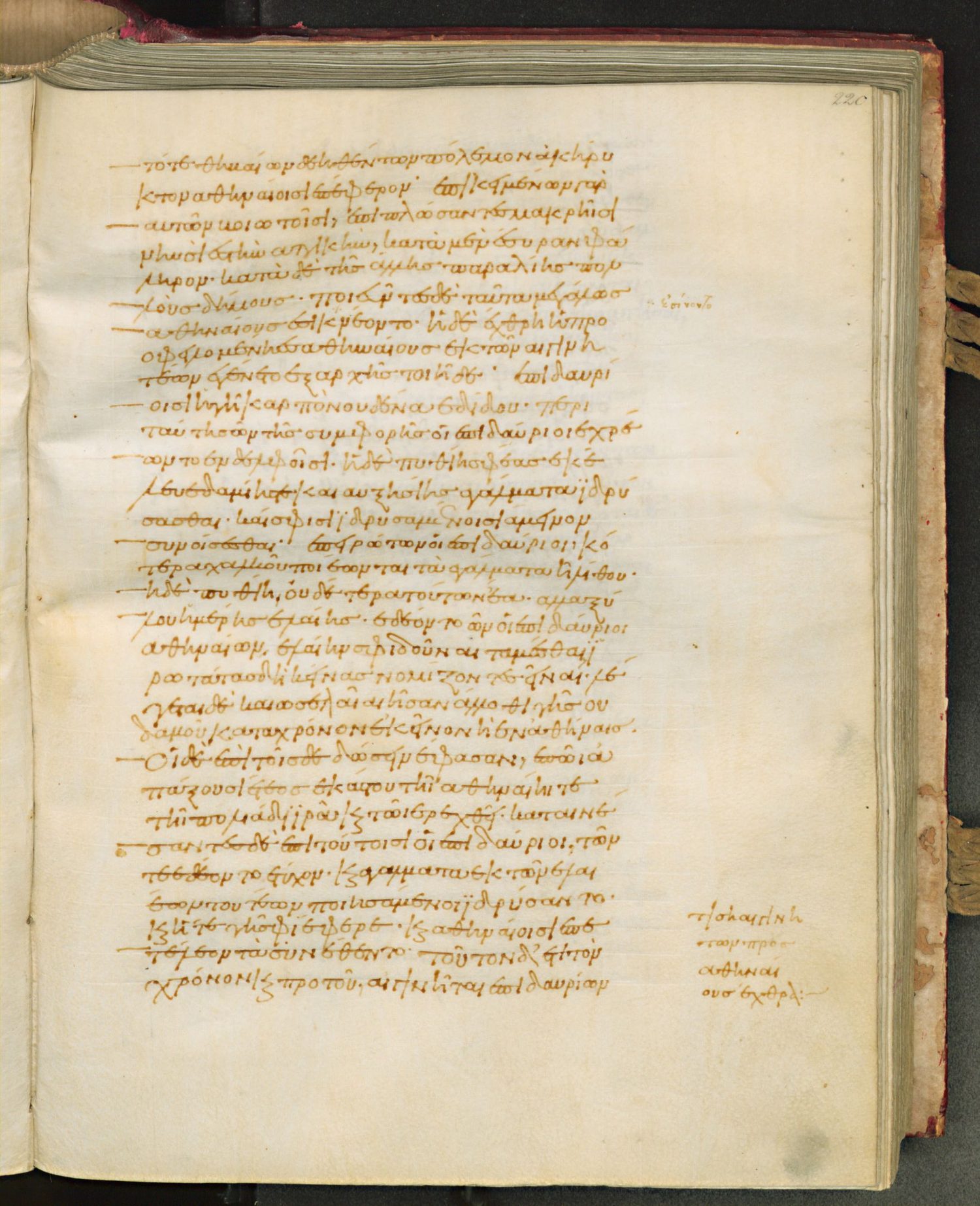
Laur. Plut. 70.3, fol. 220r: Greek here 5.81.2 to 5.83.1. Checked on the image (first and last words read and located in the Greek; each break checked against the neighbouring page): fol. 220r begins ‹τότε Θηβαίων δεηθέντων πόλεμον› (5.81.2), ends ‹πρὸ τοῦ Αἰγινῆται Ἐπιδαυρίων› (5.83.1). English here: 5.82.1 to 5.82.3 (Godley's sentences for the sections whose Greek lies mostly on this page).
5.81.2τότε Θηβαίων δεηθέντων πόλεμον ἀκήρυκτον Ἀθηναίοισι ἐπέφερον· 5.81.3ἐπικειμένων γὰρ αὐτῶν Βοιωτοῖσι, ἐπιπλώσαντες μακρῇσι νηυσὶ ἐς τὴν Ἀττικὴν κατὰ μὲν ἔσυραν Φάληρον κατὰ δὲ τῆς ἄλλης παραλίης πολλοὺς δήμους, ποιεῦντες δὲ ταῦτα μεγάλως Ἀθηναίους ἐσικνέοντο. 5.82.1ἡ δὲ ἔχθρη ἡ προοφειλομένη ἐς Ἀθηναίους ἐκ τῶν Αἰγινητέων ἐγένετο ἐξ ἀρχῆς τοιῆσδε. Ἐπιδαυρίοισι ἡ γῆ καρπὸν οὐδένα ἀνεδίδου. περὶ ταύτης ὦν τῆς συμφορῆς οἱ Ἐπιδαύριοι ἐχρέωντο ἐν Δελφοῖσι· ἡ δὲ Πυθίη σφέας ἐκέλευε Δαμίης τε καὶ Αὐξησίης ἀγάλματα ἱδρύσασθαι καί σφι ἱδρυσαμένοισι ἄμεινον συνοίσεσθαι. 5.82.2ἐπειρώτεον ὦν οἱ Ἐπιδαύριοι κότερα χαλκοῦ ποιέωνται τὰ ἀγάλματα ἢ λίθου· ἡ δὲ Πυθίη οὐδέτερα τούτων ἔα, ἀλλὰ ξύλου ἡμέρης ἐλαίης. ἐδέοντο ὦν οἱ Ἐπιδαύριοι Ἀθηναίων ἐλαίην σφι δοῦναι ταμέσθαι, ἱρωτάτας δὴ κείνας νομίζοντες εἶναι. λέγεται δὲ καὶ ὡς ἐλαῖαι ἦσαν ἄλλοθι γῆς οὐδαμοῦ κατὰ χρόνον ἐκεῖνον ἢ ἐν Ἀθήνῃσι. 5.82.3οἳ δὲ ἐπὶ τοῖσιδε δώσειν ἔφασαν ἐπʼ ᾧ ἀπάξουσι ἔτεος ἑκάστου τῇ Ἀθηναίῃ τε τῇ Πολιάδι ἱρὰ καὶ τῷ Ἐρεχθέι. καταινέσαντες δὲ ἐπὶ τούτοισι οἱ Ἐπιδαύριοι τῶν τε ἐδέοντο ἔτυχον καὶ ἀγάλματα ἐκ τῶν ἐλαιέων τουτέων ποιησάμενοι ἱδρύσαντο· καὶ ἥ τε γῆ σφι ἔφερε καρπὸν καὶ Ἀθηναίοισι ἐπετέλεον τὰ συνέθεντο. 5.83.1τοῦτον δʼ ἔτι τὸν χρόνον καὶ πρὸ τοῦ Αἰγινῆται Ἐπιδαυρίων
5.82.1Now this was the beginning of the Aeginetans’ long-standing arrears of enmity against the Athenians. The Epidaurians’ land bore no produce; wherefore they enquired at Delphi concerning this calamity; and the priestess bade them set up images of Damia and Auxesia, saying that if they so did their luck would be better. The Epidaurians then asking further, whether they should make the images of bronze or of stone, the priestess bade them do neither, but make them of the wood of the garden olive. 5.82.2So the men of Epidaurus entreated the Athenians to give them olives for the cutting, supposing the olives there to be the holiest; and indeed it is said that at that time there were no olives anywhere save at Athens. 5.82.3The Athenians consented to give the trees, if the Epidaurians would pay yearly sacred dues to Athene the city’s goddess and to Erechtheus. The Epidaurians agreed on this condition, and their request was granted. They set up images made of these olives; and their land brought forth fruit, and they fulfilled their agreement with the Athenians.
Where on the image
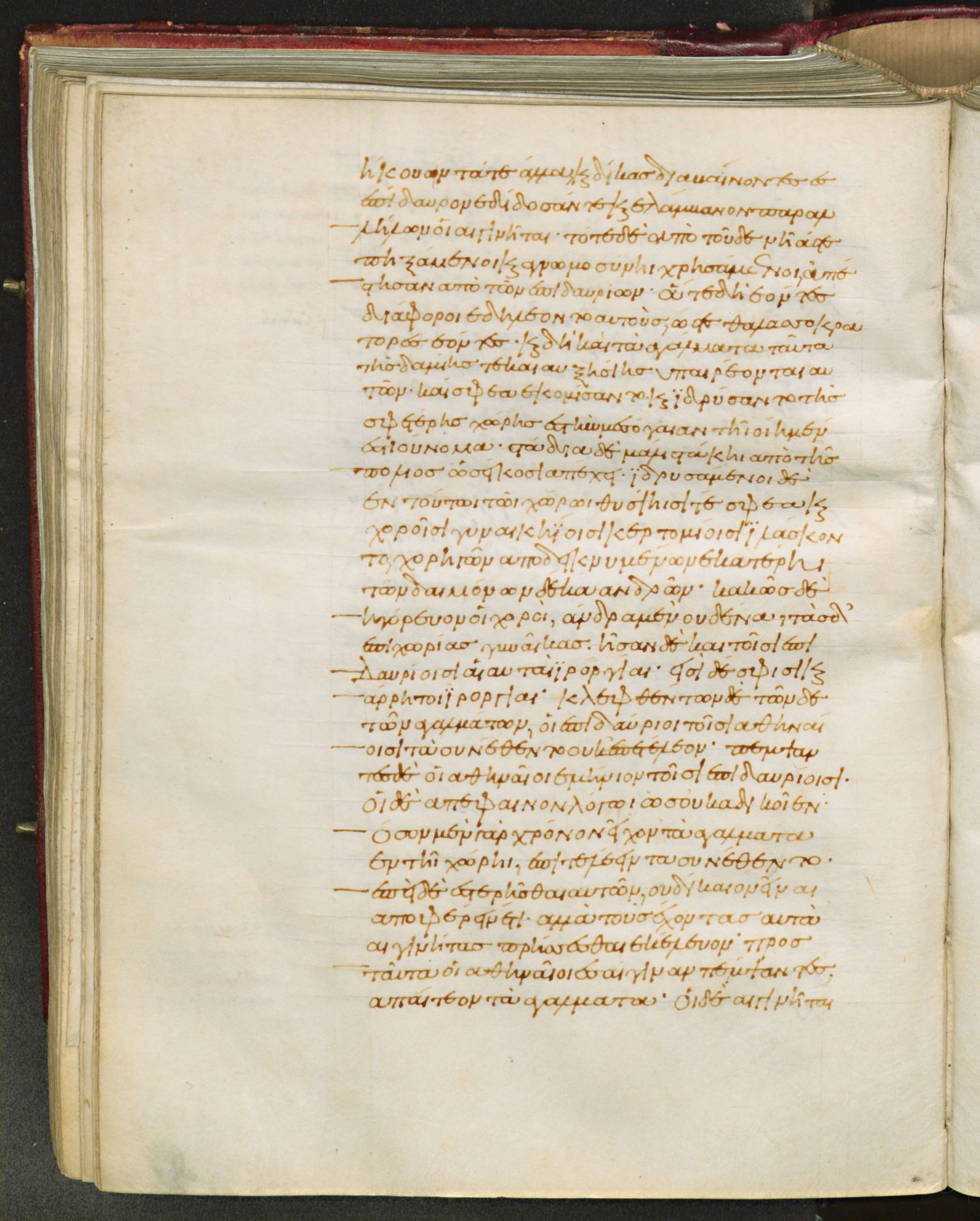
Laur. Plut. 70.3, fol. 220v: Greek here 5.83.1 to 5.84.2. Checked on the image (first and last words read and located in the Greek; each break checked against the neighbouring page): fol. 220v begins ‹ἤκουον τά τε ἄλλα› (5.83.1), ends ‹ἀγάλματα· οἱ δὲ Αἰγινῆται› (5.84.2). English here: 5.83.1 to 5.84.2 (Godley's sentences for the sections whose Greek lies mostly on this page).
5.83.1ἤκουον τά τε ἄλλα καὶ δίκας διαβαίνοντες ἐς Ἐπίδαυρον ἐδίδοσάν τε καὶ ἐλάμβανον παρʼ ἀλλήλων οἱ Αἰγινῆται· τὸ δὲ ἀπὸ τοῦδε νέας τε πηξάμενοι καὶ ἀγνωμοσύνῃ χρησάμενοι ἀπέστησαν ἀπὸ τῶν Ἐπιδαυρίων. 5.83.2ἅτε δὲ ἐόντες διάφοροι ἐδηλέοντο αὐτούς, ὥστε θαλασσοκράτορες ἐόντες, καὶ δὴ καὶ τὰ ἀγάλματα ταῦτα τῆς τε Δαμίης καὶ τῆς Αὐξησίης ὑπαιρέονται αὐτῶν, καί σφεα ἐκόμισάν τε καὶ ἱδρύσαντο τῆς σφετέρης χώρης ἐς τὴν μεσόγαιαν, τῇ Οἴη μὲν ἐστὶ οὔνομα, στάδια δὲ μάλιστά κῃ ἀπὸ τῆς πόλιος ὡς εἴκοσι ἀπέχει. 5.83.3ἱδρυσάμενοι δὲ ἐν τούτῳ τῷ χώρῳ θυσίῃσί τε σφέα καὶ χοροῖσι γυναικηίοισι κερτομίοισι ἱλάσκοντο, χορηγῶν ἀποδεικνυμένων ἑκατέρῃ τῶν δαιμόνων δέκα ἀνδρῶν· κακῶς δὲ ἠγόρευον οἱ χοροὶ ἄνδρα μὲν οὐδένα, τὰς δὲ ἐπιχωρίας γυναῖκας. ἦσαν δὲ καὶ τοῖσι Ἐπιδαυρίοισι αἱ αὐταὶ ἱροεργίαι· εἰσὶ δέ σφι καὶ ἄρρητοι ἱρουργίαι. 5.84.1κλεφθέντων δὲ τῶνδε τῶν ἀγαλμάτων οἱ Ἐπιδαύριοι τοῖσι Ἀθηναίοισι τὰ συνέθεντο οὐκ ἐπετέλεον. πέμψαντες δὲ οἱ Ἀθηναῖοι ἐμήνιον τοῖσι Ἐπιδαυρίοισι· οἳ δὲ ἀπέφαινον λόγῳ ὡς οὐκ ἀδικέοιεν· ὅσον μὲν γὰρ χρόνον εἶχον τὰ ἀγάλματα ἐν τῇ χώρῃ, ἐπιτελέειν τὰ συνέθεντο, ἐπεὶ δὲ ἐστερῆσθαι αὐτῶν, οὐ δίκαιον εἶναι ἀποφέρειν ἔτι, ἀλλὰ τοὺς ἔχοντας αὐτὰ Αἰγινήτας πρήσσεσθαι ἐκέλευον. 5.84.2πρὸς ταῦτα οἱ Ἀθηναῖοι ἐς Αἴγιναν πέμψαντες ἀπαίτεον τὰ ἀγάλματα· οἱ δὲ Αἰγινῆται
5.83.1Now still at this time, as before it, the Aeginetans were in all matters subject to the Epidaurians, crossing over to Epidaurus and there getting, and giving one another, satisfaction at law. But from this time they began to build ships, and stubbornly revolted from the Epidaurians; 5.83.2in which state of enmity, being masters of the sea, they wrought them much hurt, and stole withal their images of Damia and Auxesia, and took these away and set them up in the middle of their own country at a place called Oea, about twenty furlongs distant from their city. 5.83.3Having set them up in this place they sought their favour with sacrifices and choruses of mocking women, ten men being appointed providers of a chorus for each of the deities; and the choruses aimed their raillery not at any men but at the women of the country. The Epidaurians too had the same rites; and they have certain secret rites as well. 5.84.1But when these images were stolen, the Epidaurians ceased from fulfilling their agreement with the Athenians. Then the Athenians sent an angry message to the Epidaurians; but these pleaded that they were doing no wrong; “for as long,” they said, “as we had the images in our country, we fulfilled our agreement; but now that we are deprived of them, it is not just that we should still be paying; nay, ask your dues of the men of Aegina, who have the images.” 5.84.2The Athenians therefore sent to Aegina and demanded that the images be restored; but the Aeginetans answered that they had nothing to do with the Athenians.
Where on the image
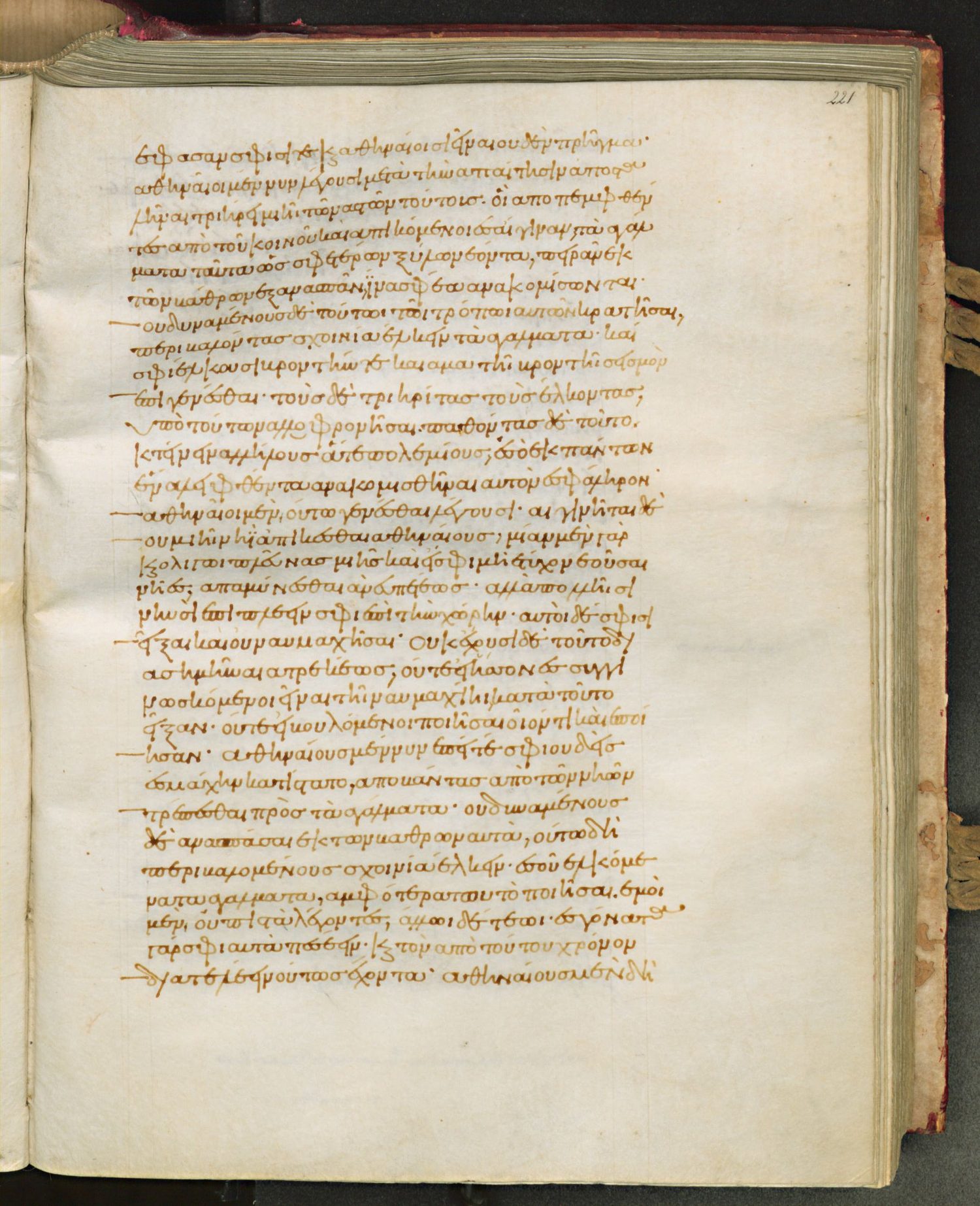
Laur. Plut. 70.3, fol. 221r: Greek here 5.84.2 to 5.86.4. Checked on the image (first and last words read and located in the Greek; each break checked against the neighbouring page): fol. 221r begins ‹ἔφασαν σφίσι τε καὶ› (5.84.2), ends ‹οὕτω ἔχοντα.Ἀθηναίους μὲν δὴ› (5.86.4). English here: 5.85.1 to 5.86.3 (Godley's sentences for the sections whose Greek lies mostly on this page).
5.84.2ἔφασαν σφίσι τε καὶ Ἀθηναίοισι εἶναι οὐδὲν πρῆγμα. 5.85.1Ἀθηναῖοι μέν νυν λέγουσι μετὰ τὴν ἀπαίτησιν ἀποσταλῆναι τριήρεϊ μιῇ τῶν ἀστῶν τούτους οἳ ἀποπεμφθέντες ἀπὸ τοῦ κοινοῦ καὶ ἀπικόμενοι ἐς Αἴγιναν τὰ ἀγάλματα ταῦτα ὡς σφετέρων ξύλων ἐόντα ἐπειρῶντο ἐκ τῶν βάθρων ἐξανασπᾶν, ἵνα σφέα ἀνακομίσωνται. 5.85.2οὐ δυναμένους δὲ τούτῳ τῷ τρόπῳ αὐτῶν κρατῆσαι, περιβαλόντας σχοινία ἕλκειν τὰ ἀγάλματα, καί σφι ἕλκουσι βροντήν τε καὶ ἅμα τῇ βροντῇ σεισμὸν ἐπιγενέσθαι· τοὺς δὲ τριηρίτας τοὺς ἕλκοντας ὑπὸ τούτων ἀλλοφρονῆσαι, παθόντας δὲ τοῦτο κτείνειν ἀλλήλους ἅτε πολεμίους, ἐς ὃ ἐκ πάντων ἕνα λειφθέντα ἀνακομισθῆναι αὐτὸν ἐς Φάληρον. 5.86.1Ἀθηναῖοι μὲν οὕτω γενέσθαι λέγουσι, Αἰγινῆται δὲ οὐ μιῇ νηὶ ἀπικέσθαι Ἀθηναίους· μίαν μὲν γὰρ καὶ ὀλίγῳ πλεῦνας μιῆς, καὶ εἰ σφίσι μὴ ἔτυχον ἐοῦσαι νέες, ἀπαμύνεσθαι ἂν εὐπετέως· ἀλλὰ πολλῇσι νηυσὶ ἐπιπλέειν σφίσι ἐπὶ τὴν χώρην, αὐτοὶ δέ σφι εἶξαι καὶ οὐ ναυμαχῆσαι. 5.86.2οὐκ ἔχουσι δὲ τοῦτο διασημῆναι ἀτρεκέως, οὔτε εἰ ἥσσονες συγγινωσκόμενοι εἶναι τῇ ναυμαχίῃ κατὰ τοῦτο εἶξαν, οὔτε εἰ βουλόμενοι ποιῆσαι οἷόν τι καὶ ἐποίησαν. 5.86.3Ἀθηναίους μέν νυν, ἐπείτε σφι οὐδεὶς ἐς μάχην κατίστατο, ἀποβάντας ἀπὸ τῶν νεῶν τραπέσθαι πρὸς τὰ ἀγάλματα, οὐ δυναμένους δὲ ἀνασπάσαι ἐκ τῶν βάθρων αὐτὰ οὕτω δὴ περιβαλομένους σχοινία ἕλκειν, ἐς οὗ ἑλκόμενα τὰ ἀγάλματα ἀμφότερα τὠυτὸ ποιῆσαι, ἐμοὶ μὲν οὐ πιστὰ λέγοντες, ἄλλῳ δὲ τεῷ· ἐς γούνατα γάρ σφι αὐτὰ πεσεῖν, καὶ τὸν ἀπὸ τούτου χρόνον διατελέειν οὕτω ἔχοντα. 5.86.4Ἀθηναίους μὲν δὴ
5.85.1After their demand the Athenians (this is their story) despatched one trireme with certain of their citizens; who, coming as they were sent in the name of the whole people to Aegina, essayed to tear the images, as being made of Attic wood, from their bases, that they might carry them away; but 5.85.2when they could not get possession of them in this manner, they fastened the images about with cords and made to drag them away, till while they dragged they were overtaken by a thunderstorm, and an earthquake withal; whereby the trireme’s crew that dragged the images were distraught, and in this affliction slew each other for enemies, till at last but one of all was left, who returned back by himself to Phalerum. 5.86.1This is the Athenian story of the matter; but the Aeginetans say that the Athenians came not in one ship only; “for,” they say, “even if we had had no ships of our own, we could right easily have defended ourselves against one ship, or a few more; but the truth is that they descended upon our coasts with many ships, and we yielded to them and made no fight of it at sea.” 5.86.2But they can never show with exact plainness whether it was because they confessed themselves to be the weaker at sea-fighting that they yielded, or because they purposed to do somewhat such as in the event they did. 5.86.3The Athenians then (say the Aeginetans), when no man came out to fight with them, disembarked from their ships and set about dealing with the images; and not being able to drag them from the bases they did there and then fasten them about with cords and drag them, till as they were dragged both the images together (and this I myself do not believe, yet others may) fell with the selfsame motion on their knees, and have remained so from that day.
Where on the image
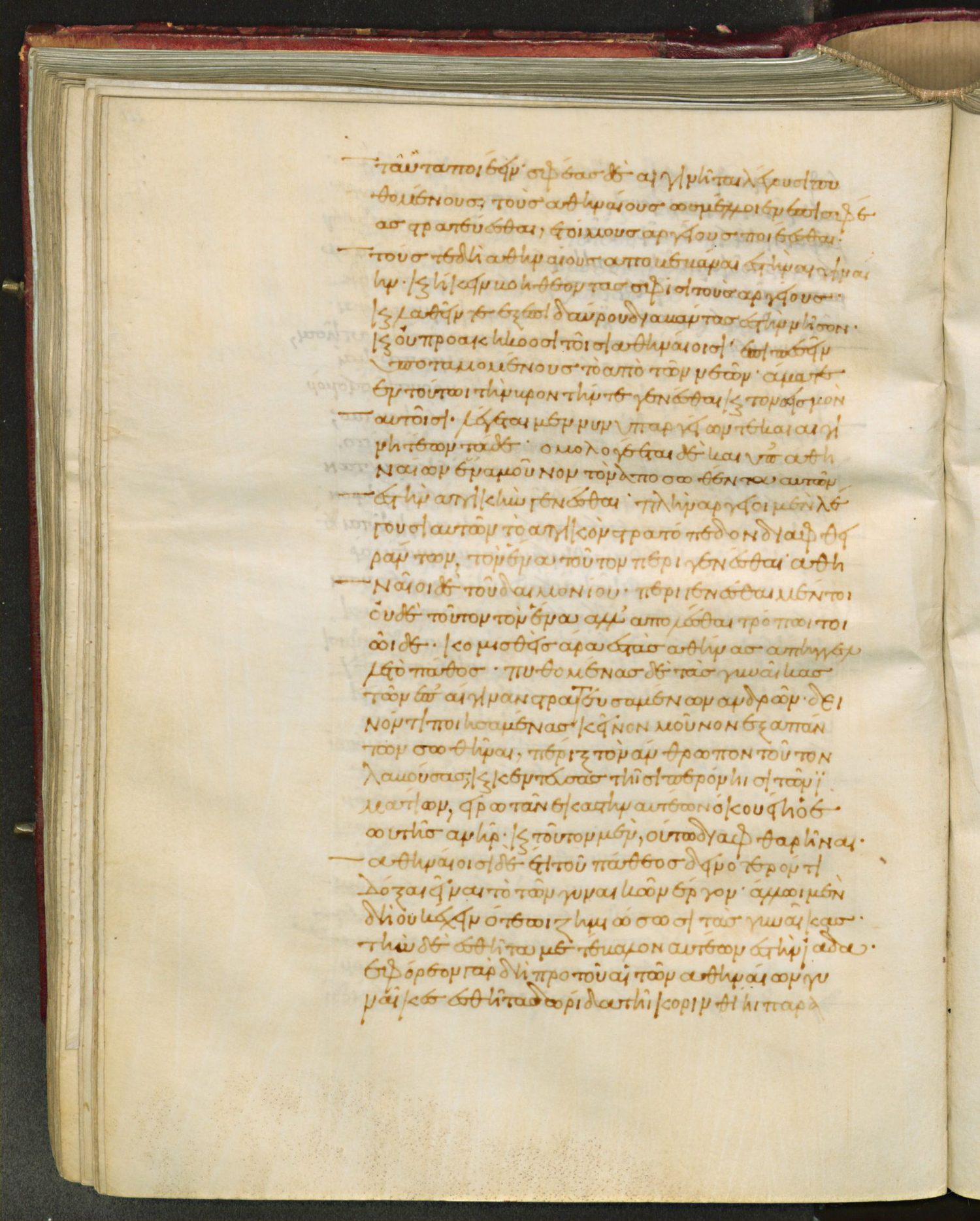
Laur. Plut. 70.3, fol. 221v: Greek here 5.86.4 to 5.87.3. Checked on the image (first and last words read and located in the Greek; each break checked against the neighbouring page): fol. 221v begins ‹ταῦτα ποιέειν· σφέας δὲ› (5.86.4), ends ‹Δωρίδα, τῇ Κορινθίῃ παρα-› (5.87.3). English here: 5.86.4 to 5.87.3 (Godley's sentences for the sections whose Greek lies mostly on this page).
5.86.4ταῦτα ποιέειν· σφέας δὲ Αἰγινῆται λέγουσι πυθομένους τοὺς Ἀθηναίους ὡς μέλλοιεν ἐπὶ σφέας στρατεύεσθαι, ἑτοίμους Ἀργείους ποιέεσθαι. τούς τε δὴ Ἀθηναίους ἀποβεβάναι ἐς τὴν Αἰγιναίην, καὶ ἥκειν βοηθέοντας σφίσι τοὺς Ἀργείους καὶ λαθεῖν τε ἐξ Ἐπιδαύρου διαβάντας ἐς τὴν νῆσον καὶ οὐ προακηκοόσι τοῖσι Ἀθηναίοισι ἐπιπεσεῖν ὑποταμομένους τὸ ἀπὸ τῶν νεῶν, ἅμα τε ἐν τούτῳ τὴν βροντήν τε γενέσθαι καὶ τὸν σεισμὸν αὐτοῖσι. 5.87.1λέγεται μέν νυν ὑπʼ Ἀργείων τε καὶ Αἰγινητέων τάδε, ὁμολογέεται δὲ καὶ ὑπʼ Ἀθηναίων ἕνα μοῦνον τὸν ἀποσωθέντα αὐτῶν ἐς τὴν Ἀττικὴν γενέσθαι· 5.87.2πλὴν Ἀργεῖοι μὲν λέγουσι αὐτῶν τὸ Ἀττικὸν στρατόπεδον διαφθειράντων τὸν ἕνα τοῦτον περιγενέσθαι, Ἀθηναῖοι δὲ τοῦ δαιμονίου· περιγενέσθαι μέντοι οὐδὲ τοῦτον τὸν ἕνα, ἀλλʼ ἀπολέσθαι τρόπῳ τοιῷδε. κομισθεὶς ἄρα ἐς τὰς Ἀθήνας ἀπήγγελλε τὸ πάθος· πυθομένας δὲ τὰς γυναῖκας τῶν ἐπʼ Αἴγιναν στρατευσαμένων ἀνδρῶν, δεινόν τι ποιησαμένας κεῖνον μοῦνον ἐξ ἁπάντων σωθῆναι, πέριξ τὸν ἄνθρωπον τοῦτον λαβούσας καὶ κεντεύσας τῇσι περόνῃσι τῶν ἱματίων εἰρωτᾶν ἑκάστην αὐτέων ὅκου εἴη ὁ ἑωυτῆς ἀνήρ. 5.87.3καὶ τοῦτον μὲν οὕτω διαφθαρῆναι, Ἀθηναίοισι δὲ ἔτι τοῦ πάθεος δεινότερόν τι δόξαι εἶναι τὸ τῶν γυναικῶν ἔργον. ἄλλῳ μὲν δὴ οὐκ ἔχειν ὅτεῳ ζημιώσωσι τὰς γυναῖκας, τὴν δὲ ἐσθῆτα μετέβαλον αὐτέων ἐς τὴν Ἰάδα· ἐφόρεον γὰρ δὴ πρὸ τοῦ αἱ τῶν Ἀθηναίων γυναῖκες ἐσθῆτα Δωρίδα, τῇ Κορινθίῃ παραπλησιωτάτην·
5.86.4Thus, then, did the Athenians; but as for themselves, the Aeginetans say that they learnt that the Athenians were about to make war upon them, and therefore they assured themselves of help from the Argives. So when the Athenians disembarked on the land of Aegina, the Argives came to aid the Aeginetans, crossing over from Epidaurus to the island privily, and then falling upon the Athenians unawares and cutting them off from their ships; and it was at this moment that the thunderstorm came upon them, and the earthquake withal. 5.87.1This, then, is the story told by the Argives and Aeginetans, and the Athenians too acknowledge that it was only one man of them who came safe back to Attica; but 5.87.2the Argives say that it was they, and the Athenians that it was divine power, that destroyed the Attic army when this one man was saved alive; albeit even this one (say the Athenians) was not saved alive but perished as here related. It would seem that he made his way to Athens and told of the mishap; and when this was known (it is said) to the wives of the men who had gone to attack Aegina, they were very wroth that he alone should be safe out of all, and they gathered round him and stabbed him with the brooch-pins of their garments, each asking him “where her man 5.87.3was.”
Where on the image
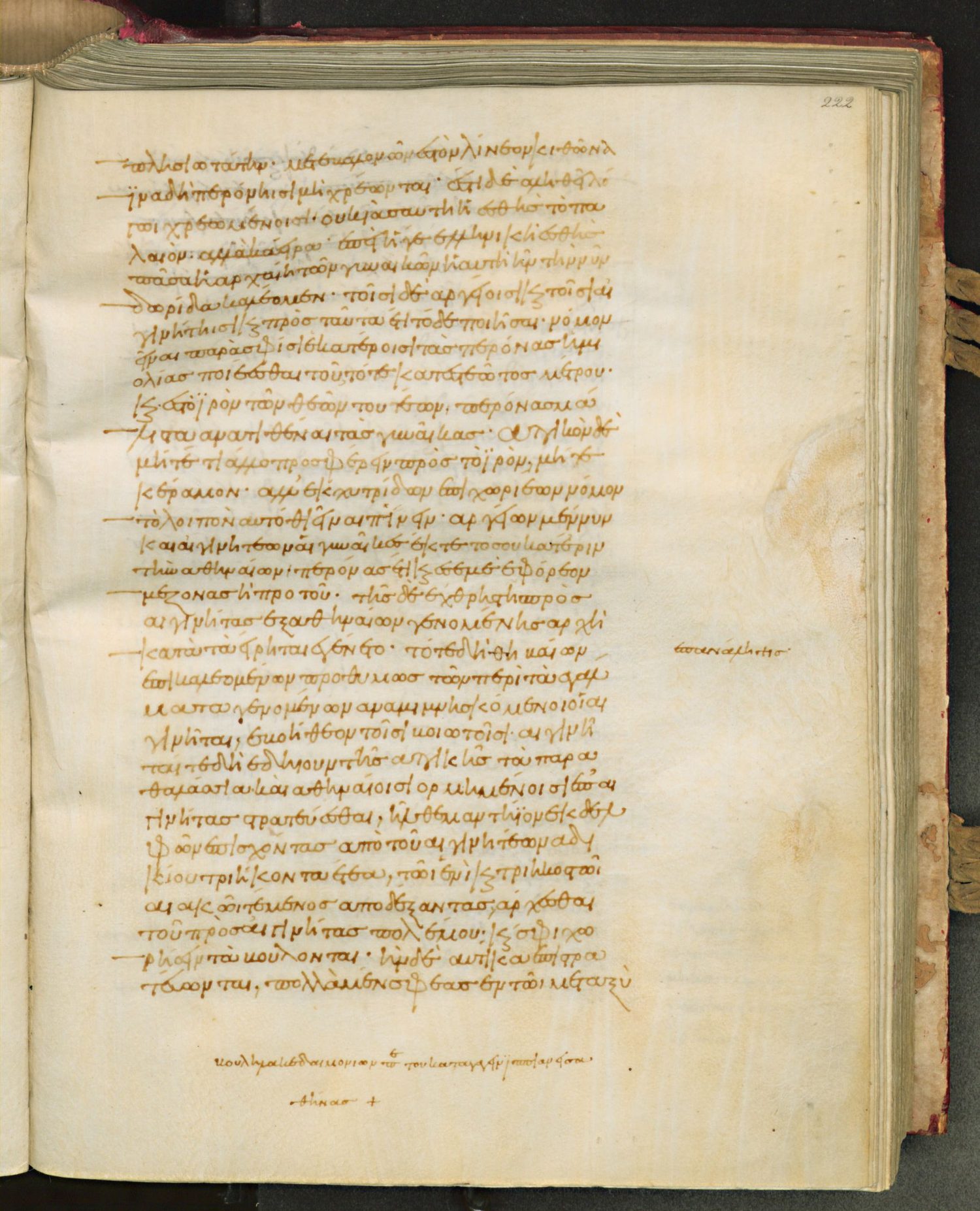
Laur. Plut. 70.3, fol. 222r: Greek here 5.87.3 to 5.89.2. Checked on the image (first and last words read and located in the Greek; each break checked against the neighbouring page): fol. 222r begins ‹-πλησιωτάτην· μετέβαλον ὦν ἐς› (5.87.3), ends ‹σφέας ἐν τῷ μεταξὺ› (5.89.2). The word ‹παραπλησιωτάτην·› is divided between fol. 221v and fol. 222r; it is given with fol. 221v. Below the text, a reader's note on the Lacedaemonians' plan to bring back Hippias to rule Athens. English here: 5.88.1 to 5.89.2 (Godley's sentences for the sections whose Greek lies mostly on this page).
5.87.3μετέβαλον ὦν ἐς τὸν λίνεον κιθῶνα, ἵνα δὴ περόνῃσι μὴ χρέωνται. 5.88.1ἔστι δὲ ἀληθέι λόγῳ χρεωμένοισι οὐκ Ἰὰς αὕτη ἡ ἐσθὴς τὸ παλαιὸν ἀλλὰ Κάειρα, ἐπεὶ ἥ γε Ἑλληνικὴ ἐσθὴς πᾶσα ἡ ἀρχαίη τῶν γυναικῶν ἡ αὐτὴ ἦν τὴν νῦν Δωρίδα καλέομεν. 5.88.2τοῖσι δὲ Ἀργείοισι καὶ τοῖσι Αἰγινήτῃσι καὶ πρὸς ταῦτα ἔτι τόδε ποιῆσαι νόμον εἶναι παρὰ σφίσι ἑκατέροισι τὰς περόνας ἡμιολίας ποιέεσθαι τοῦ τότε κατεστεῶτος μέτρου, καὶ ἐς τὸ ἱρὸν τῶν θεῶν τουτέων περόνας μάλιστα ἀνατιθέναι τὰς γυναῖκας, Ἀττικὸν δὲ μήτε τι ἄλλο προσφέρειν πρὸς τὸ ἱρὸν μήτε κέραμον, ἀλλʼ ἐκ χυτρίδων ἐπιχωριέων νόμον τὸ λοιπὸν αὐτόθι εἶναι πίνειν. 5.89.1Ἀργείων μέν νυν καὶ Αἰγινητέων αἱ γυναῖκες ἐκ τόσου κατʼ ἔριν τὴν Ἀθηναίων περόνας ἔτι καὶ ἐς ἐμὲ ἐφόρεον μέζονας ἢ πρὸ τοῦ, τῆς δὲ ἔχθρης τῆς πρὸς Αἰγινήτας ἐξ Ἀθηναίων γενομένης ἀρχὴ κατὰ τὰ εἴρηται ἐγένετο. τότε δὲ Θηβαίων ἐπικαλεομένων, προθύμως τῶν περὶ τὰ ἀγάλματα γενομένων ἀναμιμνησκόμενοι οἱ Αἰγινῆται ἐβοήθεον τοῖσι Βοιωτοῖσι. 5.89.2Αἰγινῆταί τε δὴ ἐδηίουν τῆς Ἀττικῆς τὰ παραθαλάσσια, καὶ Ἀθηναίοισι ὁρμημένοισι ἐπʼ Αἰγινήτας στρατεύεσθαι ἦλθε μαντήιον ἐκ Δελφῶν, ἐπισχόντας ἀπὸ τοῦ Αἰγινητέων ἀδικίου τριήκοντα ἔτεα, τῷ ἑνὶ καὶ τριηκοστῷ Αἰακῷ τέμενος ἀποδέξαντας ἄρχεσθαι τοῦ πρὸς Αἰγινήτας πολέμου, καί σφι χωρήσειν τὰ βούλονται· ἢν δὲ αὐτίκα ἐπιστρατεύωνται, πολλὰ μὲν σφέας ἐν τῷ μεταξὺ
5.88.1Thus was this man done to death; and this deed of their women seemed to the Athenians to be yet more dreadful than their misfortune. They could find, it is said, no other way to punish the women; but they changed their dress to the Ionian fashion; for till then the Athenian women had worn Dorian dress, very like to the Corinthian; it was changed, therefore, to the linen tunic, that so they might have no brooch-pins to use. But if the truth be told, this dress is not in its origin Ionian, but Carian; for in Hellas itself all the women’s dress in ancient times was the same as that which we now call Dorian. 5.88.2As for the Argives and Aeginetans, this was the reason of their even making a law for each of their nations that their brooch-pins should be made half as long again as the measure then customary, and that brooch-pins in especial should be dedicated by their women in the temple of those goddesses; and that neither aught else Attic should be brought to the temple, nor earthenware, but that it be the law to drink there from vessels of the country. 5.89.1So then the women of Argolis and Aegina ever since that day wore brooch-pins longer than before, by reason of the feud with the Athenians, and so they did even to my time; and the enmity of the Athenians against the Aeginetans began as I have told. And now at the Thebans’ call the Aeginetans came readily to the aid of the Boeotians, remembering the business of the images. 5.89.2The Aeginetans laying waste the seaboard of Attica, the Athenians were setting out to march against them; but there came to them an oracle from Delphi bidding them to hold their hands for thirty years after the wrong-doing of the Aeginetans, and in the thirty-first to mark out a precinct for Aeacus and begin the war with Aegina; thus should their purpose prosper; but if they sent an army against their enemies forthwith, they should indeed subdue them at the last, but in the meanwhile many should be their sufferings and many too their doings.
Where on the image
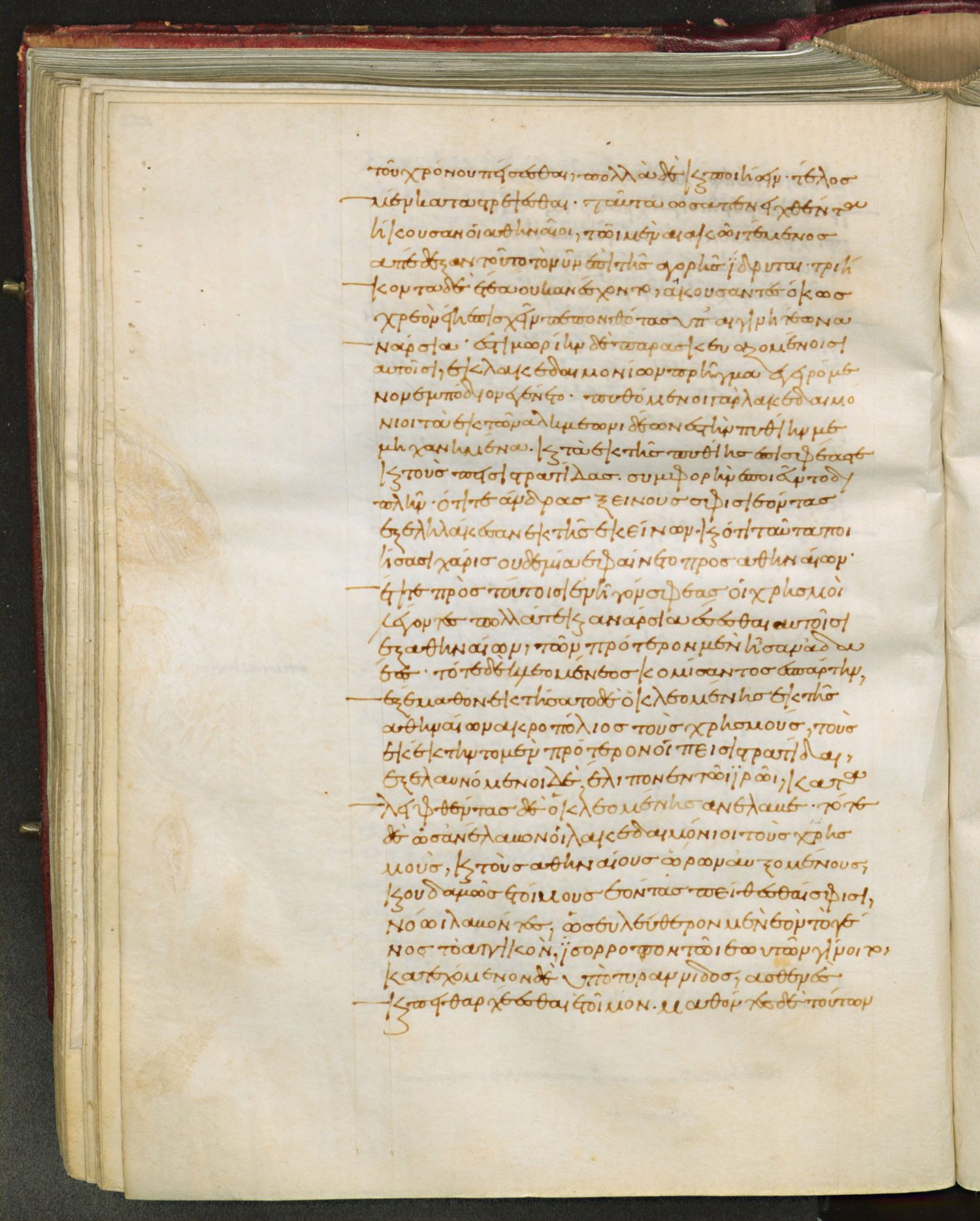
Laur. Plut. 70.3, fol. 222v: Greek here 5.89.2 to 5.91.1. Checked on the image (first and last words read and located in the Greek; each break checked against the neighbouring page): fol. 222v begins ‹τοῦ χρόνου πείσεσθαι πολλὰ› (5.89.2), ends ‹ἕτοιμον· μαθόντες δὲ τούτων› (5.91.1). English here: 5.89.3 to 5.91.2 (Godley's sentences for the sections whose Greek lies mostly on this page).
5.89.2τοῦ χρόνου πείσεσθαι πολλὰ δὲ καὶ ποιήσειν, τέλος μέντοι καταστρέψεσθαι. 5.89.3ταῦτα ὡς ἀπενειχθέντα ἤκουσαν οἱ Ἀθηναῖοι, τῷ μὲν Αἰακῷ τέμενος ἀπέδεξαν τοῦτο τὸ νῦν ἐπὶ τῆς ἀγορῆς ἵδρυται, τριήκοντα δὲ ἔτεα οὐκ ἀνέσχοντο ἀκούσαντες ὅκως χρεὸν εἴη ἐπισχεῖν πεπονθότας ὑπʼ Αἰγινητέων ἀνάρσια. 5.90.1ἐς τιμωρίην δὲ παρασκευαζομένοισι αὐτοῖσι ἐκ Λακεδαιμονίων πρῆγμα ἐγειρόμενον ἐμπόδιον ἐγένετο. πυθόμενοι γὰρ Λακεδαιμόνιοι τὰ ἐκ τῶν Ἀλκμεωνιδέων ἐς τὴν Πυθίην μεμηχανημένα καὶ τὰ ἐκ τῆς Πυθίης ἐπὶ σφέας τε καὶ τοὺς Πεισιστρατίδας συμφορὴν ἐποιεῦντο διπλῆν, ὅτι τε ἄνδρας ξείνους σφίσι ἐόντας ἐξεληλάκεσαν ἐκ τῆς ἐκείνων, καὶ ὅτι ταῦτα ποιήσασι χάρις οὐδεμία ἐφαίνετο πρὸς Ἀθηναίων. 5.90.2ἔτι τε πρὸς τούτοισι ἐνῆγον σφέας οἱ χρησμοὶ λέγοντες πολλά τε καὶ ἀνάρσια ἔσεσθαι αὐτοῖσι ἐξ Ἀθηναίων, τῶν πρότερον μὲν ἦσαν ἀδαέες, τότε δὲ Κλεομένεος κομίσαντος ἐς Σπάρτην ἐξέμαθον. ἐκτήσατο δὲ ὁ Κλεομένης ἐκ τῆς Ἀθηναίων ἀκροπόλιος τοὺς χρησμούς, τοὺς ἔκτηντο μὲν πρότερον οἱ Πεισιστρατίδαι, ἐξελαυνόμενοι δὲ ἔλιπον ἐν τῷ ἱρῷ, καταλειφθέντας δὲ ὁ Κλεομένης ἀνέλαβε. 5.91.1τότε δὲ ὡς ἀνέλαβον οἱ Λακεδαιμόνιοι τοὺς χρησμοὺς καὶ τοὺς Ἀθηναίους ὥρων αὐξομένους καὶ οὐδαμῶς ἑτοίμους ἐόντας πείθεσθαι σφίσι, νόῳ λαβόντες ὡς ἐλεύθερον μὲν ἐὸν τὸ γένος τὸ Ἀττικὸν ἰσόρροπον ἂν τῷ ἑωυτῶν γίνοιτο, κατεχόμενον δὲ ὑπὸ τυραννίδος ἀσθενὲς καὶ πειθαρχέεσθαι ἕτοιμον· μαθόντες δὲ τούτων
5.89.3When the Athenians heard this reported to them, they marked out for Aeacus that precinct which is now set in their market-place; but they could not stomach the message that they must hold their hand for thirty years, after the foul blow dealt them by the Aeginetans. 5.90.1But as they were making ready for vengeance a matter hindered them which took its rise in Lacedaemon. For when the Lacedaemonians learnt of the plot of the Alcmaeonids with the Pythian priestess and of her plot against themselves and the Pisistratids, they were very wroth for a double reason, for that they had driven their own guests and friends from the country they dwelt in, and that the Athenians showed them no thankfulness for their so doing. 5.90.2Furthermore, they were moved by the oracles which foretold that many deeds of enmity would be done against them by the Athenians; of which oracles they had till now no knowledge; but now Cleomenes had brought them to Sparta, and the Lacedaemonians learnt their content. Cleomenes possessed himself of the oracles from the Athenian acropolis; the Pisistratids had possessed them till then, but when they were driven out they left them in the temple, and being left behind they were regained by Cleomenes. 5.91.1And now the Lacedaemonians, when they regained the oracles and saw the Athenians increasing in power and in nowise ready to obey them, and bethought them that were the Attic race free it would be a match for their own, but were it held down under despotism it would be weak and ready to serve a master,—perceiving all this, they sent to bring Pisistratus’ son Hippias from Sigeum on the Hellespont, the Pisistratids’ place of refuge; 5.91.2and Hippias coming at their call, the Spartans sent for envoys from the rest of their allies, and thus bespoke them: “Sirs, our allies, we do acknowledge that we have done wrongly; for, befooled by lying divinations, we drove from their native land men that were our close friends and promised to make Athens subject to us, and presently having so done we delivered that city over to a thankless commonalty; which had no sooner lifted up its head in the freedom which we gave it, than it insolently cast out us and our king, and now has bred a spirit of pride and waxes in power; insomuch that their neighbours of Boeotia and Chalcis have especial cause to know it, and others too are like to know their error anon.
Where on the image
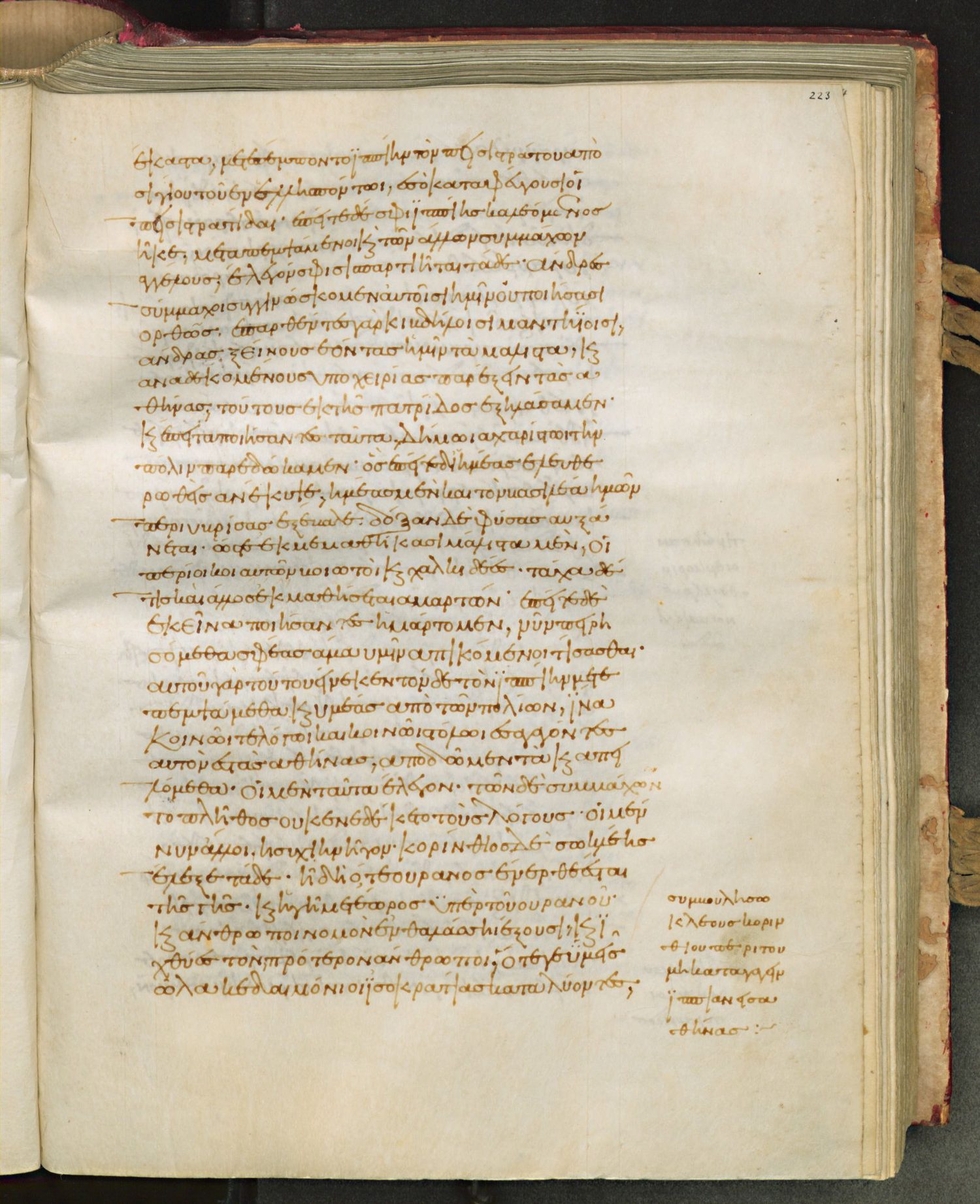
Laur. Plut. 70.3, fol. 223r: Greek here 5.91.1 to 5.92a.1. Checked on the image (first and last words read and located in the Greek; each break checked against the neighbouring page): fol. 223r begins ‹ἕκαστα μετεπέμποντο Ἱππίην τὸν› (5.91.1), ends ‹ὦ Λακεδαιμόνιοι ἰσοκρατίας καταλύοντες› (5.92a.1). English here: 5.91.3 to 5.92a.1 (Godley's sentences for the sections whose Greek lies mostly on this page).
5.91.1ἕκαστα μετεπέμποντο Ἱππίην τὸν Πεισιστράτου ἀπὸ Σιγείου τοῦ ἐν Ἑλλησπόντῳ ἐς ὃ καταφεύγουσι οἱ Πεισιστρατίδαι. 5.91.2ἐπείτε δέ σφι Ἱππίης καλεόμενος ἧκε, μεταπεμψάμενοι καὶ τῶν ἄλλων συμμάχων ἀγγέλους ἔλεγόν σφι Σπαρτιῆται τάδε. ἄνδρες σύμμαχοι, συγγινώσκομεν αὐτοῖσι ἡμῖν οὐ ποιήσασι ὀρθῶς· ἐπαερθέντες γὰρ κιβδήλοισι μαντηίοισι ἄνδρας ξείνους ἐόντας ἡμῖν τὰ μάλιστα καὶ ἀναδεκομένους ὑποχειρίας παρέξειν τὰς Ἀθήνας, τούτους ἐκ τῆς πατρίδος ἐξηλάσαμεν, καὶ ἔπειτα ποιήσαντες ταῦτα δήμῳ ἀχαρίστῳ παρεδώκαμεν τὴν πόλιν· ὃς ἐπείτε διʼ ἡμέας ἐλευθερωθεὶς ἀνέκυψε, ἡμέας μὲν καὶ τὸν βασιλέα ἡμέων περιυβρίσας ἐξέβαλε, δόξαν δὲ φύσας αὐξάνεται, ὥστε ἐκμεμαθήκασι μάλιστα μὲν οἱ περίοικοι αὐτῶν Βοιωτοὶ καὶ Χαλκιδέες, τάχα δέ τις καὶ ἄλλος ἐκμαθήσεται ἁμαρτών. 5.91.3ἐπείτε δὲ ἐκεῖνα ποιήσαντες ἡμάρτομεν, νῦν πειρησόμεθα σφέας ἅμα ὑμῖν ἀπικόμενοι τίσασθαι· αὐτοῦ γὰρ τούτου εἵνεκεν τόνδε τε Ἱππίην μετεπεμψάμεθα καὶ ὑμέας ἀπὸ τῶν πολίων, ἵνα κοινῷ τε λόγῳ καὶ κοινῷ στόλῳ ἐσαγαγόντες αὐτὸν ἐς τὰς Ἀθήνας ἀποδῶμεν τὰ καὶ ἀπειλόμεθα. 5.92.1οἳ μὲν ταῦτα ἔλεγον, τῶν δὲ συμμάχων τὸ πλῆθος οὐκ ἐνεδέκετο τοὺς λόγους. οἱ μέν νυν ἄλλοι ἡσυχίην ἦγον, Κορίνθιος δὲ Σωκλέης ἔλεξε τάδε. 5.92a.1ἦ δὴ ὅ τε οὐρανὸς ἔνερθε ἔσται τῆς γῆς καὶ ἡ γῆ μετέωρος ὑπὲρ τοῦ οὐρανοῦ, καὶ ἄνθρωποι νομὸν ἐν θαλάσσῃ ἕξουσι καὶ ἰχθύες τὸν πρότερον ἄνθρωποι, ὅτε γε ὑμεῖς ὦ Λακεδαιμόνιοι ἰσοκρατίας καταλύοντες
5.91.3But since we erred in doing that which we did, we will now essay with your aid to be avenged of them; for it is on this account and no other that we have sent for this Hippias whom you see and have brought you from your cities, that uniting our counsels and our power we may bring him to Athens and restore that which we took away.” 5.92.1Thus spoke the Lacedaemonians, but their words were ill received by the greater part of their allies. 5.92a.1The rest then keeping silence, Socles, a Corinthian, said: “Verily the heaven shall be beneath the earth and the earth aloft above the heaven, and men shall dwell in the sea and fishes where men did dwell before, now that you, Lacedaemonians! are destroying the rule of equals and making ready to bring back despotism into the cities—despotism, a thing as unrighteous and bloodthirsty as aught on this earth.
Where on the image
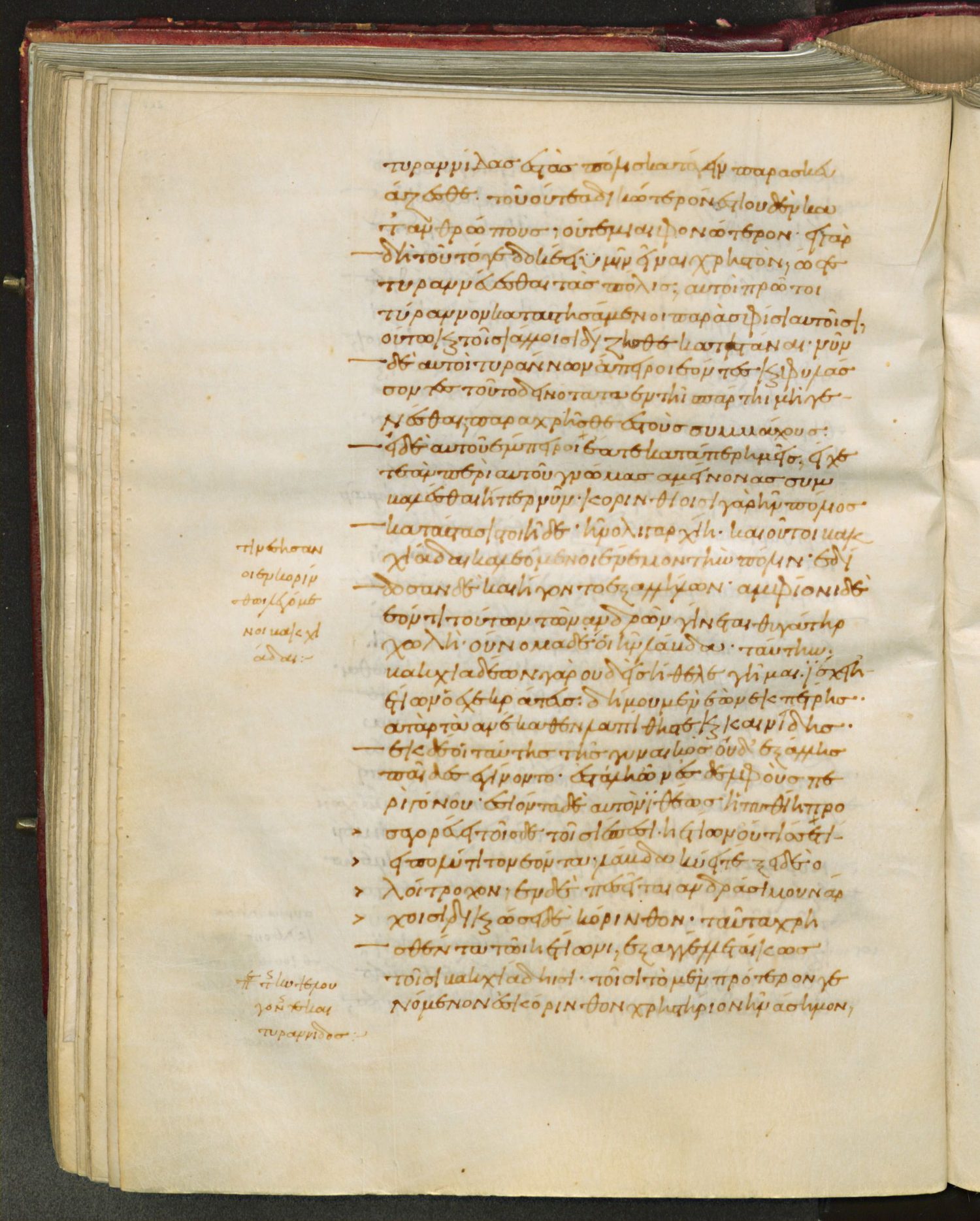
Laur. Plut. 70.3, fol. 223v: Greek here 5.92a.1 to 5.92b.3. Checked on the image (first and last words read and located in the Greek; each break checked against the neighbouring page): fol. 223v begins ‹τυραννίδας ἐς τὰς πόλις› (5.92a.1), ends ‹ἐς Κόρινθον ἦν ἄσημον› (5.92b.3). English here: 5.92a.2 to 5.92b.2 (Godley's sentences for the sections whose Greek lies mostly on this page).
5.92a.1τυραννίδας ἐς τὰς πόλις κατάγειν παρασκευάζεσθε, τοῦ οὔτε ἀδικώτερον ἐστὶ οὐδὲν κατʼ ἀνθρώπους οὔτε μιαιφονώτερον. 5.92a.2εἰ γὰρ δὴ τοῦτό γε δοκέει ὑμῖν εἶναι χρηστὸν ὥστε τυραννεύεσθαι τὰς πόλις, αὐτοὶ πρῶτοι τύραννον καταστησάμενοι παρὰ σφίσι αὐτοῖσι οὕτω καὶ τοῖσι ἄλλοισι δίζησθε κατιστάναι· νῦν δὲ αὐτοὶ τυράννων ἄπειροι ἐόντες, καὶ φυλάσσοντες τοῦτο δεινότατα ἐν τῇ Σπάρτῃ μὴ γενέσθαι, παραχρᾶσθε ἐς τοὺς συμμάχους. εἰ δὲ αὐτοῦ ἔμπειροι ἔατε κατά περ ἡμεῖς, εἴχετε ἂν περὶ αὐτοῦ γνώμας ἀμείνονας συμβαλέσθαι ἤ περ νῦν. 5.92b.1Κορινθίοισι γὰρ ἦν πόλιος κατάστασις τοιήδε· ἦν ὀλιγαρχίη, καὶ οὗτοι Βακχιάδαι καλεόμενοι ἔνεμον τὴν πόλιν, ἐδίδοσαν δὲ καὶ ἤγοντο ἐξ ἀλλήλων. Ἀμφίονι δὲ ἐόντι τούτων τῶν ἀνδρῶν γίνεται θυγάτηρ χωλή· οὔνομα δέ οἱ ἦν Λάβδα. ταύτην Βακχιαδέων γὰρ οὐδεὶς ἤθελε γῆμαι, ἴσχει Ἠετίων ὁ Ἐχεκράτεος, δήμου μὲν ἐὼν ἐκ Πέτρης, ἀτὰρ τὰ ἀνέκαθεν Λαπίθης τε καὶ Καινείδης. 5.92b.2ἐκ δέ οἱ ταύτης τῆς γυναικὸς οὐδʼ ἐξ ἄλλης παῖδες ἐγίνοντο. ἐστάλη ὦν ἐς Δελφοὺς περὶ γόνου. ἐσιόντα δὲ αὐτὸν ἰθέως ἡ Πυθίη προσαγορεύει τοῖσιδε τοῖσι ἔπεσι.
Ἠετίων, οὔτις σε τίει πολύτιτον ἐόντα.
Λάβδα κύει, τέξει δʼ ὀλοοίτροχον· ἐν δὲ πεσεῖται
ἀνδράσι μουνάρχοισι, δικαιώσει δὲ Κόρινθον. 5.92b.3ταῦτα χρησθέντα τῷ Ἠετίωνι ἐξαγγέλλεταί κως τοῖσι Βακχιάδῃσι, τοῖσι τὸ μὲν πρότερον γενόμενον χρηστήριον ἐς Κόρινθον ἦν ἄσημον,
5.92a.2For if indeed this seems to you to be a good thing, that the cities be ruled by despots, do you yourselves first set up a despot among yourselves and then seek to set up such for the rest; but now, having never made trial of despots, and taking most careful heed that none shall arise at Sparta, you deal wrongfully with your allies. But had you such experience of that thing as we have, you would be sager advisers concerning it than you are now. 5.92b.1“For the Corinthian State was ordered in such manner as I will show. The Few ruled; these few, called Bacchiadae, held sway in the city, marrying and giving in marriage among themselves. Now Amphion, one of these men, had a lame daughter, whose name was Labda. Seeing that none of the Bacchiadae would marry her, she was wedded to Eetion son of Echecrates, of the township of Petra, a Lapith by lineage, of the posterity of Caeneus. 5.92b.2No sons being born to him by this wife or any other, he set out to Delphi to enquire concerning issue; and straightway as he entered the Pythian priestess spoke these verses to him: Eetion, yet high honour is thine, though honour’d thou art not.
Labda conceiveth anon; and a rolling rock she shall bear thee,
Fated on princes to fall, and execute justice on Corinth.
Where on the image
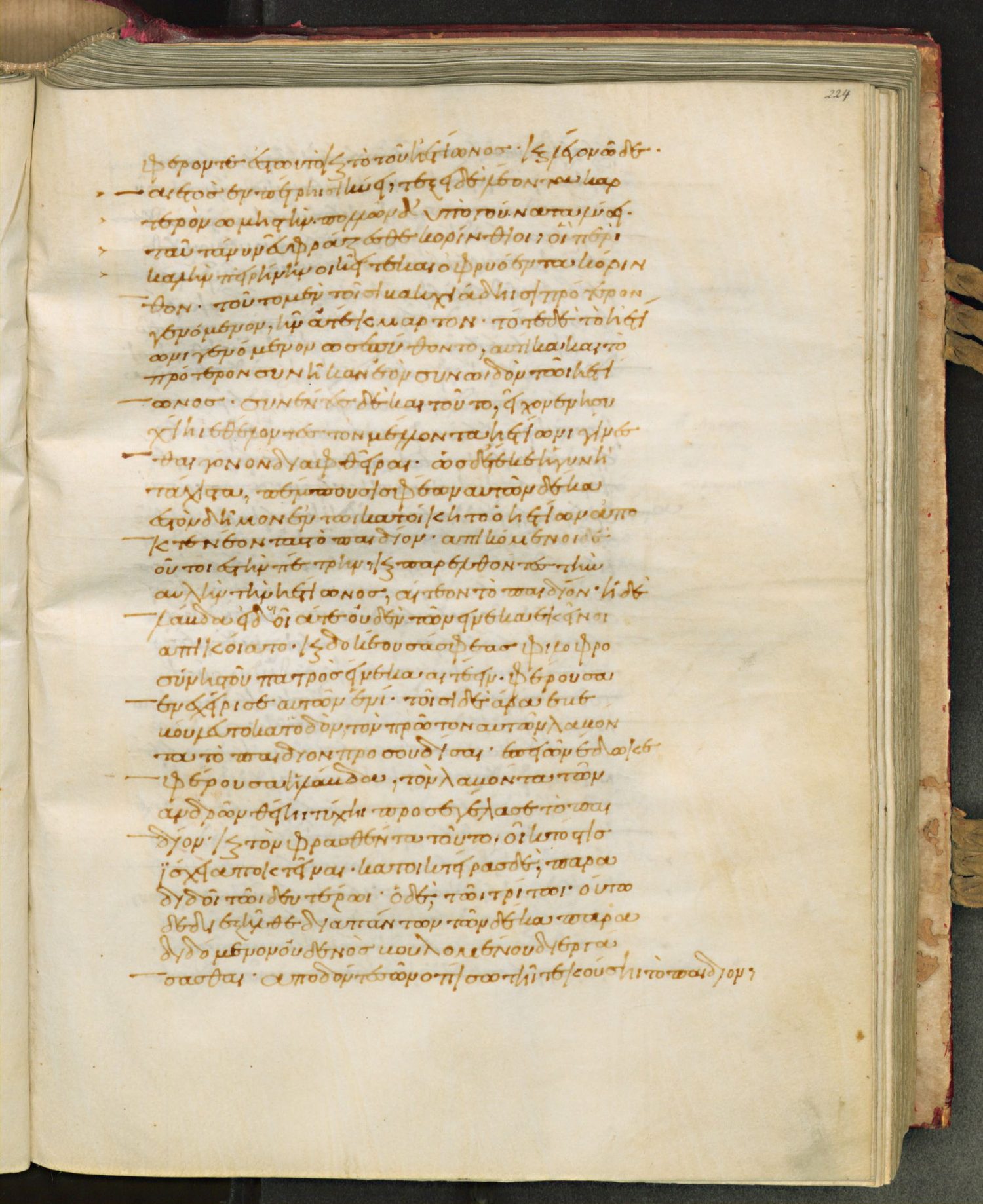
Laur. Plut. 70.3, fol. 224r: Greek here 5.92b.3 to 5.92c.4. Checked on the image (first and last words read and located in the Greek; each break checked against the neighbouring page): fol. 224r begins ‹φέρον τε ἐς τὠυτὸ› (5.92b.3), ends ‹τῇ τεκούσῃ τὸ παιδίον› (5.92c.4). English here: 5.92b.3 to 5.92c.3 (Godley's sentences for the sections whose Greek lies mostly on this page).
5.92b.3φέρον τε ἐς τὠυτὸ καὶ τὸ τοῦ Ἠετίωνος καὶ λέγον ὧδε.
αἰετὸς ἐν πέτρῃσι κύει, τέξει δὲ λέοντα
καρτερὸν ὠμηστήν· πολλῶν δʼ ὑπὸ γούνατα λύσει.
ταῦτά νυν εὖ φράζεσθε, Κορίνθιοι, οἳ περὶ καλήν
Πειρήνην οἰκεῖτε καὶ ὀφρυόεντα Κόρινθον. 5.92c.1τοῦτο μὲν δὴ τοῖσι Βακχιάδῃσι πρότερον γενόμενον ἦν ἀτέκμαρτον· τότε δὲ τὸ Ἠετίωνι γενόμενον ὡς ἐπύθοντο, αὐτίκα καὶ τὸ πρότερον συνῆκαν ἐὸν συνῳδὸν τῷ Ἠετίωνος. συνέντες δὲ καὶ τοῦτο εἶχον ἐν ἡσυχίῃ, ἐθέλοντες τὸν μέλλοντα Ἠετίωνι γίνεσθαι γόνον διαφθεῖραι. ὡς δʼ ἔτεκε ἡ γυνὴ τάχιστα, πέμπουσι σφέων αὐτῶν δέκα ἐς τὸν δῆμον ἐν τῷ κατοίκητο ὁ Ἠετίων ἀποκτενέοντας τὸ παιδίον. 5.92c.2ἀπικόμενοι δὲ οὗτοι ἐς τὴν Πέτρην καὶ παρελθόντες ἐς τὴν αὐλὴν τὴν Ἠετίωνος αἴτεον τὸ παιδίον· ἡ δὲ Λάβδα εἰδυῖά τε οὐδὲν τῶν εἵνεκα ἐκεῖνοι ἀπικοίατο, καὶ δοκέουσα σφέας φιλοφροσύνης τοῦ πατρὸς εἵνεκα αἰτέειν, φέρουσα ἐνεχείρισε αὐτῶν ἑνί. τοῖσι δὲ ἄρα ἐβεβούλευτο κατʼ ὁδὸν τὸν πρῶτον αὐτῶν λαβόντα τὸ παιδίον προσουδίσαι. 5.92c.3ἐπεὶ ὦν ἔδωκε φέρουσα ἡ Λάβδα, τὸν λαβόντα τῶν ἀνδρῶν θείῃ τύχῃ προσεγέλασε τὸ παιδίον, καὶ τὸν φρασθέντα τοῦτο οἶκτός τις ἴσχει ἀποκτεῖναι, κατοικτείρας δὲ παραδιδοῖ τῷ δευτέρῳ, ὁ δὲ τῷ τρίτῳ. οὕτω δὴ διεξῆλθε διὰ πάντων τῶν δέκα παραδιδόμενον, οὐδενὸς βουλομένου διεργάσασθαι. 5.92c.4ἀποδόντες ὦν ὀπίσω τῇ τεκούσῃ τὸ παιδίον
5.92b.3This oracle given to Eetion was in some wise made known to the Bacchiadae, by whom the former oracle sent to Corinth was not understood, albeit its meaning was the same as the meaning of the oracle of Eetion; it was this: Lo, where the eagle’s mate conceives in the rocks, and a lion
Mighty and fierce shall be born; full many a knee shall he loosen.
Wherefore I bid you beware, ye Corinthian folk, that inhabit
Nigh Pirene fair and the heights o’erhanging of Corinth. 5.92c.1This oracle, formerly given to the Bacchiadae, was past their interpretation; but now, when they learnt of that one which was given to Eetion, straightway they understood that the former accorded with the oracle of Eetion; and understanding this prophecy too they sat still, purposing to destroy whatever should be born to Eetion. Then, as soon as his wife was delivered, they sent ten men of their clan to the township where Eetion dwelt, to kill the child. 5.92c.2These men came to Petra and passing into Eetion’s courtyard asked for the child; and Labda, knowing nothing of the purpose of their coming, and thinking that they asked out of friendliness to the child’s father, brought it and gave it into the hands of one of them. Now they had planned on their way (as the story goes) that the first of them who received the child should dash it to the ground. 5.92c.3So then when Labda brought and gave the child, by heaven’s providence it smiled at the man who took it, and he saw that, and compassion forbade him to kill it, and in that compassion he delivered it to a second, and he again to a third; and thus it passed from hand to hand to each of the ten, for none would make an end of it.
Where on the image
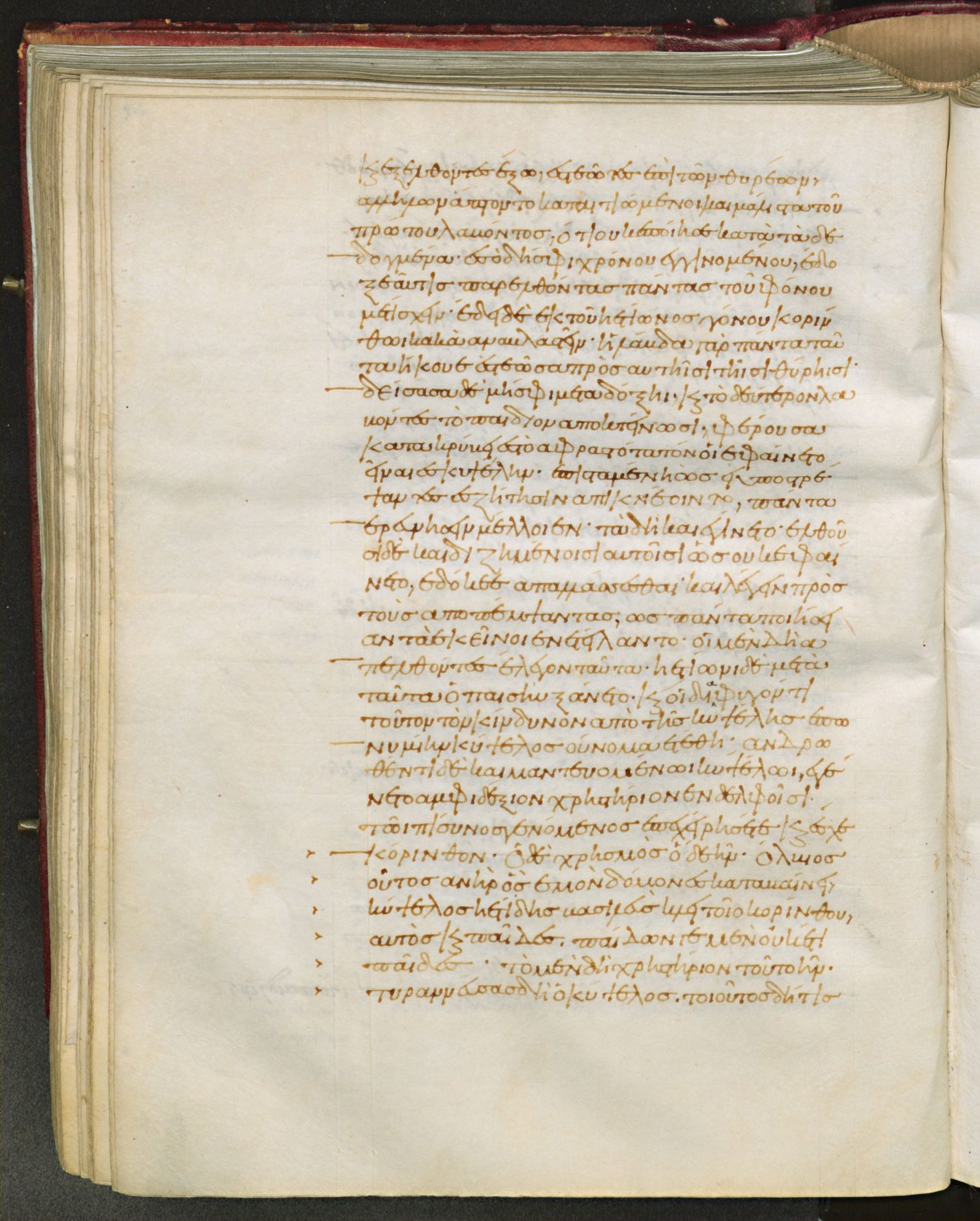
Laur. Plut. 70.3, fol. 224v: Greek here 5.92c.4 to 5.92e.2. Checked on the image (first and last words read and located in the Greek; each break checked against the neighbouring page): fol. 224v begins ‹καὶ ἐξελθόντες ἔξω, ἑστεῶτες› (5.92c.4), ends ‹Κύψελος τοιοῦτος δή τις› (5.92e.2). Fol. 224v ends τοιοῦτος δή τις and fol. 225r begins ἦν ἀνήρ· πολλοὺς μὲν Κορινθίων: the manuscript has ἦν ἀνήρ where the edition prints ἀνὴρ ἐγένετο (5.92ε.2); the edition's two words are given with fol. 224v. English here: 5.92c.4 to 5.92e.2 (Godley's sentences for the sections whose Greek lies mostly on this page).
5.92c.4καὶ ἐξελθόντες ἔξω, ἑστεῶτες ἐπὶ τῶν θυρέων ἀλλήλων ἅπτοντο καταιτιώμενοι, καὶ μάλιστα τοῦ πρώτου λαβόντος, ὅτι οὐκ ἐποίησε κατὰ τὰ δεδογμένα, ἐς ὃ δή σφι χρόνου ἐγγινομένου ἔδοξε αὖτις παρελθόντας πάντας τοῦ φόνου μετίσχειν. 5.92d.1ἔδει δὲ ἐκ τοῦ Ἠετίωνος γόνου Κορίνθῳ κακὰ ἀναβλαστεῖν. ἡ Λάβδα γὰρ πάντα ταῦτα ἤκουε ἑστεῶσα πρὸς αὐτῇσι τῇσι θύρῃσι· δείσασα δὲ μή σφι μεταδόξῃ καὶ τὸ δεύτερον λαβόντες τὸ παιδίον ἀποκτείνωσι, φέρουσα κατακρύπτει ἐς τὸ ἀφραστότατόν οἱ ἐφαίνετο εἶναι, ἐς κυψέλην, ἐπισταμένη ὡς εἰ ὑποστρέψαντες ἐς ζήτησιν ἀπικνεοίατο πάντα ἐρευνήσειν μέλλοιεν· τὰ δὴ καὶ ἐγίνετο. 5.92d.2ἐλθοῦσι δὲ καὶ διζημένοισι αὐτοῖσι ὡς οὐκ ἐφαίνετο, ἐδόκεε ἀπαλλάσσεσθαι καὶ λέγειν πρὸς τοὺς ἀποπέμψαντας ὡς πάντα ποιήσειαν τὰ ἐκεῖνοι ἐνετείλαντο. οἳ μὲν δὴ ἀπελθόντες ἔλεγον ταῦτα. 5.92e.1Ἠετίωνι δὲ μετὰ ταῦτα ὁ παῖς ηὐξάνετο, καί οἱ διαφυγόντι τοῦτον τὸν κίνδυνον ἀπὸ τῆς κυψέλης ἐπωνυμίην Κύψελος οὔνομα ἐτέθη. ἀνδρωθέντι δὲ καὶ μαντευομένῳ Κυψέλῳ ἐγένετο ἀμφιδέξιον χρηστήριον ἐν Δελφοῖσι, τῷ πίσυνος γενόμενος ἐπεχείρησέ τε καὶ ἔσχε Κόρινθον. ὁ δὲ χρησμὸς ὅδε ἦν. 5.92e.2ὄλβιος οὗτος ἀνὴρ ὃς ἐμὸν δόμον ἐσκαταβαίνει,
Κύψελος Ἠετίδης, βασιλεὺς κλειτοῖο Κορίνθου
αὐτὸς καὶ παῖδες, παίδων γε μὲν οὐκέτι παῖδες.
τὸ μὲν δὴ χρηστήριον τοῦτο ἦν, τυραννεύσας δὲ ὁ Κύψελος τοιοῦτος δή τις ἀνὴρ ἐγένετο·
5.92c.4So they gave the child back to its mother and went out, and stood before the door reproaching and upbraiding one another, but chiefly him who had first received it, for that he had not done according to their agreement; till as time passed they had a mind to go in again and all have a hand in the killing. 5.92d.1But it was written that Eetion’s offspring should be the source of ills for Corinth. For Labda heard all this where she stood close to the very door; and she feared lest they should change their minds and again take the child, and kill it; wherefore she bore it away and hid it where she thought it would be hardest to find, in a chest; for she knew that if they returned and set about searching they would seek in every place; which they did. 5.92d.2They came and sought, but not finding they resolved to go their ways and say to those that sent them that they had done all their bidding. So they went away and said this. 5.92e.1But Eetion’s son presently grew, and for his escape from that danger he was called Cypselus, after the chest. When he had come to man’s estate, and was seeking a divination, there was given him at Delphi an oracle of double meaning, trusting wherein he grasped at Corinth and won it. 5.92e.2This was the oracle: Happy I ween is the man who cometh adown to my temple,
Cypselus Eetides, great king of Corinth renownèd,
Happy himself and his sons; yet his son’s sons shall not be happy. Such was the oracle. But Cypselus, having gained despotic power, bore himself in this wise: many Corinthians he banished, many he robbed of their goods, and by far the most of their lives.
Where on the image
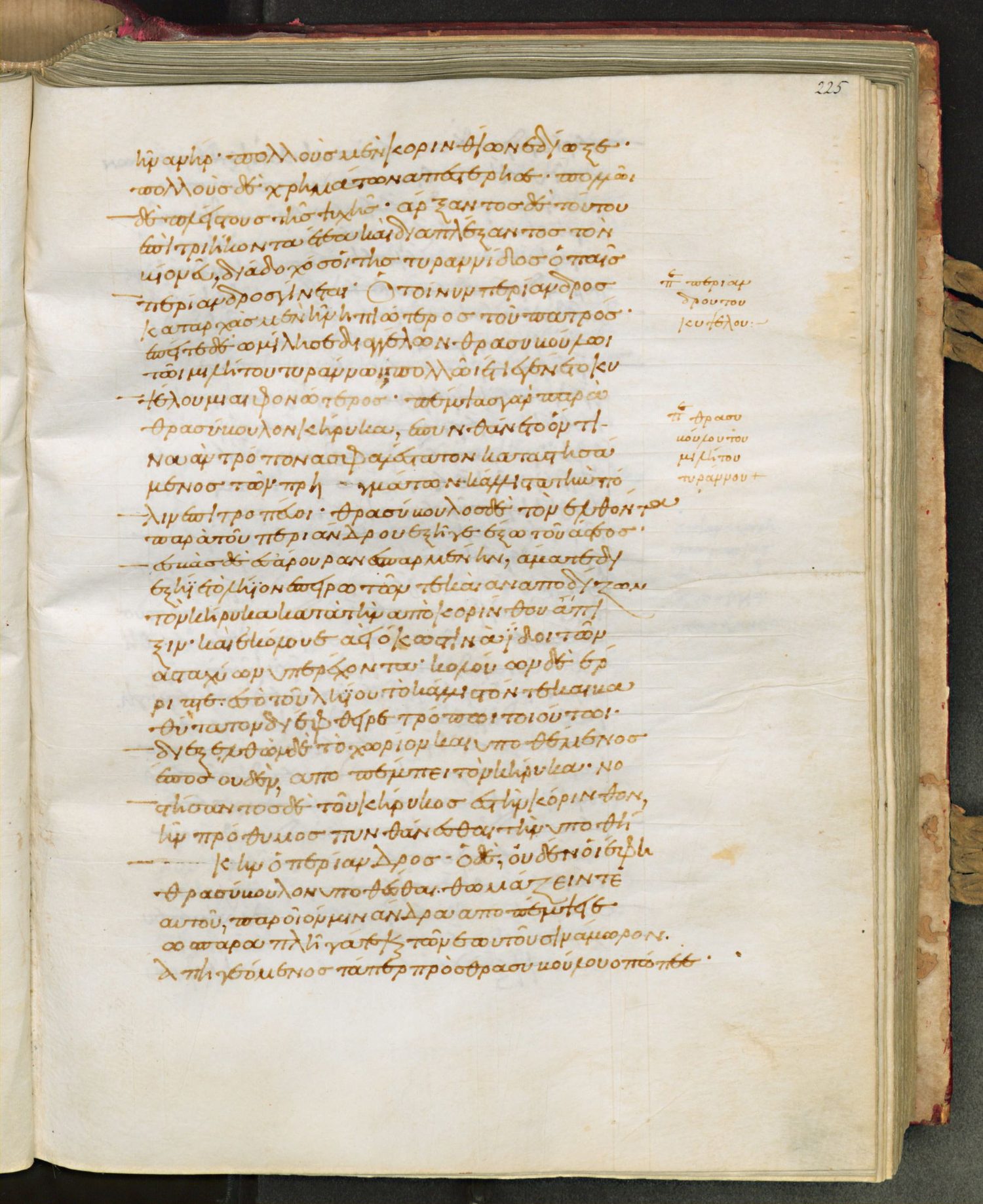
Laur. Plut. 70.3, fol. 225r: Greek here 5.92e.2 to 5.92f.3. Checked on the image (first and last words read and located in the Greek; each break checked against the neighbouring page): fol. 225r begins ‹πολλοὺς μὲν Κορινθίων ἐδίωξε,› (5.92e.2), ends ‹περ πρὸς Θρασυβούλου ὀπώπεε› (5.92f.3). Fol. 224v ends τοιοῦτος δή τις and fol. 225r begins ἦν ἀνήρ· πολλοὺς μὲν Κορινθίων: the manuscript has ἦν ἀνήρ where the edition prints ἀνὴρ ἐγένετο (5.92ε.2); the edition's two words are given with fol. 224v. English here: 5.92f.1 to 5.92f.3 (Godley's sentences for the sections whose Greek lies mostly on this page).
5.92e.2πολλοὺς μὲν Κορινθίων ἐδίωξε, πολλοὺς δὲ χρημάτων ἀπεστέρησε, πολλῷ δέ τι πλείστους τῆς ψυχῆς. 5.92f.1ἄρξαντος δὲ τούτου ἐπὶ τριήκοντα ἔτεα καὶ διαπλέξαντος τὸν βίον εὖ, διάδοχός οἱ τῆς τυραννίδος ὁ παῖς Περίανδρος γίνεται. ὁ τοίνυν Περίανδρος κατʼ ἀρχὰς μὲν ἦν ἠπιώτερος τοῦ πατρός, ἐπείτε δὲ ὡμίλησε διʼ ἀγγέλων Θρασυβούλῳ τῷ Μιλήτου τυράννῳ, πολλῷ ἔτι ἐγένετο Κυψέλου μιαιφονώτερος. 5.92f.2πέμψας γὰρ παρὰ Θρασύβουλον κήρυκα ἐπυνθάνετο ὅντινα ἂν τρόπον ἀσφαλέστατον καταστησάμενος τῶν πρηγμάτων κάλλιστα τὴν πόλιν ἐπιτροπεύοι. Θρασύβουλος δὲ τὸν ἐλθόντα παρὰ τοῦ Περιάνδρου ἐξῆγε ἔξω τοῦ ἄστεος, ἐσβὰς δὲ ἐς ἄρουραν ἐσπαρμένην ἅμα τε διεξήιε τὸ λήιον ἐπειρωτῶν τε καὶ ἀναποδίζων τὸν κήρυκα κατὰ τὴν ἀπὸ Κορίνθου ἄπιξιν, καὶ ἐκόλουε αἰεὶ ὅκως τινὰ ἴδοι τῶν ἀσταχύων ὑπερέχοντα, κολούων δὲ ἔρριπτε, ἐς ὃ τοῦ ληίου τὸ κάλλιστόν τε καὶ βαθύτατον διέφθειρε τρόπῳ τοιούτῳ· 5.92f.3διεξελθὼν δὲ τὸ χωρίον καὶ ὑποθέμενος ἔπος οὐδὲν ἀποπέμπει τὸν κήρυκα. νοστήσαντος δὲ τοῦ κήρυκος ἐς τὴν Κόρινθον ἦν πρόθυμος πυνθάνεσθαι τὴν ὑποθήκην ὁ Περίανδρος· ὁ δὲ οὐδέν οἱ ἔφη Θρασύβουλον ὑποθέσθαι, θωμάζειν τε αὐτοῦ παρʼ οἷόν μιν ἄνδρα ἀποπέμψειε, ὡς παραπλῆγά τε καὶ τῶν ἑωυτοῦ σινάμωρον, ἀπηγεόμενος τά περ πρὸς Θρασυβούλου ὀπώπεε.
5.92f.1He reigned for thirty years and made a good ending of his life; and his son Periander succeeded to his despotic power. Now Periander at the first was of milder mood than his father; but after he had held converse by his messengers with Thrasybulus the despot of Miletus, he became much more bloodthirsty than Cypselus. 5.92f.2For he sent a herald to Thrasybulus and enquired how he should most safely so order all matters as best to govern his city. Thrasybulus led the man who had come from Periander outside the town, and entered into a sown field; where, while he walked through the corn and plied the herald with still-repeated questions anent his coming from Corinth, he would ever cut off the tallest that he saw of the stalks, and cast away what he cut off, till by so doing he had destroyed the best and richest of the crop; 5.92f.3then, having passed through the place and spoken no word of counsel, he sent the herald away. When the herald returned to Corinth, Periander was desirous to hear what counsel he brought; but the man said that Thrasybulus had given him none, ‘and that is a strange man,’ quoth he, ‘to whom you sent me; for he is a madman and a destroyer of his own possessions,’ telling Periander what he had seen Thrasybulus do.
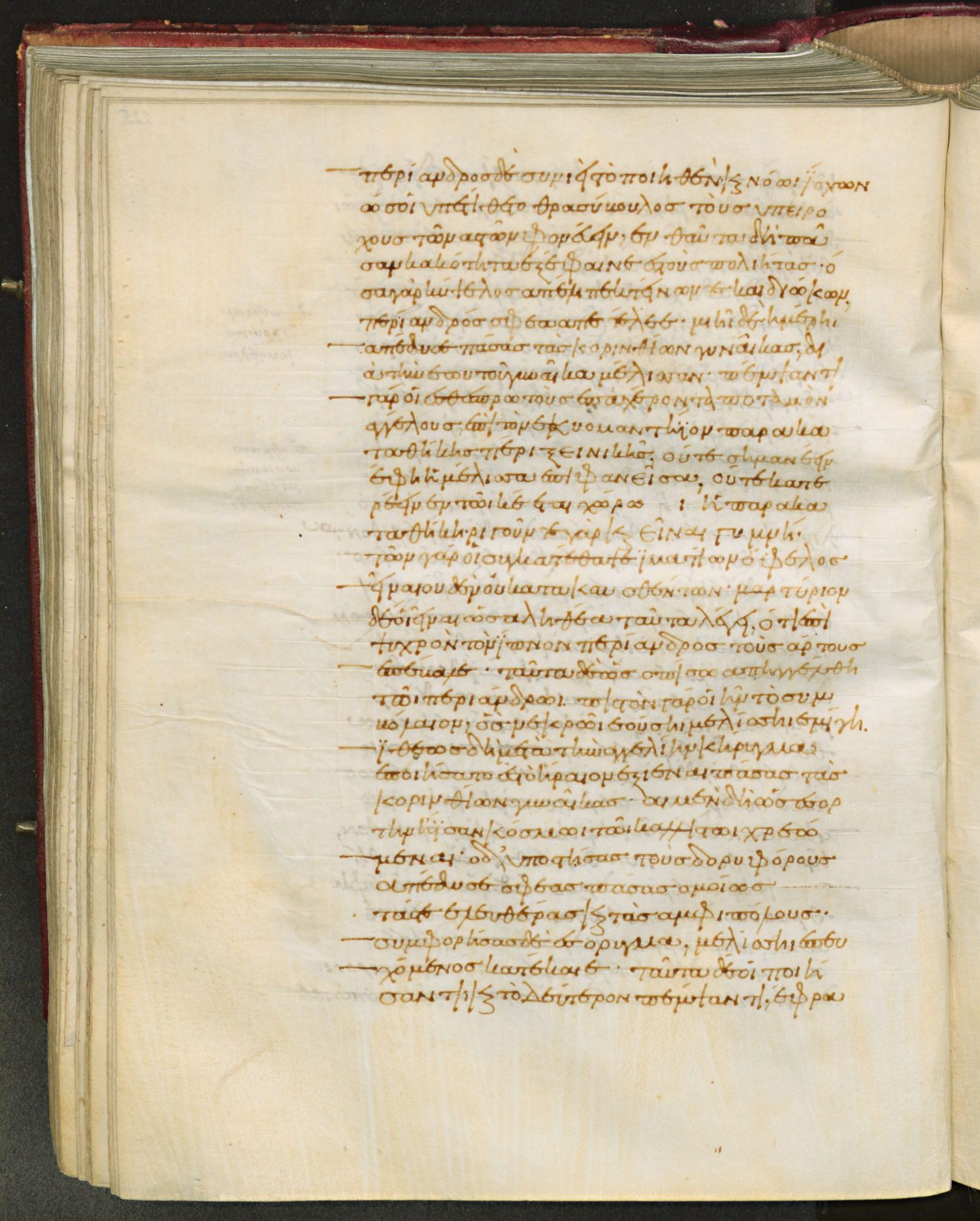
Where on the image
Laur. Plut. 70.3, fol. 225v: Greek here 5.92g.1 to 5.92g.4. Checked on the image (first and last words read and located in the Greek; each break checked against the neighbouring page): fol. 225v begins ‹Περίανδρος δὲ συνιεὶς τὸ› (5.92g.1), ends ‹τὸ δεύτερον πέμψαντι ἔφρα-› (5.92g.4). English here: 5.92g.1 to 5.92g.3 (Godley's sentences for the sections whose Greek lies mostly on this page).
5.92g.1Περίανδρος δὲ συνιεὶς τὸ ποιηθὲν καὶ νόῳ ἴσχων ὥς οἱ ὑπετίθετο Θρασύβουλος τοὺς ὑπειρόχους τῶν ἀστῶν φονεύειν, ἐνθαῦτα δὴ πᾶσαν κακότητα ἐξέφαινε ἐς τοὺς πολιήτας. ὅσα γὰρ Κύψελος ἀπέλιπε κτείνων τε καὶ διώκων, Περίανδρος σφέα ἀπετέλεσε, μιῇ δὲ ἡμέρῃ ἀπέδυσε πάσας τὰς Κορινθίων γυναῖκας διὰ τὴν ἑωυτοῦ γυναῖκα Μέλισσαν. 5.92g.2πέμψαντι γάρ οἱ ἐς Θεσπρωτοὺς ἐπʼ Ἀχέροντα ποταμὸν ἀγγέλους ἐπὶ τὸ νεκυομαντήιον παρακαταθήκης πέρι ξεινικῆς οὔτε σημανέειν ἔφη ἡ Μέλισσα ἐπιφανεῖσα οὔτε κατερέειν ἐν τῷ κέεται χώρῳ ἡ παρακαταθήκη· ῥιγοῦν τε γὰρ καὶ εἶναι γυμνή· τῶν γάρ οἱ συγκατέθαψε ἱματίων ὄφελος εἶναι οὐδὲν οὐ κατακαυθέντων· μαρτύριον δέ οἱ εἶναι ὡς ἀληθέα ταῦτα λέγει, ὅτι ἐπὶ ψυχρὸν τὸν ἰπνὸν Περίανδρος τοὺς ἄρτους ἐπέβαλε. 5.92g.3ταῦτα δὲ ὡς ὀπίσω ἀπηγγέλθη τῷ Περιάνδρῳ, πιστὸν γάρ οἱ ἦν τὸ συμβόλαιον ὃς νεκρῷ ἐούσῃ Μελίσσῃ ἐμίγη, ἰθέως δὴ μετὰ τὴν ἀγγελίην κήρυγμα ἐποιήσατο ἐς τὸ Ἥραιον ἐξιέναι πάσας τὰς Κορινθίων γυναῖκας. αἳ μὲν δὴ ὡς ἐς ὁρτὴν ἤισαν κόσμῳ τῷ καλλίστῳ χρεώμεναι, ὃ δʼ ὑποστήσας τοὺς δορυφόρους ἀπέδυσε σφέας πάσας ὁμοίως, τάς τε ἐλευθέρας καὶ τὰς ἀμφιπόλους, συμφορήσας δὲ ἐς ὄρυγμα Μελίσσῃ ἐπευχόμενος κατέκαιε. 5.92g.4ταῦτα δέ οἱ ποιήσαντι καὶ τὸ δεύτερον πέμψαντι ἔφρασε
5.92g.1But Periander understood what had been done, and perceived that Thrasybulus had counselled him to slay those of his townsmen who stood highest; and with that he began to deal very evilly with his citizens. For whatever act of slaughter or banishment Cypselus had left undone, that did Periander bring to accomplishment; and in a single day he stripped all the women of Corinth naked, by reason of his own wife Melissa. 5.92g.2For he had sent messengers to the Oracle of the Dead on the river Acheron in Thesprotia to enquire concerning a deposit that a friend had left; but the apparition of Melissa said that she would tell him nought, nor reveal where the deposit lay; for she was cold (she said) and naked; for the raiment Periander had buried with her had never been burnt, and availed her nothing; and let this (said she) be her witness that she spoke truth—that it was a cold oven wherein to Periander had cast his loaves. 5.92g.3When this message was brought back to Periander (for he had had intercourse with the dead body of Melissa and knew her token for true), immediately after the message he made a proclamation that all the Corinthian women should come out into the temple of Here. So they came out as to a festival, wearing their fairest adornment; and Periander set his guards there and stripped them all alike, ladies and serving-women, and heaped all the garments in a pit, where he burnt them, making prayers to Melissa the while.
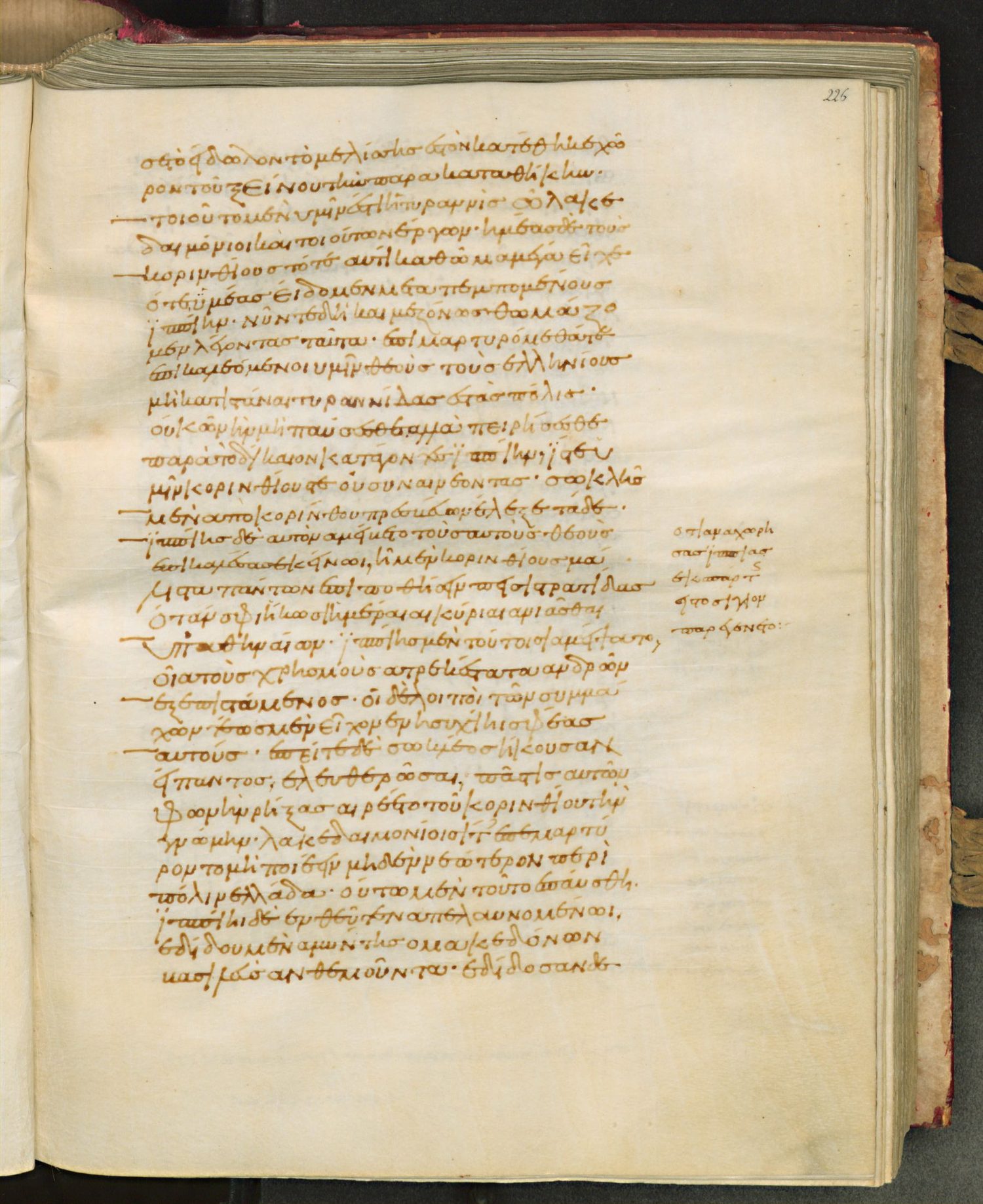
Where on the image
Laur. Plut. 70.3, fol. 226r: Greek here 5.92g.4 to 5.94.1. Checked on the image (first and last words read and located in the Greek; each break checked against the neighbouring page): fol. 226r begins ‹-σε τὸ εἴδωλον τὸ› (5.92g.4), ends ‹βασιλεὺς Ἀνθεμοῦντα, ἐδίδοσαν δὲ› (5.94.1). The word ‹ἔφρασε› is divided between fol. 225v and fol. 226r; it is given with fol. 225v. English here: 5.92g.4 to 5.93.2 (Godley's sentences for the sections whose Greek lies mostly on this page).
5.92g.4τὸ εἴδωλον τὸ Μελίσσης ἐς τὸν κατέθηκε χῶρον τοῦ ξείνου τὴν παρακαταθήκην. τοιοῦτο μὲν ὑμῖν ἐστὶ ἡ τυραννίς, ὦ Λακεδαιμόνιοι, καὶ τοιούτων ἔργων. 5.92g.5ἡμέας δὲ τοὺς Κορινθίους τότε αὐτίκα θῶμα μέγα εἶχε ὅτε ὑμέας εἴδομεν μεταπεμπομένους Ἱππίην, νῦν τε δὴ καὶ μεζόνως θωμάζομεν λέγοντας ταῦτα, ἐπιμαρτυρόμεθά τε ἐπικαλεόμενοι ὑμῖν θεοὺς τοὺς Ἑλληνίους μὴ κατιστάναι τυραννίδας ἐς τὰς πόλις. οὔκων παύσεσθε ἀλλὰ πειρήσεσθε παρὰ τὸ δίκαιον κατάγοντες Ἱππίην· ἴστε ὑμῖν Κορινθίους γε οὐ συναινέοντας. 5.93.1Σωκλέης μὲν ἀπὸ Κορίνθου πρεσβεύων ἔλεξε τάδε, Ἱππίης δὲ αὐτὸν ἀμείβετο τοὺς αὐτοὺς ἐπικαλέσας θεοὺς ἐκείνῳ, ἦ μὲν Κορινθίους μάλιστα πάντων ἐπιποθήσειν Πεισιστρατίδας, ὅταν σφι ἥκωσι ἡμέραι αἱ κύριαι ἀνιᾶσθαι ὑπʼ Ἀθηναίων. 5.93.2Ἱππίης μὲν τούτοισι ἀμείψατο οἷα τοὺς χρησμοὺς ἀτρεκέστατα ἀνδρῶν ἐξεπιστάμενος· οἱ δὲ λοιποὶ τῶν συμμάχων τέως μὲν εἶχον ἐν ἡσυχίῃ σφέας αὐτούς, ἐπείτε δὲ Σωκλέος ἤκουσαν εἴπαντος ἐλευθέρως, ἅπας τις αὐτῶν φωνὴν ῥήξας αἱρέετο τοῦ Κορινθίου τὴν γνώμην, Λακεδαιμονίοισί τε ἐπεμαρτυρέοντο μὴ ποιέειν μηδὲν νεώτερον περὶ πόλιν Ἑλλάδα. 5.94.1οὕτω μὲν τοῦτο ἐπαύσθη. Ἱππίῃ δὲ ἐνθεῦτεν ἀπελαυνομένῳ ἐδίδου μὲν Ἀμύντης ὁ Μακεδόνων βασιλεὺς Ἀνθεμοῦντα, ἐδίδοσαν δὲ
5.92g.4When he had so done and sent a second message, the ghost of Melissa told him the place where the deposit of the friend had been laid. “Know then, ye Lacedaemonians, that such a thing is despotism, and such are its deeds. 5.92g.5We of Corinth did then greatly marvel when we saw that you were sending for Hippias; and now we marvel yet more at your speaking thus; and we entreat you earnestly in the name of the gods of Hellas not to establish despotism in the cities. But if you will not cease from so doing, and will unrighteously essay to bring Hippias back, then be it known to you that the Corinthians for their part consent not thereto.” 5.93.1Thus spoke Socles, the envoy from Corinth; Hippias answered him, calling the same gods as Socles had invoked to witness that verily the Corinthians would be the first to wish Pisistratus’ house back, when the time appointed should come for them to be vexed by the Athenians. 5.93.2Hippias made this answer, inasmuch as he had more exact knowledge of the oracles than any man; but the rest of the allies, who had till now kept silence, when they heard the free speech of Socles, each and all of them spoke out and declared for the opinion of the Corinthians, entreating the Lacedaemonians to do no hurt to a Greek city.
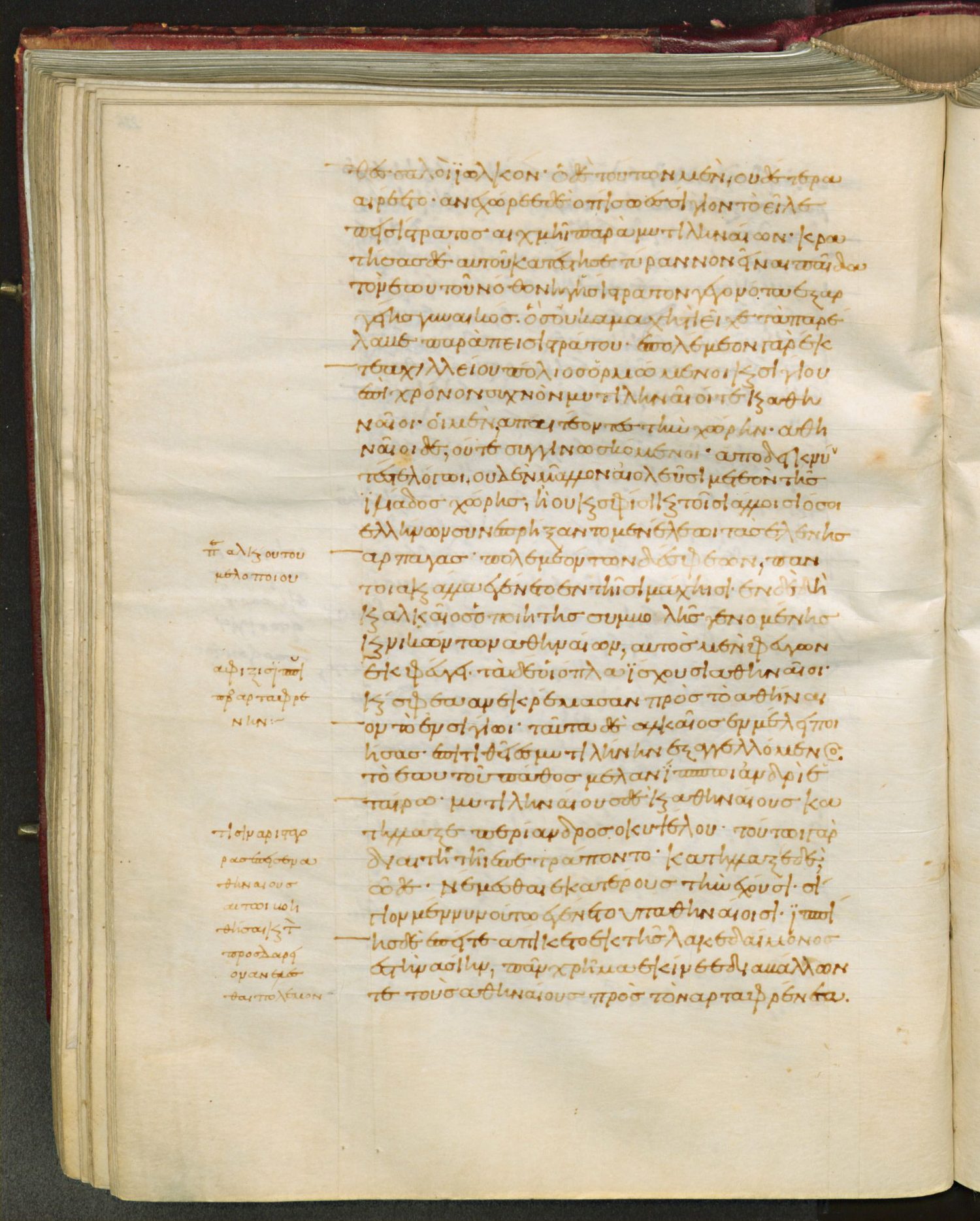
Where on the image
Laur. Plut. 70.3, fol. 226v, 227r: Greek here 5.94.1 to 5.96.2. Checked on the image (first and last words read and located in the Greek; each break checked against the neighbouring page): fol. 226v begins ‹Θεσσαλοὶ Ἰωλκόν. ὁ δὲ› (5.94.1), ends ‹Ἀθηναίους πρὸς τὸν Ἀρταφρένεα› (5.96.1). fol. 227r begins ‹καὶ ποιέων ἅπαντα ὅκως› (5.96.1), ends ‹βοηθοὺς Ἴωσι, στρατηγὸν ἀποδέξαντες› (5.97.3). Below the text, a reader's note on the twenty ships the Athenians sent to help the Ionians. This section joins the text of fol. 226v and 227r that belongs to these chapters, because the part on one of the pages is too short to carry any of Godley's sentences on its own. English here: 5.94.1 to 5.96.2 (Godley's sentences for the sections whose Greek lies mostly on this page).
5.94.1Θεσσαλοὶ Ἰωλκόν. ὁ δὲ τούτων μὲν οὐδέτερα αἱρέετο, ἀνεχώρεε δὲ ὀπίσω ἐς Σίγειον, τὸ εἷλε Πεισίστρατος αἰχμῇ παρὰ Μυτιληναίων, κρατήσας δὲ αὐτοῦ κατέστησε τύραννον εἶναι παῖδα τὸν ἑωυτοῦ νόθον Ἡγησίστρατον, γεγονότα ἐξ Ἀργείης γυναικός, ὃς οὐκ ἀμαχητὶ εἶχε τὰ παρέλαβε παρὰ Πεισιστράτου. 5.94.2ἐπολέμεον γὰρ ἔκ τε Ἀχιλληίου πόλιος ὁρμώμενοι καὶ Σιγείου ἐπὶ χρόνον συχνὸν Μυτιληναῖοί τε καὶ Ἀθηναῖοι, οἳ μὲν ἀπαιτέοντες τὴν χώρην, Ἀθηναῖοι δὲ οὔτε συγγινωσκόμενοι ἀποδεικνύντες τε λόγῳ οὐδὲν μᾶλλον Αἰολεῦσι μετεὸν τῆς Ἰλιάδος χώρης ἢ οὐ καὶ σφίσι καὶ τοῖσι ἄλλοισι, ὅσοι Ἑλλήνων συνεπρήξαντο Μενέλεῳ τὰς Ἑλένης ἁρπαγάς. 5.95.1πολεμεόντων δὲ σφέων παντοῖα καὶ ἄλλα ἐγένετο ἐν τῇσι μάχῃσι, ἐν δὲ δὴ καὶ Ἀλκαῖος ὁ ποιητὴς συμβολῆς γενομένης καὶ νικώντων Ἀθηναίων αὐτὸς μὲν φεύγων ἐκφεύγει, τὰ δέ οἱ ὅπλα ἴσχουσι Ἀθηναῖοι, καί σφεα ἀνεκρέμασαν πρὸς τὸ Ἀθήναιον τὸ ἐν Σιγείῳ. 5.95.2ταῦτα δὲ Ἀλκαῖος ἐν μέλεϊ ποιήσας ἐπιτιθεῖ ἐς Μυτιλήνην, ἐξαγγελλόμενος τὸ ἑωυτοῦ πάθος Μελανίππῳ ἀνδρὶ ἑταίρῳ. Μυτιληναίους δὲ καὶ Ἀθηναίους κατήλλαξε Περίανδρος ὁ Κυψέλου· τούτῳ γὰρ διαιτητῇ ἐπετράποντο· κατήλλαξε δὲ ὧδε, νέμεσθαι ἑκατέρους τὴν ἔχουσι. 5.96.1Σίγειον μέν νυν οὕτω ἐγένετο ὑπʼ Ἀθηναίοισι. Ἱππίης δὲ ἐπείτε ἀπίκετο ἐκ τῆς Λακεδαίμονος ἐς τὴν Ἀσίην, πᾶν χρῆμα ἐκίνεε, διαβάλλων τε τοὺς Ἀθηναίους πρὸς τὸν Ἀρταφρένεα καὶ ποιέων ἅπαντα ὅκως αἱ Ἀθῆναι γενοίατο ὑπʼ ἑωυτῷ τε καὶ Δαρείῳ. 5.96.2Ἱππίης τε δὴ ταῦτα ἔπρησσε, καὶ οἱ Ἀθηναῖοι πυθόμενοι ταῦτα πέμπουσι ἐς Σάρδις ἀγγέλους, οὐκ ἐῶντες τοὺς Πέρσας πείθεσθαι Ἀθηναίων τοῖσι φυγάσι. ὁ δὲ Ἀρταφρένης ἐκέλευε σφέας, εἰ βουλοίατο σόοι εἶναι, καταδέκεσθαι ὀπίσω Ἱππίην. οὔκων δὴ ἐνεδέκοντο τοὺς λόγους ἀποφερομένους οἱ Ἀθηναῖοι· οὐκ ἐνδεκομένοισι δέ σφι ἐδέδοκτο ἐκ τοῦ φανεροῦ τοῖσι Πέρσῃσι πολεμίους εἶναι.
5.94.1Thus this design came to nought, and Hippias perforce departed. Amyntas king of the Macedonians would have given him Anthemus, and the Thessalians Iolcus; but he would have neither, and withdrew to Sigeum, which Pisistratus had taken at the spear’s point from the Mytilenaeans, and having won it set up as its despot Hegesistratus, his own bastard son by an Argive woman. But Hegesistratus kept not without fighting what Pisistratus had given him; 5.94.2for the Mytilenaeans and Athenians waged war for a long time from the city of Achilleum and Sigeum, the Mytilenaeans demanding the place back, and the Athenians not consenting, but bringing proof to show that the Aeolians had no more part or lot in the land of Ilium than they themselves and whatsoever other Greeks had aided Menelaus to avenge the rape of Helen. 5.95.1Among the many chances that befel in the fights of this war, this is noteworthy, that in a battle when the Athenians were gaining the victory Alcaeus the poet took to flight and escaped, but his armour was taken by the Athenians and hung up in the temple of Athene at Sigeum. 5.95.2Alcaeus made of this and sent to Mytilene a poem, wherein he relates his own misfortune to his friend Melanippus. But as for the Mytilenaeans and Athenians, peace was made between them by Periander son of Cypselus, to whose arbitrament they committed the matter; and the terms of peace were that each party should keep what it had. 5.96.1Thus then Sigeum came to be under Athenian rule. But Hippias, having come from Lacedaemon into Asia, left no stone unturned, maligning the Athenians to Artaphrenes, and doing all he could to bring Athens into subjection to himself and Darius; and 5.96.2while Hippias thus wrought, the Athenians heard of it and sent messengers to Sardis, warning the Persians not to believe banished Athenians. But Artaphrenes bade them receive Hippias back, if they would be safe. When this bidding was brought back to the Athenians, they would not consent to it; and as they would not consent, it was resolved that they should be openly at war with Persia.
Notes
- Greek: the text printed in A. D. Godley's Loeb edition, via Perseus (tlg0016.tlg001.perseus-grc2). Square brackets mark words the editor considers later additions; [...] marks a gap the editor indicates. Perseus note markers are omitted.
- English: A. D. Godley, Herodotus vol. 3 (1922) (Loeb Classical Library), as transcribed on Wikisource. Godley's footnotes are omitted.
- Section numbers in the English were placed by comparing Godley's text with the Perseus version of his translation; where a section begins inside one of Godley's sentences, the English is kept with the page that holds the start of that sentence.
Cite
Sources
- Source: Florence, Laur. Plut. 70.3 (10th c.) via BML Teca Digitale + Greek of Godley's Loeb (Perseus) + English of A. D. Godley (Loeb, Wikisource) (holding institution)
- Critical edition: Greek of A. D. Godley's Loeb edition (1920-1925), via Perseus
← previous · → next · v cycle view · l back to library