Herodotus, Histories 6.18-33: The fall of Miletus and the end of the Ionian revolt
Introduction
Herodotus of Halicarnassus wrote the Histories in the third quarter of the 5th century BCE, an inquiry into the deeds of Greeks and barbarians and the causes of the wars between them, later divided into nine books. Book 6 tells of the end of the Ionian revolt at Lade and Miletus, the first Persian expeditions against Greece under Mardonius and under Datis and Artaphrenes, the quarrels of Sparta, Athens and Aegina, and the battle of Marathon.
The photographs are of Florence, Biblioteca Medicea Laurenziana, Plut. 70.3 (parchment, 10th century, 374 folios, 31 lines a page), Herodotus, Histories (codex A of the editors), the oldest surviving manuscript of the complete Histories, from the Teca Digitale of the Biblioteca Medicea Laurenziana. Each section below is the text of one page, or of the part of a page that falls within these chapters. The first and last words of every page were read on the photograph and located in the Greek, and every page break was checked against the next page; the notes quote these words. Readers' notes in the margins are not part of the text and are mentioned where they occur.
The Greek is the text printed in A. D. Godley's Loeb edition (1920-1925), from Perseus; it is the edited text, not a transcription of the manuscript, whose wording differs in places. The English is Godley's translation as printed, from Wikisource. Godley's English carries only chapter numbers; the section numbers shown in it were placed by comparison with the Perseus version of his translation. Each page's English is cut at the end of one of Godley's sentences, so it can begin or end a few lines away from the Greek of the page; each note gives the exact ranges.
This entry covers chapters 6.18-33, on fol. 237v to 240v.
How was this verified? (Provenance)
Where on the image
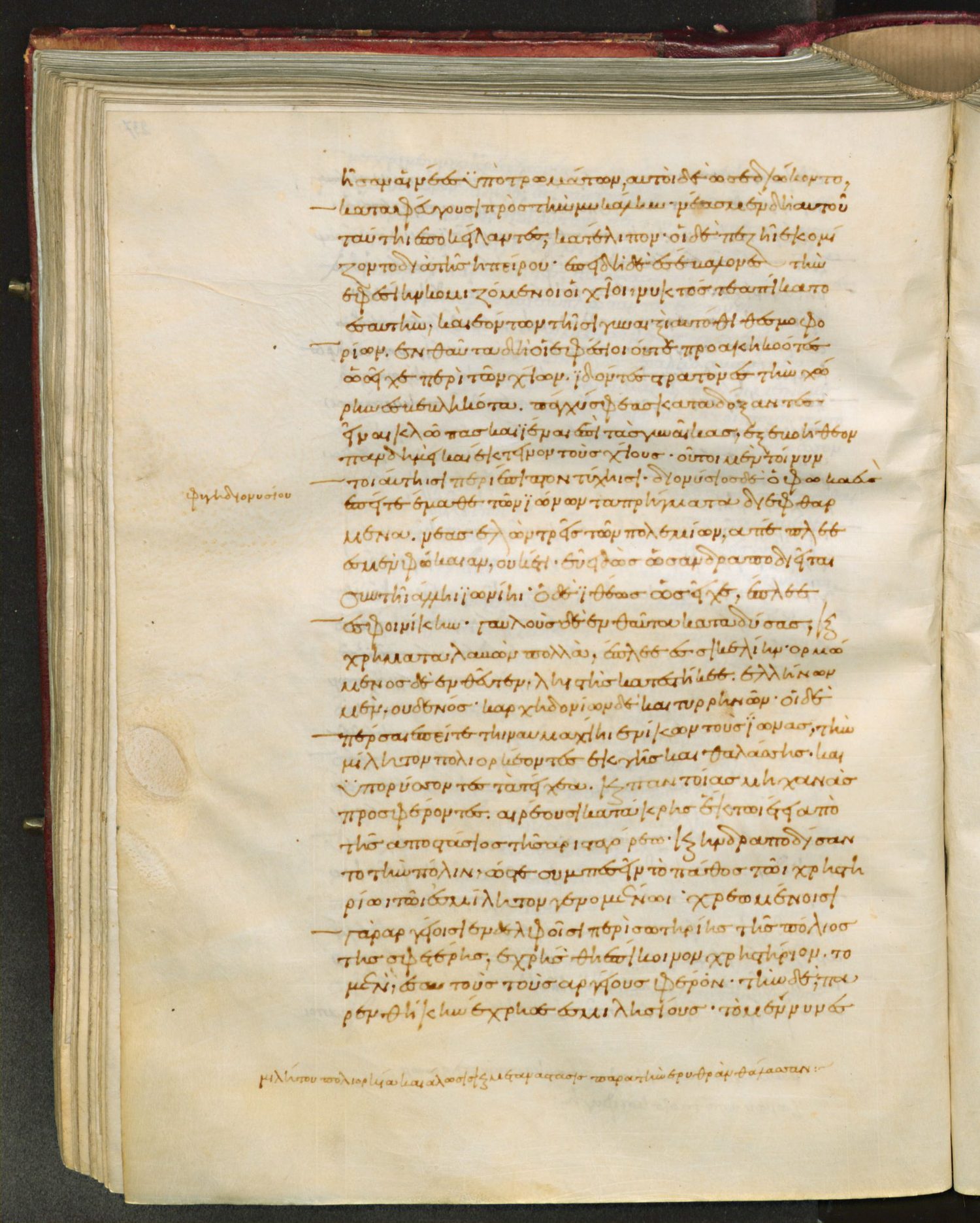
Laur. Plut. 70.3, fol. 237v: Greek here 6.18.1 to 6.19.1. Checked on the image (first and last words read and located in the Greek; each break checked against the neighbouring page): fol. 237v begins ‹ἦσαν αἱ νέες ὑπὸ› (6.16.1), ends ‹Μιλησίους. τὸ μέν νυν› (6.19.1). English here: 6.18.1 to 6.19.1 (Godley's sentences for the sections whose Greek lies mostly on this page).
6.18.1οἱ δὲ Πέρσαι ἐπείτε τῇ ναυμαχίῃ ἐνίκων τοὺς Ἴωνας, τὴν Μίλητον πολιορκέοντες ἐκ γῆς καὶ θαλάσσης καὶ ὑπορύσσοντες τὰ τείχεα καὶ παντοίας μηχανὰς προσφέροντες, αἱρέουσι κατʼ ἄκρης ἕκτῳ ἔτεϊ ἀπὸ τῆς ἀποστάσιος τῆς Ἀρισταγόρεω καὶ ἠνδραποδίσαντο τὴν πόλιν, ὥστε συμπεσεῖν τὸ πάθος τῷ χρηστηρίῳ τῷ ἐς Μίλητον γενομένῳ. 6.19.1χρεωμένοισι γὰρ Ἀργείοισι ἐν Δελφοῖσι περὶ σωτηρίης τῆς πόλιος τῆς σφετέρης ἐχρήσθη ἐπίκοινον χρηστήριον, τὸ μὲν ἐς αὐτοὺς τοὺς Ἀργείους φέρον, τὴν δὲ παρενθήκην ἔχρησε ἐς Μιλησίους. τὸ μέν νυν
6.18.1When the Persians had vanquished the Ionians by sea, they laid siege to Miletus by sea and land, mining the walls and using every device against it, till in the sixth year after the revolt of Aristagoras they took the city high and low and enslaved it. Thus did this calamity accord with the oracle concerning Miletus. 6.19.1For when the Argives enquired at Delphi of the safety of their city, there was given them an oracle of twofold import, part of it regarding the Argives themselves, but there was an oracle added thereto for the Milesians.
Where on the image
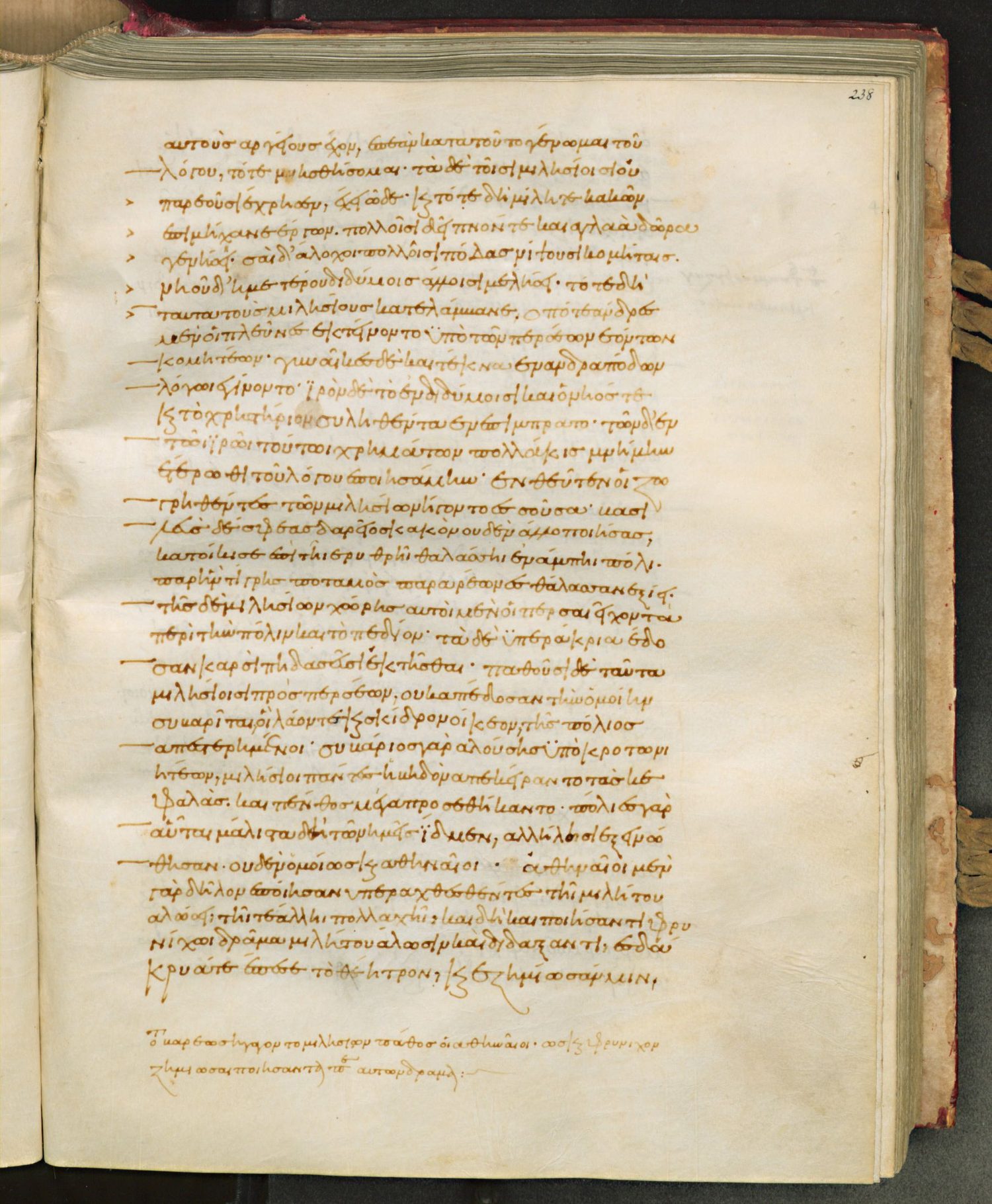
Laur. Plut. 70.3, fol. 238r: Greek here 6.19.1 to 6.21.2. Checked on the image (first and last words read and located in the Greek; each break checked against the neighbouring page): fol. 238r begins ‹ἐς τοὺς Ἀργείους ἔχον,ἐπεὰν› (6.19.1), ends ‹θέητρον, καὶ ἐζημίωσάν μιν› (6.21.2). English here: 6.19.2 to 6.21.2 (Godley's sentences for the sections whose Greek lies mostly on this page).
6.19.1ἐς τοὺς Ἀργείους ἔχον, 6.19.2ἐπεὰν κατὰ τοῦτο γένωμαι τοῦ λόγου, τότε μνησθήσομαι· τὰ δὲ τοῖσι Μιλησίοισι οὐ παρεοῦσι ἔχρησε, ἔχει ὧδε.
καὶ τότε δή, Μίλητε κακῶν ἐπιμήχανε ἔργων,
πολλοῖσιν δεῖπνόν τε καὶ ἀγλαὰ δῶρα γενήσῃ,
σαὶ δʼ ἄλοχοι πολλοῖσι πόδας νίψουσι κομήταις,
νηοῦ δʼ ἡμετέρου Διδύμοις ἄλλοισι μελήσει. 6.19.3τότε δὴ ταῦτα τοὺς Μιλησίους κατελάμβανε, ὁκότε ἄνδρες μὲν οἱ πλεῦνες ἐκτείνοντο ὑπὸ τῶν Περσέων ἐόντων κομητέων, γυναῖκες δὲ καὶ τέκνα ἐν ἀνδραπόδων λόγῳ ἐγίνοντο, ἱρὸν δὲ τὸ ἐν Διδύμοισι καὶ ὁ νηός τε καὶ τὸ χρηστήριον συληθέντα ἐνεπίμπρατο. τῶν δʼ ἐν τῷ ἱρῷ τούτῳ χρημάτων πολλάκις μνήμην ἑτέρωθι τοῦ λόγου ἐποιησάμην. 6.20.1ἐνθεῦτεν οἱ ζωγρηθέντες τῶν Μιλησίων ἤγοντο ἐς Σοῦσα. βασιλεὺς δὲ σφέας Δαρεῖος κακὸν οὐδὲν ἄλλο ποιήσας κατοίκισε ἐπὶ τῇ Ἐρυθρῇ καλεομένῃ θαλάσσῃ ἐν Ἄμπῃ πόλι, παρʼ ἣν Τίγρης ποταμὸς παραρρέων ἐς θάλασσαν ἐξιεῖ. τῆς δὲ Μιλησίων χώρης αὐτοὶ μὲν οἱ Πέρσαι εἶχον τὰ περὶ τὴν πόλιν καὶ τὸ πεδίον, τὰ δὲ ὑπεράκρια ἔδοσαν Καρσὶ Πηδασεῦσι ἐκτῆσθαι. 6.21.1παθοῦσι δὲ ταῦτα Μιλησίοισι πρὸς Περσέων οὐκ ἀπέδοσαν τὴν ὁμοίην Συβαρῖται, οἳ Λᾶόν τε καὶ Σκίδρον οἴκεον τῆς πόλιος ἀπεστερημένοι. Συβάριος γὰρ ἁλούσης ὑπὸ Κροτωνιητέων Μιλήσιοι πάντες ἡβηδὸν ἀπεκείραντο τὰς κεφαλὰς καὶ πένθος μέγα προσεθήκαντο· πόλιες γὰρ αὗται μάλιστα δὴ τῶν ἡμεῖς ἴδμεν ἀλλήλῃσι ἐξεινώθησαν· 6.21.2οὐδὲν ὁμοίως καὶ Ἀθηναῖοι. Ἀθηναῖοι μὲν γὰρ δῆλον ἐποίησαν ὑπεραχθεσθέντες τῇ Μιλήτου ἁλώσι τῇ τε ἄλλῃ πολλαχῇ, καὶ δὴ καὶ ποιήσαντι Φρυνίχῳ δρᾶμα Μιλήτου ἅλωσιν καὶ διδάξαντι ἐς δάκρυά τε ἔπεσε τὸ θέητρον, καὶ ἐζημίωσάν μιν
6.19.2Of that which concerned the Argives I will then make mention when I come to that part of my history; but this was the propheqy given to the Milesians, they not being then present: In that day, Miletus, thou planner of works that are evil, Thou for a banquet shalt serve and a guerdon rich of the spoiler; Many the long-locked gallants whose feet shall be washed by thy women; Woe for my Didyman shrine! no more shall its ministers tend it. 6.19.3All this now came upon the Milesians; for the most part of their men were slain by the long-haired Persians, and their women and children were accounted as slaves, and the temple at Didyma with its shrine and place of divination was plundered and burnt. Of the wealth that was in this temple I have often spoken elsewhere in my history. 6.20.1After that, the captive Milesians were brought to Susa. King Darius did them no further hurt, but settled them by the sea called Red, in the city called Ampe, whereby flows the river Tigris as it issues into the sea. Of the Milesian land the Persians themselves held what was nearest to the city, and the plain, giving the hill country into the possession of Carians from Pedasa. 6.21.1Now when the Milesians suffered all this at the hands of the Persians, the men of Sybaris (who had lost their city and dwelt in Laüs and Scidrus) gave them no just requital for what they had done; for when Sybaris was taken by the men of Croton, all the people of Miletus, young and old, shaved their heads and made great public lamentation; no cities within my knowledge were ever so closely joined in friendship as these. 6.21.2The Sybarites did nothing after the Athenian manner. For the Athenians, besides that they signified in many other ways their deep grief for the taking of Miletus, did this in especial:—Phrynichus having written a play entitled “The Fall of Miletus” and set it on the stage, the whole theatre brake into weeping; and they fined Phrynichus a thousand drachmae for bringing to mind a calamity that touched them so nearly, and forbade for ever the acting of that play.
Where on the image
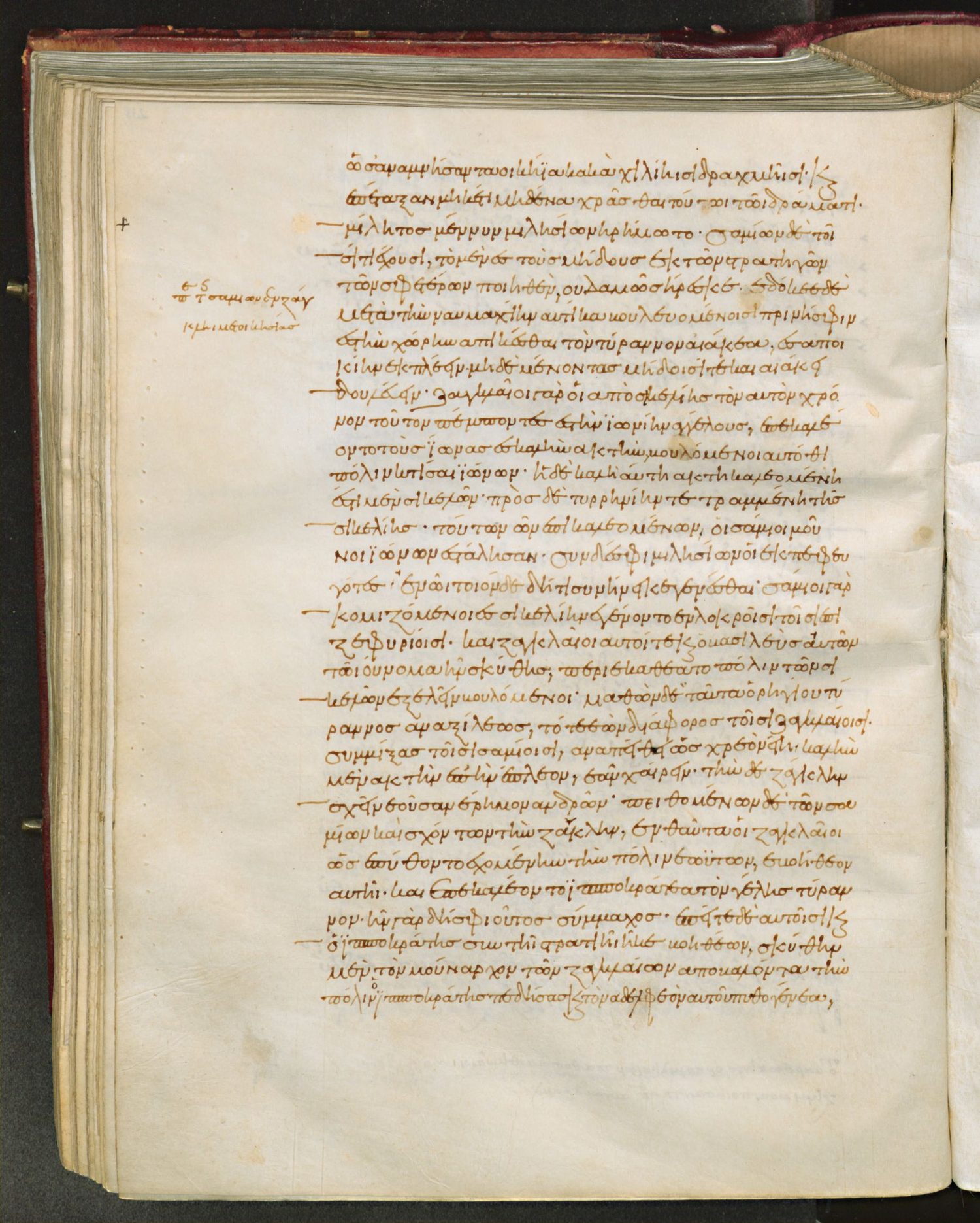
Laur. Plut. 70.3, fol. 238v: Greek here 6.21.2 to 6.23.4. Checked on the image (first and last words read and located in the Greek; each break checked against the neighbouring page): fol. 238v begins ‹ὡς ἀναμνήσαντα οἰκήια κακὰ› (6.21.2), ends ‹τὸν ἀδελφεὸν αὐτοῦ Πυθογένεα› (6.23.4). English here: 6.22.1 to 6.23.4 (Godley's sentences for the sections whose Greek lies mostly on this page).
6.21.2ὡς ἀναμνήσαντα οἰκήια κακὰ χιλίῃσι δραχμῇσι, καὶ ἐπέταξαν μηδένα χρᾶσθαι τούτῳ τῷ δράματι. 6.22.1Μίλητος μέν νυν Μιλησίων ἠρήμωτο. Σαμίων δὲ τοῖσί τι ἔχουσι τὸ μὲν ἐς τοὺς Μήδους ἐκ τῶν στρατηγῶν τῶν σφετέρων ποιηθὲν οὐδαμῶς ἤρεσκε, ἐδόκεε δὲ μετὰ τὴν ναυμαχίην αὐτίκα βουλευομένοισι, πρὶν ἤ σφι ἐς τὴν χώρην ἀπικέσθαι τὸν τύραννον Αἰάκεα, ἐς ἀποικίην ἐκπλέειν μηδὲ μένοντας Μήδοισί τε καὶ Αἰάκεϊ δουλεύειν. 6.22.2Ζαγκλαῖοι γὰρ οἱ ἀπὸ Σικελίης τὸν αὐτὸν χρόνον τοῦτον πέμποντες ἐς τὴν Ἰωνίην ἀγγέλους ἐπεκαλέοντο τοὺς Ἴωνας ἐς Καλὴν ἀκτήν, βουλόμενοι αὐτόθι πόλιν κτίσαι Ἰώνων. ἡ δὲ Καλὴ αὕτη ἀκτὴ καλεομένη ἔστι μὲν Σικελῶν, πρὸς δὲ Τυρσηνίην τετραμμένη τῆς Σικελίης. τούτων ὦν ἐπικαλεομένων οἱ Σάμιοι μοῦνοι Ἰώνων ἐστάλησαν, σὺν δέ σφι Μιλησίων οἱ ἐκπεφευγότες· ἐν ᾧ τοιόνδε δή τι συνήνεικε γενέσθαι. 6.23.1Σάμιοι γὰρ κομιζόμενοι ἐς Σικελίην ἐγίνοντο ἐν Λοκροῖσι τοῖσι Ἐπιζεφυρίοισι, καὶ Ζαγκλαῖοι αὐτοί τε καὶ ὁ βασιλεὺς αὐτῶν, τῷ οὔνομα ἦν Σκύθης, περικατέατο πόλιν τῶν Σικελῶν ἐξελεῖν βουλόμενοι. 6.23.2μαθὼν δὲ ταῦτα ὁ Ῥηγίου τύραννος Ἀναξίλεως, τότε ἐὼν διάφορος τοῖσι Ζαγκλαίοισι, συμμίξας τοῖσι Σαμίοισι ἀναπείθει ὡς χρεὸν εἴη Καλὴν μὲν ἀκτήν, ἐπʼ ἣν ἔπλεον, ἐᾶν χαίρειν, τὴν δὲ Ζάγκλην σχεῖν ἐοῦσαν ἔρημον ἀνδρῶν. 6.23.3πειθομένων δὲ τῶν Σαμίων καὶ σχόντων τὴν Ζάγκλην, ἐνθαῦτα οἱ Ζαγκλαῖοι, ὡς ἐπύθοντο ἐχομένην τὴν πόλιν ἑωυτῶν, ἐβοήθεον αὐτῇ καὶ ἐπεκαλέοντο Ἱπποκράτεα τὸν Γέλης τύραννον· ἦν γὰρ δή σφι οὗτος σύμμαχος. 6.23.4ἐπείτε δὲ αὐτοῖσι καὶ ὁ Ἱπποκράτης σὺν τῇ στρατιῇ ἧκε βοηθέων, Σκύθην μὲν τὸν μούναρχον τῶν Ζαγκλαίων ὡς ἀποβαλόντα τὴν πόλιν ὁ Ἱπποκράτης πεδήσας καὶ τὸν ἀδελφεὸν αὐτοῦ Πυθογένεα
6.22.1Miletus then was left empty of its people. But as regards the Samians, their men of substance were ill-pleased by the dealings of their generals with the Medes; after the sea-fight they took counsel straightway and resolved that before Aeaces the despot came to their country they would sail away to a colony, rather than remain and be slaves to the Medes and Aeaces. 6.22.2For the people of Zancle in Sicily about this time sent messengers to Ionia inviting the Ionians to the Fair Coast, desiring there to found an Ionian city. This Fair Coast, as it is called, is in Sicily, in that part which looks towards Tyrrhenia. At this invitation, then, the Samians alone of the Ionians, with those Milesians who had escaped, set forth; and in their journey a thing befel them such as I will show. 6.23.1As they voyaged to Sicily the Samians came to the country of the Epizephyrian Locrians at a time when the people of Zancle and their king (whose name was Scythes) were besieging a Sicilian town, desiring to take it. 6.23.2Learning this, Anaxilaus the despot of Rhegium, being then at feud with the Zanclaeans, consorted with the Samians and persuaded them from their purpose; they had best, he said, leave off their voyage to the Fair Coast, and seize Zancle while it was deserted by its men. 6.23.3To this the Samians consented and seized Zancle; whereat the Zanclaeans, when they learnt of the taking of their city, came to deliver it, calling to their aid Hippocrates the despot of Gela, who was their ally. 6.23.4But Hippocrates, when he came bringing his army to aid them, put Scythes the monarch of Zancle and his brother Pythogenes in chains for Scythes’ losing of the city, and sent them away to the town of Inyx; and for the rest of the people of Zancle, he betrayed them into the hands of the Samians, with whom he had taken counsel and exchanged oaths of agreement.
Where on the image
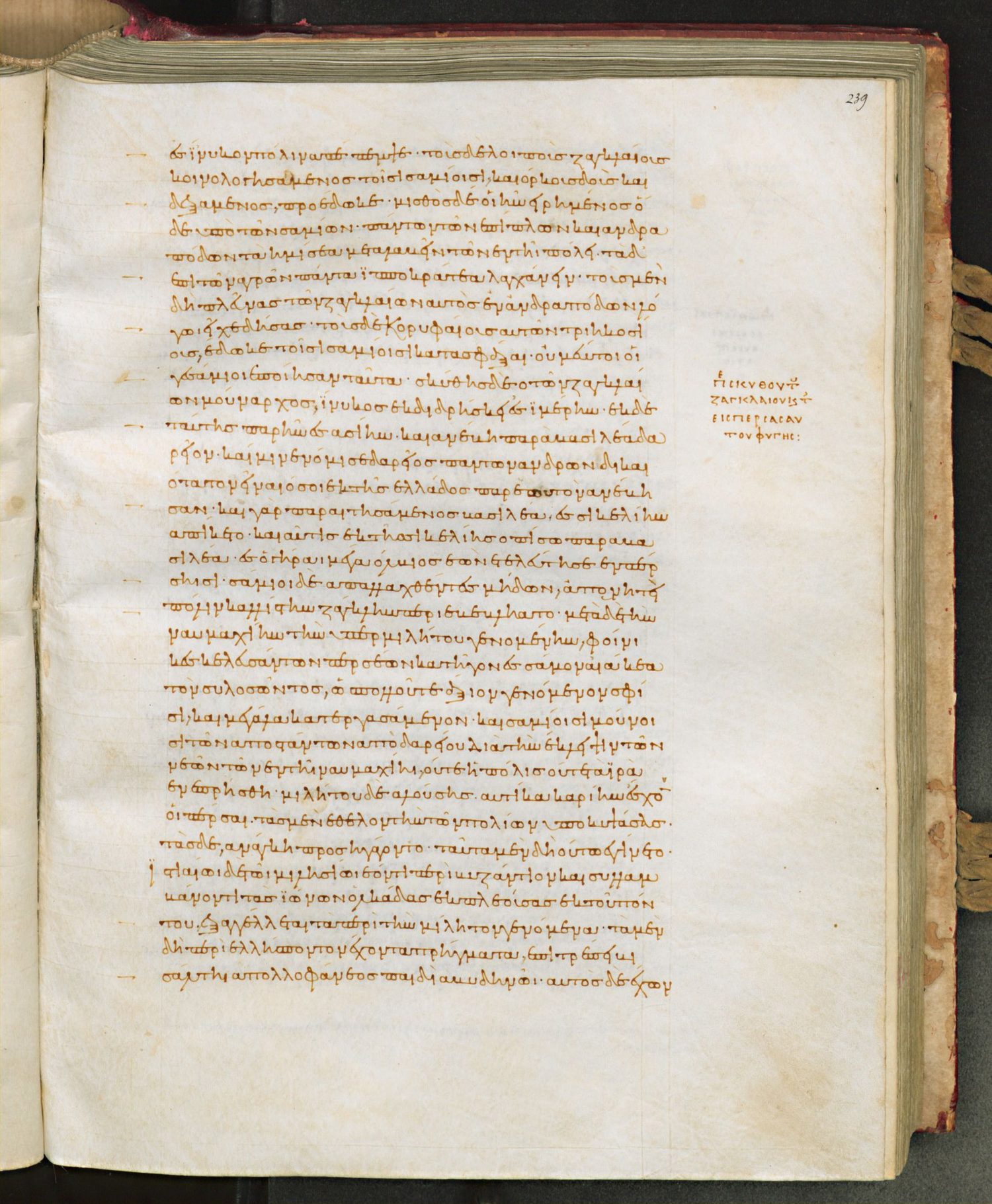
Laur. Plut. 70.3, fol. 239r: Greek here 6.23.4 to 6.26.1. Checked on the image (first and last words read and located in the Greek; each break checked against the neighbouring page): fol. 239r begins ‹ἐς Ἴνυκα πόλιν ἀπέπεμψε,› (6.23.4), ends ‹Ἀβυδηνῷ, αὐτὸς δὲ ἔχων› (6.26.1). English here: 6.23.5 to 6.26.1 (Godley's sentences for the sections whose Greek lies mostly on this page).
6.23.4ἐς Ἴνυκα πόλιν ἀπέπεμψε, τοὺς δὲ λοιποὺς Ζαγκλαίους κοινολογησάμενος τοῖσι Σαμίοισι καὶ ὅρκους δοὺς καὶ δεξάμενος προέδωκε. 6.23.5μισθὸς δέ οἱ ἦν εἰρημένος ὅδε ὑπὸ τῶν Σαμίων, πάντων τῶν ἐπίπλων καὶ ἀνδραπόδων τὰ ἡμίσεα μεταλαβεῖν τῶν ἐν τῇ πόλι, τὰ δʼ ἐπὶ τῶν ἀγρῶν πάντα Ἱπποκράτεα λαγχάνειν. 6.23.6τοὺς μὲν δὴ πλεῦνας τῶν Ζαγκλαίων αὐτὸς ἐν ἀνδραπόδων λόγῳ εἶχε δήσας, τοὺς δὲ κορυφαίους αὐτῶν τριηκοσίους ἔδωκε τοῖσι Σαμίοισι κατασφάξαι· οὐ μέντοι οἵ γε Σάμιοι ἐποίησαν ταῦτα. 6.24.1Σκύθης δὲ ὁ τῶν Ζαγκλαίων μούναρχος ἐκ τῆς Ἴνυκος ἐκδιδρήσκει ἐς Ἱμέρην, ἐκ δὲ ταύτης παρῆν ἐς τὴν Ἀσίην καὶ ἀνέβη παρὰ βασιλέα Δαρεῖον· καί μιν ἐνόμισε Δαρεῖος πάντων ἀνδρῶν δικαιότατον εἶναι, ὅσοι ἐκ τῆς Ἑλλάδος παρʼ ἑωυτὸν ἀνέβησαν. 6.24.2καὶ γὰρ παραιτησάμενος βασιλέα ἐς Σικελίην ἀπίκετο καὶ αὖτις ἐκ τῆς Σικελίης ὀπίσω παρὰ βασιλέα, ἐς ὃ γήραϊ μέγα ὄλβιος ἐὼν ἐτελεύτησε ἐν Πέρσῃσι. Σάμιοι δὲ ἀπαλλαχθέντες Μήδων ἀπονητὶ πόλιν καλλίστην Ζάγκλην περιεβεβλέατο. 6.25.1μετὰ δὲ τὴν ναυμαχίην τὴν ὑπὲρ Μιλήτου γενομένην Φοίνικες κελευσάντων Περσέων κατῆγον ἐς Σάμον Αἰάκεα τὸν Συλοσῶντος ὡς πολλοῦ τε ἄξιον γενόμενον σφίσι καὶ μεγάλα κατεργασάμενον· 6.25.2καὶ Σαμίοισι μούνοισι τῶν ἀποστάντων ἀπὸ Δαρείου διὰ τὴν ἔκλειψιν τῶν νεῶν ἐν τῇ ναυμαχίῃ οὔτε ἡ πόλις οὔτε τὰ ἱρὰ ἐνεπρήσθη. Μιλήτου δὲ ἁλούσης αὐτίκα Καρίην ἔσχον οἱ Πέρσαι, τὰς μὲν ἐθελοντὴν τῶν πολίων ὑποκυψάσας, τὰς δὲ ἀνάγκῃ προσηγάγοντο. 6.26.1ταῦτα μὲν δὴ οὕτω ἐγίνετο. Ἱστιαίῳ δὲ τῷ Μιλησίῳ ἐόντι περὶ Βυζάντιον καὶ συλλαμβάνοντι τὰς Ἰώνων ὁλκάδας ἐκπλεούσας ἐκ τοῦ Πόντου ἐξαγγέλλεται τὰ περὶ τὴν Μίλητον γενόμενα. τὰ μὲν δὴ περὶ Ἑλλήσποντον ἔχοντα πρήγματα ἐπιτράπει Βισάλτῃ Ἀπολλοφάνεος παιδὶ Ἀβυδηνῷ, αὐτὸς δὲ ἔχων
6.23.5The price which the Samians covenanted to give him was, that Hippocrates should take for his share half of the movable goods and of the slaves in the city, and all that was in the country. 6.23.6The greater number of the Zanclaeans were kept in chains as slaves by Hippocrates himself; three hundred, that were their chief men, he delivered to the Samians to be put to death; but the Samians did not so with them. 6.24.1Scythes the monarch of Zancle escaped from Inyx to Himera, and thence being arrived in Asia went up the country to king Darius. He was esteemed by Darius the most honest man of all who had come up to him from Hellas; 6.24.2for he returned by the king’s permission to Sicily and from Sicily back again to Darius; at the last he ended his life in Persia, full of years and of great possessions. Thus lightly did the Samians plant themselves in that most excellent city of Zancle, when they had escaped from the Medes. 6.25.1After the fight at sea for Miletus, the Phoenicians at the Persians’ bidding brought Aeaces, son of Syloson, back to Samos, for the high worth of his service to them, and his great achievements; and by reason of the desertion of their ships in the sea-fight the Samians were the only rebel people whose city was not burnt, nor their temples. 6.25.2Miletus being taken, the Persians thereby at once gained possession of Caria, some of the towns submitting themselves of their own accord and others being subdued perforce. 6.26.1All this fell out as I have said. But Histiaeus the Milesian was at Byzantium, seizing the Ionian merchant ships as they sailed out of the Euxine, when he had news of the business of Miletus. Thereupon, leaving all matters concerning the Hellespont in charge of Bisaltes of Abydos, son of Apollophanes, he himself sailed with Lesbians to Chios, and there did battle in the Hollows of Chios (as they are called) with Chian guardships that would not receive him.
Where on the image
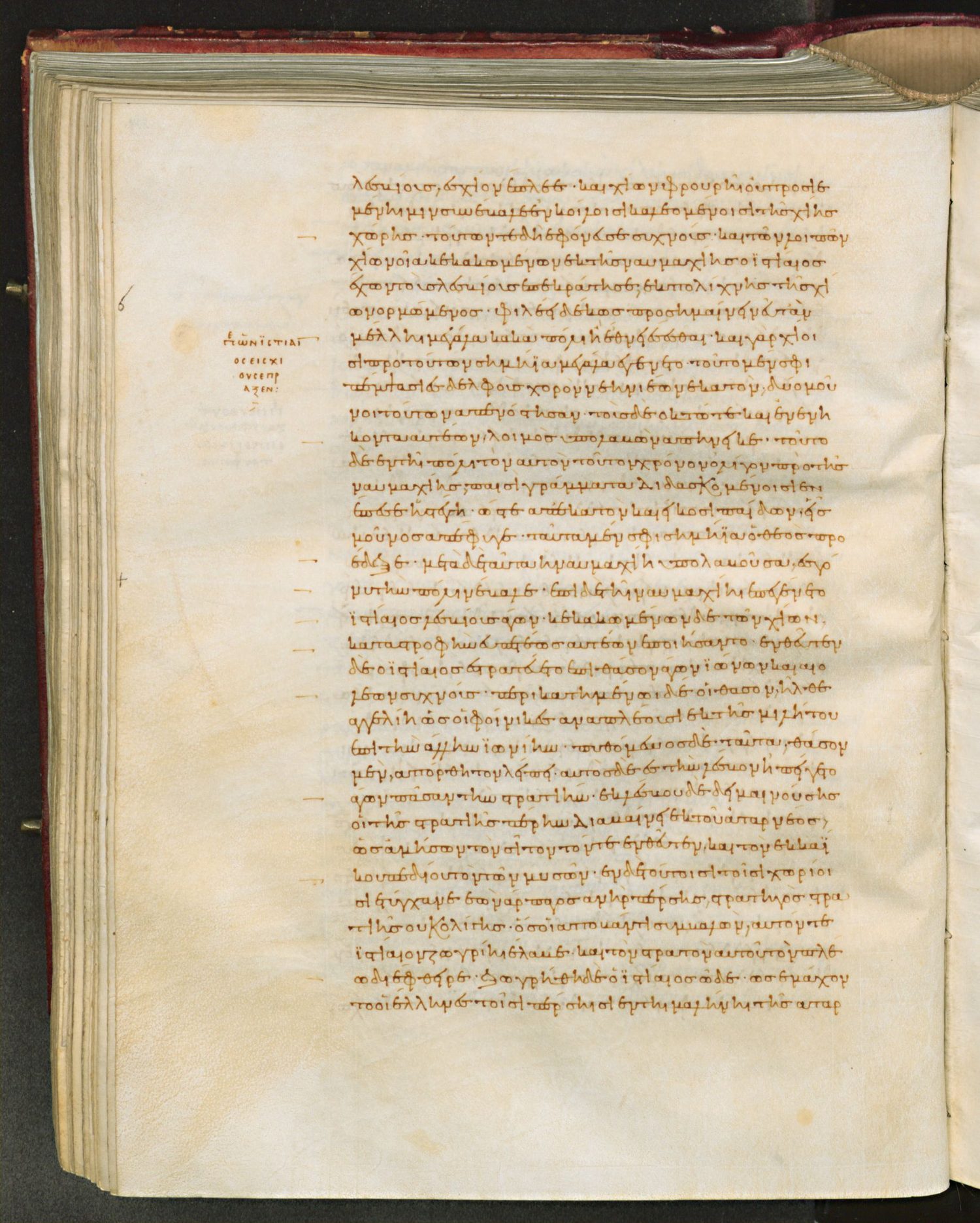
Laur. Plut. 70.3, fol. 239v: Greek here 6.26.1 to 6.29.1. Checked on the image (first and last words read and located in the Greek; each break checked against the neighbouring page): fol. 239v begins ‹Λεσβίους ἐς Χίον ἔπλεε,› (6.26.1), ends ‹τῇ Μαλήνῃ τῆς Ἀταρ-› (6.29.1). English here: 6.26.2 to 6.28.2 (Godley's sentences for the sections whose Greek lies mostly on this page).
6.26.1Λεσβίους ἐς Χίον ἔπλεε, καὶ Χίων φρουρῇ οὐ προσιεμένῃ μιν συνέβαλε ἐν Κοίλοισι καλεομένοισι τῆς Χίης χώρης. 6.26.2τούτων τε δὴ ἐφόνευσε συχνούς, καὶ τῶν λοιπῶν Χίων, οἷα δὴ κεκακωμένων ἐκ τῆς ναυμαχίης, ὁ Ἱστιαῖος ἔχων τοὺς Λεσβίους ἐπεκράτησε, ἐκ Πολίχνης τῆς Χίων ὁρμώμενος. 6.27.1φιλέει δέ κως προσημαίνειν, εὖτʼ ἂν μέλλῃ μεγάλα κακὰ ἢ πόλι ἢ ἔθνεϊ ἔσεσθαι· καὶ γὰρ Χίοισι πρὸ τούτων σημήια μεγάλα ἐγένετο· 6.27.2τοῦτο μέν σφι πέμψασι ἐς Δελφοὺς χορὸν νεηνιέων ἑκατὸν δύο μοῦνοι τούτων ἀπενόστησαν, τοὺς δὲ ὀκτώ τε καὶ ἐνενήκοντα αὐτῶν λοιμὸς ὑπολαβὼν ἀπήνεικε· τοῦτο δὲ ἐν τῇ πόλι τὸν αὐτὸν τοῦτον χρόνον, ὀλίγον πρὸ τῆς ναυμαχίης, παισὶ γράμματα διδασκομένοισι ἐνέπεσε ἡ στέγη, ὥστε ἀπʼ ἑκατὸν καὶ εἴκοσι παίδων εἷς μοῦνος ἀπέφυγε. 6.27.3ταῦτα μὲν σφι σημήια ὁ θεὸς προέδεξε, μετὰ δὲ ταῦτα ἡ ναυμαχίη ὑπολαβοῦσα ἐς γόνυ τὴν πόλιν ἔβαλε, ἐπὶ δὲ τῇ ναυμαχίῃ ἐπεγένετο Ἱστιαῖος Λεσβίους ἄγων· κεκακωμένων δὲ τῶν Χίων, καταστροφὴν εὐπετέως αὐτῶν ἐποιήσατο. 6.28.1ἐνθεῦτεν δὲ ὁ Ἱστιαῖος ἐστρατεύετο ἐπὶ Θάσον ἄγων Ἰώνων καὶ Αἰολέων συχνούς. περικατημένῳ δέ οἱ Θάσον ἦλθε ἀγγελίη ὡς οἱ Φοίνικες ἀναπλέουσι ἐκ τῆς Μιλήτου ἐπὶ τὴν ἄλλην Ἰωνίην. πυθόμενος δὲ ταῦτα Θάσον μὲν ἀπόρθητον λείπει, αὐτὸς δὲ ἐς τὴν Λέσβον ἠπείγετο ἄγων πᾶσαν τὴν στρατιήν. 6.28.2ἐκ Λέσβου δὲ λιμαινούσης οἱ τῆς στρατιῆς πέρην διαβαίνει, ἐκ τοῦ Ἀταρνέος ὡς ἀμήσων τὸν σῖτον τόν τε ἐνθεῦτεν καὶ τὸν ἐκ Καϊκου πεδίου τὸν τῶν Μυσῶν. ἐν δὲ τούτοισι τοῖσι χωρίοισι ἐτύγχανε ἐὼν Ἅρπαγος ἀνὴρ Πέρσης στρατηγὸς στρατιῆς οὐκ ὀλίγης· ὅς οἱ ἀποβάντι συμβαλὼν αὐτόν τε Ἱστιαῖον ζωγρίῃ ἔλαβε καὶ τὸν στρατὸν αὐτοῦ τὸν πλέω διέφθειρε. 6.29.1ἐζωγρήθη δὲ ὁ Ἱστιαῖος ὧδε. ὡς ἐμάχοντο οἱ Ἕλληνες τοῖσι Πέρσῃσι ἐν τῇ Μαλήνῃ τῆς Ἀταρνείτιδος
6.26.2Many of their crews he slew; the rest of the people of the country (so crippled were they by the sea-fight) Histiaeus with his Lesbians subdued to his will, coming out from Polichne in Chios. 6.27.1Ever is some warning given by heaven, when great ills threaten cities or nations; for before all this plain signs had been sent to the Chians. 6.27.2Of a band of a hundred youths whom they had sent to Delphi two only returned, ninety-eight being caught and carried off by pestilence; moreover, at about this same time, a little before the sea-fight, the roof fell in on boys at school, insomuch that of a hundred and twenty of them one alone escaped. 6.27.3These signs had been shown to them by heaven; thereafter the sea-fight brake upon them and beat the city to its knees, and with that came Histiaeus and the Lesbians to end what the sea-fight began; and the Chians being in so evil a case, he easily subdued them. 6.28.1Thence Histiaeus brought a great force of Ionians and Aeolians against Thasos. But while he beleaguered Thasos there came to him a message that the Phoenicians were putting out to sea from Miletus to attack the rest of Ionia; learning which he left Thasos unsacked, and made haste instead with all his army to Lesbos. 6.28.2Thence, for his men were anhungered, he crossed over with intent to reap from Atarneus the corn of that place and the Mysian corn of the Caïcus plain. Now it chanced that in that region was Harpagus, a Persian, having no small force under him; who, when Histiaeus landed, met him in battle and took Histiaeus himself alive and slew the greater part of his army.
Where on the image
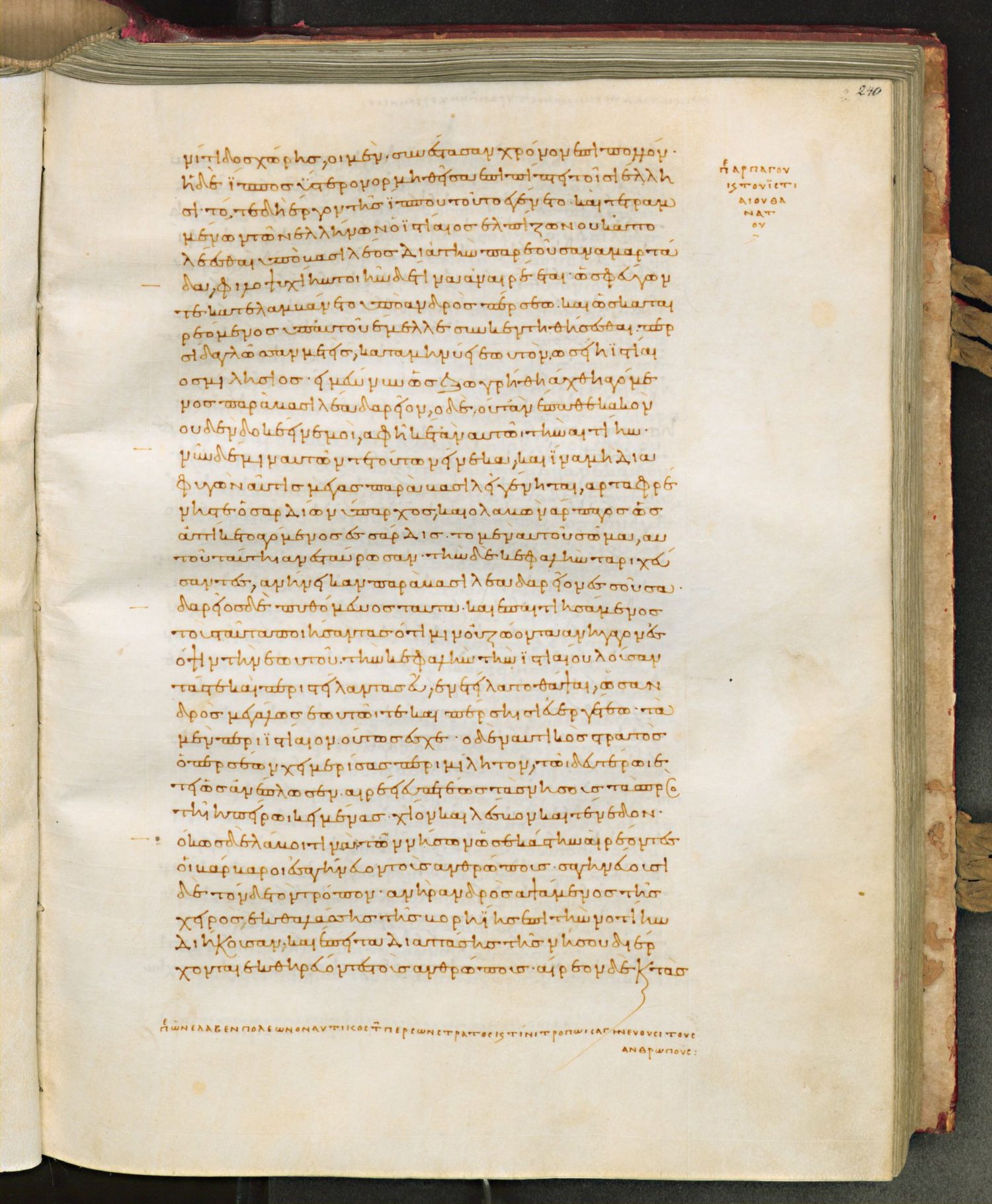
Laur. Plut. 70.3, fol. 240r: Greek here 6.29.1 to 6.31.2. Checked on the image (first and last words read and located in the Greek; each break checked against the neighbouring page): fol. 240r begins ‹-νείτιδος χώρης, οἳ μὲν› (6.29.1), ends ‹αἵρεον δὲ καὶ τὰς› (6.31.2). The word ‹Ἀταρνείτιδος› is divided between fol. 239v and fol. 240r; it is given with fol. 239v. English here: 6.29.1 to 6.31.2 (Godley's sentences for the sections whose Greek lies mostly on this page).
6.29.1χώρης, οἳ μὲν συνέστασαν χρόνον ἐπὶ πολλόν, ἡ δὲ ἵππος ὕστερον ὁρμηθεῖσα ἐπιπίπτει τοῖσι Ἕλλησι. τό τε δὴ ἔργον τῆς ἵππου τοῦτο ἐγένετο, καὶ τετραμμένων τῶν Ἑλλήνων ὁ Ἱστιαῖος ἐλπίζων οὐκ ἀπολέεσθαι ὑπὸ βασιλέος διὰ τὴν παρεοῦσαν ἁμαρτάδα φιλοψυχίην τοιήνδε τινὰ ἀναιρέεται· 6.29.2ὡς φεύγων τε κατελαμβάνετο ὑπὸ ἀνδρὸς Πέρσεω καὶ ὡς καταιρεόμενος ὑπʼ αὐτοῦ ἔμελλε συγκεντηθήσεσθαι, Περσίδα γλῶσσαν μετεὶς καταμηνύει ἑωυτὸν ὡς εἴη Ἱστιαῖος ὁ Μιλήσιος. 6.30.1εἰ μέν νυν, ὡς ἐζωγρήθη, ἄχθη ἀγόμενος παρὰ βασιλέα Δαρεῖον, ὁ δὲ οὔτʼ ἂν ἔπαθε κακὸν οὐδὲν δοκέειν ἐμοί, ἀπῆκέ τʼ ἂν αὐτῷ τὴν αἰτίην· νῦν δέ μιν αὐτῶν τε τούτων εἵνεκα καὶ ἵνα μὴ διαφυγὼν αὖτις μέγας παρὰ βασιλέι γένηται, Ἀρταφρένης τε ὁ Σαρδίων ὕπαρχος καὶ ὁ λαβὼν Ἅρπαγος, ὡς ἀπίκετο ἀγόμενος ἐς Σάρδις, τὸ μὲν αὐτοῦ σῶμα αὐτοῦ ταύτῃ ἀνεσταύρωσαν, τὴν δὲ κεφαλὴν ταριχεύσαντες ἀνήνεικαν παρὰ βασιλέα Δαρεῖον ἐς Σοῦσα. 6.30.2Δαρεῖος δὲ πυθόμενος ταῦτα καὶ ἐπαιτιησάμενος τοὺς ταῦτα ποιήσαντας ὅτι μιν οὐ ζώοντα ἀνήγαγον ἐς ὄψιν τὴν ἑωυτοῦ, τὴν κεφαλὴν τὴν Ἱστιαίου λούσαντάς τε καὶ περιστείλαντας εὖ ἐνετείλατο θάψαι ὡς ἀνδρὸς μεγάλως ἑωυτῷ τε καὶ Πέρσῃσι εὐεργέτεω. 6.31.1τὰ μὲν περὶ Ἱστιαῖον οὕτω ἔσχε. ὁ δὲ ναυτικὸς στρατὸς ὁ Περσέων χειμερίσας περὶ Μίλητον, τῷ δευτέρῳ ἔτεϊ ὡς ἀνέπλωσε, αἱρέει εὐπετέως τὰς νήσους τὰς πρὸς τῇ ἠπείρῳ κειμένας, Χίον καὶ Λέσβον καὶ Τένεδον. ὅκως δὲ λάβοι τινὰ τῶν νήσων, ὡς ἑκάστην αἱρέοντες οἱ βάρβαροι ἐσαγήνευον τοὺς ἀνθρώπους. 6.31.2σαγηνεύουσι δὲ τόνδε τὸν τρόπον· ἀνὴρ ἀνδρὸς ἁψάμενος τῆς χειρὸς ἐκ θαλάσσης τῆς βορηίης ἐπὶ τὴν νοτίην διήκουσι, καὶ ἔπειτα διὰ πάσης τῆς νήσου διέρχονται ἐκθηρεύοντες τοὺς ἀνθρώπους. αἵρεον δὲ καὶ τὰς
6.29.1Histiaeus was taken prisoner after this wise: the Greeks fought with the Persians at Malene in the country of Atarneus, and for a long time the armies battled foot to foot, till the Persian horse charged and fell upon the Greeks; thus it was they that achieved the victory; then, the Greeks being routed, Histiaeus, supposing that the king would not put him to death for his late transgression, did what showed him to love his life too well. 6.29.2Being overtaken in his flight by a Persian, and so caught and like to be stabbed, he cried out in the Persian language and discovered himself for Histiaeus of Miletus. 6.30.1Now had he been taken prisoner and brought on his way to king Darius, no harm had been done him (to my thinking) and the king had forgiven his guilt; but as it was, Histiaeus being brought to Sardis, there both by reason of what he had done, and for fear that he might escape and again win power at the court, Artaphrenes, viceroy of Sardis, and Harpagus who had taken Histiaeus, impaled his body on the spot, and sent his head embalmed to king Darius at Susa. 6.30.2When Darius learnt of this he blamed those who had so done, because they had not brought Histiaeus before him alive; for the head, he gave command that it should be washed and buried with full observance, as the head of one that had done great good to Darius himself and to Persia. 6.31.1Thus it fared with Histiaeus. The Persian fleet wintered at Miletus, and putting out to sea in the next year easily subdued the islands that lie off the mainland, Chios and Lesbos and Tenedos. Whenever they took an island, the foreigners would “net” each severally. 6.31.2This is the manner of their doing it:—the men link hands and make a line reaching from the northern sea to the southern, and then advance over the whole island hunting the people down. They took likewise also the Ionian cities of the mainland, albeit not by netting the people; for that was not possible.
Where on the image
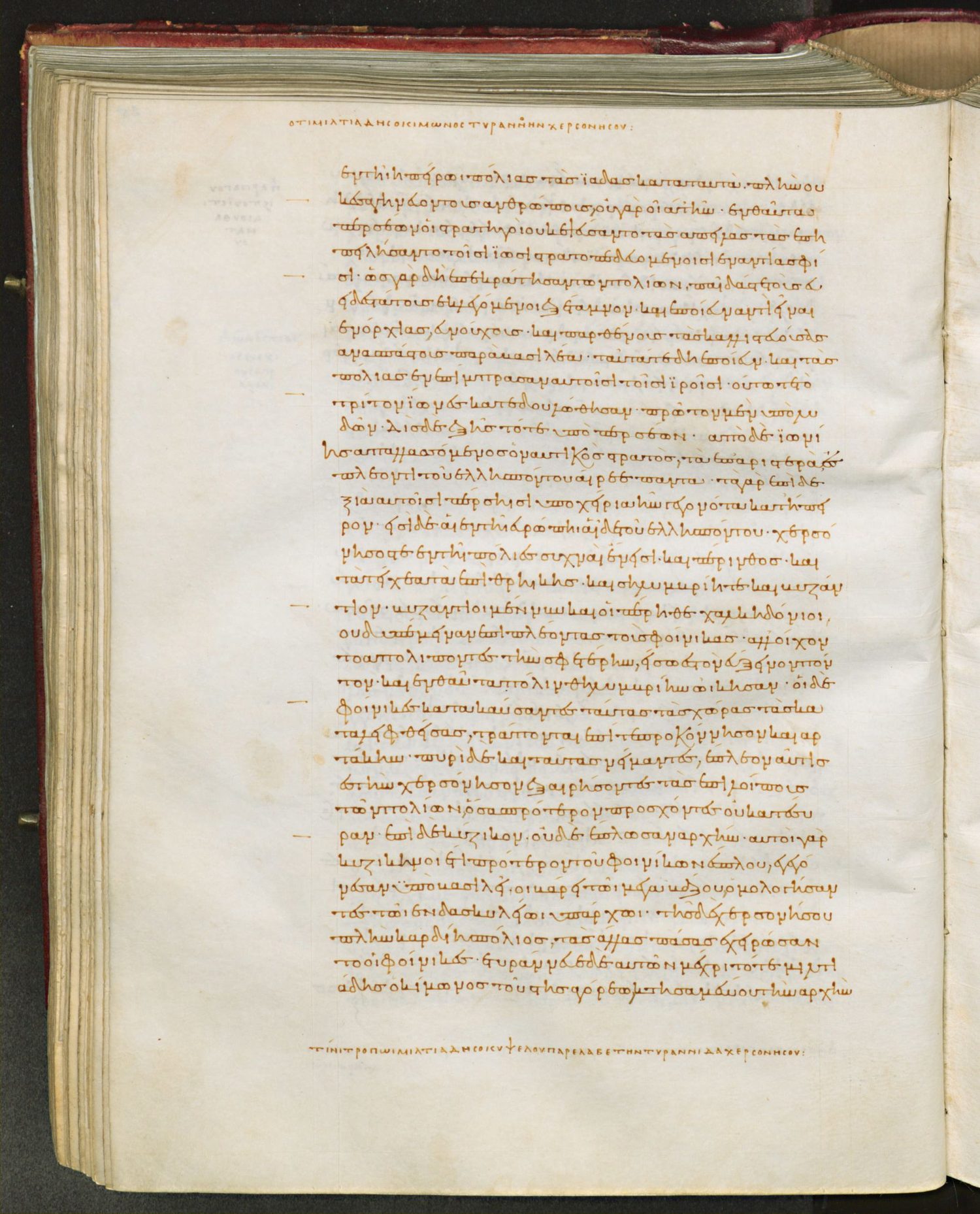
Laur. Plut. 70.3, fol. 240v: Greek here 6.31.2 to 6.33.3. Checked on the image (first and last words read and located in the Greek; each break checked against the neighbouring page): fol. 240v begins ‹ἐν τῇ ἠπείρῳ πόλιας› (6.31.2), ends ‹Στησαγόρεω, κτησαμένου τὴν ἀρχὴν› (6.34.1). In the upper margin, a reader's note in capitals on Miltiades son of Cimon, tyrant of the Chersonese. English here: 6.32.1 to 6.33.3 (Godley's sentences for the sections whose Greek lies mostly on this page).
6.31.2ἐν τῇ ἠπείρῳ πόλιας τὰς Ἰάδας κατὰ ταὐτά, πλὴν οὐκ ἐσαγήνευον τοὺς ἀνθρώπους· οὐ γὰρ οἷά τʼ ἦν. 6.32.1ἐνθαῦτα Περσέων οἱ στρατηγοὶ οὐκ ἐψεύσαντο τὰς ἀπειλὰς τὰς ἐπηπείλησαν τοῖσι Ἴωσι στρατοπεδευομένοισι ἐναντία σφίσι. ὡς γὰρ δὴ ἐπεκράτησαν τῶν πολίων, παῖδάς τε τοὺς εὐειδεστάτους ἐκλεγόμενοι ἐξέταμνον καὶ ἐποίευν ἀντὶ εἶναι ἐνόρχιας εὐνούχους καὶ παρθένους τὰς καλλιστευούσας ἀνασπάστους παρὰ βασιλέα· ταῦτά τε δὴ ἐποίευν καὶ τὰς πόλιας ἐνεπίμπρασαν αὐτοῖσι τοῖσι ἱροῖσι. οὕτω τε τὸ τρίτον Ἴωνες κατεδουλώθησαν, πρῶτον μὲν ὑπὸ Λυδῶν, δὶς δὲ ἐπεξῆς τότε ὑπὸ Περσέων. 6.33.1ἀπὸ δὲ Ἰωνίης ἀπαλλασσόμενος ὁ ναυτικὸς στρατὸς τὰ ἐπʼ ἀριστερὰ ἐσπλέοντι τοῦ Ἑλλησπόντου αἵρεε πάντα· τὰ γὰρ ἐπὶ δεξιὰ αὐτοῖσι τοῖσι Πέρσῃσι ὑποχείρια ἦν γεγονότα κατʼ ἤπειρον. εἰσὶ δὲ αἱ ἐν τῇ Εὐρώπῃ αἵδε τοῦ Ἑλλησπόντου, Χερσόνησός τε, ἐν τῇ πόλιες συχναὶ ἔνεισι, καὶ Πέρινθος καὶ τὰ τείχεα τὰ ἐπὶ Θρηίκης καὶ Σηλυμβρίη τε καὶ Βυζάντιον. 6.33.2Βυζάντιοι μέν νυν καὶ οἱ πέρηθε Καλχηδόνιοι οὐδʼ ὑπέμειναν ἐπιπλέοντας τοὺς Φοίνικας, ἀλλʼ οἴχοντο ἀπολιπόντες τὴν σφετέρην ἔσω ἐς τὸν Εὔξεινον πόντον, καὶ ἐνθαῦτα πόλιν Μεσαμβρίην οἴκησαν. οἱ δὲ Φοίνικες κατακαύσαντες ταύτας τὰς χώρας τὰς καταλεχθείσας τρέπονται ἐπί τε Προκόννησον καὶ Ἀρτάκην, πυρὶ δὲ καὶ ταύτας νείμαντες ἔπλεον αὖτις ἐς τὴν Χερσόνησον ἐξαιρήσοντες τὰς ἐπιλοίπους τῶν πολίων, ὅσας πρότερον προσσχόντες οὐ κατέσυραν. 6.33.3ἐπὶ δὲ Κύζικον οὐδὲ ἔπλωσαν ἀρχήν· αὐτοὶ γὰρ Κυζικηνοὶ ἔτι πρότερον τοῦ Φοινίκων ἐσπλόου ἐγεγόνεσαν ὑπὸ βασιλέϊ, Οἰβάρεϊ τῷ Μεγαβάζου ὁμολογήσαντες τῷ ἐν Δασκυλείῳ ὑπάρχῳ.
6.32.1There the Persian generals failed not to fulfil the threats which they had uttered against the Ionians when they were encamped over against them; for when they had gained the mastery over the cities, they chose out the comeliest boys and castrated them, making them eunuchs instead of men, and they carried the fairest maidens away to the king; this they did, and burnt the cities, yea, and their temples. Thus thrice had the Ionians been enslaved, first by the Lydians and then once and now yet again by the Persians. 6.33.1Then the fleet departed from Ionia and took all that lay on the left hand of the entrance of the Hellespont; for what was to the right had been subdued by the Persians themselves from the side of the land. These are the regions of Europe that belong to the Hellespont,—the Chersonese, wherein are many towns; Perinthus, and the forts that lie towards Thrace, and Selymbria and Byzantium. 6.33.2The people of Byzantium, and they of Calchedon beyond, did not even await the onfall of the Phoenicians, but left their own land and fled away within the Euxine, and there settled in the town Mesambria. The Phoenicians, having burnt these places aforesaid, turned against Proconnesus and Artace, and having given these also to the flames sailed back to the Chersonese to make an end of the remnant of the towns, as many as they had not destroyed at their former landing. 6.33.3But against Cyzicus they did not so much as sail at all; for the Cyzicenes had before this visitation of the fleet already made themselves the king’s subjects, by an agreement which they made with the viceroy at Dascyleum, Oebares son of Megabazus.
Notes
- Greek: the text printed in A. D. Godley's Loeb edition, via Perseus (tlg0016.tlg001.perseus-grc2). Square brackets mark words the editor considers later additions; [...] marks a gap the editor indicates. Perseus note markers are omitted.
- English: A. D. Godley, Herodotus vol. 3 (1922) (Loeb Classical Library), as transcribed on Wikisource. Godley's footnotes are omitted.
- Section numbers in the English were placed by comparing Godley's text with the Perseus version of his translation; where a section begins inside one of Godley's sentences, the English is kept with the page that holds the start of that sentence.
Cite
Sources
- Source: Florence, Laur. Plut. 70.3 (10th c.) via BML Teca Digitale + Greek of Godley's Loeb (Perseus) + English of A. D. Godley (Loeb, Wikisource) (holding institution)
- Critical edition: Greek of A. D. Godley's Loeb edition (1920-1925), via Perseus
← previous · → next · v cycle view · l back to library