Herodotus, Histories 6.95-110: Naxos, Delos and Eretria; before Marathon
Introduction
Herodotus of Halicarnassus wrote the Histories in the third quarter of the 5th century BCE, an inquiry into the deeds of Greeks and barbarians and the causes of the wars between them, later divided into nine books. Book 6 tells of the end of the Ionian revolt at Lade and Miletus, the first Persian expeditions against Greece under Mardonius and under Datis and Artaphrenes, the quarrels of Sparta, Athens and Aegina, and the battle of Marathon.
The photographs are of Florence, Biblioteca Medicea Laurenziana, Plut. 70.3 (parchment, 10th century, 374 folios, 31 lines a page), Herodotus, Histories (codex A of the editors), the oldest surviving manuscript of the complete Histories, from the Teca Digitale of the Biblioteca Medicea Laurenziana. Each section below is the text of one page, or of the part of a page that falls within these chapters. The first and last words of every page were read on the photograph and located in the Greek, and every page break was checked against the next page; the notes quote these words. Readers' notes in the margins are not part of the text and are mentioned where they occur.
The Greek is the text printed in A. D. Godley's Loeb edition (1920-1925), from Perseus; it is the edited text, not a transcription of the manuscript, whose wording differs in places. The English is Godley's translation as printed, from Wikisource. Godley's English carries only chapter numbers; the section numbers shown in it were placed by comparison with the Perseus version of his translation. Each page's English is cut at the end of one of Godley's sentences, so it can begin or end a few lines away from the Greek of the page; each note gives the exact ranges.
This entry covers chapters 6.95-110, on fol. 254r to 258r.
How was this verified? (Provenance)
Where on the image
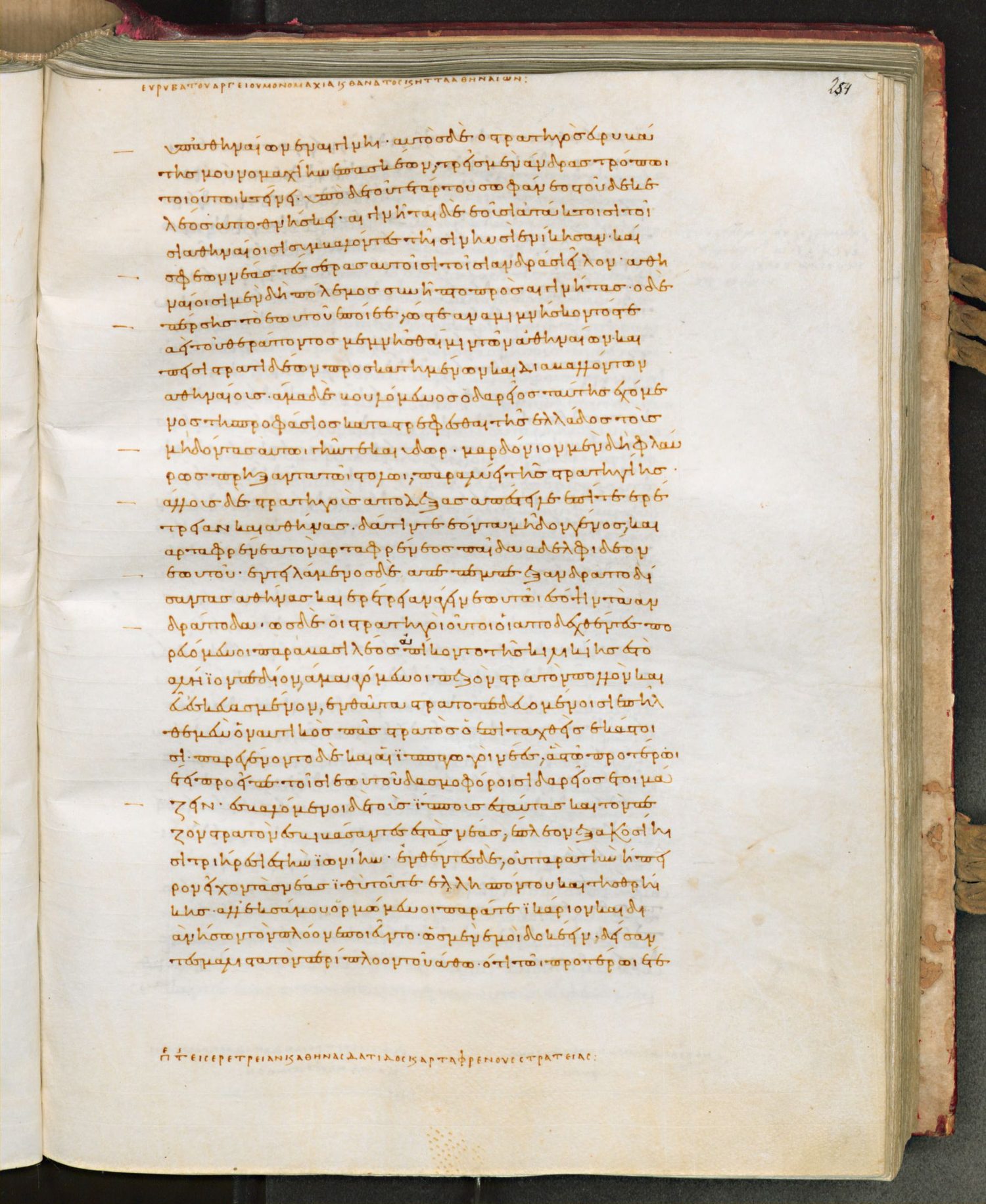
Laur. Plut. 70.3, fol. 254r: Greek here 6.95.1 to 6.95.2. Checked on the image (first and last words read and located in the Greek; each break checked against the neighbouring page): fol. 254r begins ‹ὑπʼ Ἀθηναίων ἐν Αἰγίνῃ·› (6.92.3), ends ‹ὅτι τῷ προτέρῳ ἔτεϊ› (6.95.2). In the upper margin, a reader's note in capitals on the single combats and death of Eurybates the Argive and the defeat of the Athenians. English here: 6.95.1 to 6.95.2 (Godley's sentences for the sections whose Greek lies mostly on this page).
6.95.1ὡς δὲ οἱ στρατηγοὶ οὗτοι οἱ ἀποδεχθέντες πορευόμενοι παρὰ βασιλέος ἀπίκοντο τῆς Κιλικίης ἐς τὸ Ἀλήιον πεδίον, ἅμα ἀγόμενοι πεζὸν στρατὸν πολλόν τε καὶ εὖ ἐσκευασμένον, ἐνθαῦτα στρατοπεδευομένοισι ἐπῆλθε μὲν ὁ ναυτικὸς πᾶς στρατὸς ὁ ἐπιταχθεὶς ἑκάστοισι, παρεγένοντο δὲ καὶ αἱ ἱππαγωγοὶ νέες, τὰς τῷ προτέρῳ ἔτεϊ προεῖπε τοῖσι ἑωυτοῦ δασμοφόροισι Δαρεῖος ἑτοιμάζειν. 6.95.2ἐσβαλόμενοι δὲ τοὺς ἵππους ἐς ταύτας καὶ τὸν πεζὸν στρατὸν ἐσβιβάσαντες ἐς τὰς νέας, ἔπλεον ἑξακοσίῃσι τριήρεσι ἐς τὴν Ἰωνίην. ἐνθεῦτεν δὲ οὐ παρὰ τὴν ἤπειρον εἶχον τὰς νέας ἰθὺ τοῦ τε Ἑλλησπόντου καὶ τῆς Θρηίκης, ἀλλʼ ἐκ Σάμου ὁρμώμενοι παρά τε Ἰκάριον καὶ διὰ νήσων τὸν πλόον ἐποιεῦντο, ὡς μὲν ἐμοὶ δοκέειν, δείσαντες μάλιστα τὸν περίπλοον τοῦ Ἄθω, ὅτι τῷ προτέρῳ ἔτεϊ
6.95.1When these the appointed generals on their way from the king’s presence were arrived at the Aleïan plain in Cilicia, bringing with them a host great and well furnished, there they encamped and were overtaken by all the armament of ships that was assigned to each portion; and the transports too for horses came up, that in the year before this Darius had bidden his tributary subjects to make ready. 6.95.2Having cast the horses into these, and embarked the land army in the ships, they sailed to Ionia with six hundred triremes. Thence they held their course not by the mainland and straight towards the Hellespont and Thrace, but setting forth from Samos they sailed by the Icarian sea and from island to island; this, to my thinking, was because they feared above all the voyage round Athos, seeing that in the year past they had come to great disaster by holding their course that way; and moreover Naxos constrained them, in that they had not yet taken it.
Where on the image
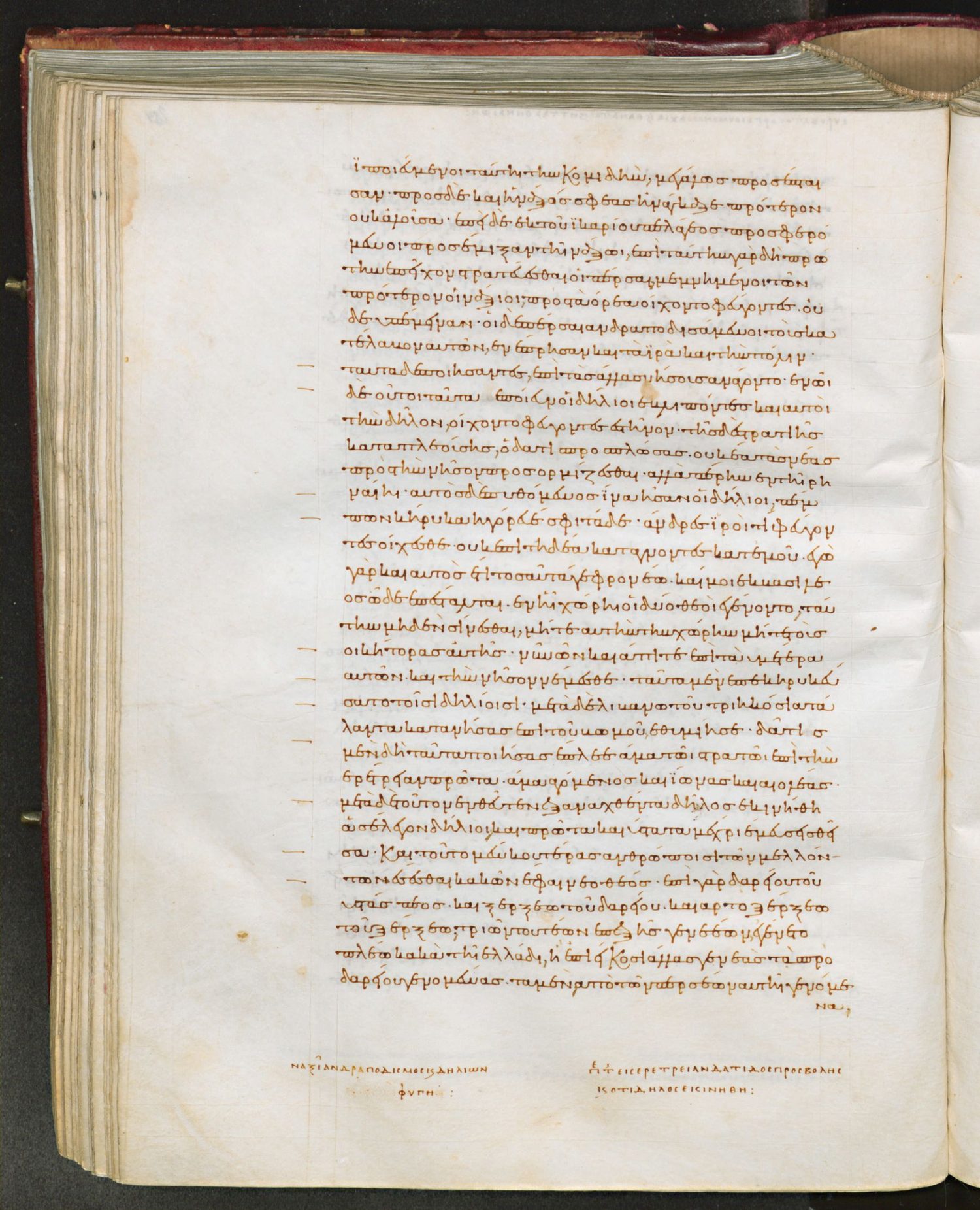
Laur. Plut. 70.3, fol. 254v: Greek here 6.95.2 to 6.98.2. Checked on the image (first and last words read and located in the Greek; each break checked against the neighbouring page): fol. 254v begins ‹ποιεύμενοι ταύτῃ τὴν κομιδὴν› (6.95.2), ends ‹τῶν Περσέων αὐτῇ γενόμενα› (6.98.2). The end of the last word (γενόμενα) is written below the last line. English here: 6.96.1 to 6.98.2 (Godley's sentences for the sections whose Greek lies mostly on this page).
6.95.2ποιεύμενοι ταύτῃ τὴν κομιδὴν μεγάλως προσέπταισαν· πρὸς δὲ καὶ ἡ Νάξος σφέας ἠνάγκαζε πρότερον οὐκ ἁλοῦσα. 6.96.1ἐπεὶ δὲ ἐκ τοῦ Ἰκαρίου πελάγεος προσφερόμενοι προσέμιξαν τῇ Νάξῳ, ἐπὶ ταύτην γὰρ δὴ πρώτην ἐπεῖχον στρατεύεσθαι οἱ Πέρσαι μεμνημένοι τῶν πρότερον οἱ Νάξιοι πρὸς τὰ ὄρεα οἴχοντο φεύγοντες οὐδὲ ὑπέμειναν, οἱ δὲ Πέρσαι ἀνδραποδισάμενοι τοὺς κατέλαβον αὐτῶν, ἐνέπρησαν καὶ τὰ ἱρὰ καὶ τὴν πόλιν. ταῦτα δὲ ποιήσαντες ἐπὶ τὰς ἄλλας νήσους ἀνήγοντο. 6.97.1ἐν ᾧ δὲ οὗτοι ταῦτα ἐποίευν, οἱ Δήλιοι ἐκλιπόντες καὶ αὐτοὶ τὴν Δῆλον οἴχοντο φεύγοντες ἐς Τῆνον. τῆς δὲ στρατιῆς καταπλεούσης ὁ Δᾶτις προπλώσας οὐκ ἔα τὰς νέας πρὸς τὴν Δῆλον προσορμίζεσθαι, ἀλλὰ πέρην ἐν τῇ Ῥηναίῃ· αὐτὸς δὲ πυθόμενος ἵνα ἦσαν οἱ Δήλιοι, πέμπων κήρυκα ἠγόρευέ σφι τάδε. 6.97.2ἄνδρες ἱροί, τί φεύγοντες οἴχεσθε, οὐκ ἐπιτήδεα καταγνόντες κατʼ ἐμεῦ; ἐγὼ γὰρ καὶ αὐτὸς ἐπὶ τοσοῦτό γε φρονέω καὶ μοι ἐκ βασιλέος ὧδε ἐπέσταλται, ἐν τῇ χώρῃ οἱ δύο θεοὶ ἐγένοντο, ταύτην μηδὲν σίνεσθαι, μήτε αὐτὴν τὴν χώρην μήτε τοὺς οἰκήτορας αὐτῆς. νῦν ὦν καὶ ἄπιτε ἐπὶ τὰ ὑμέτερα αὐτῶν καὶ τὴν νῆσον νέμεσθε. ταῦτα μὲν ἐπεκηρυκεύσατο τοῖσι Δηλίοισι, μετὰ δὲ λιβανωτοῦ τριηκόσια τάλαντα κατανήσας ἐπὶ τοῦ βωμοῦ ἐθυμίησε. 6.98.1Δᾶτις μὲν δὴ ταῦτα ποιήσας ἔπλεε ἅμα τῷ στρατῷ ἐπὶ τὴν Ἐρέτριαν πρῶτα, ἅμα ἀγόμενος καὶ Ἴωνας καὶ Αἰολέας. μετὰ δὲ τοῦτον ἐνθεῦτεν ἐξαναχθέντα Δῆλος ἐκινήθη, ὡς ἔλεγον Δήλιοι, καὶ πρῶτα καὶ ὕστατα μέχρι ἐμεῦ σεισθεῖσα. καὶ τοῦτο μέν κου τέρας ἀνθρώποισι τῶν μελλόντων ἔσεσθαι κακῶν ἔφαινε ὁ θεός. 6.98.2ἐπὶ γὰρ Δαρείου τοῦ Ὑστάσπεος καὶ Ξέρξεω τοῦ Δαρείου καὶ Ἀρτοξέρξεω τοῦ Ξέρξεω, τριῶν τουτέων ἐπεξῆς γενεέων, ἐγένετο πλέω κακὰ τῇ Ἑλλάδι ἢ ἐπὶ εἴκοσι ἄλλας γενεὰς τὰς πρὸ Δαρείου γενομένας, τὰ μὲν ἀπὸ τῶν Περσέων αὐτῇ γενόμενα,
6.96.1When they approached Naxos from the Icarian sea and came to land (for it was Naxos which the Persians purposed first to attack), the Naxians, mindful of what had before happened, fled away to the mountains, not abiding their coming. The Persians enslaved all of them that they caught, and burnt even their temples and their city; which done, they set sail for the other islands. 6.97.1While they so did, the Delians also left Delos and fled away to Tenos. But Datis, when his host was sailing landwards, went before it in his ship and bade his fleet anchor not off Delos, but across the water off Rhenaea; and being informed where the Delians were, he sent a herald to them with this proclamation: “ 6.97.2Holy men, why have you fled away, and so misjudged my intent? For it is my own desire, and the king’s command to me, to do no harm to the land wherein the two gods were born, neither to the land itself nor to those that dwell therein. Now, therefore, I bid you return to your homes and dwell in your island.” This proclamation he made to the Delians, and presently laid upon the altar and burnt there three hundred talents’ weight of frankincense. 6.98.1This done, Datis sailed with his host against Eretria first, taking with him Ionians and Aeolians; and after he had put out thence to sea, there was an earthquake in Delos, the first and last, as the Delians say, before my time. This portent was sent by heaven, as I suppose, to be an omen of the ills that were coming on the world. 6.98.2For in three generations, that is, in the time of Darius son of Hystaspes and Xerxes son of Darius and Artoxerxes son of Xerxes, more ills befel Hellas than in twenty generations before Darius; which ills came in part from the Persians and in part from the wars for preëminence among the chief of the nations themselves.
Where on the image
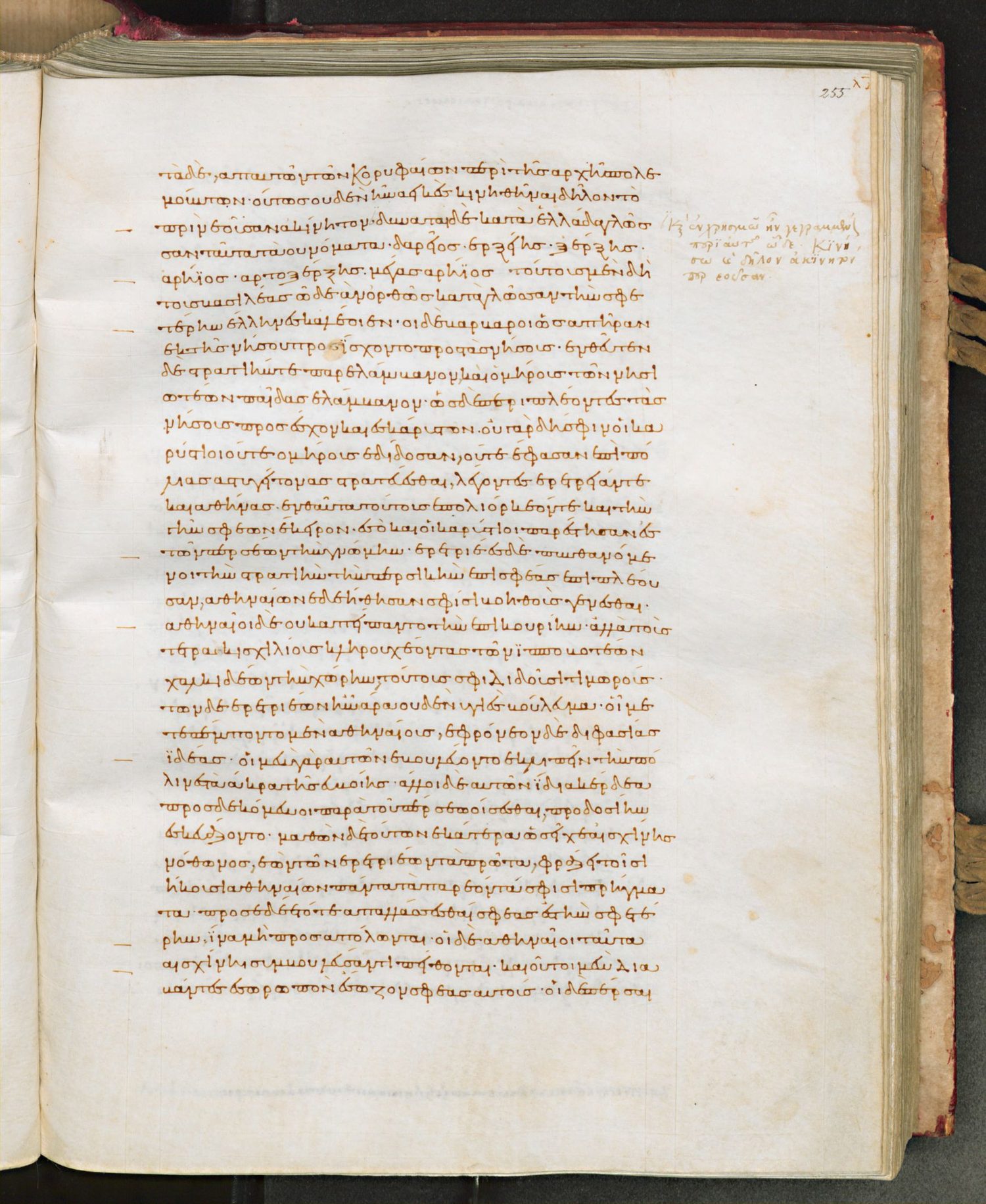
Laur. Plut. 70.3, fol. 255r: Greek here 6.98.2 to 6.101.1. Checked on the image (first and last words read and located in the Greek; each break checked against the neighbouring page): fol. 255r begins ‹τὰ δὲ ἀπʼ αὐτῶν› (6.98.2), ends ‹αὐτούς· οἱ δὲ Πέρσαι› (6.101.1). English here: 6.98.3 to 6.100.3 (Godley's sentences for the sections whose Greek lies mostly on this page).
6.98.2τὰ δὲ ἀπʼ αὐτῶν τῶν κορυφαίων περὶ τῆς ἀρχῆς πολεμεόντων. 6.98.3οὕτω οὐδὲν ἦν ἀεικὲς κινηθῆναι Δῆλον τὸ πρὶν ἐοῦσαν ἀκίνητον. καὶ ἐν χρησμῷ ἦν γεγραμμένον περὶ αὐτῆς ὧδε.
κινήσω καὶ Δῆλον ἀκίνητόν περ ἐοῦσαν.
δύναται δὲ κατὰ Ἑλλάδα γλῶσσαν ταῦτα τὰ οὐνόματα, Δαρεῖος ἐρξίης, Ξέρξης ἀρήιος, Ἀρτοξέρξης μέγας ἀρήιος. τούτους μὲν δὴ τοὺς βασιλέας ὧδε ἂν ὀρθῶς κατὰ γλῶσσαν τὴν σφετέρην Ἕλληνες καλέοιεν. 6.99.1οἱ δὲ βάρβαροι ὡς ἀπήειραν ἐκ τῆς Δήλου, προσῖσχον πρὸς τὰς νήσους, ἐνθεῦτεν δὲ στρατιήν τε παρελάμβανον καὶ ὁμήρους τῶν νησιωτέων παῖδας ἐλάμβανον. 6.99.2ὡς δὲ περιπλέοντες τὰς νήσους προσέσχον καὶ ἐς Κάρυστον, οὐ γὰρ δή σφι οἱ Καρύστιοι οὔτε ὁμήρους ἐδίδοσαν οὔτε ἔφασαν ἐπὶ πόλιας ἀστυγείτονας στρατεύεσθαι, λέγοντες Ἐρέτριάν τε καὶ Ἀθήνας, ἐνθαῦτα τούτους ἐπολιόρκεόν τε καὶ τὴν γῆν σφεων ἔκειρον, ἐς ὃ καὶ οἱ Καρύστιοι παρέστησαν ἐς τῶν Περσέων τὴν γνώμην. 6.100.1Ἐρετριέες δὲ πυνθανόμενοι τὴν στρατιὴν τὴν Περσικὴν ἐπὶ σφέας ἐπιπλέουσαν Ἀθηναίων ἐδεήθησαν σφίσι βοηθοὺς γενέσθαι. Ἀθηναῖοι δὲ οὐκ ἀπείπαντο τὴν ἐπικουρίην, ἀλλὰ τοὺς τετρακισχιλίους τοὺς κληρουχέοντας τῶν ἱπποβοτέων Χαλκιδέων τὴν χώρην, τούτους σφι διδοῦσι τιμωρούς. τῶν δὲ Ἐρετριέων ἦν ἄρα οὐδὲν ὑγιὲς βούλευμα, οἳ μετεπέμποντο μὲν Ἀθηναίους, ἐφρόνεον δὲ διφασίας ἰδέας. 6.100.2οἳ μὲν γὰρ αὐτῶν ἐβουλεύοντο ἐκλιπεῖν τὴν πόλιν ἐς τὰ ἄκρα τῆς Εὐβοίης, ἄλλοι δὲ αὐτῶν ἴδια κέρδεα προσδεκόμενοι παρὰ τοῦ Πέρσεω οἴσεσθαι προδοσίην ἐσκευάζοντο. 6.100.3μαθὼν δὲ τούτων ἑκάτερα ὡς εἶχε Αἰσχίνης ὁ Νόθωνος, ἐὼν τῶν Ἐρετριέων τὰ πρῶτα, φράξει τοῖσι ἥκουσι Ἀθηναίων πάντα τὰ παρεόντα σφι πρήγματα, προσεδέετό τε ἀπαλλάσσεσθαι σφέας ἐς τὴν σφετέρην, ἵνα μὴ προσαπόλωνται. οἱ δὲ Ἀθηναῖοι ταῦτα Αἰσχίνῃ συμβουλεύσαντι πείθονται. 6.101.1καὶ οὗτοι μὲν διαβάντες ἐς Ὠρωπὸν ἔσωζον σφέας αὐτούς· οἱ δὲ Πέρσαι
6.98.3Thus it was no marvel that there should be an earthquake in Delos where none had been ere that. Also there was an oracle concerning Delos, wherein it was written: Delos itself will I shake, that ne’er was shaken aforetime. Now as touching the names of those three kings, Darius signifies the Doer, Xerxes the Warrior, Artoxerxes the Great Warrior; and such the Greeks would rightly call them in their language. 6.99.1Launching out to sea from Delos, the foreigners put in at the islands, and gathered an army thence and took the sons of the islanders for hostages. 6.99.2When in their voyage about the islands they came to Carystos, the Carystians gave them no hostages and refused to join with them against neighbouring cities, whereby they signified Eretria and Athens; wherefore the Persians besieged them and laid waste their land, till the Carystians too came over to their side. 6.100.1The Eretrians, when they learnt that the Persian host was sailing to attack them, entreated aid from the Athenians. These did not refuse the aid, but gave the Eretrians for their defenders the four thousand tenant farmers that held the land of the Chalcidian horse-breeders. But it would seem that all was unstable in the designs of the Eretrians; for they sent to the Athenians for aid, but their counsels were divided; the one 6.100.2part of them planned to leave the city and make for the heights of Euboea, the other part plotted treason in hope so to win advantage for themselves from the Persians. 6.100.3Then Aeschines son of Nothon, who was a leading man in Eretria, out of his knowledge of both designs told those Athenians who had come how matters stood, and entreated them, moreover, to depart to their own country, lest they should perish like the rest; and the Athenians in this followed Aeschines’ advice.
Where on the image
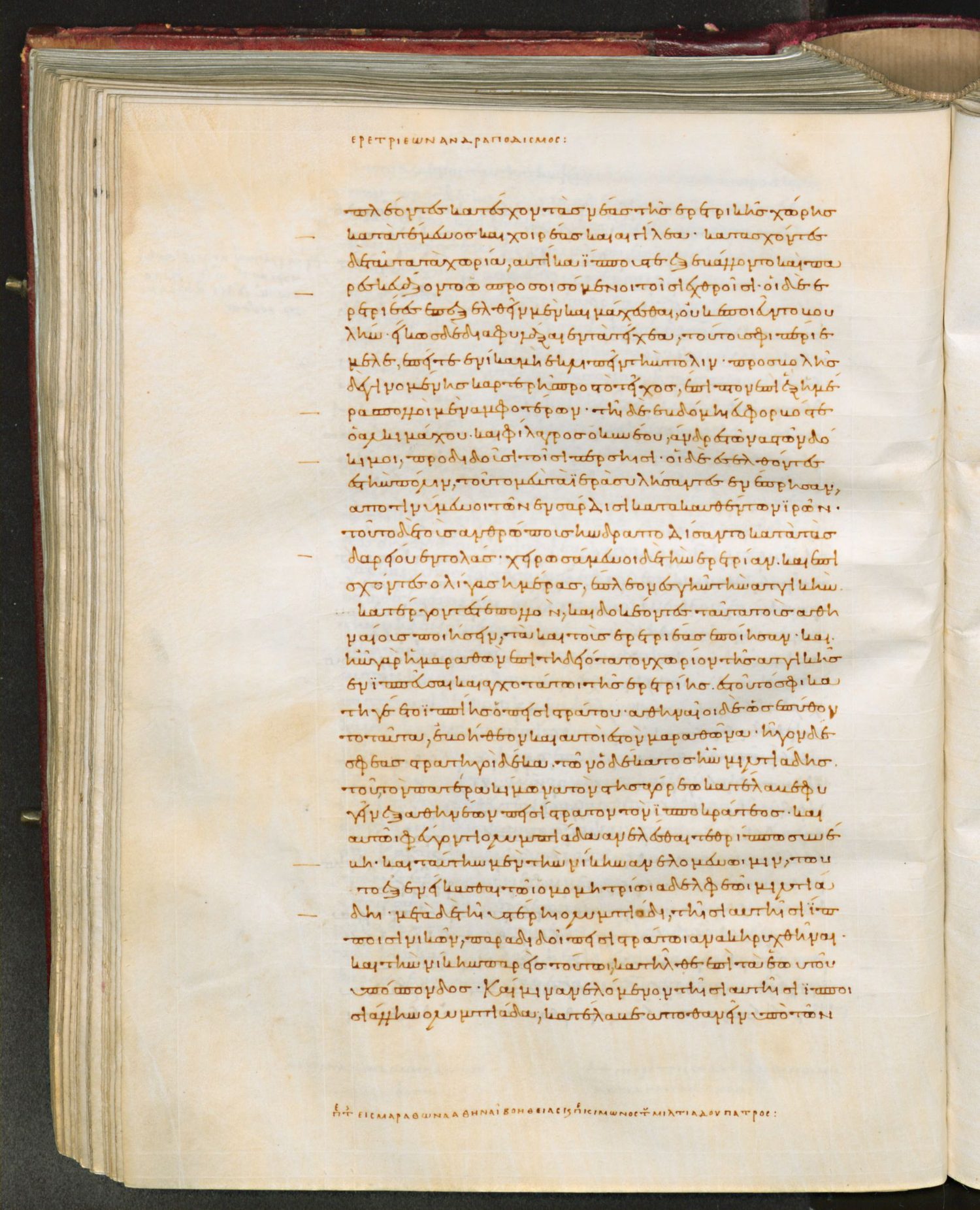
Laur. Plut. 70.3, fol. 255v: Greek here 6.101.1 to 6.103.3. Checked on the image (first and last words read and located in the Greek; each break checked against the neighbouring page): fol. 255v begins ‹πλέοντες κατέσχον τὰς νέας› (6.101.1), ends ‹κατέλαβε ἀποθανεῖν ὑπὸ τῶν› (6.103.3). In the upper margin, a reader's note in capitals: the enslavement of the Eretrians. English here: 6.101.1 to 6.103.2 (Godley's sentences for the sections whose Greek lies mostly on this page).
6.101.1πλέοντες κατέσχον τὰς νέας τῆς Ἐρετρικῆς χώρης κατὰ Τέμενος καὶ Χοιρέας καὶ Αἰγίλεα, κατασχόντες δὲ ταῦτα τὰ χωρία αὐτίκα ἵππους τε ἐξεβάλλοντο καὶ παρεσκευάζοντο ὡς προσοισόμενοι τοῖσι ἐχθροῖσι. 6.101.2οἱ δὲ Ἐρετριέες ἐπεξελθεῖν μὲν καὶ μαχέσασθαι οὐκ ἐποιεῦντο βουλήν, εἴ κως δὲ διαφυλάξαιεν τὰ τείχεα, τούτου σφι πέρι ἔμελε, ἐπείτε ἐνίκα μὴ ἐκλιπεῖν τὴν πόλιν. προσβολῆς δὲ γινομένης καρτερῆς πρὸς τὸ τεῖχος ἔπιπτον ἐπὶ ἓξ ἡμέρας πολλοὶ μὲν ἀμφοτέρων· τῇ δὲ ἑβδόμῃ Εὔφορβός τε ὁ Ἀλκιμάχου καὶ Φίλαγρος ὁ Κυνέου ἄνδρες τῶν ἀστῶν δόκιμοι προδιδοῦσι τοῖσι Πέρσῃσι. 6.101.3οἳ δὲ ἐσελθόντες ἐς τὴν πόλιν τοῦτο μὲν τὰ ἱρὰ συλήσαντες ἐνέπρησαν, ἀποτινύμενοι τῶν ἐν Σάρδισι κατακαυθέντων ἱρῶν, τοῦτο δὲ τοὺς ἀνθρώπους ἠνδραποδίσαντο κατὰ τὰς Δαρείου ἐντολάς. 6.102.1χειρωσάμενοι δὲ τὴν Ἐρέτριαν καὶ ἐπισχόντες ὀλίγας ἡμέρας ἔπλεον ἐς γῆν τὴν Ἀττικήν, κατέργοντές τε πολλὸν καὶ δοκέοντες ταὐτὰ τοὺς Ἀθηναίους ποιήσειν τὰ καὶ τοὺς Ἐρετριέας ἐποίησαν. καὶ ἦν γὰρ ὁ Μαραθὼν ἐπιτηδεότατον χωρίον τῆς Ἀττικῆς ἐνιππεῦσαι καὶ ἀγχοτάτω τῆς Ἐρετρίης, ἐς τοῦτό σφι κατηγέετο Ἱππίης ὁ Πεισιστράτου. 6.103.1Ἀθηναῖοι δὲ ὡς ἐπύθοντο ταῦτα, ἐβοήθεον καὶ αὐτοὶ ἐς τὸν Μαραθῶνα. ἦγον δὲ σφέας στρατηγοὶ δέκα, τῶν ὁ δέκατος ἦν Μιλτιάδης· τοῦ τὸν πατέρα Κίμωνα τὸν Στησαγόρεω κατέλαβε φυγεῖν ἐξ Ἀθηνέων Πεισίστρατον τὸν Ἱπποκράτεος. 6.103.2καὶ αὐτῷ φεύγοντι Ὀλυμπιάδα ἀνελέσθαι τεθρίππῳ συνέβη, καὶ ταύτην μὲν τὴν νίκην ἀνελόμενόν μιν τὠυτὸ ἐξενείκασθαι τῷ ὁμομητρίῳ ἀδελφεῷ Μιλτιάδῃ· μετὰ δὲ τῇ ὑστέρῃ Ὀλυμπιάδι τῇσι αὐτῇσι ἵπποισι νικῶν παραδιδοῖ Πεισιστράτῳ ἀνακηρυχθῆναι, καὶ τὴν νίκην παρεὶς τούτῳ κατῆλθε ἐπὶ τὰ ἑωυτοῦ ὑπόσπονδος. 6.103.3καί μιν ἀνελόμενον τῇσι αὐτῇσι ἵπποισι ἄλλην Ὀλυμπιάδα κατέλαβε ἀποθανεῖν ὑπὸ τῶν
6.101.1So they saved themselves by crossing over to Oropus; the Persians in their sailing held their course for Temenos and Choereae and Aegilea, all in Eretrian territory, and having taken possession of these places they straightway disembarked their horses and made preparation to attack their enemies. 6.101.2The Eretrians had no design of coming out and fighting; all their care was to guard their walls, if they could, seeing that it was the prevailing counsel not to leave the city. The walls were stoutly attacked, and for six days many fell on both sides; but on the seventh two Eretrians of repute, Euphorbus son of Alcimachus and Philagrus son of Cineas, betrayed the city to the Persians. 6.101.3These entered the city and plundered and burnt the temples, in revenge for the temples that were burnt at Sardis; moreover they enslaved the townspeople, according to Darius’ command. 6.102.1Having subdued Eretria they delayed for a few days, and then sailed to the Attic land, pressing hard forward and thinking that they would do to the Athenians what they had done to the Eretrians; and Marathon being the fittest part of Attica for horsemen to ride over, and nearest to Eretria, thither they were guided by Hippias son of Pisistratus. 6.103.1When the Athenians learnt of this, they too marched out to Marathon. Ten generals led them, of whom the tenth was Miltiades, whose father, Cimon son of Stesagoras, had been, as fate would have it, banished from Athens by Pisistratus son of Hippocrates. 6.103.2Being an exile, he had the luck to win the prize for four-horse chariots at Olympia, by this victory gaining the same honour as his mother’s son Miltiades had won. At the next Olympiad he was a winner again with the same team of mares, but suffered Pisistratus to be proclaimed victor, for which surrender of his victory he returned to his home under treaty.
Where on the image
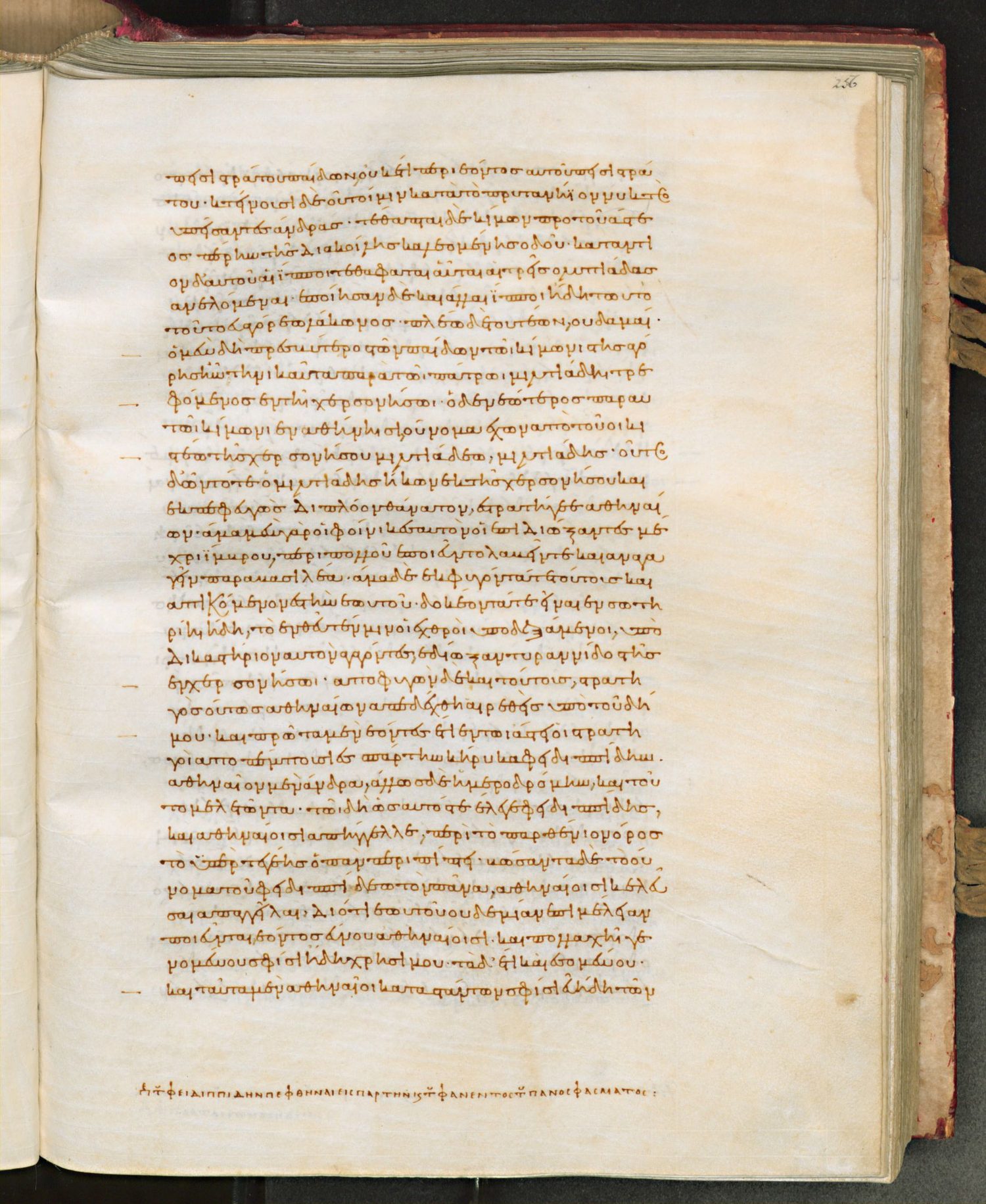
Laur. Plut. 70.3, fol. 256r: Greek here 6.103.3 to 6.105.3. Checked on the image (first and last words read and located in the Greek; each break checked against the neighbouring page): fol. 256r begins ‹Πεισιστράτου παίδων, οὐκέτι περιεόντος› (6.103.3), ends ‹σφι εὖ ἤδη τῶν› (6.105.3). English here: 6.103.3 to 6.105.2 (Godley's sentences for the sections whose Greek lies mostly on this page).
6.103.3Πεισιστράτου παίδων, οὐκέτι περιεόντος αὐτοῦ Πεισιστράτου· κτείνουσι δὲ οὗτοί μιν κατὰ τὸ πρυτανήιον νυκτὸς ὑπείσαντες ἄνδρας. τέθαπται δὲ Κίμων πρὸ τοῦ ἄστεος, πέρην τῆς διὰ Κοίλης καλεομένης ὁδοῦ· καταντίον δʼ αὐτοῦ αἱ ἵπποι τεθάφαται αὗται αἱ τρεῖς Ὀλυμπιάδας ἀνελόμεναι. 6.103.4ἐποίησαν δὲ καὶ ἄλλαι ἵπποι ἤδη τὠυτὸ τοῦτο Εὐαγόρεω Λάκωνος, πλέω δὲ τουτέων οὐδαμαί. ὁ μὲν δὴ πρεσβύτερος τῶν παίδων τῷ Κίμωνι Στησαγόρης ἦν τηνικαῦτα παρὰ τῷ πάτρῳ Μιλτιάδῃ τρεφόμενος ἐν τῇ Χερσονήσῳ, ὁ δὲ νεώτερος παρʼ αὐτῷ Κίμωνι ἐν Ἀθήνῃσι, οὔνομα ἔχων ἀπὸ τοῦ οἰκιστέω τῆς Χερσονήσου Μιλτιάδεω Μιλτιάδης. 6.104.1οὗτος δὴ ὦν τότε ὁ Μιλτιάδης ἥκων ἐκ τῆς Χερσονήσου καὶ ἐκπεφευγὼς διπλόον θάνατον ἐστρατήγεε Ἀθηναίων. ἅμα μὲν γὰρ οἱ Φοίνικες αὐτὸν οἱ ἐπιδιώξαντες μέχρι Ἴμβρου περὶ πολλοῦ ἐποιεῦντο λαβεῖν τε καὶ ἀναγαγεῖν παρὰ βασιλέα· 6.104.2ἅμα δὲ ἐκφυγόντα τε τούτους καὶ ἀπικόμενον ἐς τὴν ἑωυτοῦ δοκέοντά τε εἶναι ἐν σωτηρίῃ ἤδη, τὸ ἐνθεῦτέν μιν οἱ ἐχθροὶ ὑποδεξάμενοι ὑπὸ δικαστήριον αὐτὸν ἀγαγόντες ἐδίωξαν τυραννίδος τῆς ἐν Χερσονήσῳ. ἀποφυγὼν δὲ καὶ τούτους στρατηγὸς οὕτω Ἀθηναίων ἀπεδέχθη, αἱρεθεὶς ὑπὸ τοῦ δήμου. 6.105.1καὶ πρῶτα μὲν ἐόντες ἔτι ἐν τῷ ἄστεϊ οἱ στρατηγοὶ ἀποπέμπουσι ἐς Σπάρτην κήρυκα Φειδιππίδην Ἀθηναῖον μὲν ἄνδρα, ἄλλως δὲ ἡμεροδρόμην τε καὶ τοῦτο μελετῶντα· τῷ δή, ὡς αὐτός τε ἔλεγε Φειδιππίδης καὶ Ἀθηναίοισι ἀπήγγελλε, περὶ τὸ Παρθένιον ὄρος τὸ ὑπὲρ Τεγέης ὁ Πὰν περιπίπτει· 6.105.2βώσαντα δὲ τὸ οὔνομα τοῦ Φειδιππίδεω τὸν Πᾶνα Ἀθηναίοισι κελεῦσαι ἀπαγγεῖλαι, διʼ ὅ τι ἑωυτοῦ οὐδεμίαν ἐπιμελείην ποιεῦνται ἐόντος εὐνόου Ἀθηναίοισι καὶ πολλαχῇ γενομένου σφι ἤδη χρησίμου, τὰ δʼ ἔτι καὶ ἐσομένου. 6.105.3καὶ ταῦτα μὲν Ἀθηναῖοι, καταστάντων σφι εὖ ἤδη τῶν
6.103.3A third Olympic prize he won with the same team; after that, Pisistratus himself being now dead, fate willed that Miltiades should be slain by Pisistratus’ sons; these suborned men and slew him by night in the town-hall. Cimon lies buried outside the city, beyond the road that is called Through the Hollow; and the mares that won him the three Olympic prizes are buried over against his grave. 6.103.4None others save the mares of the Laconian Evagoras had ever achieved the same. Now Stesagoras, the eldest of Cimon’s sons, was at that time being brought up in the Chersonese with Miltiades his uncle; but the younger, named Miltiades after that Miltiades who planted a settlement on the Chersonese, was with Cimon himself at Athens. 6.104.1This Miltiades, then, had now come from the Chersonese and was a general of the Athenian army, after twice escaping death; for the Phoenicians, who held him in chase as far as Imbros, set great store by catching him and bringing him before the king; and when 6.104.2he had escaped from them to his country and supposed himself to be now in safety, he was next met by his enemies, who haled him before a court and would have justice on him for his rule of the Chersonese. From them too he was freed, and after that was appointed a general of the Athenians by the people’s choice. 6.105.1And first, while they were yet in the city, the generals sent as a herald to Sparta Phidippides, an Athenian, and one, moreover, that was a runner of long distances and made that his calling. This man, as he said himself and told the Athenians, when he was in the Parthenian hills above Tegea, met with Pan; who, 6.105.2calling to Phidippides by name, bade him say to the Athenians, “Why is it that ye take no thought for me, that am your friend, and ere now have oft been serviceable to you, and will be so again?”
Where on the image
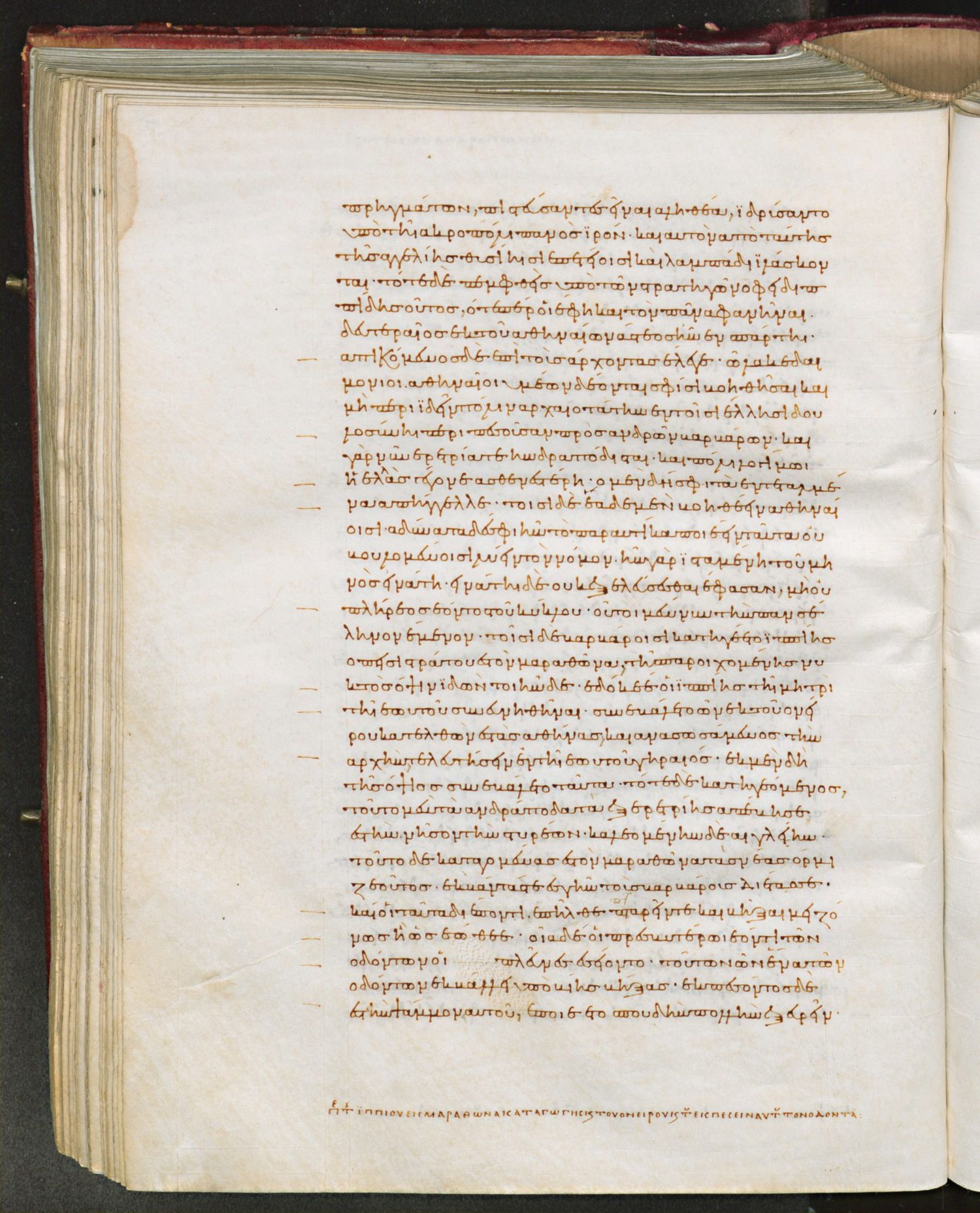
Laur. Plut. 70.3, fol. 256v: Greek here 6.105.3 to 6.107.3. Checked on the image (first and last words read and located in the Greek; each break checked against the neighbouring page): fol. 256v begins ‹πρηγμάτων, πιστεύσαντες εἶναι ἀληθέα› (6.105.3), ends ‹ἐποιέετο σπουδὴν πολλὴν ἐξευρεῖν› (6.107.3). English here: 6.105.3 to 6.107.4 (Godley's sentences for the sections whose Greek lies mostly on this page).
6.105.3πρηγμάτων, πιστεύσαντες εἶναι ἀληθέα ἱδρύσαντο ὑπὸ τῇ ἀκροπόλι Πανὸς ἱρόν, καὶ αὐτὸν ἀπὸ ταύτης τῆς ἀγγελίης θυσίῃσι ἐπετείοισι καὶ λαμπάδι ἱλάσκονται. 6.106.1τότε δὲ πεμφθεὶς ὑπὸ τῶν στρατηγῶν ὁ Φειδιππίδης οὗτος, ὅτε πέρ οἱ ἔφη καὶ τὸν Πᾶνα φανῆναι, δευτεραῖος ἐκ τοῦ Ἀθηναίων ἄστεος ἦν ἐν Σπάρτῃ, ἀπικόμενος δὲ ἐπὶ τοὺς ἄρχοντας ἔλεγε 6.106.2ὦ Λακεδαιμόνιοι, Ἀθηναῖοι ὑμέων δέονται σφίσι βοηθῆσαι καὶ μὴ περιιδεῖν πόλιν ἀρχαιοτάτην ἐν τοῖσι Ἕλλησι δουλοσύνῃ περιπεσοῦσαν πρὸς ἀνδρῶν βαρβάρων· καὶ γὰρ νῦν Ἐρέτριά τε ἠνδραπόδισται καὶ πόλι λογίμῳ ἡ Ἑλλὰς γέγονε ἀσθενεστέρη. 6.106.3ὃ μὲν δή σφι τὰ ἐντεταλμένα ἀπήγγελλε, τοῖσι δὲ ἕαδε μὲν βοηθέειν Ἀθηναίοισι, ἀδύνατα δέ σφι ἦν τὸ παραυτίκα ποιέειν ταῦτα, οὐ βουλομένοισι λύειν τὸν νόμον· ἦν γὰρ ἱσταμένου τοῦ μηνὸς εἰνάτη, εἰνάτῃ δὲ οὐκ ἐξελεύσεσθαι ἔφασαν μὴ οὐ πλήρεος ἐόντος τοῦ κύκλου. 6.107.1οὗτοι μέν νυν τὴν πανσέληνον ἔμενον. τοῖσι δὲ βαρβάροισι κατηγέετο Ἱππίης ὁ Πεισιστράτου ἐς τὸν Μαραθῶνα, τῆς παροιχομένης νυκτὸς ὄψιν ἰδὼν τοιήνδε· ἐδόκεε ὁ Ἱππίης τῇ μητρὶ τῇ ἑωυτοῦ συνευνηθῆναι. 6.107.2συνεβάλετο ὦν ἐκ τοῦ ὀνείρου κατελθὼν ἐς τὰς Ἀθήνας καὶ ἀνασωσάμενος τὴν ἀρχὴν τελευτήσειν ἐν τῇ ἑωυτοῦ γηραιός. ἐκ μὲν δὴ τῆς ὄψιος συνεβάλετο ταῦτα, τότε δὲ κατηγεόμενος τοῦτο μὲν τὰ ἀνδράποδα τὰ ἐξ Ἐρετρίης ἀπέβησε ἐς τὴν νῆσον τὴν Στυρέων, καλεομένην δὲ Αἰγλείην, τοῦτο δὲ καταγομένας ἐς τὸν Μαραθῶνα τὰς νέας ὅρμιζε οὗτος, ἐκβάντας τε ἐς γῆν τοὺς βαρβάρους διέτασσε. 6.107.3καί οἱ ταῦτα διέποντι ἐπῆλθε πταρεῖν τε καὶ βῆξαι μεζόνως ἢ ὡς ἐώθεε· οἷα δέ οἱ πρεσβυτέρῳ ἐόντι τῶν ὀδόντων οἱ πλεῦνες ἐσείοντο· τούτων ὦν ἕνα τῶν ὀδόντων ἐκβάλλει ὑπὸ βίης βήξας· ἐκπεσόντος δὲ ἐς τὴν ψάμμον αὐτοῦ ἐποιέετο σπουδὴν πολλὴν ἐξευρεῖν.
6.105.3This story the Athenians believed to be true, and when their state won to prosperity they founded a temple of Pan beneath the acropolis, and for that message sought the god’s favour with yearly sacrifices and torch-races. 6.106.1But now, at the time when he was sent by the generals and said that Pan had appeared to him, this Phidippides was at Sparta on the day after he left Athens; and he came before the rulers and said, “ 6.106.2Lacedaemonians, the Athenians entreat you to send them help, and not suffer a most ancient city of Hellas to be brought into bondage by foreigners; for even now Eretria has been enslaved, and Hellas is the weaker by the loss of a notable city. 6.106.3“Thus Phidippides gave the message wherewith he was charged, and the Lacedaemonians resolved to send help to the Athenians; but they could not do this immediately, being loath to break their law; for it was the ninth day of the first part of the month, and they would make no expedition (they said) on the ninth day, when the moon was not full. 6.107.1So they waited for the full moon. As for the Persians, they were guided to Marathon by Hippias son of Pisistratus. Hippias in the past night had seen a vision in his sleep, wherein he thought that he lay with his own mother; 6.107.2he interpreted this dream to signify that he should return to Athens and recover his power, and so die an old man in his own mother-country. Thus he interpreted the vision; for the nonce, being the Persians’ guide, he carried the slaves taken in Eretria to the island of the Styreans called Aeglea; moreover, it was he who made the ships to anchor when they had put in at Marathon, and who set the foreigners in array when they were landed. 6.107.3Now while he dealt with these matters he fell a-sneezing and a-coughing more violently than he was wont; he was well stricken in years, and the most of his teeth were loose; whereby the violence of his cough made one of his teeth to fall out. It fell into the sand, and Hippias used all diligence to find it; but the tooth being nowhere to be seen, 6.107.4he said lamentably to them that stood by, “This land is none of ours, nor shall we avail to subdue it; my tooth has all the share of it that was for me.”
Where on the image
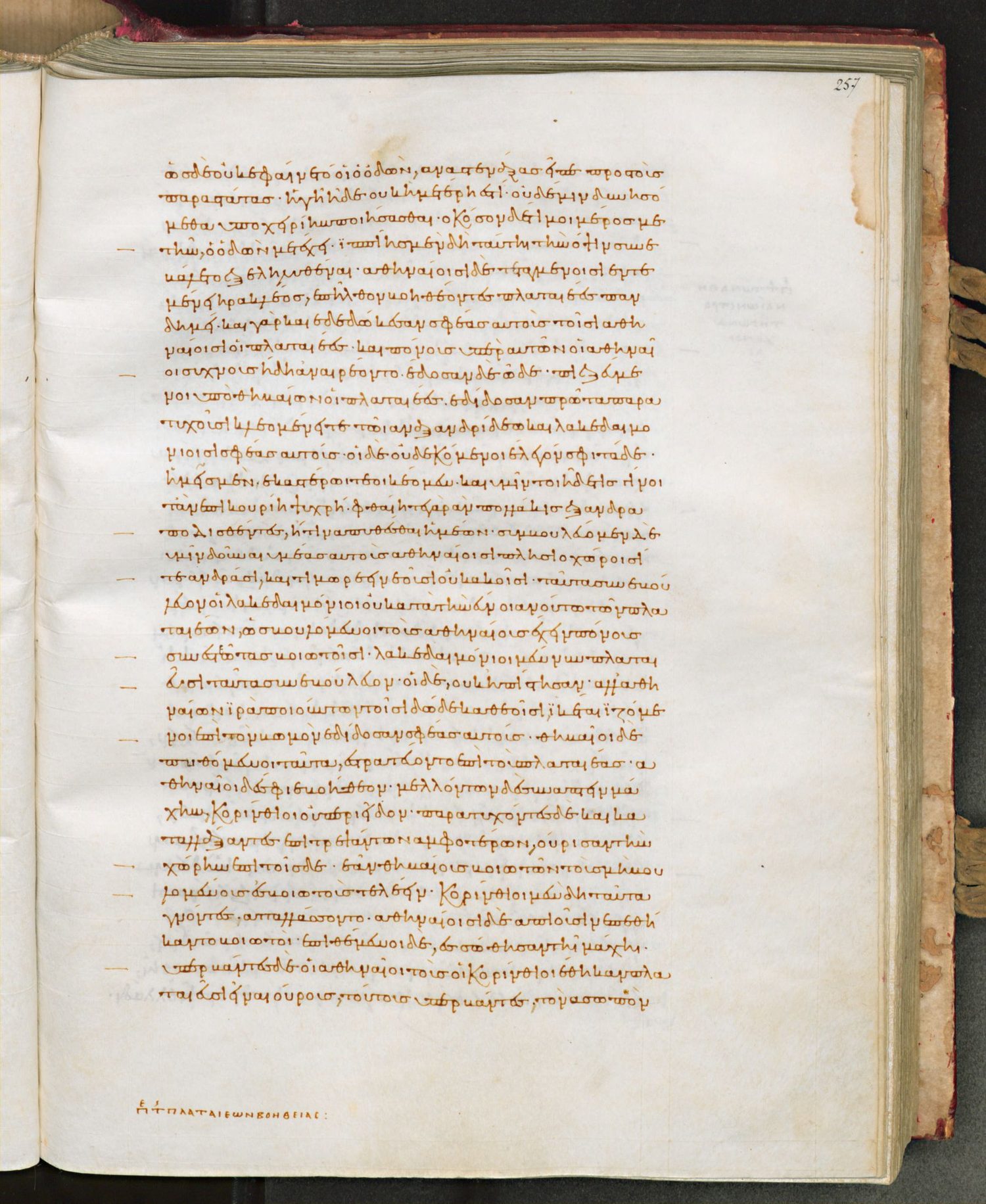
Laur. Plut. 70.3, fol. 257r: Greek here 6.107.4 to 6.108.6. Checked on the image (first and last words read and located in the Greek; each break checked against the neighbouring page): fol. 257r begins ‹ὡς δὲ οὐκ ἐφαίνετό› (6.107.4), ends ‹τούτους ὑπερβάντες τὸν Ἀσωπὸν› (6.108.6). English here: 6.108.1 to 6.108.5 (Godley's sentences for the sections whose Greek lies mostly on this page).
6.107.4ὡς δὲ οὐκ ἐφαίνετό οἱ ὁ ὀδών, ἀναστενάξας εἶπε πρὸς τοὺς παραστάτας ἡ γῆ ἥδε οὐκ ἡμετέρη ἐστί, οὐδέ μιν δυνησόμεθα ὑποχειρίην ποιήσασθαι· ὁκόσον δέ τι μοι μέρος μετῆν, ὁ ὀδὼν μετέχει. 6.108.1Ἱππίης μὲν δὴ ταύτῃ τὴν ὄψιν συνεβάλετο ἐξεληλυθέναι. Ἀθηναίοισι δὲ τεταγμένοισι ἐν τεμένεϊ Ἡρακλέος ἐπῆλθον βοηθέοντες Πλαταιέες πανδημεί. καὶ γὰρ καὶ ἐδεδώκεσαν σφέας αὐτοὺς τοῖσι Ἀθηναίοισι οἱ Πλαταιέες, καὶ πόνους ὑπὲρ αὐτῶν οἱ Ἀθηναῖοι συχνοὺς ἤδη ἀναραιρέατο· ἔδοσαν δὲ ὧδε. 6.108.2πιεζεύμενοι ὑπὸ Θηβαίων οἱ Πλαταιέες ἐδίδοσαν πρῶτα παρατυχοῦσι Κλεομένεΐ τε τῷ Ἀναξανδρίδεω καὶ Λακεδαιμονίοισι σφέας αὐτούς. οἳ δὲ οὐ δεκόμενοι ἔλεγόν σφι τάδε. ἡμεῖς μὲν ἑκαστέρω τε οἰκέομεν, καὶ ὑμῖν τοιήδε τις γίνοιτʼ ἂν ἐπικουρίη ψυχρή· φθαίητε γὰρ ἂν πολλάκις ἐξανδραποδισθέντες ἤ τινα πυθέσθαι ἡμέων. 6.108.3συμβουλεύομεν δὲ ὑμῖν δοῦναι ὑμέας αὐτοὺς Ἀθηναίοισι, πλησιοχώροισι τε ἀνδράσι καὶ τιμωρέειν ἐοῦσι οὐ κακοῖσι. ταῦτα συνεβούλευον οἱ Λακεδαιμόνιοι οὐ κατὰ τὴν εὐνοίην οὕτω τῶν Πλαταιέων ὡς βουλόμενοι τοὺς Ἀθηναίους ἔχειν πόνους συνεστεῶτας Βοιωτοῖσι. 6.108.4Λακεδαιμόνιοι μέν νυν Πλαταιεῦσι ταῦτα συνεβούλευον, οἳ δὲ οὐκ ἠπίστησαν, ἀλλʼ Ἀθηναίων ἱρὰ ποιεύντων τοῖσι δυώδεκα θεοῖσι ἱκέται ἱζόμενοι ἐπὶ τὸν βωμὸν ἐδίδοσαν σφέας αὐτούς. Θηβαῖοι δὲ πυθόμενοι ταῦτα ἐστρατεύοντο ἐπὶ τοὺς Πλαταιέας, Ἀθηναῖοι δέ σφι ἐβοήθεον. 6.108.5μελλόντων δὲ συνάπτειν μάχην Κορίνθιοι οὐ περιεῖδον, παρατυχόντες δὲ καὶ καταλλάξαντες ἐπιτρεψάντων ἀμφοτέρων οὔρισαν τὴν χώρην ἐπὶ τοῖσιδε, ἐᾶν Θηβαίους Βοιωτῶν τοὺς μὴ βουλομένους ἐς Βοιωτοὺς τελέειν. Κορίνθιοι μὲν δὴ ταῦτα γνόντες ἀπαλλάσσοντο, Ἀθηναίοισι δὲ ἀπιοῦσι ἐπεθήκαντο Βοιωτοί, ἐπιθέμενοι δὲ ἑσσώθησαν τῇ μάχῃ. 6.108.6ὑπερβάντες δὲ οἱ Ἀθηναῖοι τοὺς οἱ Κορίνθιοι ἔθηκαν Πλαταιεῦσι εἶναι οὔρους, τούτους ὑπερβάντες τὸν Ἀσωπὸν
6.108.1This then Hippias guessed to be the fulfilment of his dream. The Athenians were arrayed in the precinct of Heracles, and now the whole power of the Plataeans came to their aid; for the Plataeans had put themselves under the protection of Athens, and the Athenians had taken upon them many labours for their sake. 6.108.2The manner of the Plataeans’ so doing was this:—Being hard pressed by the Thebans, they had offered themselves to the first comers, Cleomenes son of Anaxandrides and the Lacedaemonians; but these would not accept them, and said: “We dwell afar off, and such aid as ours would be found but cold comfort to you; for you might be enslaved many times over ere any of us heard of it. 6.108.3We counsel you to put yourselves in the protection of the Athenians, who are your neighbours, and can defend you right well.” This counsel the Lacedaemonians gave not so much out of their goodwill to the Plataeans, as because they desired that the Athenians should bring trouble on themselves by making enemies of the Boeotians. 6.108.4The Lacedaemonians, then, gave them this counsel; the Plataeans obeyed it, and when the Athenians were sacrificing to the twelve gods they came as suppliants and sat them down by the altar, and so put themselves under protection. Hearing of this the Thebans sent an army against the Plataeans, and the Athenians came to the Plataeans’ aid; but 6.108.5when they were about to join battle, the Corinthians would not suffer them; as they chanced to be there, they made a reconciliation at the instance of both the parties, and drew a frontier line on the condition that the Thebans should not meddle with such Boeotians as desired not to be reckoned as part and parcel of Boeotia. Having given this judgment the Corinthians took their departure; but when the Athenians were on their way home the Boeotians set upon them and were worsted in the fight.
Where on the image
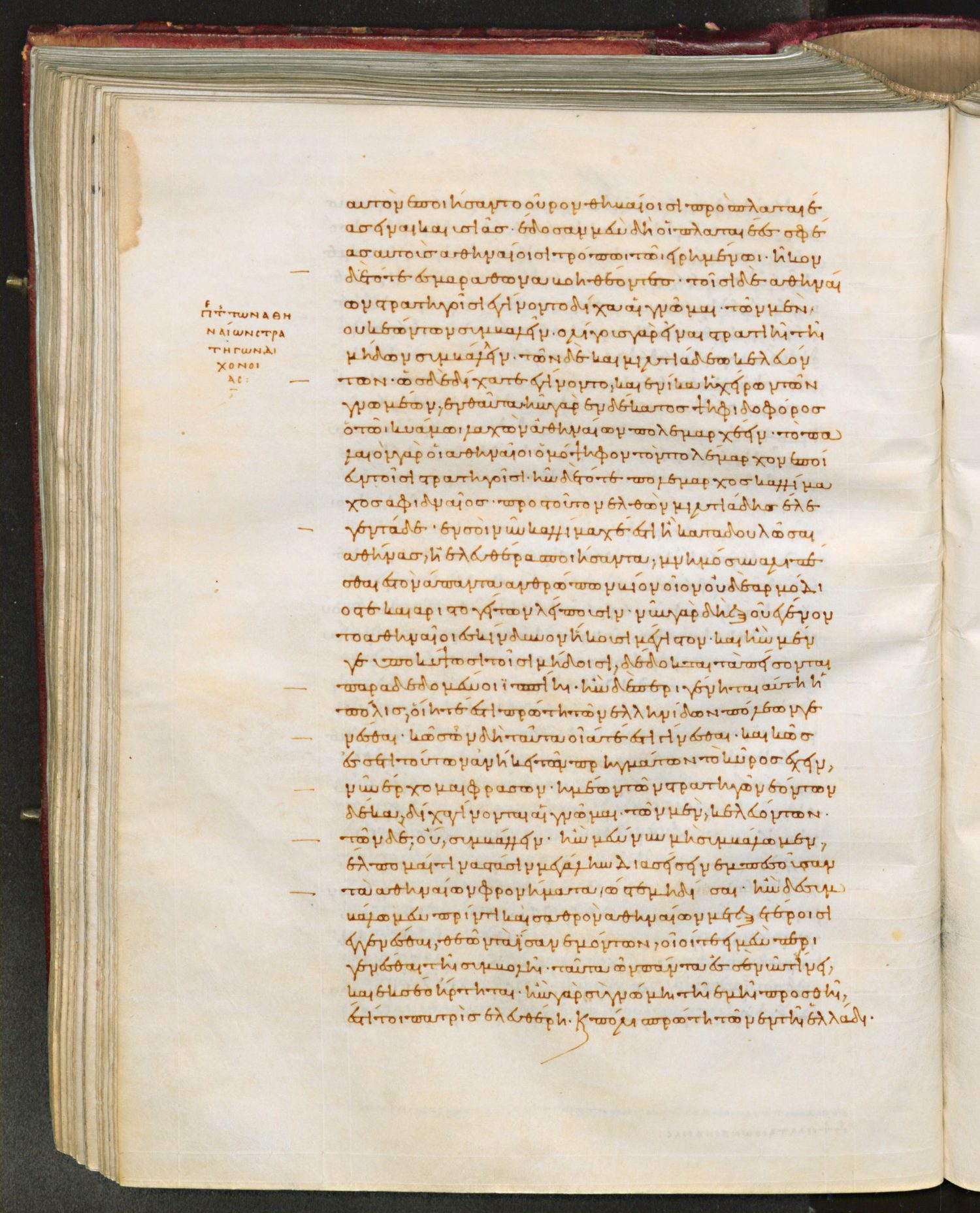
Laur. Plut. 70.3, fol. 257v: Greek here 6.108.6 to 6.109.6. Checked on the image (first and last words read and located in the Greek; each break checked against the neighbouring page): fol. 257v begins ‹αὐτὸν ἐποιήσαντο οὖρον Θηβαίοισι› (6.108.6), ends ‹τῶν ἐν τῇ Ἑλλάδι› (6.109.6). English here: 6.108.6 to 6.109.6 (Godley's sentences for the sections whose Greek lies mostly on this page).
6.108.6αὐτὸν ἐποιήσαντο οὖρον Θηβαίοισι πρὸς Πλαταιέας εἶναι καὶ Ὑσιάς. ἔδοσαν μὲν δὴ οἱ Πλαταιέες σφέας αὐτοὺς Ἀθηναίοισι τρόπῳ τῷ εἰρημένῳ, ἧκον δὲ τότε ἐς Μαραθῶνα βοηθέοντες. 6.109.1τοῖσι δὲ Ἀθηναίων στρατηγοῖσι ἐγίνοντο δίχα αἱ γνῶμαι, τῶν μὲν οὐκ ἐώντων συμβαλεῖν ʽὀλίγους γὰρ εἶναι στρατιῇ τῇ Μήδων συμβάλλειν’ τῶν δὲ καὶ Μιλτιάδεω κελευόντων. 6.109.2ὡς δὲ δίχα τε ἐγίνοντο καὶ ἐνίκα ἡ χείρων τῶν γνωμέων, ἐνθαῦτα, ἦν γὰρ ἑνδέκατος ψηφιδοφόρος ὁ τῷ κυάμῳ λαχὼν Ἀθηναίων πολεμαρχέειν ʽτὸ Παλαιὸν γὰρ Ἀθηναῖοι ὁμόψηφον τὸν πολέμαρχον ἐποιεῦντο τοῖσι στρατηγοῖσἰ, ἦν δὲ τότε πολέμαρχος Καλλίμαχος Ἀφιδναῖος· πρὸς τοῦτον ἐλθὼν Μιλτιάδης ἔλεγε τάδε. 6.109.3ἐν σοὶ νῦν Καλλίμαχε ἐστὶ ἢ καταδουλῶσαι Ἀθήνας ἢ ἐλευθέρας ποιήσαντα μνημόσυνα λιπέσθαι ἐς τὸν ἅπαντα ἀνθρώπων βίον οἷα οὐδὲ Ἁρμόδιός τε καὶ Ἀριστογείτων λείπουσι. νῦν γὰρ δὴ ἐξ οὗ ἐγένοντο Ἀθηναῖοι ἐς κίνδυνον ἥκουσι μέγιστον, καὶ ἢν μέν γε ὑποκύψωσι τοῖσι Μήδοισι, δέδοκται τὰ πείσονται παραδεδομένοι Ἱππίῃ, ἢν δὲ περιγένηται αὕτη ἡ πόλις, οἵη τε ἐστὶ πρώτη τῶν Ἑλληνίδων πολίων γενέσθαι. 6.109.4κῶς ὦν δὴ ταῦτα οἷά τε ἐστὶ γενέσθαι, καὶ κῶς ἐς σέ τοι τούτων ἀνήκει τῶν πρηγμάτων τὸ κῦρος ἔχειν, νῦν ἔρχομαι φράσων. ἡμέων τῶν στρατηγῶν ἐόντων δέκα δίχα γίνονται αἱ γνῶμαι, τῶν μὲν κελευόντων τῶν δὲ οὒ συμβάλλειν. 6.109.5ἢν μέν νυν μὴ συμβάλωμεν, ἔλπομαι τινὰ στάσιν μεγάλην διασείσειν ἐμπεσοῦσαν τὰ Ἀθηναίων φρονήματα ὥστε μηδίσαι· ἢν δὲ συμβάλωμεν πρίν τι καὶ σαθρὸν Ἀθηναίων μετεξετέροισι ἐγγενέσθαι, θεῶν τὰ ἴσα νεμόντων οἷοί τε εἰμὲν περιγενέσθαι τῇ συμβολῇ. 6.109.6ταῦτα ὦν πάντα ἐς σὲ νῦν τείνει καὶ ἐκ σέο ἤρτηται. ἢν γὰρ σὺ γνώμῃ τῇ ἐμῇ προσθῇ, ἔστι τοι πατρίς τε ἐλευθέρη καὶ πόλις πρώτη τῶν ἐν τῇ Ἑλλάδι·
6.108.6The Athenians then made a frontier beyond that which had been assigned by the Corinthians for the Plataeans, and set the Asopus itself for the Theban border on the side of Plataea and Hysiae.—In the manner aforesaid the Plataeans had put themselves in the protection of the Athenians, and now they came to Marathon to aid them. 6.109.1But the counsels of the Athenian generals were divided; some advised that they should not fight, thinking they were too few to do battle with the Median army, and some, of whom was Miltiades, that they should. 6.109.2Now there was an eleventh that had a vote, namely, that Athenian who had been chosen as polemarch by lot,—for by old Athenian custom the polemarch voted among the generals,—and at this time the polemarch was Callimachus of Aphidnae; so their counsels being divided and the worse opinion like to prevail, Miltiades betook himself to this man. 6.109.3“Callimachus,” said he, “it is for you to-day to choose, whether you will enslave Athens, or free her and thereby leave such a memorial for all posterity as was left not even by Harmodius and Aristogiton. For now is Athens in greater peril than ever since she was first a city; and if her people bow their necks to the Medes, their fate is certain, for they will be delivered over to Hippias; but if our city be saved, she may well grow to be the first of Greek cities. 6.109.4How then this can be brought about, and how it comes that the deciding voice in these matters is yours, I will now show you. We ten generals are divided in counsel, some bidding us to fight and some to forbear. 6.109.5Now if we forbear to fight, it is likely that some great schism will rend and shake the courage of our people till they make friends of the Medes; but if we join battle before some at Athens be infected by corruption, then let heaven but deal fairly with us, and we may well win in this fight. 6.109.6It is you that all this concerns; all hangs on you; for if you join yourself to my opinion, you make your country free and your city the first in Hellas; but if you choose the side of them that would persuade us not to fight, you will have wrought the very opposite of the blessings whereof I have spoken.”
Where on the image
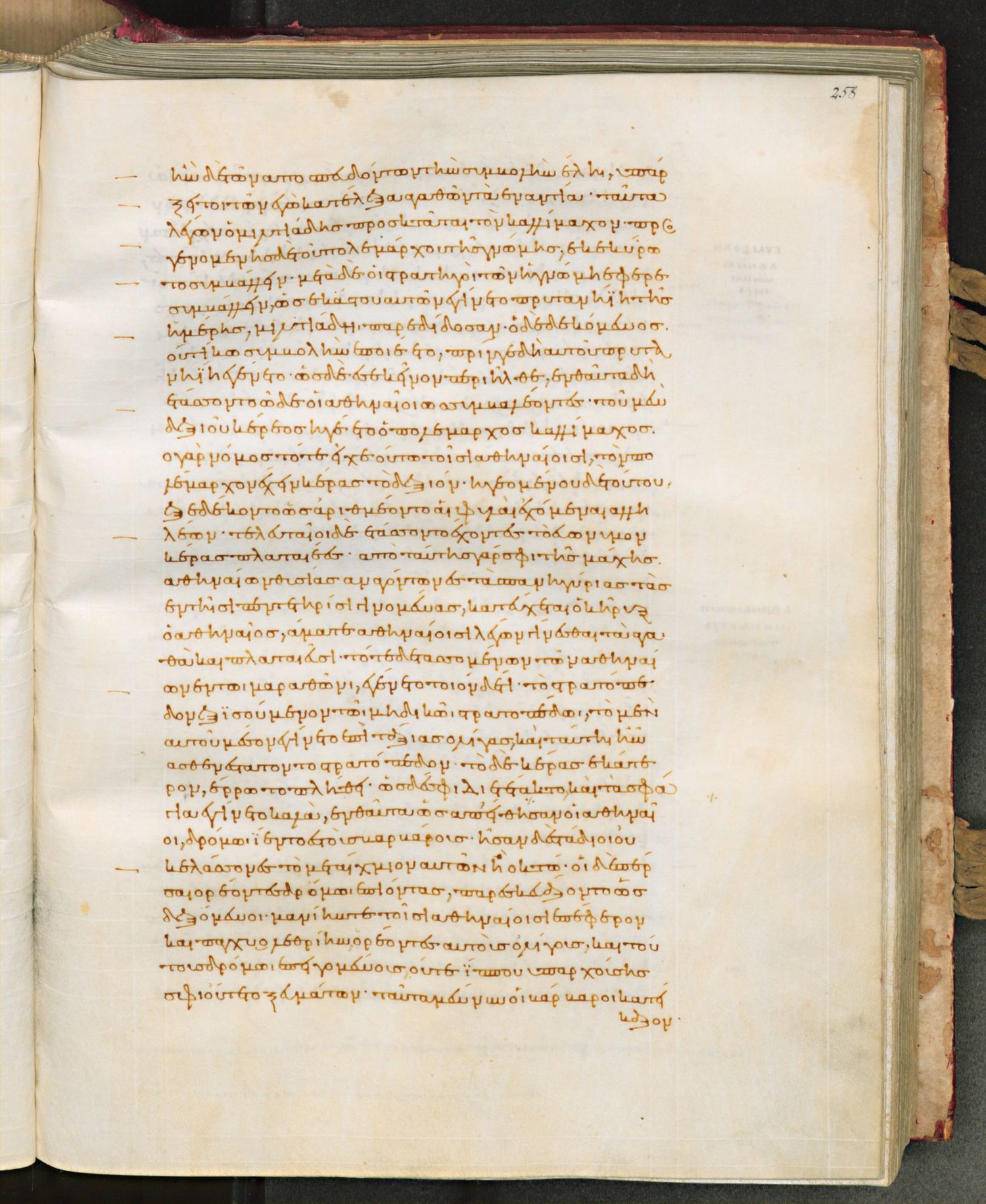
Laur. Plut. 70.3, fol. 258r: Greek here 6.109.6 to 6.110.1. Checked on the image (first and last words read and located in the Greek; each break checked against the neighbouring page): fol. 258r begins ‹ἢν δὲ τὴν τῶν› (6.109.6), ends ‹νυν οἱ βάρβαροι κατείκαζον› (6.112.3). The end of the last word (κατείκαζον) is written below the last line. English here: 6.110.1 (Godley's sentences for the sections whose Greek lies mostly on this page).
6.109.6ἢν δὲ τὴν τῶν ἀποσπευδόντων τὴν συμβολὴν ἕλῃ, ὑπάρξει τοι τῶν ἐγὼ κατέλεξα ἀγαθῶν τὰ ἐναντία. 6.110.1ταῦτα λέγων ὁ Μιλτιάδης προσκτᾶται τὸν Καλλίμαχον· προσγενομένης δὲ τοῦ πολεμάρχου τῆς γνώμης ἐκεκύρωτο συμβάλλειν. μετὰ δὲ οἱ στρατηγοὶ τῶν ἡ γνώμη ἔφερε συμβάλλειν, ὡς ἑκάστου αὐτῶν ἐγίνετο πρυτανηίη τῆς ἡμέρης, Μιλτιάδῃ παρεδίδοσαν· ὁ δὲ δεκόμενος οὔτι κω συμβολὴν ἐποιέετο, πρίν γε δὴ αὐτοῦ πρυτανηίη ἐγένετο.
6.110.1By this plea Miltiades won Callimachus to be his ally; and with the polemarch’s vote added it was resolved to fight. Thereafter the generals whose counsel was for fighting made over to Miltiades the day’s right of leading that fell to each severally; he received it, but would not join battle till the day of his own leadership came round.
Notes
- Greek: the text printed in A. D. Godley's Loeb edition, via Perseus (tlg0016.tlg001.perseus-grc2). Square brackets mark words the editor considers later additions; [...] marks a gap the editor indicates. Perseus note markers are omitted.
- English: A. D. Godley, Herodotus vol. 3 (1922) (Loeb Classical Library), as transcribed on Wikisource. Godley's footnotes are omitted.
- Section numbers in the English were placed by comparing Godley's text with the Perseus version of his translation; where a section begins inside one of Godley's sentences, the English is kept with the page that holds the start of that sentence.
Cite
Sources
- Source: Florence, Laur. Plut. 70.3 (10th c.) via BML Teca Digitale + Greek of Godley's Loeb (Perseus) + English of A. D. Godley (Loeb, Wikisource) (holding institution)
- Critical edition: Greek of A. D. Godley's Loeb edition (1920-1925), via Perseus
← previous · → next · v cycle view · l back to library