Herodotus, Histories 6.34-47: Miltiades in the Chersonese; the expedition of Mardonius
Introduction
Herodotus of Halicarnassus wrote the Histories in the third quarter of the 5th century BCE, an inquiry into the deeds of Greeks and barbarians and the causes of the wars between them, later divided into nine books. Book 6 tells of the end of the Ionian revolt at Lade and Miletus, the first Persian expeditions against Greece under Mardonius and under Datis and Artaphrenes, the quarrels of Sparta, Athens and Aegina, and the battle of Marathon.
The photographs are of Florence, Biblioteca Medicea Laurenziana, Plut. 70.3 (parchment, 10th century, 374 folios, 31 lines a page), Herodotus, Histories (codex A of the editors), the oldest surviving manuscript of the complete Histories, from the Teca Digitale of the Biblioteca Medicea Laurenziana. Each section below is the text of one page, or of the part of a page that falls within these chapters. The first and last words of every page were read on the photograph and located in the Greek, and every page break was checked against the next page; the notes quote these words. Readers' notes in the margins are not part of the text and are mentioned where they occur.
The Greek is the text printed in A. D. Godley's Loeb edition (1920-1925), from Perseus; it is the edited text, not a transcription of the manuscript, whose wording differs in places. The English is Godley's translation as printed, from Wikisource. Godley's English carries only chapter numbers; the section numbers shown in it were placed by comparison with the Perseus version of his translation. Each page's English is cut at the end of one of Godley's sentences, so it can begin or end a few lines away from the Greek of the page; each note gives the exact ranges.
This entry covers chapters 6.34-47, on fol. 240v to 243v.
How was this verified? (Provenance)
Where on the image
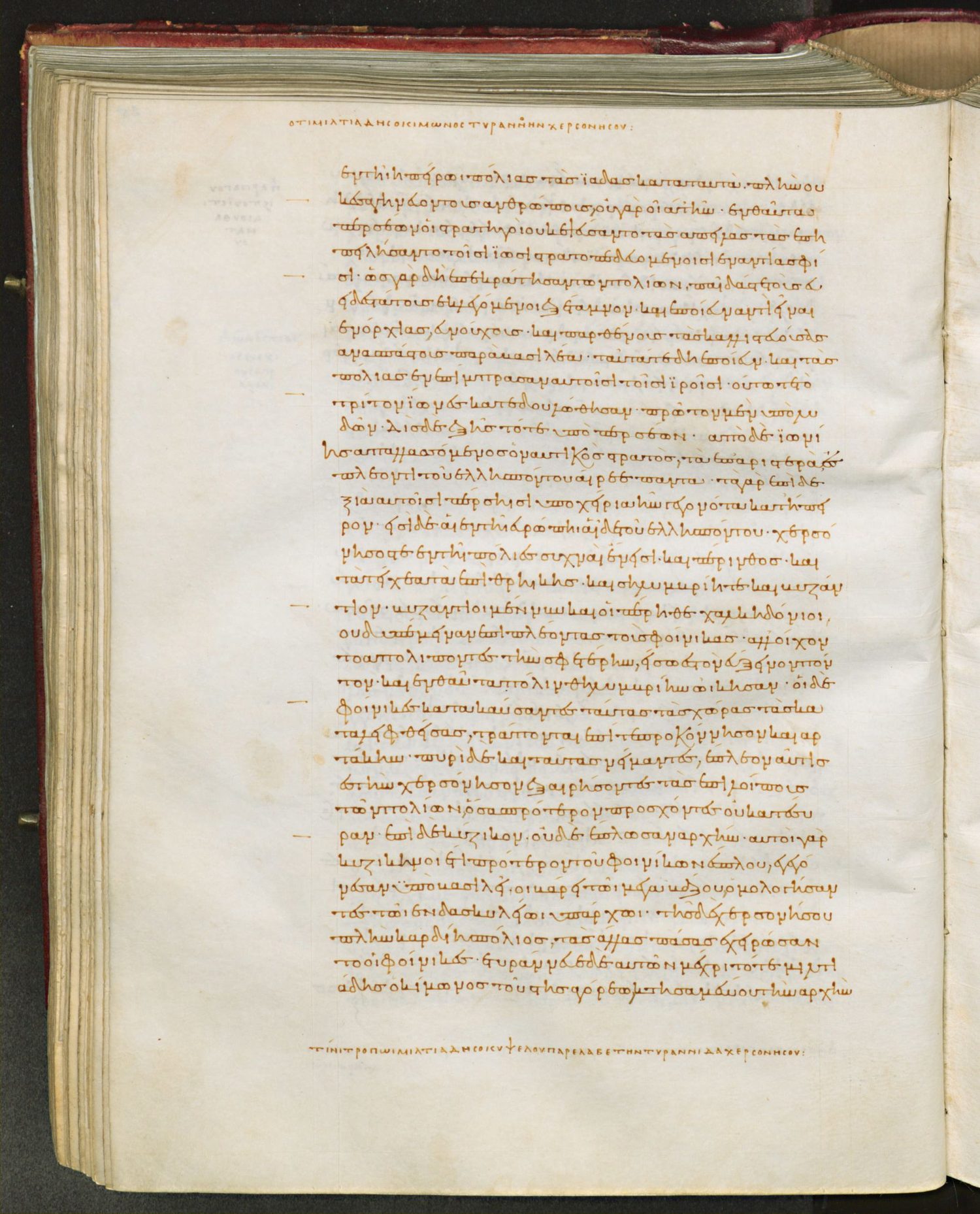
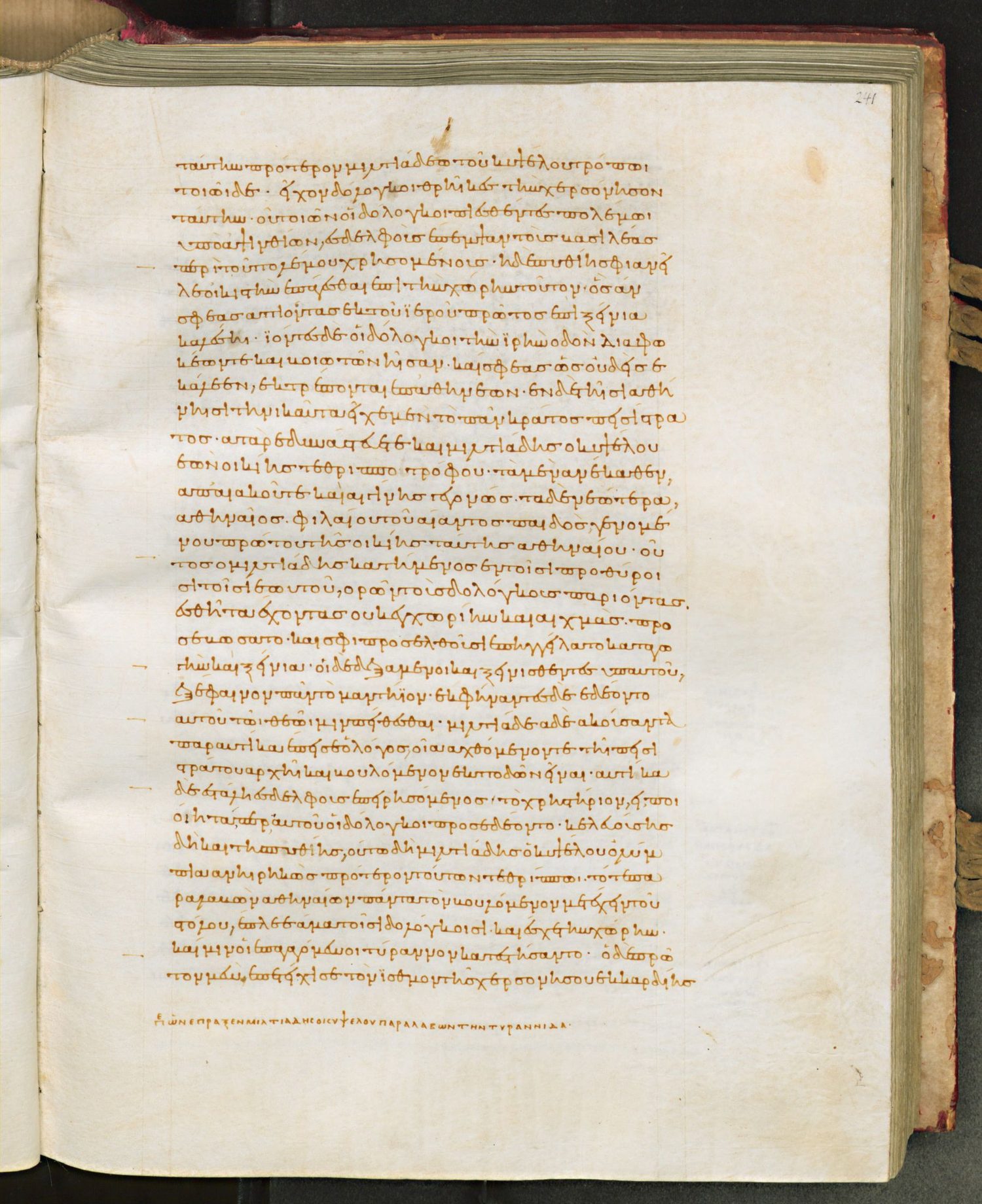
Laur. Plut. 70.3, fol. 240v, 241r: Greek here 6.34.1 to 6.36.2. Checked on the image (first and last words read and located in the Greek; each break checked against the neighbouring page): fol. 240v begins ‹ἐν τῇ ἠπείρῳ πόλιας› (6.31.2), ends ‹Στησαγόρεω, κτησαμένου τὴν ἀρχὴν› (6.34.1). In the upper margin, a reader's note in capitals on Miltiades son of Cimon, tyrant of the Chersonese. fol. 241r begins ‹ταύτην πρότερον Μιλτιάδεω τοῦ› (6.34.1), ends ‹τῆς Χερσονήσου ἐκ Καρδίης› (6.36.2). This section joins the text of fol. 240v and 241r that belongs to these chapters, because the part on one of the pages is too short to carry any of Godley's sentences on its own. English here: 6.34.1 to 6.36.1 (Godley's sentences for the sections whose Greek lies mostly on this page).
6.34.1τῆς δὲ Χερσονήσου πλὴν Καρδίης πόλιος τὰς ἄλλας πάσας ἐχειρώσαντο οἱ Φοίνικες. ἐτυράννευε δὲ αὐτέων μέχρι τότε Μιλτιάδης ὁ Κίμωνος τοῦ Στησαγόρεω, κτησαμένου τὴν ἀρχὴν ταύτην πρότερον Μιλτιάδεω τοῦ Κυψέλου τρόπῳ τοιῷδε. εἶχον Δόλογκοι Θρήικες τὴν Χερσόνησον ταύτην. οὗτοι ὦν οἱ Δόλογκοι πιεσθέντες πολέμῳ ὑπὸ Ἀψινθίων ἐς Δελφοὺς ἔπεμψαν τοὺς βασιλέας περὶ τοῦ πολέμου χρησομένους. 6.34.2ἡ δὲ Πυθίη σφι ἀνεῖλε οἰκιστὴν ἐπάγεσθαι ἐπὶ τὴν χώρην τοῦτον ὃς ἂν σφέας ἀπιόντας ἐκ τοῦ ἱροῦ πρῶτος ἐπὶ ξείνια καλέσῃ. ἰόντες δὲ οἱ Δόλογκοι τὴν ἱρὴν ὁδὸν διὰ Φωκέων τε καὶ Βοιωτῶν ἤισαν· καί σφεας ὡς οὐδεὶς ἐκάλεε, ἐκτρέπονται ἐπʼ Ἀθηνέων. 6.35.1ἐν δὲ τῇσι Ἀθήνῃσι τηνικαῦτα εἶχε μὲν τὸ πᾶν κράτος Πεισίστρατος, ἀτὰρ ἐδυνάστευέ γε καὶ Μιλτιάδης ὁ Κυψέλου ἐὼν οἰκίης τεθριπποτρόφου, τὰ μὲν ἀνέκαθεν ἀπʼ Αἰακοῦ τε καὶ Αἰγίνης γεγονώς, τὰ δὲ νεώτερα Ἀθηναῖος, Φιλαίου τοῦ Αἴαντος παιδὸς γενομένου πρώτου τῆς οἰκίης ταύτης Ἀθηναίου. 6.35.2οὗτος ὁ Μιλτιάδης κατήμενος ἐν τοῖσι προθύροισι τοῖσι ἑωυτοῦ, ὁρέων τοὺς Δολόγκους παριόντας ἐσθῆτα ἔχοντας οὐκ ἐγχωρίην καὶ αἰχμὰς προσεβώσατο καί σφι προσελθοῦσι ἐπηγγείλατο καταγωγὴν καὶ ξείνια. οἳ δὲ δεξάμενοι καὶ ξεινισθέντες ὑπʼ αὐτοῦ ἐξέφαινον πᾶν τὸ μαντήιον, ἐκφήναντες δὲ ἐδέοντο αὐτοῦ τῷ θεῷ μιν πείθεσθαι. 6.35.3Μιλτιάδεα δὲ ἀκούσαντα παραυτίκα ἔπεισε ὁ λόγος οἷα ἀχθόμενόν τε τῇ Πεισιστράτου ἀρχῇ καὶ βουλόμενον ἐκποδὼν εἶναι. αὐτίκα δὲ ἐστάλη ἐς Δελφούς, ἐπειρησόμενος τὸ χρηστήριον εἰ ποιοίη τά περ αὐτοῦ οἱ Δόλογκοι προσεδέοντο. 6.36.1κελευούσης δὲ καὶ τῆς Πυθίης, οὕτω δὴ Μιλτιάδης ὁ Κυψέλου, Ὀλύμπια ἀναραιρηκὼς πρότερον τούτων τεθρίππῳ, τότε παραλαβὼν Ἀθηναίων πάντα τὸν βουλόμενον μετέχειν τοῦ στόλου ἔπλεε ἅμα τοῖσι Δολόγκοισι, καὶ ἔσχε τὴν χώρην· καί μιν οἱ ἐπαγαγόμενοι τύραννον κατεστήσαντο. 6.36.2ὁ δὲ πρῶτον μὲν ἀπετείχισε τὸν ἰσθμὸν τῆς Χερσονήσου ἐκ Καρδίης
6.34.1As for the Chersonese, the Phoenicians subdued all the towns in it, save only Cardia. These had been ruled till then by Miltiades son of Cimon who was the son of Stesagoras. This sovereignty had been formerly won by Miltiades son of Cypselus in such manner as I will now show. The Dolonci, who were Thracians, possessed this Chersonese; they then, being hard pressed in war by he Apsinthians, sent their princes to Delphi to ask an oracle concerning the war; and 6.34.2the priestess in her reply bade them bring him in to found their state who should first offer them hospitality when they departed from the temple. Then the Dolonci followed the Sacred Way and journeyed through Phocis and Boeotia; and when none invited them in they turned aside towards Athens. 6.35.1Now at this time the supreme ruler of Athens was Pisistratus, but Miltiades also, son of Cypselus, was a man of power; he was of a house that kept four-horse chariots, tracing his earliest descent from Aeacus and Aegina, but by later lineage Athenian; the first Athenian of that house was Philaeus son of Aias. 6.35.2This Miltiades, as he sat in his porch, saw the Dolonci pass by with raiment and spears of foreign fashion, and he hailed them, and when they approached offered them lodging and hospitality. They consented thereto; and when he had received them as guests they laid before him all the words of the oracle, and entreated him to obey the god. 6.35.3Hearing this, Miltiades was persuaded by what they said; for he was impatient of the rule of Pisistratus and desired to be away from it. Forthwith he set out for Delphi, to enquire of the oracle if he should do as the Dolonci entreated him. 6.36.1The priestess too bidding him consent, thereupon Miltiades son of Cypselus, that Miltiades who had ere now won a race of four-horse chariots at Olympia, took with him all Athenians who desired to share his enterprise, and sailing with the Dolonci gained possession of their country; and they who had brought him in made him their despot.
Where on the image
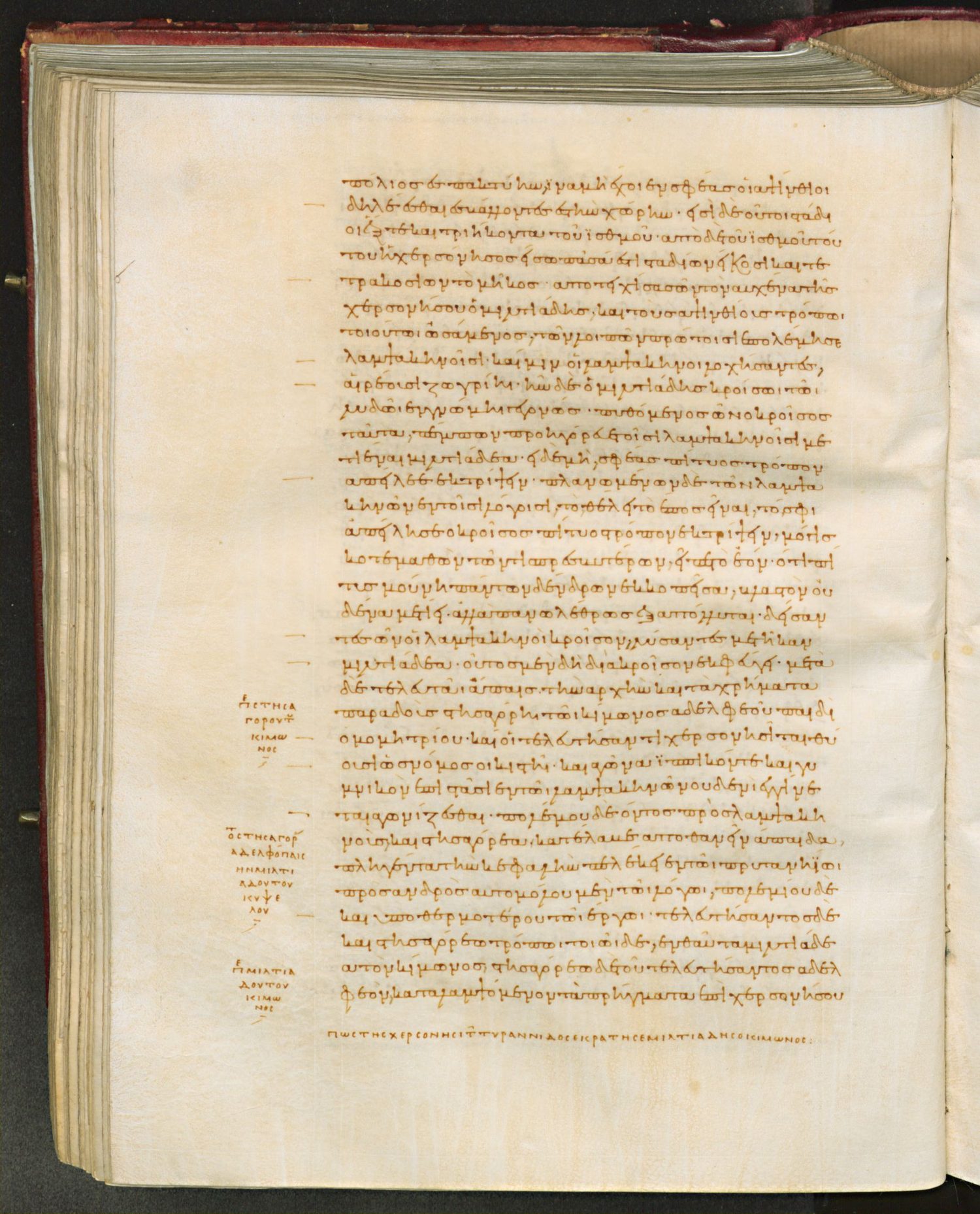
Laur. Plut. 70.3, fol. 241v: Greek here 6.36.2 to 6.39.1. Checked on the image (first and last words read and located in the Greek; each break checked against the neighbouring page): fol. 241v begins ‹πόλιος ἐς Πακτύην, ἵνα› (6.36.2), ends ‹τὰ πρήγματα ἐπὶ Χερσονήσου› (6.39.1). Below the text, a reader's note in capitals on how Miltiades son of Cimon took the tyranny of the Chersonese; his name stands in the left margin. English here: 6.36.2 to 6.38.2 (Godley's sentences for the sections whose Greek lies mostly on this page).
6.36.2πόλιος ἐς Πακτύην, ἵνα μὴ ἔχοιεν σφέας οἱ Ἀψίνθιοι δηλέεσθαι ἐσβάλλοντες ἐς τὴν χώρην. εἰσὶ δὲ οὗτοι στάδιοι ἕξ τε καὶ τριήκοντα τοῦ ἰσθμοῦ· ἀπὸ δὲ τοῦ ἰσθμοῦ τούτου ἡ Χερσόνησος ἔσω πᾶσα ἐστὶ σταδίων εἴκοσι καὶ τετρακοσίων τὸ μῆκος. 6.37.1ἀποτειχίσας ὦν τὸν αὐχένα τῆς Χερσονήσου ὁ Μιλτιάδης καὶ τοὺς Ἀψινθίους τρόπῳ τοιούτῳ ὠσάμενος, τῶν λοιπῶν πρώτοισι ἐπολέμησε Λαμψακηνοῖσι· καί μιν οἱ Λαμψακηνοὶ λοχήσαντες αἱρέουσι ζωγρίῃ. ἦν δὲ ὁ Μιλτιάδης Κροίσῳ τῷ Λυδῷ ἐν γνώμῃ γεγονώς· πυθόμενος ὦν ὁ Κροῖσος ταῦτα, πέμπων προηγόρευε τοῖσι Λαμψακηνοῖσι μετιέναι Μιλτιάδεα· εἰ δὲ μή σφεας πίτυος τρόπον ἀπείλεε ἐκτρίψειν. 6.37.2πλανωμένων δὲ τῶν Λαμψακηνῶν ἐν τοῖσι λόγοισι τὸ θέλει τὸ ἔπος εἶναι τό σφι ἀπείλησε ὁ Κροῖσος, πίτυος τρόπον ἐκτρίψειν, μόγις κοτὲ μαθὼν τῶν τις πρεσβυτέρων εἶπε τὸ ἐόν, ὅτι πίτυς μούνη πάντων δενδρέων ἐκκοπεῖσα βλαστὸν οὐδένα μετιεῖ ἀλλὰ πανώλεθρος ἐξαπόλλυται. δείσαντες ὦν οἱ Λαμψακηνοὶ Κροῖσον λύσαντες μετῆκαν Μιλτιάδεα. 6.38.1οὗτος μὲν δὴ διὰ Κροῖσον ἐκφεύγει, μετὰ δὲ τελευτᾷ ἄπαις, τὴν ἀρχήν τε καὶ τὰ χρήματα παραδοὺς Στησαγόρῃ τῷ Κίμωνος ἀδελφεοῦ παιδὶ ὁμομητρίου. καί οἱ τελευτήσαντι Χερσονησῖται θύουσι ὡς νόμος οἰκιστῇ, καὶ ἀγῶνα ἱππικόν τε καὶ γυμνικὸν ἐπιστᾶσι, ἐν τῷ Λαμψακηνῶν οὐδενὶ ἐγγίνεται ἀγωνίζεσθαι. 6.38.2πολέμου δὲ ἐόντος πρὸς Λαμψακηνοὺς καὶ Στησαγόρεα κατέλαβε ἀποθανεῖν ἄπαιδα, πληγέντα τὴν κεφαλὴν πελέκεϊ ἐν τῷ πρυτανηίῳ πρὸς ἀνδρὸς αὐτομόλου μὲν τῷ λόγῳ πολεμίου δὲ καὶ ὑποθερμοτέρου τῷ ἔργῳ. 6.39.1τελευτήσαντος δὲ καὶ Στησαγόρεω τρόπῳ τοιῷδε, ἐνθαῦτα Μιλτιάδεα τὸν Κίμωνος, Στησαγόρεω δὲ τοῦ τελευτήσαντος ἀδελφεόν, καταλαμψόμενον τὰ πρήγματα ἐπὶ Χερσονήσου
6.36.2First he built a wall across the isthmus of the Chersonese from the town Cardia to Pactye, that so the Apsinthians might not be able to harm them by invading the country. The breadth of the isthmus is six-and-thirty furlongs; and the length of the Chersonese on the hither side of that isthmus is four hundred and twenty furlongs. 6.37.1Having then built a wall across the neck of the Chersonese, and thus thrust the Apsinthians back, Miltiades made war upon the Lampsacenes first of all the rest; and they lay in ambush and took him captive. But Miltiades was well known to Croesus the Lydian; wherefore Croesus, learning of what had been done, warned the men of Lampsacus to let Miltiades go; “or,” he threatened, “I will raze you from the earth like a pine-tree.” 6.37.2The men of Lampsacus were all astray in their counsels as to what this threat of Croesus to them (that he would raze them like a pine-tree) might mean, till after much seeking one of their elders at last told them the truth, to wit, that the pine is the only tree that sends forth no shoots after it is cut down, but perishes utterly; wherefore in fear of Croesus they freed Miltiades and let him go. 6.38.1So Miltiades was saved by Croesus; but afterwards he died childless, leaving his government and his possessions to Stesagoras, the son of his full brother Cimon; and since his death the men of the Chersonese have ever offered him such sacrifice as is a founders right, ordaining days for horse-races and feats of strength, wherein no man of Lampsacus is suffered to contend. 6.38.2But in the war against the Lampsacenes Stesagoras too met his end and died childless; he was smitten on the head with an axe in the town-hall by one that feigned to be a deserter but in truth was an enemy and a man of violence.
Where on the image
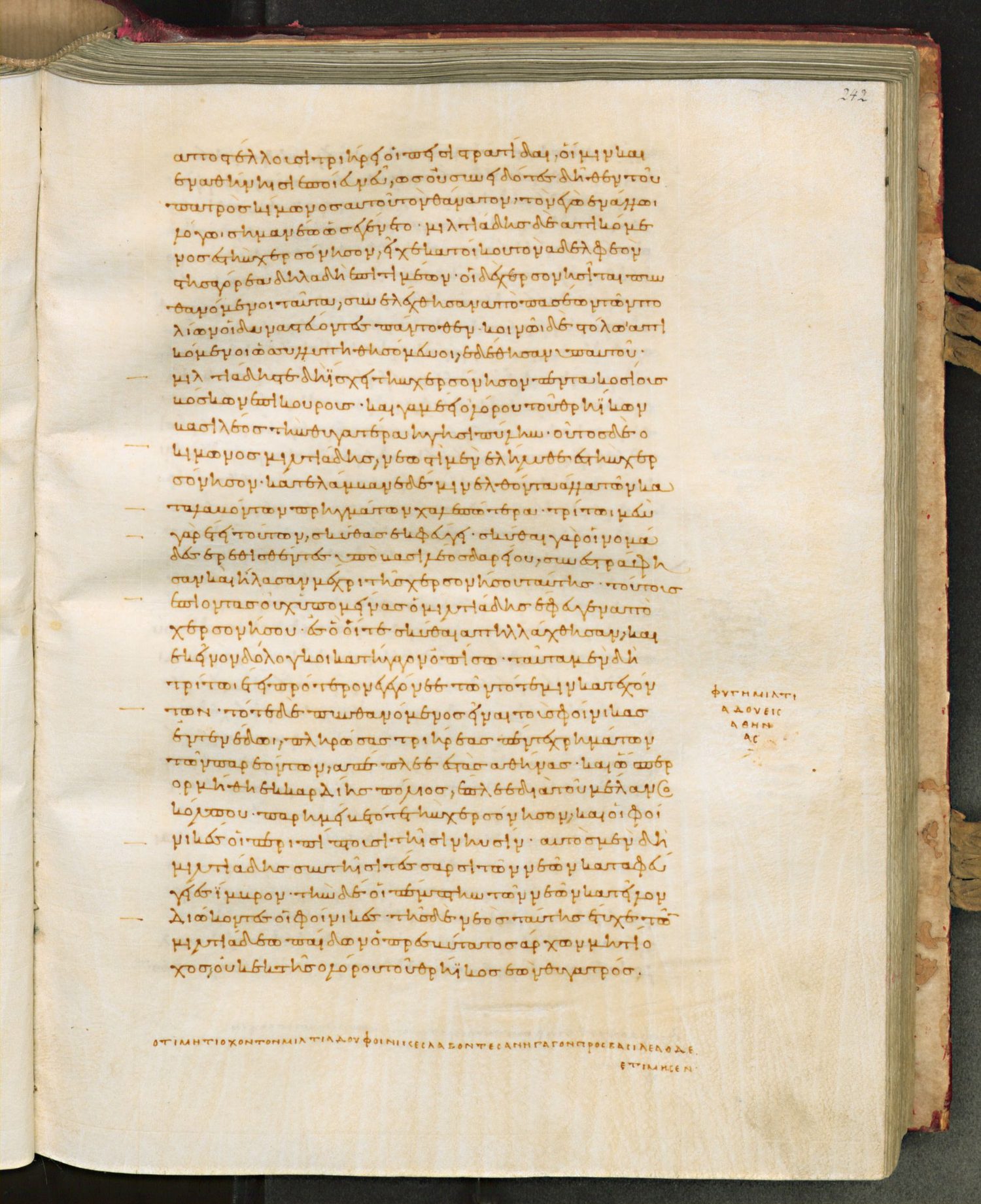
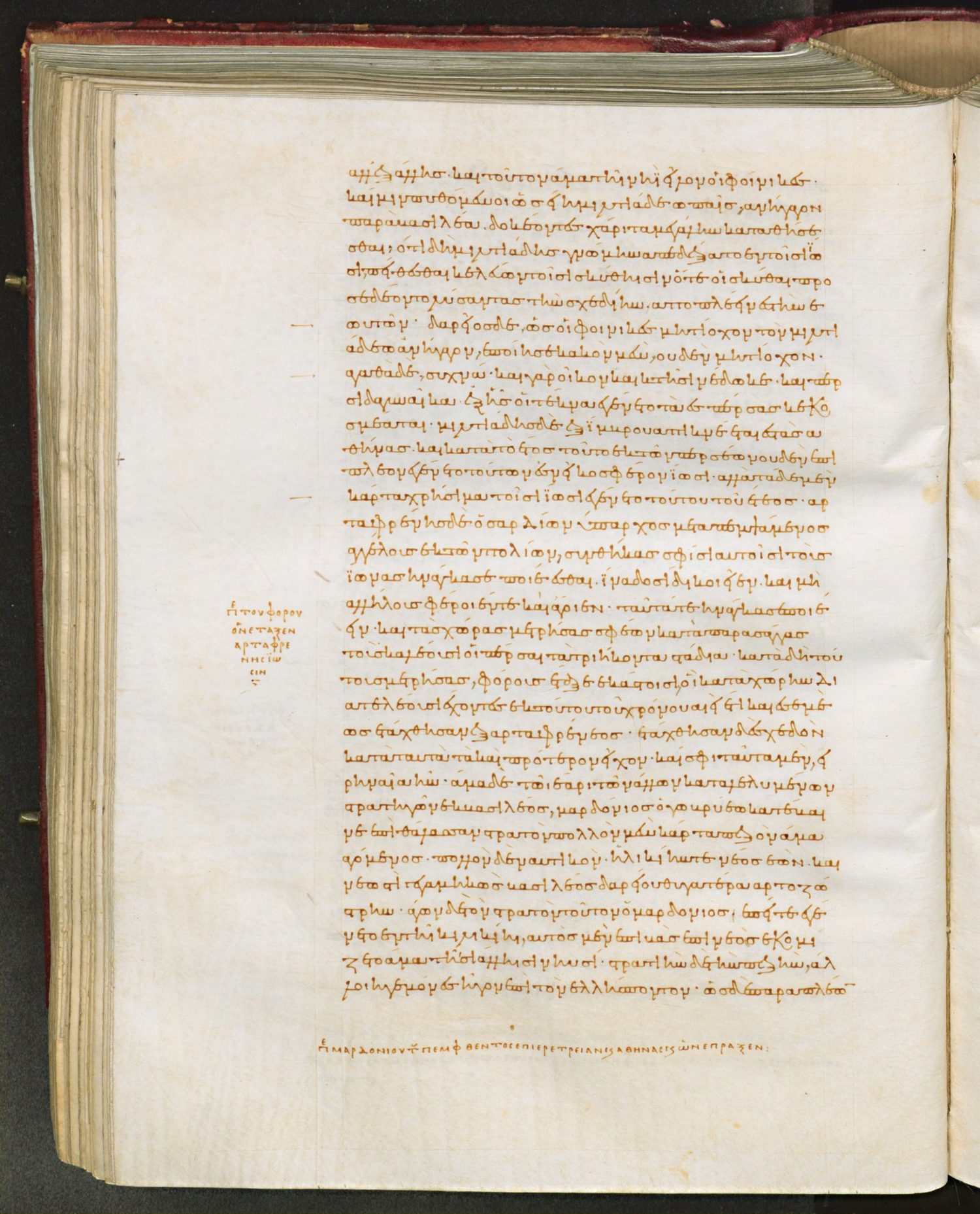
Laur. Plut. 70.3, fol. 242r: Greek here 6.39.1 to 6.41.2. Checked on the image (first and last words read and located in the Greek; each break checked against the neighbouring page): fol. 242r begins ‹ἀποστέλλουσι τριήρεϊ οἱ Πεισιστρατίδαι,› (6.39.1), ends ‹τοῦ Θρήικος ἐὼν θυγατρὸς› (6.41.2). English here: 6.39.1 to 6.41.3 (Godley's sentences for the sections whose Greek lies mostly on this page).
6.39.1ἀποστέλλουσι τριήρεϊ οἱ Πεισιστρατίδαι, οἵ μιν καὶ ἐν Ἀθήνῃσι ἐποίευν εὖ ὡς οὐ συνειδότες δῆθεν τοῦ πατρὸς Κίμωνος αὐτοῦ τὸν θάνατον, τὸν ἐγὼ ἐν ἄλλῳ λόγῳ σημανέω ὡς ἐγένετο. 6.39.2Μιλτιάδης δὲ ἀπικόμενος ἐς τὴν Χερσόνησον εἶχε κατʼ οἴκους, τὸν ἀδελφεὸν Στησαγόρεα δηλαδὴ ἐπιτιμέων. οἱ δὲ Χερσονησῖται πυνθανόμενοι ταῦτα συνελέχθησαν ἀπὸ πασέων τῶν πολίων οἱ δυναστεύοντες πάντοθεν, κοινῷ δὲ στόλῳ ἀπικόμενοι ὡς συλλυπηθησόμενοι ἐδέθησαν ὑπʼ αὐτοῦ. Μιλτιάδης τε δὴ ἴσχει τὴν Χερσόνησον, πεντακοσίους βόσκων ἐπικούρους, καὶ γαμέει Ὀλόρου τοῦ Θρηίκων βασιλέος τὴν θυγατέρα Ἡγησιπύλην. 6.40.1οὗτος δὲ ὁ Κίμωνος Μιλτιάδης νεωστὶ μὲν ἐληλύθεε ἐς τὴν Χερσόνησον, κατελάμβανε δέ μιν ἐλθόντα ἄλλα τῶν καταλαβόντων πρηγμάτων χαλεπώτερα. τρίτῳ μὲν γὰρ ἔτεϊ πρὸ τούτων Σκύθας ἐκφεύγει. Σκύθαι γὰρ οἱ νομάδες ἐρεθισθέντες ὑπὸ βασιλέος Δαρείου συνεστράφησαν καὶ ἤλασαν μέχρι τῆς Χερσονήσου ταύτης· 6.40.2τούτους ἐπιόντας οὐκ ὑπομείνας ὁ Μιλτιάδης ἔφευγε Χερσόνησον, ἐς ὃ οἵ τε Σκύθαι ἀπαλλάχθησαν καὶ ἐκεῖνον Δόλογκοι κατήγαγον ὀπίσω. ταῦτα μὲν δὴ τρίτῳ ἔτεϊ πρότερον ἐγεγόνεε τῶν τότε μιν κατεχόντων. 6.41.1τότε δὲ πυνθανόμενος εἶναι τοὺς Φοίνικας ἐν Τενέδῳ, πληρώσας τριήρεας πέντε χρημάτων τῶν παρεόντων ἀπέπλεε ἐς τὰς Ἀθήνας. καὶ ὥσπερ ὁρμήθη ἐκ Καρδίης πόλιος ἔπλεε διὰ τοῦ Μέλανος κόλπου· παραμείβετό τε τὴν Χερσόνησον καὶ οἱ Φοίνικές οἱ περιπίπτουσι τῇσι νηυσί. 6.41.2αὐτὸς μὲν δὴ Μιλτιάδης σὺν τῇσι τέσσερσι τῶν νεῶν καταφεύγει ἐς Ἴμβρον, τὴν δέ οἱ πέμπτην τῶν νεῶν κατεῖλον διώκοντες οἱ Φοίνικες. τῆς δὲ νεὸς ταύτης ἔτυχε τῶν Μιλτιάδεω παίδων ὁ πρεσβύτατος ἄρχων Μητίοχος, οὐκ ἐκ τῆς Ὀλόρου τοῦ Θρήικος ἐὼν θυγατρὸς
6.39.1Such having been the end of Stesagoras, Miltiades son of Cimon and brother of the dead Stesagoras was sent in a trireme to the Chersonese, there to take control of the country, by the sons of Pisistratus; these had already used him well at Athens, feigning that they had not been accessory to the death of Cimon his father, the manner whereof I will relate in another place. 6.39.2Being come to the Chersonese, Miltiades kept himself within his house, professing thus to honour the memory of his brother Stesagoras. When this was known to the people of the Chersonese, the ruling men gathered together from all their cities on every side, and came in a body, as with intent to show fellow-feeling with his mourning; but he put them in bonds. So Miltiades made himself master of the Chersonese; there he maintained a guard of five hundred men, and married Hegesipyle the daughter of Olorus, king of Thrace. 6.40.1But not long after this Miltiades, son of Cimon, had come to the Chersonese, he was overtaken by a visitation heavier than the former. For he had been driven from the country three years ere this by the Scythians, their nomad tribes, provoked by Darius, having gathered themselves together and ridden as far as the Chersonese aforesaid. 6.40.2Not abiding their onset, Miltiades fled from the Chersonese, till the Scythians departed and the Dolonci brought him back again. All this had happened three years before the matters that now engaged him. 6.41.1But now, learning that the Phoenicians were in Tenedos, he sailed away to Athens with five triremes laden with the possessions that he had by him. Setting sail from Cardia he crossed the Black Bay, and as he sailed past the Chersonese the Phoenician ships fell in with him. 6.41.2Miltiades himself escaped with four of his ships to Imbros, but the fifth was pursued and overtaken by the Phoenicians. Now, it chanced that the captain of this ship was Metiochus, the eldest son of Miltiades by another wife, not the daughter of Olorus the Thracian; this man 6.41.3the Phoenicians took captive with his ship, and hearing that he was Miltiades’ son brought him up to the king; they thought that this would be a very thankworthy service, seeing that Miltiades had given his voice among the Ionians for obeying the Scythians when they demanded of the Ionians that they should break the bridge of boats and sail away to their homes.
Where on the image
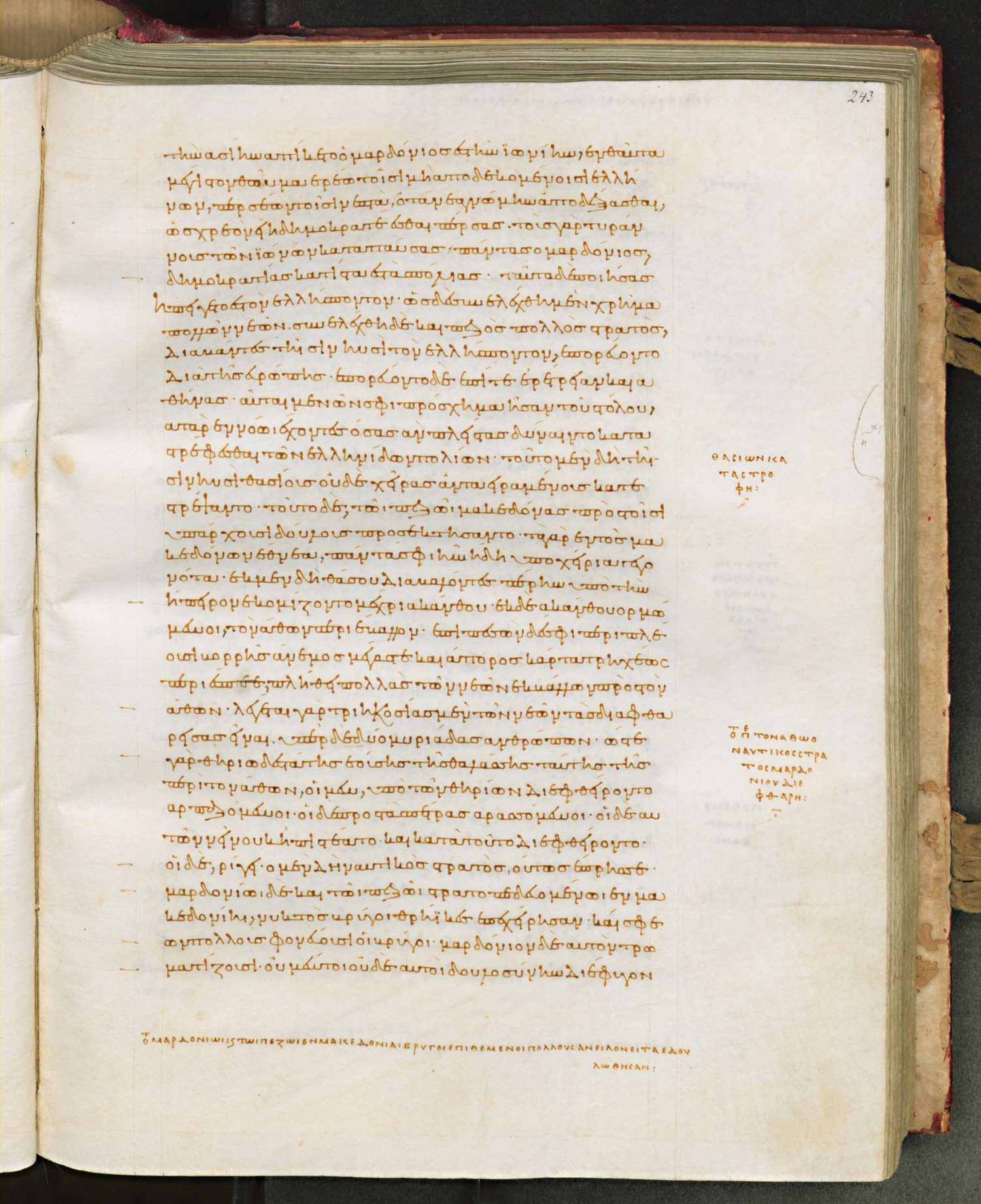
Laur. Plut. 70.3, fol. 242v: Greek here 6.41.2 to 6.43.3. Checked on the image (first and last words read and located in the Greek; each break checked against the neighbouring page): fol. 242v begins ‹ἀλλʼ ἐξ ἄλλης·καὶ τοῦτον› (6.41.2), ends ‹τὸν Ἑλλήσποντον.ὡς δὲ παραπλέων› (6.43.3). English here: 6.41.4 to 6.43.2 (Godley's sentences for the sections whose Greek lies mostly on this page).
6.41.2ἀλλʼ ἐξ ἄλλης· 6.41.3καὶ τοῦτον ἅμα τῇ νηὶ εἷλον οἱ Φοίνικες, καί μιν πυθόμενοι ὡς εἴη Μιλτιάδεω παῖς ἀνήγαγον παρὰ βασιλέα, δοκέοντες χάριτα μεγάλην καταθήσεσθαι, ὅτι δὴ Μιλτιάδης γνώμην ἀπεδέξατο ἐν τοῖσι Ἴωσι πείθεσθαι κελεύων τοῖσι Σκύθῃσι, ὅτε οἱ Σκύθαι προσεδέοντο λύσαντας τὴν σχεδίην ἀποπλέειν ἐς τὴν ἑωυτῶν. 6.41.4Δαρεῖος δέ, ὡς οἱ Φοίνικες Μητίοχον τὸν Μιλτιάδεω ἀνήγαγον, ἐποίησε κακὸν μὲν οὐδὲν Μητίοχον, ἀγαθὰ δὲ συχνά· καὶ γὰρ οἶκον καὶ κτῆσιν ἔδωκε καὶ Περσίδα γυναῖκα, ἐκ τῆς οἱ τέκνα ἐγένετο τὰ ἐς Πέρσας κεκοσμέαται. Μιλτιάδης δὲ ἐξ Ἴμβρου ἀπικνέεται ἐς τὰς Ἀθήνας. 6.42.1καὶ κατὰ τὸ ἔτος τοῦτο ἐκ τῶν Περσέων οὐδὲν ἐπὶ πλέον ἐγένετο τούτων ἐς νεῖκος φέρον Ἴωσι, ἀλλὰ τάδε μὲν χρήσιμα κάρτα τοῖσι Ἴωσι ἐγένετο τούτου τοῦ ἔτεος· Ἀρταφρένης ὁ Σαρδίων ὕπαρχος μεταπεμψάμενος ἀγγέλους ἐκ τῶν πολίων συνθήκας σφίσι αὐτοῖσι τοὺς Ἴωνας ἠνάγκασε ποιέεσθαι, ἵνα δωσίδικοι εἶεν καὶ μὴ ἀλλήλους φέροιέν τε καὶ ἄγοιεν. 6.42.2ταῦτά τε ἠνάγκασε ποιέειν, καὶ τὰς χώρας μετρήσας σφέων κατὰ παρασάγγας, τοὺς καλέουσι οἱ Πέρσαι τὰ τριήκοντα στάδια, κατὰ δὴ τούτους μετρήσας φόρους ἔταξε ἑκάστοισι, οἳ κατὰ χώρην διατελέουσι ἔχοντες ἐκ τούτου τοῦ χρόνου αἰεὶ ἔτι καὶ ἐς ἐμὲ ὡς ἐτάχθησαν ἐξ Ἀρταφρένεος· ἐτάχθησαν δὲ σχεδὸν κατὰ ταὐτὰ καὶ πρότερον εἶχον. καί σφι ταῦτα μὲν εἰρηναῖα ἦν. 6.43.1ἅμα δὲ τῷ ἔαρι, τῶν ἄλλων καταλελυμένων στρατηγῶν ἐκ βασιλέος, Μαρδόνιος ὁ Γοβρύεω κατέβαινε ἐπὶ θάλασσαν, στρατὸν πολλὸν μὲν κάρτα πεζὸν ἅμα ἀγόμενος πολλὸν δὲ ναυτικόν, ἡλικίην τε νέος ἐὼν καὶ νεωστὶ γεγαμηκὼς βασιλέος Δαρείου θυγατέρα Ἀρτοζώστρην· 6.43.2ἄγων δὲ τὸν στρατὸν τοῦτον ὁ Μαρδόνιος ἐπείτε ἐγένετο ἐν τῇ Κιλικίῃ, αὐτὸς μὲν ἐπιβὰς ἐπὶ νεὸς ἐκομίζετο ἅμα τῇσι ἄλλῃσι νηυσί, στρατιὴν δὲ τὴν πεζὴν ἄλλοι ἡγεμόνες ἦγον ἐπὶ τὸν Ἑλλήσποντον. 6.43.3ὡς δὲ παραπλέων
6.41.4But when the Phoenicians brought Miltiades’ son Metiochus before him, Darius did him no hurt but much good, giving him a house, and substance, and a Persian wife, who bore him children that were reckoned as Persians. As for Miltiades, he made his way from Imbros to Athens. 6.42.1In this year no further deed of enmity was done by the Persians against the Ionians; but at this same time certain things happened which greatly benefited them. Artaphrenes viceroy of Sardis summoned to him ambassadors from the cities and compelled the Ionians to make agreements among themselves, that they might submit to redress at law and not harry and plunder each other. 6.42.2This he compelled them to do; and he measured their lands by parasangs, which is the Persian name for a distance of thirty furlongs, and appointed that each people should according to this measurement pay a tribute which has remained fixed ever since that time to this day, even as it was ordained by Artaphrenes; the sum appointed was about the same as that which they had rendered heretofore. This then tended to their peace. 6.43.1But at the beginning of spring, the other generals being now deposed by the king from their offices, Mardonius son of Gobryas, a man young in years and lately wedded to Darius’ daughter Artozostre, came down to the coast at the head of a very great army and fleet; with which 6.43.2when Mardonius was come to Cilicia, he himself embarked on shipboard and sailed with the rest of his ships, while the land army was led by other captains to the Hellespont.
Where on the image
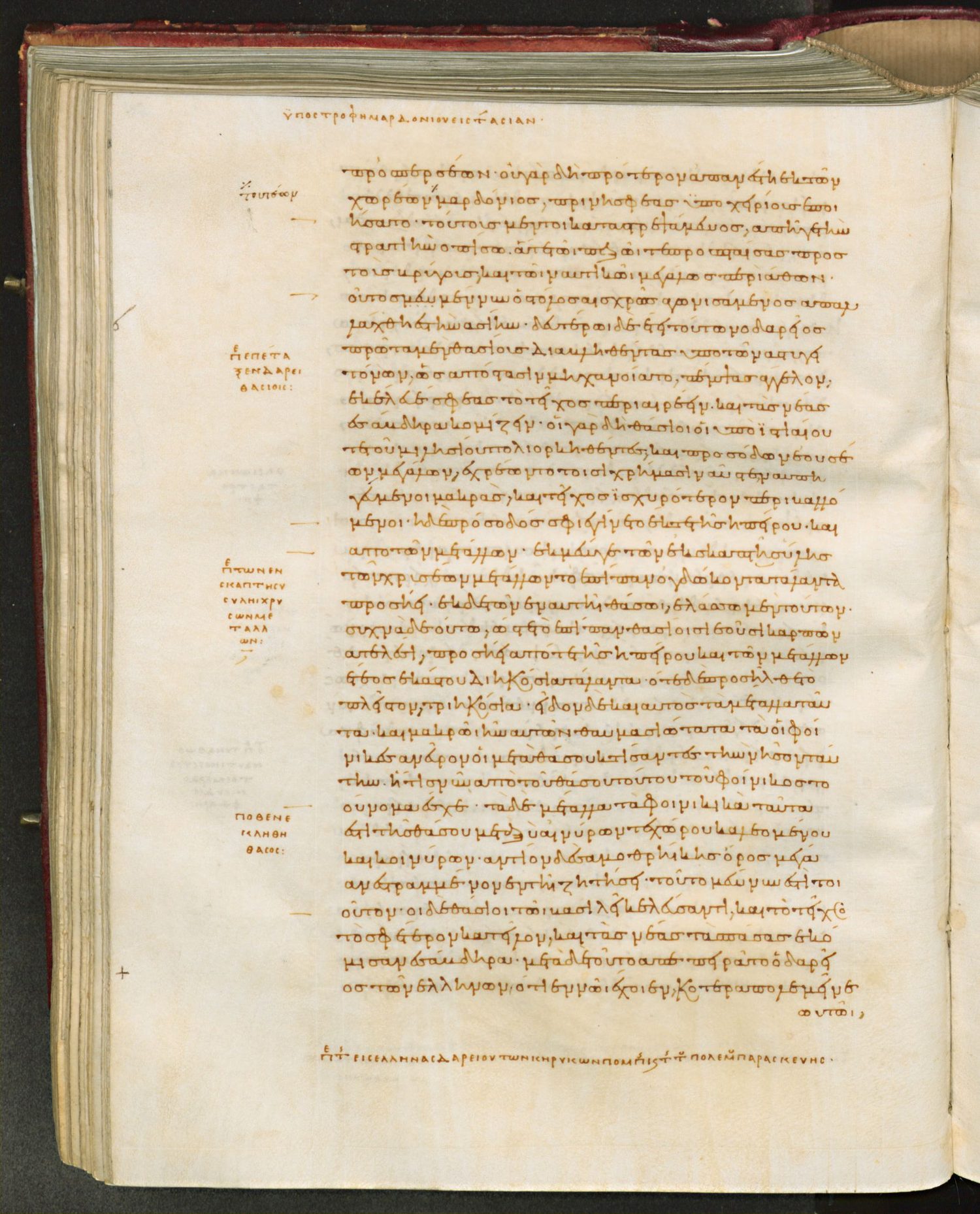
Laur. Plut. 70.3, fol. 243r: Greek here 6.43.3 to 6.45.1. Checked on the image (first and last words read and located in the Greek; each break checked against the neighbouring page): fol. 243r begins ‹τὴν Ἀσίην ἀπίκετο ὁ› (6.43.3), ends ‹οὐδὲ αὐτοὶ δουλοσύνην διέφυγον› (6.45.1). English here: 6.43.3 to 6.45.1 (Godley's sentences for the sections whose Greek lies mostly on this page).
6.43.3τὴν Ἀσίην ἀπίκετο ὁ Μαρδόνιος ἐς τὴν Ἰωνίην, ἐνθαῦτα μέγιστον θῶμα ἐρέω τοῖσι μὴ ἀποδεκομένοισι Ἑλλήνων Περσέων τοῖσι ἑπτὰ Ὀτάνεα γνώμην ἀποδέξασθαι ὡς χρεὸν εἴη δημοκρατέεσθαι Πέρσας· τοὺς γὰρ τυράννους τῶν Ἰώνων καταπαύσας πάντας ὁ Μαρδόνιος δημοκρατίας κατίστα ἐς τὰς πόλιας. 6.43.4ταῦτα δὲ ποιήσας ἠπείγετο ἐς τὸν Ἑλλήσποντον. ὡς δὲ συνελέχθη μὲν χρῆμα πολλὸν νεῶν συνελέχθη δὲ καὶ πεζὸς στρατὸς πολλός, διαβάντες τῇσι νηυσὶ τὸν Ἑλλήσποντον ἐπορεύοντο διὰ τῆς Εὐρώπης, ἐπορεύοντο δὲ ἐπί τε Ἐρέτριαν καὶ Ἀθήνας. 6.44.1αὗται μὲν ὦν σφι πρόσχημα ἦσαν τοῦ στόλου· ἀτὰρ ἐν νόῳ ἔχοντες ὅσας ἂν πλείστας δύνωνται καταστρέφεσθαι τῶν Ἑλληνίδων πολίων, τοῦτο μὲν δὴ τῇσι νηυσὶ Θασίους οὐδὲ χεῖρας ἀνταειραμένους κατεστρέψαντο, τοῦτο δὲ τῷ πεζῷ Μακεδόνας πρὸς τοῖσι ὑπάρχουσι δούλους προσεκτήσαντο· τὰ γὰρ ἐντὸς Μακεδόνων ἔθνεα πάντα σφι ἦν ἤδη ὑποχείρια γεγονότα. 6.44.2ἐκ μὲν δὴ Θάσου διαβαλόντες πέρην ὑπὸ τὴν ἤπειρον ἐκομίζοντο μέχρι Ἀκάνθου, ἐκ δὲ Ἀκάνθου ὁρμώμενοι τὸν Ἄθων περιέβαλλον. ἐπιπεσὼν δέ σφι περιπλέουσι βορέης ἄνεμος μέγας τε καὶ ἄπορος κάρτα τρηχέως περιέσπε, πλήθεϊ πολλὰς τῶν νεῶν ἐκβάλλων πρὸς τὸν Ἄθων. 6.44.3λέγεται γὰρ τριηκοσίας μὲν τῶν νεῶν τὰς διαφθαρείσας εἶναι, ὑπὲρ δὲ δύο μυριάδας ἀνθρώπων. ὥστε γὰρ θηριωδεστάτης ἐούσης τῆς θαλάσσης ταύτης τῆς περὶ τὸν Ἄθων, οἳ μὲν ὑπὸ τῶν θηρίων διεφθείροντο ἁρπαζόμενοι, οἳ δὲ πρὸς τὰς πέτρας ἀρασσόμενοι· οἳ δὲ αὐτῶν νέειν οὐκ ἐπιστέατο καὶ κατὰ τοῦτο διεφθείροντο, οἳ δὲ ῥίγεϊ. 6.45.1ὁ μὲν δὴ ναυτικὸς στρατὸς οὕτω ἔπρησσε, Μαρδονίῳ δὲ καὶ τῷ πεζῷ στρατοπεδευομένῳ ἐν Μακεδονίῃ νυκτὸς Βρύγοι Θρήικες ἐπεχείρησαν· καί σφεων πολλοὺς φονεύουσι οἱ Βρύγοι, Μαρδόνιον δὲ αὐτὸν τρωματίζουσι. οὐ μέντοι οὐδὲ αὐτοὶ δουλοσύνην διέφυγον
6.43.3When Mardonius arrived at Ionia in his voyage by the coast of Asia, he did a thing which I here set down for the wonder of those Greeks who will not believe Otanes to have declared his opinion among the Seven that democracy was best for Persia: Mardonius deposed all the Ionian despots and setup democracies in their cities. 6.43.4This done, he made all speed for the Hellespont; and a great multitude of ships and a great army being there assembled, the Persians crossed the Hellespont on shipboard and marched through Europe, with Eretria and Athens for their goal. 6.44.1This was the avowed end of their expedition; but their intent being to subdue as many of the Greek cities as they could, first their fleet subdued the Thasians, who did not so much as lift up their hands against it; and next, their land army added the Macedonians to the slaves that they had already; for all the nations nearer to them than Macedonia had been made subject to the Persians ere this. 6.44.2Crossing then over from Thasos they voyaged near the land as far as Acanthus, and putting out from thence they would have rounded Athos. But as they sailed, there brake upon them a north wind great and irresistible, and dealt very roughly with them, driving many of their ships upon Athos; three hundred, 6.44.3it is said, was the tale of the ships that perished, and more than twenty thousand men. For inasmuch as these coasts of Athos abounded in wild beasts, some were carried off by these and so perished; others were dashed against the rocks; and those of them that could not swim perished by reason of that, and others again by the cold. 6.45.1Thus then it fared with the fleet; as for Mardonius and his land army, while they were encamped in Macedonia the Brygi of Thrace attacked them by night, and slew many of them, wounding Mardonius himself. Nevertheless not even these themselves could escape being enslaved by the Persians; for Mardonius did not depart out of those lands before he had made them subject to him.
Where on the image
Laur. Plut. 70.3, fol. 243v: Greek here 6.45.1 to 6.47.2. Checked on the image (first and last words read and located in the Greek; each break checked against the neighbouring page): fol. 243v begins ‹πρὸς Περσέων· οὐ γὰρ› (6.45.1), ends ‹ἔχοιεν, κότερα πολεμέειν ἑωυτῷ› (6.48.1). The end of the last word (ἑωυτῷ) is written below the last line. English here: 6.45.2 to 6.47.2 (Godley's sentences for the sections whose Greek lies mostly on this page).
6.45.1πρὸς Περσέων· οὐ γὰρ δὴ πρότερον ἀπανέστη ἐκ τῶν χωρέων τουτέων Μαρδόνιος πρὶν ἤ σφεας ὑποχειρίους ἐποιήσατο. 6.45.2τούτους μέντοι καταστρεψάμενος ἀπῆγε τὴν στρατιὴν ὀπίσω, ἅτε τῷ πεζῷ τε προσπταίσας πρὸς τοὺς Βρύγους καὶ τῷ ναυτικῷ μεγάλως περὶ Ἄθων. οὗτος μέν νυν ὁ στόλος αἰσχρῶς ἀγωνισάμενος ἀπαλλάχθη ἐς τὴν Ἀσίην. 6.46.1δευτέρῳ δὲ ἔτεϊ τούτων ὁ Δαρεῖος πρῶτα μὲν Θασίους διαβληθέντας ὑπὸ τῶν ἀστυγειτόνων ὡς ἀπόστασιν μηχανῴατο, πέμψας ἄγγελον ἐκέλευε σφέας τὸ τεῖχος περιαιρέειν καὶ τὰς νέας ἐς Ἄβδηρα κομίζειν. 6.46.2οἱ γὰρ δὴ Θάσιοι, οἷα ὑπὸ Ἱστιαίου τε τοῦ Μιλησίου πολιορκηθέντες καὶ προσόδων ἐουσέων μεγαλέων, ἐχρέωντο τοῖσι χρήμασι νέας τε ναυπηγεύμενοι μακρὰς καὶ τεῖχος ἰσχυρότερον περιβαλλόμενοι. ἡ δὲ πρόσοδός σφι ἐγίνετο ἔκ τε τῆς ἠπείρου καὶ ἀπὸ τῶν μετάλλων· 6.46.3ἐκ μέν γε τῶν ἐκ Σκαπτησύλης τῶν χρυσέων μετάλλων τὸ ἐπίπαν ὀγδώκοντα τάλαντα προσήιε, ἐκ δὲ τῶν ἐν αὐτῇ Θάσῳ ἐλάσσω μὲν τούτων, συχνὰ δὲ οὓτω ὣστε τὸ ἐπίπαν Θασίοισι ἐοῦσι καρπῶν ἀτελέσι προσήιε ἀπό τε τῆς ἠπείρου καὶ τῶν μετάλλων ἔτεος ἑκάστου διηκόσια τάλαντα, ὅτε δὲ τὸ πλεῖστον προσῆλθε, τριηκόσια. 6.47.1εἶδον δὲ καὶ αὐτὸς τὰ μέταλλα ταῦτα, καὶ μακρῷ ἦν αὐτῶν θωμασιώτατα τὰ οἱ Φοίνικες ἀνεῦρον οἱ μετὰ Θάσου κτίσαντες τὴν νῆσον ταύτην, ἥτις νῦν ἀπὸ τοῦ Θάσου τούτου τοῦ Φοίνικος τὸ οὔνομα ἔσχε. 6.47.2τὰ δὲ μέταλλα τὰ Φοινικικὰ ταῦτα ἐστὶ τῆς Θάσου μεταξὺ Αἰνύρων τε χώρου καλεομένου καὶ Κοινύρων, ἀντίον δὲ Σαμοθρηίκης, ὄρος μέγα ἀνεστραμμένον ἐν τῇ ζητήσι. τοῦτο μέν νυν ἐστὶ τοιοῦτον. οἱ δὲ Θάσιοι τῷ βασιλέι κελεύσαντι καὶ τὸ τεῖχος τὸ σφέτερον κατεῖλον καὶ τὰς νέας τὰς πάσας ἐκόμισαν ἐς Ἄβδηρα.
6.45.2Yet when he had subdued them, he led his host away homewards, seeing that the Brygi had dealt a heavy blow to his army and Athos a blow yet heavier to his fleet. This expedition then after an inglorious adventure returned back to Asia. 6.46.1In the next year after this, Darius first sent a message bidding the Thasians, of whom it was falsely reported by their neighbours that they were planning rebellion, destroy their walls and bring their ships to Abdera. 6.46.2For the Thasians, inasmuch as they had been besieged by Histiaeus of Miletus and had great revenues, had used their wealth to build their ships of war and encompass themselves with stronger walls. 6.46.3Their revenue came from the mainland and the mines. Eighty talents for the most part they drew from the gold-mines of the “Digged Forest”; and from the mines of Thasos itself, albeit less than that, yet so much that the Thasians, paying no tax for their crops, drew for the most part a yearly revenue from the mainland and the mines of two hundred talents, and three hundred when the revenue was greatest. 6.47.1I myself have seen these mines; most marvellous by far were those of them that were found by the Phoenicians who came with Thasos and planted a settlement in this island, which is now called after that Phoenician Thasos. 6.47.2These Phoenician mines are between the place called Aenyra and Coenyra in Thasos, over against Samothrace; they are in a great hill that has been digged up in the searching. Thus much I have to say of this. The Thasians at the king’s command destroyed their walls and brought all their ships to Abdera.
Notes
- Greek: the text printed in A. D. Godley's Loeb edition, via Perseus (tlg0016.tlg001.perseus-grc2). Square brackets mark words the editor considers later additions; [...] marks a gap the editor indicates. Perseus note markers are omitted.
- English: A. D. Godley, Herodotus vol. 3 (1922) (Loeb Classical Library), as transcribed on Wikisource. Godley's footnotes are omitted.
- Section numbers in the English were placed by comparing Godley's text with the Perseus version of his translation; where a section begins inside one of Godley's sentences, the English is kept with the page that holds the start of that sentence.
Cite
Sources
- Source: Florence, Laur. Plut. 70.3 (10th c.) via BML Teca Digitale + Greek of Godley's Loeb (Perseus) + English of A. D. Godley (Loeb, Wikisource) (holding institution)
- Critical edition: Greek of A. D. Godley's Loeb edition (1920-1925), via Perseus
← previous · → next · v cycle view · l back to library