Herodotus, Histories 6.48-60: Earth and water; the kings of Sparta
Introduction
Herodotus of Halicarnassus wrote the Histories in the third quarter of the 5th century BCE, an inquiry into the deeds of Greeks and barbarians and the causes of the wars between them, later divided into nine books. Book 6 tells of the end of the Ionian revolt at Lade and Miletus, the first Persian expeditions against Greece under Mardonius and under Datis and Artaphrenes, the quarrels of Sparta, Athens and Aegina, and the battle of Marathon.
The photographs are of Florence, Biblioteca Medicea Laurenziana, Plut. 70.3 (parchment, 10th century, 374 folios, 31 lines a page), Herodotus, Histories (codex A of the editors), the oldest surviving manuscript of the complete Histories, from the Teca Digitale of the Biblioteca Medicea Laurenziana. Each section below is the text of one page, or of the part of a page that falls within these chapters. The first and last words of every page were read on the photograph and located in the Greek, and every page break was checked against the next page; the notes quote these words. Readers' notes in the margins are not part of the text and are mentioned where they occur.
The Greek is the text printed in A. D. Godley's Loeb edition (1920-1925), from Perseus; it is the edited text, not a transcription of the manuscript, whose wording differs in places. The English is Godley's translation as printed, from Wikisource. Godley's English carries only chapter numbers; the section numbers shown in it were placed by comparison with the Perseus version of his translation. Each page's English is cut at the end of one of Godley's sentences, so it can begin or end a few lines away from the Greek of the page; each note gives the exact ranges.
This entry covers chapters 6.48-60, on fol. 243v to 246v.
How was this verified? (Provenance)
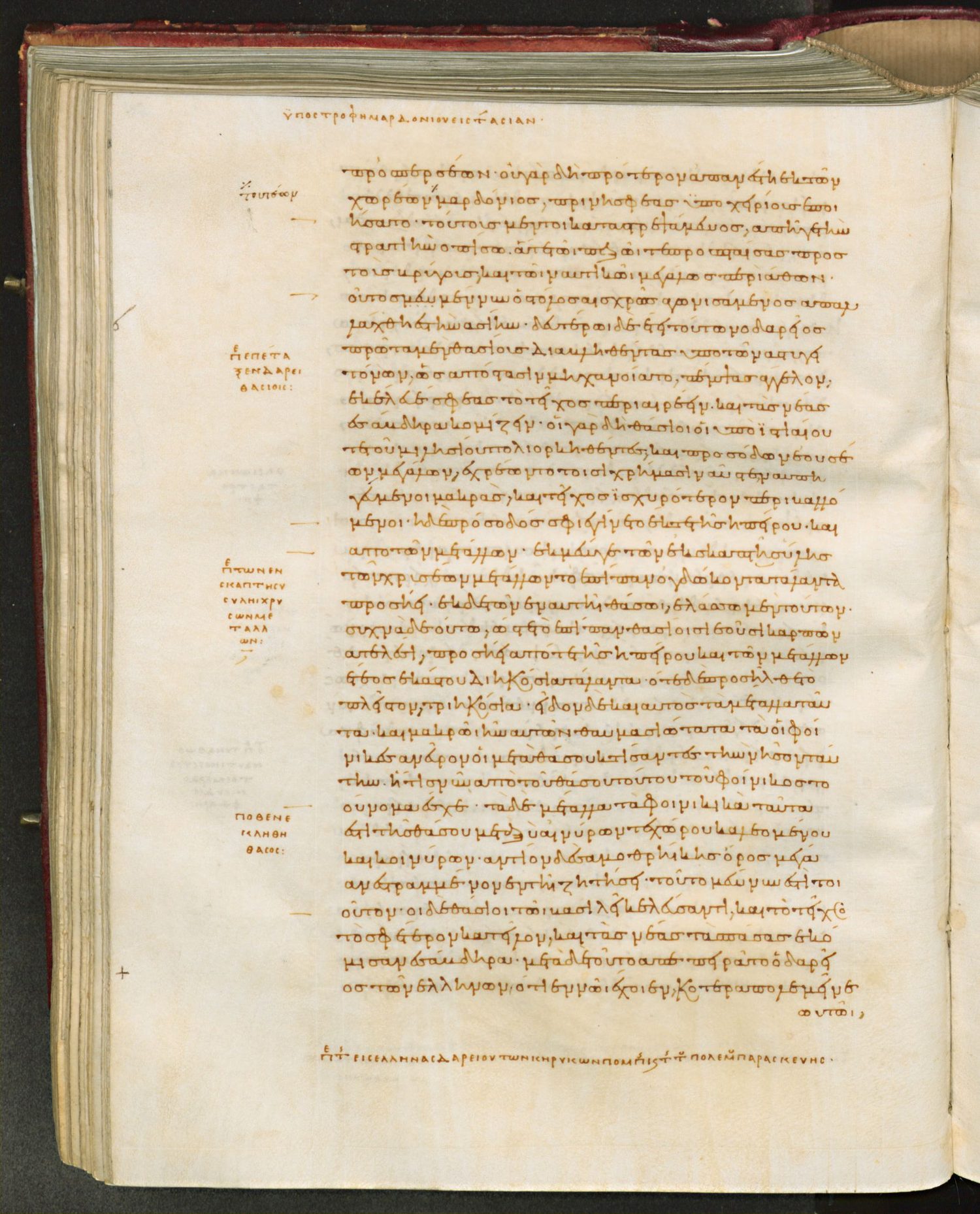
Where on the image
Laur. Plut. 70.3, fol. 243v: Greek here 6.48.1. Checked on the image (first and last words read and located in the Greek; each break checked against the neighbouring page): fol. 243v begins ‹πρὸς Περσέων· οὐ γὰρ› (6.45.1), ends ‹ἔχοιεν, κότερα πολεμέειν ἑωυτῷ› (6.48.1). The end of the last word (ἑωυτῷ) is written below the last line. English here: 6.48.1 (Godley's sentences for the sections whose Greek lies mostly on this page).
6.48.1μετὰ δὲ τοῦτο ἀπεπειρᾶτο ὁ Δαρεῖος τῶν Ἑλλήνων ὅ τι ἐν νόῳ ἔχοιεν, κότερα πολεμέειν ἑωυτῷ
6.48.1After this, Darius essayed to learn whether the Greeks purposed to wage war against him or to surrender themselves. Therefore he sent heralds this way and that about Hellas as they were severally appointed, bidding them demand a gift of earth and water for the king.
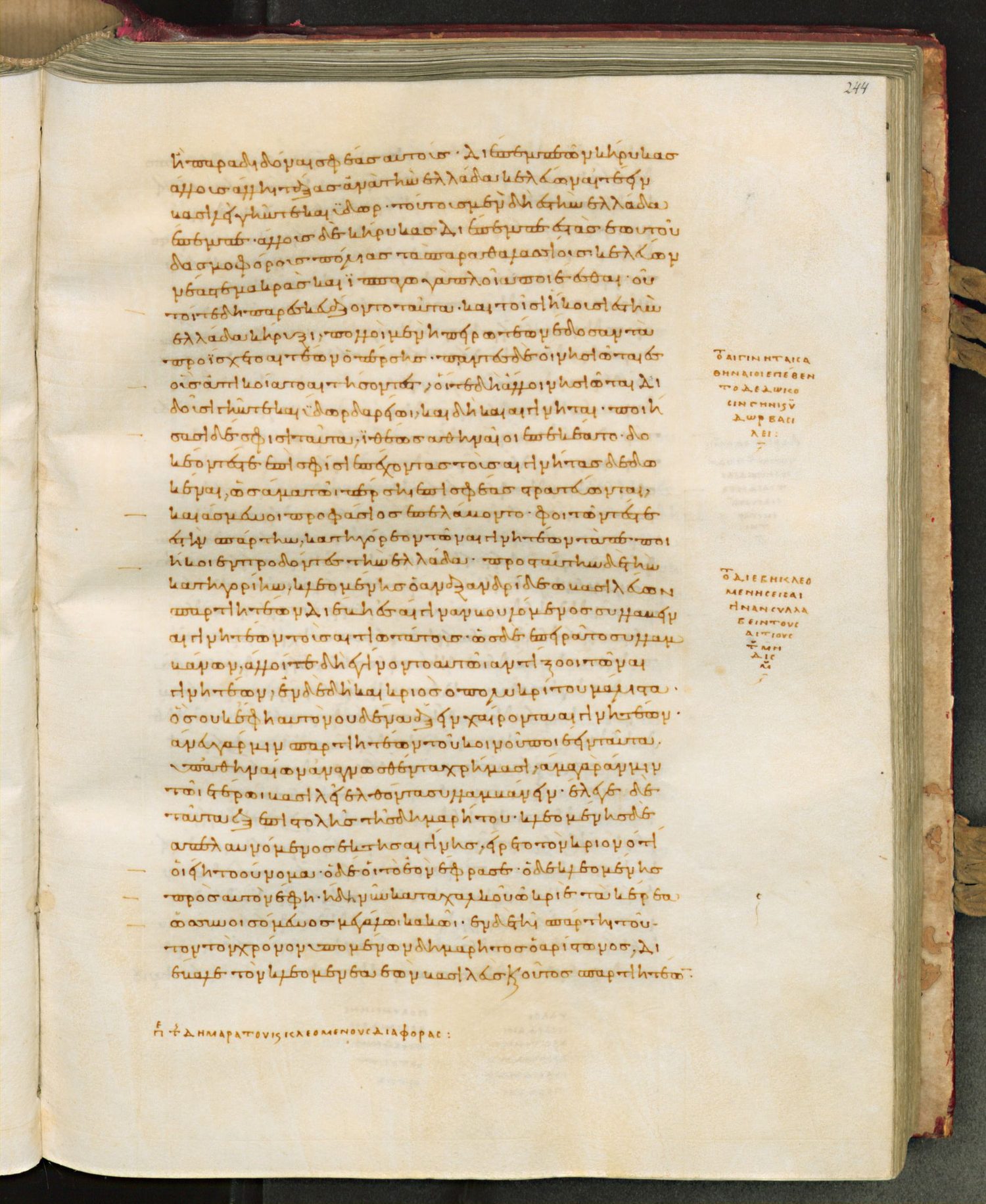
Where on the image
Laur. Plut. 70.3, fol. 244r: Greek here 6.48.1 to 6.51.1. Checked on the image (first and last words read and located in the Greek; each break checked against the neighbouring page): fol. 244r begins ‹ἢ παραδιδόναι σφέας αὐτούς.διέπεμπε› (6.48.1), ends ‹βασιλεὺς καὶ οὗτος Σπαρτιητέων› (6.51.1). English here: 6.48.2 to 6.50.3 (Godley's sentences for the sections whose Greek lies mostly on this page).
6.48.1ἢ παραδιδόναι σφέας αὐτούς. 6.48.2διέπεμπε ὦν κήρυκας ἄλλους ἄλλῃ τάξας ἀνὰ τὴν Ἑλλάδα, κελεύων αἰτέειν βασιλέι γῆν τε καὶ ὕδωρ. τούτους μὲν δὴ ἐς τὴν Ἑλλάδα ἔπεμπε, ἄλλους δὲ κήρυκας διέπεμπε ἐς τὰς ἑωυτοῦ δασμοφόρους πόλιας τὰς παραθαλασσίους, κελεύων νέας τε μακρὰς καὶ ἱππαγωγὰ πλοῖα ποιέεσθαι. 6.49.1οὗτοί τε δὴ παρεσκευάζοντο ταῦτα, καὶ τοῖσι ἥκουσι ἐς τὴν Ἑλλάδα κήρυξι πολλοὶ μὲν ἠπειρωτέων ἔδοσαν τὰ προΐσχετο αἰτέων ὁ Πέρσης, πάντες δὲ νησιῶται ἐς τοὺς ἀπικοίατο αἰτήσοντες. οἵ τε δὴ ἄλλοι νησιῶται διδοῦσι γῆν τε καὶ ὕδωρ Δαρείῳ καὶ δὴ καὶ Αἰγινῆται. 6.49.2ποιήσασι δέ σφι ταῦτα ἰθέως Ἀθηναῖοι ἐπεκέατο, δοκέοντές τε ἐπὶ σφίσι ἐπέχοντας τοὺς Αἰγινήτας δεδωκέναι ὡς ἅμα τῷ Πέρσῃ ἐπὶ σφέας στρατεύωνται, καὶ ἄσμενοι προφάσιος ἐπελάβοντο, φοιτέοντές τε ἐς τὴν Σπάρτην κατηγόρεον τῶν Αἰγινητέων τὰ πεποιήκοιεν προδόντες τὴν Ἑλλάδα. 6.50.1πρὸς ταύτην δὲ τὴν κατηγορίην Κλεομένης ὁ Ἀναξανδρίδεω βασιλεὺς ἐὼν Σπαρτιητέων διέβη ἐς Αἴγιναν, βουλόμενος συλλαβεῖν Αἰγινητέων τοὺς αἰτιωτάτους. 6.50.2ὡς δὲ ἐπειρᾶτο συλλαμβάνων, ἄλλοι τε δὴ ἐγίνοντο αὐτῷ ἀντίξοοι τῶν Αἰγινητέων, ἐν δὲ δὴ καὶ Κριὸς ὁ Πολυκρίτου μάλιστα, ὃς οὐκ ἔφη αὐτὸν οὐδένα ἄξειν χαίροντα Αἰγινητέων· ἄνευ γάρ μιν Σπαρτιητέων τοῦ κοινοῦ ποιέειν ταῦτα, ὑπʼ Ἀθηναίων ἀναγνωσθέντα χρήμασι· ἅμα γὰρ ἄν μιν τῷ ἑτέρῳ βασιλέι ἐλθόντα συλλαμβάνειν. 6.50.3ἔλεγε δὲ ταῦτα ἐξ ἐπιστολῆς τῆς Δημαρήτου. Κλεομένης δὲ ἀπελαυνόμενος ἐκ τῆς Αἰγίνης εἴρετο τὸν Κριὸν ὅ τι οἱ εἴη τὸ οὔνομα· ὁ δέ οἱ τὸ ἐὸν ἔφρασε. ὁ δὲ Κλεομένης πρὸς αὐτὸν ἔφη ἤδη νῦν καταχαλκοῦ ὦ κριὲ τὰ κέρεα, ὡς συνοισόμενος μεγάλῳ κακῷ. 6.51.1ἐν δὲ τῇ Σπάρτῃ τοῦτον τὸν χρόνον ὑπομένων Δημάρητος ὁ Ἀρίστωνος διέβαλλε τὸν Κλεομένεα, ἐὼν βασιλεὺς καὶ οὗτος Σπαρτιητέων,
6.48.2These he despatched to Hellas, and others he sent severally to his own tributary cities of the sea-coast, commanding that ships of war and transports for horses be built. 6.49.1So the cities set about these preparations; and the heralds that went to Hellas received that which the king’s proclamation demanded, from many of the dwellers on the mainland and all the islanders to whom they came with the demand. Among the islanders that gave earth and water to Darius were the Aeginetans. 6.49.3These by so doing straightway brought the Athenians upon them, who supposed the Aeginetans to have given the gift out of enmity against Athens, that so they might join with the Persians in attacking the Athenians; and, gladly laying hold of this pretext, they betook themselves to Sparta and there accused the Aeginetans of an act that proved them traitors to Hellas. 6.50.1On this impeachment, Cleomenes, son of Anaxandrides, being then a king of Sparta, crossed over to Aegina, that he might lay hands on the guiltiest of its people. 6.50.2But when he essayed to lay hands on them, Crius son of Polycritus, with other Aeginetans at his back, withstood him, and bade Cleomenes take no man of Aegina, or he would rue it; “for,” said he, “you have no authority from the Spartans for what you do, but a bribe from Athens; had you such, the other king had come with you to take us.” This he said, being so instructed in a letter by Demaratus. 6.50.3Being thus compelled to depart from Aegina, Cleomenes asked Crius what was his name; and when Crius told him what it was, “Now is the time to put bronze on your horns, Sir Ram,” said Cleomenes, “for great calamity will confront you.”
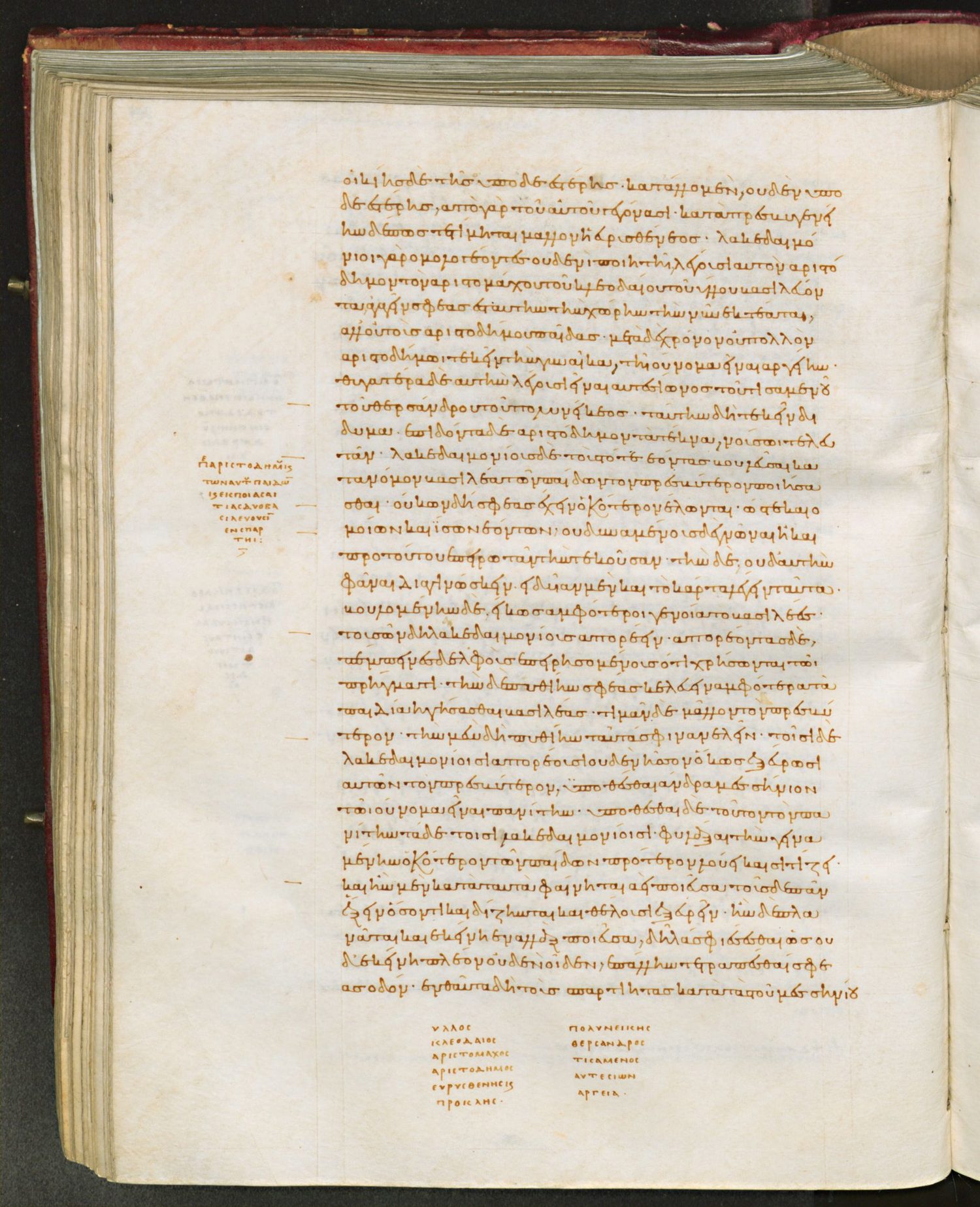
Where on the image
Laur. Plut. 70.3, fol. 244v: Greek here 6.51.1 to 6.52.7. Checked on the image (first and last words read and located in the Greek; each break checked against the neighbouring page): fol. 244v begins ‹οἰκίης δὲ τῆς ὑποδεεστέρης,› (6.51.1), ends ‹κατὰ τὰς τοῦ Μεσσηνίου› (6.52.7). Below the text, a reader's list in capitals of the ancestors of the Spartan kings, from Hyllus to Eurysthenes and Procles and from Polynices to Argeia. English here: 6.51.1 to 6.52.6 (Godley's sentences for the sections whose Greek lies mostly on this page).
6.51.1οἰκίης δὲ τῆς ὑποδεεστέρης, κατʼ ἄλλο μὲν οὐδὲν ὑποδεεστέρης· ἀπὸ γὰρ τοῦ αὐτοῦ γεγόνασι· κατὰ πρεσβυγενείην δε κως τετίμηται μᾶλλον ἡ Εὐρυσθένεος. 6.52.1Λακεδαιμόνιοι γὰρ ὁμολογέοντες οὐδενὶ ποιητῇ λέγουσι αὐτὸν Ἀριστόδημον τὸν Ἀριστομάχου τοῦ Κλεοδαίου τοῦ Ὕλλου βασιλεύοντα ἀγαγεῖν σφεας ἐς ταύτην τὴν χώρην τὴν νῦν ἐκτέαται, ἀλλʼ οὐ τοὺς Ἀριστοδήμου παῖδας. 6.52.2μετὰ δὲ χρόνον οὐ πολλὸν Ἀριστοδήμῳ τεκεῖν τὴν γυναῖκα, τῇ οὔνομα εἶναι Ἀργείην· θυγατέρα δὲ αὐτὴν λέγουσι εἶναι Αὐτεσίωνος τοῦ Τισαμενοῦ τοῦ Θερσάνδρου τοῦ Πολυνείκεος· ταύτην δὴ τεκεῖν δίδυμα, ἐπιδόντα δὲ τὸν Ἀριστόδημον τὰ τέκνα νούσῳ τελευτᾶν. 6.52.3Λακεδαιμονίους δὲ τοὺς τότε ἐόντας βουλεῦσαι κατὰ νόμον βασιλέα τῶν παίδων τὸν πρεσβύτερον ποιήσασθαι. οὔκων δή σφεας ἔχειν ὁκότερον ἕλωνται ὥστε καὶ ὁμοίων καὶ ἴσων ἐόντων· οὐ δυναμένους δὲ γνῶναι, ἢ καὶ πρὸ τούτου, ἐπειρωτᾶν τὴν τεκοῦσαν. 6.52.4τὴν δὲ οὐδὲ αὐτὴν φάναι διαγινώσκειν. εἰδυῖαν μὲν καὶ τὸ κάρτα λέγειν ταῦτα, βουλομένην δὲ εἴ κως ἀμφότεροι γενοίατο βασιλέες. τοὺς ὦν δὴ Λακεδαιμονίους ἀπορέειν, ἀπορέοντας δὲ πέμπειν ἐς Δελφοὺς ἐπειρησομένους ὅ τι χρήσωνται τῷ πρήγματι. 6.52.5τὴν δὲ Πυθίην σφέας κελεύειν ἀμφότερα τὰ παιδία ἡγήσασθαι βασιλέας, τιμᾶν δὲ μᾶλλον τὸν γεραίτερον. τὴν μὲν δὴ Πυθίην ταῦτά σφι ἀνελεῖν, τοῖσι δὲ Λακεδαιμονίοισι ἀπορέουσι οὐδὲν ἧσσον ὅκως ἐξεύρωσι αὐτῶν τὸν πρεσβύτερον, ὑποθέσθαι ἄνδρα Μεσσήνιον τῷ οὔνομα εἶναι Πανίτην· 6.52.6ὑποθέσθαι δὲ τοῦτον τὸν Πανίτην τάδε τοῖσι Λακεδαιμονίοισι, φυλάξαι τὴν γειναμένην ὁκότερον τῶν παίδων πρότερον λούει καὶ σιτίζει· καὶ ἢν μὲν κατὰ ταὐτὰ φαίνηται αἰεὶ ποιεῦσα, τοὺς δὲ πᾶν ἕξειν ὅσον τι καὶ δίζηνται καὶ θέλουσι ἐξευρεῖν, ἢν δὲ πλανᾶται καὶ ἐκείνη ἐναλλὰξ ποιεῦσα, δῆλά σφι ἔσεσθαι ὡς οὐδὲ ἐκείνη πλέον οὐδὲν οἶδε, ἐπʼ ἄλλην τε τραπέσθαι σφέας ὁδόν. 6.52.7ἐνθαῦτα δὴ τοὺς Σπαρτιήτας κατὰ τὰς τοῦ Μεσσηνίου
6.51.1All this time Demaratus son of Ariston abode at Sparta and spread evil reports of Cleomenes. This Demaratus was also king of Sparta, but of the less worthy family of the two; not indeed in any other regard less worthy (for they have a common ancestor), but the house of Eurysthenes has in some sort the greater honour by right of primogeniture. 6.52.1For by the Lacedaemonian story, wherewith no poet agrees, it was Aristodemus (the son of Aristomachus, who was the son of Cleodaeus, who was the son of Hyllus), and not his sons, who led them to that land which they now possess. 6.52.2After no long time Aristodemus’ wife, whose name was Argeia, bore him offspring; she, they say, was daughter of Autesion, who was the son of Tisamenus, who was the son of Thersander, who was the son of Polynices; she bore him twins; Aristodemus lived to see the children, and presently died of a sickness. 6.52.3The Lacedaemonians of that day planned to follow their custom and make the eldest of the children king. But the children being in all respects alike, they knew not which to choose; and when they could not judge between them, or perchance even before they had essayed, they asked the mother. 6.52.4But she said that she knew no better than the Lacedaemonians which was the elder; this she said, though she knew right well, because she desired that by some means both might be made kings. Being then in a quandary (so the story goes), the Lacedaemonians sent to Delphi to enquire how they should deal with the matter. 6.52.5The priestess bade them make both the children kings, but honour the first of them most. On this answer of the priestess, the Lacedaemonians knowing no better than before how to discover the eldest child, a certain Messenian, called Panites, gave them counsel; and this was his 6.52.6counsel, that they should watch the mother and see which of the children she washed and fed before the other; and if in this she should ever follow one rule, they would then have all that they sought and desired to discover; but if she changed about in her practice at haphazard, then it would be manifest to the Lacedaemonians that she know no more than they did, and they must betake them to some other means.
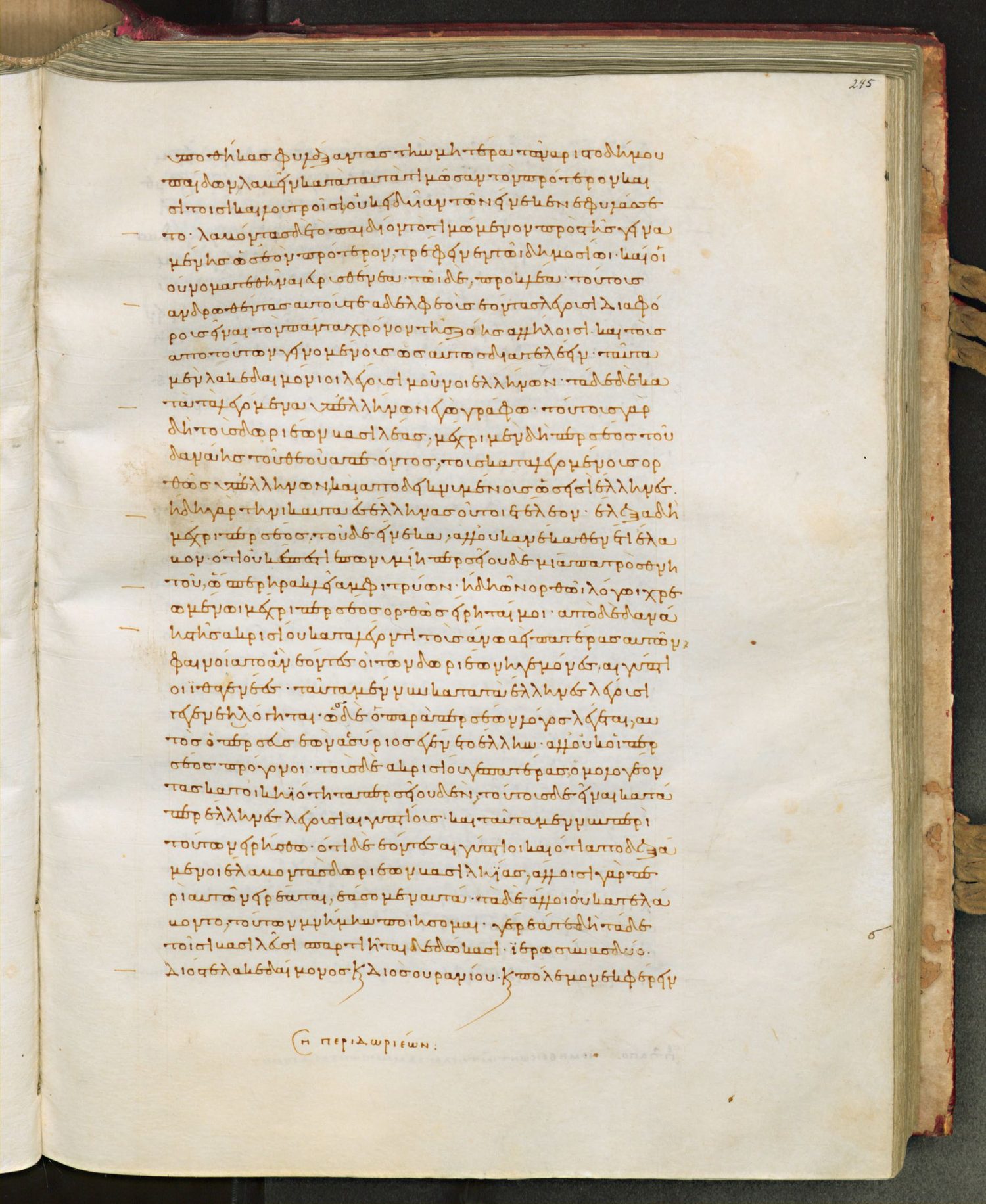
Where on the image
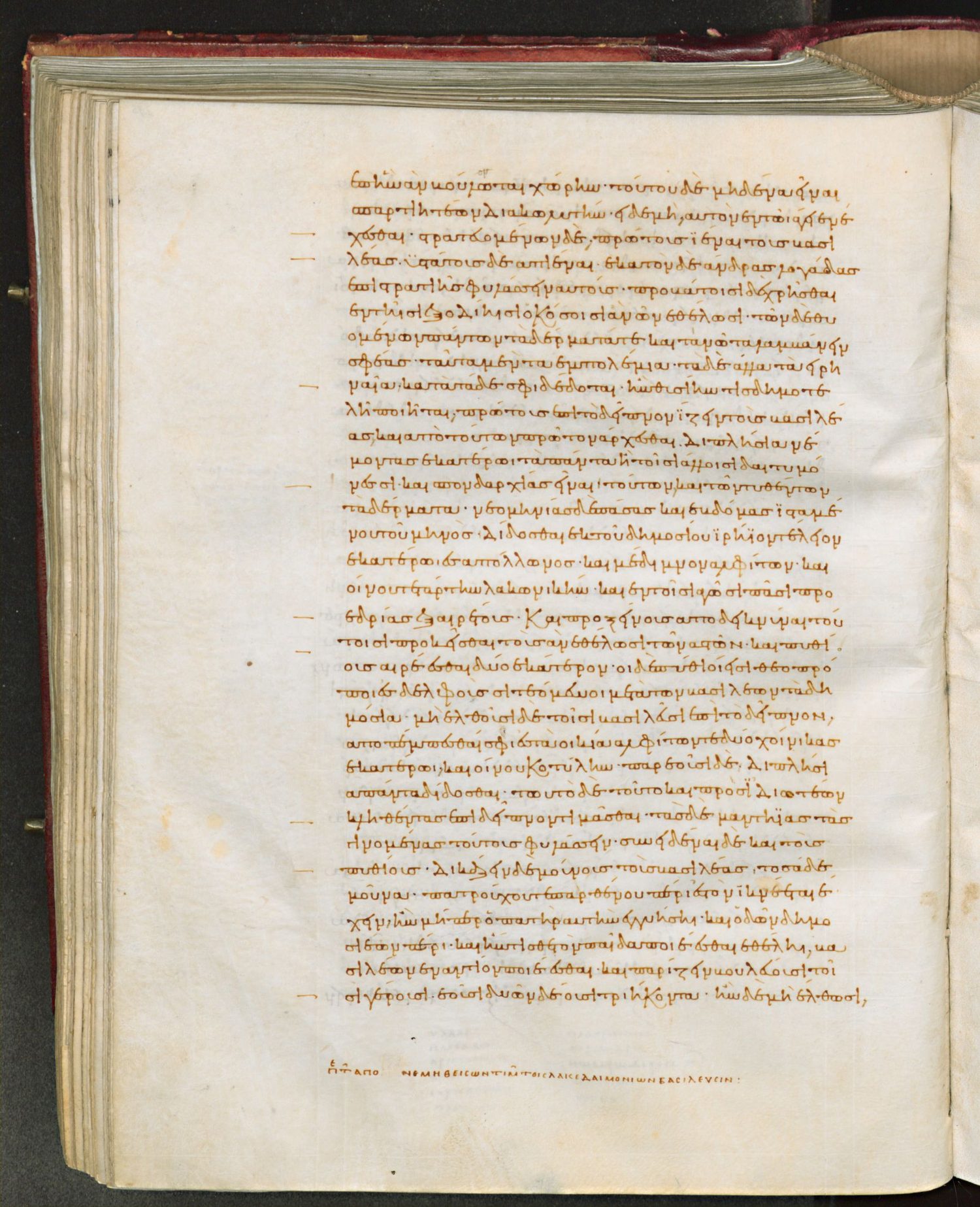
Laur. Plut. 70.3, fol. 245r: Greek here 6.52.7 to 6.56.1. Checked on the image (first and last words read and located in the Greek; each break checked against the neighbouring page): fol. 245r begins ‹ὑποθήκας φυλάξαντας τὴν μητέρα› (6.52.7), ends ‹οὐρανίου, καὶ πόλεμον ἐκφέρειν› (6.56.1). English here: 6.52.7 to 6.55.1 (Godley's sentences for the sections whose Greek lies mostly on this page).
6.52.7ὑποθήκας φυλάξαντας τὴν μητέρα τῶν Ἀριστοδήμου παίδων λαβεῖν κατὰ ταὐτὰ τιμῶσαν τὸν πρότερον καὶ σίτοισι καὶ λουτροῖσι, οὐκ εἰδυῖαν τῶν εἵνεκεν ἐφυλάσσετο. λαβόντας δὲ τὸ παιδίον τὸ τιμώμενον πρὸς τῆς γειναμένης ὡς ἐὸν πρότερον τρέφειν ἐν τῷ δημοσίῳ· καί οἱ οὔνομα τεθῆναι Εὐρυσθένεα, τῷ δὲ Προκλέα. 6.52.8τούτους ἀνδρωθέντας αὐτούς τε ἀδελφεοὺς ἐόντας λέγουσι διαφόρους εἶναι τὸν πάντα χρόνον τῆς ζόης ἀλλήλοισι, καὶ τοὺς ἀπὸ τούτων γενομένους ὡσαύτως διατελέειν. 6.53.1ταῦτα μὲν Λακεδαιμόνιοι λέγουσι μοῦνοι Ἑλλήνων· τάδε δὲ κατὰ τὰ λεγόμενα ὑπʼ Ἑλλήνων ἐγὼ γράφω, τούτους τοὺς Δωριέων βασιλέας μέχρι μὲν δὴ Περσέος τοῦ Δανάης, τοῦ θεοῦ ἀπεόντος, καταλεγομένους ὀρθῶς ὑπʼ Ἑλλήνων καὶ ἀποδεικνυμένους ὡς εἰσὶ Ἕλληνες· ἤδη γὰρ τηνικαῦτα ἐς Ἕλληνας οὗτοι ἐτέλεον. 6.53.2ἔλεξα δὲ μέχρι Περσέος τοῦδε εἵνεκα, ἀλλʼ οὐκ ἀνέκαθεν ἔτι ἔλαβον, ὅτι οὐκ ἔπεστι ἐπωνυμίη Περσέι οὐδεμία πατρὸς θνητοῦ, ὥσπερ Ἡρακλέι Ἀμφιτρύων. ἤδη ὦν ὀρθῷ χρεωμένῳ μέχρι Περσέος ὀρθῶς εἴρηταί μοι· ἀπὸ δὲ Δανάης τῆς Ἀκρισίου καταλέγοντι τοὺς ἄνω αἰεὶ πατέρας αὐτῶν φαινοίατο ἂν ἐόντες οἱ τῶν Δωριέων ἡγεμόνες Αἰγύπτιοι ἰθαγενέες. 6.54.1ταῦτα μέν νυν κατὰ τὰ Ἕλληνες λέγουσι γεγενεηλόγηται· ὡς δὲ ὁ παρὰ Περσέων λόγος λέγεται, αὐτὸς ὁ Περσεὺς ἐὼν Ἀσσύριος ἐγένετο Ἕλλην, ἀλλʼ οὐκ οἱ Περσέος πρόγονοι· τοὺς δὲ Ἀκρισίου γε πατέρας ὁμολογέοντας κατʼ οἰκηιότητα Περσέι οὐδέν, τούτους δὲ εἶναι, κατά περ Ἕλληνες λέγουσι, Αἰγυπτίους. 6.55.1καὶ ταῦτα μέν νυν περὶ τούτων εἰρήσθω. ὅ τι δὲ ἐόντες Αἰγύπτιοι καὶ ὅ τι ἀποδεξάμενοι ἔλαβον τὰς Δωριέων βασιληίας, ἄλλοισι γὰρ περὶ αὐτῶν εἴρηται, ἐάσομεν αὐτά· τὰ δὲ ἄλλοι οὐ κατελάβοντο, τούτων μνήμην ποιήσομαι. 6.56.1γέρεά τε δὴ τάδε τοῖσι βασιλεῦσι Σπαρτιῆται δεδώκασι, ἱρωσύνας δύο, Διός τε Λακεδαίμονος καὶ Διὸς οὐρανίου, καὶ πόλεμον ἐκφέρειν
6.52.7Thereupon the Spartans did as the Messenian counselled, and watching the mother of Aristodemus’ children, found her ever preferring the first-born of the two when she fed and washed them, she not knowing wherefore she was watched. So they took the child that was preferred by its mother and brought it up at the public charge as the first-born; and they called it Eurysthenes, and the other Procles. 6.52.8These two brothers, it is said, when they came to man’s estate, were ever at feud with each other as long as they lived, and their descendants too continued in the same state. 6.53.1Such is the story told by the Lacedaemonians, but by no other Greeks. But I in what I write follow the Greek report, and hold that the Greeks are right in recording these kings of the Dorians as far back as to Perseus son of Danaë,—wherein they make no mention of the god,—and in proving the said kings to be Greek; for by Perseus’ time they had come to be reckoned as Greeks. 6.53.2As far back as Perseus, I say, and I take the matter no farther than that, because none is named as the mortal father of Perseus, as Amphitryon is named father of Heracles. It is plain, then, that I have right reason on my side when I say that the Greek record is right as far back as to Perseus; farther back than that, if the king’s ancestors in each generation, from Danae daughter of Acrisius upward, be reckoned, then the leaders of the Dorians will be shown to be true-born Egyptians. 6.54.1Thus have I traced their lineage according to the Greek story; but the Persian tale is, that Perseus himself was an Assyrian, and became a Greek, which his forbears had not been; as for Acrisius (say the Persians), his ancestors had no bond of kinship with Perseus, and they indeed were, as the Greeks say, Egyptians. 6.55.1Enough of these matters. Now the reason why and for what achievements these men, being Egyptian, won the kingship of the Dorians, has been told by others; of this therefore I will say nothing, and will make mention of matters which others have not touched.
Where on the image
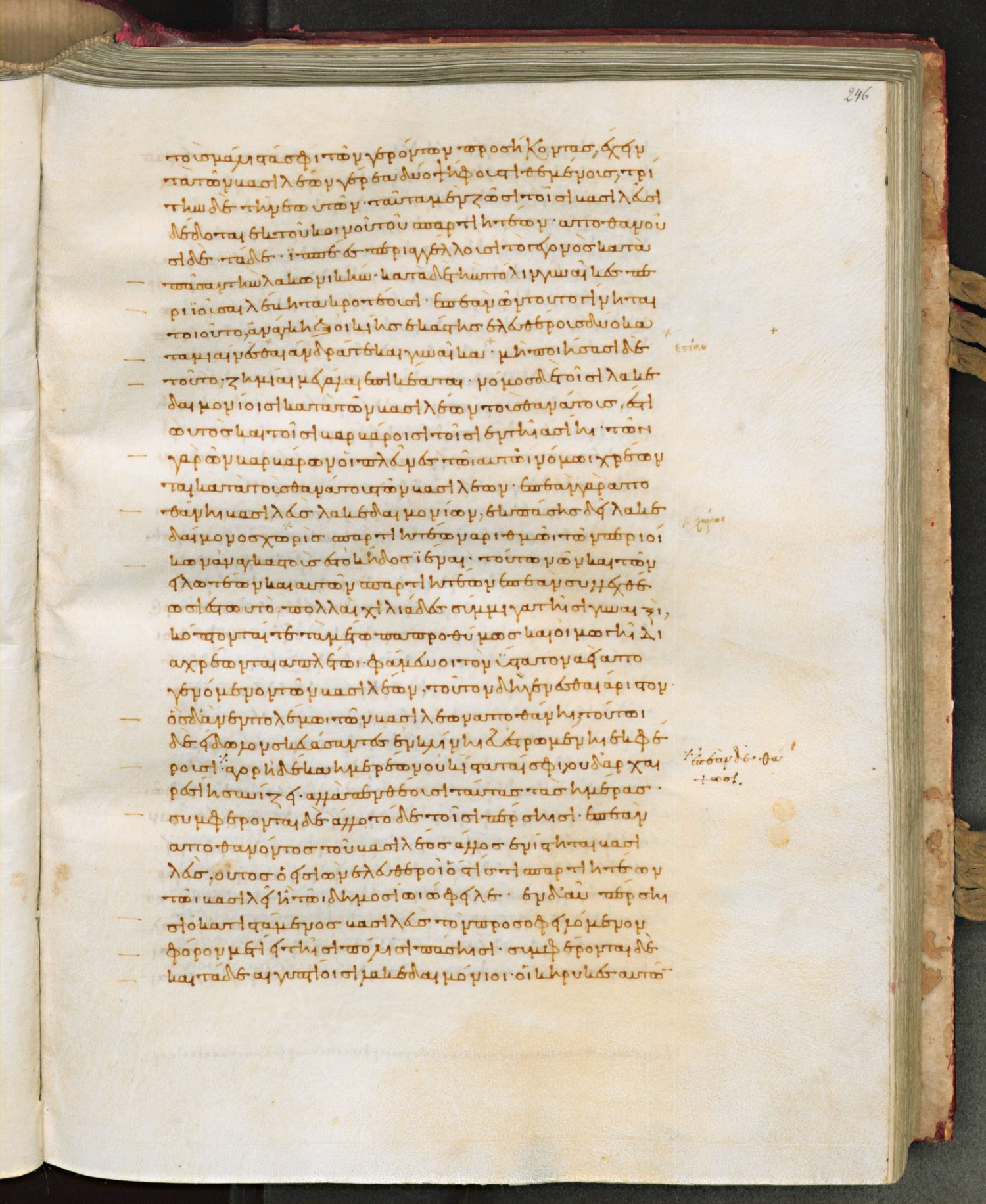
Laur. Plut. 70.3, fol. 245v: Greek here 6.56.1 to 6.57.5. Checked on the image (first and last words read and located in the Greek; each break checked against the neighbouring page): fol. 245v begins ‹ἐπʼ ἣν ἂν βούλωνται› (6.56.1), ends ‹ἢν δὲ μὴ ἔλθωσι› (6.57.5). English here: 6.56.1 to 6.57.5 (Godley's sentences for the sections whose Greek lies mostly on this page).
6.56.1ἐπʼ ἣν ἂν βούλωνται χώρην, τούτου δὲ μηδένα εἶναι Σπαρτιητέων διακωλυτήν, εἰ δὲ μὴ αὐτὸν ἐν τῷ ἄγεϊ ἐνέχεσθαι. στρατευομένων δὲ πρώτους ἰέναι τοὺς βασιλέας, ὑστάτους δὲ ἀπιέναι· ἑκατὸν δὲ ἄνδρας λογάδας ἐπὶ στρατιῆς φυλάσσειν αὐτούς· προβάτοισι δὲ χρᾶσθαι ἐν τῇσι ἐξοδίῃσι ὁκόσοισι ἂν ὦν ἐθέλωσι, τῶν δὲ θυομένων πάντων τὰ δέρματά τε καὶ τὰ νῶτα λαμβάνειν σφεας. 6.57.1ταῦτα μὲν τὰ ἐμπολέμια, τὰ δὲ ἄλλα τὰ εἰρηναῖα κατὰ τάδε σφι δέδοται. ἢν θυσίη τις δημοτελὴς ποιέηται, πρώτους ἐπὶ τὸ δεῖπνον ἵζειν τοὺς βασιλέας, καὶ ἀπὸ τούτων πρῶτον ἄρχεσθαι διπλήσια νέμοντας ἑκατέρῳ τὰ πάντα ἢ τοῖσι ἄλλοισι δαιτυμόνεσι, καὶ σπονδαρχίας εἶναι τούτων καὶ τῶν τυθέντων τὰ δέρματα. 6.57.2νεομηνίας δὲ πάσας καὶ ἑβδόμας ἱσταμένου τοῦ μηνὸς δίδοσθαι ἐκ τοῦ δημοσίου ἱρήιον τέλεον ἑκατέρῳ ἐς Ἀπόλλωνος καὶ μέδιμνον ἀλφίτων καὶ οἴνου τετάρτην Λακωνικήν, καὶ ἐν τοῖσι ἀγῶσι πᾶσι προεδρίας ἐξαιρέτους. καὶ προξείνους ἀποδεικνύναι τούτοισι προσκεῖσθαι τοὺς ἂν ἐθέλωσι τῶν ἀστῶν, καὶ Πυθίους αἱρέεσθαι δύο ἑκάτερον. οἱ δὲ Πύθιοι εἰσὶ θεοπρόποι ἐς Δελφούς, σιτεόμενοι μετὰ τῶν βασιλέων τὰ δημόσια. 6.57.3μὴ ἐλθοῦσι δὲ τοῖσι βασιλεῦσι ἐπὶ τὸ δεῖπνον ἀποπέμπεσθαί σφι ἐς τὰ οἰκία ἀλφίτων τε δύο χοίνικας ἑκατέρῳ καὶ οἴνου κοτύλην, παρεοῦσι δὲ διπλήσια πάντα δίδοσθαι· τὠυτὸ δὲ τοῦτο καὶ πρὸς ἰδιωτέων κληθέντας ἐπὶ δεῖπνον τιμᾶσθαι. 6.57.4τὰς δὲ μαντηίας τὰς γινομένας τούτους φυλάσσειν, συνειδέναι δὲ καὶ τοὺς Πυθίους. δικάζειν δὲ μούνους τοὺς βασιλέας τοσάδε μοῦνα, πατρούχου τε παρθένου πέρι, ἐς τὸν ἱκνέεται ἔχειν, ἢν μή περ ὁ πατὴρ αὐτὴν ἐγγυήσῃ, καὶ ὁδῶν δημοσιέων πέρι· 6.57.5καὶ ἤν τις θετὸν παῖδα ποιέεσθαι ἐθέλῃ, βασιλέων ἐναντίον ποιέεσθαι. καὶ παρίζειν βουλεύουσι τοῖσι γέρουσι ἐοῦσι δυῶν δέουσι τριήκοντα· ἢν δὲ μὴ ἔλθωσι,
6.56.1These prerogatives, then, the Spartans have given to their kings:—They shall have two priesthoods, of Zeus called Lacedaemon, and Zeus of Heaven; they shall wage war against what land soever they will, and no Spartan shall hinder them therein, on peril of being laid under the curse. When the armies go forth the kings shall be first in the advance and last in the retreat. A hundred chosen men shall guard them in their campaigns. They shall use for sacrifice at the setting out of their expeditions as many sheep and goats as they will, and shall take the hides and the chines of all sacrificed beasts. 6.57.1Such are their rights in war; in peace the powers given them are according as I shall now show. At all public sacrifices the kings shall be first to sit down to the banquet, and shall be first served, each of them receiving a portion double of what is given to the rest of the company; theirs shall be the first Libations, and theirs the hides of the sacrificed beasts. 6.57.2At each new moon and each seventh day of the first part of the month, there shall be given to each of them from the public store a full-grown victim for Apollo’s temple, and a bushel of barley-meal and a Laconian quart of wine, and chief seats set apart for them at the games. 6.57.3Moreover, to these it shall belong to appoint what citizens soever they will to be protectors of foreigners; and they shall choose the Pythians, each of them two. (The Pythians are messengers sent to enquire at Delphi, who eat with the kings at the public charge.) And if the kings come not to the public dinner there shall be sent to their houses two choenixes of barley-meal and half a pint of wine, but when they come they shall receive a double share of everything; and the same honour shall be theirs when they are bidden by private citizens to dinner. 6.57.4All oracles that are given shall be in the king’s keeping, the Pythians also being cognisant thereof. The kings alone shall judge concerning the rightful possessor of an unwedded heiress, if her father have not betrothed her, and concerning the public ways, but in no other cases. 6.57.5And if a man desire to adopt a son he shall do it in the presence of the kings. And they shall sit with the twenty-eight elders in council; but if they come not thereto, then those elders that are nearest of kin to them shall have the king’s prerogative, giving two votes over and above the third which is their own.
Where on the image
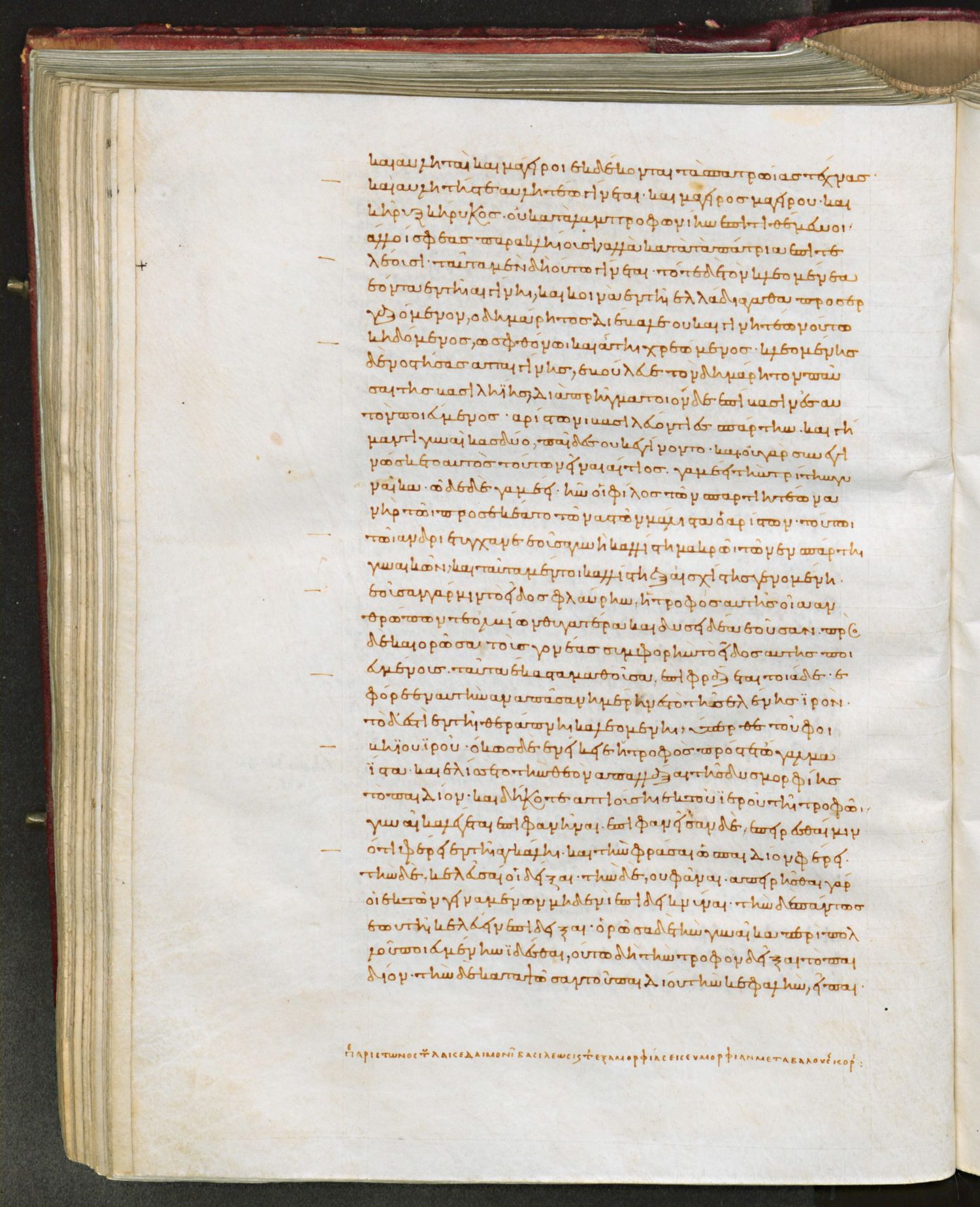
Laur. Plut. 70.3, fol. 246r: Greek here 6.57.5 to 6.60.1. Checked on the image (first and last words read and located in the Greek; each break checked against the neighbouring page): fol. 246r begins ‹τοὺς μάλιστά σφι τῶν› (6.57.5), ends ‹Λακεδαιμόνιοι· οἱ κήρυκες αὐτῶν› (6.60.1). English here: 6.58.1 to 6.59.1 (Godley's sentences for the sections whose Greek lies mostly on this page).
6.57.5τοὺς μάλιστά σφι τῶν γερόντων προσήκοντας ἔχειν τὰ τῶν βασιλέων γέρεα, δύο ψήφους τιθεμένους, τρίτην δὲ τὴν ἑωυτῶν. 6.58.1ταῦτα μὲν ζῶσι τοῖσι βασιλεῦσι δέδοται ἐκ τοῦ κοινοῦ τῶν Σπαρτιητέων, ἀποθανοῦσι δὲ τάδε. ἱππέες περιαγγέλλουσι τὸ γεγονὸς κατὰ πᾶσαν τὴν Λακωνικήν, κατὰ δὲ τὴν πόλιν γυναῖκες περιιοῦσαι λέβητα κροτέουσι. ἐπεὰν ὦν τοῦτο γίνηται τοιοῦτο, ἀνάγκη ἐξ οἰκίης ἑκάστης ἐλευθέρους δύο καταμιαίνεσθαι, ἄνδρα τε καὶ γυναῖκα· μὴ ποιήσασι δὲ τοῦτο ζημίαι μεγάλαι ἐπικέαται. 6.58.2νόμος δὲ τοῖσι Λακεδαιμονίοισι κατὰ τῶν βασιλέων τοὺς θανάτους ἐστὶ ὡυτὸς καὶ τοῖσι βαρβάροισι τοῖσι ἐν τῇ Ἀσίῃ· τῶν γὰρ ὦν βαρβάρων οἱ πλεῦνες τῷ αὐτῷ νόμῳ χρέωνται κατὰ τοὺς θανάτους τῶν βασιλέων. ἐπεὰν γὰρ ἀποθάνῃ βασιλεὺς Λακεδαιμονίων, ἐκ πάσης δεῖ Λακεδαίμονος, χωρὶς Σπαρτιητέων, ἀριθμῷ τῶν περιοίκων ἀναγκαστοὺς ἐς τὸ κῆδος ἰέναι. 6.58.3τούτων ὦν καὶ τῶν εἱλωτέων καὶ αὐτῶν Σπαρτιητέων ἐπεὰν συλλεχθέωσι ἐς τὠυτὸ πολλαὶ χιλιάδες σύμμιγα τῇσι γυναιξί, κόπτονταί τε τὰ μέτωπα προθύμως καὶ οἰμωγῇ διαχρέωνται ἀπλέτῳ, φάμενοι τὸν ὕστατον αἰεὶ ἀπογενόμενον τῶν βασιλέων, τοῦτον δὴ γενέσθαι ἄριστον. ὃς δʼ ἂν ἐν πολέμῳ τῶν βασιλέων ἀποθάνῃ, τούτῳ δὲ εἴδωλον σκευάσαντες ἐν κλίνῃ εὖ ἐστρωμένῃ ἐκφέρουσι. ἐπεὰν δὲ θάψωσι, ἀγορὴ δέκα ἡμερέων οὐκ ἵσταταί σφι οὐδʼ ἀρχαιρεσίη συνίζει, ἀλλὰ πενθέουσι ταύτας τὰς ἡμέρας. 6.59.1συμφέρονται δὲ ἄλλο οὗτοι τόδε τοῖσι Πέρσῃσι· ἐπεὰν ἀποθανόντος τοῦ βασιλέος ἄλλος ἐνίστηται βασιλεύς, οὗτος ὁ ἐσιὼν ἐλευθεροῖ ὅστις τι Σπαρτιητέων τῷ βασιλέι ἢ τῷ δημοσίῳ ὤφειλε· ἐν δʼ αὖ Πέρσῃσι ὁ κατιστάμενος βασιλεὺς τὸν προοφειλόμενον φόρον μετιεῖ τῇσι πόλισι πάσῃσι. 6.60.1συμφέρονται δὲ καὶ τάδε Αἰγυπτίοισι Λακεδαιμόνιοι· οἱ κήρυκες αὐτῶν
6.58.1These rights have the kings received from the Spartan commonwealth for their lifetime; when they die, their rights are as I shall now show. Horsemen proclaim their death in all parts of Laconia, and in the city women go about beating on a caldron. So when this is done, two free persons from each house, a man and a woman, must needs put on the signs of defilement, or incur heavy penalties if they fail so to do. 6.58.2The Lacedaemonians have the same custom at the deaths of their kings as have the foreign people of Asia; for the most of the foreigners use the same custom at their kings’ deaths. For when a king of the Lacedaemonians is dead, from all Lacedaemon, besides the Spartans, such and such a number of their subject neighbours must perforce come to the funeral. 6.58.6These then and the helots and the Spartans themselves being assembled in one place to the number of many thousands, together with the women, they zealously smite their foreheads and make long and loud lamentation, calling that king that is lateliest dead, whoever he be, the best of all their kings. Whenever a king is slain in war, they make an image of him and carry it out on a well-bedecked bier, and after burial, for ten days thereafter there is no meeting for market or assize, nor for choosing of magistrates, but these are days of mourning. 6.59.1Here is another matter wherein the Lacedaemonians are like to the Persians:—When one king is dead and another takes his office, this successor releases from debt what Spartan soever owed anything to the king or the commonwealth; so too among the Persians the king at the beginning of his reign forgives all cities their arrears of tribute.
Where on the image
Laur. Plut. 70.3, fol. 246v: Greek here 6.60.1. Checked on the image (first and last words read and located in the Greek; each break checked against the neighbouring page): fol. 246v begins ‹καὶ αὐληταὶ καὶ μάγειροι› (6.60.1), ends ‹παιδίου τὴν κεφαλὴν εἶπαι› (6.61.5). English here: 6.60.1 (Godley's sentences for the sections whose Greek lies mostly on this page).
6.60.1καὶ αὐληταὶ καὶ μάγειροι ἐκδέκονται τὰς πατρωίας τέχνας, καὶ αὐλητής τε αὐλητέω γίνεται καὶ μάγειρος μαγείρου καὶ κῆρυξ κήρυκος· οὐ κατὰ λαμπροφωνίην ἐπιτιθέμενοι ἄλλοι σφέας παρακληίουσι, ἀλλὰ κατὰ τὰ πάτρια ἐπιτελέουσι.
6.60.1Moreover the Lacedaemonians are like the Egyptians, in that their heralds and flute-players and cooks inherit the craft from their fathers, a flute-player’s son being a flute-player, and a cook’s son a cook, and a herald’s son a herald; no others usurp their places, making themselves heralds by loudness of voice; they ply their craft by right of birth.
Notes
- Greek: the text printed in A. D. Godley's Loeb edition, via Perseus (tlg0016.tlg001.perseus-grc2). Square brackets mark words the editor considers later additions; [...] marks a gap the editor indicates. Perseus note markers are omitted.
- English: A. D. Godley, Herodotus vol. 3 (1922) (Loeb Classical Library), as transcribed on Wikisource. Godley's footnotes are omitted.
- Section numbers in the English were placed by comparing Godley's text with the Perseus version of his translation; where a section begins inside one of Godley's sentences, the English is kept with the page that holds the start of that sentence.
Cite
Sources
- Source: Florence, Laur. Plut. 70.3 (10th c.) via BML Teca Digitale + Greek of Godley's Loeb (Perseus) + English of A. D. Godley (Loeb, Wikisource) (holding institution)
- Critical edition: Greek of A. D. Godley's Loeb edition (1920-1925), via Perseus
← previous · → next · v cycle view · l back to library