Herodotus, Histories 6.73-84: Cleomenes at Aegina and Argos; his madness and death
Introduction
Herodotus of Halicarnassus wrote the Histories in the third quarter of the 5th century BCE, an inquiry into the deeds of Greeks and barbarians and the causes of the wars between them, later divided into nine books. Book 6 tells of the end of the Ionian revolt at Lade and Miletus, the first Persian expeditions against Greece under Mardonius and under Datis and Artaphrenes, the quarrels of Sparta, Athens and Aegina, and the battle of Marathon.
The photographs are of Florence, Biblioteca Medicea Laurenziana, Plut. 70.3 (parchment, 10th century, 374 folios, 31 lines a page), Herodotus, Histories (codex A of the editors), the oldest surviving manuscript of the complete Histories, from the Teca Digitale of the Biblioteca Medicea Laurenziana. Each section below is the text of one page, or of the part of a page that falls within these chapters. The first and last words of every page were read on the photograph and located in the Greek, and every page break was checked against the next page; the notes quote these words. Readers' notes in the margins are not part of the text and are mentioned where they occur.
The Greek is the text printed in A. D. Godley's Loeb edition (1920-1925), from Perseus; it is the edited text, not a transcription of the manuscript, whose wording differs in places. The English is Godley's translation as printed, from Wikisource. Godley's English carries only chapter numbers; the section numbers shown in it were placed by comparison with the Perseus version of his translation. Each page's English is cut at the end of one of Godley's sentences, so it can begin or end a few lines away from the Greek of the page; each note gives the exact ranges.
This entry covers chapters 6.73-84, on fol. 249r to 251v.
How was this verified? (Provenance)
Where on the image
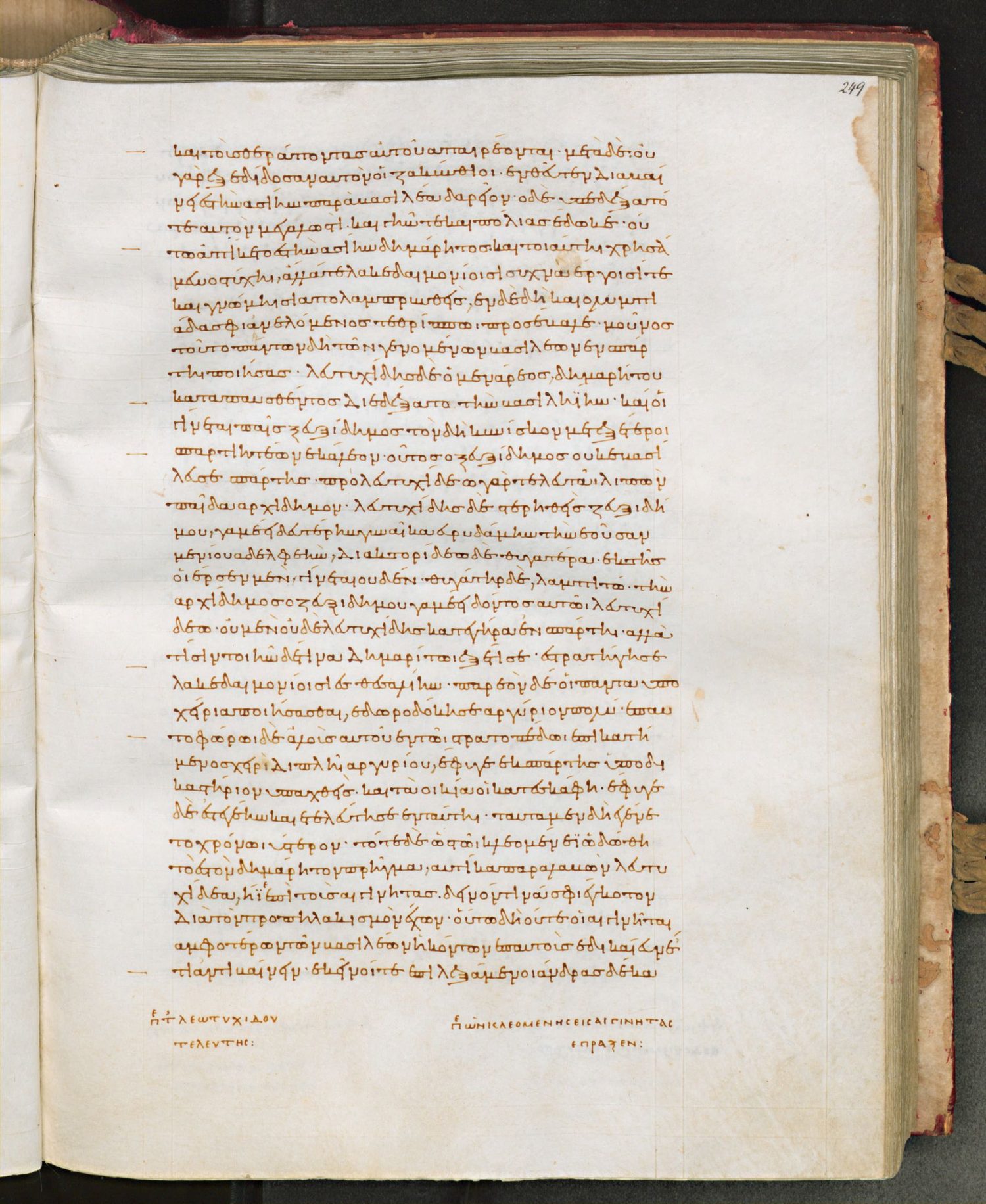
Laur. Plut. 70.3, fol. 249r: Greek here 6.73.1 to 6.73.2. Checked on the image (first and last words read and located in the Greek; each break checked against the neighbouring page): fol. 249r begins ‹καὶ τοὺς θεράποντας αὐτοῦ› (6.70.2), ends ‹τε ἐπιλεξάμενοι ἄνδρας δέκα› (6.73.2). English here: 6.73.1 (Godley's sentences for the sections whose Greek lies mostly on this page).
6.73.1ταῦτα μὲν δὴ ἐγένετο χρόνῳ ὕστερον· τότε δὲ ὡς τῷ Κλεομένεϊ ὡδώθη τὸ ἐς τὸν Δημάρητον πρῆγμα, αὐτίκα παραλαβὼν Λευτυχίδεα ἤιε ἐπὶ τοὺς Αἰγινήτας, δεινόν τινά σφι ἔγκοτον διὰ τὸν προπηλακισμὸν ἔχων. 6.73.2οὕτω δὴ οὔτε οἱ Αἰγινῆται, ἀμφοτέρων τῶν βασιλέων ἡκόντων ἐπʼ αὐτούς, ἐδικαίευν ἔτι ἀντιβαίνειν, ἐκεῖνοί τε ἐπιλεξάμενοι ἄνδρας δέκα
6.73.1This befel long afterwards; but at the time of my story, Cleomenes, his dealing in the matter of Demaratus being so sped, forthwith took Leutychides with him and went to punish the Aeginetans, against whom he was terribly wroth by reason of their despiteful usage of him.
Where on the image
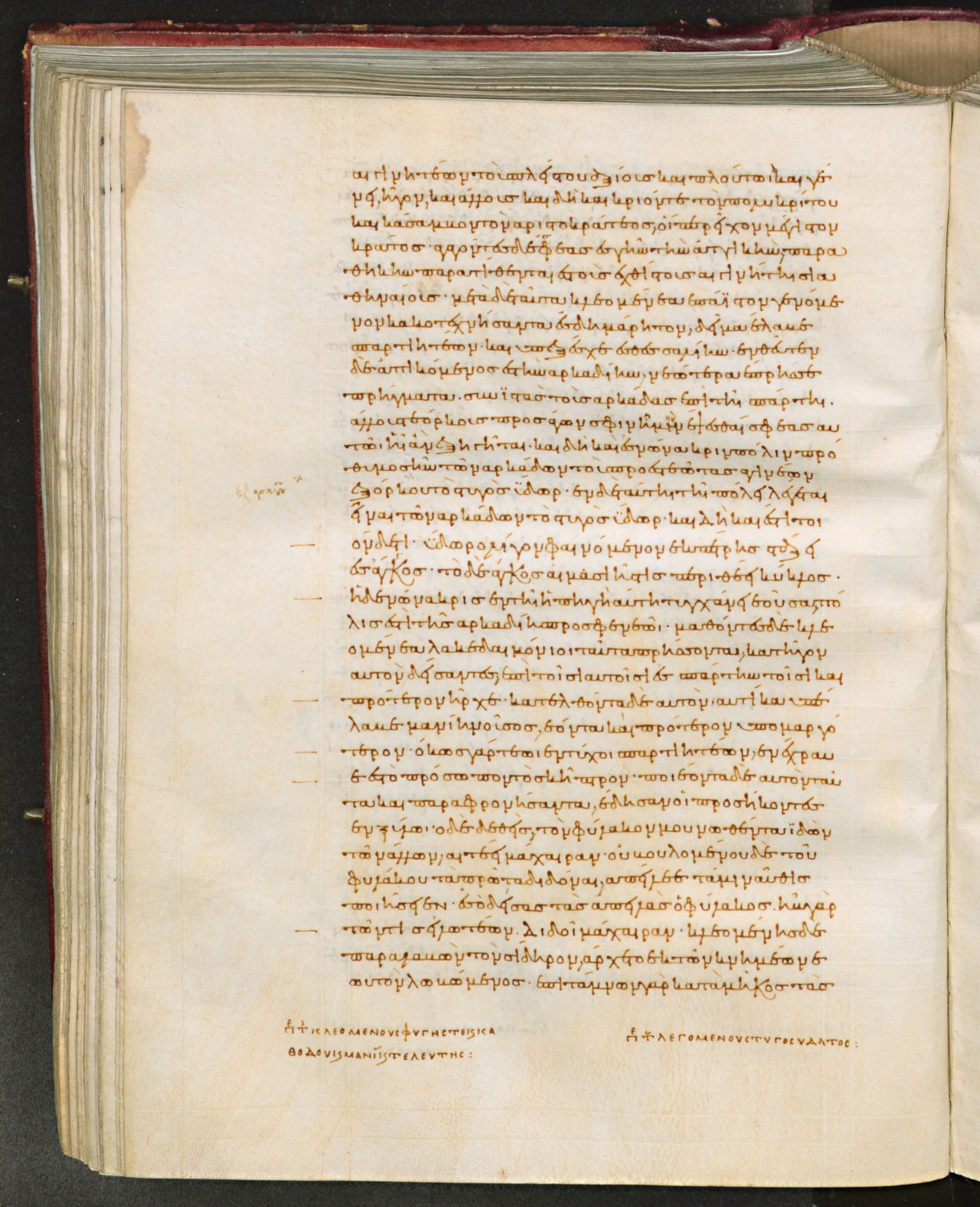
Laur. Plut. 70.3, fol. 249v: Greek here 6.73.2 to 6.75.3. Checked on the image (first and last words read and located in the Greek; each break checked against the neighbouring page): fol. 249v begins ‹Αἰγινητέων τοὺς πλείστου ἀξίους› (6.73.2), ends ‹γὰρ κατὰ μῆκος τὰς› (6.75.3). English here: 6.73.2 to 6.75.2 (Godley's sentences for the sections whose Greek lies mostly on this page).
6.73.2Αἰγινητέων τοὺς πλείστου ἀξίους καὶ πλούτῳ καὶ γένει· ἦγον καὶ ἄλλους καὶ δὴ καὶ Κριόν τε τὸν Πολυκρίτου καὶ Κάσαυβον τὸν Ἀριστοκράτεος, οἵ περ εἶχον μέγιστον κράτος· ἀγαγόντες δὲ σφέας ἐς γῆν τὴν Ἀττικὴν παραθήκην παρατίθενται ἐς τοὺς ἐχθίστους Αἰγινήτῃσι Ἀθηναίους. 6.74.1μετὰ δὲ ταῦτα Κλεομένεα ἐπάιστον γενόμενον κακοτεχνήσαντα ἐς Δημάρητον δεῖμα ἔλαβε Σπαρτιητέων, καὶ ὑπεξέσχε ἐς Θεσσαλίην. ἐνθεῦτεν δὲ ἀπικόμενος ἐς τὴν Ἀρκαδίην νεώτερα ἔπρησσε πρήγματα, συνιστὰς τοὺς Ἀρκάδας ἐπὶ τῆ Σπάρτῃ, ἄλλους τε ὅρκους προσάγων σφι ἦ μὲν ἕψεσθαι σφέας αὐτῷ τῇ ἂν ἐξηγέηται, καὶ δὴ καὶ ἐς Νώνακριν πόλιν πρόθυμος ἦν τῶν Ἀρκάδων τοὺς προεστεῶτας ἀγινέων ἐξορκοῦν τὸ Στυγὸς ὕδωρ. 6.74.2ἐν δὲ ταύτῃ τῇ πόλι λέγεται εἶναι ὑπὸ τῶν Ἀρκάδων τὸ Στυγὸς ὕδωρ, καὶ δὴ καὶ ἔστι τοιόνδε τι· ὕδωρ ὀλίγον φαινόμενον ἐκ πέτρης στάζει ἐς ἄγκος, τὸ δὲ ἄγκος αἱμασιῆς τις περιθέει κύκλος. ἡ δὲ Νώνακρις, ἐν τῇ ἡ πηγὴ αὕτη τυγχάνει ἐοῦσα, πόλις ἐστὶ τῆς Ἀρκαδίης πρὸς Φενεῷ. 6.75.1μαθόντες δὲ Κλεομένεα Λακεδαιμόνιοι ταῦτα πρήσσοντα, κατῆγον αὐτὸν δείσαντες ἐπὶ τοῖσι αὐτοῖσι ἐς Σπάρτην τοῖσι καὶ πρότερον ἦρχε. κατελθόντα δὲ αὐτὸν αὐτίκα ὑπέλαβε μανίη νοῦσος, ἐόντα καὶ πρότερον ὑπομαργότερον· ὅκως γὰρ τεῷ ἐντύχοι Σπαρτιητέων, ἐνέχραυε ἐς τὸ πρόσωπον τὸ σκῆπτρον. 6.75.2ποιέοντα δὲ αὐτὸν ταῦτα καὶ παραφρονήσαντα ἔδησαν οἱ προσήκοντες ἐν ξύλω· ὁ δὲ δεθεὶς τὸν φύλακον μουνωθέντα ἰδὼν τῶν ἄλλων αἰτέει μάχαιραν· οὐ βουλομένου δὲ τὰ πρῶτα τοῦ φυλάκου διδόναι ἀπείλεε τά μιν αὖτις ποιήσει, ἐς ὁ δείσας τὰς ἀπειλὰς ὁ φύλακος (ἦν γὰρ τῶν τις εἱλωτέων) διδοῖ οἱ μάχαιραν. 6.75.3Κλεομένης δὲ παραλαβὼν τὸν σίδηρον ἄρχετο ἐκ τῶν κνημέων ἑωυτὸν λωβώμενος· ἐπιτάμνων γὰρ κατὰ μῆκος τὰς
6.73.2When the Aeginetans saw that both the kings were come after them, they now deemed it best to offer no further resistance; and the kings chose out ten men of Aegina who were most honoured for wealth and lineage, among them Crius son of Polycritus and Casambus son of Aristocrates, the two most powerful men in Aegina; these they carried to Attica and gave them into the keeping of the Athenians, the bitterest foes of the Aeginetans. 6.74.1After this, Cleomenes’ treacherous plot against Demaratus became known; and he was seized with fear of the Spartans and slunk away into Thessaly. Coming thence into Arcadia he wrought disorder in that country; for he strove to unite the Arcadians against Sparta; besides his other ways of binding them by oath to follow him to whatsoever enterprise he led them, he was fain to bring the chief men in Arcadia to the town of Nonacris and make them to swear by the water of Styx. 6.74.2Near this town is said to be the Arcadian water of Styx, and this is its nature: it is a stream, small to behold, that flows from a cliff into a pool; a wall of stones runs round the pool. Nonacris, where this spring rises, is a town of Arcadia nigh to Pheneus. 6.75.1When the Lacedaemonians learnt that such was Cleomenes’ intent, they took fright, and brought him back to Sparta, there to be king as he had heretofore been. But Cleomenes had ere now been not wholly in his right mind, and now he fell sick of a madness; for any Spartan that he met he would smite in the face with his staff. 6.75.2For so doing, and for the frenzy that was on him, his nearest of kin made him fast in the stocks. But he saw in his bonds that his guard was left alone and none by, and he asked him for a dagger; the guard at first would not give it, but Cleomenes threatening what he would do to him thereafter, the guard, who was a helot, was affrighted by the threats and gave him the dagger.
Where on the image
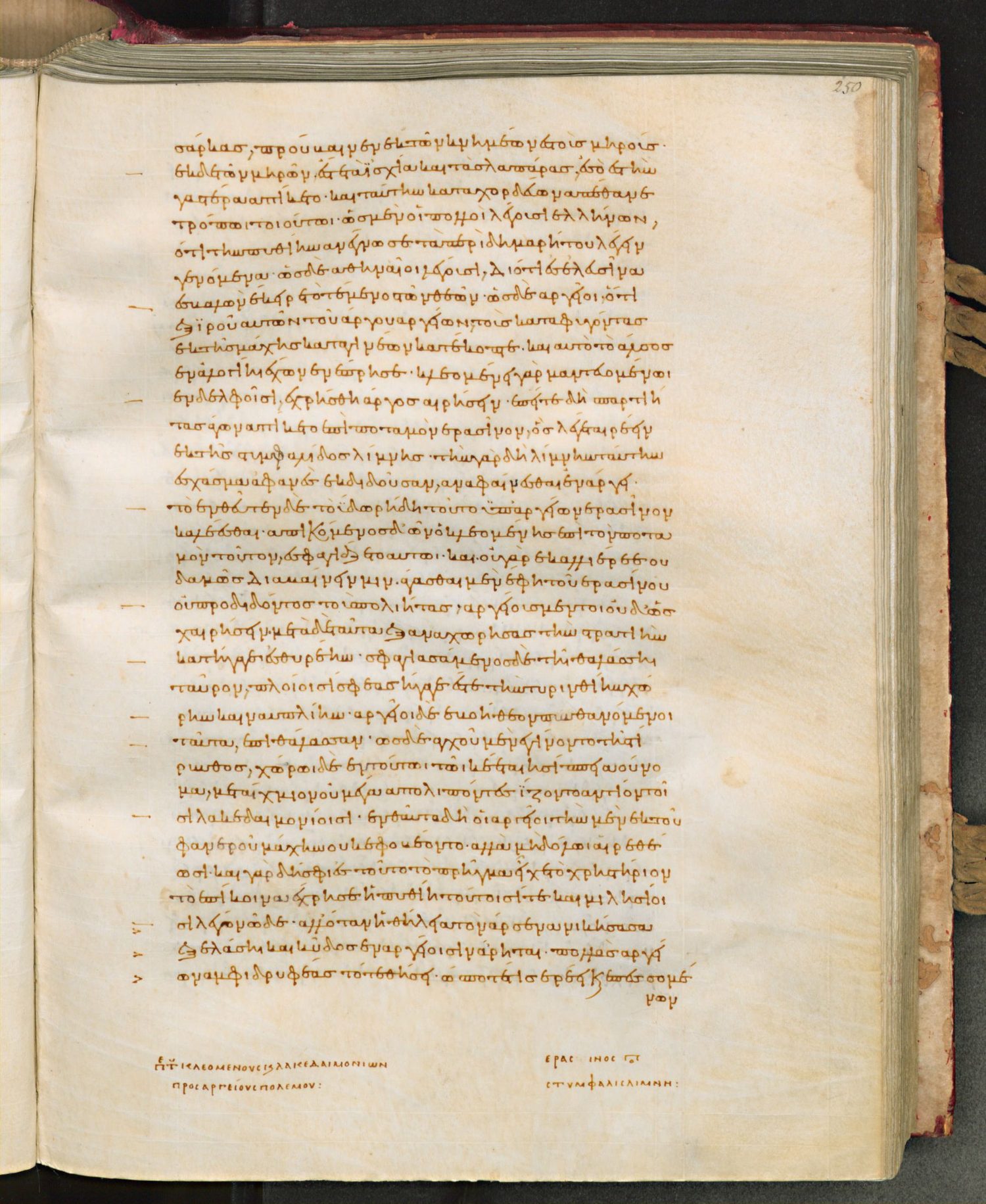
Laur. Plut. 70.3, fol. 250r: Greek here 6.75.3 to 6.77.2. Checked on the image (first and last words read and located in the Greek; each break checked against the neighbouring page): fol. 250r begins ‹σάρκας προέβαινε ἐκ τῶν› (6.75.3), ends ‹τις ἐρέει καὶ ἐπεσσομένων› (6.77.2). The end of the last word (ἐπεσσομένων) is written below the last line. English here: 6.75.3 to 6.77.2 (Godley's sentences for the sections whose Greek lies mostly on this page).
6.75.3σάρκας προέβαινε ἐκ τῶν κνημέων ἐς τοὺς μηρούς, ἐκ δὲ τῶν μηρῶν ἔς τε τὰ ἰσχία καὶ τὰς λαπάρας, ἐς ὃ ἐς τὴν γαστέρα ἀπίκετο, καὶ ταύτην καταχορδεύων ἀπέθανε τρόπῳ τοιούτῳ, ὡς μὲν οἱ πολλοὶ λέγουσι Ἐλλήνων, ὅτι τὴν Πυθίην ἀνέγνωσε τὰ περὶ Δημαρήτου λέγειν γενόμενα, ὡς δὲ Ἀθηναῖοι μοῦνοι λέγουσι, διότι ἐς Ἐλευσῖνα ἐσβαλὼν ἔκειρε τὸ τέμενος τῶν θεῶν, ὡς δὲ Ἀργεῖοι, ὅτι ἐξ ἱροῦ αὐτῶν τοῦ Ἄργου Ἀργείων τοὺς καταφυγόντας ἐκ τῆς μάχης καταγινέων κατέκοπτε καὶ αὐτὸ τὸ ἄλσος ἐν ἀλογίῃ ἔχων ἐνέπρησε. 6.76.1Κλεομένεϊ γὰρ μαντευομένῳ ἐν Δελφοῖσι ἐχρήσθη Ἄργος αἱρήσειν· ἐπείτε δὲ Σπαρτιήτας ἄγων ἀπίκετο ἐπὶ ποταμὸν Ἐρασῖνον, ὃς λέγεται ῥέειν ἐκ τῆς Στυμφαλίδος λίμνης· τὴν γὰρ δὴ λίμνην ταύτην ἐς χάσμα ἀφανὲς ἐκδιδοῦσαν ἀναφαίνεσθαι ἐν Ἄργεϊ, τὸ ἐνθεῦτεν δὲ τὸ ὕδωρ ἤδη τοῦτο ὑπʼ Ἀργείων Ἐρασῖνον καλέεσθαι· ἀπικόμενος δʼ ὦν ὁ Κλεομένης ἐπὶ τὸν ποταμὸν τοῦτον ἐσφαγιάζετο αὐτῷ· 6.76.2καὶ οὐ γὰρ ἐκαλλιέρεε οὐδαμῶς διαβαίνειν μιν, ἄγασθαι μὲν ἔφη τοῦ Ἐρασίνου οὐ προδιδόντος τοὺς πολιήτας, Ἀργείους μέντοι οὐδʼ ὣς χαιρήσειν. μετὰ δὲ ταῦτα ἐξαναχωρήσας τὴν στρατιὴν κατήγαγε ἐς Θυρέην, σφαγιασάμενος δὲ τῇ θαλάσσῃ ταῦρον πλοίοισι σφέας ἤγαγε ἔς τε τὴν Τιρυνθίην χώρην καὶ Ναυπλίην. 6.77.1Ἀργεῖοι δὲ ἐβοήθεον πυνθανόμενοι ταῦτα ἐπὶ θάλασσαν· ὡς δὲ ἀγχοῦ μὲν ἐγίνοντο τῆς Τίρυνθος, χώρῳ δὲ ἐν τούτῳ τῷ κεῖται Ἡσίπεια οὔνομα, μεταίχμιον οὐ μέγα ἀπολιπόντες ἵζοντο ἀντίοι τοῖσι Λακεδαιμονίοισι. ἐνθαῦτα δὴ οἱ Ἀργεῖοι τὴν μὲν ἐκ τοῦ φανεροῦ μάχην οὐκ ἐφοβέοντο, ἀλλὰ μὴ δόλῳ αἱρεθέωσι· 6.77.2καὶ γὰρ δή σφι ἐς τοῦτο τὸ πρῆγμα εἶχε τὸ χρηστήριον τὸ ἐπίκοινα ἔχρησε ἡ Πυθίη τούτοισί τε καὶ Μιλησίοισι, λέγον ὧδε.
ἀλλʼ ὅταν ἡ θήλεια τὸν ἄρσενα νικήσασα
ἐξελάσῃ καὶ κῦδος ἐν Ἀργείοισιν ἄρηται,
πολλὰς Ἀργείων ἀμφιδρυφέας τότε θήσει.
ὧς ποτέ τις ἐρέει καὶ ἐπεσσομένων
6.75.3Then Cleomenes took the weapon and set about gashing himself from his shins upwards; from the shin to the thigh he cut his flesh lengthways, and from the thigh to the hip and the flank, till he reached the belly, and cut it into strips; thus he died, as the most of the Greeks say, because he over-persuaded the Pythian priestess to tell the tale of Demaratus; as the Athenians say (but none other) because he invaded Eleusis and laid waste the precinct of the gods; and as the Argives say, because when Argives had taken refuge after the battle in their temple of Argus he brought them out thence and cut them down, and held the sacred grove itself in no regard but burnt it. 6.76.1For when Cleomenes was seeking a divination at Delphi, an oracle was given him that he should take Argos. When he came with Spartans to the river Erasinus, which is said to flow from the Stymphalian lake (for this lake, they say, issues into a cleft out of sight and reappears at Argos, and from that place onwards the stream is called by the Argives Erasinus),—when Cleomenes came to this river he sacrificed victims to it; and being in nowise able to get 6.76.2favourable omens for his crossing, he said that he honoured the Erasinus for keeping true to its countrymen, but that even so the Argives should not go unscathed. Presently he withdrew thence and led his army seaward to Thyrea, where he sacrificed a bull to the sea and carried his men on shipboard to the region of Tiryns, and Nauplia. 6.77.1Hearing of this, the Argives came to the coast to do battle with him; and when they had come near Tiryns and were at the place called Hesipaea, they encamped over against the Lacedaemonians, leaving but a little space between the armies. There the Argives had no fear of fair fighting, but rather of being worsted by guile; for 6.77.2it was that which was signified by the oracle which the Pythian priestess gave to the Argives and Milesians in common, which ran thus: Woe for the day when a woman shall vanquish a man in the battle, Driving him far from the field and winning her glory in Argos: Many an Argive dame her cheeks shall be rending in sorrow. Yea, and in distant days this word shall be spoken of mortals: “There lay slain by the spear that thrice-twined terrible serpent.”
Where on the image
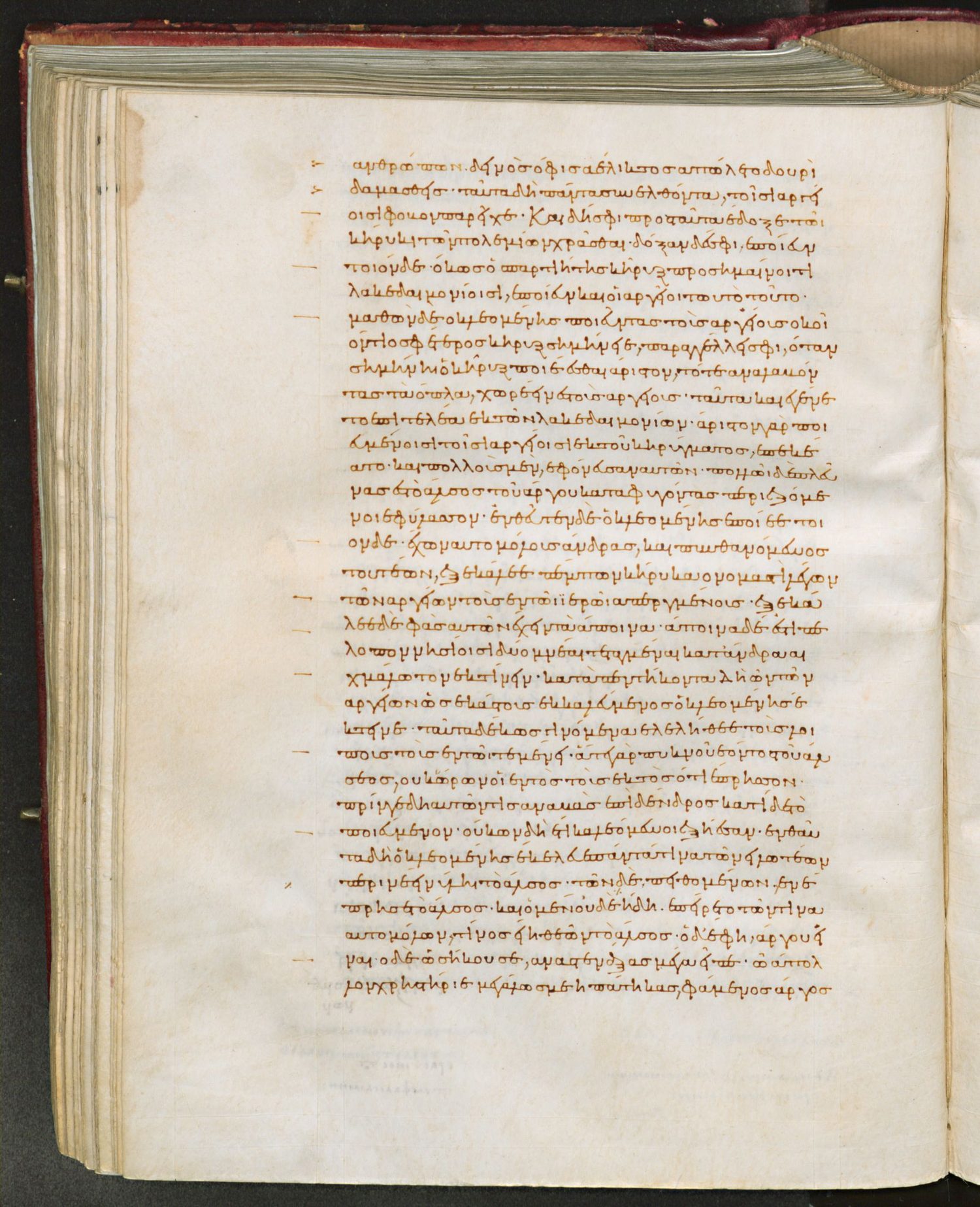
Laur. Plut. 70.3, fol. 250v: Greek here 6.77.2 to 6.80.1. Checked on the image (first and last words read and located in the Greek; each break checked against the neighbouring page): fol. 250v begins ‹ἀνθρώπων δεινὸς ὄφις τριέλικτος› (6.77.2), ends ‹με ἠπάτηκας φάμενος Ἄργος› (6.80.1). English here: 6.77.3 to 6.80.1 (Godley's sentences for the sections whose Greek lies mostly on this page).
6.77.2ἀνθρώπων
δεινὸς ὄφις τριέλικτος ἀπώλετο δουρὶ δαμασθείς. 6.77.3ταῦτα δὴ πάντα συνελθόντα τοῖσι Ἀργείοισι φόβον παρεῖχε. καὶ δή σφι πρὸς ταῦτα ἔδοξε τῷ κήρυκι τῶν πολεμίων χρᾶσθαι, δόξαν δέ σφι ἐποίεον τοιόνδε· ὅκως ὁ Σπαρτιήτης κῆρυξ προσημαίνοι τι Λακεδαιμονίοισι, ἐποίευν καὶ οἱ Ἀργεῖοι τὠυτὸ τοῦτο. 6.78.1μαθὼν δὲ ὁ Κλεομένης ποιεῦντας τοὺς Ἀργείους ὁκοῖόν τι ὁ σφέτερος κῆρυξ σημήνειε, παραγγέλλει σφι, ὅταν σημήνῃ ὁ κῆρυξ ποιέεσθαι ἄριστον, τότε ἀναλαβόντας τὰ ὅπλα χωρέειν ἐς τοὺς Ἀργείους. 6.78.2ταῦτα καὶ ἐγένετο ἐπιτελέα ἐκ τῶν Λακεδαιμονίων· ἄριστον γὰρ ποιευμένοισι τοῖσι Ἀργείοισι ἐκ τοῦ κηρύγματος ἐπεκέατο, καὶ πολλοὺς μὲν ἐφόνευσαν αὐτῶν, πολλῷ δέ τι πλεῦνας ἐς τὸ ἄλσος τοῦ Ἄργου καταφυγόντας περιιζόμενοι ἐφύλασσον. 6.79.1ἐνθεῦτεν δὲ ὁ Κλεομένης ἐποίεε τοιόνδε. ἔχων αὐτομόλους ἄνδρας καὶ πυνθανόμενος τούτων, ἐξεκάλεε πέμπων κήρυκα ὀνομαστὶ λέγων τῶν Ἀργείων τοὺς ἐν τῷ ἱρῷ ἀπεργμένους, ἐξεκάλεε δὲ φὰς αὐτῶν ἔχειν τὰ ἄποινα. ἄποινα δὲ ἐστὶ Πελοποννησίοισι δύο μνέαι τεταγμέναι κατʼ ἄνδρα αἰχμάλωτον ἐκτίνειν. κατὰ πεντήκοντα δὴ ὦν τῶν Ἀργείων ὡς ἑκάστους ἐκκαλεύμενος ὁ Κλεομένης ἔκτεινε. 6.79.2ταῦτα δέ κως γινόμενα ἐλελήθεε τοὺς λοιποὺς τοὺς ἐν τῷ τεμένεϊ· ἅτε γὰρ πυκνοῦ ἐόντος τοῦ ἄλσεος, οὐκ ὥρων οἱ ἐντὸς τοὺς ἐκτὸς ὅ τι ἔπρησσον, πρίν γε δὴ αὐτῶν τις ἀναβὰς ἐπὶ δένδρον κατεῖδε τὸ ποιεύμενον. οὔκων δὴ ἔτι καλεόμενοι ἐξήισαν. 6.80.1ἐνθαῦτα δὴ ὁ Κλεομένης ἐκέλευε πάντα τινὰ τῶν εἱλωτέων περινέειν ὕλῃ τὸ ἄλσος, τῶν δὲ πειθομένων ἐνέπρησε τὸ ἄλσος. καιομένου δὲ ἤδη ἐπείρετο τῶν τινα αὐτομόλων τίνος εἴη θεῶν τὸ ἄλσος· ὁ δὲ ἔφη Ἄργου εἶναι. ὁ δὲ ὡς ἤκουσε, ἀναστενάξας μέγα εἶπε ὦ Ἄπολλον χρηστήριε, ἦ μεγάλως με ἠπάτηκας φάμενος Ἄργος
6.77.3All these things meeting together spread fear among the Argives. Therefore they resolved to defend themselves by making the enemies’ herald serve them, and, being so resolved, whenever the Spartan herald cried any command to the Lacedaemonians they, too, did the very thing that he bade. 6.78.1When Cleomenes saw that the Argives did whatever was bidden by his herald, he gave command that when the herald cried the signal for the men to breakfast, they should then put on their armour and attack the Argives. 6.78.2The Lacedaemonians performed this bidding: for when they assaulted the Argives they caught them breakfasting in obedience to the herald’s signal; many of them they slew, and more by far of the Argives fled for refuge into the grove of Argus, where the Lacedaemonians encamped round and closely watched them. 6.79.1Then Cleomenes’ plan was this: he had with him certain deserters, from whom he made due enquiry, and then sent a herald calling the names of the Argives that were shut up in the sacred precinct and inviting them to come out; saying therewith, that he had their ransom. Now among the Peloponnesians there is a fixed ransom to be paid for every prisoner, two minae for each. So Cleomenes invited about fifty Argives to come out, one after another, and slew them. 6.79.2It happened that this slaying was unknown to the rest that were in the temple precinct; for the grove being thick, they that were within could not see how it fared with them that were without, till one of them climbed a tree and saw what was being done. Thereafter they would not come out at the herald’s call. 6.80.1On that Cleomenes bade all the helots pile wood about the grove; they obeyed, and he burnt the grove. When the fire was now burning, he asked of one of the deserters, to what god the grove was sacred; “to Argus,” said the man; when he heard that he cried loudly and lamentably: “Apollo, thou god of oracles, sorely hast thou deceived me with thy word that I should take Argos; this, I guess, is the fulfilment of that prophecy.”
Where on the image
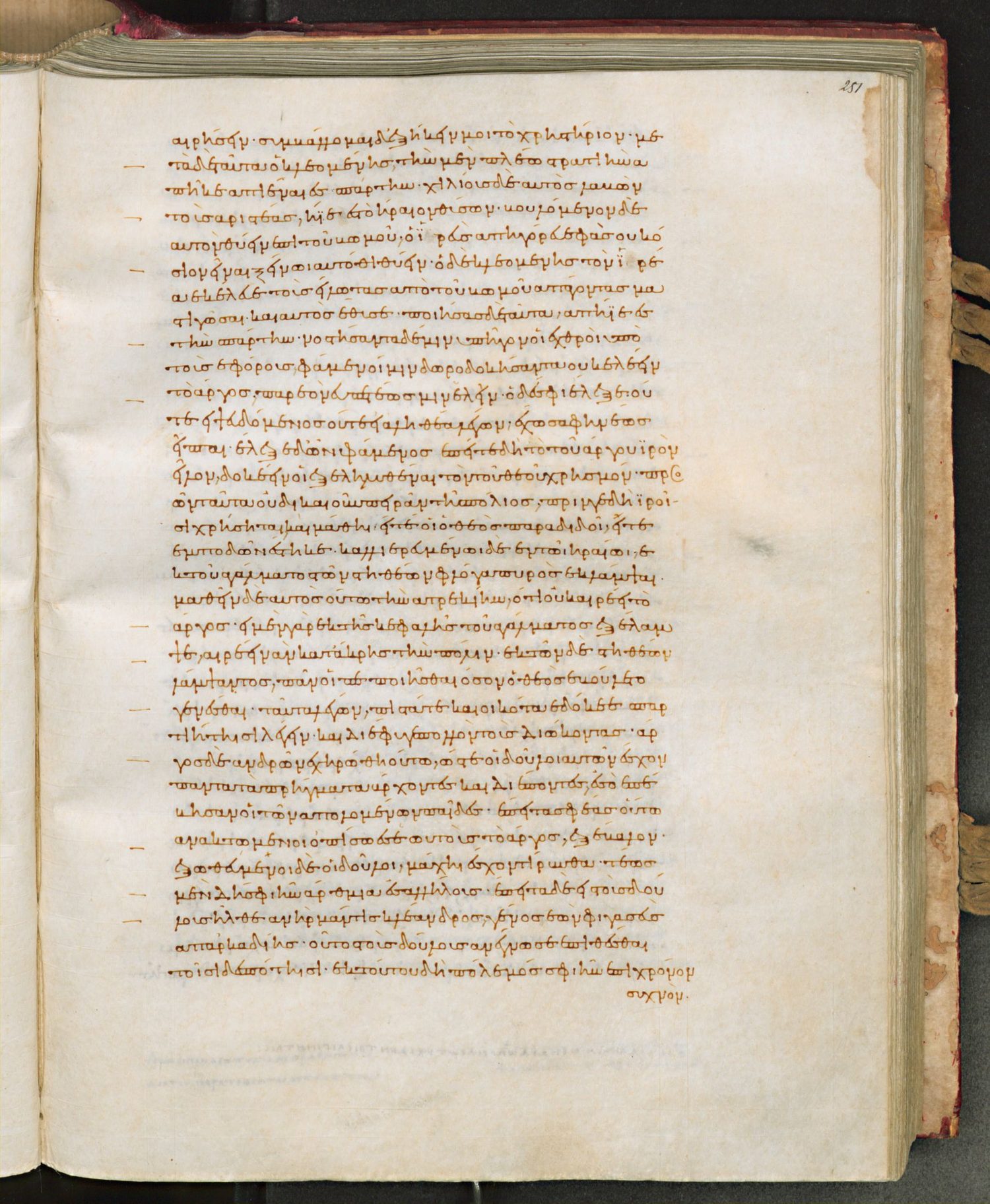
Laur. Plut. 70.3, fol. 251r: Greek here 6.80.1 to 6.83.2. Checked on the image (first and last words read and located in the Greek; each break checked against the neighbouring page): fol. 251r begins ‹αἱρήσειν· συμβάλλομαι δʼ ἐξήκειν› (6.80.1), ends ‹ἦν ἐπὶ χρόνον συχνόν› (6.83.2). The last word (συχνόν) is written below the end of the last line. English here: 6.81.1 to 6.83.2 (Godley's sentences for the sections whose Greek lies mostly on this page).
6.80.1αἱρήσειν· συμβάλλομαι δʼ ἐξήκειν μοι τὸ χρηστήριον. 6.81.1μετὰ δὲ ταῦτα ὁ Κλεομένης τὴν μὲν πλέω στρατιὴν ἀπῆκε ἀπιέναι ἐς Σπάρτην, χιλίους δὲ αὐτὸς λαβὼν τοὺς ἀριστέας ἤιε ἐς τὸ Ἥραιον θύσων· βουλόμενον δὲ αὐτὸν θύειν ἐπὶ τοῦ βωμοῦ ὁ ἱρεὺς ἀπηγόρευε, φὰς οὐκ ὅσιον εἶναι ξείνῳ αὐτόθι θύειν. ὁ δὲ Κλεομένης τὸν ἱρέα ἐκέλευε τοὺς εἵλωτας ἀπὸ τοῦ βωμοῦ ἀπάγοντας μαστιγῶσαι, καὶ αὐτὸς ἔθυσε· ποιήσας δὲ ταῦτα ἀπήιε ἐς τὴν Σπάρτην. 6.82.1νοστήσαντα δέ μιν ὑπῆγον οἱ ἐχθροὶ ὑπὸ τοὺς ἐφόρους, φάμενοί μιν δωροδοκήσαντα οὐκ ἑλεῖν τὸ Ἄργος, παρεὸν εὐπετέως μιν ἑλεῖν. ὁ δέ σφι ἔλεξε, οὔτε εἰ ψευδόμενος οὔτε εἰ ἀληθέα λέγων, ἔχω σαφηνέως εἶπαι, ἔλεξε δʼ ὦν φάμενος, ἐπείτε δὴ τὸ τοῦ Ἄργου ἱρὸν εἷλον, δοκέειν οἱ ἐξεληλυθέναι τὸν τοῦ θεοῦ χρησμόν· πρὸς ὦν ταῦτα οὐ δικαιοῦν πειρᾶν τῆς πόλιος, πρίν γε δὴ ἱροῖσι χρήσηται καὶ μάθῃ εἴτε οἱ ὁ θεὸς παραδιδοῖ εἴτε ἐμποδὼν ἕστηκε· 6.82.2καλλιερευμένῳ δὲ ἐν τῷ Ἡραίῳ ἐκ τοῦ ἀγάλματος τῶν στηθέων φλόγα πυρὸς ἐκλάμψαι, μαθεῖν δὲ αὐτὸς οὕτω τὴν ἀτρεκείην, ὅτι οὐκ αἱρέει τὸ Ἄργος· εἰ μὲν γὰρ ἐκ τῆς κεφαλῆς τοῦ ἀγάλματος ἐξέλαμψε, αἱρέειν ἂν κατʼ ἄκρης τὴν πόλιν, ἐκ τῶν στηθέων δὲ λάμψαντος πᾶν οἱ πεποιῆσθαι ὅσον ὁ θεὸς ἐβούλετο γενέσθαι. ταῦτα λέγων πιστά τε καὶ οἰκότα ἐδόκεε Σπαρτιήτῃσι λέγειν, καὶ διέφυγε πολλὸν τοὺς διώκοντας. 6.83.1Ἄργος δὲ ἀνδρῶν ἐχηρώθη οὕτω ὥστε οἱ δοῦλοι αὐτῶν ἔσχον πάντα τὰ πρήγματα ἄρχοντές τε καὶ διέποντες, ἐς ὃ ἐπήβησαν οἱ τῶν ἀπολομένων παῖδες· ἔπειτα σφέας οὗτοι ἀνακτώμενοι ὀπίσω ἐς ἑωυτοὺς τὸ Ἄργος ἐξέβαλον· ἐξωθεύμενοι δὲ οἱ δοῦλοι μάχῃ ἔσχον Τίρυνθα. 6.83.2τέως μὲν δή σφι ἦν ἄρθμια ἐς ἀλλήλους, ἔπειτα δὲ ἐς τοὺς δούλους ἦλθε ἀνὴρ μάντις Κλέανδρος, γένος ἐὼν Φιγαλεὺς ἀπʼ Ἀρκαδίης· οὗτος τοὺς δούλους ἀνέγνωσε ἐπιθέσθαι τοῖσι δεσπότῃσι. ἐκ τούτου δὴ πόλεμός σφι ἦν ἐπὶ χρόνον συχνόν,
6.81.1Presently Cleomenes sent the more part of his army back to Sparta; he himself took with him a thousand that were his best warriors, and went to the temple of Here, there to sacrifice. But when he would have sacrificed on the altar the priest forbade him, saying that no stranger might lawfully sacrifice there. Thereupon Cleomenes bade the helots bring the priest away from the altar and scourge him, and he himself offered sacrifice; which done, he returned to Sparta. 6.82.1But after his returning his enemies brought him before the ephors, saying that it was for a bribe that he had not taken Argos, when he might have taken it easily. But Cleomenes alleged (whether falsely or truly, I cannot rightly say; but this he alleged in his speech) that he had supposed the god’s oracle to be fulfilled by his taking of the temple of Argus; wherefore, he had thought it best not to make any assay on the city before he should have enquired by sacrifice and learnt whether the god would deliver it to him or withstand him; and 6.82.2while he took omens in Here’s temple a flame of fire had shone forth from the breast of the image, whereby he had learnt the truth of the matter, that Argos was not for his taking. For (said he) had the flame come out of the head of the image, he would have taken the city from head to foot utterly; but its coming from the breast signified that he had done as much as it was the god’s will should happen. This plea of his seemed to the Spartans to be credible and reasonable, and he far outdistanced the pursuit of his accusers. 6.83.1But Argos was so wholly widowed of her men, that their slaves took all in possession, and ruled and governed, till the sons of them that were slain came to man’s estate. Then these recovered Argos for themselves and cast out the slaves, who, being thrust out, took possession of Tiryns by force. 6.83.2For a while they were at peace with each other; but presently there came to the slaves one Cleander, a prophet, a man of Phigalea in Arcadia by birth; he persuaded the slaves to attack their masters. From this out for a long time there was war between them, till at last with much ado the Argives got the upper hand.
Where on the image
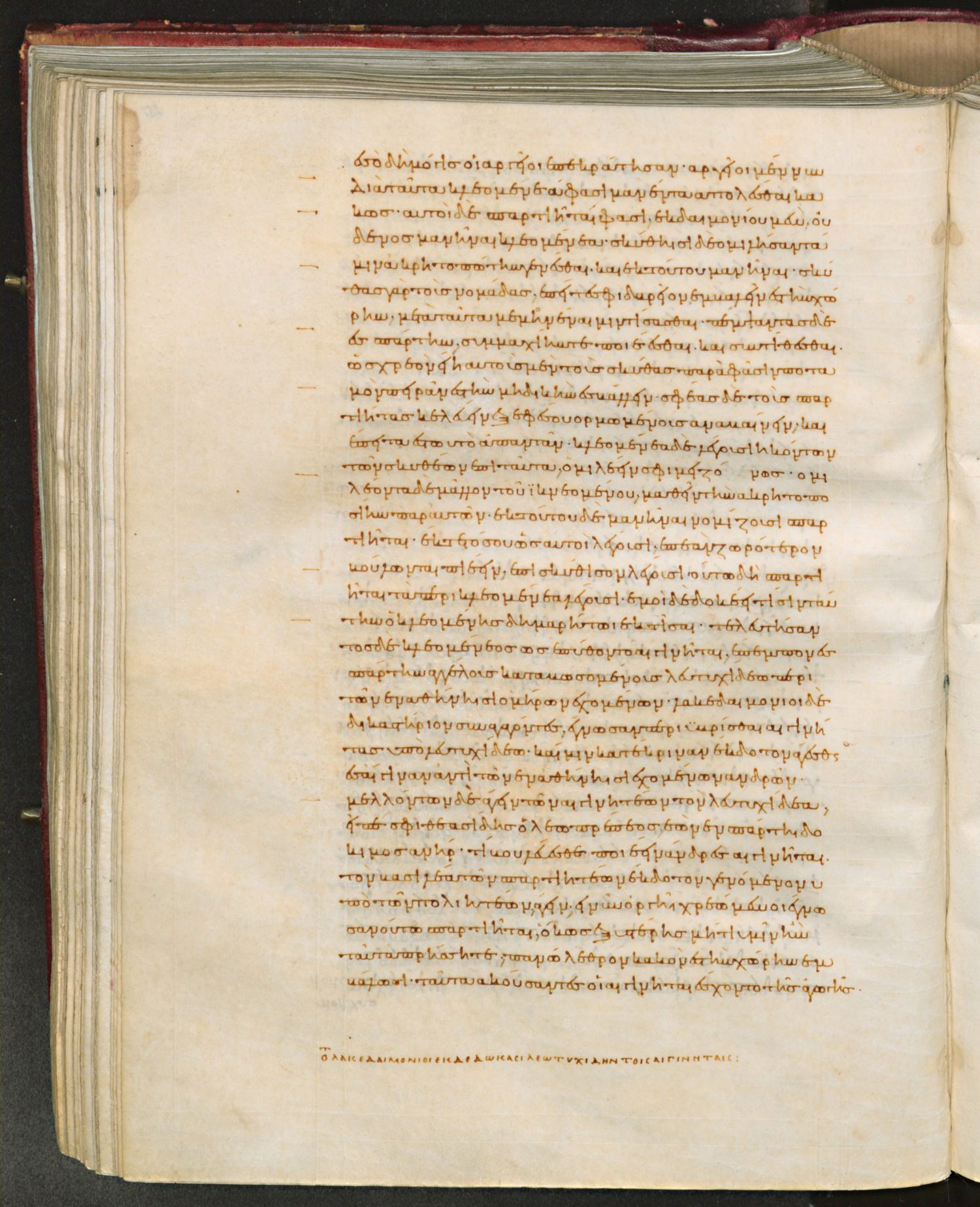
Laur. Plut. 70.3, fol. 251v: Greek here 6.83.2 to 6.84.3. Checked on the image (first and last words read and located in the Greek; each break checked against the neighbouring page): fol. 251v begins ‹ἐς ὃ δὴ μόγις› (6.83.2), ends ‹Αἰγινῆται ἔσχοντο τῆς ἀγωγῆς› (6.85.3). English here: 6.84.1 to 6.84.3 (Godley's sentences for the sections whose Greek lies mostly on this page).
6.83.2ἐς ὃ δὴ μόγις οἱ Ἀργεῖοι ἐπεκράτησαν. 6.84.1Ἀργεῖοι μέν νυν διὰ ταῦτα Κλεομένεα φασὶ μανέντα ἀπολέσθαι κακῶς· αὐτοὶ δὲ Σπαρτιῆται φασὶ ἐκ δαιμονίου μὲν οὐδενὸς μανῆναι Κλεομένεα, Σκύθῃσι δὲ ὁμιλήσαντά μιν ἀκρητοπότην γενέσθαι καὶ ἐκ τούτου μανῆναι. 6.84.2Σκύθας γὰρ τοὺς νομάδας, ἐπείτε σφι Δαρεῖον ἐμβαλεῖν ἐς τὴν χώρην, μετὰ ταῦτα μεμονέναι μιν τίσασθαι, πέμψαντας δὲ ἐς Σπάρτην συμμαχίην τε ποιέεσθαι καὶ συντίθεσθαι ὡς χρεὸν εἴη αὐτοὺς μὲν τοὺς Σκύθας παρὰ Φᾶσιν ποταμὸν πειρᾶν ἐς τὴν Μηδικὴν ἐσβάλλειν, σφέας δὲ τοὺς Σπαρτιήτας κελεύειν ἐξ Ἐφέσου ὁρμωμένους ἀναβαίνειν καὶ ἔπειτα ἐς τὠυτὸ ἀπαντᾶν. 6.84.3Κλεομένεα δὲ λέγουσι ἡκόντων τῶν Σκυθέων ἐπὶ ταῦτα ὁμιλέειν σφι μεζόνως, ὁμιλέοντα δὲ μᾶλλον τοῦ ἱκνεομένου μαθεῖν τὴν ἀκρητοποσίην παρʼ αὐτῶν· ἐκ τούτου δὲ μανῆναί μιν νομίζουσι Σπαρτιῆται. ἔκ τε τόσου, ὡς αὐτοὶ λέγουσι, ἐπεὰν ζωρότερον βούλωνται πιεῖν, Ἐπισκύθισον λέγουσι. οὕτω δὴ Σπαρτιῆται τὰ περὶ Κλεομένεα λέγουσι· ἐμοὶ δὲ δοκέει τίσιν ταύτην ὁ Κλεομένης Δημαρήτῳ ἐκτῖσαι.
6.84.1This was the reason (say the Argives) of Cleomenes’ madness and his evil end; but the Spartans themselves say, that heaven had no hand in Cleomenes’ madness, but by consorting with Scythians he became a drinker of strong wine, and thence the madness came. 6.84.2For (so they say) the nomad Scythians, after Darius had invaded their land, were fain to be revenged upon him, and made an alliance with Sparta by messengers sent thither; whereby it was agreed, that the Scythians themselves should essay to invade Media by way of the river Phasis, while the Spartans by their counsel should set out and march inland from Ephesus, and meet the Scythians. 6.84.3When the Scythians had come with this intent, Cleomenes, it is said, kept too close company with them, and by consorting with them out of measure learnt from them to drink strong wine; and this the Spartans hold to have been the cause of his madness. Ever since, as they themselves say, when they desire a strong draught they will call for “a Scythian cup.” Such is the Spartan story of Cleomenes; but to my thinking, it was for what he did to Demaratus that he was punished thus.
Notes
- Greek: the text printed in A. D. Godley's Loeb edition, via Perseus (tlg0016.tlg001.perseus-grc2). Square brackets mark words the editor considers later additions; [...] marks a gap the editor indicates. Perseus note markers are omitted.
- English: A. D. Godley, Herodotus vol. 3 (1922) (Loeb Classical Library), as transcribed on Wikisource. Godley's footnotes are omitted.
- Section numbers in the English were placed by comparing Godley's text with the Perseus version of his translation; where a section begins inside one of Godley's sentences, the English is kept with the page that holds the start of that sentence.
Cite
Sources
- Source: Florence, Laur. Plut. 70.3 (10th c.) via BML Teca Digitale + Greek of Godley's Loeb (Perseus) + English of A. D. Godley (Loeb, Wikisource) (holding institution)
- Critical edition: Greek of A. D. Godley's Loeb edition (1920-1925), via Perseus
← previous · → next · v cycle view · l back to library