Herodotus, Histories 6.85-94: Glaucus; Athens and Aegina
Introduction
Herodotus of Halicarnassus wrote the Histories in the third quarter of the 5th century BCE, an inquiry into the deeds of Greeks and barbarians and the causes of the wars between them, later divided into nine books. Book 6 tells of the end of the Ionian revolt at Lade and Miletus, the first Persian expeditions against Greece under Mardonius and under Datis and Artaphrenes, the quarrels of Sparta, Athens and Aegina, and the battle of Marathon.
The photographs are of Florence, Biblioteca Medicea Laurenziana, Plut. 70.3 (parchment, 10th century, 374 folios, 31 lines a page), Herodotus, Histories (codex A of the editors), the oldest surviving manuscript of the complete Histories, from the Teca Digitale of the Biblioteca Medicea Laurenziana. Each section below is the text of one page, or of the part of a page that falls within these chapters. The first and last words of every page were read on the photograph and located in the Greek, and every page break was checked against the next page; the notes quote these words. Readers' notes in the margins are not part of the text and are mentioned where they occur.
The Greek is the text printed in A. D. Godley's Loeb edition (1920-1925), from Perseus; it is the edited text, not a transcription of the manuscript, whose wording differs in places. The English is Godley's translation as printed, from Wikisource. Godley's English carries only chapter numbers; the section numbers shown in it were placed by comparison with the Perseus version of his translation. Each page's English is cut at the end of one of Godley's sentences, so it can begin or end a few lines away from the Greek of the page; each note gives the exact ranges.
This entry covers chapters 6.85-94, on fol. 251v to 254r.
How was this verified? (Provenance)
Where on the image
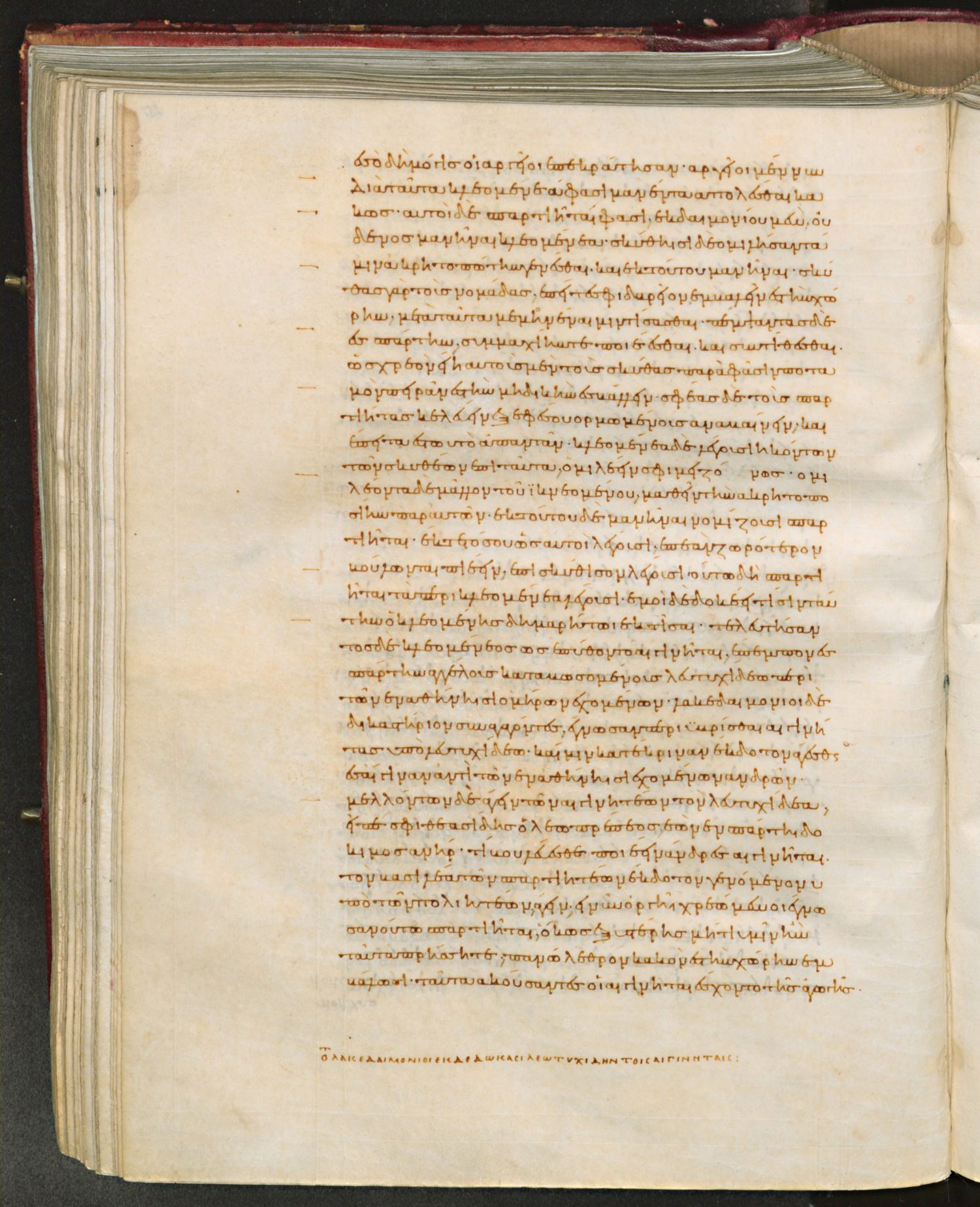
Laur. Plut. 70.3, fol. 251v: Greek here 6.85.1 to 6.85.3. Checked on the image (first and last words read and located in the Greek; each break checked against the neighbouring page): fol. 251v begins ‹ἐς ὃ δὴ μόγις› (6.83.2), ends ‹Αἰγινῆται ἔσχοντο τῆς ἀγωγῆς› (6.85.3). English here: 6.85.1 to 6.85.2 (Godley's sentences for the sections whose Greek lies mostly on this page).
6.85.1τελευτήσαντος δὲ Κλεομένεος ὡς ἐπύθοντο Αἰγινῆται, ἔπεμπον ἐς Σπάρτην ἀγγέλους καταβωσομένους Λευτυχίδεω περὶ τῶν ἐν Ἀθήνῃσι ὁμήρων ἐχομένων. Λακεδαιμόνιοι δὲ δικαστήριον συναγαγόντες ἔγνωσαν περιυβρίσθαι Αἰγινήτας ὑπὸ Λευτυχίδεω, καί μιν κατέκριναν ἔκδοτον ἄγεσθαι ἐς Αἴγιναν ἀντὶ τῶν ἐν Ἀθήνῃσι ἐχομένων ἀνδρῶν. 6.85.2μελλόντων δὲ ἄγειν τῶν Αἰγινητέων τὸν Λευτυχίδεα, εἶπέ σφι Θεασίδης ὁ Λεωπρέπεος, ἐὼν ἐν Σπάρτῃ δόκιμος ἀνήρ, τί βουλεύεσθε ποιέειν, ἄνδρες Αἰγινῆται; τὸν βασιλέα τῶν Σπαρτιητέων ἔκδοτον γενόμενον ὑπὸ τῶν πολιητέων ἄγειν; εἰ νῦν ὀργῇ χρεώμενοι ἔγνωσαν οὕτω Σπαρτιῆται, ὅκως ἐξ ὑστέρης μή τι ὑμῖν, ἢν ταῦτα πρήσσητε, πανώλεθρον κακὸν ἐς τὴν χώρην ἐμβάλωσι. 6.85.3ταῦτα ἀκούσαντες οἱ Αἰγινῆται ἔσχοντο τῆς ἀγωγῆς,
6.85.1When Cleomenes was dead, and the Aeginetans heard of it, they sent messengers to Sparta to cry for justice on Leutychides, for the matter of the hostages that were held at Athens. The Lacedaemonians then assembled a court and gave judgment that Leutychides had done violence to the Aeginetans; and they condemned him to be given up and carried to Aegina, in requital for the men that were held at Athens. 6.85.2But when the Aeginetans were about to carry Leutychides away, a man of repute at Sparta, Theasides, son of Leoprepes, said to them, “Men of Aegina, what is this that you purpose to do? Would you have the king of the Spartans given up to you by the citizens and carry him away? Nay, if the Spartans have now so judged in their anger, look to it lest at a later day, if you do as you purpose, they bring utter destruction upon your country.”
Where on the image
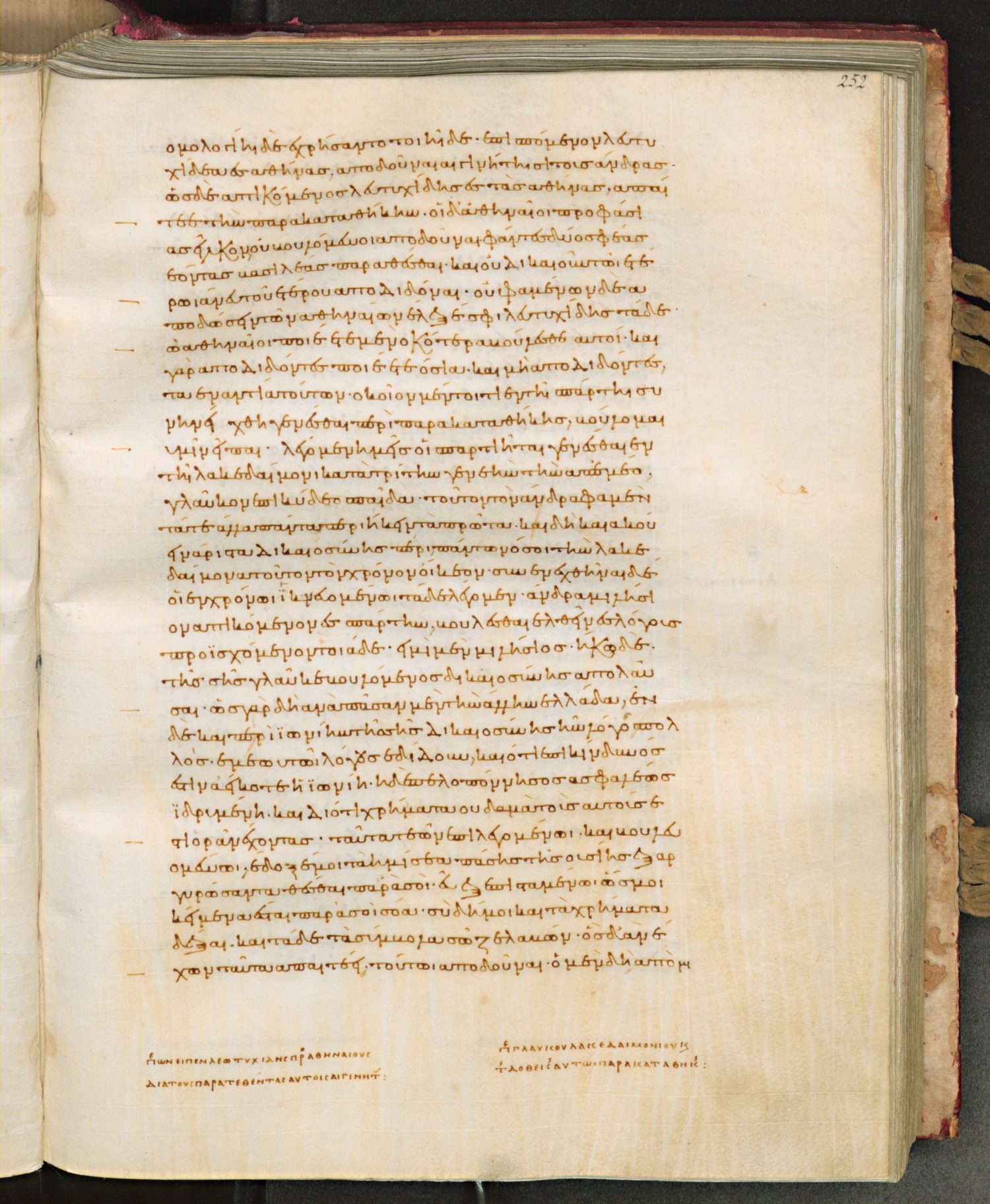
Laur. Plut. 70.3, fol. 252r: Greek here 6.85.3 to 6.86b.1. Checked on the image (first and last words read and located in the Greek; each break checked against the neighbouring page): fol. 252r begins ‹ὁμολογίῃ δὲ ἐχρήσαντο τοιῇδε,› (6.85.3), ends ‹μὲν δὴ ἀπὸ Μι-› (6.86b.1). English here: 6.85.3 to 6.86a.5 (Godley's sentences for the sections whose Greek lies mostly on this page).
6.85.3ὁμολογίῃ δὲ ἐχρήσαντο τοιῇδε, ἐπισπόμενον Λευτυχίδεα ἐς Ἀθήνας ἀποδοῦναι Αἰγινήτῃσι τοὺς ἄνδρας. 6.86.1ὡς δὲ ἀπικόμενος Λευτυχίδης ἐς τὰς Ἀθήνας ἀπαίτεε τὴν παραθήκην, οἱ δʼ Ἀθηναῖοι προφάσιας εἷλκον οὐ βουλόμενοι ἀποδοῦναι, φάντες δύο σφέας ἐόντας βασιλέας παραθέσθαι καὶ οὐ δικαιοῦν τῷ ἑτέρῳ ἄνευ τοῦ ἑτέρου ἀποδιδόναι· 6.86a.1οὐ φαμένων δὲ ἀποδώσειν τῶν Ἀθηναίων, ἔλεξέ σφι Λευτυχίδης τάδε. ὦ Ἀθηναῖοι, ποιέετε μὲν ὁκότερα βούλεσθε αὐτοί· καὶ γὰρ ἀποδιδόντες ποιέετε ὅσια, καὶ μὴ ἀποδιδόντες τὰ ἐναντία τούτων· ὁκοῖον μέντοι τι ἐν τῇ Σπάρτῃ συνηνείχθη γενέσθαι περὶ παρακαταθήκης, βούλομαι ὑμῖν εἶπαι. 6.86a.2λέγομεν ἡμεῖς οἱ Σπαρτιῆται γενέσθαι ἐν τῇ Λακεδαίμονι κατὰ τρίτην γενεὴν τὴν ἀπʼ ἐμέο Γλαῦκον Ἐπικύδεος παῖδα· τοῦτον τὸν ἄνδρα φαμὲν τά τε ἄλλα πάντα περιήκειν τὰ πρῶτα, καὶ δὴ καὶ ἀκούειν ἄριστα δικαιοσύνης πέρι πάντων ὅσοι τὴν Λακεδαίμονα τοῦτον τὸν χρόνον οἴκεον. 6.86a.3συνενειχθῆναι δέ οἱ ἐν χρόνῳ ἱκνευμένῳ τάδε λέγομεν. ἄνδρα Μιλήσιον ἀπικόμενον ἐς Σπάρτην βούλεσθαί οἱ ἐλθεῖν ἐς λόγους προϊσχόμενον τοιάδε. εἰμὶ μὲν Μιλήσιος, ἥκω δὲ τῆς σῆς Γλαῦκε βουλόμενος δικαιοσύνης ἀπολαῦσαι. 6.86a.4ὡς γὰρ δὴ ἀνὰ πᾶσαν μὲν τὴν ἄλλην Ἑλλάδα, ἐν δὲ καὶ περὶ Ἰωνίην τῆς σῆς δικαιοσύνης ἦν λόγος πολλός, ἐμεωυτῷ λόγους ἐδίδουν καὶ ὅτι ἐπικίνδυνος ἐστὶ αἰεί κοτε ἡ Ἰωνίη, ἡ δὲ Πελοπόννησος ἀσφαλέως ἱδρυμένη, καὶ διότι χρήματα οὐδαμὰ τοὺς αὐτούς ἐστι ὁρᾶν ἔχοντας. 6.86a.5ταῦτά τε ὦν ἐπιλεγομένῳ καὶ βουλευομένῳ ἔδοξέ μοι τὰ ἡμίσεα πάσης τῆς οὐσίης ἐξαργυρώσαντα θέσθαι παρὰ σέ, εὖ ἐξεπισταμένῳ ὥς μοι κείμενα ἔσται παρὰ σοὶ σόα. σὺ δή μοι καὶ τὰ χρήματα δέξαι καὶ τάδε τὰ σύμβολα σῶζε λαβών· ὃς δʼ ἂν ἔχων ταῦτα ἀπαιτέῃ, τούτῳ ἀποδοῦναι. 6.86b.1ὁ μὲν δὴ ἀπὸ Μιλήτου
6.85.3Hearing this, the Aeginetans stayed their hand from carrying the king away, and made an agreement that Leutychides should go with them to Athens and restore the men to the Aeginetans. 6.86.1So when Leutychides came to Athens and demanded that what had been entrusted be restored, and the Athenians, being loath to restore it, made excuses, and said that, having been charged with the trust by both the kings, they deemed it wrong to restore it to the one alone without the other,— 6.86a.1when the Athenians refused to restore, Leutychides said to them: “Men of Athens, do whichever thing you desire; if you restore, you do righteously, if you restore not you do contrariwise; yet hear from me the story of what befel at Sparta in the matter of a trust. 6.86a.2It is told by us Spartans that three generations agone there was at Lacedaemon one Glaucus, son of Epicydes. This man (so the story goes) added to his other excellences a reputation for justice above all men who at that time dwelt in Lacedaemon. 6.86a.3But in the fitting time this, as it is told, befel him:—There came to Sparta a certain man of Miletus, desiring to hold converse with Glaucus, and making him this proffer: ‘I am,’ he said, ‘of Miletus, and hither am I come, Glaucus! to reap advantage from your justice. 6.86a.4For seeing that all about Hellas and Ionia too there was much talk of your justice, I bethought me in myself that Ionia is ever a land of dangers and Peloponnesus securely stablished, and in Ionia nowhere are the same men seen continuing in possession of wealth. 6.86a.5Considering and taking counsel concerning these matters, I resolved to turn the half of my substance into silver and give it into your charge, being well assured that it will lie safe for me in your keeping. Do you then receive the sum, and take and keep these tokens; and restore the money to him that comes with the like tokens and demands it back.’
Where on the image
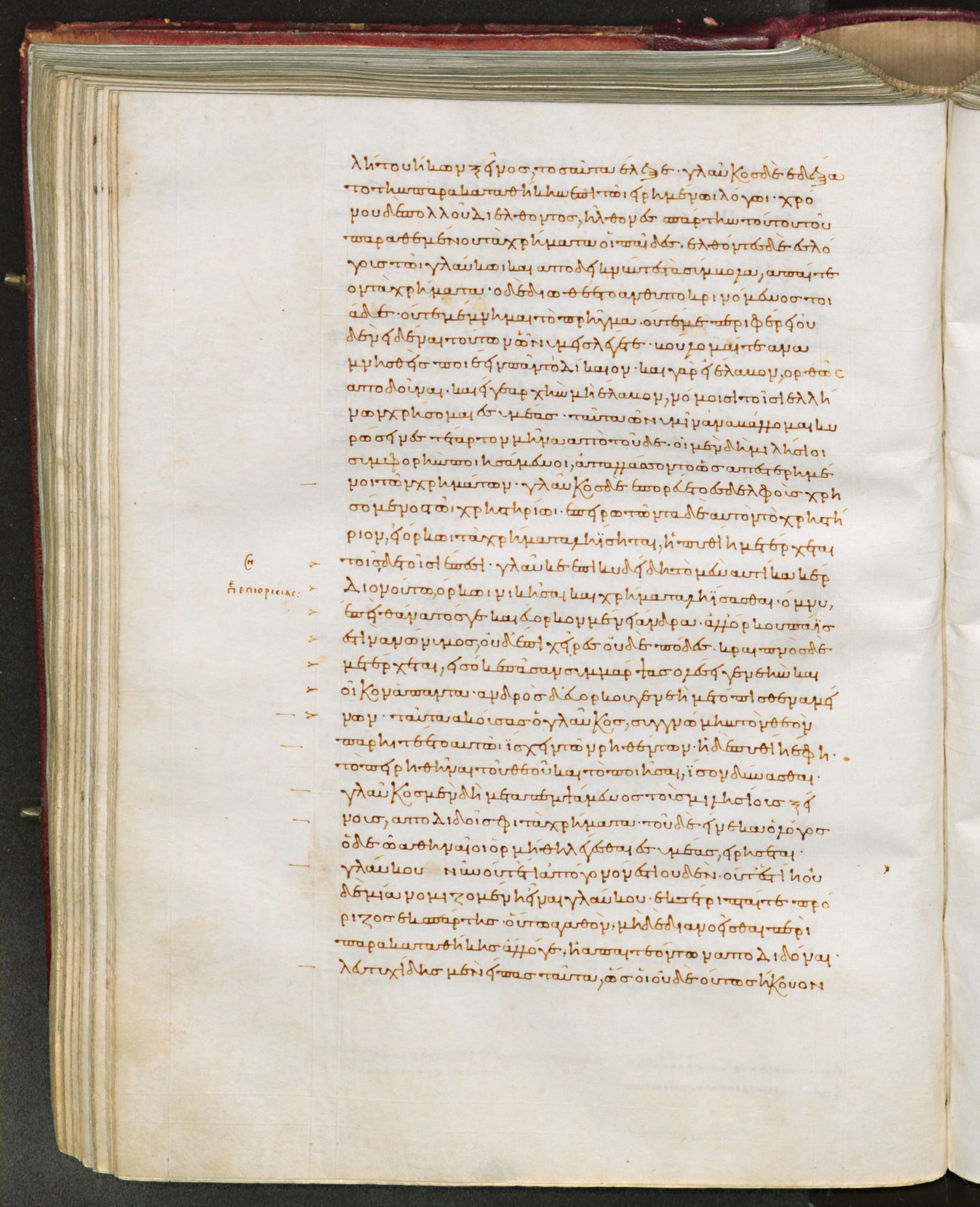
Laur. Plut. 70.3, fol. 252v: Greek here 6.86b.1 to 6.87.1. Checked on the image (first and last words read and located in the Greek; each break checked against the neighbouring page): fol. 252v begins ‹-λήτου ἥκων ξεῖνος τοσαῦτα› (6.86b.1), ends ‹οἱ οὐδὲ οὕτω ἐσήκουον› (6.87.1). The word ‹Μιλήτου› is divided between fol. 252r and fol. 252v; it is given with fol. 252r. English here: 6.86b.1 to 6.86d.1 (Godley's sentences for the sections whose Greek lies mostly on this page).
6.86b.1ἥκων ξεῖνος τοσαῦτα ἔλεξε, Γλαῦκος δὲ ἐδέξατο τὴν παρακαταθήκην ἐπὶ τῷ εἰρημένῳ λόγῳ. χρόνου δὲ πολλοῦ διελθόντος ἦλθον ἐς Σπάρτην τούτου τοῦ παραθεμένου τὰ χρήματα οἱ παῖδες, ἐλθόντες δὲ ἐς λόγους τῷ Γλαύκῳ καὶ ἀποδεικνύντες τὰ σύμβολα ἀπαίτεον τὰ χρήματα· 6.86b.2ὁ δὲ διωθέετο ἀντυποκρινόμενος τοιάδε. οὔτε μέμνημαι τὸ πρῆγμα οὔτε με περιφέρει οὐδὲν εἰδέναι τούτων τῶν ὑμεῖς λέγετε, βούλομαί τε ἀναμνησθεὶς ποιέειν πᾶν τὸ δίκαιον· καὶ γὰρ εἰ ἔλαβον, ὀρθῶς ἀποδοῦναι, καὶ εἴ γε ἀρχὴν μὴ ἔλαβον, νόμοισι τοῖσι Ἑλλήνων χρήσομαι ἐς ὑμέας. ταῦτα ὦν ὑμῖν ἀναβάλλομαι κυρώσειν ἐς τέταρτον μῆνα ἀπὸ τοῦδε. 6.86c.1οἱ μὲν δὴ Μιλήσιοι συμφορὴν ποιησάμενοι ἀπαλλάσσοντο ὡς ἀπεστερημένοι τῶν χρημάτων, Γλαῦκος δὲ ἐπορεύετο ἐς Δελφοὺς χρησόμενος τῷ χρηστηρίῳ. ἐπειρωτῶντα δὲ αὐτὸν τὸ χρηστήριον εἰ ὅρκῳ τὰ χρήματα ληίσηται, ἡ Πυθίη μετέρχεται τοῖσιδε τοῖσι ἔπεσι. 6.86c.2γλαῦκʼ Ἐπικυδείδη, τὸ μὲν αὐτίκα κέρδιον οὕτω
ὅρκῳ νικῆσαι καὶ χρήματα ληίσσασθαι.
ὄμνυ, ἐπεὶ θάνατός γε καὶ εὔορκον μένει ἄνδρα.
ἀλλʼ ὅρκου πάις ἐστίν, ἀνώνυμος, οὐδʼ ἔπι χεῖρες
οὐδὲ πόδες· κραιπνὸς δὲ μετέρχεται, εἰς ὅ κε πᾶσαν
συμμάρψας ὀλέσῃ γενεὴν καὶ οἶκον ἅπαντα.
ἀνδρὸς δʼ εὐόρκου γενεὴ μετόπισθεν ἀμείνων.
ταῦτα ἀκούσας ὁ Γλαῦκος συγγνώμην τὸν θεὸν παραιτέετο αὐτῷ ἴσχειν τῶν ῥηθέντων. ἡ δὲ Πυθίη ἔφη τὸ πειρηθῆναι τοῦ θεοῦ καὶ τὸ ποιῆσαι ἴσον δύνασθαι. 6.86d.1Γλαῦκος μὲν δὴ μεταπεμψάμενος τοὺς Μιλησίους ξείνους ἀποδιδοῖ σφι τὰ χρήματα. τοῦ δὲ εἵνεκα ὁ λόγος ὅδε ὦ Ἀθηναῖοι ὁρμήθη λέγεσθαι ἐς ὑμέας, εἰρήσεται· Γλαύκου νῦν οὔτε τι ἀπόγονον ἐστὶ οὐδὲν οὔτʼ ἱστίη οὐδεμία νομιζομένη εἶναι Γλαύκου, ἐκτέτριπταί τε πρόρριζος ἐκ Σπάρτης. οὕτω ἀγαθὸν μηδὲ διανοέεσθαι περὶ παρακαταθήκης ἄλλο γε ἢ ἀπαιτεόντων ἀποδιδόναι. 6.87.1Λευτυχίδης μὲν εἴπας ταῦτα, ὥς οἱ οὐδὲ οὕτω ἐσήκουον
6.86b.1Thus spoke the stranger who had come from Miletus, and Glaucus received the trust according to the agreement. When a long time had passed, there came to Sparta the sons of the man who had given the money in trust; they spoke with Glaucus, showing him the tokens and demanding the money back. 6.86b.2But Glaucus put them off with a demurrer: ‘I have no remembrance,’ he said, ‘of the matter, nor am I moved to any knowledge of that whereof you speak; let me bring it to mind, and I will do all that is just; if I took the money I will duly restore it, and if I never took it at all I will deal with you according to the customs of the Greeks. Suffer me, therefore, to delay making my words good till the fourth month from this day.’ 6.86c.1So the Milesians went away in sorrow, as men robbed of their possessions; but Glaucus journeyed to Delphi, to enquire of the oracle. When he asked the oracle whether he should swear and so ravish the money, the Pythian priestess threatened him in these verses: Hear, 6.86c.2Epicydes’ son: ’twere much to thy present advantage Couldst thou prevail by an oath and ravish the stranger’s possessions: Swear an thou wilt; death waits for the just no less than the unjust. Ay—but an oath hath a son, a nameless avenger of evil: Hands hath he none, nor feet; yet swiftly he runneth pursuing, Grippeth his man at the last and maketh an end of his offspring. Better endureth the line of the man that sweareth not falsely. When Glaucus heard that, he entreated the god to pardon him for what he had said. But the priestess answered, that to tempt the god and to do the deed were of like effect. 6.86d.1Glaucus, then, sent for the Milesian strangers and restored them their money; but hear now, Athenians! why I began to tell you this story. There is at this day no descendant of Glaucus, nor any household that bears Glaucus’ name; he and his have been utterly uprooted out of Sparta. So good a thing it is not even to design aught concerning a trust, save the restoring of it on demand.”
Where on the image
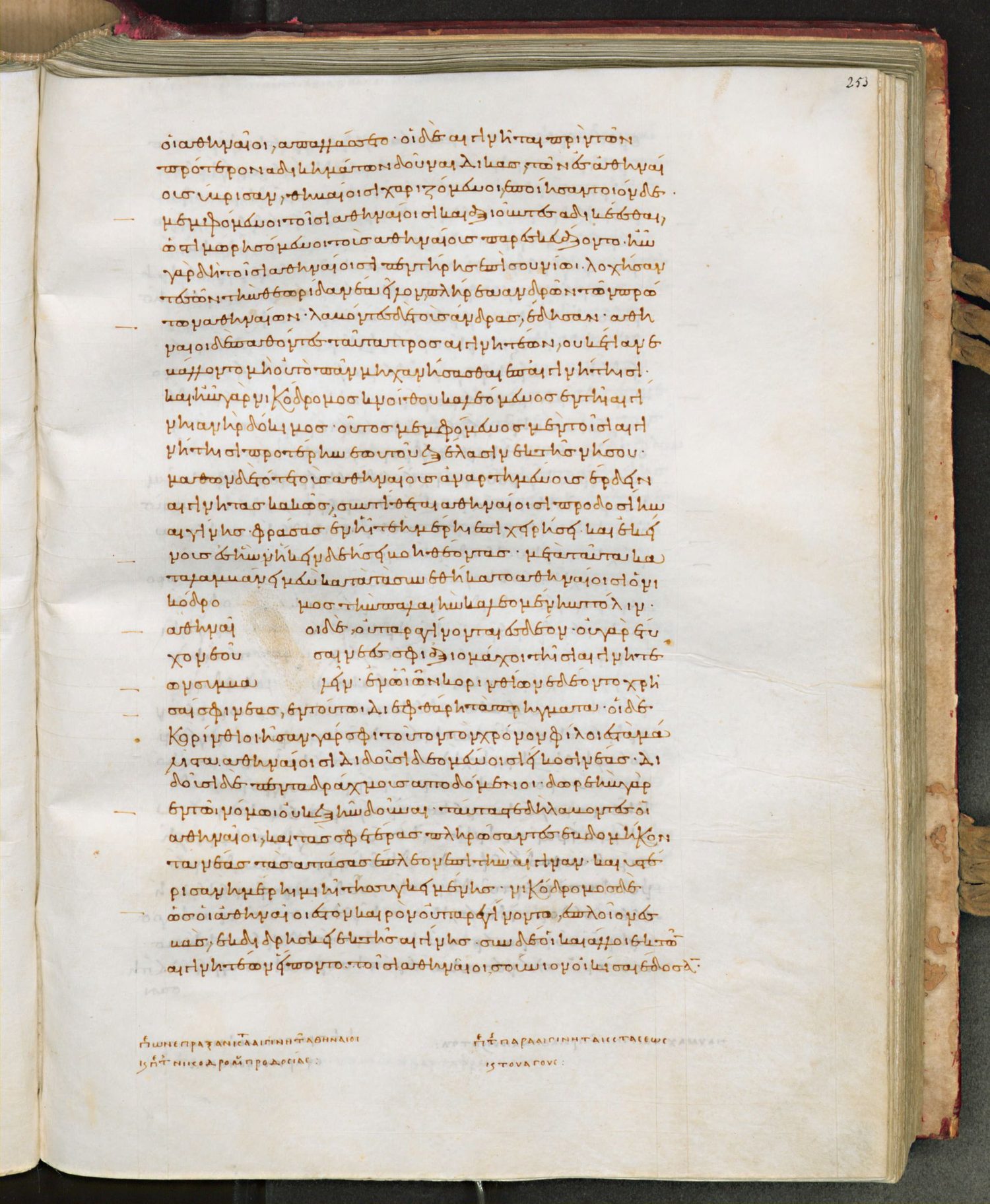
Laur. Plut. 70.3, fol. 253r: Greek here 6.87.1 to 6.90.1. Checked on the image (first and last words read and located in the Greek; each break checked against the neighbouring page): fol. 253r begins ‹οἱ Ἀθηναῖοι, ἀπαλλάσσετο· οἱ› (6.87.1), ends ‹Ἀθηναῖοι Σούνιον οἰκῆσαι ἔδοσαν› (6.90.1). English here: 6.87.1 to 6.90.1 (Godley's sentences for the sections whose Greek lies mostly on this page).
6.87.1οἱ Ἀθηναῖοι, ἀπαλλάσσετο· οἱ δὲ Αἰγινῆται, πρὶν τῶν πρότερον ἀδικημάτων δοῦναι δίκας τῶν ἐς Ἀθηναίους ὕβρισαν Θηβαίοισι χαριζόμενοι, ἐποίησαν τοιόνδε. μεμφόμενοι τοῖσι Ἀθηναίοισι καὶ ἀξιοῦντες ἀδικέεσθαι, ὡς τιμωρησόμενοι τοὺς Ἀθηναίους παρεσκευάζοντο· καὶ ἦν γὰρ δὴ τοῖσι Ἀθηναίοισι πεντετηρὶς ἐπὶ Σουνίῳ, λοχήσαντες ὦν τὴν θεωρίδα νέα εἷλον πλήρεα ἀνδρῶν τῶν πρώτων Ἀθηναίων, λαβόντες δὲ τοὺς ἄνδρας ἔδησαν. 6.88.1Ἀθηναῖοι δὲ παθόντες ταῦτα πρὸς Αἰγινητέων οὐκέτι ἀνεβάλλοντο μὴ οὐ τὸ πᾶν μηχανήσασθαι ἐπʼ Αἰγινήτῃσι. καὶ ἦν γὰρ Νικόδρομος Κνοίθου καλεόμενος ἐν τῇ Αἰγίνῃ ἀνὴρ δόκιμος, οὗτος μεμφόμενος μὲν τοῖσι Αἰγινήτῃσι προτέρην ἑωυτοῦ ἐξέλασιν ἐκ τῆς νήσου, μαθὼν δὲ τότε τοὺς Ἀθηναίους ἀναρτημένους ἔρδειν Αἰγινήτας κακῶς, συντίθεται Ἀθηναίοισι προδοσίην Αἰγίνης, φράσας ἐν τῇ τε ἡμέρῃ ἐπιχειρήσει καὶ ἐκείνους ἐς τὴν ἥκειν δεήσει βοηθέοντας. 6.89.1μετὰ ταῦτα καταλαμβάνει μὲν κατὰ τὰ συνεθήκατο Ἀθηναίοισι ὁ Νικόδρομος τὴν παλαιὴν καλεομένην πόλιν, Ἀθηναῖοι δὲ οὐ παραγίνονται ἐς δέον· οὐ γὰρ ἔτυχον ἐοῦσαι νέες σφι ἀξιόμαχοι τῇσι Αἰγινητέων συμβαλεῖν. ἐν ᾧ ὦν Κορινθίων ἐδέοντο χρῆσαι σφίσι νέας, ἐν τούτῳ διεφθάρη τὰ πρήγματα. οἱ δὲ Κορίνθιοι, ἦσαν γάρ σφι τοῦτον τὸν χρόνον φίλοι ἐς τὰ μάλιστα, Ἀθηναίοισι διδοῦσι δεομένοισι εἴκοσι νέας, διδοῦσι δὲ πενταδράχμους ἀποδόμενοι· δωρεὴν γὰρ ἐν τῷ νόμῳ οὐκ ἐξῆν δοῦναι. ταύτας τε δὴ λαβόντες οἱ Ἀθηναῖοι καὶ τὰς σφετέρας, πληρώσαντες ἑβδομήκοντα νέας τὰς ἁπάσας, ἔπλεον ἐπὶ τὴν Αἴγιναν καὶ ὑστέρησαν ἡμέρῃ μιῇ τῆς συγκειμένης. 6.90.1Νικόδρομος δέ, ὡς οἱ Ἀθηναῖοι ἐς τὸν καιρὸν οὐ παρεγίνοντο, ἐς πλοῖον ἐσβὰς ἐκδιδρήσκει ἐκ τῆς Αἰγίνης· σὺν δέ οἱ καὶ ἄλλοι ἐκ τῶν Αἰγινητέων εἵποντο, τοῖσι Ἀθηναῖοι Σούνιον οἰκῆσαι ἔδοσαν.
6.87.1Thus spoke Leutychides; but even so the Athenians would not listen to him, and he took his departure. But the Aeginetans, before paying the penalty for the high-handed wrong they had done the Athenians to please the Thebans, did as I will show. Having a grudge against Athens and deeming themselves wronged, they prepared to take vengeance on the Athenians. Among these there was now a five-yearly festival toward on Sunium; wherefore the Aeginetans set an ambush and took the ship that bore deputies to the festival, with many noble Athenians therein, and put in prison the men whom they took. 6.88.1Thus mishandled by the Aeginetans, the Athenians delayed no longer to devise all mischief against Aegina. Now there was one Nicodromus, son of Cnoethus by name, a notable man in Aegina. He, having a grudge against the Aeginetans for his former banishment from the island, and learning now that the Athenians were set upon doing hurt to the Aeginetans, agreed with the Athenians to betray Aegina to them, naming the day whereon he would essay it and whereon they must come to aid him. 6.89.1Presently, according to his agreement with the Athenians, Nicodromus took possession of the Old City, as it was called; but the Athenians failed of arriving at the right time; for it chanced that they had not ships enough to cope with the Aeginetans; wherefore they entreated the Corinthians to lend them ships, and by that delay their business was thwarted. The Corinthians, being at that time their close friends, consented to the Athenians’ entreaty and gave them twenty ships, at a price of five drachmas apiece; for by their law they could not make a free gift of them. Taking these ships and their own, the Athenians manned seventy in all and sailed for Aegina, whither they came a day later than the time agreed. 6.90.1But Nicodromus, the Athenians not being at hand on the day appointed, took ship and escaped from Aegina, he and other Aeginetans with him, to whom the Athenians gave Sunium to dwell in; making which their headquarters they harried the Aeginetans of the island.
Where on the image
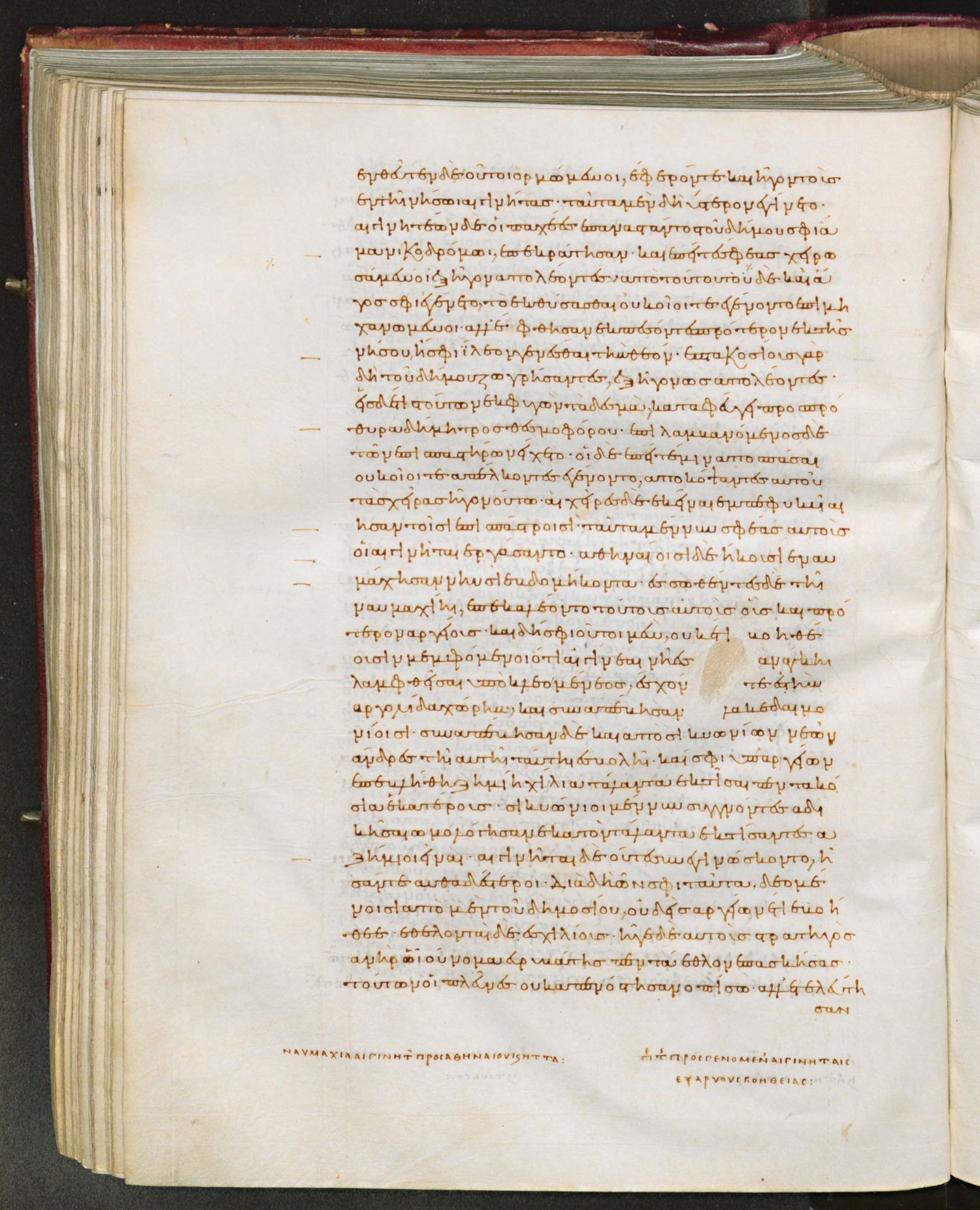
Laur. Plut. 70.3, fol. 253v: Greek here 6.90.1 to 6.92.3. Checked on the image (first and last words read and located in the Greek; each break checked against the neighbouring page): fol. 253v begins ‹ἐνθεῦτεν δὲ οὗτοι ὁρμώμενοι› (6.90.1), ends ‹ἀπενόστησαν ὀπίσω, ἀλλʼ ἐτελεύτησαν› (6.92.3). The end of the last word (ἐτελεύτησαν) is written below the last line. English here: 6.91.1 to 6.92.2 (Godley's sentences for the sections whose Greek lies mostly on this page).
6.90.1ἐνθεῦτεν δὲ οὗτοι ὁρμώμενοι ἔφερόν τε καὶ ἦγον τοὺς ἐν τῇ νήσῳ Αἰγινήτας. 6.91.1ταῦτα μὲν δὴ ὕστερον ἐγίνετο. Αἰγινητέων δὲ οἱ παχέες ἐπαναστάντος τοῦ δήμου σφι ἅμα Νικοδρόμῳ ἐπεκράτησαν, καὶ ἔπειτα σφέας χειρωσάμενοι ἐξῆγον ἀπολέοντες. ἀπὸ τούτου δὲ καὶ ἄγος σφι ἐγένετο, τὸ ἐκθύσασθαι οὐκ οἶοί τε ἐγένοντο ἐπιμηχανώμενοι, ἀλλʼ ἔφθησαν ἐκπεσόντες πρότερον ἐκ τῆς νήσου ἤ σφι ἵλεον γενέσθαι τὴν θεόν. 6.91.2ἑπτακοσίους γὰρ δὴ τοῦ δήμου ζωγρήσαντες ἐξῆγον ὡς ἀπολέοντες, εἷς δέ τις τούτων ἐκφυγὼν τὰ δεσμὰ καταφεύγει πρὸς πρόθυρα Δήμητρος θεσμοφόρου, ἐπιλαμβανόμενος δὲ τῶν ἐπισπαστήρων εἴχετο· οἳ δὲ ἐπείτε μιν ἀποσπάσαι οὐκ οἷοί τε ἀπέλκοντες ἐγίνοντο, ἀποκόψαντες αὐτοῦ τὰς χεῖρας ἦγον οὕτω, αἱ χεῖρες δὲ ἐκεῖναι ἐμπεφυκυῖαι ἦσαν τοῖσι ἐπισπαστῆρσι. 6.92.1ταῦτα μέν νυν σφέας αὐτοὺς οἱ Αἰγινῆται ἐργάσαντο, Ἀθηναίοισι δὲ ἥκουσι ἐναυμάχησαν νηυσὶ ἑβδομήκοντα, ἑσσωθέντες δὲ τῇ ναυμαχίῃ ἐπεκαλέοντο τοὺς αὐτοὺς καὶ πρότερον, Ἀργείους. καὶ δή σφι οὗτοι μὲν οὐκέτι βοηθέουσι, μεμφόμενοι ὅτι Αἰγιναῖαι νέες ἀνάγκῃ λαμφθεῖσαι ὑπὸ Κλεομένεος ἔσχον τε ἐς τὴν Ἀργολίδα χώρην καὶ συναπέβησαν Λακεδαιμονίοισι, συναπέβησαν δὲ καὶ ἀπὸ Σικυωνιέων νεῶν ἄνδρες τῇ αὐτῇ ταύτῃ ἐσβολῇ· 6.92.2καί σφι ὑπʼ Ἀργείων ἐπεβλήθη ζημίη χίλια τάλαντα ἐκτῖσαι, πεντακόσια ἑκατέρους. Σικυώνιοι μέν νυν συγγνόντες ἀδικῆσαι ὡμολόγησαν ἑκατὸν τάλαντα ἐκτίσαντες ἀζήμιοι εἶναι, Αἰγινῆται δὲ οὔτε συνεγινώσκοντο ἦσάν τε αὐθαδέστεροι. διὰ δὴ ὦν σφι ταῦτα δεομένοισι ἀπὸ μὲν τοῦ δημοσίου οὐδεὶς Ἀργείων ἔτι ἐβοήθεε, ἐθελονταὶ δὲ ἐς χιλίους· ἦγε δὲ αὐτοὺς στρατηγὸς ἀνὴρ ᾧ οὔνομα Εὐρυβάτης, ἀνὴρ πεντάεθλον ἐπασκήσας. 6.92.3τούτων οἱ πλεῦνες οὐκ ἀπενόστησαν ὀπίσω, ἀλλʼ ἐτελεύτησαν
6.91.1This was done after the time whereof I have spoken. But the rich men of Aegina gained the mastery over the commonalty, who had risen against them with Nicodromus, and having made them captive led them out to be slain. For this cause a curse fell upon them, whereof for all their devices they could not rid themselves by sacrifice, but they were driven out of their island ere the goddess would be merciful to them. 6.91.2For they had taken seven hundred of the commonalty alive; and as they led these out for slaughter one of them escaped from his bonds and fled to the temple gate of Demeter the Lawgiver, where he laid hold of the door-handles and clung to them; so when his enemies could not drag him away for all their striving, they cut off his hands, and so brought him off; and those hands were left clinging fast to the door-handles. 6.92.1Thus the Aeginetans dealt with each other; when the Athenians had come, they fought with them at sea with seventy ships, and being worsted in the sea-fight they asked help of the Argives, as they had done before. But this time the Argives would not aid them, for a grudge that they bore the Aeginetans; since ships of Aegina had been taken perforce by Cleomenes and put in on the Argolid coast, where their crews landed with the Lacedaemonians; and there were men too from ships of Sicyon that took part in this same onfall; and 6.92.2the Argives laid on them the payment of a fine of a thousand talents, each people five hundred. The Sicyonians owned that they had done wrongfully and agreed to go scathless for a payment of a hundred talents, but the Aeginetans made no such confession, and were stiff-necked. For this cause the Argive state sent no man at their entreaty to aid them, but about a thousand came of their own will, led by a captain whose name was Eurybates, a man practised in the five contests.
Where on the image
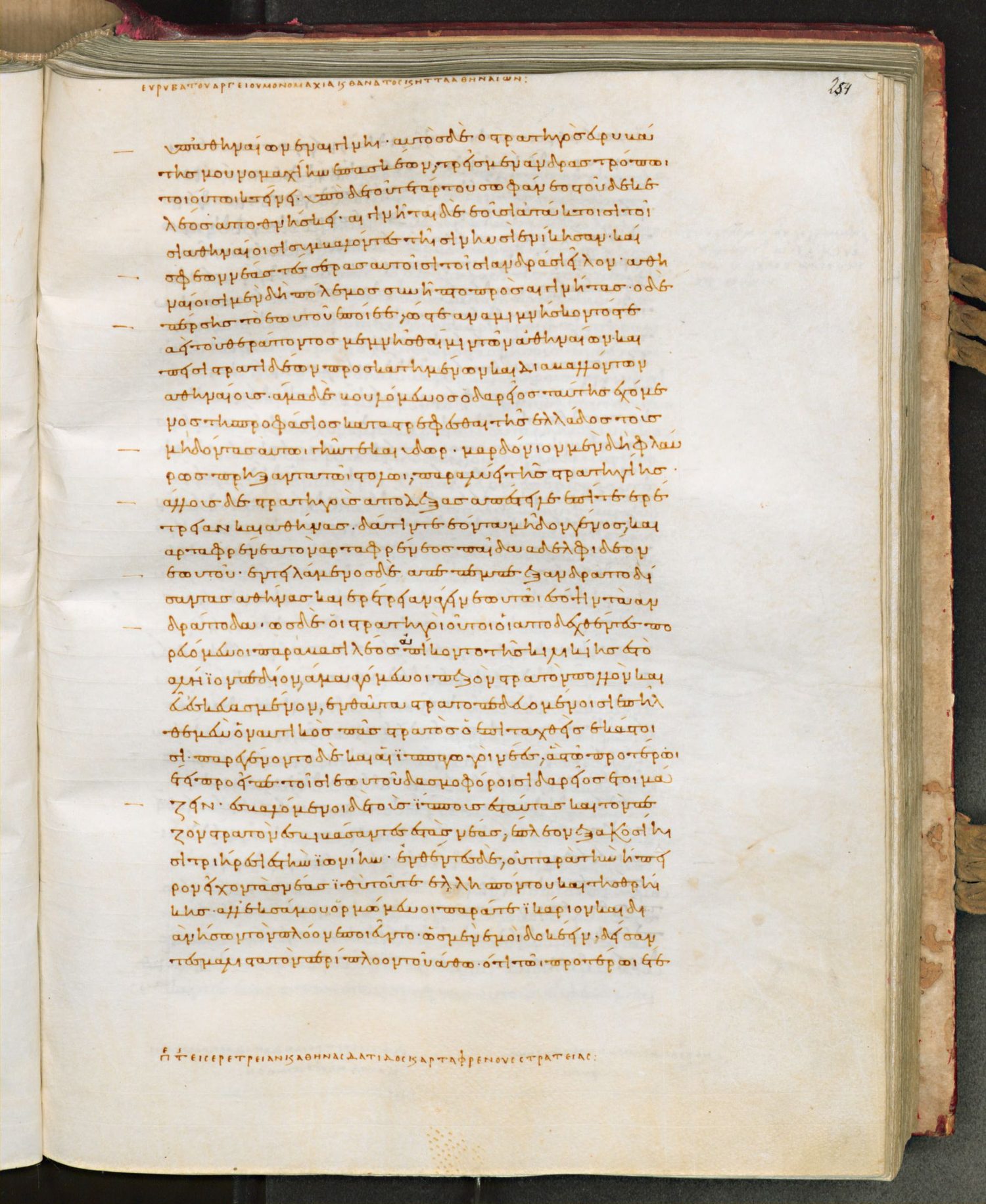
Laur. Plut. 70.3, fol. 254r: Greek here 6.92.3 to 6.94.2. Checked on the image (first and last words read and located in the Greek; each break checked against the neighbouring page): fol. 254r begins ‹ὑπʼ Ἀθηναίων ἐν Αἰγίνῃ·› (6.92.3), ends ‹ὅτι τῷ προτέρῳ ἔτεϊ› (6.95.2). In the upper margin, a reader's note in capitals on the single combats and death of Eurybates the Argive and the defeat of the Athenians. English here: 6.92.3 to 6.94.2 (Godley's sentences for the sections whose Greek lies mostly on this page).
6.92.3ὑπʼ Ἀθηναίων ἐν Αἰγίνῃ· αὐτὸς δὲ ὁ στρατηγὸς Εὐρυβάτης μουνομαχίην ἐπασκέων τρεῖς μὲν ἄνδρας τρόπῳ τοιούτῳ κτείνει, ὑπὸ δὲ τοῦ τετάρτου Σωφάνεος τοῦ Δεκελέος ἀποθνήσκει. 6.93.1Αἰγινῆται δὲ ἐοῦσι ἀτάκτοισι τοῖσι Ἀθηναίοισι συμβαλόντες τῇσι νηυσὶ ἐνίκησαν, καί σφεων νέας τέσσερας αὐτοῖσι τοῖσι ἀνδράσι εἷλον. 6.94.1Ἀθηναίοισι μὲν δὴ πόλεμος συνῆπτο πρὸς Αἰγινήτας. ὁ δὲ Πέρσης τὸ ἑωυτοῦ ἐποίεε, ὥστε ἀναμιμνήσκοντός τε αἰεὶ τοῦ θεράποντος μεμνῆσθαί μιν τῶν Ἀθηναίων, καὶ Πεισιστρατιδέων προσκατημένων καὶ διαβαλλόντων Ἀθηναίους, ἅμα δὲ βουλόμενος ὁ Δαρεῖος ταύτης ἐχόμενος τῆς προφάσιος καταστρέφεσθαι τῆς Ἑλλάδος τοὺς μὴ δόντας αὐτῷ γῆν τε καὶ ὕδωρ. 6.94.2Μαρδόνιον μὲν δὴ φλαύρως πρήξαντα τῷ στόλῳ παραλύει τῆς στρατηγίης, ἄλλους δὲ στρατηγοὺς ἀποδέξας ἀπέστειλε ἐπὶ τε Ἐρέτριαν καὶ Ἀθήνας, Δᾶτίν τε ἐόντα Μῆδον γένος καὶ Ἀρταφρένεα τὸν Ἀρταφρένεος παῖδα, ἀδελφιδέον ἑωυτοῦ· ἐντειλάμενος δὲ ἀπέπεμπε ἐξανδραποδίσαντας Ἀθήνας καὶ Ἐρέτριαν ἀνάγειν ἑωυτῷ ἐς ὄψιν τὰ ἀνδράποδα.
6.92.3Of these the greater part never returned back but met their death by the hands of the Athenians in Aegina; Eurybates himself, their captain, fought in single combat and thus slew three men, but was slain by the fourth, Sophanes the son of Deceles. 6.93.1The Aeginetan ships found the Athenians in disarray, and attacked and overcame them, taking four Athenian ships and their crews. 6.94.1Thus Athens and Aegina grappled together in war. But the Persian was going about his own business; for his servant was ever reminding him to remember the Athenians, and the Pisistratidae were at his elbow maligning the Athenians, and moreover Darius desired to take this pretext for subduing all the men of Hellas that had not given him earth and water. 6.94.2As for Mardonius, who had fared so ill with his armament, him he dismissed from his command, and appointed other generals to lead his armies against Athens and Eretria, Datis a Mede, and his own nephew Artaphrenes son of Artaphrenes; and the charge he gave them at their departure was, to enslave Athens and Eretria, and bring the slaves into his presence.
Notes
- Greek: the text printed in A. D. Godley's Loeb edition, via Perseus (tlg0016.tlg001.perseus-grc2). Square brackets mark words the editor considers later additions; [...] marks a gap the editor indicates. Perseus note markers are omitted.
- English: A. D. Godley, Herodotus vol. 3 (1922) (Loeb Classical Library), as transcribed on Wikisource. Godley's footnotes are omitted.
- Section numbers in the English were placed by comparing Godley's text with the Perseus version of his translation; where a section begins inside one of Godley's sentences, the English is kept with the page that holds the start of that sentence.
Cite
Sources
- Source: Florence, Laur. Plut. 70.3 (10th c.) via BML Teca Digitale + Greek of Godley's Loeb (Perseus) + English of A. D. Godley (Loeb, Wikisource) (holding institution)
- Critical edition: Greek of A. D. Godley's Loeb edition (1920-1925), via Perseus
← previous · → next · v cycle view · l back to library