Pliny the Elder, Natural History 4.88-91: the Rhipaean mountains and the Hyperboreans
Introduction
Pliny the Elder (23/24-79 AD) dedicated his Natural History to Titus in 77 AD. In book 4, after the peoples north of the Black Sea and the snowy Rhipaean mountains (4.88), he describes the Hyperboreans: a happy people beyond the north wind, 'if we believe it', where the hinges of the world turn and the sun rises once and sets once in the year; they live in woods and groves, know no discord or disease, and when sated with life leap from a rock into the sea (4.89). Some place them in Asia (4.90); their first-fruits, sent to Apollo at Delos, show that they existed (4.91).
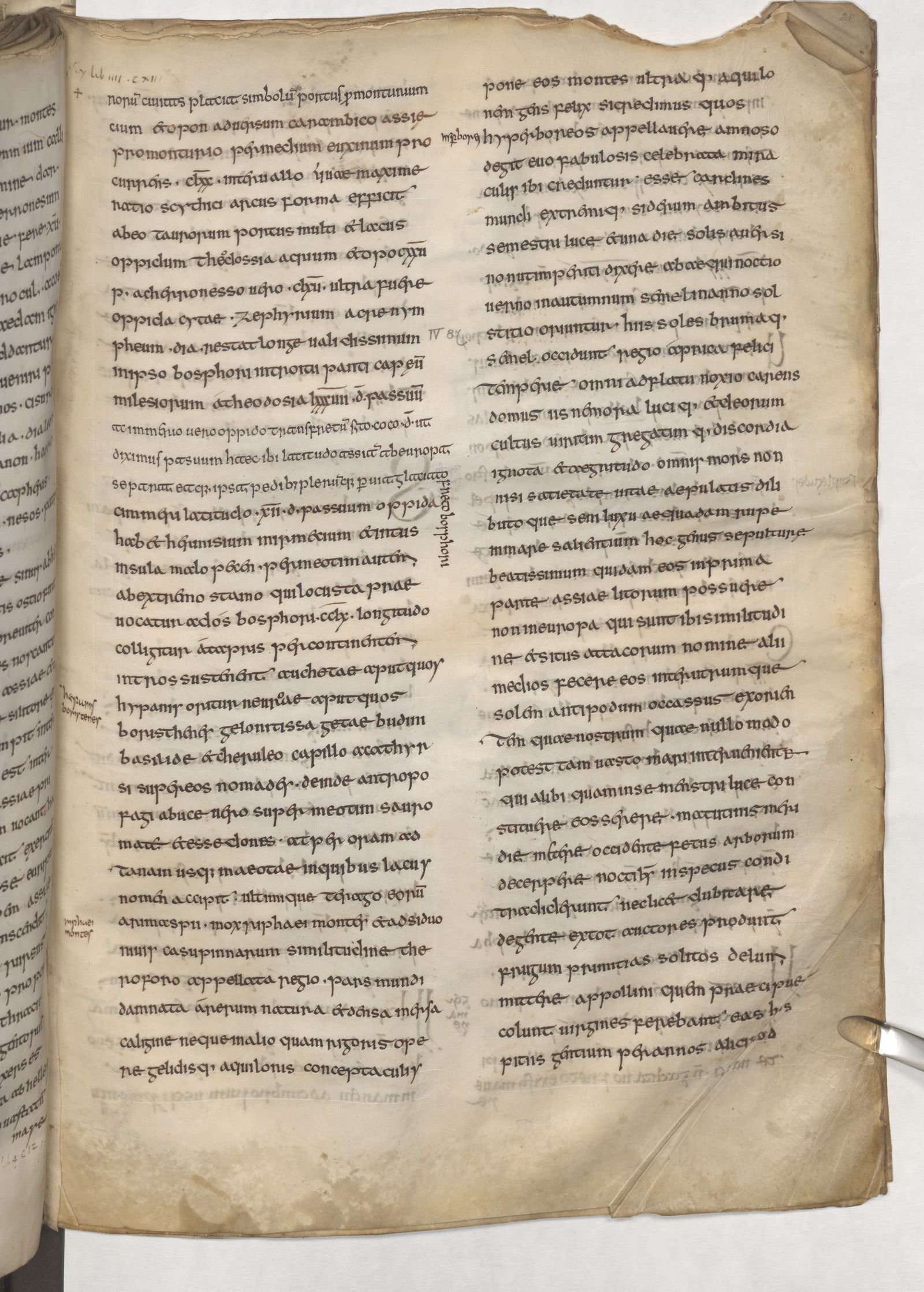
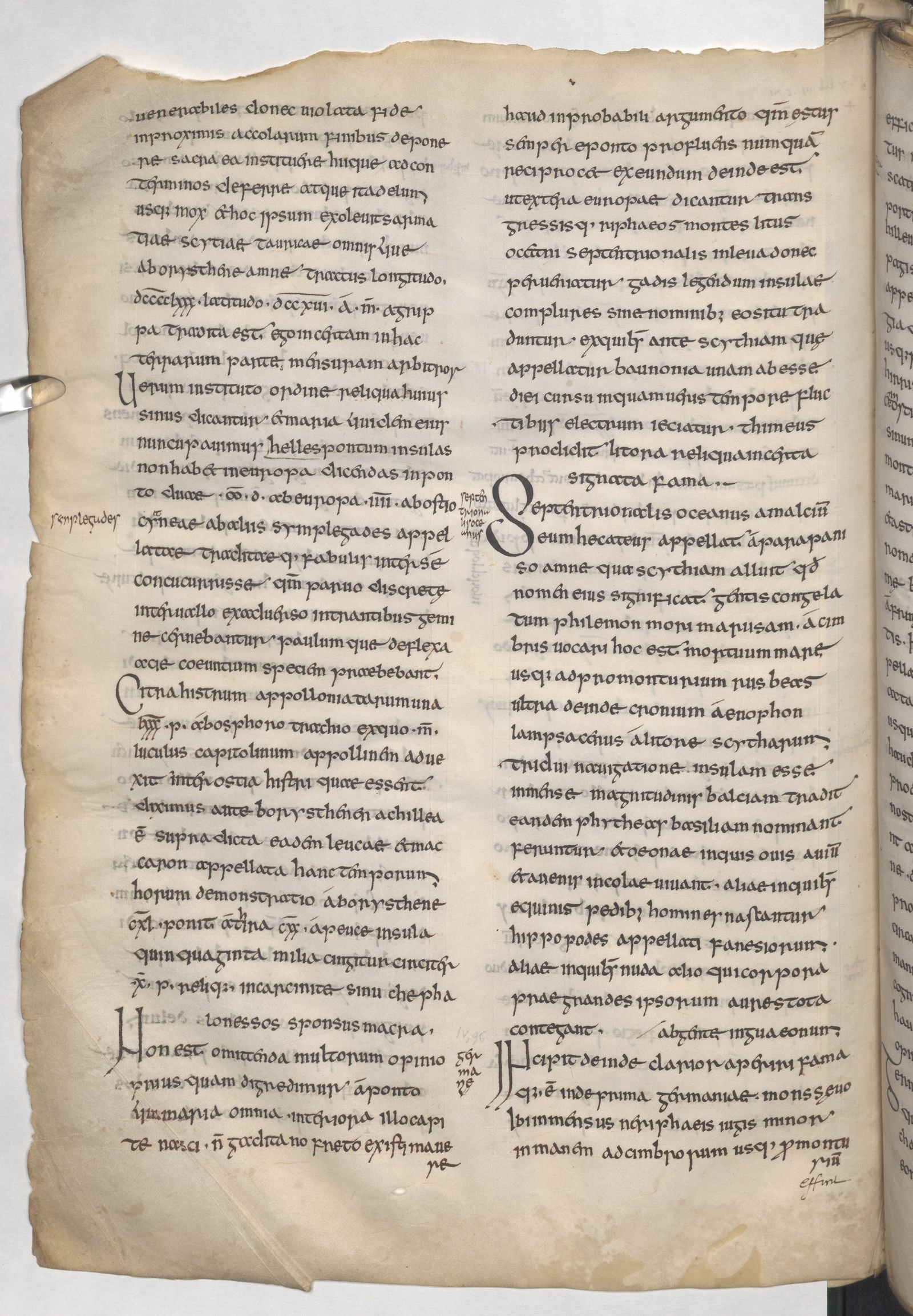
The manuscript is Leiden, Universiteitsbibliotheek, VLF 4 (Voss. Lat. F. 4), the oldest manuscript of these books of the Natural History, written in an insular (Northumbrian) hand in the first half of the 8th century; the Pliny leaves hold parts of books 2-6. Each page has two columns of 36-37 lines. 4.88-91 stand on fol. 27r and the top of 27v; the positions of each section, read on the images, are given in the notes.
The Latin is Karl Mayhoff's Teubner text (via Perseus), not a transcription of the manuscript, whose spelling differs (e.g. 'a tapris', 'ex tot'). The English is the translation of John Bostock and H. T. Riley (1855), divided here at Mayhoff's section breaks by its opening words; its last sentence (4.91) stands at the head of their chapter 27.
How was this verified? (Provenance)
Where on the image
4.88 begins mid-line at fol. 27r col. a line 21 with ‹a tapris per continentem› (Mayhoff 'a Taphris'); line 22 reads ‹introssus tenent auchetae apud quos›; the section ends with the last line of the column, ‹re gelidisque aquilonis conceptaculis›. Read on the Leiden University Libraries images (full pages 27r and 27v and column crops); Mayhoff's apparatus cites this manuscript (A) for the passage.
A Taphris per continentem introrsus tenet Auchetae, apud quos Hypanis oritur, Neuroe, apud quos Borysthenes, Geloni, Thyssagetae, Budini, Basilidae et caeruleo capillo Agathyrsi. super eos Nomades, deinde Anthropophagi, a Buce vero super Maeotim Sauromatae et Essedones. at per oram ad Tanain usque Maeotae, a quibus lacus nomen accepit, ultimique a tergo eorum Arimaspi. mox Ripaei montes et adsiduo nivis casu pinnarum similitudine Pterophoros appellata regio, pars mundi damnata a rerum natura et densa mersa caligine neque in alio quam rigoris opere gelidisque Aquilonis conceptaculis.
Leaving Taphræ, and going along the mainland, we find in the interior the Auchetæ, in whose country the Hypanis has its rise, as also the Neurœ, in whose district the Borysthenes has its source, the Geloni, the Thyssagetæ, the Budini, the Basilidæ, and the Agathyrsi with their azure-coloured hair. Above them are the Nomades, and then a nation of Anthropophagi or cannibals. On leaving Lake Buges, above the Lake Mæotis we come to the Sauromatæ and the Essedones. Along the coast, as far as the river Tanais, are the Mæotæ, from whom the lake derives its name, and the last of all, in the rear of them, the Arimaspi. We then come to the Riphæan mountains, and the region known by the name of Pterophoros, because of the perpetual fall of snow there, the flakes of which resemble feathers; a part of the world which has been condemned by the decree of nature to lie immersed in thick darkness; suited for nothing but the generation of cold, and to be the asylum of the chilling blasts of the northern winds.
Where on the image
4.89 opens fol. 27r col. b: line 1 ‹pone eos montes ultraque aquilo-›, line 2 ‹nem gens felix si credimus quos›, line 3 ‹hyperboreos appellavere annoso› (margin gloss 'hyperborei'); it ends at line 19 with ‹beatissimum›. Read on the Leiden University Libraries images (full pages 27r and 27v and column crops); Mayhoff's apparatus cites this manuscript (A) for the passage.
Pone eos montes ultraque Aquilonem gens felix, si credimus, quos Hyperboreos appellavere, annoso degit aevo, fabulosis celebrata miraculis. ibi creduntur esse cardines mundi extremique siderum ambitus semenstri luce [et una die] solis adversi, non, ut imperiti dixere, ab aequinoctio verno in autumnum: semel in anno solstitio oriuntur iis soles brumaque semel occidunt. regio aprica, felici temperie , omni adflatu noxio carens. domus iis nemora lucique , et deorum cultus viritim gregatimque, discordia ignota et aegritudo omnis. mors non nisi satietate vitae epulatis delibutoque senio luxu e quadam rupe in mare salientibus; hoc genus sepulturae beatissimum.
Behind these mountains, and beyond the region of the northern winds, there dwells, if we choose to believe it, a happy race, known as the Hyperborei, a race that lives to an extreme old age, and which has been the subject of many marvellous stories. At this spot are supposed to be the hinges upon which the world revolves, and the extreme limits of the revolutions of the stars. Here we find light for six months together, given by the sun in one continuous day, who does not, however, as some ignorant persons have asserted, conceal himself from the vernal equinox to autumn. On the contrary, to these people there is but one rising of the sun for the year, and that at the summer solstice, and but one setting, at the winter solstice. This region, warmed by the rays of the sun, is of a most delightful temperature, and exempt from every noxious blast. The abodes of the natives are the woods and groves; the gods receive their worship singly and in groups, while all discord and every kind of sickness are things utterly unknown. Death comes upon them only when satiated with life; after a career of feasting, in an old age sated with every luxury, they leap from a certain rock there into the sea; and this they deem the most desirable mode of ending existence.
Where on the image
4.90 begins mid-line at fol. 27r col. b line 19, ‹quidam eos in prima›, and ends at line 31 with ‹tradiderunt›. Read on the Leiden University Libraries images (full pages 27r and 27v and column crops); Mayhoff's apparatus cites this manuscript (A) for the passage.
quidam eos in prima parte Asiae litorum posuere, non in Europa, quia sunt ibi similitudine et situs Attacorum nomine. alii medios fecere eos inter utrumque solem, antipodum occasus exorientemque nostrum, quod fieri nullo modo potest tam vasto mari interveniente. qui alibi quam in semenstri luce constituere eos, serere matutinis, meridie metere, occidente fetus arborum decerpere, noctibus in specus condi tradiderunt.
Some writers have placed these people, not in Europe, but at the very verge of the shores of Asia, because we find there a people called the Attacori, who greatly resemble them and occupy a very similar locality. Other writers again have placed them midway between the two suns, at the spot where it sets to the Antipodes and rises to us; a thing however that cannot possibly be, in consequence of the vast tract of sea which there intervenes. Those writers who place them nowhere but under a day which lasts for six months, state that in the morning they sow, at mid-day they reap, at sunset they gather in the fruits of the trees, and during the night conceal themselves in caves.
Where on the image
4.91 begins mid-line at fol. 27r col. b line 31, ‹nec licet dubitare› (line 32 ‹de gente ex tot auctores produnt›, the scribe's 'ex' for 'ea:'); col. b ends ‹pitiis gentium per annos aliquot› and fol. 27v col. a begins ‹venerabiles donec violata fide›; the section ends at fol. 27v col. a line 13 with ‹nuncupavimus›, followed on the same line by 4.92 ‹hellespontum insulas›. Read on the Leiden University Libraries images (full pages 27r and 27v and column crops); Mayhoff's apparatus cites this manuscript (A) for the passage.
nec licet dubitare de gente ea: tot auctores produnt frugum primitias solitos Delum mittere Apollini, quem praecipue colunt. virgines ferebant eas, hospitiis gentium per annos aliquot venerabiles, donec violata fide in proximis accolarum finibus deponere sacra ea instituere iique ad conterminos deferre atque ita Delum usque. mox et hoc ipsum exolevit. Sarmatiae, Scythiae, Tauricae omnisque a Borysthene amne tractus longitude DCCCCLXXX, latitudo DCCXVI a M. Agrippa tradita est. ego incertam in hac terrarum parte mensuram arbitror. Verum instituto ordine reliqua huius sinus dicantur, et maria quidem eius nuncupavimus.
Nor are we at liberty to entertain any doubts as to the existence of this race; so many authors are there who assert that they were in the habit of sending their first-fruits to Delos to present them to Apollo, whom in especial they worship. Virgins used to carry them, who for many years were held in high veneration, and received the rites of hospitality from the nations that lay on the route; until at last, in consequence of repeated violations of good faith, the Hyperboreans came to the determination to deposit these offerings upon the frontiers of the people who adjoined them, and they in their turn were to convey them on to their neighbours, and so from one to the other, till they should have arrived at Delos. However, this custom, even, in time fell into disuse. The length of Sarmatia, Scythia, and Taurica, and of the whole of the region which extends from the river Borysthenes, is, according to Agrippa, 980 miles, and its breadth 717. I am of opinion, however, that in this part of the earth all estimates of measurement are exceedingly doubtful. But now, in conformity with the plan which I originally proposed, the remaining portions of this gulf must be described. As for its seas, we have already made mention of them.
Notes
- Bostock and Riley's footnotes are omitted.
- Pliny returns to the Hyperboreans at 6.34 and 6.55 (not included).
Cite
Sources
- Source: Leiden, UB, VLF 4 (Pliny A, 8th c.) fol. 27r-27v + Mayhoff's Latin (Perseus) + Bostock and Riley's English (1855, Perseus) (holding institution)
- Critical edition: Perseus editions named per passage
← previous · → next · v cycle view · l back to library