Pomponius Mela, Chorographia 3.36-37: the Hyperboreans under the pole
Introduction
Pomponius Mela, from Tingentera in southern Spain, wrote his Chorographia, the oldest surviving Latin geography, in the early 40s AD. Following the northern shore of Asia, he places the Hyperboreans first, beyond the north wind and the Rhipaean mountains under the very pole, where day and night each last six months (3.36). Their land is narrow, sunny and fertile; they are the most just of men and live longer and more happily than any, at peace, devoted to Apollo, to whom they sent first-fruits at Delos; when sated with life they crown themselves and leap from a rock into the sea (3.37).
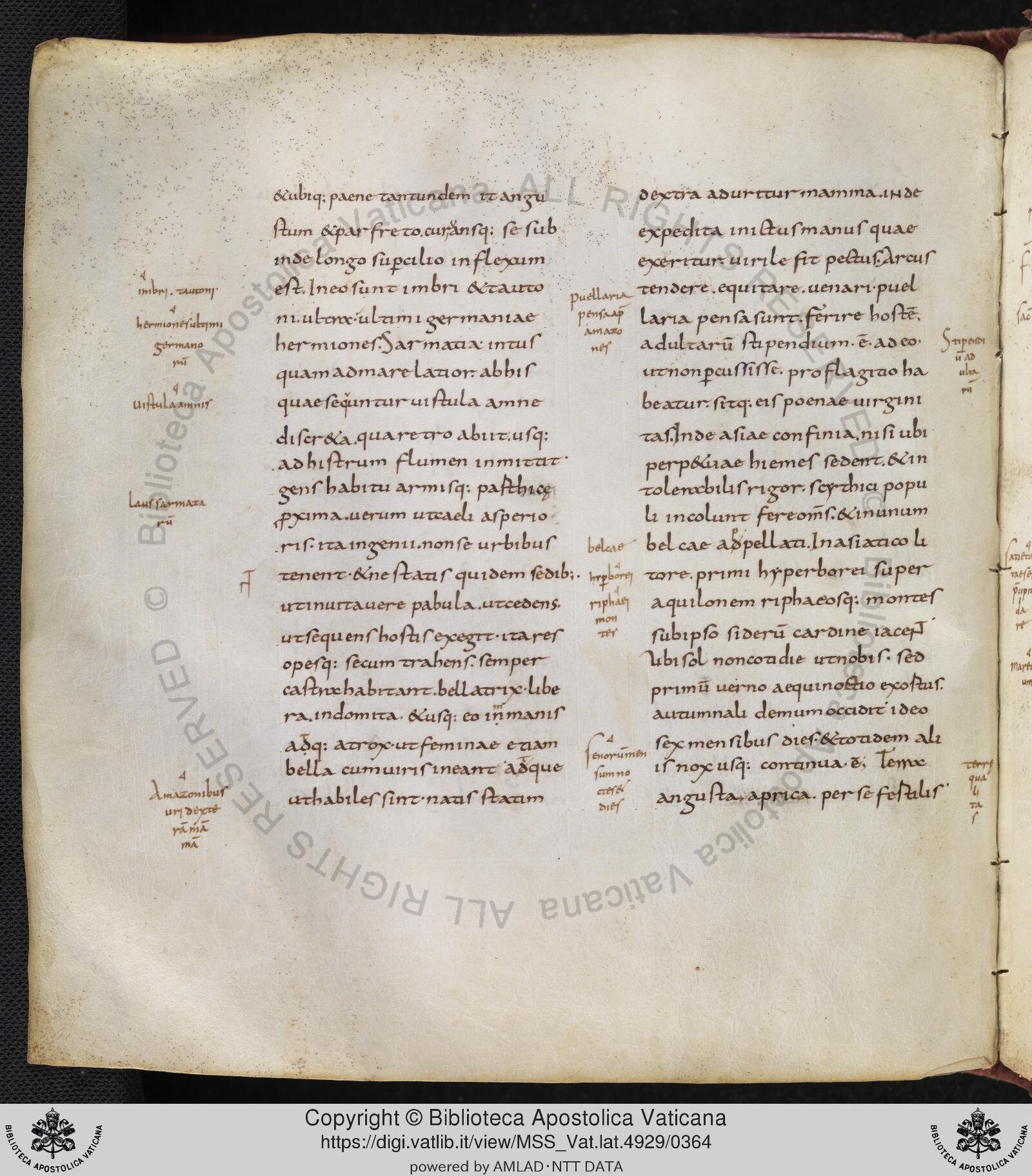
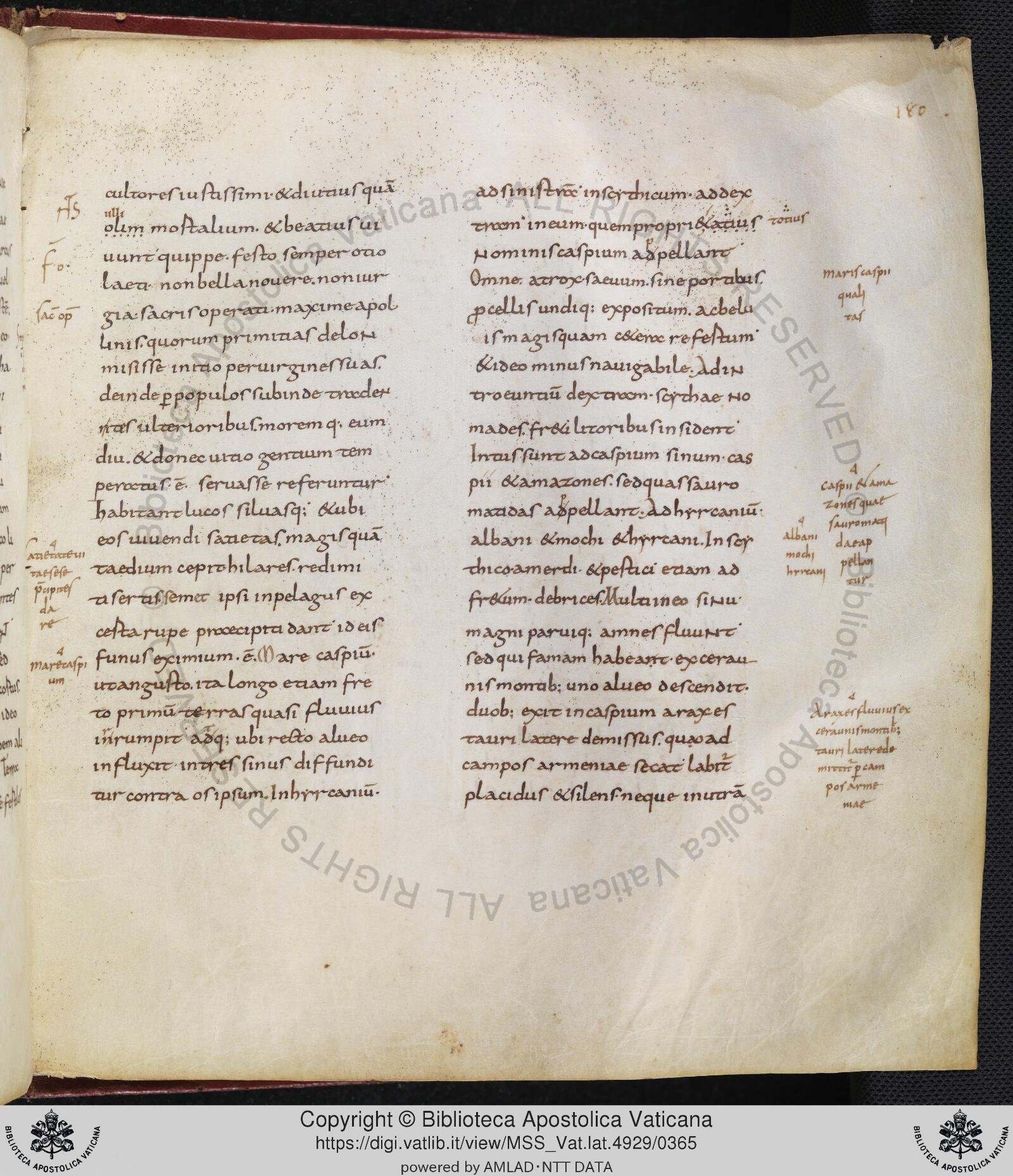
The manuscript is Vatican, Biblioteca Apostolica Vaticana, Vat. lat. 4929, written in the 9th century at Auxerre, the sole independent witness to Mela's text (siglum A). Each page has two columns of 22 lines. 3.36-37 run from fol. 179v col. b to fol. 180r col. a; the positions, read on the images, are given in the notes.
The Latin is Carl Frick's Teubner edition (Leipzig, 1880), whose apparatus collates this manuscript; it was transcribed for this entry from the printed page images. The English is Arthur Golding's translation, The worke of Pomponius Mela, the cosmographer (London, 1585), in the Early English Books Online Text Creation Partnership edition, with its original spelling.
How was this verified? (Provenance)
Where on the image
3.36 begins mid-line at fol. 179v col. b line 9: ‹tas. Inde asiae confinia nisi ubi› (the end of 'virginitas' and the start of 3.36); lines 13-14 read ‹belcae appellati. In asiatico li- / tore primi hyperborei super›; the section ends at line 21 with ‹nox usque continua est›. Checked on the DigiVatLib image (full page and column crops). Viewer: https://digi.vatlib.it/view/MSS_Vat.lat.4929/0364
Inde Asiae confinia nisi ubi perpetuae hiemes sedent et intolerabilis rigor. Scythici populi incolunt, fere omnes et in unum Belcae adpellati. in Asiatico litore primi Hyperborei super aquilonem Riphaeosque montes sub ipso siderum cardine iacent; ubi sol non cotidie ut nobis sed primum verno aequinoctio exortus autumnali demum occidit; ideo sex mensibus dies et totidem aliis nox usque continua est.
FRom thence-foorth, the Sea coastes of Asia, sauing where the snowe lyeth continuallie, and where the colde is intollerable, are inhabited by the Nations of Scithia, called almost all by one name, vniuersallie Sages. The first vpon the Sea coast of Asia, be the Hyperboreans, furthest North beyond the Riphoean mountaines, vnder the verie North-pole: in which Countrie the Sunne dooth not rise and set daylie, as it dooth with vs: but it ryseth in the Lenton equinoctiall, and setteth not againe, tyll the Haruest equinoctiall, by reason whereof, it is daye by the space of sixe whole monethes together, and likewise night, by the space of other sixe monethes.
Where on the image
3.37 begins mid-line at fol. 179v col. b line 21 (‹Terra›), line 22 ‹angusta aprica per se fertilis› ends the page; fol. 180r col. a begins ‹cultores iustissimi et diutius quam› ('olim', corrected to 'ulli' above the line, on line 2) and the section ends at line 17 with ‹funus eximium est›, followed on the same line by 3.38 ‹Mare caspium›. Checked on the DigiVatLib images. Viewers: https://digi.vatlib.it/view/MSS_Vat.lat.4929/0364 , https://digi.vatlib.it/view/MSS_Vat.lat.4929/0365
terra angusta aprica per se fertilis. cultores iustissimi et diutius quam ulli mortalium et beatius vivunt. quippe festo semper otio laeti non bella novere non iurgia, sacris operati maxime Apollinis, quorum primitias Delon misisse initio per virgines suas, deinde per populos subinde tradentes ulterioribus, moremque eum diu et donec vitio gentium temeratus est servasse referuntur. habitant lucos silvasque, et ubi eos vivendi satietas magis quam taedium cepit, hilares redimiti sertis semet ipsi in pelagus ex certa rupe praecipites dant. id eis funus eximium est.
The Land is narrowe, open to the Sunne, & fruitfull: the Inhabiters are most vpright dealers, and liue both longer, & more happilie than other men. For they enioying alwaies feastfull peace, can no skill of warre, nor of quarelling, but doo buste themselues about matters of Religion, specially cōcerning Apollo, the first fruites whereof, they be reported to haue sent to Delos, at the first by certaine Uirgins of theirs, and afterward by their neighbour Nations, deliuering them from one to an other, styll further & further, which custome they kept long time, vntill at length it was restrained, through default of those Nations. Their dwelling is in Woods and Forrests: and when suffizance, or rather wearines of life commeth vpon them, then decking themselues with garlands, they throwe themselues chéerfully headlong into the Sea▪ from a certaine rocke, which vnto them is the honourablest buriall that can be.
Notes
- Golding's English keeps the 1585 spelling as keyed by EEBO-TCP (e.g. 'vnder', 'buste' for 'busie'); the mark ▪ is TCP's sign for an unidentified punctuation mark in the print.
- Frick's section numbers are used; the Latin Library text numbers these sections differently.
Cite
Sources
- Source: Vatican Library, Vat. lat. 4929 (9th c.) fol. 179v-180r via DigiVatLib + Frick's Latin (Teubner 1880) + Golding's English (1585, EEBO-TCP) (holding institution)
- Critical edition: Perseus editions named per passage
← previous · → next · v cycle view · l back to library