Strabo, Geography 15.1.57: Megasthenes' marvels and the thousand-year Hyperboreans
Introduction
At 15.1.57 Strabo lists, and dismisses, the marvels told by Megasthenes about India: men of three spans who fight cranes, men with ears they sleep in, and, he says, the Hyperboreans who live a thousand years, described as Simonides, Pindar and other myth-writers described them.
The manuscript is Paris, BnF, grec 1393 (Strabo C), late 13th or early 14th century. 15.1.57 stands on fol. 207v, lines 7-28.
How was this verified? (Provenance)
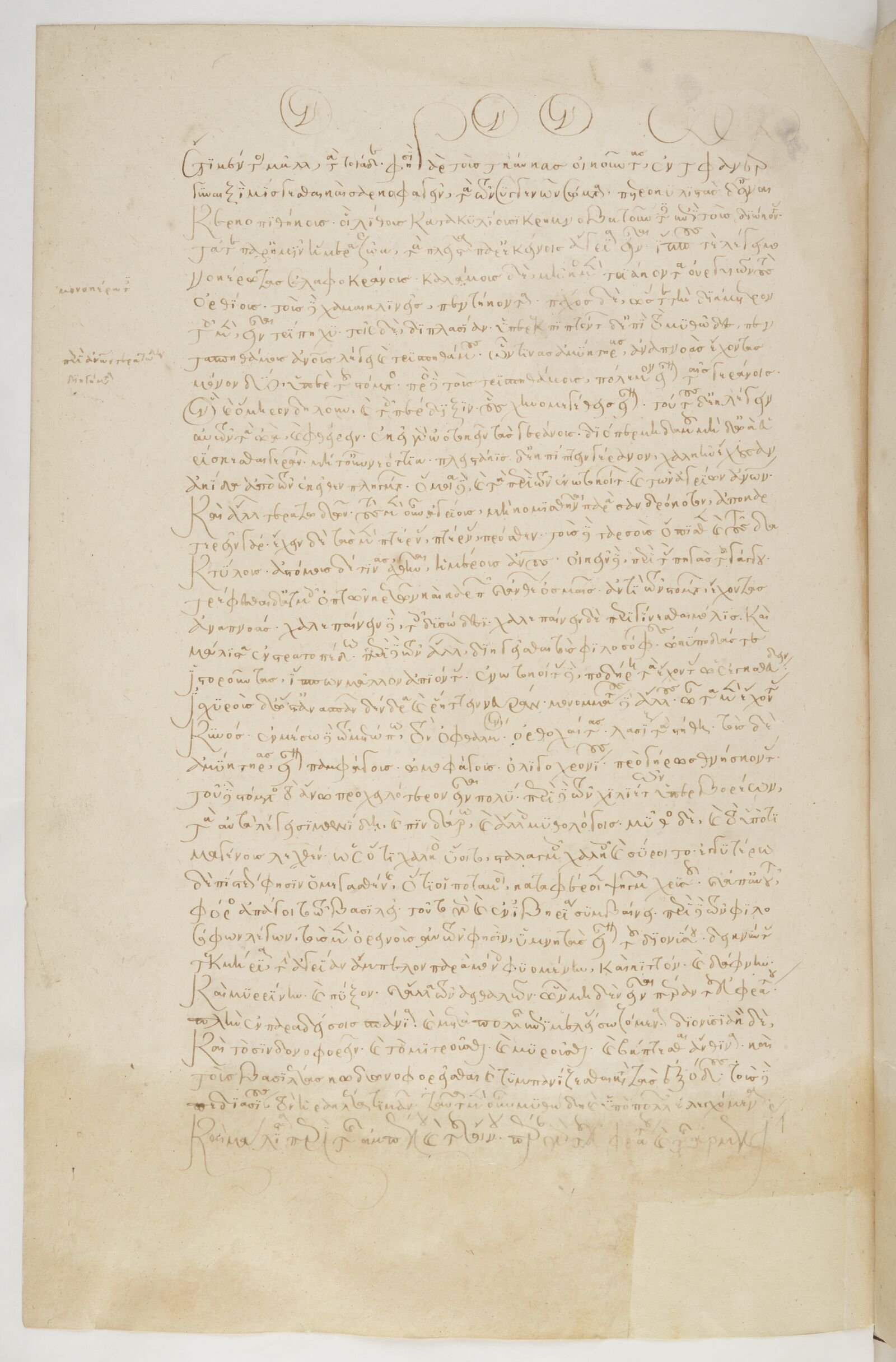
Where on the image
15.1.57 begins at fol. 207v line 7, ‹ὑπερεκπίπτων δ' ἐπὶ τὸ μυθῶδες πεν-|τασπιθάμους›, after ‹τοὺς δὲ διπλασίους›; ‹περὶ δὲ τῶν χιλιετῶν ὑπερβορέων› closes line 24 and line 25 reads ‹τὰ αὐτὰ λέγει σιμωνίδῃ καὶ πινδάρῳ›; Megasthenes is named on line 27; the section ends at line 28, ‹καὶ ἐν ἰβηρίᾳ συμβαίνει›, followed by 15.1.58. Read on the BnF images (line-numbered page and crops).
̔υπερεκπίπτων δʼ ἐπὶ τὸ μυθῶδες πεντασπιθάμους ἀνθρώπους λέγει καὶ τρισπιθάμους, ὧν τινὰς ἀμύκτηρας, ἀναπνοὰς ἔχοντας μόνον δύο ὑπὲρ τοῦ στόματος· πρὸς δὲ τοὺς τρισπιθάμους πόλεμον εἶναι ταῖς γεράνοις (ὃν καὶ Ὅμηρον δηλοῦν) καὶ τοῖς πέρδιξιν, οὓς χηνομεγέθεις εἶναι· τούτους δʼ ἐκλέγειν αὐτῶν τὰ ᾠὰ καὶ φθείρειν· ἐκεῖ γὰρ ᾠοτοκεῖν τὰς γεράνους· διόπερ μηδαμοῦ μήτʼ ᾠὰ εὑρίσκεσθαι γεράνων, μήτʼ οὖν νεόττια· πλειστάκις δʼ ἐκπίπτειν γέρανον χαλκῆν ἔχουσαν ἀκίδα ἀπὸ τῶν ἐκεῖθεν πληγμάτων. ὅμοια δὲ καὶ τὰ περὶ τῶν ἐνωτοκοιτῶν καὶ τῶν ἀγρίων ἀνθρώπων καὶ ἄλλων τερατωδῶν. τοὺς μὲν οὖν ἀγρίους μὴ κομισθῆναι παρὰ Σανδρόκοττον· ἀποκαρτερεῖν γάρ· ἔχειν δὲ τὰς μὲν πτέρνας πρόσθεν, τοὺς δὲ ταρσοὺς ὄπισθεν καὶ τοὺς δακτύλους. ἀστόμους δέ τινας ἀχθῆναι ἡμέρους ἀνθρώπους· οἰκεῖν δὲ περὶ τὰς πηγὰς τοῦ Γάγγου, τρέφεσθαι δʼ ἀτμοῖς ὀπτῶν κρεῶν καὶ καρπῶν καὶ ἀνθέων ὀσμαῖς, ἀντὶ τῶν στομάτων ἔχοντας ἀναπνοάς, χαλεπαίνειν δὲ τοῖς δυσώδεσι, καὶ διὰ τοῦτο περιγίνεσθαι μόλις καὶ μάλιστα ἐν στρατοπέδῳ. περὶ δὲ τῶν ἄλλων διηγεῖσθαι τοὺς φιλοσόφους, ὠκύποδάς τε ἱστοροῦντας ἵππων μᾶλλον ἀπιόντας, ἐνωτοκοίτας τε ποδήρη τὰ ὦτα ἔχοντας ὡς ἐγκαθεύδειν, ἰσχυροὺς δʼ ὥστʼ ἀνασπᾶν δένδρα καὶ ῥήττειν νευράν, μονομμάτους τε ἄλλους ὦτα μὲν ἔχοντας κυνὸς ἐν μέσῳ δὲ τῷ μετώπῳ τὸν ὀφθαλμόν, ὀρθοχαίτας, λασίους τὰ στήθη· τοὺς δὲ ἀμύκτηρας εἶναι παμφάγους ὠμοφάγους ὀλιγοχρονίους πρὸ γήρως θνήσκοντας· τοῦ δὲ στόματος τὸ ἄνω προχειλότερον εἶναι πολύ. περὶ δὲ τῶν χιλιετῶν Ὑπερβορέων τὰ αὐτὰ λέγει Σιμωνίδῃ καὶ Πινδάρῳ καὶ ἄλλοις μυθολόγοις. μῦθος δὲ καὶ τὸ ὑπὸ Τιμαγένους λεχθὲν ὅτι χαλκὸς ὕοιτο σταλαγμοῖς χαλκοῖς καὶ σύροιτο. ἐγγυτέρω δὲ πίστεώς φησιν ὁ Μεγασθένης ὅτι οἱ ποταμοὶ καταφέροιεν ψῆγμα χρυσοῦ καὶ ἀπʼ αὐτοῦ φόρος ἀπάγοιτο τῷ βασιλεῖ· τοῦτο γὰρ καὶ ἐν Ἰβηρίᾳ συμβαίνει.
He then deviates into fables, and says that there are men of five, and even three spans in height, some of whom are without nostrils, with only two breathing orifices above the mouth. Those of three spans in height wage war with the cranes (described by Homer) and with the partridges, which are as large as geese; these people collect and destroy the eggs of the cranes which lay their eggs there; and nowhere else are the eggs or the young cranes to be found; frequently a crane escapes from this country with a brazen point of a weapon in its body, wounded by these people.
Similar to this is the account of the Enotocoitae, of the wild men, and of other monsters. The wild men could not be brought to Sandrocottus, for they died by abstaining from food. Their heels are in front, the instep and toes are turned backwards. Some have been taken, which had no mouths, and were tame. They live near the sources of the Ganges, and are supported by the smell of dressed meat and the fragrance of fruits and flowers, having instead of mouths orifices through which they breathe. They are distressed by strong-smelling substances, and therefore their lives are sustained with difficulty, particularly in a camp.
With respect to the other singular animals, the philosophers informed him of a people called Ocypodae, so swift of foot that they leave horses behind them; of Enotocoitae, or persons having ears hanging down to their feet, so that they lie and sleep upon them, and so strong as to be able to pluck up trees and to break the sinew string of a bow; of others (Monommati) who have only one eye, and the ears of a dog, the eye placed in the middle of the forehead, the hair standing erect, and the breasts shaggy; of others (Amycteres) without nostrils, devouring everything, eaters of raw meat, short-lived, and dying before they arrive at old age; the upper part of their mouths projects far beyond the lower lip.
With respect to the Hyperboreans, who live to the age of a thousand years, his description is the same as that of Simonides, Pindar, and other mythological writers.
The story told by Timagenes of a shower of drops of brass, which were raked together, is a fable. The account of Megasthenes is more probable, namely, that the rivers bring down gold-dust, a part of which is paid as a tax to the king; and this is the case in Iberia (of Armenia).
Notes
- Greek: Meineke's Teubner text (Perseus), not a transcription of the manuscript.
- English: Hamilton and Falconer (Bohn, 1854-1857), who translated the earlier text of Kramer; small differences from Meineke's Greek result.
Cite
Sources
- Source: Paris, BnF, grec 1393 (Strabo C) fol. 207v via Gallica (BnF) + Meineke's Greek (Perseus) + Hamilton and Falconer's English (1854-1857, Perseus) (holding institution)
- Critical edition: Perseus editions named per passage
← previous · → next · v cycle view · l back to library