Strabo, Geography 1.3.22: Eratosthenes, Herodotus and the Hyperboreans
Introduction
Strabo of Amaseia wrote his Geography under Augustus and Tiberius. At 1.3.22 he reports how Eratosthenes answered Herodotus' joke (Hdt. 4.36) that if there are Hyperboreans there must also be Hypernotians, and adds his own view that Herodotus' error lay in thinking the Hyperboreans were so called because the north wind does not blow on them; the poets' commentators, he says, meant simply the most northerly people.
The manuscript is Paris, BnF, grec 1397 (Strabo A), the oldest manuscript of books 1-9, a palimpsest of the 10th-11th century, here in the BnF's black-and-white microfilm images. 1.3.22 stands on fol. 34v, lines 16-34.
How was this verified? (Provenance)
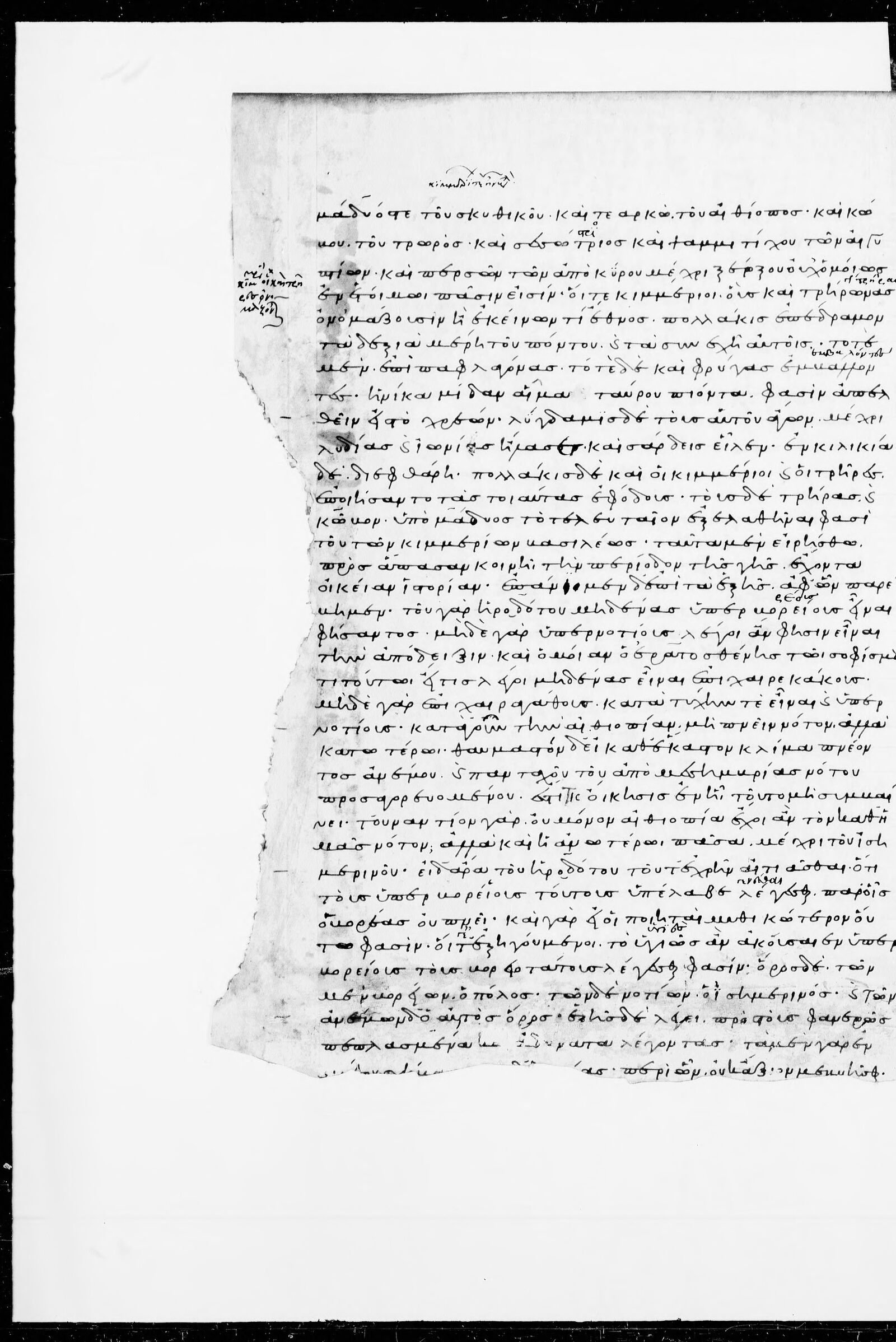
Where on the image
1.3.22 begins at fol. 34v line 16, after ‹οἰκείαν ἱστορίαν›: ‹ἐπάνιμεν δ' ἐπὶ τὰ ἑξῆς· ἀφ' ὧν παρέ-|βημεν›; line 17 has ‹τοῦ γὰρ ἡροδότου μηδένας ὑπερβορείους›; the section ends at line 34, ‹ἀνέμων δ' ὁ αὐτὸς ὅρος›. The page begins ‹μάδυός τε τοῦ σκυθικοῦ› (in 1.3.21); its torn lower edge does not touch lines 16-34. Read on the BnF images (line-numbered page and crops).
Ἐπάνιμεν δʼ ἐπὶ τὰ ἑξῆς ἀφʼ ὧν παρέβημεν. τοῦ γὰρ Ἡροδότου μηδένας ὑπερβορείους εἶναι φήσαντος, μηδὲ γὰρ ὑπερνοτίους, γελοίαν φησὶν εἶναι τὴν ἀπόδειξιν καὶ ὁμοίαν ὁ Ἐρατοσθένης τῷ σοφίσματι τούτῳ, εἴ τις λέγοι μηδένας εἶναι ἐπιχαιρεκάκους, μηδὲ γὰρ ἐπιχαιραγάθους. κατὰ τύχην τε εἶναι καὶ ὑπερνοτίους· κατὰ γοῦν τὴν Αἰθιοπίαν μὴ πνεῖν νότον, ἀλλὰ κατωτέρω. θαυμαστὸν δʼ εἰ καθʼ ἕκαστον κλίμα πνέοντος ἀνέμου καὶ πανταχοῦ τοῦ ἀπὸ μεσημβρίας νότου προσαγορευομένου, ἔστι τις οἴκησις ἐν ᾗ τοῦτο μὴ συμβαίνει. τοὐναντίον γὰρ οὐ μόνον Αἰθιοπία ἔχοι ἂν τὸν καθʼ ἡμᾶς νότον, ἀλλὰ καὶ ἡ ἀνωτέρω πᾶσα μέχρι τοῦ ἰσημερινοῦ. εἰ δʼ ἄρα, τοῦ Ἡροδότου τοῦτʼ ἐχρῆν αἰτιᾶσθαι, ὅτι τοὺς ὑπερβορείους τούτους ὑπέλαβε λέγεσθαι, παρʼ οἷς ὁ βορέας οὐ πνεῖ. καὶ γὰρ εἰ οἱ ποιηταὶ μυθικώτερον οὕτω φασίν, οἵ γʼ ἐξηγούμενοι τὸ ὑγιὲς ἂν ἀκούσαιεν, ὑπερβορείους τοὺς βορειοτάτους λέγεσθαι. ὅρος δὲ τῶν μὲν βορείων ὁ πόλος, τῶν δὲ νοτίων ὁ ἰσημερινός· καὶ τῶν ἀνέμων δʼ ὁ αὐτὸς ὅρος.
We must now return to the point whence we digressed. Herodotus having observed that there could be no such people as Hyperborean, inasmuch as there were no Hypernotii, Eratosthenes calls this argument ridiculous, and compares it to the sophism, that there are no epichaerekaki, inasmuch as there are no epichaeragathi; [adding] perhaps there are Hypernotii; since at all events in Ethiopia Notus does not blow, although lower down it does.
It would indeed be strange, since winds blow under every latitude, and especially the southern wind called Notus, if any region could be found where this latter was not felt. On the contrary, not only does Ethiopia experience our Notus, but also the whole country which lies above as far as the equator.
If Herodotus must be blamed at all, it is for supposing that the Hyperboreans were so named in consequence of Boreas, or the north wind, not blowing upon them. The poets are allowed much licence in their modes of expression; but their commentators, who endeavour always to give us the correct view, tell us that the people who dwelt in the extreme north, were styled Hyperboreans. The pole is the boundary of the northern winds, and the equator of the southern; these winds have no other limit.
Notes
- Greek: Meineke's Teubner text (Perseus), not a transcription of the manuscript.
- English: Hamilton and Falconer (Bohn, 1854-1857), who translated the earlier text of Kramer; small differences from Meineke's Greek result.
Cite
Sources
- Source: Paris, BnF, grec 1397 (Strabo A) fol. 34v via Gallica (BnF) + Meineke's Greek (Perseus) + Hamilton and Falconer's English (1854-1857, Perseus) (holding institution)
- Critical edition: Perseus editions named per passage
← previous · → next · v cycle view · l back to library