P46 (Chester Beatty II): 1 Corinthians 10:11-11:6 (fols. 50r-51r)
Introduction
P46 is a papyrus codex of the letters of Paul copied in Egypt around 200, the oldest surviving collection of Paul's letters. 86 of its 104 leaves survive: 56 in the Chester Beatty Library, Dublin (Biblical Papyrus II, published by Frederic Kenyon in 1934-1937) and 30 in the University of Michigan Library, Ann Arbor (P.Mich. inv. 6238, published by Henry Sanders in 1935). The letters run in the order Romans, Hebrews, 1 and 2 Corinthians, Ephesians, Galatians, Philippians, Colossians and 1 Thessalonians; the first seven leaves (Romans 1:1-5:17) and the end of the book are lost. Hebrews standing after Romans, and the doxology of Romans (16:25-27) standing after 15:33, are among its best-known features.
Each section below is one page side: the holding library's photograph, the NTVMR diplomatic transcription line by line, and the King James Version of every verse that has text on the page. The lower lines of many leaves are lost; the transcribers' restorations are in square brackets.
This entry covers fols. 50r-51r (1 Corinthians 10:11-11:6).
How was this verified? (Provenance)
Where on the image
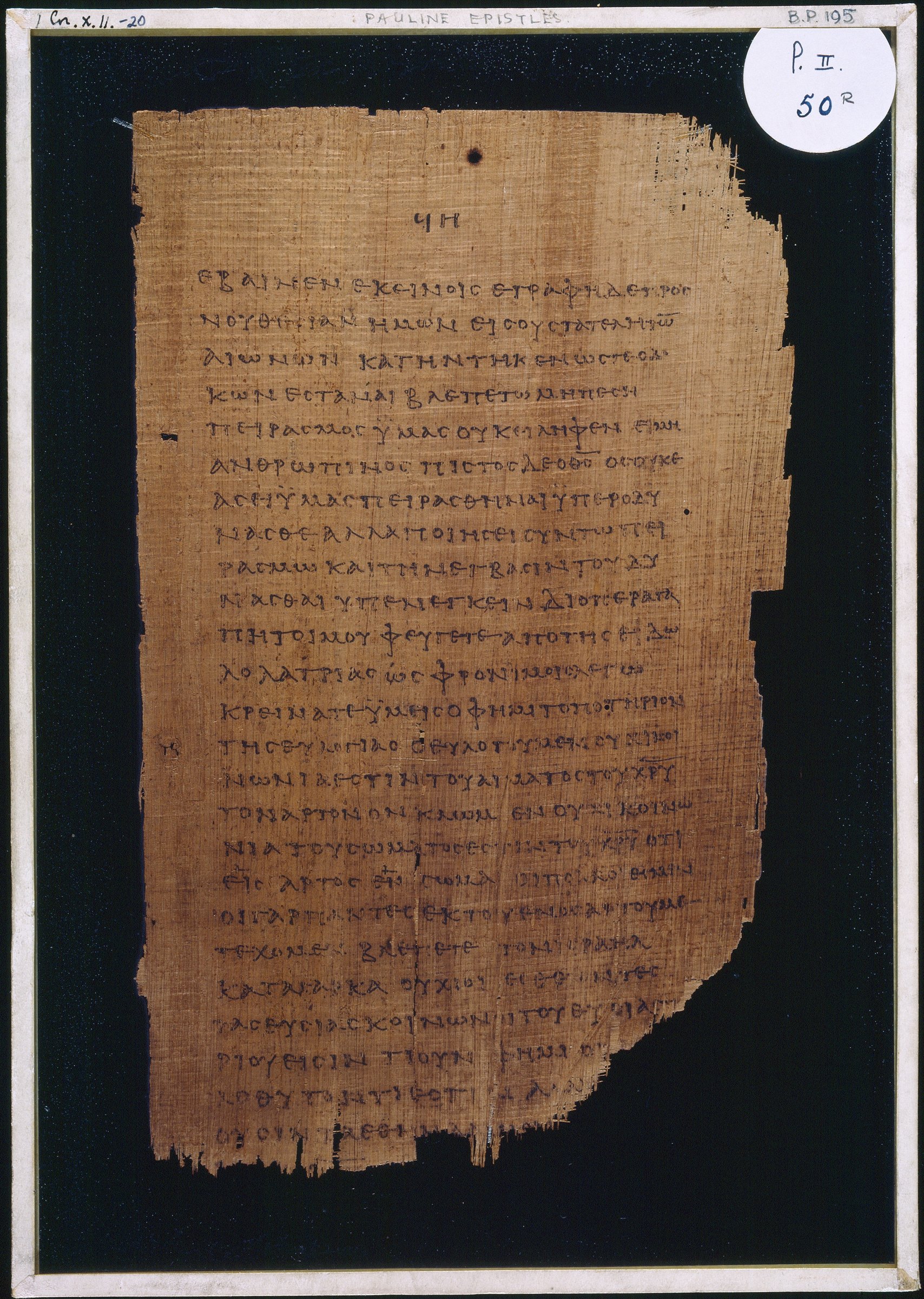
Chester Beatty Library photograph T0005606.jpg (https://ntmss.info/images/webfriendly/10046/T0005606.jpg), linked to NTVMR page 810 (folio 50r) in NTVMR's page index. 10:11 begins on the previous page; 10:20 continues on the next page. Checked on the image: the disc on the frame reads ‹P. II 50R›.
10:11 εβαινεν εκεινοις εγραφη δε π̣ρος
νουθεσιαν ημων εις ους τα τελη των
αιωνων κατηντηκεν 12 ωστε ο δο̣
κων εσταναι βλεπετω μη πεση
13 πειρασμος υμας ουκ ειληφεν ει μη
ανθρωπινος πιστος δε ο θ̅ς̅ ος ουκ ε
ασει υμας πειρασθηναι υπερ ο δυ
νασθε αλλα ποιησει συν τω πει
ρασμω και την εγβασιν του δυ
νασθαι υπενεγκειν 14 διοπερ αγα
πητοι μου φευγετε απο της ειδω
λολατριας 15 ως φρονιμοις λεγω
κρεινατε υμεις ο φημι 16 το ποτηριον
της ευλογιας ο ευλογουμεν ουχι κοι
νωνια εστιν του αιματος του χ̅ρ̅υ̅
τον αρτον ον κλωμεν ουχι κοινω
νια του σωματος εστιν του χ̅ρ̅υ̅ 17 οτι
εις αρτος εν σωμα οι πολλοι̣ εσμεν
οι γαρ παντες εκ του ενος αρτου με
τεχομεν̣ 18 βλεπετε τον ισραηλ
κατα σαρκα ουχι οι εσθει̣οντες
τας θυσιας κοινωνο̣ι του θυσιαστ̣[η]
ριου εισιν 19 τι ουν φημι οτ̣[ι ειδω]
λ̣ο̣θυτον τι εστιν 20 αλ̣λ [οτι α θυ]
ουσιν τ̣α̣ εθν̣η̣ δ̣α̣[ι]μ̣ο̣ν̣[ιοις θυουσιν]
[και ου θ̅ω̅ ου θελω δε υμας κοινω]
[νους]
10:11Now all these things happened unto them for ensamples: and they are written for our admonition, upon whom the ends of the world are come. 12Wherefore let him that thinketh he standeth take heed lest he fall. 13There hath no temptation taken you but such as is common to man: but God is faithful, who will not suffer you to be tempted above that ye are able; but will with the temptation also make a way to escape, that ye may be able to bear it. 14Wherefore, my dearly beloved, flee from idolatry. 15I speak as to wise men; judge ye what I say. 16The cup of blessing which we bless, is it not the communion of the blood of Christ? The bread which we break, is it not the communion of the body of Christ? 17For we being many are one bread, and one body: for we are all partakers of that one bread. 18Behold Israel after the flesh: are not they which eat of the sacrifices partakers of the altar? 19What say I then? that the idol is any thing, or that which is offered in sacrifice to idols is any thing? 20But I say, that the things which the Gentiles sacrifice, they sacrifice to devils, and not to God: and I would not that ye should have fellowship with devils.
Where on the image
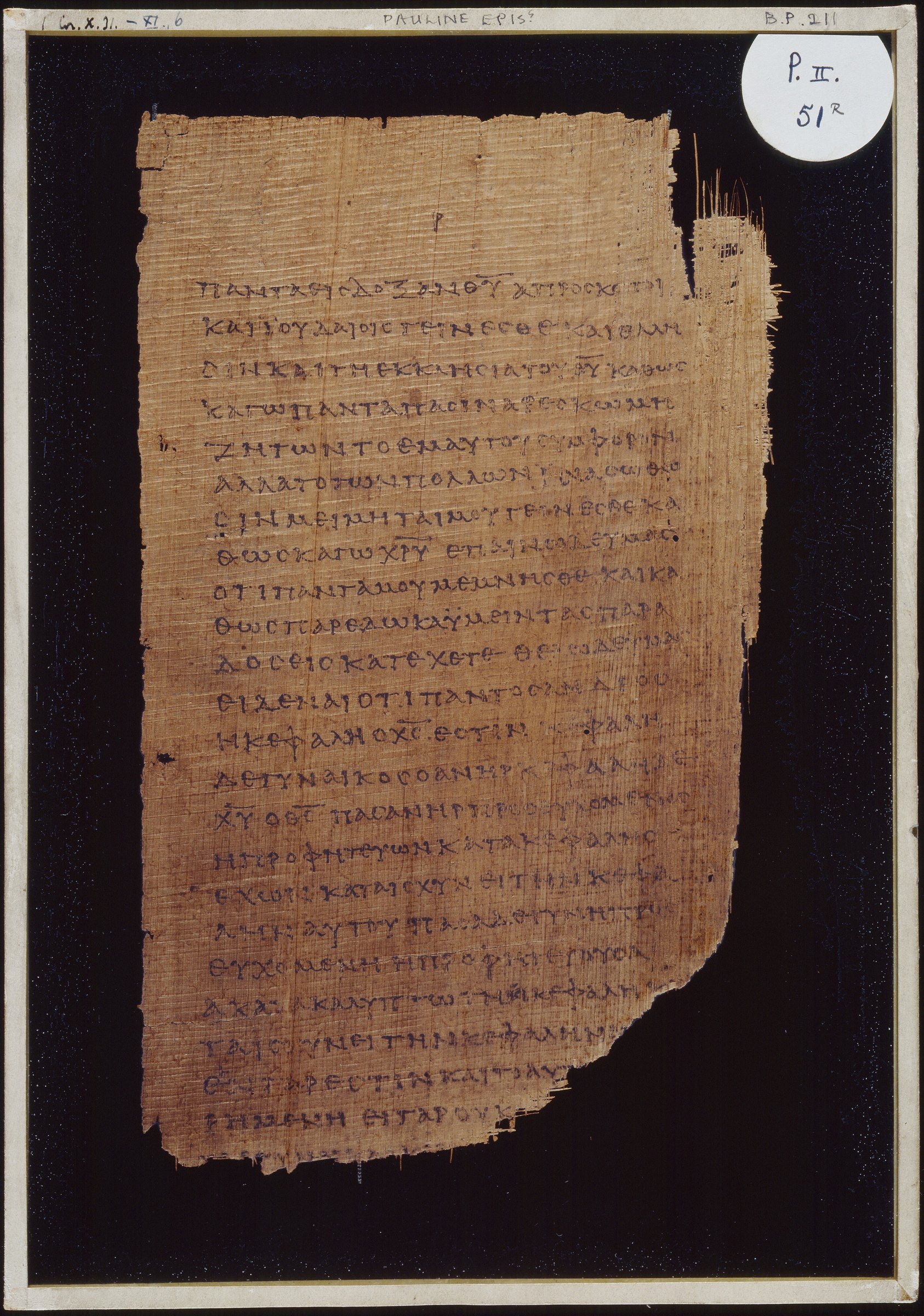
Chester Beatty Library photograph T0005608.jpg (https://ntmss.info/images/webfriendly/10046/T0005608.jpg), linked to NTVMR page 830 (folio 51r) in NTVMR's page index. 10:31 begins on the previous page; 11:6 continues on the next page. Checked on the image: the disc on the frame reads ‹P. II 51R›.
10:31 παντα εις δοξαν θ̅υ̅ 32 απροσκο̣π̣ο̣ι
και ιουδαιοις γεινεσθε και ελλη
σιν και τη εκκλησια του θ̅υ̅ 33 καθως
καγω παντα πασιν αρεσκω μη
ζητων το εμαυτου συμφορο̣ν
αλλα το των πολλων ινα σωθω
σιν 11:1 μειμηται μου γεινεσθε κα
θως καγω χ̅ρ̅υ̅ 2 επαινω δε υμας
οτι παντα μου μεμνησθε και κα
θως παρεδωκα υμειν τας παρα
δοσεις κατεχετε 3 θελ̣ω δε υμας̣
ειδεναι οτι παντος ανδρος
η κεφαλη ο χ̅ς̅ εστιν κε̣φαλη
δε γυναικος ο ανηρ κεφαλη δε
χ̅υ̅ ο θ̅ς̅ 4 πας ανηρ προσευχομενος
η προφητευων κατα κεφαλης
εχων καταισχυνει την κεφα
λην αυτου 5 πασα δε γυνη προσ
ευχομενη η προφητευουσα
ακατ̣ακαλυπτω την κεφαλη κ̣α̣
ταισχυνει την κεφαλην ε̣[αυτης]
εν γαρ εστιν και το αυτ̣[ο τη εξυ]
ρημενη 6 ει γαρ ου κ[ατακαλυπτε]
τ̣[α]ι̣ γ̣υν̣η̣ κ̣α̣ι̣ κ̣[ειρασθω ει δε]
10:31Whether therefore ye eat, or drink, or whatsoever ye do, do all to the glory of God. 32Give none offence, neither to the Jews, nor to the Gentiles, nor to the church of God: 33Even as I please all men in all things, not seeking mine own profit, but the profit of many, that they may be saved. 11:1Be ye followers of me, even as I also am of Christ. 2Now I praise you, brethren, that ye remember me in all things, and keep the ordinances, as I delivered them to you. 3But I would have you know, that the head of every man is Christ; and the head of the woman is the man; and the head of Christ is God. 4Every man praying or prophesying, having his head covered, dishonoureth his head. 5But every woman that prayeth or prophesieth with her head uncovered dishonoureth her head: for that is even all one as if she were shaven. 6For if the woman be not covered, let her also be shorn: but if it be a shame for a woman to be shorn or shaven, let her be covered.
Notes
- Greek: the NTVMR diplomatic transcription, line by line as on the papyrus. Square brackets enclose letters that are lost or illegible and were supplied by the transcribers; a dot under a letter marks it as uncertain; [...] marks a gap. Nomina sacra and numerals keep the scribe's overline. Spelling is the scribe's (no accents or breathings). Words broken at a line end stay broken as on the papyrus. Corrections are not shown: the text is the first hand.
- English: the King James Version (1611), whole verses, for every verse that has text on the page. A verse that begins on one page and ends on the next is given in full on both. The KJV translates a later form of the Greek text, so its wording does not always match the papyrus; material differences (such as verses the papyrus does not have) are noted in the section.
Cite
Sources
- Source: P46 (Chester Beatty Biblical Papyrus II, Chester Beatty Library, Dublin): photographs as published in the INTF New Testament Virtual Manuscript Room; Greek from the INTF NTVMR transcription of P46; English from the King James Version (holding institution)
- Critical edition: INTF NTVMR diplomatic transcription (CC BY 4.0)
← previous · → next · v cycle view · l back to library