P46 (Chester Beatty II): 1 Corinthians 11:18-12:2 (fols. 52r-52v)
Introduction
P46 is a papyrus codex of the letters of Paul copied in Egypt around 200, the oldest surviving collection of Paul's letters. 86 of its 104 leaves survive: 56 in the Chester Beatty Library, Dublin (Biblical Papyrus II, published by Frederic Kenyon in 1934-1937) and 30 in the University of Michigan Library, Ann Arbor (P.Mich. inv. 6238, published by Henry Sanders in 1935). The letters run in the order Romans, Hebrews, 1 and 2 Corinthians, Ephesians, Galatians, Philippians, Colossians and 1 Thessalonians; the first seven leaves (Romans 1:1-5:17) and the end of the book are lost. Hebrews standing after Romans, and the doxology of Romans (16:25-27) standing after 15:33, are among its best-known features.
Each section below is one page side: the holding library's photograph, the NTVMR diplomatic transcription line by line, and the King James Version of every verse that has text on the page. The lower lines of many leaves are lost; the transcribers' restorations are in square brackets.
This entry covers fols. 52r-52v (1 Corinthians 11:18-12:2).
How was this verified? (Provenance)
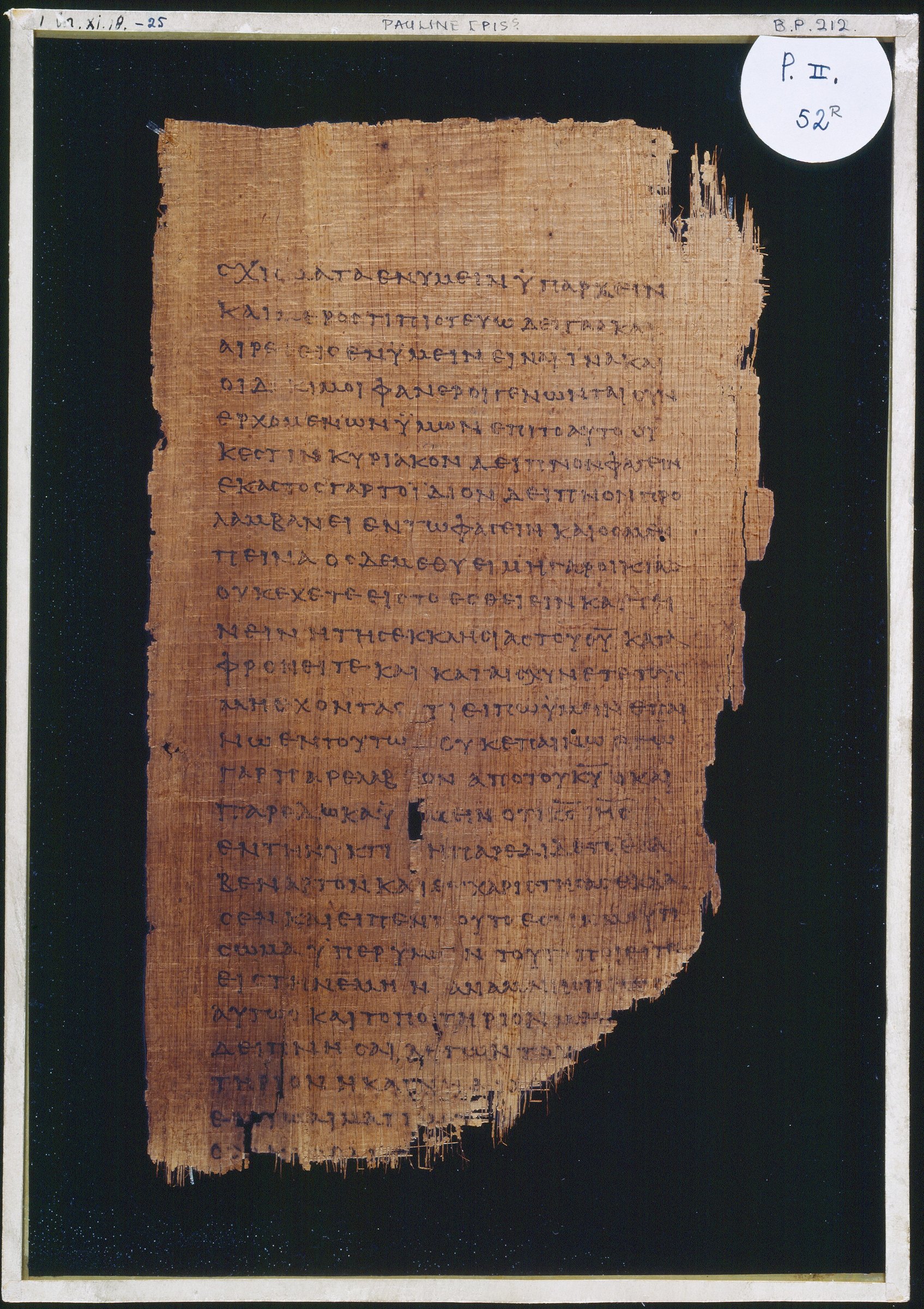
Where on the image
Chester Beatty Library photograph T0005610.jpg (https://ntmss.info/images/webfriendly/10046/T0005610.jpg), linked to NTVMR page 850 (folio 52r) in NTVMR's page index. 11:18 begins on the previous page; 11:25 continues on the next page. Checked on the image: the disc on the frame reads ‹P. II 52R›.
11:18 σχισμ̣ατα εν υμειν υπαρχειν
και μ̣ερος τι πιστευω 19 δει γαρ̣ και
αιρεσ̣εις εν υμειν ειναι ινα και
οι δο̣κιμοι φανεροι γενωνται 20 συν
ερχομενων υμων επι το αυτο ου
κ εστιν κυριακον δειπνον φαγειν
21 εκαστος γαρ το ιδιον δειπνον προ
λαμβανει εν τω φαγειν και ος μεν
πεινα ος δε μεθυει 22 μη γαρ οικιας
ουκ εχετε εις το εσθειειν και πει
νειν η της εκκλησιας του θ̅υ̅ κατα
φρονειτε και καταισχυνετε τους
μη εχοντας τι ειπω υμειν επαι
νω εν τουτω ουκ επαινω 23 εγω
γαρ παρελαβον απο του κ̅υ̅ ο και
παρεδωκα υμειν οτι κ̅ς̅ ι̅η̅ς̅
εν τη νυκτι η παρεδιδετο ελ̣α
βεν αρτον 24 και ευ̣χαριστησας εκλα
σεν και ειπεν τουτο εστ̣ιν μου το
σωμα υπερ υμω̣ν τουτο̣ ποιειτε
εις την εμην αναμνη̣σιν̣ 25 ω̣σ
αυτως και το ποτηριον μετ̣[α το]
δειπνησαι λεγων του̣[το το πο]
τηριον η καινη δ̣ι̣αθ̣[ηκη εστιν]
εν̣ τ̣ω αιματι μ̣ο̣υ̣ [τουτο ποιειτε]
οσα̣κ̣ι̣ς̣ ε̣α̣ν̣ π̣[εινητε εις την]
11:18For first of all, when ye come together in the church, I hear that there be divisions among you; and I partly believe it. 19For there must be also heresies among you, that they which are approved may be made manifest among you. 20When ye come together therefore into one place, this is not to eat the Lord’s supper. 21For in eating every one taketh before other his own supper: and one is hungry, and another is drunken. 22What? have ye not houses to eat and to drink in? or despise ye the church of God, and shame them that have not? What shall I say to you? shall I praise you in this? I praise you not. 23For I have received of the Lord that which also I delivered unto you, That the Lord Jesus the same night in which he was betrayed took bread: 24And when he had given thanks, he brake it, and said, Take, eat: this is my body, which is broken for you: this do in remembrance of me. 25After the same manner also he took the cup, when he had supped, saying, This cup is the new testament in my blood: this do ye, as oft as ye drink it, in remembrance of me.
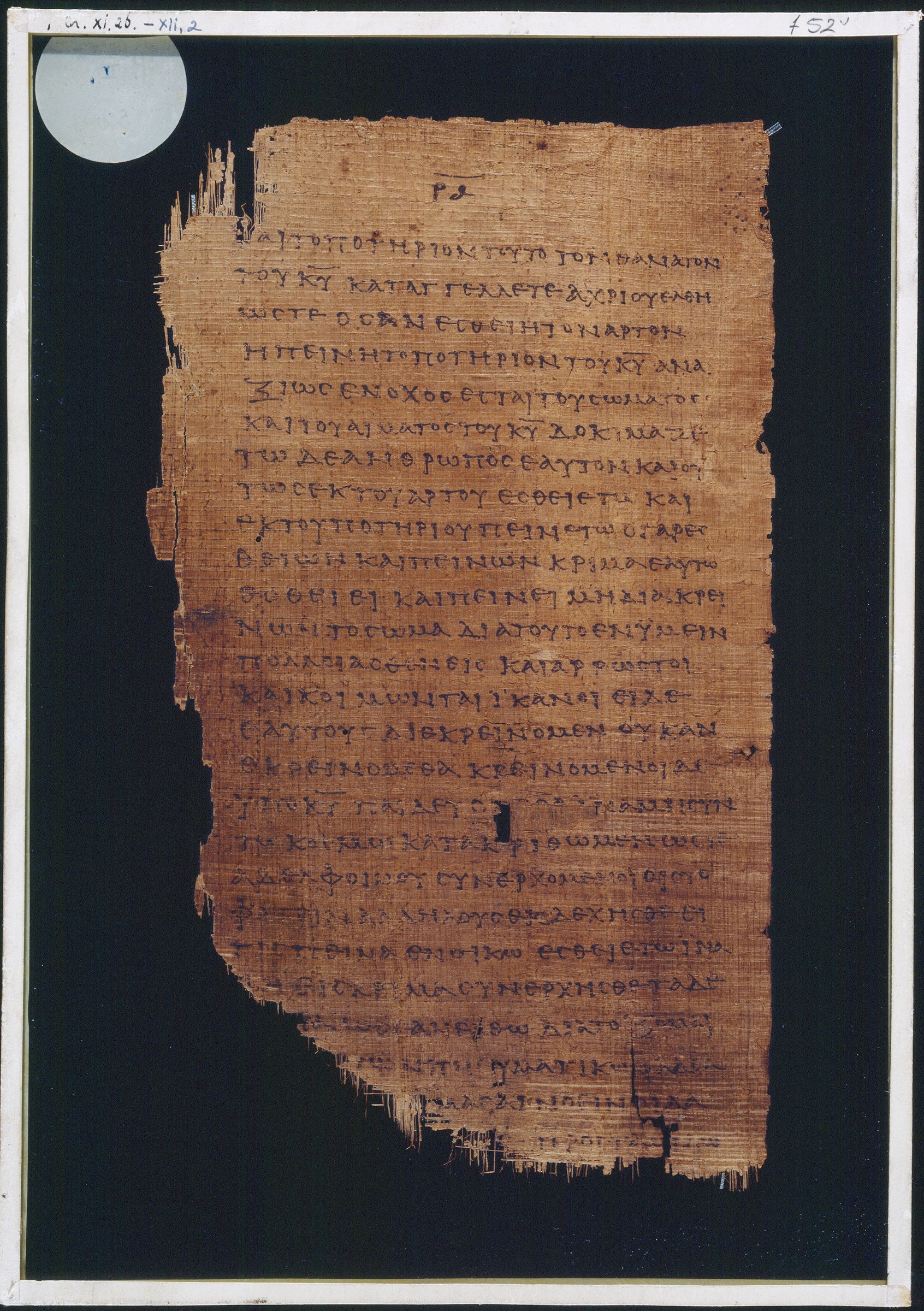
Where on the image
Chester Beatty Library photograph T0005609.jpg (https://ntmss.info/images/webfriendly/10046/T0005609.jpg), linked to NTVMR page 860 (folio 52v) in NTVMR's page index. 11:26 begins on the previous page; 12:2 continues on the next page. Checked on the image: the scribe's page number ρα (101) at the head of the page, continuing the sequence of the neighbouring pages.
11:26 κ̣αι το ποτηριον τουτο τον θανατον
του κ̅υ̅ καταγγελλετε αχρι ου ελθη
27 ωστε ος ε εσθειη τον αρτον
η πεινη το ποτηριον του κ̅υ̅ ανα
ξιως ενοχος εσται του σωματος
και του αιματος του κ̅υ̅ 28 δοκιμαζε
τω δε ανθρωπος εαυτον και ου
τως εκ του αρτου εσθειετω̣ και
εκ του ποτηριου πεινετω 29 ο γαρ εσ
θειων και πεινων κριμα εαυτω
εσθειει και πεινει μη διακρει
νων το σωμα 30 δια τουτο εν υμειν
πολλοι ασθενεις και αρρωστοι
και κοιμωνται ικανοι 31 ει δε
εαυτους διεκρεινομεν ουκ αν
εκρεινομεθα 32 κρεινομενοι δε
υπο κ̅υ̅ παιδευομ̣ε̣θ̣α̣ ι̣ν̣α μη συν
τω κοσμω κατακριθωμεν 33 ωστε
αδελφοι μου συνερχομενοι εις το
φαγειν αλ̣ληλους εκδεχησθε 34 ει
τις πεινα εν οικω εσθειετω ινα
μ̣η̣ εις κ̣ριμα συνερχησθε τα δε
[λοι]π̣α ως εαν ελθω διατοξομαι
12:1 [περι δ]ε̣ τ̣ων πν̣ε̣υ̣ματικων αδελ
[φοι ου θελω] υ̣μας αγνοειν 2 ο̣ιδα
[τε οτι οτε εθνη ητ]ε̣ προς τ̣α ε̣ι̣δ̣ω
[λα]
11:26For as often as ye eat this bread, and drink this cup, ye do shew the Lord’s death till he come. 27Wherefore whosoever shall eat this bread, and drink this cup of the Lord, unworthily, shall be guilty of the body and blood of the Lord. 28But let a man examine himself, and so let him eat of that bread, and drink of that cup. 29For he that eateth and drinketh unworthily, eateth and drinketh damnation to himself, not discerning the Lord’s body. 30For this cause many are weak and sickly among you, and many sleep. 31For if we would judge ourselves, we should not be judged. 32But when we are judged, we are chastened of the Lord, that we should not be condemned with the world. 33Wherefore, my brethren, when ye come together to eat, tarry one for another. 34And if any man hunger, let him eat at home; that ye come not together unto condemnation. And the rest will I set in order when I come. 12:1Now concerning spiritual gifts, brethren, I would not have you ignorant. 2Ye know that ye were Gentiles, carried away unto these dumb idols, even as ye were led.
Notes
- Greek: the NTVMR diplomatic transcription, line by line as on the papyrus. Square brackets enclose letters that are lost or illegible and were supplied by the transcribers; a dot under a letter marks it as uncertain; [...] marks a gap. Nomina sacra and numerals keep the scribe's overline. Spelling is the scribe's (no accents or breathings). Words broken at a line end stay broken as on the papyrus. Corrections are not shown: the text is the first hand.
- English: the King James Version (1611), whole verses, for every verse that has text on the page. A verse that begins on one page and ends on the next is given in full on both. The KJV translates a later form of the Greek text, so its wording does not always match the papyrus; material differences (such as verses the papyrus does not have) are noted in the section.
Cite
Sources
- Source: P46 (Chester Beatty Biblical Papyrus II, Chester Beatty Library, Dublin): photographs as published in the INTF New Testament Virtual Manuscript Room; Greek from the INTF NTVMR transcription of P46; English from the King James Version (holding institution)
- Critical edition: INTF NTVMR diplomatic transcription (CC BY 4.0)
← previous · → next · v cycle view · l back to library