P46 (Chester Beatty II): 1 Corinthians 13:2-14:6 (fols. 54v-55r)
Introduction
P46 is a papyrus codex of the letters of Paul copied in Egypt around 200, the oldest surviving collection of Paul's letters. 86 of its 104 leaves survive: 56 in the Chester Beatty Library, Dublin (Biblical Papyrus II, published by Frederic Kenyon in 1934-1937) and 30 in the University of Michigan Library, Ann Arbor (P.Mich. inv. 6238, published by Henry Sanders in 1935). The letters run in the order Romans, Hebrews, 1 and 2 Corinthians, Ephesians, Galatians, Philippians, Colossians and 1 Thessalonians; the first seven leaves (Romans 1:1-5:17) and the end of the book are lost. Hebrews standing after Romans, and the doxology of Romans (16:25-27) standing after 15:33, are among its best-known features.
Each section below is one page side: the holding library's photograph, the NTVMR diplomatic transcription line by line, and the King James Version of every verse that has text on the page. The lower lines of many leaves are lost; the transcribers' restorations are in square brackets.
This entry covers fols. 54v-55r (1 Corinthians 13:2-14:6).
How was this verified? (Provenance)
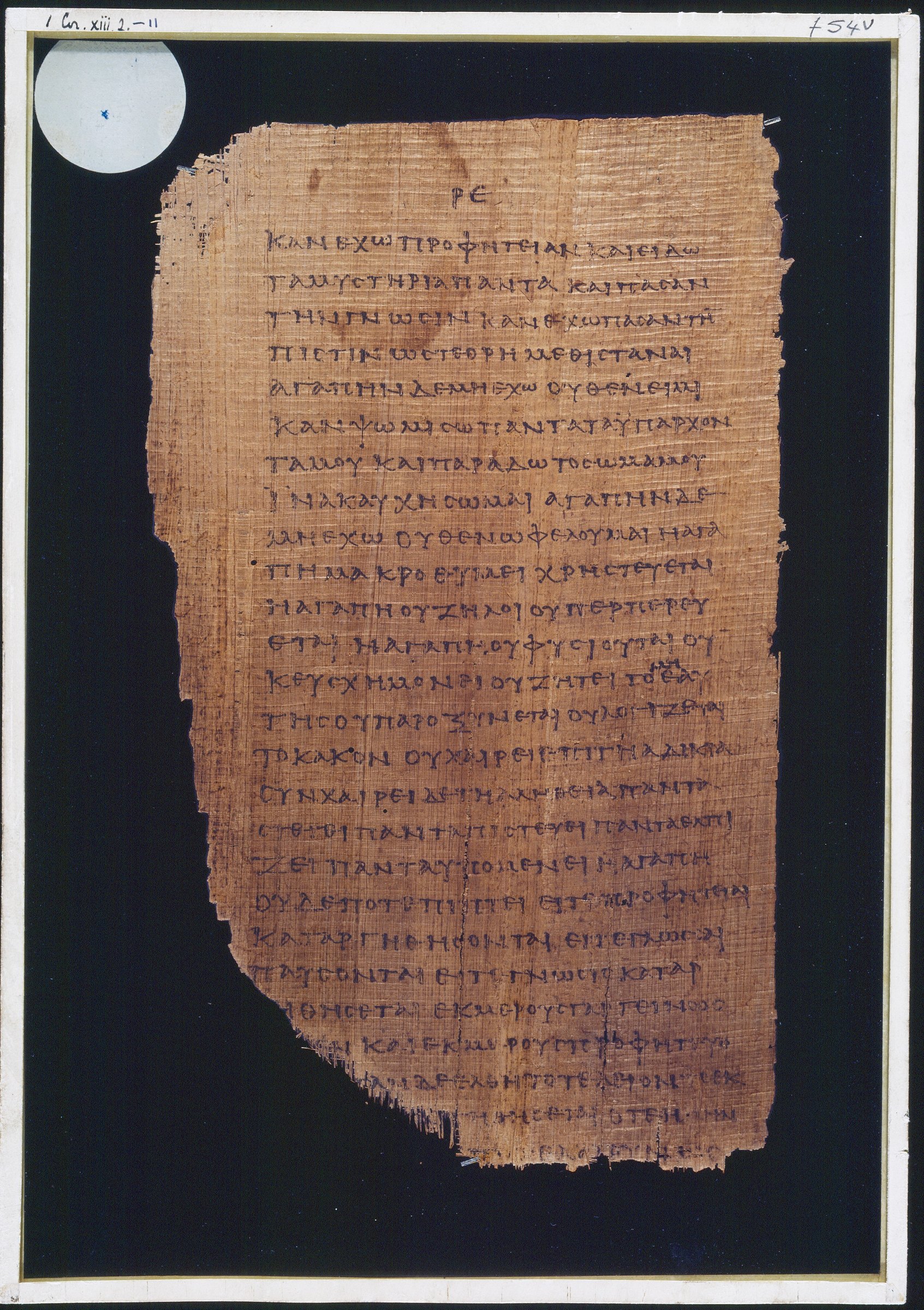
Where on the image
Chester Beatty Library photograph T0005563.jpg (https://ntmss.info/images/webfriendly/10046/T0005563.jpg), linked to NTVMR page 900 (folio 54v) in NTVMR's page index. 13:11 continues on the next page. Checked on the image: the scribe's page number ρε (105) at the head of the page, continuing the sequence of the neighbouring pages.
13:2 καν εχω προφητειαν και ειδω
τα μυστηρια παντα και πασαν
την γνωσιν καν εχω πασαν την
πιστιν ωστε ορη μεθισταναι
αγαπην δε μη εχω ουθεν ειμι
3 καν ψωμισω παντα τα υπαρχον
τα μου και παραδω το σωμα μου
ινα καυχησωμαι αγαπην δε
μη εχω ουθεν ωφελουμαι 4 η αγα
πη μακροθυμει χρηστευεται
η αγαπη ου ζηλοι ου περπερευ
εται η αγαπη ου φυσιουται 5 ου
κ ευσχημονει ου ζητει το εαυ
της ου παροξυνεται ου λογιζεται
το κακον 6 ου χαιρει επι τη αδικια
συνχαιρει δε τη αληθεια 7 παντα
στεγει παντα πιστευει παντα ελπι
ζει παντα υπομενει 8 η αγαπη
ουδεποτε πιπτει ειτε προφητειαι
καταργηθησονται ειτε γλωσσαι
παυσονται ει̣τε γνωσις καταρ
[γ]η̣θησεται 9 εκ μερους γαρ γεινωσ
[κομ]ε̣ν και εκ μερους προφητευο
[μεν] 10 [ο]τ̣αν δε ελθη το τελειον το̣ εκ
[μερους κατ]α̣ρ̣γ̣ηθησεται 11 οτε ημ̣ην
[νηπιος ως νη]πι̣ο̣ς̣ ελαλ̣ο̣υν ως
13:2And though I have the gift of prophecy, and understand all mysteries, and all knowledge; and though I have all faith, so that I could remove mountains, and have not charity, I am nothing. 3And though I bestow all my goods to feed the poor, and though I give my body to be burned, and have not charity, it profiteth me nothing. 4Charity suffereth long, and is kind; charity envieth not; charity vaunteth not itself, is not puffed up, 5Doth not behave itself unseemly, seeketh not her own, is not easily provoked, thinketh no evil; 6Rejoiceth not in iniquity, but rejoiceth in the truth; 7Beareth all things, believeth all things, hopeth all things, endureth all things. 8Charity never faileth: but whether there be prophecies, they shall fail; whether there be tongues, they shall cease; whether there be knowledge, it shall vanish away. 9For we know in part, and we prophesy in part. 10But when that which is perfect is come, then that which is in part shall be done away. 11When I was a child, I spake as a child, I understood as a child, I thought as a child: but when I became a man, I put away childish things.
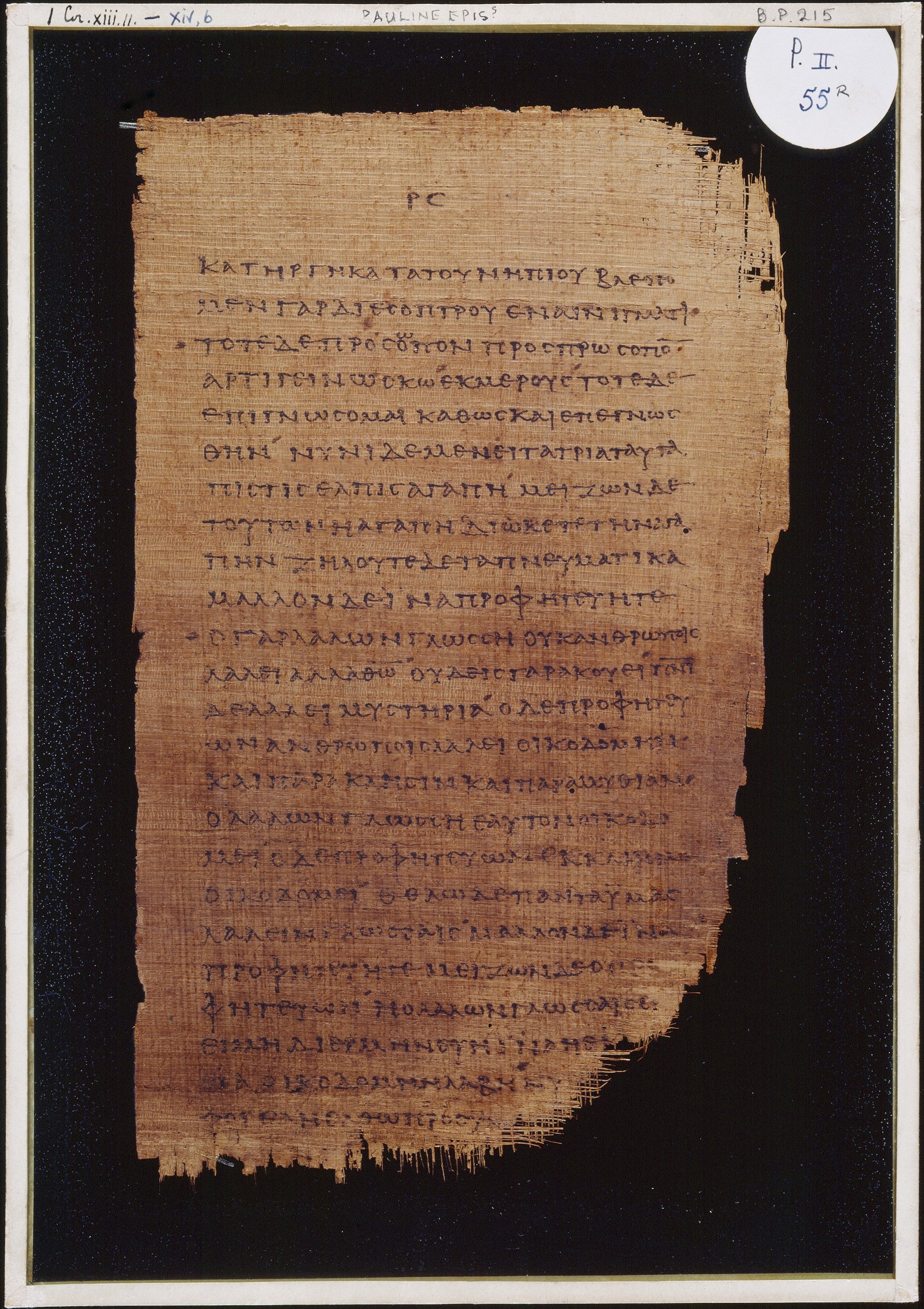
Where on the image
Chester Beatty Library photograph T0005566.jpg (https://ntmss.info/images/webfriendly/10046/T0005566.jpg), linked to NTVMR page 910 (folio 55r) in NTVMR's page index. 13:11 begins on the previous page; 14:6 continues on the next page. Checked on the image: the scribe's page number ρς (106) at the head of the page, continuing the sequence of the neighbouring pages; the disc on the frame reads ‹P. II 55R›.
13:11 κατηργηκα τα του νηπιου 12 βλεπο
μεν γαρ δι εσοπτρου εν αινιγματι
τοτε δε προσοπον προς πρωσοπον
αρτι γεινωσκω εκ μερους τοτε δε
επιγνωσομαι καθως και επεγνωσ
θην 13 νυνι δε μενει τα τρια ταυτα
πιστις ελπις αγαπη μειζων δε
τουτων η αγαπη 14:1 διωκετε την αγα
πην ζηλουτε δε τα πνευματικα
μαλλον δε ινα προφητευητε
2 ο γαρ λαλων γλωσση ουκ ανθρωποις
λαλει αλλα θ̅ω̅ ουδεις γαρ ακουει π̅ν̅ι̅
δε λαλει μυστηρια 3 ο δε προφητευ
ων ανθρωποις λαλει οικοδομην
και παρακλησιν και παραμυθιαν
4 ο λαλων γλωσση εαυτον οικοδο
μει ο δε προφητευων εκκλησιαν̣
οικοδομει 5 θελω δε παντα υμας
λαλειν γλωσσαις μαλλον δε ινα
προφητευητε μειζων δε ο προ̣
φητευων η ο λαλων γλωσσαις εκ̣[τος]
ει μη διερμηνευη ινα η εκ̣[κλη]
σια οικοδομην λαβη 6 νυ[ν δε αδελ]
φοι εαν ελθω προς υμ̣[ας γλωσ]
[σαις] προφη
13:11When I was a child, I spake as a child, I understood as a child, I thought as a child: but when I became a man, I put away childish things. 12For now we see through a glass, darkly; but then face to face: now I know in part; but then shall I know even as also I am known. 13And now abideth faith, hope, charity, these three; but the greatest of these is charity. 14:1Follow after charity, and desire spiritual gifts, but rather that ye may prophesy. 2For he that speaketh in an unknown tongue speaketh not unto men, but unto God: for no man understandeth him; howbeit in the spirit he speaketh mysteries. 3But he that prophesieth speaketh unto men to edification, and exhortation, and comfort. 4He that speaketh in an unknown tongue edifieth himself; but he that prophesieth edifieth the church. 5I would that ye all spake with tongues, but rather that ye prophesied: for greater is he that prophesieth than he that speaketh with tongues, except he interpret, that the church may receive edifying. 6Now, brethren, if I come unto you speaking with tongues, what shall I profit you, except I shall speak to you either by revelation, or by knowledge, or by prophesying, or by doctrine?
Notes
- Greek: the NTVMR diplomatic transcription, line by line as on the papyrus. Square brackets enclose letters that are lost or illegible and were supplied by the transcribers; a dot under a letter marks it as uncertain; [...] marks a gap. Nomina sacra and numerals keep the scribe's overline. Spelling is the scribe's (no accents or breathings). Words broken at a line end stay broken as on the papyrus. Corrections are not shown: the text is the first hand.
- English: the King James Version (1611), whole verses, for every verse that has text on the page. A verse that begins on one page and ends on the next is given in full on both. The KJV translates a later form of the Greek text, so its wording does not always match the papyrus; material differences (such as verses the papyrus does not have) are noted in the section.
Cite
Sources
- Source: P46 (Chester Beatty Biblical Papyrus II, Chester Beatty Library, Dublin): photographs as published in the INTF New Testament Virtual Manuscript Room; Greek from the INTF NTVMR transcription of P46; English from the King James Version (holding institution)
- Critical edition: INTF NTVMR diplomatic transcription (CC BY 4.0)
← previous · → next · v cycle view · l back to library