P46 (Chester Beatty II): 1 Corinthians 12:3-13:1 (fols. 53r-54r)
Introduction
P46 is a papyrus codex of the letters of Paul copied in Egypt around 200, the oldest surviving collection of Paul's letters. 86 of its 104 leaves survive: 56 in the Chester Beatty Library, Dublin (Biblical Papyrus II, published by Frederic Kenyon in 1934-1937) and 30 in the University of Michigan Library, Ann Arbor (P.Mich. inv. 6238, published by Henry Sanders in 1935). The letters run in the order Romans, Hebrews, 1 and 2 Corinthians, Ephesians, Galatians, Philippians, Colossians and 1 Thessalonians; the first seven leaves (Romans 1:1-5:17) and the end of the book are lost. Hebrews standing after Romans, and the doxology of Romans (16:25-27) standing after 15:33, are among its best-known features.
Each section below is one page side: the holding library's photograph, the NTVMR diplomatic transcription line by line, and the King James Version of every verse that has text on the page. The lower lines of many leaves are lost; the transcribers' restorations are in square brackets.
This entry covers fols. 53r-54r (1 Corinthians 12:3-13:1).
How was this verified? (Provenance)
Where on the image
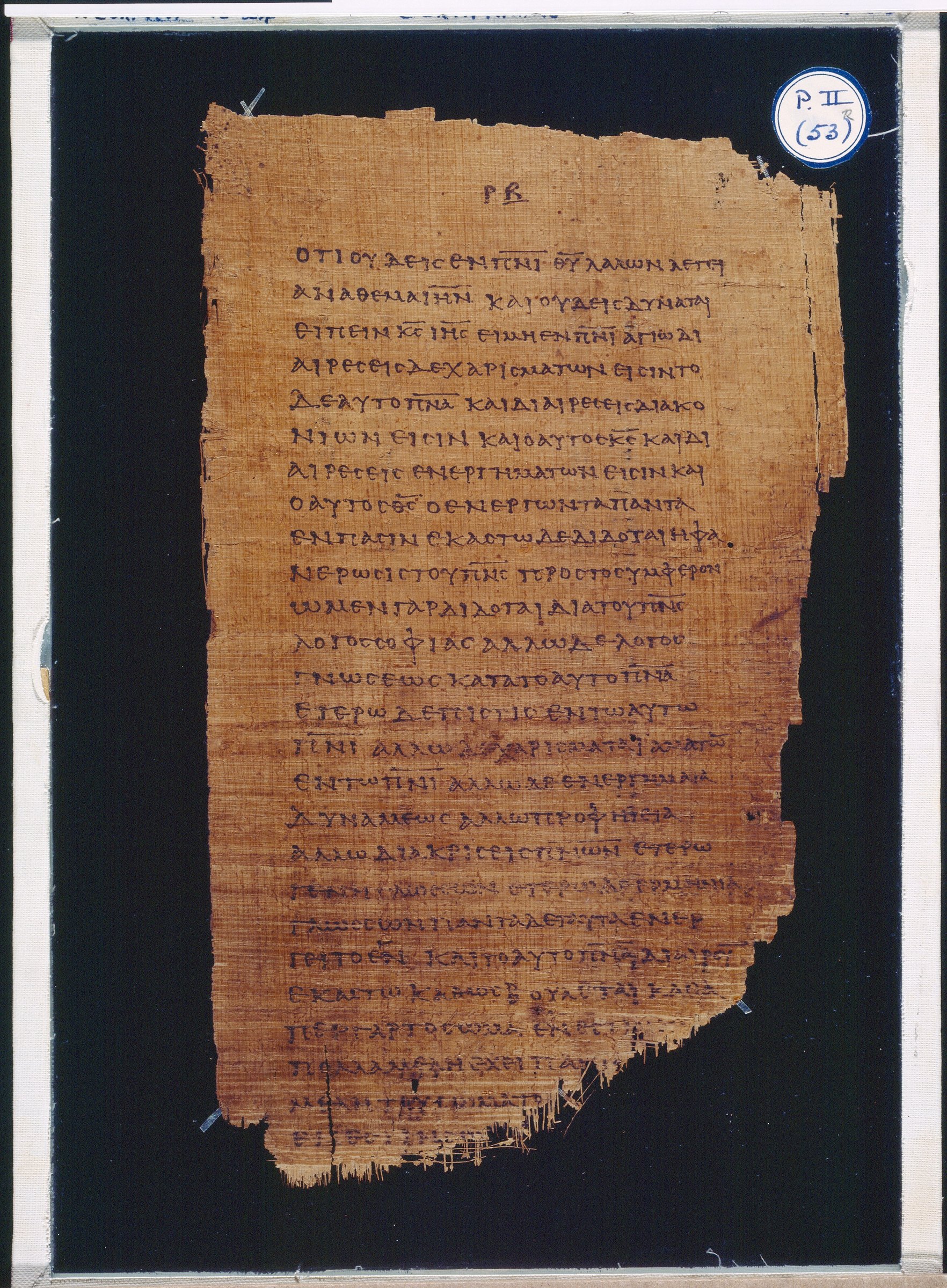
Chester Beatty Library photograph T0005562.jpg (https://ntmss.info/images/webfriendly/10046/T0005562.jpg), linked to NTVMR page 870 (folio 53r) in NTVMR's page index. 12:3 begins on the previous page. Checked on the image: the scribe's page number ρβ (102) at the head of the page, continuing the sequence of the neighbouring pages; the disc on the frame reads ‹P. II (53)›.
12:3 οτι ουδεις εν π̅ν̅ι̅ θ̅υ̅ λαλων λεγει
αναθεμα ι̅η̅ν̅ και ουδεις δυναται
ειπειν κ̅ς̅ ι̅η̅ς̅ ει μη εν π̅ν̅ι̅ αγιω 4 δι
αιρεσεις δε χαρισματων εισιν το
δε αυτο π̅ν̅α̅ 5 και διαιρεσεις διακο
νιων εισιν και ο αυτος κ̅ς̅ 6 και δι
αιρεσεις ενεργηματων εισιν και
ο αυτος θ̅ς̅ ο ενεργων τα παντα
εν πασιν 7 εκαστω δε διδοται η φα
νερωσις του π̅ν̅ς̅ προς το συμφερον
8 ω μεν γαρ διδοται δια του π̅ν̅ς̅
λογος σοφιας αλλω δε λογος
γνωσεως κατα το αυτο π̅ν̅α̅
9 ετερω δε πιστις εν τω αυτω
π̅ν̅ι̅ αλλω δε χαρισματα ιαματων
εν τω π̅ν̅ι̅ 10 αλλω δε ενεργηματ̣α
δυναμεως αλλω προφητ̣εια
αλλω διακρισεις π̅ν̅ω̅ν̅ ετερω
γενη γλωσσων ετερω δε ερμηνια
γλωσσων 11 παντα δε ταυτα ενερ
γει το εν και το αυτο π̅ν̅α̅ διαιρουν
εκαστω καθως βουλε̣ται 12 καθ̣α
περ γαρ το σωμα εν εστιν̣ κ̣[αι]
πολλα μελη εχει παν̣τ̣[α δε τα]
μελη του σωματο[ς πολλα οντα]
εν̣ εστ̣ιν σω[μα ουτως και ο χ̅ρ̅ς̅]
12:3Wherefore I give you to understand, that no man speaking by the Spirit of God calleth Jesus accursed: and that no man can say that Jesus is the Lord, but by the Holy Ghost. 4Now there are diversities of gifts, but the same Spirit. 5And there are differences of administrations, but the same Lord. 6And there are diversities of operations, but it is the same God which worketh all in all. 7But the manifestation of the Spirit is given to every man to profit withal. 8For to one is given by the Spirit the word of wisdom; to another the word of knowledge by the same Spirit; 9To another faith by the same Spirit; to another the gifts of healing by the same Spirit; 10To another the working of miracles; to another prophecy; to another discerning of spirits; to another divers kinds of tongues; to another the interpretation of tongues: 11But all these worketh that one and the selfsame Spirit, dividing to every man severally as he will. 12For as the body is one, and hath many members, and all the members of that one body, being many, are one body: so also is Christ.
Where on the image
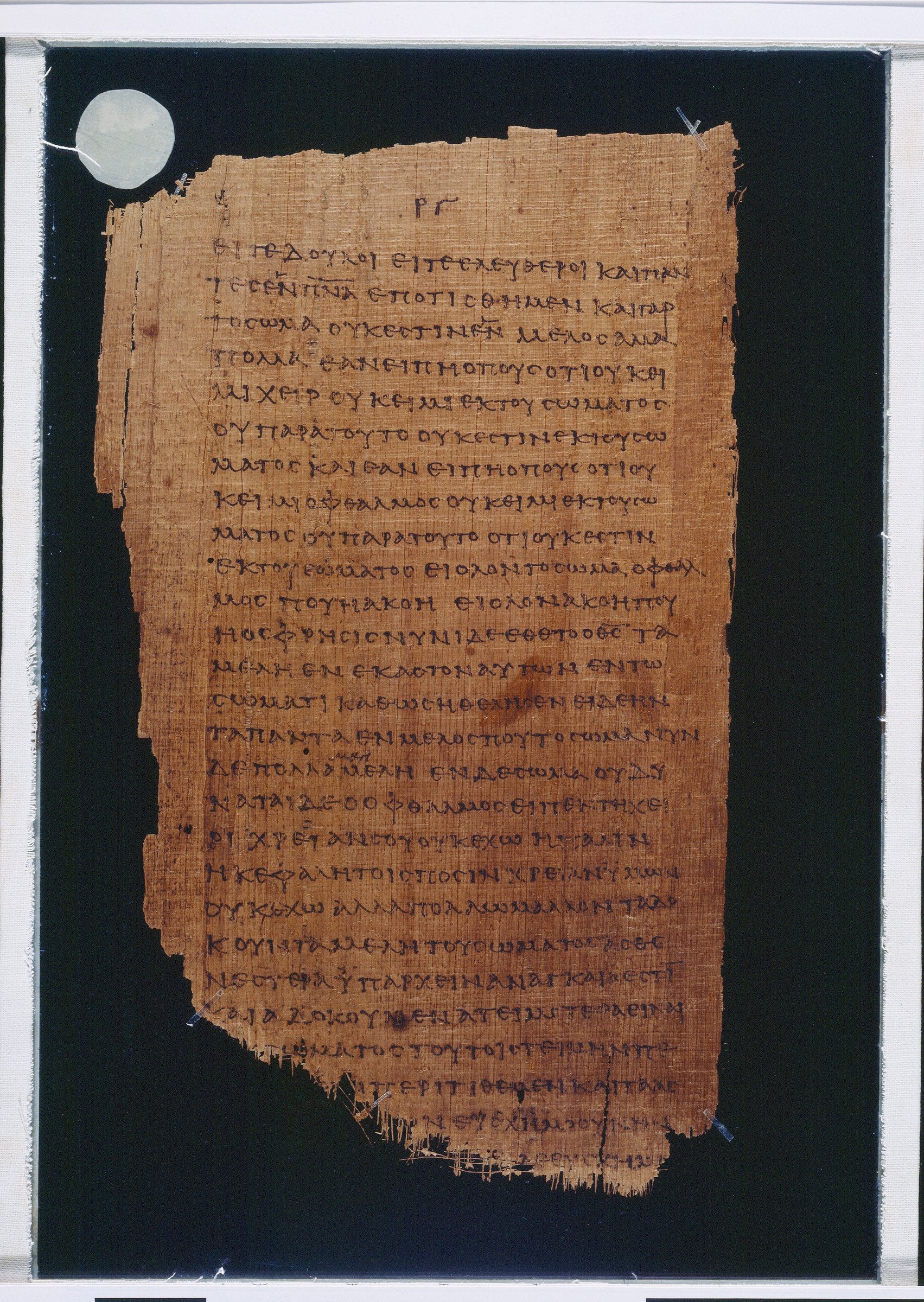
Chester Beatty Library photograph T0005561.jpg (https://ntmss.info/images/webfriendly/10046/T0005561.jpg), linked to NTVMR page 880 (folio 53v) in NTVMR's page index. 12:13 begins on the previous page; 12:24 continues on the next page. Checked on the image: the scribe's page number ργ (103) at the head of the page, continuing the sequence of the neighbouring pages.
12:13 ειτε δουλοι ειτε ελευθεροι και παν
τες εν π̅ν̅α̅ εποτισθημεν 14 και γαρ
το σωμα ουκ εστιν εν μελος αλλα
πολλα 15 εαν ειπη ο πους οτι ουκ ει
μι χειρ ουκ ειμι εκ του σωματος
ου παρα τουτο ουκ εστιν εκ του σω
ματος 16 και εαν ειπη ο πους οτι ου
κ ειμι οφθαλμος ουκ ειμι εκ του σω
ματος ου παρα τουτο οτι ουκ εστιν
εκ του σωματος 17 ει ολον το σωμα οφθαλ
μος που η ακοη ει ολον ακοη που
η οσφρησις 18 νυνι δε εθετο ο θ̅ς̅ τα
μελη εν εκαστον αυτων εν τω
σωματι καθως ηθελησεν 19 ει δε ην
τα παντα εν μελος που το σωμα 20 νυν
δε πολλα μελη εν δε σωμα 21 ου δυ
ναται δε ο οφθαλμος ειπεν τη χει
ρι χρειαν σου ουκ εχω η παλιν
η κεφαλη τοις ποσιν χρειαν υμων
ουκ εχω 22 αλλα πολλω μαλλον τα δο
κουντα μελη του σωματος ασθε
νεστερα υπαρχειν αναγκαια εστιν
23 κ̣αι α δοκουμεν ατειμοτερα ειναι
[το]υ̣ σ̣ωματος τουτοις τειμην πε
[ρισσοτε]ρ̣[α]ν̣ περιτιθεμεν και τα ασ
[χημονα ημ]ω̣ν ευσχημοσυνην
[περισσοτεραν εχει] 24 [τ]α̣ δ̣ε ευσχημο̣
[να]
12:13For by one Spirit are we all baptized into one body, whether we be Jews or Gentiles, whether we be bond or free; and have been all made to drink into one Spirit. 14For the body is not one member, but many. 15If the foot shall say, Because I am not the hand, I am not of the body; is it therefore not of the body? 16And if the ear shall say, Because I am not the eye, I am not of the body; is it therefore not of the body? 17If the whole body were an eye, where were the hearing? If the whole were hearing, where were the smelling? 18But now hath God set the members every one of them in the body, as it hath pleased him. 19And if they were all one member, where were the body? 20But now are they many members, yet but one body. 21And the eye cannot say unto the hand, I have no need of thee: nor again the head to the feet, I have no need of you. 22Nay, much more those members of the body, which seem to be more feeble, are necessary: 23And those members of the body, which we think to be less honourable, upon these we bestow more abundant honour; and our uncomely parts have more abundant comeliness. 24For our comely parts have no need: but God hath tempered the body together, having given more abundant honour to that part which lacked:
Where on the image
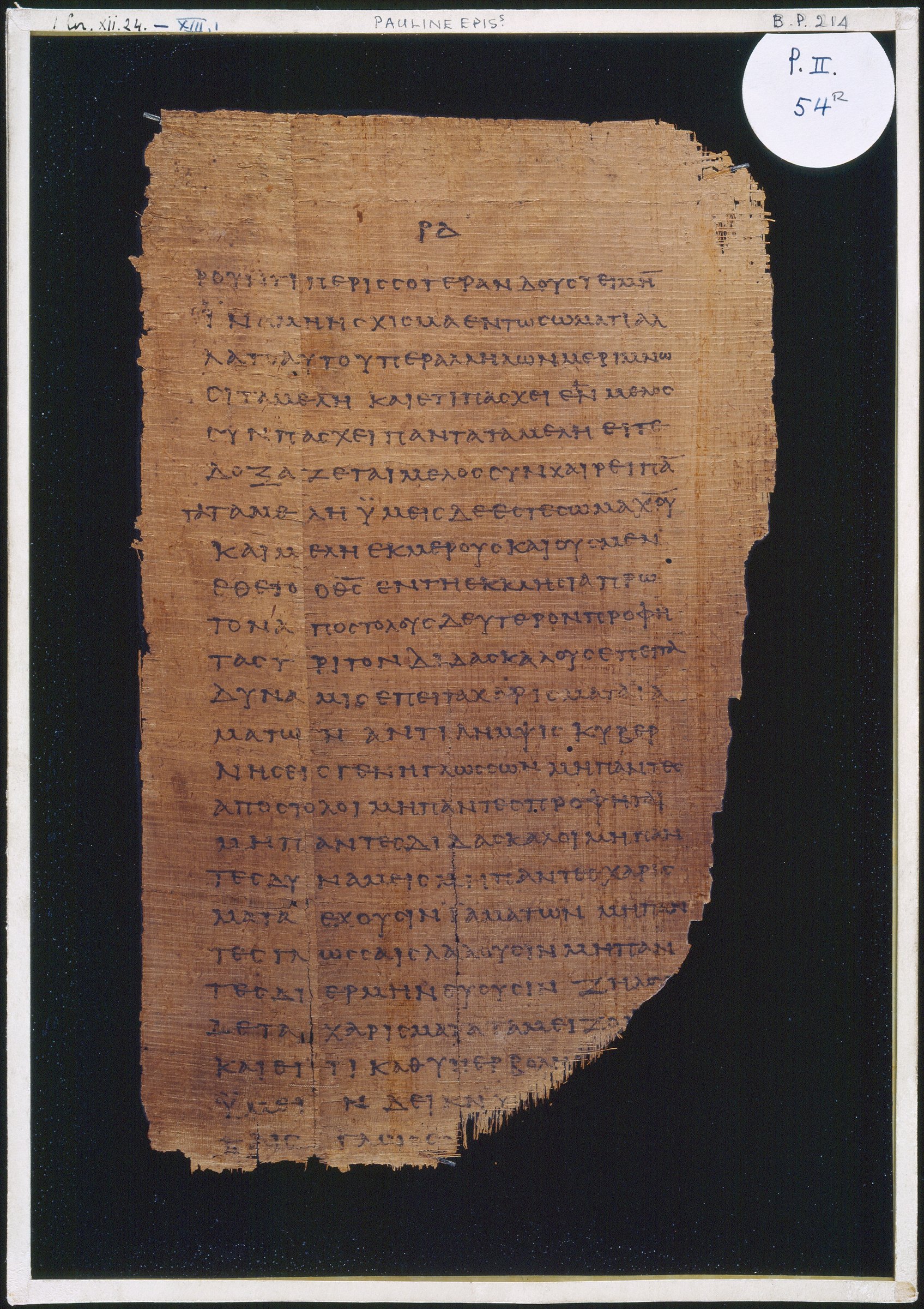
Chester Beatty Library photograph T0005564.jpg (https://ntmss.info/images/webfriendly/10046/T0005564.jpg), linked to NTVMR page 890 (folio 54r) in NTVMR's page index. 12:24 begins on the previous page; 13:1 continues on the next page. Checked on the image: the disc on the frame reads ‹P. II 54R›.
12:24 ρουντι περισσοτεραν δους τειμην
25 ινα̣ μη η σχισμα εν τω σωματι αλ
λα το̣ αυτο υπερ αλληλων μεριμνω
σι τα μελη 26 και ετι πασχει εν μελος
συνπασχει παντα τα μελη ειτε
δοξαζεται μελος συνχαιρει παν
τα μελη 27 υμεις δε εστε σωμα χ̅ρ̅υ̅
και μελη εκ μερους 28 και ους μεν
εθετο ο θ̅ς̅ εν τη εκκλησια πρω
τον αποστολους δευτερον προφη
τας τριτον διδασκαλους επειτα
δυναμις επειτα χαρισματα ια
ματων αντιλημψις κυβερ
νησεις γενη γλωσσων 29 μη παντες
αποστολοι μη παντες προφηται
μη παντες διδασκαλοι μη παν
τες δυναμεις 30 μη παντες χαρισ
ματα εχουσιν ιαματων μη παν
τες γλωσσαις λαλουσιν μη παν
τες διερμηνευουσιν 31 ζηλου̣[τε]
δε τα χαρισματα τα μειζον̣[α]
και ει τι καθ υπερβολην̣ [οδον]
υμειν δεικνυ[μι] 13:1 [εαν]
ταις γλωσσα̣[ις των α̅ν̅ω̅ν̅ λαλω]
12:24For our comely parts have no need: but God hath tempered the body together, having given more abundant honour to that part which lacked: 25That there should be no schism in the body; but that the members should have the same care one for another. 26And whether one member suffer, all the members suffer with it; or one member be honoured, all the members rejoice with it. 27Now ye are the body of Christ, and members in particular. 28And God hath set some in the church, first apostles, secondarily prophets, thirdly teachers, after that miracles, then gifts of healings, helps, governments, diversities of tongues. 29Are all apostles? are all prophets? are all teachers? are all workers of miracles? 30Have all the gifts of healing? do all speak with tongues? do all interpret? 31But covet earnestly the best gifts: and yet shew I unto you a more excellent way. 13:1Though I speak with the tongues of men and of angels, and have not charity, I am become as sounding brass, or a tinkling cymbal.
Notes
- Greek: the NTVMR diplomatic transcription, line by line as on the papyrus. Square brackets enclose letters that are lost or illegible and were supplied by the transcribers; a dot under a letter marks it as uncertain; [...] marks a gap. Nomina sacra and numerals keep the scribe's overline. Spelling is the scribe's (no accents or breathings). Words broken at a line end stay broken as on the papyrus. Corrections are not shown: the text is the first hand.
- English: the King James Version (1611), whole verses, for every verse that has text on the page. A verse that begins on one page and ends on the next is given in full on both. The KJV translates a later form of the Greek text, so its wording does not always match the papyrus; material differences (such as verses the papyrus does not have) are noted in the section.
Cite
Sources
- Source: P46 (Chester Beatty Biblical Papyrus II, Chester Beatty Library, Dublin): photographs as published in the INTF New Testament Virtual Manuscript Room; Greek from the INTF NTVMR transcription of P46; English from the King James Version (holding institution)
- Critical edition: INTF NTVMR diplomatic transcription (CC BY 4.0)
← previous · → next · v cycle view · l back to library