P46 (Chester Beatty II): 1 Corinthians 4:4-5:7 (fols. 42r-43r)
Introduction
P46 is a papyrus codex of the letters of Paul copied in Egypt around 200, the oldest surviving collection of Paul's letters. 86 of its 104 leaves survive: 56 in the Chester Beatty Library, Dublin (Biblical Papyrus II, published by Frederic Kenyon in 1934-1937) and 30 in the University of Michigan Library, Ann Arbor (P.Mich. inv. 6238, published by Henry Sanders in 1935). The letters run in the order Romans, Hebrews, 1 and 2 Corinthians, Ephesians, Galatians, Philippians, Colossians and 1 Thessalonians; the first seven leaves (Romans 1:1-5:17) and the end of the book are lost. Hebrews standing after Romans, and the doxology of Romans (16:25-27) standing after 15:33, are among its best-known features.
Each section below is one page side: the holding library's photograph, the NTVMR diplomatic transcription line by line, and the King James Version of every verse that has text on the page. The lower lines of many leaves are lost; the transcribers' restorations are in square brackets.
This entry covers fols. 42r-43r (1 Corinthians 4:4-5:7).
How was this verified? (Provenance)
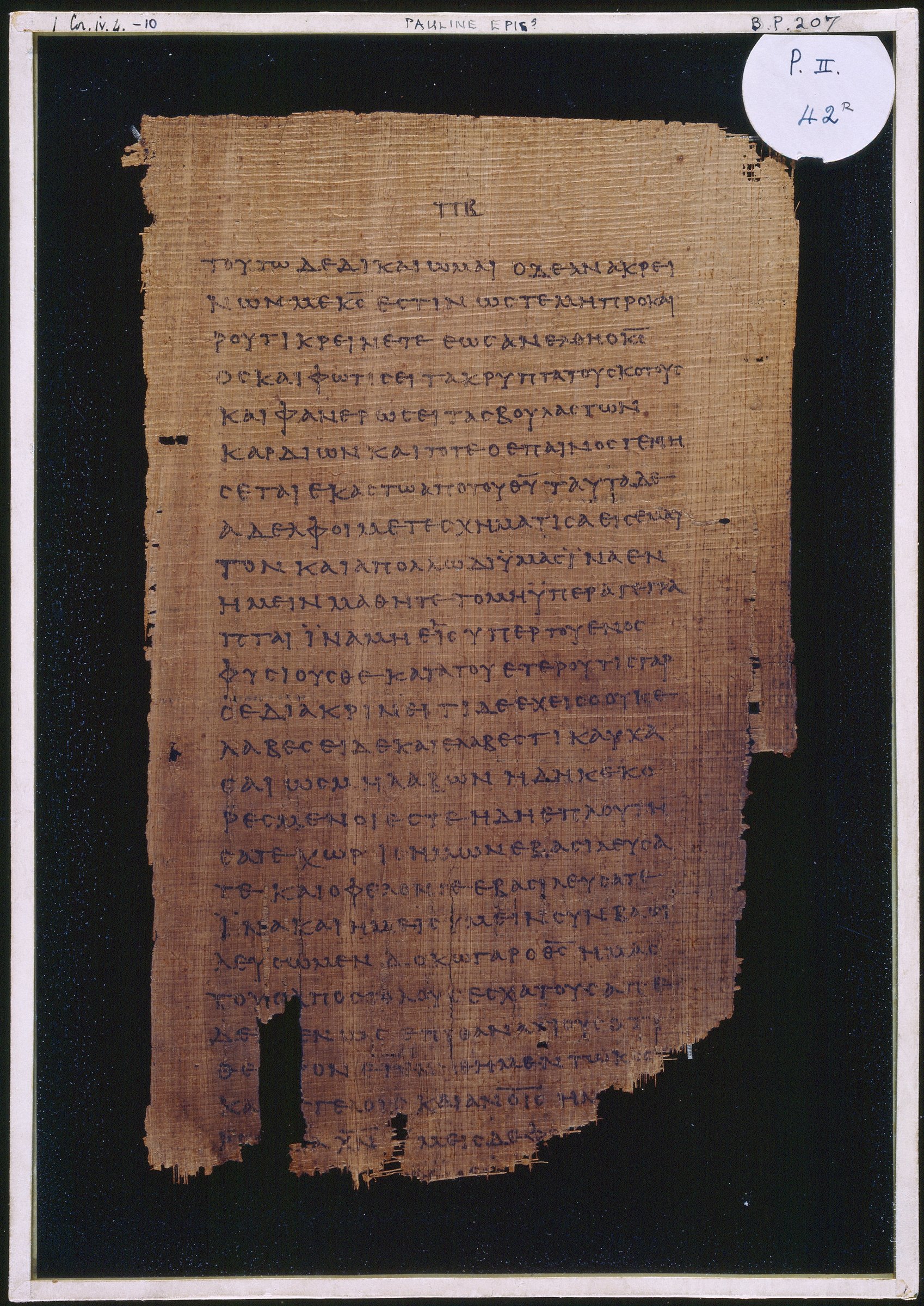
Where on the image
Chester Beatty Library photograph T0005592.jpg (https://ntmss.info/images/webfriendly/10046/T0005592.jpg), linked to NTVMR page 650 (folio 42r) in NTVMR's page index. 4:4 begins on the previous page; 4:10 continues on the next page. Checked on the image: the scribe's page number πβ (82) at the head of the page, continuing the sequence of the neighbouring pages; the disc on the frame reads ‹P. II 42R›.
4:4 τουτω δεδικαιωμαι ο δε ανακρει
νων με κ̅ς̅ εστιν 5 ωστε μη προ και
ρου τι κρεινετε εως αν ελθη ο κ̅ς̅
ος και φωτισει τα κρυπτα του σκοτους
και φανερωσει τας βουλας των
καρδιων και τοτε ο επαινος γενη
σεται εκαστω απο του θ̅υ̅ 6 ταυτα δε
αδελφοι μετεσχηματισα εις εμαυ
τον και απολλω δι υμας ινα εν
ημειν μαθητε το μη υπερ α γεγρα
πται ινα μη εις υπερ του ενος
φυσιουσθε κατα του ετερου 7 τις γαρ
σε διακρινει τι δε εχεις ο ουκ ε
λαβες ει δε και ελαβες τι καυχα
σαι ως μη λαβων 8 ηδη κεκο
ρεσμενοι εστε ηδη επλουτη
σατε χωρις ημων εβασιλευσα
τε και οφελον γε εβασιλευσατε
ινα και ημεις υ̣μειν συνβασι
λευσωμεν 9 δοκω γαρ ο θ̅ς̅ ημας
τους α̣ποστολους εσχατους απε
δει̣[ξ]εν ως επιθανατιους οτι̣
θε[ατ]ρ̣ον εγενη̣θημεν τω κο̣σ[μω]
κα[ι α]γ̣γελοις και α̅ν̅ο̅ι̅ς̅ 10 ημ̣[εις μω]
ρο̣ι̣ δ̣[ι]α χ̅ν̅ υ̣μεις δε φρ̣[ονιμοι εν]
[χ̅ρ̅ω̅ ημεις α]σ̣θ̣ε̣ν̣ε̣[ις υμεις δε]
4:4For I know nothing by myself; yet am I not hereby justified: but he that judgeth me is the Lord. 5Therefore judge nothing before the time, until the Lord come, who both will bring to light the hidden things of darkness, and will make manifest the counsels of the hearts: and then shall every man have praise of God. 6And these things, brethren, I have in a figure transferred to myself and to Apollos for your sakes; that ye might learn in us not to think of men above that which is written, that no one of you be puffed up for one against another. 7For who maketh thee to differ from another? and what hast thou that thou didst not receive? now if thou didst receive it, why dost thou glory, as if thou hadst not received it? 8Now ye are full, now ye are rich, ye have reigned as kings without us: and I would to God ye did reign, that we also might reign with you. 9For I think that God hath set forth us the apostles last, as it were appointed to death: for we are made a spectacle unto the world, and to angels, and to men. 10We are fools for Christ’s sake, but ye are wise in Christ; we are weak, but ye are strong; ye are honourable, but we are despised.
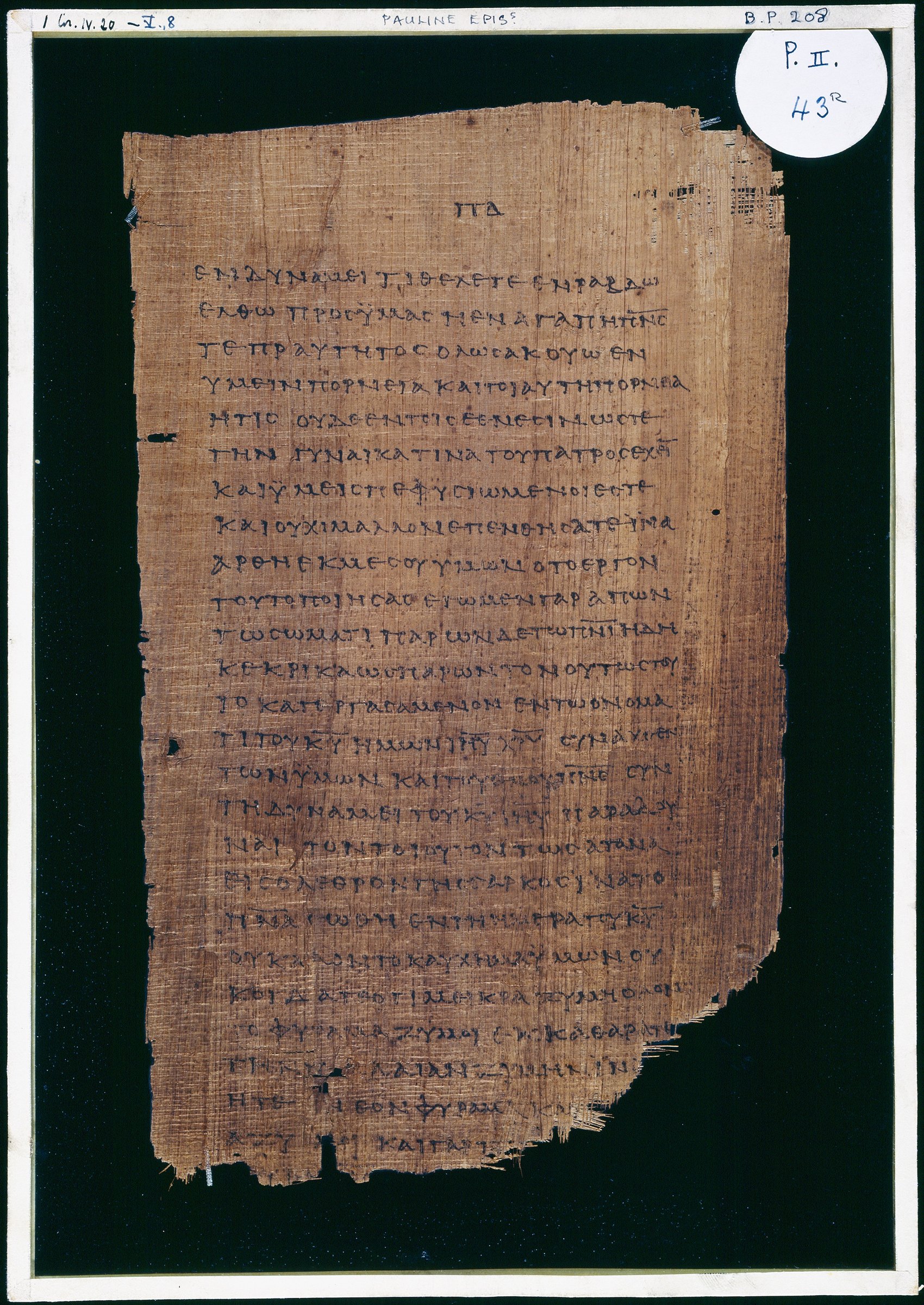
Where on the image
Chester Beatty Library photograph T0005594.jpg (https://ntmss.info/images/webfriendly/10046/T0005594.jpg), linked to NTVMR page 670 (folio 43r) in NTVMR's page index. 4:20 begins on the previous page. Checked on the image: the scribe's page number πδ (84) at the head of the page, continuing the sequence of the neighbouring pages; the disc on the frame reads ‹P. II 43R›.
4:20 εν δυναμει 21 τι θελετε εν ραβδω
ελθω προς υμας η εν αγαπη π̅ν̅ς̅
τε πραυτητος 5:1 ολως ακουω εν
υμειν πορνεια και τοιαυτη πορνεια
ητις ουδε εν τοις εθνεσιν ωστε
την γυναικα τινα του πατρος εχειν
2 και υμεις πεφυσιωμενοι εστε
και ουχι μαλλον επενθησατε ινα
αρθη εκ μεσου υμων ο το εργον
τουτο ποιησας 3 εγω μεν γαρ απων
τω σωματι παρων δε τω π̅ν̅ι̅ ηδη
κεκρικα ως παρων τον ουτως του
το κατεργασαμενον 4 εν τω ονομα
τι του κ̅υ̅ ημων ι̅η̅υ̅ χ̅ρ̅υ̅ συναχθεν
των υμων και του εμου π̅ν̅ς̅ συν
τη δυναμει του κ̅υ̅ ι̅η̅υ̅ 5 παραδου
ναι τον τοιουτον τω σατανα
εις ολεθρον της σαρκος ινα το
π̅ν̅α̅ σωθη εν τη ημερα του κ̅υ̅
6 ου καλ̣ον το καυχημα υμων ου
κ οιδατε οτι μεικρα ζυμη ολον
το φυρ̣αμα ζυμοι 7 εκκαθαρα̣τε̣
την πα̣λαιαν ζυμην ινα̣
ητε νεον φυραμα̣ καθ̣[ως εστε]
αζυμ̣οι και γαρ τ[ο πασχα ημων]
[ετ]υ̣θ̣η̣ [χ̅]ρ̣̣̅ς̣̣̅
4:20For the kingdom of God is not in word, but in power. 21What will ye? shall I come unto you with a rod, or in love, and in the spirit of meekness? 5:1It is reported commonly that there is fornication among you, and such fornication as is not so much as named among the Gentiles, that one should have his father’s wife. 2And ye are puffed up, and have not rather mourned, that he that hath done this deed might be taken away from among you. 3For I verily, as absent in body, but present in spirit, have judged already, as though I were present, concerning him that hath so done this deed, 4In the name of our Lord Jesus Christ, when ye are gathered together, and my spirit, with the power of our Lord Jesus Christ, 5To deliver such an one unto Satan for the destruction of the flesh, that the spirit may be saved in the day of the Lord Jesus. 6Your glorying is not good. Know ye not that a little leaven leaveneth the whole lump? 7Purge out therefore the old leaven, that ye may be a new lump, as ye are unleavened. For even Christ our passover is sacrificed for us:
Notes
- Greek: the NTVMR diplomatic transcription, line by line as on the papyrus. Square brackets enclose letters that are lost or illegible and were supplied by the transcribers; a dot under a letter marks it as uncertain; [...] marks a gap. Nomina sacra and numerals keep the scribe's overline. Spelling is the scribe's (no accents or breathings). Words broken at a line end stay broken as on the papyrus. Corrections are not shown: the text is the first hand.
- English: the King James Version (1611), whole verses, for every verse that has text on the page. A verse that begins on one page and ends on the next is given in full on both. The KJV translates a later form of the Greek text, so its wording does not always match the papyrus; material differences (such as verses the papyrus does not have) are noted in the section.
Cite
Sources
- Source: P46 (Chester Beatty Biblical Papyrus II, Chester Beatty Library, Dublin): photographs as published in the INTF New Testament Virtual Manuscript Room; Greek from the INTF NTVMR transcription of P46; English from the King James Version (holding institution)
- Critical edition: INTF NTVMR diplomatic transcription (CC BY 4.0)
← previous · → next · v cycle view · l back to library