P46 (P.Mich. inv. 6238): 2 Corinthians 11:3-12:9 (fols. 71v-73r)
Introduction
P46 is a papyrus codex of the letters of Paul copied in Egypt around 200, the oldest surviving collection of Paul's letters. 86 of its 104 leaves survive: 56 in the Chester Beatty Library, Dublin (Biblical Papyrus II, published by Frederic Kenyon in 1934-1937) and 30 in the University of Michigan Library, Ann Arbor (P.Mich. inv. 6238, published by Henry Sanders in 1935). The letters run in the order Romans, Hebrews, 1 and 2 Corinthians, Ephesians, Galatians, Philippians, Colossians and 1 Thessalonians; the first seven leaves (Romans 1:1-5:17) and the end of the book are lost. Hebrews standing after Romans, and the doxology of Romans (16:25-27) standing after 15:33, are among its best-known features.
Each section below is one page side: the holding library's photograph, the NTVMR diplomatic transcription line by line, and the King James Version of every verse that has text on the page. The lower lines of many leaves are lost; the transcribers' restorations are in square brackets.
This entry covers fols. 71v-73r (2 Corinthians 11:3-12:9).
How was this verified? (Provenance)
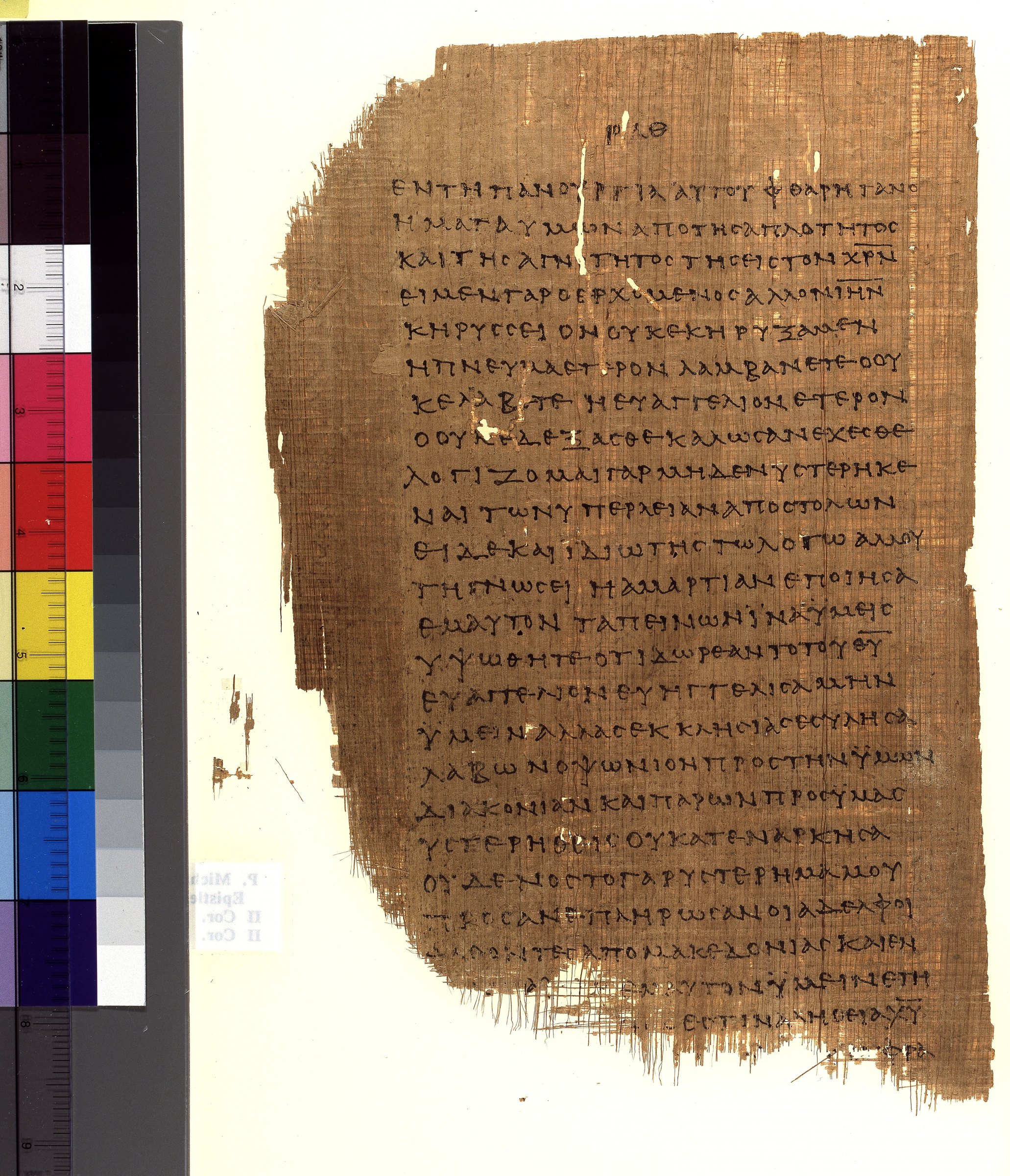
Where on the image
University of Michigan Library photograph 10046x6238_139JP2_UMich.jpg (https://ntmss.info/images/webfriendly/10046/10046x6238_139JP2_UMich.jpg), linked to NTVMR page 1240 (folio 71v) in NTVMR's page index. 11:3 begins on the previous page; 11:10 continues on the next page. Checked on the image: the scribe's page number ρλθ (139) at the head of the page, continuing the sequence of the neighbouring pages; the first line reads ‹εν τη πανουργια αυτου φθαρη τα νο...›, as in the transcription.
11:3 εν τη πανουργια αυτου φθαρη τα νο
ηματα υμων απο της απλοτητος
και της αγνο̣τητος της εις τον χ̅ρ̅ν̅
4 ει μεν γαρ ο ερχομενος αλλον ι̅η̅ν̅
κηρυσσει ον ουκ εκηρυξαμεν
η πνευμα ετερον λαμβανετε ο ου
κ ελαβε̣τε η ευαγγελιον ετερον
ο ουκ̣ εδεξασθε καλως ανεχεσθε
5 λογιζομαι γαρ μηδεν υστερηκε
ναι των υπερλειαν αποστολων
6 ει δε και ιδιωτης τω λογω αλλ ου
τη γνωσει 7 η αμαρτιαν εποιησα
εμαυτον ταπεινων ινα υμεις
υψωθητε οτι δωρεαν το του θ̅υ̅
ευαγγελιον ευηγγελισαμην
υμειν 8 αλλας εκκλησιας εσυλησα
λαβων οψωνιον προς την υμων
διακονιαν 9 και παρων προς υμας
υστερηθεις ου κατεναρκησα
ουδενος το γαρ υστερημα μου
προσανεπληρωσαν οι αδελφοι
ε̣λ̣θοντες απο μακεδονιας και εν
[πα]ν̣τ̣ι̣ αβ̣α̣ρ̣η̣ εμαυτον υμειν ετη
[ρησα και τηρ]η̣σ̣ω̣ 10 εστιν αληθεια χ̅υ̅
[εν εμοι οτι η καυχησις αυτ]η̣ ο̣υ φρα
[γησεται]
11:3But I fear, lest by any means, as the serpent beguiled Eve through his subtilty, so your minds should be corrupted from the simplicity that is in Christ. 4For if he that cometh preacheth another Jesus, whom we have not preached, or if ye receive another spirit, which ye have not received, or another gospel, which ye have not accepted, ye might well bear with him. 5For I suppose I was not a whit behind the very chiefest apostles. 6But though I be rude in speech, yet not in knowledge; but we have been throughly made manifest among you in all things. 7Have I committed an offence in abasing myself that ye might be exalted, because I have preached to you the gospel of God freely? 8I robbed other churches, taking wages of them, to do you service. 9And when I was present with you, and wanted, I was chargeable to no man: for that which was lacking to me the brethren which came from Macedonia supplied: and in all things I have kept myself from being burdensome unto you, and so will I keep myself. 10As the truth of Christ is in me, no man shall stop me of this boasting in the regions of Achaia.
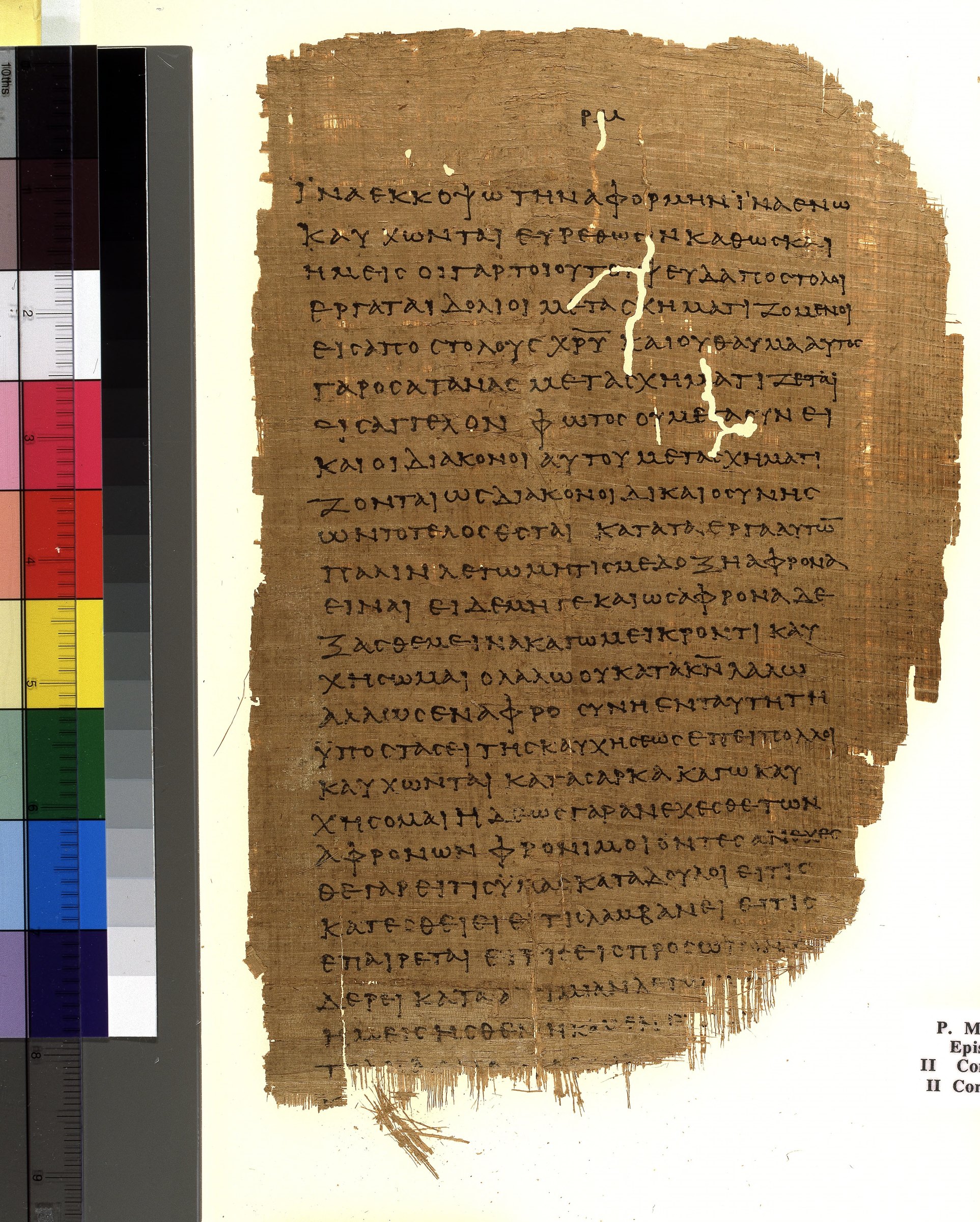
Where on the image
University of Michigan Library photograph 10046x6238_140JP2_UMich.jpg (https://ntmss.info/images/webfriendly/10046/10046x6238_140JP2_UMich.jpg), linked to NTVMR page 1250 (folio 72r) in NTVMR's page index. 11:12 begins on the previous page. Checked on the image: the scribe's page number ρμ (140) at the head of the page, continuing the sequence of the neighbouring pages; the first line reads ‹ινα εκκοψω την αφορμην ινα εν ω›, as in the transcription.
11:12 ινα εκκοψω την αφορμην ινα εν ω
καυχωνται ευρεθωσιν καθως και
ημεις 13 οι γαρ τοιουτοι ψευδαποστολοι
εργαται δολιοι μετασχηματιζομενοι
εις αποστολους χ̅ρ̅υ̅ 14 και ου θαυμα αυτος
γαρ ο σατανας μετασχηματιζεται
εις αγγελον φωτος 15 ου μεγ̣α ουν ει
και οι διακονοι αυτου μετασχηματι
ζονται ως διακονοι δικαιοσυνης
ων το τελος εσται κατα τα εργα αυτων
16 παλιν λεγω μη τις με δοξη αφρονα
ειναι ει δε μη γε και ως αφρονα δε
ξασθε με ινα καγω μεικρον τι καυ
χησωμαι 17 ο λαλω ου κατα κ̅ν̅ λαλω
αλλ ως εν αφροσυνη εν ταυτη τη
υποστασει της καυχησεως 18 επει πολλοι
καυχωνται κατα σαρκα καγω καυ
χησομαι 19 ηδεως γαρ ανεχεσθε των
αφρονων φρονιμοι οντες 20 ανεχεσ
θε γαρ ει τις υμας καταδουλοι ει τις
κατεσθειει ε[ι] τις λαμβανει ει τις
επαιρεται ει τις εις προσωπον υ̣[μας]
δερει 21 κατα α[τ]ιμιαν λεγω ω̣ς̣ [οτι]
ημεις ησθενηκαμ̣εν εν̣ [ω δ αν τις]
τ[ο]λ̣μ̣α ε̣ν̣ α̣φ̣ρ̣ο̣σ̣υ̣ν̣[η λεγω τολμω]
κ̣[αγω]
11:12But what I do, that I will do, that I may cut off occasion from them which desire occasion; that wherein they glory, they may be found even as we. 13For such are false apostles, deceitful workers, transforming themselves into the apostles of Christ. 14And no marvel; for Satan himself is transformed into an angel of light. 15Therefore it is no great thing if his ministers also be transformed as the ministers of righteousness; whose end shall be according to their works. 16I say again, Let no man think me a fool; if otherwise, yet as a fool receive me, that I may boast myself a little. 17That which I speak, I speak it not after the Lord, but as it were foolishly, in this confidence of boasting. 18Seeing that many glory after the flesh, I will glory also. 19For ye suffer fools gladly, seeing ye yourselves are wise. 20For ye suffer, if a man bring you into bondage, if a man devour you, if a man take of you, if a man exalt himself, if a man smite you on the face. 21I speak as concerning reproach, as though we had been weak. Howbeit whereinsoever any is bold, (I speak foolishly,) I am bold also.
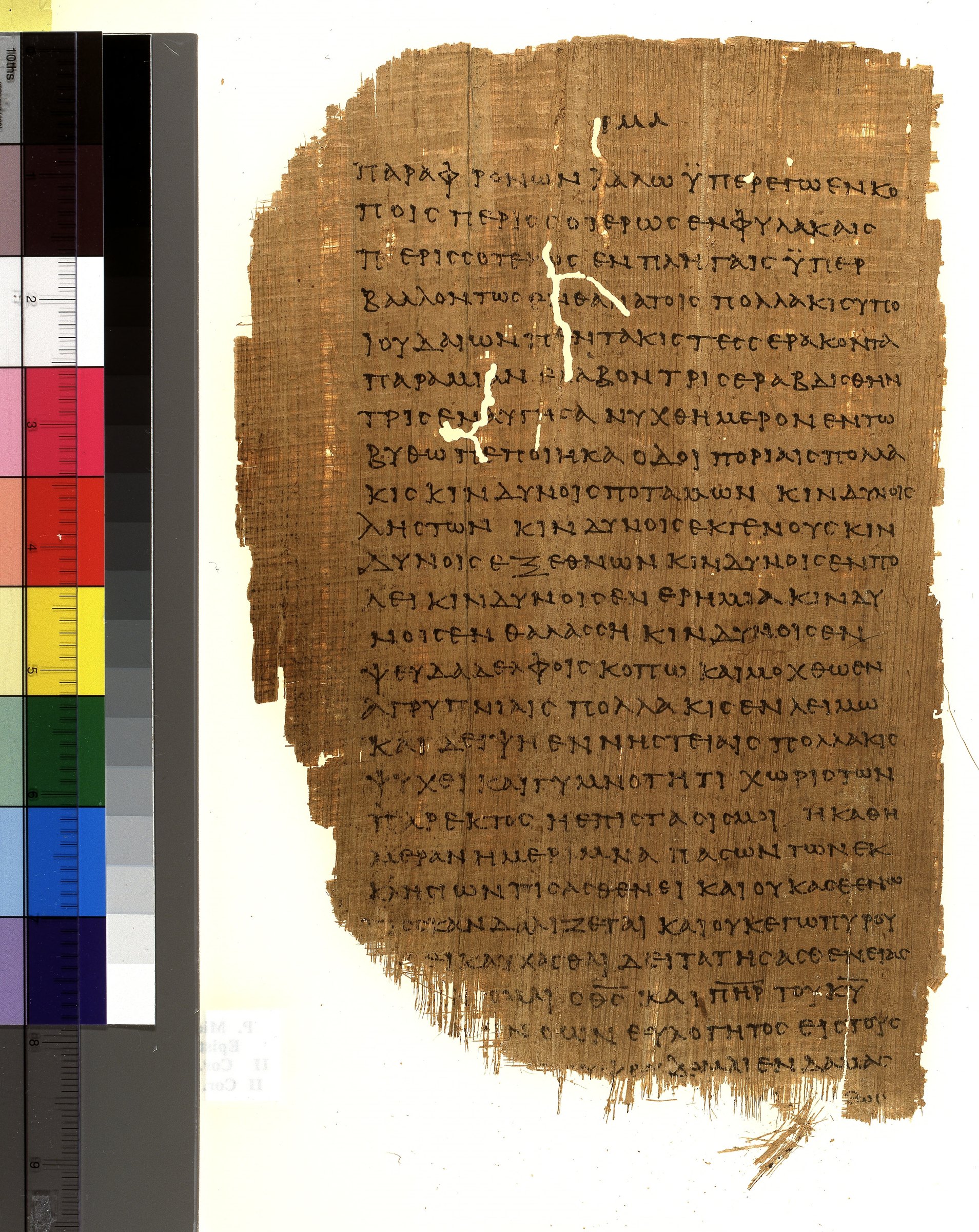
Where on the image
University of Michigan Library photograph 10046x6238_141JP2_UMich.jpg (https://ntmss.info/images/webfriendly/10046/10046x6238_141JP2_UMich.jpg), linked to NTVMR page 1260 (folio 72v) in NTVMR's page index. 11:23 begins on the previous page; 11:32 continues on the next page. Checked on the image: the scribe's page number ρμα (141) at the head of the page, continuing the sequence of the neighbouring pages; the first line reads ‹παραφρονων λαλω υπερ εγω εν κο...›, as in the transcription.
11:23 παραφρονων λαλω υπερ εγω εν κο
ποις περισσοτερως εν φυλακαις
περισσοτερω̣ς εν πληγαις υπερ
βαλλοντως εν θανατοις πολλακις 24 υπο
ιουδαιων πε̣ντακις τεσσερακοντα
παρα μια̣ν ελ̣αβον 25 τρις εραβδισθην
τρις εναυγησα νυχθημερον εν τω
βυθω πεποιηκα 26 οδοιποριαις πολλα
κις κινδυνοις ποταμων κινδυνοις
ληστων κινδυνοις εκ γενους κιν
δυνοις εξ εθνων κινδυνοις εν πο
λει κινδυνοις εν ερημια κινδυ
νοις εν θαλασση κινδυνοις εν
ψευδαδελφοις 27 κοπω και μοχθω εν
αγρυπνιαις πολλακις εν λειμω
και δειψη εν νηστειαις πολλακις
ψυχει και γυμνοτητι 28 χωρις των
παρεκτος η επιστασις μοι η καθ η
μεραν η μεριμνα πασων των εκ
κλησιων 29 τις ασθενει και ουκ ασθενω
τις σκανδαλιζεται και ουκ εγω πυρου
[μαι] 30 ει καυχασθαι δει τα της ασθενειας
[καυ]χ̣ησ̣ομαι 31 ο θ̅ς̅ και π̅η̅ρ̅ του κ̅υ̅
[ι̅η̅υ̅ οι]δ̣ε̣ν ο ων ευλογητος εις τους
[αιωνας οτι] ο̣υ ψευδομαι 32 εν δαμασ
[κω ο εθναρχης αρετα τ]ο̣υ̣ β̣α̣[σιλ]εως
11:23Are they ministers of Christ? (I speak as a fool) I am more; in labours more abundant, in stripes above measure, in prisons more frequent, in deaths oft. 24Of the Jews five times received I forty stripes save one. 25Thrice was I beaten with rods, once was I stoned, thrice I suffered shipwreck, a night and a day I have been in the deep; 26In journeyings often, in perils of waters, in perils of robbers, in perils by mine own countrymen, in perils by the heathen, in perils in the city, in perils in the wilderness, in perils in the sea, in perils among false brethren; 27In weariness and painfulness, in watchings often, in hunger and thirst, in fastings often, in cold and nakedness. 28Beside those things that are without, that which cometh upon me daily, the care of all the churches. 29Who is weak, and I am not weak? who is offended, and I burn not? 30If I must needs glory, I will glory of the things which concern mine infirmities. 31The God and Father of our Lord Jesus Christ, which is blessed for evermore, knoweth that I lie not. 32In Damascus the governor under Aretas the king kept the city of the Damascenes with a garrison, desirous to apprehend me:
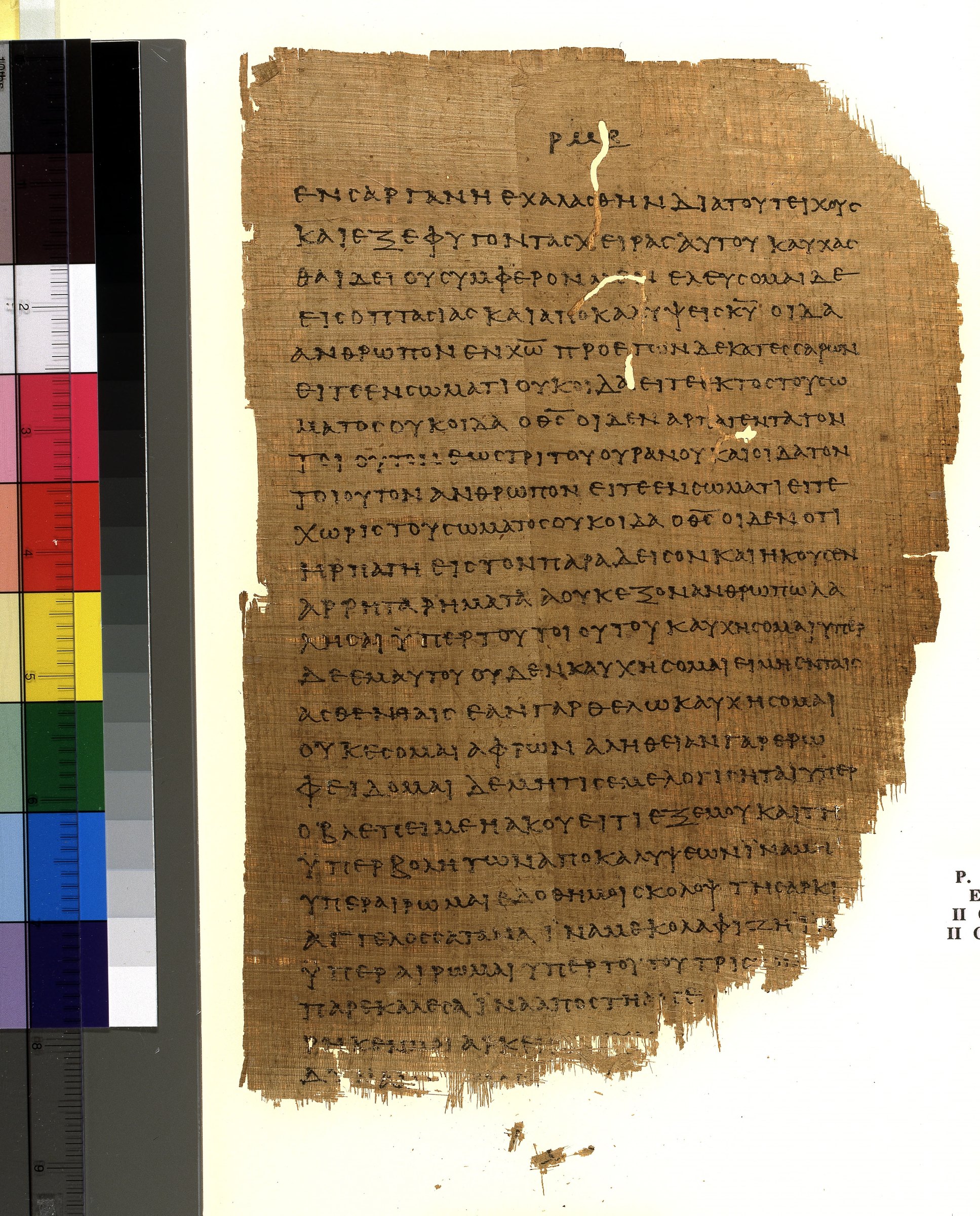
Where on the image
University of Michigan Library photograph 10046x6238_142JP2_UMich.jpg (https://ntmss.info/images/webfriendly/10046/10046x6238_142JP2_UMich.jpg), linked to NTVMR page 1270 (folio 73r) in NTVMR's page index. 11:33 begins on the previous page; 12:9 continues on the next page. Checked on the image: the scribe's page number ρμβ (142) at the head of the page, continuing the sequence of the neighbouring pages; the first line reads ‹εν σαργανη εχαλασθην δια του τειχους›, as in the transcription.
11:33 εν σαργανη εχαλασθην δια του τειχους
και εξεφυγον τας χειρας αυτου 12:1 καυχασ
θαι δει ου συμφερον μεν ελευσομαι δε
εις οπτασιας και αποκαλυψεις κ̅υ̅ 2 οιδα
ανθρωπον εν χ̅ω̅ προ ετων δεκατεσσαρων
ειτε εν σωματι ουκ οιδα ειτε εκτος του σω
ματος ουκ οιδα ο θ̅ς̅ οιδεν αρπαγεντα τον
τοιουτον εως τριτου ουρανου 3 και οιδα τον
τοιουτον ανθρωπον ειτε εν σωματι ειτε
χωρις του σωματος ουκ οιδα ο θ̅ς̅ οιδεν 4 οτι
ηρπαγη εις τον παραδεισον και ηκουσεν
αρρητα ρηματα α ουκ εξον ανθρωπω λα
λησαι 5 υπερ του τοιουτου καυχησομαι υπερ
δε εμαυτου ουδεν καυχησομαι ει μη εν ταις
ασθενιαις 6 εαν γαρ θελω καυχησομαι
ουκ εσομαι αφρων αληθειαν γαρ ερω
φειδομαι δε μη τις εμε λογισηται υπερ
ο βλεπει με η ακουει τι εξ εμου 7 και τη
υπερβολη των αποκαλυψεων ινα μη
υπεραιρωμαι εδοθη μοι σκολοψ τη σαρκι
αγγελος σατανα ινα με κολαφιζη ιν̣[α μη]
υπεραιρωμαι 8 υπερ τουτου τρις τον̣ [κ̅ν̅]
παρεκαλεσα ινα αποστη απ̣ εμ̣[ου] 9 [και ει]
ρηκεν μοι αρκει σοι η χαρ̣ις̣ [μου η γαρ]
δυναμι[ς ε]ν̣ α̣σ̣[θεν]ε̣[ια] τε̣[λειται ηδι]
[στα]
11:33And through a window in a basket was I let down by the wall, and escaped his hands. 12:1It is not expedient for me doubtless to glory. I will come to visions and revelations of the Lord. 2I knew a man in Christ above fourteen years ago, (whether in the body, I cannot tell; or whether out of the body, I cannot tell: God knoweth;) such an one caught up to the third heaven. 3And I knew such a man, (whether in the body, or out of the body, I cannot tell: God knoweth;) 4How that he was caught up into paradise, and heard unspeakable words, which it is not lawful for a man to utter. 5Of such an one will I glory: yet of myself I will not glory, but in mine infirmities. 6For though I would desire to glory, I shall not be a fool; for I will say the truth: but now I forbear, lest any man should think of me above that which he seeth me to be, or that he heareth of me. 7And lest I should be exalted above measure through the abundance of the revelations, there was given to me a thorn in the flesh, the messenger of Satan to buffet me, lest I should be exalted above measure. 8For this thing I besought the Lord thrice, that it might depart from me. 9And he said unto me, My grace is sufficient for thee: for my strength is made perfect in weakness. Most gladly therefore will I rather glory in my infirmities, that the power of Christ may rest upon me.
Notes
- Greek: the NTVMR diplomatic transcription, line by line as on the papyrus. Square brackets enclose letters that are lost or illegible and were supplied by the transcribers; a dot under a letter marks it as uncertain; [...] marks a gap. Nomina sacra and numerals keep the scribe's overline. Spelling is the scribe's (no accents or breathings). Words broken at a line end stay broken as on the papyrus. Corrections are not shown: the text is the first hand.
- English: the King James Version (1611), whole verses, for every verse that has text on the page. A verse that begins on one page and ends on the next is given in full on both. The KJV translates a later form of the Greek text, so its wording does not always match the papyrus; material differences (such as verses the papyrus does not have) are noted in the section.
Cite
Sources
- Source: P46 (P.Mich. inv. 6238, University of Michigan Library): photographs as published in the INTF New Testament Virtual Manuscript Room; Greek from the INTF NTVMR transcription of P46; English from the King James Version (holding institution)
- Critical edition: INTF NTVMR diplomatic transcription (CC BY 4.0)
← previous · → next · v cycle view · l back to library