P46 (Chester Beatty II): 2 Corinthians 7:5-8:3 (fols. 67v-68r)
Introduction
P46 is a papyrus codex of the letters of Paul copied in Egypt around 200, the oldest surviving collection of Paul's letters. 86 of its 104 leaves survive: 56 in the Chester Beatty Library, Dublin (Biblical Papyrus II, published by Frederic Kenyon in 1934-1937) and 30 in the University of Michigan Library, Ann Arbor (P.Mich. inv. 6238, published by Henry Sanders in 1935). The letters run in the order Romans, Hebrews, 1 and 2 Corinthians, Ephesians, Galatians, Philippians, Colossians and 1 Thessalonians; the first seven leaves (Romans 1:1-5:17) and the end of the book are lost. Hebrews standing after Romans, and the doxology of Romans (16:25-27) standing after 15:33, are among its best-known features.
Each section below is one page side: the holding library's photograph, the NTVMR diplomatic transcription line by line, and the King James Version of every verse that has text on the page. The lower lines of many leaves are lost; the transcribers' restorations are in square brackets.
This entry covers fols. 67v-68r (2 Corinthians 7:5-8:3).
How was this verified? (Provenance)
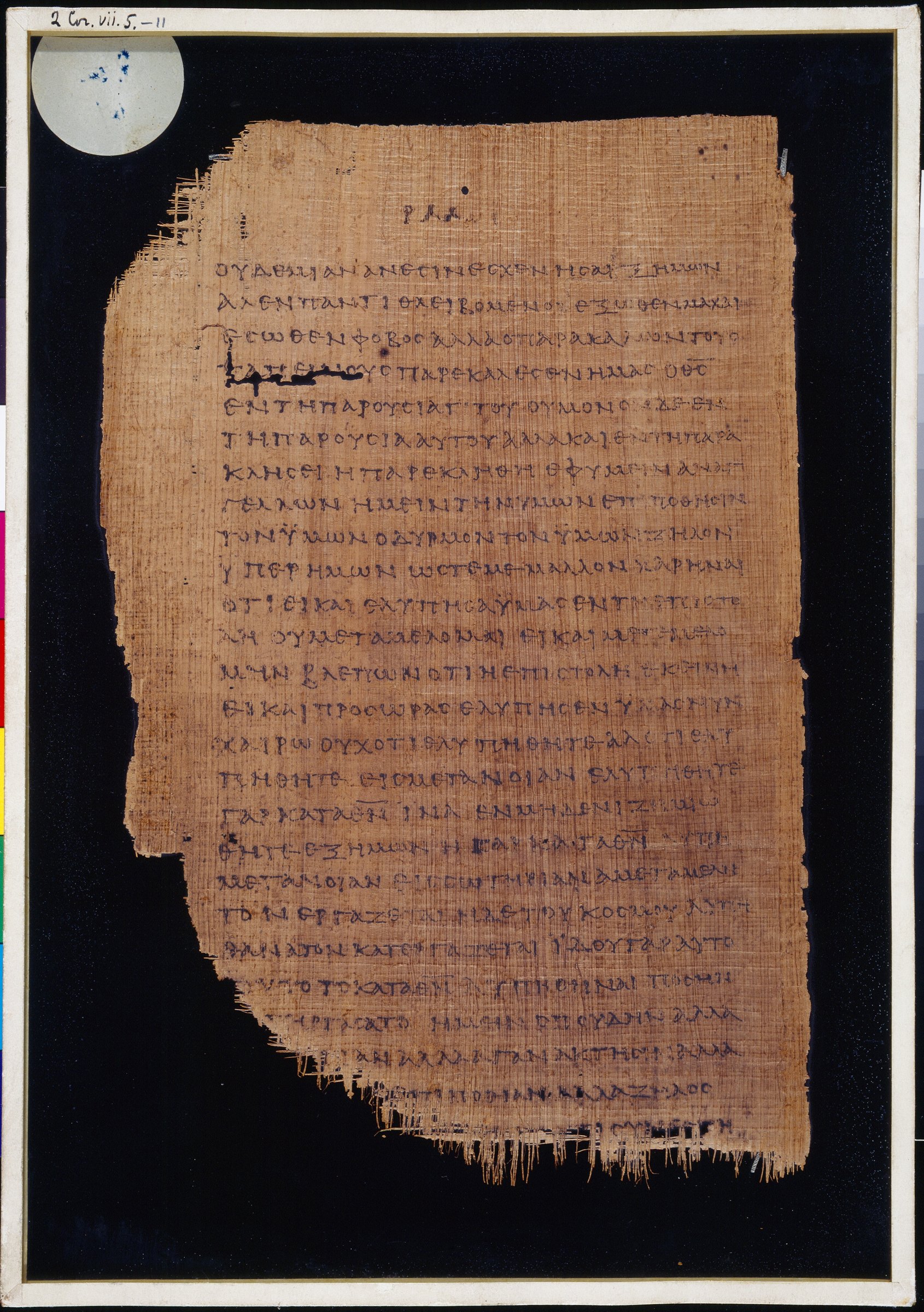
Where on the image
Chester Beatty Library photograph T0005262.jpg (https://ntmss.info/images/webfriendly/10046/T0005262.jpg), linked to NTVMR page 1160 (folio 67v) in NTVMR's page index. 7:5 begins on the previous page; 7:11 continues on the next page. Checked on the image: the scribe's page number ρλα (131) at the head of the page, continuing the sequence of the neighbouring pages.
7:5 ουδεμιαν ανεσιν εσχεν η σαρξ̣ ημων
αλ εν παντι θλειβομενοι εξωθεν μαχαι
εσωθεν φοβος 6 αλλα ο παρακαλων τους
τ̣απειν̣ους παρεκαλεσεν ημας ο θ̅ς̅
εν τη παρουσια τι̣του 7 ου μονον̣ δε εν
τη παρουσια αυτου αλλα και εν τη παρα
κλησει η παρεκληθη εφ υμειν αναγ
γελλων ημειν την υμων επι̣ποθησιν
τον υμων οδυρμον τον υμων ζηλον
υπερ ημων ωστε με μαλλον χαρηναι
8 οτι ει και ελυπησα υμας εν τη̣ επισ̣το
λη ου μεταμελομαι ει και μετ̣εμελο
μη̣ν βλεπων οτι η επιστολη εκεινη
ει και προς ωρας ελυπησεν υμας 9 νυν
χαιρω ουχ οτι ελυπηθητε αλ οτι ελυ
πηθητε εις μετανοιαν ελυπ̣ηθητε
γαρ κατα θ̅ν̅ ινα εν μηδενι ζημιω
θητε εξ ημων 10 η κ κατα θ̅ν̅ λ̣υπη
μετανοιαν εις σωτηριαν αμεταμελη
τον εργαζεται η δε του κοσμου λυπη
θανατον κατεργαζεται 11 ιδου γαρ αυτο
[τ]ο̣υ̣το το κατα θ̅ν̅ λυπηθηναι ποσην
[κα]τ̣η̣ργασατο ημειν σπουδην αλλα
[απολο]γ̣ι̣αν αλλα αγανακτησιν αλλα
[φοβον αλλ]α̣ ε̣πιποθιαν α̣λλα ζηλος
[αλλα εκδικησιν] ε̣ν̣ π̣α̣ν̣τ̣ι συνε̣σ̣τ̣η
[σατε]
7:5For, when we were come into Macedonia, our flesh had no rest, but we were troubled on every side; without were fightings, within were fears. 6Nevertheless God, that comforteth those that are cast down, comforted us by the coming of Titus; 7And not by his coming only, but by the consolation wherewith he was comforted in you, when he told us your earnest desire, your mourning, your fervent mind toward me; so that I rejoiced the more. 8For though I made you sorry with a letter, I do not repent, though I did repent: for I perceive that the same epistle hath made you sorry, though it were but for a season. 9Now I rejoice, not that ye were made sorry, but that ye sorrowed to repentance: for ye were made sorry after a godly manner, that ye might receive damage by us in nothing. 10For godly sorrow worketh repentance to salvation not to be repented of: but the sorrow of the world worketh death. 11For behold this selfsame thing, that ye sorrowed after a godly sort, what carefulness it wrought in you, yea, what clearing of yourselves, yea, what indignation, yea, what fear, yea, what vehement desire, yea, what zeal, yea, what revenge! In all things ye have approved yourselves to be clear in this matter.
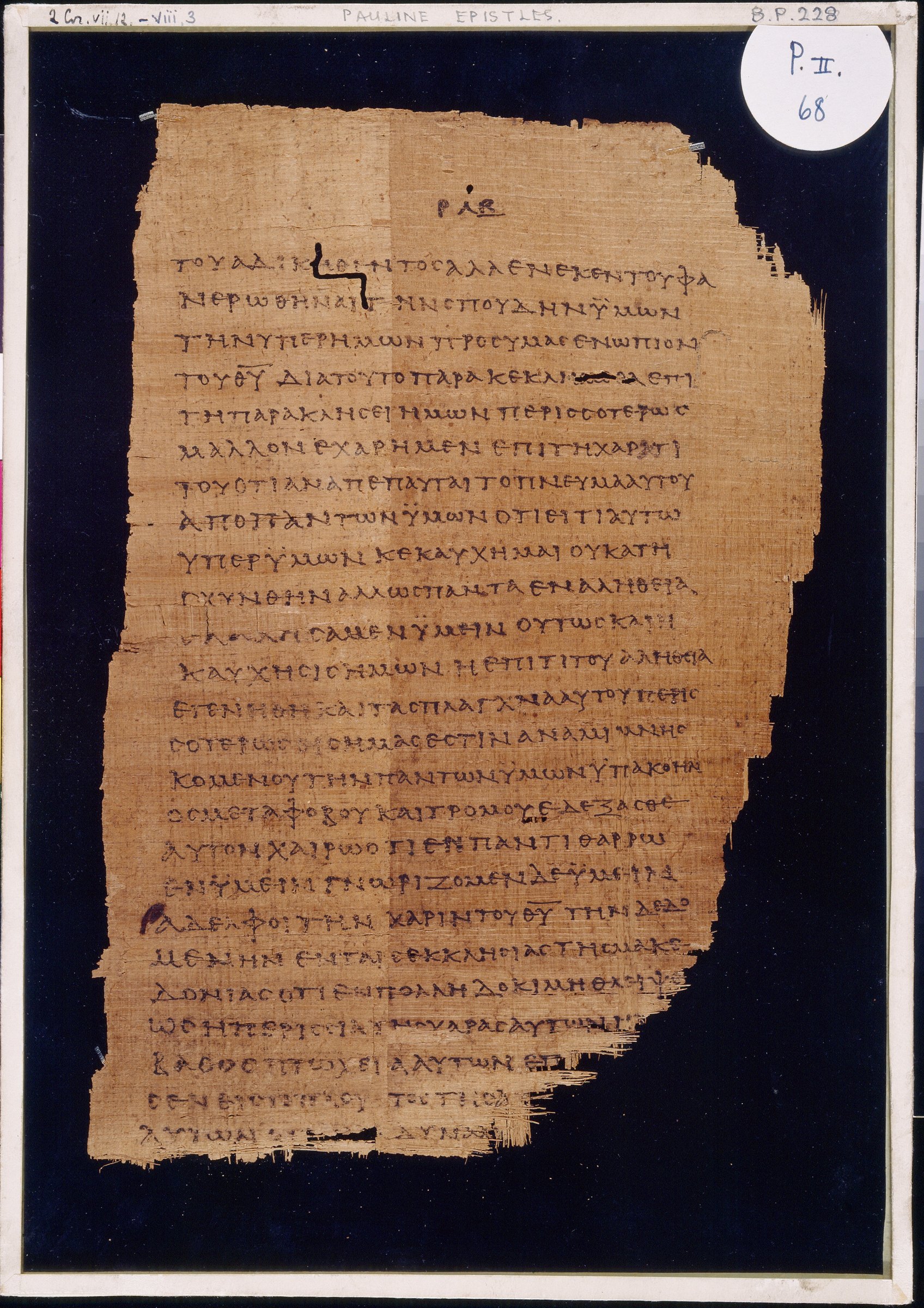
Where on the image
Chester Beatty Library photograph T0005265.jpg (https://ntmss.info/images/webfriendly/10046/T0005265.jpg), linked to NTVMR page 1170 (folio 68r) in NTVMR's page index. 7:12 begins on the previous page; 8:3 continues on the next page. Checked on the image: the scribe's page number ρλβ (132) at the head of the page, continuing the sequence of the neighbouring pages; the disc on the frame reads ‹P. II 68›.
7:12 του αδικη̣θεντος αλλ ενεκεν του φα
νερωθηναι την σπουδην υμων
την υπερ ημων προς υμας ενωπιον
του θ̅υ̅ 13 δια τουτο παρακεκλη̣μ̣ε̣θα επι
τη παρακλησει ημων περισσοτερως
μαλλον εχαρημεν επι τη χαρα τι
του οτι αναπεπαυται το πνευμα αυτου
απο παντων υμων 14 οτι ει τι αυτω
υπερ υμων κεκαυχημαι ου κατη
σχυνθην αλλ ως παντα εν αληθεια
ε̣λαλη̣σαμεν υμειν ουτως και η
καυχησις ημων η επι τιτου αληθεια
εγενηθη 15 και τα σπλαγχνα αυτου περισ
σοτερως εις ημας εστιν αναμιμνησ
κομενου την παντων υμων υπακοην
ος μετα φοβου και τρομου εδεξασθε
αυτον 16 χαιρω οτι εν παντι θαρρω
εν υμειν 8:1 γνωριζομεν δε υμειν
αδελφοι την χαριν του θ̅υ̅ την δεδο
μενην εν ταις εκκλησιας της μακε
δονιας 2 οτι εν πολλη δοκιμη θλειψε
ως η περισσια της χ̣αρας αυτων η κ̣[ατα]
βαθος πτωχεια αυτων επ[ερισσευ]
σεν εις το πλουτος της απ̣[λοτητος]
αυτ̣ων 3 ο̣τ̣ι̣ κ̣α̣τ̣α̣ δυναμ̣[ιν μαρτυρω]
7:12Wherefore, though I wrote unto you, I did it not for his cause that had done the wrong, nor for his cause that suffered wrong, but that our care for you in the sight of God might appear unto you. 13Therefore we were comforted in your comfort: yea, and exceedingly the more joyed we for the joy of Titus, because his spirit was refreshed by you all. 14For if I have boasted any thing to him of you, I am not ashamed; but as we spake all things to you in truth, even so our boasting, which I made before Titus, is found a truth. 15And his inward affection is more abundant toward you, whilst he remembereth the obedience of you all, how with fear and trembling ye received him. 16I rejoice therefore that I have confidence in you in all things. 8:1Moreover, brethren, we do you to wit of the grace of God bestowed on the churches of Macedonia; 2How that in a great trial of affliction the abundance of their joy and their deep poverty abounded unto the riches of their liberality. 3For to their power, I bear record, yea, and beyond their power they were willing of themselves;
Notes
- Greek: the NTVMR diplomatic transcription, line by line as on the papyrus. Square brackets enclose letters that are lost or illegible and were supplied by the transcribers; a dot under a letter marks it as uncertain; [...] marks a gap. Nomina sacra and numerals keep the scribe's overline. Spelling is the scribe's (no accents or breathings). Words broken at a line end stay broken as on the papyrus. Corrections are not shown: the text is the first hand.
- English: the King James Version (1611), whole verses, for every verse that has text on the page. A verse that begins on one page and ends on the next is given in full on both. The KJV translates a later form of the Greek text, so its wording does not always match the papyrus; material differences (such as verses the papyrus does not have) are noted in the section.
Cite
Sources
- Source: P46 (Chester Beatty Biblical Papyrus II, Chester Beatty Library, Dublin): photographs as published in the INTF New Testament Virtual Manuscript Room; Greek from the INTF NTVMR transcription of P46; English from the King James Version (holding institution)
- Critical edition: INTF NTVMR diplomatic transcription (CC BY 4.0)
← previous · → next · v cycle view · l back to library