P46 (Chester Beatty II): 2 Corinthians 6:3-7:4 (fols. 66v-67r)
Introduction
P46 is a papyrus codex of the letters of Paul copied in Egypt around 200, the oldest surviving collection of Paul's letters. 86 of its 104 leaves survive: 56 in the Chester Beatty Library, Dublin (Biblical Papyrus II, published by Frederic Kenyon in 1934-1937) and 30 in the University of Michigan Library, Ann Arbor (P.Mich. inv. 6238, published by Henry Sanders in 1935). The letters run in the order Romans, Hebrews, 1 and 2 Corinthians, Ephesians, Galatians, Philippians, Colossians and 1 Thessalonians; the first seven leaves (Romans 1:1-5:17) and the end of the book are lost. Hebrews standing after Romans, and the doxology of Romans (16:25-27) standing after 15:33, are among its best-known features.
Each section below is one page side: the holding library's photograph, the NTVMR diplomatic transcription line by line, and the King James Version of every verse that has text on the page. The lower lines of many leaves are lost; the transcribers' restorations are in square brackets.
This entry covers fols. 66v-67r (2 Corinthians 6:3-7:4).
How was this verified? (Provenance)
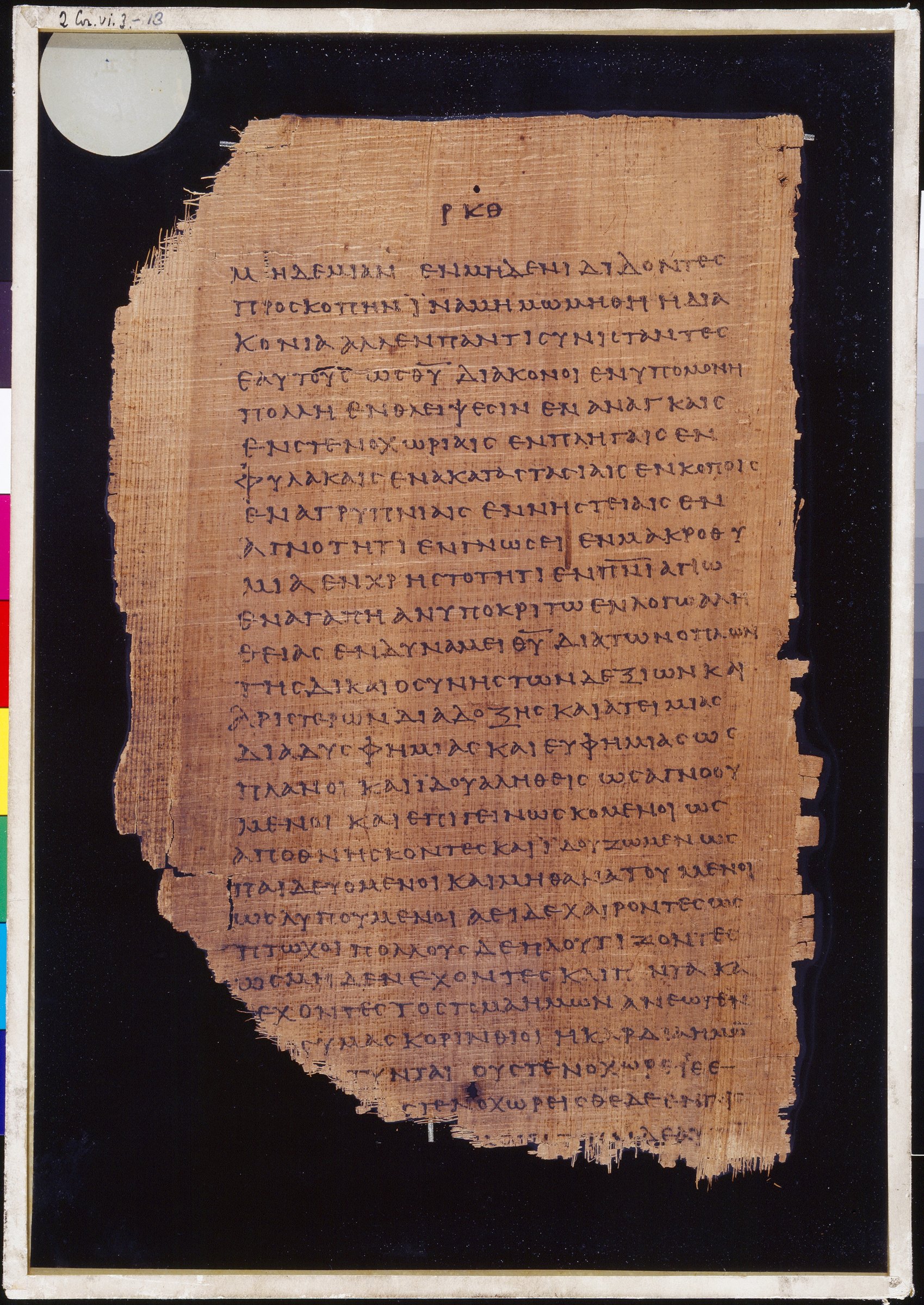
Where on the image
Chester Beatty Library photograph T0005261.jpg (https://ntmss.info/images/webfriendly/10046/T0005261.jpg), linked to NTVMR page 1140 (folio 66v) in NTVMR's page index. 6:13 continues on the next page. Checked on the image: the scribe's page number ρκθ (129) at the head of the page, continuing the sequence of the neighbouring pages.
6:3 μηδεμιαν εν μηδενι διδοντες
προσκοπην ινα μη μωμηθη η δια
κονια 4 αλλ εν παντι συνισταντες
εαυτους ως θ̅υ̅ διακονοι εν υπομονη
πολλη εν θλειψεσιν εν αναγκαις
εν στενοχωριαις 5 εν πληγαις εν
φυλακαις εν ακαταστασιαις εν κοποις
εν αγρυπνιαις εν νηστειαις 6 εν
αγνοτητι εν γνωσει εν μακροθυ
μια εν χρηστοτητι εν π̅ν̅ι̅ αγιω
εν αγαπη ανυποκριτω 7 εν λογω αλη
θειας εν δυναμει θ̅υ̅ δια των οπλων
της δικαιοσυνης των δεξιων και
αριστερων 8 δια δοξης και ατειμιας
δια δυσφημιας και ευφημιας ως
πλανοι και ιδου αληθεις 9 ως αγνοου
μενοι και επιγεινωσκομενοι ως
αποθνησκοντες και ιδου ζωμεν ως
παιδευομενοι και μη θανατουμενοι
10 ως λυπουμενοι αει δε χαιροντες ως
πτωχοι πολλους δε πλουτιζοντες
ως μηδεν εχοντες και πα̣ντα κα
[τ]εχοντες 11 το στομα ημων ανεωγεν
[πρ]ο̣ς υμας κορινθιοι η καρδια ημων
[πεπλ]α̣τυνται 12 ου στενοχωρειθε
[εν ημειν] στενοχωρεισθε δε εν τοις
[σπλαγχνοις υ]μ̣ων̣ 13 τ̣ην̣ δε αυτ̣[η]ν̣
6:3Giving no offence in any thing, that the ministry be not blamed: 4But in all things approving ourselves as the ministers of God, in much patience, in afflictions, in necessities, in distresses, 5In stripes, in imprisonments, in tumults, in labours, in watchings, in fastings; 6By pureness, by knowledge, by longsuffering, by kindness, by the Holy Ghost, by love unfeigned, 7By the word of truth, by the power of God, by the armour of righteousness on the right hand and on the left, 8By honour and dishonour, by evil report and good report: as deceivers, and yet true; 9As unknown, and yet well known; as dying, and, behold, we live; as chastened, and not killed; 10As sorrowful, yet alway rejoicing; as poor, yet making many rich; as having nothing, and yet possessing all things. 11O ye Corinthians, our mouth is open unto you, our heart is enlarged. 12Ye are not straitened in us, but ye are straitened in your own bowels. 13Now for a recompence in the same, (I speak as unto my children,) be ye also enlarged.
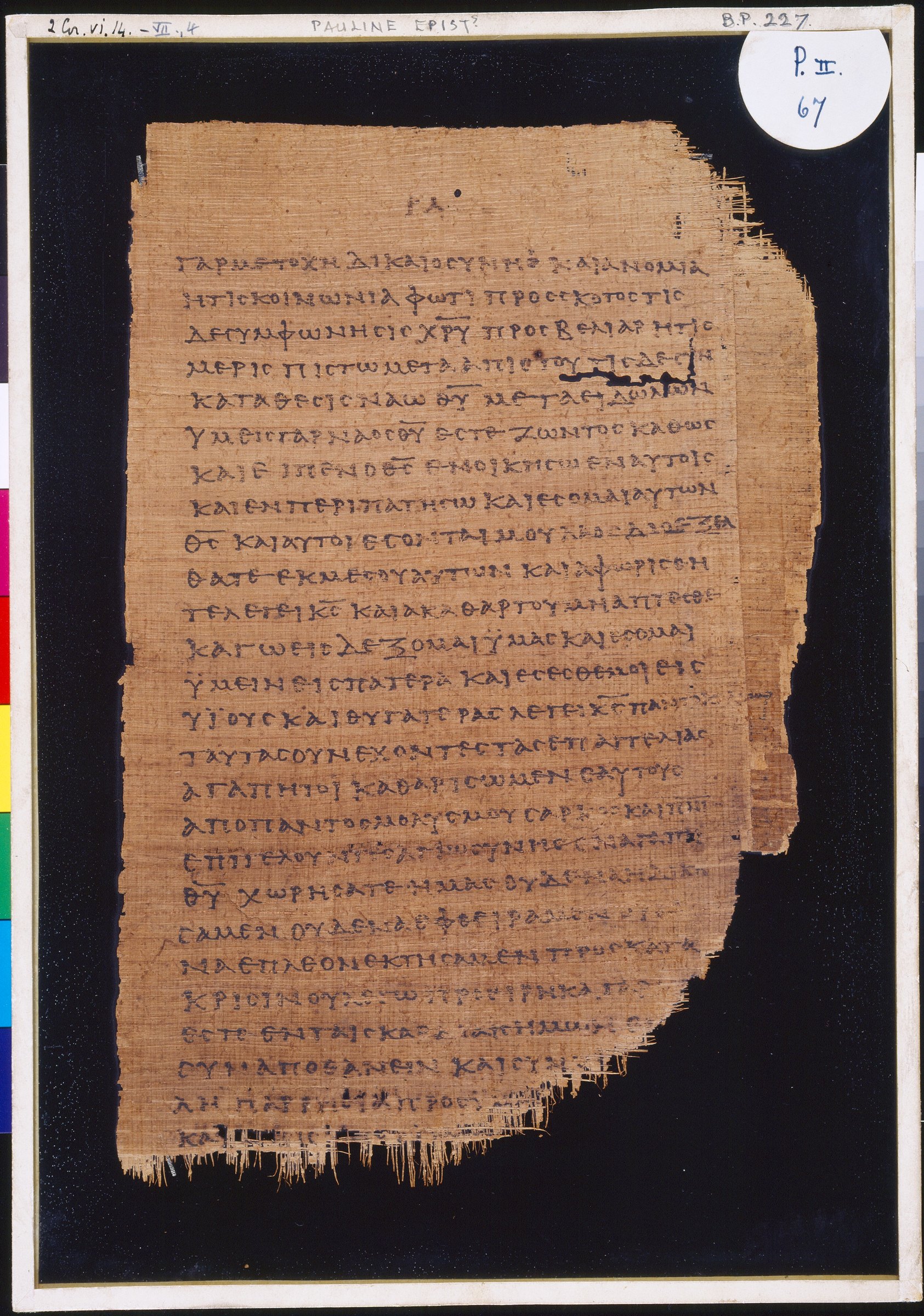
Where on the image
Chester Beatty Library photograph T0005260.jpg (https://ntmss.info/images/webfriendly/10046/T0005260.jpg), linked to NTVMR page 1150 (folio 67r) in NTVMR's page index. 6:14 begins on the previous page; 7:4 continues on the next page. Checked on the image: the disc on the frame reads ‹P. II 67›.
6:14 γαρ μετοχη δικαιοσυνης και ανομια
η τις κοινωνια φωτι προς σκοτος 15 τις
δε συμφωνησις χ̅ρ̅υ̅ προς βελιαρ η τις
μερις πιστω μετα απιστου 16 τις δε σ[υ]ν
καταθεσις ναω θ̅υ̅ μετα ειδωλων
υμεις γαρ ναος θ̅υ̅ εστε ζωντος καθως
και ειπεν ο θ̅ς̅ ενοικησω εν αυτοις
και ενπεριπατησω και εσομαι αυτων
θ̅ς̅ και αυτοι εσονται μου λαος 17 διο εξελ
θατε εκ μεσου αυτων και αφωρισθη
τε λεγει κ̅ς̅ και ακαθαρτου μη απτεσθε
καγω εισδεξομαι υμας 18 και εσομαι
υμειν εις πατερα και εσεσθε μοι εις
υιους και θυγατερας λεγει κ̅ς̅ παντο̣κ[ρ]α̣τ̣ωρ
7:1 ταυτας ουν εχοντες τας επαγγελιας
αγαπητοι καθαρισωμεν εαυτους
απο παντος μολυσμου σαρκος και π̅ν̅ι̅
επιτελουντες αγιωσυνης ε̣ν αγαπη̣
θ̅υ̅ 2 χωρησατε ημας ουδενα ηδι̣κη̣
σαμεν ουδενα εφθειραμεν ουδ̣ε̣
να επλεονεκτησαμεν 3 προς κατα
κρισιν ου λεγω προειρηκα γαρ̣ ο̣[τι]
εστε εν ταις καρδιαις ημων ει̣[ς το]
συναποθανειν και συνζ̣[ην] 4 [πολ]
λη παρρη̣σ̣ια προς υμα̣ς̣ [πολλη μοι]
καυ̣χ̣[η]σ̣ις υ̣[π]ε̣ρ̣ υ̣μ̣ω̣ν̣ [πεπληρωμαι]
6:14Be ye not unequally yoked together with unbelievers: for what fellowship hath righteousness with unrighteousness? and what communion hath light with darkness? 15And what concord hath Christ with Belial? or what part hath he that believeth with an infidel? 16And what agreement hath the temple of God with idols? for ye are the temple of the living God; as God hath said, I will dwell in them, and walk in them; and I will be their God, and they shall be my people. 17Wherefore come out from among them, and be ye separate, saith the Lord, and touch not the unclean thing; and I will receive you, 18And will be a Father unto you, and ye shall be my sons and daughters, saith the Lord Almighty. 7:1Having therefore these promises, dearly beloved, let us cleanse ourselves from all filthiness of the flesh and spirit, perfecting holiness in the fear of God. 2Receive us; we have wronged no man, we have corrupted no man, we have defrauded no man. 3I speak not this to condemn you: for I have said before, that ye are in our hearts to die and live with you. 4Great is my boldness of speech toward you, great is my glorying of you: I am filled with comfort, I am exceeding joyful in all our tribulation.
Notes
- Greek: the NTVMR diplomatic transcription, line by line as on the papyrus. Square brackets enclose letters that are lost or illegible and were supplied by the transcribers; a dot under a letter marks it as uncertain; [...] marks a gap. Nomina sacra and numerals keep the scribe's overline. Spelling is the scribe's (no accents or breathings). Words broken at a line end stay broken as on the papyrus. Corrections are not shown: the text is the first hand.
- English: the King James Version (1611), whole verses, for every verse that has text on the page. A verse that begins on one page and ends on the next is given in full on both. The KJV translates a later form of the Greek text, so its wording does not always match the papyrus; material differences (such as verses the papyrus does not have) are noted in the section.
Cite
Sources
- Source: P46 (Chester Beatty Biblical Papyrus II, Chester Beatty Library, Dublin): photographs as published in the INTF New Testament Virtual Manuscript Room; Greek from the INTF NTVMR transcription of P46; English from the King James Version (holding institution)
- Critical edition: INTF NTVMR diplomatic transcription (CC BY 4.0)
← previous · → next · v cycle view · l back to library