P46 (P.Mich. inv. 6238): Ephesians 3:11-4:1 (fol. 77v)
Introduction
P46 is a papyrus codex of the letters of Paul copied in Egypt around 200, the oldest surviving collection of Paul's letters. 86 of its 104 leaves survive: 56 in the Chester Beatty Library, Dublin (Biblical Papyrus II, published by Frederic Kenyon in 1934-1937) and 30 in the University of Michigan Library, Ann Arbor (P.Mich. inv. 6238, published by Henry Sanders in 1935). The letters run in the order Romans, Hebrews, 1 and 2 Corinthians, Ephesians, Galatians, Philippians, Colossians and 1 Thessalonians; the first seven leaves (Romans 1:1-5:17) and the end of the book are lost. Hebrews standing after Romans, and the doxology of Romans (16:25-27) standing after 15:33, are among its best-known features.
Each section below is one page side: the holding library's photograph, the NTVMR diplomatic transcription line by line, and the King James Version of every verse that has text on the page. The lower lines of many leaves are lost; the transcribers' restorations are in square brackets.
This entry covers fol. 77v (Ephesians 3:11-4:1).
How was this verified? (Provenance)
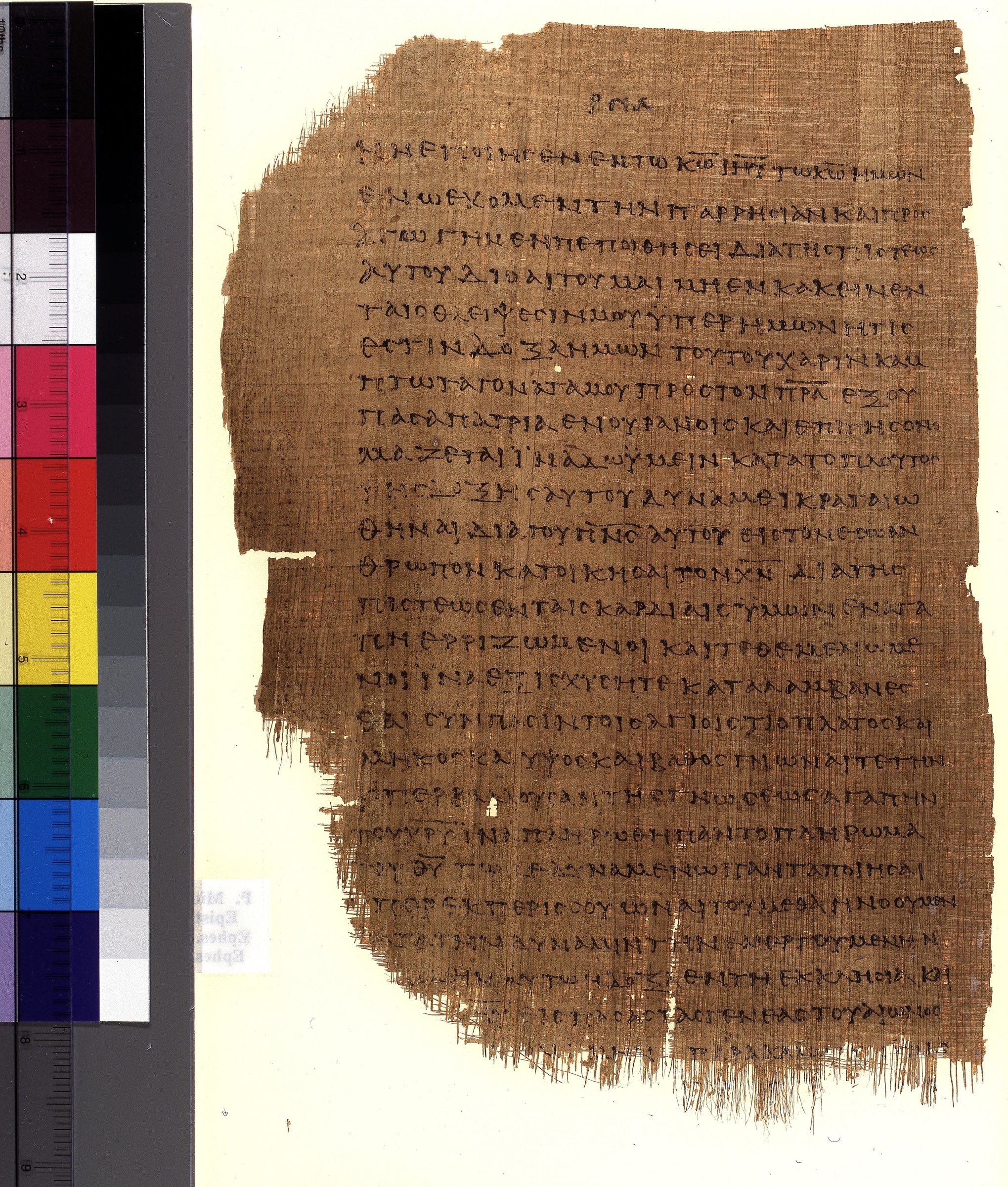
Where on the image
University of Michigan Library photograph 10046x6238_151JP2_UMich.jpg (https://ntmss.info/images/webfriendly/10046/10046x6238_151JP2_UMich.jpg), linked to NTVMR page 1360 (folio 77v) in NTVMR's page index. 3:11 begins on the previous page; 4:1 continues on the next page. Checked on the image: the scribe's page number ρνα (151) at the head of the page, continuing the sequence of the neighbouring pages; the first line reads ‹ην εποιησεν εν τω κ̅ω̅ ι̅η̅υ̅ τω κ̅ω̅ ημων›, as in the transcription.
3:11 ην εποιησεν εν τω κ̅ω̅ ι̅η̅υ̅ τω κ̅ω̅ ημων
12 εν ω εχομεν την παρρησιαν και προσ
αγωγην εν πεποιθησει δια της πιστεως
αυτου 13 διο αιτουμαι μη ενκακειν εν
ταις θλειψεσιν μου υπερ ημων ητις
εστιν δοξα ημων 14 τουτου χαριν καμ
πτω τα γονατα μου προς τον π̅ρ̅α̅ 15 εξ ου
πασα πατρια εν ουρανοις και επι γης ονο
μαζεται 16 ινα δω υμειν κατα το πλουτος
της δοξης αυτου δυναμει κραταιω
θηναι δια του π̅ν̅ς̅ αυτου εις τον εσω αν
θρωπον 17 κατοικησαι τον χ̅ν̅ δια της
πιστεως εν ταις καρδιαις υμων εν αγα
πη ερριζωμενοι και τεθεμελιωμε
νοι 18 ινα εξισχυσητε καταλαμβανεσ
θαι συν πασιν τοις αγιοις τι ο πλατος και
μηκος και̣ υψος και βαθος 19 γνωναι τε την
υ̣περβαλλουσαν της γνωσεως αγαπην
του χ̅ρ̅υ̅ ινα πληρωθη παν το πληρωμα
τ̣ου θ̅υ̅ 20 τω δ̣ε δυναμενω παντα ποιησαι
[υ]περεκπ̣ερισσου ων αιτουμεθα η νοουμεν
[κ]α̣τα την δυναμιν την ενεργουμενην
[εν] [.]μ̣ειν 21 αυτω η δοξα εν τη εκκλησια και
[εν χ̅ρ̅ω̅] ι̣̣̅η̅υ̅ εις πασας τας γενεας του αιωνος
[των αιω]ν̣ω̣ν α̣μην 4:1 παρακαλω ο̣υν υμας
[εγω ο δεσμιος εν κ̅ω̅ α]ξ̣ι̣[ω]ς [περιπατησαι]
3:11According to the eternal purpose which he purposed in Christ Jesus our Lord: 12In whom we have boldness and access with confidence by the faith of him. 13Wherefore I desire that ye faint not at my tribulations for you, which is your glory. 14For this cause I bow my knees unto the Father of our Lord Jesus Christ, 15Of whom the whole family in heaven and earth is named, 16That he would grant you, according to the riches of his glory, to be strengthened with might by his Spirit in the inner man; 17That Christ may dwell in your hearts by faith; that ye, being rooted and grounded in love, 18May be able to comprehend with all saints what is the breadth, and length, and depth, and height; 19And to know the love of Christ, which passeth knowledge, that ye might be filled with all the fulness of God. 20Now unto him that is able to do exceeding abundantly above all that we ask or think, according to the power that worketh in us, 21Unto him be glory in the church by Christ Jesus throughout all ages, world without end. Amen. 4:1I therefore, the prisoner of the Lord, beseech you that ye walk worthy of the vocation wherewith ye are called,
Notes
- Greek: the NTVMR diplomatic transcription, line by line as on the papyrus. Square brackets enclose letters that are lost or illegible and were supplied by the transcribers; a dot under a letter marks it as uncertain; [...] marks a gap. Nomina sacra and numerals keep the scribe's overline. Spelling is the scribe's (no accents or breathings). Words broken at a line end stay broken as on the papyrus. Corrections are not shown: the text is the first hand.
- English: the King James Version (1611), whole verses, for every verse that has text on the page. A verse that begins on one page and ends on the next is given in full on both. The KJV translates a later form of the Greek text, so its wording does not always match the papyrus; material differences (such as verses the papyrus does not have) are noted in the section.
Cite
Sources
- Source: P46 (P.Mich. inv. 6238, University of Michigan Library): photographs as published in the INTF New Testament Virtual Manuscript Room; Greek from the INTF NTVMR transcription of P46; English from the King James Version (holding institution)
- Critical edition: INTF NTVMR diplomatic transcription (CC BY 4.0)
← previous · → next · v cycle view · l back to library