P46 (P.Mich. inv. 6238): Ephesians 5:8-6:6 (fols. 79v-80r)
Introduction
P46 is a papyrus codex of the letters of Paul copied in Egypt around 200, the oldest surviving collection of Paul's letters. 86 of its 104 leaves survive: 56 in the Chester Beatty Library, Dublin (Biblical Papyrus II, published by Frederic Kenyon in 1934-1937) and 30 in the University of Michigan Library, Ann Arbor (P.Mich. inv. 6238, published by Henry Sanders in 1935). The letters run in the order Romans, Hebrews, 1 and 2 Corinthians, Ephesians, Galatians, Philippians, Colossians and 1 Thessalonians; the first seven leaves (Romans 1:1-5:17) and the end of the book are lost. Hebrews standing after Romans, and the doxology of Romans (16:25-27) standing after 15:33, are among its best-known features.
Each section below is one page side: the holding library's photograph, the NTVMR diplomatic transcription line by line, and the King James Version of every verse that has text on the page. The lower lines of many leaves are lost; the transcribers' restorations are in square brackets.
This entry covers fols. 79v-80r (Ephesians 5:8-6:6).
How was this verified? (Provenance)
Where on the image
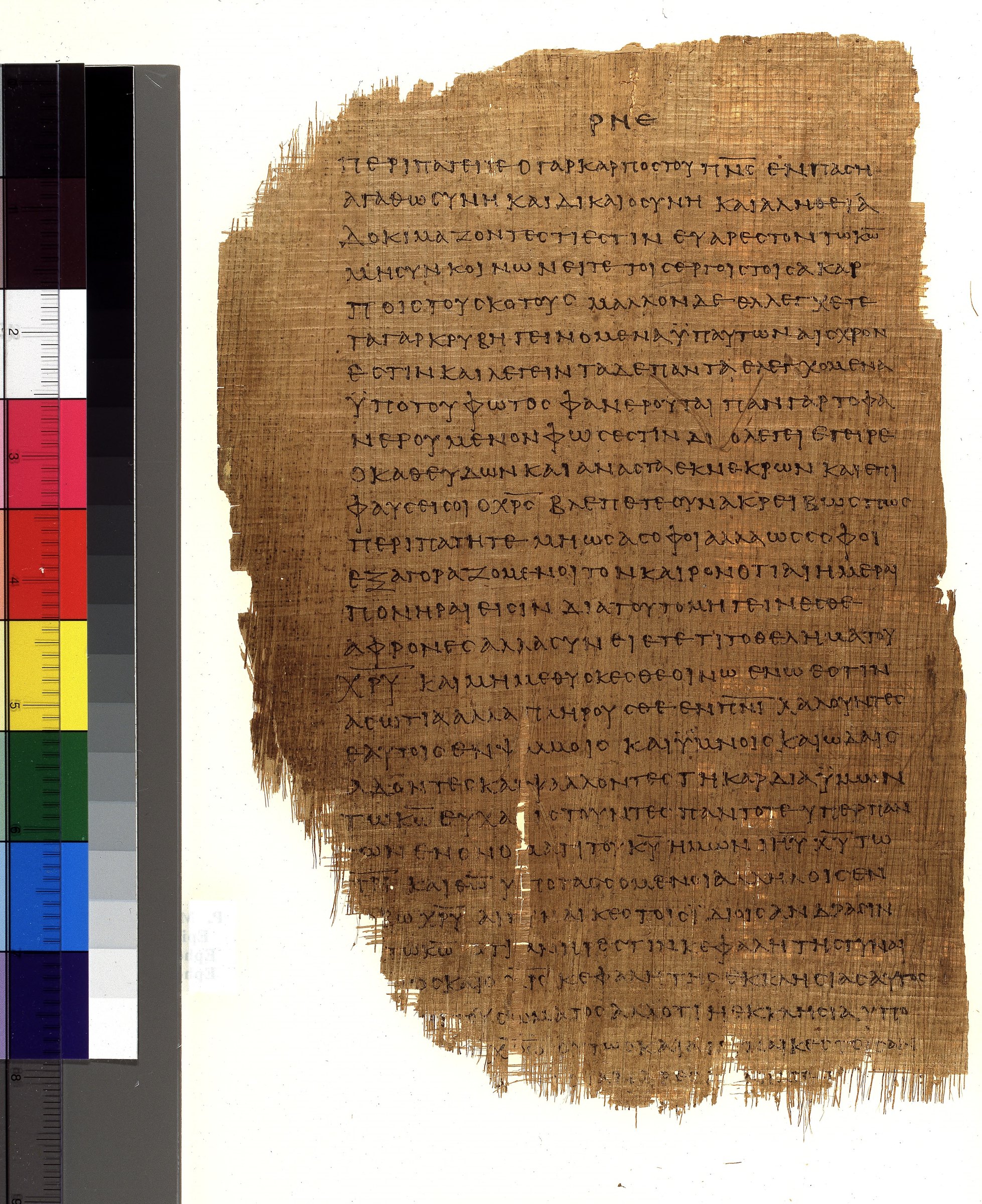
University of Michigan Library photograph 10046x6238_155JP2_UMich.jpg (https://ntmss.info/images/webfriendly/10046/10046x6238_155JP2_UMich.jpg), linked to NTVMR page 1400 (folio 79v) in NTVMR's page index. 5:8 begins on the previous page; 5:25 continues on the next page. Checked on the image: the scribe's page number ρνε (155) at the head of the page, continuing the sequence of the neighbouring pages; the first line reads ‹περιπατειτε ο γαρ καρπος του π̅ν̅ς̅ εν παση›, as in the transcription.
5:8 περιπατειτε 9 ο γαρ καρπος του π̅ν̅ς̅ εν παση
αγαθωσυνη και δικαιοσυνη και αληθεια
10 δοκιμαζοντες τι εστιν ευαρεστον τω κ̅ω̅
11 μη συνκοινωνειτε τοις εργοις τοις ακαρ
ποις του σκοτους μαλλον δε ελλεγχετε
12 τα γαρ κρυβη γεινομενα υπ αυτων αισχρον
εστιν και λεγειν 13 τα δε παντα ελεγχομενα
υπο του φωτος φανερουται 14 παν γαρ το φα
νερουμενον φως εστιν διο λεγει εγειρε
ο καθευδων και αναστα εκ νεκρων και επι
φαυσει σοι ο χ̅ρ̅ς̅ 15 βλεπετε ουν ακρειβως πως
περιπατητε μη ως ασοφοι αλλα ως σοφοι
16 εξαγοραζομενοι τον καιρον οτι αι ημεραι
πονηραι εισιν 17 δια τουτο μη γεινεσθε
αφρονες αλλα συνειετε τι το θελημα του
χ̅ρ̅υ̅ 18 και μη μεθυσκεσθε οινω εν ω εστιν
ασωτια αλλα πληρουσθε εν π̅ν̅ι̅ 19 λαλουντες
εαυτοις εν ψα̣λμοις και υμνοις και ωδαις
αδοντες και ψαλλοντες τη καρδια υμων
τω κ̅ω̅ 20 ευχα[ρ]ιστουντες παντοτε υπερ παν
των εν ονομ̣ατι του κ̅υ̅ ημων ι̅η̅υ̅ χ̅υ̅ τω
π̣̣̅ρ̅ι̅ και θ̅ω̅ 21 υπ̣οτασσομενοι αλληλοις εν
[φ]ο̣βω χ̅ρ̅υ̅ 22 αι γυ̣ναικες τοις ιδιοις ανδρασιν
[ως] τω κ̅ω̅ 23 οτι ανηρ εστιν κεφαλη της γυναι
[κος] ω̣ς και ο χ̣̣̅ρ̅ς̅ κεφαλη της εκκλησιας αυτος
[σωτ]η̣ρ̣ του σωματος 24 αλλ οτι η εκκλησια υπο
[τασσεται τ]ω̣ χ̅ρ̣̣̅ω̅ ουτως και αι γ̣υ̣ναικες τοις αν
[δρασιν εν π]α̣[ν]τ̣ι̣ 25 ο̣ι ανδ̣ρες α̣[γ]α̣π̣α̣τε τ̣α̣ς̣ [γυ]ν̣[α]ι̣
[κας]
5:8For ye were sometimes darkness, but now are ye light in the Lord: walk as children of light: 9(For the fruit of the Spirit is in all goodness and righteousness and truth;) 10Proving what is acceptable unto the Lord. 11And have no fellowship with the unfruitful works of darkness, but rather reprove them. 12For it is a shame even to speak of those things which are done of them in secret. 13But all things that are reproved are made manifest by the light: for whatsoever doth make manifest is light. 14Wherefore he saith, Awake thou that sleepest, and arise from the dead, and Christ shall give thee light. 15See then that ye walk circumspectly, not as fools, but as wise, 16Redeeming the time, because the days are evil. 17Wherefore be ye not unwise, but understanding what the will of the Lord is. 18And be not drunk with wine, wherein is excess; but be filled with the Spirit; 19Speaking to yourselves in psalms and hymns and spiritual songs, singing and making melody in your heart to the Lord; 20Giving thanks always for all things unto God and the Father in the name of our Lord Jesus Christ; 21Submitting yourselves one to another in the fear of God. 22Wives, submit yourselves unto your own husbands, as unto the Lord. 23For the husband is the head of the wife, even as Christ is the head of the church: and he is the saviour of the body. 24Therefore as the church is subject unto Christ, so let the wives be to their own husbands in every thing. 25Husbands, love your wives, even as Christ also loved the church, and gave himself for it;
Where on the image
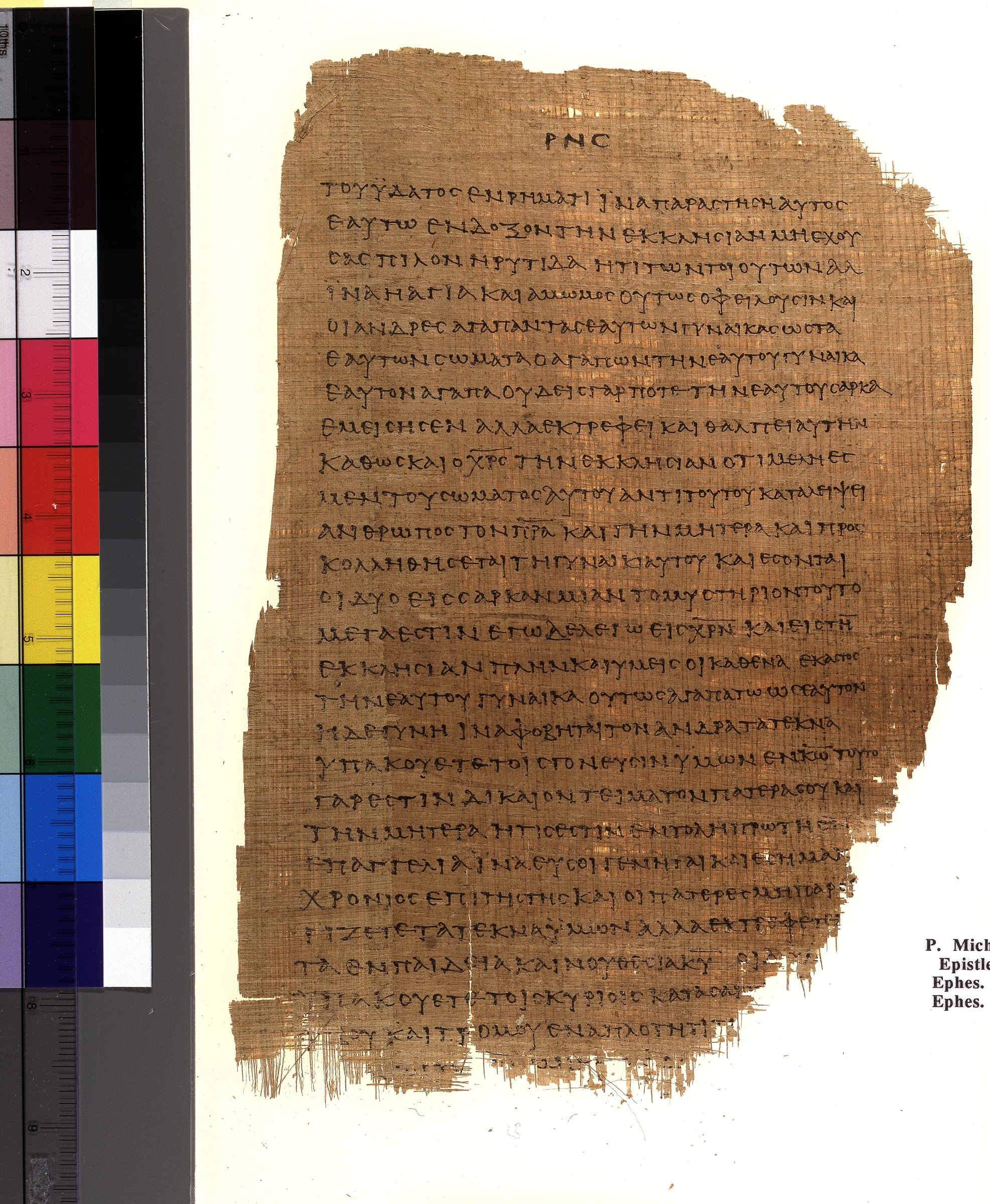
University of Michigan Library photograph 10046x6238_156JP2_UMich.jpg (https://ntmss.info/images/webfriendly/10046/10046x6238_156JP2_UMich.jpg), linked to NTVMR page 1410 (folio 80r) in NTVMR's page index. 5:26 begins on the previous page; 6:6 continues on the next page. Checked on the image: the scribe's page number ρνς (156) at the head of the page, continuing the sequence of the neighbouring pages; the first line reads ‹του υδατος εν ρηματι ...›, as in the transcription.
5:26 του υδατος εν ρηματι 27 ινα παραστηση αυτος
εαυτω ενδοξον την εκκλησιαν μη εχου
σα σπιλον η ρυτιδα η τι των τοιουτων αλ
ινα η αγια και αμωμος 28 ουτως οφειλουσιν και
οι ανδρες αγαπαν τας εαυτων γυναικας ως τα
εαυτων σωματα ο αγαπων την εαυτου γυναικα
εαυτον αγαπα 29 ουδεις γαρ ποτε την εαυτου σαρκα
εμεισησεν αλλα εκτρεφει και θαλπει αυτην
καθως και ο χ̅ρ̅ς̅ την εκκλησιαν 30 οτι μελη εσ
μεν του σωματος αυτου 31 αντι τουτου καταλειψει
ανθρωπος τον π̅ρ̅α̅ και την μητερα και προσ
κολληθησεται τη γυναικι αυτου και εσονται
οι δυο εις σαρκαν μιαν 32 το μυστηριον τουτο
μεγα εστιν εγω δε λεγω εις χ̅ρ̅ν̅ και εις την
εκκλησιαν 33 πλην και υμεις οι καθ ενα εκαστος
την εαυτου γυναικα ουτως αγαπατω ως εαυτον
η δε γυνη ινα φοβηται τον ανδρα 6:1 τα τεκνα
υπακουετε τοις γονευσιν υμων εν κ̅ω̅ τουτο
γαρ εστιν δικαιον 2 τειμα τον πατερα σου και
την μητερα ητις εστιν εντολη πρωτη εν
επαγγελια 3 ινα ευ σοι γενηται και εση μακ[ρο]
χρονιος επι της γης 4 και οι πατερες μη παρο[ρ]
γιζετε τα τεκνα υμων αλλα εκτρεφετε α̣[υ]
τα εν παιδεια και νουθεσια κ̅υ̅ 5 οι δο̣υ̣λ̣[οι]
υπακουετε τοις κυριοις κατα σαρ̣κ̣[α μετα]
φ̣ο̣β̣ου και τρομου εν απλοτητι τη̣[ς καρδιας]
[υμων] ω̣ς̣ τ̣ω̣ [χ̅]ρ̣̣̅ω̣̣̅ 6 μη κ̣α[τ] ο̣φ̣θ̣α̣[λμοδουλιαν]
5:26That he might sanctify and cleanse it with the washing of water by the word, 27That he might present it to himself a glorious church, not having spot, or wrinkle, or any such thing; but that it should be holy and without blemish. 28So ought men to love their wives as their own bodies. He that loveth his wife loveth himself. 29For no man ever yet hated his own flesh; but nourisheth and cherisheth it, even as the Lord the church: 30For we are members of his body, of his flesh, and of his bones. 31For this cause shall a man leave his father and mother, and shall be joined unto his wife, and they two shall be one flesh. 32This is a great mystery: but I speak concerning Christ and the church. 33Nevertheless let every one of you in particular so love his wife even as himself; and the wife see that she reverence her husband. 6:1Children, obey your parents in the Lord: for this is right. 2Honour thy father and mother; (which is the first commandment with promise;) 3That it may be well with thee, and thou mayest live long on the earth. 4And, ye fathers, provoke not your children to wrath: but bring them up in the nurture and admonition of the Lord. 5Servants, be obedient to them that are your masters according to the flesh, with fear and trembling, in singleness of your heart, as unto Christ; 6Not with eyeservice, as menpleasers; but as the servants of Christ, doing the will of God from the heart;
Notes
- Greek: the NTVMR diplomatic transcription, line by line as on the papyrus. Square brackets enclose letters that are lost or illegible and were supplied by the transcribers; a dot under a letter marks it as uncertain; [...] marks a gap. Nomina sacra and numerals keep the scribe's overline. Spelling is the scribe's (no accents or breathings). Words broken at a line end stay broken as on the papyrus. Corrections are not shown: the text is the first hand.
- English: the King James Version (1611), whole verses, for every verse that has text on the page. A verse that begins on one page and ends on the next is given in full on both. The KJV translates a later form of the Greek text, so its wording does not always match the papyrus; material differences (such as verses the papyrus does not have) are noted in the section.
Cite
Sources
- Source: P46 (P.Mich. inv. 6238, University of Michigan Library): photographs as published in the INTF New Testament Virtual Manuscript Room; Greek from the INTF NTVMR transcription of P46; English from the King James Version (holding institution)
- Critical edition: INTF NTVMR diplomatic transcription (CC BY 4.0)
← previous · → next · v cycle view · l back to library