P46 (Chester Beatty II): Galatians 6:10-Philippians 1:1 (fol. 86r)
Introduction
P46 is a papyrus codex of the letters of Paul copied in Egypt around 200, the oldest surviving collection of Paul's letters. 86 of its 104 leaves survive: 56 in the Chester Beatty Library, Dublin (Biblical Papyrus II, published by Frederic Kenyon in 1934-1937) and 30 in the University of Michigan Library, Ann Arbor (P.Mich. inv. 6238, published by Henry Sanders in 1935). The letters run in the order Romans, Hebrews, 1 and 2 Corinthians, Ephesians, Galatians, Philippians, Colossians and 1 Thessalonians; the first seven leaves (Romans 1:1-5:17) and the end of the book are lost. Hebrews standing after Romans, and the doxology of Romans (16:25-27) standing after 15:33, are among its best-known features.
Each section below is one page side: the holding library's photograph, the NTVMR diplomatic transcription line by line, and the King James Version of every verse that has text on the page. The lower lines of many leaves are lost; the transcribers' restorations are in square brackets.
This entry covers fol. 86r (Galatians 6:10-Philippians 1:1).
How was this verified? (Provenance)
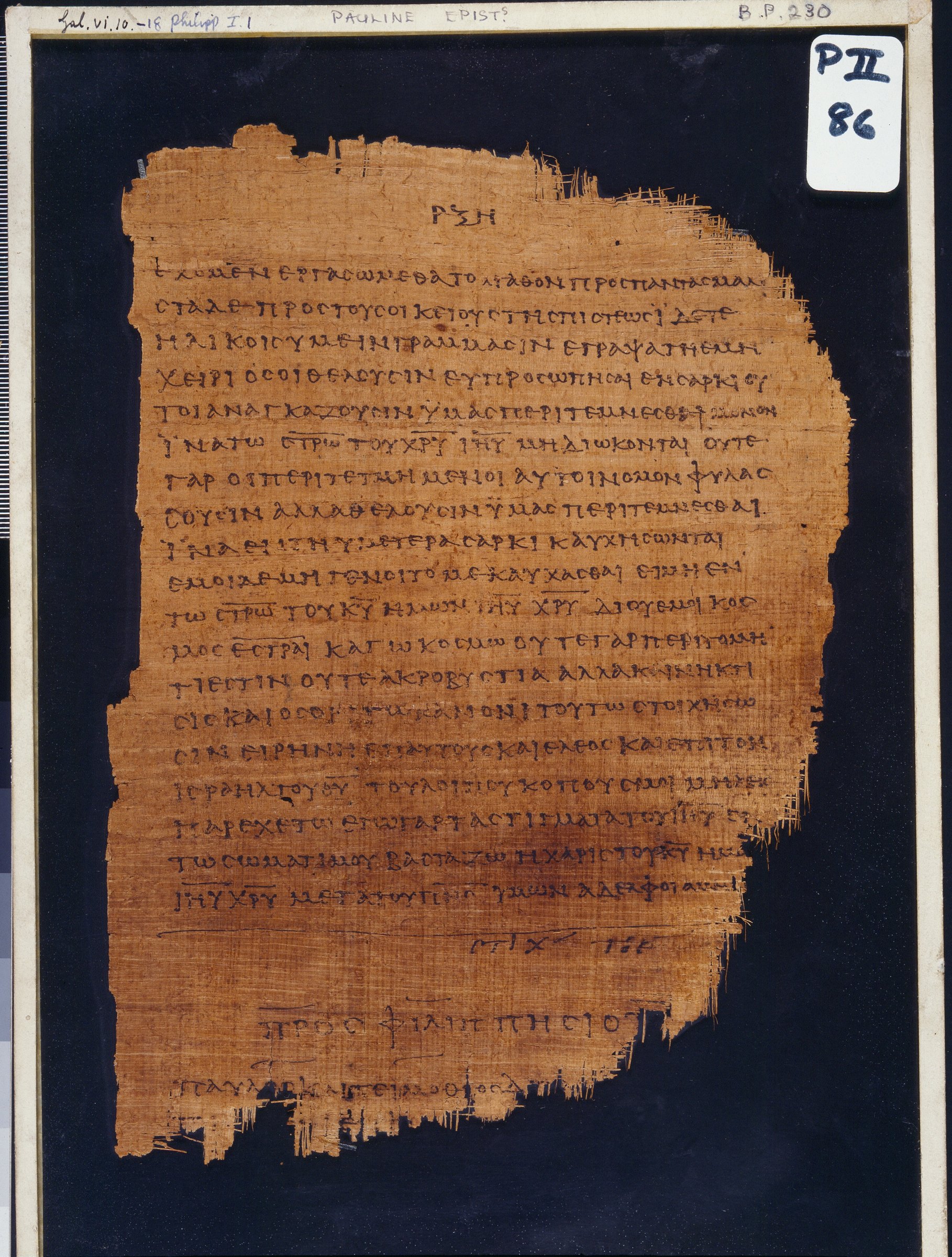
Where on the image
Chester Beatty Library photograph T0005574.jpg (https://ntmss.info/images/webfriendly/10046/T0005574.jpg), linked to NTVMR page 1530 (folio 86r) in NTVMR's page index. 6:10 begins on the previous page; 1:1 continues on the next page. The page also carries a book title, shown in italics in the Greek (προς φιλιππησιου̣ς̣); the KJV has no English for it. Checked on the image: the label on the frame reads ‹P II 86›.
6:10 εχομεν εργασωμεθα το αγαθον προς παντας μαλι̣
στα δε προς τους οικειους της πιστεως 11 ιδετε
ηλικοις υμειν γραμμασιν εγραψα τη εμη
χειρι 12 οσοι θελουσιν ευπροσωπησαι εν σαρκι ου
τοι αναγκαζουσιν υμας περιτεμνεσθαι μονον
ινα τω σ̅τ̅ρ̅ω̅ του χ̅ρ̅υ̅ ι̅η̅υ̅ μη διωκονται 13 ουτε
γαρ οι περιτετμημενοι αυτοι νομον φυλασ
σουσιν αλλα θελουσιν υμας περιτεμνεσθαι
ινα εν τη υμετερα σαρκι καυχησωνται
14 εμοι δε μη γενοιτο με καυχασθαι ει μη εν
τω σ̅τ̅ρ̅ω̅ του κ̅υ̅ ημων ι̅η̅υ̅ χ̅ρ̅υ̅ δι ου εμοι κοσ
μος ε̅σ̅τ̅ρ̅α̅ι̅ καγω κοσμω 15 ουτε γαρ περιτομη
τι εστιν ουτε ακροβυστια αλλα καινη κτι
σις 16 και οσοι τω κανονι τουτω στοιχησω
σιν ειρηνη επ αυτους και ελεος και επι τον
ισραηλ του θ̅υ̅ 17 του λοιπου κοπους μοι μηδεις
παρεχετω εγω γαρ τα στιγματα του ι̅η̅υ̅ εν̣
τω σωματι μου βασταζω 18 η χαρις του κ̅υ̅ ημω̣[ν]
ι̅η̅υ̅ χ̅ρ̅υ̅ μετα του π̅ν̅ς̅ υμων αδελφοι αμην̣
προς φιλιππησιου̣ς̣
Philippians 1:1 παυλο̣ς̣ και̣ τειμοθε̣ος δο̣υ̣λ̣[οι χ̅ρ̅υ̅ ι̅η̅υ̅]
τ̣ο̣ι̣[ς ουσιν] εν̣ φ̣ι̣[λιπποις συν επισκοποις]
6:10As we have therefore opportunity, let us do good unto all men, especially unto them who are of the household of faith. 11Ye see how large a letter I have written unto you with mine own hand. 12As many as desire to make a fair shew in the flesh, they constrain you to be circumcised; only lest they should suffer persecution for the cross of Christ. 13For neither they themselves who are circumcised keep the law; but desire to have you circumcised, that they may glory in your flesh. 14But God forbid that I should glory, save in the cross of our Lord Jesus Christ, by whom the world is crucified unto me, and I unto the world. 15For in Christ Jesus neither circumcision availeth any thing, nor uncircumcision, but a new creature. 16And as many as walk according to this rule, peace be on them, and mercy, and upon the Israel of God. 17From henceforth let no man trouble me: for I bear in my body the marks of the Lord Jesus. 18Brethren, the grace of our Lord Jesus Christ be with your spirit. Amen. Philippians 1:1Paul and Timotheus, the servants of Jesus Christ, to all the saints in Christ Jesus which are at Philippi, with the bishops and deacons:
Notes
- Greek: the NTVMR diplomatic transcription, line by line as on the papyrus. Square brackets enclose letters that are lost or illegible and were supplied by the transcribers; a dot under a letter marks it as uncertain; [...] marks a gap. Nomina sacra and numerals keep the scribe's overline. Spelling is the scribe's (no accents or breathings). Words broken at a line end stay broken as on the papyrus. Corrections are not shown: the text is the first hand.
- English: the King James Version (1611), whole verses, for every verse that has text on the page. A verse that begins on one page and ends on the next is given in full on both. The KJV translates a later form of the Greek text, so its wording does not always match the papyrus; material differences (such as verses the papyrus does not have) are noted in the section.
Cite
Sources
- Source: P46 (Chester Beatty Biblical Papyrus II, Chester Beatty Library, Dublin): photographs as published in the INTF New Testament Virtual Manuscript Room; Greek from the INTF NTVMR transcription of P46; English from the King James Version (holding institution)
- Critical edition: INTF NTVMR diplomatic transcription (CC BY 4.0)
← previous · → next · v cycle view · l back to library