P46 (P.Mich. inv. 6238): Hebrews 1:7-2:3 (fol. 22r)
Introduction
P46 is a papyrus codex of the letters of Paul copied in Egypt around 200, the oldest surviving collection of Paul's letters. 86 of its 104 leaves survive: 56 in the Chester Beatty Library, Dublin (Biblical Papyrus II, published by Frederic Kenyon in 1934-1937) and 30 in the University of Michigan Library, Ann Arbor (P.Mich. inv. 6238, published by Henry Sanders in 1935). The letters run in the order Romans, Hebrews, 1 and 2 Corinthians, Ephesians, Galatians, Philippians, Colossians and 1 Thessalonians; the first seven leaves (Romans 1:1-5:17) and the end of the book are lost. Hebrews standing after Romans, and the doxology of Romans (16:25-27) standing after 15:33, are among its best-known features.
Each section below is one page side: the holding library's photograph, the NTVMR diplomatic transcription line by line, and the King James Version of every verse that has text on the page. The lower lines of many leaves are lost; the transcribers' restorations are in square brackets.
This entry covers fol. 22r (Hebrews 1:7-2:3).
How was this verified? (Provenance)
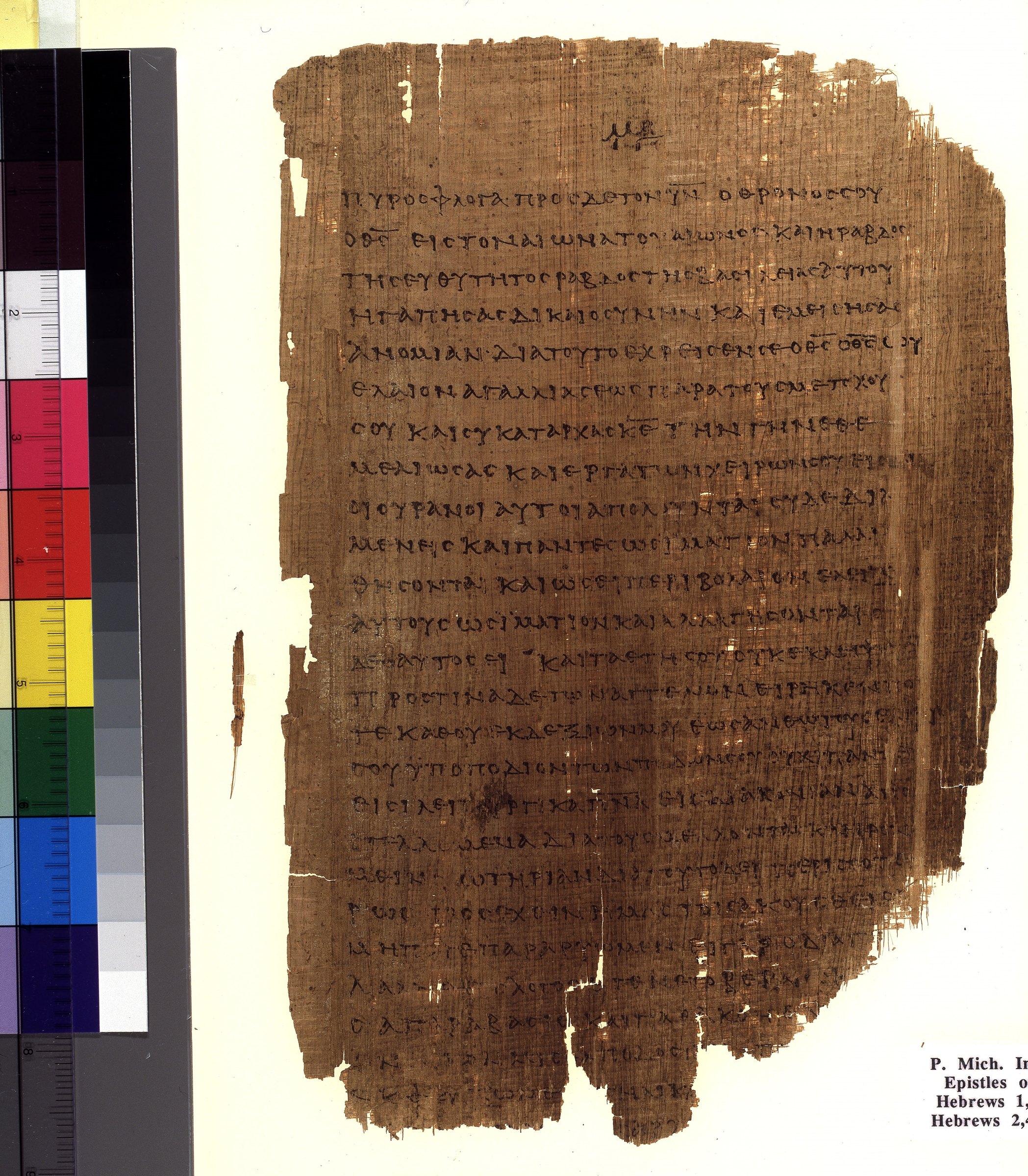
Where on the image
University of Michigan Library photograph 10046x6238_42JP2_UMich.jpg (https://ntmss.info/images/webfriendly/10046/10046x6238_42JP2_UMich.jpg), linked to NTVMR page 250 (folio 22r) in NTVMR's page index. 1:7 begins on the previous page; 2:3 continues on the next page. Checked on the image: the first line reads ‹πυρος φλογα προς δε τον υ̅ν̅ ο θρονος σου›, as in the transcription.
1:7 πυρος φλογα· 8 προς δε τον υ̅ν̅ ο θρονος σου
ο θ̅ς̅ εις τον αιωνα του αιωνος και η ραβδος
της ευθυτητος ραβδος της βασιλειας αυτου
9 ηγαπησας δικαιοσυνην και εμεισησας
ανομιαν· δια τουτο εχρεισεν σε ο θ̅ς̅ ο θ̅ς̅ σου
ελαιον αγαλλιασεως παρα τους μετο̣χους̣
σου 10 και συ κατ αρχας κ̅ε̅ την γην εθε
μελιωσας και εργα των χειρων σου εισ[ι]ν̣
οι ουρανοι 11 αυτοι απολο̣υνται συ δε δια
μενεις και παντες ως ιματιον παλαι[ω]
θησονται 12 και ωσει περιβολαιον ελειξ[ε]ι̣[ς]
αυτους ως ιματιον και αλλαγησονται σ[υ]
δε ο αυτος ει και τα ετη σου ουκ εκλειψου̣σι̣ν̣
13 προς τινα δε των αγγελων ειρηκεν πο
τε καθου εκ δεξιων μου εως αν θω τους εχ̣θ̣ρ̣[ο]υ̣ς
σου υποποδιον των ποδων σου 14 ουχι παντ̣ες
εισι λειτο̣υ̣ργικα π̅ν̅α̣̣̅ εις διακονιαν απο
στελλο̣μενα δια τους μελλοντας κλ̣ηρονο̣
μειν σ̣ωτηριαν 2:1 δια τουτο δει περισσοτε
ρως π̣ροσεχειν ημας τοις ακουσθεισ[ι]
μηποτε παραρυωμεν 2 ει γαρ ο δι̣ αγγ̣[ελων]
λαλη̣θ̣ει̣ς λογος εγενετο βεβαιο̣ς̣ κ[αι πα]
σα παραβασι̣ς και παρακοη ελ̣[αβεν]
ενδ̣ι̣κ̣ον μισθ̣αποδοσια̣ν̣ 3 π̣[ως ημεις]
εκφευξωμε[θα] τ̣ηλικα̣[υτης αμελησαν]
[τες σωτηριας ητι]ς̣ αρχ[ην λαβουσα λαλεισ]
1:7And of the angels he saith, Who maketh his angels spirits, and his ministers a flame of fire. 8But unto the Son he saith, Thy throne, O God, is for ever and ever: a sceptre of righteousness is the sceptre of thy kingdom. 9Thou hast loved righteousness, and hated iniquity; therefore God, even thy God, hath anointed thee with the oil of gladness above thy fellows. 10And, Thou, Lord, in the beginning hast laid the foundation of the earth; and the heavens are the works of thine hands: 11They shall perish; but thou remainest; and they all shall wax old as doth a garment; 12And as a vesture shalt thou fold them up, and they shall be changed: but thou art the same, and thy years shall not fail. 13But to which of the angels said he at any time, Sit on my right hand, until I make thine enemies thy footstool? 14Are they not all ministering spirits, sent forth to minister for them who shall be heirs of salvation? 2:1Therefore we ought to give the more earnest heed to the things which we have heard, lest at any time we should let them slip. 2For if the word spoken by angels was stedfast, and every transgression and disobedience received a just recompence of reward; 3How shall we escape, if we neglect so great salvation; which at the first began to be spoken by the Lord, and was confirmed unto us by them that heard him;
Notes
- Greek: the NTVMR diplomatic transcription, line by line as on the papyrus. Square brackets enclose letters that are lost or illegible and were supplied by the transcribers; a dot under a letter marks it as uncertain; [...] marks a gap. Nomina sacra and numerals keep the scribe's overline. Spelling is the scribe's (no accents or breathings). Words broken at a line end stay broken as on the papyrus. Corrections are not shown: the text is the first hand.
- English: the King James Version (1611), whole verses, for every verse that has text on the page. A verse that begins on one page and ends on the next is given in full on both. The KJV translates a later form of the Greek text, so its wording does not always match the papyrus; material differences (such as verses the papyrus does not have) are noted in the section.
Cite
Sources
- Source: P46 (P.Mich. inv. 6238, University of Michigan Library): photographs as published in the INTF New Testament Virtual Manuscript Room; Greek from the INTF NTVMR transcription of P46; English from the King James Version (holding institution)
- Critical edition: INTF NTVMR diplomatic transcription (CC BY 4.0)
← previous · → next · v cycle view · l back to library