P46 (P.Mich. inv. 6238): Hebrews 5:8-6:4 (fol. 25v)
Introduction
P46 is a papyrus codex of the letters of Paul copied in Egypt around 200, the oldest surviving collection of Paul's letters. 86 of its 104 leaves survive: 56 in the Chester Beatty Library, Dublin (Biblical Papyrus II, published by Frederic Kenyon in 1934-1937) and 30 in the University of Michigan Library, Ann Arbor (P.Mich. inv. 6238, published by Henry Sanders in 1935). The letters run in the order Romans, Hebrews, 1 and 2 Corinthians, Ephesians, Galatians, Philippians, Colossians and 1 Thessalonians; the first seven leaves (Romans 1:1-5:17) and the end of the book are lost. Hebrews standing after Romans, and the doxology of Romans (16:25-27) standing after 15:33, are among its best-known features.
Each section below is one page side: the holding library's photograph, the NTVMR diplomatic transcription line by line, and the King James Version of every verse that has text on the page. The lower lines of many leaves are lost; the transcribers' restorations are in square brackets.
This entry covers fol. 25v (Hebrews 5:8-6:4).
How was this verified? (Provenance)
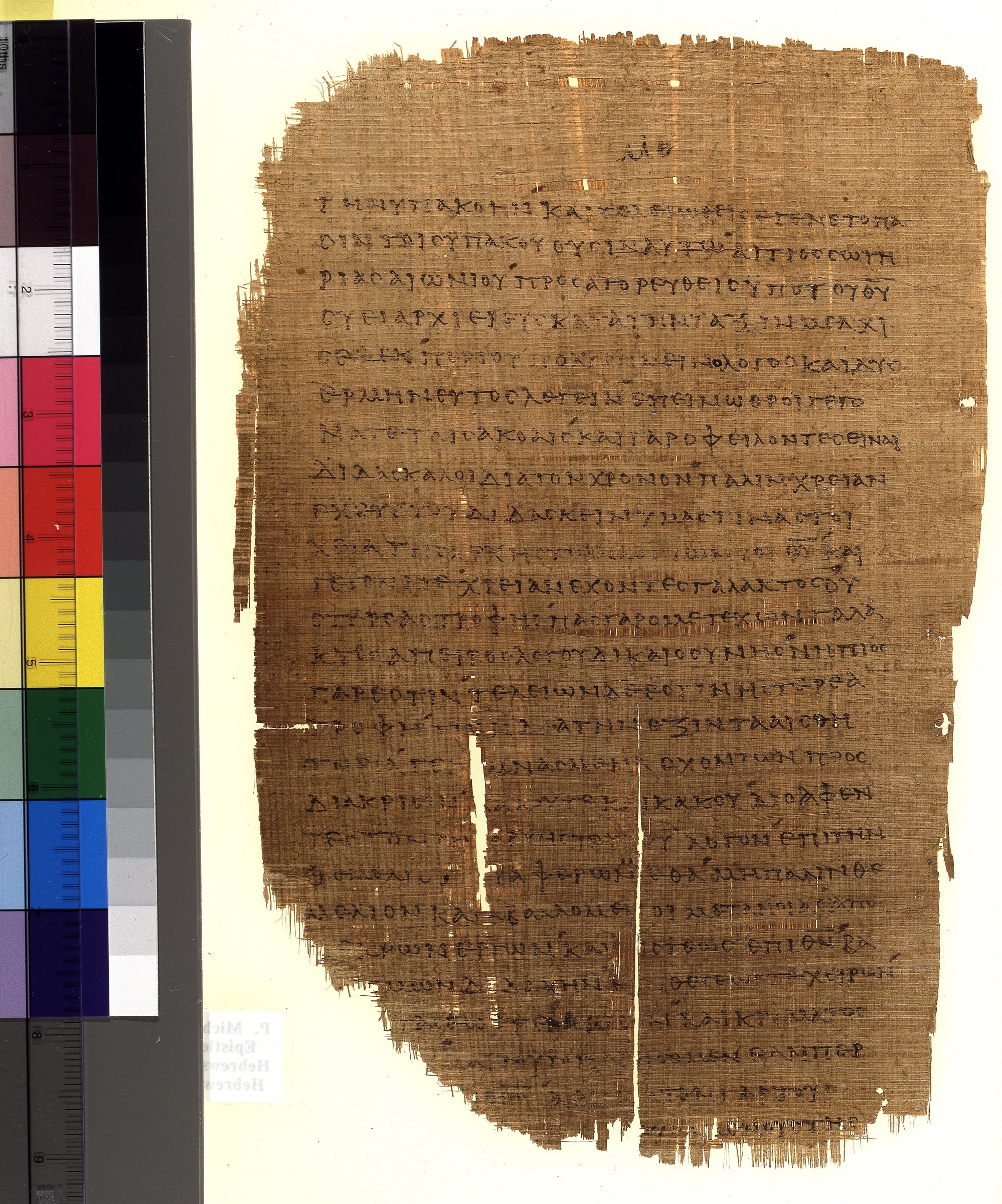
Where on the image
University of Michigan Library photograph 10046x6238_49JP2_UMich.jpg (https://ntmss.info/images/webfriendly/10046/10046x6238_49JP2_UMich.jpg), linked to NTVMR page 320 (folio 25v) in NTVMR's page index. 5:8 begins on the previous page; 6:4 continues on the next page. Checked on the image: the scribe's page number μθ (49) at the head of the page, matching NTVMR folio 25v.
5:8 την υπακοην 9 και τελειωθεις εγενετο πα
σιν τοις υπακουουσιν αυτω αιτιος σωτη
ριας αιωνιου 10 προσαγορευθεις υπο του θ̅υ̅
συ ει αρχιερευς κατα την ταξιν μελχι
σεδεκ 11 περι ου πολυς ημειν λογος και δυσ
ερμηνευτος λεγειν επει νωθροι γεγο
νατε ταις ακοαις 12 και γαρ οφειλοντες ειναι
διδασκαλοι δια τον χρονον παλιν χρειαν
εχετε του διδασκειν υμας τινα στοι
χεια της αρχης των λογιων του θ̅υ̅ και
γεγονατε χρειαν εχοντες γαλακτος ου
στερεας τροφης 13 πας γαρ ο μετεχων γαλα
κτος απειρος λογου δικαιοσυνης νηπιος
γαρ εστιν 14 τελειων δε εστιν η στερεα
τροφη των δια την εξιν τα αισθη
τηρια γεγ[υ]μνασμενα̣ εχοντων προς
διακρισιν κ̣αλου τε και κακου 6:1 διο αφεν
τες τον τη[ς] αρχης του χ̣̣̅ρ̣̣̅υ̅ λογον επι την
θεμελιοτ[η]τα φερωνεθα μη παλιν θε
μελιον καταβαλλομεν̣οι μετανοιας απο
[ν]ε̣κρων εργων και π̣ιστεως επι θ̅ν̅ 2 βα
[πτ]ι̣σ̣μων διδαχην επιθεσεως τε χειρων
[ανασ]τασεως τε νεκρ̣ω̣ν και κριματος
[αιωνιου] 3 κ̣αι τουτο πο̣ιησομεν εανπερ
[επιτρεπ]η̣ ο θ̅ς̣̣̅ 4 αδυ̣νατον γαρ τους
[απαξ φωτισθεντας γ]ευσ̣α̣μ̣ενους της
5:8Though he were a Son, yet learned he obedience by the things which he suffered; 9And being made perfect, he became the author of eternal salvation unto all them that obey him; 10Called of God an high priest after the order of Melchisedec. 11Of whom we have many things to say, and hard to be uttered, seeing ye are dull of hearing. 12For when for the time ye ought to be teachers, ye have need that one teach you again which be the first principles of the oracles of God; and are become such as have need of milk, and not of strong meat. 13For every one that useth milk is unskilful in the word of righteousness: for he is a babe. 14But strong meat belongeth to them that are of full age, even those who by reason of use have their senses exercised to discern both good and evil. 6:1Therefore leaving the principles of the doctrine of Christ, let us go on unto perfection; not laying again the foundation of repentance from dead works, and of faith toward God, 2Of the doctrine of baptisms, and of laying on of hands, and of resurrection of the dead, and of eternal judgment. 3And this will we do, if God permit. 4For it is impossible for those who were once enlightened, and have tasted of the heavenly gift, and were made partakers of the Holy Ghost,
Notes
- Greek: the NTVMR diplomatic transcription, line by line as on the papyrus. Square brackets enclose letters that are lost or illegible and were supplied by the transcribers; a dot under a letter marks it as uncertain; [...] marks a gap. Nomina sacra and numerals keep the scribe's overline. Spelling is the scribe's (no accents or breathings). Words broken at a line end stay broken as on the papyrus. Corrections are not shown: the text is the first hand.
- English: the King James Version (1611), whole verses, for every verse that has text on the page. A verse that begins on one page and ends on the next is given in full on both. The KJV translates a later form of the Greek text, so its wording does not always match the papyrus; material differences (such as verses the papyrus does not have) are noted in the section.
Cite
Sources
- Source: P46 (P.Mich. inv. 6238, University of Michigan Library): photographs as published in the INTF New Testament Virtual Manuscript Room; Greek from the INTF NTVMR transcription of P46; English from the King James Version (holding institution)
- Critical edition: INTF NTVMR diplomatic transcription (CC BY 4.0)
← previous · → next · v cycle view · l back to library