P46 (P.Mich. inv. 6238): Romans 16:4-Hebrews 1:7 (fols. 20v-21v)
Introduction
P46 is a papyrus codex of the letters of Paul copied in Egypt around 200, the oldest surviving collection of Paul's letters. 86 of its 104 leaves survive: 56 in the Chester Beatty Library, Dublin (Biblical Papyrus II, published by Frederic Kenyon in 1934-1937) and 30 in the University of Michigan Library, Ann Arbor (P.Mich. inv. 6238, published by Henry Sanders in 1935). The letters run in the order Romans, Hebrews, 1 and 2 Corinthians, Ephesians, Galatians, Philippians, Colossians and 1 Thessalonians; the first seven leaves (Romans 1:1-5:17) and the end of the book are lost. Hebrews standing after Romans, and the doxology of Romans (16:25-27) standing after 15:33, are among its best-known features.
Each section below is one page side: the holding library's photograph, the NTVMR diplomatic transcription line by line, and the King James Version of every verse that has text on the page. The lower lines of many leaves are lost; the transcribers' restorations are in square brackets.
This entry covers fols. 20v-21v (Romans 16:4-Hebrews 1:7).
How was this verified? (Provenance)
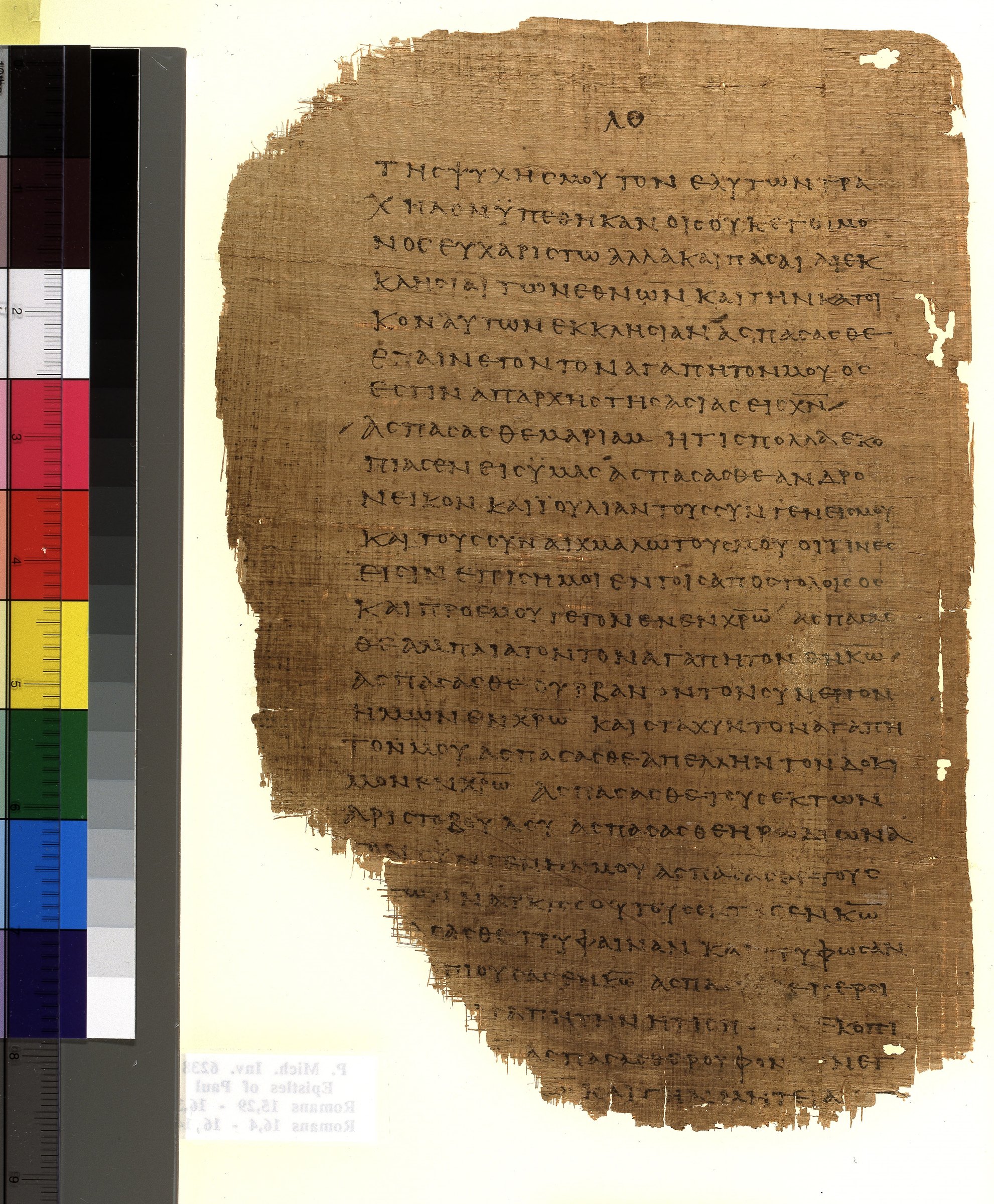
Where on the image
University of Michigan Library photograph 10046x6238_39JP2_UMich.jpg (https://ntmss.info/images/webfriendly/10046/10046x6238_39JP2_UMich.jpg), linked to NTVMR page 220 (folio 20v) in NTVMR's page index. 16:4 begins on the previous page; 16:13 continues on the next page. Checked on the image: the scribe's page number λθ (39) at the head of the page, matching NTVMR folio 20v; the first line reads ‹της ψυχης μου τον εαυτων τρα...›, as in the transcription.
16:4 της ψυχης μου τον εαυτων τρα
χηλον υπεθηκαν οις ουκ εγω μο
νος ευχαριστω αλλα και πασαι αι εκ
κλησιαι των εθνων 5 και την κατ οι
κον αυτων εκκλησιαν ασπασασθε
επαινετον τον αγαπητον μου ος
εστιν απ αρχης της ασιας εις χ̅ν̅
6 ασπασασθε μαριαμ ητις πολλα εκο
πιασεν εις υμας 7 ασπασασθε ανδρο
νεικον και ιουλιαν τους συνγενεις μου
και τους συναιχμαλωτους μου οιτινες
εισιν επισημοι εν τοις αποστολοις ος
και προ εμου γεγονεν εν χ̅ρ̅ω̅ 8 ασπασασ
θε αμπλιατον τον αγαπητον εν κ̅ω̅
9 ασπασασθε ουρβανον τον συνεργον
ημων εν χ̅ρ̅ω̅ και σταχυν τον αγαπη
τον μου 10 ασπασασθε απελλην τον δοκι
μον εν χ̅ρ̅ω̅ ασπασασθε τους εκ των
αριστοβουλου 11 ασπασασθε ηρωδιωνα
τ̣ον συνγενην μου ασπασασθε τους
[εκ] των̣ ναρκισσου τους οντα̣ς εν κ̅ω̅
12 [ασ]π̣α̣σασθε τρυφαιναν και τρυφωσαν
[τας κ]ο̣πιουσας εν κ̅ω̅ ασπασα̣σ̣θ̣ε περσι
[δα την] α̣γαπητην ητις πολ̣λ̣α̣ εκοπι
[ασεν εν κ̅]ω̣̣̅ 13 ασπασασθε ρουφον τ̣ο̣ν εγ
[λεκτον εν] κ̣̣̅ω̣̣̅ και την μητερ̣α α̣υ̣τ̣[ου]
16:4Who have for my life laid down their own necks: unto whom not only I give thanks, but also all the churches of the Gentiles. 5Likewise greet the church that is in their house. Salute my wellbeloved Epaenetus, who is the firstfruits of Achaia unto Christ. 6Greet Mary, who bestowed much labour on us. 7Salute Andronicus and Junia, my kinsmen, and my fellowprisoners, who are of note among the apostles, who also were in Christ before me. 8Greet Amplias my beloved in the Lord. 9Salute Urbane, our helper in Christ, and Stachys my beloved. 10Salute Apelles approved in Christ. Salute them which are of Aristobulus’ household. 11Salute Herodion my kinsman. Greet them that be of the household of Narcissus, which are in the Lord. 12Salute Tryphena and Tryphosa, who labour in the Lord. Salute the beloved Persis, which laboured much in the Lord. 13Salute Rufus chosen in the Lord, and his mother and mine.
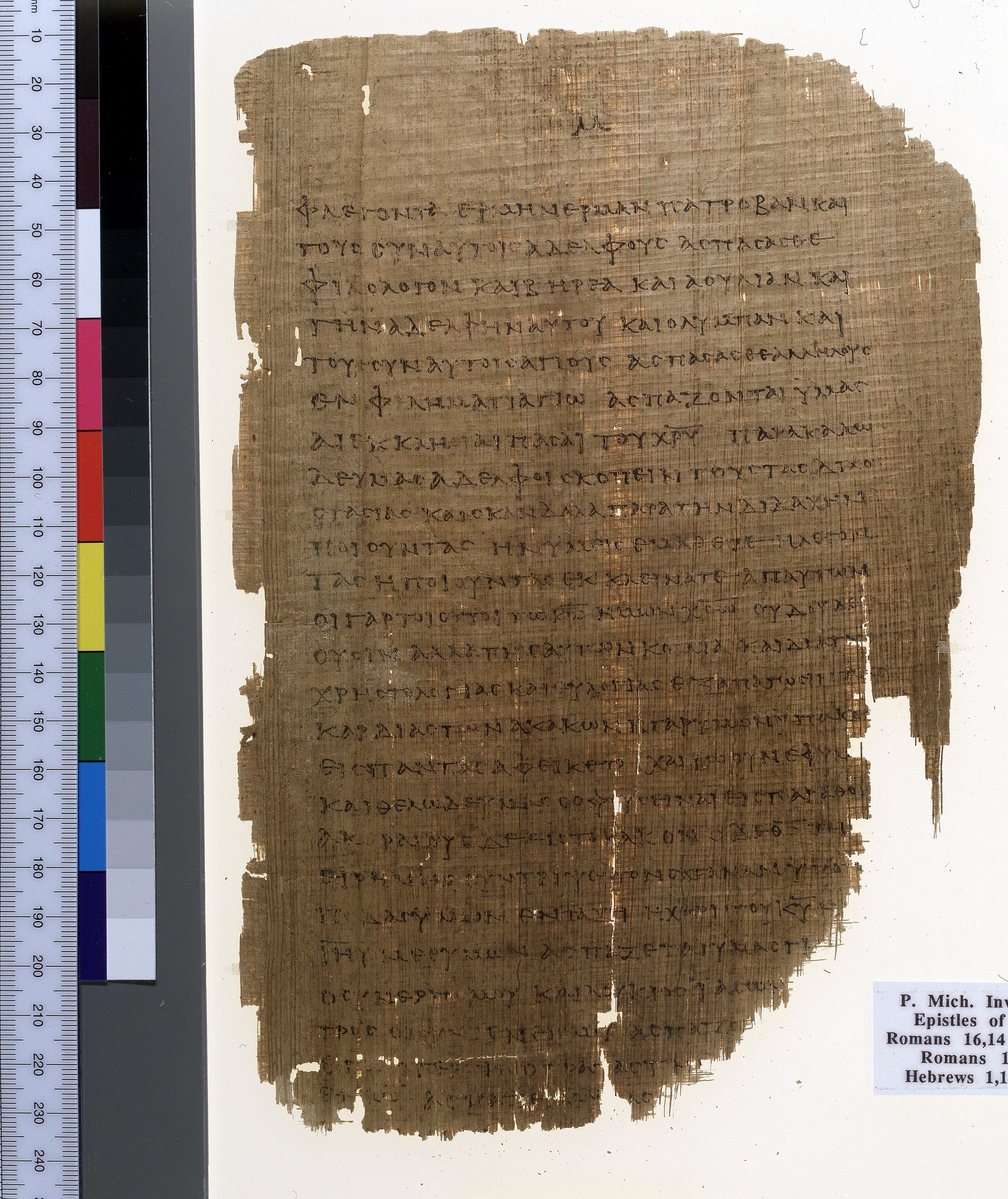
Where on the image
University of Michigan Library photograph 10046x6238_41JP2_UMich.jpg (https://ntmss.info/images/webfriendly/10046/10046x6238_41JP2_UMich.jpg), linked to NTVMR page 230 (folio 21r) in NTVMR's page index. 16:14 begins on the previous page; 16:23 continues on the next page. Checked on the image: the scribe's page number μ (40) at the head of the page, matching NTVMR folio 21r.
16:14 φλεγοντα ερμην ερμαν πατροβαν και
τους συν αυτοις αδελφους 15 ασπασασθε
φιλολογον και βηρεα και αουλιαν και
την αδελφην αυτου και ολυμπαν και
τους συν αυτοις αγιους 16 ασπασασθε αλληλους
εν φιληματι αγιω ασπαζονται υμας
αι εκκλησιαι πασαι του χ̅ρ̅υ̅ 17 παρακαλω
δε υμας αδελφοι σκοπειν τους τας διχο
στασιας και σκανδαλα παρα την διδαχην
ποιουντας ην υμεις εμαθετε η λεγον
τας η ποιουντας εκκλεινατε απ αυτων
18 οι γαρ τοιουτοι τω κ̅ω̅ ημων χ̅ρ̅ω̅ ου δουλευ̣
ουσιν αλλα τη εαυτων κοιλια και δια τη̣ς
χρηστολογιας και ευλογιας εξαπατωσιν τα̣ς
καρδιας των ακακων 19 η γαρ υμων υπακοη̣
εις παντας αφεικετο χαιρ̣ω ουν εφ υμ[ειν]
και θελω δε υμας σοφους ειναι εις το αγαθον̣
ακεραιους δε εις το κακον 20 ο δε θ̅ς̅ της̣
ειρηνης συντριψει̣ τον σαταναν υπο τ̣ο̣[υ]ς̣
ποδας υμων εν ταχει η χα̣ρ̣ις̣ του κ̅υ̅ ημ̣[ων]
ι̅η̅υ̅ μεθ υμων 21 ασπαζεται υμας τιμ̣[οθεος]
ο συνεργο̣ς̣ μου και λουκιος ιασων [και σωσιπα]
τρος οι συνγ̣ενεις μο̣υ̣ 22 ασπαζο̣μ̣[αι υμας]
εγω̣ ο̣ τερτ̣ιος̣ ο γ̣ρ̣αψ̣ας την̣ [επιστολην]
εν κ̅ω̅ 23 ασπαζεται υ[μ]ας [γαιος ο ξενος μου]
[κα]ι̣ [ο]λ̣η̣ς̣ [της εκκλησιας ασπαζεται υμας]
16:14Salute Asyncritus, Phlegon, Hermas, Patrobas, Hermes, and the brethren which are with them. 15Salute Philologus, and Julia, Nereus, and his sister, and Olympas, and all the saints which are with them. 16Salute one another with an holy kiss. The churches of Christ salute you. 17Now I beseech you, brethren, mark them which cause divisions and offences contrary to the doctrine which ye have learned; and avoid them. 18For they that are such serve not our Lord Jesus Christ, but their own belly; and by good words and fair speeches deceive the hearts of the simple. 19For your obedience is come abroad unto all men. I am glad therefore on your behalf: but yet I would have you wise unto that which is good, and simple concerning evil. 20And the God of peace shall bruise Satan under your feet shortly. The grace of our Lord Jesus Christ be with you. Amen. 21Timotheus my workfellow, and Lucius, and Jason, and Sosipater, my kinsmen, salute you. 22I Tertius, who wrote this epistle, salute you in the Lord. 23Gaius mine host, and of the whole church, saluteth you. Erastus the chamberlain of the city saluteth you, and Quartus a brother.
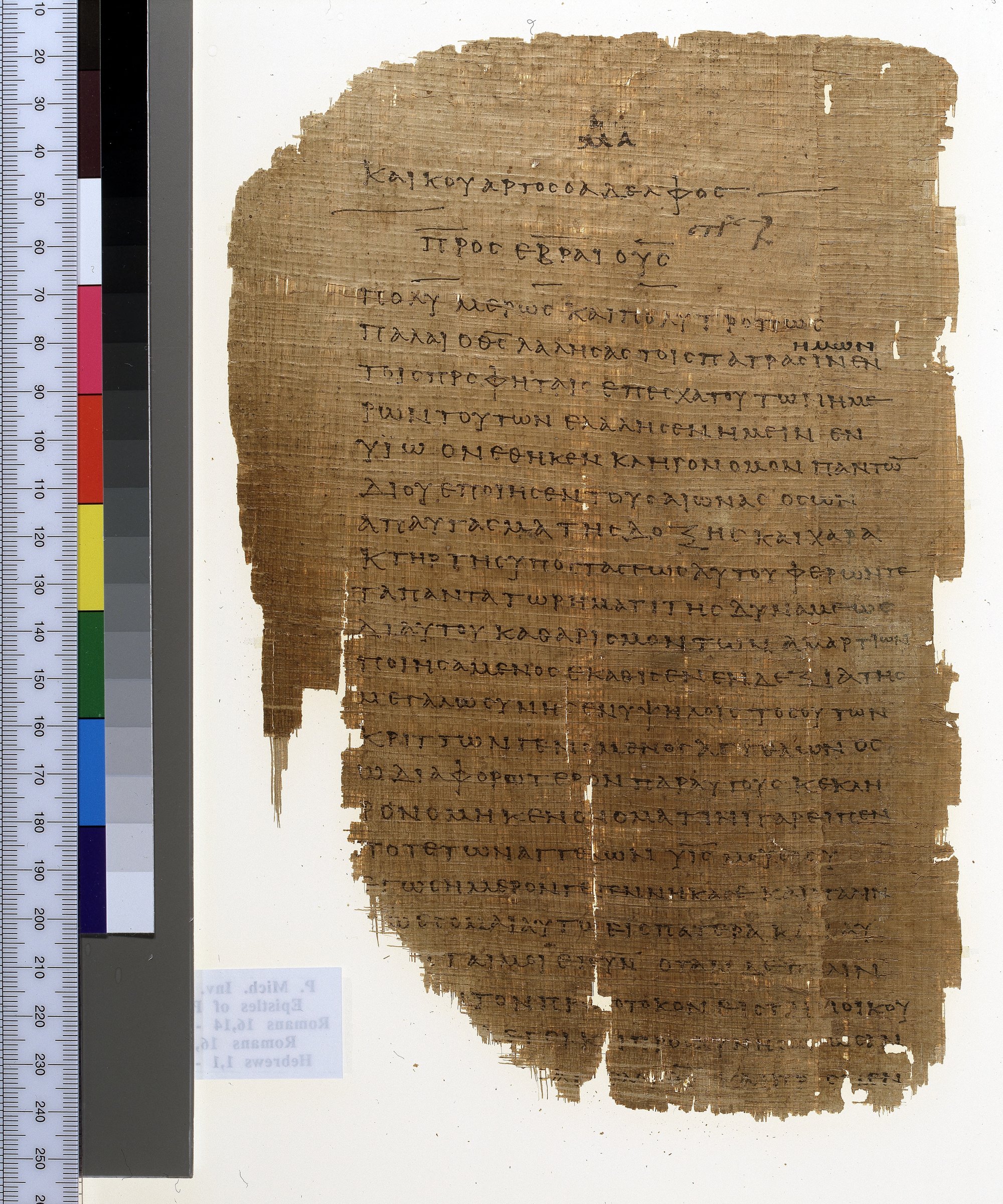
Where on the image
University of Michigan Library photograph 10046x6238_40JP2_UMich.jpg (https://ntmss.info/images/webfriendly/10046/10046x6238_40JP2_UMich.jpg), linked to NTVMR page 240 (folio 21v) in NTVMR's page index. 16:23 begins on the previous page; 1:7 continues on the next page. The page also carries a book title, shown in italics in the Greek (προς εβραιους); the KJV has no English for it. Checked on the image: the scribe's page number μα (41) at the head of the page, matching NTVMR folio 21v; the first line reads ‹και κουαρτος ο αδελφος›, as in the transcription.
16:23 και κουαρτος ο αδελφος
προς εβραιους
Hebrews 1:1 πολυμερως και πολυτροπως
παλαι ο θ̅ς̅ λαλησας τοις πατρασιν εν
τοις προφηταις 2 επ εσχατου των ημε
ρων τουτων ελαλησεν ημειν εν
υιω ον εθηκεν κληρονομον παντων
δι ου εποιησεν τους αιωνας 3 ος ων
απαυγασμα της δοξης και χαρα
κτηρ της υποστασεως αυτου φερων τε
τα παντα τω ρηματι της δυναμεως
δι αυτου καθαρισμον των αμαρτιων
ποιησαμενος εκαθισεν εν δεξια της
μεγαλωσυνης εν υψηλοις 4 τοσουτων
κριττων γενομενος αγγελων οσ
ω διαφορωτερον παρ αυτους κεκλη
ρονομηκεν ονομα 5 τινι γαρ ειπεν
ποτε των αγγελων υ̅ι̅ς̅ μου ει συ
εγω σημερον γεγεννηκα σε και π̣αλιν
[εγ]ω εσομαι αυτω εις πατερα κα̣ι αυ
[τος ε]σται μοι εις̣ υ̅ν̅ 6 οταν̣ δε πα̣λιν
[αγαγ]η̣ τον πρω̣τ̣οτοκον εις την̣ οικου
[μενην] λεγει κ[α]ι προσκυνησα̣τ̣ωσαν
[αυτω παντε]ς̣ αγ̣[γ]ελοι θ̣̣̅υ̣̣̅ 7 κ̣αι προ̣ς μ̣εν
16:23Gaius mine host, and of the whole church, saluteth you. Erastus the chamberlain of the city saluteth you, and Quartus a brother. Hebrews 1:1God, who at sundry times and in divers manners spake in time past unto the fathers by the prophets, 2Hath in these last days spoken unto us by his Son, whom he hath appointed heir of all things, by whom also he made the worlds; 3Who being the brightness of his glory, and the express image of his person, and upholding all things by the word of his power, when he had by himself purged our sins, sat down on the right hand of the Majesty on high; 4Being made so much better than the angels, as he hath by inheritance obtained a more excellent name than they. 5For unto which of the angels said he at any time, Thou art my Son, this day have I begotten thee? And again, I will be to him a Father, and he shall be to me a Son? 6And again, when he bringeth in the firstbegotten into the world, he saith, And let all the angels of God worship him. 7And of the angels he saith, Who maketh his angels spirits, and his ministers a flame of fire.
Notes
- Greek: the NTVMR diplomatic transcription, line by line as on the papyrus. Square brackets enclose letters that are lost or illegible and were supplied by the transcribers; a dot under a letter marks it as uncertain; [...] marks a gap. Nomina sacra and numerals keep the scribe's overline. Spelling is the scribe's (no accents or breathings). Words broken at a line end stay broken as on the papyrus. Corrections are not shown: the text is the first hand.
- English: the King James Version (1611), whole verses, for every verse that has text on the page. A verse that begins on one page and ends on the next is given in full on both. The KJV translates a later form of the Greek text, so its wording does not always match the papyrus; material differences (such as verses the papyrus does not have) are noted in the section.
Cite
Sources
- Source: P46 (P.Mich. inv. 6238, University of Michigan Library): photographs as published in the INTF New Testament Virtual Manuscript Room; Greek from the INTF NTVMR transcription of P46; English from the King James Version (holding institution)
- Critical edition: INTF NTVMR diplomatic transcription (CC BY 4.0)
← previous · → next · v cycle view · l back to library