P66 (Papyrus Bodmer II): John 1:1-2:3 (pages 1-7)
Introduction
P66 is a papyrus codex of the Gospel of John copied in Egypt around 200, the most complete early copy of John. Most of it is Papyrus Bodmer II in the Fondation Martin Bodmer, Cologny (Geneva); small pieces are in the Chester Beatty Library, Dublin, and the Institut für Altertumskunde, Cologne. The first five quires (John 1:1-14:26) survive as a bound book of numbered pages; later leaves, from John 14:29 to 21:9, are damaged and kept between glass. The scribe made many corrections, some of them his own; only the first hand is shown here.
Each section below is one page: the photograph, the NTVMR diplomatic transcription line by line, and the King James Version of every verse on the page. Pages of the bound book are shown on the photographic plates published by Victor Martin and J. W. B. Barns in 1962 (scanned by the Bodmer Lab), the glass-mounted leaves on colour photographs. Lost: John 6:12-34 (pages 35-38) and parts of chapters 14-21; the transcription ends at 21:9. Where P66 lacks a verse that the KJV has (John 5:4, the account of the adulteress at 7:53-8:11, 16:15), the section says so.
This entry covers pages 1-7 (John 1:1-2:3).
How was this verified? (Provenance)
Where on the image
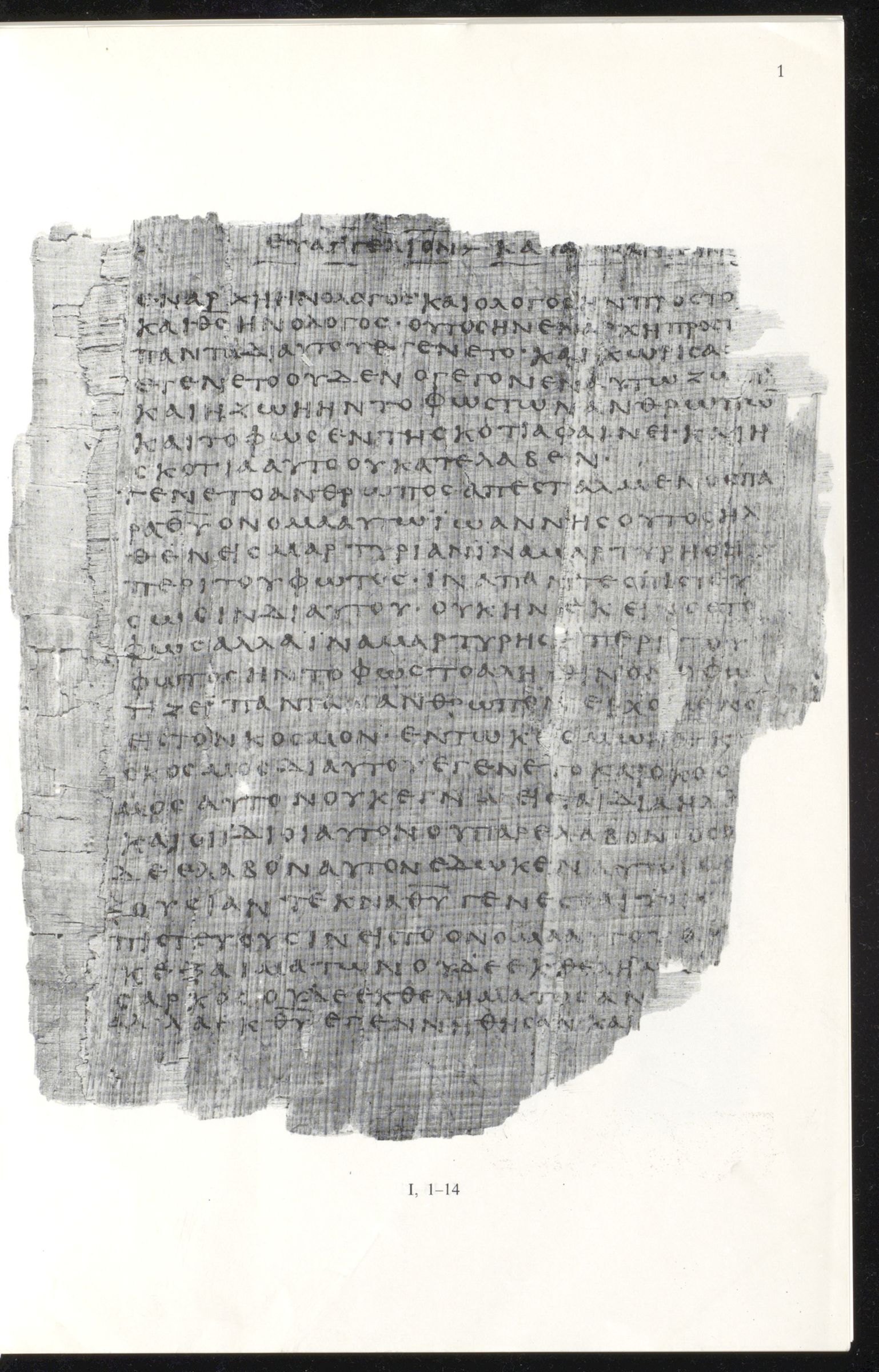
Fondation Martin Bodmer, Papyrus Bodmer II, Bodmer Lab image 1072205287_009 (https://bodmerlab.unige.ch/fr/constellations/papyri/mirador/1072205287), photographic plate of the 1962 Martin-Barns edition, shown whole. NTVMR page 10 (page 1) is linked to this image in NTVMR's page index. 1:14 continues on the next page. The page also carries a book title, shown in italics in the Greek (ευαγγελιον κατ̣α [ι]ω̣ανν̣η̣ν); the KJV has no English for it. Checked on the image: the printed caption reads ‹I, 1-14›; the last line of writing, ‹αλλα εκ θ̅υ̅ εγεννηθησαν· και› (line 26 of the transcription), is legible at the foot of the page.
ευαγγελιον κατ̣α [ι]ω̣ανν̣η̣ν
1:1 εν αρχη ην ο λογος· και ο λογος ην προς το[ν θ̅ν̅]
και θ̅ς̅ ην ο λογος· 2 ουτος ην εν αρχη προς τ[ον θ̅ν̅]
3 παντα δι αυτου εγενετο· και χωρις α[υτου]
εγενετο ουδεν ο γεγονεν 4 αυτω ζω̣η̣ η̣[ν]
και η ζωη ην το φως των ανθρωπων
5 και το φως εν τη σκοτια φαινει· και η
σκοτια αυτο ου κατελαβεν·
6 [ε]γενετο ανθρωπος απεσταλμενος πα
ρα θ̅υ̅ ονομα αυτω ιωαννης 7 ουτος ηλ
θεν εις μαρτυριαν ινα μαρτυρηση
περι του φωτος· ινα παντες πιστευ
σωσιν δι αυτου· 8 ουκ ην εκεινος το
φως αλλα ινα μαρτυρηση περι του
φωτος 9 ην το φως το αληθινον̣ ο φω
τιζει πανταν ανθρωπον ερχομ̣ενον
εις τον κοσμον· 10 εν τω κο̣σμω ην και
ο κοσμος δι αυτου εγενετο και ο κοσ
μος αυτον ουκ εγνω 11 εις τα ιδια ηλθ[εν]
και οι ιδιοι αυτον ου παρελαβον· 12 οσο[ι]
δε ελαβον αυτον εδωκεν αυτοις ε
ξουσιαν τεκνα θ̅υ̅ γενεσθαι τοις
πιστευουσιν εις το ονομα αυτου 13 οι ου̣
κ εξ αιματων ουδε εκ θελημα̣[τος]
σαρκος ουδε εκ θεληματος αν[δρος]
αλλα εκ θ̅υ̅ εγεννηθησαν· 14 και [ο λογος]
1:1In the beginning was the Word, and the Word was with God, and the Word was God. 2The same was in the beginning with God. 3All things were made by him; and without him was not any thing made that was made. 4In him was life; and the life was the light of men. 5And the light shineth in darkness; and the darkness comprehended it not. 6¶ There was a man sent from God, whose name was John. 7The same came for a witness, to bear witness of the Light, that all men through him might believe. 8He was not that Light, but was sent to bear witness of that Light. 9That was the true Light, which lighteth every man that cometh into the world. 10He was in the world, and the world was made by him, and the world knew him not. 11He came unto his own, and his own received him not. 12But as many as received him, to them gave he power to become the sons of God, even to them that believe on his name: 13Which were born, not of blood, nor of the will of the flesh, nor of the will of man, but of God. 14And the Word was made flesh, and dwelt among us, (and we beheld his glory, the glory as of the only begotten of the Father,) full of grace and truth.
Where on the image
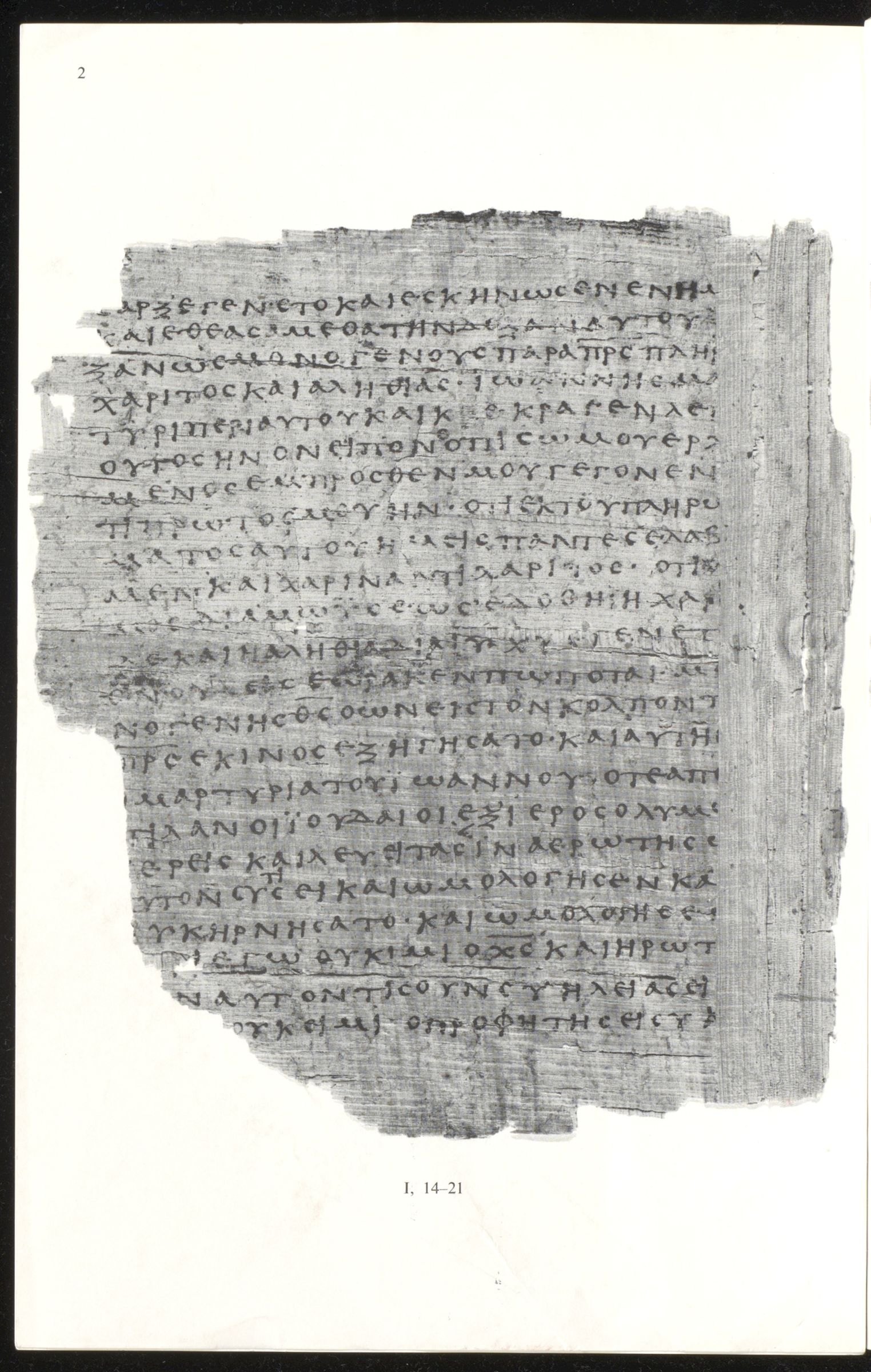
Fondation Martin Bodmer, Papyrus Bodmer II, Bodmer Lab image 1072205287_010 (https://bodmerlab.unige.ch/fr/constellations/papyri/mirador/1072205287), photographic plate of the 1962 Martin-Barns edition, shown whole. NTVMR page 20 (page 2) is linked to this image in NTVMR's page index. 1:14 begins on the previous page; 1:21 continues on the next page. Checked on the image: the printed caption reads ‹I, 14-21›; the last line of writing, ‹ουκ ειμι ο προφητης ει συ κ̣› (line 23 of the transcription), is legible at the foot of the page. John 1:18: P66 reads μονογενης θ̅ς̅ (θεος, "God") where the KJV has "the only begotten Son".
1:14 σ̣αρξ εγενετο και εσκηνωσεν εν ημ̣[ιν]
και εθεασαμεθα την δοξαν αυτου δ[ο]
ξαν ως μονογενους παρα π̅ρ̅ς̅ πληρ̣[ης]
χαριτος και αληθιας· 15 ιωαννης μα[ρ]
τυρι περι αυτου και κρ̣εκραγεν λεγ̣[ων]
ουτος ην ον ειπον οπισω μου ερχ̣[ο]
μενος εμπροσθεν μου γεγονεν [ο]
τι πρωτος μου ην· 16 οτι εκ του πληρω̣
ματος αυτου ημεις παντες ελαβ[ο]
μεν και χαριν αντι χαριτος· 17 οτι ο [νο]
μος δια μωυσεως εδοθη· η χαρι̣[ς]
δε και η αληθια δια ι̅υ̅ χ̅υ̅ εγενετ[ο]
18 θ̅ν̅ ουδεις εωρακεν πωποται· μο̣
νογενης θ̅ς̅ ο ων εις τον κολπον τ[ου]
π̅ρ̅ς̅ εκινος εξηγησατο· 19 και αυτη ε̣[στιν]
η̣ μαρτυρια του ιωαννου οτε απε̣
[σ]τιλαν οι ιουδαιοι. εξ ιεροσολυμω̣[ν]
ι̣ερεις και λευειτας ινα ερωτησω̣[σιν]
α̣υτον συς ει 20 και ωμολογησεν κα[ι]
[ο]υκ ηρνησατο· και ωμολογησεν̣
[ο]τ̣ι εγω ουκ ιμι ο χ̅ς̅· 21 και ηρωτ[η]
[σα]ν αυτον τις ουν συ ηλειας ει [και]
[λεγει] ουκ ειμι ο προφητης ει συ κ̣[αι]
1:14And the Word was made flesh, and dwelt among us, (and we beheld his glory, the glory as of the only begotten of the Father,) full of grace and truth. 15¶ John bare witness of him, and cried, saying, This was he of whom I spake, He that cometh after me is preferred before me: for he was before me. 16And of his fulness have all we received, and grace for grace. 17For the law was given by Moses, but grace and truth came by Jesus Christ. 18No man hath seen God at any time; the only begotten Son, which is in the bosom of the Father, he hath declared him. 19¶ And this is the record of John, when the Jews sent priests and Levites from Jerusalem to ask him, Who art thou? 20And he confessed, and denied not; but confessed, I am not the Christ. 21And they asked him, What then? Art thou Elias? And he saith, I am not. Art thou that prophet? And he answered, No.
Where on the image
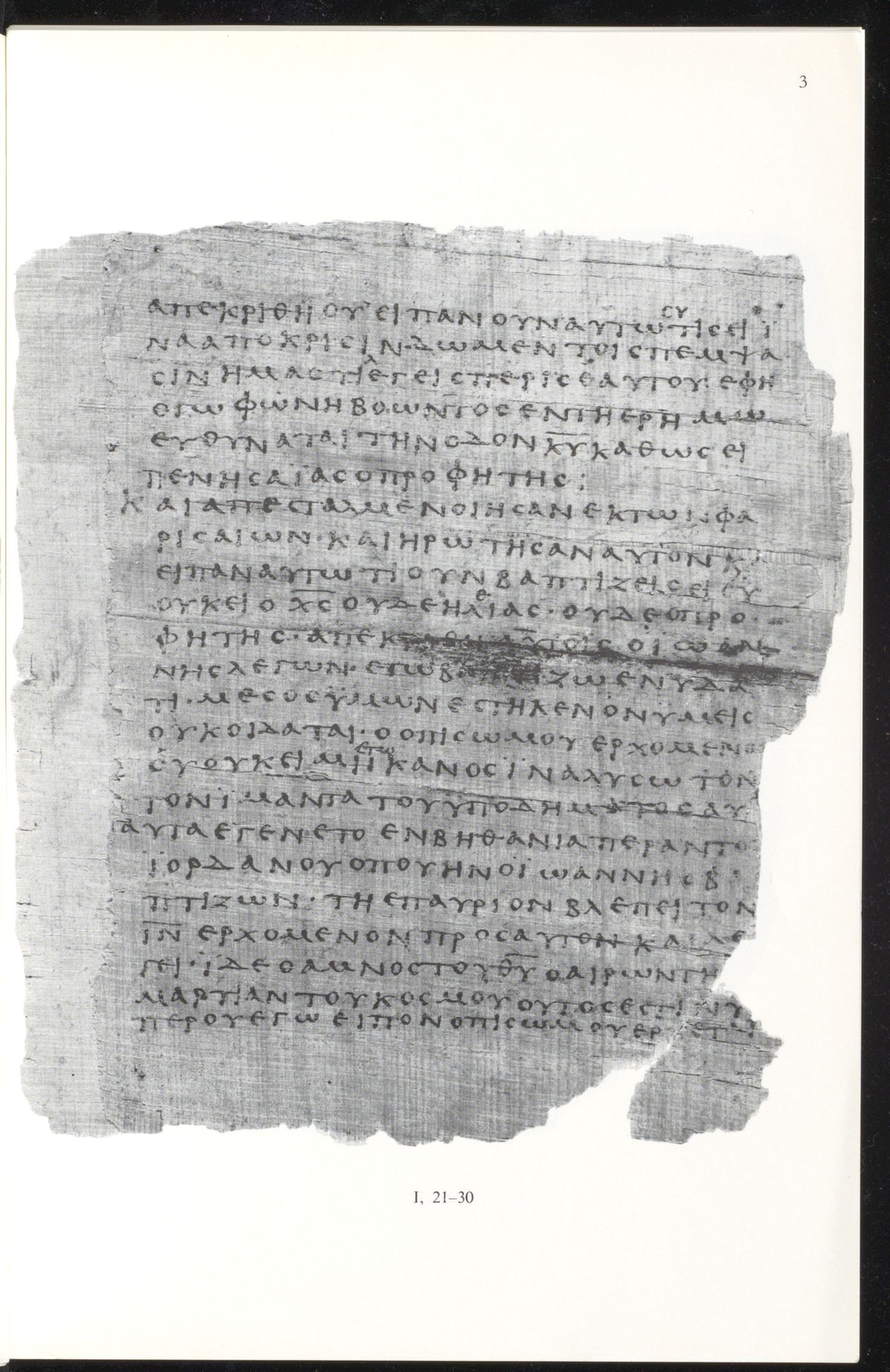
Fondation Martin Bodmer, Papyrus Bodmer II, Bodmer Lab image 1072205287_011 (https://bodmerlab.unige.ch/fr/constellations/papyri/mirador/1072205287), photographic plate of the 1962 Martin-Barns edition, shown whole. NTVMR page 30 (page 3) is linked to this image in NTVMR's page index. 1:21 begins on the previous page; 1:30 continues on the next page. Checked on the image: the printed caption reads ‹I, 21-30›; the last line of writing, ‹περ ου εγω ειπον οπισω μου ερχ̣ετα̣ι› (line 23 of the transcription), is legible at the foot of the page.
1:21 απεκριθη ου· 22 ειπαν ουν αυτω τις ει ι
να αποκρισιν δωμεν τοις πεμψα
σιν ημας τι εγεις περι σεαυτου· 23 εφη
εγω φωνη βοωντος εν τη ερημω
ευθυναται την οδον κ̅υ̅ καθως ει
πεν ησαιας ο προφητης·
24 και απεσταλμενοι ησαν εκ των φα
ρισαιων· 25 και ηρωτησαν αυτον και
ειπαν αυτω τι ουν βαπτιζεις ει συ
ουκ ει ο χ̅ς̅ ουδε ηλιας· ουδε ο προ
φητης· 26 απεκριθη αυτοις ο ιωαν
νης λεγων· εγω βαπτιζω εν υδα
τι· μεσος υμων εστηκεν ον υμεις
ουκ οιδαται· 27 ο οπισω μου ερχομενος̣
ου ουκ ειμι ικανος ινα λυσω τον
τον ιμαντα του υποδηματος αυ[του]
28 τ̣αυτα εγενετο εν βηθανια περαν του̣
ιορδανου οπου ην ο ιωαννης βα
πτιζων· 29 τη επαυριον βλεπει τον
ι̅ν̅ ερχομενον προς αυτον και λε
γει· ιδε ο αμνος του θ̅υ̅ ο αιρων τη[ν α]
μαρτιαν του κοσμου 30 ουτος εστιν υ
περ ου εγω ειπον οπισω μου ερχ̣ετα̣ι
1:21And they asked him, What then? Art thou Elias? And he saith, I am not. Art thou that prophet? And he answered, No. 22Then said they unto him, Who art thou? that we may give an answer to them that sent us. What sayest thou of thyself? 23He said, I am the voice of one crying in the wilderness, Make straight the way of the Lord, as said the prophet Esaias. 24And they which were sent were of the Pharisees. 25And they asked him, and said unto him, Why baptizest thou then, if thou be not that Christ, nor Elias, neither that prophet? 26John answered them, saying, I baptize with water: but there standeth one among you, whom ye know not; 27He it is, who coming after me is preferred before me, whose shoe’s latchet I am not worthy to unloose. 28These things were done in Bethabara beyond Jordan, where John was baptizing. 29¶ The next day John seeth Jesus coming unto him, and saith, Behold the Lamb of God, which taketh away the sin of the world. 30This is he of whom I said, After me cometh a man which is preferred before me: for he was before me.
Where on the image
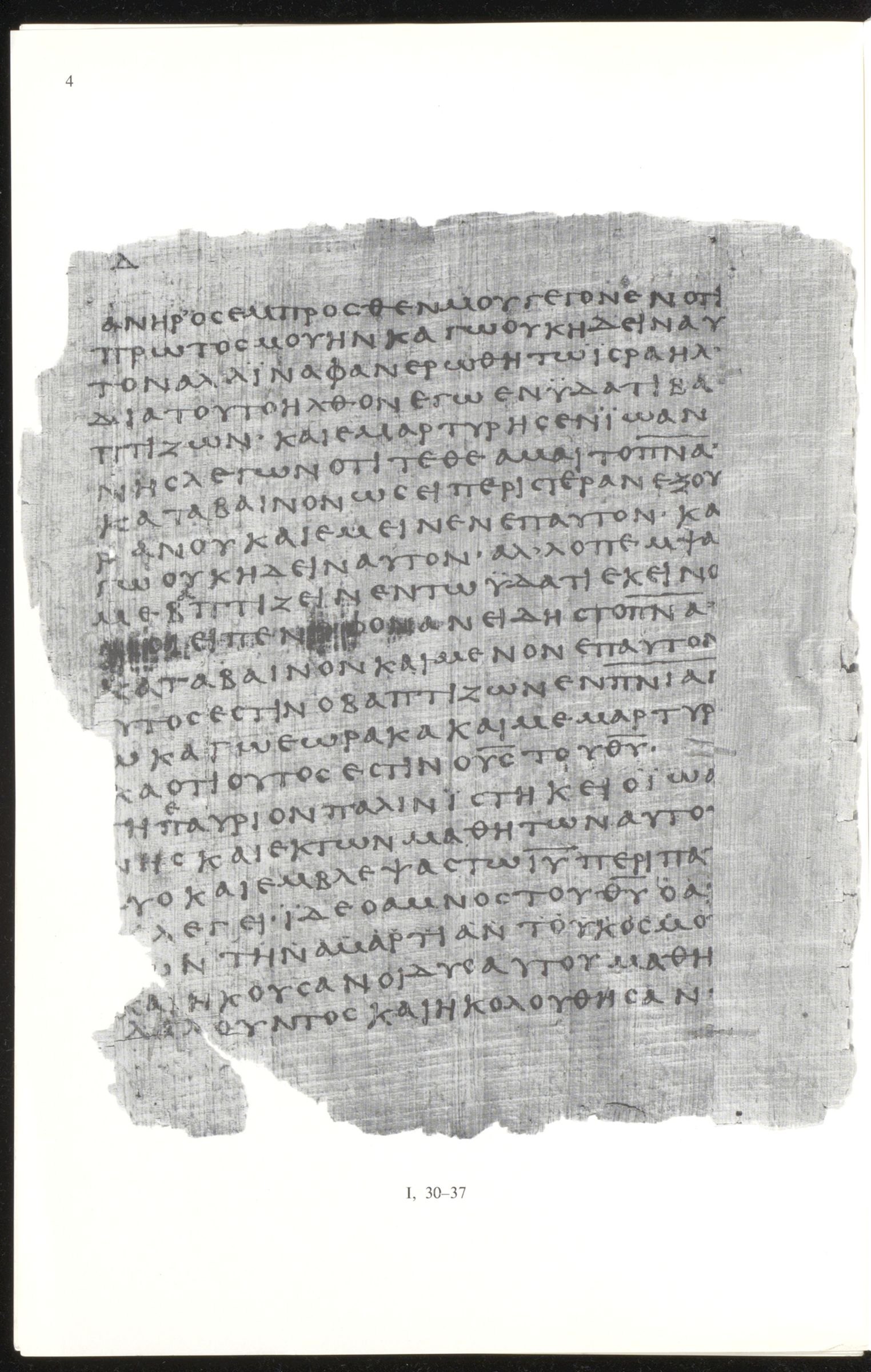
Fondation Martin Bodmer, Papyrus Bodmer II, Bodmer Lab image 1072205287_012 (https://bodmerlab.unige.ch/fr/constellations/papyri/mirador/1072205287), photographic plate of the 1962 Martin-Barns edition, shown whole. NTVMR page 40 (page 4) is linked to this image in NTVMR's page index. 1:30 begins on the previous page; 1:37 continues on the next page. Checked on the image: the printed caption reads ‹I, 30-37›; the last line of writing, ‹λαλουντος και ηκολουθησαν› (line 22 of the transcription), is legible at the foot of the page.
1:30 ανηρ ος εμπροσθεν μου γεγονεν οτι
πρωτος μου ην 31 καγω ουκ ηδειν αυ
τον αλλ ινα φανερωθη τω ισραηλ
δια τουτο ηλθον εγω εν υδατι βα
πτιζων· 32 και εμαρτυρησεν ιωαν
νης λεγων οτι τεθεαμαι το π̅ν̅α̅
καταβαινον ωσει περιστεραν εξ ου
ρανου και εμεινεν επ αυτον· 33 κα
γω ουκ ηδειν αυτον· αλλ ο πεμψα[ς]
με βπτιζειν εν τω υδατι εκεινο[ς]
μ̣οι ειπεν ε̣φ ον αν ειδης το π̅ν̅α̅
καταβαινον και μενον επ αυτον̣
[ο]υτος εστιν ο βαπτιζων εν π̅ν̅ι̅ αγ̣[ι]
ω̣ 34 καγω εωρακα και μεμαρτυρ[η]
κα οτι ουτος εστιν ο υ̅ς̅ του θ̅υ̅·
35 τ̣η παυριον παλιν ιστηκει ο ιωα[ν]
ν̣ε̣ι̣ς και εκ των μαθητων αυτου̣
δ̣υο 36 και εμβλεψας τω ι̅υ̅ περιπατ̣[ουν]
[τ]ι̣ λεγει· ιδε ο αμνος του θ̅υ̅ ο αι̣
[ρ]ω̣ν την αμαρτιαν του κοσμου̣
37 και ηκουσαν οι δυο αυτου μαθη[ται]
λαλουντος και ηκολουθησαν
1:30This is he of whom I said, After me cometh a man which is preferred before me: for he was before me. 31And I knew him not: but that he should be made manifest to Israel, therefore am I come baptizing with water. 32And John bare record, saying, I saw the Spirit descending from heaven like a dove, and it abode upon him. 33And I knew him not: but he that sent me to baptize with water, the same said unto me, Upon whom thou shalt see the Spirit descending, and remaining on him, the same is he which baptizeth with the Holy Ghost. 34And I saw, and bare record that this is the Son of God. 35¶ Again the next day after John stood, and two of his disciples; 36And looking upon Jesus as he walked, he saith, Behold the Lamb of God! 37And the two disciples heard him speak, and they followed Jesus.
Where on the image
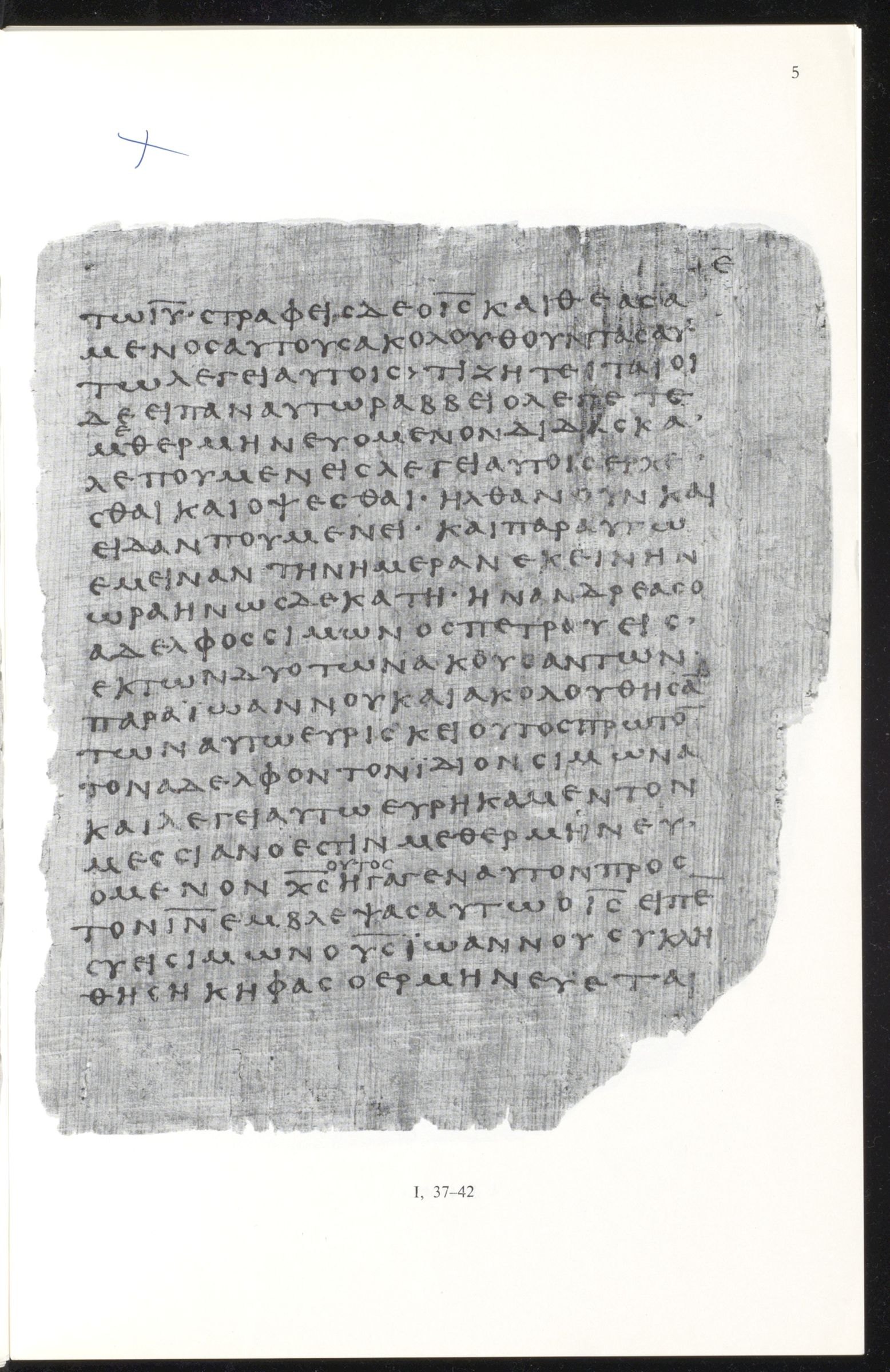
Fondation Martin Bodmer, Papyrus Bodmer II, Bodmer Lab image 1072205287_013 (https://bodmerlab.unige.ch/fr/constellations/papyri/mirador/1072205287), photographic plate of the 1962 Martin-Barns edition, shown whole. NTVMR page 50 (page 5) is linked to this image in NTVMR's page index. 1:37 begins on the previous page; 1:42 continues on the next page. Checked on the image: the printed caption reads ‹I, 37-42›; the last line of writing, ‹θηση κηφας ο ερμηνευεται› (line 21 of the transcription), is legible at the foot of the page.
1:37 τω ι̅υ̅· 38 στραφεις δε ο ι̅ς̅ και θεασα
μενος αυτους ακολουθουντας αυ
τω λεγει αυτοις· τι ζητειται οι
δε ειπαν αυτω ραββει ο λεγετε
μθερμηνευομενον διδασκα
λε που μενεις 39 λεγει αυτοις ερχε
σθαι και οψεσθαι· ηλθαν ουν και
ειδαν που μενει· και παρ αυτω
εμειναν την ημεραν εκεινην
ωρα ην ως δεκατη· 40 ην ανδρεας ο
αδελφος σιμωνος πετρου εις
εκ των δυο των ακουσαντων·
παρα ιωαννου και ακολουθησαν
των αυτω 41 ευρισκει ουτος πρωτον
τον αδελφον τον ιδιον σιμωνα
και λεγει αυτω ευρηκαμεν τον
μεσσιαν ο εστιν μεθερμηνευ
ομενον χ̅ς̅ 42 ηγαγεν αυτον προς
τον ι̅ν̅ εμβλεψας αυτω ο ι̅ς̅ ειπεν
συ ει σιμων ο υ̅ς̅ ιωαννου συ κλη
θηση κηφας ο ερμηνευεται
1:37And the two disciples heard him speak, and they followed Jesus. 38Then Jesus turned, and saw them following, and saith unto them, What seek ye? They said unto him, Rabbi, (which is to say, being interpreted, Master,) where dwellest thou? 39He saith unto them, Come and see. They came and saw where he dwelt, and abode with him that day: for it was about the tenth hour. 40One of the two which heard John speak, and followed him, was Andrew, Simon Peter’s brother. 41He first findeth his own brother Simon, and saith unto him, We have found the Messias, which is, being interpreted, the Christ. 42And he brought him to Jesus. And when Jesus beheld him, he said, Thou art Simon the son of Jona: thou shalt be called Cephas, which is by interpretation, A stone.
Where on the image
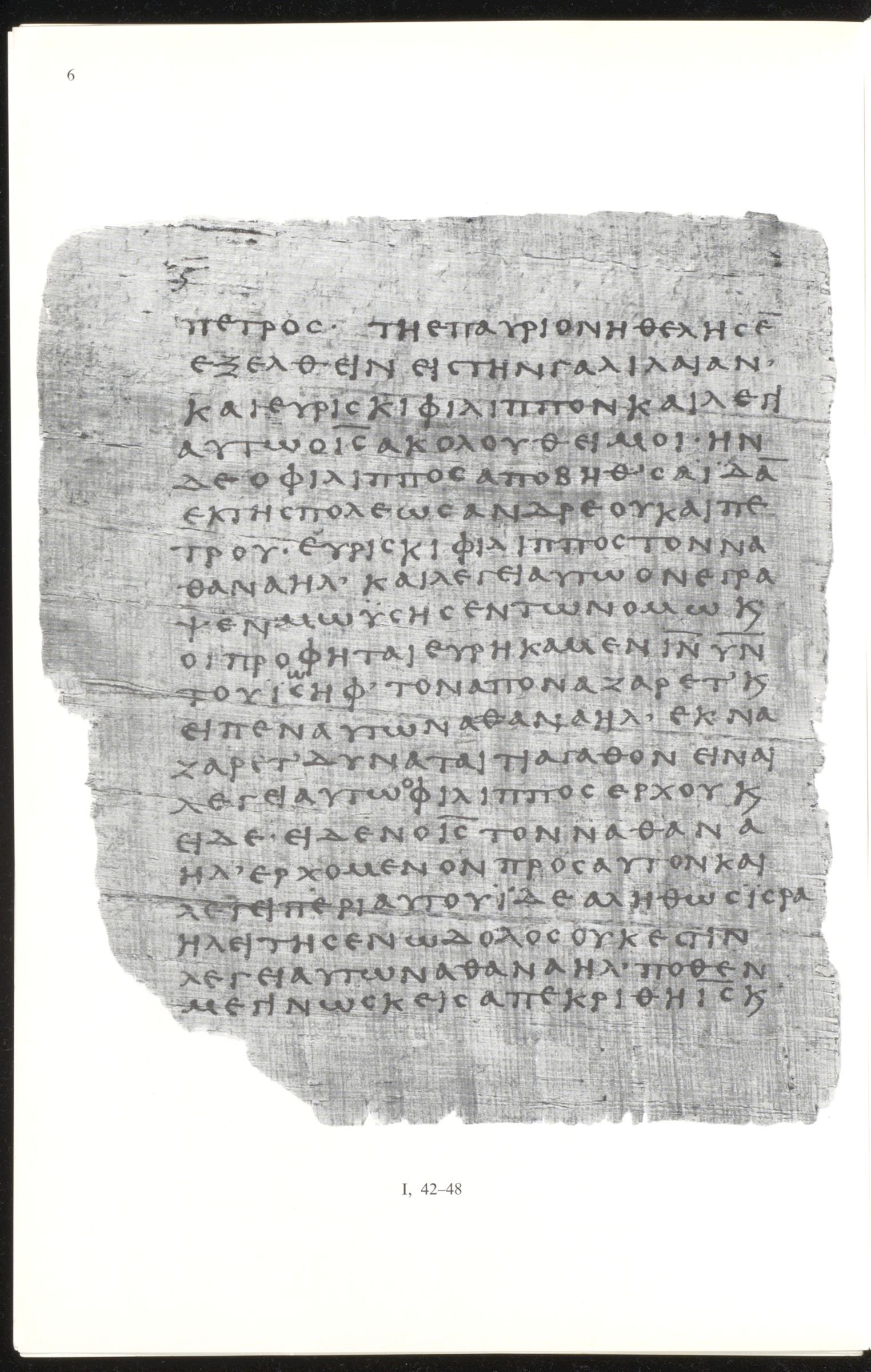
Fondation Martin Bodmer, Papyrus Bodmer II, Bodmer Lab image 1072205287_014 (https://bodmerlab.unige.ch/fr/constellations/papyri/mirador/1072205287), photographic plate of the 1962 Martin-Barns edition, shown whole. NTVMR page 60 (page 6) is linked to this image in NTVMR's page index. 1:42 begins on the previous page; 1:48 continues on the next page. Checked on the image: the printed caption reads ‹I, 42-48›; the last line of writing, ‹με γινωσκεις απεκριθη ι̅ς̅ και› (line 20 of the transcription), is legible at the foot of the page.
1:42 πετρος. 43 τη επαυριον ηθελησεν
εξελθειν εις την γαλιλαιαν
και ευρισκι φιλιππον και λεγι
αυτω ο ι̅ς̅ ακολουθει μοι· 44 ην
δε ο φιλιππος απο βηθσαιδαν
εκ της πολεως ανδρεου και πε
τρου· 45 ευρισκι φιλιππος τον να
θαναηλ και λεγει αυτω ον εγρα
ψεν μωυσης εν τω νομω και
οι προφηται ευρηκαμεν ι̅ν̅ υ̅ν̅
του ισηφ τον απο ναζαρετ 46 και
ειπεν αυτω ναθαναηλ εκ να
ζαρετ δυναται τι αγαθον ειναι
λεγει αυτω φιλιππος ερχου και
ειδε 47 ειδεν ο ι̅ς̅ τον ναθανα
ηλ ερχομενον προς αυτον και
λεγει περι αυτου ιδε αληθως ισρα
ηλειτης εν ω δολος ουκ εστιν
48 λεγει αυτω ναθαναηλ ποθεν
με γινωσκεις απεκριθη ι̅ς̅ και
1:42And he brought him to Jesus. And when Jesus beheld him, he said, Thou art Simon the son of Jona: thou shalt be called Cephas, which is by interpretation, A stone. 43¶ The day following Jesus would go forth into Galilee, and findeth Philip, and saith unto him, Follow me. 44Now Philip was of Bethsaida, the city of Andrew and Peter. 45Philip findeth Nathanael, and saith unto him, We have found him, of whom Moses in the law, and the prophets, did write, Jesus of Nazareth, the son of Joseph. 46And Nathanael said unto him, Can there any good thing come out of Nazareth? Philip saith unto him, Come and see. 47Jesus saw Nathanael coming to him, and saith of him, Behold an Israelite indeed, in whom is no guile! 48Nathanael saith unto him, Whence knowest thou me? Jesus answered and said unto him, Before that Philip called thee, when thou wast under the fig tree, I saw thee.
Where on the image
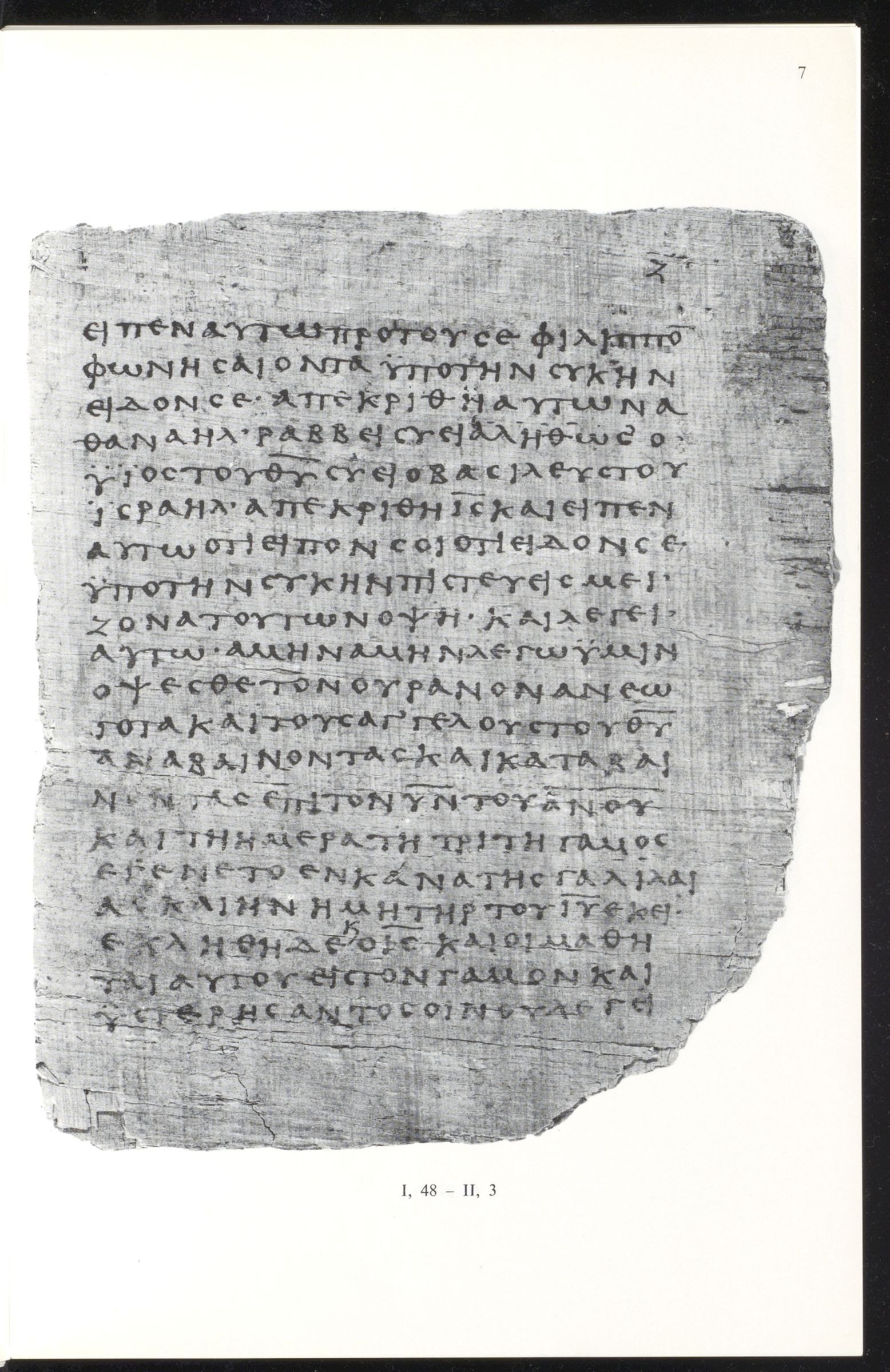
Fondation Martin Bodmer, Papyrus Bodmer II, Bodmer Lab image 1072205287_015 (https://bodmerlab.unige.ch/fr/constellations/papyri/mirador/1072205287), photographic plate of the 1962 Martin-Barns edition, shown whole. NTVMR page 70 (page 7) is linked to this image in NTVMR's page index. 1:48 begins on the previous page; 2:3 continues on the next page. Checked on the image: the printed caption reads ‹I, 48 - II, 3›; the last line of writing, ‹υστερησαντος οινου λεγει› (line 20 of the transcription), is legible at the foot of the page.
1:48 ειπεν αυτω προ του σε φιλιππον
φωνησαι οντα υπο την συκην
ειδον σε· 49 απεκριθη αυτω να
θαναηλ ραββει συ ει αληθως ο
υιος του θ̅υ̅ συ ει ο βασιλευς του
ισραηλ 50 απεκριθη ι̅ς̅ και ειπεν
αυτω οτι ειπον σοι οτι ειδον σε
υπο την συκην πιστευεις μει
ζονα τουτων οψη· 51 και λεγει
αυτω· αμην αμην λεγω υμιν
οψεσθε τον ουρανον ανεω
γοτα και τους αγγελους του θ̅υ̅
αναβαινοντας και καταβαι
νο̣ντας επι τον υ̅ν̅ του α̅ν̅ο̅υ̅
2:1 και τη ημερα τη τριτη γαμος
εγενετο εν κανα της γαλιλαι
ας και ην η μητηρ του ι̅υ̅ εκει·
2 εκληθη δε ο ι̅ς̅ και οι μαθη
ται αυτου εις τον γαμον 3 και
υστερησαντος οινου λεγει
1:48Nathanael saith unto him, Whence knowest thou me? Jesus answered and said unto him, Before that Philip called thee, when thou wast under the fig tree, I saw thee. 49Nathanael answered and saith unto him, Rabbi, thou art the Son of God; thou art the King of Israel. 50Jesus answered and said unto him, Because I said unto thee, I saw thee under the fig tree, believest thou? thou shalt see greater things than these. 51And he saith unto him, Verily, verily, I say unto you, Hereafter ye shall see heaven open, and the angels of God ascending and descending upon the Son of man. 2:1And the third day there was a marriage in Cana of Galilee; and the mother of Jesus was there: 2And both Jesus was called, and his disciples, to the marriage. 3And when they wanted wine, the mother of Jesus saith unto him, They have no wine.
Notes
- Greek: the NTVMR diplomatic transcription, line by line as on the papyrus. Square brackets enclose letters that are lost or illegible and were supplied by the transcribers; a dot under a letter marks it as uncertain; [...] marks a gap. Nomina sacra and numerals keep the scribe's overline. Spelling is the scribe's (no accents or breathings). Words broken at a line end stay broken as on the papyrus. Corrections are not shown: the text is the first hand.
- English: the King James Version (1611), whole verses, for every verse that has text on the page. A verse that begins on one page and ends on the next is given in full on both. The KJV translates a later form of the Greek text, so its wording does not always match the papyrus; material differences (such as verses the papyrus does not have) are noted in the section.
Cite
Sources
- Source: Papyrus Bodmer II (P66), Fondation Martin Bodmer: images from the Bodmer Lab, University of Geneva; Greek from the INTF NTVMR transcription of P66; English from the King James Version (holding institution)
- Critical edition: INTF NTVMR diplomatic transcription (CC BY 4.0)
← previous · → next · v cycle view · l back to library