P66 (Papyrus Bodmer II): John 14:3-30 (pages 104-109)
Introduction
P66 is a papyrus codex of the Gospel of John copied in Egypt around 200, the most complete early copy of John. Most of it is Papyrus Bodmer II in the Fondation Martin Bodmer, Cologny (Geneva); small pieces are in the Chester Beatty Library, Dublin, and the Institut für Altertumskunde, Cologne. The first five quires (John 1:1-14:26) survive as a bound book of numbered pages; later leaves, from John 14:29 to 21:9, are damaged and kept between glass. The scribe made many corrections, some of them his own; only the first hand is shown here.
Each section below is one page: the photograph, the NTVMR diplomatic transcription line by line, and the King James Version of every verse on the page. Pages of the bound book are shown on the photographic plates published by Victor Martin and J. W. B. Barns in 1962 (scanned by the Bodmer Lab), the glass-mounted leaves on colour photographs. Lost: John 6:12-34 (pages 35-38) and parts of chapters 14-21; the transcription ends at 21:9. Where P66 lacks a verse that the KJV has (John 5:4, the account of the adulteress at 7:53-8:11, 16:15), the section says so.
This entry covers pages 104-109 (John 14:3-30).
How was this verified? (Provenance)
Where on the image
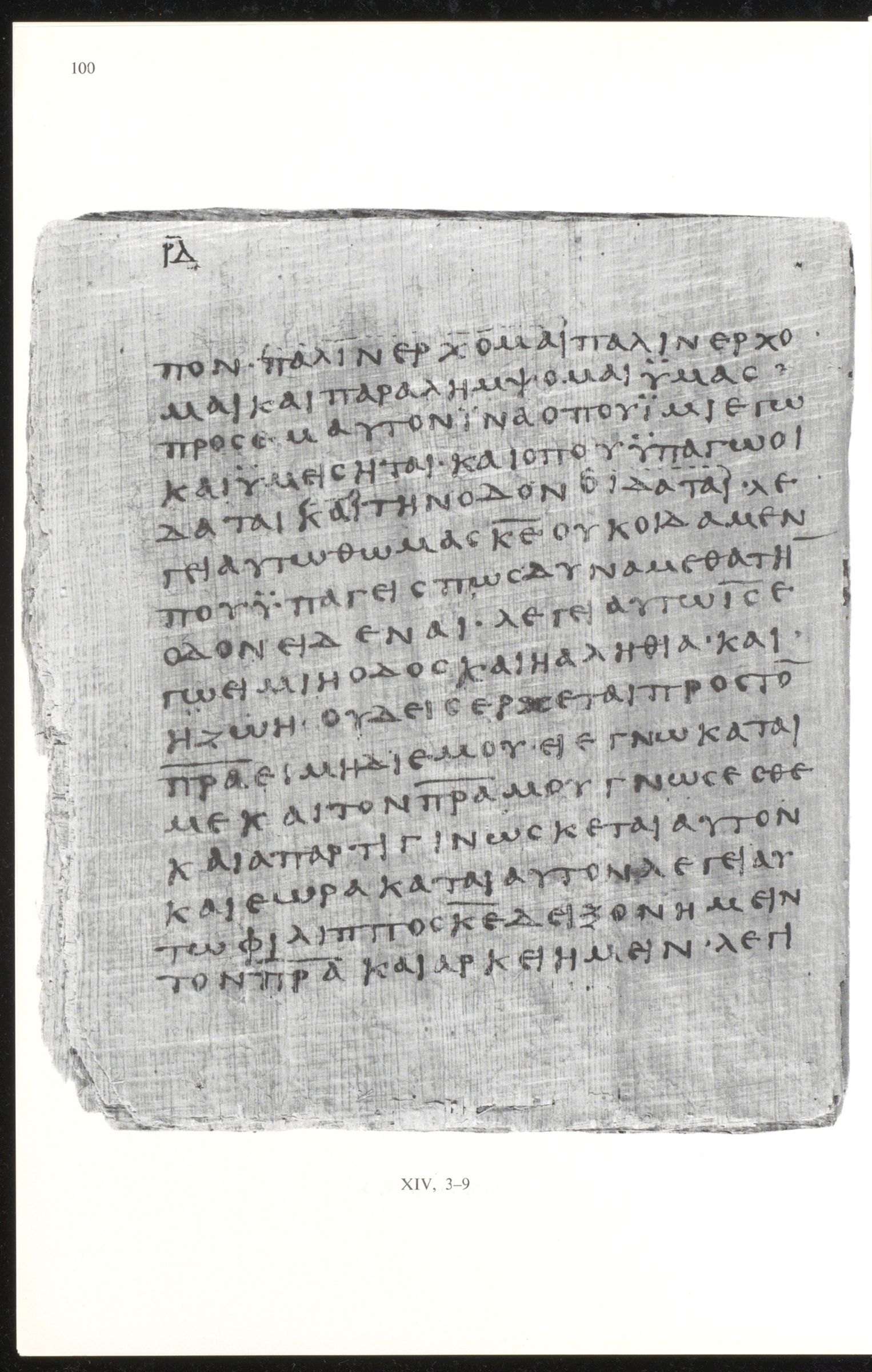
Fondation Martin Bodmer, Papyrus Bodmer II, Bodmer Lab image 1072205287_108 (https://bodmerlab.unige.ch/fr/constellations/papyri/mirador/1072205287), photographic plate of the 1962 Martin-Barns edition, shown whole. NTVMR page 1000 (page 104) is linked to this image in NTVMR's page index. 14:3 begins on the previous page; 14:9 continues on the next page. Checked on the image: the printed caption reads ‹XIV, 3-9›.
14:3 πον· παλιν ερχομαι παλιν ερχο
μαι και παραλημψομαι υμας
προς εμαυτον ινα οπου ιμι εγω
και υμεις ηται· 4 και οπου υπαγω οι
δαται και την οδον οιδαται· 5 λε
γει αυτω θωμας κ̅ε̅ ουκ οιδαμεν
που υπαγεις πως δυναμεθα την
οδον ειδεναι· 6 λεγει αυτω ι̅ς̅ ε
γω ειμι η οδος και η αληθια· και
η ζωη· ουδεις ερχεται προς τον
π̅ρ̅α̅ ει μη δι εμου· 7 ει εγνωκαται
με και τον π̅ρ̅α̅ μου γνωσεσθε
και απ αρτι γινωσκεται αυτον
και εωρακαται αυτον 8 λεγει αυ
τω φιλιππος κ̅ε̅ δειξον ημειν
τον π̅ρ̅α̅ και αρκει ημειν 9 λεγι
14:3And if I go and prepare a place for you, I will come again, and receive you unto myself; that where I am, there ye may be also. 4And whither I go ye know, and the way ye know. 5Thomas saith unto him, Lord, we know not whither thou goest; and how can we know the way? 6Jesus saith unto him, I am the way, the truth, and the life: no man cometh unto the Father, but by me. 7If ye had known me, ye should have known my Father also: and from henceforth ye know him, and have seen him. 8Philip saith unto him, Lord, shew us the Father, and it sufficeth us. 9Jesus saith unto him, Have I been so long time with you, and yet hast thou not known me, Philip? he that hath seen me hath seen the Father; and how sayest thou then, Shew us the Father?
Where on the image
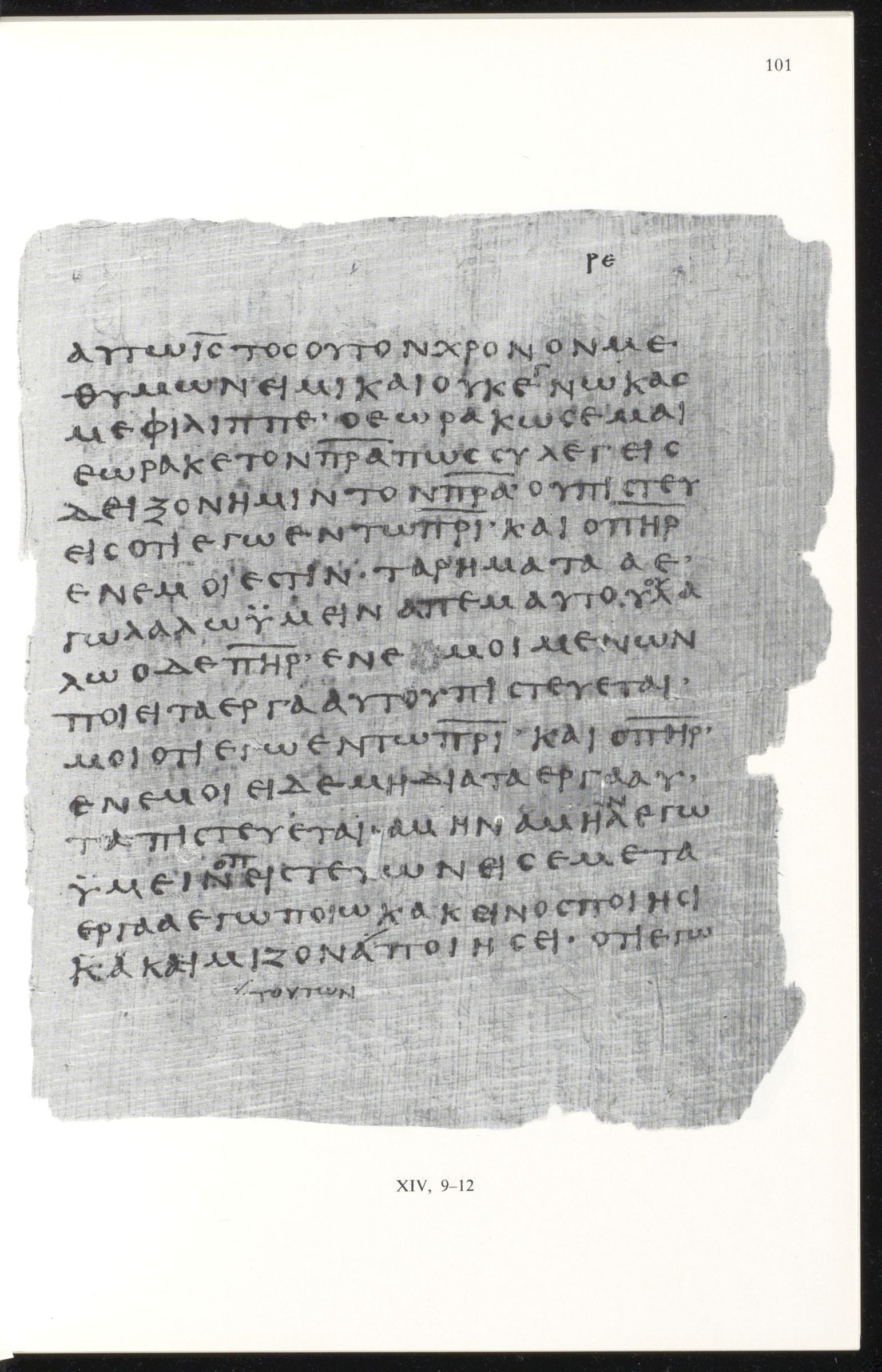
Fondation Martin Bodmer, Papyrus Bodmer II, Bodmer Lab image 1072205287_109 (https://bodmerlab.unige.ch/fr/constellations/papyri/mirador/1072205287), photographic plate of the 1962 Martin-Barns edition, shown whole. NTVMR page 1010 (page 105) is linked to this image in NTVMR's page index. 14:9 begins on the previous page; 14:12 continues on the next page. Checked on the image: the printed caption reads ‹XIV, 9-12›.
14:9 αυτω ι̅ς̅ τοσουτον χρονον με
θ υμων ειμι και ουκ ενωκας
με φιλιππε ο εωρακως εμαι
εωρακε τον π̅ρ̅α̅ πως συ λεγεις
δειξον ημιν τον π̅ρ̅α̅ 10 ου πιστευ
εις οτι εγω εν τω π̅ρ̅ι̅ και ο π̅η̅ρ̅
εν εμοι εστιν· τα ρηματα α ε
γω λαλω υμειν απ εμαυτου λα
λω ο δε π̅η̅ρ̅ εν εν̣μοι μενων
ποιει τα εργα αυτου 11 πιστευεται
μοι οτι εγω εν τω π̅ρ̅ι̅ και ο π̅η̅ρ̅
εν εμοι ει δε μη δια τα εργα αυ
του πιστευεται· 12 αμην αμη λεγω
υμειν ειστευων εις εμε τα
εργα α εγω ποιω κακεινος ποιησι
κακει μιζονα ποιησει· οτι εγω
14:9Jesus saith unto him, Have I been so long time with you, and yet hast thou not known me, Philip? he that hath seen me hath seen the Father; and how sayest thou then, Shew us the Father? 10Believest thou not that I am in the Father, and the Father in me? the words that I speak unto you I speak not of myself: but the Father that dwelleth in me, he doeth the works. 11Believe me that I am in the Father, and the Father in me: or else believe me for the very works’ sake. 12Verily, verily, I say unto you, He that believeth on me, the works that I do shall he do also; and greater works than these shall he do; because I go unto my Father.
Where on the image
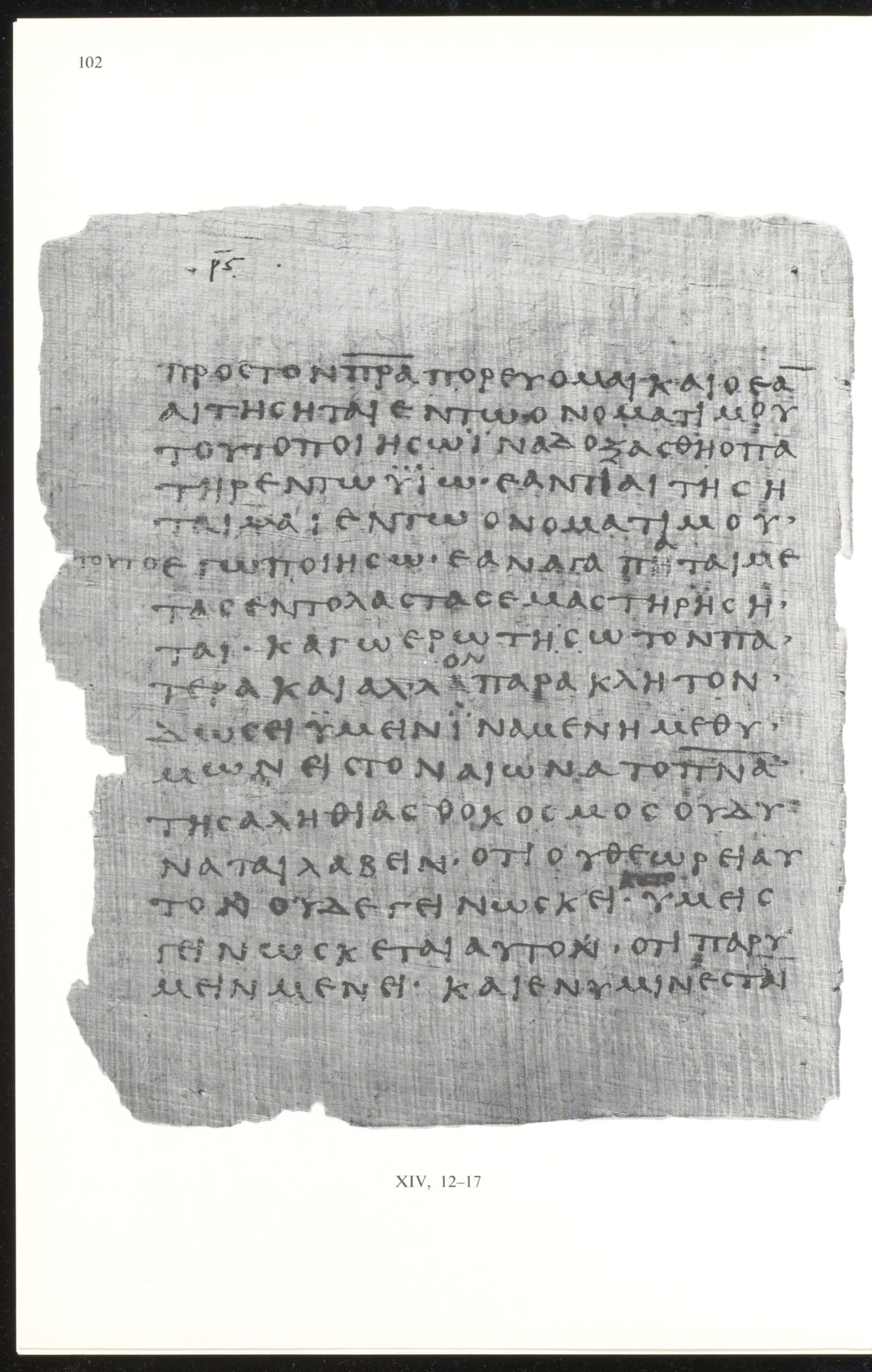
Fondation Martin Bodmer, Papyrus Bodmer II, Bodmer Lab image 1072205287_110 (https://bodmerlab.unige.ch/fr/constellations/papyri/mirador/1072205287), photographic plate of the 1962 Martin-Barns edition, shown whole. NTVMR page 1020 (page 106) is linked to this image in NTVMR's page index. 14:12 begins on the previous page. Checked on the image: the printed caption reads ‹XIV, 12-17›; the last line of writing, ‹μειν μενει· και εν υμιν εστι̣ν› (line 16 of the transcription), is legible at the foot of the page.
14:12 προς τον π̅ρ̅α̅ πορευομαι 13 και ο εαν
αιτησηται εν τω ονοματι μου
τουτο ποιησω ινα δοξασθη ο πα
τηρ εν τω υιω· 14 εαν τι αιτηση
ται μαι εν τω ονοματι μου
εγω ποιησω· 15 εαν αγαπηται με
τας εντολας τας εμας τηρηση
ται· 16 καγω ερωτησω τον πα
τερα και αλλα παρακλητον
δωσει υμειν ινα μενη μεθ υ
μων εις τον αιωνα 17 το π̅ν̅α̅
της αληθιας ο ο κοσμος ου δυ
ναται λαβειν· οτι ου θεωρει αυ
τον ουδε γεινωσκει· υμεις
γεινωσκεται αυτον· οτι παρ υ
μειν μενει· και εν υμιν εστι̣ν
14:12Verily, verily, I say unto you, He that believeth on me, the works that I do shall he do also; and greater works than these shall he do; because I go unto my Father. 13And whatsoever ye shall ask in my name, that will I do, that the Father may be glorified in the Son. 14If ye shall ask any thing in my name, I will do it. 15¶ If ye love me, keep my commandments. 16And I will pray the Father, and he shall give you another Comforter, that he may abide with you for ever; 17Even the Spirit of truth; whom the world cannot receive, because it seeth him not, neither knoweth him: but ye know him; for he dwelleth with you, and shall be in you.
Where on the image
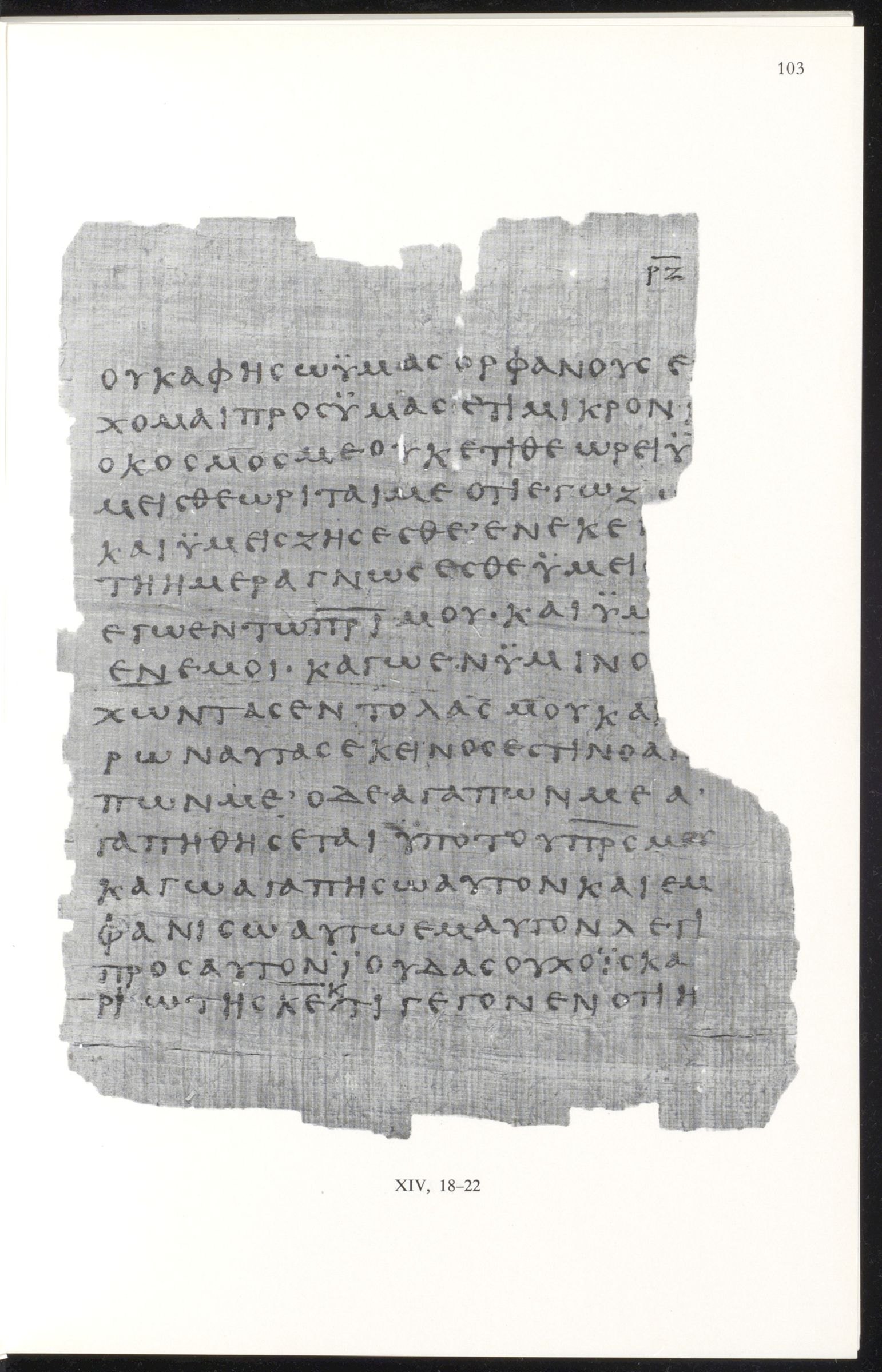
Fondation Martin Bodmer, Papyrus Bodmer II, Bodmer Lab image 1072205287_111 (https://bodmerlab.unige.ch/fr/constellations/papyri/mirador/1072205287), photographic plate of the 1962 Martin-Barns edition, shown whole. NTVMR page 1030 (page 107) is linked to this image in NTVMR's page index. 14:22 continues on the next page. Checked on the image: the printed caption reads ‹XIV, 18-22›; the last line of writing, ‹ριωτης κ̅ε̅ τι γεγονεν οτι η› (line 16 of the transcription), is legible at the foot of the page.
14:18 ουκ αφησω υμας ορφανους ε[ρ]
χομαι προς υμας 19 ετι μικρον κ̣[αι]
ο κοσμος με ουκετι θεωρει υ
μεις θεωριται με οτι εγω ζω̣
και υμεις ζησεσθε 20 εν εκει[νη]
τη ημερα γνωσεσθε υμεις̣ [οτι]
εγω εν τω π̅ρ̅ι̅ μου· και υμ[εις]
εν εμοι· καγω εν υμιν 21 ο [ε]
χων τας εντολας μου και [τη]
ρων αυτας εκεινος εστιν ο αγ̣[α]
πων με ο δε αγαπων με α
γαπηθησεται υπο του π̅ρ̅ς̅ μου
καγω αγαπησω αυτον και εμ
φανισω αυτω εμαυτον 22 λεγι
προς αυτον ιουδας ουχ ο ισκα
ριωτης κ̅ε̅ τι γεγονεν οτι η
14:18I will not leave you comfortless: I will come to you. 19Yet a little while, and the world seeth me no more; but ye see me: because I live, ye shall live also. 20At that day ye shall know that I am in my Father, and ye in me, and I in you. 21He that hath my commandments, and keepeth them, he it is that loveth me: and he that loveth me shall be loved of my Father, and I will love him, and will manifest myself to him. 22Judas saith unto him, not Iscariot, Lord, how is it that thou wilt manifest thyself unto us, and not unto the world?
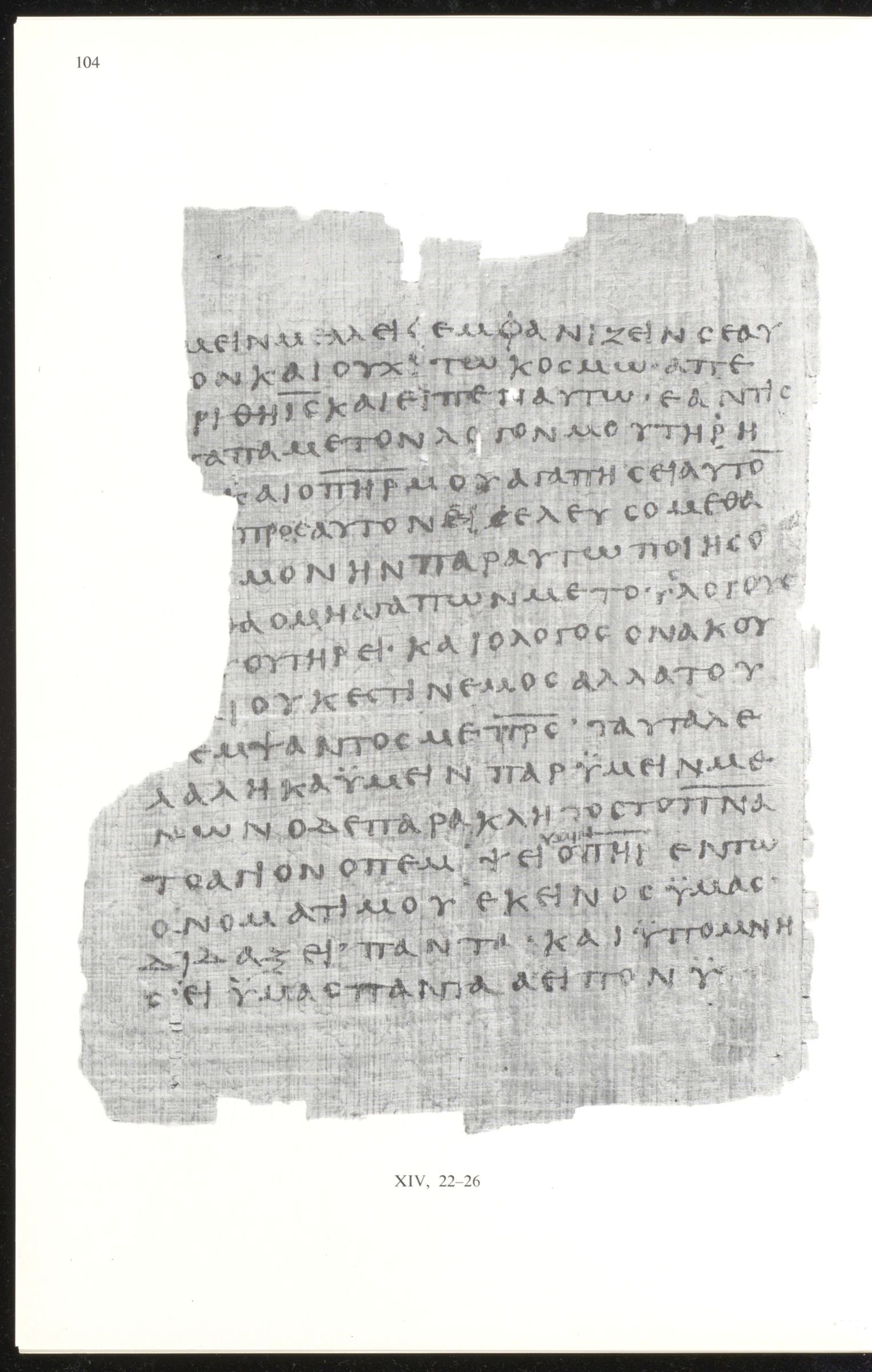
Where on the image
Fondation Martin Bodmer, Papyrus Bodmer II, Bodmer Lab image 1072205287_112 (https://bodmerlab.unige.ch/fr/constellations/papyri/mirador/1072205287), photographic plate of the 1962 Martin-Barns edition, shown whole. NTVMR page 1040 (page 108) is linked to this image in NTVMR's page index. 14:22 begins on the previous page; 14:26 continues on the next page. Checked on the image: the printed caption reads ‹XIV, 22-26›; the last line of writing, ‹σει υμας παντα α ειπον υ› (line 17 of the transcription), is legible at the foot of the page.
14:22 μειν μελλεις εμφανιζειν σεαυ
[τ]ον και ουχι̣ τω κοσμω· 23 απε
[κ]ριθη ι̅ς̅ και ειπεν αυτω· εαν τις
[α]γ̣απα με τον λογον μου τηρη
[σει] και ο π̅η̅ρ̅ μου αγαπησει αυτον
[και] παρ αυτον εισελευσομεθα
[και] μονην παρ αυτω ποιησο
[με]θ̣α 24 ο μη αγαπων με του λογου
[μο]υ̣ ου τηρει· και ο λογος ον ακου
[ετ]α̣ι ουκ εστιν εμος αλλα του
[π]εμψαντος με π̅ρ̅ς̅ 25 ταυτα λε
λαληκα υμειν παρ υμειν με
νων 26 ο δε παρακλητος το π̅ν̅α̅
το αγιον ο πεμψει ο π̅η̅ρ̅ εν τω
ονοματι μου εκεινος υμας
διδαξει παντα· και υπομνη
σει υμας παντα α ειπον υ
14:22Judas saith unto him, not Iscariot, Lord, how is it that thou wilt manifest thyself unto us, and not unto the world? 23Jesus answered and said unto him, If a man love me, he will keep my words: and my Father will love him, and we will come unto him, and make our abode with him. 24He that loveth me not keepeth not my sayings: and the word which ye hear is not mine, but the Father’s which sent me. 25These things have I spoken unto you, being yet present with you. 26But the Comforter, which is the Holy Ghost, whom the Father will send in my name, he shall teach you all things, and bring all things to your remembrance, whatsoever I have said unto you.
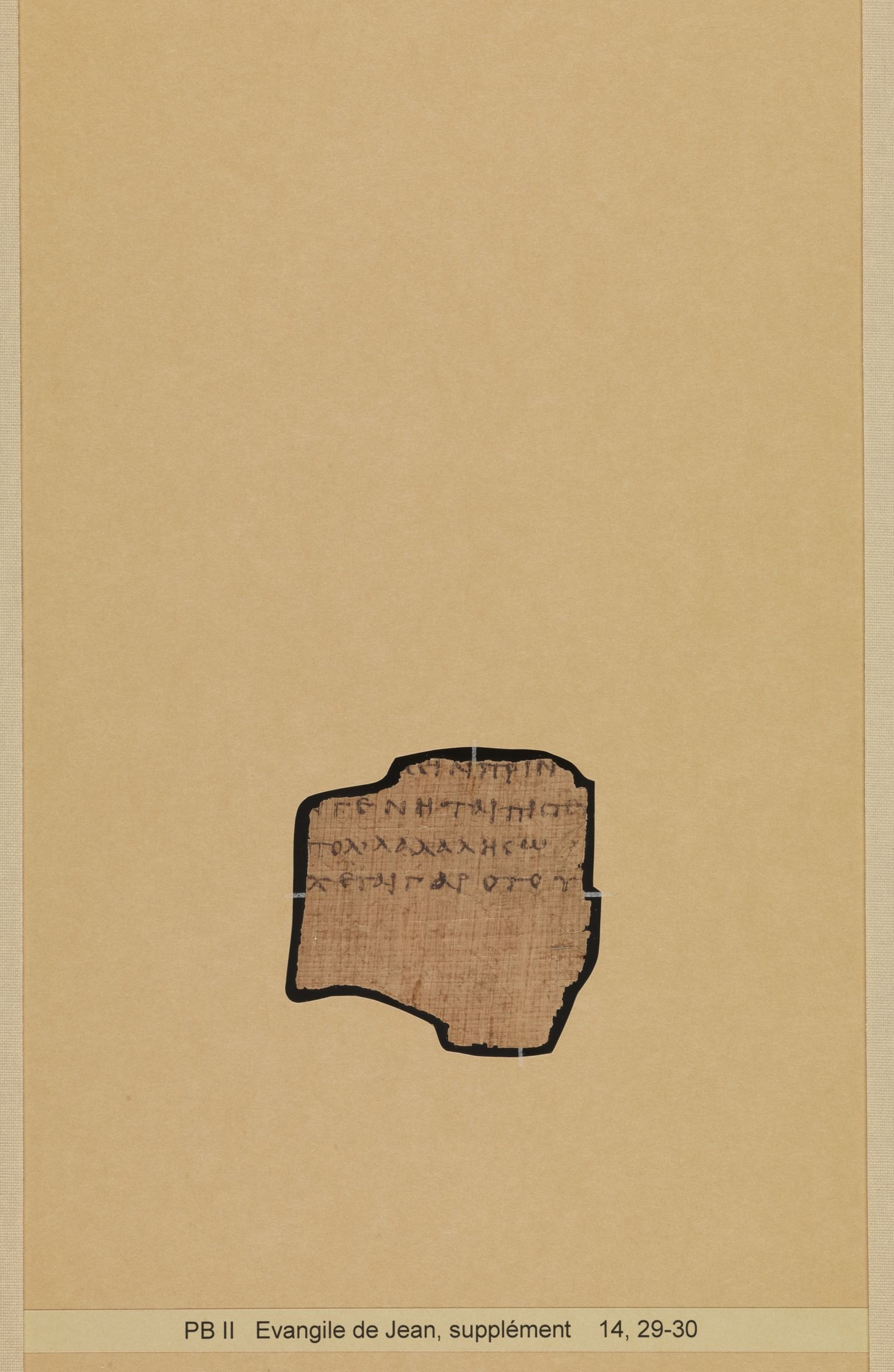
Where on the image
Fondation Martin Bodmer, Papyrus Bodmer II, Bodmer Lab image 1072205287_113 (https://bodmerlab.unige.ch/fr/constellations/papyri/mirador/1072205287), colour photograph of the glass-mounted leaf, shown whole. NTVMR page 1050 (page 109) is linked to this image in NTVMR's page index. 14:29 begins on the previous page; 14:30 continues on the next page. Checked on the image: the printed caption reads ‹PB II Evangile de Jean, supplément 14, 29-30›.
14:29 [ειρηκα υ]μ̣ειν πριν [γενεσθαι]
[ινα οτα]ν̣ γενηται πιστευ̣[σητε]
30 [ουκετι] πολλα λαλησω μ̣[εθ υ]
[μων ερ]χεται γαρ ο του [κοσμου]
14:29And now I have told you before it come to pass, that, when it is come to pass, ye might believe. 30Hereafter I will not talk much with you: for the prince of this world cometh, and hath nothing in me.
Notes
- Greek: the NTVMR diplomatic transcription, line by line as on the papyrus. Square brackets enclose letters that are lost or illegible and were supplied by the transcribers; a dot under a letter marks it as uncertain; [...] marks a gap. Nomina sacra and numerals keep the scribe's overline. Spelling is the scribe's (no accents or breathings). Words broken at a line end stay broken as on the papyrus. Corrections are not shown: the text is the first hand.
- English: the King James Version (1611), whole verses, for every verse that has text on the page. A verse that begins on one page and ends on the next is given in full on both. The KJV translates a later form of the Greek text, so its wording does not always match the papyrus; material differences (such as verses the papyrus does not have) are noted in the section.
Cite
Sources
- Source: Papyrus Bodmer II (P66), Fondation Martin Bodmer: images from the Bodmer Lab, University of Geneva; Greek from the INTF NTVMR transcription of P66; English from the King James Version (holding institution)
- Critical edition: INTF NTVMR diplomatic transcription (CC BY 4.0)
← previous · → next · v cycle view · l back to library